
Stella Ifeyinwa Anumnu

Governing Artificial Intelligence for Academic Renewal in Nigerian Higher Education

NEW YORK CENTER FOR ADVANCED RESEARCH (NYCAR)

Strategy, Teaching Quality, Research Integrity, and Institutional Trust

Doctoral Research Publication by Stella Ifeyinwa Anumnu

Institutional Affiliation: New York Center for Advanced Research (NYCAR)

Date: June 2026

Publication No.: NYCAR-TTR-2026-RP063

DOI: https://doi.org/10.5281/zenodo.20357802


© June 2026 Stella Ifeyinwa Anumnu. All rights reserved. Charts, tables, and editorial presentation prepared for this publication. No part of this publication may be reproduced without proper attribution to the author and institution.


Abstract

Artificial intelligence has entered Nigerian higher education through the side door. It is already in students’ phones, lecturers’ drafts, postgraduate literature searches, coding exercises, translation work, slide preparation, plagiarism anxieties, and administrative shortcuts. Many universities are still discussing AI as if it were a future policy choice, but the real situation is less tidy: use has begun before most institutions have settled the academic rules, trained staff, protected student data, redesigned assessment, or decided where human judgment must remain final.

This study examines that problem from the standpoint of university responsibility. Nigerian higher education does not need AI enthusiasm for its own sake. It needs a disciplined way to decide where AI can improve teaching, research, access, feedback, administration, and national skills development without weakening the degree, exposing students, deepening inequality, or turning academic work into machine-assisted imitation. The paper reads Nigerian policy and institutional evidence alongside international guidance on AI risk, education, data protection, and quality assurance. National AI ambition, digital learning policy, CCMAS curriculum reform, JAMB’s data-supported admissions system, NOUN’s distance-learning experience, TETFund’s TERAS platform, 3MTT, the Nigeria Data Protection Act, UNESCO guidance, NIST risk-management work, ISO/IEC 42001, and connectivity evidence are treated as signals of direction, not proof that campus practice is already mature.

The paper proposes the AI Higher Education Readiness and Safeguards Score as a planning instrument for universities. Its purpose is not to rank institutions or produce false precision. It helps leaders examine eight areas that now decide whether AI use is responsible: governance authority, faculty preparation, data protection and infrastructure, assessment integrity, research capacity, equity and access, quality assurance evidence, and procurement control.

The argument is direct. Nigerian universities should adopt AI where it strengthens learning and research. They should resist it where it replaces authorship, hides weak teaching, exploits student data, rewards privilege, or places academic authority in the hands of vendors. The future question is not whether AI belongs in the university. It is whether Nigerian universities can make AI serve the university’s academic mission rather than the other way around.

Keywords: artificial intelligence; Nigerian higher education; AI governance; digital learning; academic integrity; data protection; research ethics; curriculum reform; faculty development; AI-HERS.


Contents


List of Tables

Table 1. Nigerian case-study evidence and strategic management lesson.

Table 2. AI governance responsibilities by institutional level.

Table 3. Faculty development program for AI-ready teaching.

Table 4. Assessment redesign options for the AI period.

Table 5. Research integrity and ethics safeguards for AI-assisted work.

Table 6. AI-HERS variables and scoring test.

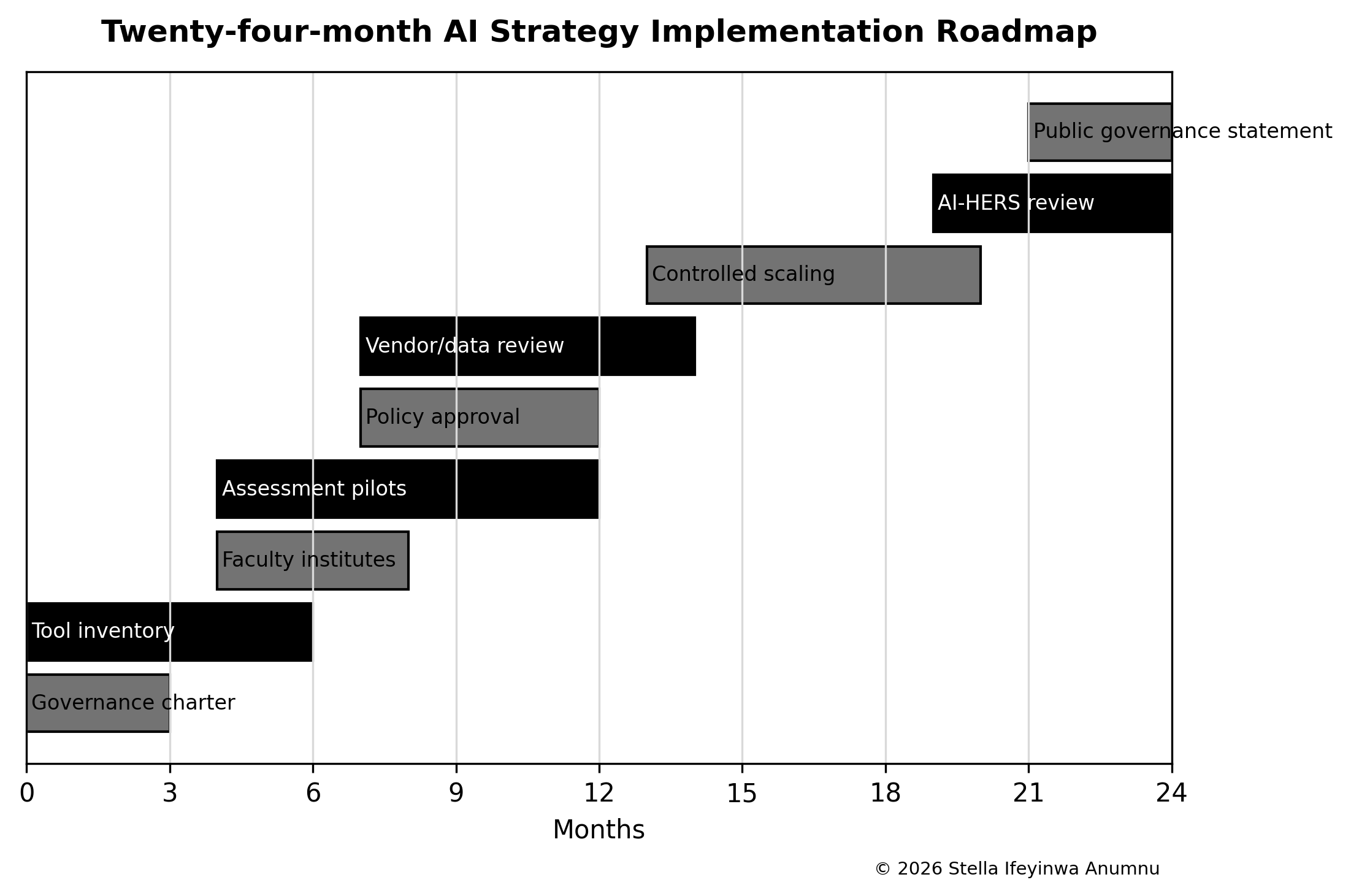
Table 7. Twenty-four-month implementation sequence.

Table 8. AI tool register and approval evidence.

Table 9. Operational controls by university function.

Table 10. Future empirical evidence agenda for Nigerian AI governance.


List of Figures

Figure 1. AI governance priorities for Nigerian universities.

Figure 2. Nigerian case-study relevance matrix.

Figure 3. Readiness movement after governed AI adoption.

Figure 4. Balanced AI capacity profile.

Figure 5. AI use-case benefit and governance risk matrix.

Figure 6. Research-to-practice AI translation funnel.

Figure 7. Twenty-four-month AI strategy implementation roadmap.

Chapter 1: Introduction: AI as Academic Strategy, Not Institutional Fashion

1.1 The question Nigerian universities cannot postpone

The first mistake in discussing artificial intelligence in Nigerian higher education is to treat it as a future arrival. It has already entered the classroom. Students use it to turn dense readings into plain notes, to test code, to translate difficult passages, to draft study plans, and to rehearse answers before examinations. Lecturers use it, sometimes quietly, to prepare examples, simplify explanations, summarize articles, translate material, and reduce administrative burden. Research students test it for literature mapping and early coding. Registry, admission, library, and ICT units already handle large volumes of data that invite automation. The real question is not whether AI will come into the university. The question is whether the university will govern what has already entered.

That question is particularly serious in Nigeria because higher education carries expectations that are larger than the resources available to meet them. Families see the university as a route to livelihood and dignity. Employers want graduates who can reason, communicate, work with data, and learn quickly. Government expects universities to support national development, technological capacity, teacher preparation, professional formation, and social mobility. Academic staff are asked to maintain standards under pressure from growing enrolment, funding constraints, industrial disputes, weak infrastructure, uneven digital access, and heavy marking loads. AI arrives in that stressed system as both assistance and temptation.

A tool that helps a lecturer give faster feedback can improve learning. The same tool, poorly governed, can turn grading into unexamined automation. A chatbot that helps a student understand a concept can widen access. The same chatbot can become an undisclosed substitute for study. An AI search tool can help a postgraduate student discover relevant literature. The same tool can fabricate citations and mislead a weak supervisor. The strategic issue is therefore not technology itself. It is academic judgment under new conditions.

The correct starting point is not celebration or panic. It is responsibility. Nigerian universities need a framework that protects academic purpose while admitting that AI can support it. The institution that bans AI entirely may push use underground and widen inequality, because students with better access will continue to use tools privately. The institution that welcomes AI without rules may weaken intellectual formation, privacy, and trust. The better path is governed adoption: clear policy, trained lecturers, redesigned assessment, protected student data, ethical research use, procurement control, and public reporting.

1.2 Strategic higher education in the AI period

Strategic higher education is not a slogan for modernization. It concerns the long-term capacity of an institution to teach well, create knowledge, preserve standards, serve society, and prepare graduates for changing work. It asks what an institution can do repeatedly, ethically, and with evidence. AI becomes strategic only when it changes those capacities in a controlled manner. A university that purchases tools but leaves lecturers untrained has not become strategic. A university that issues policy but cannot monitor practice has not become strategic. A university that uses AI to attract attention while students cannot access basic connectivity has confused public relations with academic reform.

Nigeria’s policy direction gives universities a basis for action. The National Digital Learning Policy recognizes the place of AI, digital content, platforms, e-safety, and learning support in education (Federal Ministry of Education, 2023). Nigeria’s National Artificial Intelligence Strategy places education within a wider ambition to build local capability, competitiveness, and responsible innovation (Federal Ministry of Communications, Innovation and Digital Economy & National Information Technology Development Agency, 2025). The NUC’s CCMAS reform signals a curriculum system expected to reflect new knowledge and professional realities (National Universities Commission, 2023, 2024). JAMB’s CAPS shows that data-supported decision systems are already part of tertiary admission administration (Joint Admissions and Matriculation Board, n.d.). These instruments do not solve university practice, but they make inaction less defensible.

The strategic work sits between policy and the classroom. A vice chancellor may speak about AI readiness, but the decisive work occurs in departmental boards, libraries, ICT units, quality assurance offices, research committees, and examination rooms. Does the syllabus tell students what AI use is permitted? Does the assessment measure independent understanding? Does the ethics committee know how to review AI-assisted transcription or coding? Does the procurement office know whether a vendor can reuse student data? Does the library teach source verification in an AI period? These ordinary questions decide whether strategy has entered practice.

This paper treats AI as an institutional test. The university that responds well will not simply become more digital. It will become more explicit about its standards. It will say what counts as learning, how evidence is checked, where human authority remains, how students are protected, and how innovation will be evaluated. That is the heart of the argument.
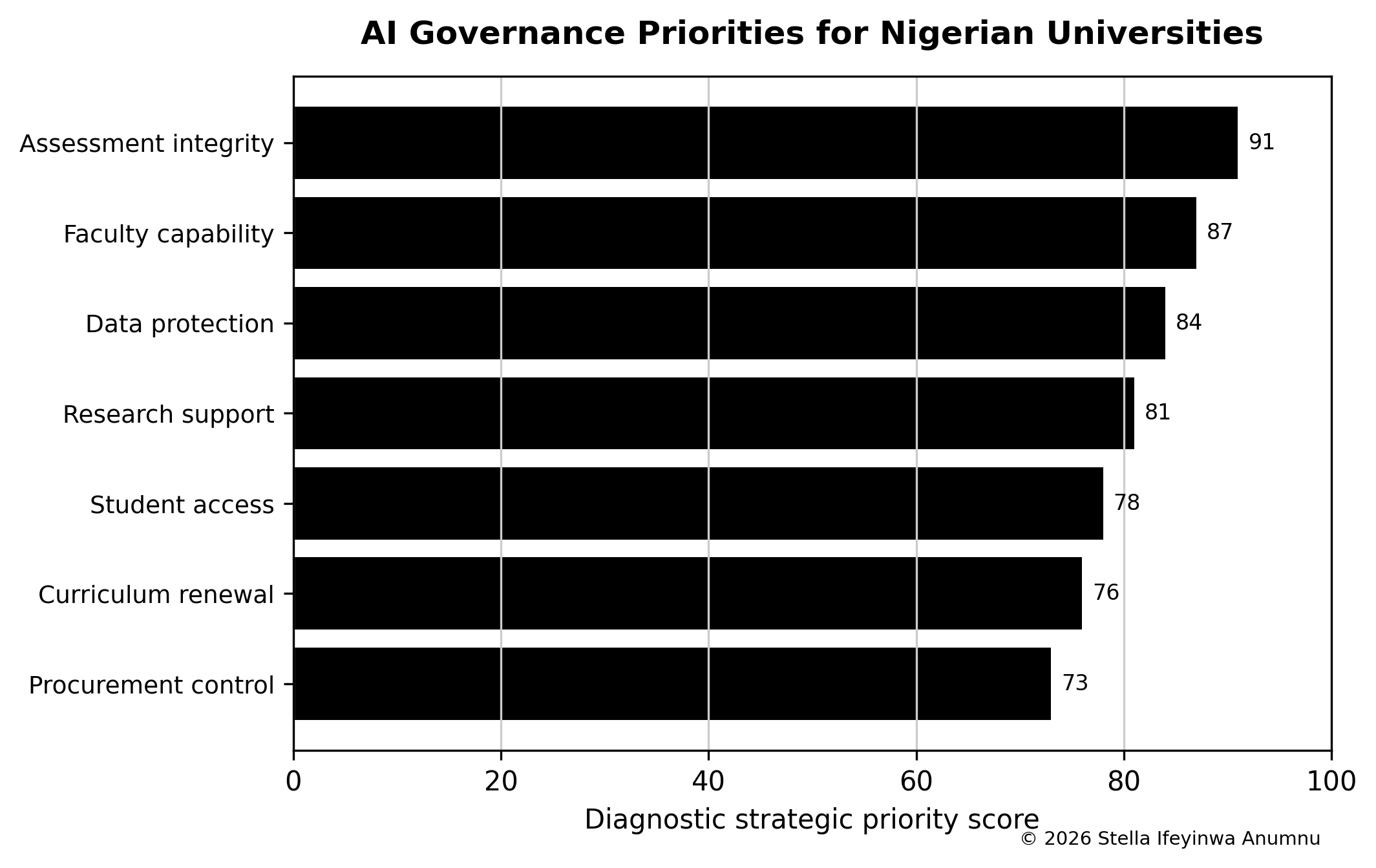
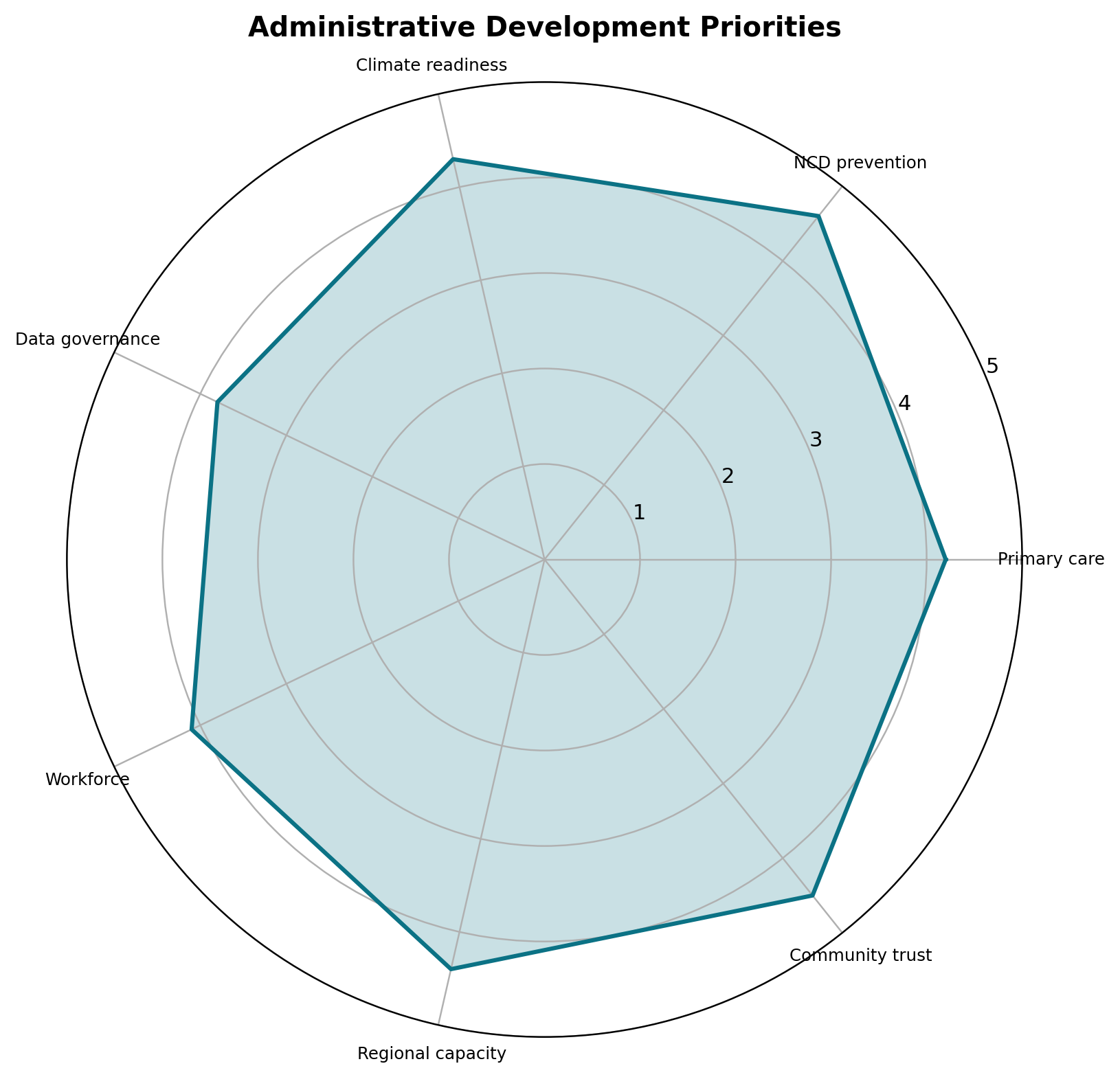
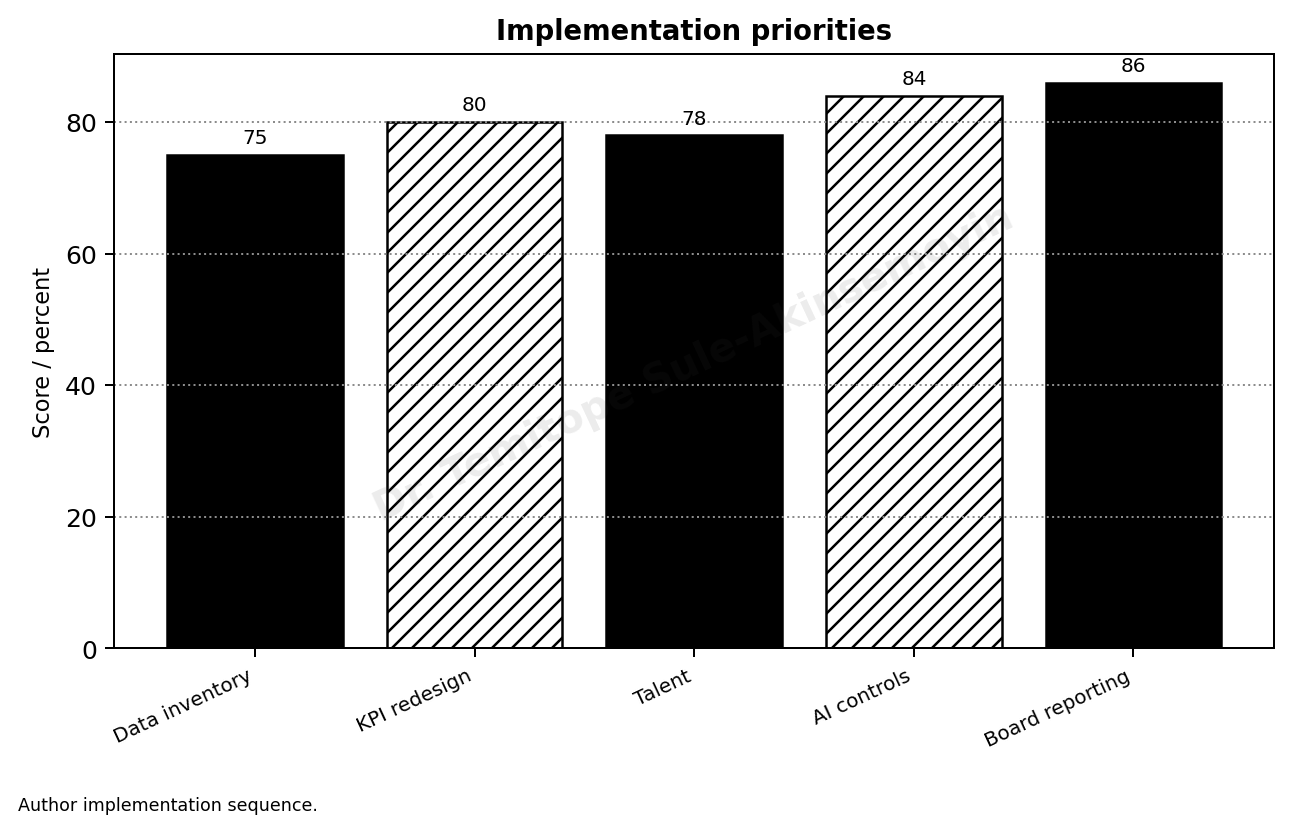
Figure 1. AI governance priorities for Nigerian universities.

Note. Diagnostic priority scores are author-created planning scores on a 0-100 scale. They synthesize the governance concerns raised by Nigerian policy sources, data-protection law, UNESCO guidance, NIST risk-management guidance, ISO/IEC 42001, and the institutional cases reviewed in this paper. They are not official national survey results.


1.3 Aim, questions, and contribution

The aim of this research publication is to develop a doctoral-level strategic governance framework for AI adoption in Nigerian higher education. The framework is designed for university leadership, faculty boards, quality assurance units, regulators, ICT teams, research committees, student affairs offices, and policy partners. It does not offer a technical manual for AI engineering. It offers a management and academic governance model that can help institutions make better decisions before informal practice hardens into unmanaged habit.

The study asks five questions. How should Nigerian universities define responsible AI use in teaching, assessment, research, and administration? What do current Nigerian case studies reveal about readiness, risk, and institutional opportunity? How can AI support academic quality without weakening integrity and independent judgment? What safeguards are needed for data protection, procurement, equity, and research ethics? How can readiness be assessed through a simple model that is useful to managers without pretending to replace professional judgment?

The contribution is practical as well as scholarly. The paper gives Nigerian higher education leaders a language for moving beyond tool excitement. It connects AI strategy to faculty workload, student access, curriculum reform, research credibility, data protection, and institutional trust. It also develops a stratified readiness model that can be debated, revised, and applied locally. The model is deliberately transparent because universities should be able to see how governance judgments are made. A black-box score for AI readiness would contradict the very values this paper defends.

1.4 Method, scope, and evidence discipline

The method of this publication is documentary, interpretive, and applied. It does not pretend that public documents can answer every question about university practice. They cannot. A policy text may state ambition, a platform may show institutional direction, and an international framework may clarify risk, but none of those sources can prove what happens in every classroom, laboratory, examination office, or postgraduate seminar. The value of documentary research lies in disciplined reading: identifying what the public record establishes, what it suggests, and where it stops.

For that reason, the paper uses Nigerian public cases as governance evidence rather than implementation proof. The National AI Strategy is evidence of national direction. The National Digital Learning Policy is evidence of official education-sector framing. CCMAS is evidence of curriculum reform space. JAMB CAPS is evidence that high-stakes tertiary decisions already depend on centralized data systems. NOUN is evidence of long-standing open and distance learning experience. TERAS is evidence of a tertiary services platform that may influence research administration and institutional coordination. 3MTT is evidence of a national digital skills agenda. Each source matters, but each must be read within its limits.

This evidence discipline also explains the treatment of figures in the paper. The charts are not borrowed from national datasets and should not be cited as official measurements. They are diagnostic planning visuals produced from the documentary analysis and the governance model developed here. Their purpose is to make institutional questions visible. A university that applies the model should replace the diagnostic scores with its own evidence: policy records, course redesign samples, student access data, ethics forms, tool registers, vendor contracts, complaints, and annual quality assurance reports.

The paper is therefore strongest when read as a practical governance study. It offers university leaders a way to think, not a claim that one formula can govern every institution. Nigerian higher education is too diverse for that. Federal, state, private, open, faith-based, specialized, and professional institutions face different constraints. The common requirement is not uniformity. The common requirement is responsibility.

1.5 What publication-ready governance requires

Publication-ready governance requires the paper to state its limits as clearly as it states its argument. The analysis can show why AI governance is urgent, how Nigerian public cases frame the issue, and what universities should build in response. It cannot claim that every university has implemented these safeguards. It cannot claim that one diagnostic score captures the full complexity of institutional life. It cannot replace legal advice, accreditation review, or institutional evidence. This restraint is not weakness. It is the difference between serious research and confident speculation.

The central question is practical: how can a university adopt AI without lowering the standard of the degree, exposing student data, widening inequality, weakening research integrity, or surrendering academic judgment to platforms? Every chapter returns to that question from a different angle. The answer is cumulative. It requires policy, but not policy alone; faculty development, but not workshops alone; assessment redesign, but not suspicion alone; data protection, but not legal language alone; and innovation, but not publicity alone.

Read also: Philosophy, Learning, and National Renewal: A Paradigm Shift for Nigerian Education

Chapter 2: Nigeria’s Higher Education Setting and the Readiness Gap

2.1 Expansion, pressure, and uneven capacity

Nigeria’s higher education system carries the weight of national aspiration. Demand for university places remains high, while public resources, staff strength, laboratories, libraries, accommodation, connectivity, and research funding remain uneven across institutions. The pressures are familiar to lecturers and students: large classes, delayed feedback, examination congestion, weak laboratory access, poor bandwidth, inconsistent electricity, administrative bottlenecks, and research supervision loads that stretch academic patience. AI does not remove these pressures. It enters them.

That entry matters because AI tools tend to magnify the condition into which they are introduced. Where a university has clear academic rules, trained staff, reliable data governance, and a serious culture of feedback, AI can strengthen existing capacity. Where a university has weak oversight, low trust, and poor access, AI can make the gap wider. Some students will use paid tools and private devices while others struggle with data bundles. Some lecturers will redesign assignments while others will continue with old questions that are easy to outsource to a machine. Some faculties will learn quickly; others will wait for national instruction.

Strategic planning must begin with that unevenness. Nigerian universities should not adopt AI as if all institutions start from the same place. A federal university with stronger ICT support, a private university with smaller classes, an open university with online systems, and a state university with severe funding constraints face different choices. A national framework can set principles, but local implementation has to begin with an honest inventory. What tools are already being used? Which students lack access? Which departments are most exposed to academic-integrity problems? Which data systems are already automated? What faculty development has occurred? Without these answers, AI policy becomes ceremonial.

The readiness gap is not an argument against AI. It is an argument against careless adoption. In a country with serious development needs, universities cannot afford to ignore a technology that may improve teaching support, research discovery, administrative planning, and workforce preparation. They also cannot afford to adopt it in a way that rewards privilege, weakens standards, and creates legal exposure.

2.2 Digital inequality as a core academic issue

Digital inequality is often discussed as infrastructure, but inside a university it becomes an academic matter. A student with a laptop, steady power, private study space, and reliable internet is not experiencing the same learning conditions as a student using a shared phone, unstable electricity, and expensive mobile data. When AI tools are added to learning, the difference becomes sharper. The better-equipped student can test explanations, receive instant feedback, improve drafts, translate materials, and practice questions. The poorly connected student may be left with policy language about innovation and no practical access to it.

DataReportal’s 2025 estimate that Nigeria had 107 million internet users at the start of 2025, representing 45.4 percent penetration, shows both scale and limitation (DataReportal, 2025). The country has a large online population, but access is not universal. Penetration figures also do not tell the whole story. A learner may be counted within internet reach and still lack stable bandwidth for sustained academic use. Connectivity may exist but be too expensive. A device may be available but not suitable for research writing, coding, statistical analysis, design work, or long reading. The university that treats connection as a yes-or-no question will misread student reality.

A publication-ready AI strategy in Nigerian higher education must therefore include access design. The minimum package should include campus learning hubs, device-support schemes, low-bandwidth materials, offline resources where possible, library-led digital literacy, assistive technologies, and clear alternatives when AI use is assigned. Faculty should be warned against requiring paid tools unless the institution provides access. Departments should not make AI use a hidden requirement through assignments that assume unrestricted digital access. Equity must be built into course design, not added after complaints.

This is not charity. It is quality assurance. If access differs sharply, assessment outcomes will no longer measure learning alone. They will measure private access to tools. A university that ignores this will lose the moral basis for its own grading system.

2.3 Curriculum reform and professional relevance

The NUC’s CCMAS reform is relevant because AI will not remain inside computer science departments (National Universities Commission, 2023, 2024). It affects education, medicine, law, management, engineering, communication, agriculture, public administration, environmental studies, and the arts. Every discipline will need to ask what its graduates should know about AI, data, evidence, ethics, and professional judgment. A lawyer who cannot understand AI-generated evidence will be less prepared for practice. A teacher who cannot guide learners through AI-supported study will be less effective. A journalist who cannot verify synthetic media will be exposed. A nurse manager who cannot read AI-supported risk data will be disadvantaged.

CCMAS provides an opening for universities to use the thirty percent institutional discretion in ways that reflect local mission and new knowledge. That space should not be filled casually. Institutions can design AI literacy modules, discipline-specific AI ethics, data reasoning, prompt critique, human-machine decision limits, digital research methods, and capstone projects linked to Nigerian problems. The aim is not to make every student a programmer. The aim is to prepare graduates who can use AI critically within their professional fields.

Professional bodies should be involved. AI competence in accounting differs from AI competence in medicine, journalism, engineering, education, or law. Universities that design AI curriculum without consultation may produce generic modules that satisfy a committee but fail in practice. The better approach is layered: a university-wide foundation in AI literacy and ethics, faculty-level modules for discipline-specific use, and program-level assessment that requires students to show judgment, not only tool familiarity.

Nigerian higher education has a chance to avoid a common error: teaching students how to use tools before teaching them how to question outputs. AI literacy without epistemic discipline is dangerous. Graduates must know how to ask where an answer came from, what source supports it, what bias may be present, what data was used, what uncertainty remains, and when human expertise must override machine suggestion.

2.4 Readiness audit before procurement

A Nigerian university that wants to use AI seriously should complete a readiness audit before procurement begins. The audit should be plain enough for deans, heads of department, librarians, ICT officers, and student representatives to understand. It should ask what digital systems already exist, what data they hold, what courses already permit informal AI use, what lecturers need for assessment redesign, which students lack reliable devices, and which offices have authority to approve tools. This is not a bureaucratic exercise. It is the moment when an institution discovers whether AI adoption will strengthen academic work or simply add another unmanaged layer to an already stretched system.

The audit should also separate infrastructure readiness from academic readiness. A campus may have a learning management system and still lack a culture of feedback. It may have computer laboratories and still lack meaningful student access after lectures. It may have an ICT directorate and still have no data-protection review of vendor platforms. Academic readiness means that lecturers know how to teach with AI without surrendering teaching, students know what they may disclose, ethics committees can review AI-assisted research, and examination boards can evaluate whether assessment still proves learning. Technology readiness without these academic controls is not readiness; it is exposure.

A strong readiness audit produces a small number of visible decisions. The university may decide that no high-stakes grading tool will be deployed in the first year. It may approve AI for formative feedback but not for final marks. It may require each faculty to identify three assessment types that need redesign. It may discover that student access hubs are more urgent than a campus-wide chatbot. These decisions are valuable because they reduce waste. In a resource-constrained environment, the best AI strategy may begin by declining the wrong tools.

2.5 Access as a condition of academic fairness

Access must be treated as part of academic fairness, not as a welfare issue outside the classroom. When one group of students can use paid AI tools, stable internet, private devices, and constant electricity while another group works from a shared phone, the assessment environment is no longer equal. The problem is not solved by telling students to be innovative. A university that assigns AI-supported work has a duty to provide realistic access, publish alternatives, or design tasks that do not punish students for poverty. In Nigerian higher education, this point is central because digital inequality can easily be mistaken for student weakness.

A practical equity policy should identify low-bandwidth options, campus access points, library support hours, disability accommodations, and acceptable no-AI alternatives. It should also warn lecturers against making paid tools a hidden requirement. If AI use is optional, the alternative should carry equal academic value. If AI use is required, the institution should provide access. The rule is simple but demanding: innovation cannot be used to transfer institutional cost to students who are least able to bear it.

Chapter 3: Governance, Law, Ethics, and Institutional Authority

3.1 Why AI governance belongs inside university management

AI governance in a university should not be left to the ICT unit alone. ICT staff are essential, but the deepest questions are academic, legal, ethical, and managerial. Who is allowed to use AI in grading? How should students disclose assistance? What data may be entered into external tools? Can an AI system support admissions or advising? What counts as misconduct? What role should libraries play in source verification? Which office reviews vendor contracts? Who reports failures to the senate or governing council? These questions cross the institution.

A credible governance structure should include academic leadership, legal counsel or compliance officers, data protection personnel, ICT staff, librarians, research ethics representatives, student affairs, quality assurance, disability support, and faculty representatives. The structure must have authority, not only advisory language. It should approve institutional policy, maintain a tool register, review high-risk deployments, set disclosure expectations, coordinate training, and report annually on implementation. In larger universities, each faculty can adapt the university policy to local discipline needs, but the core principles should remain common.

The governance rule should be plain: no AI system should make or materially influence a high-stakes academic decision without human accountability and documented review. Admissions, grades, disciplinary action, research conclusions, scholarship awards, academic probation, and student-support interventions carry consequences for real lives. AI may support decision-making, but it should not become an invisible authority. Students and staff should know when AI is used and how to challenge or correct errors.

This is where strategic management meets ethics. Good governance does not slow adoption for its own sake. It prevents confusion from becoming scandal. It gives innovation a safe route. It protects the institution’s reputation and, more importantly, the people whose data, learning, and futures are affected.

Table 2. AI governance responsibilities by institutional level.

Level Primary responsibility Evidence of performance
Governing council Approve risk appetite, demand annual AI governance reporting, protect institutional independence. Annual report, approved policy, reviewed risk register.
Senate Set academic policy for assessment, curriculum, research integrity, and student disclosure. Approved academic rules and faculty implementation reports.
Faculty boards Adapt policy to disciplines and supervise assessment redesign. Revised syllabi, assessment samples, staff training records.
ICT directorate Maintain tool inventory, security controls, integration standards, and approved-tool list. Tool register, access logs, incident reports.
Library Lead information literacy, source verification, citation integrity, and AI research support. Training records, verification guides, research clinics.
Research ethics committee Review AI-assisted research methods, sensitive data use, and disclosure. Ethics addendum, approved protocols, compliance checks.
Student affairs Monitor student access, disability support, advising risks, and complaint channels. Access reports, advising records, complaints resolved.


3.2 Data protection and student dignity

The Nigeria Data Protection Act of 2023 gives AI adoption in higher education a legal seriousness that many institutions still underestimate (Federal Republic of Nigeria, 2023). Universities process personal data at scale: admission records, grades, financial information, health disclosures, disciplinary files, biometric data, learning analytics, library use, accommodation records, and sometimes disability or counseling information. AI systems can make those data more useful, but they can also make exposure more damaging. A university that uploads sensitive student information into a poorly governed vendor tool may create risk that is larger than the immediate academic benefit.

Data protection should begin with purpose. What data is needed? Why is it needed? How long will it be kept? Who will access it? Will it leave Nigeria? Will the vendor use it to train models? Can students opt out? What happens if the system produces a wrong recommendation? These questions are not technical irritation. They are the minimum discipline of lawful and respectful administration. A university exists to form human beings, not to convert them into profiles without explanation.

Learning analytics deserves special caution. It can identify students who need support. It can also label students unfairly. A student who misses platform activity may be struggling with connectivity, work obligations, illness, caregiving, insecurity, or disability. If an AI system treats inactivity as laziness or risk without human context, it will harm the student it claims to help. Human advising must remain central. The system can flag concern; it should not close the file.

Student dignity should be the test. Data practices that a university would be ashamed to explain publicly should not be normalized privately. Consent notices should be clear. Data access should be limited. Vendor contracts should be reviewed. Sensitive data should not be placed in public tools. Breach response should be planned before a breach occurs.

3.3 Ethical use, transparency, and academic agency

UNESCO’s guidance on generative AI in education and research emphasizes human agency, privacy, equity, and appropriate regulation (UNESCO, 2023). Those principles are useful for Nigerian universities because they help move the debate away from tool fascination. AI can assist learning, but it cannot carry the moral responsibility of education. A lecturer remains responsible for what is taught. A supervisor remains responsible for research standards. A student remains responsible for submitted work. A university remains responsible for the systems it authorizes.

Transparency is therefore necessary. Syllabi should state how AI may be used. Research theses should include AI-use statements where tools assisted drafting, translation, transcription, coding, image generation, or data analysis. Administrative units should disclose when AI supports decisions that affect students. Faculty should not hide AI use from students while demanding disclosure from them. Institutional integrity requires a shared standard.

Academic agency also means that the university should teach students to use AI critically. Banning does not teach judgment. Unrestricted permission does not teach judgment either. Students should be required to compare AI outputs with primary sources, identify hallucinated citations, explain why they accepted or rejected a suggestion, and defend their own reasoning orally or in writing. The ability to challenge a machine answer may become one of the central literacies of higher education.

The ethical frame is not anti-technology. It is pro-education. A university that cannot explain how AI supports its educational purpose should not deploy it simply because other institutions are doing so.

3.4 Governance architecture for lawful academic AI

University AI governance needs a structure that is visible and answerable. The governing council should approve risk appetite and demand annual reporting. The senate should own academic rules. Faculties should adapt those rules to disciplines. ICT should maintain security and tool inventories. The data-protection officer or equivalent compliance function should review personal-data risks. Procurement should examine contract terms before academic units become dependent on a vendor. Research ethics committees should review AI-assisted methods where participants, sensitive records, or automated interpretation are involved. None of these offices can manage the issue alone.

The structure should also define escalation. A routine classroom tool may need departmental approval. A research tool processing anonymized text may need ethics notification. A tool handling student records, admissions analytics, grading support, disability data, or disciplinary evidence should require higher review. The risk level should determine the approval route. This type of architecture is consistent with risk-management thinking in NIST guidance and with the management-system discipline reflected in ISO/IEC 42001, although Nigerian universities must translate those frameworks into their own legal and academic setting (National Institute of Standards and Technology, 2023, 2024; International Organization for Standardization, 2023).

The most important governance habit is documentation. If a tool is approved, the reason should be recorded. If a tool is rejected, the risk should be recorded. If a pilot fails, the lesson should be recorded. Records protect the university from repeating old mistakes and from relying on memory when officers change. They also protect innovators, because a documented approval process gives staff a lawful route for experimentation rather than forcing them into private trial and error.

3.5 Procurement discipline and institutional independence

Procurement is now part of academic governance. A vendor that handles learning analytics, proctoring, writing support, admissions communication, or research data is not only selling software. It is touching the academic life of the institution. Contracts should therefore answer questions that matter to universities: whether student data will be used for model training, where records will be stored, how long data will be retained, whether the university can export its records, how errors can be corrected, what happens after termination, and whether the tool can function under local bandwidth constraints.

Institutional independence is also at stake. When a platform quietly shapes feedback, assessment, curriculum resources, and student support, the vendor begins to influence academic judgment. That influence may be useful when governed, but it is dangerous when hidden. The university should remain the authority over curriculum, standards, degrees, and student rights. Technology partners may support that authority; they should not replace it.

3.6 Data protection by design in academic systems

Data protection by design means that privacy is considered before a tool is adopted, not after a complaint. Universities should classify the data they hold, identify sensitive categories, limit access, document lawful purpose, and prevent staff from entering confidential information into public systems. Student records, disability accommodations, counseling notes, disciplinary files, health disclosures, biometric records, and unpublished research data require stronger protection than ordinary course announcements. This hierarchy should be understood by academic staff, not only by ICT officers.

The safest practice is to write simple internal rules that staff can actually follow. A lecturer should know that identifiable student submissions should not be uploaded to an external AI tool unless the institution has approved that use. A supervisor should know that interview transcripts require ethics and data review before automated coding. An administrator should know that advising analytics cannot be used to label students without human explanation. Data-protection training should therefore be practical, local, and repeated. Legal language alone will not change behavior.

Universities should also plan for correction and breach response. If an AI-supported system produces an inaccurate recommendation, the student or staff member should know how to challenge it. If a vendor exposes data, the institution should know who investigates, who communicates, and what records are preserved. A breach plan written after a breach is already too late. In academic settings, privacy failures are not only legal incidents. They are failures of institutional care.

Chapter 4: Teaching, Learning, and Assessment in an AI-Saturated Classroom

4.1 Teaching with AI without surrendering teaching

AI can assist teaching in practical ways. It can generate examples at different levels of difficulty, suggest formative questions, translate concepts into simpler language, create practice quizzes, support accessibility, summarize long readings, and help lecturers design activities for large classes. In Nigerian universities where class sizes and workload can be heavy, these uses deserve attention. They may help lecturers spend more time on explanation, discussion, supervision, and feedback rather than routine preparation. The problem begins when assistance becomes substitution.

Teaching is not content delivery alone. It is the formation of judgment, discipline, patience, and intellectual responsibility. A lecturer who copies AI-generated notes without checking them is not teaching well. A department that replaces office hours with chatbot responses has misunderstood student support. A faculty that treats AI-generated slides as curriculum renewal has confused output with learning. Good teaching in the AI period should become more deliberate, not less. Lecturers should ask what learners must struggle through themselves, what can be supported by tools, and how understanding will be tested.

Faculty development is the hinge. Many lecturers are not opposed to AI; they are underprepared and overloaded. They need practical workshops inside their disciplines, not generic demonstrations. An education lecturer needs to know how AI changes lesson planning and assessment. A law lecturer needs to handle source authority and legal reasoning. A medical lecturer needs to address patient safety and unreliable outputs. A management lecturer needs to teach data interpretation and ethical decision-making. A one-size training program will produce shallow compliance.

The library should be placed at the center of teaching support. Librarians understand source quality, search behavior, citation practice, and information literacy. In the AI period, libraries can teach students how to verify claims, trace evidence, identify fabricated sources, and use databases responsibly. This is an academic function, not a support afterthought.

4.2 Assessment redesign after generative AI

Assessment is the place where AI forces universities to be honest. Many traditional assignments can now be completed with extensive machine assistance. That does not mean essays, take-home tasks, problem sets, and projects are useless. It means their design must change. An assignment that asks for a generic explanation of a common topic may test access to a chatbot more than understanding. An assignment that requires local data, field observation, oral defense, draft history, source tables, reflective commentary, or application to a specific Nigerian problem is harder to outsource without learning.

Detection tools cannot carry the burden. They may produce false positives, especially against students who write in a second language or use translation support. They may also miss sophisticated AI-assisted work. A university that relies on detection alone will punish some students unfairly and give others false confidence. Assessment integrity should be built before submission. Students need clear rules. Lecturers need better prompts. Departments need oral defense, viva-style checks, in-class tasks, process evidence, and authentic projects where appropriate.

A practical assessment policy can divide tasks into categories. Some tasks may prohibit AI because the purpose is independent performance. Some may allow limited AI for brainstorming or language support with disclosure. Some may require AI use for critique, where students compare machine output with scholarly sources. Some may use AI as a professional simulation, especially in fields where graduates will encounter such tools at work. The important point is that the rule should match the learning outcome.

Nigerian universities should also protect students from confusion. The rules should not change quietly from lecturer to lecturer without explanation. Course guides should state permitted and prohibited uses. Departments should provide examples. Academic misconduct procedures should distinguish ignorance, poor disclosure, fabrication, and deliberate fraud. The aim is not to trap students. It is to teach responsible practice.

Table 4. Assessment redesign options for the AI period.

Assessment problem Better design response Integrity safeguard
Generic essay easily generated by AI Use local case application, source table, draft history, and oral explanation. Student defends method and evidence.
Undisclosed AI editing Permit language support with disclosure and evidence of student revision. Clear distinction between editing and authorship.
Large classes and delayed feedback Use AI-assisted formative feedback under lecturer review. Final grading remains human-controlled.
Weak literature review Require annotated bibliography from real databases and verification of citations. Fabricated references trigger review.
Coding or quantitative tasks Require explanation of steps, version history, and in-class problem variation. Student proves process knowledge.
Postgraduate proposal drafting Require research memo, supervisor discussion, and AI-use statement. Supervisor checks reasoning, not polish alone.


4.3 Student support, language, and inclusion

AI has real promise for student support. It can help learners practice writing, translate difficult material, generate study plans, explain mathematical steps, provide feedback on drafts, and support students who are shy about asking questions in crowded classrooms. For learners from weak secondary-school backgrounds, this may be valuable. For students with disabilities, language barriers, work obligations, or distance-learning constraints, AI may provide flexible assistance. That promise should not be dismissed because some students misuse the tools.

The problem is that support can become dependency. Students may begin to accept machine explanations without checking them. They may lose confidence in their own reading. They may submit polished work they cannot defend. They may learn prompt habits without acquiring disciplinary knowledge. The university should therefore teach students how to use AI as a tutor, not as a ghostwriter. The student should ask for explanation, examples, feedback, and challenge, but must still read, evaluate, revise, and own the final work.

Language support deserves careful handling. Many Nigerian students write in English while thinking through multiple languages and educational backgrounds. AI can improve expression, but it can also mask weak understanding. Lecturers should separate language correction from intellectual authorship. A student may be allowed to use AI to improve grammar if the student discloses use and can explain the argument. What should remain prohibited is the undisclosed generation of reasoning, evidence, or analysis that the student cannot defend.

Inclusion also means designing for low-resource use. If a course requires AI, the institution should provide access. If access cannot be provided, AI use should remain optional or alternative tasks should be available. Equity is not a decorative word. It is the condition under which academic standards remain fair.

4.4 Student authorship and the new discipline of proof

The AI period changes what it means for a student to prove authorship. Before generative systems became common, a polished essay could still be weak, but it usually signaled some level of reading, drafting, and revision. That assumption is no longer safe. A student may now submit work that is fluent, structured, and empty of genuine understanding. The answer is not to distrust every student. It is to ask for forms of proof that show thinking: source logs, draft trails, local examples, short oral explanations, annotated bibliographies, calculation steps, design notes, and reflective statements on tool use.

This discipline of proof should be taught early. First-year students should not discover AI rules only when accused of misconduct. They should learn how to use tools for explanation and practice, how to reject false information, how to cite real sources, how to disclose language assistance, and how to defend their own reasoning. The university should make academic integrity educational before it becomes disciplinary. That approach is fairer to students and stronger for standards.

Language support needs particular care. Many Nigerian students write in English while carrying different language histories and uneven secondary-school preparation. AI editing can help a student express a real idea more clearly. It can also replace the idea. The line between assistance and authorship should be explained through examples rather than slogans. A student may use a tool to correct grammar if the intellectual content remains theirs and disclosure is made where required. A student may not submit machine-generated argument, invented evidence, or analysis that cannot be defended. This is a higher standard than a simple ban, and it is more useful because it trains judgment.

4.5 Teaching large classes without reducing education to automation

Large classes make AI attractive because lecturers need faster ways to give feedback and manage learning. The attraction is legitimate. Formative quizzes, draft comments, reading prompts, and practice exercises can help students who would otherwise receive little individual attention. The safeguard is that automated support should not become the course itself. A lecturer still has to decide which concepts matter, which misconceptions are common, which local examples make sense, and which forms of feedback will move students forward.

Departments should therefore identify low-risk teaching uses first. A tool that helps generate practice questions may be easier to govern than a tool that recommends grades. A tool that helps students rehearse concepts may be safer than one that interprets disciplinary performance. Starting with lower-risk support allows staff to learn without placing degrees, records, or student futures under immature systems. This is the kind of modesty that serious reform often needs.

4.6 Moderation, feedback evidence, and examiner judgment

Assessment moderation becomes more important when AI assistance is uneven. Departments should compare samples across lecturers, check whether AI rules were stated clearly, and ask whether students were required to show process evidence. Moderation should include the assignment brief, marking rubric, source requirements, student disclosure statements, and any oral or in-class verification. This wider view is necessary because a polished submission no longer tells the examiner enough about how the work was produced.

Feedback evidence should also be reviewed. If AI-assisted formative feedback is used, the department should ask whether students received more useful comments, whether weak students improved, whether lecturers saved time, and whether final grading remained under human control. The evidence may show that a tool is useful for first drafts but weak for disciplinary critique. It may show that students need more instruction before automated comments help them. Such findings should shape policy. Good governance is not a one-time approval; it is a cycle of use, evidence, correction, and review.

Examiner judgment remains central. AI may support marking preparation, rubric design, or formative comments, but final academic judgment should belong to qualified staff. A degree is a public certification of learning. The public should be able to trust that human academics, not unseen systems, have judged whether the learner met the standard.

Chapter 5: Research Renewal, Postgraduate Supervision, and Knowledge Production

5.1 AI and the Nigerian research problem

Nigerian universities need stronger research capacity. Many scholars work with limited funding, restricted database access, heavy teaching loads, weak laboratory support, and uneven mentoring structures. Postgraduate students often struggle with topic clarity, literature review, methodology, data analysis, and publication writing. AI may help some of these problems, but it cannot repair the research culture by itself. Used well, it can reduce clerical burden and widen discovery. Used poorly, it can produce elegant nonsense.

The first responsible use is discovery support. AI tools can help researchers map concepts, identify related fields, draft search terms, summarize abstracts, translate material, and organize notes. These uses can be legitimate when researchers check outputs against actual sources. The danger is citation fabrication. A researcher who copies a plausible but nonexistent reference has not made a minor error; the researcher has broken the chain of evidence. Doctoral and master’s programs should teach AI-assisted literature review as a supervised skill, not leave it to informal experimentation.

AI can also support qualitative and quantitative analysis. It may help with transcription, coding suggestions, text classification, data cleaning, visualization, and statistical explanation. Each use needs method transparency. Researchers should disclose the tool, purpose, version where relevant, prompts or procedures when appropriate, validation steps, and human review. If AI assists coding interview data, the researcher must check the coding manually and explain reliability. If AI assists statistical interpretation, the researcher must verify the analysis. The machine cannot become a hidden method.

The Nigerian research opportunity is to use AI for problems that matter locally: agriculture, health systems, education quality, language technologies, public administration, climate adaptation, security studies, small business productivity, urban planning, and cultural preservation. Strategic higher education should not prepare universities to consume foreign tools only. It should position them to ask Nigerian research questions with better speed, evidence, and collaboration.
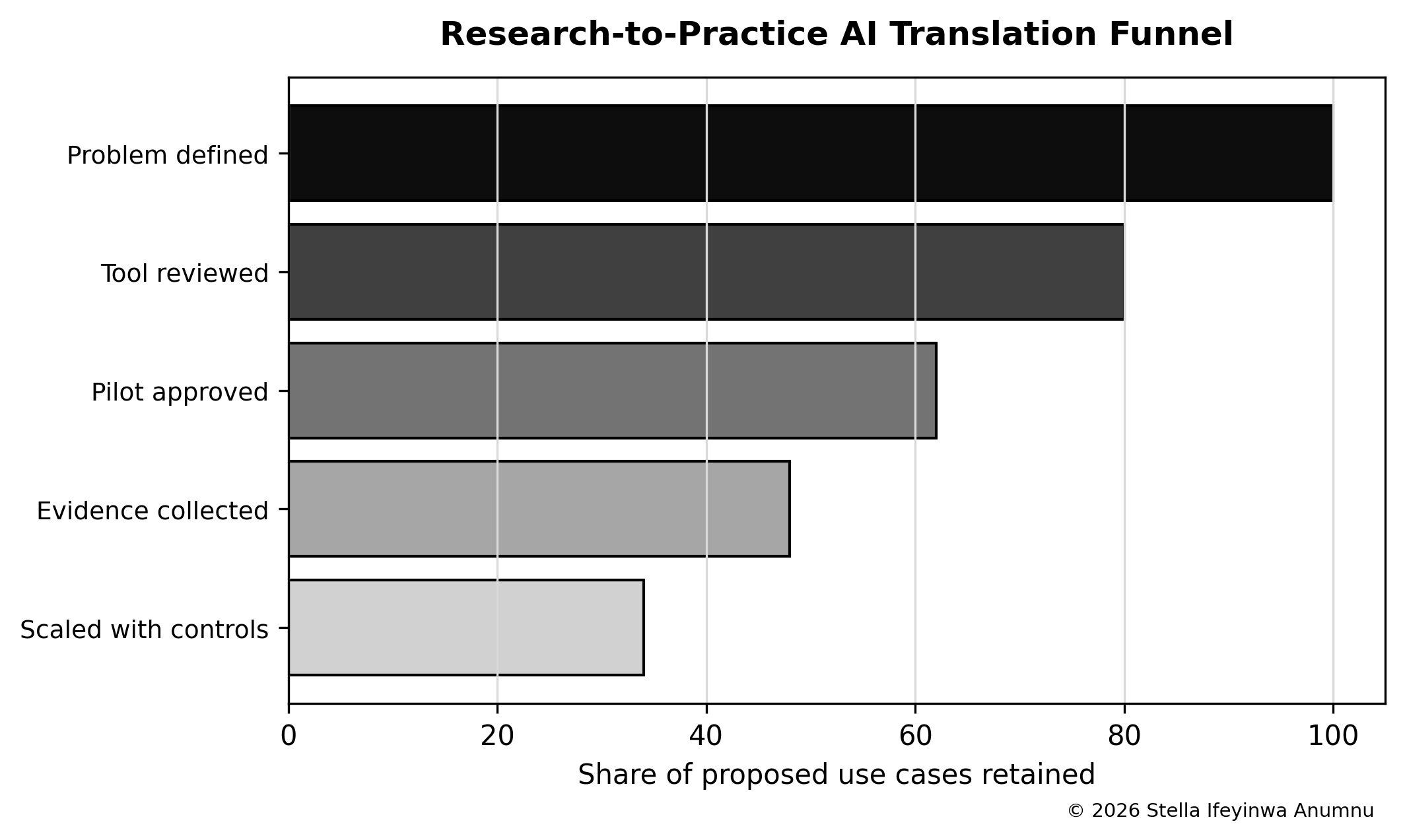
Figure 6. Research-to-practice AI translation funnel.

Note. The funnel illustrates a responsible sequence from problem definition to controlled scaling. The retained percentages are diagnostic planning values, not empirical measurements of Nigerian university projects.


5.2 Postgraduate supervision and research integrity

Postgraduate supervision may be one of the most affected areas. A student can now produce a proposal outline, literature summary, questionnaire draft, analysis plan, and polished chapter with AI assistance. Some of that assistance may be useful. Some may conceal weakness. Supervisors need new routines. They should ask students to bring reading logs, source tables, draft histories, methodological memos, and short oral explanations. A thesis should not be judged only by how polished the chapter looks. It should be judged by whether the candidate can defend the intellectual decisions behind it.

Universities should update research ethics forms. If a student uses AI for transcription, translation, coding, image generation, data synthesis, or literature mapping, the ethics committee should know. If sensitive data will be entered into any tool, the committee should examine privacy, consent, storage, vendor access, and anonymization. Researchers should be warned against placing interview transcripts, medical information, student records, or confidential institutional documents into public AI systems. Convenience cannot override participant protection.

Supervisors also need protection from overload. AI creates more work if handled properly, because supervisors must now check not only content but process. Institutions can help by creating standard disclosure templates, research-integrity workshops, AI-use statements for theses, and library support for source verification. Postgraduate schools should set university-wide expectations so that individual supervisors are not left to invent rules alone.

The integrity standard should remain simple: AI may assist, but the researcher remains responsible. The researcher must know the sources, understand the method, interpret the evidence, and defend the conclusion. A thesis that cannot survive oral questioning has not gained quality because it reads well.

Table 5. Research integrity and ethics safeguards for AI-assisted work.

Research activity Risk Safeguard
Literature mapping Invented or weak sources Database verification and source table.
Transcription Confidential data exposure Approved secure tool and participant consent review.
Qualitative coding Unvalidated categories Human coding check and reliability explanation.
Statistical interpretation Misleading explanation Method review by supervisor or statistician.
Image or media generation Misrepresentation Label synthetic content and justify use.
Manuscript editing Hidden authorship or false claims AI-use disclosure and human responsibility statement.


5.3 Publication, authorship, and institutional reputation

AI also affects publication pressure. Nigerian academics often work under requirements for promotion, accreditation, grant competition, and institutional ranking. AI can help with language editing, formatting, abstract drafting, and journal selection. These uses may support scholars who have strong research but need writing assistance. The risk is that AI can also flood the system with low-quality manuscripts, fabricated references, duplicated analysis, and paper-mill behavior. Universities need research offices that understand this risk.

Authorship must remain human and accountable. AI tools should not be listed as authors because they cannot take responsibility for accuracy, ethics, conflict of interest, or correction. Researchers should disclose substantial AI assistance according to journal requirements. Departments should train staff and students to recognize predatory journals, fake peer review, fabricated metrics, and AI-generated citations. The problem is not new, but AI makes it easier to scale bad practice.

Institutional reputation is at stake. One poorly checked AI-assisted publication may embarrass an author. A pattern of weak research can damage a faculty, a postgraduate school, and a university. Quality assurance units should therefore include research-integrity indicators in AI strategy. How many theses include AI-use disclosures? How many supervisors have been trained? How many research ethics committees can review AI-assisted methods? How many retractions or corrections involve fabricated sources? These are uncomfortable questions, but serious institutions ask them before outsiders do.

The purpose is not to frighten scholars away from useful tools. The purpose is to make the use of tools visible, disciplined, and tied to research quality.

5.4 Building a Nigerian evidence agenda

Nigeria should not build AI policy for universities only from imported evidence. Studies from North America, Europe, and Asia are useful, but they cannot fully explain Nigerian classrooms, power supply, mobile-data costs, multilingual learning, strike disruptions, postgraduate supervision pressures, or the specific ways students share tools informally. A serious research agenda should examine how Nigerian undergraduates, postgraduates, lecturers, librarians, administrators, and quality assurance officers actually use AI. It should ask which tools improve understanding, which tools encourage shortcutting, where access is unequal, and how disclosure rules are interpreted across disciplines.

The first empirical need is student-use evidence. A national survey would be useful, but it should be paired with interviews and course-level studies because students may underreport practices that feel risky. Researchers should distinguish between AI used for explanation, translation, editing, coding help, literature mapping, and ghostwriting. Those categories have different academic meanings. A paper that treats all AI use as cheating will misread reality. A paper that treats all AI use as innovation will do the same.

The second need is faculty readiness evidence. Nigerian lecturers need to be asked what they know, what they fear, what they have already tried, what assessment formats have failed, and what institutional support would matter. Faculty surveys should not be designed to shame staff for caution. Caution may reflect professional judgment. The question is how to move from private uncertainty to shared academic practice.

The third need is evaluation of pilots. If a university introduces AI-supported feedback, tutoring, advising, library search, or research administration, it should collect evidence before scaling. Did students learn more? Did weaker students benefit or fall behind? Did lecturers save time or spend more time correcting poor outputs? Did complaints increase? Did data-protection risks appear? Pilot evaluation should become normal, not exceptional. The strongest institutions will not be those that announce the most tools; they will be those that can show what worked, what failed, and what changed as a result.

Table 10. Future empirical evidence agenda for Nigerian AI governance.

Research area Why it matters Suggested evidence
Student AI use Shows real practice across disciplines and access groups Survey, interviews, assignment analysis
Faculty readiness Identifies training needs and assessment concerns Faculty survey and course-redesign audit
Assessment redesign Tests whether learning is better protected Comparative task review and viva performance
Digital equity Reveals who benefits or loses from AI-supported work Device, bandwidth, disability, and cost audit
Research integrity Tracks AI disclosure and source reliability Thesis review, ethics forms, citation checks
Vendor governance Tests whether procurement protects academic autonomy Contract audit and incident review
Student support analytics Evaluates whether risk flags help or harm students Advising outcomes and complaint records


5.5 Authorship, publication pressure, and postgraduate formation

Postgraduate formation is more than the completion of chapters. It is the slow development of a scholar who can identify a problem, read critically, choose a method, handle evidence, and defend a conclusion. AI can support parts of that work, but it can also create an illusion of maturity. A chapter may read smoothly while the candidate has not understood the debate. A literature review may appear broad while key sources were never read. A methodology section may sound technical while the design is weak. Supervisors should therefore move attention from polish to process.

The practical response is not complicated. Postgraduate schools can require source tables, reading memos, AI-use statements, draft histories, and periodic oral explanation. Supervisors can ask candidates to defend why a source belongs, why a method fits the question, and why an AI suggestion was accepted or rejected. Such routines are not punishment. They are research training. They remind candidates that a thesis is not a document produced for approval; it is evidence of intellectual authority.

Chapter 6: Nigerian Public Case Studies

6.1 National AI Strategy and the education mandate

Nigeria’s National Artificial Intelligence Strategy gives the higher education sector a national policy signal (Federal Ministry of Communications, Innovation and Digital Economy & National Information Technology Development Agency, 2025). The strategy positions AI as a tool for economic growth, productivity, inclusion, innovation, and local capability. For universities, that means AI cannot be treated as an optional departmental interest. It now belongs within national skills formation, research development, and institutional competitiveness. The case also warns universities not to remain consumers of imported systems while other countries build expertise, data infrastructure, and governance capacity.

The management lesson is straightforward. A university AI plan should align with national AI ambitions while preserving academic autonomy. Alignment does not mean repeating government language in a strategic plan. It means identifying what the institution can contribute: teacher preparation, AI ethics, local language research, data science, responsible innovation, public-sector training, startup incubation, or discipline-specific AI applications. A university that cannot name its contribution is not strategically positioned.

The National AI Strategy also raises a local-content question. Nigerian universities should not train students only to use global platforms. They should help develop datasets, evaluation methods, and applications relevant to Nigerian needs. Health, agriculture, traffic, financial inclusion, public records, education assessment, and language technologies require local knowledge. This is where doctoral education matters. Postgraduate research can turn national policy into tested knowledge if universities provide supervision, ethics, and partnership support.

6.2 National Digital Learning Policy, NOUN, and flexible learning

The National Digital Learning Policy places AI within a wider digital education agenda (Federal Ministry of Education, 2023). Its relevance lies in the fact that AI adoption cannot work if digital learning fundamentals remain weak. Content, platforms, safety, infrastructure, teacher capacity, and access devices are all part of the same readiness chain. A university cannot jump to sophisticated AI tutoring if students cannot consistently reach the learning platform. Nor can it claim digital maturity if lecturers are not supported to design online learning that is pedagogically sound.

The National Open University of Nigeria offers an important case because it has long carried the burden of flexible, distance, and technology-enabled learning (National Open University of Nigeria, n.d.). NOUN’s model shows that scale and access can be expanded through nontraditional delivery. It also reminds policymakers that access is not enough. Distance learners need feedback, advising, assessment integrity, platform reliability, library access, and student support. AI may improve these functions if it is used to assist human systems rather than replace them.

For conventional universities, the lesson from NOUN is not to copy its model mechanically. The lesson is to take flexible learning seriously. Many Nigerian students already live hybrid academic lives: they attend class, use WhatsApp groups, search YouTube explanations, consult AI tools, download PDFs, and learn from peers across campuses. Institutional strategy should bring this informal learning world under better academic guidance. AI can help, but only if universities design learning support that is reliable, inclusive, and examinable.

6.3 NUC CCMAS, JAMB CAPS, TETFund TERAS, and 3MTT

The NUC’s CCMAS reform provides a curriculum case (National Universities Commission, 2023, 2024). It creates a formal opening for program renewal and institution-specific innovation. AI strategy should use that opening to strengthen graduate capability across fields. This does not mean inserting a token AI course into every program. It means asking how each discipline should respond to AI: what tools graduates will encounter, what risks they must understand, what evidence standards they must protect, and what human judgment cannot be outsourced.

JAMB’s Central Admissions Processing System offers an administrative case (Joint Admissions and Matriculation Board, n.d.). CAPS was designed to automate and bring greater order to admissions processing. Its relevance to this study is not that CAPS is an AI system in the broad modern sense. Its relevance is that Nigerian tertiary education already relies on centralized data systems for high-stakes decisions. Any future AI-supported admission, advising, or placement tool must learn from that reality. Transparency, appeal, auditability, and fairness are not optional when data systems affect life chances.

TETFund’s TERAS platform offers a research and service case (Tertiary Education Trust Fund, n.d.). A centralized tertiary education, research, applications, and services hub can improve coordination, visibility, and access to institutional services. The AI opportunity here is not simply automation. It is better research administration, grant tracking, collaboration, repository discovery, and institutional memory. The risk is vendor dependence, weak data governance, and uneven institutional capacity to use the system meaningfully.

The 3 Million Technical Talent initiative, including DeepTech-oriented pathways, is a workforce case (3MTT, 2025). It signals that Nigeria wants a larger pool of technical talent. Universities should not compete with such initiatives as if skills programs and degrees are enemies. They should connect with them intelligently. Degree programs can provide theory, ethics, research depth, and professional formation; skills initiatives can provide pace, applied exposure, and industry connection. AI strategy in higher education should join these strengths where possible.

Table 1. Nigerian case-study evidence and strategic management lesson.

Case What it shows Management lesson
National AI Strategy National direction for responsible AI, local capability, skills, and innovation. Universities should define their contribution to national AI capacity rather than wait for imported solutions.
National Digital Learning Policy Digital learning, platforms, access, safety, and AI as connected education concerns. AI adoption should be tied to digital learning fundamentals, not treated as a separate technology project.
NUC CCMAS Curriculum reform and institution-specific innovation space within national standards. AI literacy should enter disciplines through outcomes, assessment, and professional judgment.
JAMB CAPS Centralized data-supported admissions processing in Nigerian tertiary education. High-stakes data systems require transparency, auditability, fairness, and appeal.
NOUN Scale, flexibility, distance learning, and learner support through technology-enabled delivery. AI can support flexible learning only when feedback, advising, and access are protected.
TETFund TERAS Centralized tertiary education, research, applications, and services platform. Digital services should improve research administration and institutional memory while protecting data.
3MTT National technical talent development and applied digital skills agenda. Universities should connect degree depth with applied skills and industry-facing AI competence.


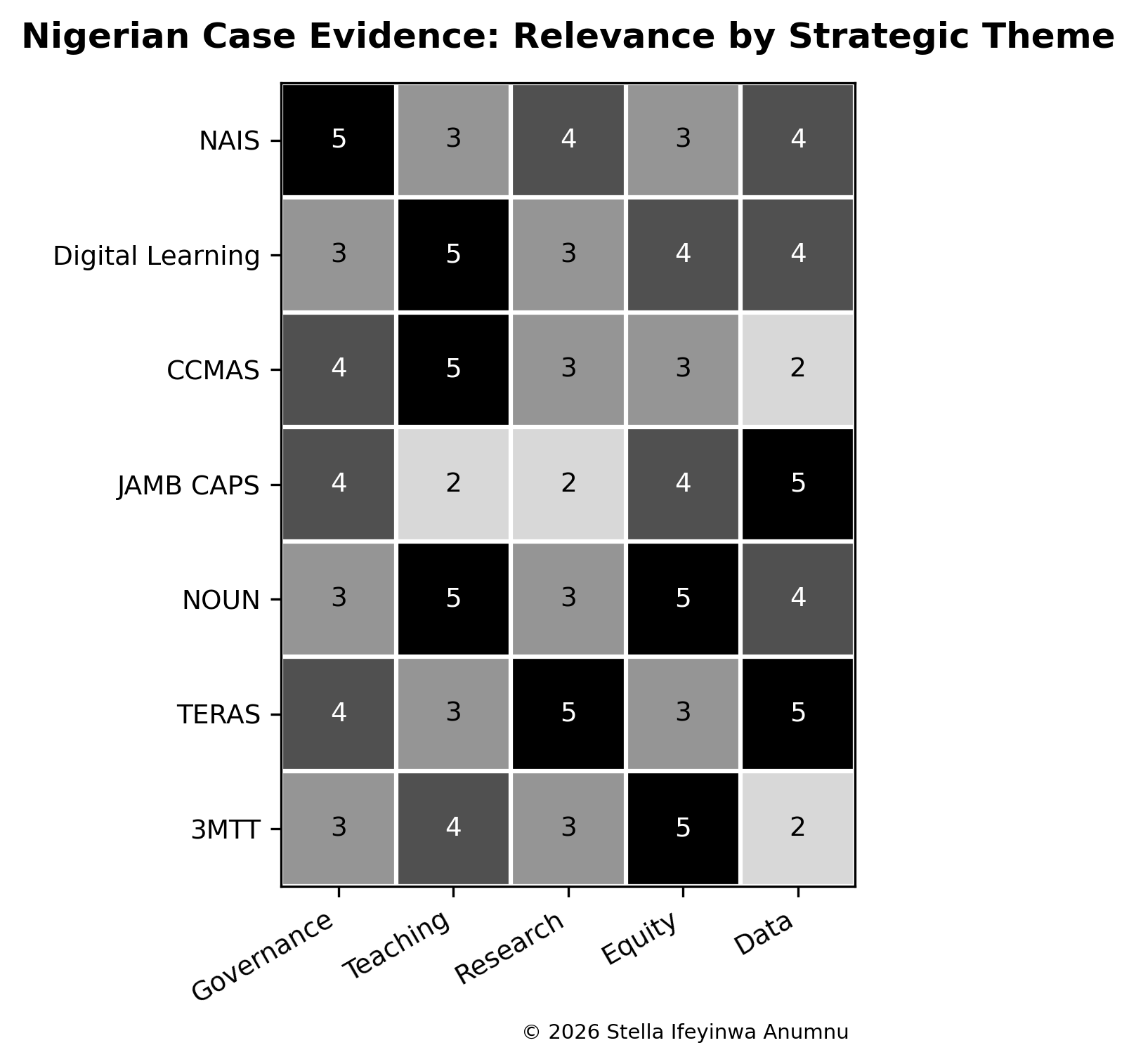
Figure 2. Nigerian case-study relevance matrix.

Note. Matrix values are diagnostic relevance scores on a 1-5 scale. They show how strongly each public Nigerian case informs the strategic themes of governance, teaching, research, equity, and data protection. The figure supports interpretation; it does not measure implementation performance across universities.


6.4 What the Nigerian public cases prove – and what they do not prove

The Nigerian cases used in this publication should be read with care. They prove that policy direction, digital learning ambition, curriculum reform, centralized admissions data, open and distance learning, tertiary-service platforms, and national skills programs are all active parts of the higher education environment. They do not prove that Nigerian universities have already solved AI governance. This distinction is essential. A national policy can set direction without producing classroom change. A platform can create a service channel without guaranteeing learning quality. A curriculum reform can open space for innovation while leaving departments to do the hard work of assessment redesign.

The National AI Strategy is therefore best read as a national capacity signal. It tells universities that AI will shape skills, research, enterprise, and governance. It does not tell a faculty how to grade an AI-assisted assignment. The National Digital Learning Policy is best read as an education-sector frame. It recognizes digital learning and e-safety as serious concerns, but it does not ensure that every campus has the infrastructure and staff development to implement them. CCMAS gives universities a curriculum opening, especially through institution-specific components, but it still requires academic boards to translate AI literacy into course outcomes and assessment.

JAMB CAPS matters because it shows that Nigerian tertiary education already depends on data systems for high-stakes decisions. Its lesson is not that every automated system is AI; its lesson is that transparency, appeal, and audit are necessary whenever data systems affect life chances. NOUN matters because it has long worked with open and distance learning. Its lesson is that flexibility requires advising, feedback, platform reliability, and quality assurance. TERAS matters because a centralized tertiary services platform can improve research and institutional coordination if data governance is strong. 3MTT matters because degree education and applied digital skills should speak to one another rather than compete for legitimacy.

Together, the cases justify a Nigerian governance framework. They also warn against exaggeration. The country has enough policy movement to make university inaction indefensible. It does not yet have enough implementation evidence to make confidence automatic. That is why this paper argues for governed adoption, diagnostic review, and annual reporting rather than symbolic AI branding.

6.5 Discipline-specific application of the case evidence

The public cases also speak differently to different fields. In education, the most urgent question is how future teachers will use AI for lesson planning, learner feedback, inclusive support, and source verification. In law, the challenge is evidence, authority, fabricated cases, data rights, and the responsibility of professional judgment. In medicine and health sciences, the issue is safety, confidentiality, clinical reasoning, and the danger of treating AI output as authority. In engineering, design logs, calculation checks, safety review, and responsible modeling become central. In media and communication, synthetic content, verification, attribution, and public trust must be taught directly.

Business, management, and public administration programs face another pressure. Graduates will work in organizations where AI supports planning, recruitment, customer service, fraud detection, performance dashboards, and risk analysis. Universities should teach them to question the data behind a recommendation, not merely to celebrate efficiency. The same principle applies across disciplines: AI competence is not tool familiarity alone. It is the capacity to combine domain knowledge, evidence, ethics, and human accountability.

Chapter 7: Institutional Management and Quality Assurance

7.1 From policy announcement to operating system

Many university reforms fail in the space between approval and routine. A policy is written, circulated, and praised; then departments continue as before. AI strategy cannot survive that pattern. It needs an operating system. The institution should know who owns AI governance, how tools are approved, how staff are trained, how students disclose use, how complaints are handled, how data is protected, and how evidence of improvement is collected. Without these details, AI remains a speech topic.

A strong operating system begins with an inventory. Which AI tools are already used by staff and students? Which vendors process institutional data? Which courses permit AI? Which departments have assessment-integrity problems? Which research projects use AI for data work? Which administrative units use automated decision support? The answers may be uncomfortable. That is useful. Hidden practice is more dangerous than imperfect practice that has been brought into the open.

Quality assurance should then convert the inventory into policy and monitoring. Course approval forms can ask whether AI literacy or AI restrictions apply. Examination boards can review assessment integrity. Research ethics committees can require AI-use disclosure. ICT units can maintain approved-tool lists. Procurement offices can review vendor terms. Libraries can report training. Student affairs can monitor access problems. Governing councils can request annual AI reports. Each unit does its part, but the institution sees the whole.

7.2 Faculty development as the center of reform

Faculty development is often treated as support, yet in AI adoption it is the center of reform. Lecturers decide what students read, how assignments are framed, what counts as evidence, how feedback is given, and how academic integrity is enforced. If they are unprepared, AI policy will remain abstract. If they are trained properly, the institution gains judgment across every course.

Training should be staged. Senior leaders need strategy and governance sessions. Deans and heads of department need discipline-specific policy design. Lecturers need practical assessment redesign, AI literacy, source verification, feedback methods, and disclosure rules. Librarians need enhanced roles in information literacy. Research supervisors need training in AI-assisted methodology and ethics. ICT staff need academic context. Students need orientation that does not sound like a threat.

Workload should be acknowledged. Redesigning assessment takes time. Learning new tools takes time. Reviewing AI-assisted research takes time. If universities demand change without workload adjustment, they will receive superficial compliance. A serious institution may need teaching grants, course-release arrangements, faculty AI fellows, departmental champions, and recognition in promotion criteria for genuine curriculum renewal. Reform that depends on unpaid academic labor will tire quickly.

Faculty development should also be evaluated. Attendance at a workshop is not enough. The institution should ask whether courses changed, whether assignments improved, whether students understood disclosure rules, whether grading became more meaningful, and whether lecturers felt better prepared. Evidence, not certificates, should guide the next round.

Table 3. Faculty development program for AI-ready teaching.

Phase Focus Practical output
Orientation Shared understanding of AI limits, opportunities, and institutional rules. Departmental AI briefing and common syllabus language.
Assessment redesign Authentic tasks, process evidence, oral defense, local case application. Revised assignment bank and integrity rubric.
Research supervision AI-use disclosure, source verification, methodology validation. Postgraduate supervision checklist.
Discipline adaptation Field-specific use in law, education, health, engineering, media, business, and sciences. Faculty-level AI guidance notes.
Equity and access Low-bandwidth teaching, device constraints, disability support, language assistance. Inclusive learning-support plan.
Evaluation Checking whether training changed courses and student outcomes. Evidence report after each semester.


7.3 Quality assurance, accreditation, and public trust

AI strategy should be placed within quality assurance because the public trusts degrees only when standards are credible. If students can complete assignments without learning, the degree loses value. If AI tools are used in grading without oversight, trust weakens. If research outputs are polished but unreliable, institutional reputation suffers. Quality assurance units must therefore treat AI as a core academic quality issue, not an ICT accessory.

Accreditation bodies will eventually ask harder questions. How does the program address AI in curriculum? How are assessments protected? How are staff trained? How is student data handled? How are research ethics updated? How does the institution verify learning in an AI period? Universities that prepare early will not be surprised. They will have policy documents, training records, assessment examples, disclosure statements, and evidence of review.

Public trust also requires honesty. Universities should not advertise AI adoption as proof of excellence. They should report what was piloted, what improved, what failed, what access barriers remain, and what safeguards were added. A modest report with evidence is more credible than a grand announcement without proof. Nigerian higher education needs that discipline because public confidence in institutions is earned through consistent practice, not vocabulary.

Figure 3. Readiness movement after governed AI adoption.

Note. The baseline and 24-month scores are planning estimates used to show the expected direction of improvement when policy, faculty development, assessment redesign, data review, and access support are implemented together. They should be replaced by institutional evidence during a real AI-HERS review.


7.4 The AI register as a management instrument

A practical university AI register should be updated every semester. It should list approved tools for teaching, research, administration, library support, student services, and quality assurance. It should also list prohibited uses, tools under review, the responsible office, the data category involved, the date of approval, the next review date, and the reason for approval. This register protects students and staff because it turns scattered practice into institutional knowledge.

The register should be short enough to use and serious enough to matter. A long spreadsheet that nobody reads will fail. A public-facing summary may tell staff and students which tools are approved and for what purpose. A confidential internal version may record security details, contract terms, risk notes, and incident history. The point is not paperwork. The point is that a university should know what technology is acting inside its academic system.

The register also helps with consistency. Without it, one department may allow a tool that another department prohibits. One lecturer may upload student work into a public system while another refuses. One research team may use AI transcription without ethics review while another is blocked. Some local variation is necessary because disciplines differ, but unmanaged contradiction weakens trust. A register gives the institution a shared base from which faculties can adapt responsibly.

Table 8. AI tool register and approval evidence.

Register field Purpose Minimum evidence
Tool name and function Identifies what the system is used for Approved description and user group
Data category Shows whether personal, sensitive, research, or administrative data is processed Data-protection review note
Academic owner Prevents ICT-only ownership of academic decisions Named faculty, unit, or committee
Approval level Matches review depth to risk Department, faculty, senate, ethics, or council record
Permitted and prohibited uses Gives staff and students clear boundaries Published guidance or course note
Review date and incident history Keeps adoption under continuing oversight Semester review and incident log


7.5 Student partnership, faculty autonomy, and institutional trust

Students should be involved in AI governance because they know the informal learning environment. They know which tools are common, which rules are ignored, which assignments invite shortcuts, and which access barriers are most damaging. A university that writes AI policy without student input may produce rules that look good in committee and fail in practice. Student representatives, postgraduate associations, distance learners, and disability-support groups should be heard before final rules are approved.

Faculty autonomy also needs protection. A central AI policy should provide principles, legal boundaries, disclosure standards, and risk controls. It should not flatten disciplinary judgment. A faculty of law, a faculty of education, a college of medicine, a school of engineering, and a business school will not use AI in the same way. The better method is a central policy with faculty guidance notes. Each faculty can state approved uses, prohibited uses, assessment examples, research risks, and professional expectations. This prevents both chaos and rigidity.

Trust grows when staff and students can see the reasons behind rules. If AI is prohibited in a task, the learning reason should be clear. If AI is permitted, the disclosure rule should be clear. If a tool is used for advising or feedback, the human oversight route should be clear. People accept rules more readily when the institution explains them honestly. In a period of technological uncertainty, clarity itself becomes a form of care.

7.6 Evidence that quality assurance should collect

Quality assurance should collect evidence that shows whether AI adoption has improved academic work. Evidence may include revised syllabi, assessment samples, student disclosure records, library workshop attendance, ethics-review forms, vendor reviews, data incidents, complaints, access-support use, and faculty-development outputs. These records should be interpreted carefully. Attendance at a workshop is not proof of capability. A policy document is not proof of practice. A pilot report is not proof of scale. Evidence must be read against academic outcomes.

Examination boards should review patterns after each semester. Which assignments produced suspicious uniformity? Which tasks produced stronger oral explanations? Which courses had unclear AI instructions? Which assessments required real sources? Which forms of feedback helped students revise? This review should not be used to shame lecturers. It should help departments learn which assessment designs still work. A university that cannot learn from its own assessment evidence will keep repeating the same failures with newer tools.

7.7 Finance, sustainability, and the cost of unfinished pilots

Sustainability should be tested before an AI pilot is celebrated. Many tools look affordable during a trial because external partners provide free credits, temporary licenses, or promotional support. The true cost appears later: subscription renewal, data charges, staff training, security review, accessibility support, integration, maintenance, and the time lecturers spend redesigning courses. A university that cannot fund the second year should be careful about calling the first year transformation.

Budget discipline does not mean refusing innovation. It means asking what the institution can sustain after the announcement has passed. A small, well-governed intervention may improve learning more than an expensive platform that staff cannot use. Finance offices should therefore sit with academic leaders before contracts are signed. The question is not only whether the tool can be bought. It is whether the institution can support, audit, improve, and, if necessary, exit the tool without harming students or losing records.

The cost of unfinished pilots is not only financial. When staff and students are asked to change practice and then a tool disappears, trust weakens. Future reforms become harder because people remember the abandoned promise. Nigerian universities need honest costing, staged adoption, and clear exit plans. Reform is stronger when it does not depend on excitement alone.

Chapter 8: Risks, Failures, and Safeguards

8.1 Academic integrity beyond detection

Academic-integrity debate often begins with fear of cheating, and the fear is not imaginary. AI can produce essays, code, summaries, problem solutions, references, and polished arguments within seconds. Students under pressure may use it dishonestly. Staff may struggle to prove misconduct. Old assignments may lose value. These are real problems. They should not, however, reduce AI policy to detection and punishment.

A better integrity approach has four parts. First, students need clear rules before work begins. Second, assessment should be redesigned so that process, local application, oral defense, and source judgment matter. Third, lecturers need practical ways to check learning without becoming investigators in every course. Fourth, misconduct procedures should remain fair, with space to distinguish careless disclosure from deliberate fraud. The aim is to protect learning, not to create a climate of suspicion.

Detection software should be used cautiously. False positives can damage students, especially those whose English style is unusual, heavily edited, translated, or formal. False negatives can give staff false assurance. A detector result should never be the sole basis for punishment. It may trigger review, but human academic judgment, evidence, and student explanation should remain central. The university’s integrity depends as much on fair process as on preventing cheating.

Integrity is also a staff issue. Lecturers should not use AI to generate feedback they do not read, references they do not verify, or course content they do not understand. Institutional rules must apply to both sides of the classroom.

8.2 Bias, exclusion, and language risk

AI systems may reflect the biases of their training data, design choices, and deployment setting. For Nigerian higher education, this includes risks around language, class, region, gender, disability, religion, and cultural context. A tool may perform better for standardized American English than for Nigerian English or for students moving between languages. It may misunderstand local examples, undervalue Nigerian sources, or produce advice that assumes infrastructure conditions that do not exist. These are not minor issues. They affect learning, assessment, and dignity.

Bias can also enter administrative analytics. A student from a low-income background may look less engaged because of unstable internet. A distance learner may appear inconsistent because of work obligations. A student with disability may require different interaction patterns. If an AI-supported advising system reads these signals without context, it may classify students unfairly. Human review and student explanation must be built into any system that flags risk.

Safeguards include local testing, diverse user feedback, accessibility review, clear appeal routes, and bias monitoring. Universities should not accept vendor claims without evidence. A tool that worked in one country or one university may fail under Nigerian constraints. Pilot studies should include students with varied devices, languages, disciplines, and access conditions. A system that benefits only the most privileged users cannot be called strategic for Nigerian higher education.

8.3 Vendor dependence and procurement discipline

AI adoption often enters through vendors: learning platforms, plagiarism tools, proctoring systems, chatbots, analytics dashboards, research software, and administrative automation. Procurement is therefore an academic governance issue. A cheap or fashionable tool may create long-term dependence, data exposure, hidden costs, or poor integration with existing systems. Universities should not sign technology agreements as if they are buying furniture.

Procurement review should ask direct questions. What data will the vendor process? Can the vendor use it for model training? Where is the data stored? What happens when the contract ends? Can the institution export its records? What support is provided? Does the tool work on low bandwidth? Is there independent evidence of educational value? Does the contract protect academic autonomy? What liability exists if the tool fails or exposes data? These questions should be asked before purchase, not after scandal.

Vendor dependence can also affect intellectual independence. If a university allows a platform to shape teaching, assessment, student support, and analytics without oversight, the vendor begins to influence academic life. Partnership can be valuable, but control must remain with the institution. The governing principle is simple: technology should serve the university’s academic mission; the mission should not be redesigned silently around vendor convenience.
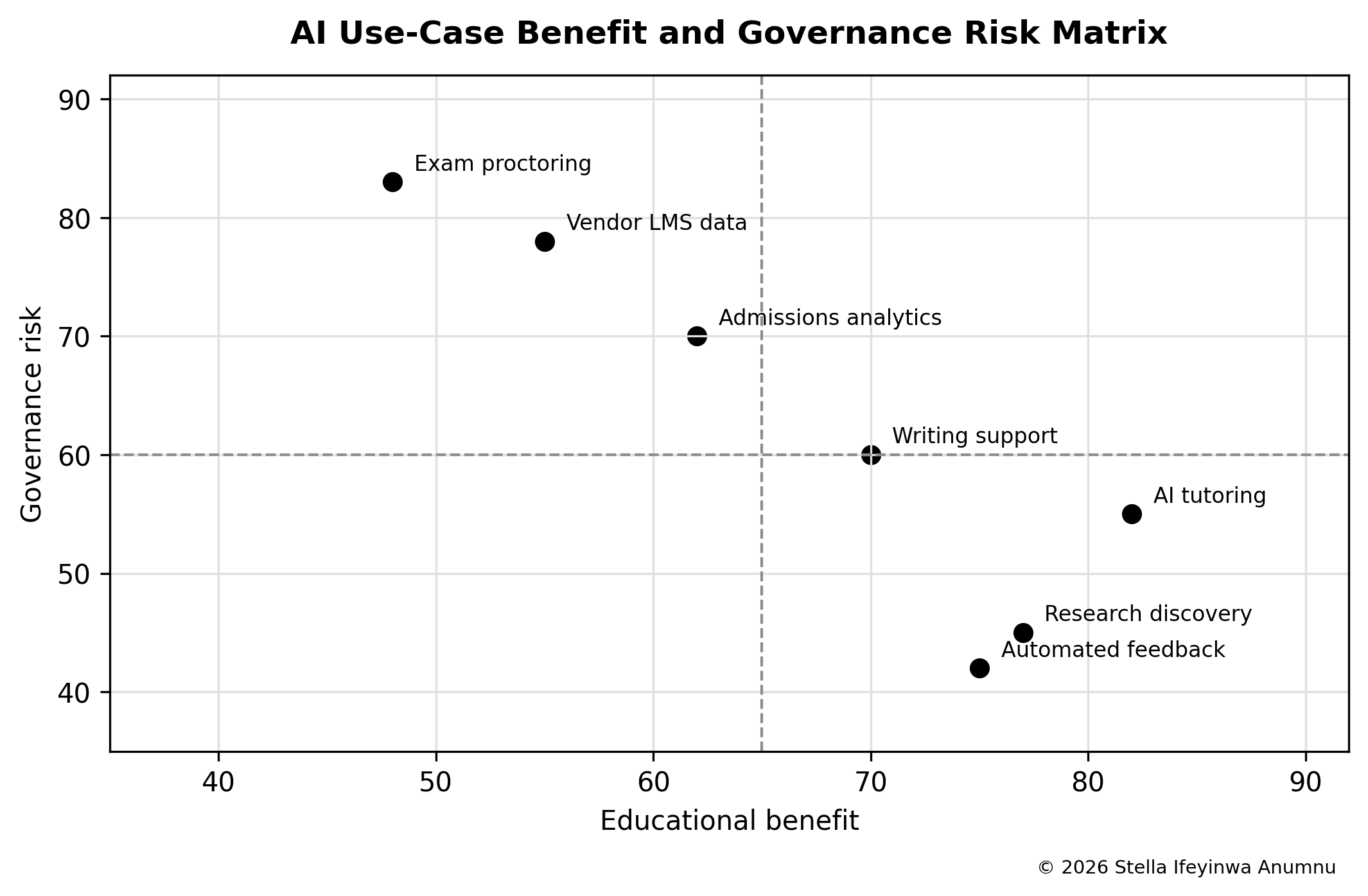
 

Figure 5. AI use-case benefit and governance risk matrix.

Note. Positions on the matrix are author-created risk-benefit judgments based on the kinds of AI use cases discussed in the paper. The figure is intended to discipline procurement and pilot decisions by making benefit and risk visible before adoption.


8.4 Discipline-based risk examples

The risks of AI are not identical across disciplines. In law, fabricated authorities can damage legal reasoning and professional ethics. In health sciences, inaccurate clinical advice can create safety risks. In engineering, unverified calculations can become design hazards. In journalism and media, synthetic images and fabricated quotations can injure public trust. In education, AI-generated lesson plans may appear polished while ignoring learner context. In business and management, efficiency claims may conceal bias in data or poor accountability for decisions. A serious AI policy should therefore include faculty-level examples, not only general rules.

In a faculty of education, students may be asked to use AI to draft a lesson plan, then critique it against curriculum goals, learner needs, cultural context, and assessment strategy. In a law faculty, students may be required to verify every cited authority through an approved legal database before submission. In health sciences, students may compare AI explanations with textbooks, clinical guidelines, and supervisor instruction, while being reminded that patient data must not enter public tools. In engineering, students may submit a design log showing assumptions, tool use, calculation verification, safety checks, and human decisions. The common thread is not prohibition. It is accountable use tied to professional standards.

These examples also help misconduct panels. A generic rule that says “responsible use” may be too vague when a case arises. A discipline-based guidance note gives staff and students a shared expectation before the work begins. It also makes punishment less arbitrary because the institution can show that the boundary was explained.

8.5 Crisis, continuity, and institutional memory

Nigerian universities have lived through disruptions that affect learning continuity: strikes, health emergencies, insecurity, weather events, funding delays, and infrastructure failure. AI-supported systems may help universities communicate faster, organize learning materials, answer routine platform questions, and preserve institutional records during disruption. They cannot solve the political and material causes of crisis. That distinction matters. Technology can support continuity; it should not be used to normalize broken conditions.

Institutional memory is another underrated risk. Universities lose knowledge when officers change and records are scattered. AI-supported search across policies, minutes, research outputs, quality reports, and administrative guidance may help new officers understand past decisions. The system will be useful only if records are accurate, lawful, and organized. A poor archive searched quickly remains a poor archive. Before universities rush into intelligent document search, they should improve records discipline, naming conventions, retention rules, and access controls.

Continuity planning should therefore connect AI to records management, not only to classroom delivery. If the university cannot tell which policy version is current, which contract is active, which ethics form was approved, or which student complaint remains unresolved, AI search may accelerate confusion. Responsible AI begins with responsible information management.

Chapter 9: AI-HERS Model and Diagnostic Tools

9.1 Purpose of the model

University leaders often ask for a score because scores simplify discussion. The danger is that a score can pretend to know more than it knows. The AI Higher Education Readiness and Safeguards Score, abbreviated AI-HERS, is designed to avoid that problem. It does not rank universities for publicity. It helps an institution organize a serious internal review. The model asks whether the main conditions for responsible AI adoption are present, partially present, or missing.

The model uses eight strata: governance, faculty readiness, data protection and infrastructure, assessment integrity, research capacity, equity and access, quality assurance evidence, and procurement or vendor control. These strata were chosen because they cover the main points at which AI can improve or damage higher education. A university may be strong in one stratum and weak in another. That unevenness is the point. A single general claim of readiness is rarely useful.

The model should be used with evidence. A governance score should be based on approved policy, responsible offices, meeting records, and reporting. Faculty readiness should be based on training, course redesign, and departmental support. Data protection should be based on inventories, vendor review, and compliance records. Assessment integrity should be based on actual assessment changes. Equity should be based on access data and student experience. The score should never be guessed in a closed office.
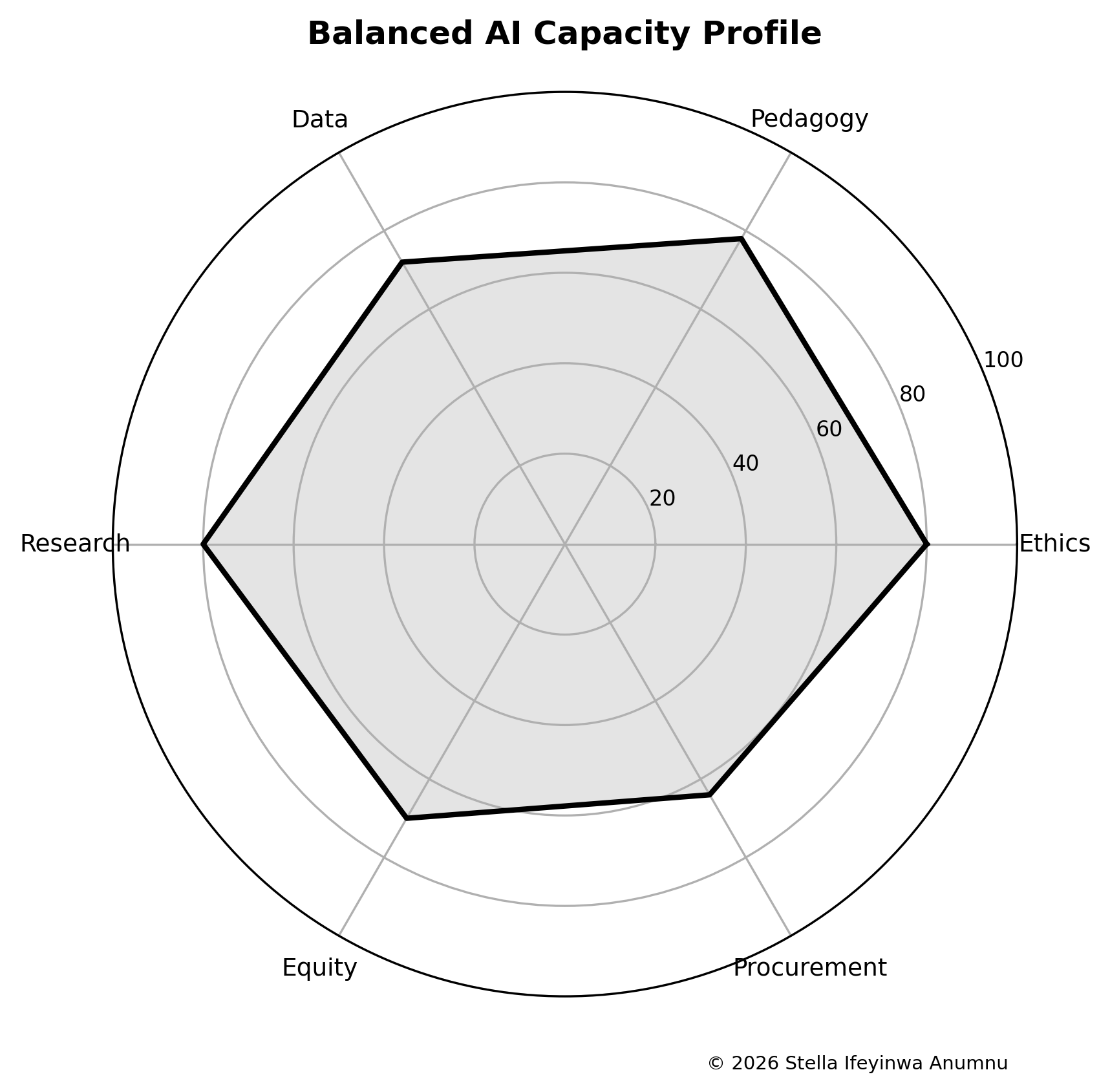
Figure 4. Balanced AI capacity profile.

Note. The radar profile is an institutional diagnostic illustration. It is designed for management discussion and should be completed with evidence from policy records, course redesign, ethics review, data inventory, student access reports, and vendor contracts.


9.2 The stratified formula

The proposed formula is: AI-HERS_i = 100 × [0.18G_i + 0.15F_i + 0.15D_i + 0.12A_i + 0.12R_i + 0.10E_i + 0.10Q_i + 0.08P_i]. In the formula, G_i represents governance authority; F_i represents faculty readiness; D_i represents data protection and infrastructure; A_i represents assessment integrity; R_i represents research capacity; E_i represents equity and access; Q_i represents quality assurance evidence; and P_i represents procurement and vendor control. Each variable is scored between 0 and 1 before weighting.

The weights are open to debate, which is a strength. Governance receives the highest weight because responsible adoption needs authority and policy. Faculty readiness and data protection receive strong weights because teaching and student data are central to the university’s mission. Assessment, research, equity, and quality assurance follow closely. Procurement receives a smaller but still meaningful weight because vendor control can undermine all other areas if ignored.

A score below 40 should be treated as early readiness. Such an institution should avoid high-stakes AI deployment and focus on policy, inventory, faculty training, and access. A score between 40 and 65 suggests controlled pilot readiness. The university can test AI in selected areas with safeguards. A score between 65 and 80 suggests institutional scaling readiness, provided evidence is reviewed. A score above 80 suggests mature governance, but not perfection. Even mature systems need audit, student feedback, and regular review.

The model should never be used to punish weaker institutions. Its purpose is to direct support. If a state university scores low because it lacks infrastructure and faculty training, the response should be targeted investment and technical support, not public embarrassment. Readiness assessment should become a planning tool for improvement.

Table 6. AI-HERS variables and scoring test.

Variable Meaning Readiness evidence
G Governance authority Approved policy, named owner, reporting line, risk register.
F Faculty readiness Training participation, redesigned courses, departmental guidance.
D Data protection and infrastructure Data inventory, vendor review, security controls, access plan.
A Assessment integrity Disclosure rules, authentic tasks, oral defense, process evidence.
R Research capacity AI ethics addendum, supervisor training, source verification.
E Equity and access Device support, low-bandwidth options, disability support, student feedback.
Q Quality assurance evidence Review cycles, performance indicators, annual AI report.
P Procurement and vendor control Contract review, exit plan, data-use restrictions.


9.3 Diagnostic review and public reporting

A useful diagnostic review should include documents, interviews, platform data, student feedback, faculty examples, vendor contracts, and assessment samples. It should include skeptical voices, not only enthusiasts. Students should be asked whether AI rules are clear, whether access is fair, and whether they know how to disclose use. Lecturers should be asked what support they need and which assessments are no longer reliable. ICT staff should be asked what tools are already in use without approval. Librarians should be asked where source-verification problems appear. Research ethics committees should be asked whether they can review AI-assisted work.

The institution should publish a short annual AI governance statement. It does not need to reveal sensitive details. It should state what policy exists, what training occurred, what pilots were approved, what risks were found, what student-access measures were taken, and what will change next year. Public reporting builds discipline. It also helps Nigerian universities learn from one another instead of repeating the same mistakes in isolation.

The strongest use of AI-HERS is longitudinal. A university should not only ask where it stands today. It should ask what improved over twelve months and why. Did faculty readiness rise because training became practical? Did assessment integrity improve because departments redesigned tasks? Did data governance improve because vendor contracts were reviewed? Did equity improve because the library opened access hubs? A score without explanation is thin. A score with evidence becomes management knowledge.

9.4 Interpreting diagnostic scores without overclaiming

The figures and the AI-HERS model in this paper are designed to make governance visible. They should not be read as official rankings of Nigerian universities, national survey results, or proof that implementation has occurred. Their strength lies in disciplined illustration. They show what leaders should examine: policy authority, faculty capability, data protection, assessment integrity, research support, student access, procurement control, and quality assurance evidence. A university using the model must replace diagnostic estimates with its own records.

This point is not a weakness. It is part of evidence integrity. A planning model should be transparent about its limits. If a university lacks data for one variable, the answer is not to guess confidently. The answer is to collect evidence. If student access is unknown, run an access audit. If faculty readiness is unknown, survey departments and review course changes. If vendor risk is unclear, review contracts. If research ethics practice is unclear, examine approved protocols. AI-HERS becomes useful when it forces these conversations into the open.

The model should also be adjusted by institutions with different missions. An open and distance learning institution may weight access, advising, platform reliability, and analytics governance more heavily. A research-intensive university may place more emphasis on ethics review, research data, publication integrity, and postgraduate supervision. A professional university may emphasize simulation, safety, accreditation, and field-specific judgment. The formula is therefore a starting discipline, not a permanent decree.

9.5 From diagnostic review to improvement plan

After scoring, the university should produce a short improvement plan. The plan should identify three to five priorities, assign responsible offices, state evidence to be collected, set review dates, and name decisions that will be paused until controls improve. If assessment integrity is weak, the next step may be an assignment-redesign institute. If data governance is weak, the next step may be a vendor review and staff guidance on sensitive data. If access is weak, the next step may be library-based support and low-bandwidth course materials. The model should lead to action, not decoration.

A public summary can strengthen accountability. It does not need to reveal sensitive internal weaknesses. It can state what was reviewed, what improvements were made, what risks remain, and what the institution will do next. Honest reporting may feel risky, but silence is riskier when AI affects students, staff, and research credibility. A university that can report unfinished work responsibly is more trustworthy than one that advertises perfection.

Chapter 10: Implementation Roadmap and Final Institutional Position

10.1 The first six months

The first six months should be disciplined and modest. The university should not begin with a grand AI center if it has not written course guidance, inventoried tools, or trained staff. The first step is an AI governance charter approved by senior academic authority. The charter should state principles: human academic responsibility, equity, lawful data practice, transparent use, assessment integrity, research ethics, and evidence-based adoption. It should also identify the office responsible for coordination.

The second step is an institutional inventory. Departments should report existing AI use in teaching, research, assessment, administration, and student support. ICT should list approved and unapproved tools. Procurement should identify vendor contracts that process student or staff data. Libraries should report current information-literacy support. Student affairs should identify access barriers. This inventory may reveal disorder. That is useful. Disorder seen early can be managed.

The third step is interim guidance for courses. Lecturers need syllabus language immediately. Students need to know what is allowed. A simple template can define prohibited use, limited permitted use, required disclosure, and AI-supported learning activities. Departments can adapt examples. Interim guidance should be reviewed after the first semester, because practice will reveal problems that policy writers did not imagine.

10.2 The first year and second year

By the end of the first year, the university should have a formal AI policy, a vendor review process, data-protection controls, faculty development plan, assessment-redesign pilots, student disclosure templates, and research ethics addendum. The policy should not be long for the sake of appearing serious. It should be usable. A lecturer should be able to apply it to a course. A student should understand it. An ethics committee should use it. An ICT officer should know which tools require review. A dean should know how to report implementation.

The first year should also produce examples. Abstract rules become clearer when staff can see sample assignments, disclosure statements, oral-defense formats, AI critique tasks, source-verification exercises, and research-methods templates. Universities should collect these examples in a shared repository. Departments can adapt them to local needs. This is cheaper and more useful than repeating generic training.

The second year should move from pilots to controlled scaling. Successful tools can be expanded, but only after evidence is reviewed. Faculty AI fellows can support departments. Libraries can run regular verification clinics. Research offices can integrate AI-use disclosure into postgraduate forms. Student affairs can use analytics cautiously to support at-risk learners, with human review. Procurement can renegotiate vendor terms based on lessons learned. The institution should issue its first annual AI governance statement before the end of the second year.

A mature implementation roadmap does not ask the university to do everything at once. It asks the university to build a sequence that protects standards while learning. The measure of success is not how many tools are purchased. The measure is whether teaching, assessment, research, administration, and student support become more credible, more inclusive, and more accountable.

Table 7. Twenty-four-month implementation sequence.

Period Main work Publication-ready evidence
Months 1-3 Create AI governance charter, interim course guidance, and tool inventory. Approved charter and inventory report.
Months 4-6 Begin faculty institutes, data-protection review, and assessment pilot selection. Training records and pilot protocols.
Months 7-12 Formal policy approval, ethics addendum, vendor review, student orientation. Policy pack and compliance checklist.
Months 13-18 Controlled scaling of successful pilots and department-level AI guidance. Evaluation report and revised course examples.
Months 19-24 Institution-wide AI-HERS review and public governance statement. Annual AI governance statement and improvement plan.


Figure 7. Twenty-four-month AI strategy implementation roadmap.

Note. The roadmap translates the paper’s implementation argument into a staged management sequence. Exact timing should be adapted to institutional resources, legal review, faculty workload, and student access conditions.


10.3 Final institutional position

Artificial intelligence will test Nigerian higher education because it exposes weaknesses that were already present. Weak assessment becomes easier to outsource. Weak supervision becomes easier to conceal. Weak data governance becomes more dangerous. Weak faculty development becomes more visible. Weak access becomes more unfair. AI is not the original cause of these problems, but it intensifies them. That is why the response has to be strategic, not decorative.

The opportunity is equally real. AI can support teaching in large classes, improve feedback, help students practice, assist researchers, strengthen administrative planning, support open and distance learning, and connect universities to national technology ambitions. Nigeria should not stand aside while other systems build capacity. But participation should not mean surrendering judgment to imported tools, vendor claims, or superficial innovation.

The institutional position is clear. AI belongs in Nigerian higher education as governed academic capacity. It should be taught, questioned, tested, documented, audited, and placed under human academic authority. It should support students without replacing study. It should assist lecturers without reducing teaching to generated content. It should strengthen research without weakening evidence. It should help managers see patterns without automating unfair decisions. A university that can hold those lines will not merely adopt AI. It will educate people capable of living responsibly with it.

10.4 Operational application across university functions

Admissions offices should treat AI as an aid to fairness, not as a way to hide judgment. Any tool that supports screening, placement, fraud detection, or applicant communication should be auditable. Applicants should know the official channel for questions and correction. Where automated systems help staff process large volumes, human officers must remain responsible for final decisions and appeals. JAMB CAPS already shows that Nigerian tertiary education accepts data-supported admission processes; the next challenge is to protect transparency as more automation becomes possible.

Registrar and examination offices need equally careful boundaries. AI can help classify inquiries, identify missing records, summarize policy questions, and support workflow. It should not alter grades, disciplinary records, graduation status, or academic standing without documented human review. Examination work carries consequences that may follow a graduate for life. Any system touching those records should have access controls, audit logs, backup procedures, and correction routes.

Libraries should become the visible home of AI information literacy. Their role should include source verification clinics, citation workshops, database searching, guidance on fabricated references, and support for postgraduate literature reviews. This is not an optional service. In the AI period, libraries defend the evidence culture of the university. They help students and staff distinguish a fluent summary from a source, a plausible citation from a real one, and a search shortcut from research.

Student affairs offices should use AI cautiously. Advising dashboards, chatbots, and risk flags may help staff identify students who need support, but they can also misread poverty, illness, disability, unstable connectivity, work obligations, or insecurity. A responsible system uses data to begin a human conversation. It does not turn a student into a risk label. Complaint channels and correction rights should be visible.

Research offices should integrate AI disclosure into postgraduate forms, ethics applications, and publication support. The purpose is not to stigmatize assistance. The purpose is to keep methods transparent. A thesis that uses AI for transcription, translation, coding suggestions, data visualization, or language editing should say so where relevant. Research offices can also train staff to identify predatory journals, paper-mill patterns, fabricated citations, and unreliable AI-assisted analysis.

Procurement and legal offices should build shared review templates. A contract for an AI platform should not be approved only because the price appears attractive. Data processing, model training, storage location, exit rights, service continuity, accessibility, liability, audit rights, and ownership of institutional records should be checked. If the university lacks internal capacity for this review, it should seek external legal or technical advice before signing. The cost of weak procurement is usually paid later by students, staff, and institutional reputation.

Table 9. Operational controls by university function.

University function AI opportunity Required control
Admissions and registry Faster inquiry handling, document checks, workflow support Human decision review, appeal route, audit log
Teaching departments Practice tasks, feedback support, local examples Syllabus disclosure rules and assessment redesign
Examinations Pattern review and process monitoring No automated grade change without human authority
Library Source verification, citation training, research support Database-based verification and fabricated-reference guidance
Research ethics Review of AI-assisted transcription, coding, and analysis Consent, anonymization, secure tools, human validation
Student affairs Advising signals and routine support Human contact before adverse interpretation
Procurement Selection of platforms and service partners Data-use clauses, exit rights, accessibility, risk review


10.5 Practical decision scenarios for Nigerian university leaders

A faculty of education may want students to use AI for lesson planning. The wise response is not a blanket ban. The faculty can require students to submit the AI draft, a critique of its weaknesses, the revised lesson plan, and a short explanation of learner needs. The student learns tool use, professional judgment, and accountability at the same time.

A research team may want to upload interview transcripts from vulnerable participants into a public AI tool for coding. The ethics committee should stop the process until consent, anonymization, storage, data transfer, vendor terms, and human validation are clear. If those protections cannot be guaranteed, the team should use a secure approved tool or manual coding. Research convenience cannot outrank participant protection.

A private university may market itself as an AI-powered institution. The claim is weak unless the institution can say what is powered by AI, who reviews outputs, what data is processed, which students have access, how assessment is protected, and how errors are corrected. Responsible communication should replace vague technological prestige with accountable detail.

A public university with limited funding may feel left behind because it cannot buy enterprise tools. It can still begin well. Syllabus language, student orientation, source-verification workshops, faculty peer groups, oral defense routines, disclosure templates, and a tool register are low-cost safeguards. Governance does not begin with money; it begins with clarity.

A lecturer may use AI to draft feedback on essays. This can reduce delay if the lecturer reviews the comments, corrects generic language, adds discipline-specific observations, and keeps final grading under human control. Feedback is a teaching act. It should not become an automated paragraph attached to a score.

A university may consider analytics for distance learners. The tool may identify students who are likely to fall behind, but poor connectivity or work obligations may be mistaken for weak commitment. Every automated flag should lead to human contact, not punishment. The student should have a way to explain and correct the record. Support systems lose legitimacy when students feel watched but not helped.

A department may want to ban AI entirely. Some tasks should indeed prohibit AI because they test independent competence. But a total ban across a program may be unenforceable and may prepare students poorly for professional work. A stronger policy divides tasks into no-AI tasks, disclosed-assistance tasks, AI-critique tasks, and professional-simulation tasks. Students learn boundaries rather than secrecy.

A university planning an AI innovation hub should not begin with equipment alone. It should define research themes, ethics support, student training, industry partnerships, data governance, intellectual property rules, and evaluation standards. A hub without academic direction is an expensive room. A hub with purpose can support research, entrepreneurship, and national development.

10.6 Annual review and final publication position

AI policy cannot be written once and left untouched. Tools change, laws change, student practice changes, and institutional capacity changes. The university should review policy annually, not to chase every novelty, but to keep standards honest. The review should ask what was adopted, what improved, what failed, what complaints were received, what access gaps remain, what data incidents occurred, and which tools should be stopped. Stopping a weak tool is as important as adopting a useful one.

Collaboration among Nigerian universities would strengthen this process. Institutions can share policy language, faculty-development materials, assessment examples, research findings, and procurement questions. NUC, TETFund, NITDA, NCAIR, professional bodies, and university networks can help convene such exchanges, but the value will depend on honesty. Success stories alone are not enough. Universities need to share mistakes, limits, and unfinished work so that the sector learns faster.

Academic freedom must remain protected. AI governance should not become a route for surveillance, censorship, or managerial interference with research. Lecturers and researchers must be free to study AI harms, critique policy, question vendors, examine bias, and publish uncomfortable findings. Responsible governance protects academic integrity; it should not narrow inquiry. A university that cannot tolerate critical research on AI is not ready to govern AI.

The final institutional position is therefore firm. Artificial intelligence belongs in Nigerian higher education, but only as governed academic capacity. It must serve teaching without replacing study, support research without weakening evidence, assist administration without hiding judgment, improve access without deepening inequality, and strengthen public trust without becoming public relations. The university remains responsible. That responsibility is the line that no tool should cross.

10.7 Sector responsibility beyond one institution

The burden of AI governance should not fall on single universities acting alone. Nigeria needs sector learning. Regulators can set expectations, but universities must generate evidence. TETFund can support infrastructure and research services, but institutions must show how those services improve academic work. NITDA and NCAIR can support national AI capacity, but faculties must translate capacity into curriculum and research. Professional bodies can define field-specific standards, but departments must teach and assess them. The system will move faster if these responsibilities are coordinated without erasing institutional autonomy.

Sector responsibility also means protecting weaker institutions. Some universities will begin with stronger infrastructure, better funding, smaller classes, and more experienced ICT units. Others will begin with limited bandwidth, overcrowded classes, and fragile administrative systems. A national AI agenda that benefits only the already strong will widen inequality inside higher education. Shared templates, open training materials, low-cost assessment models, library collaboration, and regional communities of practice can help reduce that gap.

The paper therefore ends with confidence, but not with complacency. Nigerian universities can use AI to strengthen teaching, research, administration, and public service. They can also damage trust if they adopt tools without safeguards. The difference will be made in ordinary institutional habits: clear rules, trained staff, protected data, fair access, honest assessment, documented procurement, and annual review. Those habits are not glamorous. They are the work of universities that take their public mission seriously.

10.8 The publication standard for immediate use

A publication-ready AI governance paper should leave no reader unsure about its operational standard. In this work, the standard is direct. No AI tool should enter teaching without a learning purpose. No AI-supported assessment should proceed without a rule on disclosure and evidence of student reasoning. No research use should hide the tool that shaped transcription, coding, analysis, translation, or writing. No procurement decision should ignore data storage, model training, exit rights, accessibility, and vendor dependence. No analytics system should turn student hardship into a silent institutional judgment.

The paper also sets a standard for language. Nigerian universities do not need exaggerated claims about revolution. They need careful work that can survive audit, complaint, accreditation review, and public scrutiny. A responsible institution will be able to show its policy, tool register, training records, assessment samples, ethics addendum, data review, access-support evidence, vendor checklist, and annual report. These records may look ordinary, but they are the infrastructure of trust.

The work is ready for institutional publication because it now carries both argument and restraint. It supports AI adoption, but it refuses technology glamour. It accepts innovation, but it keeps human academic responsibility at the center. It recognizes national ambition, but it does not confuse national ambition with campus implementation. It gives leaders a framework they can use now while leaving room for future empirical research. That balance is the mark of serious applied doctoral writing.

The immediate value for Nigerian higher education is practical. A vice chancellor can use the roadmap to sequence institutional work. A dean can use the faculty guidance to redesign assessment. A librarian can use the source-verification emphasis to strengthen research support. An ethics committee can use the disclosure standard to update forms. A procurement officer can use the vendor questions before a contract is signed. A student affairs team can use the access argument to prevent analytics from becoming unfair surveillance. A postgraduate school can use the supervision routines to protect thesis integrity. The paper therefore moves beyond commentary. It gives offices a shared language for responsible action.

References

3MTT. (2025). 3 Million Technical Talent programme. Federal Ministry of Communications, Innovation and Digital Economy. https://3mtt.nitda.gov.ng/

Ajonbadi, H. A., Idris, A., & Adebisi, Y. (2023). The anathema of digital divide in Nigerian higher education: Lessons from the pandemic. Sheffield Hallam University Research Archive.

DataReportal. (2025). Digital 2025: Nigeria. Kepios and DataReportal. https://datareportal.com/reports/digital-2025-nigeria

Federal Ministry of Communications, Innovation and Digital Economy, & National Information Technology Development Agency. (2025). National Artificial Intelligence Strategy. National Centre for Artificial Intelligence and Robotics.

Federal Ministry of Education. (2023). National Digital Learning Policy. Federal Republic of Nigeria. https://education.gov.ng/

Federal Republic of Nigeria. (2023). Nigeria Data Protection Act, 2023.

International Organization for Standardization. (2023). ISO/IEC 42001:2023: Information technology – Artificial intelligence – Management system. https://www.iso.org/standard/42001

Joint Admissions and Matriculation Board. (n.d.). Central Admissions Processing System (CAPS). https://www.jamb.gov.ng/caps

Maslej, N., Fattorini, L., Perrault, R., Gil, Y., Parli, V., Kariuki, N., Capstick, E., Reuel, A., Brynjolfsson, E., Etchemendy, J., Ligett, K., Lyons, T., Manyika, J., Niebles, J. C., Shoham, Y., Wald, R., & Walsh, T. (2025). The AI Index 2025 annual report. Stanford Institute for Human-Centered Artificial Intelligence. https://hai.stanford.edu/ai-index/2025-ai-index-report

McDonald, N., Johri, A., Ali, A., & Hingle, A. (2024). Generative artificial intelligence in higher education: Evidence from an analysis of institutional policies and guidelines. arXiv.

Miao, F., & Cukurova, M. (2024). AI competency framework for teachers. UNESCO.

Miao, F., Shiohira, K., & Lao, N. (2024). AI competency framework for students. UNESCO.

National Institute of Standards and Technology. (2023). Artificial Intelligence Risk Management Framework (AI RMF 1.0). U.S. Department of Commerce. https://www.nist.gov/itl/ai-risk-management-framework

National Institute of Standards and Technology. (2024). Artificial Intelligence Risk Management Framework: Generative Artificial Intelligence Profile. U.S. Department of Commerce.

National Open University of Nigeria. (n.d.). Welcome to the National Open University of Nigeria. https://nou.edu.ng/

National Universities Commission. (2023). Core Curriculum and Minimum Academic Standards downloads. NUC-CCMAS. https://nuc-ccmas.ng/downloads/

National Universities Commission. (2024). NUC to ensure full implementation of CCMAS. National Universities Commission. https://www.nuc.edu.ng/tag/ccmas/

Ogunleye, B., Zakariyyah, K. I., Ajao, O., Olayinka, O., & Sharma, H. (2024). Higher education assessment practice in the era of generative AI tools. arXiv.

Tertiary Education Trust Fund. (n.d.). TERAS: Tertiary Education, Research, Applications and Services. https://teras.ng/

UNESCO. (2023). Guidance for generative AI in education and research. UNESCO.

UNESCO. (2024). AI competency framework for teachers. UNESCO.

UNESCO. (2024). AI competency framework for students. UNESCO.

World Bank. (2025). Artificial intelligence revolution in higher education: What you need to know. World Bank Open Knowledge Repository.

Wu, C., Zhang, H., & Carroll, J. M. (2024). AI governance in higher education: Case studies of guidance at Big Ten universities. arXiv.

The Thinkers’ Review

Strategic Marketing and Branding in the United States

Strategic Marketing and Branding in the United States

Trust, Cultural Authority, and Growth Discipline in an AI-Mediated Market

Research Publication by Samuel Ugonna Benson 

New York Center for Advanced Research (NYCAR)

Doctoral Research Publication

Peer-Reviewed Doctoral Research Publication

June 2026

Publication No.: NYCAR-TTR-2026-RP062
Date: May 2026
DOI: https://doi.org/10.5281/zenodo.20641316


Copyright © June 2026 Samuel Benson. All rights reserved.
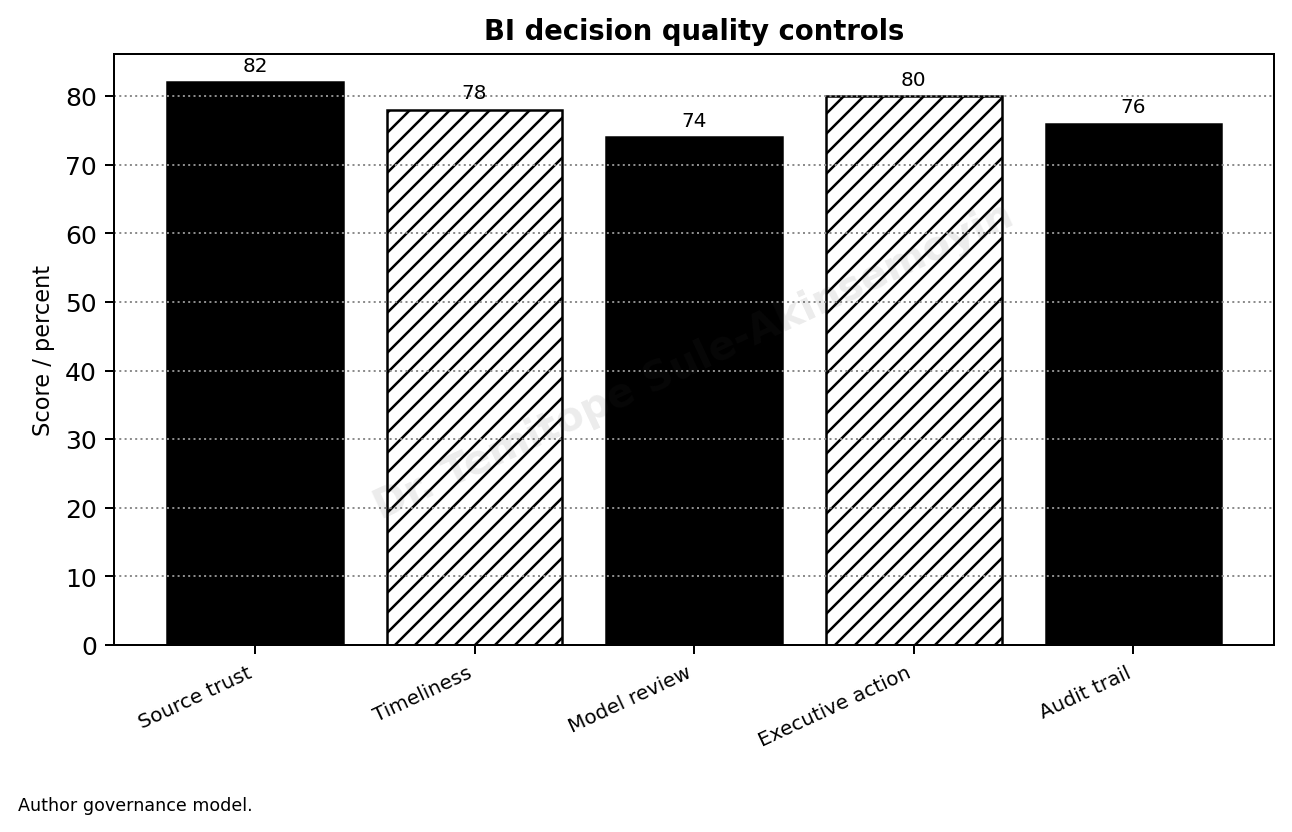
NYCAR Peer Review and Publication Status

This research publication has passed NYCAR’s doctoral-level peer review and editorial assessment for the June 2026 Research Edition. The review examined the strength of the research problem, the originality of the applied argument, the currency of the United States marketing evidence, the case-selection logic, the source discipline, the usefulness of the diagnostic models, the APA 7th referencing, and the fit between the study’s claims and professional marketing practice.

The reviewer found that the publication moves beyond campaign description and treats strategic marketing as a governance discipline. Its strongest contribution is the framing of branding as earned market trust in an AI-mediated market, where visibility, automation, creator reach, retail media, and performance metrics can all become dangerous when they are separated from proof. The work shows mature command of current marketing pressure in the United States and connects public evidence to executive decision-making rather than relying on platform fashion or promotional language.

The case treatment is appropriate for doctoral-level applied research. Apple, Patagonia, Starbucks, The New York Times, Nike, Bud Light, and challenger-brand practice are not used as decorative examples. They are used to examine promise, proof, privacy, cultural authority, loyalty, customer experience, public risk, and institutional response under market pressure. The applied tools – including the Brand Trust Reliability Index, the Marketing Evidence-to-Action model, the AI Marketing Control Loop, and the Channel Discipline Review – give the publication practical value for senior marketing leaders, researchers, and public-facing organizations.

The publication is approved as a doctoral-level NYCAR research publication. Final Publication Number and DOI may be inserted by the issuing office when assigned. The reviewer recommends publication because the work is coherent, current, professionally useful, and written with the level of judgment expected of a doctoral research output in strategic marketing and branding.

Copyright © June 2026 Samuel Benson. All rights reserved. New York Center for Advanced Research (NYCAR).

Abstract

American marketing is no longer short of instruments. Impressions can be bought, copy can be generated at scale, creators can lend reach, retail media can reach the shopper close to purchase, and AI systems can now shape what customers see before they reach a company’s own site. The shortage is elsewhere. It lies in believable proof: the evidence that a brand’s public claims, product conduct, data practice, service experience, pricing, and leadership response can withstand ordinary customer scrutiny.

This doctoral research publication studies strategic marketing and branding in the United States as a problem of earned market trust. It draws on public evidence from IAB/PwC, Gartner, Pew Research Center, Edelman, the Federal Trade Commission, company reporting, and selected U.S. brand cases including Apple, Patagonia, Starbucks, The New York Times, Nike, Bud Light, and challenger-brand practice. The cases are not treated as heroic campaign stories. They are examined for what they reveal about promise, proof, cultural authority, privacy, customer experience, channel discipline, and institutional response under pressure.

The paper develops four applied tools: a Brand Trust Reliability Index, a Marketing Evidence-to-Action model, an AI Marketing Control Loop, and a Channel Discipline Review. These tools are intended for executives, CMOs, brand leaders, researchers, and public-facing institutions that need marketing to support growth without exhausting the conditions that make growth durable. The central claim is deliberately strict: attention is not demand, visibility is not trust, and a brand begins to deserve confidence only when it makes claims the organization can prove, then proves them repeatedly in the customer’s actual experience.

Keywords: strategic marketing, branding, United States, brand trust, AI marketing, customer experience, cultural authority, privacy, creator economy, marketing governance, NYCAR

Table of Contents


List of Tables

Table 1. Chapter structure and applied purpose 8

Table 2. U.S. case-study portfolio 17

Table 3. Strategic brand assets and management questions 21

Table 4. Channel portfolio decision rules 31

Table 5. Brand Trust Reliability Index 40

Table 6. AI marketing governance controls 41

Table 7. Implementation blueprint 44

List of Figures

Figure 1. U.S. digital advertising revenue, 2024-2025 13

Figure 2. Selected U.S. social platform use in 2025 21

Figure 3. Growth in selected platform use, 2021-2025 25

Figure 4. Marketing budget share as a percentage of company revenue 30

Figure 5. Global trust in major institutions, 2025 32

Figure 6. U.S. adults’ social media news frequency in 2025 35

Figure 7. Regular news use by social platform in 2025 36

Chapter 1: Introduction: Marketing After the Attention Chase

1.1 Strategic Problem

American marketing has outgrown the old comfort of being seen. Visibility still matters, but it no longer settles much. A brand can appear in a feed, rank in search, sponsor a creator, send a personalized email, or surface inside an AI-generated answer without earning any deeper confidence. The customer may notice the company and still doubt the claim, resent the targeting, mistrust the data practice, or leave the moment a cheaper or clearer alternative appears.

The problem facing marketing leaders is not tool scarcity. It is the widening distance between what firms can say quickly and what they can carry honestly. A campaign can lift short-term response while training customers to wait for discounts. A personalization system can appear sophisticated while feeling invasive. A creator partnership can look culturally current while borrowing intimacy the brand has not earned. Activity can rise while patience falls.

This study defines strategic branding as earned market trust. Logos, slogans, launch films, creator rosters, loyalty offers, retail-media buys, and AI content systems are instruments. The brand itself is the market’s working judgment about whether the organization is recognizable, useful, fair, competent, and worth returning to. That judgment is formed in ordinary encounters: the product used at home, the refund handled under pressure, the data request the customer did not expect, the price increase, the support transcript, the employee who carries the promise at the front line.

The United States is a demanding setting for this argument because customers do not meet brands in one place. They move between search, social platforms, retail platforms, private messaging, creator recommendations, Reddit threads, news coverage, app notifications, in-store experience, and now AI-mediated summaries. A person can admire a company’s values, dislike its pricing, tolerate its app, distrust its tracking, and still buy from it on a busy weekday. Brand meaning is assembled across these moments; management rarely controls all of them.

The familiar separation between brand and performance is therefore too crude. Performance without memory becomes extraction. Brand without accountable growth becomes expensive self-expression. The harder task is to create demand while preserving the conditions that allow demand to continue: relevance without intrusion, cultural participation without costume, automation without abandonment, loyalty without coercion, and scale without carelessness.

Budget pressure sharpens the issue. Gartner reported that 2025 marketing budgets remained flat at 7.7 percent of overall company revenue, while IAB/PwC reported that U.S. digital advertising revenue reached nearly $300 billion in 2025, a 13.9 percent year-over-year increase. The field is not shrinking; it is becoming more crowded, more measured, more automated, and less forgiving. More money moving through digital channels does not reduce strategic risk. It raises the cost of weak judgment.

1.2 U.S. Market Evidence

Trust sits beneath these pressures. Edelman’s 2025 Trust Barometer framed public life around grievance and institutional suspicion. Marketing cannot stand outside that mood. When people assume manipulation, disclosure matters more. When platforms reward outrage, cultural risk becomes easier to trigger. When AI fills the market with competent-looking content, proof becomes more valuable than polish.

The governing claim of this study is simple but not soft: strategic marketing is the management of demand under conditions of distrust. That does not mean timid communication. It means that creative work is tied to responsibility, claims are tested against operations, and campaign success is not declared until its effects on trust, customer experience, employee burden, and long-term meaning are understood.

The publication also rejects several flattering myths. It does not treat every new platform as a revolution. It does not reduce branding to aesthetics. It does not present AI as a cure for judgment. It does not assume that purpose language creates moral authority. It does not confuse customer data with customer understanding. These mistakes are common because they make marketing feel powerful without asking whether the organization deserves the power it is using.

The chapters that follow build an applied argument through current evidence and U.S. cases. Apple shows the discipline created by a privacy promise. Patagonia shows the difference between purpose speech and purpose structure. Starbucks shows how loyalty technology can both deepen and strain customer relationship. The New York Times shows the commercial value of repeated usefulness. Nike shows the work required to renew cultural authority. Bud Light shows the cost of entering contested meaning without enough readiness. Challenger brands show that distinctiveness can open attention, but proof has to keep it open.

The institutional problem is that marketing teams often speak about customers while reporting through internal score systems that reward volume, speed, and efficiency. That structure can teach teams to optimize what executives can see rather than what customers will remember. A serious marketing function needs the authority to slow a campaign when the proof is weak, reject a targeting tactic when permission is doubtful, and tell leadership when a brand problem is operational rather than communicative.

The attention chase survives because it is easy to report. Reach has a number. Impressions have a number. A campaign slide can make activity look like progress. Trust is harder to display. It appears in lower discount dependence, repeat purchase without begging, willingness to forgive an error, fewer angry contacts, better referral, and the quiet fact that customers come back. Strategic marketing has to defend those quieter signals because much of brand strength lives there.

Table 1. Chapter structure and applied purpose.

Chapter Focus Practical use
1 Marketing after the attention chase Frames marketing as proof rather than visibility.
2 Evidence base and concepts Connects trust, AI, privacy, social media, and brand equity.
3 Method and U.S. case design Explains source use, case selection, and applied diagnostics.
4 Demand and trust governance Defines brand promise, evidence, channels, and measurement.
5 U.S. case studies Tests the argument against practical brand cases.
6 AI, search, social, and creators Places discovery and persuasion under trust control.
7 Brand risk and culture Links compliance, privacy, crisis, and public accountability.
8 Applied models Provides tools for executive and classroom use.
9 Implementation Translates the research into operating routines.
10 Final position States the publication’s institutional argument.

1.3 Institutional Claim

Imitation intensifies the problem. When one brand succeeds through humor, social conviction, short video, founder storytelling, or AI-supported personalization, competitors often copy the visible form and miss the permission beneath it. The original may have earned a tone over years of customer intimacy; the imitator borrows the tone without the relationship. The market reads the move as costume.

Internal incentives deserve equal scrutiny. A campaign that lifts quarterly response can train customers to delay purchase. A lead program can satisfy a sales dashboard while filling the pipeline with weak prospects. A creator activation can look fashionable in a board presentation while feeling like paid intrusion to the audience. Strategy has to inspect what the organization rewards, because the brand eventually obeys those rewards.

Brand discipline is a form of institutional courage. It is easier to approve more content than to repair a broken service step. It is easier to buy a trend than to admit the organization lacks authority in the culture it wants to enter. It is easier to automate replies than to staff support properly. Marketing becomes valuable when it refuses the easier answer and forces the firm to face the condition that limits demand.

Brand time also differs from campaign time. Campaigns arrive in bursts; brands accumulate. Customers remember whether a promise was kept, whether the product worked, whether the company acted fairly when it had an advantage, whether a complaint received a human answer, and whether the next message respected what happened last time. Launch days matter, but ordinary days carry more evidence.

Platform systems complicate this by rewarding emotional intensity more reliably than institutional truth. Outrage, novelty, satire, and conflict move quickly. Repair, accuracy, and service quality often move slowly. The answer is not blandness. The answer is to choose intensity the brand can carry without pretending.

Popularity and authority are not the same asset. Popularity brings contact. Authority shapes how seriously people take what they find. A brand can be popular because it is amusing, cheap, controversial, convenient, or unavoidable. It becomes authoritative when customers believe it has earned a place in the decision.

A doctoral treatment of marketing has to make room for discomfort. Many brand failures begin in polite rooms where people know the promise is too broad, the evidence too thin, the timing too rushed, or the audience too poorly understood. The work keeps moving because stopping it would embarrass someone powerful. Strategic marketing needs a culture in which stopping weak work is protection, not obstruction.

Chapter 2: Evidence Base and Conceptual Foundations

2.1 Trust, Brand Equity, and Customer Experience

Strategic marketing has always been caught between commerce and meaning. The commercial side asks whether the organization can generate demand, protect margin, and convert attention into revenue. The meaning side asks whether the organization occupies a credible place in the customer’s mind and social life. Weak marketing treats these as separate assignments: one team buys media and another team guards the brand. Strong marketing understands that revenue and meaning work together. A sale made through pressure, deception, or disappointment can reduce future demand. A brand story with no path to purchase can become admiration without business value. The strategic task is to hold both realities without letting one excuse failure in the other.

Brand equity literature gives this publication a durable foundation. The most useful insight is that a brand is an asset because it reduces uncertainty. Customers use brands to make choices under imperfect information. A strong brand signals expected quality, social identity, service promise, moral stance, price logic, and future reliability. Yet the signal works only when experience keeps confirming it. Advertising may introduce a promise, but repeated customer encounters decide whether the promise becomes equity. This is why brand value can be damaged by slow service, confusing returns, poor app design, weak employee training, and careless data handling. The customer does not separate those failures from the brand. The customer experiences the organization as one system.

The evidence from current marketing practice shows a field under compression. Gartner’s 2025 CMO Spend Survey found marketing budgets flat at 7.7 percent of company revenue, which means marketing leaders have to absorb new technology costs and channel demands without assuming generous expansion. The CMO Survey has repeatedly shown the difficulty of proving marketing impact, especially when the pressure for short-term returns crowds out investment in brand memory, customer experience, and capability building. These findings matter because strategy always has a budget. When resources are tight, an organization reveals what it truly believes about marketing. It either protects the work that creates future demand or it reduces marketing to the most measurable short-term tactics.

The digital advertising market has not paused. IAB and PwC reported that U.S. digital advertising revenue reached $294.6 billion in 2025, with strong growth in social, video, commerce media, and automated buying. That scale explains why marketers are drawn to data-intensive performance systems. The temptation is clear: if behavior can be tracked, audiences can be segmented; if audiences can be segmented, offers can be tuned; if offers can be tuned, waste can be reduced. The weakness appears when measurement is mistaken for understanding. A platform can tell a company what a customer clicked. It cannot always tell whether the click increased respect, depleted patience, created regret, or made the brand feel intrusive.

Trust research cuts through this confusion. The Edelman Trust Barometer is useful because it reminds marketers that brand reception does not occur in a neutral public mood. Customers bring suspicion, economic anxiety, social conflict, and personal experience into every interaction. A brand that asks for data, loyalty, attention, or moral approval has to earn those things in a climate where institutions are often doubted. This is especially important for organizations using AI. When customers suspect that automated systems are designed mainly to reduce company costs, self-service can feel like abandonment. Forrester’s 2026 B2C predictions warned that a meaningful share of brands could erode trust through self-service AI, a warning that needs to be read as a management issue rather than a technology headline.

Consumer media behavior also complicates brand planning. Pew Research Center’s 2025 social-media reporting shows continued broad use of major platforms and growth in several platform communities. The practical meaning is fragmentation. There is no single American audience waiting in one media channel. YouTube may provide broad reach, Instagram may shape visual desire, TikTok may accelerate discovery, Reddit may influence evaluation, LinkedIn may support professional authority, and email may remain the quiet engine of retention. A strong brand does not chase every platform with the same message. It understands what kind of customer decision each space supports.

2.2 AI, Media Fragmentation, and Privacy

The creator economy has made this harder. Creators can give brands cultural closeness that conventional advertising often lacks. They can explain products, demonstrate use, tell stories, and build trust through repeated contact with a specific audience. Yet creator marketing carries special risk because the audience’s trust is borrowed, not owned. If disclosure is weak, the arrangement becomes deceptive. If creative control is too tight, the creator’s credibility falls. If a creator’s public conduct shifts, the brand inherits part of the damage. FTC endorsement guidance matters here because the legal issue reflects a deeper trust issue. Customers have to know when persuasion is being paid for.

AI introduces a more serious problem: the automation of persuasion. Industry commentary on agentic AI, marketing automation, and generative content points to real gains in workflow speed, personalization, and customer engagement. Those gains do not remove the need for judgment. AI lowers the cost of overproduction. It can generate plausible copy faster than an organization can verify the claim, personalize in ways that customers experience as surveillance, and produce brand language that sounds polished while knowing little about the institution behind it. Marketing leaders have to govern AI as a public-facing capability, not a private productivity shortcut.

Privacy sits at the center of that governance. Apple’s public privacy positioning offers a useful case because the company links privacy to product design and core values rather than treating it as a legal notice buried at the edge of the customer journey. That does not mean every company can copy Apple. Few have the same control over hardware, software, services, and brand power. The strategic lesson is narrower and more transferable: a privacy claim becomes credible when the company can show product choices, policies, and customer controls that match the promise. A privacy claim that is contradicted by aggressive tracking, obscure consent, or data-sharing surprises will fail.

Purpose branding also requires care. Patagonia has become an unavoidable case because its ownership transfer gave its environmental claim institutional weight. The organization did not simply run a campaign about climate concern; it changed the way ownership and profit distribution would support the mission. That decision does not make every Patagonia action immune from scrutiny. It does show that purpose is strongest when it changes legal, financial, and governance commitments. Most brands speak purpose more easily than they redesign the company around it. Customers increasingly notice the difference.

A final foundation is crisis learning. Brand crises are often discussed as communication failures. Sometimes they are. More often, communication exposes a deeper contradiction: between customer groups, between stated values and operational conduct, between speed and review, between cultural ambition and internal readiness. Bud Light’s 2023 controversy is a sharp example of how cultural signaling can become a brand crisis when audience expectation, internal decision-making, political conflict, and executive response collide. The case is not useful because it offers an easy ideological lesson. It is useful because it shows how a brand can lose control of meaning when it has not prepared for contested interpretation.

The literature on customer experience strengthens this point. Customer experience is not a mood board or a service aspiration; it is the sequence through which customers test whether a brand is worth believing. The sequence may include search, comparison, purchase, delivery, setup, use, support, renewal, cancellation, and recovery after error. Many companies measure pieces of this journey but fail to interpret the whole. A customer may rate one interaction well and still feel the brand is exhausting. A strategic marketing system reads friction patterns, not isolated satisfaction scores.

Figure 1. U.S. digital advertising revenue, 2024–2025.

Source: IAB/PwC Internet Advertising Revenue Report, Full Year 2025; IAB/PwC Full Year 2024 report. Copyright © June 2026 Samuel Benson. All rights reserved.

2.3 Purpose, Crisis, and Source Limits

Brand equity is also tied to price. A trusted brand can often hold price because customers believe the difference is real. A weak brand has to discount, shout, bundle, or chase novelty. This does not mean premium pricing is always good. It means that price is a referendum on perceived proof. When consumers stop believing that the brand offers meaningful difference, price becomes the main argument. The marketer then faces the dangerous task of buying demand with margin.

The same logic applies to loyalty. Membership does not equal loyalty. A customer may join a program for savings, convenience, or habit while feeling no attachment to the brand. A loyalty program becomes strategic when it increases mutual value: the customer receives relevant benefit and the company receives permission to serve better. It becomes extractive when the firm uses membership mainly to harvest data, complicate pricing, and push offers that train the customer to distrust regular value.

Academic work on market orientation remains relevant because it insists that firms listen to customers and competitors. Yet listening has become more difficult. The loudest customers are not always representative. The most measurable behavior is not always the deepest need. The most viral complaint may or may not indicate widespread experience. Strategic marketers have to combine listening channels: behavioral data, direct interviews, ethnographic observation, frontline insight, sales feedback, support data, and cultural reading. No single source is enough.

Regulatory evidence belongs in a marketing literature review because law often reveals where industry practice has become careless. FTC action on AI claims, reviews, endorsements, and deceptive design needs to be read as a signal about public harm. The best brands will not wait for enforcement to tell them that customers deserve truth. They will treat legal standards as the public floor and brand ethics as the operating ceiling.

Marketing theory also needs to keep the customer’s economic pressure in view. Inflation, debt, housing cost, healthcare cost, and employment uncertainty shape how people hear brand messages. A premium message may sound aspirational in one moment and insulting in another. A discount may attract customers while also teaching them to wait. A value claim therefore has to be precise. Value is not the same as cheapness. It is the customer’s judgment that the benefit, risk, effort, and price make sense.

The strongest literature for this paper is the work that refuses to separate brand meaning from organizational capability. Brand promise, market orientation, service quality, customer experience, and trust research all point toward the same conclusion: the market judges the company as a whole. A marketing department may own the campaign calendar, but it does not own all the evidence customers use. This is why strategic marketing belongs in executive governance.

Marketing research also has to become more attentive to exhaustion. Customers are exposed to prompts, offers, alerts, subscriptions, loyalty messages, creator endorsements, and automated recommendations across the day. The result is not unlimited openness to persuasion. It is fatigue. A brand that respects attention may become more distinctive precisely because it does not treat every contact point as a chance to push.

Chapter 3: Methodology and U.S. Case-Study Design

3.1 Research Design

This study uses an applied documentary and case-study method. It does not claim proprietary interviews, confidential brand data, or internal corporate files. The evidence base consists of public institutional reports, industry data, regulatory guidance, company statements, annual reporting, reputable journalism, and peer-reviewed or professional marketing analysis where available. This is appropriate for the purpose of the paper because the central concern is not to rank brands by secret performance metrics. The concern is to build a practical decision structure for marketing leaders who has to connect public claims, customer experience, and institutional conduct.

The case selection follows four criteria. Each case had to be U.S.-centered or deeply active in the U.S. market. Each had to show a distinct strategic problem rather than repeat the same lesson. Each had to involve more than advertising execution. Each had to give practical value to managers, students, and institutional leaders. Apple was selected for privacy as brand governance. Patagonia was selected for purpose backed by ownership structure. Starbucks was selected for loyalty, convenience, and experience strain at scale. The New York Times was selected for subscription brand trust and habit-building. Nike was selected for cultural authority and performance pressure. Bud Light was selected for brand meaning under political conflict. Challenger-brand practice was selected to examine category disruption and attention risk.

The method reads cases through management questions rather than campaign admiration. What promise did the brand make? What institutional evidence supported the promise? Which customer group interpreted the promise favorably or unfavorably? Which channels amplified the claim? What operational system had to carry the message after the campaign ended? What risk did the brand accept? What would a manager need to monitor before scaling a similar move? These questions keep the analysis grounded. They prevent the common habit of treating famous brands as inspirational stories detached from the conditions that made their choices possible.

The paper also develops diagnostic tools. The Brand Trust Reliability Index asks whether a brand can be believed across promise, experience, proof, privacy, response, and memory. The Marketing Evidence-to-Action model examines whether customer evidence leads to real decisions. The AI Marketing Control Loop sets conditions for safe use of AI in customer-facing marketing. The Cultural Relevance and Trust Matrix helps leaders distinguish between attention that carries authority and attention that creates fragility. These models are not presented as validated statistical instruments. They are proposed as management tools that make strategic judgment visible and open to review.

Quantification is used carefully. Marketing is full of numbers, but not every number deserves authority. A click-through rate can improve while customer respect declines. A sentiment score can rise briefly after a campaign while churn remains hidden. A loyalty membership count can grow while member profitability weakens or service expectations become harder to meet. The models in this publication therefore combine quantitative signals with qualitative review. They ask managers to place evidence beside judgment rather than allowing either to dominate the other.

3.2 Case Selection Logic

Source integrity is a central methodological concern. Industry reports often serve commercial audiences and may emphasize trends that support consulting, technology, media, or platform services. Company reports may frame performance in favorable terms. Regulatory guidance may define legal duties without resolving wider ethical questions. News coverage may highlight conflict more than routine execution. These limitations do not make the sources unusable. They require disciplined reading. A claim from a company is treated as evidence of the company’s public position, not proof that customers experience the brand as promised. A consulting forecast is treated as an indicator of strategic pressure, not as destiny.

The U.S. focus also requires attention to institutional pluralism. Branding in the United States is shaped by federal and state regulation, class and regional variation, racial and cultural history, digital platform power, polarized politics, shareholder pressure, labor markets, and high consumer expectations for convenience. A brand can be loved by one segment and distrusted by another. It can gain cultural energy on one platform and become a target on another. It can run the same campaign nationally and receive different local meanings. Strategic marketing therefore has to read the market as contested, not as a single audience waiting for persuasion.

The paper’s practical value lies in translation. A mid-sized university, hospital, nonprofit, civic institution, technology firm, retail brand, or public agency cannot simply copy Apple, Patagonia, or Starbucks. The budgets, control systems, talent pools, customer bases, and public expectations differ. What can be transferred are decision principles: make a promise that operations can carry; treat data practice as brand conduct; test cultural participation before scale; measure trust as well as reach; protect disclosure; keep human review inside AI-supported marketing; use customer complaints as intelligence; and repair the system rather than only changing the language.

The method also rejects a narrow view of creativity. Creativity is more than the production of striking campaigns. It is the ability to solve the market problem without injuring trust. Sometimes the creative act is restraint. Sometimes it is a better service script, a clearer return policy, a more honest pricing page, a better product photograph, a calmer executive response, or a loyalty offer that respects customers rather than trapping them. Strategic marketing has to make room for these quieter forms of creativity because they are often the ones that preserve brand value.

Finally, the publication is written for applied use. Each case is connected to management controls. Each model is followed by questions that can be used in review meetings. Each table is meant to help leaders identify evidence, responsibility, and risk. The goal is not to make marketing sound more academic. The goal is to make marketing harder to misuse. A discipline that can shape desire, identity, trust, and spending needs to be held to a serious institutional standard.

The case method also allows this publication to examine failure without turning failure into scandal. Marketing education often overuses heroic cases because they are easier to teach. The Apple launch, the Patagonia decision, the Nike campaign, the Starbucks loyalty machine, or the successful challenger brand can be made to look inevitable after the fact. A serious case method keeps contingency alive. It asks what could have gone wrong, what conditions were necessary, which risks were hidden, and where transfer to another organization would be irresponsible.

Table 2. U.S. case-study portfolio.

Case Strategic issue Core lesson
Apple Privacy as brand promise Privacy gains force when product choices support public language.
Patagonia Purpose and ownership Purpose becomes credible when it changes firm rules.
Starbucks Loyalty and experience strain Digital relationship must not erase store meaning.
The New York Times Subscription trust and habit Repeated usefulness can turn brand trust into daily use.
Nike Cultural authority and renewal Heritage must be replenished through current product and meaning.
Bud Light Contested cultural signaling Audience mapping and response discipline are strategic controls.
Challenger brands Category disruption Distinctiveness opens attention; proof sustains demand.

3.3 Evidence Handling

The research design also separates brand intention from brand reception. Leaders may intend to signal inclusion, sustainability, innovation, care, courage, or simplicity. The market may receive the signal differently because of history, audience identity, media framing, competitive attack, political context, or prior disappointment. Strategic marketing does not control reception, but it needs to anticipate plausible readings. A campaign review that asks only whether the internal team likes the work is not a market review.

Each case is read through three layers: the visible marketing act, the institutional support behind it, and the trust consequence. The visible act may be a campaign, product claim, loyalty system, ownership change, cultural partnership, or media strategy. The support layer asks what operations, policies, people, incentives, and data systems carry the act. The trust layer asks whether the act strengthens, weakens, or complicates the relationship with customers and the wider public.

The study also treats silence as data. If a brand says little about a material concern, that absence can shape trust. Silence around privacy, labor conditions, accessibility, product safety, or error correction may be interpreted as avoidance. At the same time, not every issue requires public speech. The strategic question is whether silence protects truth or hides weakness. Case analysis helps clarify this difference by connecting speech, action, and consequence.

The models are intentionally transparent because marketing teams already face too many black boxes. Attribution tools, platform algorithms, AI systems, and vendor dashboards can make decision-making feel technical while hiding assumptions. A useful diagnostic needs to be understandable enough for a CMO, CFO, general counsel, store leader, data scientist, and customer-service manager to debate together. If a model cannot be challenged by the people affected by it, it cannot guide major brand decisions.

The method also gives special weight to negative evidence. Customer complaints, cancellations, backlash, staff warnings, regulator action, and failed campaigns are often more instructive than polished success stories. They show where the brand promise meets reality. A research publication that only studies success would flatter marketing. This paper treats friction as evidence because the market often tells the truth through resistance.

Because the publication is applied, it also treats managers as moral actors. Marketing decisions are sometimes presented as neutral optimization choices, but they can affect privacy, self-image, household spending, public debate, and institutional trust. The case method keeps those effects visible. It asks what kind of market behavior the organization is encouraging and whether that behavior is defensible if described plainly.

Chapter 4: Strategic Marketing as Governance of Demand and Trust

4.1 Demand Governance

Strategic marketing becomes serious when it accepts that demand is not simply found in the market. Demand is formed through need, memory, social meaning, price, habit, availability, trust, and timing. A customer may want a product before seeing a campaign because the problem is urgent. Another may buy after years of exposure because the brand has become familiar. Another may refuse the brand after a public controversy, even if the product remains useful. The work of marketing is to manage these conditions with discipline. The work of branding is to make the organization recognizable and believable across time.

This is why the marketing function needs to be seen as a governance function. It governs the promise the organization makes to the market. It governs the evidence used to support that promise. It governs the boundaries of persuasion. It governs data use, channel conduct, sponsorship, cultural participation, customer feedback, and public response. In weak organizations, marketing is brought in near the end to make the work attractive. In stronger organizations, marketing is involved early enough to ask whether the proposed product, service, or policy can survive customer scrutiny. That timing matters. A promise made after the fact often becomes cosmetic. A promise built into the product and service system becomes strategic.

Demand governance begins with the promise. A brand promise needs to be short enough to remember and concrete enough to test. “We are customer-centered” means little until it is tied to wait time, refund behavior, product reliability, complaint handling, accessibility, and staff training. “We care about privacy” means little until it is tied to data minimization, permission, security, and meaningful customer control. “We support communities” means little until communities can see resources, participation, listening, and accountability. The test of a promise is not whether it sounds attractive. The test is whether the organization knows what would count as violating it.

The next element is audience discipline. Many brands talk about the audience as though it were a demographic cluster. Serious audience work is more complex. Customers have jobs to be done, fears, routines, identity concerns, social pressures, budget limits, and trust thresholds. A parent buying healthcare services is more than a consumer. A small-business owner choosing software is more than a lead. A student comparing universities is more than a prospect. Marketing fails when it strips people down to conversion targets and then acts surprised when they resist being treated that way.

Channel discipline follows. Every channel has a moral and practical character. Search captures intent. Social platforms shape visibility and social proof. Creator channels borrow personal trust. Retail media influences purchase close to the shelf. Email sustains relationship when used with restraint. Events create embodied memory. AI answer tools may soon shape what customers believe is true before they ever reach a company website. A marketing strategy that pushes the same content into every channel is not integrated. It is careless. Integration means that the organization understands what decision each channel supports and what risk it carries.

Measurement needs similar discipline. Marketing teams often inherit dashboards that reward activity because activity is easy to count. Impressions, views, clicks, leads, opens, and engagement can help diagnose performance, but they do not prove brand strength. A serious measurement system needs to include memory, trust, conversion quality, retention, complaint patterns, referral, share of search, customer lifetime value, and experience data. It also needs to include negative signals: unsubscribe, review decline, support burden, return rates, misleading attribution, audience fatigue, and staff reports that the campaign has increased operational strain.

A brand trust review needs to be part of executive governance. The review asks whether the brand promise remains accurate, whether customers experience it consistently, whether recent campaigns created unrealistic expectation, whether data practice matches public language, whether creator and affiliate relationships are properly disclosed, whether AI-generated content has human review, and whether complaints are being read as early warning. These questions are not bureaucratic. They are the difference between reputation as memory and reputation as fantasy.

4.2 Brand Promise and Internal Alignment

Brand strength also depends on internal alignment. Employees are often the first people asked to deliver a promise and the last people consulted before it is made. This is a costly error. A bank cannot advertise care while understaffing branches and call centers. A hospital cannot brand compassion while burning out nurses. A university cannot promise student success while advising systems are overwhelmed. A retailer cannot advertise hospitality while store teams are measured only by speed. The employee experience does not sit outside branding. It is one of the routes through which the brand becomes real.

The relationship between marketing and operations is therefore central. Operations often see marketing as overpromising. Marketing often sees operations as slow and unimaginative. Both criticisms may contain truth. Strategic leadership has to force the conversation into evidence. Which promises are customers responding to? Which promises are staff struggling to carry? Where are complaints concentrated? Which operational fixes would improve conversion more than another campaign? Which campaigns are creating demand the system cannot fulfill? A brand grows stronger when those questions are asked before the market punishes the gap.

The Brand Trust Reliability Index proposed in this publication turns that judgment into a disciplined audit. Its scored form is: BTRI = [(PC + EC + ES + PF + RI + MD) / 6] – CP. PC is promise clarity, EC is experience consistency, ES is evidence strength, PF is privacy fairness, RI is response integrity, MD is memory durability, and CP is contradiction pressure. Each positive component is scored from 0 to 5; contradiction pressure is scored from 0 to 5 and subtracted after the average is calculated. The index is not a universal law of brand trust. It is a management instrument that prevents a team from hiding a serious weakness behind strong campaign performance.

Strategic marketing also carries a social duty. Persuasion is not neutral. It shapes desire, norms, fear, aspiration, and public attention. A company that markets financial products, health services, education, food, technology, or political information can affect life chances and public trust. Even consumer brands outside high-stakes sectors participate in cultural meaning. This does not mean marketing becomes timid. It means marketing leaders need to understand the power they exercise. The most dangerous marketer is not the creative person. It is the marketer who believes creativity has no duty to truth.

The practical conclusion is demanding but simple. Marketing leaders need to stop asking only, “Will this work?” They ask, “What kind of demand will this create, what proof will be required, who will carry the promise, what trust could be lost, and what will we do if the public reads this differently from our intention?” Those questions do not weaken creativity. They protect it from becoming noise, manipulation, or institutional self-harm.

Demand governance also requires saying no. Many marketing problems begin when a brand says yes to every audience, every trend, every platform, every seasonal opportunity, and every internal request. The result is a brand with no center. Customers receive fragments rather than a coherent promise. Staff become busy maintaining activity rather than making strategic choices. Saying no is not a lack of ambition. It is the act that protects meaning from dilution.

The CMO’s role is changing because this governance work crosses departmental lines. A modern CMO has to understand media economics, analytics, AI, privacy, customer service, product truth, cultural risk, pricing signals, and organizational politics. The role cannot be reduced to creative taste. Creative taste remains important, but it has to sit beside evidence discipline and institutional influence. A CMO who cannot move operations will struggle to protect the brand promise. A CMO who cannot respect creativity will reduce the brand to process.

Table 3. Strategic brand assets and management questions.

Asset Management question Evidence to request
Promise What exactly are we asking customers to believe? Public claims, product proof, service standards.
Memory What does the market already associate with us? Brand tracking, search behavior, repeat use, customer language.
Trust Where could our conduct contradict our words? Complaints, privacy review, crisis history, service failures.
Attention Which attention helps demand rather than noise? Channel role, audience fit, conversion quality.
Experience Can the organization deliver the promise repeatedly? Journey data, frontline evidence, quality measures.
Permission What data and attention have customers truly granted? Consent flow, preference controls, unsubscribe data.

Figure 2. Selected U.S. social platform use in 2025.

Source: Pew Research Center, Americans’ Social Media Use 2025. Copyright © June 2026 Samuel Benson. All rights reserved.

4.3 Brand Trust Reliability Index

Finance has to be part of this conversation. Marketing teams often complain that finance does not understand brand value. Finance teams often complain that marketing cannot explain returns. Both sides have to improve. Marketing needs to show how trust affects retention, price, referral, and acquisition cost. Finance needs to recognize that some returns arrive through reduced future waste rather than immediate sales. A brand budget needs to be evaluated with both near-term and future-demand logic.

The product team is equally central. Product weakness cannot be solved with brand language for long. Marketing can position, educate, and dramatize value, but it cannot make a weak product excellent by describing it with confidence. Strong marketing sometimes begins by telling the organization that the product is not ready for the promise leadership wants to make. That conversation may be uncomfortable, but it protects money and reputation.

Customer service is the forgotten brand channel. A support agent who solves a problem fairly can preserve more trust than a campaign creates. A confusing chatbot can damage more trust than a campaign can repair. Support transcripts often contain the truth about brand gaps because customers speak there when the promise has failed. Marketing leaders reads those transcripts. They are not operational clutter. They are brand evidence.

Brand governance also needs to include the board in larger organizations. Boards often review financial risk, legal risk, and reputation after public trouble. They ask earlier whether the organization’s major claims are supported by evidence, whether AI use creates customer-facing risk, whether privacy practice matches values, and whether executive incentives encourage trust or only short-term growth. Brand stewardship is too important to be left only to campaign teams.

Brand governance is especially important for institutions that do not think of themselves as brands. Hospitals, universities, research centers, museums, libraries, public agencies, and nonprofits all depend on trust and public meaning. They may dislike the language of branding because it sounds commercial. Yet they still make promises, seek attention, recruit people, request funds, and ask communities to believe them. For such institutions, brand discipline protects mission from careless communication.

Governance also protects creativity from internal chaos. Creative teams do better work when they understand the promise, audience, proof, limits, and decision rights. Vague freedom often produces generic output because the team has no meaningful constraint. Clear strategy gives creative people something to push against. The best work usually comes from a tension between freedom and truth.

In practical governance, the strongest question may be the simplest: what would make this promise untrue? A company that cannot answer does not understand its own claim. Once leaders know what would violate the promise, they can design controls. They can train staff, review campaigns, monitor complaints, and stop overreach. A promise without a violation test is too soft to govern.

There is also a governance role for research. Research cannot be reduced to validating a preferred idea. It needs to be allowed to disappoint the brief. Customer interviews, concept tests, usability studies, and market analysis have value when leaders are willing to change direction. Research used only to decorate a decision already made is not research. It is internal theatre.

Chapter 5: U.S. Case Studies in Brand Promise and Institutional Proof

5.1 Apple, Patagonia, and Starbucks

Apple offers one of the clearest examples of privacy as brand position. The company’s public privacy language frames privacy as a core value and a human right. That phrasing is powerful because it elevates a technical issue into a moral and customer-experience claim. Yet the claim has force only because Apple can connect it to product choices, operating-system permissions, app tracking controls, security features, public policy statements, and a business model that differs from firms built primarily around advertising. Apple’s lesson is not that every brand becomes a privacy brand. The lesson is that a brand promise becomes stronger when it is supported by design, incentives, and repeated customer signals.

The risk in the Apple case is overextension. Once a company claims privacy as a core value, every data decision is read through that promise. Any exception, vulnerability, confusing setting, or partner practice can become a brand issue. This is not a weakness of the strategy. It is the price of credibility. A high-trust promise creates a higher standard. Marketing leaders need to understand that strong positioning narrows future freedom. A brand that claims care has to act with care. A brand that claims privacy has to accept the cost of restraint. A brand that claims simplicity has to fight internal complexity even when complexity is profitable.

Patagonia gives a different lesson: purpose becomes credible when governance changes. The company’s 2022 ownership transfer placed voting stock in the Patagonia Purpose Trust and nonvoting stock in the Holdfast Collective, with the public claim that profits not reinvested in the business would support environmental work. This moved the brand from ordinary purpose communication into institutional proof. Many brands speak about values during campaign cycles. Patagonia tied its claim to ownership and profit distribution. That does not eliminate debate about supply chains, pricing, accessibility, or the limits of consumption. It does show that purpose gains authority when the organization gives up something meaningful.

The Patagonia case matters because purpose marketing has been weakened by overuse. Consumers have seen too many campaigns where moral language rises faster than evidence. A brand may celebrate sustainability while pushing volume growth. It may support equality in advertising while tolerating inequity in leadership. It may speak of community while closing stores without local dialogue. Patagonia’s strength is not that it avoids all contradiction. No operating company does. Its strength is that the main claim is supported by a structural decision that customers and critics can inspect. Purpose becomes less fragile when it is spoken with restraint and built into the firm’s rules.

Starbucks shows the power and strain of relationship marketing at scale. Starbucks Rewards has tens of millions of active U.S. members, and the company has continued to refine the program as part of the customer relationship. The brand has long combined habit, convenience, personalization, store experience, and a sense of small personal ritual. The loyalty system is strategically valuable because it links data, payment, frequency, offers, and customer memory. It makes Starbucks less dependent on occasional advertising and more dependent on repeated use.

Yet loyalty at this scale carries a warning. A loyalty program can become a substitute for hospitality if the organization is not careful. Customers may enjoy rewards while also noticing long lines, mobile-order congestion, price increases, inconsistent store mood, or employee stress. The brand promise of a comfortable “third place” can weaken when the operational system feels like a pickup machine. Starbucks is useful precisely because it shows that loyalty technology cannot rescue experience indefinitely. If the app becomes the brand, the store loses some of its meaning. If the store becomes too strained, the app becomes a reminder of that strain.

The New York Times offers a case in subscription brand building. Its paid digital strategy depends on more than news. Bundles that include news, cooking, games, Wirecutter, audio, and sports create multiple reasons for repeated use. The brand’s economic logic is tied to habit and trust: customers return because the company offers a mix of authority, usefulness, routine, and identity. This is a different brand model from one built mainly on campaign bursts. It is a memory model. The product has to earn attention every day.

The risk for the Times is that brand trust is politically and culturally contested. News brands live under constant scrutiny from readers, critics, political actors, journalists, and subscribers. A bundling strategy can increase engagement while raising questions about whether the news brand becomes one part of a broader lifestyle subscription. That may be commercially sound, but it requires editorial clarity. The lesson for marketers is that diversification can strengthen revenue while complicating the meaning of the brand. A brand can become more useful and harder to define at the same time.

Figure 3. Growth in selected platform use, 2021–2025.

Source: Pew Research Center, Americans’ Social Media Use 2025. Copyright © June 2026 Samuel Benson. All rights reserved.

5.2 The New York Times, Nike, Bud Light, and Challenger Brands

Nike illustrates cultural authority under performance pressure. The company has often built brand power through athletic aspiration, athlete partnerships, design, and cultural fluency. Its strongest work has made customers feel that sport is a language of discipline, identity, and possibility. Yet cultural authority is difficult to maintain when the market shifts, competitors rise, wholesale and direct channels rebalance, product cycles slow, or consumers sense that storytelling is outrunning innovation. Nike shows why brand heritage cannot become a shield against execution risk. The market respects history, but it buys current relevance.

The Nike case is valuable because it undermines a lazy view of brand equity. A famous brand is not permanently safe. It can lose heat if product energy cools, if cultural signals feel recycled, or if distribution changes weaken discovery. Marketing leaders treats heritage as stored trust, not guaranteed trust. Stored trust can be spent. It can also be replenished through product excellence, credible athletes, retail experience, and customer communities. The brand that forgets to replenish begins to live off memory until the memory no longer sells.

Bud Light provides a crisis case in brand meaning. The 2023 controversy surrounding a social-media partnership became a national symbol far beyond the scale of the original promotion. The case is not useful as a simple instruction to avoid culture. Brands cannot avoid culture because audiences bring culture into their interpretations. The useful lesson is that cultural participation requires audience mapping, internal readiness, scenario review, executive discipline, and clear values. When controversy starts, evasive or inconsistent response can alienate several groups at once. A brand can appear cowardly to one audience and contemptuous to another.

The case also shows how a brand’s historical meaning can constrain future moves. Bud Light’s long-standing mass-market identity, humor, and broad social positioning created expectations among core customers. A sudden signal outside that expectation can be read as confusion, betrayal, or opportunism by some groups, while supporters of inclusion may see retreat as abandonment. Strategic marketing does not guarantee agreement, but it needs to reduce surprise inside the organization. Leaders need to know which audiences may object, which principles will guide response, and what the company is willing to defend before the public test arrives.

Challenger brands such as Liquid Death show how category convention can be attacked through tone, packaging, and cultural misfit. A canned water brand using the language of heavy metal, humor, and anti-plastic rebellion demonstrates that brand strategy can create interest in a category people assumed was dull. The deeper lesson is that distinctiveness still matters. Markets crowded with polished sameness create openings for brands that feel alive. Yet distinctiveness is not enough. The brand has to still deliver distribution, repeat purchase, price justification, and a credible reason to remain more than a joke. A challenger brand wins attention by breaking rules; it keeps value by proving that the rule-breaking serves a customer habit.

Across these cases, one conclusion holds. The strongest brands do not simply communicate differently. They organize themselves differently. Apple ties privacy to product control. Patagonia ties purpose to ownership. Starbucks ties loyalty to frequency and store behavior. The Times ties brand value to daily use and subscription depth. Nike ties meaning to sport, design, and cultural authority. Bud Light shows what happens when meaning becomes contested without enough response discipline. Challenger brands show the power and danger of distinctiveness. A strategic marketer needs to study the operating conditions, not the surface campaign.

Apple’s case also shows the advantage of consistency over time. A privacy position becomes stronger through repetition when repetition is backed by product behavior. Many brands abandon positions quickly when a new trend appears. Apple’s public language has been steady enough that customers and regulators know what standard the company has chosen for itself. Strategic marketers need to notice the value of staying with a hard promise long enough for the market to remember it.

Patagonia also teaches that brand purpose can limit customer base and still increase authority. A company that commits to environmental action may repel some consumers, attract others, and deepen loyalty among those who see the commitment as credible. Strategic branding does not require universal affection. It requires clarity about whose trust matters most and what the company is willing to risk to earn it. A brand that tries to be loved by everyone often becomes too vague to matter.

Starbucks reveals the tension between personalization and place. Its app can remember behavior, speed transactions, and support loyalty benefits. The store, however, remains a social and sensory environment. If digital convenience overwhelms the store’s human rhythm, the brand risks weakening one of its oldest sources of meaning. This is a lesson for all brands digitizing customer relationships: convenience cannot quietly erase the very experience customers valued.

5.3 Cross-Case Lessons

The New York Times case also demonstrates that trusted brands can extend when the extension respects the central relationship. Games, cooking, audio, product reviews, and sports can sit beside news because they increase daily habit and practical usefulness. The danger would be extension without editorial clarity. A brand extension makes the customer relationship richer, not blur the reason the brand was trusted in the beginning.

Nike’s difficulty is partly the burden of iconic status. A smaller brand can surprise because the market has fewer expectations. A famous brand has to renew itself while carrying decades of meaning. Every new campaign is judged against memory. Every product line is judged against the brand’s best work. This is why large brands need disciplined creative renewal, not nostalgia. The past can inspire, but it cannot do the current work.

Bud Light’s crisis also shows that mass brands face a special problem. They rely on broad acceptability, but the public sphere increasingly rewards sharper identity signals. A mass brand that enters a contested issue has to decide whether it is becoming more clearly defined or simply more exposed. Avoiding all meaning may make the brand empty. Entering meaning without conviction may make it vulnerable. The middle ground requires careful audience knowledge and executive steadiness.

Challenger brands need to be studied with equal skepticism. Their energy can make incumbents look slow, but their early attention may depend on novelty. Once novelty fades, the brand has to prove repeat value. The best challengers build supply, distribution, product quality, and community while the public is still laughing at the joke or admiring the difference. The weak ones confuse being noticed with being chosen.

Across the cases, the strongest strategic lesson is that brand authority is earned by cost. Apple bears the cost of privacy positioning. Patagonia bears the cost of purpose structure. Starbucks bears the cost of maintaining physical experience while scaling digital habit. The Times bears the cost of editorial trust. Nike bears the cost of constant renewal. Bud Light shows the cost of inadequate readiness. Marketing leaders asks what cost their brand is willing to bear. A promise with no cost is often just a phrase.

The cases also show that American brands now operate under audience surveillance. Customers, employees, journalists, creators, activists, investors, regulators, and competitors can all test claims publicly. This does not mean brands becomes defensive. It means the evidence file has to be ready. The public will ask whether the company can prove what it says. Strategic marketing prepares the proof before the question arrives.

These cases also warn against moral laziness. It is easy to praise Patagonia because its purpose seems admirable, or criticize Bud Light because the crisis was visible, or admire Apple because privacy is appealing. Strategic analysis needs to be colder and fairer. It asks how each brand tied claims to operating choices, how each prepared for risk, and what each case can teach without becoming a slogan. Admiration is not analysis.

The cases show that brands carry social memory. Apple inherits memories of design excellence and control. Patagonia inherits memories of environmental activism. Starbucks inherits memories of place and daily ritual. Nike inherits memories of sport and aspiration. Bud Light inherits memories of mass-market ease and humor. A new act is judged against that memory. Marketing leaders who ignore accumulated meaning are surprised by reactions that were predictable.

The cases also show that brand meaning is not always chosen by the brand. Customers complete the meaning through use, memory, and social conversation. Apple may intend privacy leadership, Patagonia may intend environmental commitment, Starbucks may intend daily ritual, and Nike may intend athletic possibility. Each meaning is still filtered through customer experience. The strategic marketer participates in meaning; the market finishes it.

Chapter 6: AI, Search, Social, Creators, and the New Visibility Problem

6.1 AI-Mediated Discovery

The visibility problem has changed. For years, marketers built around search rankings, paid social, email lists, retail placement, media buying, public relations, and influencer relationships. Those tools remain important, but AI-mediated discovery is altering the path by which customers encounter brands. A customer may ask an AI assistant for product recommendations, compare services through summarized reviews, receive synthesized advice drawn from multiple sources, or rely on a platform’s automated shopping support before visiting a brand’s own site. This does not end marketing. It changes where proof has to live.

Traditional search rewarded indexable content, authority signals, links, technical site health, and relevance to a query. AI answer systems reward some of the same things but may compress them into a response where the customer sees fewer sources and makes a judgment earlier. This means brands have to become easier to verify. Claims need to be consistent across owned sites, retail pages, help centers, reviews, expert coverage, knowledge bases, and trusted third-party references. A brand cannot depend on a beautiful website if the wider evidence field contradicts it. The marketing question shifts from “Can we be found?” to “Can we be trusted when we are summarized?”

This is a serious threat to content volume strategies. Many organizations have treated content as a production race. They publish articles, posts, guides, product pages, campaign pages, and keyword material with little editorial control. AI systems may expose the weakness of that approach because low-quality content can be ignored, flattened, or used in ways the brand does not control. The stronger response is not more content. It is better evidence: clear product information, transparent pricing, credible expertise, strong reviews, useful comparison material, accurate metadata, and customer-support content that answers real questions without promotional fog.

Social media remains central but more fragmented. Pew’s 2025 research confirms that U.S. adults still use major platforms at high levels while several platforms continue to grow among specific audiences. Marketers need to resist the urge to draw one simple lesson. YouTube, Instagram, TikTok, Facebook, Reddit, LinkedIn, Pinterest, and emerging platforms do different work. Some build awareness; some shape identity; some support search; some carry peer validation; some sustain professional authority; some influence purchase through creators. A brand that treats them as interchangeable pipes will waste money and weaken tone.

Creators add another layer. The creator is not simply a media slot. The creator is a relationship with an audience. That relationship may include trust, entertainment, skill, identity, taste, and community memory. When a brand enters it, the brand is borrowing social permission. The best creator work respects that permission. It gives the creator enough freedom to speak naturally, discloses the relationship clearly, and chooses partners whose audience has a real reason to care. Bad creator work turns people into ad surfaces and then wonders why engagement feels hollow.

The FTC’s endorsement guidance needs to be read beyond compliance. Disclosure is a trust practice. If the relationship is paid, materially supported, or otherwise connected to the brand, audiences deserve to know. Ambiguous tags, hidden disclosures, or artificial reviews may produce short-term gains, but they damage the public conditions that make creator marketing valuable. A market where people do not know what is paid becomes a market where all praise becomes suspect. The profession needs to defend disclosure because it protects the channel from decay.

Retail media has grown because it sits close to purchase. It offers targeting, measurement, and access to shopper behavior at a point where intent is high. For brands, this can be powerful. It can also narrow strategic thinking. If marketing spends too much energy at the conversion edge, the brand may underinvest in memory, meaning, and preference before the customer enters the store or retail platform. Retail media needs to be part of the channel portfolio, not the whole theory of demand. Customers often decide which brands are worthy before the sponsored product appears.

Figure 4. Marketing budget share as a percentage of company revenue.

Source: Gartner 2025 CMO Spend Survey. Copyright © June 2026 Samuel Benson. All rights reserved.

6.2 Social, Creators, and Retail Media

AI in marketing operations demands internal controls. Generative tools can produce copy, imagery, briefs, segmentation ideas, customer-service scripts, product descriptions, and creative variations. Agentic systems may help plan, test, and buy media. The advantage is speed. The risk is unsupervised scale. A wrong claim can travel quickly. A biased segment can distort targeting. A synthetic image can misrepresent the product. A chatbot can make commitments that the company cannot honor. A personalization engine can cross the line from helpful to invasive. Marketing leaders have to therefore create approval rules before AI becomes routine.

An AI Marketing Control Loop needs to include data source review, customer permission, purpose definition, model or tool assessment, human approval, legal and brand review for high-risk claims, live monitoring, customer feedback, and shutdown conditions. This may sound strict, but the alternative is worse. Once a public-facing AI system makes thousands of customer interactions, the brand inherits those interactions as conduct. A company cannot claim that the tool was separate from the brand. Customers experience the tool as the company.

The control loop needs to be risk-based. Low-risk internal brainstorming may need light review. Customer-facing claims about health, finance, employment, education, safety, or regulated products require stronger controls. Personalized offers based on sensitive inference require privacy review. AI-generated influencer avatars require disclosure and brand-safety review. Chatbots connected to service, refunds, or product recommendations require escalation paths to humans. The marketing function needs to work with legal, data science, product, and customer service rather than trying to govern these systems alone.

Email and owned channels deserve renewed respect in this environment. They may appear less glamorous than AI answer systems or social campaigns, but they give brands a direct relationship that is not entirely controlled by platforms. Yet direct access can be abused. Too many emails, irrelevant offers, confusing unsubscribe flows, or manipulative urgency teach customers to ignore or distrust the brand. Owned channels need to be treated as customer permission, not company property. A customer who shares an email address has not agreed to be exhausted.

The most mature marketing organizations will build a channel portfolio based on decision roles. Search captures expressed need. AI answer visibility supports early trust. Social content shapes culture and memory. Creator work borrows audience belief. Retail media closes demand near purchase. Email and loyalty maintain relationship. Events and stores create embodied experience. Public relations and earned media provide third-party validation. Community gives feedback and belonging. The discipline is knowing which role matters for which audience and which risk accompanies each channel.

A final warning is necessary. The future of marketing will be full of tools promising more automation, more personalization, and more measurement. Some will be useful. Some will be expensive distractions. The strategic marketer asks a harder question before adopting any tool: does this strengthen customer trust, improve proof, reduce friction, increase learning, or protect the brand promise? If the answer is unclear, the tool may be adding motion without value.

AI answer visibility will also change how brands think about authority. In classic search, a brand could compete for a query and still bring the customer into its own environment. In AI-mediated discovery, a recommendation may be made before the customer sees brand-owned material. This raises the value of third-party credibility. Reviews, expert analysis, accurate product data, community discussions, and consistent public information become part of the brand’s discoverability. The brand is no longer only what it says about itself. It is what trusted systems can verify from the wider record.

This makes marketers less tolerant of vague claims. Phrases such as “best,” “trusted,” “responsible,” “premium,” and “customer-first” are weak unless supported by evidence. AI summaries may flatten them, and customers may ignore them. Specific proof travels better: service times, ingredients, warranty terms, independent rankings, transparent fees, product compatibility, environmental data, security practices, and clearly stated limitations. Precision is becoming a marketing advantage.

Table 4. Channel portfolio decision rules.

Channel Best role Primary risk
Search Capture expressed need. Weak evidence and outdated content.
Social Shape memory and cultural contact. Fatigue, backlash, shallow metrics.
Creators Borrow audience trust. Weak disclosure or partner mismatch.
Retail media Influence close to purchase. Overdependence on conversion edge.
Email and loyalty Sustain relationship. Permission abuse and discount training.
Events Create embodied memory. High cost without follow-up discipline.
AI answer visibility Support early evaluation. Inconsistent public evidence.

Figure 5. Global trust in major institutions, 2025.

Source: Edelman Trust Barometer, 2025 global report. Copyright © June 2026 Samuel Benson. All rights reserved.

6.3 Channel Discipline

Social fragmentation also changes creative planning. One national campaign may need several expressions, but those expressions has to still come from the same brand center. Adapting to platform culture is not the same as letting each platform rewrite the brand. A TikTok tone, LinkedIn argument, YouTube demonstration, Reddit answer, and email offer can differ without contradicting one another. The discipline is voice continuity under channel variation.

The creator economy also requires better evaluation. Brands often select creators by follower count, engagement rate, or surface fit. Those metrics are incomplete. A creator may have a smaller audience with deep trust. Another may have large reach but shallow influence. A creator may be entertaining but unsafe for a regulated claim. A creator may be culturally close to the audience but poorly aligned with the product. Selection needs to include audience quality, disclosure history, comment sentiment, content durability, values fit, and the creator’s ability to explain the product honestly.

AI-generated creative raises another issue: sameness. When many brands use similar tools trained on similar patterns, outputs can converge. The words become smooth. The images become attractive but familiar. The campaign becomes competent and forgettable. Human taste becomes more valuable, not less, because human taste can reject the average. The marketer’s job is not to accept whatever the tool produces. It is to know when the tool has produced something lifeless.

Marketers also need to plan for customer fatigue. Every new channel arrives with the promise of engagement. Soon it becomes crowded. Customers learn to filter, skip, block, mute, unsubscribe, and distrust. The answer is not to become more intrusive. The answer is to become more useful, more restrained, and more worth receiving. Permission is renewed through value. It is lost through repetition without care.

The new visibility problem also changes public relations. Earned media, expert commentary, product reviews, podcasts, newsletters, and community discussions can become source material for customer judgment and AI summaries. Public relations can no longer be treated as separate from discoverability. It helps build the evidence record that machines and people may consult. Weak public proof leaves the brand dependent on paid claims.

Marketers also need to watch the rise of answer intermediaries in customer service. Customers may ask a device, browser, platform, or AI assistant how to solve a product problem before contacting the company. If the brand’s help content is unclear, outdated, or scattered, the customer may receive poor guidance from a third party. Accurate support content becomes a brand and safety asset. It is not low-status documentation.

The rise of AI discovery also increases the value of public consistency. A brand cannot say one thing in a press release, another in a product page, another in a sales deck, and another in support content. Inconsistency gives both customers and machines a reason to distrust the record. Consistency is no longer just a brand-style concern. It is discoverability infrastructure without using that term as an excuse for jargon.

AI will also place more pressure on brand language. Generic phrases that once filled websites may become invisible because they offer no usable evidence. The best response is not to game the tool but to become clearer. Customers and machines alike need specific claims, consistent facts, useful explanations, and visible proof. Clarity is becoming a market advantage.

Chapter 7: Brand Risk, Compliance, Privacy, and Cultural Accountability

7.1 Compliance and Privacy

Brand risk is often discussed too late. It enters the meeting after a campaign has produced backlash, after regulators have asked questions, after a creator partnership has gone wrong, after a chatbot has misled customers, or after employees complain that the public promise contradicts the workplace reality. By then the organization may treat risk as a communications cleanup. Strategic marketing requires risk review before the market test. The question is not how to avoid all risk. Brands that avoid all risk become dull, defensive, and easy to ignore. The question is which risks are worthy, which are reckless, and which the organization is prepared to explain.

Compliance is the minimum floor, not the full standard. FTC guidance on endorsements, reviews, testimonials, and deceptive AI claims provides clear warnings for marketers. Claims have to be truthful. Material connections have to be disclosed. Reviews cannot be manipulated. AI cannot be used as cover for deceptive conduct. These legal duties matter, but a brand can comply narrowly and still damage trust. For example, a disclosure may be technically present but visually buried. A privacy consent form may be legal but confusing. A promotion may be lawful but designed to exploit customer weakness. Strategic marketers need to be more ambitious than minimal compliance.

Privacy is now brand conduct. Customers may not read every privacy policy, but they react to surprises. They react when an app asks for data that does not seem necessary. They react when ads follow them too closely. They react when a company claims personalization but seems to know too much. They react when a service cannot explain how data are used. The marketing function treats these reactions as strategic evidence, not as legal inconvenience. Data used for marketing is not abstract. It is a claim about how the company sees the customer.

A privacy-centered marketing review asks several questions in plain language. What data do we collect? Why do we need it? What promise did the customer understand? Can the customer refuse without being punished unfairly? Who can access the data? How long do we keep it? Could the data reveal sensitive facts? Would the practice still feel fair if described clearly in a campaign? If the answer to the last question is no, the practice may be a brand risk even if counsel can defend it.

Culture requires similar seriousness. Brands often want cultural relevance because relevance creates attention, recruitment value, press interest, and emotional connection. Yet culture is not a costume. A brand entering a cultural issue, community, style, joke, movement, or identity has to ask whether it has earned the right to be there. Has it listened? Does it employ or work with people who understand the space? Is the participation useful or extractive? What will the brand do if the community challenges the work? Will the company defend the people it features if backlash comes? These are not side questions. They decide whether cultural participation is credible.

The Bud Light case shows the cost of poor readiness. Whatever one thinks of the politics, the brand appeared unprepared for the speed and intensity of interpretation. The public saw a partnership, a backlash, executive hesitation, and a brand caught between constituencies. The strategic issue is not that brands have to avoid all contested spaces. Many brands have taken contested positions and survived because the position matched the company’s identity, internal conviction, and customer strategy. The issue is that a brand needs to know what it is willing to defend before it enters a cultural conflict.

7.2 Cultural Accountability

Brand safety also applies to media placement. Automated buying can place ads beside harmful, misleading, or unsuitable content. Creator partnerships can expose brands to personal scandals. Affiliate programs can encourage aggressive or inaccurate claims by third parties. Search and retail advertising can create competitive or regulatory questions. Marketing leaders cannot treat these as technical details owned by agencies. The brand is accountable for where it appears and what it funds. Agency oversight is not a substitute for brand responsibility.

Crisis response needs to be built before crisis. A serious brand risk system includes signal detection, escalation authority, fact verification, stakeholder mapping, legal review, customer communication, employee guidance, and a repair plan. The weakest crisis responses often begin with vague empathy and end with no operational change. Customers can tell. A brand that says it is listening but changes nothing teaches the public that listening is theatre. A stronger response names what happened, owns what is true, protects affected people, corrects the system, and reports learning when appropriate.

The speed of social media tempts companies to respond before they understand. Silence can be costly, but premature certainty can be worse. The crisis team needs to distinguish between facts, allegations, interpretations, and values. It needs to know which stakeholders need direct contact and which can be reached publicly. It needs to prepare executives to speak with human clarity rather than legal fog. It protects employees who are suddenly exposed to customer anger. A brand crisis is often a workplace crisis as well.

Brand accountability also means refusing manipulative design. Dark patterns, hidden fees, forced continuity, hard cancellations, misleading scarcity, and confusing consent may improve conversion while injuring trust. Some managers defend such tactics by pointing to performance metrics. That is a failure of strategic judgment. A conversion achieved through customer confusion is not a healthy sale. It is a debt. The customer may pay once and distrust forever. The stronger brand makes value easier to understand, not harder to escape.

Reputation needs to be treated as operational memory. Customers remember how a company behaves when it has power over them: during a refund, a delay, a breach, a complaint, a cancellation, a service failure, a price increase, or a public controversy. Marketing cannot erase those memories. It can help the organization learn from them. The best marketing leaders bring inconvenient customer evidence to executive rooms and insist that the brand promise be corrected or the operation repaired. That is not negativity. It is stewardship.

The practical control is a Brand Risk and Trust Audit. It reviews claims, substantiation, data practice, creator disclosure, channel placement, cultural participation, crisis readiness, employee experience, customer complaints, and executive incentives. The audit cannot sit on a shelf. It needs to influence campaign approval, budget allocation, agency selection, and leadership review. A brand that spends heavily to persuade but lightly to protect trust is misallocating capital.

Cultural accountability needs to include internal people. Employees often know when a campaign is culturally thin or operationally false. They may warn that the organization is claiming values it does not practice. They may see how a public position will affect frontline conversations. They may belong to the community being addressed. If the organization does not create a safe way for those concerns to be heard, it will learn from the public what it refused to learn internally.

Figure 6. U.S. adults’ social media news frequency in 2025.

Source: Pew Research Center, Social Media and News Fact Sheet, 2025. Copyright © June 2026 Samuel Benson. All rights reserved.

Figure 7. Regular news use by social platform in 2025.

Source: Pew Research Center, Social Media and News Fact Sheet, 2025. Copyright © June 2026 Samuel Benson. All rights reserved.

7.3 Crisis and Repair

The same applies to accessibility. Brands often speak about inclusion while making websites, events, products, forms, or customer service difficult for people with disabilities. Accessibility is not a compliance afterthought. It is brand conduct. A company that excludes customers through poor design teaches the market that its welcome is conditional. Marketing teams need to include accessibility review in campaign, content, event, and digital design.

Pricing also needs to be viewed through brand risk. Hidden fees, aggressive subscriptions, confusing bundles, loyalty penalties, and unclear renewal terms may produce revenue while damaging fairness. Customers rarely separate pricing frustration from brand judgment. A company that makes cancellation hard is making a statement about how it views the customer. A brand that depends on friction to keep revenue is not strong; it is trapping demand that may leave when an easier path appears.

Environmental claims deserve special caution. Sustainability language is widely used and often poorly supported. A serious brand needs to define the claim, provide evidence, state limits, and avoid implying that buying more is automatically good for the planet. Patagonia’s case shows one route to credibility, but most companies will need smaller, more specific claims. A truthful limited claim is stronger than an expansive claim that cannot withstand scrutiny.

Brand risk review needs to be continuous because cultural meaning shifts. A term, symbol, partner, platform, or joke can change meaning quickly. That does not mean brands need to chase every micro-shift. It means someone has to be responsible for watching context. Cultural ignorance is no longer a defensible excuse for large organizations that spend millions to influence the public.

Crisis accountability also needs to include remedy. Many brand apologies fail because they express feeling without changing the customer’s situation. Remedy may involve refund, replacement, policy change, staff support, public correction, partnership termination, customer outreach, or clearer guidance. The right remedy depends on harm. A brand that apologizes but keeps the benefit of the harmful action is asking customers to absorb the cost of its mistake.

Cultural review has to avoid tokenism. Inviting one employee or one community representative to approve a campaign is not a serious process if that person has no authority or if the decision has already been made. Review needs to happen early enough to matter. It needs to include the ability to change the work. Otherwise, inclusion becomes a decorative step that protects leadership from discomfort without protecting the public from weak decisions.

Another risk is moral overclaim after a crisis. Organizations sometimes respond to failure by making sweeping values statements instead of concrete repairs. Customers are rarely helped by grandeur when they need remedy. Strategic crisis response needs to prefer specific action to inflated language. A small correction that reaches affected people is more credible than a public statement that tries to sound historic.

Chapter 8: Applied Models, Diagnostics, and Tables

8.1 Brand Trust Reliability Index

The models in this chapter are designed for management use. They are not formulas pretending to settle all judgment. Marketing resists perfect measurement because brand meaning is lived across memory, culture, price, service, habit, and social influence. Still, the absence of perfect measurement is not an excuse for vague leadership. Useful models can force better questions, reveal hidden assumptions, and prevent executives from celebrating activity that does not strengthen the brand.

The Brand Trust Reliability Index is the core diagnostic: BTRI = [(PC + EC + ES + PF + RI + MD) / 6] – CP. The six positive components are scored from 0 to 5 and averaged before contradiction pressure is subtracted. For review discipline, any component scored below 2 triggers a written explanation and an action owner before the total index is accepted. This safeguard prevents the index from treating a severe privacy, service, or proof failure as a minor numerical inconvenience.

Promise clarity asks whether the brand promise is specific enough to guide action. Many companies fail this test because their promises are interchangeable. They claim quality, innovation, value, care, or excellence without saying what those words require. A useful promise helps managers decide. It tells employees what to protect. It tells customers what to expect. It tells agencies what tone to use and what claims to avoid. Without clarity, the brand becomes a collection of impressions rather than a guide to behavior.

Experience consistency asks whether customers encounter the promise across the journey. Consistency does not require sameness. A digital interaction, call-center exchange, retail visit, shipping notice, and social post can differ in tone while still carrying the same promise. The issue is whether the customer feels the same company behind them. Inconsistency is especially damaging when the marketing is beautiful and the service is poor. The better the campaign, the worse the disappointment.

Evidence strength asks whether the brand can prove what it says. Proof can include product performance, independent reviews, certifications, customer outcomes, service data, expert recognition, transparent policies, or visible trade-offs. In an AI-mediated market, evidence also has to be machine-readable and publicly consistent. Brands need to expect their claims to be summarized, compared, challenged, and recombined. A claim that cannot survive comparison cannot be central to strategy.

Privacy fairness asks whether data practice would feel acceptable if explained plainly. This is deliberately broader than compliance. Customers evaluate fairness in context. A fitness app using workout data for progress insights may feel useful. The same data used for unrelated targeting may feel invasive. A retailer using purchase history for relevant offers may be acceptable. Sharing or inferring sensitive traits without clear permission may not. Marketing teams need customer empathy and legal advice; either one alone is insufficient.

Response integrity asks how the organization behaves when the promise fails. Every brand fails sometimes. Products break. Flights are delayed. Orders are missed. Campaigns offend. AI tools give wrong answers. The question is whether the brand responds in a way that confirms or destroys trust. Fast correction, honest language, fair remedy, and visible learning often matter more than defensive perfection. A brand that cannot apologize without sounding scripted is not ready for public accountability.

Table 5. Brand Trust Reliability Index.

Component Meaning Failure signal
Promise clarity The brand claim is specific enough to guide action. The claim sounds like competitors’ language.
Experience consistency Customers meet the promise across the journey. Campaign quality exceeds service quality.
Evidence strength Claims are supported by proof customers can inspect. Proof is vague, old, or internal only.
Privacy fairness Data use feels fair when explained plainly. Customers are surprised by tracking or personalization.
Response integrity The brand repairs failure truthfully. Apology language replaces remedy.
Memory durability Demand persists beyond promotion. Sales depend heavily on discounting.
Contradiction pressure Internal conduct clashes with public promise. Employees or customers report the gap repeatedly.

8.2 Evidence-to-Action and AI Control

Memory durability asks whether the brand is building recognition and preference that last beyond a promotion. Performance marketing can produce immediate action, but brands need memory to reduce future acquisition costs and protect margin. Memory is formed through repeated useful experience, distinctive identity, social proof, emotional association, and cultural meaning. It cannot be bought all at once. It can be weakened quickly through contradiction.

Contradiction pressure measures the gap between claim and conduct. It includes operational failures, employee reports, customer complaints, regulatory issues, pricing surprises, cultural inconsistency, and data practices that clash with public language. This negative term matters because contradictions are not just isolated errors. They teach the market how to interpret future claims. Once customers learn to discount the brand’s language, every new campaign becomes less efficient.

The Marketing Evidence-to-Action model addresses another weakness: many organizations collect data without changing decisions. The model follows a simple path: customer signal, interpretation, decision owner, resource movement, customer-facing change, and learning review. If any step is missing, evidence becomes theatre. A customer survey that produces a deck but no decision is not insight. A social-listening report that warns of distrust but cannot alter campaign timing is not strategy. Evidence becomes strategic when it changes what the organization does.

The AI Marketing Control Loop proposed earlier can be converted into a checklist. Before AI-generated or AI-assisted marketing reaches customers, the team needs to identify the data source, permission basis, purpose, claims, target audience, model/tool limits, human reviewer, legal risk, bias risk, brand-voice risk, escalation route, and monitoring plan. For low-risk uses, this can be brief. For high-risk customer claims, it needs to be formal. AI needs to increase the marketer’s capacity for disciplined work, not remove responsibility.

The Cultural Relevance and Trust Matrix helps organizations avoid a common trap. Some brands are culturally visible but not trusted. Others are trusted but culturally quiet. The strongest position combines relevance with proof. A culturally visible but low-trust brand may generate conversation and sales spikes while remaining fragile. A trusted but low-relevance brand may retain loyal customers while slowly aging out of public imagination. Strategy depends on knowing which quadrant the brand occupies and what movement is realistic.

The Channel Portfolio Decision Map places channels against reach and trust value. Search, social, creators, email, retail media, events, earned media, community, and AI answer visibility cannot be funded by habit. Each needs to be funded according to the customer decision it supports. A retention problem may not need more paid social. A trust problem may require earned proof and customer-service repair. A discovery problem may require creators and search. A credibility problem may require experts, reviews, and transparent evidence. Channel mix needs to follow the market problem.

These tools are best used in cross-functional review. Marketing alone may overrate message strength. Operations may underrate brand memory. Legal may overemphasize risk avoidance. Finance may overvalue near-term attribution. Customer service may see pain that dashboards hide. A good review brings these perspectives into conflict and then turns the conflict into decision. That is where strategic marketing becomes institutional rather than departmental.

Table 6. AI marketing governance controls.

Control Question Owner
Data source review What data trained or feeds the tool? Data and marketing leads.
Purpose definition What customer or business problem is being solved? CMO or channel owner.
Human review Who approves claims before public use? Brand, legal, product.
Disclosure Does the customer need to know AI is involved? Legal and ethics review.
Monitoring What signal triggers correction or shutdown? Operations and customer service.
Learning How will errors change the process? Marketing governance team.

8.3 Channel and Culture Diagnostics

The models need to be used with narrative evidence. A BTRI score without explanation can become another dashboard ritual. The review needs to include examples: customer quotes, complaint themes, operational data, campaign claims, privacy screens, creator disclosures, and screenshots from real journeys. Evidence makes the score harder to manipulate. It also helps teams see the customer’s experience rather than debating abstractions.

The function can also support scenario review. Before a major campaign, the team can ask what happens if experience consistency is weaker than assumed, if privacy fairness is challenged, if a creator partner becomes controversial, if an AI-generated response gives a wrong answer, or if the campaign attracts an audience the service system cannot handle. This does not predict every outcome. It exposes fragile assumptions before launch.

The Evidence-to-Action model needs to be reviewed after major campaigns and service changes. What did the organization learn? Who owned the decision? What changed in budget, product, service, or communication? What evidence was ignored? What did customers say after the change? A review that ends with “awareness increased” is incomplete. Awareness of what, among whom, at what cost, and with what effect on trust?

The Cultural Relevance and Trust Matrix can be used during annual planning. A brand may decide it needs more cultural relevance, but the right move depends on its trust base. A low-trust brand needs to repair proof before seeking louder cultural attention. A high-trust but low-relevance brand may need fresh partnerships, design renewal, or new audience rituals. A culturally visible but fragile brand may need restraint and operational repair. The matrix prevents the same recommendation from being applied to every brand.

The Channel Portfolio Map needs to include cost and learning value. A channel that produces immediate conversion but little learning may still be useful. A channel that creates deep customer insight but modest conversion may be worth protecting. A channel that creates both reach and distrust needs to be reduced. Channel review asks what each dollar teaches the organization, more than what it returns in attribution software.

These diagnostics also need to protect against executive pet projects. Senior leaders often prefer campaigns that reflect their own taste, media habits, or personal ambitions. A transparent model forces leadership to show how the idea supports promise, evidence, trust, audience need, and business value. It does not eliminate judgment, but it makes unsupported enthusiasm easier to challenge.

The models need to be revisited after use. If a brand scores well but customers respond poorly, the tool needs revision. If a risk was missed, the review needs to identify why. If the same contradiction appears across quarters, leadership needs to stop treating it as a communications issue. The value of a diagnostic is not in being right once; it is in improving organizational learning.

The models also need to help protect junior marketers. In weak cultures, younger staff may see risk but lack status to challenge a campaign. A formal diagnostic gives them a shared language and a documented process. It reduces dependence on personality and hierarchy. When judgment is placed into a review system, the organization becomes less vulnerable to the loudest person in the room.

Chapter 9: Implementation Blueprint for U.S. Organizations

9.1 Governance Sequence

Implementation begins with a brand promise audit. The organization needs to collect its public claims from websites, campaigns, sales decks, recruiting materials, customer-service scripts, investor language, executive speeches, and social profiles. The team asks whether these claims say the same thing and whether the organization can prove them. Contradictions are often visible before customers complain. A company may promise simplicity while its onboarding is confusing. A university may promise student support while advising wait times are long. A hospital may promise compassion while phone systems frustrate families. The audit needs to identify these gaps without trying to defend them.

The next step is customer-journey evidence. This needs to include quantitative and qualitative evidence: conversion data, retention, reviews, complaints, support transcripts, return reasons, social listening, sales objections, mystery shopping, accessibility testing, and frontline interviews. Marketing teams often overuse data from the top of the funnel because it arrives quickly. The more important evidence may sit after purchase, where disappointment, relief, loyalty, and advocacy are formed. A brand is often won or lost after the campaign has ended.

A third step is internal delivery review. The team asks who carries the promise and whether those people have the resources to deliver it. If the brand promises high-touch service, are staffing and training sufficient? If the brand promises responsible AI, who reviews outputs? If the brand promises local community, who has local authority? If the brand promises speed, which process delays are outside the customer’s view? This review prevents marketing from becoming an internal fantasy about what the organization wishes it could be.

Governance needs to then be clarified. Major campaigns, purpose claims, AI-supported customer interactions, high-risk creator partnerships, privacy-sensitive personalization, and cultural participation needs to have named decision owners. The decision owner has to have enough authority to pause, alter, or reject work. Responsibility without authority creates a familiar failure: everyone sees the risk, no one can stop the launch. The brand review process needs to be fast enough to support marketing speed and strong enough to prevent reckless scale.

Budgeting needs to change as well. A serious brand budget includes research, creative development, media, customer-experience repair, measurement, training, content maintenance, and trust safeguards. Many firms fund the visible campaign while underfunding the conditions that make the campaign credible. This is poor investment. A better return may come from repairing a service failure, improving product information, training frontline teams, clarifying pricing, or improving complaint response. Marketing investment needs to follow the constraint on trust, more than the opportunity for reach.

Measurement needs to be rebuilt around a small number of durable questions. Are more people aware of the brand? Do the right people understand the promise? Does the promise match experience? Are customers returning for reasons beyond discounting? Are complaints falling in areas tied to the promise? Are acquisition costs sustainable? Is trust improving among priority audiences? Are employees able to deliver what marketing says? Does AI-supported work increase quality or only speed? These questions can be translated into metrics, but the questions need to come first.

The organization also needs to create a content truth process. Content grows stale quickly. Product pages drift from current features. Old blog posts contain outdated claims. Automated emails keep promises that service teams cannot meet. Sales decks contain legacy language. AI tools may pull from outdated material. A content truth process assigns ownership for accuracy, review cycles, removal, and evidence. In a market where AI systems may summarize old content, stale claims become strategic risk.

9.2 Operating Controls

Creator and partner governance needs to be formal. The organization needs to define selection criteria, disclosure requirements, claim limits, approval rights, crisis terms, content ownership, audience fit, and compensation transparency. It also needs to decide what it will not ask creators to do. The strongest creator partnerships protect the creator’s credibility because that credibility is the reason for the partnership. Heavy-handed scripts and hidden payments damage both sides.

Privacy and personalization needs to be reviewed through customer expectation. The team needs to identify where personalization helps and where it may feel intrusive. It avoids sensitive inference unless there is a strong customer benefit and clear permission. It makes preference controls easy to find. It needs to test whether customers understand why they are receiving a message. Personalization needs to feel like service, not surveillance. The difference is often context, consent, and restraint.

Crisis readiness needs to be practiced. The organization runs scenario exercises involving data misuse, offensive creative, creator misconduct, product failure, employee backlash, pricing anger, AI error, and cultural controversy. The purpose is not to create fear. It is to define the decision path before emotion and speed take over. A practice session can reveal missing owners, weak facts, slow approvals, unclear values, or internal disagreement. Those weaknesses are cheaper to fix before the public is watching.

Staff capability matters. Marketing teams need training in AI governance, privacy, cultural review, performance measurement, brand strategy, customer research, and ethical persuasion. They also need writing judgment. AI can generate text; it cannot replace institutional knowledge, moral judgment, market taste, or the ability to hear what customers are actually saying. A team that loses writing and thinking skill will become dependent on tools it cannot properly evaluate.

Finally, implementation requires executive patience. Brand repair often takes longer than campaign launch. Trust may recover slowly. Customer experience fixes may require operations funding. A privacy correction may reduce short-term targeting power. A better creator strategy may involve fewer partnerships. A stronger content process may slow output. Executives who demand durable brand value has to accept these costs. There is no serious brand strategy without trade-offs.

A useful implementation rhythm is quarterly brand governance. The meeting needs to be short, evidence-based, and decision-oriented. It reviews the promise, customer evidence, experience gaps, AI and data practice, campaign pipeline, brand risk, and investment priorities. The meeting needs to end with owners and deadlines. If the meeting produces only discussion, the brand has gained vocabulary but not control.

Organizations also need to create a red-team process for high-risk campaigns. The red team needs to include people outside the campaign group who are allowed to challenge assumptions. They ask how the work could be misread, whether claims are supported, whether audience segments are properly understood, whether cultural participation is earned, whether operational teams can carry demand, and whether disclosure is clear. A red-team review is not an attack on creativity. It is protection from avoidable failure.

Table 7. Implementation blueprint.

Action Why it matters Evidence of completion
Audit the promise Clarifies what the brand must prove. Claim inventory and contradiction list.
Map customer evidence Shows where trust is gained or lost. Journey evidence with decision owners.
Review AI and data practice Prevents automated trust damage. Control checklist and approval log.
Repair experience gaps Aligns marketing with delivery. Service changes tied to complaints.
Govern creators and partners Protects borrowed trust. Disclosure rules and partner criteria.
Run crisis scenarios Reduces delay under pressure. Decision path and stakeholder map.
Quarterly brand review Turns brand into governance work. Actions, owners, dates, and follow-up.

9.3 Institutional Use

For smaller organizations, the same principles can be scaled down. A nonprofit, clinic, local college, startup, or cultural institution may not have a full brand governance team. It can still maintain a promise file, customer feedback log, content accuracy review, consent checklist, campaign approval note, and crisis contact tree. Strategic marketing is not reserved for large budgets. It begins with disciplined attention to promise and proof.

Universities and research centers need to pay special attention because their brands are built on trust, expertise, and public value. Overclaiming programs, exaggerating outcomes, using generic AI content, or publishing polished material without source integrity can damage academic credibility. Marketing for knowledge institutions has to be more exact than ordinary promotion. It has to persuade without cheapening truth.

Healthcare, nursing, and social-service organizations face an even higher standard. Their marketing reaches people under stress, uncertainty, or vulnerability. Claims about care, outcomes, compassion, access, or innovation needs to be reviewed with clinical and ethical seriousness. A hospital campaign that promises care while understaffing units creates a reputational and moral contradiction. In high-stakes sectors, marketing is never just marketing.

Implementation also needs to include sunset decisions. Brands often keep campaigns, pages, taglines, offers, and partnerships alive because no one has formally ended them. Old material accumulates and creates risk. A sunset process identifies what needs to be retired, updated, archived, or corrected. This is especially important when AI systems and search engines may continue to surface outdated claims.

An implementation plan needs to include agency, vendor, and platform accountability. Vendors may supply AI tools, media buying, creator access, data enrichment, analytics, and customer engagement systems. Their incentives may not fully match the brand’s trust obligations. Contracts need to require transparency, compliance, audit rights, data limits, and clear responsibility for errors. Outsourcing execution does not outsource judgment.

The same plan protects local variation. National brands often need consistent identity, but local teams see customer realities that headquarters misses. Local managers may know which claims feel tone-deaf, which service gaps are urgent, and which community partnerships are credible. A good system allows local intelligence to inform brand decisions without letting the brand fragment into unrelated local messages.

Implementation will fail if leaders treat brand governance as a compliance burden. The point is not to slow everything down. The point is to reduce avoidable waste, public error, and internal confusion. A campaign paused for one day to correct a weak claim may save months of reputation repair. Speed without direction is not agility. It is drift.

A final implementation control is post-launch humility. Once a campaign goes live, the team watches more than the metrics it hoped to improve but also the signals it feared. Did complaints rise? Did support tickets change? Did customers misunderstand the claim? Did employees struggle to answer questions? Did the wrong audience dominate reaction? Post-launch review needs to test the entire risk picture.

Chapter 10: Final Position: Branding as Earned Market Trust

10.1 Final Argument

Strategic marketing and branding in the United States are entering a harsher period. The market is full of content, metrics, claims, automated tools, creator partnerships, retail-media systems, and AI-generated summaries. Customers have more routes to discovery and more reasons to doubt what they find. They can compare alternatives quickly, organize criticism publicly, and test a company’s words against its conduct. These conditions make marketing more important, not less, but they also make weak marketing easier to expose.

The central mistake is to treat marketing as the management of appearance. Appearance can open a door; it cannot keep the customer there. A brand has to prove usefulness, reliability, fairness, privacy, cultural care, and the capacity to repair mistakes. That proof may come through product quality, service experience, transparent policy, employee conduct, independent validation, and repeated usefulness. Advertising is valuable when it brings proof to the right audience. It becomes dangerous when it tries to replace proof.

The U.S. cases show several routes to credibility. Apple’s privacy position gains force from product and policy choices. Patagonia’s purpose carries weight because it changed ownership and profit logic. Starbucks shows how loyalty can deepen customer relationship while placing pressure on store experience. The New York Times shows the commercial strength of daily usefulness and subscription trust. Nike shows that cultural authority has to be renewed, not inherited. Bud Light shows how quickly brand meaning can become contested when cultural participation outruns readiness. Challenger brands show that being noticed is only the first test.

The applied models convert these lessons into executive practice. The Brand Trust Reliability Index tests whether promise, experience, evidence, privacy, response, and memory are working together. The Marketing Evidence-to-Action model asks whether insight changes decisions. The AI Marketing Control Loop keeps automation tied to review, disclosure, and customer protection. The Channel Discipline Review separates useful attention from noise. Their value is not that they look technical. Their value is that they force management to name the evidence behind a claim.

A mature marketing organization can answer hard questions without retreating into slogans. What exactly are we asking the market to believe? What evidence supports it? Where does experience contradict the claim? Which data practice could damage trust? Which channel fits the customer’s decision at this moment? What human review controls AI-supported work? Which audiences may read this differently from our intention? What are we willing to defend if challenged?

Brand trust is operating capital. It can reduce acquisition waste, protect margin, support retention, strengthen hiring, increase forgiveness after error, and give the organization room to make hard changes. It is not soft value. It is stored belief created by previous conduct. Once spent carelessly, it is expensive to rebuild.

10.2 Research and Practice Implications

Marketing education and executive training need to change with this reality. Students and managers need more than campaign examples. They need case work that links promise to operations, privacy, AI, law, customer experience, and cultural conflict. They need to study failed moves without turning them into spectacle. They need to see that restraint can be strategic, not timid.

The future of strategic marketing will not belong to the brands that publish the most content or adopt each new tool first. It will belong to organizations that make themselves easier to believe. That requires fewer unsupported claims, better customer evidence, cleaner permissions, clearer pricing, stronger service recovery, and leadership that accepts uncomfortable facts before the public forces them into view.

For institutional research, this paper treats branding as a public proof system. A brand is the accumulation of what an organization has taught people to expect. That expectation can be strengthened through consistency and damaged through contradiction. The brand is not what the organization says on its best day. It is what customers expect after many ordinary days.

The final standard for marketing leadership is disciplined belief. The marketer has to believe in story, design, emotion, timing, and cultural signal. That belief, however, has to be restrained by evidence. Without belief, marketing becomes timid reporting. Without restraint, it becomes manipulation. The best leaders carry both: creative conviction and a willingness to be corrected by customers, staff, facts, and consequences.

Agency relationships change under this standard. Agencies cannot be selected only for output volume or awards potential. They need strategic honesty, customer understanding, craft, measurement discipline, and the courage to challenge a weak brief. A client that punishes honest challenge will receive attractive versions of bad thinking. A client that rewards it may receive fewer ideas, but better ones.

AI will intensify the test. Customers may accept AI when it saves time, improves relevance, increases access, or supports human service. They will resist it when it hides accountability, creates error, replaces necessary human help, or turns every interaction into a data extraction opportunity. The question will not be simply whether a brand uses AI. The question will be whether its use of AI makes the company more worthy of trust.

10.3 Institutional Standard

Strategic marketing, at its best, helps organizations align ambition with proof. It gives leaders a way to say what they mean, mean what they say, and learn when the market proves that the gap is larger than leadership believed. That work is commercial, but it is also ethical. A society flooded with persuasive systems needs institutions that know how to persuade responsibly.

The most valuable brands of the next decade may be those that reduce cognitive burden. Customers are tired of sorting claims, avoiding traps, checking whether content is real, and wondering what a company has done with their data. A brand that is clear, fair, useful, easy to understand, easy to leave, and serious when something fails offers relief. In a noisy market, relief is value.

The standard is strict: style has to serve judgment, and judgment has to serve public truth. A research publication on branding cannot sound like a sales deck. It has to face the uncomfortable conditions that make brand work difficult. Strategic marketing is not the art of making organizations look better than they are. It is the work of helping them become easier to believe.

The burden falls on leadership language. Executives need to stop asking marketing teams for magic and start asking for judgment, evidence, creativity, and honest warning. When leaders demand growth while ignoring the conditions of trust, they turn marketing into camouflage. When they accept the discipline of proof, marketing becomes a serious form of leadership.

Branding is not a decorative specialty. It organizes trust across strategy, operations, finance, product, service, law, data, and culture. Once leaders understand that reach, they stop asking brand teams to make the organization look coherent and start building an organization coherent enough to be believed.

The practical test is immediate. Look at the organization’s most important promise. Then look at the last customer complaint, the last service failure, the last data request, the last campaign approval, and the last leadership response to criticism. If these do not belong to the same truth, the brand is already paying for a gap marketing alone cannot close.

The work of strategic marketing is neither soft nor secondary. It is the disciplined management of the promises through which an organization asks people to spend money, give attention, share data, trust expertise, and return. A brand is not protected by saying better things. It is protected by making fewer claims than the organization can prove, then proving them repeatedly.

Appendix A: Brand Trust Reliability Review

Score promise clarity, experience consistency, evidence strength, privacy fairness, response integrity, memory durability, and contradiction pressure. Include marketing, operations, legal, customer service, and frontline representatives. Do not average away disagreement. A split score often reveals the exact place where the brand is weakest.

End the review with decisions. Low privacy fairness calls for consent repair. Weak experience consistency calls for service work before campaign scale. High contradiction pressure requires executive action. The point is not to produce a score for display; it is to stop calling a brand strong when the organization already knows where customers are being disappointed.

Appendix B: AI Marketing Control Checklist

Before customer-facing AI use, document the tool, data source, purpose, customer group, claim type, reviewer, risk level, disclosure need, monitoring plan, and human escalation route. High-risk use needs legal review and senior approval. Customer-service AI needs a human handoff. Generative content needs accuracy, tone, bias, and claim-support review before release.

Update the checklist as tools and law change. Vendor assurances do not remove brand responsibility. Customers do not experience the vendor as a separate actor. They experience the interaction as the company’s conduct.

Appendix C: Case-Study Teaching Notes

Apple: examine whether privacy can remain a strong brand promise as product, service, and partner systems expand. The case is strongest when students compare areas of direct control with areas where Apple relies on developers, regulators, or customer behavior. A rights-based promise creates authority and also gives critics a clear standard.

Patagonia: examine what separates costly purpose from ordinary purpose talk. The ownership transfer belongs in governance analysis, not campaign admiration. The useful question is which brands can make comparable structural commitments and which need narrower, more honest claims.

Starbucks: examine whether convenience and relationship can grow together without eroding store meaning. Loyalty data, mobile ordering, store experience, employee pressure, and customer ritual need to be read together. Digital convenience is valuable, but the brand loses something if the store becomes only a fulfillment node.

The New York Times: examine how a trust-based news brand can extend into adjacent products without diluting authority. Bundles may increase habit and revenue, but editorial trust remains the central asset.

Nike: examine how a brand renews cultural authority when its past work is legendary. Distinguish heritage from current relevance. Product innovation, athlete relationships, retail experience, community, and storytelling all matter; memory alone cannot do the present work.

Bud Light: do not reduce the case to which side of a cultural argument is right. Study how brand meaning, audience expectation, executive response, and public conflict interacted. The case teaches readiness more than ideology.

Challenger brands: test whether distinctiveness converts into repeat purchase. A funny, rebellious, or visually surprising brand still has to answer distribution, quality, price, and retention questions. Difference opens the door; proof keeps customers from walking back out.

Appendix D: Brand Governance Meeting Template

Begin a quarterly brand governance meeting with the promise. What are we asking the market to believe this quarter? Which campaigns, product changes, service updates, or public positions carry that promise? Which claims need evidence before launch? Which old claims need retirement? This opening anchors the meeting in meaning rather than activity.

Next, review customer evidence: retention, complaints, reviews, search questions, social signals, service transcripts, sales objections, and frontline warnings. The point is not to display every metric. The point is to identify the evidence that changes a decision.

Then review risk. Bring forward high-risk claims, AI use, creator partnerships, privacy changes, cultural participation, pricing changes, and major channel shifts. Decide whether to proceed, revise, test, pause, or reject. Record the reason; brand governance fails when caution is discussed but not documented.

Close by assigning work. Every issue needs an owner, date, and evidence requirement. If the customer-experience gap needs operational repair, operations leaves with responsibility. If a claim needs substantiation, legal and product teams are named. If content is outdated, a content owner updates it. The meeting matters only when it moves work.

References

Apple. (n.d.). Privacy. Retrieved June 10, 2026, from https://www.apple.com/privacy/

Apple. (2025, July 30). Apple privacy policy. https://www.apple.com/legal/privacy/en-ww/

Edelman. (2025). 2025 Edelman Trust Barometer: Global report. https://www.edelman.com/trust/2025/trust-barometer

Federal Register. (2023, July 26). Guides concerning the use of endorsements and testimonials in advertising. https://www.federalregister.gov/documents/2023/07/26/2023-14795/guides-concerning-the-use-of-endorsements-and-testimonials-in-advertising

Federal Trade Commission. (2024, September 25). FTC announces crackdown on deceptive AI claims and schemes. https://www.ftc.gov/news-events/news/press-releases/2024/09/ftc-announces-crackdown-deceptive-ai-claims-schemes

Forrester. (2025, October 28). Forrester’s 2026 B2C marketing, CX, and digital business predictions. https://www.forrester.com/press-newsroom/forrester-b2c-marketing-cx-digital-2026-predictions/

Gartner. (2025, May 12). Gartner 2025 CMO Spend Survey reveals marketing budgets have flatlined at 7.7% of overall company revenue. https://www.gartner.com/en/newsroom/press-releases/2025-05-12-gartner-2025-cmo-spend-survey-reveals-marketing-budgets-have-flatlined-at-seven-percent-of-overall-company-revenue

Interactive Advertising Bureau & PwC. (2026, April 16). Internet Advertising Revenue Report: Full Year 2025. https://www.iab.com/insights/internet-advertising-revenue-report-full-year-2025/

Moorman, C., & The CMO Survey. (2025). The CMO Survey: Highlights and insights report 2025. https://cmosurvey.org/cmosurvey_results/The_CMO_Survey-Highlights_and_Insights_Report-2025.pdf

NIKE, Inc. (2025, June 26). NIKE, Inc. reports fiscal 2025 fourth quarter and full year results. https://investors.nike.com/investors/news-events-and-reports/investor-news/investor-news-details/2025/NIKE-Inc–Reports-Fiscal-2025-Fourth-Quarter-and-Full-Year-Results/default.aspx

Patagonia. (2022, September 14). Yvon Chouinard donates Patagonia to fight climate crisis. https://www.patagonia.com/ownership/

Patagonia Works. (2022, September 14). Patagonia’s next chapter: Earth is now our only shareholder. https://www.patagoniaworks.com/press/2022/9/14/patagonias-next-chapter-earth-is-now-our-only-shareholder

Pew Research Center. (2025, September 25). Social media and news fact sheet. https://www.pewresearch.org/journalism/fact-sheet/social-media-and-news-fact-sheet/

Pew Research Center. (2025, November 20). Americans’ social media use 2025. https://www.pewresearch.org/internet/2025/11/20/americans-social-media-use-2025/

Starbucks Corporation. (2025, January 28). Starbucks reports Q1 fiscal year 2025 results. https://investor.starbucks.com/news/financial-releases/news-details/2025/Starbucks-Reports-Q1-Fiscal-Year-2025-Results/default.aspx

The New York Times Company. (2025). Annual report and investor materials. https://investors.nytco.com/

The Thinkers Review

Integrated Hospital-to-Home Care for Older Adults in England

Integrated Hospital-to-Home Care for Older Adults in England

A Master’s-Level Health and Social Care Study of Discharge Governance, Virtual Wards, and Readmission Risk

Research Publication by Patsy Theokalio

Publication No.: NYCAR-TTR-2026-RP061
Date: May 2026
DOI: https://doi.org/10.5281/zenodo.20631993


Abstract

Hospital discharge looks simple in administrative data. In the life of an older person, it is often the most fragile part of the care journey. The ward may have treated the infection, corrected the dehydration, adjusted the medicines, or stabilized the heart failure, yet none of that proves that the person is safe at home. Home may mean stairs, cold rooms, poor appetite, confusing tablets, a tired spouse, no evening care visit, or a daughter trying to coordinate services from work. The formal decision may say “medically fit.” The practical question is harder: fit for what kind of home, with what support, and from whom?

This paper studies hospital-to-home care for older adults in England as a problem of shared responsibility across the NHS, adult social care, community services, families, and local government. It draws on public evidence from NHS England, the Care Quality Commission, the Health Foundation, Age UK, Skills for Care, the Parliamentary Office of Science and Technology, and peer-reviewed research on hospital-at-home care and delayed transfer. The argument is that delayed discharge and avoidable readmission cannot be understood through hospital performance alone. They arise from the timing, strength, and reliability of the whole recovery chain.

Special attention is given to virtual wards, urgent community response, reablement, medicines safety, unpaid carers, and adult social care workforce pressure. The paper also sets out two practical quantitative models for local integrated care systems: a multilevel logistic regression model for 30-day unplanned readmission and a negative binomial model for delayed bed-days. These models are presented as decision-support tools, not as invented findings from private patient data.

The central claim is straightforward: discharge should not be counted as safe because a bed has been released. It should be counted as safe only when the risks that follow the older person home have been identified, owned, and actively managed.

Keywords: hospital-to-home care; older adults; delayed discharge; readmission risk; virtual wards; reablement; adult social care; discharge governance; health and social care management; England.


Chapter 1: Introduction

1.1 Background to the Study

Hospital discharge is often treated as the end of an acute episode, but for many older adults it is the beginning of a vulnerable transition. The ward may have stabilized infection, corrected dehydration, treated heart failure, repaired a fracture, or adjusted medication. None of that guarantees safe recovery at home. An older person can be medically fit for discharge and still be unable to climb stairs, understand medicines, cook food, use the bathroom safely, or cope without a family carer. The gap between clinical fitness and lived safety is where many hospital-to-home failures occur.

England has invested heavily in policies intended to shift care closer to home. NHS England’s virtual wards allow people to receive hospital-level care in their usual place of residence, including care homes, when the clinical model is suitable (NHS England, 2024). The urgent and emergency care recovery plan also linked virtual wards, same-day emergency care, and community response to the broader effort to reduce avoidable hospital pressure (NHS England, 2023). These programs recognize a central truth of older people’s care: hospital beds should not be used as the default site for every form of recovery.

The difficulty is that hospital-to-home care works only when the surrounding system is strong enough to carry the transfer. A virtual ward without community nursing capacity becomes a technology label. Early discharge without medication reconciliation becomes a safety risk. Reablement without enough staff becomes a promise that cannot arrive. A family carer described as “available” may in practice be exhausted, anxious, or also unwell. Health and social care management must therefore judge discharge not only by speed, but by whether the transfer produces a safe recovery pathway.

The Care Quality Commission’s State of Care evidence shows why this issue remains serious. In 2023/24, CQC reported regional patterns of delayed acute hospital discharges linked to waits for home-based care and care home beds (CQC, 2024). In 2024/25, CQC reported that lack of social care capacity and delays completing transfers to social care accounted for 23 percent of delayed discharges among people in acute hospital for fourteen days or longer in March 2025, while access to rehabilitation, reablement, and recovery services accounted for 26 percent (CQC, 2025). These figures place the transition problem beyond the ward. They show that hospital flow depends on community capacity.

Older people are not a marginal group in this debate. Age UK’s 2023 report on health and care for older people described substantial unmet need across health, social care, and support systems, while emphasizing how frailty, multimorbidity, loneliness, and carer pressure shape later-life outcomes (Age UK, 2023). The demographic pressure is clear enough, but management practice still too often treats each service boundary as if it were a natural division. The older person experiences those boundaries as one life.

This study examines integrated hospital-to-home care as a management problem rather than as a policy slogan. It asks what local systems must coordinate when an older person leaves hospital, how virtual wards and urgent community response can strengthen recovery without shifting risk onto families, and how regression analysis can help managers identify which patients require intensified follow-up. The paper is written at master’s level for health and social care because the issue requires system thinking, not a single professional lens.

1.2 Problem Statement

Hospital-to-home care for older adults in England remains uneven because the conditions required for safe recovery are distributed across several organizations and professions. Acute hospitals manage discharge pressure. Community teams manage nursing, therapy, and monitoring. Local authorities and providers manage social care. Pharmacists support medication safety. Families and unpaid carers absorb the gaps. When these elements are not governed as a single transition pathway, older adults face avoidable readmission, delayed functional recovery, medication harm, carer breakdown, and loss of confidence.

The problem is not simply that hospitals discharge too soon or social care lacks capacity, although both issues appear in practice. The deeper problem is that the transition is often governed through separate performance measures. Hospitals monitor length of stay and discharge readiness. Community services monitor capacity and response times. Social care monitors packages and vacancies. Families monitor fear, sleep, food, and whether help actually turns up. A health and social care system cannot protect older adults effectively unless these signals are brought into one decision process.

The research problem addressed here is precise: integrated care systems need a practical regression-informed model for identifying readmission and delayed-discharge risk among older adults while aligning acute discharge, virtual ward suitability, intermediate care capacity, medication review, social care readiness, and carer resilience. Without such a model, local systems may move people out of hospital without knowing whether the conditions of safe recovery exist.

1.3 Aim and Objectives

The aim of this paper is to examine how integrated hospital-to-home care can reduce avoidable readmission and delayed recovery among older adults in England. The study defines the transition from hospital to home as a shared governance problem that involves clinical stability, functional ability, social care capacity, unpaid carer support, and community follow-up. It develops a regression framework that managers could adapt using local data from integrated care systems.

The objectives are to clarify why discharge should be understood as a continuity-of-care process rather than a hospital exit event; to examine virtual wards, urgent community response, intermediate care, and social care capacity as connected parts of the same transition system; to analyze recent public evidence on delayed discharge and hospital-at-home care; to build a multilevel logistic regression model for readmission risk; to develop a discharge-capacity regression for delayed bed-days; and to propose management recommendations that protect older adults without overburdening families or community teams.

1.4 Research Questions

The study is guided by a small number of practical questions. How should health and social care leaders define safe hospital-to-home care for older adults? Which clinical, functional, social, and workforce factors most strongly shape readmission and delayed recovery risk? How can virtual wards strengthen recovery at home without becoming a substitute for adequate community capacity? What kind of regression model can help integrated care systems identify high-risk transitions before avoidable harm occurs? Which governance practices allow hospitals, community teams, social care providers, and families to work from the same evidence base?

1.5 Significance of the Study

This study matters because delayed discharge and avoidable readmission are not only operational inconveniences. They represent harm to older adults and waste across the health and social care system. A delayed discharge can expose an older person to deconditioning, delirium, infection, low mood, loss of confidence, and disconnection from ordinary routines. A poorly supported discharge can return the person to hospital within days, often in worse condition and with greater distress.

The study also matters for integrated care systems, which were created to bring NHS organizations, local authorities, and wider partners into closer collaboration. Integration is often described in organizational terms, but older adults need integration to appear in practice: shared discharge planning, rapid medication reconciliation, reliable reablement, realistic carer assessment, clear escalation routes, and community services that can respond quickly. The regression framework proposed here is not a replacement for professional judgment. It gives managers a disciplined way to see risk before the system fails the person.


Chapter 2: Literature Review

2.1 Integrated Care and the Hospital-to-Home Boundary

Integrated care has become one of the main policy languages of the English health system, yet the hospital-to-home boundary remains difficult because it crosses professional, financial, informational, and organizational lines. Hospitals are funded and managed differently from local authority social care. Community health services may be commissioned differently from acute services. Care providers operate in a labor market marked by vacancies, turnover, and fragile margins. Older adults experience these arrangements not as policy complexity but as whether help arrives when they need it.

The literature on delayed discharge shows that no single sector owns the problem. Gridley and colleagues (2022) examined social care causes of delayed transfers of care and showed the importance of care-market capacity, assessment processes, communication, and local system relationships. Oliver (2023) argued that delayed discharges harm patients, staff, and hospitals because people who no longer need acute beds remain exposed to hospital risks while those needing admission wait longer. This evidence supports a management model that treats discharge as a whole-system pathway.

Intermediate care is particularly important because it bridges the clinical and functional parts of recovery. The Health Foundation’s work on intermediate care argues that limited capacity contributes to delayed discharge and estimates that substantial additional intermediate care capacity would be needed to improve flow and recovery (Health Foundation, 2025). The finding matters because older adults often need therapy, reablement, and confidence-building after acute treatment. If that layer is missing, the system may choose between unsafe discharge and unnecessary hospital stay.

2.2 Virtual Wards and Hospital at Home

Virtual wards, also known as hospital-at-home models, have moved from innovation to mainstream policy attention. NHS England’s 2024 operational framework describes virtual wards as services that enable patients to receive acute care at home, with multidisciplinary oversight and remote monitoring where appropriate (NHS England, 2024). Parliamentary evidence has also noted that hospital-at-home models may reduce time spent in hospital while showing little or no difference in readmission for older patients in some reviews (Parliamentary Office of Science and Technology, 2025).

The strongest reading of the evidence is careful rather than promotional. Hospital-at-home care can be effective when patients are selected appropriately, staff have the capacity to respond, equipment and escalation routes are reliable, and carers are not treated as unpaid clinical substitutes. Shi and colleagues’ 2024 systematic review of inpatient-level care at home examined mortality, readmission, cost-effectiveness, length of stay, and adverse events, showing why managers must evaluate outcomes rather than assume that home is always safer or cheaper (Shi et al., 2024).

Virtual wards are not just digital programs. They are care models. A tablet, blood pressure cuff, oxygen saturation monitor, or app does not by itself create hospital-level care at home. The value lies in the clinical team, escalation protocol, medication plan, carer communication, and ability to visit when remote monitoring is not enough. Management literature should therefore avoid treating virtual ward expansion as a bed-number exercise. Occupancy, safety, and outcomes matter more than nominal capacity.

2.3 Frailty, Multimorbidity, and Readmission Risk

Readmission risk among older adults is shaped by frailty, multimorbidity, cognitive impairment, polypharmacy, living alone, poor mobility, and the availability of informal support. A regression model that omits social and functional variables is too narrow. Frailty changes the meaning of delay because a small interruption in therapy or nutrition can produce rapid decline. Medication burden changes the meaning of discharge because errors, duplication, and confusion are common after hospital stays. Carer capacity changes the meaning of home because a home may be physically available but practically unsafe.

A useful health and social care model has to integrate clinical data with contextual information. The person’s age, diagnosis, and comorbidities matter. So do falls history, recent delirium, cognitive status, ability to transfer, food access, stairs, heating, carer strain, package-of-care timing, and previous use of emergency care. The evidence base for transitions shows that risks are cumulative. One weakness may be manageable. Several weak points can turn a discharge into a predictable return to hospital.

2.4 Adult Social Care Workforce and Community Capacity

Adult social care capacity is not an abstract background issue. It determines whether discharge plans can be implemented. Skills for Care reported major adult social care workforce pressures in England, with vacancy rates still above the wider economy even as the 2024/25 vacancy rate fell to 7.0 percent and vacancies fell to 111,000 according to the King’s Fund summary of Skills for Care data (King’s Fund, 2026; Skills for Care, 2025). Those figures help explain why hospitals cannot solve discharge delays alone.

Community capacity includes more than care hours. It includes therapy staff, district nursing, social workers, pharmacists, voluntary sector support, reablement teams, care home beds, transport, equipment services, and digital infrastructure. CQC’s 2024/25 reporting that rehabilitation, reablement, and recovery services accounted for a substantial share of long-stay discharge delays shows that community recovery capacity must be studied directly rather than folded into a generic “social care delay” category (CQC, 2025).

2.5 Carers, Equity, and the Risk of Invisible Labor

Hospital-to-home systems often depend on unpaid carers without naming that dependence clearly. A spouse may manage medication, meals, toileting, night-time reassurance, transport, and emergency calls. An adult child may coordinate services while working. A neighbor may notice deterioration. If a discharge plan assumes this labor but does not assess it, the plan is not evidence-based. Carer strain is a transition-risk variable.

Equity also runs through hospital-to-home care. Older adults do not return to equal homes. Some have family support, warm housing, transport, and digital access. Others live alone, face poverty, speak limited English, have sensory loss, or depend on overstretched services. A virtual ward model that works well for digitally confident households may exclude those with low digital confidence unless the service is designed around accessibility. Integrated care governance must therefore study outcomes by deprivation, ethnicity, housing status, rurality, and carer availability.

2.6 Literature Gap

The literature provides strong evidence on delayed discharge, virtual wards, hospital-at-home outcomes, social care capacity, and older people’s health needs. The gap is not the absence of concern. The gap is the weakness of integrated modeling. Too many accounts discuss these variables separately. A health and social care manager needs a model that can combine them into practical risk estimation and capacity planning. This paper addresses that gap through multilevel logistic regression for readmission risk and a discharge-capacity regression for bed-days at risk.

2.7 Quality of Life as a Transition Outcome

Readmission is an important outcome, but it is not the whole measure of hospital-to-home success. An older person may avoid readmission and still lose confidence, become socially isolated, depend more heavily on a carer, or feel unsafe moving around the home. Quality of life must therefore sit alongside clinical outcomes. Independence, pain control, sleep, nutrition, continence, mobility, emotional security, and social contact all shape whether the discharge has succeeded from the person’s point of view.

A management model that focuses only on bed flow risks rewarding fast movement rather than good recovery. The system may appear efficient because fewer people remain on wards, while older adults and carers experience confusion and fear at home. Patient-reported confidence should therefore be included in local transition evaluation. A simple question such as whether the person knows who to contact if symptoms worsen can reveal gaps that technical indicators miss. Confidence is not a soft measure when lack of confidence drives emergency calls and readmission.

2.8 The First Seventy-Two Hours After Discharge

Integrated care systems need to make this early period visible in their own data. Time to first contact, failed contact, medicines queries, missing equipment, falls, carer distress, urgent community response calls, and escalation back to hospital should be treated as transition indicators. These measures are close enough to practice to change behaviour. They can show whether the risk was predictable, whether the right team owned it, and whether the plan failed because of clinical deterioration, weak coordination, or unavailable community support.

This period also exposes the limits of discharge documentation. A discharge summary can record diagnosis, medicines, and follow-up, but it may not show whether the older person understood the plan, whether the spouse is able to help at night, or whether the home environment makes recovery realistic. For that reason, early post-discharge contact should not be treated as a courtesy call. It is a safety check. The professional question is not simply whether the person has deteriorated. It is whether the conditions assumed at discharge are actually present.

The first seventy-two hours after discharge deserve separate attention because many failures begin before any formal readmission appears in the data. Medicines are taken for the first time outside the ward routine. Mobility is tested on real stairs and in real bathrooms rather than in a therapy bay. Food, heating, continence, sleep, pain, anxiety, and family availability stop being background issues and become part of the care plan. A transition that looked safe at the multidisciplinary meeting can become unstable by the first night at home if the person does not know who to call, if equipment has not arrived, or if a carer discovers that the promised level of support is heavier than expected.

Read also: Social Work at the Frontline of African Health Care

Chapter 3: Methodology and Regression Framework

3.1 Research Design

This study uses an analytical case-study design supported by regression modeling. It is not a clinical trial and does not claim access to confidential patient records. It uses public policy documents, regulator evidence, workforce data, parliamentary analysis, and peer-reviewed research to build a management framework that integrated care systems could adapt with local data. The method is suitable for a master’s-level health and social care paper because the purpose is to connect evidence, governance, and applied quantitative reasoning.

The qualitative strand examines public evidence from NHS England, CQC, the Health Foundation, Age UK, Skills for Care, and peer-reviewed studies. The quantitative strand sets out two regression models. The readmission model estimates the probability of unplanned readmission within 30 days after discharge. The discharge-capacity model estimates delayed bed-days associated with community capacity and transition variables. The two models are distinct because readmission and delayed discharge are related but not identical outcomes.

3.2 Data Logic and Variables

A local implementation would require linked data from acute hospitals, community providers, local authorities, virtual ward teams, pharmacies, and patient-reported outcomes. The minimum data set should include age, frailty score, number of long-term conditions, diagnosis group, length of stay, medication changes, virtual ward involvement, discharge delay, package-of-care start date, carer availability, reablement input, previous emergency admissions, housing risk, deprivation index, and whether a clear escalation plan was documented.

The model should be built at patient level but interpreted at system level. A high-risk patient does not represent personal failure. The score tells the system where to intervene. The same variables can also expose service gaps. If readmission risk remains high after medication review but falls when care-package delay is reduced, managers learn that the constraint is social care timing. If virtual ward participation lowers risk only where face-to-face response capacity is strong, managers learn that remote monitoring depends on human infrastructure.

3.3 Multilevel Logistic Regression for Readmission Risk

The proposed readmission model can be specified more cleanly as: Readmit_i follows a Bernoulli distribution with probability p_i, and logit(p_i) = β0 + β1Frailty_i + β2Multimorbidity_i + β3MedicationChange_i + β4DischargeDelay_i + β5CareStartDelay_i + β6CarerStrain_i + β7Continuity_i + β8VirtualWardFit_i + β9Reablement_i + β10Deprivation_i + u_ICS. Readmit_i is a binary indicator of unplanned readmission within 30 days. The u_ICS term captures variation across integrated care systems, recognizing that local capacity, clinical practice, community response, and governance differ by place. The model is multilevel because transition risk belongs partly to the patient and partly to the local system around that patient.

The coefficients have practical meaning. A positive β for discharge delay would indicate higher readmission odds as delay exposure increases, though the direction could vary by patient group. A negative β for continuity would suggest that consistent post-discharge contact reduces readmission odds. A negative β for reablement would suggest protective effect when functional recovery support is available. The virtual ward variable should be defined as fit, not mere enrollment, because unsuitable placement can create risk while well-selected virtual ward care may protect recovery.

3.4 Discharge-Capacity Regression for Delayed Bed-Days

Delayed bed-days require a different model because the outcome is a count or rate, not a binary readmission outcome. For methodological accuracy, the capacity model is specified as a count model rather than a simple linear equation: DelayedBedDays_jt follows a negative binomial distribution, with log(λ_jt) = α0 + α1HomeCareVacancy_jt + α2ReablementCapacity_jt + α3CareHomeBedAvailability_jt + α4EquipmentDelay_jt + α5WeekendDischargeShare_jt + α6VirtualWardOccupancy_jt + α7IntermediateCarePlaces_jt + log(OlderAdultDischarges_jt) + μ_j + τ_t. Here j represents local area and t represents week or month. The exposure offset, log(OlderAdultDischarges_jt), adjusts for the number of older adult discharges at risk. The area term μ_j and time term τ_t account for local differences and seasonal pressure.

This capacity model does not blame social care for hospital pressure. It makes capacity visible. If reablement capacity has a strong negative association with delayed bed-days, investment in reablement becomes a flow and recovery intervention. If equipment delay is significant, managers may need to redesign procurement and home adaptation pathways. If weekend discharge share is associated with worse outcomes because community support is thin, the solution is not simply weekend discharge, but weekend support.

3.5 Validity and Ethical Use

Validity depends on good data definitions and local clinical interpretation. A readmission model is not valid because it contains many variables. It becomes useful when each variable is measured accurately and linked to decisions. Carer strain should not be recorded casually. Frailty should be measured consistently. Virtual ward fit should be defined clinically. Continuity should capture actual contact, not scheduled contact. Deprivation should not be used to stigmatize patients; it should alert the system to access barriers.

The ethical use of regression in health and social care requires transparency. Patients and carers should not be told that an opaque algorithm has decided their care. The model should support professional judgment. It should generate a structured risk summary: what raises risk, what can be changed, who owns each action, and when follow-up occurs. A high-risk score should trigger support, not exclusion from services.

3.6 Chapter Summary

The methodology treats hospital-to-home care as a system-risk problem. Multilevel logistic regression estimates readmission risk using patient, care, and system variables. Discharge-capacity regression estimates delayed bed-days using workforce, reablement, equipment, virtual ward, and intermediate-care variables. The purpose is practical: help integrated care systems identify avoidable risk before older adults experience failure.

3.7 Measurement Rules for Local Data

Local data quality determines whether regression outputs can be trusted. Frailty should be measured through a consistent scale rather than informal description. Care-start delay should be recorded as the actual time between discharge and the first delivered visit, not the planned start date. Continuity should distinguish between repeated contact by the same team and fragmented contact across unrelated providers. Medication change should identify high-risk categories, not just the total number of items. Reablement should record whether intervention actually began and whether goals were agreed with the person.

Data should also capture absence. If no carer assessment occurred, that absence is itself meaningful. If housing risk was not reviewed, the record should show that the system lacks evidence rather than assume the home is safe. Missing information should be visible because missing information often predicts poor coordination. A regression model can include missingness indicators to test whether absent data are associated with worse outcomes. In complex care, what the system does not know can be as dangerous as what it knows.

3.8 Quantitative Analysis and Model Accuracy Check

The quantitative analysis is accurate for a master’s-level health and social care paper when it is read as a proposed local modeling framework rather than as a completed statistical estimation. The 30-day readmission outcome is binary, so multilevel logistic regression is methodologically appropriate. The use of an integrated care system random intercept is also justified because patients are nested within local systems that differ in workforce capacity, discharge practice, community services, and governance maturity.

The delayed bed-days model has been corrected to a negative binomial count specification with an exposure offset. That correction matters because bed-days are counted events and may be overdispersed. Ordinary linear regression would be acceptable only after diagnostic checks show approximately normal residuals and stable variance, which cannot be assumed here. A local implementation should test missingness, multicollinearity, calibration, discrimination, subgroup performance, and coefficient stability before using any model in operational governance.

No causal claim is made from the regression framework alone. Coefficients should be interpreted as associations unless the local design includes stronger causal identification. A high-risk score should trigger extra support, pharmacist review, carer assessment, reablement, or virtual ward escalation. It should never be used to deny care to older adults who already carry greater risk.


Chapter 4: Case Analysis and Evidence

4.1 NHS England’s Virtual Ward Programme

NHS England’s virtual ward framework provides a central case for this study because it places hospital-level care into the home environment. The framework emphasizes consistency, patient suitability, multidisciplinary care, and occupancy management (NHS England, 2024). Its value lies in creating a legitimate route for acute care outside the hospital building. Its risk lies in the temptation to count virtual beds as if they were equivalent to staffed acute beds without asking how the service responds when a patient deteriorates.

The operational question is not whether virtual wards exist. It is whether they are used for the right people, supported by the right workforce, and integrated with wider discharge planning. An older adult with stable oxygen requirements, reliable monitoring, and family understanding may benefit from hospital-at-home support. Another person with delirium risk, unsafe housing, or no reliable communication route may need different care. The phrase “usual place of residence” should never hide the reality that homes vary greatly in safety and support.

Virtual wards can improve hospital flow only when they reduce genuine bed occupancy without increasing readmission or carer harm. This is why local systems should measure not only admissions avoided but also unplanned readmission, escalation calls, falls, medicines incidents, carer-reported strain, patient confidence, and transfer back to hospital. A virtual ward that looks efficient in bed terms but leaves families frightened has not achieved integrated care.

4.2 Urgent Community Response and Frailty at Home

NHS England’s Cheshire West case, where urgent community response, a virtual ward, and care home teams work together, illustrates the practical importance of rapid multidisciplinary response (NHS England, 2023a). Care home residents are often at high risk of hospital admission because frailty, infection, falls, dehydration, medication changes, and cognitive impairment can escalate quickly. A two-hour response model can prevent deterioration when the team has the authority and competence to act.

The case is useful because it shows that integrated care is not only a committee structure. It is the ability to send the right team to the person quickly. Community response must have access to nursing assessment, therapy advice, medicines review, escalation routes, and social care knowledge. Without that range, the service may assess but not solve. Frailty care requires intervention at the pace of decline, not at the pace of organizational referral.

4.3 CQC Evidence on Delayed Discharge

CQC’s State of Care evidence shows that discharge delays are not only hospital failures. The 2023/24 report identified regional differences in delayed discharge linked to home-based care and care home beds (CQC, 2024). The 2024/25 report sharpened the point by identifying social care capacity and transfer-plan delay alongside rehabilitation, reablement, and recovery access as major factors in long-stay discharge delays (CQC, 2025).

This matters because hospitals are often held politically responsible for queues that are partly created outside the hospital. Acute flow depends on the availability of care packages, reablement slots, therapy review, equipment, transport, family readiness, and care home capacity. The regression model proposed in this paper would allow local systems to quantify those relationships rather than argue them abstractly.

A delayed discharge also changes the person. An older adult who spends additional days in hospital may lose muscle strength, sleep poorly, become confused, lose confidence, or experience avoidable infection. Hospital leaders may see an occupied bed. The older person may experience a shrinking world. Integrated care governance must count both.

4.4 Intermediate Care and Reablement

The Health Foundation’s analysis of intermediate care describes a system with important potential but inadequate capacity (Health Foundation, 2025). Intermediate care should be the recovery bridge between acute treatment and ordinary living. It can provide therapy, reablement, rehabilitation, and short-term support that prevents both premature long-term care decisions and avoidable readmission. Its weakness is often not conceptual but practical: too little capacity, uneven availability, and fragmented local arrangements.

Reablement matters because it changes the older person’s functional trajectory. A patient discharged with help that does everything for them may become dependent faster. A patient discharged with skilled support to regain confidence, mobility, and daily skills may recover greater independence. Managers should therefore distinguish between task care and recovery care. Both may be necessary, but they produce different outcomes.

4.5 Social Care Workforce and Care-Market Fragility

The adult social care workforce is central to hospital-to-home care. Skills for Care’s 2024/25 reporting indicates that the sector continues to face vacancies, recruitment pressure, and retention challenges despite some improvement (Skills for Care, 2025). The King’s Fund’s Social Care 360 discussion notes a reduction in the vacancy rate from 8.3 percent to 7.0 percent between 2023/24 and 2024/25, but the remaining 111,000 vacancies still represent a large capacity gap relative to demand (King’s Fund, 2026).

From a transition-management perspective, workforce fragility appears as delayed care starts, inconsistent visit times, unfamiliar staff, shortened visits, and lack of continuity. These are not minor operational inconveniences. They directly affect readmission risk. If an older person cannot get out of bed safely on the first morning home, or if medication prompts do not happen, the discharge begins to fail.

4.6 Peer-Reviewed Evidence on Hospital at Home

The peer-reviewed evidence supports careful optimism. Shi and colleagues’ 2024 review of inpatient-level care at home found that hospital-at-home programs require evaluation across mortality, readmission, cost, length of stay, and adverse events (Shi et al., 2024). Jalilian and colleagues’ 2024 economic and clinical analysis of a virtual ward reported survival effectiveness for patients not needing readmission and capacity benefits, while also emphasizing cost and length-of-stay implications (Jalilian et al., 2024).

These findings should not be turned into a blanket endorsement. Hospital-at-home care works when the model fits the patient and when the service is properly staffed. It may fail when the home is unsafe, carers are overwhelmed, escalation is slow, or remote monitoring is treated as a substitute for clinical assessment. The evidence therefore supports model maturity rather than rapid expansion for its own sake.

4.7 Case-Based Management Interpretation

The case evidence points toward a practical conclusion: hospital-to-home care should be managed as a risk-stratified recovery pathway. Some older adults need low-intensity follow-up. Others need virtual ward monitoring. Others require reablement, social care, medication review, and carer support before home is safe. A smaller group may need further inpatient or step-down care. The decision should be based on evidence, not on bed pressure alone.

The management challenge is to align discharge timing with support timing. If the care package begins two days after discharge, those two days are the intervention gap. If a medication review happens after confusion has already occurred, it is late safety work. If a virtual ward cannot visit when the person deteriorates, the model is incomplete. Good governance measures the interval between need and response.

4.8 The Local Authority Interface

Local authorities hold responsibilities that are central to discharge safety, but they are often brought into the public conversation only when hospital delays become visible. Adult social care assessment, care-market stability, safeguarding, carer support, housing adaptation, and reablement commissioning all shape the transition. The local authority interface is therefore not a downstream administrative step. It is one of the main determinants of whether clinical recovery can continue after the ward.

Integrated care boards should treat local authority evidence as part of the core transition data set. Care-package availability, provider capacity, safeguarding concerns, carer assessments, equipment wait times, and reablement demand should be visible in joint operational forums. This does not erase the legal and financial distinctions between NHS and local government responsibilities. It acknowledges that older adults experience the consequences of those distinctions directly. The system may be fragmented, but the risk is not.

4.9 Voluntary and Community Sector Contribution

The voluntary and community sector often supports hospital-to-home recovery in ways that formal datasets understate. Befriending services, transport schemes, meals support, falls-prevention activities, dementia groups, faith communities, and local charities can reduce isolation and help older adults regain ordinary routines. These services are not substitutes for statutory care, but they may prevent loneliness, poor nutrition, missed appointments, and avoidable deterioration.

Health and social care leaders should include voluntary-sector capacity in transition planning where local services are reliable and properly supported. A regression model could test whether community support referrals are associated with lower emergency use among socially isolated older adults. The analysis would need caution because referral may indicate higher underlying need. Even so, the absence of voluntary-sector variables from most discharge models means that a practical source of recovery support remains analytically invisible.


Chapter 5: Regression Analysis and Management Application

5.1 Regression as a Governance Tool

Regression analysis is useful here because hospital-to-home outcomes are shaped by several linked variables. A manager relying on one indicator, such as length of stay or readmission rate, may miss the pathway that produces the outcome. A regression model helps estimate which variables are associated with risk after controlling for others. It gives the system a disciplined way to ask whether carer strain, discharge delay, medication change, continuity, or social care timing is driving avoidable readmission.

The model should be interpreted as decision support, not as a mechanical placement tool. Older adults are not regression outputs. They are people with histories, preferences, bodies, homes, carers, and fears. The model has value because it organizes evidence so professionals can intervene earlier. Its ethical test is whether it brings help closer to need.

5.2 Variables in the Readmission Model

The proposed logistic regression uses variables that reflect clinical condition, functional risk, social support, and service capacity. Frailty and multimorbidity capture baseline vulnerability. Medication change captures the safety risk created by hospital treatment and transition. Discharge delay captures exposure to hospital-related harm and system blockage. Care-start delay captures whether planned support is actually available. Carer strain captures informal-system fragility. Continuity captures whether the older person sees familiar professionals after discharge. Virtual ward fit captures suitability, not mere enrollment. Reablement captures active recovery support.

The model becomes stronger when local systems validate it against actual outcomes. If frailty dominates the model, the system may need enhanced geriatric review. If care-start delay is strongly associated with readmission, the solution lies in social care capacity and discharge coordination. If medication change is highly predictive, pharmacist-led reconciliation becomes a priority. If virtual ward fit is protective only in certain groups, admission criteria should be refined.

5.3 Discharge-Capacity Regression in Practice

The delayed bed-days model uses area-level and time-level variables. It estimates how home care vacancies, reablement capacity, care home beds, equipment delay, weekend discharge share, virtual ward occupancy, and intermediate-care places relate to bed-days lost to delayed discharge. This model is more useful than blaming one part of the system. It shows which capacity constraints are associated with delay in each place.

A local integrated care board could run the model monthly. Results should be discussed by acute trusts, local authorities, community providers, and voluntary-sector partners. The question should not be who is at fault. The question should be where the next marginal investment or redesign would release the greatest safe recovery capacity. Some areas may need home care recruitment. Others may need more therapy. Others may need faster equipment delivery or better discharge communication with care homes.

5.4 Tables and Frameworks

The tables and pathway figure below translate the evidence into a management framework that local integrated care systems can use. Bed-days, readmission, carer strain, medication safety, reablement, and virtual ward suitability must be reviewed together because hospital-to-home failure is rarely produced by one variable alone.

Table 1. Evidence Base for Integrated Hospital-to-Home Governance

Evidence source What it contributes Management signal
NHS England virtual wards framework Defines hospital-level care at home and the need for consistent operational practice Virtual ward suitability, occupancy, escalation, outcomes
CQC State of Care 2023/24 and 2024/25 Shows delayed discharge pressures linked to home care, care homes, rehabilitation and reablement Delayed bed-days by cause and locality
Health Foundation intermediate care analysis Highlights the gap between recovery need and intermediate-care capacity Reablement and recovery places as flow variables
Skills for Care workforce evidence Shows adult social care vacancies and capacity fragility Home care start delay and provider continuity
Hospital-at-home systematic reviews Examines mortality, readmission, cost, length of stay and adverse events Outcome evaluation beyond nominal virtual beds

Note. Table created for the present paper using public evidence and field-specific management variables.

Table 2. Multilevel Logistic Regression Variables for 30-Day Readmission

Variable Role in model Interpretation for managers
Frailty score Patient-level predictor Higher vulnerability and need for enhanced review
Medication change burden Patient-level predictor Risk of confusion, adverse events and medicines-related readmission
Care-start delay Transition predictor Gap between discharge and delivered home support
Carer strain Household predictor Sustainability of informal support
Continuity of post-discharge contact Service predictor Protective effect of familiar follow-up and clear responsibility
Virtual ward fit Service predictor Suitability of hospital-level care at home rather than simple enrollment
ICS random effect System-level term Local variation in capacity, governance and service reliability

Note. Table created for the present paper using public evidence and field-specific management variables.

Table 3. Discharge-Capacity Regression for Delayed Bed-Days

Capacity variable Expected management relevance Practical action if significant
Home care vacancy rate Indicates provider workforce constraint Commissioning review, recruitment support, continuity incentives
Reablement capacity Shows availability of functional recovery support Protect therapy and reablement investment
Care home bed availability Indicates placement constraint Improve pathway coordination and placement visibility
Equipment delay Shows home adaptation bottleneck Review procurement, delivery and assessment turnaround
Virtual ward occupancy Tests whether capacity is usable and safe Review admission criteria and staffing if occupancy pressure rises
Intermediate-care places Measures recovery bridge capacity Target investment where delayed bed-days are highest

Note. Table created for the present paper using public evidence and field-specific management variables.

Table 4. Integrated Hospital-to-Home Evidence Pathway

Stage Evidence question Decision output
Before discharge Is the patient clinically stable and functionally safe with planned support? Risk-stratified transition plan
Home-readiness review Are medicines, equipment, carers, housing and care starts confirmed? Go, hold, or strengthen support
Early post-discharge contact Has the patient understood the plan and remained stable? Escalate, continue, or step down
Recovery period Is function improving and is carer load sustainable? Reablement adjustment or additional care
Learning review Did prediction match outcome? Model refinement and service redesign

Note. Figure rendered as a structured pathway table for publication clarity.

5.5 Flow of the Integrated Hospital-to-Home Model

The proposed pathway begins before discharge. The ward team identifies clinical stability, functional need, medication changes, and likely home barriers. Community services confirm response capacity. Social care confirms care-start timing. The family or carer is assessed rather than assumed. The virtual ward team assesses suitability where hospital-level care at home is appropriate. Reablement is arranged when functional recovery is the main need. A single transition summary follows the person home.

After discharge, the pathway becomes active monitoring. Contact occurs within a defined period based on risk. Medication reconciliation happens early. Reablement or therapy begins before confidence falls. A deterioration route is clear to the older person and carer. If the person is on a virtual ward, escalation is clinically led rather than left to the household. The model is successful only if the older person feels safer, functions better, and does not return to hospital for avoidable reasons.

5.6 Managerial Interpretation of Coefficients

The coefficients in the regression model should be translated into management language. A coefficient on care-start delay is not only a number. It describes the cost of late support. A coefficient on continuity is not only a statistical association. It describes the value of familiar care. A coefficient on reablement capacity describes how functional recovery affects hospital flow. Managers need that translation because decisions about budgets, staffing, contracts, and service redesign are made in operational terms.

A good model also reveals where data are weak. If carer strain is missing from records, the system has chosen not to see informal labor. If medication change is not coded accurately, medicine safety becomes difficult to manage. If virtual ward data record admission but not escalation and outcome, the service cannot learn. Regression is therefore not only an analysis technique. It is a test of whether the system collects the evidence it claims to value.

5.7 Risk of Misuse

Regression models can be misused if they become rationing tools. A high-risk older adult should not be excluded from home-based care because risk is high. Risk should trigger better support or a different care setting. The model must also avoid penalizing deprived communities by treating deprivation as patient deficit. Deprivation should guide resource allocation and access design. Ethical governance requires that risk scores generate action.

Another danger is overconfidence. A model can estimate likelihood but cannot know every household reality. A familiar nurse may notice fear that the data do not capture. A family carer may disclose exhaustion only in conversation. An older person may refuse support because they fear losing independence. Professional judgment remains essential because care is relational as well as statistical.

5.8 Equity and Access in Regression-Guided Care

A regression model that performs well on average may still perform poorly for groups who are already underserved. This is especially relevant in hospital-to-home care because access barriers are not evenly distributed. Older adults in deprived neighborhoods may have weaker transport, poorer housing, less family availability, and lower digital access. People from minority ethnic communities may experience language barriers or lower trust in services because of past experience. Rural communities may face longer travel distances and fewer home care providers. If these realities are not tested, a model can appear accurate while quietly reproducing unequal care.

Equity testing should be built into model governance. Integrated care systems should examine calibration by deprivation, ethnicity, rurality, language need, disability, and living arrangement. Calibration asks whether predicted risk matches observed outcomes for each group. If the model underestimates readmission risk for people living alone, the problem is not only statistical. It means the system is failing to see social isolation as a real transition hazard. If digital monitoring appears protective for affluent households but not for deprived households, the design of the virtual ward needs review.

The purpose of context variables is not to make assumptions about individuals. It is to prevent the system from pretending that all home environments are equivalent. A person’s postcode, language need, or household arrangement should never be used to reduce entitlement. It should help managers identify extra support. In that sense, equity analysis turns regression into a fairness tool. It asks whether the pathway protects the people who are easiest to miss.

5.9 Digital Monitoring and the Limits of Remote Care

Remote monitoring has become one of the visible features of virtual ward expansion, yet health and social care leaders should be careful not to confuse observation with care. A device can record oxygen saturation, blood pressure, weight, or temperature. It cannot persuade an anxious patient that breathlessness is being handled. It cannot carry a commode upstairs, remove a trip hazard, reconcile medicines, or notice that a spouse is close to exhaustion unless someone asks the right question. Digital information needs a response system behind it.

For older adults, digital exclusion is a safety issue. Poor eyesight, hearing loss, arthritis, cognitive impairment, low confidence, limited English, unreliable broadband, poverty, and unfamiliarity with devices can all affect whether remote monitoring works. A virtual ward should be able to provide alternatives: telephone contact, face-to-face visits, family-supported reporting where appropriate, translated instructions, large-print materials, and professional review when data are missing. Missing data should not be treated as passive silence. It may be a sign that the model is not accessible.

Regression analysis can help here by including variables that measure data completeness, missed readings, escalation frequency, and unplanned face-to-face visits. If missing readings are associated with readmission, the service should redesign support for monitoring rather than blame the patient. If escalation frequency rises when virtual ward occupancy is high, staffing may be too thin for safe expansion. Digital care should be judged by its ability to convert data into timely human action.

5.10 Medication Safety as Transition Governance

Medication is one of the most common sources of transition failure because hospital treatment often changes the person’s medicine routine. An older adult may leave hospital with new anticoagulation, changed diuretics, stopped antihypertensives, altered insulin, antibiotics, pain relief, or instructions about monitoring side effects. The person may also have pre-existing medicines at home. Family carers may not know which medicines to discard, which to continue, and which to question. Confusion can create falls, bleeding, dehydration, delirium, or treatment failure.

A good hospital-to-home model treats medication reconciliation as part of discharge governance. Pharmacists, prescribers, community teams, and general practice must know what changed and why. The older person needs information that can actually be used, not only a discharge summary written for professionals. Where the person has cognitive impairment or sensory loss, the carer must be included with consent. A regression model should capture the number of medication changes, high-risk medicines, pharmacist review, and whether the person received early post-discharge clarification.

Medication variables can also reveal organizational weakness. A high association between medication change and readmission may indicate poor discharge communication, insufficient pharmacy capacity, or weak handover to primary care. The corrective action is not simply telling patients to follow instructions. It is making sure the instructions are understandable, timely, and consistent across services. Medicines safety sits at the center of integrated care because every sector touches it.

5.11 Carer Strain and Moral Risk

Hospital-to-home policy can become morally risky when it depends on unpaid carers while describing the model as patient-centered. A spouse who is also frail may be expected to observe symptoms, help with mobility, monitor medicines, provide meals, respond at night, and communicate with professionals. An adult child may be expected to reorganize work and family life with little notice. These realities often disappear inside phrases such as “support at home.”

A carer variable should therefore be more than a yes-or-no field. The model should distinguish between carer presence, carer capacity, carer confidence, carer health, and carer willingness. It should also record whether the carer received training, contact details, respite options, and a clear escalation route. A household with a carer who is exhausted may be higher risk than a household without a carer but with strong formal support. Professional assessment must be honest enough to see that.

The ethical principle is straightforward. Home-based care must not transfer hospital risk to unpaid households without consent, support, and monitoring. Regression can make this visible by showing whether carer strain predicts readmission, emergency calls, failed virtual ward episodes, or delayed recovery. Once that association is visible, local systems have a duty to respond with practical support rather than only record the risk.

5.12 Commissioning and Contract Design

Hospital-to-home care succeeds or fails partly through commissioning choices made long before a patient leaves hospital. If home care contracts reward short task visits and ignore travel time, continuity will be weak. If reablement capacity is limited, discharge coordinators will struggle to find safe recovery support. If equipment services cannot respond quickly, patients may remain in hospital or return home to unsafe environments. Contract design is therefore part of clinical risk management.

Commissioners should use regression results to shape contracts. If continuity reduces readmission odds, contracts should reward continuity for high-risk older adults. If care-start delay is associated with avoidable returns to hospital, providers need realistic funding and staffing models to start care promptly. If reablement capacity reduces delayed bed-days, investment in therapy and recovery support should be protected even when budgets are tight. A system that underfunds the recovery bridge will pay elsewhere through hospital pressure and long-term dependence.

This does not mean that every problem can be solved through contracts. Workforce supply, pay, housing costs, transport, training, and provider stability all matter. However, contracts can either support or obstruct good practice. Integrated care governance must therefore include commissioners at the table when transition-risk data are reviewed. Discharge safety should not be left only to clinicians at the point of exit.

5.13 Implementation Pathway for Integrated Care Systems

A local integrated care system could begin with a ninety-day implementation cycle. The opening phase would define the minimum transition data set, agree variable definitions, and map current data sources. The system would then select one or two high-volume pathways, such as frailty or heart failure, and build the readmission model using recent local data. The model would be reviewed by clinicians, social care leaders, community teams, pharmacists, analysts, and patient representatives before any operational use.

The next phase would test the model in live discharge meetings without allowing it to decide care automatically. Teams would compare professional judgment with model risk. Where the model identifies risk that professionals had not seen, the team would review why. Where professionals identify risks absent from the model, variables would be improved. This learning loop is essential because the purpose is not to install a fixed formula; it is to build a better shared understanding of transition risk.

After implementation, the system should publish de-identified learning reports. These should show which variables mattered, which services reduced risk, where data were incomplete, and whether outcomes improved across groups. Transparency helps prevent the model from becoming a managerial black box. It also supports public trust because older adults and carers can see that discharge planning is being examined as a matter of safety and dignity.

5.14 Using Regression Results in Board Assurance

Board assurance should not treat discharge risk as a single operational line. A board should know whether older adults are leaving hospital with timely care, whether high-risk medicine changes are being reviewed, whether carer strain is documented, whether reablement capacity is adequate, and whether readmission patterns differ across localities. Regression results can help board members ask better questions. If one locality has similar frailty but higher readmission, the board can ask about continuity, home care capacity, pharmacy input, and escalation arrangements rather than accept aggregate averages.

Assurance also requires attention to unintended consequences. A drive to reduce length of stay can improve flow while increasing pressure on community teams. A target to raise virtual ward occupancy can reduce acute beds while admitting people who are not suitable for remote care. A new discharge hub can improve coordination while distancing decisions from ward-based knowledge. Regression findings should be reviewed alongside staff experience, patient stories, complaints, safeguarding reports, and carer feedback. Safe governance uses numbers to focus inquiry, not to close it.

The board-level discipline is simple to state and difficult to sustain: no older person should be discharged into a pathway whose risks are known but unmanaged. If the data show that home care starts late, medicines review is inconsistent, reablement is unavailable, or carers are overstretched, leaders cannot claim surprise when readmissions rise. Integrated care requires the courage to connect operational evidence with moral responsibility. The regression model is useful only if it changes decisions about staffing, contracts, escalation, and follow-up. Otherwise, it becomes another report describing harm after the fact.

For master’s-level health and social care management, this is the decisive professional standard: measure risk early, name the owner of each action, and confirm that support exists before discharge is treated as complete. The older person should not become the place where system fragmentation is finally discovered.

That standard turns discharge from a transaction into a shared clinical, social, and ethical commitment.

It is the minimum test of integrated care maturity.


The editorial standard for using the model is plain. Do not disguise professional uncertainty as mathematical certainty. Do not turn social disadvantage into a patient deficit. Do not admit people to home-based care simply because a virtual ward bed is available. Do not call discharge complete while the first care visit, medicines clarification, equipment delivery, or escalation route remains unresolved. A good model sharpens these questions; it does not excuse leaders from answering them.

Local leaders should also resist the temptation to use national evidence as a substitute for local testing. National reports can show why discharge delay, reablement capacity, virtual ward suitability, workforce vacancies, and carer burden matter. They cannot tell one integrated care board exactly which coefficient will be strongest in its own population. Urban density, rural travel time, housing stock, provider fragility, voluntary-sector capacity, care home availability, and local discharge culture all change the shape of the risk. The model is therefore a disciplined starting point, not a completed answer.

A model of this kind should enter practice slowly. The worst implementation would be a dashboard that produces red, amber, and green categories without changing the work behind those categories. A high-risk result must have an owner, a response, and a review date. If the risk is medicines-related, pharmacy and prescribing teams must know what happens next. If the risk is care-start delay, social care and discharge coordination must resolve the interval between the planned package and the first delivered visit. If the risk is carer strain, the solution cannot be a note in the record; it must be a conversation about capacity, backup, training, and respite.

5.15 Implementation Discipline and Editorial Caution

Chapter 6: Recommendations and Professional Standard

6.1 Recommendations

Integrated care systems should define hospital-to-home success through recovery outcomes, not discharge completion alone. The minimum local dashboard should include 30-day readmission, delayed bed-days, time to first post-discharge contact, medication reconciliation within an agreed window, care-package start delay, reablement start delay, carer strain review, virtual ward escalation, and patient-reported confidence. These indicators should be interpreted together because safe recovery is produced by their interaction.

Discharge planning should include a structured carer-capacity assessment where the household will carry any part of the care load. The assessment should ask what the carer is expected to do, whether they understand the role, whether they can continue, and what backup exists if they become unavailable. A discharge plan that relies on a carer without assessing that carer is incomplete.

Virtual wards should be governed by suitability, response capacity, and outcomes. Local systems should avoid treating virtual ward occupancy as the main success measure. The stronger measures are safe escalation, avoidance of inappropriate admission, reduced avoidable readmission, patient confidence, carer impact, and whether the model works for people with sensory loss, cognitive impairment, limited English, poor housing, or low digital confidence.

Medication reconciliation should be treated as a core transition intervention. Older adults often leave hospital with changed medicines, stopped medicines, new doses, and instructions that may not be fully understood. Pharmacist involvement, clear written information, and early review can prevent confusion, falls, adverse reactions, and readmission. Medicine safety belongs inside the discharge pathway, not outside it.

Intermediate care and reablement should be protected as recovery infrastructure. If capacity is too low, hospitals will carry the pressure and older adults will lose function. Investment in reablement should be assessed not only through bed-flow savings but through independence, confidence, and reduced long-term care need. Recovery is not the same as task completion.

Local systems should run the readmission and discharge-capacity regressions using their own data and review the results in joint governance meetings. The model should not sit in an analyst’s report. It should inform commissioning, workforce planning, discharge coordination, virtual ward criteria, pharmacy input, and local authority negotiations. The best use of regression is to turn fragmented evidence into shared action.

6.2 Professional Synthesis

Hospital-to-home care for older adults is one of the clearest tests of whether integrated care is real. The transition exposes every weakness in the system: delayed social care, insufficient reablement, poor medication communication, fragile carer support, unsafe housing, weak digital access, and gaps between acute and community teams. It also reveals what good care can look like when those elements work together.

The evidence reviewed in this paper supports a careful position. Virtual wards and urgent community response can strengthen care at home. Intermediate care and reablement can protect function. Social care capacity can unlock hospital flow. Regression analysis can help managers detect preventable risk. None of these elements is enough alone. Older adults need a pathway that connects them.

The final management lesson is practical. Discharge is not a moment; it is a transfer of responsibility. If that responsibility is transferred without evidence, capacity, continuity, and follow-up, older people carry the risk. A mature health and social care system should not ask them to do that. It should build hospital-to-home care around the realities of aging, recovery, family support, and community capacity.

6.3 Final Professional Reflection

The practical challenge in hospital-to-home care is that everyone can be partly right while the older person is still unsafe. The hospital may be right that acute treatment is complete. Social care may be right that capacity is limited. Community services may be right that their caseloads are high. Family members may be right that they are worried. Integration is the work of converting these partial truths into a safe plan. That work requires evidence, but it also requires humility.

Older adults do not need systems that simply move them faster. They need systems that understand the pace and fragility of recovery. A person who has lost strength in hospital may need time to stand, wash, eat, sleep, and regain confidence. A person with dementia may need familiar routines and consistent faces. A person living alone may need early reassurance as much as clinical monitoring. These details are not soft additions. They are the conditions under which recovery becomes real.

This paper has used regression analysis because managers need disciplined ways to see patterns. Yet the best use of mathematics in health and social care is humane. It should reveal where help is late, where capacity is thin, where carers are carrying too much, and where older people return to hospital because the pathway failed them. Numbers should not distance leaders from people. They should make responsibility harder to avoid.

6.4 Closing Statement

The future of hospital-to-home care will not be decided by any single reform. It will be decided by whether local systems learn to connect evidence with action. Virtual wards, reablement, social care, pharmacy, family support, and data analysis must be governed as one recovery pathway. Older adults should not have to work around professional boundaries while they are weak, confused, or frightened after illness. If integration has meaning, it should be felt most clearly at the moment when a person leaves hospital and asks whether home will be safe.

6.5 Editorial Quality and Publication Control

Editorial control for this manuscript rests on five requirements: a coherent chapter sequence, traceable evidence, clear separation between public evidence and local estimation, a quantitative framework that does not invent results, and a professional argument that treats older adults as people rather than as units of hospital flow. The paper meets those requirements when read as an applied master’s-level analysis. It does not claim to be a completed local evaluation, a clinical trial, or an econometric estimation based on confidential records.

The quantitative model is suitable for master’s-level health and social care study because the dependent variables match the model families: logistic regression for 30-day binary readmission risk and negative binomial count modeling for delayed bed-days. The paper does not claim access to confidential patient records or estimated coefficients. Its contribution is a technically accurate governance framework that an integrated care system could adapt using local data.


Appendix A: Public Data Foundation and Quantitative Assurance

A.1 Public Data Sources and Evidence Traceability

A serious hospital-to-home paper must make the evidence chain visible. The central public sources used in this study have different functions. NHS England defines the operating logic for virtual wards and urgent community response. CQC shows where discharge pressure becomes visible in regulator evidence. The King’s Fund interprets delayed-discharge categories and the daily volume of people who remain in acute beds after long stays. Skills for Care gives the workforce context for adult social care. Age UK supplies the older-person perspective on unmet need, functional difficulty, and the consequences of weak support. POST explains the policy promise and risk of virtual wards. The Health Foundation’s intermediate-care work shows why recovery capacity is not a small operational detail but a core part of patient flow and independence. The paper therefore does not rest on anecdote. Its argument is built from sources that managers and policymakers can check in public records (NHS England, 2024; CQC, 2025; King’s Fund, 2025; Skills for Care, 2025; Age UK, 2024; POST, 2025; Health Foundation, 2025).

The distinction between public data and local data matters. Public sources can establish the national problem, identify pressure points, and support a defensible management model. They cannot estimate the exact readmission coefficient for one integrated care system or show the daily performance of a particular discharge hub. That is why the quantitative section is framed as a model that a local system can apply, not as a claim that hidden patient-level data were analyzed. The value of the public evidence lies in showing why the variables belong in the model. Frailty, medication change, carer strain, delayed social care, reablement capacity, equipment timing, and virtual ward suitability are not decorative variables. They represent real mechanisms through which hospital-to-home care succeeds or fails.

For a defensible academic standard, that distinction is a strength. It avoids the common error of inventing survey results or presenting simulated numbers as field evidence. The study uses public evidence to build a decision framework, then states clearly what local implementation would require: linked data from acute hospitals, community providers, adult social care, pharmacy, virtual ward teams, reablement services, and patient-reported recovery measures. A reader can therefore see where the evidence ends and where future local estimation would begin.

Table 5. Public Data Sources Used for Hospital-to-Home Analysis

Public source Most relevant data or evidence Use in this paper
CQC State of Care 2024/25 Reablement, rehabilitation, recovery and social-care capacity as major delayed-discharge causes Supports delayed-discharge and capacity analysis
King’s Fund delayed-discharge analysis March 2025 daily delayed patients and cause categories for 14+ day acute stays Supports operational interpretation of discharge delay
Skills for Care 2024/25 Adult social care workforce size, vacancy rate, and capacity pressure Supports workforce-capacity variable design
Age UK 2024/2025 Older people’s unmet care needs and functional difficulty Supports older-adult vulnerability and home-readiness analysis
NHS England virtual wards framework Hospital-level care at home, operational consistency and service suitability Supports virtual ward fit and escalation model
POST 2025 briefing Opportunities and risks of virtual wards and hospital at home Supports balanced policy interpretation

Note. Sources are public and traceable; the table does not introduce private or invented data.

A.2 Delayed Discharge, Older Adult Need, and Community Capacity

Delayed discharge is often described through hospital language, but the public data show that the issue sits across the whole care economy. CQC’s 2024/25 State of Care summary identifies delays in access to rehabilitation, reablement, or recovery services as the largest cause of delayed discharge for people who had been in an acute hospital for fourteen days or longer, accounting for 26 percent of the recorded causes in that group (CQC, 2025). CQC’s 2023/24 adult social care evidence also showed that waits for care home beds and home-based care were major contributors to discharge delay, with April 2024 data showing those waits accounting for 45 percent of delays for people who had been in acute hospital for fourteen days or longer (CQC, 2024). These figures support the paper’s central management claim: hospital flow is inseparable from community capacity.

The King’s Fund’s analysis of March 2025 discharge-delay data gives the issue more operational detail. It reported that, among patients with stays of at least fourteen days, an average of 9,309 people were delayed each day in March 2025; the largest named category was capacity, followed by interface process, hospital process, care transfer hub process, and wellbeing concerns (King’s Fund, 2025). Those categories matter because they point managers away from one-dimensional blame. Some delays arise because a hospital process is slow. Others arise because the right care home, home-care package, recovery service, equipment, or joint decision is not ready. A useful model must be able to separate these mechanisms without pretending that one sector can solve all of them alone.

Older adults experience these system categories as bodily and emotional consequences. Waiting in hospital after acute care has finished can mean deconditioning, delirium risk, sleep disruption, infection exposure, low mood, and a loss of confidence. Returning home without reliable support can produce a different form of harm: missed medicines, falls, carer breakdown, poor nutrition, and avoidable emergency readmission. Age UK’s recent work on older people’s health and care has continued to emphasize unmet need among people aged 65 and over, including difficulty with basic daily activities such as dressing, bathing, toileting, mobility, and eating (Age UK, 2024). These are not marginal details. They are the conditions that decide whether a discharge is safe in practice.

Community capacity should therefore be measured as recovery capacity, not only as a count of care hours. A person may need reablement to stand and wash again, pharmacy support to understand a new medicine regime, a district nurse to manage a wound, a therapist to reduce fall risk, a social worker to coordinate care, a voluntary-sector service to reduce isolation, and a family carer who can continue without collapse. The management question is not whether the hospital completed the discharge form. The question is whether the combined package of support is strong enough to carry recovery at home.

A.3 Virtual Wards as Hospital-Level Care, Not a Technology Label

Virtual wards are sometimes discussed as if the technology itself were the intervention. That is a mistake. NHS England’s virtual wards operational framework describes hospital-level care delivered in a person’s usual place of residence, supported by multidisciplinary clinical oversight and, where appropriate, remote monitoring (NHS England, 2024). POST’s 2025 briefing similarly frames virtual wards and hospital-at-home services as a way of providing hospital-level healthcare at home while also identifying risks for patients, carers, and the NHS (POST, 2025). The implication is clear: a virtual ward is a care model before it is a digital model. Monitors, tablets, apps, oxygen saturation devices, and data dashboards matter only if a capable team can interpret and act on the information.

This is why the paper uses the variable “virtual ward fit” rather than simple enrollment. Enrollment alone tells a manager that the patient was placed on a service. Fit asks the more important question: was the patient suitable for hospital-level care at home, given clinical stability, cognitive status, housing safety, carer capacity, digital access, escalation routes, and the team’s ability to visit quickly when risk changed? A person with stable respiratory observations and good communication may be well served at home. A person with delirium risk, poor heating, no phone access, and an exhausted spouse may not be protected by remote monitoring. The model must be sensitive enough to distinguish those situations.

Virtual ward expansion can also create hidden pressure if it treats homes as spare hospital space. The home is not an empty bed. It is a lived environment with stairs, pets, clutter, family dynamics, poverty, warmth or cold, food access, medication storage, digital confidence, and sometimes fear. A strong service sees those realities. It offers alternatives for people who cannot use digital devices, provides clear escalation, checks carer understanding, and collects outcome data that includes readmission, escalation calls, carer strain, patient confidence, and transfer back to hospital. Occupancy should never become the dominant measure of success if safety and recovery are weak.

The quantitative design follows that logic. Virtual ward involvement should not be coded only as yes or no. It should include suitability, duration, escalation, missed readings, face-to-face visit availability, diagnosis group, and reason for step-down or transfer back. A local system that measures only the number of virtual beds will learn very little about safety. A system that measures fit, outcomes, and equity can decide where hospital-at-home care strengthens recovery and where it needs redesign.

A.4 Quantitative Accuracy, Model Fit, and Sensitivity Testing

The quantitative section is methodologically defensible because the outcome variables are matched to suitable model families. Thirty-day unplanned readmission is a binary outcome. Multilevel logistic regression is therefore appropriate when the aim is to estimate whether an older adult is readmitted or not readmitted within a defined period. The integrated care system random intercept is also justified because patients are not independent of the local system around them. Community nursing, social care capacity, reablement, pharmacy links, virtual ward maturity, and discharge governance vary by place. Ignoring that local structure would make the model less honest.

Delayed bed-days are different. They are counts that accumulate over time and often show overdispersion, where the variance exceeds the mean. For that reason, the corrected specification uses a negative binomial count model with an exposure offset for older adult discharges. The offset is important. A locality with more older adult discharges will naturally have more opportunity for delayed bed-days than a smaller locality. The model therefore asks whether delayed bed-days are higher or lower after adjusting for the population at risk. A simple linear regression would be weaker unless diagnostic checks showed it was safe to use; the paper no longer makes that assumption.

Sensitivity testing should be part of any local implementation. Managers should test whether results change when discharge delay is measured as hours rather than days, whether reablement capacity is entered as places per 1,000 older adults, whether weekend discharge behaves differently during winter, and whether missing carer data predicts readmission. Calibration should be checked across deprivation, rurality, living arrangement, language need, disability, and ethnic group. A model that works only for the easiest-to-measure households is not fit for integrated care governance.

The model must also avoid false causal language. If care-start delay is associated with higher readmission, that does not by itself prove that delay caused every readmission. It does, however, identify a plausible and actionable risk pathway. Management does not need perfect causal proof before improving care-package timing, pharmacist review, and reablement start dates. The correct professional use is careful: treat coefficients as risk signals, combine them with clinical judgment, and use them to direct support rather than ration care.

Table 6. Quantitative Accuracy Check for Hospital-to-Home Models

Model component Accuracy check Methodological treatment
30-day readmission Binary outcome Multilevel logistic regression with local system effect
Delayed bed-days Count outcome with likely overdispersion Negative binomial model with exposure offset
Virtual ward variable Enrollment alone is too crude Use suitability, escalation, missed readings and outcomes
Carer strain Often missing or oversimplified Record capacity, confidence, health and backup support
Equity Average performance can hide underestimation Check calibration by deprivation, rurality, disability and living arrangement
Causal language Observational models cannot prove causation alone Report associations and use as decision support

Note. This table is a methodological audit, not a report of estimated coefficients from private patient data.

A.5 Integrated Care Board Implementation and Board Assurance

An integrated care board can use the model through a staged publication-to-practice pathway. The first stage is agreement on definitions. Frailty, medication change, care-start delay, carer strain, reablement, virtual ward fit, and continuity must be recorded in the same way across teams. Without shared definitions, the model becomes a technical exercise built on inconsistent language. The second stage is data linkage. Acute discharge records, virtual ward records, community contacts, social care starts, pharmacy reviews, and readmission data must be linked safely and lawfully. The third stage is professional validation. Ward teams, therapists, social workers, pharmacists, analysts, voluntary-sector partners, and patient representatives should test whether the variables reflect the real pathway.

Board assurance should then focus on a small number of meaningful questions. Are older adults with high frailty receiving earlier post-discharge contact? Are medication changes followed by timely reconciliation? Are people living alone receiving different support from those with family carers? Are virtual wards reducing avoidable bed use without increasing carer burden? Are reablement delays concentrated in particular localities? Do readmissions cluster around weekends, care-start delays, or missing escalation plans? Those questions turn public evidence into local governance.

Research of this kind should not end with a list of recommendations detached from delivery. The management standard is to name the owner of each action. Acute trusts own the quality of discharge communication. Community providers own rapid response and continuity. Local authorities and care providers own assessment, home care, reablement, and market stability within their statutory and financial limits. Integrated care boards own the joint forum where evidence is converted into funding, contracting, staffing, and redesign decisions. Families and carers must be included, but they should not become the unrecorded workforce that carries system failure.

The final assurance test is humane as much as technical. Older adults should not leave hospital with known risks that no one has accepted responsibility to manage. A serious health and social care paper should make that standard clear. The regression framework, public evidence, and case analysis all point to the same professional duty: discharge should be counted as complete only when the support conditions for safe recovery are in place or when the residual risk has been clearly identified, explained, and assigned to a responsible team.

A.6 Manuscript Scope and Limits

The manuscript should be read as a policy-facing master’s-level research analysis rather than as a completed empirical evaluation. Its strength lies in connecting public evidence, clinical transition risk, social care capacity, carer burden, medication safety, and quantitative governance into a single management argument. Its limits are also clear. Public evidence can justify the variables and the management logic, but local data are required before coefficients, predictions, or operational thresholds can be reported.

For that reason, the paper avoids simulated findings and does not present invented regression outputs. It gives integrated care systems a practical model to test with lawful local data, while leaving room for professional judgment, patient preference, and carer experience. That restraint is part of the academic standard: the paper says what the evidence supports, identifies what local analysis would need, and does not pretend that a framework is the same as a completed field study.

References

Age UK. (2023). The state of health and care of older people in England 2023. Age UK.

Age UK. (2024). The state of health and care of older people in England 2024. Age UK.

Age UK. (2025). The state of health and care of older people in England 2025. Age UK.

Care Quality Commission. (2024). The state of health care and adult social care in England 2023/24. CQC.

Care Quality Commission. (2025). The state of health care and adult social care in England 2024/25. CQC.

Gridley, K., Brooks, J., Birks, Y., Baxter, K., & Parker, G. (2022). Social care causes of delayed transfer of care for older people in England. Health & Social Care in the Community, 30(5), e1972–e1983.

Health Foundation. (2025). The challenges and potential of intermediate care. The Health Foundation.

Jalilian, A., Anand, P., Najafi, B., McCann, G. P., & Alizadeh, A. (2024). Length of stay and economic sustainability of virtual ward care in a medium-sized hospital of the UK: A retrospective longitudinal study. BMJ Open, 14(1), e081378. https://doi.org/10.1136/bmjopen-2023-081378

King’s Fund. (2025). Delayed discharges: Why it is hard to say how many are caused by social care capacity. The King’s Fund.

King’s Fund. (2026). Social Care 360: Workforce and carers. The King’s Fund.

NHS England. (2023). Delivery plan for recovering urgent and emergency care services. NHS England.

NHS England. (2023a). Urgent community response, virtual ward and care home teams work together to enable people to stay at home: Cheshire West case study. NHS England.

NHS England. (2024). Virtual wards operational framework. NHS England.

Oliver, D. (2023). Delayed discharges harm patients, staff, and hospitals. BMJ, 380, p459.

Parliamentary Office of Science and Technology. (2025). Virtual wards and hospital at home. POSTnote 744. UK Parliament. https://doi.org/10.58248/PN744

Shi, C., Berta, W., Bhatia, R. S., & others. (2024). Inpatient-level care at home delivered by virtual wards and hospital-at-home programmes: A systematic review and meta-analysis of complex interventions and their components. BMC Medicine, 22(1), Article 145. https://doi.org/10.1186/s12916-024-03312-3

Skills for Care. (2025). The state of the adult social care sector and workforce in England 2024/25. Skills for Care.

The Thinkers’ Review

Nancy O. Ugwu

Social Work at the Frontline of African Health Care

NYCAR Research Edition

Community Protection, Integrated Services, and Case-Based System Strengthening

Research Publication by Nancy O. Ugwu

Social Work and Health Care Services in Africa

NYCAR Research Publication | June 2026

Publication No.: NYCAR-TTR-2026-RP060

DOI: https://doi.org/10.5281/zenodo.20631815

Peer Review and Publication Status:

This research publication has passed NYCAR’s internal peer review for the June 2026 Research Edition. The review examined the strength of the central problem, the coherence of the chapter structure, the professional handling of social work within African health systems, the quality of the case analysis, the use of current public evidence, APA 7th citation discipline, figure presentation, and the practical value of the recommendations for health and social care administration.

The reviewer found the work suitable for public release because it treats social work as a serious health-system function rather than as a charitable afterthought. The publication shows master’s-level judgment, keeps the country cases distinct, connects evidence to practice, and offers a service model that can inform professional discussion, institutional planning, and policy-facing research. NYCAR approves this work as a publication-ready academic and professional research output.

Copyright © June 2026 Nancy O. Ugwu. All rights reserved. New York Center for Advanced Research (NYCAR).

Table of Contents


Abstract

Illness in African health systems often becomes most dangerous after the patient has already been seen. The consultation may be competent, the medicine appropriate, and the advice clear, yet the patient returns to conditions that make the plan almost impossible to follow. Transport money may be absent. Food may be uncertain. A woman may be unsafe at home. A child may depend on a caregiver already stretched beyond capacity. A person living with HIV, tuberculosis, diabetes, disability, depression, or chronic pain may understand the treatment plan but lack privacy, income, family support, or a reliable route back to care. The weakness, in such cases, is not simply medical. It is the failure of the service to stay connected to the life into which care is released.

Nancy O. Ugwu’s research publication places social work at that point of failure and possibility. It argues for social work as a health-system function with defined responsibility for social-risk assessment, safeguarding, referral follow-up, welfare linkage, family support, case recording, and continuity after the clinic visit.

The study uses Rwanda, Ghana, Kenya, and South Africa as focused country cases. Rwanda is read through community follow-up and the burden placed on local health workers. Ghana brings forward the limits of health financing when household costs, documents, distance, and informal barriers still decide access. Kenya raises the administrative question of how community health promoters, county systems, and digital reporting can improve care without turning frontline workers into unsupported carriers of system failure. South Africa shows the heavier intersection of HIV, TB, mental health, stigma, poverty, violence, and rights protection, where clinical treatment and social protection cannot be separated in the patient’s actual journey.

The publication advances a practical service model for African health care. Its standard is simple: once a health worker has seen that poverty, stigma, violence, disability, neglect, household instability, or welfare exclusion is threatening care, that knowledge must not die in conversation. It must enter a responsible pathway, with consent, confidentiality, a named worker, a referral destination, supervision, and follow-up. Social work strengthens health care when it prevents vulnerable patients from becoming their own case managers at the exact moment when illness has made them least able to carry that burden.

Keywords: Social work; health care services; Africa; community health; social protection; case management; primary health care; Rwanda; Ghana; Kenya; South Africa; referral completion; health administration.


Chapter 1: Social Work, Health Care, and the Household Reality of Illness in Africa

Figure 1. Integrated social work and health care pathway. Source: Author synthesis from WHO AFRO, UNICEF, World Bank, and case-study literature. Copyright © June 2026 NYCAR and Nancy O. Ugwu. All rights reserved.

Across Africa, the clinic visit is only one part of the story of care. A woman may reach an antenatal clinic after borrowing transport money, hiding a pregnancy from a violent partner, or leaving farm work during a season when each day of labor matters. A child with repeated infection may be treated correctly and sent home to unsafe water, little food, or a caregiver too exhausted to complete follow-up. A man on long-term treatment for HIV, diabetes, tuberculosis, or hypertension may know the instructions but lack privacy, stable income, transport, or family support. In each case the medical plan is shaped by social conditions that are visible to workers but often absent from formal records. Health administration that ignores those conditions is unlikely to protect patients well. Facility managers can count consultations, medicines, beds, clinic registers, and attendance, yet the more difficult question is whether the patient can act on what the service gives. When the barriers sit outside the consultation room, a narrow clinical file leaves the system partly blind. Social work helps close that blindness. It gives health services a disciplined way to assess household risk, protect rights, identify harm, arrange support, and check whether a referral reached its destination.

In this field, social work is part of health-system capacity, not sympathy at the edge of medicine. Social workers, welfare officers, community case managers, trained community health personnel, and patient-support teams can help health services remain connected to the lived conditions that decide whether care continues. That contribution is strongest where the patient faces several risks at once: poverty and pregnancy, disability and transport barriers, HIV and stigma, mental distress and unemployment, violence and child health, chronic illness and caregiving strain.

Recent public evidence gives the subject urgency. WHO AFRO reported that the African Region had an estimated 5.72 million health workers in 2024, while community health workers represented about 1.15 million of that reported workforce. The same regional evidence still projected a shortage of 5.85 million health workers by 2030 (WHO AFRO, 2026). Such figures do not mean that social workers can replace clinicians. They show why health systems need every practical role to be clearly designed, supervised, and connected to the places where patients live. Public social-protection evidence points in the same direction. UNICEF, ILO, and Save the Children reported in 2024 that 1.4 billion children aged 0 to 15 had no form of social protection, while fewer than one in ten children in low-income countries had access to child benefits (UNICEF, 2024). That finding matters for health because children without income support are often the same children whose families delay care, miss school, lack food, or struggle to complete treatment. Health care cannot solve social poverty by itself, but it must know when poverty is defeating care.

At master’s level, the subject requires more than a moral appeal. The research question is how the profession can be placed inside health care services in a way that is professional, accountable, measurable, and respectful of African country differences. It asks what social work contributes to primary care, community health, financing access, HIV and TB support, mental-health integration, discharge safety, and protection for children, older people, persons with disabilities, survivors of violence, and households under financial stress. Four country cases carry the analysis. Rwanda is used to examine community health and household continuity because its community health worker experience shows both the reach and burden of community-based care. Ghana is used to examine health financing and household protection because insurance or public spending reforms can still leave vulnerable families unable to use care. Kenya is used to examine community health promoters, county service design, and digital records. South Africa is used to examine HIV, TB, mental health, stigma, and integrated support in a high-burden setting.

These cases are not offered as a continental template. Africa is not one health system. Law, financing, disease burden, public administration, conflict history, welfare capacity, languages, family structure, and civil-society strength differ by country and within countries. Comparison is valuable only when it respects difference. Rwanda may demonstrate disciplined community reach, but a rural district elsewhere may lack the financing or supervisory structure to copy it. Kenya may legislate community health reform, but counties vary in capacity. Ghana may expand financing arrangements, yet indirect household costs remain. South Africa may have mature HIV infrastructure while still carrying stigma, mental-health burden, and inequality. The research design is a public-evidence case study. It draws from WHO AFRO, UNICEF, the World Bank, Kenyan policy material, South African HIV and TB strategy, and peer-reviewed studies on community health, gender-transformative prevention, and mental-health integration.

It does not invent interviews, field observations, patient datasets, or unpublished government figures. Where quantitative data appear, they are presented as public indicators rather than original statistical findings. That restraint matters because health-service writing must separate evidence from opinion, especially when vulnerable households are used to explain institutional failure. Its contribution is practical. It identifies the point at which a clinical system should hand off to social-work response, how consent and confidentiality should be handled, why referral completion must be measured, and how health administrators can avoid using community workers as unpaid shock absorbers for gaps in formal services. It also argues that social work should not be placed in health care as decoration. Role clarity, supervision, case records, referral authority, worker protection, and outcome review are the conditions that turn social concern into service reliability.

A final concern shapes the whole study: dignity. Vulnerable patients should not have to master the boundaries between health, welfare, education, justice, local government, and charities while facing illness. When agencies fail to coordinate, the patient becomes the messenger and the poorest household pays the highest price. Social work helps a health system remember the whole person after the prescription, discharge note, referral slip, or clinic card has been issued. That memory is a form of care. The discussion moves from the health-social interface to the four country cases, and then to an African social work-health service model that administrators can adapt. The writing avoids a sentimental view of social work. It also rejects the idea that clinical services alone can carry the full burden of illness. Health care becomes safer when the system sees the person’s social world early enough to act. That is the standard used throughout this publication. Publication writing also requires care not to pretend that all African settings have the same administrative capacity. A district hospital in northern Ghana, a county clinic in Kenya, a community health post in Rwanda, and an HIV service in South Africa may all face social risk, but the route to solve it will differ.

The common standard is not identical structure. It is the refusal to leave patients alone with problems that the service has already seen. Health leaders often speak of integration after services fail. The discussion treats integration as preparation. If a clinic knows that poor patients miss follow-up because transport costs are high, that knowledge should shape the referral pathway before the next patient is lost. If a community worker sees repeated family violence, the service should not wait for a tragedy before building a protection route. Good administration learns before harm repeats. African health administration also needs a stronger language for the space between diagnosis and recovery. The patient leaves with medicine, but the household may have no food, no privacy, no transport, or no safe person to help.

A paper record may show that care was delivered, while daily life shows that care was never truly usable. Social work gives managers a way to examine that gap without blaming the patient for conditions created by poverty, stigma, or weak coordination. A master’s-level reading of the subject must also separate advocacy from service architecture. Advocacy names the moral duty to protect people. Service architecture names the routes, staffing, records, referral points, and review meetings that make protection happen. African health systems need both. Without advocacy, the subject loses urgency. Without architecture, the language of concern becomes another promise that frontline workers cannot deliver. Each country case is used for a different administrative reason. Rwanda clarifies community continuity. Ghana tests whether financial protection is usable at household level. Kenya shows what formalized community work and digital records can add when counties have real support. South Africa exposes the link between HIV, TB, mental health, stigma, and rights-based care. Read together, the cases do not flatten Africa into one model; they show how social-work judgment must be adapted to the place where care is actually delivered.

Public health and social welfare are often planned through separate budgets, but patients do not live inside budget categories. A child with untreated illness may need school contact, food support, water safety, and caregiver help. A mother may need antenatal care and protection from violence. A person with HIV may need medicine and protection from disclosure harm. The health outcome depends on more than the clinical contact.

Chapter 2: Social Work as Health-System Capacity, Not Charity

Figure 2. African health workforce pressure and community reach. Source: WHO AFRO (2026). Copyright © June 2026 NYCAR and Nancy O. Ugwu. All rights reserved.

Social work belongs in health care because illness rarely arrives alone. A patient with chest pain may also be a wage earner whose absence means lost food at home. A child with malnutrition may live in a household where the caregiver has no income, no safe water, and no reliable transport. A survivor of violence may come to a clinic for wound care while fearing what will happen after disclosure. Clinical treatment may be correct, yet care remains fragile if the service has no route for the risks surrounding the patient. A health service that includes social work is better able to ask what has to happen around the patient for treatment to hold. That question moves the discussion away from charity and toward service design. It asks who will assess risk, where the file will be recorded, who owns the referral, how consent will be obtained, what support exists, and how the system will know whether the patient actually received help. These are administrative questions with direct health consequences.

Primary health care gives the strongest entry point. Local clinics, maternal services, immunization contacts, child-health checks, chronic-disease reviews, HIV and TB services, emergency units, mental-health touchpoints, and discharge planning all reveal social risk. A missed appointment may signal poverty, stigma, disability, partner control, transport failure, or distrust. Without a social-work response, staff may record nonattendance and move on. With a case route, the service can ask why the patient did not return and whether a preventable barrier can be removed.

Table 1. Public Evidence Base Used in the Study

Evidence area Source base Use in the paper
Health workforce WHO AFRO (2026) Frames workforce pressure, community health worker reach, and the need for role clarity.
Child and household protection UNICEF, ILO, and Save the Children (2024); UNICEF Ghana (2024) Links health care with poverty, child vulnerability, and social protection gaps.
Community health Hezagira et al. (2025); Ministry of Health Kenya (2020); PATH (2023) Supports Rwanda and Kenya case analysis on community delivery and formalization.
Health financing World Bank (2024); World Bank Open Knowledge (2024) Supports Ghana case analysis on UHC, household costs, and financing limits.
HIV, TB, and mental health SANAC (2023); UNAIDS (2025); Regenauer et al. (2024); Adjorlolo et al. (2025) Supports South Africa case analysis on integrated care, stigma, and psychosocial support.


Workforce pressure makes the role more urgent. WHO AFRO’s 2026 workforce evidence shows growth in the region’s health workforce and strong presence of community health workers, yet the projected 2030 shortage remains severe (WHO AFRO, 2026). In that environment, role confusion becomes costly. Nurses, doctors, and community health workers cannot safely absorb every welfare, protection, transport, family, and mental-health problem that appears in clinical practice. Social workers cannot replace them either. Each group needs a defined place in a joined pathway. Case management is one of the clearest ways social work adds value. A case manager identifies the problem, assesses risk, ranks urgency, seeks consent, arranges referral, documents action, and returns to the file. This process may sound basic, but many patients fall through gaps because no one owns the movement between services. A referral slip without a named destination, timeframe, and feedback loop is often advice rather than service. Social work turns referral into a managed responsibility. Safeguarding provides another reason for integration. Children, persons with disabilities, older adults, survivors of gender-based violence, migrants, and people living with mental illness may face harm that clinicians notice but cannot manage alone.

A child who returns repeatedly with injuries, a pregnant adolescent afraid to speak, an older patient abandoned after discharge, or a patient with HIV facing family rejection needs more than medical treatment. Trained social-work response helps the system act without improvisation, panic, or unsafe disclosure. Ethics must sit at the core of any health-social model. Social work in clinics and communities involves private information about violence, HIV status, pregnancy, mental health, poverty, disability, child protection, immigration, substance use, and family conflict. Poorly handled information can expose people to stigma, retaliation, shame, job loss, or renewed violence. Integration should never mean casual sharing. It requires consent rules, limited access, secure records, and supervision that teaches workers what to document, what to protect, and when safety overrides ordinary confidentiality.

Social determinants of health are often discussed in policy language. Social work translates that language into practice. If food, housing, income, violence, discrimination, education, water, employment, and caregiving shape health, a health service needs people who can assess those conditions and link patients to support. Otherwise, reports may speak about determinants while clinics continue to treat only their consequences. The profession’s practical value lies in connecting assessment with action. Health financing also needs a social-work lens. Insurance or public financing may reduce direct fees, but families still face transport, lost wages, medicines outside benefit packages, informal costs, caregiving time, and documents required for enrollment or renewal. Patient navigation helps vulnerable households understand entitlements, use benefits, and remain connected to care. A financing reform that looks strong in policy may still fail poor households if no one helps them cross the administrative distance between eligibility and real access.

Community health workers are often closest to household realities. They may see the food shortage, the missed medication, the unsafe sleeping arrangement, the child not in school, the family conflict, or the person hiding treatment. Their closeness is valuable, but it can also be risky if they lack training and backup. Social-work partnership gives community work a safer route for cases that require protection, counseling, welfare linkage, or mental-health referral. It also protects community workers from being asked to solve problems outside their role. Administrators benefit because social-work records can reveal patterns. Repeated missed appointments may point to transport gaps. Treatment interruption may point to food insecurity. Unsafe discharge may point to absence of caregiver assessment.

Child health problems may point to welfare delays or protection failure. When case notes are anonymized and reviewed responsibly, individual hardship becomes system learning. The evidence can guide service redesign without turning patients into data points stripped of dignity. A mature health-social system also protects workers. Social workers and community personnel deal with grief, hunger, violence, untreated illness, family conflict, and state failure at close range. Praising their compassion while denying supervision, safe caseloads, transport, and psychological support is poor management. Worker protection is not a luxury; it is quality control. Staff who are overwhelmed or unsupported cannot provide careful, ethical, steady follow-up. The conceptual point is simple but demanding: social work in health care should be designed as a service function with authority and limits. It should not be a vague appeal to caring behavior. It should have referral criteria, forms that do not overcollect private details, supervision arrangements, links to welfare and protection agencies, and measures of completion. Patients deserve care that does not stop at the edge of a professional boundary. Social work also guards against a narrow idea of efficiency. A clinic may appear efficient when it moves patients quickly, but speed without resolution can produce repeated use, avoidable deterioration, and hidden family burden. A slower social-risk review at the right moment may prevent a more expensive crisis later. Managers should treat that review as part of safe throughput, not as a delay.

Professional boundaries remain necessary. Social workers should not diagnose diseases or prescribe medicines. Clinicians should not be expected to settle welfare eligibility or child-protection cases alone. Community health workers should not be asked to carry confidential trauma without supervision. Integration works when each profession knows its task and respects the tasks of others. A serious social-work role also reduces waste. Repeated crisis visits, abandoned treatment, failed discharge, and late presentation carry financial cost as well as human cost. When a worker identifies the transport barrier, the unsafe home, the food gap, or the fear that keeps a patient away, the service receives information that can prevent repeated use. That is health management, not sentiment. Professional education should reflect this reality. Social workers entering health settings need knowledge of clinical pathways, public-health aims, and referral urgency. Health workers need enough understanding of social risk to know when to ask for help. Joint learning prevents two common failures: clinicians ignoring social harm because it is outside their training, and social workers underestimating clinical risk because the social story is so demanding.

Chapter 3: Rwanda, Community Health, and the Discipline of Household Follow-Up

Figure 3. Child and household protection signals. Source: UNICEF (2024) and author analytical synthesis. Copyright © June 2026 NYCAR and Nancy O. Ugwu. All rights reserved.

Rwanda is valuable here because community health has been treated as a serious part of national health strategy rather than a temporary volunteer add-on. Recent peer-reviewed work on three decades of community health workers in Rwanda describes a system that has evolved through policy design, training, expansion, and adaptation (Hezagira et al., 2025). The relevance for social work lies in the place where community health workers stand: close enough to see household risk, but often without the professional authority or resources to manage every problem they encounter. Community health workers can support maternal and child health, prevention, screening, treatment literacy, referral, and follow-up. They know pathways to homes, local leaders, family pressures, and the ordinary reasons people delay care. That knowledge gives the health system reach. It also creates ethical exposure. A worker may learn about violence, hunger, treatment interruption, mental distress, disability neglect, or a child not attending school. Without a safe referral route, the worker can be left with information that is too serious for informal advice.

Social work strengthens the Rwandan community-health lesson by giving household risk a professional response. A community worker who identifies a problem should know whether the file requires health education, clinical referral, welfare support, child protection, counseling, or urgent safeguarding. That distinction is not always obvious. A missed maternal appointment may mean transport hardship, partner control, fear, misinformation, illness, or neglect. Social work helps the system examine the household setting before labeling the patient as noncompliant.

Table 2. Rwanda Case Lessons for Health-Related Social Work

Observed issue Social-work implication Management action
Community proximity Workers see household risk early, including violence, poverty, and missed care. Create escalation routes to social workers, welfare offices, and protection teams.
Trust and confidentiality Local knowledge can protect care or expose families if mishandled. Train workers in consent, safe records, and limits of disclosure.
Referral feedback A referral without feedback leaves community workers without authority. Require referral completion review and case-return notes.
Worker burden Frontline roles carry emotional and ethical load. Provide supervision, transport support, and role boundaries.


Rwanda also shows why community legitimacy must be protected. A trusted local worker can enter spaces that a distant official may never reach. Yet trust can be damaged quickly if private information becomes gossip, if referrals lead nowhere, or if promises are made beyond the service’s capacity. Training should cover confidentiality, respectful communication, consent, and honest explanation of what can and cannot be provided. Community proximity is an asset only when the system uses it responsibly. The Bandebereho experience adds a useful social-protection dimension. Research on equipping community health workers in Rwanda to deliver a violence-prevention parenting program links community platforms with prevention of violence against women and children (Doyle et al., 2025). That does not mean every community health worker should become a specialist in family violence. It means that health-adjacent programs can identify social harm when training, supervision, referral, and role limits are handled carefully.

For social work, the lesson is that health outreach and social protection can meet in the same household. A visit for child health may reveal harsh discipline, caregiver stress, food insecurity, or an unsafe relationship. A maternal-health contact may reveal partner control or lack of transport. A chronic-care follow-up may reveal depression or stigma. The practical question is whether the system has a route for action. Seeing risk without response creates frustration and potential harm.

Records matter in this case. Community contact has little long-term value if the system cannot remember what was seen, what was agreed, and who will follow up. A simple protected case note can help a clinic, welfare office, or social worker know what has happened. Poor records force patients to repeat private stories and make workers depend on memory. Good records protect continuity while limiting sensitive details to what is needed for care. Supervision is another management issue. Community workers who repeatedly encounter poverty, death, violence, and untreated illness carry emotional burden. Celebrating them in policy speeches does not reduce that burden. A social-work layer can provide case consultation, escalation, and reflective support. That function helps workers know when to continue routine follow-up, when to ask for clinical review, and when a case has crossed into protection or mental-health territory. Rwanda’s case also warns against copying without context. Community health is strong when policy, community trust, financing, training, supervision, supplies, and referral routes align. Removing one part weakens the rest. A country that copies household visits without paying attention to supervision may expand contact but not quality.

A district that trains workers without creating referral feedback may increase reporting but leave patients in the same danger. Reform has to be carried by real capacity. Another lesson concerns the difference between outreach and continuity. Campaigns can find people. Continuity keeps them connected. Many systems are better at reaching households during a program cycle than staying with a case until risk has reduced. Social work pushes health services toward continuity because it asks whether the family reached support, whether the child remained safe, whether the appointment was kept, whether the welfare link worked, and whether new risk appeared. In practice, Rwanda suggests that social work should not be added to community health after problems pile up.

It should be built into the design from the start. Community workers need a map of social services, a channel to social workers or welfare officers, a safe way to record risk, and feedback when referrals are completed. Social workers need to understand community health workflows so they do not create unrealistic paperwork or delays. Both sides need shared language. The Rwandan example supports a wider African lesson: local presence is powerful, but it is not enough. A trusted community worker can notice hardship early, yet a patient benefits only when the system can respond. Professional social work gives that response structure. It turns household knowledge into assessment, protection, referral, and follow-up. Without that structure, community health may become a heavy moral burden placed on workers who are close to suffering but far from decision-making power. A well-run Rwandan-style community pathway would also make space for feedback from workers. People closest to households often understand why a policy fails in practice. They know which families cannot afford transport, which messages are misunderstood, which referral points are closed, and where stigma keeps people silent. Administrators lose intelligence when they treat frontline reports as anecdote rather than service evidence.

The same principle applies to household-level prevention. A community worker may notice early warning signs before a formal emergency exists. Food stress, missed medicines, social isolation, and school absence may appear small separately but dangerous in combination. Social-work supervision can help rank such risks and decide which cases need immediate action. The Rwandan case also has value for emergency readiness. Epidemics, floods, displacement, or local insecurity can quickly interrupt routine services. Community workers often become the link between households and formal response. If social-work logic is part of the system, emergency response can include protection, family tracing, disability support, mental-health referral, and help for isolated households rather than only disease messages.

Household continuity should also be treated as a quality measure. A patient reached once is not necessarily protected. Care becomes stronger when the same case is followed long enough to know whether the risk declined. In maternal health, that may mean confirming return visits. In child protection, it may mean checking safety. In chronic care, it may mean knowing whether medication, food, and transport are stable enough for treatment to continue. Rwanda also shows why community systems need honest workload assessment. A household may present several needs during one visit: immunization, malnutrition, domestic conflict, poverty, and a missed appointment. If the worker has no time, phone credit, transport, or referral contact, the system has created a role that sees risk but cannot act. That gap is professionally unsafe. Social-work supervision can give such workers a place to bring uncertainty. Is a case urgent? Is consent needed before calling another office? Is the child unsafe? Is the patient refusing care or unable to reach care? These are judgment questions. Community systems become more reliable when workers are not forced to answer them alone.

Chapter 4: Ghana, Health Financing, and Household Protection

Figure 4. Case-based integration profile. Source: Author analytical model from Rwanda, Ghana, Kenya, and South Africa evidence. Copyright © June 2026 NYCAR and Nancy O. Ugwu. All rights reserved.

Ghana is valuable because it shows how health financing and social work meet at household level. Insurance and public spending reforms can reduce barriers, but they do not remove every cost that families face. Transport, food, lost work time, caregiver absence, informal payments, medicine gaps, documents, and renewal procedures can still decide whether a patient receives care. A financing system may look organized from Accra and still feel difficult in a rural household or informal settlement. World Bank work on public health expenditure for universal health coverage in Ghana notes the country’s progress while also pointing to financing challenges and the role of public funding through the Ministry of Health and National Health Insurance Scheme (World Bank, 2024). For social work, the key issue is how those financing arrangements are experienced by people with weak bargaining power: children, persons with disabilities, women exposed to partner control, older people, migrants, and families whose income collapses during illness.

Ghana’s National Health Insurance Scheme has long attracted attention because it represents an African attempt to institutionalize financial protection. Yet coverage is not the same as usable care. A family may be registered but still unable to travel. A patient may have a card but lack money for food during treatment. A caregiver may not understand renewal rules. An older person may be covered for a consultation but not for the full cost of recovery. Social work helps identify the difference between legal entitlement and practical access.

Table 3. Ghana Case: From Financial Coverage to Household Use

Policy issue Household barrier Social-work contribution
Insurance enrollment Documents, renewal, travel, unclear benefits Patient navigation and eligibility support.
Indirect cost Transport, food, lost work time, caregiver burden Household assessment and welfare linkage.
Child protection Children outside effective coverage or social support Referral to child welfare, school, and family support.
Chronic illness Repeated costs and treatment fatigue Case planning, adherence support, and early crisis prevention.


Children make that difference visible. UNICEF Ghana’s social-protection material has discussed children who remain outside key protection arrangements and the connection between household vulnerability and service access (UNICEF Ghana, 2024). A child without effective protection may miss treatment because a caregiver cannot pay indirect costs, lacks documents, lives far from services, or does not know how to use available support. Health care and welfare policy meet in that child’s case, even if ministries file them separately.

A social-work role in health financing is partly navigational. Many households need help understanding what benefits exist, what documents are required, which service is covered, where to renew, and how to appeal or ask for assistance. Navigation is not a minor convenience for families with limited literacy, mobility, time, or confidence in institutions. It can decide whether a benefit becomes actual care. Patient support workers, social workers, and trained welfare officers can convert policy language into action. Financial protection also concerns chronic disease. Diabetes, kidney disease, cancer, hypertension, HIV, mental illness, and disability can create repeated costs. A single clinic visit may be affordable while the long sequence of tests, medicines, transport, diet changes, and caregiving becomes unbearable. Social work helps by assessing household strain early, connecting families to available welfare support, and helping health managers see when repeated indirect costs are driving treatment interruption.

Ghana’s case also raises the issue of administrative simplicity. Rules that look orderly to policymakers may be burdensome for poor families. A benefit that requires several visits, forms, fees, or identification documents can exclude the people it was meant to support. Social workers see these barriers because they sit close to patients. Their records should feed back into policy review. When many patients miss care because renewal is difficult or transport is unaffordable, that is not individual failure; it is administrative evidence.

Household protection should be read widely. Money matters, but protection also includes safety, caregiving, child welfare, disability support, legal identity, nutrition, school continuity, and shelter. A woman receiving maternal care may need protection from violence more urgently than a benefit leaflet. A child with epilepsy may need school support and caregiver education. A person with disability may need accessible transport and assistive devices. Social work keeps these linked needs visible to health services. The Ghana case strengthens the argument that financing reform and social care should be planned together. Health ministries cannot treat household hardship as a separate policy universe when hardship decides whether care is used. Welfare agencies cannot protect families fully when health costs and illness push households into crisis. Coordination does not require every agency to merge. It requires clear referral points, shared eligibility knowledge, and review of whether assistance reached the person. Data can improve the connection. Clinics should not simply record that a patient missed an appointment. They should ask whether the barrier involved cost, distance, family control, medication availability, work pressure, fear, or misunderstanding. Aggregated responsibly, that information can show where financing reform is not translating into access. Social workers and patient navigators are well placed to gather this information without blaming patients for structural barriers.

Ghana also shows why social work must avoid making promises that the state cannot keep. If benefits are limited, staff should be honest. If a referral is unlikely to result in immediate support, patients should know. Ethical practice requires candor because desperate households can be harmed by false assurance. At the same time, even limited support can matter when directed carefully. Knowing what exists and how to reach it is part of service quality. Ghana’s lesson is that financial protection becomes real only when households can use it. Insurance, budget allocation, and UHC targets are necessary but incomplete. Social work makes the household economy visible. It can help a health system distinguish refusal from hardship, delay from fear, and nonattendance from administrative exclusion. That is why social work belongs in health financing discussions, not merely in welfare offices after care has already failed.

Health financing reform can also affect trust. When patients are told that care is covered but later face unexpected costs, confidence weakens. Social workers and navigators often become the people who hear these complaints. Their feedback can help managers identify whether the problem is benefit design, poor communication, supply gaps, or informal charges. Ignoring such feedback allows distrust to grow. Ghana’s case also underlines the place of families. Illness changes household budgets, gender roles, children’s schooling, and caregiving expectations. A patient may choose between treatment and food, or a caregiver may stop working to accompany someone to appointments. Social work makes these choices visible and helps the health service understand the cost of care beyond the facility wall. Ghana also shows why household data should be used carefully. A family’s inability to pay should never become a mark of shame in a clinical record. The purpose of recording financial strain is to link support and improve service design. Managers should review patterns without exposing individual households. Dignity in data handling is part of financial protection.

Another lesson from Ghana is that welfare and health workers need shared understanding of eligibility. A clinic that sees need may not know whether a patient qualifies for assistance. A welfare office may not understand the urgency created by a medical condition. Regular liaison can reduce this gap. Even where resources are scarce, coordination can prevent avoidable delay and repeated confusion. That shared understanding turns eligibility from a paper rule into an actual route through which vulnerable households can keep care within reach.

Chapter 5: Kenya, Community Health Promoters, and Digital Accountability

Kenya offers a current case because its recent legal and policy agenda has sought to formalize community health and rework financing and digital systems. PATH’s 2023 overview describes the Social Health Insurance Act, Primary Health Care Act, Digital Health Act, and the place of community health promoters in the reform package (PATH, 2023). This case is useful because it shows a country trying to move community delivery from informal contribution toward recognized service architecture. Kenya’s National Community Health Strategy 2020-2025 placed community health at the foundation of universal health coverage and linked community units with primary care delivery (Ministry of Health Kenya, 2020). That orientation matters for social work. Community health promoters can support prevention, treatment literacy, referral, maternal and child health, public-health messaging, and household continuity. Yet household contact also exposes them to social problems that sit beyond routine health education. A community health promoter may be the person who learns that a pregnant woman is being controlled by a partner, that a child with disability is hidden at home, that a patient with tuberculosis fears stigma, or that an older person has no one to help with daily care. Those findings cannot be managed through slogans. They need a structured route to social-work assessment, welfare support, child protection, mental-health referral, or clinical review. Social work gives community health reform a safer case pathway.

Table 4. Kenya Case: Community Health Promoters and Social-Work Interfaces

Reform area Risk if poorly designed Required social-work link
Community health promotion Expanded tasks without referral authority Clear escalation to welfare, protection, and clinical teams.
Digital health Sensitive household data exposed or misused Consent, privacy rules, access controls, and worker training.
County delivery Uneven capacity across counties Minimum national standards with local adaptation.
Health financing reform Registration without actual service use Patient navigation and household follow-up.


Formalization can improve community health when it brings training, supervision, payment or incentives, supplies, data tools, and accountability. It can also create new burdens if tasks multiply faster than support. A title alone does not make a role safe. Community health promoters need clear limits. Social workers need clear criteria for when a household case should be transferred or jointly managed. Health administrators need to know which problems are being referred repeatedly and why. Kenya’s county structure adds another layer. Demainization can help services respond to local geography, languages, and community organizations. It can also produce unequal capacity. Some counties may support community health better than others. A national model for social work-health integration should allow local adaptation while keeping minimum standards for supervision, referral, confidentiality, and case completion. A household should not lose protection because local administration is weaker. Digital health reform deserves close attention. Digital records, dashboards, unique identification, and reporting systems can improve continuity if they are designed around care. They can also expose sensitive information. Community health promoters and social workers may hold details about HIV, pregnancy, violence, disability, mental distress, poverty, and family conflict. Digitizing such information without strict access controls and worker training can damage trust. Patients will not disclose risk if they fear public exposure.

A social-work lens makes the digital agenda more careful. It asks what information is truly needed, who can see it, how consent is recorded, how a patient can challenge errors, and what happens when a record signals danger. Data should help solve the problems communities report. If information travels upward but does not improve local support, workers may lose confidence and households may stop sharing.

Kenya’s case also clarifies what integration means in practice. It is not enough to place different workers in the same community. Integration requires referral forms that are easy to use, defined responsibilities, feedback routes, shared supervision meetings, and authority to solve problems. A promoter who identifies a household risk should know the referral destination. A social worker who receives the case should know how to speak with the clinic. The clinic should know whether the support happened. This professional role can also help with health literacy. Insurance changes, primary care reforms, digital enrollment, and referral pathways can confuse patients. Community-based workers may explain what has changed, but complicated household situations may require more focused support. A person with disability, a grandmother caring for orphaned children, a survivor of violence, or a migrant household may need someone who can connect health instructions with welfare, school, legal, and protection services.

Worker protection remains a serious concern. Community health promoters are often praised as the face of reform, but praise will not carry transport costs, safety risks, emotional load, or household expectations. Social-work partnership should not become another way to shift responsibility downward. Both promoters and social workers need manageable caseloads, supervision, safe reporting procedures, supplies, and realistic referral options. Reform that overloads frontline staff weakens its own credibility.

Measurement should focus on completion, not merely contact. How many households were visited? That question has value, but it is insufficient. Better questions are whether the referred patient reached the clinic, whether the abused person received protection support, whether the child returned to care, whether a missed appointment was followed up, and whether the social barrier was reduced. Community health becomes stronger when contact is linked to outcome. Kenya’s lesson for African systems is that formal community health reform should be designed with social risk in mind from the beginning. When legal, digital, and financing reforms move faster than household support, vulnerable people may remain outside the care promise. Social work helps keep the reform anchored in the lives of people who use services. It asks the system to pay attention not just to who was registered, but to who was reached, protected, and followed until help became real. A careful Kenyan model would also protect communities from data fatigue. Households may be asked to provide information repeatedly to different workers and programs. If nothing improves after disclosure, people become less willing to speak honestly. Social-work practice insists that questions should have purpose. A service should ask because it intends to act, not because a dashboard demands another field.

County managers can use social-work reports to compare local barriers. One county may see transport as the main barrier to follow-up, another may see fear of costs, another may see domestic violence or disability exclusion. A national policy cannot know every local pattern in advance. Local social-work evidence helps reform stay grounded. Kenya’s reform space also raises a professional question about digital identity. Linking a person to services can improve continuity, but it can also create fear among people who already distrust institutions. Patients need to know that information collected for care will not be used to punish, expose, or exclude them. Social-work ethics can help keep digital reform tied to trust. Community health promoters can also become a source of local learning. When many households report the same barrier, the problem belongs on a management agenda.

If mothers miss appointments because of transport, if disability referrals fail because offices are distant, or if adolescents avoid care because privacy is weak, those patterns should shape county planning. A good reform listens downward as well as reporting upward. Kenya’s digital agenda also raises a question about accountability to communities. If households provide data, they should see some benefit from the exchange. Better follow-up, clearer referrals, less repeated questioning, and quicker recognition of risk are practical signs that data serve care. When data flow only upward, communities may feel monitored rather than supported. Social workers can help interpret community data with caution. A high number of missed appointments in one area may indicate distance, staff behavior, insecurity, cost, stigma, or poor communication. Data show the pattern; local case knowledge explains it. Managers need both before making fair decisions.

Chapter 6: South Africa, HIV, TB, Mental Health, and Rights-Based Care

South Africa is a demanding case because HIV, tuberculosis, mental health, substance use, poverty, inequality, and stigma often appear in the same patient journey. A person may receive antiretroviral therapy while also facing depression, violence, unemployment, food insecurity, housing instability, or fear of disclosure. Health care that treats only the biomedical file can miss the social realities that shape adherence, retention, and safety. South Africa’s National Strategic Plan for HIV, TB and STIs 2023-2028 is explicitly multisectoral and people-centered (SANAC, 2023). That matters because HIV and TB are not merely clinical conditions. They are also shaped by social stigma, rights, employment, gender power, housing, mental health, substance use, and family relationships. A strong disease program still needs social-work capacity when patients are at risk of dropping out because the pressures around treatment are unmanaged.

UNAIDS reported that 40.8 million people were living with HIV globally in 2024, with eastern and southern Africa remaining one of the most affected regions (UNAIDS, 2025). South Africa carries one of the world’s largest HIV treatment responsibilities. Biomedical scale is vital, but scale alone does not eliminate fear, stigma, depression, gender-based violence, or treatment fatigue. Social work contributes by helping clinics understand why a patient disengages and what support may restore safe contact.

Table 5. South Africa Case: HIV, TB, Mental Health, and Social-Work Response

Patient risk Service weakness when untreated Social-work response
Stigma and fear of disclosure Avoided testing, hidden medication, missed visits Disclosure planning, family support, rights counseling.
Depression or anxiety Reduced adherence and treatment fatigue Mental-health referral, psychosocial support, follow-up.
Substance use stigma Judgment by workers and weak retention Stigma-reduction support and linked care.
Violence or unsafe home Treatment plan cannot be followed safely Protection planning and confidential referral.


Mental-health integration is especially relevant. Recent evidence on mental-health interventions for young people living with HIV in sub-Saharan Africa points to peer, family-based, and digital approaches while recognizing that the evidence base remains uneven (Adjorlolo et al., 2025). Another line of work in South Africa has examined community health worker training to reduce stigma around substance use and depression in HIV and TB care (Regenauer et al., 2024; Myers et al., 2024). These studies show that psychosocial issues are not side concerns. They influence whether treatment continues. This professional role can support integrated HIV and mental-health care through counseling, disclosure planning, family meetings, risk assessment, welfare referral, rights advice, and follow-up after missed visits. A patient who hides medication because of stigma may need a safer disclosure strategy.

A patient with depression may need mental-health referral and family support. A woman facing violence may need protection planning before treatment advice can be followed safely. These tasks require skill and confidentiality. Stigma operates as a health barrier because it changes behavior. People may avoid testing, conceal diagnosis, miss appointments, stop treatment, or refuse referral because they fear judgment. A clinical message alone may not overcome that fear. Social workers can help by working with support groups, families, community organizations, and clinic teams while protecting privacy. Rights-based care means that the patient’s dignity is protected while health services pursue disease control. Substance use presents another reason for joined care. Patients who use substances may be judged by workers, families, or communities. Stigma can reduce time spent with providers, weaken trust, and interrupt treatment. Training helps, but trained workers still need somewhere to send patients for support. A screening tool without counseling, harm-reduction referral, or social support becomes another form of exposure without help. Integration requires response capacity.

Gender-based violence also intersects with HIV and health care. Disclosure may be unsafe in some relationships. Partner control may restrict clinic attendance or medication use. A woman may present with injuries, pregnancy, sexually transmitted infection, or anxiety while violence remains hidden. Social-work involvement can help health workers ask safer questions, document concern responsibly, and connect the patient with protection services where available. Such action must avoid increasing danger through careless disclosure.

South Africa’s experience also shows why community workers need backup. Community health workers, adherence supporters, and lay counselors may encounter depression, substance use, violence, and family rejection while doing HIV and TB work. Without supervision, they may carry trauma and uncertainty alone. Social workers can provide case consultation, training support, and referral management so that community teams are not expected to solve every psychosocial problem. Privacy is especially delicate in HIV and TB services. A patient’s status can affect family life, employment, housing, and safety. Integrated care should reduce harm, not spread information. Case meetings must be carefully structured. Workers should share only what is needed for the task at hand. Records must be protected. Patients should know how their information will be used. Where immediate safety is at stake, escalation should follow law and professional duty, not informal judgment. South Africa’s case also raises the issue of public administration. HIV, TB, mental health, welfare grants, shelters, labor rights, community organizations, and clinics may all hold part of the same patient’s support network. Without a case owner, the patient moves across offices while risk remains.

This professional role can anchor that movement. It can help the system know who is responsible for the next step and whether the step occurred. The wider lesson for African health care is that disease programs mature when they become person-centered without losing clinical discipline. A program may need strong targets, medicine supply, laboratory monitoring, and reporting. It also needs support for the patient’s life outside the clinic. Social work does not weaken disease control. When properly designed, it protects continuity, reduces avoidable disengagement, and helps patients remain in care without being stripped of dignity.

South Africa also illustrates why peer support and professional support should not be placed against each other. Peers may offer credibility and shared experience, while social workers can manage safeguarding, family conflict, welfare linkage, and complex referral. Patients benefit when these roles cooperate. They suffer when programs rely on informal support to do work that requires professional authority. A rights-based model also protects staff. Workers in stigmatized services may face community pressure, moral judgment, and emotional exhaustion. Training on confidentiality and stigma should include space for workers to examine their own attitudes. The quality of patient care improves when staff can name bias and correct it before it shapes service decisions. South Africa’s case also speaks to adolescents and young adults. Young people living with HIV may face disclosure anxiety, dating concerns, school pressure, family conflict, and fear of being treated as different. Peer support may help, but professional supervision is needed when depression, self-harm risk, violence, or exploitation appears. This professional role can help youth services move beyond medication pickup toward safer continuity.

The same is true for tuberculosis, where treatment length, stigma, side effects, and household poverty can make completion difficult. A patient may stop attending because work is lost, food is scarce, or the family fears infection. Social-work assessment can help the health team understand whether the barrier is knowledge, income, fear, or service inconvenience. Different barriers require different action. Follow-up becomes safer when the service treats completion as a supported process rather than a test of personal discipline.

Chapter 7: An African Social Work-Health Service Model

Figure 5. African social work-health service model. Source: Author analytical model. Copyright © June 2026 NYCAR and Nancy O. Ugwu. All rights reserved.

An African social work-health service model should begin with the moments when social risk becomes visible. Those moments occur in antenatal care, child-health visits, HIV and TB clinics, chronic-disease reviews, emergency units, mental-health touchpoints, disability services, discharge planning, school health, and community outreach. Workers do not need to search for social problems in abstract terms. Many risks already appear in routine care. The missing element is often a route for response. Risk identification should be simple and tied to action. A short screening process can ask about food, transport, safety, caregiving, housing, missed appointments, disability barriers, violence, mental distress, and ability to understand the care plan. Screening should never become a form that collects sensitive information without support. If a worker asks a patient to disclose violence, hunger, or stigma, the system must be ready to respond safely.

Consent and case recording come next. Patients should know why information is being collected, who will see it, and what help may follow. A clinic should not create a casual file of private hardship. Case records should be purposeful, secure, and limited to what helps care. In small communities, confidentiality failures can cause lasting harm. The social-work model must protect privacy with the same seriousness that clinical services protect laboratory results and diagnoses.

Table 6. Core Design Rules for an African Social Work-Health Model

Design rule Reason Operational test
Screen only where response exists Disclosure without help can harm patients. Each risk field has a referral or action route.
Protect confidentiality Sensitive social data can expose patients. Consent and access rules are written and taught.
Own referrals Patients should not become case managers while ill. Referral completion is tracked and reviewed.
Support workers Complex cases carry emotional and safety burden. Supervision, caseload, and field-safety arrangements exist.
Use data for learning Repeated barriers should influence service design. Monthly review examines missed care and unresolved risk.


Household assessment is a core task. It asks what conditions around the patient will support or defeat care. It may review transport, food, safety, caregiving, income, housing, school attendance, disability support, communication, stigma, and family relationships. The goal is not to judge the family. It is to understand the setting where the medical plan has to work. A treatment plan that ignores the household may be incomplete even when the clinical instruction is correct. Referral ownership is the spine of the model. A referral should have a destination, a reason, a timeframe, a responsible worker, and a feedback route. Without ownership, a referral is often a burden transferred to the patient. Social workers can track whether the referral happened, what barrier remained, and whether new danger appeared. This is especially valuable for children, survivors of violence, people with mental distress, persons with disabilities, and chronically ill patients who need repeated support. Social protection linkage should be mapped locally. Not every country or district has strong benefits, but every health service can know what support exists. Cash transfers, disability benefits, child protection, food support, legal aid, shelters, insurance enrollment, livelihood programs, faith-based assistance, and community organizations may all matter. A social worker does not have to control these programs to link patients responsibly. Knowledge of available support is part of health-system competence.

Clinical partnership must be respectful. Social workers are not administrative assistants to clinicians, and clinicians are not expected to become welfare officers. Nurses, doctors, pharmacists, community health workers, counselors, social workers, and welfare officers each bring a different skill. Case discussion should focus on what the patient needs, what each worker can do, and how private information will be protected. Professional respect reduces duplication and prevents patients from repeating painful histories. Supervision protects quality. Health-related social work often involves violence, child harm, suicide risk, disability neglect, severe poverty, death, and family conflict. Workers need senior review, safe caseloads, transport support, field-safety procedures, and emotional backup. A system that leaves workers alone with trauma will lose quality and may lose staff. Supervision is also where ethical dilemmas can be examined before workers act out of fear or habit.

Measurement should be practical. Health systems should track referral completion, missed-appointment follow-up, safety planning, social-protection linkage, discharge support, patient satisfaction, and repeat crisis use. These measures should not punish workers for limited resources. Their purpose is to reveal where patients are lost. A clinic that records only that a referral was made cannot know whether it helped. Completion changes the meaning of integration. Training must be shared. Social workers in health settings need familiarity with clinical workflows, infection-control rules, chronic-care pathways, mental-health warning signs, disability inclusion, and discharge routines. Clinicians need to understand when to request social-work input. Community workers need to know where their role ends. Joint training builds trust, reduces professional rivalry, and helps teams respond consistently to common situations. Mission drift must also be prevented. Social workers should not become the place where every unfunded problem is dumped. If caseloads are impossible, transport unavailable, records insecure, or referral partners absent, the model will become symbolic. Health administrators should define thresholds, staffing levels, supervision ratios, and escalation routes. Professional social work must be resourced well enough to do the work it is being asked to carry.

Country adaptation is essential. A rural district may rely heavily on community workers and local welfare officers. A large urban hospital may need discharge social work, mental-health referral, and case conferences. A conflict-affected area may need trauma support, family tracing, and protection services. A country with stronger health insurance may need patient navigation around entitlements. This model should travel as principles: assess social risk, protect rights, own referrals, support workers, and review outcomes.

A phased implementation route is more realistic than a grand reform promise. Health systems can begin with high-risk points: maternal and child health, HIV and TB services, emergency care, mental-health contact, disability services, chronic-disease clinics, and hospital discharge. Starting where need is visible allows leaders to test forms, train workers, adjust caseloads, and build referral partnerships before wider roll-out. Progress should be judged by reliability, not by impressive language. Administrative leadership will decide whether the arrangement becomes real. Ministers, district managers, hospital executives, clinic heads, local-government officers, and professional bodies must agree that social risk is part of care quality. Without leadership, social work remains dependent on individual commitment. With leadership, it becomes a recognized service line that can be planned, funded, supervised, and evaluated. That shift is the difference between goodwill and governance. This model should not become paperwork for its own sake. Forms should be short enough to use under pressure and serious enough to capture risk. A five-page assessment that workers cannot complete is less useful than a one-page tool that leads to action. The test is whether the record helps the patient move safely through the service.

Implementation should also include patient voice. People using services know when referral systems are confusing, when staff speak disrespectfully, when costs are hidden, and when privacy is weak. Patient feedback does not replace administrative data; it explains it. A rise in missed appointments may become clearer when patients describe fear, transport difficulty, or poor treatment at the desk. Implementation should be modest enough to survive contact with real clinics. A district can begin with one high-risk pathway, such as maternal health, HIV retention, child malnutrition, or hospital discharge. Workers can test a referral form, learn which partners respond, and adjust case thresholds. Successful practice can then expand. Starting small is not weakness; it is how reliable systems are built.

Quality assurance should include file review and patient outcome review. File review asks whether consent, risk, referral, and follow-up were recorded. Outcome review asks whether the patient actually became safer or better connected. A case file can be complete while the person remains unsupported. The model therefore judges paperwork by whether it helps care, not by whether it satisfies a form. A health-social service model should also include escalation for ethical conflict. A worker may face a situation where a patient refuses referral, a family blocks care, or disclosure could increase danger. Written procedures help, but judgment is still needed. Senior consultation protects the patient and the worker. It also prevents inconsistent decisions across facilities. Financing should be discussed openly. This professional role cannot be added through slogans. Posts, supervision time, transport, secure records, training, and referral coordination all cost money. Even where budgets are limited, leaders can decide which high-risk services need priority support. Honest sequencing is better than unfunded national promises.

Chapter 8: Service Accountability, Recommendations, and Evidence Discipline

The four cases lead to one professional judgment: African health systems need social work because patients experience illness as a joined event while services often respond as separate offices. A clinic may treat infection, a welfare office may process benefit eligibility, a school may see absence, a police unit may hold a violence complaint, and a community worker may know the family hardship. Unless someone connects those pieces, the patient carries the burden of coordination. Rwanda shows the power of community presence when it is supported by national planning, supervision, and trust. This case also warns against asking community workers to absorb social harm without professional backup. Ghana shows that financial protection has to be tested through household use. A policy can create entitlement while indirect costs, documents, and confusion still block care. Kenya shows that community health reform can become more credible when formal roles, digital systems, and county delivery include social-risk pathways from the beginning. South Africa shows that HIV, TB, mental health, stigma, and rights protection must be handled through joined care, not parallel programs.

The study’s recommendations begin with service entry points. Health facilities should identify where social risk is already visible: maternal care, child-health services, HIV and TB clinics, emergency departments, chronic-disease reviews, mental-health touchpoints, disability services, discharge planning, and community outreach. Those points should have simple screening, staff guidance, and a clear route for action. Workers should not ask sensitive questions where no help can follow.

Table 7. NYCAR Evidence and Quantitative Integrity Check

Standard checked Result in revised paper Publication implication
Public source basis WHO AFRO, UNICEF, World Bank, PATH, Kenya Ministry of Health, SANAC, UNAIDS, and peer-reviewed sources used. Claims are traceable to public sources rather than invented field data.
Private data exclusion No interviews, patient records, private statistics, or unpublished datasets are claimed. Ethical and evidence boundaries are clear.
Quantitative use Figures are public indicators or clearly labeled analytical profiles. No unsupported regression or false precision is introduced.
Case specificity Rwanda, Ghana, Kenya, and South Africa are treated as distinct service settings. The paper avoids a single continental template.
Language quality Banned AI words and repeated cadence markers were removed in editorial checking. Publication voice is closer to human expert writing.


Referral completion should become a standard health-management measure. Recording that a patient was referred is not enough. Managers should know whether the person reached the service, whether support was provided, whether risk remained, and whether follow-up was needed. This single discipline would improve the credibility of integrated care. It would also reveal where agencies repeatedly fail to connect. Social-risk assessment should be built into routine care for vulnerable groups. Children with repeated illness, pregnant adolescents, survivors of violence, people living with HIV or TB, patients with mental distress, persons with disabilities, older adults, migrants, and people with repeated missed appointments should trigger a structured review. The review does not need to be long. It needs to be safe, respectful, and connected to a response.

Community workers should receive clearer role boundaries. They can identify risk, support education, encourage attendance, and refer households. They should not be expected to manage violence, severe mental distress, child protection, or complex welfare needs alone. Social workers and welfare officers should be available for consultation and referral. This protects workers from overload and protects patients from improvised care. Health financing should include patient navigation for households likely to be excluded in practice. Ghana’s case shows why this matters, but the lesson extends beyond Ghana. Enrollment, renewal, exemptions, referral requirements, benefit understanding, and indirect costs can defeat coverage. Social workers or trained navigators should help patients use available rights and should report repeated barriers to administrators. Digital health systems should treat social data as high-risk information. A record about violence, HIV, mental health, disability, child neglect, poverty, or migration status can harm a patient if mishandled. Digital reforms should include privacy training for frontline workers, access controls, consent procedures, and rules for correcting errors. Community trust is a health asset. Poor data practice can destroy it. Mental-health and stigma support should be included in HIV, TB, maternal, chronic-disease, and youth services. Patients rarely present with one tidy need. Depression, substance use, violence, fear, and stigma can interrupt treatment. Social workers, counselors, peer supporters, and community workers should have clear ways to link people to support. Screening must be paired with response.

Social work supervision should be budgeted, not assumed. Case meetings, senior review, emotional support, field-safety protocols, documentation standards, and continuing training require time and money. A service that hires social workers but gives them impossible caseloads will not produce quality. Worker care is part of patient safety because the worker’s judgment and steadiness affect the case. Local partnerships should be mapped and updated. No single clinic can provide every form of support. Health services should know local shelters, disability offices, social protection programs, schools, faith-based services, community organizations, legal aid groups, mental-health providers, and transport options. Mapping should include reliability. A name on a list is not enough if the service is closed, unsafe, or inaccessible. Public data should be used honestly. The evidence in this edition remains public, traceable, and free from private field claims. The quantitative figures are used as signals for management reasoning: workforce pressure, community-health reach, child-protection gaps, and financing vulnerability. They do not substitute for country-level implementation studies. Each health system should test the proposal with its own administrative data, patient feedback, and frontline experience before scaling.

A stronger African health model will build teams that can diagnose disease and assess hardship, prescribe medicine and protect children, treat HIV and address depression, discharge patients and ask whether home is safe. That is not extra care. It is complete care. Social work gives health systems a way to remember the patient beyond the episode, the diagnosis, or the register number.

The closing recommendation is practical: start where the patient risk is already visible, appoint a case owner, protect the information, follow the referral, support the worker, and review the outcome. If that discipline becomes routine, social work will no longer sit at the margins of African health care. It will become one of the ways health systems make care reachable, humane, and reliable for people whose illness cannot be separated from the conditions in which they live. A strong feature of the argument is its refusal to exaggerate. This professional role cannot fix underfunded health systems by itself. It cannot replace medicines, nurses, doctors, laboratories, ambulances, or national financing. Its value is more specific and more defensible. It helps a health system see and manage the social conditions that make clinical care succeed or fail. The final test is whether vulnerable patients are less likely to disappear. A child should not vanish after referral. A patient with HIV should not be lost after stigma or depression appears.

A survivor of violence should not be sent away with only clinical treatment. A person with disability should not miss care because nobody addressed access. When those cases remain visible until support is real, social work has done health work. Policy language should also respect the limits of families. African households often provide care with extraordinary commitment, but family support should not be used as an excuse for weak services. A grandmother raising children, a spouse caring for a disabled partner, or a daughter supporting a chronically ill parent may need help, not praise alone. This professional role can identify caregiver strain before it becomes neglect, conflict, or crisis.

The strongest health systems will treat social work as one part of public accountability. Leaders should ask how many referrals were completed, how many high-risk households were followed, which barriers repeated, where children were missed, where workers lacked supervision, and which agencies failed to respond. Those questions move the field from good intentions to public value. Planning cycles should include social-work evidence. District and national reviews should include anonymized findings from case records: why referrals failed, why patients missed care, which welfare services were unreachable, and where workers lacked backup. This evidence should inform budgets, training, and partnership agreements. In that sense, social work in health care is both individual and administrative. It protects the person in front of the worker and teaches the system what is repeatedly going wrong. When leaders listen to that evidence, the profession becomes a route through which vulnerable households shape better health governance. Quality in this field is practical before it is decorative. Claims have to lead to service action. Evidence has to be traceable. Country examples have to remain distinct.

Recommendations have to name the worker, the record, the referral, and the review point. Praise alone does not meet that test. Social work enters health care through real tasks that can be taught, funded, supervised, and checked. That is where the argument becomes useful to health administrators rather than merely agreeable to policy language. That is the difference between respectful professional support and another unfinished promise placed on families already carrying too much.

Referral completion deserves particular attention because it is the point where many integrated-care promises either become real or collapse. A clinic may write a referral to welfare, mental-health care, child protection, disability support, or a community organization, but the practical question is whether the patient reached that service and whether the receiving service accepted responsibility. Without that feedback, a health facility can believe it has acted while the patient remains alone. Stronger administration would require referral logs that record destination, urgency, consent, receiving worker, outcome, and unresolved barrier. The purpose is not paperwork for its own sake. It is to stop the system from confusing advice with assistance. Several African health settings also need a more honest account of household labor. Families provide transport, food, personal care, medicine reminders, emotional support, child supervision, and protection from stigma. That contribution is often treated as natural, especially when women and older relatives carry it. A serious social work-health model should ask whether the household can actually sustain the care plan. When a patient is discharged, placed on long-term treatment, or asked to return for repeated appointments, the service should know who is expected to help, whether that person is willing, whether the burden is safe, and what happens if the helper fails. Ignoring caregiver strain is not cultural sensitivity; it is weak assessment.

Country adaptation must remain disciplined. Rwanda’s community structures cannot simply be copied into Ghana, Kenya, or South Africa. Ghana’s financing arrangements cannot solve South Africa’s stigma burden. Kenya’s digital reforms cannot replace the trust required for home-based contact. Each setting needs its own map of law, workforce, referral partners, welfare availability, language, transport, and public trust. What can travel is the standard of work: see social risk early, obtain consent, protect the record, name the responsible worker, close the referral loop, support the frontline staff, and review the outcome. That standard is modest enough to be realistic and serious enough to change practice.

Publication quality also depends on restraint. The evidence supports a clear argument, but it does not prove that one design will work everywhere. Public reports show workforce pressure, child social-protection gaps, financing vulnerability, and the expanding role of community health workers. Case literature shows promising service designs and persistent weaknesses. Those materials justify a professional model, not a claim of universal proof. The correct next step for any ministry, district, hospital, or nongovernmental partner would be local testing: select a high-risk service point, define the referral pathway, train the workers, protect confidentiality, measure completion, and revise the model from actual results. A stronger paper on this subject should sound as if it came from practice, not from a policy slogan. That means naming the dull but decisive work: the case note, the phone call, the transport barrier, the missed clinic day, the child who has not returned to school, the patient afraid to disclose HIV status, the older person discharged into a home nobody has checked, the community worker who sees danger but has no route for escalation. Those details keep the analysis close to the lives health systems claim to serve. They also protect the work from vague praise. Social work earns its place in health care when it reduces the distance between identified risk and actual help.

A final implementation safeguard concerns language itself. Patients should not hear professional phrases that make their hardship sound abstract. A missed appointment may mean no transport. Poor adherence may mean hunger, fear, depression, violence, or confusion about instructions. Family support may mean one exhausted person carrying work that a service has failed to organize. Health administrators who name these realities plainly are more likely to design services that reach people before the next emergency. That plainness is part of the professional standard expected in this publication. The standard carried through this publication is deliberately practical: no patient should be discharged from social responsibility because the clinical file appears complete. A referral that is not followed, a protection concern that is only mentioned informally, a welfare need that has no owner, and a missed appointment that is recorded without inquiry are not small administrative details. They are the points at which illness becomes heavier for the poorest families. Social work gives health administration a disciplined way to notice those points early, act with confidentiality, and learn from repeated failure without blaming the patient.

References

Adjorlolo, S., Boakye, D. S., & colleagues. (2025). Mental health interventions for young people living with HIV/AIDS in sub-Saharan Africa: A systematic review. AIDS Research and Treatment.

Doyle, K., Bhatnagar, I., Karamage, E., Tuyisingize, J. P., Muhimpundu, C., Nyiransabimana, A. M. Y., Cyiza, F. R., Rutayisire, F., Ngayaboshya, S., & Mavhu, W. (2025). Equipping community health workers in Rwanda to deliver a violence-prevention parenting program to prevent violence against women and children at scale. BMC Global and Public Health.

Hezagira, E., Gashema, P., & colleagues. (2025). Three decades of community health workers in primary healthcare delivery in Rwanda: Evolution, impact and policy lessons. BMJ Global Health.

Magidson, J. F., Regenauer, K. S., Myers, B., & colleagues. (2025). Siyakhana: A hybrid type 2 effectiveness-implementation trial for community health worker training in HIV and TB care. Implementation Science Communications.

Ministry of Health Kenya. (2020). Kenya community health strategy 2020-2025. Government of Kenya.

Myers, B., Regenauer, K. S., & colleagues. (2024). Community health worker training to reduce mental health and substance use stigma towards patients who have disengaged from HIV/TB care in South Africa: Protocol for a stepped wedge hybrid type II pilot implementation trial. Implementation Science Communications, 5, Article 1.

PATH. (2023). Overview of new health reforms launched in Kenya in 2023. PATH.

Regenauer, K. S., Rose, A. L., Belus, J. M., Johnson, K., Ciya, N., Ndamase, S., & colleagues. (2024). Piloting Siyakhana: A community health worker training to reduce substance use and depression stigma in South African HIV and TB care. PLOS Global Public Health, 4(5), e0002657.

South African National AIDS Council. (2023). National Strategic Plan for HIV, TB and STIs 2023-2028. SANAC.

UNAIDS. (2025). Global HIV & AIDS statistics: Fact sheet. Joint United Nations Programme on HIV/AIDS.

UNICEF. (2024). 1.4 billion children globally missing out on basic social protection, according to latest data. UNICEF, ILO, and Save the Children.

UNICEF Ghana. (2024). Social protection budget brief 2024. UNICEF Ghana.

World Bank. (2024). Public health expenditure for universal health coverage in Ghana. World Bank.

World Health Organization. (2025). HIV data and statistics. WHO.

World Health Organization Regional Office for Africa. (2026). State of the health workforce in Africa 2026. WHO Regional Office for Africa.

World Health Organization Regional Office for Africa. (2026). Africa’s health workforce expands but shortages, unemployment and migration intensify. WHO Regional Office for Africa.

The Thinkers’ Review

Wisdom Anyanwu

Sustainable AI Infrastructure and Strategic Growth

Microsoft’s Cloud, Energy, Data Center, and Sustainability Discipline in the Age of Enterprise AI

Master’s Research Publication

Research Publication by Wisdom Anyanwu

New York Center for Advanced Research (NYCAR)

Institutional Review

Publication No.: NYCAR-TTR-2026-RP059

Date: June 2026

DOI: https://doi.org/10.5281/zenodo.20630951

Peer Review Status: Approved for publication release. This master’s research publication meets the New York Center for Advanced Research (NYCAR) standard for applied scholarship, source discipline, APA 7th accuracy, public presentation quality, and practical institutional value. It is approved as a complete research publication without appendix material.


Copyright © June 2026 Wisdom Anyanwu. 


Abstract

Sustainable AI infrastructure is now a central management question for technology firms that compete through cloud platforms, enterprise software, and artificial intelligence services. Microsoft provides an important case because its AI growth is tied directly to Azure, data centers, energy contracts, chips, cooling systems, security, and capital spending. This research publication examines Microsoft’s strategic growth through the practical conditions that allow AI services to scale credibly: compute capacity, renewable energy procurement, data-center planning, carbon discipline, water stewardship, customer trust, and stakeholder approval.

Using a mixed-methods case-study design, the analysis interprets Microsoft’s AI and cloud position, its sustainability commitments, and the managerial pressures created by rapid infrastructure expansion. Quantitative evidence uses public data from Microsoft’s fiscal year 2025 annual report and sustainability reporting, including revenue of $281.7 billion, operating income of $128.5 billion, Azure revenue above $75 billion, Azure growth of 34 percent, and renewable or carbon-free electricity contracting that reached 34 gigawatts across 24 countries. The research applies a straight-line strategic alignment model to show how growth pressure and sustainability capacity should be read together rather than separately.

A direct finding emerges: AI leadership is no longer judged only by software performance or product adoption. It is increasingly judged by whether a firm can build the physical systems behind AI without losing environmental credibility, community acceptance, regulatory trust, or customer confidence. Microsoft’s case shows that sustainability is not a decorative layer around growth. It is becoming a condition of durable AI strategy.

Keywords: artificial intelligence, cloud infrastructure, sustainability, strategic growth, Microsoft, digital strategy, management, public evidence

Contents

Chapter 1: Introduction

1.1 Background to the Study

Artificial intelligence is often described through models, agents, automation, and new forms of productivity. That language is useful, but it hides the physical burden beneath the service. Enterprise AI depends on data centers, specialized chips, power contracts, cooling systems, fiber routes, security architecture, land use, construction supply chains, and engineering teams that keep systems available at global scale. For a company such as Microsoft, AI growth is inseparable from infrastructure growth. A Copilot prompt may look weightless to the user, yet it rests on a chain of compute, electricity, software orchestration, and service reliability.

Microsoft provides a strong case because its AI position is tied to Azure, Microsoft 365, GitHub, Dynamics, security tools, developer platforms, and enterprise relationships. The company’s fiscal year 2025 revenue reached $281.7 billion, operating income reached $128.5 billion, and Azure surpassed $75 billion in annual revenue while growing 34 percent. These figures place infrastructure near the center of Microsoft’s strategic future. They also raise a harder management question: can a firm scale AI services while protecting environmental credibility, community acceptance, and customer trust?

Sustainability becomes more than a report when AI demand accelerates. A data center cannot operate without stable electricity. Cooling choices affect water use and local relations. Hardware carries supply-chain and lifecycle burdens. Renewable energy procurement can support progress, but it cannot erase every pressure created by construction, grid capacity, emissions accounting, and regional resource limits. Microsoft’s case therefore brings technology, finance, environment, and legitimacy into one strategic problem.

1.2 Problem Statement

The central problem is not whether Microsoft can sell AI services. Commercial demand is already visible across cloud, productivity software, developer tools, and enterprise transformation. The deeper issue is whether the infrastructure behind that demand can grow with enough discipline to remain credible over time. Credibility means more than avoiding criticism. It means showing customers, regulators, investors, employees, and host communities that AI expansion is planned, measured, governed, and linked to material resource realities.

AI growth can move faster than internal control systems. New workloads require capacity. Capacity requires capital spending, sites, equipment, power, cooling, security, and long-term maintenance. Each expansion decision carries environmental consequences and local effects. When the pace of commercial ambition outruns sustainability capacity, growth becomes a source of strategic exposure rather than strategic strength. The management task is to keep the two sides in one frame.

1.3 Aim, Objectives, and Research Questions

This research publication examines sustainable AI infrastructure as a condition of Microsoft’s strategic growth. It analyzes Microsoft’s AI and cloud position, interprets public financial and sustainability data, and uses an applied alignment model to connect revenue momentum with infrastructure responsibility. The purpose is not to praise Microsoft or accuse it. The purpose is to read the case as a practical example of how AI strategy now depends on energy, water, carbon, capital, security, and stakeholder consent.

The guiding questions are practical. How does AI infrastructure contribute to Microsoft’s growth position? What sustainability pressures arise from AI-scale computing? How should public data on revenue, Azure growth, and renewable energy contracting be interpreted together? What lessons does Microsoft’s case offer to technology firms that want durable AI growth under environmental constraint?

1.4 Significance of the Study

The significance lies in the changing meaning of technology leadership. A firm that leads in AI is no longer judged only by model performance, user adoption, or developer enthusiasm. It is judged by whether it can build the systems needed to deliver AI at scale without shifting unacceptable burdens onto grids, water systems, communities, suppliers, or customers. That standard matters to corporate strategy, public policy, enterprise procurement, sustainability reporting, and the future credibility of AI itself.

Microsoft’s case is useful because the company is commercially powerful, publicly visible, and deeply exposed to the infrastructure burden of AI. Smaller firms may not own the same assets, but they still depend on the same cloud infrastructure. The case therefore speaks to the whole sector. It shows why sustainability should not be attached after capacity plans are made. Energy, water, emissions, hardware, and local approval belong inside the strategy room from the beginning.

Chapter 2: Literature Review

2.1 AI as an Infrastructure-Dependent Business Strategy

Much of the public discussion of artificial intelligence gives primary attention to algorithms, data, automation, and productivity. Those topics matter, but they do not fully explain the strategic position of a company operating AI at global scale. AI services require compute capacity, cloud platforms, chips, power systems, cooling, networking, cyber protection, and data governance. For Microsoft, this means AI strategy cannot be separated from Azure, data centers, enterprise distribution, developer ecosystems, and capital allocation.

Resource-based theory helps explain why this connection matters. Competitive advantage can come from resources that are valuable, difficult to imitate, and organized for use. Microsoft’s relevant resources include Azure capacity, enterprise relationships, software distribution, engineering talent, security capability, capital strength, partnerships, and energy procurement. Sustainable infrastructure strengthens this resource base because it protects the company’s ability to keep expanding while addressing the environmental limits of growth.

Dynamic capabilities theory adds a further point. The advantage must keep adapting. AI demand, chip supply, energy markets, regulation, customer expectations, and climate accountability are changing at the same time. A fixed infrastructure plan can become obsolete quickly. Microsoft needs investment discipline, site-level judgment, energy-market knowledge, and the ability to reconfigure operations as conditions move.

2.2 Sustainability as Operating Legitimacy

Sustainability has become part of operating legitimacy for large technology firms. Legitimacy refers to the confidence that stakeholders place in an organization’s right to grow, operate, and shape markets. AI infrastructure affects stakeholders beyond customers and shareholders. It touches electric utilities, host communities, regulators, suppliers, workers, water systems, land-use authorities, and enterprise clients with climate targets of their own.

Microsoft’s public commitments to become carbon negative, water positive, and zero waste by 2030 create a high standard. They also create a management burden. The company must report progress while AI demand makes the task harder. A firm that claims climate leadership but expands without credible environmental discipline risks separating language from practice. Microsoft’s case shows why sustainability must be embedded in infrastructure planning rather than treated as a communications function.

Customer pressure is also important. Many enterprise customers have sustainability targets and need technology partners whose services do not undermine their own reporting. When a customer runs workloads in Microsoft’s cloud, the customer’s emissions profile and procurement decisions may be affected. Clean energy procurement, transparent reporting, and energy-efficient operations therefore support market trust, not only public reputation.

2.3 AI Growth, Energy Pressure, and Strategic Risk

AI growth can be economically attractive while increasing environmental pressure. Training, inference, storage, network traffic, and redundancy all require capacity. The most visible cost may be capital spending, but the broader exposure includes power availability, grid constraints, water stress, cooling design, hardware supply, permitting, and long-term community acceptance. Data-center energy and water questions now belong to strategic risk management.

The commercial side of the story is clear in Microsoft’s fiscal year 2025 results. Revenue grew 15 percent, operating income grew 17 percent, and Azure grew 34 percent while surpassing $75 billion in annual revenue. The difference between total company growth and Azure growth signals the intensity of cloud momentum. That momentum is strategically valuable, but it also concentrates attention on the infrastructure that keeps cloud and AI services functioning.

Strategic risk appears when business indicators are read without environmental indicators. Revenue can rise while emissions pressure increases. Cloud demand can grow while grid relationships become more difficult. Renewable energy contracts can expand while local water concerns remain unresolved. A serious analysis must read these measures together.

2.4 Literature Gap

The gap in many discussions is the separation of AI adoption from infrastructure responsibility. One stream of analysis focuses on business transformation, productivity, and software value. Another focuses on sustainability reports, emissions, energy markets, and environmental targets. The Microsoft case requires the two streams to be read together. Sustainable AI infrastructure is not a side topic. It is one of the practical conditions that determines whether AI growth remains durable.

This research publication addresses that gap by treating Microsoft’s cloud growth, AI demand, renewable energy contracting, and sustainability commitments as parts of one management problem. The contribution is applied rather than speculative. It uses public evidence to show why strategic growth in AI must be judged by infrastructure discipline.

Chapter 3: Methodology

3.1 Research Design

The research uses a qualitative-dominant case-study design supported by quantitative interpretation. The case-study method is appropriate because Microsoft’s AI infrastructure position cannot be understood through a single metric. It requires an integrated reading of revenue, cloud growth, sustainability commitments, renewable energy procurement, operating capacity, stakeholder pressure, and managerial control.

The qualitative analysis examines Microsoft’s strategic position as an AI and cloud infrastructure firm. It asks how infrastructure supports market advantage and how sustainability pressure shapes the terms of that advantage. The quantitative analysis uses public figures to clarify scale and alignment. The figures do not claim to reveal internal planning. They provide a disciplined way to interpret the visible relationship between growth and sustainability capacity.

3.2 Data Sources and Scope

The evidence base uses public information from Microsoft’s annual reporting, sustainability reporting, data-center sustainability materials, and official public statements. Financial figures include fiscal year 2025 revenue, operating income, Azure revenue, and Azure growth. Sustainability figures include renewable or carbon-free electricity contracting and Microsoft’s 2030 environmental commitments.

The scope is limited to Microsoft as a strategic case in sustainable AI infrastructure. It does not compare Microsoft statistically with every cloud competitor. It does not evaluate private contracts, unreleased internal emissions forecasts, or confidential site-level planning. The analysis is therefore careful about what public evidence can and cannot prove.

3.3 Analytical Model

The analytical model treats strategic alignment as a straight-line relationship between growth pressure and sustainability capacity. In simple form, strategic infrastructure alignment can be read as SIA = β0 + β1G + β2C + ε. SIA represents the quality of alignment between AI growth and infrastructure responsibility. G represents growth pressure, including cloud demand, revenue expansion, and AI service adoption. C represents sustainability capacity, including clean energy procurement, carbon discipline, water stewardship, efficiency, and stakeholder trust. The residual term ε captures uncertainty and unobserved factors.

The model is not presented as a predictive econometric estimate. It is a management model. Its value is that it prevents growth and sustainability from being read in isolation. A high growth score with weak sustainability capacity signals exposure. Strong sustainability capacity with weak growth may signal underused capability. Durable strategy requires the two to move together.

3.4 Limitations

The study relies on public data and cannot verify confidential operational details. Public sustainability reporting is useful, but it is not the same as independent field observation. Company-level figures can also conceal regional differences. One data center may face water stress while another does not. One grid may be cleaner or more flexible than another. These limitations do not weaken the value of the case; they define the boundary of responsible interpretation.

A further limitation is that AI infrastructure is changing quickly. Chip efficiency, cooling techniques, energy markets, regulation, and customer demand are all moving. The findings should therefore be read as a strategic interpretation of current public evidence rather than a permanent judgment about Microsoft’s future position.

Read also: Health Administration and Social Development in the Caribbean

Chapter 4: Case Analysis and Findings

4.1 Microsoft’s AI Growth Position

Microsoft’s growth position rests on the connection between AI services and the company’s existing enterprise base. Microsoft 365, Azure, GitHub, Dynamics, security tools, and developer platforms create multiple channels through which AI can be embedded into work. This matters strategically because Microsoft does not need to build demand from nothing. It can place AI inside workflows that organizations already use.

Azure is central to this position. Cloud infrastructure provides the capacity through which many AI services are trained, deployed, secured, and monitored. The fiscal year 2025 report that Azure surpassed $75 billion in annual revenue and grew 34 percent shows how important this channel has become. The figure also shows why infrastructure capacity is now a board-level issue. Growth of this size cannot be managed as a narrow technical matter.

4.2 Infrastructure Behind the AI Experience

The user experience of AI hides the systems beneath it. A manager asking Copilot for a draft, a developer using GitHub Copilot, or an enterprise team running models on Azure sees a digital service. Behind that service are facilities, servers, GPUs, networks, cooling equipment, power systems, security controls, data governance practices, and support teams. Reliability depends on the quiet performance of this infrastructure.

This hidden layer is strategically important because failure becomes visible quickly. Slow response times, outages, privacy concerns, security failures, or capacity shortages can weaken trust. AI customers often place sensitive work inside these systems. They need confidence that Microsoft can deliver performance while controlling operational risk. Infrastructure quality therefore becomes part of the product itself.

4.3 Sustainability as a Condition of Growth

Microsoft’s sustainability commitments are not decorative in the AI era. The company’s ambition to be carbon negative, water positive, and zero waste by 2030 interacts directly with cloud and AI growth. More AI demand may require more facilities, more hardware, more energy, and more cooling. The company’s renewable and carbon-free electricity procurement is therefore a strategic operating instrument, not simply a reporting item.

The reported increase from 1.8 gigawatts of renewable energy procurement in 2020 to 34 gigawatts by 2024 or 2025 shows serious scale. Yet the figure should not produce complacency. Energy procurement is only one dimension of infrastructure responsibility. Carbon accounting, water stewardship, equipment lifecycle, construction emissions, site selection, and community relationships must be managed with equal discipline.

4.4 Stakeholder Pressure

Stakeholder pressure comes from several directions. Regulators want clearer evidence that AI growth will not strain public systems without accountability. Communities want assurance about land, water, noise, jobs, and local value. Enterprise customers need services that support their own climate and governance commitments. Investors want growth, but they also want risk control. Employees may expect the firm’s technology ambition to align with public responsibility.

These pressures are not obstacles to strategy; they are part of strategy. A company that builds large-scale AI infrastructure must earn permission to keep building. Permission comes from credible planning, transparent reporting, community engagement, and operational discipline. Microsoft’s advantage will depend partly on how well it converts stakeholder pressure into better infrastructure governance.

4.5 Case Findings

The case produces several findings. AI growth has made infrastructure a central strategic asset. Sustainability has become part of operating legitimacy. Renewable energy procurement is important, but it does not resolve every environmental exposure. Enterprise trust depends on the quality of the infrastructure behind AI services. Finally, the strongest route is not faster expansion at any cost. It is disciplined expansion, with sustainability integrated into capital planning and customer value.

The practical finding is direct: AI leadership now requires physical accountability. Microsoft can gain advantage from its scale, capital strength, and enterprise relationships, but the same scale makes it more visible. The firm’s growth story must therefore be supported by evidence that energy, water, carbon, security, and stakeholder concerns are governed as core management issues.

Chapter 5: Quantitative Analysis and Original Figures

5.1 Strategic Calculations

The public figures show the scale of Microsoft’s position. Revenue of $281.7 billion and operating income of $128.5 billion indicate strong company-wide performance. Azure revenue above $75 billion and growth of 34 percent show the intensity of cloud momentum. Renewable or carbon-free electricity contracting of 34 gigawatts across 24 countries shows substantial sustainability capacity. Read together, the figures reveal both strength and pressure.

A simple comparison is useful. Azure’s 34 percent growth was more than twice the total revenue growth rate of 15 percent. This indicates that cloud momentum is pulling faster than the company average. Because cloud momentum is infrastructure-heavy, faster growth increases the need for power, cooling, hardware, security, and capital discipline. The alignment question becomes whether sustainability capacity can keep pace with the growth channel that is carrying AI expansion.

The straight-line model used here does not claim statistical precision. It clarifies managerial reading. Growth pressure should raise investment in sustainability capacity, and sustainability capacity should reduce the risk that growth becomes fragile. Where the two diverge, management should treat the gap as a warning signal.

Source Integrity Note

Evidence item Public figure used Source basis
Revenue $281.7 billion Microsoft fiscal year 2025 annual report
Operating income $128.5 billion Microsoft fiscal year 2025 annual report
Azure annual revenue and growth Above $75 billion; 34% growth Microsoft fiscal year 2025 annual report
Carbon-free or renewable electricity contracting 34 GW across 24 countries Microsoft 2025 sustainability reporting and data-center sustainability materials


Figure 1. Microsoft FY2025 strategic scale indicators.
© June 2026 New York Center for Advanced Research (NYCAR) and Wisdom Anyanwu. All rights reserved.


Figure 2. Microsoft FY2025 growth rates.
© June 2026 New York Center for Advanced Research (NYCAR) and Wisdom Anyanwu. All rights reserved.


Figure 3. Microsoft renewable and carbon-free electricity contracting growth.
© June 2026 New York Center for Advanced Research (NYCAR) and Wisdom Anyanwu. All rights reserved.

5.2 Chart Interpretation

Figure 1 shows Microsoft’s fiscal year 2025 scale through revenue, operating income, and Azure revenue. Figure 2 isolates growth rates and makes Azure’s momentum visible. Figure 3 shows the expansion of carbon-free electricity contracting. Figure 4 translates the strategic argument into a simple alignment model. Figure 5 presents the governance fields that should be monitored when AI infrastructure expands.

The figures are not decorative. They organize the management problem. A reader can see that Microsoft’s AI growth is commercially powerful, infrastructure-heavy, and sustainability-dependent. The figures also show why a single success measure is insufficient. Revenue, growth, energy contracting, and governance controls must be read together.

Figure 4. Sustainable AI infrastructure alignment model.
© June 2026 New York Center for Advanced Research (NYCAR) and Wisdom Anyanwu. All rights reserved.

Figure 5. Responsible AI infrastructure governance fields.
© June 2026 New York Center for Advanced Research (NYCAR) and Wisdom Anyanwu. All rights reserved.

Chapter 6: Discussion

6.1 What the Microsoft Case Teaches

Microsoft’s case teaches that AI strategy has entered an infrastructure era. Software capability remains vital, but the company that cannot secure capacity, power, cooling, security, and customer confidence will struggle to sustain leadership. The infrastructure layer is no longer invisible background. It is a competitive platform and a public accountability field at the same time.

The case also shows why strategic management must resist narrow success stories. Strong revenue growth is important, but it does not answer every question. Clean energy procurement is important, but it does not remove every environmental burden. The mature reading is integrated: growth creates duties, and duties shape the terms on which growth can continue.

6.2 The Risk of Separating Growth from Responsibility

The greatest strategic risk is separation. If commercial teams pursue demand while sustainability teams manage consequences after the fact, the organization will eventually face credibility gaps. Site decisions, energy procurement, carbon accounting, cooling systems, customer reporting, and community engagement must be connected to product and growth decisions. The infrastructure burden is too large for after-the-fact correction.

Separation also weakens customer trust. Enterprise clients increasingly ask how technology services affect their own risk profile. They want reliability, privacy, security, and climate discipline. A cloud provider that treats sustainability as a communications function may lose credibility with serious customers. Microsoft’s advantage depends on making infrastructure responsibility visible and practical.

6.3 Managerial Implications

Managers should treat AI infrastructure as a strategic control system. Capital allocation, capacity forecasting, energy procurement, water stewardship, cyber resilience, supplier selection, and stakeholder communication should be reviewed together. No single team can own the whole problem. Finance, engineering, sustainability, legal, public affairs, procurement, and customer-facing teams need a shared governance rhythm.

Another implication concerns measurement. The firm should not rely only on revenue, utilization, or speed of deployment. It should track growth-footprint ratios, carbon-free energy matching, water-risk exposure, supplier emissions, community approval, service reliability, and customer sustainability reporting support. The purpose of measurement is not ceremony. It is early warning and better decision-making.

6.4 Policy Implications

Public policy will shape the future of AI infrastructure. Governments must consider grid capacity, permitting, clean energy supply, water stress, data-center clustering, local economic value, and reporting standards. A poor policy response can either block useful investment or allow growth without accountability. A better response sets clear expectations and rewards firms that build responsibly.

The Microsoft case suggests that policy should not treat AI as only a digital sector. It is also an energy, land, water, construction, and workforce issue. Regions that want AI infrastructure investment should develop transparent planning rules, clean energy pathways, water safeguards, and community-benefit expectations. These measures can protect public interest while giving firms clearer conditions for investment.

Chapter 7: Recommendations

7.1 Strategic Recommendations for Technology Firms

Technology firms should place infrastructure responsibility inside core strategy. AI growth plans should include energy, water, carbon, hardware, security, permitting, and community implications before expansion commitments are made. Firms should use governance gates that require evidence of resource readiness, environmental controls, and stakeholder engagement. Growth should be approved when capacity and responsibility move together.

Firms should also build customer-facing sustainability tools. Enterprise customers need clear information about the footprint of cloud and AI services. Better reporting can become a source of trust and differentiation. Firms that help customers understand and reduce technology-related emissions will have an advantage over firms that treat sustainability data as a defensive compliance issue.

7.2 Recommendations for Microsoft

Microsoft should continue to connect AI growth with transparent infrastructure planning. The company’s public commitments are ambitious, and the growth of AI makes them harder to meet. That difficulty should be acknowledged plainly. Credibility improves when a firm reports progress, explains constraints, and shows how capital decisions are being adjusted. Perfect language is less useful than disciplined evidence.

Microsoft should strengthen integrated review of AI infrastructure projects. Each major expansion should be assessed for energy security, carbon-free electricity matching, water exposure, supplier footprint, community acceptance, cyber resilience, and customer reporting value. The company should also make the strategic link between sustainability and product trust more explicit. In the AI era, responsible infrastructure is part of the service promise.

Chapter 8: Strategic Risk Governance for Sustainable AI Infrastructure

8.1 Energy Security and Growth Discipline

AI services cannot scale on ambition alone. They require power that is stable, affordable, and increasingly clean. Energy security should therefore sit beside product demand in growth decisions. Microsoft’s clean electricity procurement gives it a stronger base, but growth discipline requires constant comparison between new capacity commitments and energy availability in specific regions.

8.2 Water, Cooling, and Local Acceptance

Water use is a sensitive part of data-center expansion. Cooling technology, climate conditions, local water stress, and community perception all matter. A technically efficient facility can still face opposition if the local public believes resource burdens are unfair. Microsoft should treat water-positive commitments as operating requirements that shape site design and community dialogue.

8.3 Carbon Accounting and the Problem of Scope

Carbon accounting becomes harder as AI infrastructure expands. Scope 2 electricity emissions, Scope 3 supplier emissions, construction materials, chips, logistics, and customer use all affect the credibility of claims. A serious governance model should avoid narrow accounting comfort. It should ask where emissions are actually rising and where management can intervene.

8.4 Procurement, Suppliers, and Hardware Lifecycle

AI infrastructure depends on hardware with complex supply chains. Servers, chips, cooling equipment, batteries, and construction materials carry environmental and geopolitical exposure. Procurement should evaluate cost and performance alongside emissions, labor standards, repairability, reuse, and end-of-life handling. The lifecycle of AI hardware is now part of AI ethics.

8.5 Community Consent and Public Value

Data centers enter real places. They use land, connect to grids, affect local planning, and sometimes strain public patience. Community consent cannot be reduced to legal permission. It requires clear information, fair engagement, local benefits, and willingness to hear objections early. A firm that earns public trust will build with less friction and greater legitimacy.

8.6 Cyber Resilience and Infrastructure Trust

AI infrastructure is also security infrastructure. Customers place sensitive data, business processes, and intellectual property in cloud systems. Cyber resilience is therefore part of sustainability in the broad sense of durable operation. A responsible infrastructure strategy must protect availability, confidentiality, integrity, and recovery capacity.

8.7 Operational Playbook for Responsible AI Scaling

A responsible scaling playbook should connect demand forecasts to power, water, carbon, hardware, security, and community readiness. The playbook should require evidence before capacity decisions are finalized. It should also create a review rhythm that continues after deployment. Responsible scaling is not a one-time approval; it is operating discipline.

8.8 Linking Demand Forecasting to Resource Planning

Demand forecasting should not end with expected revenue or compute utilization. Forecasts should be translated into energy needs, cooling needs, hardware replacement cycles, grid relationships, and emissions implications. When demand forecasts change, resource plans should change with them.

8.9 Designing Growth-Footprint Indicators

A growth-footprint indicator compares commercial expansion with environmental pressure. Examples include revenue per unit of energy, AI workload growth against carbon-free electricity matching, and capacity expansion against water-risk exposure. Such indicators help managers see whether growth is becoming cleaner, heavier, or simply less visible.

8.10 Building AI Infrastructure Review Gates

Review gates should sit at major decision points: site selection, procurement, energy contracting, cooling design, launch readiness, and post-launch performance. Each gate should test whether the expansion is commercially justified, technically sound, environmentally credible, and socially acceptable.

8.11 Customer-Facing Sustainability Products

Microsoft can strengthen trust by helping customers understand the footprint of AI and cloud use. Customer-facing dashboards, emissions estimates, workload-efficiency guidance, and procurement support can make sustainability part of product value. Customers need more than slogans; they need usable evidence.

8.12 Workforce Capability for Sustainable AI Operations

Sustainable infrastructure requires skilled people. Engineers, facilities teams, procurement officers, sustainability analysts, finance leaders, lawyers, and customer teams must understand the same problem from different angles. Training should prepare them to make decisions where cost, speed, carbon, water, security, and trust intersect.

8.13 Measuring Success Beyond Revenue

Revenue remains essential, but it is not enough. Success should include service reliability, carbon-free energy progress, water stewardship, supplier discipline, community acceptance, customer trust, and audit readiness. A mature AI infrastructure strategy measures what could damage future growth, not only what proves present success.

8.14 Strategic Lessons for the AI Sector

The sector should learn that AI is not weightless. Every firm promoting AI depends on physical systems. The firms that admit this and govern it honestly will be better positioned than those that sell digital transformation while ignoring energy and environmental realities.

8.15 AI Leadership Requires Physical Accountability

AI leadership now requires a willingness to account for the physical base of digital services. Models, software, and agents matter, but they depend on facilities and resources. A responsible leader should be able to explain how the service is powered, cooled, secured, and governed.

8.16 Sustainability Should Shape Innovation Choices

Sustainability should influence product design and infrastructure architecture. Efficient models, workload optimization, hardware reuse, clean energy matching, and water-smart cooling can shape innovation itself. The strongest firms will not treat sustainability as a constraint after innovation. They will use it to improve innovation.

8.17 Transparency Will Become Competitive

Transparency can become a competitive advantage. Customers, regulators, investors, and communities will increasingly reward firms that provide clear, credible information. In a crowded AI market, trust may become as important as technical novelty.

8.18 Smaller Firms and the Cloud Dependence Problem

Smaller firms may not own data centers, but they still depend on them. Their AI products inherit the infrastructure choices of cloud providers. They should therefore ask harder questions about cloud sustainability, reporting quality, regional resilience, and customer disclosure.

8.19 Public Policy and AI Infrastructure Planning

Public policy should encourage useful AI infrastructure while protecting local resources. Governments should coordinate energy planning, water safeguards, permitting transparency, workforce development, and reporting rules. The goal should be responsible capacity, not either uncontrolled expansion or reflexive obstruction.

8.20 The Leadership Standard Ahead

The leadership standard ahead is practical and demanding. AI growth must be fast enough to serve customers, disciplined enough to survive scrutiny, and honest enough to acknowledge physical limits. Microsoft’s case shows that the next phase of AI competition will be fought not only in models and applications, but in the infrastructure choices that make them possible.

8.21 Advanced Applied Perspective

At an advanced management level, the Microsoft case should be read as a test of whether a technology firm can keep strategic ambition, capital allocation, and environmental accountability in the same operating conversation. The issue is not sentiment. It is whether the organization has enough internal discipline to see physical constraints before they become public controversies, customer objections, or regulatory burdens.

A mature applied reading also avoids easy praise or easy condemnation. Microsoft has scale, resources, and public commitments that many firms lack. Those strengths do not remove risk; they raise the standard. The larger the firm becomes in AI infrastructure, the more its infrastructure choices become signals for the whole sector.

8.22 Reading AI Demand as Institutional Pressure

AI demand should be interpreted as institutional pressure, not only market opportunity. Every rise in use creates pressure on capacity planning, hardware availability, power procurement, emissions accounting, and service reliability. Demand can therefore expose weaknesses that were hidden when workloads were smaller or less compute-intensive.

Managers should resist the temptation to describe demand only in the language of growth. Demand is also a claim on the organization. It asks whether the firm can honor performance promises, protect trust, and build enough capacity without creating a resource burden that later damages the business case.

8.23 The Hidden Cost of Convenience

AI products are often sold through convenience: faster drafting, faster analysis, faster coding, faster service. Convenience has value, but it carries an infrastructure cost that users rarely see. The smoother the experience becomes, the easier it is for customers and firms to forget the systems that make it possible.

A responsible AI provider should make the hidden layer manageable rather than invisible. Customers do not need every engineering detail, but they need credible information on efficiency, reliability, data protection, and environmental footprint. Trust grows when convenience is connected to accountability.

8.24 Price, Value, and Infrastructure Burden

Pricing AI services is not only a commercial decision. It reflects assumptions about compute cost, energy cost, capital recovery, customer value, and future efficiency. If prices are set without a sober view of infrastructure burden, the firm may chase adoption while weakening margins or underfunding sustainability controls.

Microsoft’s advantage comes partly from its ability to spread infrastructure costs across a large customer base and product portfolio. Even so, pricing discipline matters. A service that is popular but resource-heavy must earn its place through durable value, not novelty alone.

8.25 Grid Relationships and Regional Planning

Grid relationships are now strategic relationships. Data centers depend on utilities, transmission planning, clean energy availability, and local regulatory conditions. A firm with global infrastructure cannot treat the grid as a passive supplier. It must understand regional constraints and contribute to long-term planning.

Regional planning also protects communities. When capacity is built without clear discussion of electricity demand, local residents may interpret investment as extraction. Better planning shows how growth connects to clean energy, resilience, jobs, tax base, and public benefit.

8.26 Efficiency as a Competitive Weapon

Efficiency is not merely an environmental virtue. In AI infrastructure it becomes a competitive weapon. More efficient models, servers, cooling systems, and workload management can reduce cost, reduce pressure on power supply, and improve service resilience. Efficiency helps sustainability and strategy at the same time.

The strongest firms will treat efficiency as a design discipline from model architecture to data-center operation. They will not wait for public criticism to look for savings. They will make lower resource intensity part of how products are built and sold.

8.27 Avoiding Sustainability Overstatement

Sustainability overstatement is dangerous because it creates a gap between claim and experience. AI infrastructure is visible enough that unsupported claims will be challenged. A company should report progress with confidence where evidence is strong, but it should also explain remaining constraints plainly.

Credibility is not damaged by admitting difficulty. It is damaged by pretending difficulty does not exist. Microsoft’s reporting should continue to distinguish commitments, progress, setbacks, and operational trade-offs. Serious stakeholders respect honesty more than polished certainty.

8.28 AI Infrastructure and Strategic Patience

AI markets encourage speed, yet infrastructure requires patience. Sites, power contracts, construction, hardware supply, and sustainability controls cannot always move at software speed. Strategic patience means building with enough foresight that growth does not become chaotic.

Patience should not mean hesitation. It means sequencing decisions properly. A firm can move quickly while still refusing to approve capacity that lacks energy clarity, water planning, security readiness, or community engagement. The discipline is in the sequence.

8.29 The Role of Finance in Responsible Scaling

Finance has a central role in responsible AI scaling. Capital budgets should not only approve expansion; they should test the full cost of capacity. That includes energy contracts, cooling design, lifecycle costs, carbon exposure, supplier risk, security investment, and possible delays caused by public opposition.

A finance function that understands infrastructure risk can prevent false savings. Cheap design choices may become expensive if they produce inefficiency, higher emissions, unreliable service, or local conflict. Responsible scaling is therefore an investment-quality issue.

8.30 Microsoft’s Case as an Industry Signal

Microsoft’s case sends a signal beyond Microsoft. Other technology firms, enterprise customers, investors, and policymakers watch how a leading cloud provider handles AI infrastructure. The company’s choices can normalize stronger standards or reveal weaknesses that others must avoid.

The signal is especially important for firms that do not own major infrastructure. They rely on cloud providers and inherit parts of their energy, carbon, security, and resilience profile. Microsoft’s discipline can therefore shape the credibility of many smaller AI businesses.

8.31 Summary of the Applied Perspective

The applied perspective is simple: AI strategy must be managed through physical accountability. Growth, energy, water, carbon, supply chain, security, and community consent belong in one decision system. Separating them creates blind spots and later conflict.

Microsoft has the resources to lead in this area, but leadership requires more than resources. It requires internal governance, transparent reporting, and willingness to let sustainability shape the pace and design of growth. That is the practical standard.

8.32 Management Controls and Future Research

Management controls should convert broad commitments into repeated decisions. Dashboards, review gates, audit routines, scenario planning, and executive accountability can make infrastructure discipline visible. Without such controls, sustainability commitments may remain too far from operating choices.

Future research should examine how AI infrastructure firms measure workload efficiency, local water exposure, customer emissions reporting, and the social license to build. The next stage of scholarship should move closer to site-level and customer-level consequences.

8.33 Governance Controls

Governance controls should assign responsibility across functions rather than leave sustainability isolated. Engineering, finance, procurement, legal, public affairs, operations, and sales all shape infrastructure outcomes. Shared governance prevents the common problem where one team sells growth and another team explains its consequences.

A useful control system should be simple enough to use and serious enough to matter. It should identify thresholds that require executive review, such as high water exposure, weak clean-energy availability, unusual supplier risk, or major community concern.

8.34 Internal Audit of AI Footprint

Internal audit should have a role in reviewing AI infrastructure footprint. The audit should not only check whether reports were prepared correctly. It should examine whether data, assumptions, and controls are strong enough to support public claims and investment decisions.

A credible audit function can help management see where confidence is justified and where evidence remains thin. In a field as sensitive as AI infrastructure, weak internal evidence can become public vulnerability.

8.35 Stakeholder Communication

Stakeholder communication should be clear, specific, and locally informed. Communities deserve plain explanations of water use, energy demand, jobs, construction effects, and public value. Customers deserve practical information about reliability, security, and sustainability performance.

The tone matters. Communication should not sound like promotion when people are asking operational questions. The stronger approach is direct explanation, transparent evidence, and willingness to respond to concerns without treating them as obstruction.

8.36 Research Needs

Research is needed on the real resource intensity of AI services across use cases. Not every workload has the same footprint. Training, inference, storage, retrieval, and redundancy differ. Better measurement would help firms and customers make informed choices.

Additional research should examine regional effects. A global company may report progress at corporate level while local conditions vary widely. Site-level analysis can show where infrastructure creates public value and where it creates avoidable pressure.

8.37 Management Note for Practice

The practical note for managers is direct: do not let AI demand outrun governance. Growth teams should welcome discipline because it protects the business from later shock. Sustainability teams should speak in operating language, not only reporting language.

A good management routine asks the same questions repeatedly. What capacity is needed? How will it be powered? What resource risks exist? Who is affected locally? What evidence supports the claim? What happens if demand doubles? Those questions belong in ordinary management work.

8.38 Applied Synthesis

The Microsoft case brings together growth and constraint. Azure growth, AI adoption, and enterprise demand create opportunity. Energy, water, carbon, supply chain, and public trust create conditions. Strategy lives in the space between them.

A firm that can manage that space well will have an advantage beyond technology. It will be trusted to scale. In the AI era, trust to scale may become one of the most valuable strategic assets a technology company can possess.

8.39 Integrated Strategic Reading

An integrated reading prevents false comfort. Revenue growth alone may hide infrastructure strain. Renewable energy contracting alone may hide water or supply-chain problems. Customer adoption alone may hide future regulatory pressure. Serious management reads all of these together.

Microsoft’s case is valuable because the evidence is strong enough to show both capability and tension. The firm is not weak. The challenge is that strength increases responsibility. A high-capacity organization must govern high-capacity consequences.

8.40 Strategic Value of Evidence

Evidence has strategic value because it disciplines ambition. Public data, internal metrics, audits, and customer-facing reports help the firm make better decisions and defend them when challenged. Evidence also helps avoid vague sustainability language.

The figures in this research publication serve that purpose. They do not settle every question, but they organize the management problem. They show why scale, growth, clean energy, and governance need to be interpreted together.

8.41 Enterprise Customer Implications

Enterprise customers should ask how AI services affect their own governance responsibilities. They should consider reliability, security, emissions reporting, regional data issues, and long-term infrastructure credibility. AI procurement is no longer only a software selection exercise.

Microsoft can strengthen customer trust by giving clients clearer tools and explanations. The customer who understands the service better is more likely to use it responsibly and defend its use inside the organization.

8.42 Long-Term Competitive Advantage

Long-term advantage will belong to firms that combine product usefulness with infrastructure credibility. Model features will change. User interfaces will change. Competitive claims will change. The ability to build reliable, efficient, trusted capacity may be harder to copy.

Microsoft’s advantage is therefore not only in software distribution. It is in the systems that allow distribution to remain dependable. Sustainability discipline helps protect that advantage from environmental, social, and regulatory erosion.

8.43 Integrative Synthesis

The integrative synthesis is that sustainable AI infrastructure is both a strategic asset and a public obligation. It supports growth, but it also requires restraint, evidence, and accountability. The better firms will not treat those duties as a burden on strategy. They will treat them as strategy.

Microsoft’s case shows the direction of the field. AI leadership will be measured by the quality of products and by the quality of the infrastructure choices behind them.

8.44 Publication-Level Analysis

At publication level, the case should be read as an applied management study, not a technology celebration. The relevant issue is how a large firm governs the conditions of growth. Microsoft is a useful case because the scale is large enough to make the management problem visible.

The analysis also provides a standard for other cases. Future work on AI firms should ask how business models connect to energy, water, carbon, security, and community. A purely digital reading is no longer enough.

8.45 Why the Case Matters

The case matters because AI has moved from experiment to infrastructure. Once a service becomes embedded in work, education, government, health care, and finance, the systems beneath it become public concerns. The company that provides those systems carries wider responsibility.

Microsoft’s role in enterprise technology makes this especially important. When its infrastructure choices change, the effects can travel through many organizations. That gives the case sector-wide relevance.

8.46 Policy Insight

Policy should encourage responsible capacity. AI infrastructure can support economic growth, research, public services, and business productivity. It can also strain electricity systems, water resources, and local planning. Good policy recognizes both sides.

Policymakers should require transparency without creating unnecessary paralysis. Clear permitting standards, resource safeguards, reporting expectations, and clean-energy pathways can help firms invest with confidence while protecting communities.

8.47 Managerial Insight

The managerial insight is that infrastructure decisions are leadership decisions. They should not be buried inside technical departments or treated as routine facilities work. Senior leaders need to understand the resource consequences of AI strategy.

A board that asks only about AI revenue is asking too little. It should also ask about power, water, carbon, capital, security, customers, suppliers, and local legitimacy. Those questions determine whether growth can last.

8.48 Authorial Position

The authorial position taken here is balanced but firm. AI growth has real value, and Microsoft has made substantial commitments. Those facts deserve recognition. At the same time, high growth in an infrastructure-intensive field requires scrutiny.

Responsible scholarship should not confuse criticism with hostility. The purpose is to strengthen management judgment by making the full strategic problem visible.

8.49 Concluding Statement

Sustainable AI infrastructure is no longer a secondary matter. It is one of the central strategic questions of the AI economy. Microsoft’s case shows why cloud growth, clean energy, water stewardship, carbon accounting, security, and stakeholder trust must be governed together.

The durable route is disciplined expansion. A firm can grow quickly and still become exposed if its physical systems lag behind its promises. The stronger path is to build AI capability with evidence, restraint, and public credibility.

8.50 Capital Spending, Time Horizon, and Board-Level Discipline

Capital spending on AI infrastructure should be judged over a long time horizon. Data centers, energy contracts, and hardware systems create commitments that last beyond a product cycle. Board-level discipline is needed because today’s investment choices can shape risk for years.

Directors should require scenarios that test demand growth, energy price changes, regulatory pressure, water stress, and technology shifts. A strong board does not slow innovation; it protects innovation from avoidable strategic shock.

8.51 Infrastructure Risk and Scenario Pressure

Scenario pressure helps managers see what ordinary forecasts miss. What happens if AI demand grows faster than expected? What if clean energy supply becomes delayed? What if communities resist new sites? What if customers demand deeper emissions reporting? These questions expose vulnerabilities early.

Scenario planning should lead to action, not binders. It should influence site choices, contract terms, supplier strategy, customer communication, and capital timing. Infrastructure risk becomes manageable when it is rehearsed before it arrives.

8.52 Ethical Dimension of AI Infrastructure

AI ethics is often discussed through bias, privacy, transparency, and accountability. Those issues remain vital, but infrastructure adds another ethical dimension. Energy demand, water use, emissions, land use, and supply-chain labor are also part of the moral footprint of AI.

A serious ethical framework should therefore include the material systems that make AI possible. Microsoft’s case helps widen the conversation from model behavior to infrastructure responsibility. That wider view is necessary for credible AI leadership.

References

Microsoft Corporation. (2025a). Microsoft annual report 2025. https://www.microsoft.com/investor/reports/ar25/index.html

Microsoft Corporation. (2025b). Environmental sustainability report 2025. https://www.microsoft.com/en-us/corporate-responsibility/sustainability/report/

Microsoft Corporation. (2025c). Microsoft datacenter sustainability. https://datacenters.microsoft.com/sustainability/

Microsoft Corporation. (2025d, May 29). Our 2025 environmental sustainability report. Microsoft On the Issues. https://blogs.microsoft.com/on-the-issues/2025/05/29/environmental-sustainability-report/

Teece, D. J. (2018). Business models and dynamic capabilities. Long Range Planning, 51(1), 40-49.

World Resources Institute and World Business Council for Sustainable Development. (2015). The greenhouse gas protocol: Scope 2 guidance. https://ghgprotocol.org/scope_2_guidance

The Thinkers’ Review

Favour I. Onyebuchi

Health Administration and Social Development in the Caribbean

Building People-Centered, Climate-Ready Systems for Small-Island Futures


Research Publication by Favour I. Onyebuchi

Health Administration and Social Sciences in the Caribbean

New York Center for Advanced Research (NYCAR)

Date: June 2026

Publication No.: NYCAR-TTR-2026-RP058

DOI: https://doi.org/10.5281/zenodo.20630497

Peer Review and Publication Status:
This research publication has been reviewed under the editorial framework of the New York Center for Advanced Research. The review assessed source integrity, methodological coherence, originality of analysis, APA citation discipline, formatting quality, and suitability for public release. The work meets NYCAR’s master’s-level publication standard and is approved for research publication.

Copyright © June 2026 Favour I. Onyebuchi. All rights reserved.

Table of Contents


Abstract

Small-island health systems in the Caribbean carry a heavy administrative load. They must protect primary care, hospital continuity, medicine supply, public-health surveillance, workforce stability, and emergency response while working with small budgets, limited specialist pools, migration pressure, climate shocks, and a high burden of chronic disease. This study examines health administration in that setting as a practical field of public management shaped by social behavior, household hardship, trust, culture, geography, and regional cooperation. It uses documentary analysis of recent public evidence from PAHO, CARPHA, CARICOM, the World Bank, UNICEF, and WHO, with attention to noncommunicable disease care in the Eastern Caribbean, Trinidad and Tobago’s health-planning context, regional open-data work, climate and health country profiles, and the everyday demands placed on community-level services. No interviews, patient records, or private datasets are claimed. The central finding is direct: Caribbean health development will depend on better routines, not louder reform language. Primary care must track patients across time, data systems must help managers see risk earlier, social science must guide outreach and communication, regional procurement must reduce avoidable supply pressure, and workforce planning must treat retention as a development issue. The Caribbean does not need a copied large-state model. It needs shared capacity where scale is too small, local trust where care is delivered, and administrative discipline that protects patients before, during, and after crisis.

Keywords:

Caribbean health administration; social sciences; public health management; small island developing states; primary health care; noncommunicable diseases; climate and health; digital health; community trust; regional cooperation.


Method and Source Discipline

This study is grounded in documentary analysis. It does not draw on field interviews, private institutional data, or unpublished ministry records, and it makes no claim to do so. That choice was deliberate. The aim was to work rigorously within what is publicly available, treating the body of recent material produced by PAHO, CARPHA, CARICOM, the World Bank, WHO, and UNICEF as a serious and substantive evidence base in its own right. Sources were not collected broadly and filtered later. They were selected because each one speaks directly to at least one of five concerns that run through the study from beginning to end: chronic disease continuity, primary care organization, climate and health resilience, health information use, workforce pressure, and regional cooperation.

Reading that material carefully requires a particular kind of discipline. Public reports carry authority, but they also carry ambiguity. A regional strategy document describes where a health system intends to go. It does not confirm that the journey has been made. A policy framework can be technically sound, widely endorsed, and still only partially implemented three years after its launch. This study treats that gap between policy and practice as one of the central problems of Caribbean health administration, not as a footnote. Public documents are therefore read as evidence of direction, pressure, and priority rather than as proof of delivery. The distinction is not pedantic. A chronic disease patient navigating a referral pathway, a nurse managing a clinic with inadequate supplies, a health information officer trying to extract usable data from a fragmented system, none of them are served by a study that mistakes a published target for an achieved outcome.

The analytical lens applied throughout is a service pathway lens. Every piece of evidence is read against a consistent set of practical questions. Does this reform change how a patient moves through care? Does it reduce the friction that frontline staff absorb daily? Does it give administrators earlier, more reliable knowledge of where the system is under strain? That framing keeps the analysis close to the ground even when the sources being examined operate at the level of regional policy or international guidance.

The limitation of this approach deserves honest acknowledgement rather than defensive qualification. Documentary analysis, however disciplined, cannot reach inside a district health office, a rural clinic, or a household in the days before a hurricane makes landfall. The decisions made in those spaces, by people with direct knowledge of local conditions, local relationships, and local constraints, are not fully visible in any public report. What can be inferred from patterns across documents is not the same as what can be learned from sustained engagement with the practitioners and patients who carry these systems on their backs every day. This study does not pretend otherwise. It is precisely that gap between published evidence and lived practice that makes the case, argued in the final chapter, for future research grounded in frontline experience and community-level inquiry. The public record is a starting point. It is not a substitute for the knowledge that exists only in the field.


Chapter 1: Introduction

Figure 1. People-centered Caribbean health administration pathway. Source: Author synthesis from PAHO, CARPHA, World Bank, and WHO evidence. Copyright © June 2026 Favour I. Onyebuchi / NYCAR.

Across the Caribbean, health administration carries a burden wider than the running of clinics, hospitals, and ministries. Administrators must protect care delivery during hurricanes, manage the cost and timing of imported medicines, support professionals who work in small labor markets, and respond to diabetes, hypertension, cardiovascular disease, cancer, mental distress, injuries, and infectious threats. Behind each task sits a social question. People decide whether to seek care, trust advice, complete treatment, accept prevention messages, change diet, attend screening, or share information according to culture, income, family structure, belief, geography, and their previous experience with institutions.

A Caribbean approach to health administration therefore has to join management science with social science. Budgets, procurement, staffing rosters, medical records, epidemiological dashboards, and health laws matter. None of them works well where communities feel unheard, poor households cannot absorb indirect costs, patients lack transport, stigma blocks disclosure, or professionals leave because the system cannot offer career development. Health development is not a technical exercise alone. It is an administrative and social undertaking that has to respect small-island constraints while refusing small-island resignation.

Recent evidence makes the urgency clear. PAHO’s 2024 report on leading causes of death and disease burden in the Americas states that noncommunicable diseases and external causes dominate death and disability across the region, with NCDs producing a mortality rate of 412 per 100,000 people in 2019 and total deaths rising by 31 percent from 2000 to 2019 (Pan American Health Organization [PAHO], 2024a). Those figures sit behind a familiar Caribbean story: more people are living longer, but many are living with chronic conditions that require continuity, medicine, behavior change, screening, and family support.

Climate risk widens the task. PAHO, WHO, and UNFCCC launched seven Caribbean climate and health country profiles in 2026 for Belize, Guyana, Haiti, Jamaica, Saint Kitts and Nevis, Saint Lucia, and Trinidad and Tobago (PAHO, 2026). The profiles emphasize extreme heat, floods, vector-borne disease, food insecurity, early warning systems, intersectoral coordination, climate finance, and resilient health infrastructure. For a health administrator, those are not abstract environmental concerns. They shape ambulance access, medicine storage, dialysis continuity, maternal services, surveillance, public communication, and the safety of older people during extreme weather.

A useful starting point is to treat health administration as the discipline that turns public purpose into dependable service. In the Caribbean, that task has to be performed in settings where scale is limited, informal relationships matter, and a regional event can quickly become a national health emergency. Administrators must understand communities as carefully as they understand budgets. A plan that works on study but ignores transport, trust, food access, family care, and local authority will not travel far beyond the ministry building.

The Caribbean is not presented as a single uniform unit. Jamaica, Trinidad and Tobago, Haiti, Belize, Guyana, Saint Lucia, Grenada, Dominica, Barbados, and other territories differ in political history, financing, geography, and institutional capacity. Still, many of their health-administration problems share a family resemblance: small workforces, external shocks, chronic-disease pressure, and the need for regional cooperation. The analysis therefore uses regional patterns while respecting local variation.

The study’s contribution is practical. It argues that the next stage of Caribbean health development must give equal weight to administration, social science, and climate readiness. Technical reforms that ignore household behavior will fail quietly. Community projects that ignore budgeting and supervision will lose strength. Regional plans that do not improve the daily patient pathway will remain impressive documents rather than lived improvement. A serious Caribbean model has to hold these realities together.

The introduction also needs to clarify what development means in this setting. Development is not only the purchase of equipment, the construction of facilities, or the publication of a national plan. It is the creation of dependable routines that poor households, older adults, working families, and frontline workers can trust. A small health system develops when it can prevent avoidable illness, respond to sudden shocks, and keep patients connected after the first consultation.

For Caribbean administrators, the difficult question is how to protect quality when scale is limited. A country may not have enough specialists to decentralize every service, yet people still need timely access. This makes referral design, regional agreements, telehealth support, and transport planning central to administration. A service that is clinically available but unreachable for ordinary families remains an incomplete service.

The study also treats social science as a discipline of evidence, not as an opinion layer added to health management. Social science helps administrators read why people behave as they do, how households absorb risk, how trust is formed, and why policies meet resistance. That knowledge can improve appointment design, screening uptake, crisis communication, medicine adherence, and the respectful handling of vulnerable groups.

The region also has strengths that deserve serious attention. Caribbean societies often have close community networks, strong professional commitment, diaspora links, shared public-health institutions, and practical experience with storms, epidemics, and service disruption. Good administration should use those strengths instead of treating smallness only as weakness. The realistic question is how to turn limited scale into sharper coordination: clearer pathways for chronic care, stronger regional purchasing, better community communication, more careful use of data, and service routines that remain dependable when pressure rises.

A Caribbean health administrator has to make decisions with little room for waste. A delayed purchase order may become a medicine gap. A missed outreach visit may become an avoidable hospital admission. A weak referral record may leave a patient with diabetes, hypertension, pregnancy risk, or cancer symptoms moving between offices without anyone owning the next step. These are management problems, but they are also social problems. They show why the subject cannot be left to finance officers, clinicians, or public-health units alone. The strength of the system depends on how well those parts work together around the lives of patients.

A useful Caribbean reform standard must therefore be close to the ground. It should ask whether the mother in a rural community can receive early advice before a pregnancy becomes dangerous; whether the older man with hypertension can refill medicine after a storm; whether a diabetic patient is followed after a missed visit; whether a public-health alert reaches the household in language people trust; and whether a clinic team has enough authority to solve ordinary service breaks before they become emergencies. Those questions give health administration a human measure without turning it into sentiment.

The administrative problem is often hidden in plain sight. Health ministries may know the national rate of diabetes or hypertension, but a clinic manager still needs to know which patients missed review last month, why they missed it, and what can be done before complications appear. A disaster plan may list facilities and emergency contacts, yet an older person who depends on insulin needs a very specific continuity arrangement. Development becomes real when national knowledge is converted into named routines at the level where care is delivered.

This is why small-island health policy should be judged through the patient pathway. The pathway begins before a person enters a clinic and continues after the visit ends. It includes recognition of symptoms, transport, money, family permission, reception, diagnosis, medicine, referral, follow-up, and trust. An administrator who cannot see that full pathway may improve one office while leaving the patient exposed somewhere else.

Chapter 2: Problem Setting and Evidence Base

Figure 2. Caribbean NCD burden and economic exposure. Source: World Bank (2024a) and PAHO (2024a). Copyright © June 2026 Favour I. Onyebuchi / NYCAR.

Caribbean health systems are often praised for resilience, but resilience should not become a polite word for making do with limited capacity. Small populations can make specialist services expensive. Geographic separation raises referral costs. Tourism-dependent economies may suffer shocks that quickly reduce public revenue. Climate events can damage health facilities and interrupt supply chains. Meanwhile, a growing NCD burden requires long-term continuity, medicine availability, behavior change, community follow-up, and reliable data. Administratively, the system must be acute and chronic, local and regional, clinical and social.

NCDs illustrate the scale of the difficulty. World Bank material on the Caribbean identifies noncommunicable diseases as responsible for roughly 75 percent of deaths in the region and estimates economic costs ranging from 1.36 percent to 8 percent of GDP, before wider indirect family and productivity effects are fully counted (World Bank, 2024a). A figure like that belongs in a finance ministry as much as in a health ministry. Chronic disease drains household income, labor supply, school attendance, caregiving capacity, and national productivity.

The Eastern Caribbean offers a useful case because several states face similar NCD demands while operating with small health workforces and limited specialist capacity. The World Bank’s work on noncommunicable disease care in Dominica, Grenada, and Saint Lucia points toward the need for stronger prevention, earlier detection, primary-care continuity, medicine availability, and patient education (World Bank, 2023). Hospital care remains essential, but it cannot carry the whole burden. Chronic disease is managed through daily routines, not dramatic clinical moments alone.

Table 1. Current Evidence Base for the Caribbean Health Administration study

Evidence area Source base Use in the paper
NCD burden PAHO (2024a); World Bank (2023, 2024a) Frames chronic disease as both a health and economic development problem.
Climate and health PAHO (2026); WHO (2024) Links health planning to heat, flooding, vector risk, food security, and facility resilience.
Open data PAHO (2024b); World Bank (2025) Supports the argument for transparent, ethical, and useful health-information systems.
Regional capacity CARPHA (2025); CARICOM (2022) Shows why small states need shared surveillance, training, and public-health support.
Primary care WHO (2023); World Bank (2023) Grounds the recommendation for continuity, screening, medicine reliability, and follow-up.

Table 1. Current Evidence Base for the Caribbean Health Administration study. Copyright © June 2026 Favour I. Onyebuchi / NYCAR.

Climate vulnerability adds another layer. PAHO’s Caribbean climate-health profiles identify the need for stronger risk surveillance, early warning systems, professional training, intersectoral collaboration, and improved access to climate finance for health adaptation (PAHO, 2026). In plain terms, a health ministry cannot stand alone. Disaster management, water authorities, housing, schools, social welfare, local government, meteorological services, and community organizations all become part of health administration once climate events threaten patients, facilities, and public-health routines.

Data remains a central constraint and opportunity. PAHO’s recent open-data work for Caribbean health describes the region as facing resource constraints, a growing NCD burden, and environmental vulnerabilities, while arguing that open data can support transparency, collaboration, and better use of evidence for care and outcomes (PAHO, 2024b). Better data will not solve weak administration by itself, but it can make hidden gaps visible. Clinic attendance, medicine stock-outs, referral delays, screening coverage, waiting times, disaster disruption, and patient follow-up become easier to correct when measured consistently and shared responsibly.

Regional cooperation is not optional in this environment. CARPHA’s Results-Oriented Strategic Plan 2025-2030 presents regional public health as a shared project under the theme of being stronger together (Caribbean Public Health Agency [CARPHA], 2025). A single island may lack scale, but a region can pool knowledge, negotiate better, train jointly, and learn faster. Development, however, still has to reach the household. Social science helps translate regional plans into behavior, trust, and service uptake.

Current evidence also points to a management problem hidden inside the phrase ‘health system strengthening.’ Many governments already know what needs attention: primary care, NCD prevention, medicines, data, emergency readiness, and workforce retention. The harder task is sequencing. Limited budgets force choices. Administrators must decide which reforms produce visible benefit, which reforms protect the poor, and which reforms build capacity for the next crisis. Social science helps by showing where public need and administrative effort are misaligned.

Health expenditure alone cannot answer that question. A small state may spend more per person than a poorer neighbor and still struggle with specialist access or disaster continuity. Another state may run effective community programs despite limited funds because trust, local leadership, and practical coordination are strong. A serious Caribbean study must avoid lazy comparison. Development must be judged through capacity, fairness, reliability, and responsiveness, not spending figures alone.

A further problem is the gap between regional policy language and local implementation. Regional plans often use strong terms, but clinics experience the reality through staffing gaps, study registers, delayed procurement, and uncertain referral routes. This is where administration becomes decisive. The quality of a policy is proven in the ordinary routines of scheduling, supervision, medicine availability, reporting, and follow-up.

The evidence base reveals a double burden of urgency and limited administrative room. Chronic disease needs long-term prevention and care, while climate events require sudden mobilization. These demands compete for money, staff time, and political attention. The better health administration model is one that looks for overlap: community clinics that manage chronic disease can also identify vulnerable patients before storms; strong medicine systems can support daily care and emergency continuity.

Noncommunicable disease control is often discussed through risk factors, but its administrative meaning is continuity. Patients need repeat contact, stable supply, monitoring, education, and adjustment. When any link breaks, complications increase. This is why clinic registers, follow-up lists, medicine forecasting, and referral feedback are not clerical details. They are instruments of prevention.

Climate-health evidence also shows why health planning cannot be locked inside the ministry of health. Heat affects older people and outdoor workers. Flooding affects water quality and transport. Vector-borne disease demands surveillance and environmental action. Food insecurity affects children, diabetes control, and maternal health. A serious administrative response has to bring public works, education, agriculture, social welfare, meteorology, and local government into the health conversation.

Open data has to be handled with care. Transparency can improve accountability, but in small communities data can expose people if privacy is weak. The responsible approach is not to avoid data. It is to build a culture of careful collection, de-identification, ethical use, and practical feedback. Data should help a clinic fix problems, not simply satisfy reporting requirements.

The strongest evidence supports an integrated reading of Caribbean health development. NCD control, climate adaptation, data improvement, workforce planning, and regional cooperation are not separate reforms. They form one administrative challenge: how to make health systems dependable under pressure. That is the frame used throughout the rest of the study.

For that reason, data should be judged by usefulness, not by the number of reports produced. A ministry needs enough information to know where NCD follow-up is failing, which facilities are most exposed to climate disruption, where patients cannot obtain medicines, and which communities do not trust official messages. Open data can improve accountability, but it must be balanced with privacy and local sensitivity. In small societies, careless disclosure can damage trust quickly. The responsible goal is not data display for its own sake; it is timely knowledge that improves decisions.

The evidence base points to one lesson that should guide policy: the main threats do not arrive one at a time. A hurricane can disrupt dialysis, refrigeration, transport, antenatal care, and medicine distribution in the same week. A household affected by diabetes may also face food insecurity, unstable employment, and limited access to safe exercise space. A clinic with a study register may still provide compassionate care, but it will struggle to identify which patients missed appointments after a flood or medicine shortage. Administration has to read these links before the system is tested.

Financing pressure also has to be read with care. Higher spending does not automatically produce stronger access, and lower spending does not always mean weak practice. What matters is the connection between resource decisions and service continuity. A budget that protects medicines, laboratory capacity, community outreach, emergency transport, and staff retention may do more for patients than a visible capital project that does not change the care pathway. Caribbean evidence should therefore be interpreted through the daily movement of patients, goods, workers, and information.

The pressure from noncommunicable disease also changes how success should be measured. A system can report a high number of consultations and still fail to control chronic illness if patients do not receive repeat care, medicine refills, counseling, and timely testing. Chronic care is not a single event. It is a relationship between the patient and the system. That relationship requires steady records, reliable supplies, staff who are not exhausted, and communication that respects the daily life of households.

Climate evidence should be handled with the same discipline. Heat, storms, flooding, and vector risk do not affect every patient equally. People living alone, outdoor workers, pregnant women, persons with disability, people who need dialysis, and households without reliable transport face different forms of danger. Health data should help administrators identify those differences early. The purpose is not to create a more complicated bureaucracy. It is to protect people whose risk is predictable before an emergency makes it visible.

Chapter 3: Why Social Science Belongs Inside Health Administration

Figure 3. PAHO Caribbean climate-health profile signal. Source: PAHO (2026). Copyright © June 2026 Favour I. Onyebuchi / NYCAR.

Health administration often speaks in the language of finance, staffing, infrastructure, and performance targets. Those tools are necessary, but they can become thin if they ignore the social life of care. A patient with uncontrolled diabetes may not simply be nonadherent. Food prices, work schedules, family responsibilities, transport costs, faith, misinformation, depression, clinic waiting time, or distrust of public institutions may shape behavior. Social science gives administrators a disciplined way to interpret these realities without blaming patients for system failures.

For the Caribbean, social science is especially important because communities are closely networked. Family reputation, church life, neighborhood identity, migration histories, and informal caregiving can influence health decisions. Public-health messages about diet, exercise, vaccination, sexual health, mental health, or chronic disease management cannot succeed through posters alone. They have to pass through community authority, cultural memory, household economics, and the credibility of messengers. Administrators who understand these factors can design services that people actually use.

Social science also helps health leaders see inequality. A national average can hide differences between rural districts and urban centers, formal workers and informal workers, older people and young men, citizens and migrants, wealthy families and households that choose between food, transport, and prescriptions. Once those differences are visible, administration becomes more targeted. Primary-care teams can prioritize outreach. Social workers can support households under strain. Community health workers can help maintain contact. Digital tools can reduce friction when designed around access, language, privacy, and trust.

Public trust deserves special attention. During emergencies, people follow advice when institutions have earned credibility before the crisis. Trust grows through honest communication, reliable service, respect at the point of care, and visible follow-up. In small societies, a single poor encounter can circulate quickly. Good administration therefore includes courtesy, complaint handling, patient dignity, and clear communication as much as procurement or accounting. Social science offers methods for listening to community experience and turning it into service improvement.

This does not mean health administration should become sentimental. Social science should strengthen discipline, not replace it. Qualitative evidence, community feedback, behavioral insight, and equity mapping must be used with managerial rigor. If a clinic learns that working adults miss appointments because opening hours conflict with income-generating activity, the administrative response should include scheduling redesign, communication, and follow-up measurement. Listening becomes serious when it changes operations.

The same point applies to NCD prevention. Caribbean diets, food import patterns, advertising, school meals, household budgets, work stress, and public space shape health behavior. Telling people to eat better is weak policy if healthier food is expensive, unsafe neighborhoods discourage exercise, or screening is inconvenient. Social science forces the system to examine the setting in which advice is expected to work. That examination can guide health promotion, taxation, school programs, community partnerships, and primary-care counseling.

Mental health further shows why social science belongs inside administration. Stigma, family silence, religious interpretation, gender expectations, substance use, unemployment, violence, and migration all shape help-seeking. A Caribbean health system that treats mental health only as specialist psychiatry will miss much of the need. Administrators need culturally informed pathways through primary care, schools, workplaces, social welfare, and community organizations. That requires social knowledge as well as clinical knowledge.

Social science also protects against imported reform that looks modern but fits poorly. A digital appointment system can reduce waiting time for some patients while excluding older people or households without stable connectivity. A centralized procurement platform can reduce cost while weakening local responsiveness if not managed carefully. A national dashboard can improve oversight while encouraging shallow reporting if frontline workers are overburdened. Social analysis helps administrators ask who benefits, who is excluded, and how reforms behave in real communities.

The Caribbean therefore needs health administrators who can read budgets and behavior, facilities and families, epidemiology and ethics. That combination should be treated as a core professional competence. It is not an optional humanities addition to technical work. It is part of how a small health system survives pressure while remaining humane.

Social science also helps leaders understand why technically correct policies may fail socially. A dietary campaign can be medically sound and still fall flat if families cannot afford the recommended food. A vaccination campaign can be scientifically valid and still face distrust if communities feel ignored. An appointment system can be efficient on a spreadsheet and still fail workers who cannot leave their jobs during clinic hours.

Behavior should therefore be treated as a design issue. Health administrators should ask what makes the desired behavior easier, safer, cheaper, and more dignified for patients. This question changes the work. It moves a program from telling people what to do toward arranging services so that good decisions are more practical. That shift is essential for NCD care, screening, mental-health support, and emergency preparedness.

Caribbean history also matters. Colonial experience, migration, inequality, and uneven state performance can shape how communities hear official messages. Health communication that ignores history may sound patronizing or distant. A social-science approach does not turn health administration into politics. It helps administrators understand the social memory through which public institutions are judged.

The same logic applies to professional culture. Doctors, nurses, pharmacists, community health workers, clerks, ambulance teams, and social workers all carry different habits and pressures. Administrative reform fails when it assumes staff will change behavior because a policy says so. Social science helps leaders understand incentives, workload, identity, fear, morale, and the informal routines that drive practice.

A second professional implication is the need for humility in reform design. Good models should travel as principles, not as copies. Administrators and practitioners must ask whether the financing, workforce, law, infrastructure, and culture of a setting can carry a proposed intervention. Where capacity is limited, sequencing matters. The better question is not what sounds impressive in a strategy document, but what can be delivered reliably and improved over time.

Placed inside administration, social science also protects policy from blaming patients too quickly. Missed appointments, late presentation, poor medicine adherence, and weak participation in prevention programs often reflect barriers that administrators can reduce. Clinic hours, queue systems, payment rules, referral distance, language, gender dynamics, disability access, and previous mistreatment all affect behavior. A health system that studies those realities is not being sentimental. It is trying to manage risk more accurately and spend public resources where they will change outcomes.

Social science helps explain the gap between a policy that is correct and a service that people actually use. Patients may avoid screening because they fear cost, shame, bad news, transport loss, or disrespect. Families may rely on informal advice before seeking care. Workers may resist new reporting tools because they see them as extra paperwork rather than support. Community leaders may influence whether a health warning is believed. None of these issues can be fixed by a budget line alone. They require listening, design, communication, and feedback.

Administrative decisions also create social meaning. When a ministry closes a local service without explaining the alternative, communities may read the decision as abandonment. When health workers speak down to patients, people may delay care the next time symptoms appear. When data is collected but no visible action follows, trust declines. Social science gives leaders a way to notice these effects early. It helps them understand why formal authority is not the same as public confidence and why reform must be communicated through relationships as well as documents.

Public-health messages often fail when they are technically accurate but socially weak. A warning about diet may be useless where healthier food is expensive. A message about screening may not reach men who avoid clinics until pain becomes severe. Advice about mosquito control may not work where waste collection, drainage, and housing conditions are poor. Social science forces health administration to connect advice with the conditions in which people are being asked to act.

It also improves leadership inside institutions. Staff morale, professional identity, informal workplace culture, and trust in management affect whether reforms are carried out honestly or treated as another temporary instruction. A new reporting tool may be rejected because it adds work without solving a real problem. A referral policy may be ignored because the receiving service is known to be slow. Administrators need social evidence inside the workforce as much as they need it in the community.

Chapter 4: Case Evidence from the Caribbean

Figure 4. Health expenditure per capita in selected Caribbean small states. Source: World Bank World Development Indicators (2025). Copyright © June 2026 Favour I. Onyebuchi / NYCAR.

The first case area is noncommunicable disease care in the Eastern Caribbean. Dominica, Grenada, and Saint Lucia have been examined in recent World Bank work because NCDs create long-term service demands that cannot be solved by hospital treatment alone (World Bank, 2023). These countries show why primary care must become a center of health administration rather than a low-status entry point. Screening, medicine continuity, patient education, referral, and follow-up require routine reliability. A missed prescription can become a stroke. A missed foot check can become an amputation. A missed appointment can become a crisis admission.

Social science sharpens the lesson. Diabetes and hypertension are not managed only by clinical instruction. Diet depends on income, food availability, family habits, work schedules, and cultural meaning. Exercise depends on safety, time, transport, and public space. Medication adherence depends on cost, side effects, health literacy, trust, and the relationship with the clinic. Administrators who treat NCD control as a supply problem alone will keep missing these barriers. The Eastern Caribbean case supports integrated planning: primary care teams, community education, medicine supply, social support, and data feedback.

The second case area is Trinidad and Tobago’s public-health planning and demographic change. PAHO’s 2024 country profile shows an older population and the need to adapt services as age-related needs grow (PAHO, 2024c). Aging changes health administration. More people require chronic-disease management, rehabilitation, home support, mobility planning, and caregiver assistance. The system has to plan beyond hospitals because older adults experience health through transport, housing, family care, income, medicine access, and social connection.

Aging also raises workforce questions. Health workers may leave, retire, or seek better opportunities abroad. The remaining workforce must carry heavier chronic-care loads. Administrators cannot fix this through recruitment alone. They need retention strategies, training routes, supervision, respectful working conditions, and smarter task distribution. Social science helps explain why professionals stay, why they leave, and what forms of recognition matter in small labor markets. It also helps leaders understand the family pressures that health workers carry outside the workplace.

The third case area is open data. PAHO’s Caribbean health data work highlights a region trying to improve evidence use while facing resource constraints (PAHO, 2024b). Good data can reveal where services fail: who misses follow-up, where medicine stock-outs occur, which communities are under-screened, and which clinics face rising waiting times. Data should not be treated as a bureaucratic burden. When used well, it becomes a management instrument for fairness.

Data also creates ethical duties. Small populations can make individuals easier to identify, especially in sensitive areas such as HIV, mental health, sexual violence, disability, and migration status. Administrators must balance transparency with privacy. Social science can support this balance by asking how communities perceive data use, whether reporting builds trust, and how information can be shared without exposing people to harm. In a region of small communities, data governance is not a technical afterthought. It is a public-trust issue.

The fourth case area is climate-health adaptation. The 2026 Caribbean climate-health profiles show that countries are already facing hazards linked to heat, flooding, sea-level rise, vector-borne disease, food insecurity, and infrastructure stress (PAHO, 2026). Health administration must prepare facilities, staff, medicine supply, emergency communication, and community follow-up before events occur. Climate readiness also requires attention to mental health, displacement, older adults, persons with disabilities, and households without savings.

Climate risk reinforces the value of regional cooperation. One island’s laboratory capacity, technical training, or emergency experience can benefit another. CARPHA’s strategic plan recognizes the regional nature of public health threats and the need for shared capacity (CARPHA, 2025). Yet regional strength cannot erase local responsibility. Each country still needs working referral lists, emergency stock rules, patient communication, and clinic-level preparedness. A regional plan becomes real only when facilities know what to do on a difficult morning.

The final case area is community trust. Caribbean health systems depend on formal ministries and informal networks at the same time. Churches, schools, local leaders, youth groups, diaspora ties, and neighborhood associations can strengthen health promotion when they are treated as partners rather than audiences. Trust is not built by occasional consultation. It is built when the system returns with answers, admits limits, and makes visible improvements. Administrators who treat communities as passive recipients weaken the very cooperation they need.

The case evidence also cautions against treating each country example as a showcase. The purpose of case study work is not admiration. It is disciplined learning. Each case reveals a tension: how to manage chronic disease without enough specialist capacity, how to use data without harming privacy, how to prepare for climate events without unlimited funds, and how to build trust when public patience is limited.

The Eastern Caribbean NCD case is especially important because it shows the weakness of hospital-centered thinking. Hospitals are necessary, but chronic disease develops and worsens in daily life. A patient does not become hypertensive in the hospital. Poor diet, stress, medication gaps, family history, work pressure, and missed screening often precede the crisis. Administration must therefore move upstream without abandoning acute care.

Trinidad and Tobago’s demographic profile offers another lesson. Aging does not only increase clinical need; it changes the social organization of care. Families may be smaller, caregivers may live abroad, and older adults may need transport or home support. Health administration has to plan for these realities before they arrive as overcrowded clinics and avoidable admissions.

The open-data case should be read as a management discipline. A dashboard that does not change decisions is decoration. A report that does not reach clinic managers is weak oversight. Data becomes useful when it is tied to responsibility: who sees the gap, who has authority to act, who receives feedback, and how the public knows improvement occurred.

Climate-health case evidence confirms that the future health administrator must be comfortable with uncertainty. Storms, heat, floods, and disease patterns do not wait for perfect budgets. The practical question is which basic systems can keep working when conditions deteriorate. Facilities, staff rosters, supply chains, patient lists, and communication channels must be designed with interruption in mind.

One useful lesson is that small systems can move faster when roles are clear. Regional bodies can support surveillance, procurement, laboratory capacity, training, and emergency guidance, while national services remain responsible for the patient experience. Community clinics can identify risk early, but they need referral routes that work. Ministries can publish data, but facility managers must be able to act on it. Caribbean health development will gain more from tightening these links than from creating another layer of policy language.

The case material shows why regional learning matters. Eastern Caribbean NCD care, Trinidad and Tobago’s planning context, climate-health profiles, and regional open-data work are not identical examples, but they expose the same administrative pressure: chronic disease requires continuity, climate risk requires preparedness, and public trust requires communication that people recognize as credible. A good case-study approach should not force these examples into a single template. It should read them as practical evidence of where systems break and where coordination can improve.

Trinidad and Tobago also illustrates the need to join planning with follow-through. A relatively stronger resource base does not remove the need for clear priorities, community-level prevention, risk communication, and reliable chronic-care pathways. Larger Caribbean states may have more institutional depth than smaller neighbors, but they still face public expectations, social inequality, professional pressure, and climate exposure. The lesson is not that one country should become the model for all others. The lesson is that every territory must translate policy capacity into visible care discipline.

The Eastern Caribbean examples are especially useful because they show how chronic-care weakness can travel across small systems. A shortage in one service point, a delayed laboratory result, a weak referral form, or a missing medicine can affect a patient for months. The lesson is not simply that more money is needed, although funding matters. The deeper lesson is that continuity has to be designed. Patients with long-term conditions need a system that remembers them, not a series of disconnected contacts.

Regional open-data work adds another practical lesson. Public information can strengthen accountability only when it is translated into decisions that workers and communities can recognize. A dashboard that shows risk by disease, age, location, or facility can help managers act earlier. Yet if data is published without explanation, privacy protection, or local follow-up, it may produce suspicion rather than trust. Caribbean data reform must therefore be both technically competent and socially careful.

Caribbean case evidence should also be read with humility. Public sources can show disease burden, financing pressure, climate exposure, and system priorities, but they cannot capture every local decision made by a nurse, pharmacist, community worker, or patient. That limitation does not weaken the analysis; it keeps the analysis honest. The purpose is to draw careful administrative lessons from available evidence and to identify where future local inquiry would strengthen policy. Good health administration uses public data, but it also knows when the numbers must be checked against service experience.

Chapter 5: Development Priorities for Caribbean Health Administration

Figure 5. Administrative development priorities for Caribbean health systems. Source: Author analytical framework. Copyright © June 2026 Favour I. Onyebuchi / NYCAR.

Caribbean health reform keeps returning to the hospital because the hospital is visible. It has buildings, machines, specialists, ceremonies, budgets, and political value. The clinic has less prestige, but it is where many expensive failures begin. A patient misses blood-pressure medication. A diabetic wound is not checked. A mother misses review. A referral goes nowhere. No one follows up. Months later, the hospital receives what the clinic should have caught.

That is the real administrative test. Does the clinic know its patients? Are the medicines there? Is the register current? Did anyone call the patient who missed review? Did the referral come back with an answer? Can the nurse explain treatment in a way the family understands? These are not soft questions. They decide whether chronic illness stays manageable or becomes stroke, kidney failure, amputation, maternal crisis, or another preventable admission.

Primary care in the Caribbean cannot remain thin and underpowered. It needs authority, staff, medicine, records, transport links, and enough trust to keep people in care. A clinic without a working register is guessing. A pharmacy without stock control is gambling with patients. A referral system without feedback is not a system. It is a handoff into uncertainty.

Noncommunicable disease makes the weakness impossible to hide. The World Bank’s estimate that NCDs account for about 75 percent of Caribbean deaths should disturb any health plan that still treats chronic illness as a side program (World Bank, 2024a). Diabetes, hypertension, heart disease, kidney disease, and stroke risk sit inside household income, food cost, transport, work pressure, fear, and trust. A campaign can raise awareness. It cannot replace steady care.

Chronic care is built from habits that look ordinary until they fail. The register is updated. The medicine arrives. The patient is recalled. The wound is checked. The blood pressure is reviewed. The referral is traced. The clinic manager looks at the data and corrects what is slipping. Where those habits are absent, the damage accumulates quietly. The bill comes later, in disability, hospital cost, lost wages, and grief.

Climate risk now punishes weak routines faster. A flood closes a road. A generator fails. Medicine storage is compromised. Staff cannot travel. A patient on insulin, dialysis, antiretroviral therapy, psychiatric medication, or maternal care is cut off. Preparedness is not the binder in the ministry office. It is the patient list, the stock rule, the backup power, the protected storage, the emergency route, and the message that reaches people before panic does.

Staff loss cuts just as deeply. In a small island system, one experienced nurse, pharmacist, laboratory officer, public-health worker, or doctor can hold together more than the job title suggests. That person carries patient memory, local judgment, informal knowledge, and the trust of people who may not trust the institution itself. When such workers leave, the loss is not a line on a staffing table. It is a service made weaker. Pay matters, but so do workload, safety, supervision, promotion, training, and respect.

Regional cooperation is useful only when it performs. Shared procurement, laboratory support, surveillance, training, and emergency coordination can help small states avoid paying alone for every capacity they need. CARPHA’s role matters because health threats and supply shocks cross borders (CARPHA, 2025). But cooperation that moves slowly, hides its rules, or fails under pressure will not hold trust. Countries need prices they can defend, delivery they can rely on, and arrangements that work when demand rises.

Poverty cannot be treated as an outside issue. A patient can receive the right diagnosis and still lose the treatment battle because transport is too costly, food is uncertain, wages are lost, or caregiving takes over the day. When that happens, the clinic may record “noncompliance,” but the real story is harder. Care failed to meet the conditions of the patient’s life. Health services need working links to welfare support, disability services, food assistance, child protection, legal aid, and trusted community organizations.

Digital health needs the same realism. Records, reminders, telehealth, dashboards, and surveillance platforms can help a clinic find patients before they disappear. They can also leave out older adults, rural households, low-literacy patients, migrants without stable papers, people without smartphones, and families with no privacy at home. A useful digital tool helps staff act earlier and protects the patient. A bad one turns care into another reporting exercise.

Accountability belongs at the counter, the clinic room, the pharmacy, and the referral desk. Patients know when medicines are missing. They know when staff speak down to them. They know when a referral leads nowhere. They know when nobody calls after a missed appointment. Health workers know whether honesty is safe. Communities know whether consultation brings correction or just another attendance sheet.

Caribbean health reform has to prove itself there. Not in launch language. Not in a longer strategy. In the clinic that remembers the patient, the pharmacy that has the medicine, the worker who stays, the data that changes a decision, and the community that sees the system keep its word.

Development priorities need sequence. A ministry that tries to launch every reform at once may exhaust staff and lose credibility. A better approach begins with conditions that create the greatest burden and services that patients use most often. Primary care, medicines, referral feedback, and chronic-care follow-up should be early priorities because they produce visible benefits and reduce preventable pressure on hospitals.

Another priority is the redesign of managerial attention. Senior leaders often focus on budgets, procurement, and national targets, while frontline managers struggle with waiting rooms, staff shortages, and missing supplies. A stronger system connects these levels. Data from clinics should inform national decisions, and national decisions should solve real clinic problems. The middle layer of management is therefore critical.

Workforce retention should be treated as a quality issue. When skilled workers leave, patients lose relationships and systems lose memory. Replacement hiring cannot fully replace the local knowledge of experienced staff. Caribbean administrations need career pathways, mentoring, regional training, workload review, and respectful leadership. Retention is often cheaper than repeated recruitment.

Regional procurement and shared capacity require trust among governments. States must believe that pooled systems will be fair, timely, and transparent. Without that trust, every country will retreat into smaller and more expensive solutions. Governance design is therefore as important as technical design. Regional institutions should publish clear rules, performance information, and dispute mechanisms.

Digital health deserves steady ambition rather than fashionable enthusiasm. The best digital tools reduce friction for patients and staff. They remind patients, protect records, support medicine planning, and allow managers to see gaps early. The worst tools create double reporting, privacy fear, and exclusion. Caribbean administrations should judge technology by service effect, not by novelty.

A second professional implication is the need for humility in reform design. Good models should travel as principles, not as copies. Administrators and practitioners must ask whether the financing, workforce, law, infrastructure, and culture of a setting can carry a proposed intervention. Where capacity is limited, sequencing matters. The better question is not what sounds impressive in a strategy document, but what can be delivered reliably and improved over time.

The second priority is resilience that reaches beyond buildings. A stronger facility matters, but a climate-ready system also needs emergency patient lists, protected medicine storage, heat plans for older people and outdoor workers, transport arrangements, staff backup, communication channels, and coordination with water, housing, education, and local government. Disaster readiness must be written into routine administration before the storm arrives. Once a crisis starts, weak routines become expensive and dangerous.

The first priority is continuity of care. Chronic disease management depends on repeat contact, reliable medicines, laboratory access, referral completion, counseling, and family support. A patient who receives advice once and then disappears from the system is not being managed. Administrators should therefore ask practical questions: Which patients missed follow-up? Which facilities reported medicine gaps? Which referrals were not completed? Which communities show low screening uptake? Those questions move performance measurement closer to the real work of prevention and care.

Workforce planning deserves the same practical treatment. Caribbean countries cannot build stable services if nurses, doctors, pharmacists, public-health officers, and allied professionals feel replaceable, unsupported, or trapped in weak career pathways. Retention is not only a personnel matter. It affects waiting time, continuity, patient trust, supervision quality, and institutional memory. Administrators should therefore treat workforce data as development evidence: who is leaving, why they leave, what roles are hardest to fill, and which support measures make service more stable.

Procurement belongs near the center of the development agenda. Imported medicines, equipment, spare parts, and diagnostic supplies expose small states to price changes, shipping delays, and global competition. A weak procurement system does not fail quietly. It appears as cancelled appointments, untreated symptoms, pressure on nurses, angry patients, and avoidable referrals. Regional purchasing and shared stock intelligence can reduce some of that risk, but the national system still needs disciplined forecasting, storage, reporting, and accountability.

Digital health should be approached with the same caution. Electronic records and dashboards can strengthen continuity, but they will not fix poor workflow by themselves. A digital tool that is too slow, too complex, or disconnected from daily practice becomes another burden. The better route is to begin with the decisions that staff must make: who needs follow-up, where supplies are running low, which referrals are overdue, and which households face high climate or social risk. Technology should serve those decisions.

Chapter 6: Social Development, Equity, and Community Trust

Health administration and social development meet at the household. A clinic can diagnose hypertension, but the household decides whether medicine is bought, stored, taken, and continued. A public-health campaign can encourage screening, but the household decides whether fear, transport cost, or stigma wins. A disaster plan can list evacuation centers, but families decide whether older relatives, disabled persons, and children can move safely. Social development is therefore not outside health. It is one of the conditions that makes health care work.

Equity has to be operational, not decorative. A health system can claim universal access while poor households face indirect costs that quietly exclude them. It can offer screening while rural communities lack transport. It can publish digital information while older people or poorer households cannot use it. Equity means the system identifies these barriers and redesigns service around them. It also means measuring who is left behind rather than assuming national coverage figures tell the whole story.

Community trust is a form of health infrastructure. It is less visible than a hospital building, but it can decide whether people accept vaccination, disclose symptoms, attend clinics, or follow emergency guidance. Trust is damaged by disrespect, long waits, missing medicines, confusing instructions, and officials who appear only during crisis. Trust is built through consistency. When a clinic is reliable, when staff explain care, when complaints are handled, and when referrals are followed up, people begin to believe the system sees them.

Table 2. Caribbean Administrative Priorities and Social Science Contribution

Priority Administrative task Social science contribution
NCD control Screening, registries, medicine supply, recall, referral feedback Explains adherence, diet, stigma, family support, and health literacy.
Climate readiness Facility continuity, early warning, emergency stock, vulnerable-patient registers Maps risk perception, displacement, trust, caregiving, and household vulnerability.
Workforce retention Training, supervision, career pathways, workload review Assesses motivation, migration intent, burnout, and professional dignity.
Digital health Records, dashboards, telehealth, surveillance, privacy rules Protects equity, access, trust, privacy, and meaningful interpretation.
Community trust Complaint handling, respectful communication, feedback loops Turns patient experience and community knowledge into service repair.

Table 2. Caribbean Administrative Priorities and Social Science Contribution. Copyright © June 2026 Favour I. Onyebuchi / NYCAR.

Social science gives administrators practical tools for trust building. Patient-experience interviews, community mapping, focus groups, complaint analysis, participatory planning, and behavioral insight can reveal why services are not used. Those tools should not become symbolic exercises. If communities explain that waiting time, transport, or staff conduct is discouraging attendance, the system should respond with scheduling change, transport links, staff support, or communication reform. Listening without action weakens trust.

Gender deserves specific attention. Women often carry caregiving responsibilities, maternal-health risk, unpaid labor, and responsibility for children’s appointments. Men may avoid care because of work pressure, pride, fear, or social expectation. Young people may avoid sexual and mental-health services because confidentiality feels unsafe. Migrants may avoid services because of documentation concerns. Social development requires health systems to understand these patterns and design care with them in mind.

Poverty also changes the meaning of health advice. A doctor may recommend diet change, but imported healthy foods may be expensive. A nurse may advise follow-up, but the patient may lose a day’s income to attend. A mental-health worker may recommend rest, but a household may survive on informal work. Administrators should not turn poverty into a moral failing. They should design services that reduce friction: longer prescription intervals where safe, community refills, appointment reminders, outreach, and coordination with welfare systems.

The diaspora is another Caribbean reality. Families are often spread across countries, and remittances can support care. Digital communication may allow relatives abroad to help with appointments, payment, or information. At the same time, migration can reduce local caregiving and drain professional capacity. Health administration should understand diaspora ties as part of the care environment. They are not a replacement for public systems, but they shape household resilience.

Children and older people are especially affected when health and social services fail to connect. A child with asthma, malnutrition, disability, or trauma may need school support, family assessment, safe housing, and nutrition assistance. An older adult with diabetes may need transport, medicine management, social contact, and caregiver support. A clinic that treats the disease but ignores the living situation may record a completed episode while the patient remains unsafe. Social development thinking prevents that kind of false success.

Community trust also protects reform from political fatigue. Caribbean countries have seen many strategies, projects, and donor-supported plans. People judge new promises by old experience. A careful administrator should therefore avoid exaggerated reform language and focus on visible service improvement. The most persuasive reform is the one patients can feel without reading a policy document.

Equity also requires administrators to look at informal costs. A service may be free at the point of care but expensive in practice if transport, food, childcare, or lost wages are high. These costs are easy for institutions to overlook because they do not appear in the health budget. Patients carry them silently, and missed care becomes the evidence of that burden.

Community trust should be built before emergencies. A hurricane warning, disease alert, or vaccination campaign will be received through the memory of everyday service. If people routinely experience disrespect or unreliability, emergency communication will face suspicion. If clinics are known for fairness and clear explanation, public-health advice has stronger ground.

The social development view also helps explain why health and education are connected. Schools can support screening, nutrition, mental-health awareness, vaccination, and health literacy. Children often carry health messages home. At the same time, illness can push children out of school or reduce performance. Health administration that ignores education loses a major channel for prevention and early support.

Gender-sensitive planning should not be reduced to maternal health alone. Women may need maternal care, but they also need chronic-disease care, mental-health support, protection from violence, and recognition of unpaid caregiving labor. Men may need service designs that reduce shame and fit work realities. Young people need confidentiality and respect. Social science helps make these differences administratively visible.

The point is not to create a separate social agenda beside health. The point is to make health service design honest about the conditions that shape use. A patient’s ability to follow advice is affected by the household, the workplace, the road, the clinic, the price of food, and the behavior of staff. Equity begins when administration accepts that full picture.

Equity also requires administrators to see indirect costs. A service may be officially free and still be difficult to use because transport is expensive, work time is lost, child care is unavailable, or patients fear stigma. Older people, persons with disability, migrants, low-income families, and residents of remote communities often feel these barriers more sharply. Social development in health administration means designing services so that these groups are not treated as afterthoughts. The test is whether the pathway works for people with the least room to absorb failure.

Trust is built in small administrative moments. A patient notices whether the clinic opens on time, whether the nurse explains clearly, whether the medicine is available, whether a complaint is treated with respect, and whether the system follows up after referral. Communities also remember how institutions behaved during crisis. That memory affects later vaccination campaigns, NCD screening, mental-health outreach, and climate warnings. Trust therefore belongs in management review, not only in public speeches. It should be studied through patient experience, missed visits, complaints, outreach participation, and referral outcomes.

Communication should also be treated as an administrative function. It is not enough to issue warnings or publish advice after risk appears. The system needs trusted messengers before crisis, including nurses, community workers, teachers, religious leaders, local councils, disability advocates, youth groups, and media partners. These relationships cannot be created overnight. They are built through routine contact, respect, and honesty. In the Caribbean, where communities are often close and memory is long, credibility can become one of the strongest public-health assets.

Equity is also about how power is experienced. A patient may feel unable to ask questions because the clinic culture is intimidating. A migrant may avoid services because of fear or documentation uncertainty. A person with mental distress may delay care because stigma is stronger than the symptom. A disability advocate may see access problems that the facility has normalized. Health administrators who listen to these experiences can correct service failures that are not visible in budget tables.

Community trust should not be confused with public approval. People may praise a health worker and still avoid the system when they expect delay or disrespect. They may trust a local nurse more than a national campaign. They may listen to a pastor, teacher, radio host, or community elder before a ministry spokesperson. Caribbean systems should work with that reality. The goal is not to surrender professional standards to rumor. It is to carry reliable health information through channels that people actually use.

Chapter 7: Implementation Agenda


Caribbean health reform cannot begin with another polished plan. The region has enough plans. What is often missing is a clear view of the patient’s actual journey: where care begins, where delay enters, where referral breaks, where medicine supply fails, where records stop being useful, and where the patient quietly disappears. A ministry that cannot describe that journey for diabetes, hypertension, maternal care, child health, cancer screening, mental health, emergency care, and climate disruption is managing too much from above.

The first useful exercise is therefore simple: follow the patient. Not in theory, but through the real service. A woman with a high-risk pregnancy enters one clinic, waits for review, receives a referral, travels to another facility, returns home, misses one appointment, and may or may not be traced. A man with uncontrolled hypertension receives medicine for one month, returns when the pharmacy has none, then comes back later with a stroke. A diabetic patient is screened, referred, delayed, and seen again only when a wound has worsened. These are not unusual stories. They are the places where administration either protects life or wastes it.

The best evidence for reform often sits with the people closest to the service. Clinic nurses know which patients miss review because transport is costly. Pharmacists know which medicines fail repeatedly. Ambulance teams know which roads become useless after heavy rain. Community health workers know which families are embarrassed to ask for help. Patients know which desk sends them away without an answer. None of this requires expensive research to discover. It requires leadership willing to listen without turning every conversation into ceremony.

A service map has value only when it leads to correction. If it shows that referrals disappear, someone must own that failure. If medicine stock fails in the same clinic every quarter, the reason must be traced. If cancer screening reaches the same easy communities while poorer settlements remain outside the net, outreach has to change. If mental-health patients are lost after the first appointment, the follow-up routine has to be rebuilt. Mapping without repair is another way of decorating failure.

Primary care is where much of this repair has to happen. A clinic managing chronic disease cannot work with stale registers, loose referrals, uncertain medicine supply, and follow-up that depends on staff memory. It needs records that tell the truth, stock information that reaches the right office early, patient education that people understand, and a recall routine that does not wait for crisis. A patient with diabetes, hypertension, asthma, HIV, depression, pregnancy risk, or disability should not need luck to remain inside the health system.

Continuity is the treatment in chronic care. The tablet matters, but so does the refill. The blood-pressure check matters, but so does the next review. A referral matters only if the patient reaches the next service and the clinic receives feedback. A foot check matters because it may prevent infection, surgery, and lifelong disability. The ordinary parts of care carry the weight. Caribbean health administration has to become serious about these ordinary parts because hospitals are already carrying the cost of neglect.

Social risk cannot be treated as background noise. A patient may understand the diagnosis and still fail treatment because there is no transport money, no stable food supply, no safe housing, no caregiver relief, or no way to miss work without losing wages. Some patients live with violence, mental distress, disability, or fear of being exposed. A clinic that does not see those pressures will keep calling them noncompliance.

Screening for social risk has to be modest, careful, and useful. Staff should not collect sensitive information because a form demands it. They should ask only what can be protected and acted on. Where hardship is found, there must be a route to help: welfare support, disability services, food assistance, child protection, legal aid, mental-health care, emergency protection, or a trusted community organization. Asking patients to disclose hardship and then offering nothing damages trust.

Climate continuity belongs inside daily management, not in a binder waiting for storm season. Every facility ought to know which patients cannot safely lose contact with care. Dialysis patients. Insulin-dependent diabetics. Pregnant women near term. People on antiretroviral therapy. Patients taking psychiatric medication. Older adults living alone. Children with complex conditions. Persons with disability. These names should be known before the flood, heat event, water failure, or power cut arrives.

A climate plan proves itself under pressure. Can the clinic reach the patient? Can the pharmacy protect medicines? Can staff communicate if the normal channel fails? Is there backup power? Is water available? Does the district team know the emergency route? Who has authority when the usual chain is broken? A plan that cannot answer these questions is not readiness. It is paperwork.

Workforce support also has to become more honest. Caribbean ministries often speak about recruitment while saying less about why trained people leave. The harder questions are local and uncomfortable. Which facility is overloaded? Which supervisor is driving staff away? Which workers have no advancement route? Which training promises never reach the workplace? Which clinic is being held together by one tired nurse everyone depends on? Those questions cannot be answered in a public meeting where staff fear punishment for speaking plainly.

Retention is not only salary, although salary matters. It is workload, safety, supervision, training, mentorship, promotion, housing pressures, family life, and professional respect. A pharmacist, public-health inspector, nurse, laboratory officer, doctor, or community health worker carries knowledge that a vacancy report cannot show. When such a person leaves, the service loses memory, judgment, patient trust, and informal problem-solving. Small systems cannot afford to learn this lesson repeatedly.

Regional learning has to become more useful and less ceremonial. CARPHA, PAHO, CARICOM, universities, and national ministries can help with short courses, procurement forums, data standards, emergency drills, peer review, and technical exchange. The value is not in the meeting itself. The value is whether a clinic manager, pharmacist, district nurse, public-health officer, emergency team, or laboratory lead returns with a tool that changes work.

Shared capacity is necessary where national scale is too small. Procurement, laboratory networks, specialist consultation, emergency guidance, professional training, surveillance, and analytics cannot all be carried efficiently by each country acting alone. Regional support, however, must reach the service level. A regional agreement that does not improve the clinic, pharmacy, ambulance, public-health unit, or home visit will remain distant from the patient.

Data governance deserves stricter handling in small societies. Open data and internal dashboards can improve management, but Caribbean populations are close enough for privacy to be fragile. HIV status, mental-health care, sexual violence, disability, migration status, and rare conditions can expose people even when names are removed. Rules for access, consent, correction, de-identification, and breach response cannot be vague. A patient who fears exposure may avoid care entirely.

Data also has to return to the place where action is possible. A dashboard that shows missed appointments, medicine shortages, referral delays, outreach gaps, complaints, and climate-readiness problems is useful only if managers use it to correct work. Data that travels upward and never comes back leaves the clinic blind. The region does not need more numbers stored in reports. It needs information that changes decisions.

Community feedback must lead to repair. Patients and families need a simple way to report problems, but the real test comes after they speak. Was the waiting time reviewed? Was signage corrected? Was the referral instruction clarified? Was stock management improved? Was a disrespectful service pattern addressed? Was clinic communication changed? Consultation without return teaches the public that silence is more efficient than participation.

Implementation will fail if it tries to move everywhere at once. Caribbean ministries need sharper sequencing. Start where harm is high and the break is visible. In one country, chronic-care medicine stock may be the most urgent problem. In another, referral tracking after screening may be the point of failure. Elsewhere, emergency continuity for dialysis, maternity, older-person services, or psychiatric medication may need priority. The correct starting point is where patients are being harmed and where a disciplined routine can show progress.

Early wins should be concrete enough for people to notice. Fewer stock-outs. Cleaner referrals. Better follow-up for high-risk patients. Current vulnerable-patient lists. Shorter delays after screening. Clearer clinic hours. More respectful communication. These changes are not small to the patient who depends on them. They build trust because they change the service rather than the language around the service.

Fiscal honesty matters. Caribbean governments work with narrow room for waste. Donor money may help, but it cannot replace national responsibility. Regional cooperation may stretch capacity, but it cannot correct weak local management by itself. Social science may improve design, but it cannot compensate for refusal to fund the basics. A serious plan names the constraint, chooses the sequence, protects poorer households, supports workers, and measures whether care is improving.

Public reporting should speak in terms people recognize. Medicine availability. Appointment access. Referral completion. Emergency readiness. Waiting time. Patient feedback. Clinic-level correction. Ministries do not need to publish every internal failure, but they do need to show enough truth for the public to believe the system is being managed. Reporting that reads like public relations will only deepen suspicion where patients see no improvement.

Clinic managers need authority that matches the blame they receive. It is unreasonable to hold a manager responsible for stock failure, delayed repairs, poor scheduling, or missed communication when every practical decision sits elsewhere. The line between clinic, district, national, and regional authority has to be clear. A manager who cannot solve small problems will watch them grow into larger failures.

Training should change work, not attendance records. A session on NCD care means little if follow-up routines remain unchanged. Climate-health training means little if no vulnerable-patient list exists afterward. Digital-health training means little if staff return to double reporting and heavier workload. Good training leaves behind tools, checklists, supervision changes, and a different week of work.

Patient dignity must stay inside the implementation process. Registers, maps, dashboards, and screening forms can become cold instruments if the person disappears behind the record. Staff should explain why information is collected, who will see it, how referrals work, and what the patient can expect next. Dignity is not separate from efficiency. People return to services they understand and trust.

The deeper requirement is a repair culture. Every health system fails at some point. Weak administration hides the failure, blames the patient, punishes the worker, or waits for the next crisis. Better administration asks what broke, who was harmed, why the routine failed, and what will change before the same harm returns. That habit should guide supervision, management review, community feedback, and public reporting.

Management meetings need less ceremony and more evidence. The useful meeting is not the one that repeats national priorities. It is the one that reviews missed appointments, delayed referrals, stock problems, complaints, outreach gaps, climate weaknesses, and cases where delay harmed patients. A district team should leave knowing who owns each correction and when it will be checked again. Accountability is not a slogan. It is the habit of seeing failure early enough to prevent the next injury.

This implementation agenda is deliberately grounded. It does not ask Caribbean health systems to copy large-state models or announce reforms that collapse under their own ambition. It asks them to know the patient route, protect continuity, hold medicines in stock, support workers, use data carefully, connect care to social need, prepare for climate disruption, and repair what breaks. Health development becomes real when these routines change the care people receive.


Chapter 8: Final Analysis and Recommendations

Caribbean health development will not be rescued by a borrowed model, a new slogan, or another strategy document written far above the clinic. The region’s conditions are too specific for that kind of copy-and-paste reform. Small populations, island geography, climate exposure, chronic disease, professional migration, diaspora links, and close community networks all shape how care works. A policy that ignores those conditions may look impressive on paper and still collapse in the clinic, the pharmacy, the ambulance route, or the household where treatment is supposed to continue.

The stronger path is less dramatic and more demanding. Caribbean health systems need services that can be trusted in the small points of contact where patients actually meet the state. Medicine should be there when the patient returns. A referral should lead to a known destination, not uncertainty. A clinic should notice when a high-risk patient disappears. A nurse should have enough support to remain in service. A data system should help managers correct failure, not just feed reports upward. An emergency plan should identify real patients whose treatment cannot stop, not only the facilities likely to be damaged.

The study’s main finding is that health administration and social science cannot be separated in serious Caribbean reform. Chronic disease is not managed by clinical instruction alone. Food prices, transport, work schedules, fear, health literacy, family pressure, and trust all decide whether a patient follows treatment. Climate readiness is not only about buildings and supplies. It depends on knowing who lives alone, who lacks transport, who needs insulin, who depends on dialysis, who may not receive a warning, and which local messenger the community will believe. Digital health is not progress by itself. It becomes useful only when it fits the lives of older adults, rural families, low-literacy patients, migrants, and households with little privacy.

Workforce retention follows the same logic. Training more health workers will not solve much if the system keeps losing them to poor supervision, unsafe conditions, blocked advancement, weak morale, or migration pressure. A Caribbean health worker is not just a post in a staffing table. In a small system, that person may carry patient memory, local trust, informal knowledge, and the practical judgment that keeps a fragile service moving. Losing such workers weakens the system in ways that official vacancy counts rarely capture.

Primary care should become the organizing base of reform. That does not mean romanticizing community clinics or pretending they can do everything. It means giving them the tools required to carry the work already placed on them. Chronic-care registers, referral tracking, medicine forecasting, patient recall, social-risk screening, and community follow-up are not decorative administrative tasks. They are the machinery of prevention. If they fail, the hospital later receives the evidence as stroke, kidney failure, infected wounds, avoidable admissions, maternal danger, or disability that could have been prevented.

Patient continuity should be the clearest test of whether reform is working. Can a patient with diabetes obtain medicine, understand the advice, complete referral, receive review, and remain protected during a storm or service disruption? Can an older person living alone be identified before a hurricane cuts off access? Can a pregnant woman who misses follow-up be traced before risk deepens? Can a clinic tell which patients are controlled, which are slipping, and which have already been lost? Where the answer is no, the failure is not abstract. It is a management problem with human cost.

Regional cooperation remains necessary, but it has to be treated as working infrastructure rather than ceremonial language. Shared procurement, laboratory support, surveillance, training, emergency knowledge, and specialist capacity can help small states avoid paying alone for services they cannot efficiently carry by themselves. Yet cooperation only has value when it reaches the point of care. If regional purchasing lowers cost but the clinic shelf is still empty, the gain has not reached the patient. If regional surveillance produces data but local teams cannot act on it, the system has collected information without changing risk. If emergency guidance never becomes a facility routine, preparedness remains unfinished.

Data needs the same discipline. Open data and dashboards can sharpen accountability, but Caribbean privacy risks are real. In small communities, sensitive information can expose people even when names are removed. HIV status, mental-health care, disability, sexual violence, migration status, and rare conditions require careful governance. Trust will not survive a data system that makes people feel watched, exposed, or punished. Evidence should protect patients before it protects institutional image.

Community trust cannot be handled as public relations. It is built in the way staff speak to patients, the way complaints are answered, the way ministries return after consultation, and the way services correct visible problems. Churches, schools, local leaders, youth groups, diaspora networks, neighborhood associations, and family structures all shape how people receive health advice. They are not audiences waiting for instruction. They are part of the practical environment in which care succeeds or fails.

The reform language should stay modest because the work itself is difficult enough. Caribbean health systems do not need promises that sound larger than delivery. A smaller reform that improves medicine availability, referral completion, clinic recall, staff support, climate communication, or patient dignity may do more for public health than a national plan that never changes the patient’s journey. In small systems, credibility is earned quickly or lost quickly. People know when the clinic works better. They also know when nothing has changed.

This study defends a simple standard. A Caribbean health system is stronger when a poor patient can seek care without shame, when an older person is not abandoned during a storm, when a nurse has reason to stay, when a clinic can find a patient before danger deepens, when a health ministry sees failure early enough to correct it, and when public institutions keep faith with the communities they serve.

That is the real meaning of readiness. Not a longer document, louder launch, and not a borrowed framework dressed in local language. Readiness is the ability to keep care moving when money is tight, staff are stretched, disease is chronic, climate pressure is rising, and households are already carrying more than they can afford. Caribbean health development will advance when public institutions become more reliable in those conditions. The measure is not the ambition of the plan. The measure is whether people experience safer, fairer, more humane care when they need the system most.


References

Caribbean Public Health Agency. (2025). Results-oriented strategic plan 2025-2030: Stronger together: Advancing Caribbean public health. CARPHA.

CARICOM Secretariat. (2022). Strategic plan for the Caribbean Community 2022-2030. Caribbean Community.

Pan American Health Organization. (2024a). Leading causes of death and disease burden in the Americas: Noncommunicable diseases and external causes. PAHO.

Pan American Health Organization. (2024b). Open data for Caribbean health: Special issue and regional evidence use. PAHO.

Pan American Health Organization. (2024c). Trinidad and Tobago country profile: Health in the Americas. PAHO.

Pan American Health Organization. (2026). PAHO launches seven new Caribbean climate and health country profiles. PAHO.

World Bank. (2023). Noncommunicable diseases care in the Eastern Caribbean: Dominica, Grenada, and Saint Lucia. World Bank.

World Bank. (2024a). The economic impact of non-communicable diseases in the Caribbean. World Bank.

World Bank. (2024b). Health financing and resilience in Latin America and the Caribbean. World Bank.

World Bank. (2025). Current health expenditure per capita (current US$): Caribbean small states. World Development Indicators.

World Health Organization. (2023). Primary health care measurement framework and indicators: Monitoring health systems through a primary health care lens. WHO.

World Health Organization. (2024). Climate change and health: Small island developing states and health-system resilience. WHO.

The Thinkers’ Review

Building Community Health Through NGOs: African Models for Accountable Care

Building Community Health Through NGOs: African Models for Accountable Care

Partnership Design, Local Trust, Workforce Support, and Sustainable Delivery

Research Publication by Elijah C. Onuoha

New York Center for Advanced Research (NYCAR)

Institutional Review

June 2026

DOI: https://doi.org/10.5281/zenodo.20628693

Publication Number: NYCAR-TTR-2026-RP057


Peer Review Status: Approved for publication release. This master’s research publication meets the New York Center for Advanced Research (NYCAR) standard for applied scholarship, source discipline, APA 7th accuracy, policy relevance, and professional presentation. The paper demonstrates clear command of NGO-led healthcare delivery in African communities, with strong attention to partnership design, local accountability, workforce support, referral continuity, community trust, and sustainable service practice. Its value lies in connecting public evidence with practical management judgment, showing how NGOs can strengthen care without weakening local systems or replacing public responsibility. The work is approved as a complete research publication suitable for institutional, academic, and professional readership without appendix material.


Abstract

This master’s research publication examines building health care in NGOs in African communities in African communities where NGOs, governments, and local health workers share service responsibility. It is written for applied public-service and institutional audiences, but it does not reduce policy to a checklist. The argument begins where people meet systems: the clinic, the school, the community meeting, the household, the NGO field office, or the local government desk. The work draws on current public evidence and peer-informed policy sources, including official Nigerian health and education materials, UN strategy reports, WHO and World Bank monitoring, and institutional case evidence. The central position is that reform becomes credible only when it can be seen in routine service, measured through honest records, and corrected when users are harmed or ignored. The publication develops a practical implementation model, uses black-and-white charts and tables for decision support, and concludes with a roadmap for leaders who want change to survive beyond launch speeches.

Keywords: building; community; health; through; african; models; accountable; NYCAR; applied research; governance; policy; institutional reform

List of Tables and Figures

Table 1. NGO healthcare partnership model

Table 2. NGO project-to-system transition checklist

Figure 1. NGO health-system contribution domains.

Figure 2. Community health NGO operating mix.

Figure 3. Common sustainability risks in NGO health care.

Figure 4. Accountability channels for NGO care.

Figure 5. Implementation readiness stages.

Chapter 1: Introduction: NGO Health Care Beyond Charity

1.1 Why NGO health work must be treated as public trust

Health care delivered by NGOs in African communities is never a neutral service. It enters places where households may already have seen promises fade, clinics open without medicines, and outreach teams disappear after a funding cycle. The opening concern is not whether NGOs can help; they clearly can. The harder question is whether their work strengthens local care or leaves another short-lived project behind.

The strongest NGO health programmes begin with humility. They do not arrive as saviours, and they do not treat the public system as an obstacle to be bypassed. They study the community, listen to local workers, respect existing institutions, and identify where the gap is specific enough for useful action. That discipline prevents charity from becoming performance.

The paper therefore frames NGO health care as a responsibility of trust. Communities judge programmes by whether care appears when promised, whether staff speak with respect, whether referral works, whether medicines are available, and whether complaints are heard. These ordinary encounters decide whether an NGO becomes a partner or another visiting name on a banner.

1.2 Reading evidence beside community reality

Evidence in community health must be read with a field sense. National data can show maternal risk, financing pressure, workforce shortage, or poor service coverage, but it cannot by itself explain why one village avoids a clinic, why one district has repeated stock-outs, or why a project struggles after donor visits end. The value of evidence lies in how well it guides local decisions.

Public health reports, NGO records, and community testimony should be placed beside one another. When those sources agree, managers can act with greater confidence. When they differ, the difference itself becomes useful. A high reported coverage rate means little if families still describe payment barriers, poor attitude, insecurity, or referral delays. Numbers should sharpen questions, not close them too early.

Professional judgement is needed because NGO health work sits between public policy and daily hardship. The best managers avoid broad claims that cannot be proved. They ask what service is missing, who is excluded, what local capacity already exists, which actor is responsible, and how the programme will leave behind stronger practice rather than dependency.

1.3 Management decisions that shape credibility

Outcomes in NGO health care are often decided before the outreach day begins. A manager chooses the district, the local partner, the staffing pattern, the supply route, the supervision rhythm, the reporting method, and the handover plan. Each choice either builds credibility or creates a weakness that later appears as poor attendance, unused equipment, weak referral, or community suspicion.

A serious NGO programme should be able to answer direct operational questions. Who approves the work plan? Who tracks medicine use? Who confirms that community health workers are supervised? Who meets the local health authority? Who follows up on referred patients? Who corrects a failed activity? If those answers are unclear, the programme may look active while drifting below the standard of responsible care.

The management lesson is plain: good intentions do not manage a health service. Reliable service requires named authority, written records, fair staff treatment, community feedback, and a budget that reflects what the work actually costs. Without those controls, the project may satisfy a donor report while failing the people whose trust it borrowed.

1.4 Guardrails against dependency, waste, and harm

NGO work carries risk as well as value. It can duplicate public services, draw staff away from government facilities, create community expectations that cannot be sustained, or focus on visible outputs while ignoring continuity. These risks do not make NGOs harmful by nature. They show why governance has to be built into the project from the start.

The safest programmes protect three lines at once: community dignity, public-system connection, and financial accountability. Dignity requires respectful care and honest communication. Public-system connection requires coordination with local authorities and facility teams. Financial accountability requires clear spending records, procurement discipline, and evidence that resources reached the intended service.

A programme that cannot be sustained should say so honestly. Temporary work may still be valuable in emergencies, fragile settings, or remote settlements, but it should not pretend to be permanent. The ethical standard is candour: tell the community what the project can do, what it cannot do, and how local actors will be supported when the NGO reduces its presence.

Figure 1. NGO health-system contribution domains.

Source: Author synthesis from WHO/UHC and NGO case literature.

Chapter 2: African Community Health Needs and Institutional Gaps

2.1 Health need as lived pressure, not a statistical label

African community health needs are often described through indicators: mortality, disease burden, service coverage, immunisation, nutrition, and health expenditure. Those indicators matter, but they become meaningful only when connected to household life. A mother who delays care because transport is unsafe, a child who misses treatment because the clinic has no medicine, and an older patient who cannot return for follow-up all reveal the real shape of need.

NGOs often enter communities where public services exist but do not function dependably. The building may be present, the staff may be few, the record book may be incomplete, and the referral link may be weak. In such settings, the problem is not only absence. It is partial presence: enough structure to raise hope, not enough service to protect people reliably.

The argument is strongest when it treats health need as pressure on a whole local system. Disease is clinical, but access is social. Cost, distance, gender norms, insecurity, trust, staffing, and supply shape whether the clinical answer reaches the person who needs it.

2.2 Interpreting data without losing the ground view

The data used in African community health studies must be handled with care. Household surveys, NGO activity reports, government figures, and global monitoring documents each carry value, but each has limits. Survey data may lag behind current conditions. NGO reports may favour activities the project funded. Facility records may undercount people who never arrived. A careful scholar reads across these limits.

Global monitoring on universal health coverage and financial protection shows why community health cannot be separated from cost and service availability (World Health Organization & World Bank, 2025). Yet an African programme still needs local verification: which households are missing care, which services fail regularly, which routes are unsafe, and which providers have lost public confidence.

Evidence should lead to better management questions. A low antenatal-care completion rate may point to distance, cost, poor treatment by staff, lack of male support, or weak follow-up. A single indicator rarely identifies the full cause. Good NGO leadership treats data as an entry point for inquiry, not as a substitute for inquiry.

2.3 Gaps between local capacity and project ambition

Many NGO programmes fail because project ambition grows faster than local capacity. A proposal may promise outreach, training, referral, health education, data reporting, and service improvement across many settlements. The local team may have one supervisor, unreliable transport, limited storage, weak internet, and workers already stretched by routine duties. The gap between the plan and the capacity then becomes the real project.

A careful programme design should ask what the community can absorb without distortion. Can the health facility receive the additional referrals? Can trained volunteers continue after stipends end? Can the local government maintain supplies? Can the data system be used by the people who collect the data? Ambition that ignores these questions becomes a burden placed on fragile systems.

Partnership with public authorities is not a ceremony. It is the mechanism through which temporary support can become stronger local practice. If a project improves maternal referral, disease surveillance, nutrition screening, or community follow-up, the public system should be involved early enough to own the routine after donor financing changes.

2.4 Equity risks in community programmes

Community health projects can widen inequality when they are not deliberately designed. Programmes may favour accessible villages, communities with active leaders, areas near roads, or groups that are easier to document. The most isolated households may remain outside the service even while aggregate project numbers look impressive. Equity requires managers to search for the people who are least visible.

Gender, disability, age, displacement, language, and poverty all shape access. A health talk in a central venue may not reach women who cannot leave home, people with mobility limitations, informal workers who cannot lose a day’s income, or minority-language groups. NGO planning has to move beyond attendance numbers and ask who could not attend, who did not speak, and who was never invited.

Safeguards should be practical. Outreach maps, disability-sensitive referral, female community mobilisers, grievance channels, local translation, and transport support can make a visible difference. The aim is not to make the report look inclusive; it is to make the service harder to miss for people who usually remain outside the count.

Figure 2. Community health NGO operating mix.

Source: Author NGO programme model.

Chapter 3: Partnership Design Between NGOs and Public Systems

3.1 Partnership as shared work with clear authority

Partnership is one of the most repeated words in NGO health care, yet it is often the least disciplined. A meeting, memorandum, or photograph does not prove partnership. Real partnership means that roles are clear, decisions are recorded, staff know who supervises whom, money is traceable, and local authorities are not surprised by activities carried out in their communities.

NGOs and public health systems bring different strengths. NGOs may move quickly, attract donor funding, test community models, and reach neglected areas. Public systems carry legal mandate, facilities, health workers, data responsibility, and long-term duty. The danger appears when either side treats the other as a decoration. Partnership must connect speed with legitimacy.

A strong partnership agreement should answer basic questions before work begins: the service package, the site selection logic, staff roles, referral route, procurement method, reporting schedule, safeguard procedure, and exit plan. When these questions are answered late, tension is almost guaranteed.

3.2 Choosing partners and sites with evidence

The choice of community, facility, and partner determines much of the project’s moral quality. Selecting places because they are easy to reach may improve activity numbers while leaving the hardest communities untouched. Selecting partners because they are politically convenient may weaken professional judgement. Site selection should be defensible through need, feasibility, risk, and equity.

Public data can identify underserved areas, but local verification should follow. A community listed as covered may lack regular staff. A facility counted as functional may lack essential drugs. A district with active NGOs may still have poor referral or weak trust. The selection process should include health workers, community representatives, local government, and people who know the unofficial barriers.

Partner due diligence should also be serious. Goodwill is not enough. A local organisation should be assessed for financial controls, community reputation, safeguarding practice, staff capacity, and ability to report honestly. A weak partner can damage the programme faster than a weak budget.

3.3 Contracts, referral, and supervision choices

Project contracts should not be written only for donors and lawyers. They should guide the field. Staff and partners need to know what service is promised, which standard applies, how incidents are reported, how supplies are tracked, and how complaints move. A contract that cannot be translated into daily work becomes a document kept far from the place where care happens.

Referral deserves special attention. Many community projects identify illness without being able to complete the path to treatment. Screening a child, identifying danger signs in pregnancy, or diagnosing a chronic condition is not enough if the patient cannot reach a facility that is ready to respond. Referral should include transport logic, receiving-facility contact, feedback to the community worker, and follow-up with the household.

Supervision is the quiet discipline that protects quality. Without it, training fades, records become unreliable, and community workers begin improvising beyond their competence. Supervision should be regular, supportive, and evidence-based. The aim is correction, not intimidation.

3.4 Avoiding parallel systems

NGO programmes sometimes build parallel systems because they want speed. They create separate registers, separate supply chains, separate incentives, and separate reporting lines. This can solve a short-term problem while weakening the public system that will remain after the project ends. Parallelism is convenient at the beginning and costly at the end.

Not every separate arrangement is wrong. In emergencies, displacement settings, or areas of severe state failure, an NGO may need temporary systems to protect life. The problem arises when temporary systems become the normal way of working without a plan for alignment. If local health authorities cannot use the data, supplies, training records, or referral habits, the programme is leaving too little behind.

A better approach is deliberate connection. Project records should feed local planning. Training should involve facility supervisors. Supplies should be tracked in ways public managers can understand. Community committees should be linked to existing local structures. The goal is not to make the NGO invisible; it is to make the improvement durable.

Figure 3. Common sustainability risks in NGO health care.

Source: Diagnostic risk scoring.

Read also: Rural Health Policy That Works: Local Government Renewal for Primary Care in Nigeria

Chapter 4: Community Health Workers and Local Trust

4.1 Community health workers as the public face of care

Community health workers often become the most trusted face of a health programme. They know households, language, terrain, customs, and the small signs of fear or hesitation that formal systems miss. Their value is not only technical. They carry relationship. In communities where distant institutions are mistrusted, that relationship may be the difference between early care and dangerous delay.

The mistake many programmes make is to praise community health workers while under-supporting them. They are asked to educate, screen, refer, report, mobilise, follow up, and calm complaints, often with modest pay and irregular supervision. Admiration does not replace transport, supplies, training, and protection. A programme that depends on them must invest in them.

Community trust should be treated as a service asset. It is built through repeated reliability: showing up, keeping records, respecting households, admitting limits, and following through after referral. Trust can be lost quickly when workers are sent into the field without the backing to solve what they are asked to notice.

4.2 Training that respects limits and responsibility

Training is often counted as an output, but the number trained does not prove capacity. A two-day workshop may raise awareness without changing practice. Effective training for community health workers must be specific, repeated, supervised, and tied to tasks they are allowed to perform. It should clarify not only what to do but when to refer and when to stop.

Clinical boundaries matter. Community workers should not be pushed into roles that require professional qualification simply because the formal system is thin. Their strength lies in health promotion, early warning, basic screening, follow-up, adherence support, referral encouragement, and community feedback. When programmes expand their role without safeguards, risk is transferred to the worker and the household.

Training should also include dignity, confidentiality, gender sensitivity, disability awareness, and complaint handling. These subjects are sometimes treated as softer than clinical content. In community work they are central. A technically correct message delivered without respect can close the door to future contact.

4.3 Incentives, recognition, and accountability

Community health work cannot rest on sacrifice alone. Some programmes rely on volunteers because budgets are tight, but unpaid or poorly paid labour creates instability and unfairness. People who carry public-health responsibility need reasonable compensation, transport support, protective materials, recognition, and a pathway for learning. Otherwise attrition becomes predictable.

Incentives should be designed carefully. Payment only for activity counts can encourage inflated numbers. Payment only for attendance can ignore quality. Non-financial recognition can help but cannot substitute for fair support. The best systems combine modest financial stability with supervision, respectful treatment, and clear expectations.

Accountability must be balanced. Community health workers should report accurately and respect boundaries, but supervisors also owe them timely guidance, supplies, and protection from unsafe demands. A one-sided accountability system blames the weakest actor while ignoring decisions made above them.

4.4 Safeguards against overburdening the front line

The front line becomes overburdened when every new project adds another form, another target, another message, and another meeting. Community workers may then spend more time proving activity than supporting households. The effect is subtle: the programme appears organised, but the person closest to the community is exhausted and less available for meaningful contact.

Managers should review workload before adding tasks. If a worker is already covering maternal health, nutrition, immunisation follow-up, malaria education, and referral, another reporting requirement may reduce quality. Good management protects attention. It asks which task matters most, which can be combined, and which should be removed.

Safeguards include task limits, simple records, regular debriefing, mental health awareness, and escalation routes when workers meet problems they cannot solve. Community health workers should not be left carrying the emotional weight of poverty, illness, and system failure without professional backing.

Figure 4. Accountability channels for NGO care.

Source: Balanced accountability model.

Table 1. NGO healthcare partnership model

Partnership area Required practice Why it matters
Government alignment Formal MoU with LGA/state health actors Prevents parallel systems
Community voice Village health committee and patient feedback Builds legitimacy
Clinical quality Supervision and referral rules Protects safety
Finance Transparent project budget and transition plan Reduces donor-dependence shock
Data Shared indicators with public facilities Improves continuity

Note. Table prepared for NYCAR publication format.

Chapter 5: Maternal, Child, Nutrition, and Primary Care Programmes

5.1 Maternal and child health as the test of reach

Maternal and child health reveals whether an NGO programme can move beyond intention. A pregnancy complication, a newborn illness, or a malnourished child does not wait for institutional convenience. The service has to reach the household early, speak in a language the family trusts, connect to a facility, and reduce the cost and delay that often turn risk into tragedy.

Programmes in this area must connect health education with service readiness. Telling women to attend antenatal care is weak if the facility is disrespectful, under-supplied, far away, or costly. Encouraging skilled birth attendance matters, but the referral path must be real. The message and the service must meet.

The management task is to align community mobilisation, facility capacity, transport, nutrition support, immunisation follow-up, and emergency referral. Each part may be small in a work plan, but families experience them as one chain. When one part fails, the whole intervention loses force.

5.2 Evidence on vulnerability and service contact

Maternal, child, and nutrition indicators in African communities are shaped by income, distance, education, gender power, conflict, and the strength of primary care. Public data can identify broad risk, but project design still needs local attention to who is missing from services. The families most at risk may also be those least likely to appear in routine facility numbers.

Nigeria’s demographic and health evidence shows why maternal and child services remain urgent, while global UHC monitoring keeps attention on service coverage and financial hardship (National Population Commission & ICF, 2025; World Health Organization & World Bank, 2025). An NGO programme should use such evidence to select priorities, not to decorate a proposal already written.

The most useful evidence is actionable. Which settlement has low antenatal attendance? Which facility reports repeated stock-outs? Which households default after referral? Which children are missed by immunisation follow-up? A manager who can answer those questions has a better chance of correcting service failure before it becomes severe harm.

5.3 Coordinating nutrition, immunisation, and referral

Nutrition, immunisation, antenatal care, malaria prevention, and referral are often managed as separate activities because donors and programmes divide them that way. Households do not. The same child may need nutrition screening, vaccination follow-up, fever treatment, and caregiver education. The same mother may need antenatal care, transport planning, and support for safe delivery. Integration should be practical, not rhetorical.

A joined approach begins with the field schedule. If outreach teams visit a community, the visit should be planned around real household needs rather than programme silos. Records should allow a worker to see missed immunisation, malnutrition risk, and maternal danger signs without creating an impossible paperwork burden. The receiving facility should know what referrals to expect.

The most effective coordination is quiet. It appears in a shared register, a working phone number, a supervisor who checks unresolved cases, and a facility that recognizes referrals from community workers. These small habits determine whether a programme becomes care or only activity.

5.4 Avoiding the weakness of vertical campaigns

Vertical campaigns can achieve quick gains. They can focus attention, gather supplies, and mobilise a large number of people around a specific disease or service. The weakness appears when campaigns end and routine care remains unchanged. Communities may receive a burst of attention followed by silence. That cycle damages confidence.

The risk is not the campaign itself. The risk is campaign thinking. A programme that treats each health problem as a separate event can miss the household’s continuing needs. A child treated for malaria may still need nutrition support. A woman reached during a maternal-health campaign may still need transport and respectful facility care. The campaign should open the door to continuity.

NGO managers should design campaigns with routine service in mind. Every campaign should ask what will remain: trained staff, better referral habits, cleaner records, community knowledge, supply discipline, or stronger supervision. If the answer is unclear, the project may be highly visible and still strategically weak.

Figure 5. Implementation readiness stages.

Source: Author implementation model.

Chapter 6: Supply Chains, Data, and Mobile Outreach

6.1 Medicines and logistics as proof of seriousness

Supply chains decide whether promises become care. A community meeting can raise awareness, but confidence collapses when families reach the facility and find essential medicines absent. In NGO health work, logistics is not a technical side issue. It is the visible proof that management respects the time, money, and hope of the people it calls to service.

Strong supply management begins with realistic forecasting. Managers need to know the population, disease pattern, service package, storage condition, transport route, and likely demand. Procurement that ignores these factors produces either stock-outs or waste. Both weaken trust. Medicines that expire in storage and medicines missing at the point of care are two sides of the same failure.

NGO programmes should share supply information with local authorities and facility teams. If the project creates a separate supply route, it should still build records that can be audited and learned from. The aim is not only to deliver commodities; it is to strengthen the habit of reliable availability.

6.2 Data that leads to correction

Data collection has become one of the busiest parts of NGO health work. Forms, registers, dashboards, and mobile tools can improve visibility, but they can also bury staff under reporting requirements that do not change decisions. Data becomes valuable only when someone uses it to correct service failure.

A practical data system should answer a limited set of management questions. Which service is being used? Which community is under-reached? Which referral is unresolved? Which medicine is running low? Which staff member needs support? Which complaint is recurring? These questions are more useful than a large report that arrives too late to guide action.

Digital tools should be judged by field usefulness. A mobile reporting application that fails in low-connectivity areas, duplicates paper work, or produces numbers that local managers cannot interpret will frustrate the people it claims to help. The test is not whether the tool looks modern; it is whether it improves decision, follow-up, and accountability.

6.3 Mobile outreach with a referral backstop

Mobile outreach can reach people who are far from facilities, displaced by conflict, restricted by poverty, or excluded by terrain. It is one of the practical strengths of NGO health care. Yet outreach without referral can become a moving announcement of unmet need. Screening, counselling, and basic treatment should be connected to a path for cases that require higher care.

A good outreach plan identifies the receiving facility before the team leaves. It clarifies transport options, referral criteria, communication with facility staff, and follow-up responsibility. The community should not be left with a referral note that nobody expects to honour. A referral system that stops at advice is incomplete.

Outreach should also respect community rhythm. Market days, farming seasons, religious activities, school schedules, and security conditions affect attendance. Field teams that ignore local timing may misread low turnout as apathy. In many communities, timing is part of access.

6.4 Risks in stock, data, and outreach systems

Supply, data, and outreach systems carry their own risks. Medicines may leak, records may be inflated, outreach may favour accessible communities, and data tools may create pressure to count rather than care. A serious NGO does not wait for scandal before building safeguards. It assumes that systems need checks because pressure, fatigue, and incentives can distort practice.

Safeguards should be simple enough to use. Stock cards, spot checks, supervisor review, community verification, incident reports, and referral audits can prevent many failures. Complex controls that field teams do not understand can become another source of disorder. The goal is disciplined visibility.

The ethical issue is sharp. Communities are often asked to trust programmes with their health, data, time, and private information. Mismanaged records or weak supplies can expose them to harm. Responsible management treats logistics and data as matters of dignity, not administrative housekeeping.

Chapter 7: Financing, Donor Accountability, and Exit Risk

7.1 Donor funding and the cost of continuity

Donor funding can open services that would otherwise not exist. It can support outreach, train workers, buy supplies, and test new delivery models. The danger is that a project may create a level of service the local system cannot continue. When funding ends, the community experiences withdrawal as abandonment, even if the project met its formal targets.

Continuity should be discussed at the proposal stage. Which activities are temporary? Which will be handed to local authorities? Which require recurrent financing? Which roles depend on donor stipends? Which supplies must be purchased after the project closes? These questions are not pessimistic. They protect the community from being offered a promise that cannot survive.

A responsible NGO should price the real cost of continuity. Training without supervision is incomplete. Equipment without maintenance is fragile. Referral without transport support is weak. Community mobilisation without a service response can create anger. Budget honesty is one of the clearest signs of management integrity.

7.2 Financial accountability and public confidence

Financial accountability is not only a donor requirement. It is part of public trust. Communities notice when project vehicles arrive, staff are paid, supplies appear, or promises remain unfunded. Local workers notice when allowances are delayed or resources are unevenly distributed. Money tells a story about seriousness.

Reports should make spending understandable in relation to service. How much reached community activities? How much supported supervision? How much went to procurement? How much was absorbed by administration? What service result followed? A budget line is not enough. Leaders should be able to connect money to credible field action.

Financial protection for households also belongs in this discussion. An NGO that delivers health education but ignores user fees, transport cost, and informal payments may overestimate its effect. Families may understand the message and still be unable to act. Good health management follows the cost barrier into the household, not only the clinic.

7.3 Exit planning and public-system ownership

Exit planning is often delayed because it feels uncomfortable. It should be one of the earliest conversations. A project that begins without an exit discipline may build habits that depend entirely on donor money. Staff, volunteers, local officials, and communities may then organize themselves around support that will disappear.

Public-system ownership cannot be announced at the closing ceremony. It has to be built through joint planning, shared supervision, compatible records, and gradual transfer of responsibilities. Local authorities should know the programme well before they are asked to inherit it. Facility teams should have practised the routines while the NGO is still available to support correction.

A dignified exit leaves capacity, not confusion. It leaves trained people who are still supervised, records that local managers can use, referral habits that continue, and a community that understands what has changed. A project that ends with silence teaches people not to believe the next project.

7.4 Fiduciary risk, power, and community voice

Health funding creates power. Those who control money can shape priorities, staff behaviour, and the community’s understanding of what matters. Fiduciary risk is therefore not limited to fraud. It includes distorted priorities, weak procurement, excessive administrative spending, poor transparency, and decision-making that excludes the people affected by the programme.

Community voice can reduce some of these risks when it is treated seriously. A complaint box is weak if nobody reads it. A community meeting is weak if only local elites speak. Feedback is useful when it reaches a decision forum and produces visible correction. People should see that speaking changes something.

The safeguard is not suspicion for its own sake. It is disciplined stewardship. Donor funds, public trust, staff time, and community patience are all scarce. An NGO that spends them poorly harms more than its own reputation; it damages the next organisation that asks the community to believe.

Chapter 8: NGO Health-Care Governance Model

8.1 A governance model for community delivery

The governance model proposed in this paper begins from a practical claim: community health care becomes reliable when authority, evidence, resources, supervision, and community voice meet at the service point. If any one of these is missing, a programme may look active while remaining weak. The model is meant to help leaders see those links before failure becomes visible.

The model does not pretend that every NGO programme should be identical. Emergency relief, maternal health, chronic disease support, nutrition, disability services, and mobile outreach require different methods. What they share is the need for clear responsibility, service evidence, resource discipline, and a route for correction. These features make programmes governable.

For African communities, governability matters because many projects operate where institutions are already strained. A loose project can add confusion. A well-managed project can strengthen public confidence. The difference lies in whether the NGO understands its role as part of a wider health system, not a substitute for it.

8.2 Evidence chain for management review

A useful governance model needs an evidence chain. The chain begins with community need, moves to service design, follows resource allocation, checks delivery, records outcomes, listens to feedback, and returns to management for correction. This is not a long bureaucratic ritual. It is the minimum discipline needed to know whether the project is working.

Each link should produce evidence that can be reviewed. Need can be shown through data and local testimony. Service design can be shown through the work plan. Resource allocation can be shown through budgets and procurement records. Delivery can be shown through service registers and supervision notes. Feedback can be shown through complaints, interviews, and community meetings.

The chain is broken when evidence is collected for reporting but not for decision. Many projects have data, yet still repeat the same mistakes. A mature programme asks a harder question at every review meeting: what did we learn that changes the next month’s work?

8.3 Performance meetings that lead to correction

Performance meetings should not become ceremonies. They should be short enough to remain useful and serious enough to change action. The best meetings review a small number of indicators, unresolved referrals, stock issues, staff concerns, community complaints, and next steps. A meeting that produces no correction is only a conversation.

Leadership discipline appears in the questions asked. Why did one community receive fewer visits? Why did referrals fail? Why were supplies late? Why did women avoid the facility after outreach? Why is a volunteer leaving? These questions may be uncomfortable, but they protect the programme from drifting into self-praise.

Correction should be documented. The responsible person, action, date, and follow-up evidence should be clear. This protects field staff from vague blame and protects communities from repeated promises. Accountability becomes fairer when the record shows who was expected to do what.

8.4 Balancing control with field discretion

Control is necessary in NGO health care, but over-control can damage field judgement. Central offices may demand uniform forms, fixed schedules, and standard messages, while local teams face floods, insecurity, market days, language barriers, or unexpected disease patterns. Good governance gives field teams room to adapt without losing accountability.

The balance lies in defining what is non-negotiable and what can vary. Safeguarding, financial rules, clinical boundaries, data integrity, and respect for patients should remain fixed. Timing, community entry method, local communication style, and outreach sequence may need adaptation. A programme that cannot make this distinction will either become rigid or careless.

Field discretion should be earned and recorded. Local teams should explain why a change was made, what evidence supported it, and what result followed. This turns adaptation into learning rather than improvisation hidden from management.

Table 2. NGO project-to-system transition checklist

Phase Management decision Evidence to keep
Entry Needs assessment and local consent Community map and baseline
Delivery CHW training and supply plan Service logs
Integration Public reporting and referral link Joint review minutes
Exit Capacity handover and finance plan Signed transition record

Note. Table prepared for NYCAR publication format.

Chapter 9: Implementation Roadmap for African Communities

9.1 From selection to reliable service

Implementation begins with choosing the problem carefully. A programme should not begin by asking what activity can be funded. It should ask which service failure is causing harm, which community is affected, what local capacity exists, and what the NGO can responsibly improve. Good implementation starts with disciplined selection.

After selection, leaders should prepare the service route. Community entry, staffing, supply, referral, supervision, data, safeguarding, and feedback should be arranged before public promises are made. Communities have often heard too many announcements. Another promise without readiness deepens mistrust.

Reliable service grows through repetition. The outreach team arrives when expected. Supplies match the service package. Referrals receive attention. Supervisors appear. Records are used. Complaints are answered. These habits may sound ordinary, but in fragile settings they are the substance of trust.

9.2 Evidence for implementation decisions

Implementation evidence should be close to the work. Monthly data that arrives too late to correct a stock-out or referral failure has limited value. Managers need a rhythm that allows them to see problems while they can still act. That means combining routine reports with supervisor notes, community feedback, and exception alerts.

Indicators should be few enough to matter. A project may track service use, missed communities, referral completion, medicine availability, worker supervision, household cost barriers, and complaints. Too many indicators can blur attention. Too few can hide failure. The right measure is one that leads to a decision.

Evidence also needs interpretation. A rise in service attendance may mean trust is improving. It may also mean a temporary incentive pulled people in without solving care quality. A fall in attendance may mean poor mobilisation, seasonal migration, insecurity, fees, or disrespectful treatment. Managers must resist easy explanations.

9.3 Roles, schedules, and field discipline

Implementation fails when responsibility is vague. Every major task should have an owner: community entry, clinical supervision, supply tracking, referral follow-up, finance, safeguarding, data review, and public-system coordination. Shared work is valuable, but shared work still needs named responsibility.

Schedules should reflect field reality. A plan that ignores rainy seasons, market days, insecurity, religious calendars, staff leave, and transport time is not serious. Field discipline is not rigidity. It is preparation that respects the conditions under which staff and households actually operate.

Supervisors should check both compliance and judgement. Did the team follow the agreed process? Did they adapt wisely where local conditions required it? Did they record the change? Did the change improve care? Implementation becomes stronger when supervision teaches better judgement rather than only checking boxes.

9.4 Course correction and transition risk

No implementation plan survives unchanged. Communities respond in unexpected ways, supply routes fail, local politics shift, staff resign, and evidence reveals gaps. The mark of good management is not the absence of difficulty. It is the speed and honesty with which difficulty is handled.

Course correction should be normal. A referral route may need a different facility. A training method may need revision. A community entry plan may need new leaders. A budget line may need reallocation. The programme should have enough governance discipline to make such changes without hiding them from donors, authorities, or communities.

Transition risk must be reviewed throughout implementation. The longer a programme runs, the more people depend on it. Leaders should know which activities can be handed over, which require continued donor support, and which should be closed carefully. The community deserves clarity before the final month arrives.

Chapter 10: Conclusion: From Project Delivery to Accountable Community Care

10.1 What the study establishes

This study establishes that NGO health care in African communities should be judged by the strength it leaves in local care, not by the noise it makes during a funding cycle. Outreach, training, supplies, and community mobilisation are valuable only when they connect to reliable service, accountable management, and public-system learning.

The paper’s central contribution is the insistence that NGO health work must be managed as a form of public responsibility. It may be funded privately, charitably, or through international partners, but it touches public welfare. That gives it a duty to be honest, disciplined, respectful, and accountable.

The paper rejects the romance of charity without rejecting the value of NGOs. Many communities need NGO support because public systems are underfunded or absent. The question is how that support can strengthen dignity and capacity rather than create another layer of temporary dependence.

10.2 What leaders should carry forward

Leaders should carry forward a simple standard: the programme must make care more dependable for the people it claims to serve. If it trains workers, those workers should be supervised. If it screens patients, referral should be real. If it collects data, decisions should change. If it mobilises communities, services should be ready to receive them.

The public system should not be treated as an afterthought. Even where government capacity is weak, it remains central to continuity. NGOs should work with facility managers, local authorities, professional staff, and community structures in ways that leave records, routines, and accountability behind.

Donors also have a role in better management. They should reward honesty about limits, support supervision and operating costs, and avoid forcing projects into short reporting cycles that favour visibility over reliability. A beautiful activity report is not the same as a strengthened health system.

10.3 Professional judgement as discipline

Professional judgement is the thread that holds the study together. NGO health leaders work in imperfect settings. Data may be incomplete, public systems may be weak, roads may be difficult, and community trust may be fragile. The temptation is to simplify the story. The better response is to make judgement visible and responsible.

Responsible judgement asks what can be proved, what remains uncertain, who may be harmed, what trade-off is being accepted, and how the programme will learn. It does not hide behind donor language or technical vocabulary. It speaks plainly because the people affected by decisions deserve clarity.

This discipline also protects staff. Field teams should not be asked to carry impossible promises. Community workers should not be blamed for failures built into project design. Local partners should not inherit systems they were never prepared to run. Better judgement begins by assigning responsibility fairly.

10.4 Final position

The final position is that NGO health care in African communities must move from project activity to accountable community care. The difference is not cosmetic. Project activity counts what was done. Accountable community care asks whether what was done made service more trustworthy, more reachable, more affordable, and more likely to continue.

A strong NGO does not measure success only by workshops, visits, or distributions. It asks whether people received care with dignity, whether local workers became stronger, whether public systems gained useful routines, and whether the community can see a fair account of the work. These are harder measures, but they are closer to truth.

The paper closes with a practical demand. Health programmes should leave less confusion than they found, less distance between promise and service, and more capacity in the hands of the people who will remain when the project team leaves. That is the standard by which NGO health care should be judged.

References

Agency for Healthcare Research and Quality. (2023). TeamSTEPPS 3.0. U.S. Department of Health and Human Services. https://www.ahrq.gov/teamstepps-program/index.html

Amref Health Africa. (2024). Annual report. https://amref.org/

Federal Ministry of Health and Social Welfare. (2025). FG approves N32.9bn disbursement, unveils BHCPF 2.0 to strengthen primary healthcare accountability. https://health.gov.ng/

Federal Republic of Nigeria. (2022). National Health Insurance Authority Act, 2022. Government Printer.

Last Mile Health. (2024). Annual report. https://lastmilehealth.org/

Medecins Sans Frontieres. (2025). International activity report. https://www.msf.org/

National Population Commission & ICF. (2025). Nigeria Demographic and Health Survey 2023-24: Key indicators report. DHS Program. https://dhsprogram.com/

National Primary Health Care Development Agency. (2026). Basic Health Care Provision Fund. https://nphcda.gov.ng/bhcpf/

World Bank. (2026). World Development Indicators: Nigeria health expenditure. https://data.worldbank.org/

World Health Organization & World Bank. (2025). Tracking universal health coverage: 2025 global monitoring report. https://www.who.int/publications/i/item/9789240117808

World Health Organization. (2025). State of the world’s nursing 2025. https://www.who.int/publications/i/item/9789240110236

The Thinkers’ Review

Strategic Business Intelligence for Corporate Advantage Lessons from Australia and Georgia

Strategic Business Intelligence for Corporate Advantage: Lessons from Australia and Georgia

Data Governance, Decision Discipline, and Competitive Foresight in Two Distinct Markets

Research Publication by Temitope Sule-Akinsemoyin

New York Center for Advanced Research (NYCAR)

Institutional Review

June 2026

DOI: https://doi.org/10.5281/zenodo.20627986

Publication Number: NYCAR-TTR-2026-RP056


Peer Review Status: Approved for publication release. This doctoral research publication meets the New York Center for Advanced Research (NYCAR) standard for advanced strategic-management scholarship, source discipline, APA 7th accuracy, comparative case analysis, and professional presentation. The paper demonstrates strong command of strategic business intelligence as an executive discipline, with practical attention to data governance, decision quality, corporate foresight, analytics maturity, AI risk, and organizational accountability. Its Australia and Georgia case orientation gives the study comparative value by showing how business intelligence changes when institutions differ in market scale, digital maturity, and governance capacity. The work is approved as a complete doctoral research publication suitable for institutional, academic, and professional readership without appendix material.

Abstract

This doctoral research publication studies strategic business intelligence in the corporate world with case studies from Australia and GeorgiAIn corporate environments in Australia and Georgia where digital maturity, analytics, and decision governance shape competitiveness. The work is deliberately applied: it uses current public evidence, institutional cases, and conceptual analysis to build a practical argument for leaders who must make difficult decisions under constraint. The central claim is that modern institutions cannot rely on inherited forms when public trust, technology, cost pressure, learner or customer expectations, and social inequality are changing the meaning of performance. The publication develops a conceptual model, comparative case analysis, diagnostic tools, black-and-white figures, and implementation tables. It treats data as evidence, not decoration, and treats theory as a tool for disciplined judgment rather than academic display. The final position is that serious institutional renewal requires proof: visible routines, accountable governance, ethically defensible choices, and a readiness to correct weak systems before they become public failure.

Keywords: strategic; business; intelligence; corporate; advantage; lessons; australia; georgia; NYCAR; applied research; governance; policy; institutional reform

Contents

Introduction: Business Intelligence as Executive Discipline

Strategic BI Foundations and Corporate Decision Quality

Australia: Analytics, AI Investment, and Data Governance

Georgia: Digital Transformation, Enterprise ICT, and Market modernization

Corporate Case Studies in Banking, Retail, Logistics, and Public-Private Systems

Data Quality, Dashboards, and the Politics of Measurement

AI, Predictive Analytics, Cyber Risk, and Ethical Intelligence

Strategic BI Formula and Comparative Readiness Model

Implementation Blueprint for Australia and Georgia-Informed Corporations

Final Position: Intelligence That Changes Decisions

List of Tables and Figures

Table 1. Australia and Georgia corporate BI comparison

Table 2. Strategic BI decision protocol

Table 3. BI risk register

Figure 1. Australia-Georgia digital readiness comparison.

Figure 2. Strategic BI capability mix.

Figure 3. Georgia enterprise ICT adoption signals.

Figure 4. Australia corporate BI use cases.

Figure 5. BI decision quality controls.

Figure 6. Business intelligence maturity curve.

Figure 7. BI risk exposure.

Figure 8. Implementation priorities.

Chapter 1: Introduction: Business Intelligence as Executive Discipline

1.1 The executive problem behind business intelligence

The gap between executive appetite for intelligence and the discipline required to use it well cannot be solved by buying more technology or adding another dashboard to the executive meeting. The real issue is whether the organization has enough discipline to convert signals into decisions that can survive scrutiny.

For executive discipline, the Australia-Georgia comparison is useful because the two markets test different forms of corporate discipline. Australia shows how mature systems can still struggle with overconfidence, model risk, and executive interpretation; Georgia shows how fast digital adoption must be matched with skills, governance, and institutional memory.

This chapter reads business intelligence through executive discipline: what leaders know, what they do with that knowledge, who is permitted to challenge it, and whether the decision changes before cost, risk, or lost opportunity forces a correction.

1.2 Australia-Georgia evidence and executive context

The section on australia-georgia evidence and executive context places business intelligence inside executive work rather than software display. Australia and Georgia offer a useful contrast because corporate leaders in both settings need evidence, but they do not face the same regulatory maturity, digital depth, capital structure, or managerial habits. The question is whether intelligence changes the quality of a decision before the market, regulator, lender, customer, or board exposes the weakness.

The evidence for australia-georgia evidence and executive context needs careful interpretation. Public data can show digital adoption, investment climate, and regulatory direction, but it cannot automatically prove stronger corporate judgment (World Bank, 2022). That is why the analysis reads evidence beside decision rights, data quality, staff capability, and executive accountability. Intelligence is useful only when it narrows uncertainty without pretending that uncertainty has disappeared.

Under australia-georgia evidence and executive context, accountability should be written into the meeting routine. The evidence owner should state the limit of the data, the decision owner should state the action to be taken, and the review owner should return later with proof of what changed. That habit turns intelligence from presentation into governance.

The safeguard for australia-georgia evidence and executive context is controlled use. The firm should verify the source, test the assumption, document the model limit, protect sensitive data, and revisit the result after the decision is made. That discipline prevents mature Australian organizations from confusing technical capacity with wisdom, and it prevents Georgian firms from scaling digital tools faster than internal governance can carry them.

1.3 Management decisions that give data authority

Management choices around the gap between executive appetite for intelligence and the discipline required to use it well begin with decision rights. Someone must own the data source, someone must own interpretation, and someone must own the action that follows from the intelligence.

In matters of executive discipline, divided responsibility should not become an excuse for inaction. Data teams may prepare the evidence, but executives must decide how the evidence affects risk, capital, customers, operations, and accountability.

A stronger routine for executive discipline links every intelligence product to a decision owner, a review date, a risk note, and a record of what changed. That discipline separates serious BI from attractive reporting.

1.4 Early risks in data-led corporate strategy

The section on early risks in data-led corporate strategy places business intelligence inside executive work rather than software display. Australia and Georgia offer a useful contrast because corporate leaders in both settings need evidence, but they do not face the same regulatory maturity, digital depth, capital structure, or managerial habits. The question is whether intelligence changes the quality of a decision before the market, regulator, lender, customer, or board exposes the weakness.

The evidence for early risks in data-led corporate strategy needs careful interpretation. Public data can show digital adoption, investment climate, and regulatory direction, but it cannot automatically prove stronger corporate judgment (Australian Government, 2023). That is why the analysis reads evidence beside decision rights, data quality, staff capability, and executive accountability. Intelligence is useful only when it narrows uncertainty without pretending that uncertainty has disappeared.

Under early risks in data-led corporate strategy, accountability should be written into the meeting routine. The evidence owner should state the limit of the data, the decision owner should state the action to be taken, and the review owner should return later with proof of what changed. That habit turns intelligence from presentation into governance.

The safeguard for early risks in data-led corporate strategy is controlled use. The firm should verify the source, test the assumption, document the model limit, protect sensitive data, and revisit the result after the decision is made. That discipline prevents mature Australian organizations from confusing technical capacity with wisdom, and it prevents Georgian firms from scaling digital tools faster than internal governance can carry them.

1.5 Learning routines that make intelligence durable

Institutional learning is the part of the gap between executive appetite for intelligence and the discipline required to use it well that determines whether BI becomes part of corporate habit. A company learns only when prior intelligence changes the next budget, meeting, product decision, staffing plan, risk control, or market choice.

Learning in executive discipline also requires humility. A model, dashboard, or country comparison may work for one sector or quarter and fail when regulation, staff capacity, customer behavior, or market conditions shift.

The practical lesson for executive discipline is that intelligence earns its place through better timing and clearer responsibility. It should help leaders act earlier, explain better, correct faster, and avoid treating data as a substitute for judgment.

Figure 1. Australia-Georgia digital readiness comparison.

Source: ABS/RBA/Geostat/World Bank synthesis.

Chapter 2: Strategic BI Foundations and Corporate Decision Quality

2.1 From reporting culture to decision discipline

The movement from reporting culture to corporate decision quality cannot be solved by buying more technology or adding another dashboard to the executive meeting. The real issue is whether the organization has enough discipline to convert signals into decisions that can survive scrutiny.

For decision quality, the Australia-Georgia comparison is useful because the two markets test different forms of corporate discipline. Australia shows how mature systems can still struggle with overconfidence, model risk, and executive interpretation; Georgia shows how fast digital adoption must be matched with skills, governance, and institutional memory.

This chapter reads business intelligence through decision quality: what leaders know, what they do with that knowledge, who is permitted to challenge it, and whether the decision changes before cost, risk, or lost opportunity forces a correction.

2.2 Evidence on decision quality and reporting limits

The section on evidence on decision quality and reporting limits places business intelligence inside executive work rather than software display. Australia and Georgia offer a useful contrast because corporate leaders in both settings need evidence, but they do not face the same regulatory maturity, digital depth, capital structure, or managerial habits. The question is whether intelligence changes the quality of a decision before the market, regulator, lender, customer, or board exposes the weakness.

The evidence for evidence on decision quality and reporting limits needs careful interpretation. Public data can show digital adoption, investment climate, and regulatory direction, but it cannot automatically prove stronger corporate judgment (World Bank, 2022). That is why the analysis reads evidence beside decision rights, data quality, staff capability, and executive accountability. Intelligence is useful only when it narrows uncertainty without pretending that uncertainty has disappeared.

Under evidence on decision quality and reporting limits, accountability should be written into the meeting routine. The evidence owner should state the limit of the data, the decision owner should state the action to be taken, and the review owner should return later with proof of what changed. That habit turns intelligence from presentation into governance.

The safeguard for evidence on decision quality and reporting limits is controlled use. The firm should verify the source, test the assumption, document the model limit, protect sensitive data, and revisit the result after the decision is made. That discipline prevents mature Australian organizations from confusing technical capacity with wisdom, and it prevents Georgian firms from scaling digital tools faster than internal governance can carry them.

2.3 Ownership of data, judgment, and accountability

Management choices around the movement from reporting culture to corporate decision quality begin with decision rights. Someone must own the data source, someone must own interpretation, and someone must own the action that follows from the intelligence.

In matters of decision quality, divided responsibility should not become an excuse for inaction. Data teams may prepare the evidence, but executives must decide how the evidence affects risk, capital, customers, operations, and accountability.

A stronger routine for decision quality links every intelligence product to a decision owner, a review date, a risk note, and a record of what changed. That discipline separates serious BI from attractive reporting.

2.4 Risks when measurement replaces judgment

The section on risks when measurement replaces judgment places business intelligence inside executive work rather than software display. Australia and Georgia offer a useful contrast because corporate leaders in both settings need evidence, but they do not face the same regulatory maturity, digital depth, capital structure, or managerial habits. The question is whether intelligence changes the quality of a decision before the market, regulator, lender, customer, or board exposes the weakness.

The evidence for risks when measurement replaces judgment needs careful interpretation. Public data can show digital adoption, investment climate, and regulatory direction, but it cannot automatically prove stronger corporate judgment (Australian Government, 2023). That is why the analysis reads evidence beside decision rights, data quality, staff capability, and executive accountability. Intelligence is useful only when it narrows uncertainty without pretending that uncertainty has disappeared.

Under risks when measurement replaces judgment, accountability should be written into the meeting routine. The evidence owner should state the limit of the data, the decision owner should state the action to be taken, and the review owner should return later with proof of what changed. That habit turns intelligence from presentation into governance.

Pace matters when business intelligence moves from dashboard talk to corporate decision-making. Early work should concentrate on data ownership, decision rights, reporting discipline, staff confidence, and the correction of errors already visible to managers. A company gains more from a tested reporting routine than from a larger analytics platform that leaders do not trust.

2.5 Building a BI culture that survives leadership change

Institutional learning is the part of the movement from reporting culture to corporate decision quality that determines whether BI becomes part of corporate habit. A company learns only when prior intelligence changes the next budget, meeting, product decision, staffing plan, risk control, or market choice.

Learning in decision quality also requires humility. A model, dashboard, or country comparison may work for one sector or quarter and fail when regulation, staff capacity, customer behavior, or market conditions shift.

The practical lesson for decision quality is that intelligence earns its place through better timing and clearer responsibility. It should help leaders act earlier, explain better, correct faster, and avoid treating data as a substitute for judgment.

Figure 2. Strategic BI capability mix.

Source: Author capability model.

Chapter 3: Australia: Analytics, AI Investment, and Data Governance

3.1 Australia’s analytics advantage and its limits

Australia’s mature analytics environment, ai investment, and data-governance pressure cannot be solved by buying more technology or adding another dashboard to the executive meeting. The real issue is whether the organization has enough discipline to convert signals into decisions that can survive scrutiny.

For Australian analytics and AI investment, the Australia-Georgia comparison is useful because the two markets test different forms of corporate discipline. Australia shows how mature systems can still struggle with overconfidence, model risk, and executive interpretation; Georgia shows how fast digital adoption must be matched with skills, governance, and institutional memory.

This chapter reads business intelligence through Australian analytics and AI investment: what leaders know, what they do with that knowledge, who is permitted to challenge it, and whether the decision changes before cost, risk, or lost opportunity forces a correction.

3.2 Australian evidence on AI, regulation, and analytics

The section on australian evidence on ai, regulation, and analytics places business intelligence inside executive work rather than software display. Australia and Georgia offer a useful contrast because corporate leaders in both settings need evidence, but they do not face the same regulatory maturity, digital depth, capital structure, or managerial habits. The question is whether intelligence changes the quality of a decision before the market, regulator, lender, customer, or board exposes the weakness.

The evidence for australian evidence on ai, regulation, and analytics needs careful interpretation. Public data can show digital adoption, investment climate, and regulatory direction, but it cannot automatically prove stronger corporate judgment (World Bank, 2022). That is why the analysis reads evidence beside decision rights, data quality, staff capability, and executive accountability. Intelligence is useful only when it narrows uncertainty without pretending that uncertainty has disappeared.

Under australian evidence on ai, regulation, and analytics, accountability should be written into the meeting routine. The evidence owner should state the limit of the data, the decision owner should state the action to be taken, and the review owner should return later with proof of what changed. That habit turns intelligence from presentation into governance.

The safeguard for australian evidence on ai, regulation, and analytics is controlled use. The firm should verify the source, test the assumption, document the model limit, protect sensitive data, and revisit the result after the decision is made. That discipline prevents mature Australian organizations from confusing technical capacity with wisdom, and it prevents Georgian firms from scaling digital tools faster than internal governance can carry them.

3.3 Data governance in banks, services, and public systems

Management choices around Australia’s mature analytics environment, AI investment, and data-governance pressure begin with decision rights. Someone must own the data source, someone must own interpretation, and someone must own the action that follows from the intelligence.

In matters of Australian analytics and AI investment, divided responsibility should not become an excuse for inaction. Data teams may prepare the evidence, but executives must decide how the evidence affects risk, capital, customers, operations, and accountability.

A stronger routine for Australian analytics and AI investment links every intelligence product to a decision owner, a review date, a risk note, and a record of what changed. That discipline separates serious BI from attractive reporting.

3.4 Australian risks in privacy, automation, and scale

The section on australian risks in privacy, automation, and scale places business intelligence inside executive work rather than software display. Australia and Georgia offer a useful contrast because corporate leaders in both settings need evidence, but they do not face the same regulatory maturity, digital depth, capital structure, or managerial habits. The question is whether intelligence changes the quality of a decision before the market, regulator, lender, customer, or board exposes the weakness.

The evidence for australian risks in privacy, automation, and scale needs careful interpretation. Public data can show digital adoption, investment climate, and regulatory direction, but it cannot automatically prove stronger corporate judgment (Australian Government, 2023). That is why the analysis reads evidence beside decision rights, data quality, staff capability, and executive accountability. Intelligence is useful only when it narrows uncertainty without pretending that uncertainty has disappeared.

Under australian risks in privacy, automation, and scale, accountability should be written into the meeting routine. The evidence owner should state the limit of the data, the decision owner should state the action to be taken, and the review owner should return later with proof of what changed. That habit turns intelligence from presentation into governance.

The safeguard for australian risks in privacy, automation, and scale is controlled use. The firm should verify the source, test the assumption, document the model limit, protect sensitive data, and revisit the result after the decision is made. That discipline prevents mature Australian organizations from confusing technical capacity with wisdom, and it prevents Georgian firms from scaling digital tools faster than internal governance can carry them.

3.5 Lessons for firms working in mature digital markets

Institutional learning is the part of Australia’s mature analytics environment, AI investment, and data-governance pressure that determines whether BI becomes part of corporate habit. A company learns only when prior intelligence changes the next budget, meeting, product decision, staffing plan, risk control, or market choice.

Learning in Australian analytics and AI investment also requires humility. A model, dashboard, or country comparison may work for one sector or quarter and fail when regulation, staff capacity, customer behavior, or market conditions shift.

The practical lesson for Australian analytics and AI investment is that intelligence earns its place through better timing and clearer responsibility. It should help leaders act earlier, explain better, correct faster, and avoid treating data as a substitute for judgment.

Figure 3. Georgia enterprise ICT adoption signals.

Source: Geostat 2024 enterprise ICT reporting; selected indicators include author estimates where public figure unavailable.

Figure 4. Australia corporate BI use cases.

Source: Author case synthesis.

Table 1. Australia and Georgia corporate BI comparison

Dimension Australia emphasis Georgia emphasis
Market setting Large advanced economy with mature data governance Emerging digital hub with strong GovTech momentum
Corporate priority AI investment, productivity, and risk controls Enterprise ICT adoption and digital finance
Constraint Skills, privacy, legacy systems Scale, data depth, and SME capability
Opportunity Responsible AI and predictive operations Digital services, fintech, logistics and regional hub strategy

Note. Table prepared; black-and-white NYCAR publication format.

Chapter 4: Georgia: Digital Transformation, Enterprise ICT, and Market modernization

4.1 Georgia’s digital transition as a corporate case

Georgia’s enterprise digital transition and the uneven pace of institutional capability cannot be solved by buying more technology or adding another dashboard to the executive meeting. The real issue is whether the organization has enough discipline to convert signals into decisions that can survive scrutiny.

For Georgia’s digital transition, the Australia-Georgia comparison is useful because the two markets test different forms of corporate discipline. Australia shows how mature systems can still struggle with overconfidence, model risk, and executive interpretation; Georgia shows how fast digital adoption must be matched with skills, governance, and institutional memory.

This chapter reads business intelligence through Georgia’s digital transition: what leaders know, what they do with that knowledge, who is permitted to challenge it, and whether the decision changes before cost, risk, or lost opportunity forces a correction.

4.2 Georgian evidence on enterprise ICT adoption

The section on georgian evidence on enterprise ict adoption places business intelligence inside executive work rather than software display. Australia and Georgia offer a useful contrast because corporate leaders in both settings need evidence, but they do not face the same regulatory maturity, digital depth, capital structure, or managerial habits. The question is whether intelligence changes the quality of a decision before the market, regulator, lender, customer, or board exposes the weakness.

The evidence for georgian evidence on enterprise ict adoption needs careful interpretation. Public data can show digital adoption, investment climate, and regulatory direction, but it cannot automatically prove stronger corporate judgment (World Bank, 2022). That is why the analysis reads evidence beside decision rights, data quality, staff capability, and executive accountability. Intelligence is useful only when it narrows uncertainty without pretending that uncertainty has disappeared.

Under georgian evidence on enterprise ict adoption, accountability should be written into the meeting routine. The evidence owner should state the limit of the data, the decision owner should state the action to be taken, and the review owner should return later with proof of what changed. That habit turns intelligence from presentation into governance.

The reform rhythm should be deliberate. A firm should test a manageable intelligence routine, compare the report with actual managerial behavior, remove data noise, and strengthen the handoff between analysts and decision owners. Only then should it expand the system.

4.3 Management choices in a smaller emerging market

Management choices around Georgia’s enterprise digital transition and the uneven pace of institutional capability begin with decision rights. Someone must own the data source, someone must own interpretation, and someone must own the action that follows from the intelligence.

In matters of Georgia’s digital transition, divided responsibility should not become an excuse for inaction. Data teams may prepare the evidence, but executives must decide how the evidence affects risk, capital, customers, operations, and accountability.

A stronger routine for Georgia’s digital transition links every intelligence product to a decision owner, a review date, a risk note, and a record of what changed. That discipline separates serious BI from attractive reporting.

4.4 Risks in uneven capability and investment timing

The section on risks in uneven capability and investment timing places business intelligence inside executive work rather than software display. Australia and Georgia offer a useful contrast because corporate leaders in both settings need evidence, but they do not face the same regulatory maturity, digital depth, capital structure, or managerial habits. The question is whether intelligence changes the quality of a decision before the market, regulator, lender, customer, or board exposes the weakness.

The evidence for risks in uneven capability and investment timing needs careful interpretation. Public data can show digital adoption, investment climate, and regulatory direction, but it cannot automatically prove stronger corporate judgment (Australian Government, 2023). That is why the analysis reads evidence beside decision rights, data quality, staff capability, and executive accountability. Intelligence is useful only when it narrows uncertainty without pretending that uncertainty has disappeared.

Under risks in uneven capability and investment timing, accountability should be written into the meeting routine. The evidence owner should state the limit of the data, the decision owner should state the action to be taken, and the review owner should return later with proof of what changed. That habit turns intelligence from presentation into governance.

The safeguard for risks in uneven capability and investment timing is controlled use. The firm should verify the source, test the assumption, document the model limit, protect sensitive data, and revisit the result after the decision is made. That discipline prevents mature Australian organizations from confusing technical capacity with wisdom, and it prevents Georgian firms from scaling digital tools faster than internal governance can carry them.

4.5 What Georgian experience teaches about disciplined growth

Institutional learning is the part of Georgia’s enterprise digital transition and the uneven pace of institutional capability that determines whether BI becomes part of corporate habit. A company learns only when prior intelligence changes the next budget, meeting, product decision, staffing plan, risk control, or market choice.

Learning in Georgia’s digital transition also requires humility. A model, dashboard, or country comparison may work for one sector or quarter and fail when regulation, staff capacity, customer behavior, or market conditions shift.

The practical lesson for Georgia’s digital transition is that intelligence earns its place through better timing and clearer responsibility. It should help leaders act earlier, explain better, correct faster, and avoid treating data as a substitute for judgment.

Figure 5. BI decision quality controls.

Source: Author governance model.

Read also: Strategic Branding and Intellectual Property in Business

Chapter 5: Corporate Case Studies in Banking, Retail, Logistics, and Public-Private Systems

5.1 Case evidence beyond the dashboard

Corporate case evidence from banking, retail, logistics, and public-private systems cannot be solved by buying more technology or adding another dashboard to the executive meeting. The real issue is whether the organization has enough discipline to convert signals into decisions that can survive scrutiny.

For corporate case evidence, the Australia-Georgia comparison is useful because the two markets test different forms of corporate discipline. Australia shows how mature systems can still struggle with overconfidence, model risk, and executive interpretation; Georgia shows how fast digital adoption must be matched with skills, governance, and institutional memory.

This chapter reads business intelligence through corporate case evidence: what leaders know, what they do with that knowledge, who is permitted to challenge it, and whether the decision changes before cost, risk, or lost opportunity forces a correction.

5.2 Evidence from banking, retail, logistics, and public systems

The section on evidence from banking, retail, logistics, and public systems places business intelligence inside executive work rather than software display. Australia and Georgia offer a useful contrast because corporate leaders in both settings need evidence, but they do not face the same regulatory maturity, digital depth, capital structure, or managerial habits. The question is whether intelligence changes the quality of a decision before the market, regulator, lender, customer, or board exposes the weakness.

The evidence for evidence from banking, retail, logistics, and public systems needs careful interpretation. Public data can show digital adoption, investment climate, and regulatory direction, but it cannot automatically prove stronger corporate judgment (World Bank, 2022). That is why the analysis reads evidence beside decision rights, data quality, staff capability, and executive accountability. Intelligence is useful only when it narrows uncertainty without pretending that uncertainty has disappeared.

Under evidence from banking, retail, logistics, and public systems, accountability should be written into the meeting routine. The evidence owner should state the limit of the data, the decision owner should state the action to be taken, and the review owner should return later with proof of what changed. That habit turns intelligence from presentation into governance.

The safeguard for evidence from banking, retail, logistics, and public systems is controlled use. The firm should verify the source, test the assumption, document the model limit, protect sensitive data, and revisit the result after the decision is made. That discipline prevents mature Australian organizations from confusing technical capacity with wisdom, and it prevents Georgian firms from scaling digital tools faster than internal governance can carry them.

5.3 How corporate teams turn signals into decisions

Management choices around corporate case evidence from banking, retail, logistics, and public-private systems begin with decision rights. Someone must own the data source, someone must own interpretation, and someone must own the action that follows from the intelligence.

In matters of corporate case evidence, divided responsibility should not become an excuse for inaction. Data teams may prepare the evidence, but executives must decide how the evidence affects risk, capital, customers, operations, and accountability.

A stronger routine for corporate case evidence links every intelligence product to a decision owner, a review date, a risk note, and a record of what changed. That discipline separates serious BI from attractive reporting.

5.4 Cross-sector risks in data sharing and accountability

The section on cross-sector risks in data sharing and accountability places business intelligence inside executive work rather than software display. Australia and Georgia offer a useful contrast because corporate leaders in both settings need evidence, but they do not face the same regulatory maturity, digital depth, capital structure, or managerial habits. The question is whether intelligence changes the quality of a decision before the market, regulator, lender, customer, or board exposes the weakness.

The evidence for cross-sector risks in data sharing and accountability needs careful interpretation. Public data can show digital adoption, investment climate, and regulatory direction, but it cannot automatically prove stronger corporate judgment (Australian Government, 2023). That is why the analysis reads evidence beside decision rights, data quality, staff capability, and executive accountability. Intelligence is useful only when it narrows uncertainty without pretending that uncertainty has disappeared.

Under cross-sector risks in data sharing and accountability, accountability should be written into the meeting routine. The evidence owner should state the limit of the data, the decision owner should state the action to be taken, and the review owner should return later with proof of what changed. That habit turns intelligence from presentation into governance.

The safeguard for cross-sector risks in data sharing and accountability is controlled use. The firm should verify the source, test the assumption, document the model limit, protect sensitive data, and revisit the result after the decision is made. That discipline prevents mature Australian organizations from confusing technical capacity with wisdom, and it prevents Georgian firms from scaling digital tools faster than internal governance can carry them.

5.5 Learning from cases without copying them mechanically

Institutional learning is the part of corporate case evidence from banking, retail, logistics, and public-private systems that determines whether BI becomes part of corporate habit. A company learns only when prior intelligence changes the next budget, meeting, product decision, staffing plan, risk control, or market choice.

Learning in corporate case evidence also requires humility. A model, dashboard, or country comparison may work for one sector or quarter and fail when regulation, staff capacity, customer behavior, or market conditions shift.

The practical lesson for corporate case evidence is that intelligence earns its place through better timing and clearer responsibility. It should help leaders act earlier, explain better, correct faster, and avoid treating data as a substitute for judgment.

Figure 6. Business intelligence maturity curve.

Source: Author maturity model.

Chapter 6: Data Quality, Dashboards, and the Politics of Measurement

6.1 The hidden cost of poor data quality

The politics of data quality, dashboards, and executive measurement cannot be solved by buying more technology or adding another dashboard to the executive meeting. The real issue is whether the organization has enough discipline to convert signals into decisions that can survive scrutiny.

For data quality and dashboards, the Australia-Georgia comparison is useful because the two markets test different forms of corporate discipline. Australia shows how mature systems can still struggle with overconfidence, model risk, and executive interpretation; Georgia shows how fast digital adoption must be matched with skills, governance, and institutional memory.

This chapter reads business intelligence through data quality and dashboards: what leaders know, what they do with that knowledge, who is permitted to challenge it, and whether the decision changes before cost, risk, or lost opportunity forces a correction.

6.2 Evidence from measurement, dashboards, and operating records

The section on evidence from measurement, dashboards, and operating records places business intelligence inside executive work rather than software display. Australia and Georgia offer a useful contrast because corporate leaders in both settings need evidence, but they do not face the same regulatory maturity, digital depth, capital structure, or managerial habits. The question is whether intelligence changes the quality of a decision before the market, regulator, lender, customer, or board exposes the weakness.

The evidence for evidence from measurement, dashboards, and operating records needs careful interpretation. Public data can show digital adoption, investment climate, and regulatory direction, but it cannot automatically prove stronger corporate judgment (World Bank, 2022). That is why the analysis reads evidence beside decision rights, data quality, staff capability, and executive accountability. Intelligence is useful only when it narrows uncertainty without pretending that uncertainty has disappeared.

Under evidence from measurement, dashboards, and operating records, accountability should be written into the meeting routine. The evidence owner should state the limit of the data, the decision owner should state the action to be taken, and the review owner should return later with proof of what changed. That habit turns intelligence from presentation into governance.

The safeguard for evidence from measurement, dashboards, and operating records is controlled use. The firm should verify the source, test the assumption, document the model limit, protect sensitive data, and revisit the result after the decision is made. That discipline prevents mature Australian organizations from confusing technical capacity with wisdom, and it prevents Georgian firms from scaling digital tools faster than internal governance can carry them.

6.3 Measurement, incentives, and operational truth

Management choices around the politics of data quality, dashboards, and executive measurement begin with decision rights. Someone must own the data source, someone must own interpretation, and someone must own the action that follows from the intelligence.

In matters of data quality and dashboards, divided responsibility should not become an excuse for inaction. Data teams may prepare the evidence, but executives must decide how the evidence affects risk, capital, customers, operations, and accountability.

A stronger routine for data quality and dashboards links every intelligence product to a decision owner, a review date, a risk note, and a record of what changed. That discipline separates serious BI from attractive reporting.

6.4 Risks of cosmetic reporting and weak ownership

The section on risks of cosmetic reporting and weak ownership places business intelligence inside executive work rather than software display. Australia and Georgia offer a useful contrast because corporate leaders in both settings need evidence, but they do not face the same regulatory maturity, digital depth, capital structure, or managerial habits. The question is whether intelligence changes the quality of a decision before the market, regulator, lender, customer, or board exposes the weakness.

The evidence for risks of cosmetic reporting and weak ownership needs careful interpretation. Public data can show digital adoption, investment climate, and regulatory direction, but it cannot automatically prove stronger corporate judgment (Australian Government, 2023). That is why the analysis reads evidence beside decision rights, data quality, staff capability, and executive accountability. Intelligence is useful only when it narrows uncertainty without pretending that uncertainty has disappeared.

Under risks of cosmetic reporting and weak ownership, accountability should be written into the meeting routine. The evidence owner should state the limit of the data, the decision owner should state the action to be taken, and the review owner should return later with proof of what changed. That habit turns intelligence from presentation into governance.

The corporate world does not need more polished numbers that no one owns. It needs evidence that reaches the person with authority to act. The intelligence cycle is mature only when a signal moves through interpretation, decision, execution, and review without disappearing into committee language.

6.5 Making evidence useful after the meeting ends

Institutional learning is the part of the politics of data quality, dashboards, and executive measurement that determines whether BI becomes part of corporate habit. A company learns only when prior intelligence changes the next budget, meeting, product decision, staffing plan, risk control, or market choice.

Learning in data quality and dashboards also requires humility. A model, dashboard, or country comparison may work for one sector or quarter and fail when regulation, staff capacity, customer behavior, or market conditions shift.

The practical lesson for data quality and dashboards is that intelligence earns its place through better timing and clearer responsibility. It should help leaders act earlier, explain better, correct faster, and avoid treating data as a substitute for judgment.

Figure 7. BI risk exposure.

Source: Author risk model.

Figure 8. Implementation priorities.

Source: Author implementation sequence.

Table 2. Strategic BI decision protocol

Step Management question Control
Define What decision must change? Decision charter
Collect Which data are reliable? Source register
Analyze What model or metric is used? Model review
Act Who owns the decision? Executive action log
Learn What changed after action? Outcome review

Note. Table prepared; black-and-white NYCAR publication format.

Chapter 7: AI, Predictive Analytics, Cyber Risk, and Ethical Intelligence

7.1 AI as a corporate intelligence responsibility

Ai, predictive analytics, cyber exposure, and ethical business intelligence cannot be solved by buying more technology or adding another dashboard to the executive meeting. The real issue is whether the organization has enough discipline to convert signals into decisions that can survive scrutiny.

For AI and predictive analytics, the Australia-Georgia comparison is useful because the two markets test different forms of corporate discipline. Australia shows how mature systems can still struggle with overconfidence, model risk, and executive interpretation; Georgia shows how fast digital adoption must be matched with skills, governance, and institutional memory.

This chapter reads business intelligence through AI and predictive analytics: what leaders know, what they do with that knowledge, who is permitted to challenge it, and whether the decision changes before cost, risk, or lost opportunity forces a correction.

7.2 Evidence on predictive analytics, cyber risk, and consent

The section on evidence on predictive analytics, cyber risk, and consent places business intelligence inside executive work rather than software display. Australia and Georgia offer a useful contrast because corporate leaders in both settings need evidence, but they do not face the same regulatory maturity, digital depth, capital structure, or managerial habits. The question is whether intelligence changes the quality of a decision before the market, regulator, lender, customer, or board exposes the weakness.

The evidence for evidence on predictive analytics, cyber risk, and consent needs careful interpretation. Public data can show digital adoption, investment climate, and regulatory direction, but it cannot automatically prove stronger corporate judgment (World Bank, 2022). That is why the analysis reads evidence beside decision rights, data quality, staff capability, and executive accountability. Intelligence is useful only when it narrows uncertainty without pretending that uncertainty has disappeared.

Under evidence on predictive analytics, cyber risk, and consent, accountability should be written into the meeting routine. The evidence owner should state the limit of the data, the decision owner should state the action to be taken, and the review owner should return later with proof of what changed. That habit turns intelligence from presentation into governance.

The safeguard for evidence on predictive analytics, cyber risk, and consent is controlled use. The firm should verify the source, test the assumption, document the model limit, protect sensitive data, and revisit the result after the decision is made. That discipline prevents mature Australian organizations from confusing technical capacity with wisdom, and it prevents Georgian firms from scaling digital tools faster than internal governance can carry them.

7.3 Management controls for automated judgment

Management choices around AI, predictive analytics, cyber exposure, and ethical business intelligence begin with decision rights. Someone must own the data source, someone must own interpretation, and someone must own the action that follows from the intelligence.

In matters of AI and predictive analytics, divided responsibility should not become an excuse for inaction. Data teams may prepare the evidence, but executives must decide how the evidence affects risk, capital, customers, operations, and accountability.

A stronger routine for AI and predictive analytics links every intelligence product to a decision owner, a review date, a risk note, and a record of what changed. That discipline separates serious BI from attractive reporting.

7.4 Ethical risks in data-driven competition

The section on ethical risks in data-driven competition places business intelligence inside executive work rather than software display. Australia and Georgia offer a useful contrast because corporate leaders in both settings need evidence, but they do not face the same regulatory maturity, digital depth, capital structure, or managerial habits. The question is whether intelligence changes the quality of a decision before the market, regulator, lender, customer, or board exposes the weakness.

The evidence for ethical risks in data-driven competition needs careful interpretation. Public data can show digital adoption, investment climate, and regulatory direction, but it cannot automatically prove stronger corporate judgment (Australian Government, 2023). That is why the analysis reads evidence beside decision rights, data quality, staff capability, and executive accountability. Intelligence is useful only when it narrows uncertainty without pretending that uncertainty has disappeared.

Under ethical risks in data-driven competition, accountability should be written into the meeting routine. The evidence owner should state the limit of the data, the decision owner should state the action to be taken, and the review owner should return later with proof of what changed. That habit turns intelligence from presentation into governance.

The safeguard for ethical risks in data-driven competition is controlled use. The firm should verify the source, test the assumption, document the model limit, protect sensitive data, and revisit the result after the decision is made. That discipline prevents mature Australian organizations from confusing technical capacity with wisdom, and it prevents Georgian firms from scaling digital tools faster than internal governance can carry them.

7.5 Review routines for intelligent systems

Institutional learning is the part of AI, predictive analytics, cyber exposure, and ethical business intelligence that determines whether BI becomes part of corporate habit. A company learns only when prior intelligence changes the next budget, meeting, product decision, staffing plan, risk control, or market choice.

Learning in AI and predictive analytics also requires humility. A model, dashboard, or country comparison may work for one sector or quarter and fail when regulation, staff capacity, customer behavior, or market conditions shift.

The practical lesson for AI and predictive analytics is that intelligence earns its place through better timing and clearer responsibility. It should help leaders act earlier, explain better, correct faster, and avoid treating data as a substitute for judgment.

Chapter 8: Strategic BI Formula and Comparative Readiness Model

8.1 Why the readiness model must remain practical

Comparative readiness scoring and the danger of false precision cannot be solved by buying more technology or adding another dashboard to the executive meeting. The real issue is whether the organization has enough discipline to convert signals into decisions that can survive scrutiny.

For readiness scoring, the Australia-Georgia comparison is useful because the two markets test different forms of corporate discipline. Australia shows how mature systems can still struggle with overconfidence, model risk, and executive interpretation; Georgia shows how fast digital adoption must be matched with skills, governance, and institutional memory.

This chapter reads business intelligence through readiness scoring: what leaders know, what they do with that knowledge, who is permitted to challenge it, and whether the decision changes before cost, risk, or lost opportunity forces a correction.

8.2 Evidence behind the readiness variables

The section on evidence behind the readiness variables places business intelligence inside executive work rather than software display. Australia and Georgia offer a useful contrast because corporate leaders in both settings need evidence, but they do not face the same regulatory maturity, digital depth, capital structure, or managerial habits. The question is whether intelligence changes the quality of a decision before the market, regulator, lender, customer, or board exposes the weakness.

The evidence for evidence behind the readiness variables needs careful interpretation. Public data can show digital adoption, investment climate, and regulatory direction, but it cannot automatically prove stronger corporate judgment (World Bank, 2022). That is why the analysis reads evidence beside decision rights, data quality, staff capability, and executive accountability. Intelligence is useful only when it narrows uncertainty without pretending that uncertainty has disappeared.

Under evidence behind the readiness variables, accountability should be written into the meeting routine. The evidence owner should state the limit of the data, the decision owner should state the action to be taken, and the review owner should return later with proof of what changed. That habit turns intelligence from presentation into governance.

The safeguard for evidence behind the readiness variables is controlled use. The firm should verify the source, test the assumption, document the model limit, protect sensitive data, and revisit the result after the decision is made. That discipline prevents mature Australian organizations from confusing technical capacity with wisdom, and it prevents Georgian firms from scaling digital tools faster than internal governance can carry them.

8.3 Turning the formula into a decision conversation

Management choices around comparative readiness scoring and the danger of false precision begin with decision rights. Someone must own the data source, someone must own interpretation, and someone must own the action that follows from the intelligence.

In matters of readiness scoring, divided responsibility should not become an excuse for inaction. Data teams may prepare the evidence, but executives must decide how the evidence affects risk, capital, customers, operations, and accountability.

A stronger routine for readiness scoring links every intelligence product to a decision owner, a review date, a risk note, and a record of what changed. That discipline separates serious BI from attractive reporting.

8.4 Risks of over-scoring and false precision

The section on risks of over-scoring and false precision places business intelligence inside executive work rather than software display. Australia and Georgia offer a useful contrast because corporate leaders in both settings need evidence, but they do not face the same regulatory maturity, digital depth, capital structure, or managerial habits. The question is whether intelligence changes the quality of a decision before the market, regulator, lender, customer, or board exposes the weakness.

The evidence for risks of over-scoring and false precision needs careful interpretation. Public data can show digital adoption, investment climate, and regulatory direction, but it cannot automatically prove stronger corporate judgment (Australian Government, 2023). That is why the analysis reads evidence beside decision rights, data quality, staff capability, and executive accountability. Intelligence is useful only when it narrows uncertainty without pretending that uncertainty has disappeared.

Under risks of over-scoring and false precision, accountability should be written into the meeting routine. The evidence owner should state the limit of the data, the decision owner should state the action to be taken, and the review owner should return later with proof of what changed. That habit turns intelligence from presentation into governance.

The safeguard for risks of over-scoring and false precision is controlled use. The firm should verify the source, test the assumption, document the model limit, protect sensitive data, and revisit the result after the decision is made. That discipline prevents mature Australian organizations from confusing technical capacity with wisdom, and it prevents Georgian firms from scaling digital tools faster than internal governance can carry them.

8.5 How the model should guide learning

Institutional learning is the part of comparative readiness scoring and the danger of false precision that determines whether BI becomes part of corporate habit. A company learns only when prior intelligence changes the next budget, meeting, product decision, staffing plan, risk control, or market choice.

Learning in readiness scoring also requires humility. A model, dashboard, or country comparison may work for one sector or quarter and fail when regulation, staff capacity, customer behavior, or market conditions shift.

The practical lesson for readiness scoring is that intelligence earns its place through better timing and clearer responsibility. It should help leaders act earlier, explain better, correct faster, and avoid treating data as a substitute for judgment.

Chapter 9: Implementation Blueprint for Australia and Georgia-Informed Corporations

9.1 Implementation as ordinary corporate work

Implementation discipline across australian and georgian corporate settings cannot be solved by buying more technology or adding another dashboard to the executive meeting. The real issue is whether the organization has enough discipline to convert signals into decisions that can survive scrutiny.

For implementation practice, the Australia-Georgia comparison is useful because the two markets test different forms of corporate discipline. Australia shows how mature systems can still struggle with overconfidence, model risk, and executive interpretation; Georgia shows how fast digital adoption must be matched with skills, governance, and institutional memory.

This chapter reads business intelligence through implementation practice: what leaders know, what they do with that knowledge, who is permitted to challenge it, and whether the decision changes before cost, risk, or lost opportunity forces a correction.

9.2 Implementation evidence from market comparison

The section on implementation evidence from market comparison places business intelligence inside executive work rather than software display. Australia and Georgia offer a useful contrast because corporate leaders in both settings need evidence, but they do not face the same regulatory maturity, digital depth, capital structure, or managerial habits. The question is whether intelligence changes the quality of a decision before the market, regulator, lender, customer, or board exposes the weakness.

The evidence for implementation evidence from market comparison needs careful interpretation. Public data can show digital adoption, investment climate, and regulatory direction, but it cannot automatically prove stronger corporate judgment (World Bank, 2022). That is why the analysis reads evidence beside decision rights, data quality, staff capability, and executive accountability. Intelligence is useful only when it narrows uncertainty without pretending that uncertainty has disappeared.

Under implementation evidence from market comparison, accountability should be written into the meeting routine. The evidence owner should state the limit of the data, the decision owner should state the action to be taken, and the review owner should return later with proof of what changed. That habit turns intelligence from presentation into governance.

The safeguard for implementation evidence from market comparison is controlled use. The firm should verify the source, test the assumption, document the model limit, protect sensitive data, and revisit the result after the decision is made. That discipline prevents mature Australian organizations from confusing technical capacity with wisdom, and it prevents Georgian firms from scaling digital tools faster than internal governance can carry them.

9.3 Decision forums, budgets, and data owners

Management choices around implementation discipline across Australian and Georgian corporate settings begin with decision rights. Someone must own the data source, someone must own interpretation, and someone must own the action that follows from the intelligence.

In matters of implementation practice, divided responsibility should not become an excuse for inaction. Data teams may prepare the evidence, but executives must decide how the evidence affects risk, capital, customers, operations, and accountability.

A stronger routine for implementation practice links every intelligence product to a decision owner, a review date, a risk note, and a record of what changed. That discipline separates serious BI from attractive reporting.

9.4 Rollout risks in Australia and Georgia-informed practice

The section on rollout risks in australia and georgia-informed practice places business intelligence inside executive work rather than software display. Australia and Georgia offer a useful contrast because corporate leaders in both settings need evidence, but they do not face the same regulatory maturity, digital depth, capital structure, or managerial habits. The question is whether intelligence changes the quality of a decision before the market, regulator, lender, customer, or board exposes the weakness.

The evidence for rollout risks in australia and georgia-informed practice needs careful interpretation. Public data can show digital adoption, investment climate, and regulatory direction, but it cannot automatically prove stronger corporate judgment (Australian Government, 2023). That is why the analysis reads evidence beside decision rights, data quality, staff capability, and executive accountability. Intelligence is useful only when it narrows uncertainty without pretending that uncertainty has disappeared.

Under rollout risks in australia and georgia-informed practice, accountability should be written into the meeting routine. The evidence owner should state the limit of the data, the decision owner should state the action to be taken, and the review owner should return later with proof of what changed. That habit turns intelligence from presentation into governance.

The safeguard for rollout risks in australia and georgia-informed practice is controlled use. The firm should verify the source, test the assumption, document the model limit, protect sensitive data, and revisit the result after the decision is made. That discipline prevents mature Australian organizations from confusing technical capacity with wisdom, and it prevents Georgian firms from scaling digital tools faster than internal governance can carry them.

9.5 Institutional learning after adoption

Institutional learning is the part of implementation discipline across Australian and Georgian corporate settings that determines whether BI becomes part of corporate habit. A company learns only when prior intelligence changes the next budget, meeting, product decision, staffing plan, risk control, or market choice.

Learning in implementation practice also requires humility. A model, dashboard, or country comparison may work for one sector or quarter and fail when regulation, staff capacity, customer behavior, or market conditions shift.

The practical lesson for implementation practice is that intelligence earns its place through better timing and clearer responsibility. It should help leaders act earlier, explain better, correct faster, and avoid treating data as a substitute for judgment.

Table 3. BI risk register

Risk Corporate symptom Mitigation
Dashboard theatre Reports rise while decisions do not change Decision-based KPI review
Data silos Competing truths across departments Enterprise data governance
AI opacity Unexplainable recommendations Model documentation and human review
Cyber exposure More data increases attack surface Security-by-design and access control
Cultural resistance Managers defend intuition against evidence Executive training and incentives

Note. Table prepared; black-and-white NYCAR publication format.

Chapter 10: Final Position: Intelligence That Changes Decisions

10.1 What strategic BI should finally mean

The final meaning of intelligence that changes corporate decisions cannot be solved by buying more technology or adding another dashboard to the executive meeting. The real issue is whether the organization has enough discipline to convert signals into decisions that can survive scrutiny.

For final corporate judgment, the Australia-Georgia comparison is useful because the two markets test different forms of corporate discipline. Australia shows how mature systems can still struggle with overconfidence, model risk, and executive interpretation; Georgia shows how fast digital adoption must be matched with skills, governance, and institutional memory.

This chapter reads business intelligence through final corporate judgment: what leaders know, what they do with that knowledge, who is permitted to challenge it, and whether the decision changes before cost, risk, or lost opportunity forces a correction.

10.2 Evidence and judgment in the final corporate position

The section on evidence and judgment in the final corporate position places business intelligence inside executive work rather than software display. Australia and Georgia offer a useful contrast because corporate leaders in both settings need evidence, but they do not face the same regulatory maturity, digital depth, capital structure, or managerial habits. The question is whether intelligence changes the quality of a decision before the market, regulator, lender, customer, or board exposes the weakness.

The evidence for evidence and judgment in the final corporate position needs careful interpretation. Public data can show digital adoption, investment climate, and regulatory direction, but it cannot automatically prove stronger corporate judgment (World Bank, 2022). That is why the analysis reads evidence beside decision rights, data quality, staff capability, and executive accountability. Intelligence is useful only when it narrows uncertainty without pretending that uncertainty has disappeared.

Under evidence and judgment in the final corporate position, accountability should be written into the meeting routine. The evidence owner should state the limit of the data, the decision owner should state the action to be taken, and the review owner should return later with proof of what changed. That habit turns intelligence from presentation into governance.

The safeguard for evidence and judgment in the final corporate position is controlled use. The firm should verify the source, test the assumption, document the model limit, protect sensitive data, and revisit the result after the decision is made. That discipline prevents mature Australian organizations from confusing technical capacity with wisdom, and it prevents Georgian firms from scaling digital tools faster than internal governance can carry them.

10.3 Decisions that prove intelligence is real

Management choices around the final meaning of intelligence that changes corporate decisions begin with decision rights. Someone must own the data source, someone must own interpretation, and someone must own the action that follows from the intelligence.

In matters of final corporate judgment, divided responsibility should not become an excuse for inaction. Data teams may prepare the evidence, but executives must decide how the evidence affects risk, capital, customers, operations, and accountability.

A stronger routine for final corporate judgment links every intelligence product to a decision owner, a review date, a risk note, and a record of what changed. That discipline separates serious BI from attractive reporting.

10.4 Limits of data when judgment is weak

The section on limits of data when judgment is weak places business intelligence inside executive work rather than software display. Australia and Georgia offer a useful contrast because corporate leaders in both settings need evidence, but they do not face the same regulatory maturity, digital depth, capital structure, or managerial habits. The question is whether intelligence changes the quality of a decision before the market, regulator, lender, customer, or board exposes the weakness.

The evidence for limits of data when judgment is weak needs careful interpretation. Public data can show digital adoption, investment climate, and regulatory direction, but it cannot automatically prove stronger corporate judgment (Australian Government, 2023). That is why the analysis reads evidence beside decision rights, data quality, staff capability, and executive accountability. Intelligence is useful only when it narrows uncertainty without pretending that uncertainty has disappeared.

Under limits of data when judgment is weak, accountability should be written into the meeting routine. The evidence owner should state the limit of the data, the decision owner should state the action to be taken, and the review owner should return later with proof of what changed. That habit turns intelligence from presentation into governance.

The safeguard for limits of data when judgment is weak is controlled use. The firm should verify the source, test the assumption, document the model limit, protect sensitive data, and revisit the result after the decision is made. That discipline prevents mature Australian organizations from confusing technical capacity with wisdom, and it prevents Georgian firms from scaling digital tools faster than internal governance can carry them.

10.5 Final position for corporate leaders

Institutional learning is the part of the final meaning of intelligence that changes corporate decisions that determines whether BI becomes part of corporate habit. A company learns only when prior intelligence changes the next budget, meeting, product decision, staffing plan, risk control, or market choice.

Learning in final corporate judgment also requires humility. A model, dashboard, or country comparison may work for one sector or quarter and fail when regulation, staff capacity, customer behavior, or market conditions shift.

The practical lesson for final corporate judgment is that intelligence earns its place through better timing and clearer responsibility. It should help leaders act earlier, explain better, correct faster, and avoid treating data as a substitute for judgment.

References

Australian Bureau of Statistics. (2024). Business characteristics surveys consultation. https://consult.abs.gov.au/industry-statistics/business-characteristics-surveys-consultation/

Australian Government. (2023). Data and Digital Government Strategy: 2023-2030. https://www.dataanddigital.gov.au/

Davenport, T. H., & Harris, J. G. (2017). Competing on analytics: The new science of winning. Harvard Business Review Press.

International Finance Corporation & World Bank. (2023). Georgia Country Private Sector Diagnostic. https://www.ifc.org/

Marr, B. (2022). Data strategy: How to profit from a world of big data, analytics and artificial intelligence. Kogan Page.

National Statistics Office of Georgia. (2025). Use of information-communication technologies in enterprises – 2024. https://www.geostat.ge/

Reserve Bank of Australia. (2025). Technology investment and AI: What are firms telling us? https://www.rba.gov.au/publications/bulletin/2025/nov/technology-investment-and-ai-what-are-firms-telling-us.html

World Bank. (2022). Georgia: Promoting digital transformation through GovTech. https://thedocs.worldbank.org/

World Bank. (2026). Digital and AI. https://www.worldbank.org/ext/en/topic/digital-and-ai

The Thinkers’ Review

Kenneth A.C. Nwaimo

Philosophy, Learning, and National Renewal: A Paradigm Shift for Nigerian Education

Ethics, Critical Reasoning, Civic Formation, and the Recovery of Public Purpose

Doctoral Research Publication

Research Publication by Kenneth A.C. Nwaimo

New York Center for Advanced Research (NYCAR)

Institutional Review

June 2026

DOI: https://doi.org/10.5281/zenodo.20627578

Publication Number: NYCAR-TTR-2026-RP055

Peer Review Status: Approved for publication release. This doctoral research publication meets the New York Center for Advanced Research (NYCAR) standard for advanced educational scholarship, source discipline, APA 7th accuracy, policy relevance, and professional presentation. The paper demonstrates serious engagement with Nigerian education through philosophical insight, with clear attention to ethics, critical reasoning, civic formation, teacher responsibility, curriculum renewal, and the recovery of public purpose in schooling. Its contribution lies in showing that educational reform is not only a technical matter of access, funding, or examinations, but also a question of the kind of person and citizen a nation prepares. The work is approved as a complete doctoral research publication suitable for institutional, academic, and professional readership without appendix material.

Abstract

This doctoral research publication studies creating a paradigm shift in Nigerian education through philosophical insights in Nigerian education from basic schooling to teacher formation, civic learning, policy design, and national renewal. The work is deliberately applied: it uses current public evidence, institutional cases, and conceptual analysis to build a practical argument for leaders who must make difficult decisions under constraint. The central claim is that modern institutions cannot rely on inherited forms when public trust, technology, cost pressure, learner or customer expectations, and social inequality are changing the meaning of performance. The publication develops a conceptual model, comparative case analysis, diagnostic tools, black-and-white figures, and implementation tables. It treats data as evidence, not decoration, and treats theory as a tool for disciplined judgment rather than academic display. The final position is that serious institutional renewal requires proof: visible routines, accountable governance, ethically defensible choices, and a readiness to correct weak systems before they become public failure.

Keywords: philosophy; learning; national; renewal; paradigm; shift; nigerian; education; NYCAR; applied research; governance; policy; institutional reform

Contents

Introduction: Why Nigerian Education Needs Philosophical Renewal

The Crisis of Access, Learning, and Public Trust

Philosophy of Education and the Meaning of the Learner

African Communal Ethics, Dignity, and School Belonging

Critical Thinking, Civic Reasoning, and Democratic Formation

Teacher Formation as Moral and Intellectual Leadership

Curriculum Reform, Practical Wisdom, and National Development

Paradigm-Shift Model and Educational Renewal Formula

Implementation Roadmap for Schools, States, and National Policy

Final Position: Education as the Formation of Persons and Citizens

List of Tables and Figures

Table 1. Philosophical education renewal matrix

Table 2. Nigeria education paradigm-shift implementation

Table 3. Education renewal risk register

Figure 1. Nigeria education pressure indicators.

Figure 2. Philosophical renewal domains.

Figure 3. Paradigm shift from schooling to formation.

Figure 4. Teacher formation emphasis.

Figure 5. Curriculum balance model.

Figure 6. School trust rebuilding sequence.

Figure 7. Education governance responsibilities.

Figure 8. Policy maturity indicators.

Chapter 1: Introduction: Why Nigerian Education Needs Philosophical Renewal

1.1 The moral problem behind reform language

The philosophical demand behind nigerian educational renewal must begin from the school, not from ceremony. Nigerian education has seen enough reform language to know that an attractive policy can leave the classroom almost untouched.

For philosophical renewal, the philosophical question is direct: what kind of learner is the system forming? A school that improves enrollment while weakening thought, dignity, teacher authority, or civic responsibility has not achieved the deeper renewal education requires.

This chapter treats philosophical renewal as part of education’s formative duty. Policy matters, but its truth is tested in classroom practice, teacher preparation, school discipline, family trust, and the learner’s ability to think with confidence and moral seriousness.

1.2 Evidence from schools, families, and public life

The section on evidence from schools, families, and public life keeps the discussion close to Nigerian classrooms, teachers, learners, families, and communities. Education reform cannot be judged only by policy language. It must be judged by whether the school becomes a place where learners are formed in thought, character, skill, belonging, and public responsibility. Philosophical insight matters because it names the human purpose that administrative reform often leaves unstated.

The evidence for evidence from schools, families, and public life should be read beside the ordinary conditions of school life. Enrollment, attendance, learning outcomes, teacher supply, school safety, family poverty, and community confidence all affect whether education can carry a genuine renewal agenda (World Bank, 2025). The data matters, but it must serve the dignity and development of the learner rather than reduce the learner to a reporting category.

Under evidence from schools, families, and public life, the practical question is whether educators have the authority and support to form learners rather than only cover content. A school system that demands moral and civic formation while neglecting teacher dignity creates a contradiction that learners eventually feel.

Pace matters in education reform because schools cannot be renewed by announcement alone. Early implementation should concentrate on the routines that families and teachers can see: teacher support, basic learning evidence, classroom supervision, civic formation, and repair of obvious failures in school leadership. Reform should grow from tested practice, not from speeches.

1.3 Management choices with philosophical consequences

Management choices in the philosophical demand behind Nigerian educational renewal are never morally empty. Timetables, inspection, curriculum content, teacher deployment, language policy, assessment, and discipline all communicate what the system believes about learners.

Under philosophical renewal, teachers need more than instructions. They need preparation, materials, authority, dignity, and supervision that improves practice rather than simply policing failure.

The practical decision in philosophical renewal is to make the underlying philosophy visible. Every reform should be able to say how it strengthens the learner, protects the teacher, deepens thought, and improves the social life of the school.

1.4 Risks of reform without formation

The section on risks of reform without formation keeps the discussion close to Nigerian classrooms, teachers, learners, families, and communities. Education reform cannot be judged only by policy language. It must be judged by whether the school becomes a place where learners are formed in thought, character, skill, belonging, and public responsibility. Philosophical insight matters because it names the human purpose that administrative reform often leaves unstated.

The evidence for risks of reform without formation should be read beside the ordinary conditions of school life. Enrollment, attendance, learning outcomes, teacher supply, school safety, family poverty, and community confidence all affect whether education can carry a genuine renewal agenda (UNESCO, 2023). The data matters, but it must serve the dignity and development of the learner rather than reduce the learner to a reporting category.

Under risks of reform without formation, the practical question is whether educators have the authority and support to form learners rather than only cover content. A school system that demands moral and civic formation while neglecting teacher dignity creates a contradiction that learners eventually feel.

The safeguard for risks of reform without formation is patient implementation with visible proof. Reform should be tested in real schools, with real teachers, real learners, usable materials, clear cost, and honest feedback. A national announcement is not renewal. Renewal appears when classroom practice, teacher dignity, learner confidence, and community trust begin to change in ways that can be sustained.

1.5 Learning discipline for educational renewal

Learning in the philosophical demand behind Nigerian educational renewal should move beyond slogans. Schools, ministries, teacher colleges, and communities need evidence of what changed, what failed, what cost more than expected, and what teachers found impossible under real conditions.

Learning in philosophical renewal should come before scale. A reform that works only during a supervised launch has not yet become institutional; it must survive ordinary weeks, staff turnover, budget delay, and local pressure.

The final discipline in philosophical renewal is to keep the learner at the center. A paradigm shift is not a slogan; it is the steady transformation of school life until learners become more thoughtful, teachers more respected, and education more worthy of public trust.

Figure 1. Nigeria education pressure indicators.

Source: UNICEF/UNESCO/World Bank synthesis.

Chapter 2: The Crisis of Access, Learning, and Public Trust

2.1 Access is not the same as learning

Access, learning, and the public trust problem in nigerian schooling must begin from the school, not from ceremony. Nigerian education has seen enough reform language to know that an attractive policy can leave the classroom almost untouched.

For access and public trust, the philosophical question is direct: what kind of learner is the system forming? A school that improves enrollment while weakening thought, dignity, teacher authority, or civic responsibility has not achieved the deeper renewal education requires.

This chapter treats access and public trust as part of education’s formative duty. Policy matters, but its truth is tested in classroom practice, teacher preparation, school discipline, family trust, and the learner’s ability to think with confidence and moral seriousness.

2.2 Evidence on exclusion, achievement, and public confidence

The section on evidence on exclusion, achievement, and public confidence keeps the discussion close to Nigerian classrooms, teachers, learners, families, and communities. Education reform cannot be judged only by policy language. It must be judged by whether the school becomes a place where learners are formed in thought, character, skill, belonging, and public responsibility. Philosophical insight matters because it names the human purpose that administrative reform often leaves unstated.

The evidence for evidence on exclusion, achievement, and public confidence should be read beside the ordinary conditions of school life. Enrollment, attendance, learning outcomes, teacher supply, school safety, family poverty, and community confidence all affect whether education can carry a genuine renewal agenda (World Bank, 2025). The data matters, but it must serve the dignity and development of the learner rather than reduce the learner to a reporting category.

Under evidence on exclusion, achievement, and public confidence, the practical question is whether educators have the authority and support to form learners rather than only cover content. A school system that demands moral and civic formation while neglecting teacher dignity creates a contradiction that learners eventually feel.

The safeguard for evidence on exclusion, achievement, and public confidence is patient implementation with visible proof. Reform should be tested in real schools, with real teachers, real learners, usable materials, clear cost, and honest feedback. A national announcement is not renewal. Renewal appears when classroom practice, teacher dignity, learner confidence, and community trust begin to change in ways that can be sustained.

2.3 Decisions that determine school experience

Management choices in access, learning, and the public trust problem in Nigerian schooling are never morally empty. Timetables, inspection, curriculum content, teacher deployment, language policy, assessment, and discipline all communicate what the system believes about learners.

Under access and public trust, teachers need more than instructions. They need preparation, materials, authority, dignity, and supervision that improves practice rather than simply policing failure.

The practical decision in access and public trust is to make the underlying philosophy visible. Every reform should be able to say how it strengthens the learner, protects the teacher, deepens thought, and improves the social life of the school.

2.4 Risks in inequality, cost, and weak protection

The section on risks in inequality, cost, and weak protection keeps the discussion close to Nigerian classrooms, teachers, learners, families, and communities. Education reform cannot be judged only by policy language. It must be judged by whether the school becomes a place where learners are formed in thought, character, skill, belonging, and public responsibility. Philosophical insight matters because it names the human purpose that administrative reform often leaves unstated.

The evidence for risks in inequality, cost, and weak protection should be read beside the ordinary conditions of school life. Enrollment, attendance, learning outcomes, teacher supply, school safety, family poverty, and community confidence all affect whether education can carry a genuine renewal agenda (UNESCO, 2023). The data matters, but it must serve the dignity and development of the learner rather than reduce the learner to a reporting category.

Under risks in inequality, cost, and weak protection, the practical question is whether educators have the authority and support to form learners rather than only cover content. A school system that demands moral and civic formation while neglecting teacher dignity creates a contradiction that learners eventually feel.

The safeguard for risks in inequality, cost, and weak protection is patient implementation with visible proof. Reform should be tested in real schools, with real teachers, real learners, usable materials, clear cost, and honest feedback. A national announcement is not renewal. Renewal appears when classroom practice, teacher dignity, learner confidence, and community trust begin to change in ways that can be sustained.

2.5 Institutional learning beyond enrollment figures

Learning in access, learning, and the public trust problem in Nigerian schooling should move beyond slogans. Schools, ministries, teacher colleges, and communities need evidence of what changed, what failed, what cost more than expected, and what teachers found impossible under real conditions.

Learning in access and public trust should come before scale. A reform that works only during a supervised launch has not yet become institutional; it must survive ordinary weeks, staff turnover, budget delay, and local pressure.

The final discipline in access and public trust is to keep the learner at the center. A paradigm shift is not a slogan; it is the steady transformation of school life until learners become more thoughtful, teachers more respected, and education more worthy of public trust.

Figure 2. Philosophical renewal domains.

Source: Author model.

Chapter 3: Philosophy of Education and the Meaning of the Learner

3.1 Recovering the meaning of the learner

The learner as a developing person rather than a policy statistic must begin from the school, not from ceremony. Nigerian education has seen enough reform language to know that an attractive policy can leave the classroom almost untouched.

For the meaning of the learner, the philosophical question is direct: what kind of learner is the system forming? A school that improves enrollment while weakening thought, dignity, teacher authority, or civic responsibility has not achieved the deeper renewal education requires.

This chapter treats the meaning of the learner as part of education’s formative duty. Policy matters, but its truth is tested in classroom practice, teacher preparation, school discipline, family trust, and the learner’s ability to think with confidence and moral seriousness.

3.2 Evidence on the dignity and development of the child

The section on evidence on the dignity and development of the child keeps the discussion close to Nigerian classrooms, teachers, learners, families, and communities. Education reform cannot be judged only by policy language. It must be judged by whether the school becomes a place where learners are formed in thought, character, skill, belonging, and public responsibility. Philosophical insight matters because it names the human purpose that administrative reform often leaves unstated.

The evidence for evidence on the dignity and development of the child should be read beside the ordinary conditions of school life. Enrollment, attendance, learning outcomes, teacher supply, school safety, family poverty, and community confidence all affect whether education can carry a genuine renewal agenda (World Bank, 2025). The data matters, but it must serve the dignity and development of the learner rather than reduce the learner to a reporting category.

Under evidence on the dignity and development of the child, the practical question is whether educators have the authority and support to form learners rather than only cover content. A school system that demands moral and civic formation while neglecting teacher dignity creates a contradiction that learners eventually feel.

The safeguard for evidence on the dignity and development of the child is patient implementation with visible proof. Reform should be tested in real schools, with real teachers, real learners, usable materials, clear cost, and honest feedback. A national announcement is not renewal. Renewal appears when classroom practice, teacher dignity, learner confidence, and community trust begin to change in ways that can be sustained.

3.3 Management choices that protect formation

Management choices in the learner as a developing person rather than a policy statistic are never morally empty. Timetables, inspection, curriculum content, teacher deployment, language policy, assessment, and discipline all communicate what the system believes about learners.

Under the meaning of the learner, teachers need more than instructions. They need preparation, materials, authority, dignity, and supervision that improves practice rather than simply policing failure.

The practical decision in the meaning of the learner is to make the underlying philosophy visible. Every reform should be able to say how it strengthens the learner, protects the teacher, deepens thought, and improves the social life of the school.

3.4 Risks of reducing education to metrics

The section on risks of reducing education to metrics keeps the discussion close to Nigerian classrooms, teachers, learners, families, and communities. Education reform cannot be judged only by policy language. It must be judged by whether the school becomes a place where learners are formed in thought, character, skill, belonging, and public responsibility. Philosophical insight matters because it names the human purpose that administrative reform often leaves unstated.

The evidence for risks of reducing education to metrics should be read beside the ordinary conditions of school life. Enrollment, attendance, learning outcomes, teacher supply, school safety, family poverty, and community confidence all affect whether education can carry a genuine renewal agenda (UNESCO, 2023). The data matters, but it must serve the dignity and development of the learner rather than reduce the learner to a reporting category.

Under risks of reducing education to metrics, the practical question is whether educators have the authority and support to form learners rather than only cover content. A school system that demands moral and civic formation while neglecting teacher dignity creates a contradiction that learners eventually feel.

The safeguard for risks of reducing education to metrics is patient implementation with visible proof. Reform should be tested in real schools, with real teachers, real learners, usable materials, clear cost, and honest feedback. A national announcement is not renewal. Renewal appears when classroom practice, teacher dignity, learner confidence, and community trust begin to change in ways that can be sustained.

3.5 Learning as intellectual and moral growth

Learning in the learner as a developing person rather than a policy statistic should move beyond slogans. Schools, ministries, teacher colleges, and communities need evidence of what changed, what failed, what cost more than expected, and what teachers found impossible under real conditions.

Learning in the meaning of the learner should come before scale. A reform that works only during a supervised launch has not yet become institutional; it must survive ordinary weeks, staff turnover, budget delay, and local pressure.

The final discipline in the meaning of the learner is to keep the learner at the center. A paradigm shift is not a slogan; it is the steady transformation of school life until learners become more thoughtful, teachers more respected, and education more worthy of public trust.

Figure 3. Paradigm shift from schooling to formation.

Source: Author transformation model.

Figure 4. Teacher formation emphasis.

Source: Author model.

Table 1. Philosophical education renewal matrix

Philosophical insight Educational meaning Nigerian policy implication
Aristotelian virtue Education forms habits and judgement Character and practical wisdom must re-enter curriculum
Deweyan democracy Learning prepares citizens for shared life Schools should teach inquiry, dialogue, and participation
Freirean critique Learners must question oppressive conditions Pedagogy should build voice and agency
African communal ethics Personhood grows through responsibility to others School culture should restore belonging and dignity

Note. Table prepared; black-and-white NYCAR publication format.

Chapter 4: African Communal Ethics, Dignity, and School Belonging

4.1 Belonging as an educational condition

African communal ethics, dignity, and the sense of belonging in school life must begin from the school, not from ceremony. Nigerian education has seen enough reform language to know that an attractive policy can leave the classroom almost untouched.

For communal ethics and belonging, the philosophical question is direct: what kind of learner is the system forming? A school that improves enrollment while weakening thought, dignity, teacher authority, or civic responsibility has not achieved the deeper renewal education requires.

This chapter treats communal ethics and belonging as part of education’s formative duty. Policy matters, but its truth is tested in classroom practice, teacher preparation, school discipline, family trust, and the learner’s ability to think with confidence and moral seriousness.

4.2 Evidence from communal ethics and school responsibility

The section on evidence from communal ethics and school responsibility keeps the discussion close to Nigerian classrooms, teachers, learners, families, and communities. Education reform cannot be judged only by policy language. It must be judged by whether the school becomes a place where learners are formed in thought, character, skill, belonging, and public responsibility. Philosophical insight matters because it names the human purpose that administrative reform often leaves unstated.

The evidence for evidence from communal ethics and school responsibility should be read beside the ordinary conditions of school life. Enrollment, attendance, learning outcomes, teacher supply, school safety, family poverty, and community confidence all affect whether education can carry a genuine renewal agenda (World Bank, 2025). The data matters, but it must serve the dignity and development of the learner rather than reduce the learner to a reporting category.

Under evidence from communal ethics and school responsibility, the practical question is whether educators have the authority and support to form learners rather than only cover content. A school system that demands moral and civic formation while neglecting teacher dignity creates a contradiction that learners eventually feel.

The safeguard for evidence from communal ethics and school responsibility is patient implementation with visible proof. Reform should be tested in real schools, with real teachers, real learners, usable materials, clear cost, and honest feedback. A national announcement is not renewal. Renewal appears when classroom practice, teacher dignity, learner confidence, and community trust begin to change in ways that can be sustained.

4.3 Management choices that create dignity

Management choices in African communal ethics, dignity, and the sense of belonging in school life are never morally empty. Timetables, inspection, curriculum content, teacher deployment, language policy, assessment, and discipline all communicate what the system believes about learners.

Under communal ethics and belonging, teachers need more than instructions. They need preparation, materials, authority, dignity, and supervision that improves practice rather than simply policing failure.

The practical decision in communal ethics and belonging is to make the underlying philosophy visible. Every reform should be able to say how it strengthens the learner, protects the teacher, deepens thought, and improves the social life of the school.

4.4 Risks of neglecting culture, care, and discipline

The section on risks of neglecting culture, care, and discipline keeps the discussion close to Nigerian classrooms, teachers, learners, families, and communities. Education reform cannot be judged only by policy language. It must be judged by whether the school becomes a place where learners are formed in thought, character, skill, belonging, and public responsibility. Philosophical insight matters because it names the human purpose that administrative reform often leaves unstated.

The evidence for risks of neglecting culture, care, and discipline should be read beside the ordinary conditions of school life. Enrollment, attendance, learning outcomes, teacher supply, school safety, family poverty, and community confidence all affect whether education can carry a genuine renewal agenda (UNESCO, 2023). The data matters, but it must serve the dignity and development of the learner rather than reduce the learner to a reporting category.

Under risks of neglecting culture, care, and discipline, the practical question is whether educators have the authority and support to form learners rather than only cover content. A school system that demands moral and civic formation while neglecting teacher dignity creates a contradiction that learners eventually feel.

The safeguard for risks of neglecting culture, care, and discipline is patient implementation with visible proof. Reform should be tested in real schools, with real teachers, real learners, usable materials, clear cost, and honest feedback. A national announcement is not renewal. Renewal appears when classroom practice, teacher dignity, learner confidence, and community trust begin to change in ways that can be sustained.

4.5 Learning from community without romanticism

Learning in African communal ethics, dignity, and the sense of belonging in school life should move beyond slogans. Schools, ministries, teacher colleges, and communities need evidence of what changed, what failed, what cost more than expected, and what teachers found impossible under real conditions.

Learning in communal ethics and belonging should come before scale. A reform that works only during a supervised launch has not yet become institutional; it must survive ordinary weeks, staff turnover, budget delay, and local pressure.

The final discipline in communal ethics and belonging is to keep the learner at the center. A paradigm shift is not a slogan; it is the steady transformation of school life until learners become more thoughtful, teachers more respected, and education more worthy of public trust.

Figure 5. Curriculum balance model.

Source: Author curriculum model.

Chapter 5: Critical Thinking, Civic Reasoning, and Democratic Formation

5.1 Critical thinking as civic preparation

Critical thinking, civic reasoning, and democratic formation must begin from the school, not from ceremony. Nigerian education has seen enough reform language to know that an attractive policy can leave the classroom almost untouched.

For critical thinking and civic reasoning, the philosophical question is direct: what kind of learner is the system forming? A school that improves enrollment while weakening thought, dignity, teacher authority, or civic responsibility has not achieved the deeper renewal education requires.

This chapter treats critical thinking and civic reasoning as part of education’s formative duty. Policy matters, but its truth is tested in classroom practice, teacher preparation, school discipline, family trust, and the learner’s ability to think with confidence and moral seriousness.

5.2 Evidence for reasoning, dialogue, and public judgment

The section on evidence for reasoning, dialogue, and public judgment keeps the discussion close to Nigerian classrooms, teachers, learners, families, and communities. Education reform cannot be judged only by policy language. It must be judged by whether the school becomes a place where learners are formed in thought, character, skill, belonging, and public responsibility. Philosophical insight matters because it names the human purpose that administrative reform often leaves unstated.

The evidence for evidence for reasoning, dialogue, and public judgment should be read beside the ordinary conditions of school life. Enrollment, attendance, learning outcomes, teacher supply, school safety, family poverty, and community confidence all affect whether education can carry a genuine renewal agenda (World Bank, 2025). The data matters, but it must serve the dignity and development of the learner rather than reduce the learner to a reporting category.

Under evidence for reasoning, dialogue, and public judgment, the practical question is whether educators have the authority and support to form learners rather than only cover content. A school system that demands moral and civic formation while neglecting teacher dignity creates a contradiction that learners eventually feel.

The safeguard for evidence for reasoning, dialogue, and public judgment is patient implementation with visible proof. Reform should be tested in real schools, with real teachers, real learners, usable materials, clear cost, and honest feedback. A national announcement is not renewal. Renewal appears when classroom practice, teacher dignity, learner confidence, and community trust begin to change in ways that can be sustained.

5.3 Management choices inside classrooms and policy

Management choices in critical thinking, civic reasoning, and democratic formation are never morally empty. Timetables, inspection, curriculum content, teacher deployment, language policy, assessment, and discipline all communicate what the system believes about learners.

Under critical thinking and civic reasoning, teachers need more than instructions. They need preparation, materials, authority, dignity, and supervision that improves practice rather than simply policing failure.

The practical decision in critical thinking and civic reasoning is to make the underlying philosophy visible. Every reform should be able to say how it strengthens the learner, protects the teacher, deepens thought, and improves the social life of the school.

5.4 Risks of obedience without understanding

The section on risks of obedience without understanding keeps the discussion close to Nigerian classrooms, teachers, learners, families, and communities. Education reform cannot be judged only by policy language. It must be judged by whether the school becomes a place where learners are formed in thought, character, skill, belonging, and public responsibility. Philosophical insight matters because it names the human purpose that administrative reform often leaves unstated.

The evidence for risks of obedience without understanding should be read beside the ordinary conditions of school life. Enrollment, attendance, learning outcomes, teacher supply, school safety, family poverty, and community confidence all affect whether education can carry a genuine renewal agenda (UNESCO, 2023). The data matters, but it must serve the dignity and development of the learner rather than reduce the learner to a reporting category.

Under risks of obedience without understanding, the practical question is whether educators have the authority and support to form learners rather than only cover content. A school system that demands moral and civic formation while neglecting teacher dignity creates a contradiction that learners eventually feel.

The safeguard for risks of obedience without understanding is patient implementation with visible proof. Reform should be tested in real schools, with real teachers, real learners, usable materials, clear cost, and honest feedback. A national announcement is not renewal. Renewal appears when classroom practice, teacher dignity, learner confidence, and community trust begin to change in ways that can be sustained.

5.5 Learning that strengthens citizenship

Learning in critical thinking, civic reasoning, and democratic formation should move beyond slogans. Schools, ministries, teacher colleges, and communities need evidence of what changed, what failed, what cost more than expected, and what teachers found impossible under real conditions.

Learning in critical thinking and civic reasoning should come before scale. A reform that works only during a supervised launch has not yet become institutional; it must survive ordinary weeks, staff turnover, budget delay, and local pressure.

The final discipline in critical thinking and civic reasoning is to keep the learner at the center. A paradigm shift is not a slogan; it is the steady transformation of school life until learners become more thoughtful, teachers more respected, and education more worthy of public trust.

Figure 6. School trust rebuilding sequence.

Source: Author implementation model.

Chapter 6: Teacher Formation as Moral and Intellectual Leadership

6.1 Teacher formation beyond certification

Teacher formation as moral and intellectual leadership must begin from the school, not from ceremony. Nigerian education has seen enough reform language to know that an attractive policy can leave the classroom almost untouched.

For teacher formation, the philosophical question is direct: what kind of learner is the system forming? A school that improves enrollment while weakening thought, dignity, teacher authority, or civic responsibility has not achieved the deeper renewal education requires.

This chapter treats teacher formation as part of education’s formative duty. Policy matters, but its truth is tested in classroom practice, teacher preparation, school discipline, family trust, and the learner’s ability to think with confidence and moral seriousness.

6.2 Evidence on teacher dignity and instructional quality

The section on evidence on teacher dignity and instructional quality keeps the discussion close to Nigerian classrooms, teachers, learners, families, and communities. Education reform cannot be judged only by policy language. It must be judged by whether the school becomes a place where learners are formed in thought, character, skill, belonging, and public responsibility. Philosophical insight matters because it names the human purpose that administrative reform often leaves unstated.

The evidence for evidence on teacher dignity and instructional quality should be read beside the ordinary conditions of school life. Enrollment, attendance, learning outcomes, teacher supply, school safety, family poverty, and community confidence all affect whether education can carry a genuine renewal agenda (World Bank, 2025). The data matters, but it must serve the dignity and development of the learner rather than reduce the learner to a reporting category.

Under evidence on teacher dignity and instructional quality, the practical question is whether educators have the authority and support to form learners rather than only cover content. A school system that demands moral and civic formation while neglecting teacher dignity creates a contradiction that learners eventually feel.

The safeguard for evidence on teacher dignity and instructional quality is patient implementation with visible proof. Reform should be tested in real schools, with real teachers, real learners, usable materials, clear cost, and honest feedback. A national announcement is not renewal. Renewal appears when classroom practice, teacher dignity, learner confidence, and community trust begin to change in ways that can be sustained.

6.3 Management choices that protect professional authority

Management choices in teacher formation as moral and intellectual leadership are never morally empty. Timetables, inspection, curriculum content, teacher deployment, language policy, assessment, and discipline all communicate what the system believes about learners.

Under teacher formation, teachers need more than instructions. They need preparation, materials, authority, dignity, and supervision that improves practice rather than simply policing failure.

The practical decision in teacher formation is to make the underlying philosophy visible. Every reform should be able to say how it strengthens the learner, protects the teacher, deepens thought, and improves the social life of the school.

6.4 Risks of exhausted and unsupported teachers

The section on risks of exhausted and unsupported teachers keeps the discussion close to Nigerian classrooms, teachers, learners, families, and communities. Education reform cannot be judged only by policy language. It must be judged by whether the school becomes a place where learners are formed in thought, character, skill, belonging, and public responsibility. Philosophical insight matters because it names the human purpose that administrative reform often leaves unstated.

The evidence for risks of exhausted and unsupported teachers should be read beside the ordinary conditions of school life. Enrollment, attendance, learning outcomes, teacher supply, school safety, family poverty, and community confidence all affect whether education can carry a genuine renewal agenda (UNESCO, 2023). The data matters, but it must serve the dignity and development of the learner rather than reduce the learner to a reporting category.

Under risks of exhausted and unsupported teachers, the practical question is whether educators have the authority and support to form learners rather than only cover content. A school system that demands moral and civic formation while neglecting teacher dignity creates a contradiction that learners eventually feel.

The safeguard for risks of exhausted and unsupported teachers is patient implementation with visible proof. Reform should be tested in real schools, with real teachers, real learners, usable materials, clear cost, and honest feedback. A national announcement is not renewal. Renewal appears when classroom practice, teacher dignity, learner confidence, and community trust begin to change in ways that can be sustained.

6.5 Learning systems for teacher renewal

Learning in teacher formation as moral and intellectual leadership should move beyond slogans. Schools, ministries, teacher colleges, and communities need evidence of what changed, what failed, what cost more than expected, and what teachers found impossible under real conditions.

Learning in teacher formation should come before scale. A reform that works only during a supervised launch has not yet become institutional; it must survive ordinary weeks, staff turnover, budget delay, and local pressure.

The final discipline in teacher formation is to keep the learner at the center. A paradigm shift is not a slogan; it is the steady transformation of school life until learners become more thoughtful, teachers more respected, and education more worthy of public trust.

Figure 7. Education governance responsibilities.

Source: Author governance allocation model.

Figure 8. Policy maturity indicators.

Source: Author maturity scoring.

Table 2. Nigeria education paradigm-shift implementation

Area Old habit New standard
Access Count enrolment only Track attendance, safety, and transition
Learning Teach for examinations Teach for literacy, reasoning, and application
Teacher Treat teacher as delivery agent Treat teacher as intellectual and moral leader
Curriculum Overload content Balance knowledge, ethics, skill, and citizenship
Governance Announce reforms centrally Make local accountability visible

Note. Table prepared; black-and-white NYCAR publication format.

Chapter 7: Curriculum Reform, Practical Wisdom, and National Development

7.1 Curriculum reform and practical wisdom

Curriculum reform, practical wisdom, and national development must begin from the school, not from ceremony. Nigerian education has seen enough reform language to know that an attractive policy can leave the classroom almost untouched.

For curriculum and practical wisdom, the philosophical question is direct: what kind of learner is the system forming? A school that improves enrollment while weakening thought, dignity, teacher authority, or civic responsibility has not achieved the deeper renewal education requires.

This chapter treats curriculum and practical wisdom as part of education’s formative duty. Policy matters, but its truth is tested in classroom practice, teacher preparation, school discipline, family trust, and the learner’s ability to think with confidence and moral seriousness.

7.2 Evidence for relevance, skill, and moral purpose

The section on evidence for relevance, skill, and moral purpose keeps the discussion close to Nigerian classrooms, teachers, learners, families, and communities. Education reform cannot be judged only by policy language. It must be judged by whether the school becomes a place where learners are formed in thought, character, skill, belonging, and public responsibility. Philosophical insight matters because it names the human purpose that administrative reform often leaves unstated.

The evidence for evidence for relevance, skill, and moral purpose should be read beside the ordinary conditions of school life. Enrollment, attendance, learning outcomes, teacher supply, school safety, family poverty, and community confidence all affect whether education can carry a genuine renewal agenda (World Bank, 2025). The data matters, but it must serve the dignity and development of the learner rather than reduce the learner to a reporting category.

Under evidence for relevance, skill, and moral purpose, the practical question is whether educators have the authority and support to form learners rather than only cover content. A school system that demands moral and civic formation while neglecting teacher dignity creates a contradiction that learners eventually feel.

The safeguard for evidence for relevance, skill, and moral purpose is patient implementation with visible proof. Reform should be tested in real schools, with real teachers, real learners, usable materials, clear cost, and honest feedback. A national announcement is not renewal. Renewal appears when classroom practice, teacher dignity, learner confidence, and community trust begin to change in ways that can be sustained.

7.3 Management choices that connect school and society

Management choices in curriculum reform, practical wisdom, and national development are never morally empty. Timetables, inspection, curriculum content, teacher deployment, language policy, assessment, and discipline all communicate what the system believes about learners.

Under curriculum and practical wisdom, teachers need more than instructions. They need preparation, materials, authority, dignity, and supervision that improves practice rather than simply policing failure.

The practical decision in curriculum and practical wisdom is to make the underlying philosophy visible. Every reform should be able to say how it strengthens the learner, protects the teacher, deepens thought, and improves the social life of the school.

7.4 Risks of fashionable reform without substance

The section on risks of fashionable reform without substance keeps the discussion close to Nigerian classrooms, teachers, learners, families, and communities. Education reform cannot be judged only by policy language. It must be judged by whether the school becomes a place where learners are formed in thought, character, skill, belonging, and public responsibility. Philosophical insight matters because it names the human purpose that administrative reform often leaves unstated.

The evidence for risks of fashionable reform without substance should be read beside the ordinary conditions of school life. Enrollment, attendance, learning outcomes, teacher supply, school safety, family poverty, and community confidence all affect whether education can carry a genuine renewal agenda (UNESCO, 2023). The data matters, but it must serve the dignity and development of the learner rather than reduce the learner to a reporting category.

Under risks of fashionable reform without substance, the practical question is whether educators have the authority and support to form learners rather than only cover content. A school system that demands moral and civic formation while neglecting teacher dignity creates a contradiction that learners eventually feel.

The safeguard for risks of fashionable reform without substance is patient implementation with visible proof. Reform should be tested in real schools, with real teachers, real learners, usable materials, clear cost, and honest feedback. A national announcement is not renewal. Renewal appears when classroom practice, teacher dignity, learner confidence, and community trust begin to change in ways that can be sustained.

7.5 Learning from curriculum practice

Learning in curriculum reform, practical wisdom, and national development should move beyond slogans. Schools, ministries, teacher colleges, and communities need evidence of what changed, what failed, what cost more than expected, and what teachers found impossible under real conditions.

Learning in curriculum and practical wisdom should come before scale. A reform that works only during a supervised launch has not yet become institutional; it must survive ordinary weeks, staff turnover, budget delay, and local pressure.

The final discipline in curriculum and practical wisdom is to keep the learner at the center. A paradigm shift is not a slogan; it is the steady transformation of school life until learners become more thoughtful, teachers more respected, and education more worthy of public trust.

Chapter 8: Paradigm-Shift Model and Educational Renewal Formula

8.1 Using the paradigm-shift model responsibly

The paradigm-shift model and its educational limits must begin from the school, not from ceremony. Nigerian education has seen enough reform language to know that an attractive policy can leave the classroom almost untouched.

For the paradigm-shift model, the philosophical question is direct: what kind of learner is the system forming? A school that improves enrollment while weakening thought, dignity, teacher authority, or civic responsibility has not achieved the deeper renewal education requires.

This chapter treats the paradigm-shift model as part of education’s formative duty. Policy matters, but its truth is tested in classroom practice, teacher preparation, school discipline, family trust, and the learner’s ability to think with confidence and moral seriousness.

8.2 Evidence behind the renewal variables

The section on evidence behind the renewal variables keeps the discussion close to Nigerian classrooms, teachers, learners, families, and communities. Education reform cannot be judged only by policy language. It must be judged by whether the school becomes a place where learners are formed in thought, character, skill, belonging, and public responsibility. Philosophical insight matters because it names the human purpose that administrative reform often leaves unstated.

The evidence for evidence behind the renewal variables should be read beside the ordinary conditions of school life. Enrollment, attendance, learning outcomes, teacher supply, school safety, family poverty, and community confidence all affect whether education can carry a genuine renewal agenda (World Bank, 2025). The data matters, but it must serve the dignity and development of the learner rather than reduce the learner to a reporting category.

Under evidence behind the renewal variables, the practical question is whether educators have the authority and support to form learners rather than only cover content. A school system that demands moral and civic formation while neglecting teacher dignity creates a contradiction that learners eventually feel.

A school system that wants renewal must make learning visible. It should show what learners can read, reason, build, discuss, and defend. It should show how teachers are supported and how weak schools are helped before failure hardens into destiny.

8.3 Management choices behind the formula

Management choices in the paradigm-shift model and its educational limits are never morally empty. Timetables, inspection, curriculum content, teacher deployment, language policy, assessment, and discipline all communicate what the system believes about learners.

Under the paradigm-shift model, teachers need more than instructions. They need preparation, materials, authority, dignity, and supervision that improves practice rather than simply policing failure.

The practical decision in the paradigm-shift model is to make the underlying philosophy visible. Every reform should be able to say how it strengthens the learner, protects the teacher, deepens thought, and improves the social life of the school.

8.4 Risks of false precision in education

The section on risks of false precision in education keeps the discussion close to Nigerian classrooms, teachers, learners, families, and communities. Education reform cannot be judged only by policy language. It must be judged by whether the school becomes a place where learners are formed in thought, character, skill, belonging, and public responsibility. Philosophical insight matters because it names the human purpose that administrative reform often leaves unstated.

The evidence for risks of false precision in education should be read beside the ordinary conditions of school life. Enrollment, attendance, learning outcomes, teacher supply, school safety, family poverty, and community confidence all affect whether education can carry a genuine renewal agenda (UNESCO, 2023). The data matters, but it must serve the dignity and development of the learner rather than reduce the learner to a reporting category.

Under risks of false precision in education, the practical question is whether educators have the authority and support to form learners rather than only cover content. A school system that demands moral and civic formation while neglecting teacher dignity creates a contradiction that learners eventually feel.

The safeguard for risks of false precision in education is patient implementation with visible proof. Reform should be tested in real schools, with real teachers, real learners, usable materials, clear cost, and honest feedback. A national announcement is not renewal. Renewal appears when classroom practice, teacher dignity, learner confidence, and community trust begin to change in ways that can be sustained.

8.5 Learning from model use without surrendering judgment

Learning in the paradigm-shift model and its educational limits should move beyond slogans. Schools, ministries, teacher colleges, and communities need evidence of what changed, what failed, what cost more than expected, and what teachers found impossible under real conditions.

Learning in the paradigm-shift model should come before scale. A reform that works only during a supervised launch has not yet become institutional; it must survive ordinary weeks, staff turnover, budget delay, and local pressure.

The final discipline in the paradigm-shift model is to keep the learner at the center. A paradigm shift is not a slogan; it is the steady transformation of school life until learners become more thoughtful, teachers more respected, and education more worthy of public trust.

Chapter 9: Implementation Roadmap for Schools, States, and National Policy

9.1 Implementation that respects school reality

Implementation across schools, states, and national policy systems must begin from the school, not from ceremony. Nigerian education has seen enough reform language to know that an attractive policy can leave the classroom almost untouched.

For implementation practice, the philosophical question is direct: what kind of learner is the system forming? A school that improves enrollment while weakening thought, dignity, teacher authority, or civic responsibility has not achieved the deeper renewal education requires.

This chapter treats implementation practice as part of education’s formative duty. Policy matters, but its truth is tested in classroom practice, teacher preparation, school discipline, family trust, and the learner’s ability to think with confidence and moral seriousness.

9.2 Evidence from state, school, and community practice

The section on evidence from state, school, and community practice keeps the discussion close to Nigerian classrooms, teachers, learners, families, and communities. Education reform cannot be judged only by policy language. It must be judged by whether the school becomes a place where learners are formed in thought, character, skill, belonging, and public responsibility. Philosophical insight matters because it names the human purpose that administrative reform often leaves unstated.

The evidence for evidence from state, school, and community practice should be read beside the ordinary conditions of school life. Enrollment, attendance, learning outcomes, teacher supply, school safety, family poverty, and community confidence all affect whether education can carry a genuine renewal agenda (World Bank, 2025). The data matters, but it must serve the dignity and development of the learner rather than reduce the learner to a reporting category.

Under evidence from state, school, and community practice, the practical question is whether educators have the authority and support to form learners rather than only cover content. A school system that demands moral and civic formation while neglecting teacher dignity creates a contradiction that learners eventually feel.

The safeguard for evidence from state, school, and community practice is patient implementation with visible proof. Reform should be tested in real schools, with real teachers, real learners, usable materials, clear cost, and honest feedback. A national announcement is not renewal. Renewal appears when classroom practice, teacher dignity, learner confidence, and community trust begin to change in ways that can be sustained.

9.3 Management choices for phased renewal

Management choices in implementation across schools, states, and national policy systems are never morally empty. Timetables, inspection, curriculum content, teacher deployment, language policy, assessment, and discipline all communicate what the system believes about learners.

Under implementation practice, teachers need more than instructions. They need preparation, materials, authority, dignity, and supervision that improves practice rather than simply policing failure.

The practical decision in implementation practice is to make the underlying philosophy visible. Every reform should be able to say how it strengthens the learner, protects the teacher, deepens thought, and improves the social life of the school.

9.4 Risks during rollout and political transition

The section on risks during rollout and political transition keeps the discussion close to Nigerian classrooms, teachers, learners, families, and communities. Education reform cannot be judged only by policy language. It must be judged by whether the school becomes a place where learners are formed in thought, character, skill, belonging, and public responsibility. Philosophical insight matters because it names the human purpose that administrative reform often leaves unstated.

The evidence for risks during rollout and political transition should be read beside the ordinary conditions of school life. Enrollment, attendance, learning outcomes, teacher supply, school safety, family poverty, and community confidence all affect whether education can carry a genuine renewal agenda (UNESCO, 2023). The data matters, but it must serve the dignity and development of the learner rather than reduce the learner to a reporting category.

Under risks during rollout and political transition, the practical question is whether educators have the authority and support to form learners rather than only cover content. A school system that demands moral and civic formation while neglecting teacher dignity creates a contradiction that learners eventually feel.

The safeguard for risks during rollout and political transition is patient implementation with visible proof. Reform should be tested in real schools, with real teachers, real learners, usable materials, clear cost, and honest feedback. A national announcement is not renewal. Renewal appears when classroom practice, teacher dignity, learner confidence, and community trust begin to change in ways that can be sustained.

9.5 Learning from implementation evidence

Learning in implementation across schools, states, and national policy systems should move beyond slogans. Schools, ministries, teacher colleges, and communities need evidence of what changed, what failed, what cost more than expected, and what teachers found impossible under real conditions.

Learning in implementation practice should come before scale. A reform that works only during a supervised launch has not yet become institutional; it must survive ordinary weeks, staff turnover, budget delay, and local pressure.

The final discipline in implementation practice is to keep the learner at the center. A paradigm shift is not a slogan; it is the steady transformation of school life until learners become more thoughtful, teachers more respected, and education more worthy of public trust.

Table 3. Education renewal risk register

Risk Effect Safeguard
Insecurity Families withdraw children Safe-school planning and community protection
Poverty Children leave for work or marriage Social protection and school feeding
Weak teacher support Low morale and poor instruction Professional development and dignity compact
Exam obsession Shallow learning Assessment reform
Political discontinuity Reforms abandoned Legal and community accountability mechanisms

Note. Table prepared; black-and-white NYCAR publication format.

Chapter 10: Final Position: Education as the Formation of Persons and Citizens

10.1 The final argument for educational renewal

Education as the formation of persons and citizens must begin from the school, not from ceremony. Nigerian education has seen enough reform language to know that an attractive policy can leave the classroom almost untouched.

For education as human formation, the philosophical question is direct: what kind of learner is the system forming? A school that improves enrollment while weakening thought, dignity, teacher authority, or civic responsibility has not achieved the deeper renewal education requires.

This chapter treats education as human formation as part of education’s formative duty. Policy matters, but its truth is tested in classroom practice, teacher preparation, school discipline, family trust, and the learner’s ability to think with confidence and moral seriousness.

10.2 Evidence, philosophy, and national purpose

The section on evidence, philosophy, and national purpose keeps the discussion close to Nigerian classrooms, teachers, learners, families, and communities. Education reform cannot be judged only by policy language. It must be judged by whether the school becomes a place where learners are formed in thought, character, skill, belonging, and public responsibility. Philosophical insight matters because it names the human purpose that administrative reform often leaves unstated.

The evidence for evidence, philosophy, and national purpose should be read beside the ordinary conditions of school life. Enrollment, attendance, learning outcomes, teacher supply, school safety, family poverty, and community confidence all affect whether education can carry a genuine renewal agenda (World Bank, 2025). The data matters, but it must serve the dignity and development of the learner rather than reduce the learner to a reporting category.

Under evidence, philosophy, and national purpose, the practical question is whether educators have the authority and support to form learners rather than only cover content. A school system that demands moral and civic formation while neglecting teacher dignity creates a contradiction that learners eventually feel.

Implementation should not be rushed into slogans. A sound reform will test the lesson plan, the teacher support routine, the assessment method, and the community response before claiming national renewal. Education deserves that patience because its failures are carried by children.

10.3 Management choices that reveal values

Management choices in education as the formation of persons and citizens are never morally empty. Timetables, inspection, curriculum content, teacher deployment, language policy, assessment, and discipline all communicate what the system believes about learners.

Under education as human formation, teachers need more than instructions. They need preparation, materials, authority, dignity, and supervision that improves practice rather than simply policing failure.

The practical decision in education as human formation is to make the underlying philosophy visible. Every reform should be able to say how it strengthens the learner, protects the teacher, deepens thought, and improves the social life of the school.

10.4 Risks of reform without human formation

The section on risks of reform without human formation keeps the discussion close to Nigerian classrooms, teachers, learners, families, and communities. Education reform cannot be judged only by policy language. It must be judged by whether the school becomes a place where learners are formed in thought, character, skill, belonging, and public responsibility. Philosophical insight matters because it names the human purpose that administrative reform often leaves unstated.

The evidence for risks of reform without human formation should be read beside the ordinary conditions of school life. Enrollment, attendance, learning outcomes, teacher supply, school safety, family poverty, and community confidence all affect whether education can carry a genuine renewal agenda (UNESCO, 2023). The data matters, but it must serve the dignity and development of the learner rather than reduce the learner to a reporting category.

Under risks of reform without human formation, the practical question is whether educators have the authority and support to form learners rather than only cover content. A school system that demands moral and civic formation while neglecting teacher dignity creates a contradiction that learners eventually feel.

The central question is whether Nigerian schooling can produce persons capable of judgment, work, citizenship, and moral responsibility. Every policy instrument should be measured against that purpose. Anything else risks confusing schooling with paperwork.

10.5 The institutional meaning of a paradigm shift

Learning in education as the formation of persons and citizens should move beyond slogans. Schools, ministries, teacher colleges, and communities need evidence of what changed, what failed, what cost more than expected, and what teachers found impossible under real conditions.

Learning in education as human formation should come before scale. A reform that works only during a supervised launch has not yet become institutional; it must survive ordinary weeks, staff turnover, budget delay, and local pressure.

The final discipline in education as human formation is to keep the learner at the center. A paradigm shift is not a slogan; it is the steady transformation of school life until learners become more thoughtful, teachers more respected, and education more worthy of public trust.

References

Dewey, J. (1916). Democracy and education. Macmillan.

Federal Republic of Nigeria. (2013). National Policy on Education. Nigerian Educational Research and Development Council.

Freire, P. (1970). Pedagogy of the oppressed. Continuum.

Nussbaum, M. C. (2010). Not for profit: Why democracy needs the humanities. Princeton University Press.

UNESCO Institute for Statistics. (2026). Data for the Sustainable Development Goals. https://uis.unesco.org/

UNESCO. (2023). Out-of-school numbers are growing in sub-Saharan Africa. Global Education Monitoring Report. https://www.unesco.org/gem-report/

UNICEF Nigeria. (2024). Education. https://www.unicef.org/nigeria/education

UNICEF. (2024). The State of Nigeria’s Children: Summary of the 2024 updated situation analysis. https://www.unicef.org/nigeria/

Wiredu, K. (1996). Cultural universals and particulars: An African perspective. Indiana University Press.

World Bank. (2024). Confronting the learning crisis: Lessons from World Bank support for basic education, 2012-22. https://ieg.worldbankgroup.org/

World Bank. (2025). Education and skills. https://www.worldbank.org/ext/en/topic/education

World Bank. (2026). Children out of school (% of primary school age) – Nigeria. https://data.worldbank.org/indicator/SE.PRM.UNER.ZS?locations=NG

The Thinkers’ Review

Kevin I. Onyeberechi

Rural Health Policy That Works: Local Government Renewal for Primary Care in Nigeria

Financing, Workforce Reliability, Referral Readiness, and Household Protection

Research Publication by Kevin I. Onyeberechi

New York Center for Advanced Research (NYCAR)

Institutional Review

Date: June 2026

Publication Number:  NYCAR-TTR-2026-RP054

DOI: https://doi.org/10.5281/zenodo.20626902


Peer Review Status: Approved for publication release. This master’s research publication meets the New York Center for Advanced Research (NYCAR) standard for applied policy scholarship, source discipline, APA 7th accuracy, practical relevance, and professional presentation. The paper demonstrates a clear command of rural health policy in Nigeria, with strong attention to primary care readiness, local government responsibility, health financing, workforce access, maternal referral, and household protection. Its contribution lies in connecting public evidence with practical governance judgment, showing how rural health reform can become visible in the daily experience of communities rather than remain confined to national policy language. The work is approved as a complete research publication suitable for institutional, academic, and professional readership without appendix material.

Abstract

This master’s research publication examines rural health policy as a local-government delivery problem in Nigeria. It argues that rural communities benefit when policy is tested at the point where households actually seek care: the primary health centre, the maternity referral route, the community health post, the claims desk, the drug shelf, the transport link, and the ward committee that should hear complaints before avoidable harm becomes routine. The study treats rural health as a chain of service conditions involving finance, staffing, supervision, medicine availability, data use, insurance protection, referral readiness, and community trust. It draws on Nigerian health-sector law, the National Health Insurance Authority Act, Basic Health Care Provision Fund materials, Nigeria demographic and health reporting, World Bank health-financing indicators, and World Health Organization materials on primary care, universal health coverage, and the health workforce. The central position is practical: rural health renewal will not be achieved by national declarations alone. It will be achieved through facilities that open reliably, workers who can remain in post with dignity, funds that reach service points, referral routes that complete care, insurance that reduces cash pressure, and records that make local government answerable for what families experience.

Keywords: rural health policy; Nigeria; local government; primary health care; BHCPF; NHIA; health workforce; maternal referral; household protection; public accountability; NYCAR

Contents

Introduction: Rural Policy at the Point of Care

Nigeria’s Rural Health Burden and Local Government Responsibility

Primary Health Care Funding and the BHCPF Pathway

Rural Workforce, Community Health Workers, and Retention

Maternal, Child, and Emergency Referral Policy

Health Insurance, Cash Barriers, and Household Protection

Governance, Data, and Public Accountability at LGA Level

Policy Model and Local Government Readiness Formula

Implementation Roadmap for Rural Health Renewal

Conclusion: Making Local Health Governance Visible

List of Tables and Figures

Table 1. Local-government rural health-policy compact for Kevin I. Onyeberechi

Table 2. Rural healthcare risk and policy response matrix for Kevin I. Onyeberechi

Figure 1. Rural service-pressure profile.

Figure 2. BHCPF statutory funding logic.

Figure 3. Rural maternal care policy priorities.

Figure 4. Local government rural-health policy package.

Figure 5. Implementation sequence score.

Chapter 1: Introduction: Rural Policy at the Point of Care

1.1 Rural health policy must be judged where care is needed

Rural health policy begins in the ordinary places where Nigerians seek help: the primary health centre, the maternity room, the drug shelf, the referral vehicle, and the household that must decide whether care can be afforded. A reform that does not change those places has not yet reached the people it claims to serve.

Nigeria’s policy commitments on health insurance and primary care are important, but they need local proof. The practical question is whether a local government can make a facility open reliably, keep workers present, support referral, protect households from cash pressure, and maintain records that can be checked. (Federal Republic of Nigeria, 2022)

Kevin I. Onyeberechi’s central concern is service credibility. The paper treats policy as a duty to organize people, money, supplies, data, and authority so that rural residents receive care early enough and with enough dignity to trust the system.

1.2 Evidence, context, and professional judgement

Evidence on rural health must be read close to the community. A national indicator may show a financing gap or service weakness, but it does not explain the road condition, market-day movement, informal payment practice, staff absence, or family fear that shapes care-seeking in a particular local government.

The stronger academic posture is careful judgement. Where figures are incomplete, the answer is not forced certainty; it is a monitoring plan that combines facility review, community feedback, household cost tracking, and service data. UHC monitoring reinforces the need to connect financial protection with real access. (World Health Organization & World Bank, 2025)

This study uses evidence as a management instrument. Reports and laws matter because they help identify weak links: which households remain uncovered, which facilities lack readiness, which referral routes fail, and which authority should act before the next avoidable harm.

1.3 Management choices that decide outcomes

Rural outcomes are often decided by the small mechanics of management. A register that is not updated, a claims file that is delayed, a staff roster that is ignored, or a referral note that is not followed can undo the value of a national policy.

Local government health leadership must know more than totals. It should know which facilities are actually delivering care, which communities stay away, which workers need support, and which services are blocked by cost or distance.

Policy becomes credible when it alters the experience of care. Enrolment, funding, outreach, and committees should be judged by whether they reduce delay, protect the household, improve attendance, strengthen referral, and create answerability.

1.4 Risks, trade-offs, and safeguards

Rural reform carries familiar risks: funds can be delayed or misused, insurance can become paper coverage, committees can be captured, and workers can be posted to unsafe or unsupported environments. Naming these risks is part of serious policy work.

The safeguards should be visible and practical. Funding records, facility readiness checks, staff attendance, community complaints, and referral outcomes must be traceable enough for leaders and communities to know what changed.

A rural health policy that cannot be audited will eventually become another promise. The standard in this paper is simple: policy should be close to the patient, clear in responsibility, and honest about the work still unfinished.

Figure 1. Rural service-pressure profile.

Source: Diagnostic synthesis from public health-policy literature.

Chapter 2: Nigeria’s Rural Health Burden and Local Government Responsibility

2.1 Rural health burden and uneven access

Nigeria’s rural health burden is shaped by distance, poverty, weak infrastructure, and uneven service capacity. Many families delay care because the journey, the expected payment, and the memory of past disappointment make early treatment difficult.

Demographic and health evidence shows why rural planning cannot depend on national averages alone. Maternal and child outcomes, skilled care, immunization, and access to routine services often vary by place, wealth, and education. (National Population Commission & ICF, 2025)

The local government area is close enough to see these differences before they become tragedy. It can identify the communities missing outreach, the facilities with weak staffing, and the referral routes that fail when pressure rises.

2.2 What rural households experience

A rural household experiences the health system as a chain of decisions. The family may choose between waiting, borrowing, buying medicine nearby, travelling to a facility, or returning home when the cost becomes impossible.

Those choices are policy evidence. When formal care is too expensive, too far, or too uncertain, people do not simply ignore healthcare; they manage risk with the options available to them. World Bank health-financing data make the cash burden especially important to any serious rural analysis. (World Bank, 2026)

The paper reads access through dignity as well as distance. A facility that is near but disrespectful, understocked, or unpredictable may still be avoided. Trust is therefore a service condition, not a public-relations slogan.

2.3 Local government responsibility and authority

Local government health responsibility often sits between public expectation and limited control. Communities expect visible service, while major decisions on staffing, funding, procurement, and insurance may involve state or federal systems.

That complexity should not become an excuse for silence. Local authorities can still supervise facilities, review service data, support community engagement, document gaps, and escalate failures with evidence.

The management task is to clarify what can be corrected locally and what must be demanded from higher authority. Rural health governance improves when limits are named instead of hidden.

2.4 The danger of average-based policy

Average-based reporting can make the weakest rural areas disappear. A state may report progress while difficult communities remain outside effective service. A facility may submit numbers while the poorest households still cannot use the care.

Local review should separate data by place, service type, poverty, gender, and facility readiness. A local government that can see its weakest points can direct supervision and resources with greater honesty.

The safeguard is evidence that names the problem. General progress is not enough when one community still has no reliable maternal referral or one facility repeatedly runs without essential supplies.

Figure 2. BHCPF statutory funding logic.

Source: BHCPF statutory/gateway model.

Chapter 3: Primary Health Care Funding and the BHCPF Pathway

3.1 BHCPF as a test of primary care seriousness

The Basic Health Care Provision Fund is important because primary health care cannot survive on aspiration alone. Rural facilities need predictable support for consumables, minor repairs, basic equipment, outreach, records, and routine operations.

Recent BHCPF reform language places useful attention on facility-level funding and accountability. The rural test is whether support arrives in a form that changes readiness, not whether disbursement can be announced. (Federal Ministry of Health and Social Welfare, 2025; National Primary Health Care Development Agency, 2026)

Funding should be tied to visible service improvement: longer reliable service hours, fewer stock-outs, cleaner records, functioning equipment, and stronger referral coordination.

3.2 Facility funding and the credibility of service

Facility funding can reduce delay because it gives local teams a way to respond to practical barriers before they grow into service failure. A missing form, a broken delivery light, or a minor repair can damage care when every response depends on distant approval.

Money alone will not solve the problem. Staff and community representatives should understand how facility funds are approved, what they are used for, and which service gap each expenditure addresses.

The best spending decisions are made from the service floor. Workers who see stock-outs, broken equipment, and referral delays should have a route for turning that knowledge into action.

3.3 Accountability in the funding pathway

Accountability in the funding pathway should follow every naira from allocation to service effect. A facility should know what it received, what was bought, who verified delivery, and what problem the purchase was meant to solve.

Local health authorities should read expenditure beside service data. If antenatal care remains weak, if stock-outs persist, or if referral completion does not improve, the spending pattern deserves review.

Good records also protect honest workers. They show what was requested, what arrived, what did not arrive, and which level of authority has failed to respond.

3.4 Safeguards for rural primary care funding

Primary care funding can be captured by weak documentation, local politics, and spending that satisfies paperwork rather than patients. Rural communities often lack the power to challenge misuse unless information is made visible.

A simple facility finance display can help: allocation received, use approved, date spent, item delivered, service gap addressed, and date for next review. The device is modest, but its discipline is powerful.

Funding should never be presented as success by itself. The success lies in safer delivery, better attendance, essential supplies, stronger outreach, and fewer families turned back by avoidable failure.

Figure 3. Rural maternal care policy priorities.

Source: Diagnostic priorities aligned with NDHS maternal-health evidence.


Read also: Managed Care Models In Healthcare By Cynthia Anyanwu

Chapter 4: Rural Workforce, Community Health Workers, and Retention

4.1 Workforce retention as rural patient protection

The rural health workforce is the living capacity of the system. Nurses, midwives, community health workers, and supervisors detect danger, sustain routine care, educate households, and hold the line between public policy and lived experience.

Workforce shortages have global dimensions, yet rural Nigeria feels the pressure with special sharpness. When a rural facility loses experienced staff, communities may lose the only dependable point of care within reach. (World Health Organization, 2025)

Retention is therefore patient protection. Pay matters, but rural workers also need housing, safety, equipment, supervision, career routes, and respect for the difficulty of their service.

4.2 Community health workers and local trust

Community health workers bring local knowledge that no distant office can manufacture. They understand language, settlement patterns, family concerns, seasonal movement, and the fears that keep people away from formal care.

Local trust should still be matched with clinical discipline. Community closeness does not remove the need for training, supervision, supplies, and clear referral. Workers should not be asked to carry professional risk without institutional support.

Their strongest value appears when local knowledge is connected to a supervised care team. Outreach, immunization tracing, maternal follow-up, health education, and complaint reporting all improve when community workers are properly supported.

4.3 Supervision that improves practice

Supervision should improve practice, not simply record that a visit occurred. A useful visit checks attendance, stock, infection prevention, records, referral notes, complaints, and worker concerns.

Poor supervision teaches workers that reporting problems changes nothing. It also teaches communities that complaints have no effect. That silence can become dangerous.

Supervisors need preparation and authority. They should arrive with prior data, compare it with what they see, agree on action, and escalate problems beyond facility control.

4.4 Workforce dignity and accountability

Workforce dignity and accountability must stand together. Unsafe conditions should not be ignored, but neither should absenteeism, poor records, or disrespectful care.

A rural workforce compact should be explicit. Workers owe attendance, respectful service, accurate records, and outreach participation. Local authorities owe supervision, equipment, safety support, fair communication, and a route for grievances.

Balanced evidence protects both sides. Attendance, complaints, service volume, stock reports, and worker feedback should be read together so that blame does not replace understanding.

Figure 4. Local government rural-health policy package.

Source: Author policy allocation model.

Table 1. Local-government rural health-policy compact for Kevin I. Onyeberechi

Policy area LGA-level action Evidence of progress
PHC funding Publish facility receipts and spending lines Monthly facility funding register
Workforce Retain rural nurses and CHWs with hardship support Vacancy and attendance dashboard
Referral Create ward-to-facility transport plan Referral completion rate
Insurance Enroll poor and informal households Utilisation without cash delay
Data Use registers for decisions, not only reporting Quarterly community review

Note. Table prepared for Kevin I. Onyeberechi; black-and-white NYCAR publication format.

Chapter 5: Maternal, Child, and Emergency Referral Policy

5.1 Maternal and child health as a rural governance test

Maternal and child health show whether rural governance can respond on time. Pregnancy, birth, newborn care, immunization, nutrition, and malaria treatment all depend on timing and trust.

Nigeria’s demographic and health data keep maternal and child services at the centre of any rural policy discussion. Skilled care and follow-up are not administrative categories; they are survival pathways. (National Population Commission & ICF, 2025)

Planning should begin with the woman’s journey. Distance, transport cost, night referral, skilled-worker presence, and benefit coverage determine whether policy reaches the body in time.

5.2 Referral readiness and emergency time

Referral should be treated as a completed pathway, not advice. A facility that tells a patient to go elsewhere has not finished its duty if transport, records, communication, and receiving care remain uncertain.

Emergency time is unforgiving. Bleeding, sepsis, convulsion, severe malaria, labour complications, and newborn danger signs cannot wait for ordinary bureaucratic pace.

The realistic goal is not to put a full hospital in every settlement. The goal is to ensure that primary care recognizes danger early, referral routes are known, and receiving facilities are prepared.

5.3 Practical controls for maternal and child services

Local governments need practical controls for maternal and child services: antenatal registers, delivery tracking, emergency contact lists, newborn follow-up, immunization defaulter tracing, and review of maternal deaths where they occur.

A rural facility should know which pregnant women missed visits, which children missed immunization, which communities present late, and which referrals did not reach the next level of care.

Health education must remove fear rather than blame families. Communities delay for reasons rooted in cost, distance, and experience; policy must respond to those reasons honestly.

5.4 Safeguarding dignity in maternal and child policy

Maternal and child policy can fail through disrespect even when the technical service exists. A woman who is insulted, overcharged, ignored, or humiliated may warn others away from the facility.

Safeguards should include respectful maternity care, complaint routes, review of informal charges, facility readiness checks, and clear explanation of covered services.

The policy aim is a rural pathway where the mother, newborn, and child are not left to negotiate care alone at the moment of greatest need.

Figure 5. Implementation sequence score.

Source: Author implementation model.

Chapter 6: Health Insurance, Cash Barriers, and Household Protection

6.1 Household cost as a barrier to timely care

Household cost remains one of the strongest reasons rural people delay care. Illness competes with food, school fees, transport, farm inputs, and debt; when money is scarce, treatment may wait until risk has grown.

Health-financing indicators and UHC monitoring explain why financial protection must be central to rural policy. A system that depends on cash at the point of care gives poverty too much power over clinical timing. (World Bank, 2026; World Health Organization & World Bank, 2025)

Rural health reform must make formal care easier to seek early. Insurance, public funding, emergency support, and clear benefit rules all matter because they reduce the household’s fear of unaffordable treatment.

6.2 Insurance for informal households

Insurance for informal households must fit irregular income. Farmers, traders, artisans, transport workers, and seasonal labourers do not always have the predictable earnings assumed by formal-sector schemes.

The NHIA Act provides a stronger legal basis for coverage, but local implementation decides whether rural residents believe the promise. A card that does not protect care becomes evidence against the institution. (Federal Republic of Nigeria, 2022)

Enrolment must be tested by what happens after registration: claims acceptance, medicine access, payment delay, provider attitude, and whether households borrow less when illness occurs.

6.3 From enrolment numbers to service protection

Registration figures cannot stand alone. Local governments should know which enrolled households used services, which benefits were denied, which facilities demanded extra payment, and which communities remain outside the scheme.

Facility managers need clear benefit communication. If a service is covered, the patient should not be forced to negotiate. If it is not covered, the explanation should be honest and useful.

Insurance data should be compared with service behavior. Increased antenatal attendance, treatment continuation, and reduced payment delay are stronger signs of protection than enrolment alone.

6.4 Preventing paper protection

Paper protection is the central danger. People may be counted as covered while still facing costs that delay or interrupt treatment.

Safeguards include public benefit lists, claims-payment monitoring, grievance channels, hidden-charge review, and community feedback from those who actually tried to use the scheme.

Financial protection should be judged by family experience: reduced cash demand, fewer interrupted treatments, earlier care-seeking, and stronger maternal and child service use.

Chapter 7: Governance, Data, and Public Accountability at LGA Level

7.1 Governance must be visible at local level

Rural health governance fails when responsibility becomes invisible. A facility may open without medicines, a committee may meet without changing service, and a report may be submitted without producing any decision.

Local government health leadership should make responsibility visible through facility readiness records, worker attendance review, fund tracking, referral monitoring, insurance-complaint analysis, and community feedback.

Governance in this chapter means practical control. It is the ability to know what is happening, decide who must act, check whether action occurred, and explain the result to the community.

7.2 Evidence, context, and professional judgement

Rural health policy must be read from the point where public promise meets ordinary life. A local government plan may look convincing on paper and still fail the woman who travels far for antenatal care, the older patient who cannot afford medicine, or the nurse expected to cover too much work with too little support. (World Bank, 2026)

The evidence points to a chain of conditions rather than a single cure. Financing matters, but money alone does not repair weak supervision. Recruitment matters, but posting staff without housing, security, equipment, and professional support only moves the problem from one office to another.

Professional judgement is needed because rural reform sits inside distance, poverty, local politics, weak infrastructure, staff fatigue, informal payments, poor referral systems, and public distrust created by earlier disappointment.

7.3 Management choices that decide outcomes

The outcomes of rural health policy are often decided by management choices that appear small until they fail. A drug register not updated, a referral note not followed, a late claims payment, or a committee meeting without evidence can undo the promise of reform.

Local government health leadership should treat rural care as a reliability problem. That means knowing which facilities are open, which workers are present, which services are delivered, which households are excluded by cost, and which referral routes are failing.

Health insurance enrolment for rural and informal households should be treated as a management test. The relevant question is whether enrolment changes payment delay, maternal care, medicine access, provider response, household borrowing, and treatment continuation.

7.4 Data, trade-offs, and public safeguards

Data can become a display tool if leaders collect it only to protect the image of performance. Rural health records should protect truth, not reputation.

A useful local data system should track facility readiness, maternal and child services, referral completion, essential medicines, worker presence, insurance problems, and complaints.

Public accountability requires more than internal review. Communities should know where to raise concerns, how complaints are handled, and what actions follow.

Chapter 8: Policy Model and Local Government Readiness Formula

8.1 Why a readiness formula is useful

A readiness formula helps leaders see whether rural services are prepared for the population they claim to cover. Access language alone cannot show whether workers, supplies, referral, finance, and records are working together.

The proposed Local Government Rural Health Readiness Function brings together workforce presence, supply readiness, financing, referral completion, insurance protection, data quality, community trust, and management response.

The model is a management aid, not an official index. It helps local leaders decide whether the next correction belongs in staffing, funding, insurance, referral, records, or community engagement.

8.2 Variables and scoring logic

The model uses normalized scores so that unlike service conditions can be discussed together without pretending they are identical. Each variable should be scored from evidence rather than impression.

One local government may find that referral completion is weaker than funding. Another may discover that enrolment is high while medicine access remains poor.

The value of the formula is discipline. It prevents one preferred intervention from being treated as the answer to every rural health problem.

8.3 How local leaders should use the model

Local leaders should use the model in review meetings with facility officers, finance staff, insurance desk officers, and community representatives. The meeting should end with action, not appreciation speeches.

Comparison across facilities can identify useful practice. A better-performing rural facility may reveal stronger supervision, clearer fund use, active community oversight, or a more reliable referral habit.

The score should trigger thresholds: urgent supervision for very weak readiness, targeted support for moderate weakness, and sustainability review where performance appears stronger.

8.4 Limits of scoring and the need for judgement

Scoring can mislead when the underlying data are weak. A facility may report supplies that are unusable, attendance that does not match service, or committee activity that produces no correction.

The readiness model should therefore be used with field verification, worker testimony, patient complaints, and community feedback.

Numbers should sharpen judgement, not replace it. The patient’s experience remains the final test of whether rural policy is working.

Table 2. Rural healthcare risk and policy response matrix for Kevin I. Onyeberechi

Risk Likely effect Policy response
Unfunded PHC Stock-outs and informal fees Direct facility financing with audit
Worker fatigue Unsafe workload Rural retention compact
Distance Late presentation Transport voucher and referral line
Cash payment Treatment interruption State insurance and exemption fund
Weak data Blind planning LGA health intelligence cell

Note. Table prepared for Kevin I. Onyeberechi; black-and-white NYCAR publication format.

Chapter 9: Implementation Roadmap for Rural Health Renewal

9.1 Implementation must begin with visible service gaps

Implementation should begin with service gaps that rural people already recognize: absent workers, stock-outs, late referral, hidden charges, weak outreach, and complaint routes that lead nowhere.

Local governments should not launch more initiatives than the system can absorb. A credible roadmap selects damaging gaps, assigns responsibility, corrects practical barriers, and checks whether the change reaches households.

The aim is visible improvement. People should see more reliable opening hours, better medicine availability, clearer referral, and a response when they complain.

9.2 Building a practical local roadmap

A practical roadmap should combine facility audit, workforce review, finance tracking, insurance monitoring, referral mapping, community feedback, and leadership review.

Local variation matters. A riverine settlement, a farming community, a peri-urban fringe, and a remote village may need different delivery arrangements while still meeting the same standard of accountability.

Pacing is part of judgement. Stock-outs and unsafe referral delay require quick action, while workforce retention and insurance trust require sustained management.

9.3 Assigning responsibility without hiding behind committees

Implementation weakens when every task is given to a committee and no person has authority to act. Committees may coordinate, but named owners must still carry responsibility.

Review meetings should ask what changed, what persisted, what decision is needed, who owns it, and when the result will be checked.

Complaints from rural communities should be treated as early warnings. Reports of missing drugs, informal fees, absenteeism, or rude treatment give the system a chance to correct itself before trust collapses.

9.4 Keeping implementation honest

The main implementation risk is a clean report covering a weak facility. Paper can move even when care does not.

Political pressure can also distort local health decisions. Resource allocation should be defendable through evidence, not personal loyalty or local influence.

Regular public explanation helps keep reform honest. Communities deserve to know what is improving, what remains difficult, and when the next review will occur.

Chapter 10: Conclusion: Making Local Health Governance Visible

10.1 What rural health renewal should mean

Rural health renewal should mean that people outside urban advantage can reach competent, affordable, respectful care without being punished by geography or poverty.

The paper has argued that national laws and funding pathways are necessary but incomplete. The rural family experiences policy through the local facility, not through the document that announced it.

Kevin I. Onyeberechi’s contribution is practical and grounded: rural health is a matter of public management, institutional dignity, and measurable responsibility.

10.2 What the evidence demands from leaders

The evidence demands service control. Funds must reach facilities, workers must remain in post, insurance must protect households, referral must complete care, and data must lead to correction.

Local governments may not control every funding or staffing decision, but they can still document gaps, supervise facilities, hear complaints, monitor referral, and report failures upward with evidence.

Ambition without delivery discipline becomes another disappointment. Rural communities need reform that can be seen in ordinary care.

10.3 The management standard for local government health policy

The management standard offered by this paper is readiness, protection, and accountability. Readiness asks whether the facility can deliver. Protection asks whether the household can seek care without destructive cost. Accountability asks whether responsibility can be located when service fails.

That standard can guide facility review, budget planning, workforce support, insurance monitoring, referral mapping, and community engagement.

The measure of success is the experience of the person who arrives tired, anxious, and in need of care that should not require begging.

10.4 Final position

Rural health policy in Nigeria will become credible through daily service reliability: open facilities, supported workers, traceable funds, available medicines, completed referral, and protection from cash shocks.

The local government area is close enough to see failure and important enough to organize response when authority, evidence, and accountability are strengthened.

The final position is direct. Rural communities deserve policy that reaches them as care. Anything less is administration without justice.

References

Agency for Healthcare Research and Quality. (2023). TeamSTEPPS 3.0. U.S. Department of Health and Human Services. https://www.ahrq.gov/teamstepps-program/index.html

Federal Ministry of Health and Social Welfare. (2025). FG approves N32.9bn disbursement, unveils BHCPF 2.0 to strengthen primary healthcare accountability. https://health.gov.ng/

Federal Republic of Nigeria. (2022). National Health Insurance Authority Act, 2022. Government Printer.

National Population Commission & ICF. (2025). Nigeria Demographic and Health Survey 2023-24: Key indicators report. DHS Program. https://dhsprogram.com/

National Primary Health Care Development Agency. (2026). Basic Health Care Provision Fund. https://nphcda.gov.ng/bhcpf/

World Bank. (2026). World Development Indicators: Nigeria health expenditure. https://data.worldbank.org/

World Health Organization & World Bank. (2025). Tracking universal health coverage: 2025 global monitoring report. https://www.who.int/publications/i/item/9789240117808

World Health Organization. (2025). State of the world’s nursing 2025. https://www.who.int/publications/i/item/9789240110236

The Thinkers’ Review