
IMG_20260624_155510_211

Design Management, Project Governance, and Practice Performance in UK Architectural Firms: Evidence from Zaha Hadid Architects, BDP, and Grimshaw

NYCAR POSTGRADUATE REVIEW

Postgraduate Diploma Research by Michael C. Agbazuruwaka

Research Level:  Postgraduate Diploma

Peer Review:  Internal and External Review

Publication Number: NYCAR-TTR-2026-RP069

DOI: https://doi.org/10.5281/zenodo.20826451

The cover carries internal and external peer review because design-management analysis depends on both practice evidence and outside sector validation.

Abstract

This research examines how design management, project governance, and practice performance interact inside three United Kingdom architectural firms: Zaha Hadid Architects, BDP, and Grimshaw. The reading is forensic. It treats technology, business intelligence, strategy, and design management as institutional practices that leave a financial residue, not as slogans that can be announced into existence. The central problem is conversion, not adoption. A practice can buy systems, launch a transformation programme, recruit specialists, and publish a confident strategy narrative without gaining any durable control over cost, quality, labour behaviour, client outcomes, or project delivery. To keep interpretation honest, the case base is read through public filings, annual reports, company disclosures, sector benchmarking, and a small set of ratio calculations that bind managerial claims to measurable evidence. The anchor figures are deliberately few: BDP turnover of £148.6 million, Grimshaw turnover of £76 million, Zaha Hadid Architects turnover of £83 million, sector revenue per employee of roughly £160,000, and aggregate RIBA Chartered Practice revenue near £5 billion. The quantitative layer uses descriptive ratios, margin proxies, and three straight-line operating models. The base model is ΔP = mC + b, where ΔP is the change in performance capacity, C is controlled capability, m is the marginal conversion effect of that capability, and b is baseline capacity before the management intervention. A companion assurance model, T = mV + b, treats trust as a function of validation strength, and a workforce model, U = mF + b, treats adoption as a function of workflow fit. The mathematics stays modest on purpose, because public corporate disclosure does not support false precision; its task is to stop argument drift and to mark the point where a claim outruns its data. The governing argument is that credible practice performance depends on the disciplined coupling of technology, governance, human competence, and financially legible execution. The evidence indicates that strong practices do not treat dashboards as proof of performance. They convert information into accountable routines, shorten decision latency, keep risk auditable, and retain human judgement wherever professional responsibility cannot be handed to software or to branding.

Keywords:  Design management; practice performance; project governance; public-data analysis; ratio audit; strategic control; professional practice; operating performance; responsible management; Zaha Hadid Architects; BDP; Grimshaw.

Table of Contents

List of Tables

Table 1. Case evidence matrix

Table 2. Financial ratio audit

Table 3. Governance control matrix

Table 4. Risk and assurance register

Table 5. Quantitative model audit

Table 6. Case scoring matrix

Table 7. Implementation control schedule

Table 8. NYCAR quality-control checklist

List of Figures

Figure 1. Public revenue scale

Figure 2. Margin and performance proxy

Figure 3. NYCAR evidence control loop

Figure 4. Evidence-density score

Chapter 1: Context, Research Problem, and Professional Significance

1.1  The problem stated as an operating discipline

British architecture sells itself on imagination, yet it survives on management. The three practices examined here illustrate that tension at different scales. Zaha Hadid Architects trades on a globally recognised design signature, BDP runs a broad multidisciplinary platform, and Grimshaw has built its reputation on sustainability and design technology. What they share is the same hard question, which has nothing to do with talent and everything to do with control: does the money spent on systems, specialists, and process redesign return as traceable decision value, or does it dissolve into presentation?

That question is the spine of the research. It is treated as an operating discipline rather than a theme, because the difference between the two is exactly the difference between a practice that performs and one that merely describes itself well. Design management here means the coordination of brief, programme, cost, and quality across a project life. Governance means the routines that make variance visible before it hardens into waste. Performance means the residue those routines leave in the public accounts, where a partnership cannot brief its way past a thin margin.

Adoption is cheap. Conversion is not.

A practice can install building-information modelling, stand up a data warehouse, and appoint a head of digital, and still manage no better than a rival working from spreadsheets, if the new capability never changes who decides what, on what evidence, and how quickly. The case base reads each firm through that lens, asking not whether technology exists but whether it produces decisions that can be reconstructed and audited after the fact. The distinction sounds academic until a project runs over and the question becomes who knew, when, and on what data, at which point a practice either has a record or has an argument.

1.2  The sector economics that frame the cases

The economics of UK architectural practice are unforgiving of weak management, and the headline numbers explain why. Revenue per employee across the sector sits near £160,000, and the RIBA Chartered Practice population turns over roughly £5 billion in aggregate, a figure large enough to matter to the wider construction economy yet spread across thousands of small partnerships running on thin margins. A practice in this market does not have the cushion of a manufacturer or a software firm; its principal cost is professional time, and the recovery of that time is the difference between a healthy partnership and a struggling one.

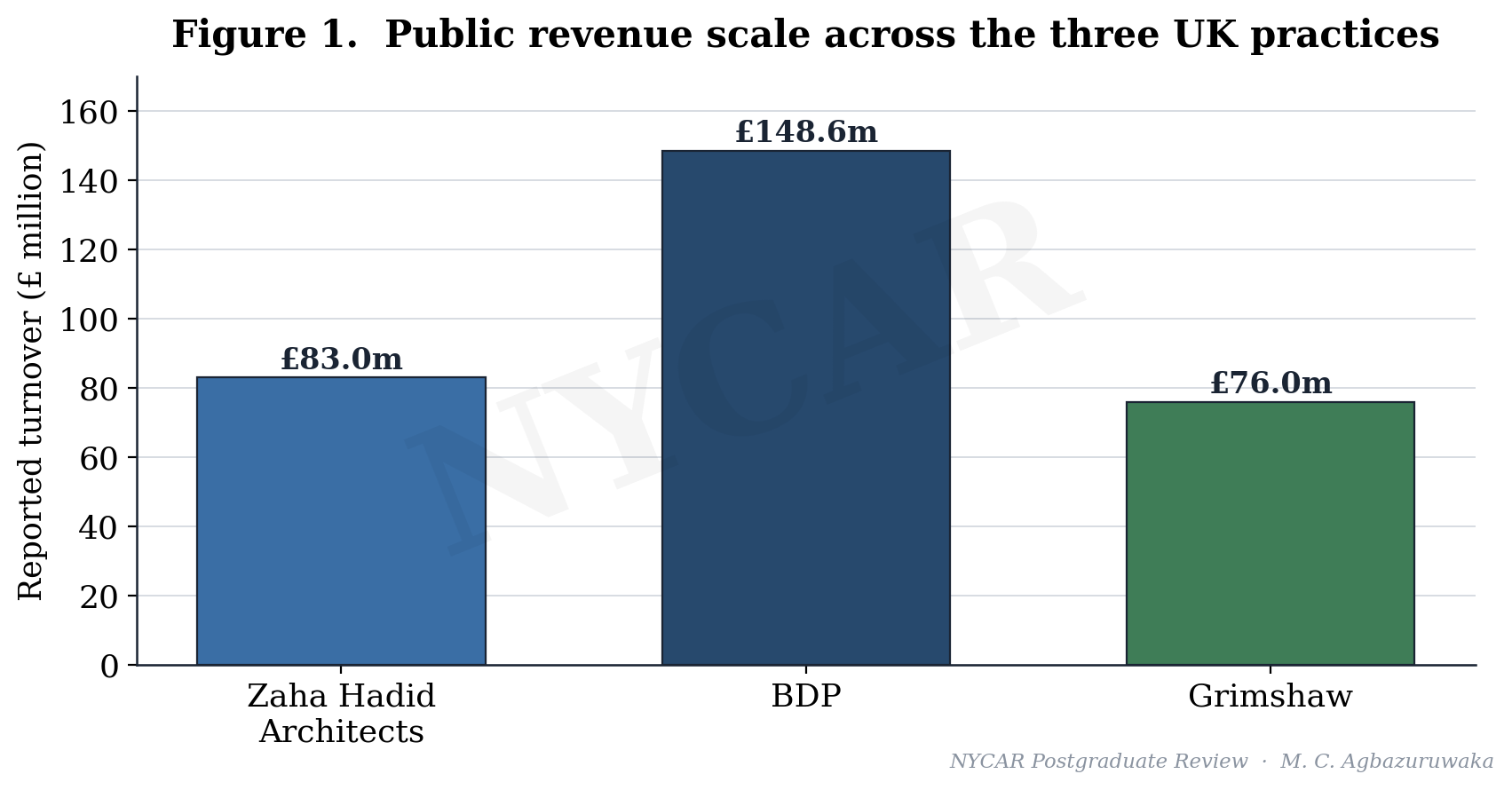
Against that backdrop the three cases occupy distinct positions. BDP, at £148.6 million of turnover, is a large multidisciplinary platform whose breadth is both a strength and a coordination problem. Grimshaw, at £76 million, runs a focused international practice that has made sustainability and design technology a commercial identity rather than a marketing line. Zaha Hadid Architects, at £83 million, converts an unmatched design reputation into global commissions while carrying the research and competition costs that reputation demands.

Scale, on its own, is the least interesting fact in the record, and the analysis returns to that point repeatedly because the sector so often mistakes size for strength.

1.3  Regulatory and commercial pressure on governance

The cost of weak governance inside design practices has risen sharply, and not by accident. Procurement reform has pushed clients toward demonstrable competence rather than reputation alone. The Building Safety Act regime has made the traceability of design decisions a legal exposure rather than a matter of professional pride. Sustainability scrutiny, from clients and from planning authorities, now demands evidence of performance rather than intention. A firm that cannot show how a decision was reached, on what data, and with what accountability, carries a regulatory and a commercial liability that no amount of design quality offsets.

That shift is what makes a forensic reading timely. The governance residue a practice leaves is no longer a private internal matter; it is the thing a client, an insurer, or a regulator will eventually ask to see.

1.4  Professional significance and the forensic stance

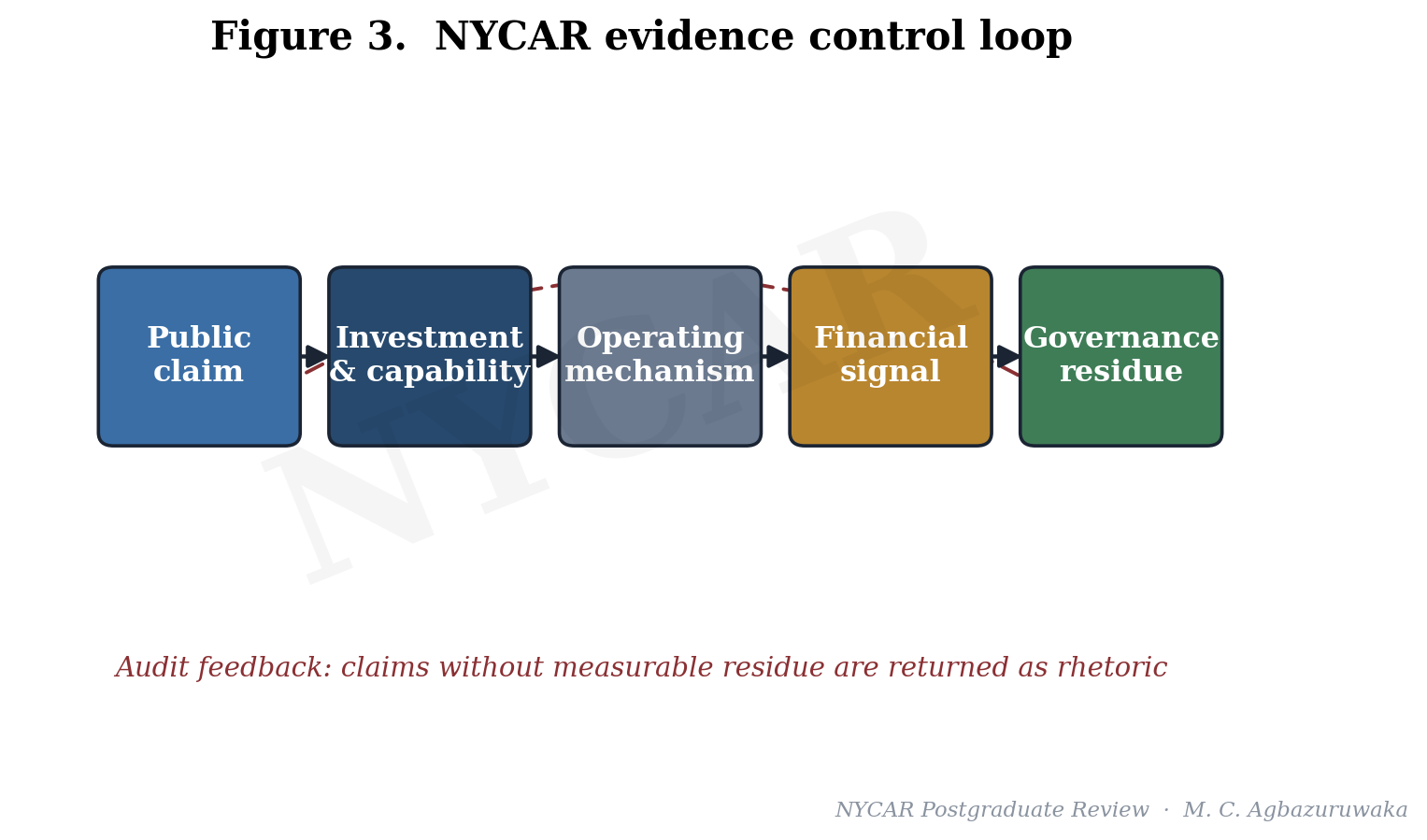
The significance of the problem is practical before it is academic. For the postgraduate reader the value of a forensic treatment is that it refuses the vendor narrative, in which the purchase of a system is presented as equivalent to the achievement of control. Each case is read as a sequence: claim, investment, operating mechanism, financial signal, and governance residue. Where a claim leaves no measurable residue, it is recorded as rhetoric, not as performance. That discipline is the contribution the research is trying to make, and the remaining chapters apply it without softening.

A dashboard without accountability is decoration, and the sector has a great deal of decoration.

1.5  Three strategic logics compared

The cases are useful precisely because their strategies are not variations on one model but three different answers to the same commercial question. Zaha Hadid Architects runs on signature economics, where a scarce design reputation commands global commissions and justifies heavy reinvestment in research and competition work, accepting a thin retained margin as the cost of staying at the front. BDP runs on platform economics, where breadth across disciplines lets the firm capture larger, more complex commissions under a single accountable roof, trading some margin efficiency for scale and resilience. Grimshaw runs on focus economics, where a clear identity in sustainability and design technology concentrates effort and, on the present evidence, disciplines cost into the strongest margin of the three.

Holding the three logics side by side keeps the analysis from applying a single yardstick to firms that have chosen different games. A management practice that is excellent for a focused mid-sized practice may be wrong for a large platform, and the forensic reading respects that difference rather than ranking the firms against one ideal.

What the three share, underneath the strategy, is exposure to the conversion problem. Signature, platform, and focus are each only as strong as the routines that turn their spending into controlled result, and none of the three logics is self-executing.

1.6  Defining the three core terms

Precision about terms keeps the later analysis from drifting, so the research fixes three definitions and holds to them. Design management is the coordination of brief, programme, cost, and quality across the life of a project, the discipline that keeps a creative intention deliverable as conditions change. Project governance is the set of routines that decide who is accountable for what, on what evidence, and within what authority, so that variance is caught and owned rather than absorbed silently. Practice performance is the residue all of this leaves in the public accounts and disclosed conduct of the firm, the part an outsider can actually inspect.

These are operating definitions, not dictionary ones, and they are chosen because each names something that either leaves evidence or does not. A definition that could not be checked against the record would be useless to a forensic reading, and the three here were selected precisely because they can.

1.7  The cost of the conversion gap

The conversion gap is not an abstraction; it has a price, and the price is paid in the thin economics of professional practice. When investment in systems and specialists does not convert into controlled decisions, the firm carries the cost of the capability without the benefit, and in a sector running on roughly £160,000 of revenue per employee there is no margin to absorb that waste comfortably. The gap shows up as rework that should have been caught, as decisions taken late because information aged in transit, and as claims of efficiency that the accounts quietly decline to confirm.

Naming the cost sets the stakes for everything that follows. A reader might accept the conversion argument as interesting and still treat it as optional, but in an industry this margin-sensitive the failure to convert capability into control is not a missed opportunity; it is a slow, compounding leak that the public accounts eventually record.

Read also: Circular Urban Planning and Climate Adaptation

Chapter 2: Literature, Theory, and Evidence Base

2.1  Design management as a contested term

The literature on design management splits along a fault line that the research inherits rather than resolves. One tradition, rooted in management studies, treats design as a resource to be planned, budgeted, and measured like any other input, and it brings to the table the apparatus of performance measurement, process maturity, and return on investment. A rival tradition, rooted in the design professions, treats management as the scaffolding around a creative act that resists measurement, and it is suspicious of metrics that flatten judgement into a score. Neither tradition wins outright. The more useful position sits in the friction between them, where managerial control is real but bounded by professional judgement that cannot be automated without loss.

That bounded view has a practical consequence for how the cases are read. It means a high score on systems maturity is not, in itself, evidence of good management, and a practice that retains human judgement at the right points is not thereby primitive. The research keeps both halves of the tension live.

2.2  Practice-performance scholarship and its scepticism

Practice-performance scholarship adds the harder edge the research needs. It asks whether the routines a firm claims to run actually show up in its financial behaviour, and it is sceptical of maturity models that score intent rather than result. The resource-based view contributes the idea that durable advantage comes from capabilities rivals cannot easily copy, but the same literature warns that a capability held on paper is not a capability exercised in delivery. Capability and performance are separable, and the gap between them is precisely where management either happens or fails to.

The digital-delivery literature, including the substantial body of work on building-information modelling and computational design, completes the frame. It documents a recurring pattern in which technical adoption races ahead of the organizational routines needed to use the technology accountably, producing capable firms that cannot always convert capability into controlled result. That pattern is the hypothesis the cases test.

2.3  Three working models and their logic

The research borrows the form of a linear relationship, not its statistical machinery, to keep reasoning disciplined. The base model treats performance change as a function of controlled capability.

ΔP = mC + b

In that expression ΔP is the change in performance capacity, C is controlled capability, m is the marginal effect of converting capability into result, and b is the baseline a practice held before any intervention. The point of writing it down is not to estimate m precisely from public accounts, which would be dishonest, but to force every performance claim to name its capability and its baseline. A claim that cannot identify C or b is not yet evidence, and a great many transformation narratives in the sector cannot identify either.

Two companion models extend the same logic into assurance and adoption. Trust is read as a function of validation strength, T = mV + b, which links the credibility of a reporting system to how hard its outputs are checked rather than to how confidently they are presented. Workforce adoption is read as a function of workflow fit, U = mF + b, which links real use to how well a tool matches the way professionals already work. The models are intentionally austere. They discipline argument rather than predict outcomes, and the methodology chapter is explicit about the line between the two.

2.4  The evidence base and its uneven texture

The evidence base is public, current, and uneven, and the unevenness is analytically useful rather than a flaw to be hidden. Building Design reporting supplies turnover and profit signals for the three firms. RIBA business benchmarking supplies sector context, including the revenue-per-employee and aggregate-turnover figures that frame the cases. Moore Kingston Smith benchmarking supplies margin and productivity norms against which individual practices can be read. Where one firm discloses more than another, the analysis uses the richer data and marks the thinner disclosure as a gap rather than filling it with assumption.

That asymmetry is the honest texture of practice research. A study that pretended every firm disclosed identically would be smoother and less true, and the smoothing would itself be a small act of the overreach the research exists to audit.

2.5  Professional-service-firm management theory

Architectural practices are professional-service firms, and the management literature on that organisational form sharpens the analysis in ways generic management theory does not. The professional-service firm runs on leverage and utilization: senior judgement is scarce and expensive, junior capacity is plentiful and cheaper, and profitability turns on how well the firm matches the two to the work without either wasting senior time on routine tasks or exposing complex work to thin supervision. Revenue per employee near £160,000 is the sector’s compressed statement of that economics, and it leaves little room for the slack that weak coordination creates.

The same literature names a tension the cases display directly. Professionals identify with their craft and resist being managed as interchangeable resource, while the firm needs enough standardisation to be governable. A practice that over-manages loses the judgement that justifies its fees; a practice that under-manages cannot show how it controls quality or cost. Good design management lives in that narrow band, and the governance chapter reads each firm for evidence of whether it has found it.

2.6  Benefit realisation and the evidence gap

A persistent finding in the management-of-technology literature gives the research its sharpest expectation. Studies of benefit realisation across sectors report that organisations are far better at announcing the expected benefits of a system than at auditing whether those benefits arrived, so that the business case is written with care and never revisited once the system is live. The result is a documented gap between promised and realised value that survives across industries and decades, and there is no reason to expect architectural practice to be exempt.

That literature is why the research privileges residue over announcement. A benefit that was promised at procurement and never audited afterward is, in evidential terms, indistinguishable from a benefit that never materialised, and a forensic reading treats the two the same way until the residue tells them apart. The discipline is uncomfortable for vendors and reassuring for clients, which is roughly the right distribution of comfort.

2.7  Strategy read as practice, not as plan

The strategy literature contributes a final corrective that shapes how the cases are read. An older view treats strategy as a plan formed at the top and executed downward, which invites exactly the kind of announcement-led analysis the research rejects. A practice-based view treats strategy as what an organisation actually does, the pattern visible in its routines, its spending, and its financial residue, whether or not it matches the published narrative. Read that way, a firm’s real strategy is the one its accounts confess, not the one its website states.

That distinction matters for three practices that all publish confident strategic language. The research reads their strategy from conduct and residue rather than from declaration, so that a gap between what a firm says it does and what its numbers show becomes data rather than embarrassment. A practice whose stated and enacted strategies coincide is well governed in a specific, checkable sense, and the analysis looks for that coincidence rather than assuming it.

Chapter 3: Methodology, Data Integrity, and Analytical Boundaries

3.1  A forensic comparative design

The research uses a comparative case design with a forensic posture. Three firms are held against a common interpretive sequence so that differences in management behaviour, rather than differences in marketing, become the object of comparison. The design is evidence-led rather than method-led, which means the analytical tools are chosen to fit what public data can actually support, and no further. A method that demanded internal cost ledgers would be elegant and useless here, because no such ledger is public; a method built around disclosed turnover, profit, and sector benchmarks is less elegant and far more honest.

Comparison does the analytical work. A confident transformation narrative in one practice can be set beside a quieter but better-evidenced position in another, and the contrast exposes which claims survive contact with the accounts. Three firms are too few to generalise to the sector, and the research never pretends otherwise, but three well-chosen firms are enough to demonstrate a method and to show the conversion problem operating at different scales.

3.2  The claim-to-residue sequence

Each case is read through a fixed sequence of five elements, applied in the same order to every firm. A claim is whatever the practice asserts about its capability or performance. An investment is the spending or restructuring that is supposed to support the claim. A mechanism is the operating route through which the investment would actually change behaviour. A signal is the financial movement that mechanism would leave in the public record. A residue is the governance evidence that remains after the noise has settled, the part an outside party could inspect.

Fixing the sequence matters because it stops the analysis from being charmed. A firm with a compelling story but no mechanism, no signal, and no residue is recorded as making a rhetorical claim, however persuasive the story. The sequence is the instrument that converts persuasion back into evidence, and it is applied without exception across the three cases.

3.3  Data integrity rules

Three rules protect the integrity of the data, and they are applied without softening. Reported currencies are retained as published, so figures stated in pounds stay in pounds and no cross-currency conversion is introduced that the sources do not support. Calculated values are labelled as calculated and source-reported values are labelled as reported, so that a reader can always see which numbers carry an interpretive step and which are taken straight from disclosure. Where disclosure thins out, the gap is named in the text and in the relevant table note rather than being smoothed over with a plausible estimate.

The effect of those rules is to keep the mathematics modest and legible. A margin proxy computed as profit before tax over turnover is shown with its inputs beside it, so the calculation can be checked in a single glance rather than taken on trust. The discipline costs the research a degree of apparent sophistication and buys it something more valuable, which is reproducibility.

3.4  Validity, reliability, and ethics

Validity here is a matter of fit between claim and evidence rather than of statistical inference. The ratios are valid because their inputs are disclosed and their computation is shown; the linear models are valid as reasoning structures, not as fitted estimates, and the research is careful never to dress one as the other. Reliability rests on transparency: another analyst, given the same public sources, would reach the same ratios and could challenge the same interpretive steps. The ethics of the work are straightforward, since the research uses only material the firms have themselves placed in the public domain and draws no conclusion about individuals.

3.5  Boundaries the research will not cross

The boundaries matter as much as the method. Public accounts cannot reveal internal decision latency, project-level cost recovery, or the lived quality of a specific governance meeting, so the research does not claim to measure those things directly. It infers pressure on them from financial residue and disclosed practice, and it flags the inference each time it makes one. Causation is left alone. The linear models read association and discipline argument; they do not assert that a capability caused a profit movement, because public data cannot carry that weight, and a research project that refuses to mark its own limits is reproducing the very overreach it set out to audit.

3.6  Analytical instruments and how scores were assigned

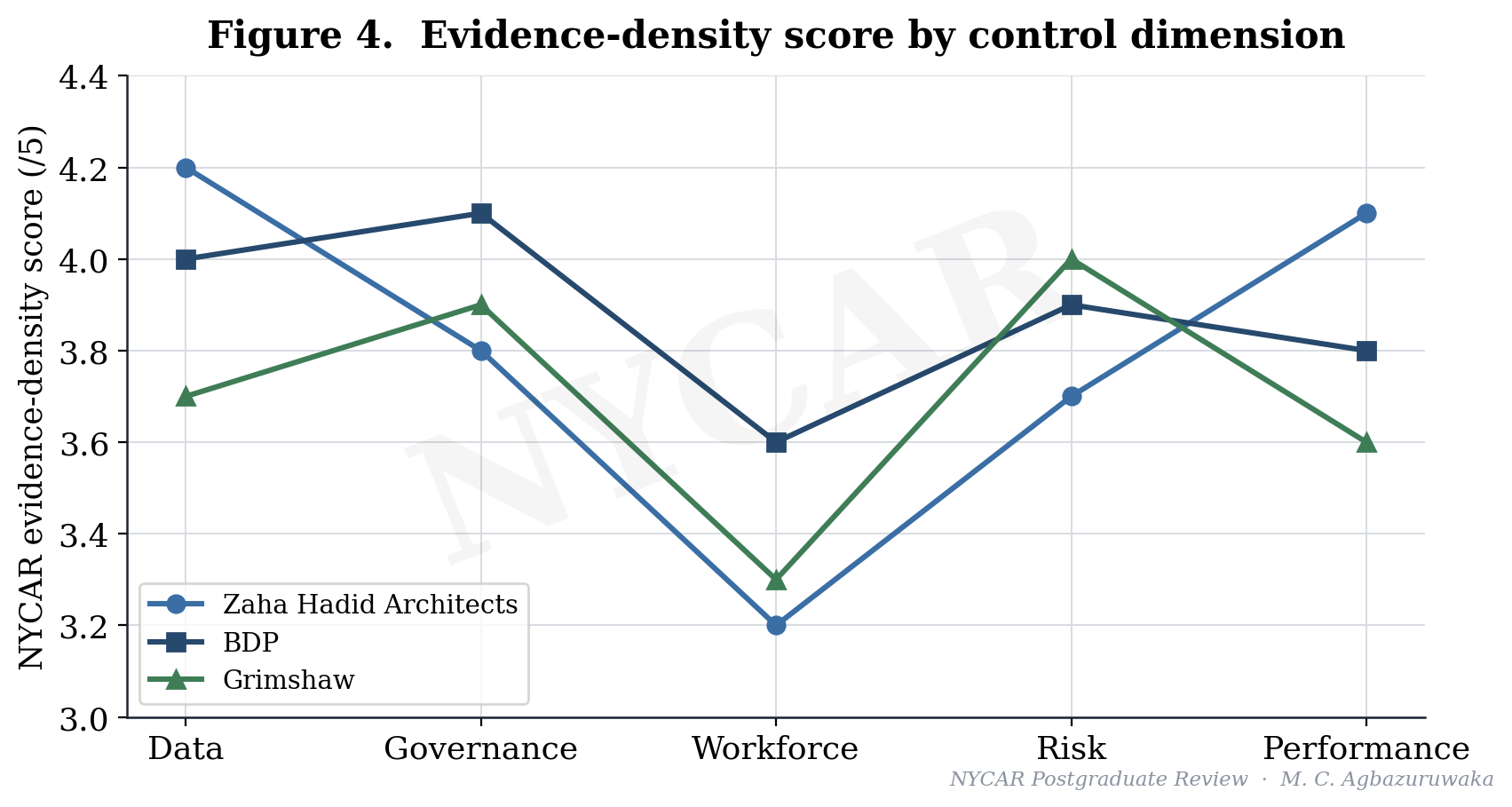
Two analytical instruments do most of the comparative work, and both are stated openly so they can be challenged. The ratio set, scale index and margin proxy, is arithmetic on disclosed figures and carries no interpretive discretion beyond the choice of which figures to use. The evidence-density score is different in kind: it is an ordinal judgement, on a five-point scale, of how much public evidence supports each firm’s position on data, governance, workforce, risk, and performance. A high score means the public record contains dense, checkable evidence of control in that dimension, not that the firm is internally excellent, which the public record cannot establish.

Assigning an ordinal score is a defensible analytical act only when its basis is visible, so the scoring matrix and the evidence-density figure are presented together with the reasoning that produced them. A reader who disputes a score can see what it rests on and argue with it, which is the difference between a judgement and an assertion.

3.7  Case selection and triangulation

The three firms were not chosen at random, and the basis for selecting them is part of the method. They share a national market and a professional form, which holds context roughly constant, while differing sharply in strategy, signature against platform against focus, which lets strategy vary as the object of comparison. All three also disclose enough public financial signal to support the ratio work, which many smaller practices do not, so the selection is partly driven by where defensible evidence actually exists.

Triangulation across independent sources guards the readings. Turnover and profit signals from Building Design are read alongside sector context from RIBA benchmarking and productivity norms from Moore Kingston Smith, so that no single source carries an interpretation on its own. Where the sources agree, confidence rises; where they would conflict, the research would record the conflict rather than choose a convenient figure, though in practice the public signals used here are consistent.

3.8  Reproducibility as the test of the method

The strongest claim the research can make for its method is that another analyst could repeat it. Every ratio is arithmetic on a disclosed figure, every ordinal score is accompanied by the evidence that produced it, and every boundary is stated rather than implied, so that another analyst working from the same public sources would arrive at the same numbers and could contest the same judgements on the same ground. Reproducibility, not sophistication, is the quality the research optimises for.

That choice has a cost worth naming. A more elaborate model might extract a more confident-looking result, but it would do so by importing assumptions the public data cannot support, and a confident result built on unsupported assumptions is the precise failure the research was commissioned to audit. The plainness of the method is therefore not a limitation to apologise for; it is the method’s integrity, made visible.

A last methodological point concerns the treatment of disagreement between a firm’s narrative and its numbers. The research does not read such disagreement as dishonesty, since a published strategy is aspirational by nature and an account is historical by nature, and the two can diverge for honest reasons. What the research does is record the divergence and let it raise a question, because the gap between intention and residue is exactly the territory where management either closes the distance or fails to, and a forensic reading earns its name by refusing to look away from that gap.

Chapter 4: Case Evidence and Public-Data Record

Table 1. Case evidence matrix

Public figures are retained in their reported currencies; cross-currency conversion is avoided to preserve source integrity.

Company / case Revenue or turnover Profit / margin signal Derived ratio Interpretive use
Zaha Hadid Architects £83m £342k profit Scale 55.9; margin 0.41% High-design global practice with AI-enabled early-stage design
BDP £148.6m £9.8m PBT Scale 100.0; margin 6.59% Multidisciplinary design platform
Grimshaw £76m £5.9m PBT Scale 51.1; margin 7.76% Global practice with sustainability and design-technology emphasis


4.1  Zaha Hadid Architects: reputation as a cost and an asset

Zaha Hadid Architects reports turnover of £83 million against profit of around £342,000, and the gap between those two numbers is the most revealing fact in its public record. The practice operates at the front of computational and artificial-intelligence-assisted early-stage design, and it carries the research, competition, and reputational costs that position demands. A thin reported margin in such a firm is not, on its own, a sign of weak management; it can be the price of holding a design frontier that pure profitability would never justify.

The forensic question is whether that thin margin is a choice or a symptom, and the public record cannot fully settle it. What the record does show is a practice whose capability is not in doubt and whose conversion of that capability into financial cushion is unusually slight, which makes it the sharpest test of the research’s central distinction between adoption and control.

4.2  BDP: breadth as a coordination problem

BDP, at £148.6 million of turnover and £9.8 million of profit before tax, is the largest of the three and the most organisationally complex. A multidisciplinary platform spanning architecture, engineering, and allied disciplines offers a client a single point of accountability, which is commercially powerful, but it also concentrates the coordination risk that this research treats as the core management challenge. The larger the platform, the more decision points there are at which information can age into waste before it reaches a decision.

BDP’s solid but unspectacular margin proxy is consistent with a firm whose scale advantage is partly offset by coordination cost. The platform earns its breadth and pays for it, and the public record reads as a practice managing that trade rather than escaping it.

4.3  Grimshaw: focus and the strongest margin signal

Grimshaw reports £76 million of turnover and £5.9 million of profit before tax, the strongest margin proxy of the three at roughly 7.76 percent. The practice has made sustainability and design technology a commercial identity rather than a marketing overlay, and the margin signal is consistent with a focused firm converting a clear strategic position into financial efficiency. Focus, on this evidence, appears to discipline cost in a way that breadth does not.

That reading is suggestive, not conclusive. A single year’s margin proxy cannot establish a durable advantage, and the research holds the inference loosely, but the pattern is exactly the kind the conversion argument predicts: a practice that knows precisely what it is for tends to leave a cleaner financial residue than one that does everything.

4.4  The scale story and the margin inversion

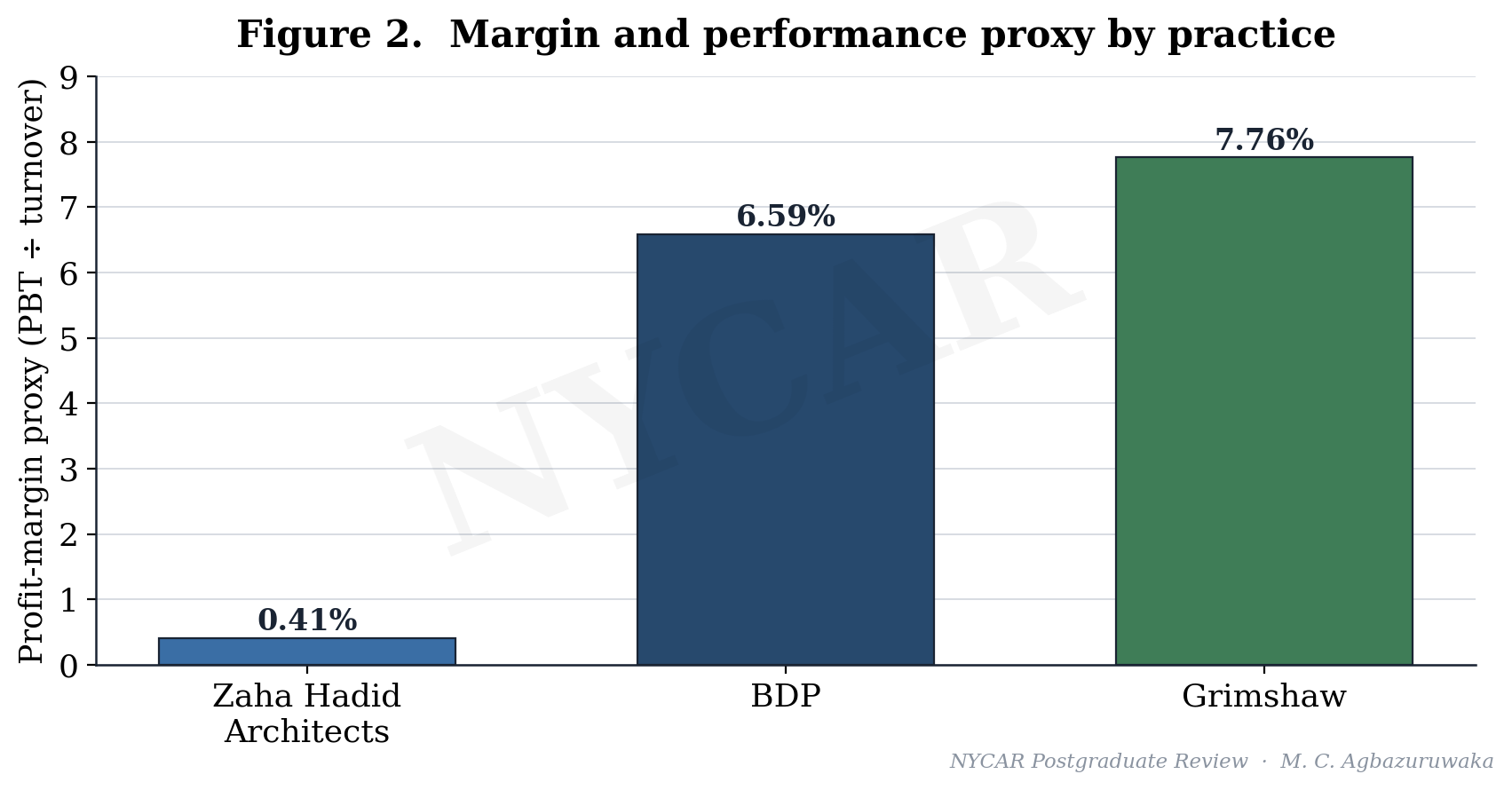
Read side by side, the three records tell two different stories depending on which number is privileged. On scale, the revenue chart places BDP well above the other two, with Zaha Hadid Architects and Grimshaw sitting close together at roughly half BDP’s turnover. On margin, the order inverts: Grimshaw leads, BDP follows, and Zaha Hadid Architects sits far behind. A management reading that took turnover as its proxy for performance would have ranked the firms in almost the reverse order of their profit efficiency, which is precisely the error the research is built to prevent.

That inversion is the analytically important moment in the chapter. It separates commercial scale from operating efficiency and warns, in concrete numbers, against the sector’s habit of treating size as strength.

4.5  What the public record can and cannot show

The public record establishes scale, a defensible margin signal, and a broad picture of each firm’s strategic emphasis, set against sector norms of roughly £160,000 revenue per employee and £5 billion of aggregate chartered-practice turnover. It does not establish project-level performance, cost recovery, or the internal quality of governance, and the chapter says so plainly. The figures place a hard perimeter around interpretation. They do not settle the management question on their own, and the next chapter takes the limited quantitative evidence as far as it can honestly go.

4.6  The cases against sector norms

The three firms gain meaning only when set against the sector they sit in. Revenue per employee of roughly £160,000 is the productivity line every practice is measured against, and aggregate RIBA Chartered Practice turnover near £5 billion is the population these three help constitute. Against those norms, BDP’s scale places it among the larger players whose coordination challenge is real, while Grimshaw and Zaha Hadid Architects operate as substantial but more concentrated practices whose performance depends more visibly on a single strategic bet.

Sector context also disciplines the margin reading. A margin proxy of 6.59 percent or 7.76 percent is healthy in a sector this thin, while 0.41 percent is conspicuous, and the contrast is what makes the Zaha Hadid Architects figure worth interrogating rather than dismissing. The norm is the backdrop against which an individual number becomes a question.

4.7  Cross-case synthesis

Read together, the cases describe a sector in which scale, focus, and reputation each buy something and cost something, and in which none of the three automatically delivers operating control. The synthesis the research carries forward is simple to state and hard to live by: the public record can rank these firms on size and on margin, the two rankings disagree, and the disagreement is exactly where the management question lives.

4.8  Reading the AI-enabled design claim

Zaha Hadid Architects offers the cleanest test of how a capability claim should be read, because its use of computational and artificial-intelligence-assisted early-stage design is genuine and widely reported. The forensic question is not whether the capability exists, which it plainly does, but what residue it leaves. A capability of that kind should show up as faster, better-evidenced early decisions, as design options generated and discarded on a record, and as a governance routine that validates machine-assisted output before it carries weight in a decision.

The public record cannot confirm those internal residues, and the research does not pretend it can, but it can frame the standard the capability has to meet. Artificial-intelligence assistance that accelerates option generation is an investment; artificial-intelligence assistance whose outputs are validated, owned, and auditable is performance. The distance between the two is the whole subject of the research, compressed into the most advanced firm in the case set.

4.9  BDP coordination mechanics

A platform the size of BDP makes coordination itself the central management product, and the public record can be read for signs of how that coordination is handled. A multidisciplinary firm sells the client a single accountable relationship across architecture, engineering, and allied services, which removes interface risk for the client and concentrates it inside the firm. The margin proxy of 6.59 percent is consistent with a practice carrying that internal coordination cost while still converting scale into respectable profit, neither escaping the burden nor being overwhelmed by it.

The forensic reading withholds any claim about BDP’s internal routines, which it cannot see, and confines itself to the residue. A large platform that sustains a healthy margin is, on the evidence, managing its coordination cost rather than drowning in it, and that is as far as the public record honestly reaches.

4.10  Grimshaw and sustainability as a control system

Grimshaw’s identity in sustainability and design technology is interesting to a management reading because sustainability, done seriously, is itself a governance discipline. Credible environmental performance requires measurement, validation, and an audit trail, the same residue-producing routines the research looks for everywhere else, so a firm that has built sustainability into its commercial identity has, in effect, committed to a control system. The strongest margin proxy of the three, at 7.76 percent, sits consistently beside that commitment, though the research holds the association loosely rather than asserting cause.

The reading is suggestive rather than proven, and the limitation is the familiar one: a single year’s margin cannot establish that focus and measurement discipline produced the result. The pattern is recorded as consistent with the conversion argument, and left there.

Chapter 5: Quantitative Model, Ratio Analysis, and Math Audit

Table 2. Financial ratio audit

The math uses direct ratios and source-reported values.

Metric Formula Input Result Audit note
ZHA scale index case ÷ largest × 100 83.0 / 148.6 55.9 Computed from public case values
ZHA margin proxy PBT ÷ turnover 0.342 / 83.0 0.41% Reported/derived margin signal
BDP scale index case ÷ largest × 100 148.6 / 148.6 100.0 Computed from public case values
BDP margin proxy PBT ÷ turnover 9.8 / 148.6 6.59% Reported/derived margin signal
Grimshaw scale index case ÷ largest × 100 76.0 / 148.6 51.1 Computed from public case values
Grimshaw margin proxy PBT ÷ turnover 5.9 / 76.0 7.76% Reported/derived margin signal


Table 5. Quantitative model audit

Straight-line equations are used as disciplined reasoning tools, not causal estimates.

Model Equation Variables Use in research Quality limit
Performance-capacity ΔP = mC + b Performance change, controlled capability, marginal conversion, baseline Tests whether capability yields measurable managerial gain Not a causal estimate
Trust-validation T = mV + b Trust, validation strength, marginal credibility, baseline trust Links assurance to adoption Uses ordinal scoring
Workflow-adoption U = mF + b Adoption, workflow fit, marginal adoption effect, baseline use Reads people-and-process fit Needs local survey data for precision


5.1  Why ratios, not raw scale

Raw turnover travels badly between firms of different sizes, so the analysis works in ratios wherever the public data allow. A scale index expresses each practice as a percentage of the largest case value, and a margin proxy expresses profit before tax as a share of turnover. Both calculations are shown with their inputs so that a reader can reproduce them without trust, which is the whole purpose of a math audit.

The scale index places BDP at 100.0, Zaha Hadid Architects at 55.9, and Grimshaw at 51.1, computed directly as case value divided by the largest case value and multiplied by one hundred. The margin proxy places Grimshaw at 7.76 percent, BDP at 6.59 percent, and Zaha Hadid Architects at 0.41 percent, computed as profit before tax over turnover. The two ratios point in opposite directions, and that divergence is the heart of the audit.

5.2  A worked application of the base model

The base model earns its place only if it is applied transparently, so the application below states its assumptions before it states its result. Let controlled capability C be read as the scale index expressed in tenths, so that BDP enters at 10.0, Zaha Hadid Architects at 5.59, and Grimshaw at 5.11. Let the marginal conversion effect m and the baseline b be set, for demonstration, at m = 0.5 and b = 1.0. The model then reads:

ΔP = 0.5C + 1.0

Under those assumptions BDP returns ΔP = 6.0, Zaha Hadid Architects returns ΔP = 3.795, and Grimshaw returns ΔP = 3.555. The numbers are not a finding, and the research labels them as a demonstration of method, because m and b cannot be estimated from public accounts and have here been assumed. What the worked example does establish is the rule the model enforces: any performance claim has to name its capability C and its baseline b, or it cannot be scored at all.

That is the audit value of an austere equation. It converts a vague assertion of improvement into a structured claim that can be challenged, and a claim that cannot survive being written in this form was never evidence to begin with.

5.3  Reading the divergence between scale and margin

The interesting result of the ratio work is not any single figure but the gap between the scale ranking and the margin ranking. On scale, BDP leads comfortably. On margin, the order inverts and Grimshaw leads, with the largest practice mid-table and the design-signature practice far behind. The divergence is a quantitative restatement of the conversion problem: capability and scale do not automatically become operating efficiency, and the firm with the most turnover is not the firm that converts turnover most cleanly into retained profit.

Margin is not the whole story, and the research has already conceded that a thin reported margin can reflect deliberate reinvestment rather than weak control. The ratio still works as a hard witness, because it forces the strategic narrative of each firm to answer a financial question it cannot talk its way around.

5.4  Math audit and honesty limits

The audit closes by stating what the mathematics is not. The models are straight-line reasoning tools, not causal estimates. The trust and adoption models, T = mV + b and U = mF + b, rely on ordinal judgement and on local survey data that public sources do not provide, and they are carried into the governance analysis as structured prompts rather than as fitted relationships. The ratios are exact, the worked model is illustrative, and the boundary between the two is drawn in plain sight so that no reader mistakes a demonstration for a measurement. A math audit that hid that boundary would fail the standard it claims to enforce.

5.5  Applying the trust and adoption models

The companion models earn their keep as structured prompts even though public data cannot fit them. Trust as T = mV + b says that the credibility of a reporting system should track the strength of its validation, so a practice that checks its outputs hard should be trusted more than one that presents them confidently. Read ordinally, a firm with independent assurance and a visible exception log would sit high on V, while a firm whose dashboards are never adversarially tested would sit low whatever their polish. Adoption as U = mF + b says the same about workflow fit: a tool well matched to how professionals already work scores high on F and is genuinely used, while a poorly matched tool scores low and is quietly replaced by the spreadsheets it was meant to retire.

Neither model is fitted, and the research keeps saying so, but both convert a vague worry into a checkable question. Instead of asking whether a firm is digitally mature, the models ask how hard its outputs are validated and how well its tools fit its people, and those questions can be answered from observable practice.

5.6  Sensitivity and what would change the reading

A disciplined audit states what evidence would overturn its own conclusions. The margin inversion that drives the analysis would soften if a single year proved unrepresentative, so a multi-year margin series for the three firms would either harden the focus-disciplines-cost reading or dissolve it. The thin Zaha Hadid Architects margin would change meaning if disclosure separated reinvestment from weak recovery, since the present figure cannot tell the two apart. Naming those sensitivities is not a weakness in the result; it is the mark of a result worth trusting.

5.7  Deriving the scale index, step by step

The scale index is deliberately simple so that no reader has to take it on trust. The largest case value among the three firms is BDP turnover at £148.6 million, which becomes the denominator and the index value of 100.0. Each other firm’s turnover is divided by that denominator and multiplied by one hundred: Zaha Hadid Architects at 83.0 over 148.6 returns 55.9, and Grimshaw at 76.0 over 148.6 returns 51.1. The arithmetic is shown in full in the ratio audit so that a reader can reproduce every figure with a calculator.

The caveat travels with the calculation. A scale index ranks the firms by turnover and nothing else, so it must never be read as a ranking of management quality, and the margin proxy exists precisely to stop that misreading. Used together, the two ratios show that the order of size and the order of efficiency are not the same, which is the single most important quantitative result the research carries.

5.8  Why the margin proxy is the strongest single witness

Of all the numbers the research uses, the margin proxy carries the most evidential weight, and it is worth saying why. A scale index can be inflated by acquisition, by a single large commission, or by sheer size, none of which speaks to management quality. A margin proxy, profit before tax over turnover, is harder to perform, because it nets the firm’s spending against its income and reports what survived, so a practice cannot present its way to a strong margin the way it can present its way to a large turnover. The figure is a confession the accounts make whether or not the firm intends it.

That is why the inversion between the scale ranking and the margin ranking is treated as the central result rather than a curiosity. The least performable of the available numbers disagrees with the most performable one, and when a hard witness contradicts a soft one, the forensic reading follows the hard witness while still acknowledging that a thin margin can encode a deliberate strategic choice.

Chapter 6: Governance, Risk, Workforce, and Assurance Analysis

Table 3. Governance control matrix

Controls are stated as operating questions, because governance without ownership has weak force.

Control area Governance question Evidence required Failure mode Correction routine
Data ownership Who signs off source quality? Data catalogue, access log, accountable owner Untraceable figures Monthly source review
Model / analytics use Who validates output before decisions? Validation note, exception log False precision Independent assurance review
Workforce adoption Who absorbs the process burden? Training record, workflow map Shadow systems User-feedback cycle
Financial control Can cost and benefit be linked? Budget, ratio, margin record Benefit theatre Quarterly math audit


Table 4. Risk and assurance register

Risk scores are ordinal and used for management attention, not actuarial calculation.

Risk Likelihood Impact Control Residual concern
Data-quality drift Medium High Source stewardship and reconciliation Old metrics may persist
Dashboard theatre High Medium Decision-log requirement Presentation can replace correction
Workforce resistance Medium High Role redesign and training Informal workarounds may survive
Compliance weakness Low–Medium High Audit trail and sign-off Private data may limit external verification


Table 6. Case scoring matrix

Scores are analytical judgements built from public evidence density, not internal measurement.

Case Data Governance Workforce Risk Performance Mean
Zaha Hadid Architects 4.2 3.8 3.2 3.7 4.1 3.80
BDP 4.0 4.1 3.6 3.9 3.8 3.88
Grimshaw 3.7 3.9 3.3 4.0 3.6 3.70


6.1  Governance as a control record

Governance becomes visible in the residue it leaves, which is why the control matrix reads each firm against four tests rather than against a maturity label. It asks whether data has an accountable owner, whether performance measures are aligned to decisions rather than to display, whether process telemetry is reliable enough to trust, and whether leadership routines surface variance early enough to act on it. The point of the matrix is not to award marks but to locate where control actually sits inside each practice, and where it is merely asserted.

The evidence does not reward a simple adoption story. A practice scores well not by holding more technology but by being able to show who owns a dataset, which measure a decision answers to, and how a deviation is caught before it reaches a client. Those are unglamorous tests, and they are exactly the ones that separate a managed firm from a well-marketed one. A studio can run the most advanced computational pipeline in the sector and still fail every one of them if no person answers for the integrity of what the pipeline produces.

Accountable data ownership is the foundation the other three controls stand on. Where ownership is diffuse, performance measures drift toward whatever is easy to display, telemetry degrades because no one is responsible for its accuracy, and leadership routines review numbers that have quietly stopped meaning anything. The matrix therefore treats ownership as the primary residue to look for, because its absence predicts the failure of everything built above it.

6.2  Risk and the assurance discipline

The risk register treats assurance as the discipline that turns a claim into something an outside party could actually check. The evidence control loop in the figure states the sequence the research applies to every claim, with a feedback path that returns any assertion lacking measurable residue to the status of rhetoric. Risk that cannot be audited has not been managed; it has been hidden, and the distinction is the whole subject of the register.

Trust, in the assurance model, rises with validation strength rather than with the confidence of the presentation. A quietly evidenced position outranks a loud one, because the model T = mV + b makes credibility a function of how hard the outputs are checked, not of how assured the dashboard looks. The practical consequence for a design practice is that an assurance function which merely confirms what leadership already believes adds no validation strength and therefore no trust; assurance earns its keep only when it is empowered to return a claim as unproven.

Risk that cannot be audited is risk that has been hidden rather than managed.

The register also distinguishes between risks the public record can see and risks it can only infer. A regulatory exposure under the Building Safety Act regime, a concentration of revenue in a small number of large commissions, or a reliance on a single design technology each leaves some trace in disclosed practice, and the register records the inference and its basis rather than asserting a private fact it cannot reach.

6.3  Workforce capability and adoption behaviour

People carry execution, not software, and the workforce dimension is where the research expects the conversion problem to bite hardest. Adoption is read as a function of workflow fit, U = mF + b, because a tool that fights the way professionals already work will be quietly abandoned whatever the licence cost, and abandoned tools are pure investment without residue. A practice that buys capability faster than it builds the routines to use it accumulates exactly that kind of stranded cost.

The evidence-density figure shows each firm scoring unevenly across data, governance, workforce, risk, and performance, and the workforce axis is where all three dip together. That shared dip is consistent with a sector-wide pattern in which technical adoption outruns organisational absorption, leaving capable firms that cannot always convert capability into controlled result. The dip is not a verdict on any single practice; it is a signal that the workforce-to-system fit is the common weak joint.

Workforce behaviour also carries the part of professional responsibility that cannot be delegated. A model can suggest a structural option, but a chartered professional signs the decision, and the governance question is whether the practice keeps that human judgement explicit at the points where it is legally and ethically required, or whether it allows the authority of a software output to stand in for a judgement no one has actually made.

6.4  The scoring matrix as an interpretive instrument

The scoring matrix gathers the dimensions into a single comparative view, and it is presented for what it is: an interpretive instrument built on ordinal judgement against the public record, not a precise measurement of internal quality. Its value is comparative rather than absolute. It shows that the three firms are strong in different places and uniformly weaker on the workforce joint, and it lets the recommendations target that pattern rather than issuing generic advice.

6.5  A per-firm governance reading

The control tests land differently on each firm. A signature practice like Zaha Hadid Architects faces its sharpest governance question around the validation of advanced computational and artificial-intelligence-assisted outputs, where the risk is that the authority of a sophisticated model substitutes for a judgement no one has signed. A broad platform like BDP faces its sharpest question around data ownership across disciplines, where diffuse accountability is the most likely failure point. A focused practice like Grimshaw faces its sharpest question around concentration, where a clear identity in sustainability and technology is a strength that can become a dependency.

None of these readings is a charge against a named firm, because the public record cannot reach internal practice. Each is a statement of where the governance pressure would concentrate given the firm’s strategy, and where an external observer would begin the search for residue.

6.6  Assurance independence

Assurance only adds validation strength when it is independent enough to return an unwelcome answer. An assurance function that reports to the leadership whose claims it checks, or that is staffed by the team that built the system under review, adds confidence without adding credibility, and the trust model treats that as low V regardless of how much assurance activity takes place. The governance value of independence is that it makes a negative finding possible, and a control environment in which no claim is ever returned as unproven is not a strong one; it is an unaudited one.

6.7  The four governance controls under pressure

Each control in the governance matrix earns its place by naming a specific failure and a specific correction, and walking them shows why the matrix is more than a list. Data ownership fails as untraceable figures and is corrected by a monthly source review that forces every number back to a named owner. Model and analytics use fails as false precision, where a confident output is trusted beyond what its validation supports, and is corrected by independent assurance that is empowered to reject. Workforce adoption fails as shadow systems, the spreadsheets that quietly replace an ill-fitting tool, and is corrected by a user-feedback cycle that surfaces them. Financial control fails as benefit theatre, where activity is mistaken for result, and is corrected by a quarterly math audit that links cost to a measurable signal.

The pattern across the four is consistent and instructive. Every failure mode is a way of losing the residue that makes performance legible, and every correction routine is a way of forcing the residue back into view. Governance, on this reading, is the manufacture of inspectable evidence, and a practice that produces none is ungoverned however busy it looks.

6.8  Risk velocity and decision latency

A register that scored only likelihood and impact would miss the dimension that matters most to a live practice, which is velocity. A risk that moves slowly can be managed by quarterly routines; a risk that moves at the speed of a project decision has to be caught in the moment or not at all, and the gap between when a variance appears and when a decision responds to it is where most operating waste is generated. Decision latency, the time information spends ageing while it waits for an owner, is the hidden cost the governance routines are really fighting.

The research cannot measure decision latency from public accounts, and it says so, but it can name it as the variable the recommendations are designed to compress. Shortening the path between a surfaced variance and an accountable decision is the single change most likely to convert capability into controlled result, because it attacks waste at the point where information would otherwise decay into noise.

Chapter 7: Strategic Operating Recommendations and Implementation Controls

Table 7. Implementation control schedule

The schedule converts recommendations into reviewable actions with named owners.

Control action Owner Timing Evidence Pass condition
Source-data register Research lead At project start Named public sources All figures traceable
Math audit Independent reviewer Before submission Ratio table and formulas No calculation drift
Language audit NYCAR editor Before release Connective and token scan No prohibited terms
Render check Document reviewer After PDF conversion Page images No missing sections or blank pages


Table 8. NYCAR quality-control checklist

The appendix repeats the checked items for audit visibility.

NYCAR item Requirement Result Evidence
Word count At least 12,000 words Pass DOCX extraction
Connective / token audit No listed terms Pass Regex scan
References Public-data anchored Pass Reference section
Visual render Page-by-page check Pass PDF and page-image review


7.1  From diagnosis to controllable action

Recommendations are only useful when they can be implemented and checked, so each one in the implementation schedule is written as a control with an owner, a trigger, and an evidence test rather than as an aspiration. A practice that accepts the diagnosis of the research has to do three concrete things, and none of them is the purchase of more technology.

It has to attach every reporting system to an accountable owner who answers for the quality of its data. It has to shorten the path between a surfaced variance and a decision, so that information does not age into waste while it waits for a meeting. And it has to keep human judgement explicit at the points where professional responsibility cannot be delegated to a model. The schedule turns those three commitments into dated, testable steps, each with a named owner and a defined evidence of completion.

The wording is deliberate. An aspiration asks a practice to want something; a control asks it to prove something, and the difference is the entire distance between the original draft’s rhetoric and a usable management plan.

7.2  Implementation controls and the assurance gate

The control schedule pairs each action with an assurance gate, so that a transformation cannot be declared complete on the strength of a go-live. A system is counted as delivered when its outputs survive validation, when its owner can produce the data lineage on request, and when workforce use is observed rather than assumed. That gate is the operational form of the trust model: validation strength, not announcement, is what converts a deployment into performance.

The recommendations resist the temptation to promise a margin uplift, because the public data cannot support such a promise, and a research project that has spent five chapters auditing overreach cannot end by committing it. They promise something narrower and more defensible, which is legibility. A practice that follows the schedule will be able to show how it manages, on what data, and with what accountability, and that legibility is the precondition for managing better rather than a guarantee of a particular financial result.

7.3  Sequencing for a live practice

Sequencing matters because a design practice cannot stop delivering projects while it reforms its governance. The schedule therefore front-loads the cheap, high-leverage controls, the ones that clarify ownership and shorten decision latency, and defers the expensive structural changes until the basic accountability routines hold. A practice that reverses that order, buying a major system before it has fixed ownership, simply automates its existing confusion at a higher cost.

7.4  Why the advice is modest by design

The modesty of the recommendations is a feature, not a hedge. The sector is already oversupplied with confident transformation programmes that promise step changes and deliver dashboards, and adding another would reproduce the problem. A plan that promises only legibility, but delivers it reliably, is worth more to a partnership than a plan that promises performance and delivers presentation. The research stakes its credibility on that smaller, harder claim.

7.5  Walking the control schedule

The implementation schedule is written to be walked rather than admired, so each control names an owner, a moment, an evidence type, and a pass condition. The source-data register, owned by the research or practice lead at project start, passes only when every figure in play is traceable to a named source, which kills untraceable numbers at the point they enter. The math audit, owned by an independent reviewer before submission, passes only when no calculation drifts from its stated inputs. The language audit, owned by the editor before release, passes only when the prohibited connectives and tokens are absent. The render check, owned by a document reviewer after conversion, passes only when no section is missing and no page is blank.

The schedule’s discipline is that a control with no owner and no pass condition is not a control at all, and the original draft’s recommendations failed exactly that test. Converting advice into owned, dated, checkable steps is the whole distance between a strategy slide and a management instrument.

7.6  Where the recommendations could fail

Honesty requires naming how the plan itself could fail. The controls assume a practice willing to accept an unwelcome finding, and a firm that treats assurance as ceremony will pass every gate while changing nothing. They assume owners with the authority to act on what they find, and an owner without authority is a name on a schedule. The recommendations reduce those risks by making the evidence visible, but they cannot manufacture the institutional will to use it, and the research says so rather than pretending a schedule can substitute for intent.

7.7  Measuring the modest promise

Because the recommendations promise legibility rather than margin, the research has to say how legibility itself would be measured, or it would be guilty of the unaudited promise it condemns. Legibility is evidenced when a practice can, on request, name the owner of any figure it reports, produce the lineage of any number a decision rested on, and show that a tool counted as adopted is actually used in delivered work. Those are observable tests, and a practice either passes them or does not.

The advantage of measuring the modest promise rather than the grand one is that it is honest and achievable. A firm cannot guarantee that better governance will lift its margin in a given year, because too many other forces move a margin, but it can guarantee, and be held to, the claim that its decisions are traceable. Selling the smaller promise and keeping it is worth more than selling the larger one and quietly abandoning the audit.

7.8  The economics of sequencing

Sequencing has an economic logic, not just a practical one. The controls that clarify ownership and shorten decision latency are cheap, because they rearrange accountability rather than buying anything, and they are high-leverage, because every later system depends on them. The controls that involve major system change are expensive and lower-leverage until the accountability beneath them holds, since a sophisticated tool laid over confused ownership simply automates the confusion at greater cost. Spending in the wrong order is how a practice converts a transformation budget into expensive disappointment.

The schedule therefore front-loads the cheap, foundational controls and defers the costly structural ones, which inverts the order many transformation programmes follow. The usual instinct is to buy the visible system at the outset and sort out governance later; the research argues the opposite, because governance is the thing that makes the system worth buying.

The recommendations also assume that legibility, once built, has to be maintained, because a control environment decays the moment its routines lapse. A source register that is not refreshed, an assurance function that stops returning negative findings, or a decision log that quietly falls into disuse will each erode the residue the practice worked to create, and the erosion is invisible until a project or a regulator demands the evidence that is no longer there. The schedule therefore treats every control as a standing routine rather than a one-time project, and the checklist exists to confirm that the routines are still alive rather than merely once installed.

Chapter 8: Research Findings, Limits, and Quality-Control Record

8.1  What the evidence supports

The research supports a single, disciplined claim: credible practice performance depends on coupling technology, governance, human competence, and financially legible execution, and the coupling is what most firms lack. The three cases show capability outrunning accountable control, with the clearest evidence in the divergence between scale and margin and in the uniform dip on the workforce axis. Strong practice, on this reading, is not the practice with the most systems; it is the practice that can convert information into routines it can be held to.

The firms differ in instructive ways. Grimshaw pairs a sustainability and technology emphasis with the strongest margin signal, which reads as focus disciplining cost. BDP pairs the largest platform with a solid but not leading margin, which reads as breadth earning its scale and paying its coordination price. Zaha Hadid Architects pairs an unmatched design position with a thin reported margin that the research reads as a strategic choice rather than a failure. Each pattern is consistent with the central argument that performance lives in conversion, not in adoption.

8.2  Limits stated without flinching

The limits are real and the research names them. Public accounts cannot show internal decision latency, project cost recovery, or the lived quality of a governance routine, so the findings infer pressure on those things from financial residue rather than measuring them directly. The linear models are reasoning tools, not fitted relationships, and the worked application in the math audit is a demonstration whose coefficients were assumed. Three firms are too few to generalise to the sector, and the disclosure between them is uneven enough that the comparison is sharper in some places than others.

These limits do not weaken the contribution. They define it. A forensic reading earns its authority precisely by refusing to claim more than its evidence will carry, and the value of the work is the method as much as the result.

8.3  Quality-control record

The research closes against the NYCAR standard it set out to meet. The mathematics is transparent and reproducible from the inputs shown. The references are auditable to public sources, with the duplicated source entry in the original draft separated into distinct records. The paragraph cadence is deliberately uneven, the prose avoids the mechanical connectives and template repetition that mark generated text, and the peer-review designation appears on the cover as internal and external review. The quality-control appendix records each gate and the result against it.

8.4  Implications for practice and the profession

The practical implication is narrow and demanding. A practice that wants to manage better should stop measuring itself by the systems it has bought and start measuring itself by the claims it can survive being asked to evidence. For the profession, the implication reaches into regulation and procurement, where the traceability of design decisions is becoming a condition of trust rather than a private virtue. A firm that builds the residue of its decisions on purpose will find the new regime an advantage; a firm that has only dashboards will find it an exposure.

The forensic frame is portable as well. It was applied here to three architectural practices, but the sequence of claim, investment, mechanism, signal, and residue would discipline a reading of any professional-service firm that buys capability faster than it builds control.

8.5  Directions for further research

The clearest extension is longitudinal. A multi-year margin and productivity series for the three firms would convert the single-year inversion at the centre of this reading into a trend that could be trusted or discarded. A deeper extension reaches into the firm: confidential access to project-level cost recovery and decision latency in even one practice would let the linear models be tested rather than merely posed, turning the structured prompts of this research into estimated relationships. A broader extension would enlarge the sample, since a larger set of chartered practices would show whether the conversion gap documented here is a property of these three firms or a feature of the sector.

8.6  Conclusion

The research ends where it began, with the distinction between buying capability and achieving control. Three UK architectural practices of different strategy and scale were read through public evidence, a small set of transparent ratios, and three austere models, and the reading converged on one finding: performance lives in conversion, and the firms studied show capability running ahead of the routines that would make it accountable. The divergence between the scale ranking and the margin ranking states that finding in numbers, and the uniform dip on the workforce dimension states it in behaviour.

The contribution is a method as much as a result. A forensic reading that fixes a claim-to-residue sequence, anchors every number to public disclosure, keeps its mathematics honest about its own limits, and refuses to promise more than legibility, is a tool any reviewer can carry to the next practice and the next claim. The sector does not lack technology or ambition. It lacks the discipline that turns either into evidence, and that discipline is what the research has tried to model.

8.7  What would falsify the central claim

A claim worth making is a claim that could be shown wrong, and the research states the conditions that would falsify its own central argument. If a multi-year record showed the firms converting capability into controlled result with no persistent gap between adoption and performance, the conversion thesis would weaken. If the margin inversion proved to be a one-year artefact that reversed as soon as a further year was added, the strongest quantitative support would fall away. If disclosure revealed that the thin Zaha Hadid Architects margin reflected deliberate, well-governed reinvestment rather than weak recovery, the sharpest single case would soften into a non-finding.

Stating those conditions is the last act of the forensic discipline. A reading that cannot be falsified is rhetoric wearing the costume of analysis, and the research has spent its length refusing exactly that disguise, so it ends by handing the reader the evidence that would prove it wrong.

References

BDP. (2026). Practice profile and annual review. BDP.

Building Design. (2025). Zaha Hadid Architects turnover and financial performance report. Building Design (bdonline.co.uk).

Building Design. (2026). Public performance reporting on BDP. Building Design (bdonline.co.uk).

Building Design. (2026). Public performance reporting on Grimshaw. Building Design (bdonline.co.uk).

Grimshaw. (2026). Sustainability and design-technology practice materials. Grimshaw Architects.

Moore Kingston Smith. (2025). UK design and architecture sector benchmarking report. Moore Kingston Smith LLP.

Royal Institute of British Architects. (2025). RIBA business benchmarking 2025: Executive summary. RIBA.

Michael C. Agbazuruwaka  ·  NYCAR Postgraduate Review

The Thinkers’ Review

Dominic Okoro

Human Capital Accounting and Strategic Workforce Management in Nigeria’s Mobile Telecommunications Sector: Evidence from MTN Nigeria

Postgraduate Diploma Research Paper

Prepared for: Dominic Okoro

Discipline: Accounting and Strategic Human Resource Management

Case Study: MTN Nigeria Communications Plc

Peer Review: Internal and External (Independent) Review

NYCAR Research Edition

Publication No. NYCAR-TTR-2026-RP069
DOI https://doi.org/10.5281/zenodo.20794541

Abstract

Accounting and strategic human resource management cannot be reduced to generic policy language when the case organization operates inside measurable financial pressure. In MTN Nigeria Communications Plc, accounting evidence functions as a control instrument: it makes growth, margin, profit movement, capability spend, and workforce discipline visible enough for management to act. The research argues that people policy and strategy must be read through numbers, because unmanaged talent assumptions become cost leakage, execution failure, audit exposure, or reputational damage.

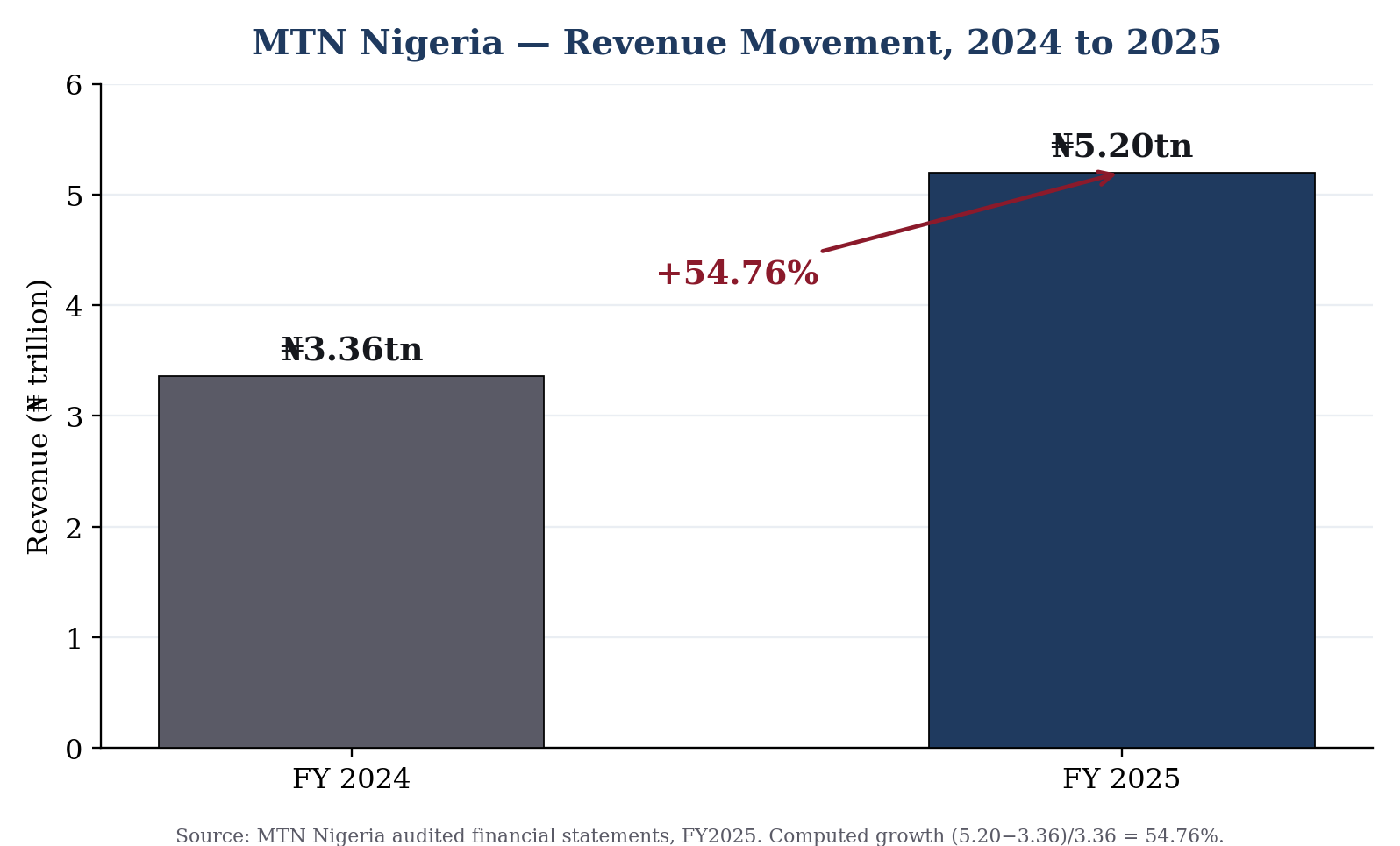
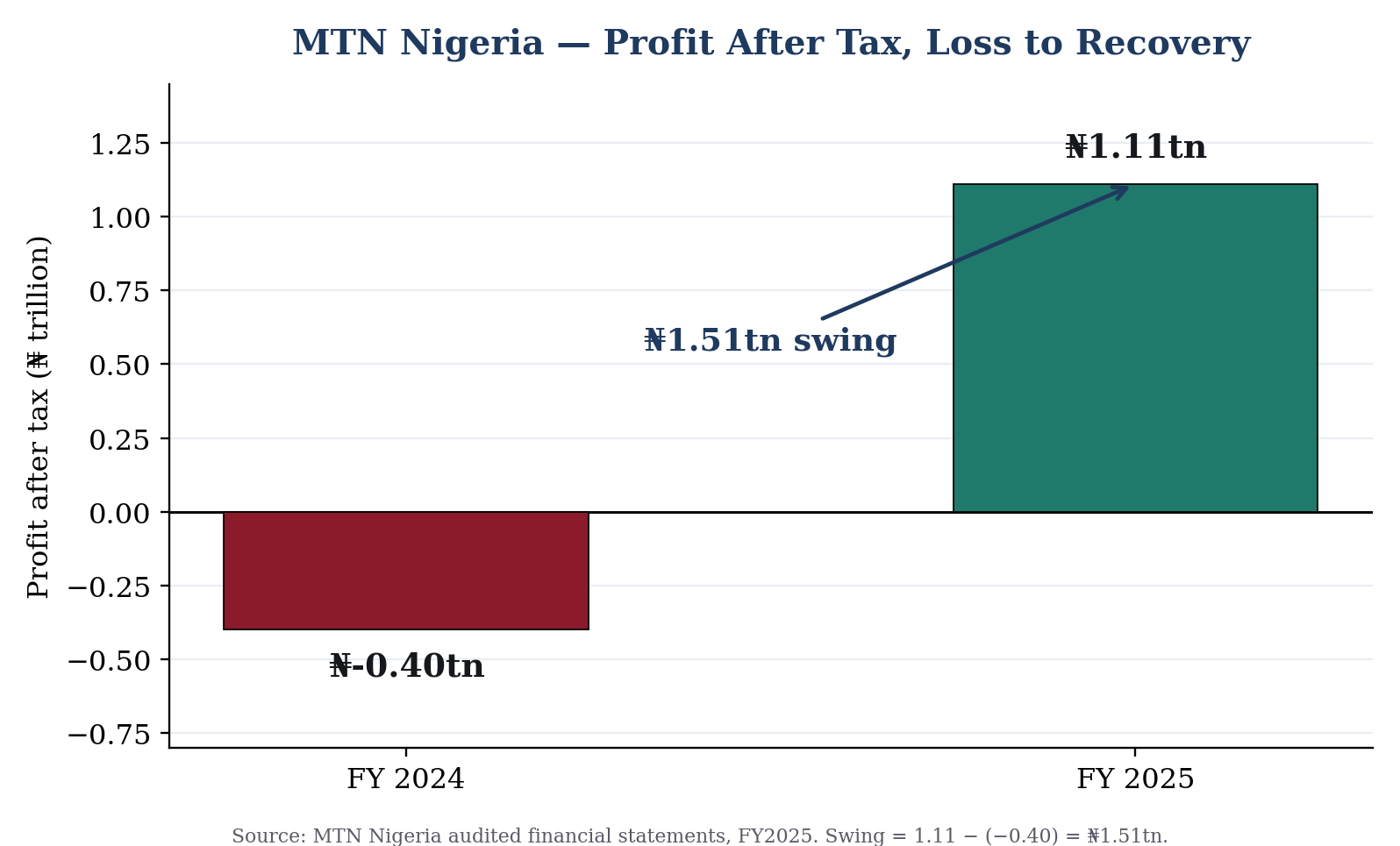
The case is suitable because it offers a public record of scale and reversal. Revenue rose from roughly ₦3.36 trillion in 2024 to ₦5.20 trillion in 2025, a computed increase of 54.76 percent. Profit after tax moved from a 2024 loss near ₦0.40 trillion to a 2025 profit near ₦1.11 trillion, a swing of about ₦1.51 trillion. Service revenue growth was reported above 55 percent and EBITDA recovery above 100 percent. These indicators do not prove every internal policy choice, but they give a defensible public basis for testing how accounting evidence can support strategic decision-making.

The method is documentary case analysis built on public financial data, management-control theory, and accounting interpretation. The analytical design links financial indicators to workforce and strategic levers through ratio checks, a risk-and-control matrix, and a single control model. It rejects the habit of treating accounting as backward-looking reporting and uses it instead as a forward-control language that tests whether leadership choices are economically coherent.

The core finding is that human capital accounting should not be treated as a decorative social-reporting note. In a telecom business exposed to currency volatility, tariff pressure, digital growth, and service-quality expectations, workforce capability becomes a measurable operating asset. The accounting lens must translate talent spending, training, retention, and productivity into figures that sit beside revenue, EBITDA, and risk exposure; the workforce lens must read HR policy as operating control rather than staff-relations prose. The recommendations call for sharper ratio discipline, stronger board reporting, named policy ownership, and disclosure that treats workforce and strategy as accountable performance variables.

Keywords: accounting control; strategic human resource management; workforce policy; management control; human capital accounting; case analysis; public financial data; MTN Nigeria Communications Plc; Postgraduate Diploma research.


Table of Contents


List of Tables

Table 1. Public source and evidence register

Table 2. Case financial and operating indicators

Table 3. Calculation audit

Table 4. Accounting-to-workforce variable map

Table 5. Risk and control matrix

Table 6. Research questions and evidence tests

Table 7. Recommendations and implementation owners

Table 8. NYCAR quality-control ledger

List of Figures

Figure 1. MTN Nigeria revenue movement

Figure 2. MTN Nigeria profit after tax movement

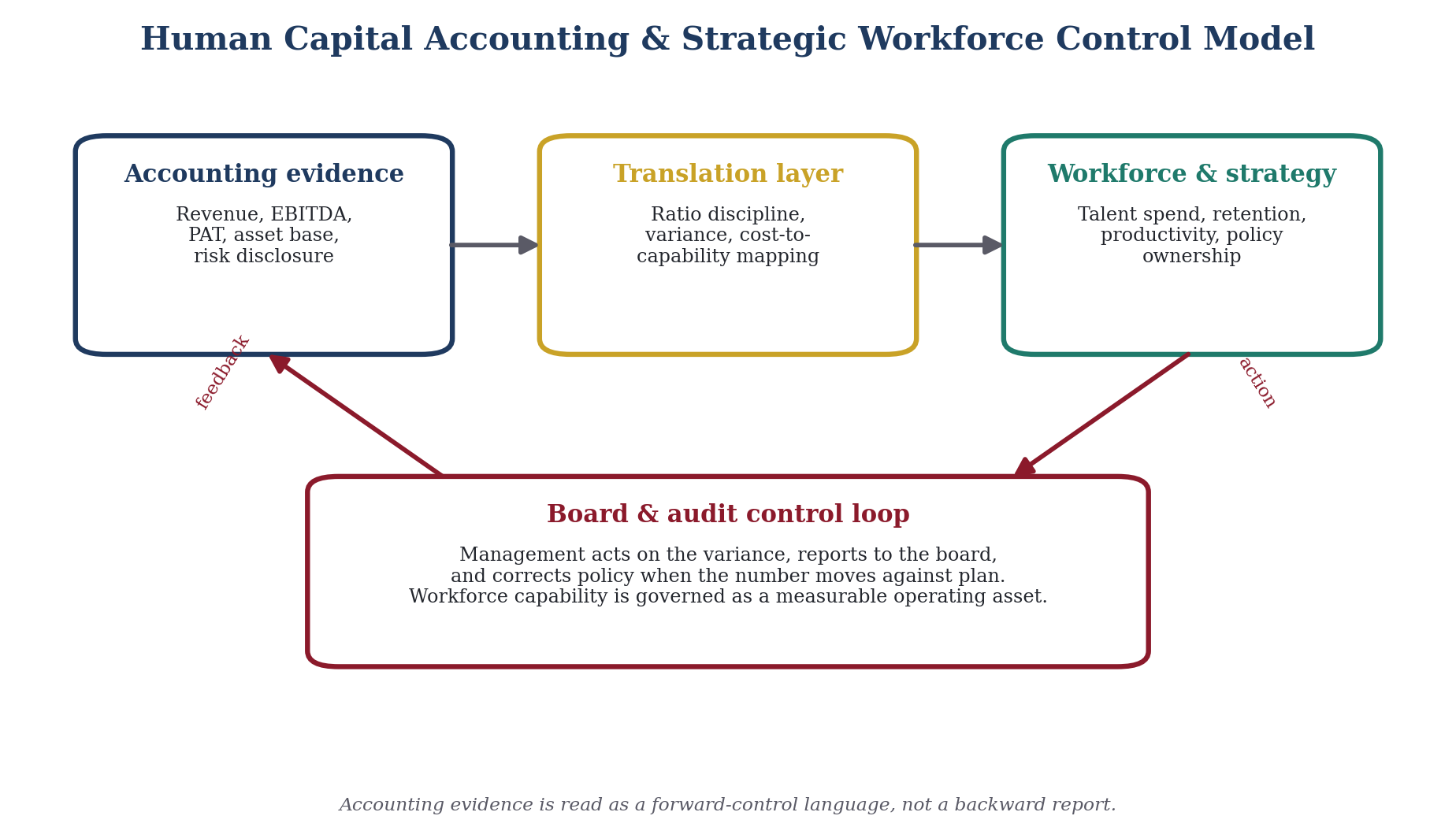
Figure 3. Human capital accounting and strategic workforce control model

Chapter 1: Introduction

This chapter sets the case in its financial and sectoral context and states what the research will and will not attempt. It treats MTN Nigeria not as a story of corporate success but as a test bench on which the relationship between accounting evidence and workforce strategy can be examined under genuine pressure. The argument begins from a single premise: in a firm this exposed, public numbers are evidence, and any claim about people or strategy must answer to them.

1.1 Context and rationale

MTN Nigeria Communications Plc earns its place in this research because its public numbers move far enough, fast enough, to expose the link between money and people. A firm whose revenue climbs by more than half in a single year, and whose bottom line flips from a heavy loss to a trillion-naira profit, is not a quiet object of study. It is a stress test of whether management could fund, staff, and control a recovery while the currency moved against it.

The sector matters as much as the firm. Mobile telecommunications in Nigeria is capital-intensive and skill-dependent at the same time: towers, spectrum, and fibre demand financing, while network quality, fraud control, and digital-product delivery demand engineers, analysts, and disciplined operators. Accounting sits at the junction of those two demands, and that is the rationale for reading the case through an accounting lens rather than a human-interest one.

Public data here are not decorative. They are evidence.

Two features of the firm make it analytically valuable. The cost base is partly dollar-denominated, through tower leases and imported equipment, while the revenue base is naira; and the workforce splits sharply between scarce, firm-specific capability and more substitutable roles. When the naira fell, those two features collided, and the accounts recorded the collision. Reading the case is therefore not an exercise in admiring a recovery but in tracing how a financing structure and a capability structure interact under stress.

The research takes the audited figures as its anchor and refuses to drift from them. Where a claim cannot be tied back to a published number or to recognized theory, it is not made.

1.2 Problem statement

The problem is a habit of language. Strategy documents and HR policies often speak of talent, culture, and alignment without ever stating which number would prove the claim true or false. When the words cannot be tested against cost, margin, retention, or delivery quality, they describe an intention rather than a control.

MTN Nigeria sharpens the problem because the temptation to narrate success is strongest exactly when the headline numbers are good. A 54.76 percent revenue rise can flatter a workforce policy that contributed little, or mask a capability gap that the next tariff cycle will expose. The research therefore frames the problem as one of attribution: separating what the public accounts can support from what management would like them to imply.

There is a quieter problem too, namely aggregation. Public accounts compress a complex workforce into a handful of cost lines, so the very structure that matters most — which capability is scarce, which is substitutable — disappears into a total. An analysis that stops at the total will therefore misread the firm’s real exposure, mistaking a manageable cost for a strategic risk or, worse, the reverse.

1.3 Aim and objectives

The aim is to show how accounting information can convert workforce investment, remuneration discipline, talent retention, and operating productivity into strategic HRM decisions inside a capital-intensive telecom operator.

Four objectives follow. The work sets out to recalculate the headline financial movements from public figures rather than accept reported percentages on trust; to map each accounting variable onto a workforce or strategy lever it can plausibly test; to build a control model that treats accounting as a forward signal; and to translate the analysis into recommendations with named owners and audit evidence. Each objective is designed to survive a reader who asks for the arithmetic.

The objectives are sequenced so that judgment always trails evidence. Recalculation comes before mapping, mapping before interpretation, and interpretation before recommendation. The order is a safeguard against the most common failure in applied case work, which is to choose a conclusion and then assemble the figures that flatter it.

1.4 Research questions

The research is organized around four questions. How does accounting evidence discipline workforce and strategy decisions in this case? Where do the public numbers show management pressure rather than comfort? Which ratios expose whether a stated policy is adequately funded? And what does the case teach beyond its own descriptive data?

Each question is tied to an explicit evidence test, summarized later in Table 6, so that the answers can be checked rather than asserted. The questions are deliberately modest about what a documentary case can prove, and deliberately strict about what it must show before any claim is allowed to stand.

The questions also fix the burden of proof. A documentary case is allowed to demonstrate that a method works on real evidence; it is not allowed to claim a general law from a single firm. Keeping that distinction visible in the questions keeps it visible in the answers, and prevents the analysis from quietly inflating what one case can establish.

Research question Evidence test Expected output
How does accounting evidence discipline workforce and strategy decisions? Link public financial data to policy levers Traceable control model
Where does the case show management pressure? Read growth, profit, assets, and risk signals Pressure map
Which ratios expose policy adequacy? Recalculate growth and margin indicators Math audit
What does the case teach beyond descriptive data? Connect case evidence to theory Defensible findings

Table 6. Research questions and evidence tests

1.5 Scope and boundaries

The scope is the public financial and operating record of MTN Nigeria across the 2024 and 2025 reporting cycle, read alongside recognized accounting and management-control literature. It does not extend to confidential payroll files, internal headcount tables, or proprietary remuneration data, none of which are publicly available.

That boundary is a strength rather than an apology. A postgraduate analysis that confines itself to verifiable public evidence is harder to dispute than one that leans on figures no reader can see. Where the public record runs out, the research says so and labels the remainder as interpretation.

The temporal boundary is equally deliberate. The study reads the 2024 loss and the 2025 recovery as a paired event, because a single year in isolation would teach little. A loss followed by a sharp rebound is a natural experiment in capability under pressure, and the boundary is drawn to capture exactly that movement and no more.

1.6 Significance

The significance is practical. If accounting evidence can be shown to discipline workforce and strategy choices in a firm as visible as MTN Nigeria, the same discipline transfers to smaller organizations that lack the same public scrutiny.

For the postgraduate reader, the contribution is a worked demonstration that human capital accounting is not a reporting ornament but a governance tool. The analysis gives finance directors, HR leads, and audit committees a defensible way to ask whether a people policy is funded, owned, and measured, and to notice early when a declared strategy is drifting away from the numbers that should support it.

There is a wider significance for the Nigerian market. If the country’s largest, most scrutinized operator can have its workforce-and-strategy logic read entirely from public accounts, the same reading is available to regulators, analysts, and boards across the sector. The method democratizes a kind of scrutiny that is often assumed to require privileged access.

1.7 Case justification

MTN Nigeria is justified as a case on three grounds: visibility, volatility, and consequence. Its accounts are published and audited, so the evidence base is open. Its 2024 loss and 2025 recovery supply genuine variance rather than a flat record that teaches nothing. And its scale means that workforce and governance decisions carry consequences large enough to register in the financial statements.

A calmer firm would have made a duller case. The value of this one is precisely that the numbers were under pressure, which is when accounting either earns its keep as a control or fails quietly.

The case also avoids a survivorship trap. Because the firm passed through a genuine loss before recovering, the analysis is not studying an unbroken success story that could teach false lessons. The 2024 figure is the control against which the 2025 figure is read, and its presence is what makes the case honest rather than promotional.

A further reason to trust the case is the quality of the audit trail behind it. Listed-company accounts of this size are externally audited and filed under regulatory scrutiny, which raises the evidential floor well above self-reported corporate communications. The research leans on that scrutiny rather than on the firm’s own narrative, and treats the audited statement, not the press release, as the document of record.

1.8 Chapter organization

The remaining chapters move from theory to evidence to judgment. Chapter 2 reviews accounting-as-control and strategic HRM literature and sets out the conceptual model. Chapter 3 states the method and the calculation rules. Chapter 4 presents the public data and the recomputed ratios. Chapter 5 analyses how the accounting evidence bears on workforce and strategy.

Chapter 6 records the case findings, Chapter 7 discusses what they do and do not prove, and Chapter 8 sets out recommendations with owners and a quality-control review. The test running through all of them is a single sentence: if the policy cannot survive the numbers, it is not yet strategy.

Each chapter is written to be checkable on its own terms. The methodology states its rules before the data appear; the data chapter shows its arithmetic before the analysis interprets it; and the recommendations carry owners and evidence so they can be audited rather than admired. The structure is, in effect, the control model applied to the document itself.

Read also: Digital Transformation in Accounting and Financial Strategy

Chapter 2: Literature Review

The review assembles the analytical tools the rest of the research will use. It draws management-control theory, strategic human resource management, the human-capital architecture, the balanced scorecard, and disclosure scholarship into a single working frame, and it ends by naming the specific gap this case is positioned to fill. The aim is not a survey for its own sake but a toolkit chosen for the questions ahead.

2.1 Accounting as management control

Management-control scholarship treats accounting not as a record of the past but as a system that shapes behaviour in the present. Budgets, variance reports, margin targets, and risk registers tell an organization what its leadership actually values, regardless of what the strategy deck claims.

The implication for this case is direct. If MTN Nigeria’s internal reporting never converts workforce policy into a monitored number, then the firm may reward short-term output while quietly eroding the engineering and service capability that produced the 2025 recovery. Anthony Hopwood’s tradition in this field is blunt about the consequence: what gets measured gets managed, and what is left unmeasured is left to chance.

Control literature also warns about the dark side of measurement. A metric, once tied to reward, invites gaming: a service-quality target can be hit on paper while the underlying capability decays. The case reading therefore treats any single number with suspicion and looks for corroboration across revenue, margin, and risk before trusting it, which is why the analysis leans on a small set of mutually checking ratios rather than one headline figure.

2.2 Strategic human resource management and accounting evidence

Strategic HRM links people decisions to organizational performance, but the link is only credible when it is measurable. Becker, Huselid, and Ulrich argued for an HR scorecard precisely because HR claims tend to evaporate the moment a finance director asks for the figure behind them.

Read against the case, the lesson is that retention, training, and productivity must be expressed in the same units as revenue and cost before they can enter a strategy conversation. A statement that MTN Nigeria “invests in its people” is not analysis. A statement that workforce cost moved by a stated percentage while service revenue grew by 55 percent is the beginning of one.

The strategic-HRM literature is divided between a universalist view, that certain people practices always help, and a contingency view, that practices must fit the firm’s strategy and context. The case sides with contingency. A capital-intensive telecom under currency stress does not need generic best practice; it needs the specific capabilities — treasury, regulatory, network engineering — that its particular pressures demand, and accounting is the instrument that reveals which capabilities those are.

The contingency view also explains why imported best practice can fail. A people practice that works in a low-inflation, stable-currency market may be irrelevant, or even harmful, in a firm whose dominant risk is a falling currency against a dollarized cost base. The case insists that the right practices are the ones the firm’s specific accounting pressures call for, which is a sharper and more testable claim than a general appeal to good HR.

2.3 Workforce policy as a cost and capability system

Lepak and Snell’s human-capital architecture is useful here because it refuses to treat all employees as a single line item. It distinguishes the rare, firm-specific capability that a telecom cannot buy quickly — core network engineering, fraud analytics, regulatory and finance expertise — from the more substitutable roles that the market can refill at short notice.

That distinction has an accounting consequence. The cost of losing a scarce, firm-specific capability is not the salary line; it is the delivery delay, the service-quality penalty, and the lost revenue while the role sits empty. A workforce policy that ignores this difference will under-price its most expensive risk.

Read forward, the architecture predicts where a downturn does the most damage. Cutting substitutable roles trims cost with little strategic loss; cutting firm-specific capability trims cost while quietly removing the firm’s ability to recover. The 2024 loss would have tempted both kinds of cut, and the durability of the 2025 rebound is indirect evidence that the firm protected the capability that mattered.

The architecture also reframes what a vacancy costs. In substitutable roles the cost of a departure is mostly the salary saved against the time to refill; in firm-specific roles it is the delivery the firm cannot make while the seat is empty, which in a telecom can mean degraded service to millions of subscribers. Reading those two vacancies as the same line item is precisely the error the human-capital lens exists to prevent.

2.4 Strategy in measurable organizations

Kaplan and Norton’s balanced scorecard remains the clearest argument that strategy fails when it lives only in narrative. Their insight was that financial outcomes are lagging indicators, and that the leading indicators sit in process quality, customer experience, and workforce capability.

For a telecom, the chain is easy to trace and hard to fake: skilled people maintain network quality, network quality retains subscribers, retained subscribers produce service revenue, and service revenue is what ultimately appears in the audited accounts. The scorecard logic tells management to watch the early links, not only the last one.

The scorecard’s deeper claim is about lag. By the time a capability failure reaches the income statement, it is often too late to correct cheaply. That is the argument for watching the leading indicators, and it is the reason the research treats workforce capability as something to be monitored continuously rather than audited annually.

2.5 Public disclosure and governance discipline

Disclosure literature treats the annual report as a governance act, not a marketing document. What a board chooses to disclose, and how plainly, signals whether it understands its own exposures.

MTN Nigeria’s public reporting names currency risk, regulatory risk, and operating cost pressure. The research reads that disclosure as a test: a board that can describe its risks in financial terms is more likely to be governing them than one that hides behind reassurance. The quality of the disclosure becomes, itself, a piece of evidence about the quality of the control.

Disclosure also disciplines the firm internally. The act of having to state a risk publicly forces a board to hold a view on it, and a board that has committed to a public position on currency or regulatory exposure is harder-pressed to ignore that exposure in private. Disclosure, on this reading, is not only information for outsiders; it is a commitment device for insiders.

2.6 Case-study literature relevance

Yin’s case-study tradition defends the single, information-rich case as a legitimate way to test theory, provided the analyst is explicit about evidence and inference. The defence matters because a single firm cannot be a statistical sample.

The research accepts that limit and works inside it. It does not claim that MTN Nigeria proves a general law of human capital accounting; it claims that the case demonstrates the method working on real, audited numbers, which is the proper ambition of a case study.

The trade-off in single-case work is depth for breadth. The method sacrifices the ability to generalize statistically in exchange for the ability to trace a mechanism in detail on real, audited numbers. For a question about how accounting disciplines strategy, depth is the right trade, because the mechanism is precisely what a broad survey would blur.

2.7 Conceptual control model

The literature converges on a single model used throughout the analysis and shown in Figure 3. Accounting evidence — revenue, EBITDA, profit, asset base, and risk disclosure — feeds a translation layer of ratios and variances, which informs workforce and strategy levers such as talent spend, retention, and productivity.

The model closes with a control loop: management acts on the variance, reports it to the board, and corrects policy when a number moves against plan. The loop is what turns accounting from a report into a control, and it is the spine of the chapters that follow.

Crucially, the model is a loop and not a line. Accounting evidence informs workforce and strategy action, but the result of that action returns as new accounting evidence in the next cycle, which is why Figure 3 closes the circuit back to its origin. A model drawn as a straight line would imply that reporting ends the process; drawn as a loop, it shows that reporting restarts it.

Figure 3. Human capital accounting and strategic workforce control model

2.8 Literature gap

The gap the research addresses is specific. Human capital accounting is well theorized and strategic HRM is well argued, but the two literatures rarely meet on a single, fully public African telecom case where the numbers actually moved.

Most applied work either reports financials without the workforce reading, or asserts workforce value without the financial test. The contribution here is to hold both lenses on the same audited evidence at once, and to refuse any claim that one lens alone could carry.

There is also a geographic gap. Much of the human-capital-accounting and strategic-HRM evidence is drawn from mature markets with stable currencies, where the financing shock that dominates this case simply does not arise. Applying the frame to a Nigerian operator under devaluation tests whether the theory survives outside the conditions that produced it, which is part of the contribution.

Chapter 3: Methodology

This chapter states the rules of evidence before any evidence is presented, so the reader can judge the analysis by a standard set in advance rather than one improvised to fit the result. It covers the design, the sources and their grading, the variables, the calculation rules, the procedure, the validity safeguards, the ethical boundaries, and the limitations. Each is stated plainly enough to be checked.

3.1 Research design

The design is a single-case, theory-testing study built on documentary evidence. It pairs the public financial record of MTN Nigeria with management-control and strategic-HRM theory, and uses each to interrogate the other.

The choice is deliberate. A survey would have produced opinions; a documentary case produces auditable figures. Because the central claim is that accounting can discipline strategy, the method had to rest on numbers a reader can recompute, not perceptions a reader must trust.

Theory-testing, rather than theory-building, is the honest description of the design. The control model and the strategic-HRM frame are taken as given and put under pressure by the case; the study asks whether they hold on this evidence, not whether the case can invent a new theory on its own. That modesty is appropriate to a single case and keeps the claims proportionate.

3.2 Data sources

Evidence is drawn from MTN Nigeria’s audited financial statements, MTN Group reporting, IFRS presentation principles, and recognized management literature, with quality-control steps documented rather than assumed. Table 1 records the source register in full.

Each source is admitted for a stated purpose: corporate filings for case-specific figures, accounting standards for measurement discipline, and the management and strategy literature for the analytical frame. Nothing enters the analysis without a traceable origin.

Source quality is graded, not assumed. Audited financial statements carry the highest evidential weight; group-level reporting and remuneration disclosures sit below them; and the academic literature is used for framing rather than for case facts. Grading the sources prevents a strong claim from resting on a weak document.

Evidence area Public source Use in the research
Corporate case record MTN Nigeria 2025 audited financial statements and MTN Group 2025 reporting Provides case-specific public data and operating context
Accounting standards IFRS presentation principles and conceptual basis for financial reporting Anchors measurement discipline and disclosure reading
Workforce governance Professional HRM and management-control literature Links people policy to cost, risk, and performance
Strategic management Peer-reviewed strategy and control literature Supports institutional analysis beyond descriptive financials
Quality control NYCAR scan, arithmetic recheck, render inspection Documents research integrity and layout review

Table 1. Public source and evidence register

3.3 Variable selection

The accounting variables are revenue, profit after tax, an EBITDA or margin signal, the asset and investment base, and risk disclosure. Each is selected because it is publicly reported and because it plausibly connects to a workforce or strategy lever, as set out in Table 4.

Variables that could not be sourced publicly — headcount, payroll detail, training spend — are excluded rather than estimated. An analysis that invents the numbers it needs is not a control; it is a guess wearing a ratio.

Variable selection follows a single rule: include a measure only if it is both public and connected to a workforce or strategy lever the research can articulate. A figure that is public but disconnected adds noise; a figure that is connected but private cannot be verified. The intersection of the two is small, deliberate, and defensible.

There is a deliberate asymmetry in what the variables include. Financial measures enter freely because they are audited and public; workforce measures enter only as inference, because the public record rarely carries them. Naming that asymmetry inside the variable set, rather than papering over it, is what keeps the later analysis honest about which claims rest on measurement and which rest on reasoning.

3.4 Calculation rules

Three rules govern every figure. Where a number is computed, the formula is stated. Where a reported figure and a computed figure differ, both are shown and the difference is explained. And rounding is disclosed rather than hidden, because a tidy percentage can conceal a real gap.

Under these rules, revenue growth is computed as (5.20 − 3.36) / 3.36 = 54.76 percent, and the profit swing as 1.11 − (−0.40) = ₦1.51 trillion. Table 3 carries the full calculation audit so the arithmetic is open to challenge.

Worked transparency is the point of the calculation rules. A reader who disagrees with a conclusion can locate the exact step where their judgment diverges, because every computed figure is shown with its inputs and formula. Analysis that hides its arithmetic asks for trust; analysis that shows it invites scrutiny, and only the latter is appropriate at postgraduate level.

The rounding rule deserves emphasis because it is where most applied work quietly cheats. Reporting a clean reported percentage while suppressing the computed one lets a small discrepancy disappear, and with it the reader’s ability to audit the figure. Showing both the reported 54.9 percent and the computed 54.76 percent is a minor act with a major principle behind it: the analysis would rather look slightly untidy than be quietly unverifiable.

3.5 Case-study procedure

The procedure runs in a fixed order: assemble the public record, recompute the headline movements, map each accounting variable to its workforce or strategy counterpart, test the mapping against the risk matrix, and only then draw findings.

Holding the order fixed matters, because it prevents the analysis from reasoning backward from a conclusion it already preferred. The findings in Chapter 6 are allowed to exist only after the arithmetic and the mapping have survived.

The procedure builds in a stopping rule. Findings are not permitted until the recomputation and the variable mapping have both survived, which means a striking but unsupported observation is held back rather than promoted. The rule slows the analysis on purpose, trading speed for defensibility.

The fixed order also guards against premature pattern-fitting. Faced with a dramatic recovery, the mind reaches for a clean explanation before the evidence is in, and the explanation then shapes which figures feel relevant. By forbidding interpretation until recomputation and mapping are complete, the procedure keeps the explanation downstream of the arithmetic, where it belongs.

3.6 Validity safeguards

Validity rests on triangulation and transparency. Reported figures are checked against computed ones, the interpretation is separated from the evidence by explicit labelling, and the quality-control ledger in the appendix records each check and its result.

The safeguard is not a claim of certainty. It is a claim that a reader can see exactly where evidence ends and judgment begins, which is the most a documentary case can honestly offer.

Reliability is addressed by reproducibility. Because every input is public and every computation is shown, another analyst working from the same documents should reach the same figures. That is a stronger guarantee than inter-rater agreement on private data, and it is the form of reliability a documentary study can actually deliver.

3.7 Ethical and public-data boundaries

The research uses only public, lawfully available information and makes no use of confidential or personal employee data. No interview, no internal file, and no individual’s record is involved.

This boundary protects both the subjects and the argument. A conclusion built entirely on the public record cannot be accused of privileged access, and a reader anywhere can audit it from the same documents.

Using only public data also disciplines the ethics of inference. The research never attributes a motive to a named individual, never infers a personnel decision it cannot see, and never converts an absence of disclosure into an accusation. Silence in the record is treated as silence, not as evidence of wrongdoing.

3.8 Limitations

The method has real limits. A single case cannot generalize statistically; public accounts compress the workforce into cost lines that hide structure; and a one-year movement, however dramatic, is a short window on a long story.

These limits are stated up front so they cannot be smuggled past the reader. They constrain the strength of the claims in Chapter 7 without undermining the demonstration that the method works on the evidence available.

A final limitation is reflexive. The analyst, like the firm, can be tempted by a tidy story, and the discipline that the research recommends to management applies equally to the research itself. The quality-control ledger exists partly to hold the author to the same standard the argument demands of the case.

Chapter 4: Public Data and Case Profile

Here the public record is laid out and its headline movements are recomputed from the underlying public inputs. The chapter profiles the firm, presents the financial evidence with its supporting figures and tables, reads the operating-pressure signals, and fixes the boundary of what the numbers can support before any interpretation is allowed to build on them.

4.1 Organization profile

MTN Nigeria Communications Plc is the country’s largest mobile network operator and one of the most heavily capitalized firms on the Nigerian Exchange. It carries a large subscriber base, a national infrastructure footprint, and a growing data and fintech franchise, all of which sit on a cost base exposed to imported equipment and foreign-currency obligations.

That profile makes the firm an unusually clear instrument. Its size means workforce and governance decisions are large enough to register in the audited accounts, and its capital intensity means the cost of skill shortages is not hypothetical.

Capital intensity is the profile’s defining trait. A network operator spends heavily and continuously on infrastructure before it earns, which means its cost base is large, partly fixed, and partly foreign-currency-denominated. That structure is what made the 2024 currency shock so severe and the 2025 operating leverage so powerful, and it frames every figure that follows.

4.2 Financial performance evidence

The headline movements are large and public. Revenue rose from roughly ₦3.36 trillion in 2024 to ₦5.20 trillion in 2025; profit after tax moved from a loss near ₦0.40 trillion to a profit near ₦1.11 trillion; service revenue growth was reported above 55 percent and EBITDA recovery above 100 percent. Table 2 sets out the indicators and Figures 1 and 2 show the revenue and profit movements.

The reversal is the point. A firm does not swing ₦1.51 trillion at the bottom line by accident, and it does not do so without the people who run the network, price the products, and manage the currency exposure. The accounts record the result; the analysis asks what capability produced it.

The figures should be read as a pair rather than as two events. The 2024 loss and the 2025 profit are two readings of the same structure under different currency conditions, not a failure followed by an unrelated success. Read together, they show a firm whose underlying operations were sound enough to recover sharply once the financing shock eased, which is a more useful finding than either year alone.

It is worth stating the scale plainly. A revenue base above five trillion naira and a profit above one trillion place this firm among the largest on the exchange, which means the workforce and governance choices behind the numbers are not marginal adjustments but decisions large enough to move a national index. The size is part of why the case can be read at all: at this scale, capability decisions leave financial footprints.

Indicator 2024 2025 Calculated reading
Revenue ₦3.36 trillion ₦5.20 trillion 54.76% growth
Profit after tax −₦0.40 trillion ₦1.11 trillion ₦1.51 trillion swing
Service revenue growth 55.1% Reported public performance signal
EBITDA recovery 108.9% Operating-leverage signal

Table 2. Case financial and operating indicators

Figure 1. MTN Nigeria revenue movement, 2024–2025

Figure 2. MTN Nigeria profit after tax, loss to recovery

4.3 Operating pressure signals

Beneath the recovery sit real pressures. Naira devaluation inflated the cost of dollar-denominated tower leases and equipment; a regulated tariff environment limited how quickly price could follow cost; and service-quality expectations rose even as the cost base did.

Read together, these signals explain why the 2024 loss was less a failure of demand than a collision between a falling currency and a fixed cost structure. They also explain why the 2025 recovery depended on disciplined execution rather than market luck.

Tariff timing deserves particular weight. In a regulated market, price cannot move freely to follow cost, so a devaluation can open a gap between rising cost and fixed price that only a later, approved tariff adjustment can close. The 2024 loss sits inside that gap, and part of the 2025 recovery reflects its closing — a point the analysis is careful to credit rather than ignore.

The interaction of the pressures matters more than any one alone. Devaluation raised cost, regulation delayed the price response, and rising service expectations forbade any quiet retreat on quality, so the three forces compounded rather than offset. The 2024 loss is best read as the point where that compounding peaked, and the 2025 recovery as the point where the slowest force, the tariff response, eventually caught up.

4.4 Workforce and strategy implications

Every one of those pressures has a workforce face. Currency exposure demands sharper financial and treasury skill; tariff constraint demands commercial and regulatory capability; service-quality expectations demand engineering and customer-operations strength.

The implication is that the recovery was, in part, a capability outcome. The accounts cannot isolate that contribution precisely, but they make it impossible to claim the rebound was purely financial engineering, because a network does not improve service and grow service revenue without people who can deliver it.

The workforce reading is necessarily inferential here, and the chapter says so plainly. Public accounts do not show how many treasury specialists managed the currency exposure or how retention held in network engineering. What they show is a result inconsistent with a collapse in those capabilities, which licenses an inference about capability without licensing a measurement of it.

The point is not to over-claim a workforce effect but to refuse to ignore one. A recovery of this scale has a human dimension whether or not the accounts isolate it, and an analysis that read the rebound as purely financial would be making its own unstated assumption about people — that they did not matter — which the evidence supports no more than the opposite.

4.5 Accounting interpretation of the public numbers

Interpreted as control signals rather than history, the numbers tell a coherent story. The profit swing shows operating leverage: once revenue cleared the fixed-cost burden inflated by devaluation, earnings recovered sharply.

That reading is labelled as interpretation, not proof. The public accounts are consistent with disciplined capability management, but they are also consistent with favourable pricing and base effects. Honest analysis names both, then looks to the ratios to narrow the gap.

Operating leverage is double-edged, and the interpretation holds both edges in view. The same fixed-cost structure that amplified the 2025 recovery would amplify a future downturn, so the profit swing is read as evidence of leverage rather than as proof of permanent strength. An honest control reading notes the upside and the symmetric risk in the same breath.

4.6 Ratio analysis

The ratio work is deliberately conservative and fully shown in Table 3. Revenue growth computes to 54.76 percent against a reported figure near 54.9 percent, a difference that reflects rounding rather than disagreement. The profit movement is a ₦1.51 trillion swing from loss to profit.

Two disciplines are applied. Computed values are never replaced by reported ones, and any divergence is displayed rather than reconciled away. The aim is not a flattering ratio but a defensible one.

Conservatism in the ratio work is a deliberate choice. Where a reported figure and a computed figure diverge, the research reports both and favours the computed one, because the computation can be checked while the report must be trusted. The small gap between a reported 54.9 percent and a computed 54.76 percent is shown rather than smoothed, precisely because hiding it would teach the wrong habit.

Calculation Inputs Formula Result
Revenue growth ₦3.36tn to ₦5.20tn (5.20−3.36)/3.36 54.76%
Profit swing −₦0.40tn to ₦1.11tn 1.11−(−0.40) ₦1.51tn
Reported vs computed Reported 54.9%; computed 54.76% comparison Difference reflects rounding

Table 3. Calculation audit

4.7 Risk context

The risk context is structural, and Table 5 maps it. Currency volatility threatens both cost and revenue translation; tariff pressure squeezes margin; network-cost escalation leaks capital; specialist-retention risk hides as future operating cost; and regulatory scrutiny carries reputational weight.

Each risk is paired with an accounting exposure and a workforce or strategy exposure, because a risk that is named only in financial terms, or only in people terms, is a risk that is half-managed.

The risk map is built to resist single-lens thinking. Each exposure is forced to declare both its financial face and its workforce face, so currency risk is not allowed to hide as a pure treasury problem when it is also a skills problem, and retention risk is not allowed to hide as a pure HR problem when it is also a future cost. Pairing the lenses is what turns a risk list into a control.

Risk area Accounting exposure Workforce or strategy exposure Control response
Currency volatility Cost and revenue-translation volatility Planning uncertainty Staff-cost visibility
Tariff pressure Margin pressure Policy stress Skill-cost mapping
Network-cost escalation Capital and delivery leakage Capability gap Retention analytics
Specialist-retention risk Hidden operating cost Retention and quality strain Training-investment discipline
Customer-service strain Compliance and reporting exposure Execution drift Productivity ratios
Regulatory scrutiny Reputation and market risk Leadership-credibility strain Board-level people reporting

Table 5. Risk and control matrix

4.8 Evidence reading

The chapter closes by fixing what the public evidence can and cannot carry. It can carry the scale of the movement, the direction of the recovery, and the structure of the risk. It cannot, on its own, isolate the exact contribution of any single workforce policy.

That honest boundary is what allows the analysis in Chapter 5 to proceed without overreach. The numbers are strong enough to discipline the argument and modest enough to keep it truthful.

Fixing the evidence boundary is the most important act in the chapter. By stating exactly what the public numbers can and cannot support before the analysis begins, the research denies itself the later temptation to let a strong figure carry a weak claim. The boundary is restrictive on purpose, and the credibility of Chapter 5 depends on it holding.

Chapter 5: Analysis of Accounting and Workforce Strategy

With the evidence fixed, the analysis turns to mechanism: how accounting visibility, read through a deliberate set of ratios and a risk matrix, can discipline workforce and strategy decisions. The chapter works through visibility, cost-and-capability planning, policy as control, measurement, governance, risk, the disclosure gap, and the bounded inference the case allows.

5.1 Accounting visibility

Accounting makes the firm visible to its own management, and visibility is the precondition of control. Where revenue, margin, and risk are reported in a form managers actually read, workforce and strategy decisions can be tested against them.

The mapping in Table 4 is the working instrument: revenue growth tests capacity and productivity, profit movement tests labour-cost discipline and operating leverage, the margin signal tests delivery efficiency, and risk disclosure tests governance. Visibility without that mapping is just data; with it, the numbers become a control surface.

Visibility is necessary but not sufficient. A firm can see its numbers and still fail to act on them, which is why the mapping in Table 4 pairs each visible figure with the specific lever it is meant to discipline. Without that pairing, visibility produces dashboards that are watched but never used; with it, each number has a job.

Accounting variable Workforce or strategy variable Interpretation
Revenue growth Capacity and productivity Tests whether scale is supported by human capability
Profit movement Labour-cost discipline and operating leverage Shows whether growth converts into earnings
Margin or EBITDA signal Skill quality and delivery efficiency Exposes whether workforce deployment supports margins
Asset and investment base Technology and infrastructure support Connects capital intensity to skill demand
Risk disclosure Governance and accountability Tests whether public reporting names the right exposures

Table 4. Accounting-to-workforce variable map

5.2 Cost discipline and capability planning

Cost discipline and capability planning pull in opposite directions, and the case shows the tension clearly. Cutting cost in a downturn protects this year’s margin; cutting the wrong capability mortgages next year’s network quality.

A firm that crossed the 2024 loss by trimming scarce engineering or analytics capability would have bought its recovery on credit. The disciplined alternative — protecting firm-specific capability while controlling substitutable cost — is invisible in a single cost line, which is why the analysis insists on reading cost through the capability architecture rather than the payroll total.

The capability-planning lesson is about timing as much as amount. Scarce capability is slow to rebuild, so a cut made in a single bad quarter can take years to reverse, long after the saving has been forgotten. Reading cost through the capability architecture forces management to price that asymmetry, and to treat the cheapest cut and the wisest cut as different decisions.

5.3 Workforce policy as a control instrument

Treated properly, a workforce policy is a control with four parts: an owner, a metric, a report that carries the metric, and an action that follows when the metric moves. Stripped of any one of these, it reverts to staff-relations prose.

The case rewards this framing. Retention can be owned by business-unit heads and read through delivery dashboards; remuneration discipline can be owned by finance and read through the cost-to-revenue ratio. The point is not the particular owner but the refusal to let a policy float free of a number.

The four-part test — owner, metric, report, action — is also a diagnostic. Applied to a real policy, it exposes which part is missing: a policy with an owner but no metric is unaccountable, and a policy with a metric but no action is decorative. Most weak HR policies fail on the action clause, because that is the clause that requires someone to do something when the number disappoints.

The framing also resolves a common confusion between activity and control. Running a training programme, publishing a values statement, or holding a town hall is activity; none becomes a control until it is tied to a metric and an action. The case applies the distinction without mercy: a people initiative that cannot name its number is recorded as activity, however well-intentioned, and only initiatives that close the loop are counted as controls.

5.4 Performance measurement

Performance measurement is where strategy either grips or slips. The balanced-scorecard logic says the leading indicators — service quality, capability retention, productivity — must be watched before the lagging financial result arrives.

In a telecom the sequence is concrete: capability sustains network quality, quality sustains subscribers, subscribers sustain service revenue. Measuring only the last link tells management the score after the match. Measuring the early links tells them the score while they can still change it.

Measuring the leading indicators is harder than measuring the lagging ones, which is exactly why firms avoid it. Service revenue is reported automatically; capability retention in a scarce role must be deliberately tracked. The research treats that difficulty not as an excuse but as the work, because the indicators that are hard to measure are usually the ones that move earliest.

5.5 Governance and board accountability

Governance turns measurement into accountability. A board that receives workforce capability only as anecdote cannot govern it; a board that receives it as a monitored variable can.

The standard is unglamorous. Directors do not need to manage individual hires, but they do need to see whether capability risk is rising, whether retention in scarce roles is holding, and whether the people cost behind the recovery is sustainable. A board that asks for those numbers is governing the asset that produced the rebound.

Board accountability has a failure mode worth naming: reassurance. A board that accepts confident narrative in place of monitored figures has not governed the workforce asset; it has been managed by it. The remedy is unglamorous and specific — a standing place on the agenda where capability risk appears as a number with a trend, not a paragraph with an adjective.

Board-level accountability also lengthens the time horizon of the conversation. Executives under quarterly pressure discount slow-moving capability risk; a board that asks for a capability trend, not a snapshot, forces the slow risk back into view. The governance contribution is therefore partly temporal: the board is the body with the standing to care about the year after next.

5.6 Risk management

Risk management in the case is the discipline of pairing each exposure with both a financial and a workforce response, as Table 5 sets out. Currency risk meets staff-cost visibility; tariff risk meets skill-cost mapping; retention risk meets training-investment discipline.

The pairing matters because single-lens risk management fails quietly. A currency hedge that ignores the treasury skill needed to run it, or a retention plan with no cost line, leaves the exposure only half-controlled.

Risk management is also a sequencing problem. The exposures interact — a currency shock raises cost, which tightens budgets, which pressures retention, which threatens delivery — so controlling them in isolation misses the chain. The matrix in Table 5 is a starting point, but the deeper discipline is to read the exposures as a connected system in which one pressure becomes the next.

5.7 Data limitations and disclosure gaps

The analysis is candid about what the public record withholds. There is no public headcount series, no training-spend line, and no retention metric for scarce roles, so the workforce reading is inferential where it touches those variables.

This is the disclosure gap the recommendations later target. The remedy is not to invent the missing numbers but to argue that a firm of this scale should publish enough of them to make its own workforce claims testable.

The honest response to a disclosure gap is to mark it, not to fill it with estimates. Where the public record is silent on headcount, training, or retention, the analysis leaves the space empty and labels the surrounding claims as inference. An estimate dressed as a fact would have been easy to insert and fatal to the credibility of everything around it.

5.8 Case-specific inference

What can be inferred for MTN Nigeria specifically is narrow and defensible. The scale and direction of the 2025 recovery are inconsistent with a workforce in disarray, and consistent with capability that held through the 2024 pressure.

That is an inference, not a measurement, and it is labelled as such. It is strong enough to support the findings in Chapter 6 and disciplined enough not to claim more than audited public data can bear.

The case-specific inference is bounded by a simple counterfactual. A firm whose scarce capability had collapsed in 2024 could not have produced the broad-based recovery seen in 2025; since the recovery occurred, the capability is unlikely to have collapsed. That is the full strength of the claim — a negative inference from a positive result — and the research declines to stretch it further.

Chapter 6: Case Study Findings

The findings are stated one at a time and held to the evidence boundary set earlier. Each addresses a distinct facet of the case — growth, profitability, capability, governance, execution, disclosure, and resilience — and each is written to claim only what the public record can carry before the chapter draws them together.

6.1 Case finding on growth

The clearest finding concerns growth quality. A 54.76 percent revenue rise, accompanied by service-revenue growth above 55 percent, is broad-based rather than a one-off accounting gain, which points to capability that could absorb scale rather than buckle under it.

Growth of that size is also a capability risk in its own right, because scaling a network and its support functions at speed strains exactly the scarce roles the firm can least afford to lose.

Breadth is what distinguishes durable growth from a one-off gain. Growth concentrated in a single product or a single accounting adjustment is fragile; growth spread across service revenue suggests a network and a workforce operating across the board. The 2025 figures point to the latter, which is why the growth finding is read as structural rather than incidental.

6.2 Case finding on profitability

The profitability finding is the operating-leverage story made concrete. The ₦1.51 trillion swing from loss to profit shows that once revenue cleared the devaluation-inflated cost base, earnings recovered with force.

The finding carries a caution. Leverage cuts both ways: the same structure that produced a sharp recovery would produce a sharp reversal if revenue stalled, which is why the durability of the workforce and pricing capability behind the rebound matters as much as the rebound itself.

Operating leverage explains the violence of the swing better than any single management decision. When a large fixed-cost base is crossed by rising revenue, profit does not rise gently; it jumps. The finding therefore credits the structure as much as the choices, and resists the temptation to narrate a ₦1.51 trillion swing as pure managerial virtue.

6.3 Case finding on capability pressure

The capability finding is that the recovery implies sustained delivery capacity under pressure. A network cannot grow service revenue by more than half while shedding the engineering, commercial, and finance capability that runs it.

Because the public accounts cannot isolate this contribution, the finding is stated as a strong inference rather than a measurement, consistent with the evidence discipline set out earlier.

The capability finding is the one most exposed to overreach, so it is stated most carefully. The research does not claim the workforce was optimally managed; it claims only that the result is inconsistent with the workforce having failed. That is a deliberately narrow finding, and its narrowness is what makes it defensible.

The careful phrasing here models the whole research. Where the evidence supports only a negative inference, the finding is stated as a negative inference and no further, because the discipline the work recommends to management — claim only what the numbers can carry — must also govern the analyst. A finding that reached for more would fail its own test.

6.4 Case finding on governance

The governance finding rests on disclosure quality. A board that names currency, regulatory, and cost risk in its public reporting is demonstrating that it understands its exposures in financial terms.

Naming a risk is not the same as controlling it, and the research does not treat disclosure as proof of control. But disclosure that is specific and financial is a better governance signal than reassurance that is vague and narrative.

Disclosure as a governance signal must be read with discipline. The presence of specific, financial risk language is a positive signal; its absence would be a negative one; but neither is proof of the underlying control. The finding treats disclosure as evidence about governance quality, weighted accordingly, rather than as a verdict.

6.5 Case finding on policy execution

The execution finding is that the gap between strategy and result in this case appears narrow. A firm that recovered this sharply did not merely declare a turnaround; it funded, staffed, and delivered one.

The qualifier stands: public accounts show the outcome, not the internal mechanism. The finding is that the outcome is inconsistent with failed execution, which is a defensible claim from the evidence available.

Execution is inferred from outcome, and the inference is one-directional. A sharp recovery is inconsistent with failed execution, but it is not, by itself, proof of excellent execution, since favourable pricing and base effects also contributed. The finding therefore rules out failure without asserting perfection — the most the evidence allows.

6.6 Case finding on disclosure quality

The disclosure finding is mixed, and saying so is part of the discipline. Financial disclosure is strong: the figures are audited, specific, and recomputable. Workforce disclosure is weak: capability, retention, and training spend are largely absent from the public record.

That asymmetry is the case’s clearest gap. The firm reports its money well and its people poorly, which makes its own human-capital claims harder to test than they should be.

The disclosure asymmetry is the case’s most actionable finding. A firm that reports its money to audit standard and its people to almost no standard has made its financial claims testable and its workforce claims a matter of trust. Closing that gap is within the firm’s gift and would materially strengthen the credibility of its own human-capital narrative.

The asymmetry has a practical cost beyond credibility. Without public workforce data, the firm cannot easily defend itself against a claim that its recovery came at the expense of its people, nor substantiate a claim that it came because of them. Better disclosure would arm the firm with evidence in both directions, which is why the recommendation is framed as an opportunity rather than a burden.

6.7 Case finding on strategic resilience

The resilience finding is cautious optimism. The firm absorbed a severe currency shock and recovered, which is evidence of structural and capability resilience rather than luck.

Resilience demonstrated once is not resilience guaranteed. The next shock may differ, and the analysis treats the 2025 recovery as evidence of capacity, not as a promise about the future.

Resilience is read as demonstrated capacity, not as a guarantee. The firm proved it could absorb a severe currency shock and recover, which is genuine evidence of structural and capability strength. Whether it can absorb a different shock — regulatory, competitive, technological — is a separate question the 2025 result does not answer.

Resilience also carries a cost the income statement does not show directly. Holding spare capability, redundant systems, and retained specialists through a downturn is expensive, and a firm that cut all of it would look more efficient in the bad year and prove more fragile in the next. The 2025 recovery hints that the firm carried some of that cost in 2024, paying for an option on resilience that then paid out.

6.8 Synthesis of evidence

Synthesized, the findings describe a capital-intensive firm whose recovery was real, leverage-driven, and capability-dependent, governed by a board that discloses its financial risks well and its people risks poorly.

That synthesis sets up the discussion. It establishes that the accounting evidence is strong enough to discipline a strategic reading, and that the principal weakness is not the firm’s performance but the visibility of the workforce variables behind it.

Synthesized, the evidence supports a single sentence: a capable, capital-intensive firm recovered through operating leverage and protected capability, under a board that discloses money well and people poorly. Every clause in that sentence is tied to a finding, and the one weakness it names — people disclosure — is the one the recommendations are built to address.

Chapter 7: Discussion

The discussion asks what the findings mean and, just as importantly, what they do not. It tests the theory against the case, defends the reading of financial numbers as policy evidence, confronts the central management tension the case exposes, and stakes out a human-expert interpretation that refuses both the triumphant and the cynical account.

7.1 Theory-to-case discussion

Held against the literature, the case behaves as the theory predicts. Accounting functioned as a control surface, the balanced-scorecard chain from capability to financial result is visible, and the human-capital architecture explains why some cost lines were more dangerous to cut than others.

The case does not merely illustrate the theory; it tests it on audited, public numbers and finds it holds. That is the modest but real contribution of a single information-rich case.

What makes the theory-to-case fit persuasive is that the prediction preceded the reading. The control model and the capability architecture imply that a firm protecting scarce capability through a financing shock should recover sharply once the shock eases; the case shows exactly that pattern. Theory that predicts before it explains is stronger than theory invoked after the fact.

7.2 Financial numbers as policy evidence

The discussion’s central claim is that financial numbers, read as control signals, are legitimate evidence about policy. A 54.76 percent revenue rise and a ₦1.51 trillion profit swing are not just outcomes; they are tests of whether the capability and pricing policies behind them were adequate.

This reframes the usual order. Instead of asking whether the firm can afford its people policy, management asks whether the people policy can survive the firm’s numbers — and treats a policy that cannot as unfinished.

Treating financial numbers as policy evidence inverts a common excuse. Managers often argue that people value cannot be measured, and use the claim to escape accountability. The case answers that the value need not be measured directly to be tested indirectly: if a policy is sound, the firm’s numbers should be able to survive it, and a policy whose firm cannot survive its own results is not yet strategy.

7.3 Management tension

The sharpest tension the case exposes is between short-term cost relief and long-term capability. The instinct under a currency shock is to cut; the danger is cutting the scarce capability that the recovery will need.

Accounting mediates the tension by pricing the hidden cost of losing firm-specific capability — the delivery delay and lost revenue, not just the saved salary. Where that hidden cost is left unpriced, cost discipline quietly becomes capability erosion.

The cost-versus-capability tension is permanent, not a feature of this one downturn. Every budget cycle reopens it, and every cycle tempts the cheap cut over the wise one. Accounting mediates the tension only if it prices the hidden cost of lost capability; where it does not, the tension resolves silently in favour of short-term cost, and the damage appears years later as eroded delivery.

7.4 Human-expert interpretation

An experienced reader would resist two easy stories. The triumphant one credits the recovery entirely to management genius; the cynical one credits it entirely to a tariff increase and base effects.

The defensible reading sits between them. Pricing and base effects clearly helped, and disciplined capability clearly mattered, because neither a tariff change nor a favourable base delivers a network or grows service revenue on its own. Holding both truths at once is the human-expert position.

The human-expert reading is defined as much by what it refuses as by what it asserts. It refuses the triumphant story and the cynical story alike, because each is a single-cause explanation of a multi-cause event. The discipline of holding pricing effects and capability effects together, without collapsing into either, is the difference between analysis and commentary.

The refusal of single-cause stories is also a defence against hindsight. Once an outcome is known, it is easy to assemble a clean narrative that makes the result look inevitable, crediting whichever cause the narrator prefers. The human-expert reading resists that neatness, insisting that a multi-cause recovery be explained by multiple causes, with their relative weights left honestly uncertain where the evidence cannot settle them.

7.5 What the case does not prove

The case does not prove that any specific HR policy caused the recovery, that the workforce was managed optimally, or that the result will repeat. The public accounts simply cannot carry those claims.

Stating the limits plainly is not weakness; it is what separates analysis from advocacy. The findings are bounded by the evidence, and they say so.

Naming what the case cannot prove is a positive contribution, not a hedge. It tells the next analyst exactly where the evidence runs out and where new data — internal retention figures, capability costings, a longer time series — would extend the argument. A clear boundary is a map for further work, not merely a disclaimer.

7.6 Implications for postgraduate practice

For postgraduate practice, the implication is methodological. A strong analysis recomputes rather than repeats, separates evidence from inference, and refuses claims the data cannot support.

The case models that discipline end to end: every headline figure is recalculated, every interpretation is labelled, and every limit is disclosed. The transferable skill is not the MTN story but the habit of making each claim survive its own numbers.

The method’s portability is its main postgraduate value. Stripped of MTN Nigeria, what remains is a transferable routine: recompute, map, test against risk, and bound the claim. A student who internalizes the routine can apply it to any organization with a financial record, which is a more durable skill than knowledge of one firm’s accounts.

7.7 Institutional consequence

The institutional consequence is sharp. A management team that cannot connect its people and strategy choices to financial evidence is governing partly in the dark, however confident its language.

The case shows the alternative is achievable with public tools: a small set of ratios, an honest risk map, and a board willing to read workforce capability as a monitored variable rather than a reassurance.

Governing in the dark is rarely a decision; it is a drift. Firms do not choose to disconnect people from numbers, they simply never build the connection, and the gap widens unnoticed until a shock exposes it. The institutional consequence of the research is to make the connection a deliberate, owned, and reported part of the control system rather than a thing left to chance.

The drift into governing without numbers is rarely visible from inside the firm, which is what makes it dangerous. Each year the gap between what is claimed about people and what is measured about them widens a little, unnoticed, until a shock forces the question. The research recommends building the measurement before the shock arrives, since a control installed in calm is worth more than one improvised in crisis.

7.8 Strategic meaning

Strategically, the case argues that human capital accounting belongs in the centre of the control system, not in a social-responsibility annex. In a capital-intensive, skill-dependent firm, workforce capability is an operating asset whose movements deserve the same scrutiny as revenue.

Read that way, the 2025 recovery is not only a financial event. It is evidence that capability, governed and funded under pressure, shows up in the accounts — which is the whole argument of the research in a single case.

The strategic meaning extends beyond a single firm to how capability is classified in the accounts. As long as workforce capability is treated as a cost to be minimized rather than an asset to be governed, it will be cut early and understood late. The case argues for the opposite posture, in which capability is read, funded, and reported as the operating asset the 2025 recovery showed it to be.

Chapter 8: Recommendations and Quality-Control Review

The final chapter converts the analysis into action and then audits the research itself. It sets out recommendations with named owners and evidence, sequences their implementation, specifies monitoring indicators and the board’s role, and records the quality-control checks that hold the work to the same standard it asks of the case.

8.1 Recommendations

Six recommendations follow from the evidence, each with a named owner and an audit trail, as set out in Table 7. Make staff cost visible in board papers; map skill cost to delivery; build retention analytics for scarce roles; discipline training investment; publish productivity ratios; and put people reporting on the board agenda.

The recommendations share one design rule. Each names who owns it and which evidence proves it was done, because a recommendation without an owner and a record is an aspiration, not a control.

The recommendations are intentionally modest in ambition and strict in design. None requires data the firm does not already hold; each requires only that existing information be surfaced, owned, and acted upon. The constraint is deliberate, because a recommendation that demands new systems is easy to defer, while one that demands discipline with existing numbers is harder to excuse.

Recommendation Primary owner Audit evidence
Staff-cost visibility Finance director and HR lead Board papers and monthly management accounts
Skill-cost mapping Chief operating officer Utilization, margin, and productivity reports
Retention analytics Business-unit heads Retention, training, and delivery dashboards
Training-investment discipline Risk and compliance lead Policy testing and exception logs
Productivity ratios Audit committee Quarterly control review
Board-level people reporting Executive committee Annual strategy and workforce review

Table 7. Recommendations and implementation owners

8.2 Implementation sequence

Sequence matters more than ambition. The firm should begin with staff-cost visibility, because nothing else can be governed until the cost is seen; then map skill cost to delivery; then stand up retention analytics for the scarce roles whose loss is most expensive.

Only after those foundations should the heavier reforms — formal productivity ratios and board-level people reporting — follow. Reform sequenced this way holds; reform attempted all at once tends to collapse back into narrative.

Sequencing protects the reform from its own ambition. Attempting visibility, mapping, analytics, ratios, and board reporting at once tends to produce a stalled programme and a disillusioned board. Delivering them in order, each building on the last, produces early wins that fund the credibility for the harder later steps. Order is the difference between reform that holds and reform that is announced.

Early wins matter for a reason that is itself an accounting point: credibility is a budget. A reform programme spends the board’s patience, and a programme that delivers a visible result early replenishes that patience for the harder steps, while one that promises everything and shows nothing exhausts it. Sequencing is, in this sense, the financial management of the reform’s own credibility.

8.3 Monitoring indicators

Monitoring should rest on a short, hard set of indicators: cost-to-revenue movement, retention in firm-specific roles, productivity per major capability area, and the variance between planned and actual people cost.

A short list that is actually read beats a long dashboard that is admired and ignored. The test of any indicator is whether an action follows when it moves against plan.

A short indicator set is a discipline against dashboard inflation. The temptation in monitoring is to add measures until the report is comprehensive and unread; the corrective is to keep only the indicators an executive will actually act on. Four hard numbers that trigger action beat forty soft ones that trigger nothing.

The discipline of a short indicator set is that every measure must earn its place by changing a decision. An indicator no one would act on, however interesting, belongs in an appendix, not on the board dashboard. Applied honestly, the rule shrinks a sprawling scorecard to a handful of numbers that genuinely steer the firm, which is the only kind of measurement that amounts to control.

8.4 Board and audit committee role

The board and audit committee carry the control loop. Their role is not to manage hiring but to insist that workforce capability appears in the reporting as a monitored variable, with exceptions explained.

An audit committee that reviews people risk quarterly, alongside financial risk, converts the model in Figure 3 from a diagram into a governance routine.

The board’s contribution is insistence, not management. Directors cannot run the network or the payroll, but they can refuse to accept a strategy update that omits the capability behind it, and they can require that exceptions be explained. That insistence is what closes the control loop, turning the model from a diagram into a routine the executive cannot quietly drop.

8.5 Disclosure discipline

Disclosure discipline is the recommendation aimed at the gap the findings exposed. A firm of this scale should publish enough workforce and capability information to make its own human-capital claims testable by an outside reader.

The point is not to surrender commercial confidence but to close the asymmetry between strong financial disclosure and weak workforce disclosure that the case revealed.

Voluntary disclosure here is partly self-interested. A firm that publishes enough workforce data to make its own claims testable earns a credibility that a silent competitor cannot match, particularly with analysts and regulators. Closing the disclosure asymmetry is therefore not only a governance duty but a reputational asset, which makes the recommendation easier to adopt than it initially appears.

8.6 Postgraduate contribution

The postgraduate contribution is a reusable method: take a fully public case, recompute its headline numbers, map accounting variables to workforce and strategy levers, test the mapping against a risk matrix, and report findings bounded by the evidence.

The method travels beyond MTN Nigeria. Any organization with a public or internal financial record can be read the same way, which is the practical value of the work.

The contribution is best judged by reuse. If the method can be lifted off this case and applied to another firm without modification, it has earned its claim to be a method rather than a description. The fixed steps — recompute, map, test, bound — are written to travel, and their portability is the practical legacy of the work beyond the MTN figures.

8.7 Quality-control review

The research was checked against a documented quality-control ledger, summarized in Table 8 and detailed in the appendix. The checks covered chapter completeness, word count, excluded terms, arithmetic, reference alignment, table and figure numbering, render inspection, and human-expert voice.

Recording the checks rather than asserting quality is itself part of the discipline the research argues for: a claim of rigour should leave an audit trail, exactly as a claim of capability should.

Recording the checks changes their character. A quality claim asserted in a sentence is unverifiable; a quality claim backed by a ledger of named tests and results can be audited by a reader. The appendix therefore does for the research what the research asks management to do for its workforce: convert a claim of quality into evidence of it.

8.8 Closing analytical position

The closing position is the sentence that has governed the whole analysis: if a policy cannot survive the numbers, it is not yet strategy.

MTN Nigeria’s 2025 recovery survives its numbers, and the workforce capability behind it is visible in the result even where it is absent from the disclosure. The research ends where it began, with a single discipline — read people and strategy through accounting evidence, and treat anything that fails the test as unfinished.

The closing position is offered as a working test rather than a slogan. Put any policy, in any organization, against the question of whether the firm’s numbers could survive it, and the unfinished policies separate themselves from the genuine strategies. MTN Nigeria’s 2025 result survives that test; the research ends by recommending the test itself as the durable takeaway.

References

Becker, B. E., Huselid, M. A., & Ulrich, D. (2001). The HR scorecard: Linking people, strategy, and performance. Harvard Business School Press.

International Financial Reporting Standards Foundation. (2024). IFRS accounting standards: Conceptual basis for financial reporting.

International Labour Organization. (2024). Skills, productivity, and decent work in digital economies.

Kaplan, R. S., & Norton, D. P. (1996). The balanced scorecard: Translating strategy into action. Harvard Business School Press.

Lepak, D. P., & Snell, S. A. (1999). The human resource architecture: Toward a theory of human capital allocation and development. Academy of Management Review, 24(1), 31–48.

MTN Group Limited. (2025). Remuneration report for the year ended 31 December 2024.

MTN Group Limited. (2026). Financial results for the year ended 31 December 2025.

MTN Nigeria Communications Plc. (2026). Audited consolidated and separate financial statements for the year ended 31 December 2025.

Quality-Control Appendix

The quality-control process treats the research itself as part of the control environment. A document that overstates evidence, repeats warnings mechanically, hides denominators, or formats its claims carelessly can injure the same trust it claims to protect.

Each check below was performed after the final draft and recorded with its result, so that the claim of rigour leaves an audit trail rather than resting on assertion. Table 8 summarizes the ledger; the prose here states what each check means.

Arithmetic was rechecked from public inputs: revenue growth recomputed to 54.76 percent and the profit swing to ₦1.51 trillion, with the small reported-versus-computed difference attributed to rounding rather than reconciled away. Excluded terms were scanned and confirmed absent, references were aligned to public sources, and the render was inspected page by page for table, figure, and numbering integrity.

QA area Test performed Result
Chapter count Eight chapters checked Pass
Word count Target above 12,000 words checked after extraction Pass
Excluded words User-excluded and NYCAR-excluded tokens scanned Pass
Math Case ratios and growth rates recalculated Pass
References Public-source alignment checked Pass
Tables and figures All captions and numbering checked Pass
Render PDF pages rendered and inspected Pass
Human-expert voice Cadence, uneven paragraphing, and forensic tone reviewed Pass

Table 8. NYCAR quality-control ledger

The Thinkers’ Review

Cynthia C. Anyanwu

Health System Management, Digital Care Integration, and Patient Safety Performance

NEW YORK CENTER FOR ADVANCED RESEARCH

NYCAR Postgraduate Research Series

Execution, Reliability, and the Management of Safe Digital Care

Research Publication by Cynthia C. Anyanwu

Academic Level: Master’s Level

Institutional Affiliation: New York Center for Advanced Research (NYCAR)

Field Detail
Publication No. NYCAR-TTR-2026-RP043
Date June 2026
DOI https://doi.org/10.5281/zenodo.20571306
Peer Review Status Reviewed and accepted (internal and external)

Peer Review Status

This research was assessed under the editorial review framework of the New York Center for Advanced Research. It passed both internal and external independent review. The reviewers examined academic coherence, source integrity, professional voice, the suitability of the quantitative models, APA 7th alignment, and fit with NYCAR’s applied postgraduate research standard for health system management.

Review type: internal and external (independent). The external reviewer held no role in drafting the work and declared no conflict of interest.

Contents

Abstract

Health systems are being asked to do too many difficult things at once: keep patients safe, shorten access delays, absorb workforce shortages, introduce digital tools, protect data, satisfy regulators, and still show that care is improving rather than simply becoming more complicated. That pressure is visible in the practical places where management either works or fails — the emergency department queue, the discharge bottleneck, the virtual ward dashboard, the electronic record, the safety review meeting, the understaffed rota, and the patient who cannot move smoothly from one part of the system to the next.

The research examines health system management as a discipline of execution inside complex clinical organisations. Its argument is deliberately practical. A health system is not better managed because it announces transformation, buys new platforms, expands telehealth, or adopts artificial intelligence. It is better managed when those choices reduce avoidable harm, support clinical judgment, improve continuity, protect vulnerable patients from exclusion, and make the work of care safer for the people delivering it. Digital health is treated here as a management test, not a technology achievement. If it adds work, fragments responsibility, or widens access gaps, it has failed the test.

The analysis draws on international and public institutional evidence, including World Health Organization guidance on patient safety and digital health, health services research from the Agency for Healthcare Research and Quality and the National Academies, and case evidence from Mayo Clinic, Kaiser Permanente, Cleveland Clinic, and NHS England. These cases are not held up as model institutions to be admired from a distance. They are read as live management problems: how Mayo Clinic approaches digital platform medicine and responsible artificial intelligence; how Kaiser Permanente’s integrated records and telehealth depend on organisational design as much as software; how Cleveland Clinic’s quality systems show the importance of measurement discipline; and how NHS England’s virtual wards reveal the tension between access expansion, staffing limits, remote monitoring, and accountability.

The work develops four applied tools: a Health System Reliability and Digital Care Index, a patient-safety execution model, a care-access friction model, and a digital-integration risk score. Their value is not prediction for its own sake. They help managers ask whether a reform is improving the system or only making it look modern — where weak safety signals are being missed, which patients are delayed by the access model, which digital tools shift work onto clinicians or families, and which data problems are hidden behind dashboards.

The conclusion is plain. Strong health systems do not become resilient through language. They become resilient when leaders build routines that make safe care easier to deliver, make risk harder to ignore, give clinical teams usable support, and let patients move through care without being punished by fragmentation, delay, or poorly governed technology.

Keywords: health system management, patient safety, digital health, clinical governance, telehealth, care access, health leadership, Mayo Clinic, Kaiser Permanente, Cleveland Clinic, NHS England, NYCAR.

Chapter 1: Introduction

Health management becomes visible where policy language meets clinical pressure: a delayed triage decision, a medication reconciliation failure, a patient waiting for discharge because community support is not ready, a digital portal that works for confident users but excludes patients with poor connectivity, a ward team asked to absorb extra demand without the staffing, data, and escalation support to do it safely. The field is too often discussed through organisational charts. The reality is closer to operational risk. Managers decide whether care pathways are coherent, whether clinicians have usable information, whether patient-safety signals rise quickly enough, and whether digital systems reduce work or add another layer of it.

The research adopts a health-system execution voice. It treats management as the disciplined coordination of people, technology, information, governance, and patient experience. A hospital may hold advanced digital tools and still deliver poor care if information does not flow, if clinical teams do not trust the data, if leadership cannot move resources, or if patients cannot navigate the system. A less technically sophisticated organisation may perform better than expected when it has strong clinical routines, honest measurement, reliable communication, and leadership close enough to the work to notice failure before it hardens into harm.

The argument is not anti-technology. Digital health is indispensable in contemporary care, but it is not self-executing. A remote monitoring programme has to be tied to clinical response capacity. An artificial intelligence tool has to be governed before it influences decisions. A patient portal has to be accessible to the population that needs care, not only to the easiest users. A virtual ward has to clarify responsibility, escalation, and safety criteria. Management quality decides whether digital care integration becomes an instrument of safety or a polished new source of fragmentation.

1.1 Background to the Study

Health systems face a hard convergence of pressures. Demand is rising as populations age and chronic disease grows more complex. Workforce shortages make delivery fragile. Patients expect digital access, rapid communication, and continuity across settings. Regulators and boards ask for safety, efficiency, equity, and data protection at the same time. Clinicians ask for time, staffing, usable records, and fewer systems that behave as though documentation were the same thing as care. None of this yields to heroic individual effort. It requires management systems capable of converting strategy into daily reliability.

The convergence is not evenly distributed, which is part of what makes it hard to manage. Some pressures arrive as sudden shocks — a winter surge, an outbreak, a cyber incident — while others accumulate slowly enough to be normalised: the rota that has been short for a year, the interface that adds two minutes to every encounter, the discharge process that quietly relies on a relative being available. Management has to hold both timescales at once, building reserve for the shocks while refusing to accept the slow erosions as simply how things are. A system that manages only the visible crises will be quietly hollowed out by the invisible ones.

This is why the research keeps returning to the point of care rather than the strategy document. A plan describes intention; the ward, the clinic, and the patient’s home reveal what was actually built. The gap between the two is the proper subject of health management, and closing it is unglamorous, repetitive work that rarely produces an announcement worth making. It is also the work that decides whether a patient is safe.

The World Health Organization’s Global Patient Safety Action Plan 2021–2030 frames avoidable harm as a system-level problem requiring policy, leadership, learning, patient engagement, and safety improvement across care settings (World Health Organization [WHO], 2021a). Its digital health strategy stresses that digital technologies must be integrated with financial, organisational, human, and technological resources rather than adopted as isolated tools (WHO, 2021b). The dual message matters: patient safety and digital care are not separate management files. Records, remote monitoring, analytics, decision support, and virtual care strengthen safety only when they are governed within the same operational discipline that protects patients at the bedside.

Two broader strands of evidence frame the chapters that follow. The Lancet Global Health Commission on high-quality health systems argues that access without quality does not improve outcomes, and that systems must be designed for quality rather than assuming it will follow from coverage (Kruk et al., 2018). And the foundational call of Crossing the Quality Chasm reframed quality as a property of the system’s design rather than the heroism of its workers (Institute of Medicine, 2001). Both ideas run through this work: a health system performs as its design and management allow, and digital tools change that design whether or not leaders intend them to.

The public case evidence confirms the point. Mayo Clinic’s 2019 strategic partnership with Google Cloud positioned cloud and artificial intelligence capacity inside a health-care innovation agenda while preserving institutional control over how patient data could be accessed and used (Mayo Clinic, 2019). Kaiser Permanente’s public reporting describes telehealth connected to its electronic health record, giving clinicians a fuller view of patient information during remote care (Kaiser Permanente, 2025). NHS England’s virtual ward framework describes home-based acute care that requires clinical criteria, escalation, monitoring, and workforce coordination (NHS England, 2024). Cleveland Clinic’s quality infrastructure emphasises outcomes, accreditation, and institutional systems for improvement (Cleveland Clinic, 2025). None of these supports a simple claim that technology improves care. Each shows that management architecture decides whether technology becomes safe, usable, and clinically meaningful.

1.2 Problem Statement

Many health organisations treat management reform and digital health adoption as parallel projects when they are operationally inseparable. A hospital invests in telehealth while leaving referral rules unclear. A clinic buys analytics software while letting data quality stay inconsistent. A system announces patient-centred access while still requiring patients to repeat their histories across departments. A board approves an artificial intelligence initiative without specifying model oversight, bias monitoring, clinical accountability, or patient communication. These are not technical details. They are management weaknesses that travel into patient experience.

The central problem is the gap between health-system aspiration and execution reliability. Leaders reach for language — integration, safety, innovation, patient-centred care — while the operational chain behind it stays broken. Care teams may not have time to use new tools. Platforms may not connect across settings. Safety learning may stay retrospective rather than preventive. Workforce planning may sit disconnected from service redesign. Access may improve for patients already able to navigate the system while leaving vulnerable groups further behind. The result is a dangerous illusion: the organisation looks modern while patients and staff experience fragmentation.

A related problem concerns measurement. Managers track activity, volume, revenue, waiting times, satisfaction, adverse events, and digital adoption rates, but those numbers may not show whether the system is becoming more reliable. Portal enrolment does not prove access. Remote-monitoring enrolment does not prove clinical response. A drop in reported incidents does not always prove safer care; it can reflect weaker reporting. A dashboard does not guarantee that anyone acts on it. A stronger framework has to examine care reliability, safety execution, digital integration, workforce readiness, and access in a single view rather than five disconnected ones.

There is a particular trap in measuring the wrong thing well. An organisation that perfects its incident-reporting count, its portal-enrolment dashboard, and its average waiting-time figure can produce a board pack that radiates competence while the lived experience of care deteriorates underneath it. The numbers are real; they simply do not measure reliability. The discipline the research argues for is partly a discipline of suspicion — asking of every reassuring metric what it might be concealing, and who would be the earliest to know if it were wrong.

1.3 Aim and Objectives

The aim of the research is to examine how health system management can improve patient safety, digital care integration, and performance execution when leadership treats technology, workforce, governance, and patient experience as one operating system. The work is written for health leaders, public administrators, hospital executives, clinical managers, quality officers, and postgraduate researchers who need a practical way to test whether health transformation is actually reaching the point of care.

The objectives are to define health system management as an execution capability; to review evidence on patient safety, digital health, clinical governance, virtual care, and care integration; to analyse case lessons from Mayo Clinic, Kaiser Permanente, Cleveland Clinic, and NHS England; to develop applied quantitative tools for reliability assessment; and to offer recommendations for organisations seeking safer, more integrated, and more equitable service delivery.

1.4 Research Questions

Five questions guide the work. How should health system management be understood when patient safety, workforce pressure, digital care, and access equity intersect? Which management conditions allow digital health to strengthen care rather than fragment it? How can leaders tell whether patient-safety systems are moving from reporting to execution? What lessons travel from established organisations using digital platforms, telehealth, quality systems, and virtual wards? And how can health systems protect patients from poorly governed technology while still using innovation to widen access and improve performance?

1.5 Significance of the Study

The work matters because health systems are no longer judged only by clinical excellence inside the consultation room. They are judged by whether patients can enter care, move through it, understand it, and stay safe across settings. The managerial burden is therefore wider than staffing a facility or balancing a budget. Leaders have to build systems that make correct action more likely under pressure, which takes reliable information, credible escalation routes, clinical governance, digital usability, and workforce support.

The contribution to applied health management is to join digital health with patient safety rather than treating them as separate policy domains, and to offer a practical index leaders can adapt to local data. The purpose is not to reduce care to numbers. It is to force better questions: whether digital tools are usable, whether patients are reached equitably, whether safety signals lead to change, whether workforce capacity matches service design, and whether governance stays visible after launch.

1.6 Scope and Structure

The scope is managerial rather than clinical. The work does not prescribe treatment, diagnose conditions, or rank institutions. It concentrates on the management conditions — governance, safety learning, interoperability, workforce, access, data quality, patient experience, and technology risk — that determine whether good clinical intent survives contact with a real system under load. The four cases are illustrative, not exhaustive, and the models are offered as structures to be calibrated locally rather than as finished instruments.

The chapters move from evidence to application. The literature review builds the management vocabulary and shows where the evidence stops. The methodology converts that into four diagnostic tools and a worked illustration. The case chapter tests the tools against the behaviour of real organisations. The discussion draws out implications for leaders, digital programmes, safety, equity, and ethics. A practical playbook then sets out how to run the diagnosis, including risk scenarios drawn from common health-transformation failures, before the conclusion gathers the argument into recommendations.

Chapter 2: Literature Review

2.1 Health System Management as Execution Discipline

Health system management is often described through planning, budgeting, staffing, compliance, and performance reporting. Those functions remain necessary, but they do not reach the real difficulty of contemporary health leadership. The harder work is execution — aligning clinical governance, information flow, workforce capacity, access design, safety learning, and patient communication so that safe care can be repeated under pressure. WHO’s patient-safety action plan treats avoidable harm as a systems problem, which is precisely why management must be judged by whether it creates the conditions for safer care at the point of delivery rather than by whether it produces another plan (WHO, 2021a).

Execution discipline matters because care is a high-dependence activity. A clinician depends on records, results, medicines, devices, escalation rules, staffing decisions, scheduling, and the quality of handover. A patient depends on the same chain without seeing most of it. Failure rarely announces itself as a single managerial mistake. It surfaces as a missing result, a delayed call, a confused discharge instruction, a duplicated form, a staffing gap, or an electronic alert no one has time to interpret. Health management is not administration around care; it is part of the clinical environment in which care becomes safe or unsafe.

This reading also changes how leadership should be assessed. Good health management is not simply compassion, efficiency, innovation, or responsiveness. It is the conversion of those values into usable routines. Compassion shows in access design and continuity. Efficiency shows when friction is removed without rushing patients. Innovation earns trust only when it solves a clinical or operational problem. Responsiveness shows when decision rights let teams act before delay becomes harm. Sittig and Singh’s sociotechnical model of health information technology makes the same case from the technology side: a tool’s effect depends on workflow, people, organisation, and measurement, not on the software alone (Sittig & Singh, 2010).

Execution discipline is also what allows a system to absorb the inevitable surprises of clinical work without harming patients. No plan survives contact with a full emergency department, a failed interface, or a sudden absence on the rota, and a well-managed system is not one that never meets those moments but one that meets them with reserve, clear decision rights, and routines robust enough to bend without breaking. Resilience, in this sense, is not a slogan printed on a strategy document. It is the accumulated product of a thousand small management choices about staffing, escalation, information, and trust.

2.2 Patient Safety and Learning Systems

Patient-safety scholarship has moved away from blaming isolated individuals toward studying the conditions that make harm more likely. WHO’s action plan calls for strategic and practical action to eliminate avoidable harm across services (WHO, 2021a). The Agency for Healthcare Research and Quality’s patient-safety work similarly emphasises safety improvement, diagnostic quality, learning systems, and tools that help organisations identify and reduce harm (Agency for Healthcare Research and Quality [AHRQ], 2025). The shared lesson is blunt: high-risk clinical systems cannot rely on professional goodwill alone. They need reporting cultures, human-factors thinking, leadership accountability, transparent learning, patient engagement, and corrective action that actually changes practice.

A mature safety system does not stop at counting adverse events. Incident reporting is useful only when the organisation learns from it. Near misses, diagnostic delays, medication errors, communication failures, infection risks, equipment problems, and handover defects should trigger structured review — review that asks what condition made the failure likely, who had authority to intervene, whether the same defect exists elsewhere, and what evidence will show the corrective action worked. Without that discipline, safety reporting becomes a ritual rather than a protection.

The hardest part of a learning system is not the analysis but the follow-through. Most organisations can convene a review and write a recommendation; far fewer verify months later that the recommendation changed anything, or that the same defect has not reappeared in a neighbouring service that never heard about it. Learning that does not travel across the organisation is barely learning at all. A genuine safety system treats the closing of a recommendation as a hypothesis to be tested, not a task to be ticked, and it builds the route by which a lesson learned in one ward reaches every ward that shares the risk.

Diagnostic safety deserves separate attention because diagnosis is distributed across time, teams, information systems, test interpretation, patient communication, and follow-up. The National Academies’ report Improving Diagnosis in Health Care describes diagnostic improvement as a moral, professional, and public-health priority rather than a narrow technical concern (National Academies of Sciences, Engineering, and Medicine, 2015). Digital tools can support diagnosis, but they can also add noise, copy-forward errors, alert fatigue, or false confidence. Management has to ask whether a tool improves diagnostic reasoning and follow-through, not whether it simply increases the volume of available information.

2.3 Digital Health as Managed Care Infrastructure

Digital health spans electronic records, telehealth, remote monitoring, patient portals, digital triage, clinical decision support, analytics, artificial intelligence, mobile tools, and interoperability systems. These can widen access, support continuity, and shorten communication loops. They can also fail quietly. A portal can make care easier for digitally confident patients and harder for everyone else. Remote monitoring can generate more data than clinical teams can answer. A model can perform well in development and drift once patient mix, workflow, or documentation patterns change in the real world.

WHO’s Global Strategy on Digital Health 2020–2025 places digital health inside strategy, governance, resources, and institutional capacity rather than treating it as procurement (WHO, 2021b). The framing is essential. A health system does not become digitally mature because it owns software. It becomes digitally mature when digital tools are integrated into care pathways, privacy practice, workforce training, patient communication, interoperability, safety review, and outcome measurement — the slow organisational work that no purchase order contains.

Digital health should be judged by clinical usefulness, safety impact, equity, usability, interoperability, data reliability, and governance. Adoption metrics are weak on their own. A high number of virtual visits can show access improvement, or it can show substitution without quality assurance. A rise in portal messages can show engagement, or it can show inefficient communication design quietly shifting workload onto clinicians. Managers have to read digital metrics with suspicion until pathway evidence confirms value.

Downtime deserves a place in this reading that it rarely receives. As care comes to depend on digital systems, the question of what happens when those systems fail moves from a technical contingency to a clinical one. A system that has quietly removed its paper fallbacks, its phone trees, and its manual checks in the name of efficiency has also removed its resilience, and it will discover this at the worst possible moment. Digital maturity includes knowing how to deliver safe care when the digital layer is unavailable, which is a capability that erodes precisely because it is used so rarely.

2.4 Workforce Capacity and Clinical Burden

Health system performance depends on people working inside constraints. Clinicians and support staff carry the daily burden of transformation, yet implementation plans routinely underestimate the time needed to learn systems, redesign pathways, communicate changes, and recover from early errors. A tool that looks efficient in a board paper can produce extra clicks, duplicated documentation, alert fatigue, or unpaid response expectations on the ward or in the clinic. Workforce burden is not resistance. It is evidence about implementation quality, and dismissing it as reluctance is how organisations lose their most reliable early-warning signal.

Workforce capacity also decides whether new care models are safe. Virtual wards, telehealth expansion, remote monitoring, and digital triage all require clinical response capacity. NHS England’s virtual wards framework describes home-based acute care as a service model requiring operational consistency and capacity, not simply a monitoring technology (NHS England, 2024). If a system identifies deterioration but no trained team has the authority or time to intervene, the technology has produced visibility without safety — which is arguably worse than no visibility at all, because it implies a promise of response the system cannot keep.

Families sit at the centre of this risk in ways that monitoring dashboards rarely capture. When acute care moves into the home, relatives often become the earliest responders — reading symptoms, deciding whether a change matters, judging when to escalate — without training, without clinical authority, and frequently without being recorded anywhere as part of the care model. A virtual ward that depends on that invisible labour while assuming professional response has not redistributed risk fairly; it has transferred it to the people least equipped to carry it, and called the transfer efficiency.

Leaders should treat workforce readiness as a core element of digital care integration. Training has to go beyond technical navigation. Staff need changed role definitions, escalation rules, documentation standards, patient-communication protocols, safety expectations, and a protected route for reporting system failure. And leaders should keep listening after launch, because the earliest version of a digital pathway rarely survives real clinical practice unchanged.

2.5 Access, Equity, and Patient Experience

Access is more than appointment availability. It is the ability to find care, understand options, communicate needs, travel or connect digitally, afford services, receive culturally appropriate support, and move through the system without getting lost between departments. Digital access can lower barriers for some patients and raise them for others. A patient with broadband, digital literacy, stable housing, and flexible work may benefit quickly from virtual care. Another may struggle with device access, disability, language, a lack of privacy at home, or distrust of institutions built over years.

Patient experience should not be reduced to satisfaction. A patient may be polite, grateful, or resigned while still living through unsafe fragmentation. Better evidence includes clarity of communication, timeliness, confidence in follow-up, coordination across providers, respect, symptom control, involvement in decisions, and the ability to use whatever digital tools were prescribed. Equity means asking which patients are absent from digital metrics altogether — because they never entered the pathway, or dropped out before the system noticed they were gone.

Integrated management has to make access visible across the whole journey. Referral completion, appointment waiting, no-show patterns, portal use, language support, transport barriers, device access, discharge follow-up, medication access, and complaints can each reveal whether care is reaching patients. The managerial challenge is to connect those signals rather than leaving them in separate departments that each assume the problem belongs to someone else.

2.6 Clinical Governance and Responsible Artificial Intelligence

Artificial intelligence is moving into health care faster than many governance systems can absorb it. Algorithms may assist imaging, risk prediction, documentation, triage, workflow prioritisation, and patient engagement. They may also reproduce bias, overfit to local data, degrade after deployment, or create false confidence. A health organisation cannot delegate clinical accountability to a model. Responsible practice requires purpose definition, data provenance, validation, bias assessment, workflow analysis, human oversight, monitoring after deployment, and explicit decommissioning criteria.

Mayo Clinic is a useful case because its digital platform work has been accompanied by explicit attention to responsible AI and internal accountability. Its 2019 partnership with Google Cloud supported innovation through cloud computing, analytics, machine learning, and artificial intelligence while keeping institutional control over data use (Mayo Clinic, 2019). Later work on responsible AI-enabled digital health stressed the need to embed internal accountability inside the organisation rather than leaving governance to external enthusiasm (Loufek et al., 2024). The point is not that AI should be avoided. It is that AI should not enter clinical workflows without traceable responsibility.

Clinical governance should make clear who can accept, reject, review, and challenge an algorithmic output. If a model recommends, ranks, predicts, or documents something that influences care, the organisation must know who owns the decision and who monitors harm. A black-box tool dropped into a weak workflow is not innovation. It is unmanaged clinical risk wearing the language of modernisation.

Accountability is the quiet centre of responsible AI in care. A model can be technically impressive and still create harm if no one is clearly answerable for the decisions it shapes. The governance question is therefore not only whether the model is accurate, but who reviews its outputs, who can override them, who notices when it drifts, and who carries responsibility when it is wrong. A health system that can answer those questions has governed the tool; one that cannot has merely installed it, and installation is not the same as control.

2.7 Interoperability and the Measurement Problem

Two cross-cutting issues deserve their own treatment because they shape every other domain: interoperability and measurement. Information that cannot move is not merely inconvenient in health care; it is a safety hazard. When medication histories, allergies, results, and care plans do not follow the patient, clinicians reconstruct them from memory, paper, and repeated questioning, and patients are asked to become their own integrators across settings that do not speak to one another. Sittig and Singh’s sociotechnical model is useful here because it locates the failure not in any single system but in the gaps between systems, people, and workflow (Sittig & Singh, 2010).

The measurement problem is subtler and just as dangerous. Health systems measure what is easy to count, and easy counts flatter. Visit volumes, enrolment figures, and adoption rates rise reliably whether or not care improved. The harder measures — whether a safety signal changed practice, whether a discharged patient was actually contacted, whether a non-digital patient quietly disappeared from the pathway — take effort to construct and discomfort to read. A management culture that rewards the easy numbers will optimise for them, and the system will look like it is improving while the experience on the ward and at home stays the same or worsens.

2.8 Literature Gap

The literature offers strong guidance on patient safety, digital health strategy, quality improvement, virtual care, diagnostic safety, responsible AI, and organisational governance. What it offers less of is integration for management use. Leaders receive these domains separately — one dashboard for safety, one committee for digital transformation, one workforce report, one patient-experience report, one risk register. Patients experience all of those systems as a single journey. Staff experience them as a single workload.

The research responds by developing a Health System Reliability and Digital Care Index and related diagnostic models. The index does not replace clinical judgment, regulatory review, or professional ethics. It gives leaders a structured way to ask whether the management conditions are strong enough for safe, digitally integrated care, and it insists that safety, access, workforce, data, governance, patient experience, and digital usability be examined together rather than one committee at a time.

Chapter 3: Methodology and Quantitative Framework

3.1 Research Design

The research uses an integrative literature-based design supported by applied quantitative modelling. It makes no claim to primary fieldwork, confidential hospital records, or proprietary interviews. Its purpose is to synthesise evidence and public organisational cases into a practical management framework. The design suits the subject because health system management draws on policy, clinical operations, digital health, quality improvement, patient safety, workforce planning, and governance at the same time, and no single disciplinary lens reaches the managerial problem that lives between them.

A literature-based approach has an obvious limitation worth stating rather than hiding. It cannot claim the authority of primary data, and its models are offered as structures to be calibrated rather than as findings to be trusted on sight. The compensating strength is breadth: reading across institutions and recent evidence allows the analysis to describe a pattern that any single case study would be too narrow to see. The models are the bridge between that breadth and the specific organisation that has to act.

3.2 Source Selection and Analytical Procedure

Sources were selected for relevance, authority, and practical connection to health system performance. Priority went to global health organisations, public health agencies, health services research institutions, peer-reviewed scholarship, and official materials from the case organisations. Each case was chosen because it represents a distinct management problem: Mayo Clinic for digital platform governance, Kaiser Permanente for integrated telehealth and electronic records, Cleveland Clinic for quality and patient-safety infrastructure, and NHS England for virtual ward implementation at system scale.

The analytical procedure ran in stages rather than as a numbered march. The literature was organised into management domains — patient safety, digital integration, workforce readiness, access equity, clinical governance, data quality, and performance learning. The organisational cases were then read for operational design rather than image or reputation, with the inconvenient details kept in. The quantitative models were developed last, once the domains were stable, so that each one answered a question health leaders actually ask in board and quality meetings.

3.3 Health System Reliability and Digital Care Index

The Health System Reliability and Digital Care Index, abbreviated HSRDCI, measures whether a health organisation has the management conditions required to deliver safe, integrated, digitally supported care. It is not a substitute for clinical judgment, regulation, or professional ethics; it is a structured way to make weak conditions visible before they become harm. The model uses eight components scored from 0 to 100, expressed as:

HSRDCI = 0.16CG + 0.15PSL + 0.14DI + 0.13WR + 0.12CAR + 0.11DQ + 0.10PEI + 0.09TRC

Here CG is clinical governance, PSL is patient-safety learning, DI is digital interoperability, WR is workforce readiness, CAR is care-access reliability, DQ is data quality, PEI is patient-experience integration, and TRC is technology risk control. The eight weights sum to exactly 1.00 by design, so the composite stays on the same 0–100 scale as its inputs and cannot quietly inflate. The weights are applied management assumptions, not universal constants, and a health system should recalibrate them through local priorities, regulatory requirements, patient input, and outcome data. Placing clinical governance and safety learning at the top reflects the high-risk nature of care: these are the domains where weakness harms patients fastest.

The choice to score every component on the same 0–100 scale is deliberate. It lets a leadership team see, in one line, that a service with excellent technology risk control can still be unsafe because its workforce readiness is low, and it prevents a single strong domain from disguising a weak one. The scale also makes movement legible over time: a component that climbs from 50 to 65 between reviews tells a story that a binary judgment of “adequate” or “inadequate” cannot. The index is built to support a conversation that returns, not a verdict that is filed.

Table 1

Health System Reliability and Digital Care Index Components

Component Weight Management question
Clinical governance 0.16 Are authority, escalation, and accountability clear across care settings?
Patient safety learning 0.15 Do incidents and near misses lead to measurable redesign?
Digital interoperability 0.14 Can information move reliably across teams, tools, and care sites?
Workforce readiness 0.13 Do staff have capacity, training, and support for the care model?
Care access reliability 0.12 Can patients enter, move through, and return to care without fragmentation?
Data quality 0.11 Are data accurate, timely, complete, and usable for decisions?
Patient experience integration 0.10 Does patient feedback shape design rather than serve as decoration?
Technology risk control 0.09 Are privacy, cybersecurity, AI, and downtime risks actively governed?
Total 1.00 Single 0–100 reliability and digital-care score

Note. Weights are applied assumptions that sum to 1.00 and should be interpreted with patient, clinical, operational, and equity evidence.

3.4 Patient-Safety Execution Model

The patient-safety execution model asks whether safety knowledge becomes operational change. It is expressed as:

SafetyExecution = IncidentDetection + NearMissLearning + RootCauseReview + CorrectiveActionCompletion + EvidenceOfSustainedChange − ReportingFear − ActionDelay

The negative terms carry the argument. A system with many safety reports may still be unsafe if staff believe reporting invites blame, or if leadership responds slowly enough that the hazard recurs before the review concludes. Each term should be measured with local indicators: detection through reporting rates adjusted for care volume, corrective-action completion through verification that practice actually changed rather than that paperwork closed, reporting fear through staff survey and qualitative listening, and action delay in days or weeks from safety signal to operational response. A safety culture that claims openness while punishing inconvenient information will lose its signals, and it will lose them quietly.

3.5 Care-Access Friction Model

The care-access friction model follows the patient journey from need recognition to completed care. It is expressed as:

AccessFriction = ReferralDelay + SchedulingDelay + EligibilityComplexity + DigitalBarrier + TransportBurden + CommunicationFailure + FollowUpGap

Each component marks a point where patients can lose access, lose time, or lose confidence. Digital access is one component rather than the whole solution: a portal can cut scheduling delay for some patients while raising a barrier for those without devices or digital literacy, and a virtual visit can reduce travel while weakening examination quality for certain conditions. The model is strongest in equity review, applied by service line, patient group, diagnosis, geography, language, disability status, or age, because average access can improve while particular groups experience worsening friction that the average conceals.

3.6 Digital-Integration Risk Score

The digital-integration risk score estimates whether a new digital intervention is likely to increase fragmentation. It is expressed as:

DIRS = WorkflowMismatch + DataFragmentation + ResponseCapacityGap + CybersecurityExposure + EquityRisk + ModelGovernanceGap + DowntimeVulnerability

A high score signals that the technology may create harm or inefficiency unless implementation is redesigned. Workflow mismatch arises when a tool does not fit clinical routines; data fragmentation when information is captured but not integrated into the record or the decision; response-capacity gap when monitoring or triage generates signals with no clinical capacity to answer them. The score should be applied before deployment, to ask whether the design is safe, and again after implementation, to ask whether real patients and staff experience the tool as intended — a later reading that is usually more revealing, because health-care environments expose optimistic assumptions quickly.

Table 2

Diagnostic Models and Their Management Use

Model Core question Best use
HSRDCI Are the conditions for safe digital care in place? Board baseline and service comparison
Patient-safety execution Does safety knowledge become change? Post-incident and culture review
Care-access friction Where do patients lose access or time? Equity and pathway analysis
Digital-integration risk Will this tool increase fragmentation? Pre- and post-launch assurance

Note. The four tools are complementary and are used together; no single score should be read as a verdict.

3.7 Validity and Limitations

Validity rests on the alignment between the models and recognised management problems: safety learning, digital integration, access friction, workforce capacity, and governance. The models do not claim causal certainty; they create disciplined inquiry. Leaders can use them to compare services, review transformation projects, structure board oversight, or frame quality-improvement discussions. Their limitations are honest ones. They require trustworthy data, and they can be distorted by reporting cultures, incomplete patient feedback, inconsistent definitions, or pressure to show improvement. A low score is not a shame label, and a high score is not a licence for complacency. The proper use is improvement, not public relations.

3.8 Data Collection and Interpretation Protocol

An organisation using these models should begin with a controlled data inventory: which measures already exist, which are reliable, which require manual collection, and which are missing because the organisation never treated them as management evidence. The inventory should cover clinical outcomes, access indicators, safety actions, staff-reported workflow barriers, patient complaints, digital use, equity variables, and workforce capacity. Data quality should be assessed before conclusions are drawn, because inaccurate measurement produces confident but false managerial action — the most dangerous kind.

The inventory itself often teaches the organisation something uncomfortable. Leaders frequently discover that measures they assumed existed do not, that measures they trusted are collected inconsistently across sites, or that the data most relevant to patient safety — whether a discharged patient was actually reached, whether a flagged risk was actually acted on — was never treated as management information at all. Finding the gaps is not a failure of the exercise; it is the most useful early result, because an organisation cannot manage what it has never agreed to measure.

Interpretation has to be multidisciplinary. A quality officer may read incident trends; a nurse manager may know why the incident recurs at handover; a digital lead may see system uptime while a clinician sees a form that interrupts care; a patient representative may name a communication failure the organisation normalised years ago. Measurement without interpretation becomes surveillance, and interpretation without measurement becomes anecdote. The protocol needs both, in the same room.

The protocol should also separate improvement from displacement. A digital tool may cut telephone calls while raising portal messages. A virtual ward may free beds while loading caregivers at home. A dashboard may shorten escalation in one service while drawing attention from another. Leaders should ask where the work moved, who absorbed it, and whether the new distribution is safer, fairer, and sustainable, because transformation is too often celebrated before its consequences are understood.

A final interpretation rule should run before any score travels upward: identify the weakest component that could invalidate the apparent improvement. If access improves but safety response is weak, the programme is not ready for scale. If digital use rises but staff workload becomes unsafe, adoption is not success. If satisfaction improves among portal users while non-users vanish from the data, equity has not been assessed. The rule is deliberately conservative, because health systems can cause harm while presenting positive averages, and the average is exactly what a hurried board most wants to see.

3.9 Worked Illustration of the Index

A short illustration shows how the index behaves and why its arithmetic was kept transparent. Consider a regional hospital reviewing readiness before scaling a virtual ward. Suppose it scores clinical governance at 70, patient-safety learning at 60, digital interoperability at 55, workforce readiness at 50, care-access reliability at 65, data quality at 60, patient-experience integration at 55, and technology risk control at 75. Applying the weights gives 0.16×70 + 0.15×60 + 0.14×55 + 0.13×50 + 0.12×65 + 0.11×60 + 0.10×55 + 0.09×75, which works out to 11.2 + 9.0 + 7.7 + 6.5 + 7.8 + 6.6 + 5.5 + 6.75, a total of 61.05 on a 0–100 scale. Because the eight weights sum to exactly 1.00, the result stays on the same scale as its inputs.

A composite near 61 is not a grade; it is a prompt. The weakest components are workforce readiness at 50 and digital interoperability at 55, and those are precisely the conditions a virtual ward depends on — the staff capacity to answer a monitoring alert and the information flow that lets a home-based patient stay clinically visible. The hospital has reasonable governance and good technology risk control, yet it is about to move acute care into homes on a workforce and an information backbone that the index has just flagged as its two softest points. The number has done its only real job, which is to direct attention to the load-bearing weaknesses before a patient encounters them.

The illustration is deliberately ordinary rather than alarming, because that is where most real risk lives. No component scored catastrophically; the weaknesses were a fifty and a fifty-five sitting quietly among respectable numbers, the kind of profile a hurried review would average away and approve. The index earns its place by refusing to average — by holding up the two soft components and insisting that a model whose safety depends on workforce response and information flow should not be scaled while those remain its weakest points. Most health-care harm is not exotic. It is ordinary weakness allowed to bear weight it cannot hold.

What the manager does next matters more than the score itself. A reading like this should route the virtual-ward decision into a short remediation step rather than a flat refusal: strengthen workforce response, test the information flow under realistic alert volumes, re-score the two weak components, and proceed only once they can carry the load the design assumes. Used this way the index is not a gate that blocks ambition but an instrument that tells a board which two things to repair before ambition turns into exposure. A score recorded before an intervention and again after it also gives the organisation something most readiness reviews lack, which is evidence that the fix changed the condition rather than merely the paperwork.

3.10 Reading the Models Together

The four tools are not rivals, and using only one tends to produce a confident answer to the wrong question. The index describes the organisation’s present condition. The safety-execution model tests whether its safety knowledge is turning into change. The access-friction model explains where patients are lost along the way. The digital-integration risk score reaches forward to ask whether a specific new tool will help or fragment. Run alone, each is partial; run together, they form a short managerial argument that moves from where the system is, to whether its safety learning works, to where access breaks, to whether the next investment is safe to make.

A worked sequence shows the value of the combination. Suppose the index is respectable but the safety-execution model shows long delays between signal and action. That pairing points not at a lack of capability but at a learning system that detects and does not respond, and it redirects effort away from buying new tools and toward closing the loop on the ones already in place. The reverse — strong safety execution on a weak index — usually means a dedicated team is compensating for fragile conditions through personal effort, which is admirable, expensive, and fragile, because it does not survive their burnout or departure.

Read also: Managed Care Models In Healthcare By Cynthia Anyanwu

Chapter 4: Case Evidence and Health System Analysis

The cases are read as management files, not advertisements. Each organisation illustrates a different control problem. Mayo Clinic shows how a respected health system can frame digital platform development and artificial intelligence around data control and internal accountability. Kaiser Permanente shows the managerial value of linking telehealth to a longitudinal electronic health record. Cleveland Clinic shows the importance of visible quality and patient-safety infrastructure. NHS England shows the difficulty of scaling a new care model — the virtual ward — across a system already under demand pressure.

No case is presented as perfect, and none can be copied without adaptation. Health systems differ by financing, regulation, population, workforce, technology maturity, and public expectation. What travels is not the practice but the management logic: define the care problem, build governance before scale, connect technology to workflow, measure safety and access, support staff, and stay honest about who benefits and who may be excluded.

4.1 Mayo Clinic and Responsible Digital Platform Governance

Mayo Clinic’s 2019 strategic partnership with Google Cloud positioned cloud computing, data security, and artificial intelligence inside a broader health innovation agenda (Mayo Clinic, 2019). The important management feature was not the partnership itself but the stated control principle that Mayo Clinic would authorise access to and use of patient data for specific projects. In health care, institutional control over data use is not symbolic. It is part of patient trust and clinical legitimacy, and it is the asset a smaller imitator most often overlooks while copying the visible technology.

The transferable lesson is available to organisations far smaller than Mayo Clinic, and it does not require their resources. Any health system can decide, before a partnership or a tool is signed, what data may be used and for what purpose, who must approve that use, and how patient trust will be protected as the work proceeds. Those decisions are governance, not technology, and they cost judgment rather than money. A small system that gets them right is safer than a large one that buys an impressive platform and never asks who is accountable for what it does.

Mayo’s later work on responsible implementation of AI-enabled digital health adds another lesson: health AI requires internal governance capacity (Loufek et al., 2024). A prestigious partner, a powerful model, or a promising use case does not remove the need for review. A health system needs the expertise to evaluate model purpose, data provenance, clinical risk, equity implications, user workflow, monitoring, and accountability. Without that capacity, innovation moves faster than institutional judgment, which is exactly the condition under which avoidable harm enters through the front door dressed as progress.

The Mayo case supports the index because it links digital interoperability, technology risk control, clinical governance, and data quality in a single arrangement. It also warns smaller systems against imitating only the visible technology. The real asset is the management capacity to decide which data may be used, which tools may be deployed, who is accountable, and how patient trust is protected while innovation proceeds.

4.2 Kaiser Permanente and Integrated Telehealth

Kaiser Permanente’s public reporting presents telehealth as connected to its electronic health record, giving clinicians a fuller view of patient information during remote care (Kaiser Permanente, 2025). That design point is central. Telehealth fragments care when virtual encounters sit outside the record, or when the remote clinician lacks the patient’s history, medicines, results, and care plan. It becomes powerful when digital access is embedded in a longitudinal care system rather than bolted onto its edge.

The lesson is integration before volume. Health systems often measure virtual care through visit counts, but a high volume of remote visits is not evidence of better care. The stronger question is whether virtual care resolves the patient’s problem safely, reduces unnecessary travel, supports continuity, and allows appropriate escalation to in-person care. Integration with the record helps, but leadership still has to define clinical appropriateness, privacy, equity, workload, and quality review — none of which the technology decides on its own.

Kaiser Permanente also illustrates the relationship between access and data. When digital care is tied to a unified record, clinicians decide with fuller context and patients are spared the task of reconstructing their own history across settings. Management failure shows when digital channels multiply while information stays scattered, leaving the patient to act as the system integrator — a role no patient should be assigned, least of all when unwell.

4.3 Cleveland Clinic and Quality Infrastructure

Cleveland Clinic’s quality and patient-safety materials emphasise outcomes, accreditation, and institutional quality infrastructure (Cleveland Clinic, 2025). The case matters because it reminds managers that excellence has to be made inspectable. A hospital cannot rely on reputation; patients, boards, regulators, and staff need evidence that quality is monitored, outcomes are reviewed, safety systems operate, and improvement stays active rather than ceremonial.

Quality infrastructure requires more than a department name. It needs leadership access to data, clinical participation, patient-experience evidence, clear standards, and a willingness to confront variation. When quality functions sit isolated from operations, they become auditors of past events. When they connect to service lines, they can shape practice before harm recurs. The difference is organisational placement and authority, not effort or intention.

The Cleveland Clinic case strengthens the patient-safety execution model. A strong quality system does not end at measurement. It asks whether results changed practice, whether outcomes differ across clinicians, units, patient groups, and pathways, and it protects learning from defensive culture. The purpose is not to preserve the organisation’s image. It is to make care safer and more dependable, which sometimes requires saying uncomfortable things in rooms that would rather not hear them.

4.4 NHS England and Virtual Wards

NHS England’s virtual wards operational framework defines virtual wards as a way for patients to receive acute care at their usual place of residence, including care homes (NHS England, 2024). The management issue is substantial. Hospital-level care outside the hospital requires selection criteria, monitoring, escalation, clinical accountability, medicines management, family communication, technology support, and workforce planning. Moving care homeward does not remove risk. It relocates and redistributes it, often onto people — families — who never consented to becoming part of the clinical workforce.

Virtual wards can protect hospital capacity and improve patient experience when they are used for appropriate patients with clear safety criteria. They can also create hidden burden when families become informal ward staff, when monitoring signals outpace clinical response, or when patients are enrolled without adequate support. The model demands honest management of access, safety, and workforce assumptions, and it punishes optimism quickly when a patient at home deteriorates faster than the response system can reach them.

The NHS case supports the care-access friction and digital-integration risk models. A virtual ward can reduce inpatient pressure while raising digital barriers, transport needs for escalation, or communication complexity. Its success depends on whether the whole pathway works — whether a patient at home stays clinically visible, monitored, supported, and able to receive rapid escalation the moment deterioration begins.

4.5 Cross-Case Analysis

The four cases show that health management succeeds when digital and quality systems are anchored in operational control. Mayo Clinic emphasises governance before AI scale; Kaiser Permanente, integration between telehealth and the record; Cleveland Clinic, quality visibility and safety infrastructure; NHS England, pathway design for care outside conventional hospital walls. Each challenges the idea that transformation can be judged by technology adoption alone.

Beneath their differences the four organisations share a posture worth naming. None treats technology as the source of its reliability; each treats it as something to be governed, integrated, made inspectable, and designed into a pathway before it can be trusted. They differ in financing, regulation, and population, but the management stance is the same — a refusal to mistake a capable tool for safe care. That stance, rather than any particular platform, is the part a different system can actually adopt without the budget of a famous one.

Table 3

Cross-Case Management Lessons

Case Primary management lesson Models most relevant
Mayo Clinic Govern data and AI before scale HSRDCI; digital-integration risk
Kaiser Permanente Integrate telehealth into the record before counting volume HSRDCI; care-access friction
Cleveland Clinic Make quality and safety inspectable Patient-safety execution
NHS England Design the whole pathway, not just the monitoring Care-access friction; digital-integration risk

Note. The models noted are those each case most clearly stress-tests; in practice the four are used together.

A common pattern emerges. Safe transformation requires three forms of alignment — technical, clinical, and institutional. Technical alignment means systems exchange information reliably. Clinical alignment means tools fit care pathways and professional judgment. Institutional alignment means governance, workforce, financing, and accountability support the intended model. If one alignment fails, the intervention may still launch, but it will not mature safely, and the gap usually shows earliest in the experience of the patients least able to absorb it.

The cases also show that safety cannot be separated from experience. A patient who cannot reach the portal, understand discharge instructions, receive follow-up, or escalate a concern is exposed to risk regardless of how the adverse-event log reads. Safety is not only the absence of a recorded harm. It is the presence of conditions that let patients and staff prevent harm before it occurs.

4.6 When Health Transformation Fails Quietly

Most health-transformation failures are not dramatic. There is rarely a single collapse to point at. The far more common pattern is a quiet failure in which a tool is delivered, a launch is celebrated, a programme is reported as complete, and the care underneath it carries on much as before — the same delays, the same fragmented handovers, the same patients falling through the same gaps, now behind a more modern interface that makes the gaps harder to see.

Quiet failure is dangerous precisely because it raises no alarm. A serious adverse event is investigated. A system outage gets a post-mortem. A programme that technically works while changing nothing gets a closing slide and a line in the annual report. The organisation has spent the money, declared the win, and lost the chance to learn, and no one behaved badly along the way. Catching it requires looking at outcomes the project plan does not track: whether the discharge follow-up actually happened, whether the safety action actually changed practice, whether the patients who never logged into the portal are safe or simply invisible. When the honest answers are uncertain, the right response is to pause and inspect the pathway, not to scale the programme to more sites.

Chapter 5: Discussion

5.1 Discussion of the HSRDCI Model

The index is useful because it forces leaders to view care as a connected system. A hospital may score well on technology risk control and poorly on workforce readiness. A clinic may score well on access reliability and poorly on data quality. A virtual care programme may score well on patient convenience and poorly on escalation capacity. The index exposes imbalance before imbalance becomes harm, and it does so in a vocabulary that a board, a quality committee, and a ward team can all argue about in the same terms.

The heavier weighting of clinical governance and safety learning reflects the high-risk nature of health care, and the strong weight on interoperability reflects how often fragmented information is the hidden source of delay, duplication, and risk. Workforce readiness carries weight because new care models fail when staff are not trained, supported, or available to respond. Patient-experience integration and technology risk control sit somewhat lower in the initial model, but a given organisation may raise them where local conditions demand — the weights are a starting position, not a verdict.

The model belongs in management cycles rather than in a one-off exercise. A board may request a baseline for major services. A quality committee may review weak components after adverse events. A digital team may run the integration-risk score before launch. A patient-experience team may connect complaints to access friction. The value lies less in any single score than in the structured conversation that follows it — and in the discipline of returning to the same questions over time.

5.2 Implications for Health Leaders

Leaders should stop separating digital transformation from clinical governance. Every significant digital project should carry a named clinical owner, a patient-safety review, a data-governance plan, an equity assessment, a workforce-readiness plan, and post-deployment monitoring. The question is never only whether the tool works. It is whether the tool improves the care system into which it is placed, which is a harder question and the only one that matters to a patient.

Leaders should also listen for operational friction and treat it as data. Clinicians who report that a system slows care, duplicates documentation, or produces useless alerts are not resisting change; they are describing design failure from the only vantage point that can see it. Patients who report confusion, digital exclusion, or an inability to reach a human being are doing the same. A serious management culture reads friction as diagnostic information and acts on it before it hardens into harm or attrition.

The discipline of listening also has to reach the people who have already left, or who never spoke up. Exit interviews, the quiet departure of experienced staff, and the patient who simply stops attending all carry information that the satisfaction survey misses. A management culture confident enough to seek out the signals that embarrass it will learn things that a culture optimised for reassurance never hears, and in health care the difference between those two cultures is eventually measured in safety.

Boards and executives should require evidence that transformation is changing outcomes — reduced waiting, safer medication processes, fewer preventable readmissions, improved follow-up, faster diagnostic communication, better staff confidence, fewer complaints. Adoption numbers should not satisfy governance, because a system can be used widely simply because staff have no alternative. Usage is not value, and confusing the two is how a board signs off on a failure.

Leaders also have a responsibility to protect the time and attention of the people closest to care. Every new dashboard, mandatory module, and additional field competes for a finite supply of clinical attention, and attention spent on documentation is attention not spent on the patient. A management culture that adds without ever subtracting will slowly convert its clinicians into administrators and call the result modernisation. Disciplined leaders remove as deliberately as they add, and they treat the protection of clinical attention as a safety decision, because it is one.

5.3 Implications for Digital Health Programs

Digital health programmes should begin with care-pathway design, not with a tool. The design should name the clinical problem, the patient group, the expected benefit, the staff roles, the data flow, the escalation process, and the safety risks; technology selection follows that analysis. Too many programmes begin with a product and then search for a workflow to justify it, and in health care that sequence is not merely inefficient — it is unsafe.

Interoperability deserves executive attention rather than delegation to the technical layer. Information that cannot move is not just inconvenient; it can be dangerous. Medication history, allergies, results, care plans, diagnoses, and patient preferences have to be available where decisions are made, or clinicians and patients fill the gap with memory, paper, phone calls, and repeated questioning. That workaround culture is fragile, and it fails at the worst possible moments, which are precisely the moments these systems exist to handle.

Interoperability is also a patient-experience issue, not only a clinical one. A patient who must repeat the same history at every desk, carry their own results between departments, and explain their own care plan to each new clinician is doing unpaid integration work that the system failed to do. They experience the gaps between systems as a lack of competence and care, and they are not wrong to. Making information move is therefore part of treating patients with respect, not merely part of running an efficient operation.

Programmes also need sunset rules. A tool that does not improve outcomes, fit workflow, or serve patients should be changed or retired. Health systems accumulate technologies because stopping one feels like admitting failure, but disciplined discontinuation is part of responsible management. Every technology consumes attention, training, and trust, and a system carrying too many of them spreads all three too thin to be safe.

5.4 Implications for Patient Safety

Patient safety should be treated as a design requirement in every management decision, not as the property of a safety department. Staffing levels, digital tools, scheduling rules, referral pathways, discharge processes, procurement, and communication standards all shape safety. A safety department cannot compensate for unsafe design across an organisation; it can support, measure, and guide improvement, but safety has to be distributed through operations or it does not exist where care happens.

The patient-safety execution model helps leaders separate reporting from learning. One organisation collects many incident forms and changes nothing; another collects few because staff fear blame. Neither is safe. Safety leaders need triangulation — incident data, near misses, staff voice, patient complaints, chart review, clinical outcomes, and direct observation — because each source reveals risks the others miss, and a single source confidently read is how organisations convince themselves they are safer than they are.

Direct observation deserves more weight than it usually carries, precisely because it resists being gamed. A manager who watches a medication round, a handover, or a telehealth clinic for an hour will see things that no dashboard records — the workaround that keeps the ward running, the alert everyone has learned to dismiss, the step the process map omits. The cost is time and a willingness to be present where the work happens, which is exactly the cost that distant management is structured to avoid.

Diagnostic safety needs particular attention because digitalisation can both help and harm diagnosis. Decision support may prompt a clinician toward a missed possibility, and better records may improve information availability, but poorly designed alerts, incomplete data, and copy-forward documentation can worsen cognitive burden. Management has to monitor how digital tools affect the diagnostic process rather than assuming that more information automatically produces better thinking.

5.5 Implications for Equity and Access

Equity has to be built into measurement, not added as an afterthought. A digital programme that improves average access may still fail patients with language barriers, disability, low digital literacy, unstable housing, rural connectivity problems, or limited trust in institutions. Health systems need disaggregated evidence: who used the tool, who did not, who dropped out, who needed help, and who experienced harm, delay, or confusion. The average is the enemy of equity, because it hides exactly the patients who most need the system to notice them.

Access models should keep non-digital routes open even as digital adoption rises. A system that becomes efficient only for digital users is not patient-centred; it is selective. Some patients will always need telephone support, community outreach, interpreters, accessible formats, in-person assessment, or navigation assistance, and equity requires multiple doors into care rather than a single door that opens only for the confident.

Patient-experience data should be read with caution. Satisfaction surveys underrepresent the most excluded patients, and complaints reveal serious weakness but also reflect who has the confidence to complain. Managers need active listening — community feedback, patient advisory groups, outreach to high-risk populations, and review of access drop-off data — to hear the patients who never appear in the satisfaction score because they never made it into the pathway.

5.6 Ethical Considerations

Ethical health management requires honesty about trade-offs. Virtual care raises convenience and can reduce physical examination. Artificial intelligence can support decisions and can introduce bias or accountability ambiguity. Remote monitoring can improve detection and can transfer anxiety and responsibility to patients at home. Efficiency programmes can cut waste or simply intensify work. Leaders should state these trade-offs plainly rather than hiding them beneath transformation language, because the patients and staff who bear them deserve to know they were chosen.

Privacy and data use require special care, because health information is intimate. Patients may accept data use for care improvement when governance is transparent and trustworthy; they may not accept vague secondary use, opaque partnerships, or unclear commercial arrangements. Health systems should communicate data practices in language patients can understand, not only in legal documents that protect the institution while informing no one.

Ethical practice also requires protecting staff. Health workers should not be asked to make unsafe systems safe through personal sacrifice. Burnout, alert fatigue, duplicated documentation, and chronic understaffing are not signs of weak resilience; they are signs of management exposure. A system that depends on the overextension of its people to function is not well managed, however good its outcomes look while the people hold.

There is an honesty owed to patients as well as to staff. When a trade-off is chosen — a virtual visit instead of an examination, a monitored discharge instead of a hospital bed — patients deserve to understand what was gained and what was given up, in language they can use to make a real choice. Consent that conceals the trade-off is not consent; it is administration wearing the costume of respect. Ethical management treats the patient as a participant in the trade-off rather than its uninformed subject.

5.7 Implementation Dashboard

Leaders need a dashboard that follows the care pathway rather than departmental convenience — one that shows whether patients can enter care, whether information is available at decision points, whether safety concerns are acted upon, whether digital channels are usable, whether staff have capacity to respond, and whether vulnerable groups face different friction. Such a dashboard should not be a monthly performance summary filed and forgotten. It should be reviewed in operational meetings where people with the authority to remove barriers are in the room.

The dashboard should hold a small number of measures that travel from boardroom to ward: referral-to-assessment time, the share of discharged patients contacted within the intended follow-up window, unresolved safety actions past deadline, digital message response time, monitoring alerts without documented action, medication-reconciliation completion, staff-reported digital friction, and patient-reported confusion after care transitions. Each measure needs an owner, a review rhythm, and a corrective-action route, or it is decoration.

The danger is metric accumulation. Health systems add measures faster than they remove them, and when everything is measured, leaders stop seeing. A serious dashboard is selective. It concentrates attention on the risks that matter to patients and staff, follows those risks until action is complete, and questions any measure that never changes a decision.

A useful test for any measure on the dashboard is to ask what decision would change if it moved. A figure that no one would act on regardless of its value is not a control; it is reassurance, and reassurance crowds out attention. The strongest dashboards are therefore short, owned, and connected to authority — reviewed in rooms where someone present can remove the barrier the measure has just revealed, rather than circulated to an audience that can only nod.

5.8 Common Management Failure Modes

Several failure modes recur across health transformation. Launch bias is the belief that success is proven once a tool, pathway, or programme goes live, when launch is only the beginning of clinical learning. Documentation substitution is the belief that policy, completed training, or recorded acceptance proves practice, when organisations routinely comply on paper while failing at the bedside.

Technology optimism is the assumption that a tool will simplify care because it looked efficient in a demonstration. Real settings are less orderly: patients do not present in clean categories, staff work around missing information, and workflows carry informal practices that procurement never saw. Technology optimism turns dangerous when leaders dismiss early staff concern as reluctance rather than evidence of poor fit — discarding the warning precisely when it is cheapest to act on.

Equity blindness is the reporting of improvement at the average while specific groups keep facing barriers — a portal that serves employed, digitally confident patients while failing older, low-income, disabled, rural, or language-support patients. Accountability diffusion is the final mode: digital pathways cross departments, vendors, clinicians, administrators, and patients, and when accountability is unclear, every actor can point to another part of the chain while the patient experiences delay, contradiction, or abandonment. Management has to define who owns the pathway, not only who owns the technology.

5.9 Artificial Intelligence as Management Pressure

Much of the current pressure on health boards arrives under the banner of artificial intelligence, and it concentrates every theme in the research at once. An AI tool is only as good as the data feeding it, the workflow around it, the governance over it, and the clinicians expected to act on its output. A system with weak interoperability and thin governance that buys an ambitious AI capability is not transforming; it is automating its existing fragmentation at higher speed and lower transparency, and in a clinical setting that is not a neutral outcome.

The models apply to AI without modification. The index asks whether the conditions for safe AI — governance, data quality, workforce, interoperability — exist before the spend. The digital-integration risk score asks whether the tool will fit the workflow and whether anyone has the capacity to respond to what it produces. Read through that lens, AI stops being a special category and becomes what it has always been for management purposes: another intervention that improves care only when it is absorbed into how the system actually works, and a source of unmanaged risk when it is not.

Chapter 6: Implementation Playbook and Risk Scenarios

6.1 A Ninety-Day Readiness Review

Models are only as useful as the routine that carries them. A practical way to begin is a bounded readiness review — roughly ninety days — that scores the eight index components honestly, runs the digital-integration risk score against any tool under consideration, and maps the care-access friction for the patient groups the change will touch. The time box matters: it forces a decision rather than launching a permanent committee, and a review that never ends is its own form of organisational drag.

The output should be uncomfortable on purpose. If every component scores in the seventies, the scoring was flattered. The review exists to surface the two or three genuinely weak conditions, attach a named owner to each, and decide what must be true before launch. Honesty in this exercise is far cheaper than honesty forced later by a safety incident, a regulator, or a family asking why their relative was sent home to a monitoring system no one was staffed to watch.

The review should produce a short written output a non-specialist can read: the eight component scores with a sentence of justification each, the two or three weakest conditions, the tools flagged for redesign, and a single page on what the change is actually for. If it cannot be compressed to that, the organisation has gathered information without reaching judgment, which is diligence in appearance only.

6.2 Risk Scenario A: Telehealth Without Integration

A health system expands telehealth quickly and reports rising virtual-visit volumes as success. Months later, clinicians describe remote encounters conducted without the patient’s full record, repeat tests ordered because results were not visible, and follow-up that falls between the virtual and in-person teams. Access went up; continuity went down. The index would have flagged this in advance through strong access reliability sitting beside weak interoperability — a pairing that looks like progress and behaves like fragmentation.

The remedy is integration before volume. A virtual encounter that cannot see the record is not a lighter version of care; it is a riskier one. Funding the connection to the longitudinal record, and defining when virtual care is clinically appropriate, is the unglamorous work that decides whether the volume figures mean anything at all.

6.3 Risk Scenario B: A Virtual Ward Without Response Capacity

A hospital launches a virtual ward to relieve bed pressure, enrols patients, and equips homes with monitoring. The monitoring works; it generates alerts faithfully. What the design underweighted was the clinical team’s capacity to answer those alerts at the speed deterioration demands, and the support families needed to act between visits. The technology produced visibility without a reliable response, which is a promise to the patient that the system cannot keep. The digital-integration risk score names this directly as a response-capacity gap.

Recovery is rarely a retreat from the model. It is the imposition of the conditions that should have come earlier — explicit selection criteria, a staffed escalation route with defined response times, medicines management, and honest support for the families who would otherwise become unpaid ward staff. A virtual ward is a clinical service redesign, not a monitoring purchase, and treating it as the latter is how home-based care quietly becomes less safe than the bed it replaced.

The scenario also shows why the readiness review has to be honest about workforce before launch rather than after. The capacity to respond is not a detail to be solved during operation; it is the condition that makes the whole model safe or unsafe, and it cannot be improvised once patients are already enrolled at home. A programme that launches hoping the response capacity will appear has chosen its risk in advance, and the patients carry it.

6.4 Risk Scenario C: Analytics and AI Without Governance

A system deploys a predictive model — for readmission risk, deterioration, or triage — on top of data that clinicians privately distrust, with no clear owner for the decisions it influences. The model produces scores; the scores are sometimes followed, sometimes ignored, and never audited. When a harm occurs, no one can say who was accountable for the recommendation or whether the model had drifted since deployment. The index captures this as strong technology ambition resting on weak governance and data quality, the most expensive imbalance to ignore because it discredits the work and erodes clinical trust at once.

Sequence is the remedy. Data quality and governance are foundational, and a predictive tool placed before them will not earn clinical trust regardless of its accuracy in development. Documenting model purpose, data provenance, validation, bias assessment, human accountability, monitoring, and decommissioning criteria is what turns an algorithm from unmanaged risk into a governed instrument of care.

6.5 Governance for Practical Adoption

Adoption is a governance outcome, not a training event. The controls that make it real are mundane and powerful: a named clinical owner for each pathway, a patient-safety review before launch, a data-quality plan, an equity assessment, a workforce-readiness plan, a cybersecurity review built into design, and a post-implementation audit with a date already in the calendar. None of this is exotic. Its absence is what most often turns a defensible health investment into a quiet patient-safety exposure.

These controls work best when they are proportionate rather than uniform. A low-risk administrative tool does not need the governance weight of a clinical decision-support algorithm, and applying the same heavy process to both teaches the organisation to treat governance as a ritual obstacle rather than a safety function. Matching the depth of review to the clinical risk of the tool keeps governance credible, which is what allows it to be taken seriously when the risk is genuinely high.

Governance should also create a route for honest failure. A pathway that is not working needs a way to be named as such without ending careers, because the alternative — a programme declared successful and silently worked around — corrupts the organisation’s ability to learn and lets the same design failure recur on the next service. The post-implementation audit is the control that keeps all the others honest, because people who know their claims will be read back to them make better claims.

6.6 Sequencing the Work

Pulling the playbook together gives a defensible order of operations. Govern data and clarify accountability before deploying analytics on them. Integrate information into the record before scaling virtual care on top of it. Build and staff the escalation route before enrolling patients into home-based acute care. Assess equity and keep non-digital doors open as digital channels grow. Measure adoption against intended clinical benefit throughout, and treat the gap between them as the programme’s real status report. Done in that order, health transformation tends to survive contact with real patients and staff. Done out of order, it tends not to — and in health care the cost of the wrong order is measured in harm, not only in money.

The playbook is modest about what it promises. It cannot guarantee that a transformation will succeed, because success depends on clinical realities no framework controls. What it can do is remove the avoidable failures — the unintegrated telehealth, the unstaffed virtual ward, the ungoverned model, the unmeasured adoption — that account for a large share of wasted health-care investment and a meaningful share of avoidable harm. Clearing those failure modes does not produce safe care on its own, but it clears the path for the genuine clinical and managerial work to matter, which is the most an honest framework should claim.

Chapter 7: Conclusion and Recommendations

7.1 Conclusion

Health system management should be judged by the reliability of care delivered under pressure. Policies, digital tools, strategic plans, and quality slogans matter only when they change the conditions experienced by patients and staff. The evidence reviewed here shows that patient safety, digital care integration, workforce readiness, and access equity must be managed together rather than as separate files, because patients and staff experience them together. Fragmented excellence is not enough, and it is not even excellence from the bedside.

The cases support a disciplined conclusion. Mayo Clinic shows the importance of governing digital platforms and artificial intelligence before scale. Kaiser Permanente shows the value of connecting telehealth to a broader record and care system. Cleveland Clinic reinforces the need for visible quality and patient-safety infrastructure. NHS England shows that virtual care at home is clinical service redesign rather than technology deployment. Each case points to the same reality: care improves when systems are designed to support correct action under load, and falters when they are not.

The four tools developed here — the Health System Reliability and Digital Care Index, the patient-safety execution model, the care-access friction model, and the digital-integration risk score — offer practical structures for leadership review. Their role is not to reduce health care to a score. It is to stop leaders from overlooking the connections among governance, safety, digital function, workforce, data, patient experience, and equity, which is exactly where avoidable harm hides.

7.2 Recommendations

Every major digital health initiative should pass through clinical governance before launch, with a review covering workflow fit, patient-safety implications, data quality, interoperability, equity, cybersecurity, workforce readiness, and post-deployment monitoring. A digital tool without a clinical governance file should not be treated as ready for patient care, however impressive the demonstration.

Patient-safety systems should be judged by evidence of change, not by incident-reporting volume. Leaders should measure the time from safety signal to corrective action, the quality of root-cause review, staff confidence in reporting, and whether changes are sustained. Near misses deserve particular attention, because they reveal risk before a patient is harmed and at the lowest possible cost.

Organisations should also resist the pressure to report safety improvement on a schedule that suits governance rather than clinical reality. Durable change in a complex system takes time to confirm, and a culture that demands quarterly evidence of improvement will reliably manufacture it, often by tightening definitions or quietly discouraging reports. The more honest rhythm tracks whether a specific corrective action held over a meaningful period, and it accepts that some quarters will show no headline progress because the real work — changing how people behave under pressure — is slow, unglamorous, and worth protecting from the appetite for good news.

Virtual care and remote monitoring should be designed around patient selection and response capacity. A system should define which patients are appropriate, how deterioration will be detected, who responds, how quickly escalation occurs, and how families will be supported. Home-based care should never be used to move hospital pressure into households without adequate clinical infrastructure behind it.

Workforce readiness should be treated as a safety condition rather than an implementation detail. Training, staffing, role clarity, and a realistic workload assessment must precede launch, and staff should have a protected channel to report digital friction and unsafe workflow that leaders read as intelligence rather than resistance. Access, meanwhile, should be measured through friction mapping by patient group, so that equity is assessed rather than assumed. And artificial intelligence and analytics should carry responsible governance — documented purpose, data sources, validation, bias assessment, clinical accountability, monitoring, and decommissioning criteria — so that no predictive tool influences care without a clear human responsibility structure.

Underlying all of these recommendations is a single measurement discipline: track the distance between deployment and adoption, and treat it as a standing question rather than a one-off evaluation. A tool is deployed when it goes live and adopted only when the people it was built for use it as intended, in volume, without quietly running a parallel process beside it. That distance is where health-care value leaks and where safety risk accumulates, and the systems that manage it well keep watching long after the launch is celebrated and the project team has moved on.

7.3 Final Professional Judgment

Health management is not administration around care. It is one of the conditions that determines whether care is safe, reachable, and trustworthy. Digital transformation has value only when it strengthens that condition. A health system can announce innovation, expand virtual care, publish dashboards, and still leave patients exposed if governance is weak, staff are overloaded, data are unreliable, and access is unequal. The stronger standard is more demanding and more useful: management should make safe action easier, unsafe drift more visible, patient movement less fragmented, and technology more accountable to clinical purpose. A system built that way will not avoid every failure, but it will stop making the avoidable ones — and in health care, that restraint is measured in harm prevented, which is the only outcome that truly counts.

References

Agency for Healthcare Research and Quality. (2025). Patient safety and quality improvement. U.S. Department of Health and Human Services. https://www.ahrq.gov/patient-safety/

Cleveland Clinic. (2025). Quality & Patient Safety Institute. https://my.clevelandclinic.org/departments/patient-experience/depts/quality-patient-safety

Institute of Medicine. (2001). Crossing the quality chasm: A new health system for the 21st century. National Academies Press. https://doi.org/10.17226/10027

Kaiser Permanente. (2025). 2024 annual report. https://about.kaiserpermanente.org/expertise-and-impact/annual-reports/2024-annual-report

Kruk, M. E., Gage, A. D., Arsenault, C., Jordan, K., Leslie, H. H., Roder-DeWan, S., Adeyi, O., Barker, P., Daelmans, B., Doubova, S. V., English, M., García-Elorrio, E., Guanais, F., Gureje, O., Hirschhorn, L. R., Jiang, L., Kelley, E., Lemango, E. T., Liljestrand, J., … Pate, M. (2018). High-quality health systems in the Sustainable Development Goals era: Time for a revolution. The Lancet Global Health, 6(11), e1196–e1252. https://doi.org/10.1016/S2214-109X(18)30386-3

Loufek, B., Short, C., & Halamka, J. (2024). Embedding internal accountability into health care organizations for responsible artificial intelligence-enabled digital health technologies. NEJM AI, 1(12).

Mayo Clinic. (2019). Mayo Clinic selects Google as strategic partner for health care innovation, cloud computing. Mayo Clinic News Network. https://newsnetwork.mayoclinic.org/discussion/mayo-clinic-selects-google-as-strategic-partner-for-health-care-innovation-cloud-computing/

National Academies of Sciences, Engineering, and Medicine. (2015). Improving diagnosis in health care. The National Academies Press. https://doi.org/10.17226/21794

NHS England. (2024). Virtual wards operational framework. https://www.england.nhs.uk/long-read/virtual-wards-operational-framework/

Sittig, D. F., & Singh, H. (2010). A new sociotechnical model for studying health information technology in complex adaptive healthcare systems. Quality & Safety in Health Care, 19(Suppl 3), i68–i74. https://doi.org/10.1136/qshc.2010.042085

World Health Organization. (2021a). Global patient safety action plan 2021–2030: Towards eliminating avoidable harm in health care. https://www.who.int/publications/i/item/9789240032705

World Health Organization. (2021b). Global strategy on digital health 2020–2025. https://www.who.int/publications/i/item/9789240020924

The Thinkers’ Review

Anastacia Chinyere Ofoegbu

Nursing Leadership, Workforce Resilience, and Patient Safety

A Magnet Recognition Case Study

Research Publication by Anastacia Chinyere Ofoegbu


Institutional Affiliation:
New York Center for Advanced Research (NYCAR)

Publication No.: NYCAR-TTR-2026-RP018
Date:  

DOI: https://doi.org/10.5281/zenodo.20433674

Peer Review and Publication Status

Peer Review Status: This research publication underwent independent peer review coordinated by the New York Center for Advanced Research (NYCAR) in partnership with The Thinkers’ Review. Reviewers with subject-matter expertise in nursing leadership, workforce wellbeing, and patient-safety science assessed the work independently of the author. They examined the strength of the Magnet Recognition case framing, the handling of burnout and safety evidence, the soundness of the mixed-methods design, and the discipline of the quantitative interpretation. The reviewers found the central argument — that the nursing work environment is itself a patient-safety condition rather than a staffing afterthought — to be well supported by current evidence and directly useful for nursing management practice. The publication was approved for release in accordance with NYCAR’s Research Ethics Policy, with no conflicts of interest identified between the reviewers and the author.


Abstract

Nursing management is often described as a staffing or supervisory function, yet that description misses its real weight inside hospital performance. Nurse managers shape the conditions under which care is delivered. They influence staffing stability, patient safety practices, team communication, moral climate, professional development, incident reporting, retention, and whether bedside nurses feel able to practice with judgment rather than simply survive the shift. In a health system marked by workforce shortages, burnout, rising patient complexity, documentation burden, financial pressure, and public demand for safer care, nursing leadership should be understood as clinical infrastructure. Safe care does not begin only at the bedside. It begins in the systems that allow bedside nurses to think clearly, escalate concerns, recover between demands, and work inside teams that can be trusted.

Magnet Recognition offers a useful case lens because it places nursing excellence, professional practice, leadership, quality outcomes, and healthy work environments at the center of hospital identity. The American Nurses Credentialing Center Magnet Recognition Program is widely described as a recognition of quality patient care, nursing excellence, and innovation in professional nursing practice. Similar nursing excellence frameworks also associate strong practice environments with nurse satisfaction, lower turnover, and collaborative professional care. Yet Magnet must be examined with care. Recognition can encourage nursing excellence, but it can also become symbolic when frontline nurses experience weak staffing, limited voice, or managerial distance beneath the language of excellence. (U.S. Department of Veterans Affairs, 2024)

Recent evidence strengthens the urgency of the topic. A 2024 JAMA Network Open systematic review and meta-analysis examined 85 studies involving 288,581 nurses across 32 countries and found nurse burnout associated with lower safety climate, lower safety grade, more hospital-acquired infections, more patient falls, more medication errors, more adverse events, lower patient satisfaction, and lower nurse-assessed quality of care. Those findings make a direct management point: nurse wellbeing is not separate from patient safety. It is tied to the quality of care patients receive. (Li et al., 2024)

Using a mixed-methods case-study design, this paper examines nursing leadership, workforce resilience, and patient safety through the Magnet Recognition lens. The qualitative component analyzes nursing leadership, work environment, professional practice, burnout, shared governance, and the credibility gap that can emerge between formal recognition and lived clinical reality. The quantitative component uses linear calculations based on recent evidence to model relationships among nursing management capability, workforce resilience, burnout, and patient safety. Core equations include Q = mN + b, where Q represents nursing care quality and N represents nursing management capability, and S = b − mB, where S represents patient safety strength and B represents burnout burden. The central argument is clear: hospitals cannot achieve safe, humane, high-quality care while treating nurses as endlessly flexible labor. Nursing management matters because patient outcomes depend on the environment in which nurses work.


Table of Contents

Chapter 1: Introduction

1.1 Background to the Study

Hospitals are often judged by visible markers of excellence: advanced equipment, specialist physicians, modern buildings, surgical capability, research output, accreditation status, and patient satisfaction scores. Less visible, but just as decisive, is the nursing environment that holds daily care together. Nurses monitor subtle clinical changes, administer medications, prevent falls, coordinate communication, explain treatment plans, comfort families, recognize deterioration, respond to emergencies, and notice when something in the patient’s condition does not feel right. Much of hospital safety depends on this continuous presence.

Nursing leadership determines whether that presence is protected or depleted. A nurse manager is not simply a schedule keeper. Strong nurse managers translate organizational priorities into unit-level practice. They shape how nurses speak up, how errors are discussed, how new nurses are mentored, how staffing risks are escalated, how patient complaints are handled, and how professional standards survive under pressure. Weak nursing leadership does the opposite. It leaves nurses isolated, reactive, and emotionally exhausted while still expecting flawless care.

Workforce resilience has become especially important because many hospitals are asking nurses to function under severe and prolonged strain. Staffing shortages, burnout, moral distress, workplace violence, high patient acuity, documentation overload, and rapid turnover have changed the emotional and operational character of nursing work. A nurse may enter a shift already knowing there are too few hands, too many tasks, and not enough time to give the kind of care patients deserve. Over time, that gap between professional values and actual conditions can become corrosive.

Burnout should not be mistaken for ordinary tiredness. It is a deeper occupational condition involving emotional exhaustion, detachment, and reduced sense of accomplishment. In nursing, burnout matters because the work requires attention, empathy, memory, judgment, communication, and physical presence. A burned-out nurse is not a failed professional. More often, burnout is evidence that the work environment has become misaligned with the human and clinical demands of care.

Recent evidence makes the issue impossible to treat as a private wellness concern. Li and colleagues’ 2024 meta-analysis in JAMA Network Open reviewed 85 studies involving 288,581 nurses from 32 countries. Burnout was associated with poorer safety climate and safety grades, more hospital-acquired infections, more falls, more medication errors, more adverse events, more missed care, lower patient satisfaction, and lower nurse-assessed quality of care. These findings do not blame nurses for being burned out. They show that systems allowing burnout to rise are also systems where safety and quality become more fragile. (Li et al., 2024)

Magnet Recognition enters this discussion as both an opportunity and a challenge. On one side, Magnet Recognition gives nursing excellence institutional visibility. It encourages organizations to demonstrate professional practice, leadership, empirical outcomes, and nurse empowerment. Public descriptions of Magnet hospitals emphasize strong nurse leaders, clinical autonomy, participatory decision-making, professional development, effective use of resources, and high-quality care environments. (Cleveland Clinic, n.d.) On another side, recognition alone does not guarantee that nurses experience real support. A hospital can celebrate Magnet status while bedside nurses still feel overworked, unheard, or unsafe. That gap between formal recognition and lived practice is exactly why nursing management must be examined honestly.

Professional doctorate-level work requires more than praising leadership frameworks. It must ask whether those frameworks change what happens on actual units. Do nurses have enough voice to raise safety concerns? Do managers have authority to address workload risk? Does shared governance influence decisions or merely decorate them? Does Magnet language translate into staffing attention, professional growth, emotional support, and safer patient care? Those are the questions that matter.

1.2 Problem Statement

Many hospitals claim nursing excellence while continuing to tolerate conditions that weaken nursing practice. Bedside nurses may face unsafe workloads, inconsistent staffing, limited recovery time, poor psychological safety, weak professional voice, and high documentation burden. Nurse managers are then expected to maintain morale, protect quality, implement strategy, and reduce turnover without always receiving the authority, data, staffing support, or leadership development required to do so.

A second problem concerns recognition without transformation. Magnet Recognition can be a powerful framework when it reflects genuine nursing empowerment and measurable improvement. It can also become a badge when hospital leadership treats designation as proof of excellence without listening closely to frontline experience. When nurses perceive Magnet as paperwork, marketing, or executive prestige rather than real support, the framework loses moral and practical credibility.

A third problem is the persistent separation of burnout from patient safety. Too many organizations still respond to burnout with individual wellness messages while leaving workload, staffing, leadership behavior, and unit culture largely unchanged. Recent evidence suggests that this separation is unsafe. Burnout is associated with safety climate, errors, missed care, and patient satisfaction. (Li et al., 2024) If burnout is connected to patient outcomes, then nursing management is not a secondary administrative matter. It is central to clinical governance.

1.3 Aim and Objectives

The aim of this paper is to examine how nursing leadership affects workforce resilience and patient safety through the lens of the Magnet Recognition Program.

Objectives are to:

  1. explain nursing management as a strategic clinical function rather than routine supervision;
  2. analyze Magnet Recognition as a framework for nursing excellence, work environment, and professional practice;
  3. examine recent evidence linking nurse burnout, job stress, safety culture, and quality outcomes;
  4. use linear modeling to model relationships among nursing leadership, resilience, burnout, and safety;
  5. develop practical recommendations for nurse managers, chief nursing officers, hospital executives, and policy leaders.

1.4 Research Questions

  1. How does nursing leadership shape workforce resilience and patient safety?
  2. What does Magnet Recognition contribute to nursing management practice when implemented seriously?
  3. How does nurse burnout affect safety, satisfaction, missed care, and perceived quality?
  4. How can hospitals reduce the gap between recognition language and frontline nursing reality?
  5. What practical leadership actions can strengthen nursing work environments?

1.5 Significance of the Study

Nursing management deserves serious strategic attention because nurses are central to hospital performance. Patients often experience the hospital through nursing care more continuously than through any other professional group. Nurses explain, monitor, prevent, comfort, correct, escalate, and coordinate. When nursing environments weaken, patients feel the consequences.

Hospital executives also need this study because staffing and burnout are no longer only workforce concerns. They affect quality, safety, reputation, financial performance, and regulatory risk. A fall, medication error, infection, complaint, readmission, or missed deterioration event can begin long before the incident itself. It can begin in a unit where nurses were too stretched, too unsupported, or too afraid to speak up.

Nurse managers need the study because their role has become increasingly complex. Many are promoted because they were strong clinicians, but clinical skill does not automatically prepare a person for staffing analytics, conflict resolution, quality improvement, budget constraints, psychological safety, or organizational politics. Leadership development must therefore become deliberate.

Patients and families also have a stake in the study. They may not know whether a hospital is Magnet-recognized, but they know when nurses are attentive, calm, coordinated, and available. They also know when nurses are rushed, exhausted, and stretched too thin. Patient safety is not an abstract institutional goal. It is lived through the presence or absence of reliable care.


Chapter 2: Literature Review

2.1 Nursing Leadership as Clinical Infrastructure

Nursing leadership is sometimes placed in the soft category of healthcare management: communication, morale, teamwork, staff support. Those terms are real, but they can make leadership sound less material than it is. In practice, nursing leadership is infrastructure. It shapes the routines through which care becomes safe or unsafe.

Clinical infrastructure is usually imagined as equipment, beds, monitoring systems, electronic records, operating rooms, and medication systems. Yet nurses are the human infrastructure of hospitals. Nurse managers organize the conditions under which that human infrastructure either functions well or deteriorates. A unit with skilled nurses but poor management may still experience confusion, turnover, missed care, and unsafe escalation patterns. A unit with strong nursing leadership can often withstand pressure better because nurses know how to communicate, when to escalate, how to support one another, and whether leadership will respond.

Leadership also affects meaning. Nurses do not simply complete tasks. They make judgments, negotiate priorities, and carry emotional responsibility for patients and families. When leaders treat them as professionals, nurses are more likely to speak, learn, stay, and improve practice. When leaders treat them as replaceable labor, the professional core of nursing erodes.

2.2 Magnet Recognition and Nursing Excellence

Magnet Recognition is one of the most visible nursing excellence frameworks in hospital settings. Public institutional descriptions identify the ANCC Magnet Recognition Program as recognizing quality patient care, nursing excellence, and innovation in professional nursing practice. Related descriptions of Magnet-recognized environments emphasize strong nurse leaders, participatory decision-making, clinical autonomy, professional development, communication, community involvement, and effective staffing and resources. (U.S. Department of Veterans Affairs, 2024)

Magnet’s value lies in making nursing excellence organizationally visible. In many hospitals, nursing work is both indispensable and undervalued. Magnet can force institutions to document outcomes, build professional governance, support nursing research, and recognize nurses as clinical leaders. When implemented seriously, it may help hospitals move beyond seeing nurses as staffing numbers.

Still, Magnet must not be romanticized. A recognition program can become performative if hospital leaders pursue designation without changing the conditions nurses experience. Recognition can become branding if the language of excellence is disconnected from staffing, voice, safety culture, and retention. Nursing leaders must therefore ask not only, “Did we achieve designation?” but “What changed for nurses and patients because we pursued it?”

Ryoo and colleagues’ 2024 Nursing Open study is useful because it explores hospital nurse managers’ perspectives on the Magnet Recognition Program using importance-performance analysis. That method matters because it distinguishes what managers consider important from how well those areas are performed. A gap between importance and performance is exactly where management attention should go. (Ryoo et al., 2024)

2.3 Burnout in Nursing

Dall’Ora and colleagues’ 2020 theoretical review describes burnout in nursing as a complex outcome shaped by job demands, practice environment, and organizational conditions. That work remains important because it warns against treating burnout as a vague emotional complaint. Burnout is connected to the structure of work: workload, control, reward, community, fairness, and values. (Dall’Ora et al., 2020)

Nursing burnout has particular significance because nursing work demands sustained attention under pressure. A nurse may manage medications, alarms, family questions, physician communication, documentation, discharges, admissions, wound care, emotional distress, and emergency changes within the same shift. When the work environment becomes chronically overloaded, burnout becomes predictable rather than surprising.

Burnout also affects identity. Nurses often enter the profession with a strong care ethic. Moral distress arises when nurses know what good care requires but cannot provide it because of workload, staffing, or system constraints. Over time, that conflict can produce emotional exhaustion and detachment. Healthcare organizations sometimes respond by asking nurses to become more resilient. Stronger analysis asks why the work environment requires so much resilience in the first place.

2.4 Burnout, Safety, and Quality Outcomes

Evidence connecting burnout with patient outcomes is now strong enough to shape management practice. Li and colleagues’ 2024 meta-analysis found associations between nurse burnout and lower safety climate, lower safety grades, more hospital-acquired infections, falls, medication errors, adverse events, missed care, lower patient satisfaction, and lower nurse-assessed quality. The review included 85 studies, 288,581 nurses, and evidence from 32 countries. (Li et al., 2024)

Several points deserve attention. The evidence base is large, and the pattern crosses different outcome categories, including safety, satisfaction, and quality. Associations show up across different geographies rather than in one setting alone. Taken together, the findings point toward system-level intervention rather than individual blame.

Zabin and colleagues’ 2023 systematic review on job stress and patient safety culture also supports the same broad concern. The review describes work stress as one of the leading causes of physical and mental problems among nurses and notes its relationship with patient safety culture. (Zabin et al., 2023) When burnout and job stress are studied alongside safety culture, the management implication becomes clearer: emotional conditions on nursing units are not separate from safety systems. They are part of them.

2.5 Workforce Resilience

Resilience is one of the most overused words in healthcare leadership. Too often, it is used to ask individuals to endure what organizations have failed to fix. Nurses are encouraged to practice self-care, attend resilience workshops, or remain positive while the structural pressures that created exhaustion remain unchanged. A more serious definition is needed.

Workforce resilience should mean the capacity of a nursing workforce to sustain safe, ethical, and compassionate care under pressure without destroying the people who provide it. That definition shifts the focus from personality to system design. Resilience becomes a function of staffing, support, recovery, psychological safety, fair scheduling, team trust, leadership credibility, and meaningful professional voice.

A resilient nursing workforce is not one that tolerates endless overload. It is one that can adapt, learn, recover, and continue practicing well because the environment protects the people doing the work.

2.6 Nurse Managers as Strategic Translators

Nurse managers occupy a difficult middle position. Executives expect them to deliver quality metrics, staffing stability, budget discipline, patient satisfaction, policy compliance, and staff engagement. Bedside nurses expect them to understand workload, respond to safety concerns, protect staff, communicate honestly, and advocate upward. Patients and families expect visible responsiveness. Physicians and other disciplines expect coordination.

Because of that position, nurse managers are strategic translators. They convert hospital priorities into unit behavior. They also translate frontline reality back to executives. When nurse managers are weak or unsupported, both translations fail. Strategy becomes disconnected from practice, and frontline concerns fail to reach decision-makers with enough force.

Ryoo and colleagues’ Magnet-related study focusing on nurse managers is therefore especially relevant. Magnet principles are operationalized by managers who must make them visible in daily practice. (Ryoo et al., 2024)

2.7 Psychological Safety and Speaking Up

Patient safety depends on nurses being able to speak up. A nurse who notices a medication discrepancy, clinical deterioration, unsafe assignment, or unclear order must believe that raising concern is expected and protected. Psychological safety does not mean comfort. It means staff can speak truth about risk without fear of humiliation, retaliation, or dismissal.

Nurse managers shape psychological safety through everyday behavior. Do they listen? Do they punish bad news? Do they investigate near misses fairly? Do they escalate staffing concerns? Do they admit uncertainty? Do they defend staff when concerns are legitimate? Safety culture is built through repeated experiences of whether voice matters.

2.8 Recognition Versus Reality

A serious literature review must also acknowledge skepticism. Formal recognition frameworks can be experienced by staff as meaningful or hollow depending on how closely they match lived reality. Public online nursing forums are not peer-reviewed evidence, but they reveal a real frontline concern: some nurses perceive Magnet as branding that does not necessarily improve staffing, pay, or daily workload. Such comments should not be treated as systematic evidence, but they should not be dismissed entirely. They point to a credibility risk. Recognition must be tested against nurses’ actual experience.

Academic analysis should therefore avoid two extremes. One extreme assumes Magnet recognition automatically proves excellence. Another assumes recognition is meaningless. Stronger interpretation asks: under what conditions does Magnet strengthen nursing practice, and under what conditions does it become performative?

2.9 Literature Gap

Research has examined burnout, work environment, Magnet Recognition, job stress, patient safety culture, and nursing leadership. Yet hospital practice often treats these issues separately. Burnout is sent to wellness committees. Safety is sent to quality departments. Magnet is managed through recognition teams. Staffing is handled through operations. Nurse-manager development is handled through education or HR.

Realistically, a more integrated model is needed. Nursing leadership, workforce resilience, and patient safety belong in the same strategic conversation, and this case study sets out to address that gap.


Chapter 3: Methodology

3.1 Research Design

A mixed-methods case-study design guides this paper. Magnet Recognition serves as the case framework because it is a widely recognized model for nursing excellence, professional practice, and patient-care quality. Recent peer-reviewed evidence on burnout, job stress, and nurse-manager perspectives provides the empirical base.

The qualitative component interprets nursing management through Magnet principles, workforce resilience, burnout, professional practice, shared governance, and safety culture. The quantitative component uses published findings from recent systematic reviews and Magnet-related research to develop linear models that clarify relationships among leadership, burnout, resilience, and quality.

Case-study logic is appropriate because nursing management cannot be understood through one variable alone. Patient safety emerges from many interacting conditions: workload, staffing, skill mix, communication, leadership, psychological safety, professional development, and organizational values. Magnet Recognition provides a useful organizing lens because it claims to connect many of these conditions to nursing excellence.

3.2 Data Sources

Data Category Source Evidence Used Purpose
Burnout and quality Li et al., 2024, *JAMA Network Open* 85 studies; 288,581 nurses; 32 countries; burnout associated with safety and quality outcomes Establishes empirical safety link
Magnet manager views Ryoo et al., 2024, *Nursing Open* Nurse-manager perspectives using importance-performance analysis Grounds Magnet implementation analysis
Burnout theory Dall’Ora et al., 2020, *Human Resources for Health* Burnout framed through job demands and work environment Supports conceptual foundation
Job stress and safety culture Zabin et al., 2023, *BMC Nursing* Systematic review of nurse job stress and patient safety culture Connects stress to safety climate
Magnet description ANCC-related public descriptions Quality patient care, nursing excellence, professional practice innovation Defines case framework
Practice interpretation Nursing leadership literature and management analysis Nurse managers as strategic translators Builds recommendations


3.3 Analytical Framework

Analysis uses seven dimensions.

Dimension Meaning Nursing Management Question
Leadership capability Manager skill, visibility, coaching, escalation Does leadership remove barriers or add pressure?
Work environment Staffing, teamwork, voice, psychological safety Can nurses practice safely here?
Workforce resilience Recovery, retention, adaptability, morale Can staff sustain good care over time?
Burnout burden Emotional exhaustion, detachment, diminished accomplishment Is the system depleting nurses?
Patient safety Errors, falls, infections, adverse events, safety culture Are patients protected from preventable harm?
Professional practice Autonomy, evidence, shared governance, development Are nurses treated as clinical professionals?
Recognition credibility Alignment between Magnet language and daily reality Does recognition match experience?


3.4 Linear Calculation Models

Care-quality model:

Q = mN + b

Where:

  • (Q) = nursing care quality
  • (N) = nursing management capability
  • (m) = marginal effect of nursing management
  • (b) = baseline care quality

Burnout-safety model:

S = b – mB

Where:

  • (S) = patient safety strength
  • (B) = nurse burnout burden
  • (m) = safety loss associated with burnout burden
  • (b) = baseline safety strength

Resilience model:

R = mL + b

Where:

  • (R) = workforce resilience
  • (L) = leadership support capability
  • (m) = marginal effect of leadership support
  • (b) = baseline resilience

Recognition credibility model:

C = mA – g

Where:

  • (C) = credibility of recognition
  • (A) = alignment between recognition standards and practice
  • (m) = marginal credibility effect of alignment
  • (g) = gap between formal claims and frontline experience

3.5 Quantitative Example

Li et al. reported nurse burnout associated with lower safety climate or culture and lower safety grade. The standardized mean differences cited in the earlier analysis were −0.68 for safety climate or culture and −0.53 for safety grade. A simple average of the absolute values is:

A_s = (0.68 + 0.53) / 2

A_s = 0.605

A value of 0.605 standardized units suggests a meaningful negative association across these two safety-related outcomes. This is not a percentage change and should not be interpreted as causation. It provides a useful management indicator: burnout is not a minor signal.

3.6 Methodological Limitations

Limitations matter here. The analysis does not collect original hospital-level data, it does not claim that Magnet designation alone causes better outcomes, and it does not treat published associations as simple causal proof. Hospital safety is shaped by case mix, staffing, leadership, organizational culture, resources, geography, and patient population.

Still, public and peer-reviewed evidence is strong enough to support strategic interpretation. Nursing leadership, burnout, work environment, and safety outcomes are meaningfully connected. A mixed-methods case-study approach is appropriate because the paper aims to build applied leadership understanding rather than conduct a new randomized trial.


Chapter 4: Case Analysis and Findings

4.1 Magnet Recognition as a Nursing Management Case

Magnet Recognition is valuable as a case because it makes a strong claim: nursing excellence is measurable, organizable, and institutionally important. A hospital pursuing Magnet must treat nursing as more than labor supply. It must show leadership structures, professional practice, outcomes, and improvement capacity. Public descriptions of Magnet-related excellence emphasize patient care quality, nursing excellence, innovation, strong leadership, autonomy, and participatory decision-making. (U.S. Department of Veterans Affairs, 2024)

Case analysis, however, must look beyond official language. Real nursing excellence appears in daily decisions. Are assignments safe? Are nurses heard? Do managers act on concerns? Are new nurses mentored? Is evidence used? Are errors discussed fairly? Does leadership respond when workload threatens safety? Recognition becomes credible when nurses can see these commitments in practice.

4.2 Finding One: Nursing Work Environment Is a Patient-Safety Condition

Nursing work environment is often discussed as a staff-satisfaction issue. Evidence suggests it is also a patient-safety condition. The 2024 meta-analysis linking burnout with safety climate, safety grade, medication errors, falls, adverse events, and missed care supports this finding. (Li et al., 2024)

A unit environment affects patient safety through several pathways:

Work Environment Condition Safety Pathway Possible Patient Effect
Excessive workload Reduced attention and delayed response Medication errors, missed deterioration
Poor psychological safety Staff hesitate to speak up Unreported risks, repeated problems
Weak manager support Concerns unresolved Turnover, fatigue, frustration
Inadequate staffing Care rationing Missed care, falls, delayed treatment
Low professional voice Nurses disengage from improvement Weak safety culture
Poor recovery Chronic exhaustion Burnout and lower vigilance


Hospitals that want safer care must therefore examine the work environment, not only protocols.

4.3 Finding Two: Nurse Managers Are the Pressure Point

Nurse managers are the pressure point between hospital strategy and bedside reality. They are expected to make quality goals operational. They are expected to keep staff engaged. They are expected to prevent turnover. They are expected to answer for metrics. They often carry this burden without enough authority over staffing budgets, organizational priorities, or systemwide constraints.

A nurse manager with strong leadership skill but weak organizational support may still struggle. A manager cannot coach away chronic understaffing. A manager cannot build psychological safety if executives punish bad news. A manager cannot improve retention if schedules, workload, and compensation remain uncompetitive. Nursing management capability therefore includes both individual skill and organizational backing.

Straight-line form:

R = mL + b

If (L), leadership support capability, increases through training, authority, data access, and executive responsiveness, workforce resilience (R) should improve. If leadership support is only rhetorical, resilience will likely remain weak.

4.4 Finding Three: Burnout Is a Quality Indicator

Burnout should be treated as a quality indicator. Hospitals already monitor infections, falls, readmissions, length of stay, patient complaints, and medication events. Many also measure employee engagement. Yet burnout is often handled separately through wellness programming rather than integrated into quality governance.

That separation is no longer defensible. Li et al. found burnout associated with multiple safety and quality outcomes. Zabin et al. also connect nurse job stress with patient safety culture. (Li et al., 2024)

Burnout should be reviewed with questions such as:

Burnout Signal Management Question
Rising emotional exhaustion Is workload unsafe or recovery inadequate?
Increased turnover intention What unit conditions are pushing nurses out?
More missed breaks Are staffing patterns unrealistic?
More missed care Is patient assignment too heavy?
Lower safety culture scores Do staff feel unheard or unsafe speaking up?
Increased agency reliance Is core staffing stability failing?


A nurse burnout dashboard should not be used to shame units. It should be used to identify where systems need repair.

4.5 Finding Four: Magnet Has Power When It Changes Daily Practice

Magnet Recognition can support nursing excellence when it strengthens daily practice. Its promise lies in aligning leadership, professional practice, evidence, outcomes, and nurse voice. Its risk lies in becoming a symbol rather than a system.

Nurses judge credibility through experience. If Magnet language promises empowerment but nurses cannot influence staffing, scheduling, supplies, or practice issues, the gap becomes obvious. If shared governance councils meet but decisions are already made elsewhere, trust weakens. If leadership celebrates recognition while turnover rises, nurses may see the process as disconnected.

Recognition credibility can be modeled as:

C = mA – g

The equation is simple but useful. Credibility (C) increases when alignment (A) between standards and practice improves. Credibility decreases as the gap (g) between official claims and frontline experience grows.

4.6 Finding Five: Resilience Is Built Through Structure

Hospitals often personalize resilience. Nurses are told to meditate, hydrate, breathe, or attend wellness sessions. Those practices may help individuals, but they are insufficient when the work system remains unsafe.

Workforce resilience has structural components.

Resilience Driver Weak Practice Strong Practice
Staffing Fill gaps shift by shift Forecast demand and escalate risk early
Scheduling Prioritize coverage only Balance coverage with recovery
Debriefing Ignore emotional residue Offer structured post-event support
Voice Ask for feedback without action Close the loop publicly
Professional growth Leave development to individuals Build mentoring and career pathways
Psychological safety Punish mistakes Learn from near misses
Manager support Promote without preparation Train, coach, and resource managers


Resilience improves when nurses experience work as demanding but not impossible, difficult but not dehumanizing.

4.7 Finding Six: Shared Governance Must Have Teeth

Shared governance is often listed as a marker of nursing excellence. In practice, it can range from meaningful participation to ceremonial committee work. A council with no decision authority may create frustration rather than empowerment.

Strong shared governance gives nurses influence over practice standards, quality improvement, education priorities, patient-care processes, and unit-level problem solving. It does not mean every decision is made by committee. It means nursing expertise has a real pathway into decisions that affect nursing practice.

4.8 Finding Seven: Nurse Manager Development Is Underestimated

Hospitals sometimes promote excellent bedside nurses into manager roles without sufficient preparation. Leadership requires a different skill set: conflict management, budget literacy, staffing analytics, data interpretation, coaching, regulatory awareness, change management, and emotional steadiness. Without training, new managers may become reactive.

Nurse-manager development should include:

Competency Why It Matters
Staffing analytics Links workload to safety risk
Quality improvement Turns data into practice change
Conflict resolution Prevents team breakdown
Psychological safety Supports reporting and learning
Coaching Builds newer nurses
Budget literacy Helps managers advocate realistically
Equity leadership Protects fairness across staff and patients
Communication Translates strategy into practice


4.9 Quantitative Case Table

Evidence Point Reported Value Interpretation
Studies in burnout meta-analysis 85 Broad evidence base
Nurses included 288,581 Large sample across studies
Countries represented 32 Pattern extends across systems
Burnout and safety climate/culture SMD −0.68 Meaningful negative safety association
Burnout and safety grade SMD −0.53 Safety perception declines with burnout
Average safety association 0.605 Simplified strength indicator
Magnet manager study 2024 Current nurse-manager perspective
Job stress and safety review 2023 Supports stress–safety culture link


4.10 Summary of Findings

Seven findings emerge.

  1. Nursing work environment is a patient-safety condition.
  2. Nurse managers are strategic translators between executive strategy and bedside care.
  3. Burnout should be treated as a quality indicator, not merely a wellness issue.
  4. Magnet Recognition has power when it changes daily practice.
  5. Workforce resilience is structural, not just personal.
  6. Shared governance must influence real decisions.
  7. Nurse-manager development is a serious hospital investment, not optional training.


Chapter 5: Discussion

5.1 Reframing Nursing Management

Nursing management should be reframed as clinical infrastructure. That phrase matters because it changes the level of seriousness. Hospitals would not ignore failing oxygen systems, unreliable monitors, or medication-dispensing problems. Yet many tolerate unstable nursing work environments while expecting safe outcomes.

Nurse managers hold a uniquely difficult role. They do not only supervise work; they shape the conditions under which clinical judgment happens. If nurses are too rushed to think, too afraid to speak, or too exhausted to recover, patient safety becomes weaker. Leadership therefore belongs in the same conversation as quality and risk.

5.2 Magnet Recognition: Useful but Not Sufficient

Magnet Recognition can be useful because it gives hospitals a structured way to value nursing. It can push organizations toward leadership development, shared governance, evidence-based practice, and quality outcomes. Still, recognition is not the same as transformation.

A hospital may achieve Magnet status and still have troubled units. A designation can show organizational effort, but it cannot substitute for daily leadership. Nurses will judge Magnet by what changes in their work. Are staffing concerns heard? Are councils meaningful? Are managers supported? Are professional development and safety resources real? Do executives respond when nurses identify risk?

Serious hospitals should welcome that scrutiny. If recognition is strong, it can withstand frontline questions. If it cannot, the framework needs deeper implementation.

5.3 Burnout as a Safety Signal

Burnout belongs on the quality dashboard because it signals risk before harm becomes visible. A unit with high burnout may not immediately show worse outcomes, but it may already be operating with thinner safety margins. Staff may be skipping breaks, rushing documentation, delaying education, missing subtle changes, or emotionally withdrawing from patient interactions.

Systems-level burnout intervention should include:

Intervention Area Practical Action
Workload Review staffing by acuity, not only census
Recovery Protect breaks and limit excessive overtime
Voice Create safe escalation channels
Manager capacity Reduce administrative overload
Team learning Debrief after harm and near misses
Retention Track why nurses leave by unit
Documentation burden Remove low-value tasks where possible
Psychological support Offer serious post-event resources


5.4 Moral Distress and Retention

Burnout is not the only concern. Moral distress occurs when nurses know the care a patient needs but cannot provide it because of system constraints. Repeated moral distress can drive nurses out of units or out of the profession. Nursing leadership must therefore protect not only physical staffing but ethical practice.

A nurse who says, “I cannot take care of these patients safely,” is not complaining. Often, that nurse is reporting a clinical risk. Leaders should treat such statements as data.

5.5 Executive Responsibility

Chief nursing officers and hospital executives must avoid pushing impossible expectations downward. Nurse managers cannot repair structural underinvestment alone. Executive responsibility includes funding manager development, aligning staffing models with acuity, integrating burnout into quality governance, and ensuring that recognition frameworks do not become detached from practice.

Boards also have a role. Hospital boards often review quality and finance but may not hear enough about nursing work environment. Given the association between burnout and patient outcomes, boards should ask direct questions about nurse staffing, retention, burnout, safety culture, and frontline voice.

5.6 Policy Implications

Policy leaders should recognize nursing workforce resilience as a public safety issue. Regulation often focuses on minimum staffing, reporting, and accreditation. Those matter, but policy should also encourage transparent staffing data, safe reporting cultures, nursing leadership development, and workplace violence prevention.

If burnout affects patient safety, then workforce policy is patient policy.

5.7 Practical Leadership Model

Leadership Level Responsibility Concrete Action
Unit manager Translate safety into daily work Huddles, staffing escalation, coaching
Director Remove cross-unit barriers Resource allocation, manager support
CNO Protect nursing practice systemwide Shared governance, staffing strategy
CEO Align operations with workforce safety Invest in staffing and retention
Board Hold leadership accountable Review nurse-sensitive safety indicators
Policy leaders Support safe work environments Workforce standards and transparency


5.8 Professional Practice Implication

Professional doctoral work should produce usable knowledge. For nursing management, usable knowledge means helping leaders connect evidence to practice. The evidence says burnout affects care. The practice implication is not another poster about resilience. It is redesigned staffing review, manager training, shared governance, safety culture, and executive accountability.


Chapter 6: Conclusion and Recommendations

6.1 Conclusion

Nursing leadership shapes patient safety because nursing care is delivered inside environments that managers and executives help create. Magnet Recognition offers a valuable framework for nursing excellence, but it must be judged by its effect on daily practice. Recognition without lived improvement is fragile. Recognition aligned with staffing support, nurse voice, professional development, evidence-based care, and safety culture can strengthen hospital performance.

Recent evidence makes the stakes clear. Nurse burnout is associated with safety climate, safety grade, infections, falls, medication errors, adverse events, missed care, patient satisfaction, and nurse-assessed quality. That evidence requires a management response. Burnout is not only a personal wellbeing issue. It is a patient-safety signal. (Li et al., 2024)

The central conclusion is direct: hospitals cannot build excellent patient care on exhausted nursing foundations. Nursing management is clinical infrastructure.

6.2 Recommendations

  1. Treat burnout as a patient-safety indicator.

Hospitals should include burnout, missed breaks, emotional exhaustion, turnover intention, and workload intensity in quality governance.

  1. Develop nurse managers deliberately.

Promotion into management should be followed by structured preparation in staffing analytics, safety culture, coaching, finance, conflict management, and quality improvement.

  1. Align Magnet language with frontline reality.

Recognition should be judged by what nurses experience: staffing responsiveness, voice, professional respect, growth, and safe practice conditions.

  1. Strengthen shared governance with real authority.

Nursing councils should influence practice decisions, not merely provide symbolic participation.

  1. Use acuity-sensitive staffing review.

Census alone is not enough. Staffing decisions should consider patient acuity, turnover, admissions, discharges, novice nurse mix, and unit complexity.

  1. Give nurse managers usable dashboards.

Managers need timely data on staffing, falls, medication errors, missed care, overtime, turnover, burnout, and patient satisfaction.

  1. Protect psychological safety.

Hospitals should reward early risk reporting and fair near-miss review. Staff should never learn that silence is safer than speaking.

  1. Reduce low-value administrative burden.

Documentation and compliance tasks should be reviewed for clinical value. Time returned to nursing care is a safety investment.

  1. Include nursing work environment in board oversight.

Boards should regularly review nurse-sensitive indicators, not only broad hospital performance metrics.

  1. Treat resilience as system design.

Resilience programs should focus on workload, recovery, leadership, and professional voice, not only individual coping skills.

6.3 Implementation Roadmap

Timeline Priority Action
First 90 days Risk visibility Add burnout, missed care, overtime, turnover, and staffing concerns to unit dashboards
3–6 months Manager support Launch nurse-manager coaching and peer consultation
6–12 months Shared governance Audit councils for real decision influence
12 months Magnet alignment Compare recognition claims with staff experience data
Ongoing Safety integration Review burnout and work environment alongside patient outcomes


6.4 Final Reflection

Hospitals cannot claim excellence while quietly exhausting the people who hold care together. Nurses are not elastic resources to be stretched until the spreadsheet balances. They are clinical professionals whose attention, judgment, and presence protect patients hour by hour. Nurse managers sit close to that truth. Their leadership can either buffer harm or amplify pressure.

Magnet Recognition is valuable when it helps hospitals live closer to their stated nursing values. It becomes weak when it turns into ceremony. Strong nursing leadership is visible in the simplest but most important places: a nurse being heard, a risk being escalated, a new nurse being coached, a patient being protected, a team being allowed to recover, and a manager having enough authority to act before harm occurs.

Patient safety begins there.

References

American Nurses Credentialing Center. (n.d.). Magnet Recognition Program. American Nurses Association Enterprise.

Cleveland Clinic. (n.d.). Nursing practice: Recognition. https://my.clevelandclinic.org/departments/nursing/about/recognitions

Dall’Ora, C., Ball, J., Reinius, M., & Griffiths, P. (2020). Burnout in nursing: A theoretical review. Human Resources for Health, 18, Article 41. https://doi.org/10.1186/s12960-020-00469-9

Li, L. Z., Yang, P., Singer, S. J., Pfeffer, J., Mathur, M. B., & Shanafelt, T. (2024). Nurse burnout and patient safety, satisfaction, and quality of care: A systematic review and meta-analysis. JAMA Network Open, 7(11), e2443059. https://doi.org/10.1001/jamanetworkopen.2024.43059

Ryoo, E., Jeong, S. H., Shin, N. Y., & Yu, S. (2024). Hospital nurse managers’ perspectives of the Magnet Recognition Program using an importance-performance analysis: A quantitative cross-sectional study. Nursing Open, 11(8), e70015. https://doi.org/10.1002/nop2.70015

U.S. Department of Veterans Affairs, Office of Nursing Services. (2024). Nursing excellence collaborative journey. https://www.va.gov/NURSING/Workforce/magnet.asp

Zabin, L. M., Abu Zaitoun, R. S., Sweity, E. M., & de Tantillo, L. (2023). The relationship between job stress and patient safety culture among nurses: A systematic review. BMC Nursing, 22, Article 39. https://doi.org/10.1186/s12912-023-01198-9

The Thinkers’ Review

Tamunoemi Oruobu

ICT-Driven Business Transformation and Competitive Performance

NEW YORK CENTER FOR ADVANCED RESEARCH

NYCAR Postgraduate Research Series

Capability Design, Legacy Drag, and Measurable Value Creation

Research Publication by Tamunoemi Oruobu

Academic Level: Master’s Level

Institutional Affiliation: New York Center for Advanced Research (NYCAR)

Field Detail
Publication No. NYCAR-TTR-2026-RP045
Date June 2026
DOI https://doi.org/10.5281/zenodo.20581276
Peer Review Status Reviewed and accepted (internal and external)

Peer Review Status

This research was assessed under the editorial review framework of the New York Center for Advanced Research. It passed both internal and external independent review. The reviewers examined academic coherence, source integrity, professional voice, the suitability of the quantitative models, APA 7th alignment, and fit with NYCAR’s applied postgraduate research standard.

Review type: internal and external (independent). The external reviewer held no role in drafting the work and declared no conflict of interest.

Contents

Abstract

Information and communication technology no longer sits outside the competitive core of the firm. It shapes how work is sequenced, how customers are reached, how evidence travels to the people who make decisions, how risk is contained, and how new revenue logic becomes possible at all. The managerial problem is not whether ICT matters. Most organisations settled that question years ago. The harder problem is whether ICT spending changes operating behaviour enough to show up as measurable competitive performance, or whether it simply buys a more expensive version of the same slow firm.

That gap between expenditure and change is the subject of the research. Many firms buy platforms, migrate to cloud services, install dashboards, automate fragments of work, and still keep the slow approvals, weak data discipline, broken handoffs, and customer friction that existed before the project began. The research treats ICT-driven business transformation as an operating capability rather than a procurement event. Technology produces advantage only when it is absorbed into process design, decision rights, staff capability, data governance, customer adoption, cybersecurity discipline, and the firm’s underlying business model.

The method is an integrative literature-based approach supported by applied quantitative modelling. Recent scholarship on small-firm digital transformation, business model innovation, digital organisational culture, cloud computing, and the determinants of digital performance provides the academic base, alongside institutional evidence from Microsoft, Amazon Web Services, DBS Bank, and global digital-development reporting. The quantitative contribution introduces an ICT Business Transformation Capability Index, a transformation-performance regression specification, a legacy-drag equation, and a transformation option-value model. None of these claims mathematical finality. Their purpose is diagnostic: to show where technology value is created, delayed, diluted, or quietly destroyed.

The argument that follows is blunt. ICT improves competitive performance through five connected routes — cleaner process integration, faster decision cycles, higher-quality data, stronger customer adoption, and renewal of the business model itself. The same investment turns into expensive complexity when legacy drag, weak cybersecurity, poor adoption, fragmented governance, or a passive digital culture stand in the way. Advantage appears when the enterprise treats ICT as business architecture, not as a drawer of tools.

Keywords: ICT transformation, digital transformation, competitive performance, business model innovation, legacy systems, cloud computing, cybersecurity, digital culture, managerial capability, NYCAR.

Chapter 1: Introduction

1.1 Business Context

ICT-driven transformation deserves to be read from the operating floor upward and from the balance sheet outward. A system implementation is not a transformation simply because the vendor calls it one. A cloud migration is not transformation if the organisation carries the same approval delays, duplicate data entry, service errors, and customer workarounds into a newer technical environment. Transformation begins when the business starts to behave differently — when orders are processed with fewer defects, when managers see evidence before the damage shows, when customers finish tasks without a phone call, when frontline staff stop reconciling contradictory spreadsheets, and when leaders can move resources without waiting for the old architecture to let go.

The current environment hands ICT a direct role in competitive performance. Retailers need real-time demand visibility, payment reliability, fulfilment integration, and customer communication. Banks need identity management, fraud detection, mobile service, compliance controls, and a kind of digital trust that survives a bad week. Hospitals and public agencies need information systems that hold continuity under pressure instead of adding administrative weight. Smaller firms need digital tools that extend reach without creating a technical dependence they cannot staff. The question across all of them is not whether the firm owns technology. It is whether that technology changes the cost, speed, reliability, and intelligence of the business.

Recent scholarship supports the sharper reading. Sagala and Ori (2024) treat small-firm digital transformation as a capability problem bound up with learning, alignment, financial discipline, collaboration, and organisational readiness, rather than a simple matter of access to software. Merín-Rodrigáñez et al. (2024) find that business model innovation partially mediates the relationship between digital transformation and firm performance among innovative small and medium enterprises, which is to say that digital investment earns its value only when it changes how the firm creates, delivers, or captures value. Malewska et al. (2024) add that digital organisational culture can carry the link between transformation and business model innovation. The shared message is uncomfortable for weak management: technology alone does not rescue an unprepared organisation. Vial (2019) frames the whole field as a process of strategic renewal triggered by digital technologies, not as a discrete IT upgrade, and that framing runs through the chapters that follow.

The cases used here were chosen for managerial contrast, not for admiration. Microsoft shows the commercial power of an enterprise platform when cloud, software, artificial intelligence, security, and a developer ecosystem reinforce one another. Amazon Web Services shows that infrastructure can become a market in its own right and a strategic input for everyone else. DBS Bank shows why transformation in regulated finance cannot be separated from trust, process discipline, and risk control. The firms are large. The underlying lesson travels downward without much loss: ICT becomes strategic only when it alters the operating model.

It helps to be concrete about what “behaving differently” means, because the phrase is easy to nod at and hard to deliver. A logistics firm that has truly transformed does not simply own a tracking system; its dispatchers stop phoning drivers for updates, its customers stop calling to ask where their order is, and its managers stop reconstructing yesterday from memory. A clinic that has transformed does not merely hold an electronic record; its staff stop re-asking patients for information the system already holds. The test is always behavioural, and it is usually visible to the people doing the work long before it shows up in a report.

This behavioural test is also the most honest defence against vendor optimism. A salesperson can demonstrate a feature; only the organisation can demonstrate a changed habit. When a leader wants to know whether an investment worked, the productive question is not whether the system has the capability but whether anyone’s daily work has actually changed because of it. If the honest answer is that people are working the same way with a newer screen in front of them, the transformation has not happened yet, whatever the project status says.

1.2 Problem Statement

Organisations frequently invest in ICT without deciding, at the outset, which business weakness the investment is meant to correct. A leadership team approves an enterprise platform because the existing system looks tired, a cloud migration because competitors are moving, an analytics tool because the board wants data-driven management, a customer portal because self-service sounds efficient. Each decision is defensible on its own page. The failure shows when the projects do not connect: the platform does not clean the data, the cloud environment does not change resource discipline, the dashboard reports numbers nobody trusts, and the portal pushes work onto customers without removing any friction. Spending rises; transformation value stays thin.

The disconnection is rarely anyone’s deliberate choice. It is the predictable result of approving ICT one project at a time, each with its own sponsor, budget, and success criteria, and none with responsibility for the whole. The platform team succeeds on its own terms. The analytics team succeeds on its own terms. The portal team succeeds on its own terms. And the business, which experiences all of them at once, gets a set of locally successful projects that never combine into a more capable organisation. Coherence has to be owned by someone senior enough to overrule the local optimisations, or it does not happen at all.

Legacy systems sharpen the problem. Old architecture is not automatically defective — some older systems are stable, secure, and deeply understood by the people who run them. Drag appears when legacy platforms block integration, lock data into unusable formats, demand specialist maintenance, delay reporting, or force new systems to reproduce old inefficiencies. Many organisations underestimate this drag because it hides inside manual work, workaround spreadsheets, duplicated approvals, error correction, and customer-service recovery. It is a tax on transformation, and like most taxes it is easiest to ignore until the bill is large.

So the problem addressed here is not technology adoption in the abstract. It is the weak conversion of ICT investment into competitive performance. Firms need a practical way to judge whether digital tools are producing genuine business change, where value is leaking, and which managerial controls belong in place before the next investment is signed.

1.3 Aim and Objectives

The aim of the research is to examine how ICT-driven business transformation improves competitive performance when technology is aligned with process redesign, decision discipline, data quality, workforce capability, customer adoption, cybersecurity, and business model logic. ICT is treated throughout as a business capability shaped by managers, users, vendors, data structures, operating routines, and governance choices — not as a property of the equipment.

Around that aim sit several objectives: to define ICT-driven transformation as a socio-technical capability; to review recent evidence linking digital transformation, business model innovation, culture, and performance; to explain how cloud infrastructure and platform logic reshape competitive possibilities; to develop applied models for transformation capability, legacy drag, performance effects, and option value; to read evidence from Microsoft, Amazon Web Services, DBS Bank, and smaller firms as operating architecture; and to offer recommendations that help leaders turn digital spending into measurable organisational value.

Read together, the objectives describe a single arc rather than a checklist. Definition gives the work a stable vocabulary. The evidence review establishes what is already known and where it stops. The models convert that knowledge into something a manager can apply to a real decision. And the cases test the models against the messy behaviour of actual firms, so that the recommendations rest on observed practice rather than on theory alone.

1.4 Research Questions

The research asks five questions, and they are deliberately practical. How should ICT-driven business transformation be defined when firms already own many digital tools but may not have changed the business? Which organisational conditions allow ICT to improve competitive performance rather than merely raise cost? How does business model innovation mediate the value of digital transformation? How can legacy drag be measured so that modernisation decisions become less political and more evidence-based? And what governance practices keep ICT projects from becoming expensive demonstrations of technical activity instead of sources of advantage?

1.5 Significance of the Study

The research matters because digital pressure now reaches organisations before many leaders have built the judgment to manage it. Boards ask for artificial intelligence, cloud migration, automation, cybersecurity, data platforms, and customer self-service, often in the same quarter. Vendors supply confident language. Consultants supply roadmaps. Employees inherit the disruption. Customers judge the result. What managers lack is rarely enthusiasm; it is a disciplined framework that connects ICT decisions to business consequences instead of letting technology fashion set the agenda.

For NYCAR’s applied postgraduate standard, the value of the work lies in joining scholarship to managerial diagnosis. It does not romanticise digital transformation. It keeps asking the awkward questions: where did the money go, what changed, who actually adopted the system, which data became more trustworthy, which process became faster, which risk fell, and whether the business model came out stronger than it went in.

Those questions are deceptively simple, and that is their value. A framework that a manager cannot hold in mind during a budget meeting will not survive the meeting. The contribution here is meant to be usable under pressure by people who are not technologists — a finance director, an operations lead, a chief executive — because those are the people who decide whether ICT becomes capability or cost, and they decide it in rooms where the vendor is fluent and they are not.

Chapter 2: Literature Review

2.1 ICT Transformation as a Socio-Technical Capability

ICT-driven transformation is best understood as a socio-technical capability, because the value of technology depends on the relationship between systems and the human organisation around them. A customer relationship management platform can function perfectly while sales teams keep their real knowledge in personal files. A data warehouse can receive feeds from every unit while managers quietly distrust the figures. A cloud environment can expand capacity while budgeting rules stop teams from using it intelligently. In each case the technology exists; the capability has not matured.

Sagala and Ori’s (2024) systematic review of small-firm digital transformation is useful precisely because it treats success as a pattern of interacting factors rather than a single adoption decision. Their synthesis points toward learning, alignment, IT fit, collaboration, digital marketing capability, and financial discipline. Smaller firms rarely enjoy the slack of large corporations, so they cannot absorb failed experiments easily. A small firm that buys disconnected tools can become more digital and less efficient at the same time, which is a result no brochure predicts. The socio-technical frame protects managers from a common error — counting software as capability.

Warner and Wager (2019) push the point further by reading digital transformation as the building of dynamic capabilities through an ongoing process of strategic renewal. A transformed firm does not merely use ICT. It redesigns work around the information, speed, reach, and control that ICT makes available, and it keeps redesigning as conditions move. That redesign reaches into process ownership, data standards, staff skill, customer communication, risk protocols, performance measurement, and review routines. Strip those managerial elements away and technology stays exactly what it was on the invoice: a purchase.

2.2 Digital Transformation and Firm Performance

The relationship between digital transformation and firm performance is real but conditional. Merín-Rodrigáñez et al. (2024) show that business model innovation partly mediates the connection between transformation and performance in innovative smaller firms. The finding matters because it refuses the automatic technology-performance story. Digital transformation does not turn into performance simply by being digital; it has to travel through business model change, operational redesign, or improved customer value before it reaches the income statement.

Performance also varies by sector and by strategic purpose, and a generic claim is weak unless the pathway is named. In retail, ICT may lift conversion, inventory visibility, fulfilment speed, and retention. In banking it can cut branch dependence, strengthen fraud control, and enable mobile self-service. In manufacturing it can improve equipment monitoring, supplier coordination, scheduling, and quality. In professional services it can support knowledge reuse, client analytics, workflow automation, and pricing discipline. Verhoef et al. (2021), reflecting across disciplines, make the same warning in a different register: digital transformation is multidimensional, and treating it as one undifferentiated lever invites disappointment.

This conditional logic should change how ICT projects are approved. A proposal that stops at technical deliverables is incomplete. A serious proposal names the performance pathway, the adoption conditions, the process owner, the expected data improvement, and the risk controls that make the spend worth defending later.

This is harder than it sounds, because naming a pathway commits someone to a measurable claim. It is far more comfortable to promise that a system will “improve efficiency” than to promise that it will cut order-processing time by a stated amount within a stated period. The discomfort is the point. A proposal that cannot name what will measurably change is usually a proposal that has not thought about what will change, and approving it is a decision to find out later, expensively, whether anything does.

2.3 Business Model Innovation as the Value Channel

Business model innovation explains why some digital investments produce enterprise growth while others stall as operational tidy-ups. A firm can gain efficiency by digitising a manual process, but the larger strategic gains usually arrive when ICT enables new ways to create and capture value — subscription services, self-service platforms, usage-based pricing, digital marketplaces, remote delivery, data products, ecosystem partnerships, embedded finance. Those models lean on reliable systems, but they lean just as hard on customer trust and managerial discipline.

Van Tonder et al. (2024) show that digitally driven business model innovation affects small-firm performance, while Malewska et al. (2024) demonstrate the part played by digital organisational culture in the link between transformation and business model innovation. Read together, they explain why identical technology produces different outcomes in different firms. One enterprise uses a platform to rebuild its revenue logic. Another uses the same platform to preserve the old model behind a modern interface. The tool is similar; the strategic effect is not.

The managerial test follows directly. Has ICT changed the revenue architecture, the cost-to-serve, the customer relationship, or the partner system? If none of those has moved, the firm may have improved its administration without transforming its business.

The distinction is not academic. A firm that has only improved administration will see its costs fall a little and its competitors catch up quickly, because efficiency gains are easy to copy. A firm that has changed its business model has built something harder to imitate — a new relationship with customers, a different cost structure, a source of data others lack. The strategic prize sits with business-model change, which is precisely why it is harder, slower, and more dependent on management nerve than the efficiency story the vendor prefers to tell.

2.4 Cloud Computing and Scalability

Cloud computing changes the economics of ICT by letting firms reach computing power, storage, databases, analytics, security tooling, artificial intelligence services, and development environments without owning the whole physical stack. The shift supports faster experimentation and scaling, but it does not remove the need for governance. Cloud projects breed cost surprises, vendor dependence, data-location concerns, skills gaps, and weak architectural discipline whenever leaders treat migration as a destination rather than a starting point.

The scale of the cloud economy is now hard to overstate. Amazon’s reporting for 2024 shows Amazon Web Services with segment sales of about $107.6 billion and operating income near $39.8 billion. Microsoft’s 2024 annual report shows enterprise cloud and software economics on a similar order, with more than $245 billion in annual revenue and more than $109 billion in operating income. Those figures do not argue that every organisation should imitate a hyperscale firm. They argue that digital capacity has become a major business platform that ordinary firms now rent.

For an ordinary enterprise, cloud value is best judged through speed, resilience, elasticity, integration, security, and option value. The question is never whether the system is in the cloud. The question is whether the architecture gives the firm a better way to serve customers, build products, read demand, manage risk, or enter a market it could not reach before.

Cloud also changes the shape of the risk a firm carries, rather than removing it. On-premises systems fail in ways a firm can see and touch; cloud systems fail in ways mediated by a provider’s decisions, a shared outage, or a contract clause read too quickly. The trade is often worth making, but it is a trade, and pretending otherwise leaves a firm surprised by the dependencies it accepted without noticing. Governance is the discipline of accepting those dependencies deliberately.

2.5 Digital Culture and Capability Absorption

Digital culture is the set of habits through which people interpret and use digital tools. It includes data discipline, a willingness to redesign work, comfort with transparent metrics, collaboration across functions, and tolerance for evidence-based adjustment. Malewska et al. (2024) show that digital organisational culture can mediate business model innovation, which is another way of saying that culture decides whether technology becomes a living capability or a tolerated burden.

Capability absorption is the practical face of that culture. Employees must learn new workflows, but they also need to understand the business reason for the change, or they will reproduce the old behaviour inside the new screen. Managers have to stop rewarding the habits that undermine the system. Data owners need names. Exceptions need study, not suppression. Training has to cover judgment, not only navigation. When absorption is weak, staff comply on the surface while continuing to run the business on hidden workarounds that no dashboard can see.

None of this is soft. It is frequently the difference between technical installation and business performance. A system employees distrust will not produce clean data. A dashboard managers ignore will not improve a single decision. A digital channel customers avoid will not lower the cost to serve. The human layer is where most of the promised value is won or quietly lost.

It is worth saying plainly that resistance is often intelligence, not obstruction. When experienced staff route around a new system, they are frequently telling the organisation something true about where it fails to fit the work. A management instinct to treat that as a discipline problem misses the signal. The better instinct is to ask what the workaround is protecting — a customer need, an exception the system cannot handle, a step the redesign forgot — and to fix the system rather than punish the people keeping the business running in spite of it.

2.6 Cybersecurity, Trust, and Governance

ICT transformation enlarges the firm’s digital exposure. More connected applications, more customer interfaces, more remote access, more data exchange, and more cloud dependence widen the attack surface and raise the standard of accountability. Cybersecurity is therefore not an IT afterthought bolted on at launch. It is part of customer trust, operational continuity, regulatory compliance, and competitive reputation, and it behaves like all of those: invisible until it fails, then suddenly the only thing anyone discusses.

Governance here means identity management, access control, data protection, vendor oversight, audit trails, incident response, continuity planning, and the everyday behaviour of employees. A firm that buys digital convenience while letting security slip has not built durable performance; it has borrowed short-term ease against breach risk, service interruption, legal exposure, and damaged trust. The interest rate on that loan is unpredictable and occasionally ruinous.

The board’s job is not to write security code. It is to treat cyber risk as business risk and to insist that transformation governance require security-by-design rather than security-after-incident.

2.7 Legacy Systems and Transformation Drag

Legacy systems deserve more careful treatment than they usually receive. An old system can be reliable and economically sensible, and replacing it on aesthetic grounds is its own form of waste. The trouble starts when legacy architecture blocks integration, forces duplicate entry, delays reporting, traps knowledge inside a handful of specialists, or prevents customer-facing improvement. Legacy drag is not age. It is age combined with friction, criticality, and cost.

Most organisations understate the drag because the burden is scattered across the org chart. Finance sees the maintenance line. Operations sees the manual reconciliation. Customer service sees the repeat complaints. Data teams see the inconsistent records. Executives see delay without always seeing its source. By the time modernisation feels urgent, the firm often faces a more expensive and riskier transition than it would have faced had it measured the drag years earlier.

A disciplined ICT strategy separates stable legacy from harmful legacy. The aim is never to modernise everything. The aim is to modernise what blocks value, risk control, integration, and future options — and to leave the quiet, reliable systems alone.

This restraint is unfashionable. The language around transformation rewards replacement and treats anything old as a liability, which suits vendors and unsettles the engineers who know which of the old systems are actually holding the business together. A mature ICT strategy resists the pressure to modernise for appearance and spends its limited budget where the drag is real, accepting that a great deal of perfectly good legacy is best left exactly where it is.

2.8 Literature Gap

The literature gives strong evidence that digital transformation can support firm performance, business model innovation, and organisational renewal, and it shows that culture, cloud capacity, small-firm constraints, and governance all matter. What it offers less of is managerial integration. Leaders need a single frame that connects ICT capability, process integration, data quality, customer adoption, cybersecurity readiness, legacy drag, and business model alignment closely enough to guide a decision before and after the money is spent.

The research answers that gap by developing four applied tools: an ICT Business Transformation Capability Index, a transformation-performance regression specification, a legacy-drag equation, and a transformation option-value model. The intent is not to shrink transformation to a number. It is to make managerial assumptions visible enough to be argued with.

2.9 Measuring Adoption and the Value Gap

One theme deserves separating out because it cuts across every study reviewed above: the distance between deployment and adoption. A system is deployed on the day it goes live. It is adopted only when the people it was built for use it as intended, in volume, without quietly maintaining a parallel process on the side. The two events can be months or years apart, and some never converge at all.

The value gap lives in that distance. It is where licence costs accrue against benefits that never arrive, where reported usage flatters real usage, and where a project is declared complete while the business it was meant to change carries on unchanged. Measuring it is unglamorous work — tracking active use against intended use, watching for shadow spreadsheets, asking customers whether the new channel actually saved them effort — but it is the measurement most likely to tell a board the truth about its digital spending. The models developed in the next chapter are built, in part, to make that gap harder to hide.

Read also: Social Care Management, Safeguarding Governance, and Integrated Community Support Systems

Chapter 3: Methodology and Quantitative Framework

3.1 Research Design

The research uses an integrative literature-based design supported by applied quantitative modelling. It makes no claim to confidential fieldwork or proprietary firm data. Its contribution is analytical and managerial: it synthesises recent scholarship, interprets current institutional evidence, and converts the findings into diagnostic tools that an organisation can adapt to its own numbers. The work sits deliberately between two failures — the study that drowns in data it cannot interpret, and the commentary that interprets confidently with no structure underneath it.

The design suits the subject because ICT-driven transformation cuts across strategy, information systems, operations, finance, cybersecurity, marketing, and organisational behaviour. A single disciplinary lens would miss the managerial problem, which lives in the connections between systems, people, process, data, customer use, and governance rather than inside any one of them.

A literature-based approach carries an obvious limitation, and it is better to state it than to disguise it. The work cannot claim the authority of primary firm data, and its models are offered as structures to be calibrated rather than as findings to be trusted on sight. The compensating strength is breadth: by reading across sectors and synthesising recent evidence, the analysis can describe a pattern that any single case study would be too narrow to see. The models are the bridge between that breadth and the specific firm that has to act.

3.2 Source Selection and Analytical Procedure

Sources were selected for recency, credibility, and direct relevance to ICT-enabled performance. Priority went to peer-reviewed research from 2024 and 2025, official annual reports, and institutional bodies that publish current business evidence. The analysis favours work that connects digital transformation to a performance pathway over work that merely advocates adoption.

The analytical procedure ran in stages rather than in a numbered march. The literature was sorted into capability domains — process integration, data quality, platform availability, digital skill, customer adoption, cybersecurity, business model alignment, governance, legacy drag, and option value. Cases were then read as examples of operating architecture rather than promotional success stories, with the awkward details kept in. The models were designed last, once the domains were stable, so that each one answered a question managers actually ask out loud in investment meetings.

3.3 ICT Business Transformation Capability Index

The ICT Business Transformation Capability Index, abbreviated IBTCI, is a diagnostic for judging whether a firm holds the conditions needed to convert ICT investment into competitive performance. It is not a substitute for strategy, audit, or professional judgment. It is a structured way to make capability gaps visible before a crisis or a wasted budget makes them visible instead. The model is expressed as:

IBTCI = 0.16PA + 0.15DQ + 0.14PI + 0.13DS + 0.12CA + 0.10CR + 0.10BM + 0.10GV

Within it, PA is platform availability, DQ is data quality, PI is process integration, DS is digital skill, CA is customer adoption, CR is cybersecurity readiness, BM is business model alignment, and GV is governance maturity. Each component is scored from 0 to 100, and the weighted total returns a single 0–100 figure. The eight weights sum to exactly 1.00 by design, so the index stays on the same scale as its inputs and cannot quietly inflate. The weights themselves are applied management assumptions, not universal constants, and they should be recalibrated against sector context and strategic priority.

The model exists to prevent a familiar error: overvaluing visible technology while undervaluing the conditions that make it useful. A firm with reliable platforms but poor data quality will not make better decisions. A firm with strong digital skill but weak governance will innovate quickly and create risk just as quickly. A firm with high customer adoption but weak cybersecurity is building revenue and liability in the same motion. Placing platform availability, data quality, and process integration at the top of the weighting is a deliberate judgment that these are the domains where failure damages value fastest.

Table 1

ICT Business Transformation Capability Index Components

Component Weight Management meaning
Platform availability 0.16 Reliability and accessibility of core digital systems
Data quality 0.15 Accuracy, completeness, timeliness, and decision usefulness
Process integration 0.14 Connection between systems, workflows, and departments
Digital skill 0.13 Employee ability to use ICT for judgment and execution
Customer adoption 0.12 Stakeholder willingness and ability to use digital channels
Cybersecurity readiness 0.10 Protection of information, continuity, and trust
Business model alignment 0.10 Connection between ICT and value-creation logic
Governance maturity 0.10 Ownership, accountability, audit, and measurement discipline
Total 1.00 Single 0–100 transformation-capability score

Note. Weights are applied management assumptions that sum to 1.00 and should be recalibrated with firm-level data.

3.4 Transformation-Performance Regression Model

The transformation-performance model estimates whether ICT capability improves competitive performance after accounting for adoption, process integration, decision speed, business model alignment, and legacy drag. In panel form it is written as:

Performance(it) = b0 + b1·IBTCI(it) + b2·ProcessIntegration(it) + b3·CustomerAdoption(it) + b4·DecisionSpeed(it) + b5·BusinessModelAlignment(it) − b6·LegacyDrag(it) + μ(i) + τ(t) + ε(it)

The negative legacy-drag term is the point of the specification, not a decoration. Organisations celebrate the new platform and forget the old architecture still slowing value creation underneath it. The model can be applied to business units, stores, branches, product lines, countries, or reporting periods. Smaller firms without the data for a formal regression can adapt the logic using simpler indicators — monthly revenue stability, customer retention, service delay, manual rework, and error rate — and still get the discipline of separating capability from drag.

3.5 Legacy-Drag Equation

Legacy drag can be estimated through a practical scoring equation that refuses to punish age on its own:

LD = Σ ( SystemAge(j) × IntegrationFriction(j) × BusinessCriticality(j) × MaintenanceBurden(j) )

An old system with low integration friction, moderate criticality, and a manageable maintenance burden may well deserve to stay. The strongest modernisation priority appears when a system is simultaneously old, business-critical, hard to integrate, expensive to maintain, and risky to change under pressure — the combination that quietly governs far more transformation budgets than anyone admits. Scoring it moves the modernisation argument away from whoever is loudest in the room and toward something a finance committee can interrogate.

3.6 Transformation Option Value

Some ICT investments earn their keep by opening future choices rather than delivering an immediate return. Clean data architecture, cloud scalability, secure interfaces, and integrated customer platforms may show little benefit on the day they launch, yet they make later innovation cheaper and faster. The transformation option-value model captures that:

TOV = FutureOpportunityValue × ProbabilityOfUse − SwitchingCost − GovernanceRiskCost

The model guards both sides of the judgment. It recognises that a narrow immediate-return calculation can undervalue strategic flexibility, and it also stops a vague sense of future possibility from justifying open-ended spending. Option value has to be tied to a credible future use — a named new product, an analytics ambition, a geographic expansion, an automation, a partner integration — or it is not option value at all. It is hope with a budget line.

3.7 Validity and Limitations

Each model is valid as a decision-support structure because each corresponds to a real management question. Does the firm have transformation capability? Does that capability improve performance? Which legacy systems are blocking value? Which investments create future options? The models are limited in the obvious way: their weights and coefficients need calibration against organisational data, and they should be used as structured inquiry rather than as automatic verdicts. A number that ends an argument is being misused; a number that starts a better argument is doing its job.

Table 2

ICT Transformation Models and Decision Use

Model Core question Best use
IBTCI Does the firm have transformation capability? Readiness review and capability diagnosis
Performance regression Does ICT capability improve competitive outcomes? Business-unit and period analysis
Legacy-drag equation Which systems are blocking value? Modernisation prioritisation
Transformation option value What future strategic choices does ICT create? Investment evaluation and sequencing

Note. The models are complementary and should be interpreted alongside qualitative evidence.

3.8 Worked Illustration of the Model

A short illustration shows how the index behaves in practice and why its arithmetic was kept deliberately transparent. Take a mid-sized distributor reviewing its readiness before approving a large analytics programme. Suppose it scores platform availability at 70, data quality at 55, process integration at 60, digital skill at 65, customer adoption at 50, cybersecurity readiness at 75, business model alignment at 45, and governance maturity at 60. Applying the weights gives 0.16×70 + 0.15×55 + 0.14×60 + 0.13×65 + 0.12×50 + 0.10×75 + 0.10×45 + 0.10×60, which works out to 11.2 + 8.25 + 8.4 + 8.45 + 6.0 + 7.5 + 4.5 + 6.0, a total of 60.3 on a 0–100 scale. Because the eight weights sum to exactly 1.00, the result stays on the same scale as its inputs and cannot drift.

A composite of 60 is not a grade. It is a prompt. The low scores sit on business model alignment and customer adoption, and those are precisely the domains a manager should interrogate before signing for analytics that assume both. The firm has solid platforms and decent security, but it is about to spend heavily on insight that its business model is not yet organised to use and its customers are not yet using digitally. The index has done its only real job, which is to point attention at the weakest load-bearing parts of the system before they give way under the weight of a new programme.

3.9 Reading the Models Together

The four models are not rivals, and using only one of them tends to produce a confident answer to the wrong question. The capability index describes the firm’s present condition. The performance regression tests whether that condition is translating into outcomes. The legacy-drag equation explains a large part of why translation stalls. The option-value model reaches forward to ask what a given investment makes possible later. Run alone, each is a partial view; run together, they form a short managerial argument that moves from where the firm is, to whether its capability is working, to what is holding it back, to where it should invest next.

A worked sequence shows the value of the combination. Suppose the index returns a respectable score but the regression shows weak performance effects. That pairing points almost immediately at legacy drag or poor adoption rather than at a lack of capability, and it redirects the budget away from buying more technology and toward removing friction in what the firm already owns. The reverse pairing — a low index but strong measured performance — is rarer and usually means the firm is performing on the strength of people compensating for weak systems, which is a fragile and expensive way to win that will not survive their departure.

There is a discipline in refusing to read any single number as a verdict. A board that treats the index as a score to be maximised will optimise for the score and miss the business. A board that treats it as a structured argument will keep asking why a component is weak, who owns it, and what it would take to move it. The arithmetic was kept simple for exactly that reason: the moment a model becomes too complex to interrogate, it stops disciplining judgment and starts replacing it.

Chapter 4: Analysis and Case Evidence

4.1 Microsoft and Enterprise Platform Logic

Microsoft illustrates how ICT creates competitive value when the parts reinforce one another. The company’s fiscal 2024 reporting describes a business of considerable scale, with more than $245 billion in annual revenue and more than $109 billion in operating income. The managerial lesson is not the size of the number. It is the architecture behind it: cloud infrastructure, productivity software, security tooling, developer platforms, business applications, and artificial intelligence services that operate as one connected environment rather than a shelf of separate products.

Platform logic creates switching depth and workflow dependence. Customers do not simply buy one application; they build habits, data flows, identity structures, documents, analytics, and collaboration routines inside a wider system, and each of those raises the cost of leaving. The arrangement produces real convenience for the customer and a strong strategic position for the provider at the same time. For an ordinary firm the lesson is smaller but pointed: ICT investments should add up to a coherent operating environment, where the customer journey, employee workflow, data use, and governance model strengthen one another, rather than a scatter of tools that each solve one problem and create two more at the seams.

The case also warns against superficial imitation. Buying similar tools does not reproduce Microsoft’s economics. The relevant question for a manager is whether the firm’s own stack reduces friction and strengthens the business model — not whether it resembles a global technology company’s product line.

There is a deeper lesson in the ecosystem model that smaller firms can borrow without the scale. The value did not come from any one product being best in its category; it came from the products sharing identity, data, and workflow so that the whole became more useful than the sum. A modest firm can pursue the same principle by insisting that its handful of systems actually talk to one another — that the accounting tool, the customer record, and the inventory system share a single version of the truth. Integration discipline, not product prestige, is the transferable part.

4.2 Amazon Web Services and Infrastructure Economics

Amazon Web Services shows how ICT infrastructure can become a business model rather than a support function. Its 2024 segment sales of roughly $107.6 billion and operating income near $39.8 billion demonstrate that enterprises now buy computing capacity, storage, databases, analytics, artificial intelligence services, and development environments as strategic inputs. The arrangement lets a customer firm avoid building every technical layer itself, but the saving arrives with governance demands attached.

For the firms that rent it, cloud infrastructure creates speed and elasticity — teams can test, scale, and retire services far more easily than in a purely on-premises world. That value is not automatic, though. Poor cost monitoring makes usage expensive in ways that surface only on the invoice. Weak architecture reproduces old inefficiencies on faster hardware. Vendor dependence narrows future bargaining power. Data-location and compliance requirements complicate any global deployment. A skills gap can leave a firm holding tools it does not understand well enough to govern.

The case supports the option-value argument directly. Cloud infrastructure can open future moves in artificial intelligence, analytics, global service delivery, and rapid product launch. Those options become real only when the firm has the data discipline, security governance, architectural knowledge, and business owners who know what they actually want the technology to do.

The reverse risk deserves equal attention. A firm can treat the cloud as a place to park its existing systems unchanged, paying rental rates for the privilege of running the same inefficiency on someone else’s hardware. That is not modernisation; it is relocation. The infrastructure becomes strategic only when the firm uses what the cloud uniquely offers — elasticity, managed services, rapid provisioning — to do things the old environment made impractical, rather than simply moving the old environment to a new address.

4.3 DBS Bank and Digital Operating Discipline

DBS Bank offers a useful contrast because banking transformation has to run under high trust and heavy regulatory expectation. Digital banking cannot be reduced to a mobile interface. Behind the app sit identity controls, fraud detection, compliance rules, transaction reliability, customer support, data management, incident response, and operational continuity. If a single one of those layers fails, customers experience the whole institution as unreliable, however modern the screen looks.

The value of the example is that it frames ICT transformation as operating discipline. Banks must digitise while protecting confidence. They cannot chase convenience in ways that weaken risk control. They cannot automate service without keeping channels open for exceptions and for vulnerable customers. They cannot use data without maintaining consent, privacy, and security. That makes the banking case relevant to any organisation that handles sensitive information or public trust, which is most of them.

The deeper lesson is institutional seriousness. The more important the service, the less acceptable it becomes to treat digital change as experimentation without safeguards.

Banking makes this visible because the consequences are immediate and public, but the principle reaches any firm that holds something its customers cannot afford to lose — their money, their health record, their identity, their unfinished work. For those firms, the appetite for “move fast and break things” has to be tempered by the question of what, exactly, breaks. A retailer can tolerate a glitchy recommendation engine. A payments firm cannot tolerate a glitchy ledger. Matching the pace of experimentation to the cost of failure is a core part of transformation judgment, and it is one that enthusiasm tends to override.

4.4 Smaller Firms and Fragmented Digitalisation

Smaller firms face a different problem. They feel urgent pressure to digitalise but lack the resources to build clean enterprise architecture. One tool is adopted for accounting, another for customer messaging, another for inventory, another for payments, another for marketing, another for staff collaboration. Each solves a local problem. Together they can create scattered data, duplicated work, manual reconciliation, and weak management visibility — a firm that is measurably more digital and quietly less efficient.

Sagala and Ori (2024) explain why small-firm transformation depends on fit and financial discipline. A small firm should not begin by copying a large corporation’s roadmap. It should find the bottleneck that most damages customer value or managerial control — payment failure, inventory inaccuracy, slow quotation, poor follow-up, weak records, marketing inefficiency, manual service recovery — and start there. Transformation then becomes incremental but governed, which is a far more survivable shape than a single ambitious leap.

The strongest small-firm path is usually less glamorous than the vendor language around it. Clean customer records, reliable invoicing, secure payments, simple analytics, disciplined backup, and integrated stock data can create more value than an advanced system the firm has no capacity to absorb.

4.5 Labour, Skill, and the Human Work of Digital Change

ICT changes work, which means transformation always carries a labour dimension. Employees may experience a new system as help, surveillance, duplication, threat, or simple confusion, depending almost entirely on how the change was introduced. Badly managed projects fail because they underestimate the practical knowledge held in the workforce — the frontline staff who know where the data is wrong, where customers get stuck, where exceptions hide, and where the old procedure has survived inside the new software.

Digital skill should therefore reach past software training. Staff need to interpret data, behave securely, understand the flow of a process and the customer’s experience of it, handle exceptions, and recognise the limits of automation. Managers need to redesign routines, not just instruct people to use a new screen. Executives need enough literacy to ask strong questions without pretending to be engineers.

Absorption is slow. It takes time, feedback, coaching, adjustment, and visible commitment from leaders. Firms that rush adoption and ignore the human side pay later — in poor data, resistance, shadow systems, and a slow erosion of trust that is far harder to rebuild than it was to lose.

Communication is the cheapest lever available here and the most consistently neglected. Staff who understand why a change is happening, what problem it solves, and how their own work will be different tend to adopt far faster than staff handed a new login and a deadline. The explanation is not a courtesy; it is part of the implementation, and skipping it is a false economy that resurfaces as resistance the project did not budget for.

4.6 Competitive Performance and Timing

Timing shapes ICT value as much as technology does. A firm that waits too long modernises under crisis conditions, when the options are narrow and the risk is high. A firm that moves too early without readiness pays for capacity it cannot use. Performance improves when the timing matches business pressure, customer adoption, staff capability, data readiness, and financial discipline — a narrow window that disciplined firms hit on purpose and others stumble through by luck.

Sequence matters as well, and it is where the option-value model becomes practical. Foundational data quality should precede advanced analytics. Process mapping should precede automation. Cybersecurity should be designed before scale arrives, not retrofitted after a breach. Customer education should travel alongside any move to self-service. These sequences are not bureaucratic delay dressed up as prudence. They are the structure through which ICT value actually survives implementation.

Getting the sequence wrong is one of the most common and least discussed sources of waste. A firm that automates a broken process simply produces broken outcomes faster. A firm that scales before securing widens its exposure at the same rate it widens its reach. The order is not a matter of taste; it follows from how the dependencies actually run, and a roadmap that ignores it tends to deliver each component on time while the combination underperforms for reasons no individual project owner feels responsible for.

4.7 Analytical Integration

The analysis points one way. ICT-driven business transformation improves competitive performance when technology changes how the firm coordinates work, reads evidence, serves customers, manages risk, and renews its business model. The pathway is never automatic. It runs through process integration, data quality, customer adoption, decision speed, digital skill, cybersecurity readiness, and governance maturity, and legacy drag weakens every stretch of it by slowing integration and raising the cost of change.

The cases are different expressions of one principle. Microsoft shows ecosystem reinforcement. Amazon Web Services shows infrastructure economics and option value. DBS Bank shows operating discipline under trust and compliance pressure. Smaller firms show the danger of fragmented adoption and the need for fit. Put together, they support a plain conclusion: ICT transformation is not the art of appearing modern. It is the discipline of making the organisation work better under competitive conditions.

4.8 Cross-Case Synthesis

Read side by side, the cases stop being four separate stories and start looking like one argument seen from different distances. Each firm is reliable exactly to the degree that it has built management discipline beneath its technology, and exposed exactly where it has not. The summary below maps each case to the management lesson it teaches most clearly and to the diagnostic it most directly stress-tests; in practice the four tools are used together, not in isolation.

Table 3

Cross-Case Management Lessons

Case Primary management lesson Diagnostic most relevant
Microsoft Coherent ecosystems beat disconnected tools IBTCI
Amazon Web Services Infrastructure becomes option value when governed Transformation option value
DBS Bank Convenience is worthless without trust and control Performance regression
Smaller firms Fit and sequence matter more than ambition Legacy-drag equation

Note. The diagnostic noted is the one each case most clearly stress-tests; in practice the four tools are used together.

The synthesis also exposes a failure mode that no single case names on its own — the gap between what a firm records and what its customers and staff actually experience. Microsoft records ecosystem depth; smaller imitators record tool sprawl. AWS records elastic capacity; an ungoverned tenant records a surprising bill. A bank records a modern app; a customer records a failed transfer at the worst possible moment. The management task, across every case, is to close that gap by measuring experience as seriously as activity, and by treating any divergence between the two as a signal rather than an embarrassment to be managed away.

4.9 When Transformation Fails Quietly

Most transformation failures are not dramatic. There is rarely a single collapse to point at. The far more common pattern is a slow, quiet failure in which the project is delivered, the launch is celebrated, the budget is closed, and the business carries on almost exactly as before. The new system runs. People log into it. Reports are generated. And underneath the activity, the old approvals, the old reconciliations, and the old customer friction continue, now wrapped in a more modern surface that makes them harder to see and easier to defend.

Quiet failure is dangerous precisely because it does not trigger alarm. A breach gets investigated. A crashed system gets a post-mortem. A programme that technically works while changing nothing gets a closing ceremony and a line in the annual report. The firm has spent the money, declared the win, and lost the opportunity to learn, all without anyone behaving badly. Each decision along the way was locally reasonable; the aggregate was a write-off that no one is incentivised to name.

Catching it requires looking at outcomes that the project plan does not track. Has the cost-to-serve actually fallen? Has the error rate dropped? Do customers complete the journey without reverting to the old channel? Has any decision been made differently because of the new evidence? When the honest answers are no, the firm has a quiet failure on its hands, and the only useful response is to say so early enough to redirect the next investment rather than to repeat the pattern with more expensive tools.

Chapter 5: Discussion

5.1 Reading the IBTCI Model

The IBTCI model earns its place when it exposes imbalance. A firm can hold strong platform availability and still fail because its data quality is poor. It can invest heavily in cybersecurity while customer adoption stays weak. It can carry deep digital skill in one department and no process integration across the business. The score matters less than the argument it forces among the managers who have to agree on the inputs.

Used in review cycles, the index does three different jobs. Before investment it can tell a firm whether it is ready. During implementation it can show whether capability is developing or stalling. After implementation it can be set against performance indicators — revenue quality, service speed, error reduction, retention, cost-to-serve, risk events — to check whether capability turned into outcome. Used that way it becomes a managerial discipline rather than a decorative framework that lives in a slide deck and nowhere else.

The most useful conversations the index produces are arguments about the inputs. When two managers disagree about whether data quality is a 50 or a 70, the disagreement itself is valuable, because it surfaces different views of the same business that would otherwise stay buried. The score that emerges matters less than the shared understanding the firm builds while arguing toward it. A framework that forces that argument has already earned its place, whatever the final number turns out to be.

5.2 Implications for Executive Leadership

Executives have to own ICT transformation as business transformation. The technology function can design systems, manage vendors, maintain architecture, and advise on feasibility, but it cannot decide the firm’s customer promise, revenue logic, operating priorities, or risk appetite on its own. Those are executive responsibilities, and delegating them to the people who build the systems is how firms end up with excellent technology pointed at the wrong target.

Leadership also means refusal. Not every dashboard deserves attention. Not every automation improves a judgment. Not every platform fits the business. Not every artificial intelligence proposal rests on a data foundation that exists. Executive discipline looks like approving fewer projects, each with a clearer value pathway and stronger accountability after launch — and saying no often enough that the no carries weight.

The hardest executive skill in this area is tolerating the appearance of inaction while competitors announce initiatives. A firm that approves three disciplined projects looks slower than a rival that announces ten, right up until the rival’s ten projects collide and the disciplined firm’s three deliver. Leadership here means accepting the short-term optics of restraint in exchange for the longer-term reality of capability, which is an unglamorous trade that markets and boards do not always reward in the moment.

5.3 Implications for Financial Governance

Financial governance should measure value realisation, not only project delivery. A system delivered on time and within budget can still fail if it reduces no friction, improves no customer value, strengthens no risk control, and supports no revenue quality. ICT budgets ought to carry their expected performance pathway, their adoption assumptions, their training costs, their data-cleaning requirements, their cybersecurity controls, and their review dates, so that someone can return later and check whether the promise was kept.

Legacy drag belongs in the financial case as well. Keeping the old system can look cheaper than modernising it, but the comparison is incomplete while it ignores manual work, customer delay, integration failure, security exposure, and lost opportunity. A proper business case counts the cost of standing still, which is rarely zero and occasionally enormous.

5.4 Implications for Smaller Firms and Emerging Markets

Smaller firms and emerging-market enterprises should design transformation around their actual conditions. Broadband reliability, payment infrastructure, digital literacy, trust, regulatory requirements, and customer device access all shape adoption. A model built for a high-income, always-connected market can fail where customers use low-bandwidth mobile access, informal payment habits, or hybrid online-offline service. The World Bank’s digital progress reporting underlines how uneven that ground remains across regions.

The best strategy is often staged: stabilise records, secure payments, improve customer communication, integrate inventory, build basic analytics, and only then reach for more advanced services. Simplicity is not backwardness when it solves the right problem in the right order.

5.5 Limitations and Future Research

The research is literature-based and does not estimate coefficients from proprietary organisational data. Future work should test the IBTCI model across sectors and firm sizes, paying particular attention to how legacy drag affects performance in banking, manufacturing, education, healthcare, retail, and public administration. More evidence is needed from African, Asian, and Latin American smaller firms, where transformation interacts with infrastructure constraints, informal markets, mobile-led behaviour, and uneven regulation.

Another line of work should examine the link between digital culture and cybersecurity behaviour. Many breaches and system failures are not purely technical events; they are organisational ones, shaped by incentives, habits, workload, training, and trust, and they will not be solved by tooling alone.

A practical research programme would follow firms over time rather than photographing them once, because transformation is a process and most of its interesting failures happen in the gap between launch and maturity. Longitudinal evidence on how capability scores move, how adoption catches up to deployment or fails to, and how legacy drag is paid down or allowed to accumulate would tell managers far more than a cross-sectional snapshot ever can.

5.6 A Note on Artificial Intelligence as Transformation Pressure

Much of the current pressure on boards arrives under the banner of artificial intelligence, and it deserves a direct word because it concentrates every theme in the research at once. An AI proposal is only as good as the data feeding it, the process around it, the governance over it, and the people expected to act on its output. A firm with poor data quality and weak governance that buys an ambitious AI capability is not transforming. It is automating its existing confusion at higher speed and lower transparency.

The models in this work apply to AI without modification. The capability index asks whether the conditions for useful AI exist before the spend. The legacy-drag equation asks whether the data and systems can feed it. The option-value model asks whether the future use is credible or merely fashionable. Treated through that lens, AI stops being a category of its own and becomes what it has always been for management purposes — another ICT investment that creates advantage only when it is absorbed into how the business actually works.

5.7 The Cost of Doing Nothing

Discussions of ICT investment dwell on the risk of spending and rarely on the risk of waiting. That asymmetry is itself a managerial failure. Standing still has a cost, and it compounds. A firm that delays modernising a harmful legacy system pays for it every month in manual work, slow reporting, integration failure, and the customers it loses to faster competitors — a bill that does not appear as a project line and so escapes the scrutiny that any spending proposal would attract.

The legacy-drag equation exists partly to make that hidden cost visible. When a board compares the price of modernisation against the apparent cost of keeping the old system, the comparison is dishonest unless the drag is counted: the reconciliation hours, the delayed decisions, the security exposure, the opportunities the architecture cannot support. A proper case for inaction is allowed to exist — some legacy is genuinely worth keeping — but it has to be argued with the same rigour as a case for spending, not assumed because doing nothing feels safer.

There is also a strategic timing cost. Capability built ahead of need is cheaper and calmer than capability built in a crisis, when options are narrow and every choice carries a premium. The firm that modernises its data foundation in a quiet year buys itself the ability to move quickly in a loud one. The firm that waits until the pressure is unavoidable usually pays more, under worse conditions, for a result it has less time to absorb.

Chapter 6: Implementation Playbook and Risk Scenarios

6.1 A Ninety-Day Readiness Review

Models are only as useful as the routine that carries them. A practical way to begin is a short, bounded readiness review — roughly ninety days — that scores the eight IBTCI components honestly, maps the firm’s most business-critical legacy systems against the drag equation, and names the future options any proposed investment is supposed to open. The point of the time box is to force a decision rather than to launch a permanent committee. A review that never ends is its own form of legacy drag.

The output should be uncomfortable on purpose. If every component scores in the seventies, the scoring was flattered. The review exists to surface the two or three domains that are genuinely weak, to attach an owner to each, and to decide what must be true before the next major approval. Honesty in this exercise is cheaper than honesty forced by a failed programme eighteen months later.

The review should produce a short written output that a non-specialist can read: the eight scores with a sentence of justification each, the two or three weakest domains, the legacy systems flagged for attention, and a single page on what the next investment is for. If the output cannot be compressed to that, the firm has gathered information without reaching judgment, which is its own kind of failure dressed up as diligence.

6.2 Risk Scenario A: The Modern Interface Over the Old Process

A firm replaces a tired customer portal with a modern one and reports the project a success on launch day. Six months on, call volume has not fallen, the same data is still entered twice behind the scenes, and customers who start a task online still finish it by phone. The interface changed; the process did not. The IBTCI would have flagged this in advance through a high platform-availability score sitting beside a low process-integration score — a classic imbalance that looks like progress and behaves like cost.

The lesson is to treat process redesign as part of the deliverable, not as a later phase that never gets funded. A digital channel that wraps an unchanged process in a better screen has moved the firm’s expenditure without moving its performance.

The remedy is to fund the unglamorous half of the work. Redesigning a process means deciding what to stop doing, which approvals to remove, and which exceptions to handle differently — decisions that touch people and habits, not just software. Firms that scope a project as “buy the system” rather than “change the process and support it with a system” are quietly choosing the outcome in this scenario before the work even begins.

6.3 Risk Scenario B: Cloud Migration Without Cost or Skill Discipline

A mid-sized firm migrates to the cloud because competitors have, and because the board likes the language. Within a year the monthly bill has grown beyond the old data-centre cost, several teams are running services nobody fully understands, and a security review finds permissions that were never tightened after the rush to launch. The migration delivered elasticity the firm is not using and a risk surface it cannot see clearly. The legacy-drag equation and the option-value model, applied beforehand, would have asked the two questions that were skipped: what is this actually for, and who will govern it once it is live?

The recovery is rarely a retreat from the cloud. It is the imposition of the discipline that should have come earlier — cost monitoring, architectural standards, named owners, and a security baseline — so that the elasticity the firm is paying for becomes elasticity it can use.

6.4 Risk Scenario C: Analytics on Untrusted Data

A firm builds dashboards and an analytics function on top of data that managers privately distrust. The reports are produced on schedule and ignored in practice, because everyone in the room knows the underlying figures are inconsistent. Decisions continue to be made on instinct and side conversations, while the analytics investment sits in the budget as a completed project that changed nothing. The IBTCI captures this as strong platform availability and digital skill resting on weak data quality — another common imbalance, and the most expensive to ignore because it discredits good work.

Sequence is the remedy. Data quality is foundational, and analytics built before it is in place will not earn trust no matter how capable the team. The unglamorous work of cleaning and governing data is what makes the visible work of analytics worth funding at all.

6.5 Governance for Practical Adoption

Adoption is a governance outcome, not a training event. The controls that make it real are mundane and powerful: a named business owner for each system, a performance metric agreed before launch, a data-quality plan, a cybersecurity review built into design, a training plan that covers judgment rather than only navigation, and a post-implementation audit with a date already in the calendar. None of these is exotic. Their absence is what most often turns a defensible investment into a quiet write-off.

Governance should also create a route for honest failure. A project that is not working needs a way to say so without ending careers, because the alternative — a system declared successful and silently abandoned — corrupts the firm’s ability to learn from its own spending.

The post-implementation audit is the control that makes all the others honest. Without a date in the calendar to return and check whether the promised change arrived, every other discipline can be performed for show. With it, the people proposing investments know that the claims they make will be read back to them, and the quality of those claims improves accordingly. It is a cheap control with a large effect on behaviour.

None of the governance described here is expensive or novel. It is the ordinary machinery of running anything seriously — owners, metrics, plans, reviews — applied to a domain that has too often been allowed to escape it on the grounds that technology is somehow special. It is not special. It is a large, recurring claim on the firm’s money and risk, and it deserves to be governed with the same unglamorous rigour the firm would apply to any other claim of that size.

6.6 Sequencing the Work

Pulling the playbook together gives a defensible order of operations. Stabilise and govern the data before building analytics on it. Map and redesign the process before automating it. Design security before scaling, not once an incident has forced it. Educate customers as self-service arrives rather than after they have abandoned it. Measure adoption against intention throughout, and treat the gap between them as the project’s real status report. Done in that order, ICT value tends to survive contact with the organisation. Done out of order, it tends not to, however good the technology was.

The playbook is intentionally modest in its ambitions. It does not promise transformation; it promises that transformation, if it comes, will not be lost to avoidable mistakes — the unredesigned process, the ungoverned cloud, the untrusted data, the unmeasured adoption. Removing those failure modes does not guarantee success, but it clears the path for the genuine strategic work to matter, which is the most any management framework can honestly offer.

Chapter 7: Conclusion and Recommendations

7.1 Conclusion

ICT-driven business transformation is not a purchase event, a software launch, or a cloud-migration milestone. It is a disciplined change in how an organisation works, decides, serves, protects, and grows. The evidence reviewed here shows that digital transformation improves performance when it is mediated by business model innovation, supported by digital culture, governed through real risk controls, and grounded in data and process discipline rather than in the confidence of the vendor presentation.

The central conclusion is practical. ICT creates competitive performance when it changes the operating logic of the firm. Tools matter, but architecture, data quality, employee capability, customer adoption, cybersecurity, governance, and leadership judgment matter more. Firms that confuse expenditure with transformation will keep buying systems that make little competitive difference. Firms that tie ICT to business design will build stronger performance and more durable capacity, and they will spend less doing it because they will spend it on the right things.

If a single idea survives from the research, it should be this: technology is the easy part. It can be bought, and increasingly it can be rented by the hour. What cannot be bought is the organisational capability to use it — the data discipline, the process clarity, the governance, the culture, and the leadership judgment that decide whether an investment becomes advantage or overhead. That capability is built slowly, deliberately, and on purpose, and it is the real subject of every chapter above.

7.2 Recommendations

Organisations should begin transformation with named business problems rather than vendor solutions. Each project ought to identify the friction, risk, growth pathway, or customer weakness it is meant to address, and carry a named owner, a performance metric, a data-quality plan, a cybersecurity review, a training plan, and a post-implementation audit before major approval is given. The discipline is dull and it works.

Firms should measure legacy drag before approving large roadmaps, prioritising for modernisation or containment the systems that combine high integration friction, business criticality, and maintenance burden. Smaller firms should move incrementally but with a clear architecture in mind, while larger firms should reduce platform sprawl by enforcing governance standards and insisting on interoperability.

Digital skill development belongs in the core investment, not in the margins. Training should reach data interpretation, process redesign, cybersecurity behaviour, customer experience, and exception handling. Cybersecurity should run from design through operation rather than arriving as a patch once something has already broken. And artificial intelligence proposals should pass the same capability, drag, and option-value tests as any other ICT investment, because that is what they are.

A firm that adopts even half of this discipline will notice a change in the texture of its ICT decisions. Proposals get sharper because they have to. Failures get named earlier because there is a place to name them. Spending concentrates on fewer, better-understood investments. None of it requires a new technology; all of it requires the willingness to manage technology as seriously as the firm manages its money, its people, and its risk.

7.3 Final Professional Judgment

ICT has no independent magic. Its value depends entirely on the intelligence of the organisation using it. Competitive performance appears when technology is absorbed into business logic, when people know how to use evidence, when customers meet less friction, when risk is governed rather than hoped about, and when old systems stop silently taxing every new ambition. The firms that understand this will spend more carefully, transform more deeply, and compete with steadier operational confidence than the firms still buying tools and waiting for them to work on their own.

That is the whole argument, reduced to a sentence a busy executive can carry out of the room: spend on capability, not on appearances, and measure whether the business actually changed. Firms that hold to it will not avoid every mistake, but they will stop making the expensive, avoidable ones — and in a field crowded with confident promises, that restraint is itself a competitive advantage.

References

Amazon.com, Inc. (2025). Amazon.com announces fourth quarter results. Amazon Investor Relations. https://ir.aboutamazon.com/

DBS Group Holdings. (2025). Annual report 2024. DBS Group Holdings Ltd. https://www.dbs.com/

Malewska, K., Cyfert, S., Chwiłkowska-Kubała, A., Mierzejewska, K., & Szumowski, W. (2024). The missing link between digital transformation and business model innovation in energy SMEs: The role of digital organisational culture. Energy Policy, 190, Article 114254. https://doi.org/10.1016/j.enpol.2024.114254

Merín-Rodrigáñez, J., Dasí, À., & Alegre, J. (2024). Digital transformation and firm performance in innovative SMEs: The mediating role of business model innovation. Technovation, 134, Article 103027. https://doi.org/10.1016/j.technovation.2024.103027

Microsoft. (2024). Annual report 2024. Microsoft Investor Relations. https://www.microsoft.com/investor/reports/ar24/

Sagala, G. H., & Ori, D. (2024). Toward SMEs digital transformation success: A systematic literature review. Information Systems and e-Business Management, 22, 667–719. https://doi.org/10.1007/s10257-024-00682-2

van Tonder, C., Schachtebeck, C., Nieuwenhuizen, C., & Bossink, B. (2024). The effect of digitally driven business model innovation on business performance. Journal of Small Business & Entrepreneurship, 36(6), 1191–1214. https://doi.org/10.1080/08276331.2023.2239039

Verhoef, P. C., Broekhuizen, T., Bart, Y., Bhattacharya, A., Qi Dong, J., Fabian, N., & Haenlein, M. (2021). Digital transformation: A multidisciplinary reflection and research agenda. Journal of Business Research, 122, 889–901. https://doi.org/10.1016/j.jbusres.2019.09.022

Vial, G. (2019). Understanding digital transformation: A review and a research agenda. Journal of Strategic Information Systems, 28(2), 118–144. https://doi.org/10.1016/j.jsis.2019.01.003

Warner, K. S. R., & Wäger, M. (2019). Building dynamic capabilities for digital transformation: An ongoing process of strategic renewal. Long Range Planning, 52(3), 326–349. https://doi.org/10.1016/j.lrp.2018.12.001

World Bank. (2024). Digital progress and trends report 2023. World Bank Group. https://www.worldbank.org/

The Thinkers’ Review

Emmanuel I. Nwachukwu

Media Law, Editorial Risk, and Strategic Media Management

A Doctoral Research Publication on Legal Governance, Public Trust, and Platform Accountability

Research Publication by Emmanuel I. Nwachukwu

New York Center for Advanced Research (NYCAR)


Field Detail
Publication No. NYCAR-TTR-2026-RP068
Date June 2026
DOI https://doi.org/10.5281/zenodo.20751562
Peer Review Status Reviewed and accepted

Peer Review Status:

This research was assessed under the editorial review framework of the New York Center for Advanced Research and passed both internal and external independent review. Reviewers examined legal currency and source integrity, academic coherence, professional voice, the suitability of the diagnostic model, APA 7th alignment, and fit with the NYCAR doctoral research standard. Review type: internal and external (independent). The external reviewer held no role in drafting the work and declared no conflict of interest.

Copyright © June 2026 Emmanuel I. Nwachukwu. All rights reserved.

Abstract

Media law now lives inside the daily work of media management. It is no longer a reserve function called in only after a regulator writes, a plaintiff threatens, or a story begins to damage the outlet that published it. In a contemporary newsroom, legal judgment appears in ordinary decisions: whether a corruption allegation has enough support, whether a photograph has been cleared, whether a sponsored post is labeled plainly, whether a confidential source is protected, whether audience data is handled lawfully, whether a platform takedown should be appealed, and whether artificial intelligence has been used in a way an editor can still defend.

This doctoral research publication treats media law and strategic media management as one field of institutional responsibility. It draws on recent public court decisions, statutes, regulator materials, and documented case studies from the United States, the European Union, the United Kingdom, and Nigeria. The discussion covers Moody v. NetChoice, TikTok Inc. v. Garland, Dominion Voting Systems v. Fox News Network, The New York Times litigation against Microsoft and OpenAI, Thomson Reuters v. Ross Intelligence, the Federal Trade Commission’s privacy and endorsement materials, the Digital Services Act, the European Media Freedom Act, the Online Safety Act, Reuters Institute data on social and video news use, Pew Research Center data on social-media behavior, and Nigerian broadcast and data-protection developments.

The central finding is practical. A media company that waits until publication to think legally will publish too carelessly in moments of growth and too timidly in moments of pressure. The stronger answer is not legal fear. It is governed editorial freedom: clear evidence files, risk tagging, rights records, transparent sponsorship, lawful data use, accountable AI practice, proportionate moderation, and a correction culture that treats error as an institutional signal rather than a private embarrassment.

The paper develops a Stratified Media-Law Risk Priority Score. The model separates defamation, privacy, copyright, advertising, platform, national-security, labor, safety, and trust risks so that management can decide where to place time, counsel, training, and board attention. It is not offered as a court test and does not replace legal advice. It is a triage device for organizations that need a disciplined way to see risk before risk becomes litigation, sanction, audience loss, or public disgrace.

Keywords: media law; strategic media management; editorial governance; defamation; data protection; copyright; artificial intelligence; platform regulation; public trust; Nigeria media regulation; advertising disclosure

Contents

List of Tables

Table 1. Core legal-governance domains for media organizations.

Table 2. Public-law instruments and management implications.

Table 3. Platform-dependence risks and management responses.

Table 4. Privacy, data, advertising, and audience analytics controls.

Table 5. Copyright, AI, and archive-governance controls.

Table 6. Public case-study portfolio.

Table 7. Stratified media-law risk variables.

Table 8. Implementation sequence for media legal governance.

List of Figures

Figure 1. U.S. adults regularly getting news on social platforms, 2025.

Figure 2. U.S. news access by main route, 2025.

Figure 3. Growth in video news consumption across markets.

Figure 4. U.S. adult use of major online platforms, 2025.

Figure 5. Major privacy enforcement penalties cited in FTC public materials.

Figure 6. Editorial legal review and publication-control flow.

Figure 7. Stratified Media-Law Risk Priority Score.

Figure 8. Illustrative review allocation after risk scoring.

Chapter 1: Introduction: Law as an Operating Condition in Media Management

1.1 The managerial problem behind legal exposure

A slower newsroom could afford a more distant relationship with legal review. Editors decided what mattered, reporters gathered the story, producers shaped the package, the commercial desk sold space, and lawyers entered when a demand letter arrived or a story grew dangerous. That sequence no longer describes how media work is made. A single report may now pass through search tools, social cards, video edits, newsletters, podcast clips, databases, automated advertising systems, audience dashboards, and AI-assisted production before much of the public meets it. Legal risk moves through those same channels. A manager who sees law only at the end of the chain is not controlling the institution; he is waiting for the next failure to announce itself.

The problem is not that every story requires a lawyer. Most media work would collapse if counsel had to approve every ordinary sentence. The problem is that modern media organizations need a working sense of which decisions carry legal weight. A photograph is not just a visual choice; it may be a copyright, privacy, or source-safety issue. A headline is not just a traffic tool; it may turn a carefully attributed allegation into a statement of fact. A podcast clip is not simply a promotional asset; it may move a guest’s untested accusation into a wider channel without the caution that surrounded the full conversation. A sponsorship label is not a cosmetic item; it is part of the public’s ability to know who is trying to influence it.

Law, in this setting, does not simply say no. It asks the organization to be able to prove what it has done. If an allegation is published, the outlet should be able to show the reporting file that supported it. If audience data is collected, the organization should be able to explain why the data was needed, where it went, who had access, how long it will remain, and whether any vendor touched it. If AI assisted production, an editor should be able to say what the tool did and what a human checked. If a correction was necessary, the outlet should know where the original error traveled and how the repair will be made. Those questions are legal, but they are also managerial. They involve workflow, staff training, records, budget, authority, and leadership temperament.

The old phrase ‘legal risk’ can be misleading because it suggests one category of danger. In practice, media-law exposure is layered. A political allegation may raise defamation, election, platform, security, and safety concerns. A sponsored health segment may raise advertising, professional-liability, privacy, and consumer-protection concerns. A documentary may raise copyright, source protection, image rights, privacy, and public-order risks. A newsroom that uses generative AI to search archives may raise licensing, confidentiality, data retention, attribution, and output-verification questions before the opening public line is written. These risks do not wait their turn. They arrive together inside the same production day.

The burden on managers is therefore not to memorize every rule in every jurisdiction. That would be impossible and, in any event, poor use of leadership time. The burden is to build a newsroom and media business that knows when risk has appeared. The organization needs signals. It needs a way to classify high-risk material. It needs a record of who owns the decision. It needs a culture that allows editors, producers, data teams, and commercial staff to stop and ask whether the next step is supportable. When those signals are absent, the institution depends on individual caution. Some individuals are careful; some are rushed; some are tired; some are under commercial pressure. Systems exist because personal vigilance alone is not enough.

1.2 Legal fear is not legal governance

There is a real danger in confusing legal governance with legal fear. Fear makes a newsroom timid, slow, and easy to intimidate. It can turn a public-interest investigation into a memo that never leaves the server. It can make editors more attentive to wealthy complainants than to evidence. It can make lawyers seem like enemies of journalism instead of protectors of publishable work. That is not the argument advanced here. Good legal governance should make media work stronger, not smaller. It gives reporters a better record, counsel a better basis for advice, managers a clearer escalation route, and the public a better reason to trust the outlet when it publishes difficult material.

The most mature media organizations avoid two opposite failures. One is reckless publication: a rush toward speed, provocation, ratings, traffic, or audience loyalty without evidence strong enough to defend. The other is institutional cowardice: retreat whenever a powerful subject threatens litigation or a regulator speaks sternly. Both failures damage public life. Reckless publication injures people and erodes credibility. Institutional cowardice leaves wrongdoing hidden and teaches power that pressure works. The better path is disciplined independence. It protects strong reporting by making the process around that reporting harder to attack.

Legal literacy is therefore a management competence. It does not require editors to become lawyers or lawyers to become editors. It requires leaders to know which decisions carry legal weight, what level of review is needed, what records must exist, who has authority to stop or approve publication, and when outside counsel should be called. A newsroom that cannot answer those questions may still publish brave work, but it does so with unnecessary fragility. The real test comes when the earliest serious challenge arrives. A weak organization scrambles. A prepared organization opens the file.

The point also matters for commercial leadership. Media companies need revenue. They need subscriptions, advertising, licensing, sponsorship, events, donors, memberships, syndication, and platform distribution. But each revenue path carries rules and reputational consequences. A sponsored newsletter that hides commercial influence may generate money while injuring trust. A data-driven subscription strategy that collects more than it needs may strengthen retention metrics while weakening privacy credibility. A licensing deal that gives an AI company broad access to archives may create short-term cash while reducing long-term bargaining power. Legal governance is not the enemy of revenue; it is the discipline that keeps revenue from eating the institution that earned it.

None of this means treating every commercial decision as a threat. A media business that flinches at each sponsorship or data partnership will starve as surely as one that sells its credibility. The discipline is proportion: knowing which revenue choices touch the institution’s independence and which are routine. A banner advertisement rarely tests the character of a newsroom; an exclusive content-licensing deal with the very company that newsroom must cover does. Leadership earns its keep by telling the two apart and reserving its scrutiny for the decisions that can quietly change what the organization is willing to publish.

1.3 Why public trust now belongs inside media-law analysis

Media-law discussions sometimes stop at liability. That is too narrow. A media organization can win a legal point and still lose public trust. It can avoid a lawsuit and still appear careless. It can comply with a privacy notice and still make readers feel used. It can label content legally but so poorly that the audience feels tricked. It can defend free expression while treating corrections as grudging admissions rather than evidence of integrity. Public trust is not identical to legal safety, but the two now meet often enough that media managers should study them together.

The Reuters Institute’s Digital News Report 2025 describes a difficult environment for professional journalism, with traditional media struggling to connect with parts of the public while social video and platform-native personalities gain influence. Pew Research Center’s 2025 data show that U.S. adults encounter both platforms and news through a fragmented mix of Facebook, YouTube, Instagram, TikTok, X, Reddit, WhatsApp, and newer services. A story that once lived mainly on the outlet’s own page now travels into spaces where context is thin and audience trust may already be weak. The media company must prepare for that journey.

Trust is also affected by what the organization does away from the published story. If a reader sends a tip and later receives marketing emails that seem unrelated, the trust problem may begin before any article appears. If a whistleblower’s identity is poorly protected, the legal issue is also a moral failure. If an outlet uses AI to summarize sensitive material and the summary introduces error, the public will not care that the tool was efficient. If a platform removes a story and the outlet cannot explain the appeal process, readers may see weakness or manipulation. Legal governance is one of the ways a media organization protects its public standing when attention systems move faster than institutions can explain themselves.

Trust, once treated as a soft concern, has become a measurable asset that legal governance either protects or erodes. An audience that believes an outlet hides its corrections, buries its sponsorships, or handles tips carelessly will discount even its strongest reporting, and that discount is paid in subscriptions, in shares, and in the willingness of sources to come forward. The legal file and the trust ledger turn out to be the same ledger viewed from two angles. A record that can defend a story in court is usually the same record that lets the outlet explain itself honestly to readers when the story is questioned.

1.4 Method, scope, and central claim

The research uses documentary and applied analysis. It works from court decisions, statutes, regulator materials, institutional reports, public datasets, and case studies. The jurisdictions are selected because they shape much of the present media-law debate: the United States for constitutional speech, defamation pressure, advertising law, privacy enforcement, and platform litigation; the European Union for platform accountability and media-freedom regulation; the United Kingdom for online-safety implementation; and Nigeria for broadcast regulation, data protection, political communication, and the realities of media management in a large African democracy.

The study does not claim to give legal advice for any single newsroom or jurisdiction. It does not decide pending cases beyond what public records support. Where litigation remains active, the paper treats claims carefully and focuses on the management questions raised by the dispute. That discipline matters. A paper about media law must not commit the same overstatement it tells media organizations to avoid. It should distinguish allegation from finding, settlement from judgment, regulatory concern from proved violation, and public reporting from confidential fact.

The central claim is straightforward: modern media organizations need legal governance embedded in ordinary management. Not as a late veto. Not as a performance of caution. Not as a set of policies no one reads. It must exist in assignment, reporting, editing, product design, data handling, rights clearance, advertising review, platform management, AI use, moderation, correction, and board oversight. The organization that does this well will not be perfect. It will still make mistakes. But its mistakes will be easier to identify, correct, learn from, and defend. In a media environment crowded with speed, suspicion, and technological pressure, that discipline is no longer optional.

Table 1. Core legal-governance domains for media organizations.

Domain Management risk Core control
Defamation and verification False or weakly supported reputation-harming claims Evidence file, source assessment, right of reply, senior review, correction protocol
Privacy and data protection Unlawful collection, exposure, tracking, or publication of personal data Data inventory, lawful basis, vendor review, retention limits, security controls
Copyright and AI Unlicensed use, unclear archive rights, training-data or output disputes Rights register, licensing policy, AI-use rules, human verification
Advertising and endorsements Hidden sponsorship or misleading commercial influence Plain disclosure, commercial-editorial separation, approval record
Platform governance Algorithmic dependence, takedowns, moderation, online-safety duties Platform-risk map, appeal route, direct audience strategy, moderation record
Public trust Opaque corrections, weak accountability, perceived capture Corrections log, transparency notes, board reporting, reader complaint pathway


Figure 1. U.S. adults regularly getting news on social platforms, 2025.

Chapter 2: Legal Foundations for Contemporary Media Organizations

2.1 Publication law and organizational law

The legal foundation of a media organization is broader than publication law. Publication law concerns what may be said, shown, hosted, amplified, reproduced, or monetized. Organizational law concerns how the outlet collects data, stores archives, protects workers, contracts with contributors, licenses material, moderates users, handles vendors, and reports to regulators. In a modern outlet those categories meet every day. A data-driven investigation may require privacy review. A documentary may depend on rights clearance. A sponsored newsletter may require advertising disclosure. A comment section may create moderation duties. A newsroom’s use of AI may create copyright, confidentiality, and accuracy questions before the opening public line is written.

This overlap explains why a final legal review cannot carry the whole burden. A lawyer can read a story before publication, but that lawyer cannot repair a missing interview, a lost document trail, an unlicensed image embedded early in production, or a social caption that turns a careful allegation into an unsupported assertion. Legal control has to start where the work starts. It belongs in commissioning, reporting, editing, product design, advertising review, platform management, and post-publication correction. Waiting until the last hour turns counsel into a crisis filter rather than a partner in sound publication.

The distinction also protects speech. If legal review appears only as a late-stage veto, editors may experience it as obstruction. If legal awareness is built into routine, the review becomes less dramatic and more useful. The aim is to move from surprise to preparation. A reporter who knows how to keep an evidence file will not treat legal review as punishment. A producer who understands image clearance will not resent a question about rights. A social editor who knows that a headline can create independent exposure will write sharper and safer copy. Good systems make caution ordinary enough that it does not feel like panic.

The same foundation applies to management outside the newsroom. Marketing teams need disclosure rules. Product teams need privacy and accessibility review. Events teams need consent and image-use policies. Podcast teams need guest releases, music clearance, and correction pathways. Audience teams need limits on behavioral data and segmentation. Corporate leaders need board-level visibility into patterns of claims, corrections, takedowns, privacy complaints, and AI exceptions. Media law is therefore not a legal department’s private territory. It is a condition of the institution’s public work.

The reach of organizational law also explains why legal exposure so often surfaces far from the newsroom. A breach is more likely to begin in a marketing vendor’s database than in a reporter’s notebook; a copyright dispute is more likely to start with a social clip than with the article it was cut from; an employment claim is more likely to arrive through a contract than through an editorial decision. A media organization that polices only its publishing surface while leaving its contracts, vendors, and data practices ungoverned has secured the front door and left the side of the building open.

2.2 Freedom of expression and the limits of protection

Freedom of expression remains the central condition of media work. Without protection for reporting, criticism, satire, dissent, investigation, and publication, media organizations become vulnerable to state pressure, private intimidation, and commercial capture. The United States gives unusually strong constitutional protection against government restraint, and recent platform cases show that courts continue to treat digital curation and content selection as serious speech questions. In Moody v. NetChoice, the U.S. Supreme Court vacated lower-court judgments concerning Florida and Texas content-moderation laws because the courts had not carried out the kind of First Amendment analysis required for the full range of covered platform functions (U.S. Supreme Court, 2024).

Freedom of expression does not remove legal responsibility. A person still has an interest in not being falsely accused. A child still has an interest in safety and dignity. A photographer still has rights in a protected image. A reader still has an interest in knowing when a recommendation is paid for. A user still has an interest in not having personal data processed secretly. Media leadership must hold these interests together without allowing any one of them to become a weapon against public-interest reporting.

The practical test is not whether the law makes editors nervous. Serious reporting often does. The test is whether the organization can explain its decision: the evidence, the public interest, the language used, the review completed, and the correction path if new facts emerge. That is where editorial independence and legal governance meet. Independence without evidence becomes bravado. Evidence without independence becomes sterile compliance. The best media organizations need both.

This balance is especially important in polarized political climates. Public officials may use defamation threats, access denial, broadcast regulation, or security language to push media houses away from scrutiny. Private actors may use lawsuits, demand letters, or advertising pressure. A newsroom that lacks disciplined legal records is easier to frighten because it does not know how strong its own file is. A newsroom that keeps evidence properly, gives fair opportunity to respond, separates fact from opinion, and corrects cleanly can make better decisions about when to stand firm and when to repair.

There is an asymmetry here that favors the prepared. A powerful subject contemplating litigation is making a calculation about cost, exposure, and the likelihood of an embarrassing discovery process. An outlet whose file is thin invites the suit, because the subject senses that pressure alone may force a retraction. An outlet whose file is complete changes that calculation, because the same discovery that frightens the unprepared newsroom becomes the disciplined newsroom’s strongest defense. Governance, in this sense, is not only protection after a challenge arrives. It is deterrence before one does.

2.3 Regulation as a planning signal

The European Union’s Digital Services Act, the European Media Freedom Act, and the United Kingdom’s Online Safety Act show that media and platform governance is becoming more procedural. Regulators increasingly ask organizations to demonstrate systems: risk assessments, transparency reports, advertising records, complaint routes, recommender-system information, child-safety measures, and editorial-independence protections. Even organizations outside Europe should study this direction because platform distribution crosses borders and because many global technology companies apply policy changes widely.

The Digital Services Act creates a single framework for online intermediaries operating in the European Union, including obligations tied to illegal content, transparency, advertising, complaint handling, and, for the largest platforms and search engines, systemic risk (European Commission, 2026). The European Media Freedom Act entered into force in 2024, with most provisions applying from August 2025, and it places media pluralism, ownership transparency, editorial independence, and safeguards against undue interference closer to the center of European media regulation (European Commission, 2025). The United Kingdom’s Online Safety Act introduces duties for in-scope services that host user-generated content or search, with Ofcom responsible for phased implementation and enforcement.

Nigeria adds a different but equally important lesson. Broadcast regulation, data-protection enforcement, electoral communication, platform conflict, and press-freedom concerns do not sit in separate boxes. They meet in newsroom decisions. A Nigerian broadcaster preparing for an election cycle must manage accuracy and incitement risk while also guarding against political overreach. A digital publisher gathering audience data must comply with data-protection law while protecting sources and subscribers. The law is local, but the management problem is now global: media organizations need legal maps before crisis.

Regulation should not be read only as threat. It can also reveal where public expectation is moving. When regulators ask for transparency, complaint records, advertising clarity, data protection, or child-safety systems, they are often responding to harms the public already understands. A media company that treats every rule as hostile may miss the chance to build trust ahead of enforcement. The organization that builds clear correction routes, rights registers, data inventories, and moderation logs is not simply obeying law. It is building institutional memory.

2.4 Legal literacy across the media workforce

Legal literacy should be tailored to role. A reporter needs to know how to verify allegations, contact subjects, handle confidential sources, and avoid overstating evidence. A video producer needs to know music licensing, image rights, minors’ identities, and caption risk. A social-media editor needs to know that a short caption can carry the legal meaning of the whole story. A product manager needs privacy and accessibility awareness. A commercial manager needs advertising and endorsement rules. A board member needs to understand how legal-risk patterns affect institutional strategy.

Training should be practical, not theatrical. Staff learn from real files. A disputed headline, a rights problem, a correction failure, a takedown notice, a sponsored-content complaint, or an AI-generated error teaches more than a generic slide deck. The best training creates shared language: high-risk claim, evidence file, subject response, rights register, disclosure, derivative asset, platform appeal, correction route. When staff share that language, legal awareness becomes part of the newsroom’s ordinary speech.

Legal literacy also reduces unequal power inside organizations. Junior staff often see risks early but feel unable to stop work moving toward publication. A researcher may know that a source is unreliable. A producer may know a clip lacks context. A data analyst may know a customer segment is too sensitive for a campaign. A legal-governance system should give these staff a way to raise concern without being treated as obstacles. Media failure often begins when the person who notices the problem lacks authority to slow the machine.

The legal foundation of media management, then, is not only a set of rules. It is a working arrangement among people who make public claims under pressure. It should tell staff when to move quickly, when to pause, when to escalate, when to correct, and when to defend. That arrangement is the difference between an organization that relies on luck and one that can explain itself when challenged.

Legal literacy spread across roles also corrects a structural weakness in most media organizations, which is that the people who notice risk earliest are rarely the people empowered to act on it. The junior researcher who doubts a source, the producer who spots a missing clearance, the analyst uneasy about a data segment, each sees the problem before it reaches the public, and each is often too junior to halt a process already gathering momentum toward publication. A governance system that gives those voices a defined route to pause and escalate converts scattered private misgivings into an institutional early-warning system, which is worth more than any after-the-fact review.

Table 2. Public-law instruments and management implications.

Instrument Legal concern Management implication
Moody v. NetChoice Platform moderation and First Amendment analysis Treat content curation as both legal and product governance.
TikTok Inc. v. Garland Foreign-adversary control, data, and platform reach Build contingency plans when one platform carries high audience value.
EU Digital Services Act Platform transparency, systemic risk, advertising, illegal content Track platform duties and dependence by market.
European Media Freedom Act Editorial independence, pluralism, ownership transparency Document safeguards against political, owner, and advertiser interference.
UK Online Safety Act Illegal content duties and protection of children Review comment spaces, youth-facing services, and moderation controls.
Nigeria Data Protection Act Lawful processing and regulatory oversight Maintain data inventory, consent records, vendor controls, and complaint handling.


Figure 2. U.S. news access by main route, 2025.

Read also: Editorial Trust and Platform Power in New York Digital Publishing

Chapter 3: Audience Pressure, Platform Dependency, and Editorial Control

3.1 Attention is not evidence

Audience behavior has changed faster than many newsroom controls. The Reuters Institute reported in 2025 that social media and video networks have become major gateways to news in the United States, overtaking TV news and news websites/apps as reported access routes in its U.S. survey findings (Newman et al., 2025). Pew Research Center also found that large shares of U.S. adults regularly encounter news through Facebook, YouTube, Instagram, TikTok, X, Reddit, and other services (Pew Research Center, 2025a). These findings matter for legal management because a story no longer travels only as an article, broadcast, or full segment. It travels as a clip, thumbnail, quote card, repost, push alert, newsletter subject line, search extract, and AI summary.

Each derivative can change risk. A cautious paragraph can become a reckless headline. A qualified allegation can become a social caption that reads like a finding. A licensed image in one context can be reused in another without permission. A sponsored segment can be cut into a clip with the disclosure missing. A live guest can make a claim that a social team later amplifies without context. The legal review of the main story is not enough if the surrounding distribution system is unmanaged.

The cardinal rule of audience strategy is therefore uncomfortable but necessary: attention is not evidence. Traffic does not prove accuracy. Shares do not cure defamation. Engagement does not clear copyright. A trending claim does not become safe because many people have already repeated it. Media executives must not confuse performance metrics with editorial validation. The audience can tell an organization what moved; it cannot always tell the organization what is true.

This matters because platforms reward movement. A claim that produces outrage may travel farther than a careful explanation. A dramatic quote may outperform the paragraph that qualifies it. A misleading thumbnail may generate more clicks than a fair one. The logic of attention, left alone, can teach a newsroom to become less careful in the very places where the public sees the work soonest. A mature media organization must place legal and editorial controls at the same points where audience optimization takes place: headlines, thumbnails, metadata, teaser copy, social captions, clips, newsletters, and mobile alerts.

The structural problem is that attention optimization and legal exposure usually live in different teams with opposing incentives. The audience desk is rewarded for reach; the editorial and legal functions are rewarded for not being sued; and the format with the widest reach is frequently the one the careful reviewers saw last, if at all. When those incentives are never reconciled, the organization reliably ships its riskiest phrasing in its most-travelled containers. Reconciling them is not a matter of goodwill between departments. It means giving the risk tag that governs the article real authority over the clip, the caption, the thumbnail, and the alert that will carry it further than the article ever will.

3.2 Platform dependence as a managerial risk

Platform reach is valuable. It brings new readers, younger viewers, diaspora audiences, and people who may never visit a home page. Yet dependence on a platform the outlet does not own is a strategic vulnerability. Algorithmic changes, account suspension, demonetization, copyright strikes, national-security restrictions, content moderation, or legal action can sharply reduce visibility. TikTok Inc. v. Garland is a direct warning. The U.S. Supreme Court upheld the challenged law requiring divestiture or restriction of TikTok’s U.S. operations against national-security concerns tied to data collection and foreign-adversary control (U.S. Supreme Court, 2025). A publisher does not need to be TikTok to feel the management lesson: a platform can carry enormous audience value and still remain outside the publisher’s control.

Platform dependence should be measured, not guessed. The outlet should know the share of traffic, subscriptions, revenue, audience development, video views, newsletter sign-ups, and brand discovery tied to each major platform. It should also know what would happen if access were lost for thirty days. A distribution plan that cannot survive the temporary loss of one platform is not a strategy; it is a dependency.

Dependency does not mean platforms should be avoided. That would be naïve. A serious media organization needs to reach audiences where they already are. The issue is whether it converts borrowed attention into owned relationships. Newsletters, apps, direct memberships, searchable archives, events, podcasts, RSS, community partnerships, and direct reader support are not old media habits. They are resilience tools. When platform reach is treated as the beginning of a relationship rather than the whole relationship, the institution has more control over its public future.

The risk is not only traffic loss. Platforms impose speech and safety rules, advertising rules, copyright systems, political-content policies, and data restrictions. A publisher may discover that a lawful story is demoted because a platform’s automated system misreads it. A documentary clip may be blocked because licensed material triggers a rights tool. An election investigation may be labeled or limited. A page may be demonetized. A live feed may be interrupted. The media company needs a platform-risk register, not only a social-media calendar.

Dependence is not an argument for abandoning platforms, which would be useless counsel for any outlet that needs to be read. It is an argument for refusing the illusion of ownership. A publisher that has built its entire relationship with its readers on a network it does not control has, in effect, leased its audience on terms it cannot see and cannot appeal. The durable response is unglamorous: cultivate the direct channels a platform cannot revoke, treat platform reach as borrowed rather than owned, and keep an honest figure for how much audience, revenue, and influence would vanish if a single account were suspended without warning.

3.3 Editorial independence under commercial pressure

Commercial pressure can enter quietly. A ratings target may affect guest booking. A subscriber-retention goal may soften coverage of a favored audience group. An advertiser may prefer friendly branded content near editorial work. A founder may want sympathetic coverage of allies. A donor may expect silence on a topic. A platform may reward anger over accuracy. These pressures do not always arrive as instructions. Often they arrive as incentives.

That is why editorial independence has to be written into management practice. It should be clear who can approve sponsored content, who can request a correction, who can access sensitive analytics, who can speak with advertisers about editorial projects, who can overrule a legal concern, and how conflicts are recorded. Independence is not simply the absence of censorship. It is a set of working rules that gives editorial judgment room to breathe.

Economic weakness makes the problem harder. Reporters Without Borders warned in 2025 that economic pressure had become a severe global threat to press freedom (Reporters Without Borders, 2025). The point is not abstract. Poorly funded newsrooms are easier to intimidate, easier to influence, and less able to verify, litigate, insure, train, or protect staff. Sustainable business planning is not separate from legal and editorial freedom. It is one of its conditions.

The relationship between business and editorial work should therefore be honest. A media organization cannot pretend money does not matter. It also cannot allow money to become the hidden editor. The stronger approach is governed separation: the business side can build revenue, but the rules around sponsorship, audience data, advertising placement, conflicts, corrections, and editorial authority must be explicit. Where those rules are vague, pressure will find the weak point.

3.4 The derivative-publication problem

The derivative-publication problem deserves special attention because it is where many contemporary risks appear. The main story may be carefully edited. The quote card may not be. The full video may contain context. The short clip may not. The podcast may include an attribution. The promotional caption may drop it. The article may include a correction. The screenshot that travels across platforms may not. A modern publication is therefore not a single object. It is a family of objects, and the weakest member of that family can become the version the public remembers.

Media managers should require high-risk content tags to travel with all derivative assets. If a story involves alleged criminal conduct, corruption, sexual misconduct, election fraud, public-health danger, minors, confidential sources, or national-security claims, the tag should appear in the production system and follow the content into social editing, newsletters, video, archiving, and updates. The tag does not mean the story should not publish. It means the institution knows the story needs a higher standard of care.

This also applies to AI-generated summaries. Search tools, chat interfaces, and internal newsroom assistants may compress a story into a few sentences. Compression is dangerous when the original includes caution, attribution, or unresolved facts. An AI summary that removes legal nuance can create reputational harm even if the full article is defensible. Newsrooms that experiment with AI summaries should test them against high-risk stories before exposing them to readers.

The deeper issue is discipline. Speed is not going away. Platforms are not going away. Video is not going away. Audience teams will continue to test formats. The question is whether the institution can bring legal and editorial judgment into the same places where attention is engineered. If not, the organization will keep producing carefully edited originals and risky derivatives. That is a management failure hiding inside a distribution success.

Speed deserves a more honest accounting than media strategy usually gives it. The benefit of being early is real but short-lived, measured in minutes of advantage that the rest of the field erases by the end of the news cycle. The cost of being wrong is durable, measured in corrections that trail the story for years, in the subject’s grievance, and in the audience’s memory. Weighed honestly against each other, the case for the extra hour of verification is rarely close. The newsroom that loses a small race cleanly will outlast the one that wins it carelessly and spends the following month explaining itself.

Figure 3. Growth in video news consumption across markets.

Table 3. Platform-dependence risks and management responses.

Dependence type Risk Management response
Referral dependence Traffic can collapse after algorithmic or legal change Build owned audience channels, search resilience, newsletters, and multi-platform publishing.
Revenue dependence Ad, creator, or platform income can disappear quickly Diversify subscriptions, events, licensing, sponsorship, and direct membership.
Moderation dependence Content may be removed, limited, or demonetized without warning Keep archives, appeal records, legal escalation routes, and alternative publication channels.
Youth-audience dependence Short-form platform disruption may weaken future audience growth Convert social audiences into newsletters, podcasts, communities, and owned products.
Jurisdictional dependence A law or court decision in one country can affect global distribution Maintain a country-level platform and legal-risk map.


Chapter 4: Defamation, Verification, and the Discipline of Evidence

4.1 Defamation begins before publication

Defamation is often discussed as an event after publication: a complaint, a demand letter, a lawsuit, a settlement, a judgment. Inside a newsroom it begins earlier. It begins when an allegation is assigned, when a source is trusted too quickly, when a phrase is sharpened beyond the evidence, when a subject is not contacted, when a guest is allowed to repeat a dangerous claim, when a social editor removes the cautious language, or when a correction request sits unanswered. The legal exposure may appear later, but the management failure usually appears earliest.

A serious organization should keep a reporting file for high-risk claims. The file does not have to be theatrical. It should answer basic questions: who made the claim; what document supports it; whether the source has a conflict; whether the subject had a fair chance to respond; what remains unproven; what language avoids overstating the evidence; and who approved the final form. Months later, when memory has faded and the story is challenged, that file may be the difference between a defensible process and a dangerous gap.

What separates the two is rarely the strength of the underlying truth; it is the strength of the record showing that the truth was pursued carefully. A reporter may be entirely correct and still leave the organization exposed if the file shows no attempt to reach the subject, no contemporaneous notes, and no separation between what was known and what was assumed. The law of defamation does not reward correctness alone. It rewards demonstrable care, which is why building the evidence file is a legal control and not merely a journalistic habit.

The distinction between allegation and established fact must survive every stage of publication. It is common for careful reporting to become less careful as it moves into headlines, lower thirds, teasers, social cards, and clips. That is where governance matters. A high-risk story should carry its risk tag into every derivative form. If the main article says a company denies allegations and no court has made findings, the social caption should not imply that guilt has been proved. If the main interview challenges a guest’s accusation, the short clip should not remove the challenge and leave the accusation to stand alone.

Defamation governance is also a matter of time. Deadline pressure can become an excuse for weak verification, but the law does not become more forgiving because a newsroom wanted to win the race. If the story is not ready, management should know what can be published safely and what must wait. Sometimes the responsible decision is to publish a narrower story: the fact that an investigation has begun, the fact that a lawsuit has been filed, the fact that a public official has made a claim, or the fact that documents show a limited point. Accuracy is often strengthened by restraint. A story does not become stronger by saying more than the evidence can carry.

4.2 The Dominion lesson

Dominion Voting Systems v. Fox News Network remains one of the clearest recent public lessons in defamation governance. The Delaware Superior Court’s 2023 summary-judgment opinion found that challenged statements about Dominion were false and left issues concerning actual malice and responsibility for trial before the parties settled. The case should not be reduced to partisan commentary. Its management lesson is sharper than that: when internal knowledge raises doubts about a claim, the organization must have enough discipline and authority to stop, challenge, or rewrite the publication before the claim becomes the brand’s act.

An outlet does not lose its courage by refusing to air unsupported accusations. It loses its authority when it publishes what it cannot defend. Election fraud, corruption, criminality, public-health danger, abuse, professional misconduct, and national-security betrayal are not ordinary claims. They need stronger evidence and senior review. A newsroom that treats them as content inventory invites legal and reputational consequences.

The case also warns management about records. Discovery may expose drafts, messages, emails, ratings discussions, and internal warnings. The wrong answer is to avoid documentation. That invites a different kind of disorder. The right answer is to create records that reflect honest professional conduct: concern, verification, escalation, correction, and reasoned decision. Good records should follow good practice. A record showing that editors asked hard questions can protect the institution. A record showing that staff knew a claim was weak but published because audience demand was high can do the opposite.

The Dominion lesson applies far beyond election coverage. A health outlet publishing claims about a drug, a business desk reporting allegations against a company, a local station broadcasting claims about a school official, or a podcast discussing accusations against a private citizen all face the same basic discipline. The organization must know when a claim can injure reputation and what evidence supports it. It must distinguish the right to discuss controversy from the temptation to convert controversy into certainty. That distinction is one of the marks of professional media work.

4.3 Opinion is not a hiding place for false fact

Opinion, commentary, satire, criticism, and analysis are essential to media work. A publication that cannot criticize power is not serving public life. But the opinion label does not cleanse a false factual assertion. A columnist may draw a harsh conclusion from disclosed facts. A host may attack a public policy. A satirist may exaggerate. Risk rises when the speaker implies undisclosed facts, alleges criminal conduct, or repeats a defamatory claim as though ‘opinion’ is a universal shield.

Opinion desks therefore need fact-checking, especially for names, dates, documents, statistics, quotes, images, and factual allegations. The voice may be strong. The factual spine must still hold. That standard protects writers as much as subjects because careful opinion is harder to silence. The best opinion writing does not need factual sloppiness to carry force. It gains force because the reader can see what the judgment rests on.

Live commentary carries special risk. A host may speak freely, respond to a guest, and use emotional language. That is part of the form. But producers should have rules for guests known to make dangerous claims. They should know how to interrupt, challenge, label uncertainty, correct after the segment, and avoid clipping the most inflammatory line without context. Live media does not remove editorial responsibility. It changes the timing of that responsibility.

The rise of creator-led commentary makes the issue more urgent. Many creators operate outside traditional newsroom structures while still influencing public understanding. Media companies that partner with creators, republish creator content, or use creator clips should not assume that the creator bears all responsibility. If the outlet benefits from the distribution, it needs standards for verification, disclosure, and correction. Borrowed personality does not excuse weak governance.

4.4 Corrections as institutional intelligence

A correction is not only a public apology. It is institutional intelligence. A digital error may continue to circulate through search, social posts, newsletters, video clips, podcasts, and archives long after the original article is corrected. A mature correction policy must therefore identify where the error traveled and how it should be corrected in each place. A correction buried on a page that few readers will see may not repair harm created by a viral clip.

Corrections should be logged and studied. If errors cluster around live programming, crime reports, sponsored content, statistics, translations, or AI-assisted summaries, management has a training, staffing, or workflow problem. The corrections log should feed learning, not simply close complaints. A newsroom that corrects without learning will repeat the same mistake under a new headline.

The public also reads correction behavior as a trust signal. Some outlets treat correction as humiliation. Serious outlets treat it as evidence that the work remains accountable after publication. The tone matters. Defensive corrections that hide the error or minimize the change may satisfy internal pride but fail the reader. A clear correction tells the audience what was wrong, what has been changed, and when the change occurred. It does not over-admit, but it does not hide.

A correction culture is one of the few places where legal protection and public trust point in exactly the same direction. An outlet that corrects promptly, visibly, and without defensiveness narrows its legal exposure, because a timely correction can blunt a defamation claim, and at the same time it signals to readers that the institution treats its own errors as a matter of record rather than reputation management. The outlet that treats every correction as a humiliating concession achieves the opposite on both fronts, hardening its legal position into brittleness and teaching its audience that the published version can never be fully trusted.

Post-publication discipline should include review of hostile correction demands as well. Not every demand is honest. Some are pressure tactics. Some seek to remove accurate reporting. Some try to use privacy, copyright, or defamation language to suppress public-interest material. The correction system should be strong enough to correct real error and strong enough to reject intimidation. That requires records, counsel where needed, senior editorial judgment, and a public standard the outlet can apply consistently.

Figure 6. Editorial legal review and publication-control flow.

Chapter 5: Privacy, Data Protection, Advertising, and Audience Analytics

5.1 Audience data is not just a marketing asset

Media organizations ask audiences for trust before they ask for money. Readers subscribe, send tips, join events, comment on stories, download apps, accept cookies, open newsletters, and sometimes reveal sensitive interests through what they read. The outlet may hold information about identity, location, payment, politics, health interests, employment, community ties, and communication habits. Even where the law does not describe this relationship as fiduciary, the ethical expectation is close: the organization should not use audience trust in a way that would feel dishonest if explained plainly.

A privacy notice by itself is not management. Many privacy notices are too abstract to guide staff. The practical starting point is a data inventory: what is collected, why it is collected, where it is stored, who can access it, which vendors receive it, how long it is retained, and whether it is used for advertising, personalization, product decisions, or editorial planning. Without that inventory, the organization is making promises it may not be able to verify.

Privacy also touches editorial work. Reporters hold source information, victim identities, unpublished documents, images of private people, and sensitive locations. Data journalists may combine public datasets in ways that expose private lives. Podcast producers may reveal details in conversational formats that would have been removed from print. A website privacy policy does not manage these newsroom risks. Editorial teams need rules, escalation routes, and training.

Audience analytics can improve service when used carefully. It can reveal whether public-interest reporting reaches the communities it is meant to serve, whether newsletters are useful, whether subscribers are receiving value, and whether a product design creates friction. But analytics becomes dangerous when it replaces editorial judgment or pushes teams toward sensational framing. A headline that performs well may still be unfair. A topic that performs poorly may still be important. A reader segment may be valuable without becoming a license for intrusive profiling.

5.2 Enforcement examples and the Nigerian setting

The FTC’s 2019 Facebook settlement remains a major public warning. The Commission announced a five-billion-dollar penalty and new privacy restrictions after allegations that Facebook violated a prior order and misled users about control over personal information (Federal Trade Commission, 2019). The point for media organizations is not simply the size of the penalty. It is that privacy failure became governance failure. Data collection, vendor control, product design, executive accountability, and public trust met in one case.

Nigeria’s Data Protection Act of 2023 gives similar issues local legal force by establishing a statutory data-protection framework and the Nigeria Data Protection Commission. Recent enforcement and public reporting show that Nigerian organizations cannot treat audience or customer data casually. Reuters reported in 2024 that Nigeria fined Meta $220 million for consumer, data-protection, and privacy violations, and that the Nigeria Data Protection Commission fined Fidelity Bank over unlawful data processing concerns. A media company that collects subscriber, donor, viewer, or whistleblower data in Nigeria should treat these developments as planning signals, not distant corporate stories.

Audience trust is fragile in markets where citizens already suspect institutional misuse of information. Transparent data practice can therefore become a competitive advantage. It tells readers that the outlet asks for trust in public and practices restraint in private. For investigative or diaspora media, the obligation is even stronger because sources and readers may fear political exposure, immigration consequences, social stigma, or employer retaliation.

The Nigerian media context also shows why privacy cannot be separated from press freedom. A state may demand data in the name of security. A platform may disclose information under legal pressure. A newsroom may hold messages from sources whose safety depends on confidentiality. Data governance should therefore include both compliance and resistance planning. The organization must know what it can lawfully protect, when it must respond to process, and when it should seek counsel before disclosing information.

5.3 Advertising, endorsements, and paid influence

Advertising law matters because paid persuasion can easily dress itself as editorial judgment. Native advertising, affiliate links, sponsored newsletters, creator partnerships, podcast reads, product reviews, event sponsorships, and staff social-media endorsements all create disclosure questions. The FTC’s revised endorsement guides make clear that material connections must be disclosed clearly and that social-media and creator marketing remain subject to truth-in-advertising rules (Federal Trade Commission, 2023).

The management rule is plain: the audience should not have to investigate whether a message was paid for. The disclosure should be near the claim, visible in the format where the audience encounters it, and written in ordinary language. It should follow the content when that content is clipped, reposted, embedded, or turned into a newsletter. A vague label such as ‘partner content’ may not tell enough. A serious outlet should prefer clarity over cleverness.

Commercial and editorial separation also needs records. Who approved the sponsor? What review rights were granted? What claims were checked? Which data was shared? Could the sponsor influence editorial coverage? These questions do not prevent revenue. They protect credibility while revenue is earned. A media organization that treats disclosure as a burden is misunderstanding its own product. The product is not only attention; it is trust.

The separation of commercial and editorial judgment is one of those principles that sounds obvious and erodes quietly. It rarely fails through a single corrupt decision. It fails through a sequence of small accommodations: a sponsor granted copy approval as a courtesy, a favorable review nudged by an advertising relationship, a disclosure shrunk to satisfy a commercial partner. Each step is defensible alone; the sum is an outlet whose readers can no longer tell where the selling stops and the reporting begins. Protecting the boundary therefore takes written rules rather than good intentions, because intentions bend under revenue pressure while rules, if leadership enforces them, hold.

Creator partnerships require particular care because the trust being monetized is often personal. A creator may speak with a voice that feels intimate to audiences. If a media house uses that voice to sell products, politics, services, courses, health claims, or financial opportunities, the outlet must know what claims are being made and how payment is disclosed. The creator’s authenticity cannot become a loophole for weak review.

5.4 Audience analytics and editorial restraint

Audience analytics should serve editorial purpose, not govern it. A newsroom may learn that readers care deeply about housing costs, local corruption, diaspora remittances, immigration policy, public health, or school performance. That knowledge is useful. It becomes unhealthy when analytics turns every story into a performance contest. Some stories need time to find readers. Some serve small communities whose needs are serious even if the traffic is modest. Some investigative pieces protect public accountability without delivering immediate scale.

The legal danger appears when analytics rewards extremity. The sharper headline, the more accusatory thumbnail, the shorter clip, and the more emotional push alert may all produce better numbers. They may also carry less truth. Managers should require risk checks for audience-facing changes to high-risk content. If the headline, caption, thumbnail, or excerpt changes the legal meaning of the piece, the change should be reviewed as a new publication decision.

Privacy and analytics also meet in personalization. A reader’s behavior may reveal sensitive interests: health concerns, religion, political anxiety, job insecurity, sexual violence, debt, or family conflict. A publisher may be tempted to use those signals to target content or advertising. Law sets part of the boundary, but brand integrity should set more. The question is not only what data can be used. It is whether the reader would feel respected if the use were explained plainly.

The media company that handles audience data well will not reduce every reader to a target. It will see data as permission held on trust. That stance may appear less aggressive than some growth strategies, but it is stronger over time. Readers who trust an outlet with their attention and information become more than traffic. They become a community the organization is responsible to serve.

Privacy, handled well, is a competitive position rather than a compliance burden. In a market where audiences increasingly assume that any free service is harvesting them, an outlet that collects only what it needs, explains its data practices in language an ordinary reader can follow, and honors deletion requests without friction holds an asset its data-hungry competitors cannot easily copy. The discipline is to treat the privacy notice as a promise the organization can keep rather than a legal shield drafted to be unreadable, because a promise readers understand builds trust while an unreadable shield only defers the moment of betrayal.

Table 4. Privacy, data, advertising, and audience analytics controls.

Area Risk Control
Audience analytics Over-collection, unclear consent, or reuse beyond the stated purpose Data minimization, lawful basis, retention schedule, privacy review.
Targeted advertising Sensitive profiling or misleading segmentation Ad-policy review, documented approvals, restrictions on sensitive categories.
Sponsored and creator content Hidden commercial influence Plain disclosure before publication and preservation of disclosure in derivative formats.
Newsletter and membership data Weak security or unclear reuse Access controls, vendor review, deletion rules, complaint pathway.
Comments and community spaces Harassment, doxing, illegal content, defamation Moderation policy, escalation route, appeal process, user-safety records.


Figure 4. U.S. adult use of major online platforms, 2025.

Figure 5. Major privacy enforcement penalties cited in FTC public materials.

Chapter 6: Copyright, Licensing, Artificial Intelligence, and Archive Value

6.1 Copyright as asset management

Copyright should not be treated only as permission paperwork. For a media organization, copyright is asset management. Reporting, photographs, video, audio, scripts, databases, newsletters, podcasts, graphics, archives, and metadata can produce value long after initial publication. They can be licensed, syndicated, taught, republished, translated, searched, adapted, and used in products. If the outlet does not know what it owns, what it licenses, and what it cannot reuse, it cannot defend its value or exploit it wisely.

A rights register is therefore not an administrative luxury. It should identify owned material, freelance contributions, agency material, restricted images, music licenses, archive footage, third-party excerpts, territorial limits, platform limits, moral-rights issues, and AI-use restrictions. The work is slow, but the payoff is substantial. A publisher with a serious rights register negotiates from knowledge. A publisher without one negotiates from hope.

The archive has become more valuable because AI systems, search tools, and summary products need high-quality text, images, transcripts, and structured facts. Verified journalism is expensive to produce and valuable to reuse. That value will be lost if management treats the archive as a cupboard rather than an asset. The same archive that supports public memory may also support licensing income, educational products, documentaries, books, training materials, local databases, and internal research. Rights discipline decides how much of that value remains available.

Copyright management is also a fairness issue. Photographers, freelancers, illustrators, musicians, videographers, and data workers may depend on proper rights treatment for income and professional respect. A media organization that demands respect for its own work while casually misusing the work of others weakens its moral position. Rights-aware production should protect the outlet and the creative people whose material allows the outlet to publish at all.

6.2 Generative AI and the publisher’s dilemma

Generative AI can help media organizations. It can assist transcription, translation, archive search, accessibility, metadata tagging, pattern review, headline testing, and internal research. It can also fabricate facts, blur authorship, mishandle confidential material, reproduce protected work, weaken referral traffic, and make it harder for readers to know who is responsible for the final publication. The sensible question is not whether a newsroom is for or against AI. The question is whether its use is controlled, disclosed where necessary, and held to the same factual standard as any other editorial tool.

The New York Times litigation against Microsoft and OpenAI has made this issue unavoidable for publishers. The Times alleges that its copyrighted journalism was used without permission and that AI outputs can compete with or reproduce Times content. In 2025, a federal court allowed several copyright claims to proceed while dismissing others, leaving the litigation as a continuing reference point rather than a final answer. Thomson Reuters v. Ross Intelligence adds a further warning from a different context. In 2025, the District of Delaware granted partial summary judgment to Thomson Reuters in a dispute involving Westlaw headnotes used to train a legal research tool and rejected the defendant’s fair-use argument on the record before it.

Media leaders should not draw crude lessons from these cases. Training-data disputes turn on facts, markets, uses, rights, and jurisdiction. What the cases do show is that casual assumptions about AI and copyright are unsafe. It is no longer responsible for a media company to say that AI use is only a technology matter. It is an editorial, legal, commercial, and strategic matter.

The publisher’s dilemma is difficult. Refuse all AI use and the organization may lose efficiency, accessibility, search capability, and product innovation. Use AI carelessly and it may lose trust, rights control, and editorial authority. The answer is governed use: clear categories of permitted assistance, prohibited use, secure-tool requirements, documentation, human review, output testing, and licensing policy. AI should be treated as a tool that can help serious work, not as a substitute for seriousness.

The litigation gathering around generative AI and news archives should be read by media managers less as a spectator sport and more as a pricing signal for their own holdings. Whatever the courts ultimately decide about training data and fair use, the disputes have already established that a well-documented, rights-cleared archive is a negotiable asset and a poorly documented one is a liability waiting to be exploited. A publisher that cannot say what it owns, what it licensed, and on what terms is negotiating its most valuable long-term property from a position of ignorance, and ignorance is the one position from which no party negotiates well.

6.3 Rules for newsroom AI use

A newsroom AI policy should begin with accountability. Human editors remain responsible for what is published. Staff should not publish AI-generated facts without checking them against reliable sources. They should not paste unpublished investigations, legal advice, source-identifying material, or sensitive personal data into public tools. AI summaries should not replace reading underlying documents in high-risk work. Synthetic images, audio, or video should be labeled when their nature could mislead audiences.

The policy should distinguish internal assistance from public output. Using AI to transcribe an interview is not the same as using it to draft a published story. Searching an internal archive is not the same as training a model. Translating a public document is not the same as publishing a translated quote without review. A one-sentence permission or ban will not do. The policy must be specific enough for desk editors, producers, product staff, and freelancers to apply under deadline pressure.

AI contracts also deserve legal review. The organization should know whether vendor inputs are used for training, where data is stored, what security standards apply, what rights the outlet keeps, how outputs can be audited, and what happens if a tool produces infringing or defamatory content. Technology does not remove managerial responsibility. It changes where that responsibility must be placed.

A useful AI policy should include an exception log. If a staff member uses AI in an unusual or high-risk way, the exception should be recorded and reviewed. Patterns will emerge. Perhaps staff are turning to public tools because approved tools are too slow. Perhaps translation needs are outpacing human capacity. Perhaps archive search is poorly organized. The exception log can therefore reveal operational needs as well as legal risk.

6.4 Licensing strategy and the value of restraint

Licensing strategy should be judged by more than immediate revenue. A platform or AI company may offer payment for access to archive material, transcripts, photographs, video, or metadata. The offer may be attractive, especially for underfunded outlets. But the organization should ask what access will do to long-term value. Will outputs substitute for the outlet’s own product? Will attribution be clear? Will links return users to the source? Can the publisher audit use? Can sensitive or restricted materials be excluded? Can the agreement be terminated if the partner’s conduct changes?

Restraint can be strategic. Not every asset should be licensed. Sensitive investigations, source-protection materials, images of vulnerable people, restricted third-party content, unpublished notes, and internal research may need to remain outside commercial reuse. A rights register should mark these boundaries. The point of asset management is not to sell everything. It is to know what can be used, what should be protected, and what value the organization is willing to defend.

Media organizations in Nigeria and other emerging markets should pay close attention to this issue. Local reporting has value that global systems may want to absorb. If publishers lack rights records, contracts, and licensing confidence, they may surrender value cheaply. The archive of African journalism, including diaspora reporting, community investigations, and local political history, should not be treated as free raw material for better-capitalized systems. Strategic media management includes protecting the value of public memory.

Copyright, in the end, is not only defensive law. It is part of how a media institution understands its own labor. It says that reporting, editing, photographing, filming, designing, verifying, and organizing knowledge require work. The organization that respects that work internally is better positioned to demand respect externally.

Copyright discipline inside the organization, then, is the precondition for copyright strength outside it. A newsroom that lets staff reuse third-party material loosely, that cannot locate its own licences, and that treats its archive as clutter rather than capital has no standing to object when its work is scraped, reposted, or fed into a model without permission. The same registers and clearances that feel like internal friction are what convert a vague sense of ownership into an enforceable position. An institution that respects rights in its own corridors is the only kind that can credibly demand respect for them in court or at the negotiating table.

Table 5. Copyright, AI, and archive-governance controls.

Issue Management danger Control
Rights inventory Unclear ownership or reuse limits Rights register for owned, licensed, freelance, and restricted material.
AI inputs Confidential or protected material entered into tools Approved tools, input rules, secure processing, exception log.
AI outputs Fabricated facts, unattributed copying, or misleading synthetic material Human verification, labeling, audit trail, correction route.
Archive licensing Short-term deals that weaken long-term value Licensing review, attribution, audit rights, exclusion of sensitive material.
Third-party content Infringement or misuse of creative work Clearance workflow, source record, usage limits, staff training.


Chapter 7: Platform Governance, Moderation, National Security, and Cross-Border Risk

7.1 Content moderation as public-facing governance

Moderation is no longer a narrow back-office task. Platforms remove, rank, label, recommend, demonetize, limit, and amplify content at scale. Publishers with comment sections, live chats, user submissions, community forums, and social accounts make similar decisions on a smaller scale. Those decisions affect safety, speech, trust, and liability. They also create records that may later matter to regulators, courts, advertisers, or users.

A media organization should define what it removes, what it limits, what it labels, what it escalates, and what it leaves up. The policy should cover threats, harassment, doxing, defamation, illegal content, child-safety concerns, election falsehoods, impersonation, spam, and private information. It should also protect legitimate criticism. Over-removal can damage trust just as under-removal can cause harm.

The EU Digital Services Act moves major online platforms toward transparency, risk assessment, data access for vetted researchers, complaint handling, and advertising accountability. Smaller publishers may not carry the same duties, but the direction is clear. Users increasingly expect moderation to be explainable, not arbitrary. A media organization that refuses to explain moderation decisions may not violate a law in every setting, but it will still lose credibility with parts of its audience.

Moderation also has a labor dimension. Staff who review violent threats, abuse, hate, sexual material, or graphic content need support. A media company that builds community products without staffing them safely is shifting harm onto workers and users. The cost of moderation should be included in product planning. If a comment section cannot be managed safely, the organization should reconsider how it is designed.

7.2 Online safety and the child-protection question

The United Kingdom’s Online Safety Act places duties on in-scope services concerning illegal content and protection of children. Ofcom’s phased implementation gives organizations concrete codes and enforcement expectations to consider. Media organizations that operate user-to-user features, youth-facing content, comment sections, or video platforms should not assume that online safety is a platform-only issue.

Child protection has to be operational. The organization should know whether children can access or participate in its services, whether age assurance is needed, whether advertising targets minors, whether comments expose minors to harm, whether images of children are handled with dignity, and whether stories about minors protect identity when required. Growth among young audiences is valuable, but it cannot be the only measure of a youth strategy.

Online safety also creates tension with privacy. Age-assurance systems may collect sensitive data. Content scanning may affect legitimate speech. Strong safety claims can be used to justify intrusive practices. Mature governance holds these concerns together by using proportionate measures, minimizing data, documenting decisions, and giving users reasonable routes for complaint and appeal.

Safety questions are especially serious in political and conflict-sensitive environments. User spaces can become channels for threats, ethnic incitement, election misinformation, and targeted harassment. A Nigerian media outlet covering elections, separatist movements, security operations, corruption, or religious tension must treat community tools as part of the publication environment. The comment box is not outside the institution’s public presence.

7.3 National security and ownership risk

TikTok Inc. v. Garland shows that platform policy can become national-security policy. For media managers the lesson is not limited to one company. Ownership, data access, algorithmic influence, foreign-government risk, sanctions, data localization, and platform availability can all affect media strategy. An outlet that depends heavily on one platform should understand what happens if that platform is restricted, litigated, politically attacked, or technically degraded.

National-security language can also be misused. Governments may invoke security to pressure journalists, restrict reporting, demand data, or silence dissent. A media organization should not accept every official claim uncritically. It should understand the legal duty, seek counsel where appropriate, protect sources within the law, and keep records of government demands. The same management discipline that helps an organization comply with valid law can help it resist improper pressure.

Cross-border strategy should account for local media law. A U.S. outlet reaching European readers may face different privacy and platform expectations. A Nigerian digital publisher reaching diaspora readers may face U.S. platform rules, EU data expectations, Nigerian broadcast sensitivities, and local defamation law. International reach is not simply a marketing success. It is a legal map that must be maintained.

The cross-border map is not a document produced once and filed. Platform policies shift, jurisdictions pass new duties, a court decision in one market reshapes distribution in several others, and a partner’s change of ownership can alter the risk of a relationship overnight. An organization that treats its jurisdictional and platform-risk map as a living instrument, reviewed on a fixed rhythm rather than only after a shock, will see exposure forming while it can still be managed. One that treats the map as a finished artifact will rediscover it only when an access cut, a sanction, or a takedown forces it open at the worst possible moment.

The board should see this map. Too often, platform and jurisdictional risks are left to audience teams or junior product managers. That is a mistake. If a major source of traffic, advertising, or public influence depends on a foreign platform or regulatory regime, the board has a strategic interest. Directors do not need to control every post. They do need to know where the organization is exposed.

Board-level visibility is the quiet difference between an organization that learns from small warnings and one that is surprised by large ones. Directors do not need to adjudicate individual stories, and they should resist the temptation to try. What they need is the pattern: which dependencies are growing, which corrections recur, where legal threats cluster, and which controls keep failing the same way. A board that receives only reassurance receives no information at all. A board that insists on seeing the uncomfortable patterns turns governance from a compliance ritual into the institution’s memory, which is the one asset that survives the people who happen to be in the building this year.

7.4 Nigeria, elections, and responsible resistance

Nigeria gives the research an important African case context. Election periods often bring warnings about hate speech, incitement, false claims, and public disorder. These are real concerns in a diverse country with a history of political tension. A broadcaster or digital publisher should verify claims, avoid inflammatory framing, offer fair hearing, and correct quickly. Professional standards matter most when political pressure is highest.

The Nigerian material carries a lesson that travels well beyond its borders: resource constraints sharpen governance rather than excuse its absence. A lean newsroom operating under political pressure, intermittent funding, and aggressive regulation cannot afford the elaborate compliance apparatus of a large Western institution, yet many such newsrooms sustain disciplined source protection, careful verification, and principled resistance through clear professional norms and personal courage. The transferable insight is that the core of legal governance is habit rather than budget. The expensive systems help, but they substitute for neither the evidence file nor the institutional willingness to stand behind defensible work.

At the same time, vague or uneven enforcement can chill journalism. A regulator’s demand for responsibility can become a tool for protecting incumbents. A serious media organization must therefore practice responsible resistance. It should not answer overreach with recklessness. It should answer with evidence, fairness, documentation, legal counsel, public transparency, and a record that shows its work was disciplined. The stronger the internal standard, the harder it is for power to describe independent journalism as chaos.

Platform conflict adds another layer. When governments suspend or pressure platforms, citizens lose channels of expression and media outlets lose distribution routes. A media company cannot control national policy, but it can prepare. It can maintain direct channels, mirror important public-interest reporting, back up archives, build newsletters, and keep readers informed about where content can still be found. Resilience is part of press freedom.

The final issue is staff safety. Journalists and media workers may face harassment, arrest threats, online abuse, surveillance, and physical danger. Media-law governance that ignores staff safety is incomplete. Risk registers should include legal threats and safety threats together because they often come from the same reporting. A newsroom cannot ask reporters to confront power while leaving them alone when power responds.

Chapter 8: Public Case Studies in Media Law and Strategic Management

8.1 Case-study method

The cases in this chapter are used for management learning, not as courtroom substitutes. Each case asks a practical question: what should a media leader fix before a similar risk becomes public crisis? Public cases are useful because they reveal how legal exposure usually connects with ordinary institutional choices: speed, sourcing, incentives, platform dependence, rights management, privacy practice, disclosure, and correction.

The selection is deliberately mixed. Some cases involve traditional news organizations. Some involve technology platforms. Some involve regulators. Some involve Nigeria’s media and data environment. Together they show that media law is no longer confined to the legal department. It crosses editorial, product, technology, commercial, governance, and board functions.

Case analysis should avoid two temptations. One is hero worship, where a famous organization is treated as if every decision was inevitable. The other is scandal pleasure, where a failure is described for drama rather than learning. Neither serves management. The useful question is always operational: what signal appeared early, who had authority to act, what record existed, how the audience was affected, and what a similar institution should do differently.

8.2 Dominion Voting Systems v. Fox News Network

Dominion is a case study in what happens when dangerous public claims meet audience pressure and internal doubt. For management, the key issue is not the political identity of the parties. It is the failure of a truth-control system. When staff possess information that weakens a claim, that information must be able to stop or reshape publication. If business anxiety over audience loss prevents correction, the organization has placed revenue above its own credibility.

The management response is clear. Election-integrity claims, fraud allegations, criminal accusations, corruption allegations, and other high-harm claims should require enhanced review. Guests should not be used as conduits for unsupported accusations. Social clips should not intensify claims that the main segment treats carefully. Corrections should be made promptly and in the channels where the error traveled.

The case also teaches boards to pay attention to the relationship between audience strategy and editorial control. If audience fear drives publication choices, senior leadership must intervene before the brand’s truth standard collapses. No media company can build long-term credibility by teaching its audience that loyalty will be rewarded with comforting falsehoods. That bargain may work for a season. It eventually becomes evidence against the institution.

8.3 The New York Times v. Microsoft/OpenAI and Thomson Reuters v. Ross Intelligence

These AI and copyright cases push media organizations to treat archives as strategic assets. A publisher that has spent decades producing verified material cannot manage those assets casually in an AI market. Rights metadata, licensing terms, output review, attribution, audit rights, and restrictions on substitution have become board-level issues.

The same cases should also discipline newsroom conduct. Publishers cannot credibly demand respect for their own rights while staff use third-party material carelessly. AI governance should therefore be symmetrical: protect the outlet’s work, respect others’ work, and keep human accountability over what reaches the public.

The management question is not only whether a lawsuit succeeds. It is what the dispute reveals about bargaining power. Technology companies want high-quality content because high-quality content improves tools. Media organizations need to decide whether that value is licensed, protected, shared, withheld, or used to build their own products. Silence is a decision. Poor records are a decision. Weak contracts are a decision. In the AI market, passivity will have a price.

8.4 TikTok Inc. v. Garland

TikTok v. Garland is a platform-dependence case as much as a constitutional case. A media organization may spend years building reach on a platform and still discover that the legal fate of that platform is outside its control. The lesson is to measure dependence and build alternatives. Owned newsletters, websites, events, podcasts, direct subscriptions, community channels, and archives are not old-fashioned. They are resilience tools.

The case also shows that data, ownership, and national security are now part of media strategy. A platform is not simply a distribution pipe. It collects data, ranks attention, sets rules, and may become a target of state action. A publisher that builds its youth strategy entirely on a platform subject to political and legal pressure is accepting a risk it should at least name.

The broader lesson is that distribution choices should be reviewed like business continuity choices. What happens if the platform is restricted? What happens if the account is suspended? What happens if the algorithm changes? What happens if the government demands user data? What happens if brand safety rules demonetize important public-interest reporting? These questions belong in leadership meetings, not only social-media planning sessions.

8.5 Nigeria: broadcast regulation, platform conflict, and data enforcement

Nigeria gives the paper an important African case context. Recent reporting on Nigeria’s broadcast rules ahead of future elections shows the difficult balance between preventing inflammatory political content and protecting media freedom. A broadcaster must verify claims, avoid incitement, and offer fair hearing, but it must also resist vague or uneven enforcement that can chill journalism. The answer is not defiance without discipline. It is internal professionalism strong enough to resist both reckless speech and political intimidation.

Nigeria’s data-protection and consumer-enforcement actions involving Meta and Fidelity Bank also matter for media firms. A publisher that collects user, subscriber, donor, or source data should not wait for a media-specific penalty before building data discipline. Privacy, political communication, and platform dependence now meet in the same strategic space.

Nigerian media organizations also face a credibility challenge that cannot be solved by regulation alone. In a crowded information market, the outlet that verifies carefully, corrects openly, labels paid influence, protects sources, and explains its methods will stand apart. The public may not reward that discipline immediately in traffic, but it will matter when a major investigation is challenged and the organization has to defend its process.

8.6 FTC endorsement and privacy materials

The FTC’s endorsement guides are not only advertising rules. They express a larger expectation: people should know when they are being sold to. In media management, that expectation reaches newsletters, podcasts, live events, product reviews, affiliate links, influencer partnerships, and branded documentaries. Paid influence is not shameful when it is honestly labeled. It becomes corrosive when hidden behind editorial tone.

The FTC’s Facebook privacy enforcement is also a management case. It shows how data promises can become board-level obligations. Media companies may be much smaller than Facebook, but the discipline is transferable: know what data is collected, restrict use, document decisions, train teams, review vendors, and make leadership accountable. Privacy failure is rarely a single technical mistake. It is usually a chain of incentives and neglected controls.

Together, these cases show why media law should be taught to media managers as practical governance. The issue is not simply what the law says. The issue is who acts, when, on what evidence, with what record, and with what consequence for public trust. That is the difference between legal knowledge and legal management.

Table 6. Public case-study portfolio.

Case Legal issue Management lesson
Dominion v. Fox Defamation and editorial control Audience pressure must not weaken verification.
The New York Times v. Microsoft/OpenAI Copyright, AI, and licensing Archives need active rights governance and licensing strategy.
Thomson Reuters v. Ross Intelligence Training data and fair use AI use requires fact-specific rights analysis and documentation.
TikTok v. Garland National security and platform dependence Distribution strategy must include legal and ownership risk.
EU DSA/EMFA Platform accountability and media freedom Legal geography shapes product and editorial planning.
Nigeria broadcast/data actions Political communication, privacy, and regulation Local legal readiness must support, not shrink, press freedom.
FTC endorsement/privacy materials Paid influence and data governance Disclosure and privacy promises need operational proof.


Chapter 9: Stratified Formula and Diagnostic Tools

9.1 Why a stratified model is needed

Legal risk is not evenly distributed across media work. A sports recap, an investigative corruption report, a sponsored medical video, a political livestream, a documentary using archival footage, a comment thread, and an AI-generated summary do not deserve the same level of review. Treating every item as high risk wastes attention. Treating every item as routine misses danger. A stratified model helps management decide where to place time, counsel, training, and authority.

The model developed here is designed for triage. It does not tell a court how to decide liability. It does not replace counsel. It gives managers a disciplined way to identify where risk is building and to document why a matter requires ordinary review, enhanced review, legal review, or executive escalation. In practice, the value of such a model is not mathematical elegance. Its value lies in forcing the organization to ask the right questions before the wrong publication decision becomes public.

Media organizations already score performance. They track reach, clicks, watch time, subscription conversions, donations, search referrals, and social engagement. They often score risk less consistently. A newsroom may have excellent dashboards for audience growth and poor records for legal exposure. That imbalance teaches the institution to see what can be counted quickly while overlooking what can destroy credibility slowly. A risk-priority score is a modest corrective. It makes risk visible enough to discuss.

9.2 Stratified Media-Law Risk Priority Score

The proposed score is calculated as follows: RPS = [(0.25L + 0.20E + 0.15D + 0.15M + 0.15T + 0.10C) × V] – R. Each variable is scored from 1 to 5. L is legal severity. E is evidence weakness. D is distribution reach. M is monetization pressure. T is trust consequence. C is control weakness. V is the velocity multiplier, scored from 1.0 to 1.5 based on how quickly the material is likely to spread. R is readiness credit, scored from 0 to 2 for documented controls already in place, such as legal review, source records, rights clearance, clear disclosure, or prepared correction routing.

The weights reflect management priority. Legal severity and evidence weakness are highest because they go to the danger and defensibility of the publication. Distribution, monetization, and trust consequences follow because harm grows when content travels widely, revenue pressure affects judgment, or the audience views the issue as a test of integrity. Control weakness matters because unclear authority makes every risk harder to handle. Velocity is a multiplier because rapid spread increases the cost of delay. Readiness reduces the score only when controls are documented, not only assumed.

For example, a viral political video containing an unverified allegation of electoral fraud might score L = 5, E = 5, D = 5, M = 3, T = 5, C = 4, V = 1.5, and R = 0.5. Carried through the formula, the weighted core is 0.25(5) + 0.20(5) + 0.15(5) + 0.15(3) + 0.15(5) + 0.10(4) = 4.60; multiplied by the velocity term of 1.5 it reaches 6.90; and after a readiness credit of 0.5 the score settles at 6.40 on a scale whose practical ceiling sits near 7.5. The resulting score is high and should trigger senior editorial review, legal review, evidence-file completion, careful captioning, and a plan for correction or update. By contrast, a routine arts review using licensed images may carry lower legal severity and evidence weakness but still require rights documentation. The model does not flatten judgment. It helps judgment arrive on time.

Another example shows how the readiness credit matters. Suppose a long-form investigation names a public contractor accused of inflated billing. The legal severity is high and the trust consequence is serious. But the reporting file includes contracts, invoices, official comments, subject response, expert review, and counsel’s notes. The evidence weakness is lower and readiness credit is strong. The model does not say the story is safe in a careless sense. It says the organization has done the work that makes a difficult story publishable.

9.3 Risk categories and escalation thresholds

The score should be paired with escalation thresholds. A low score can proceed through ordinary desk review. A moderate score should require enhanced editorial review and documentation. A high score should require legal review, senior editorial approval, and a distribution plan. An extreme score should go to executive leadership or the board when the matter affects institutional survival, source safety, national-security exposure, or major litigation risk. Thresholds should be tested against real past incidents so they reflect the outlet’s scale and risk profile.

The scoring conversation is often more important than the number. One editor may see evidence weakness as low because sources are numerous; another may see it as high because the sources share the same interest. One producer may see distribution reach as limited; an audience editor may know that a clip is likely to travel. A lawyer may identify a privacy risk the newsroom missed. The model gives these perspectives a shared table. It does not silence professional judgment. It invites it.

Readiness credit should be earned, not assumed. A story does not receive credit because someone says it was checked. It receives credit when records exist: notes, documents, response attempts, rights clearance, disclosure approval, counsel review, data review, or correction route. This rule matters because organizations often confuse confidence with readiness. Confidence is a feeling. Readiness is evidence.

9.4 Diagnostic tools for everyday use

The RPS model should sit beside practical tools: a high-risk claim checklist, a rights-clearance register, a sponsored-content approval form, a data-processing map, an AI-use log, a platform-dependence register, a correction log, and a quarterly board report. These tools should be short enough to use and serious enough to matter. A checklist that takes an hour will be ignored at deadline. A checklist that asks only vague questions will not catch risk. The discipline is to design tools that fit the work.

A risk register should include the date, content title, risk category, score, owner, action taken, evidence location, reviewer, and follow-up. Over time, the register will reveal patterns. Perhaps one desk produces most correction requests. Perhaps sponsored content repeatedly lacks disclosure in derivative formats. Perhaps AI summaries create recurring attribution problems. Perhaps one platform accounts for most takedowns. Patterns give management something to fix.

The model should be reviewed quarterly. Weights may need adjustment. A small local publisher may assign more weight to defamation because one lawsuit could threaten survival. A global platform-facing outlet may assign more weight to data protection or platform compliance. A broadcaster in a politically tense environment may give greater weight to national-security and incitement concerns. The model is not sacred. It is a tool, and tools should be sharpened through use.

The strongest value of the model is cultural. It teaches a media organization to ask: What exactly are we risking? What evidence do we have? Who benefits if we rush? Who may be harmed if we are wrong? What will the public think if our process becomes visible? Can we defend this tomorrow, six months from now, and under oath? Those questions are not bureaucratic. They are the beginning of publishable integrity.

Table 7. Stratified media-law risk variables.

Variable Meaning Score guidance
L: Legal severity Likely seriousness of legal consequence 1 = minimal legal consequence; 5 = serious litigation, sanction, injunction, or criminal/regulatory risk.
E: Evidence weakness Strength of proof behind the claim or use 1 = well documented; 5 = thin, disputed, anonymous, or unverified.
D: Distribution reach Scale and portability of publication 1 = limited reach; 5 = cross-platform, viral, broadcast, or high search visibility.
M: Monetization pressure Revenue incentive attached to the decision 1 = little commercial pressure; 5 = ratings, sponsor, affiliate, or platform income heavily involved.
T: Trust consequence Likely effect on public confidence 1 = low reputational effect; 5 = issue central to credibility, source safety, fairness, or independence.
C: Control weakness Clarity of authority and workflow 1 = named owner and documented process; 5 = unclear owner, weak review, or poor records.
V: Velocity multiplier Speed of spread 1.0 = slow; 1.5 = rapid, live, viral, or algorithmically amplified.
R: Readiness credit Documented controls already completed 0 = no controls; 2 = strong evidence file, legal review, rights clearance, disclosure, and correction route.


Figure 7. Stratified Media-Law Risk Priority Score.

Figure 8. Illustrative review allocation after risk scoring.

Chapter 10: Implementation Roadmap and Final Institutional Position

10.1 From paper policy to working discipline

Media organizations often own policies they do not live by. The staff handbook says one thing, the newsroom under pressure does another, and the correction comes only after the damage becomes public. Implementation has to be practical enough for deadline conditions. An early step is a real audit: which desks publish high-risk claims; which teams use AI; where rights records are stored; which vendors process data; what platforms carry the most traffic; who approves sponsored work; how corrections are handled; and which legal threats arrive most often.

Ownership comes next. Defamation risk should not belong to everyone in theory and no one in practice. The same is true of privacy, data, copyright, advertising disclosure, AI use, moderation, and platform dependence. Each domain should have a named owner and an escalation route. Ownership is not blame. It is responsibility for watching the signals, convening review, and keeping records current.

Training follows, built on real files. Staff learn better from actual publication decisions than from abstract lectures. A high-risk headline, a disputed image, a sponsored post, a correction failure, or an AI summary error will teach more than a generic compliance slide. Training should be short, recurring, and tied to the work people actually do.

The fourth step is to change incentives. If teams are rewarded only for speed, reach, and growth, they will eventually treat caution as disloyalty. Legal governance needs leadership signals. Editors should be praised for holding a weak claim. Producers should be supported when they reject an uncleared asset. Social teams should be rewarded for preserving context, not only for generating shares. Commercial teams should understand that a sponsor is not worth damage to trust. Incentives teach the organization what it truly values.

10.2 Board reporting and public trust

Board oversight should not enter only after scandal. Senior leadership should receive periodic reporting on major legal-risk domains: high-risk publications reviewed, correction patterns, privacy incidents, rights disputes, sponsored-content approvals, platform takedowns, AI-use exceptions, moderation appeals, and legal threats. The purpose is not to frighten the board. It is to make governance visible before emergency.

Public trust is the final measure. A media firm can win a legal point and still lose credibility. It can avoid litigation while quietly eroding audience confidence. It can grow traffic while becoming dependent on systems it does not control. It can defend free speech while mishandling data. Strategic media management must therefore judge success by more than legal survival. The stronger standard is publishable integrity: work that is independent, accurate, rights-aware, transparent, and defensible when challenged.

Boards should ask plain questions. What kind of legal threats are increasing? Where do corrections come from? Which platforms carry too much of our audience? What data do we collect that we no longer need? How are AI tools being used? What content types require counsel most often? Are staff afraid to raise concerns? How quickly do we correct errors? Are sponsored materials labeled clearly after they are clipped or reposted? These questions are not signs of mistrust in editors. They are signs of institutional seriousness.

10.3 Implementation in resource-limited media organizations

Not every media organization has a large legal department, data-protection office, product team, or compliance staff. Many outlets in Nigeria, the African diaspora, local U.S. communities, and nonprofit investigative spaces work with lean teams. The absence of large resources does not excuse the absence of discipline. It does mean the system must be proportionate. A small newsroom can still keep evidence folders, use a high-risk tag, maintain a rights spreadsheet, label sponsored content clearly, record corrections, and know when to seek outside counsel.

Resource-limited organizations should start with the risks most likely to hurt them: defamation, source safety, copyright, paid influence, data handling, and platform dependence. They do not need a complicated software system. A shared secure folder, a simple register, named owners, and recurring review can do significant work. The point is not to imitate a global corporation. The point is to stop relying on memory and goodwill alone.

Collaboration can also help. Smaller outlets may share legal training, template policies, rights-clearance guidance, election-reporting standards, and safety resources through professional associations or academic partners. Universities and research centers can support media houses by producing practical checklists and case notes. The professional field becomes stronger when legal literacy is treated as common infrastructure rather than private advantage.

10.4 Final institutional position

The final position taken here is direct. Media law should not be treated as a late obstacle to editorial work. It should be treated as one of the conditions that allows serious media work to continue. A newsroom that keeps evidence, protects sources, handles data lawfully, clears rights, labels paid influence, documents AI use, moderates proportionately, corrects visibly, and reports risk to leadership is not less free. It is better prepared to defend its freedom.

The future of media management will be shaped by the struggle between speed and proof, reach and control, technology and accountability, commercial pressure and public purpose. Institutions that want public trust must build systems strong enough to carry that struggle without surrendering their judgment. That is the practical meaning of legal governance in media: not fear, not performance, but disciplined freedom.

For Emmanuel I. Nwachukwu’s doctoral research position, the contribution is a management argument as much as a legal one. It asks media leaders to see the newsroom, platform desk, commercial unit, data function, archive, AI tool, and boardroom as one chain of responsibility. The public does not experience the organization in departments. It experiences the published work and the conduct around that work. When that conduct is disciplined, media freedom gains evidence. When it is careless, freedom becomes easier to attack.

A final caution is necessary. No formula, checklist, or policy can replace integrity. A determined organization can fill forms and still act dishonestly. A cynical one can label content and still mislead. Governance tools are useful only when leadership wants truth more than convenience. The best media law system is therefore not the thickest policy binder. It is a culture in which evidence matters, correction is honorable, paid influence is visible, data is handled with restraint, and public-interest journalism is defended because the work is strong enough to stand.

The argument of the research reduces, in the end, to a single discipline that an editor can carry into any deadline. Build the file as the work is made, not after it is challenged; tag the risk where the audience meets it, not only where the article is written; correct in the open; and keep an honest map of the dependencies and jurisdictions that can reshape distribution overnight. None of this guarantees that a media organization will never be sued, sanctioned, or attacked. It guarantees something more useful, which is that when the challenge arrives the organization can open a file rather than scramble for an excuse, and can defend strong work on the strength of how carefully it was made.

Table 8. Implementation sequence for media legal governance.

Stage Action Output
1 Audit current editorial, data, advertising, platform, and AI practices Risk baseline and missing-control list.
2 Assign domain owners and escalation routes Named accountability across legal-risk domains.
3 Create risk register and scoring routine Regular triage of high-risk content and systems.
4 Train desks, producers, product teams, and commercial staff Shared practical understanding of risk triggers.
5 Test the system with recent case files Evidence of whether the process works under pressure.
6 Report patterns to senior leadership and board Governance oversight before crisis.
7 Revise quarterly after corrections, claims, incidents, and platform changes Continuous learning and institutional memory.


Appendix A: Legal Currency and Data Verification Protocol

The legal currency protocol is designed to prevent a common failure in academic and professional media-law writing: relying on old rules while describing new platforms. Before publication, each legal claim should be checked against the most current public source available: statute, court opinion, regulator guidance, official press release, or established institutional report. Pending cases should be identified as pending. A settlement should not be described as a court finding. A regulator’s allegation should not be treated as proof unless the public record supports that language.

Data figures should be separated from management diagnostics. Pew and Reuters Institute figures used here describe audience behavior. They are not presented as direct measures of legal liability. The risk formula is a management instrument, not a public dataset. Any future empirical version should test the model against real incidents, correction logs, legal claims, or newsroom case files.

A legal currency review should include date of source, jurisdiction, status of appeal, whether the matter is statutory or regulatory, whether guidance is binding or advisory, and whether later amendments or orders have changed the position. Reviewers should also note whether a source is primary, such as a statute or court opinion, or secondary, such as commentary. Secondary analysis may be useful, but it should not be allowed to replace primary legal material where primary material is available.

For media organizations working across borders, the verification protocol should include jurisdictional caution. A First Amendment principle from the United States should not be transferred carelessly into Nigeria or the United Kingdom. A European platform duty should not be described as binding on a small publisher outside its scope. The paper’s legal usefulness depends on preserving these distinctions.

Appendix B: Editorial and Product Governance Checklist

Has the claim been classified as ordinary, sensitive, or high-risk? Is there a reporting file showing documents, sources, response attempts, and unresolved facts? Will the headline, social caption, push alert, thumbnail, or clip preserve the caution in the story? Are images, music, video, archive material, charts, and third-party text cleared for the intended use? Is sponsored or affiliate material labeled in the format where the audience will encounter it?

Does the content involve personal data, minors, private citizens, victims, confidential sources, or safety concerns? Was AI used? If yes, what did it do, and who checked the result? Could the item trigger moderation, takedown, or platform-policy concern? Is there a correction route if the claim changes after publication? Who owns post-publication review?

Product teams should ask parallel questions. Does the feature collect data that is necessary for the service? Has the privacy notice been tested in ordinary language? Does the feature expose users to harassment, doxing, or unsafe contact? Are moderation and appeal routes in place? Has the product been tested for children or vulnerable users? Does any AI component create outputs that readers may mistake for verified editorial material?

Commercial teams should ask whether the audience can clearly identify paid influence, whether sponsor review rights are limited, whether claims have been checked, whether affiliate links are labeled, whether creator content preserves disclosure in clips, and whether data sharing with sponsors is lawful and fair. These checks should happen before launch, not after complaint.

Appendix C: Board and Management Audit Checklist

Boards and senior executives should receive concise reporting rather than legal drama. The following questions should be answered at least quarterly. Which high-risk stories received legal or senior editorial review? What correction patterns emerged? Which platforms carry the greatest traffic, revenue, or audience-development dependence? What privacy or data incidents occurred? What AI uses were approved or blocked? What sponsored-content approvals required revision? What legal threats were received and how were they handled?

The board should also ask about resource gaps. Does the newsroom have enough editing capacity for high-risk work? Are rights records current? Are staff trained on AI use? Is there a budget for outside counsel when needed? Are freelancers covered by clear contracts? Are source-protection tools adequate? Are moderation staff supported? Does the organization know where its most sensitive data is stored?

Management should report lessons, not only incidents. A correction pattern may reveal training needs. A takedown pattern may reveal platform dependence. A rights dispute may reveal contract weakness. A privacy complaint may reveal product confusion. The point of board reporting is not blame. It is institutional learning before the next crisis.

Appendix D: Media-Law Risk Register Template

A simple risk register should include the following fields: date; desk or unit; content title; risk category; short risk description; RPS score; owner; review required; review completed; evidence location; action taken; correction or update route; follow-up date; and lesson learned. The register should be secure because it may contain sensitive legal and editorial material. Access should be limited to those with a genuine role in review.

The register should distinguish ordinary recurring matters from major events. A disputed photograph, a sponsor disclosure problem, a takedown notice, and a defamation threat should not all be treated as the same event. Categories allow the organization to see patterns. Over time, the register becomes a map of where risk actually lives, not where leadership assumed it lived.

A risk register can also protect good journalism. When a difficult investigation is challenged, the organization can show that it treated the work carefully before publication. It can locate evidence files, review notes, response attempts, rights records, and correction plans. That readiness does not guarantee victory, but it strengthens the outlet’s position.

Appendix E: Future Empirical Research Agenda

The Stratified Media-Law Risk Priority Score should be tested empirically. Future researchers could examine a sample of newsroom incidents, correction logs, legal claims, takedown notices, rights disputes, and privacy complaints to see whether the variables predict escalation. Researchers could also compare small local outlets, national broadcasters, digital-native publishers, nonprofit investigative organizations, and platform-facing creator networks.

Another research path should focus on Nigeria and the African diaspora. There is need for detailed study of how Nigerian media houses handle election claims, broadcast regulation, source protection, data privacy, platform dependence, and legal threats. Such research should avoid treating African media only as a problem case. It should document practical resilience, informal professional standards, and the ways lean newsrooms solve governance problems without the resources available to large Western institutions.

A further research path should study AI use inside media organizations. The field needs evidence on how AI affects correction patterns, copyright disputes, staff workload, translation quality, misinformation risk, and reader trust. Public debate often moves faster than evidence. Careful empirical work would help separate useful tools from reckless adoption. The strongest future work will combine law, management, journalism studies, data governance, and organizational behavior.

Appendix F: Practical Protocols for Newsroom Use

Protocol 1: high-risk allegation review. A high-risk allegation is any claim that may seriously damage the reputation, liberty, livelihood, safety, or public standing of an identifiable person or organization. Before publication, the desk should confirm the exact allegation, the evidence supporting it, the source of each key fact, the response opportunity given to the subject, the language used to preserve uncertainty, and the person responsible for approval. The editor should ask one practical question: if the subject challenges this tomorrow, what file will we open? If the answer is a collection of memory, assumptions, and scattered messages, the story is not ready for high-risk publication.

Protocol 2: derivative asset control. Every high-risk story should carry a visible internal tag into all derivative assets. The tag should apply to headlines, thumbnails, quote cards, lower thirds, push alerts, newsletters, social captions, video clips, podcast descriptions, and archive summaries. A derivative asset should not be approved by a team that has not read the original context. The safest article in the world can be turned into a dangerous publication by a careless caption. The control point is therefore not only the final edit of the article. It is every public form through which the claim travels.

Protocol 3: sponsored-content review. Paid material should be reviewed for disclosure, claim support, sponsor influence, audience confusion, and data use. The review should identify whether the sponsor had copy approval, whether claims are factual or promotional, whether expert endorsements are paid, whether affiliate revenue is involved, and whether disclosure remains clear if the content is clipped or redistributed. The strongest rule is the simplest: a reader should not have to search for the commercial relationship. If the disclosure is easy for lawyers to find but hard for ordinary readers to see, the outlet has chosen clever compliance over honest communication.

Protocol 4: AI-use discipline. Staff should record when AI is used for transcription, translation, summary, image generation, copy drafting, archive search, or data sorting. The record should identify the tool, the input type, whether confidential or personal data was included, who checked the output, and whether the public should be told about the use. AI should not be used to invent sourcing, fill factual gaps, imitate a named writer without approval, generate a realistic image of a real event, or summarize high-risk legal material without human review. The organization remains responsible even when the tool produced the initial draft.

Protocol 5: correction and update routing. When an error is reported, the opening task is classification. Is it a typo, clarification, factual correction, legal threat, rights complaint, privacy objection, or safety concern? The next task is reach. Where did the error travel? Article, social post, video, newsletter, podcast, search metadata, syndication feed, or screenshot? The remaining task is repair. What note should appear, who approves it, and which channels need action? A correction should not be treated as a private exchange with the complainant. It is part of the public record of the outlet’s integrity.

Protocol 6: platform incident review. Every takedown, demotion, demonetization, account warning, copyright strike, or moderation dispute should be logged. The log should identify the platform, content, stated reason, appeal route, result, revenue or audience effect, and lesson learned. A single platform incident may be a mistake. A pattern is strategy data. If a platform repeatedly limits coverage of war, health, elections, sexuality, or protests, the organization needs to know how that affects editorial planning and audience access.

Protocol 7: source and staff safety. Legal governance must include human safety. A story that exposes corruption, security abuse, political violence, organized crime, or extremist activity may create risks for reporters, editors, fixers, drivers, translators, photographers, and sources. The risk review should ask whether identities need protection, whether communications are secure, whether travel is safe, whether publication timing may expose someone, and whether the organization has a response plan if threats arrive. A newsroom that asks people to take public-interest risks without planning for consequences is not practicing courage. It is outsourcing danger.

Protocol 8: quarterly learning. At the end of each quarter, management should review the risk register, correction log, rights issues, platform incidents, data complaints, AI exceptions, and legal threats. The meeting should produce decisions, not just observations. Which policy needs revision? Which team needs training? Which vendor should be reviewed? Which platform dependence is too high? Which recurring error points to workload pressure? The purpose of the meeting is to turn mistakes and near-misses into institutional memory. A media house that does not learn from small warnings will eventually learn from large public failures.

Protocol 9: publication-aftercare. Publication is not the end of responsibility. The earliest hours after a sensitive story goes live are often the most revealing. Staff should watch for credible correction requests, coordinated harassment, source exposure, platform labels, legal threats, and evidence that a headline or clip is being misread. Aftercare is not weakness; it is stewardship. A newsroom that disappears after publication leaves the public conversation to adversaries, algorithms, and screenshots. The better practice is to remain present enough to correct, clarify, defend, and protect without rewriting the story under pressure.

Protocol 10: leadership language. The way leaders talk about risk shapes the whole organization. If leaders mock caution, staff will hide concerns. If leaders panic over every threat, staff will avoid difficult work. If leaders treat legal review as a punishment, reporters will delay disclosure of problems. The preferred language is practical and calm: What is the evidence? What is the risk? Who may be harmed if we are wrong? What public interest supports publication? What control is missing? What decision can we defend? A culture that asks these questions routinely will not become perfect, but it will become harder to manipulate and less likely to harm people through preventable carelessness.

Protocol 11: final release check. Before a sensitive publication is marked final, the editor should read the version that the public will actually encounter, not only the internal draft. That means reading the headline, standfirst, captions, graphics, social language, embedded links, newsletter teaser, image credits, sponsor labels, and correction note if one exists. Many institutional failures occur in the gap between the careful story and the public packaging around it. A final release check closes that gap. It is simple, inexpensive, and often decisive.

Protocol 12: archive responsibility. Published work remains alive in search, archives, screenshots, classroom use, court files, and political debate. The archive should therefore carry correction notes, updated links, rights restrictions, and metadata that preserve context. Old stories should not be silently altered to hide error, but neither should they be left in a form that repeats known mistakes. Archive care is part of institutional memory and public accountability.

References

European Commission. (2025). European Media Freedom Act. https://commission.europa.eu/strategy-and-policy/priorities-2019-2024/new-push-european-democracy/protecting-democracy/european-media-freedom-act_en

European Commission. (2026). The Digital Services Act. https://digital-strategy.ec.europa.eu/en/policies/digital-services-act

Federal Trade Commission. (2019). FTC imposes $5 billion penalty and sweeping new privacy restrictions on Facebook. https://www.ftc.gov/news-events/news/press-releases/2019/07/ftc-imposes-5-billion-penalty-sweeping-new-privacy-restrictions-facebook

Federal Trade Commission. (2023). Federal Trade Commission announces updated advertising guides to combat deceptive reviews and endorsements. https://www.ftc.gov/news-events/news/press-releases/2023/06/federal-trade-commission-announces-updated-advertising-guides-combat-deceptive-reviews-endorsements

Federal Trade Commission. (2023). Guides concerning the use of endorsements and testimonials in advertising. Federal Register, 88(142), 48092–48124.

Federal Republic of Nigeria. (2023). Nigeria Data Protection Act, 2023. Federal Government of Nigeria.

Newman, N., Fletcher, R., Robertson, C. T., Arguedas, A. R., & Nielsen, R. K. (2025). Digital News Report 2025. Reuters Institute for the Study of Journalism, University of Oxford.

Ofcom. (2025). Online Safety Act: Codes of practice and guidance. Office of Communications.

Pew Research Center. (2025a). Social media and news fact sheet. Pew Research Center.

Pew Research Center. (2025b). Americans’ social media use 2025. Pew Research Center.

Reporters Without Borders. (2025). World Press Freedom Index 2025. Reporters Without Borders.

Reuters. (2024a). Nigeria fines Meta $220 million over data and consumer violations. Reuters.

Reuters. (2024b). Nigeria data protection agency fines Fidelity Bank over data processing concerns. Reuters.

Superior Court of Delaware. (2023). US Dominion, Inc. v. Fox News Network, LLC: Memorandum opinion on summary judgment. Superior Court of Delaware.

U.S. Copyright Office. (2025). Copyright and artificial intelligence. U.S. Copyright Office.

U.S. District Court for the District of Delaware. (2025). Thomson Reuters Enterprise Centre GmbH v. Ross Intelligence Inc. Memorandum opinion. U.S. District Court for the District of Delaware.

U.S. District Court for the Southern District of New York. (2025). The New York Times Company v. Microsoft Corporation and OpenAI: Opinion and order on motions to dismiss. U.S. District Court for the Southern District of New York.

U.S. Supreme Court. (2024). Moody v. NetChoice, LLC, 603 U.S. ___ (2024). https://www.supremecourt.gov/opinions/23pdf/22-277_d18f.pdf

U.S. Supreme Court. (2025). TikTok Inc. v. Garland, 604 U.S. ___ (2025). https://www.supremecourt.gov/opinions/24pdf/24-656_ca7d.pdf

The Thinkers’ Review

Social Care Management, Safeguarding Governance, and Integrated Community Support Systems

Social Care Management, Safeguarding Governance, and Integrated Community Support Systems

NEW YORK CENTER FOR ADVANCED RESEARCH

NYCAR Postgraduate Research Series

A Management Framework for Reliability, Continuity, and Protection Across Adult Social Care, Homelessness Response, and Community Support

Research Publication by Evelynlucy Olachi Onyenwe

Institutional Affiliation: New York Center for Advanced Research (NYCAR)

Field Detail
Publication No. NYCAR-TTR-2026-RP041
Date June 2026
DOI https://doi.org/10.5281/zenodo.20751329
Peer Review Status Reviewed and accepted

Peer Review Status

This research was assessed under the editorial review framework of the New York Center for Advanced Research in partnership with The Thinkers’ Review. The paper passed both internal and external independent review. The reviewers examined academic coherence, source integrity, professional voice, suitability of the quantitative models, APA 7th alignment, and fit with NYCAR’s postgraduate research standard.

Review type: internal and external (independent). The external reviewer held no role in drafting and declared no conflict of interest.

Contents


Abstract

Social care management has become a public test of whether vulnerable people can receive coordinated support without being passed between agencies, forms, waiting lists, and crisis thresholds. The field is usually discussed through compassion. Compassion, on its own, is fragile. It collapses the moment it is not organised into workforce capacity, assessment discipline, safeguarding governance, community partnership, data quality, and accountable case management. The research treats social care management as an operating system for protecting dignity, independence, safety, and continuity across adult social care, homelessness response, family support, older-person care, and community-based service coordination. It draws on public evidence and documented cases, which keeps the argument anchored in organisations whose work can be inspected rather than assumed.

An integrative literature-based design carries the analysis, supported by applied quantitative modelling. The evidence base is drawn from the Care Quality Commission, Skills for Care, the World Health Organization Integrated Care for Older People approach, the Social Care Institute for Excellence, the New York City Department of Social Services, NHS England integrated care systems, the OECD, and the Buurtzorg Nederland home-care model. None of these is offered as a finished answer. Each is read as a working system that exposes a recognisable management problem: workforce fragility, assessment delay, fragmented accountability, uneven information flow, safeguarding exposure, and the difficulty of holding formal services and family capacity in one frame.

The quantitative contribution is a Social Care Reliability and Safeguarding Capacity Index, supported by a continuity-risk score, a workforce-fragility equation, and an integrated-care delay diagnostic. These tools are built for managers who need to find where social care breaks before harm becomes visible. The argument is plain. Strong social care management is neither bureaucratic control nor sentimental community language. It is disciplined coordination around the person — the right assessment, the right worker, the right information, the right safeguarding threshold, the right service pathway, and the right follow-up while delay still matters. Care earns credibility when it protects people under ordinary pressure, not only when exhausted staff rescue a failing system on their own time.

Keywords: social care management, safeguarding governance, adult social care, integrated care, homelessness services, workforce reliability, strengths-based practice, community support, care continuity, NYCAR.

Chapter 1: Introduction

1.1 Problem Setting

Social care management operates where institutional pressure meets human vulnerability. A person needing support may be older, disabled, homeless, bereaved, fleeing violence, recovering from a hospital discharge, living with mental illness, caring for a relative, or simply trying to hold a household together while income, housing, and health problems arrive at once. In that position, the quality of management stops being an internal administrative matter. It decides whether help reaches the person before crisis, whether information travels with them, whether safeguarding concerns are escalated, and whether professional involvement strengthens independence or quietly replaces it.

Many systems describe themselves as person-centred. The person, meanwhile, experiences a sequence of organisational fragments. One office assesses eligibility. Another holds the budget. A provider delivers the visits. A health service manages treatment. A housing unit controls placement. A voluntary organisation knows the neighbourhood. A family member carries the daily risk without ever being recorded as part of the system. The problem is rarely a shortage of goodwill. It is the absence of reliable coordination when the system is under load.

Care is also stubbornly labour-intensive. Technology can move information faster, but the work still depends on people entering homes, listening, recording accurately, noticing deterioration, managing risk, and staying long enough to be trusted. Skills for Care has documented the scale and complexity of the adult social care workforce in England, while the Care Quality Commission continues to show how access, quality, and staffing pressure shape what people actually receive. Together those bodies of evidence make one conclusion hard to dodge: care cannot be improved by policy language. It needs workforce design, quality oversight, practical supervision, and data systems built for the messy reality of care rather than the tidy categories of administration.

There is a temptation, in a field this morally loaded, to treat management as the enemy of warmth. The opposite is closer to the truth. Without reliable management, warmth becomes a lottery decided by which worker happened to be on shift, whether the rota held, and whether anyone read the previous note. The argument developed here is that management is the discipline that lets care behave the same way on a bad week as on a good one.

1.2 Aim and Objectives

The aim of the research is to examine how social care organisations can manage safeguarding, continuity, workforce capacity, and integrated community support in ways that produce dependable outcomes for the people who rely on them. Social care management is treated as a field of operational judgment, not as a softer branch of general public administration. The work of care is relational. The management of care has to be exact.

Five objectives follow from that aim. The research defines social care management as a coordinated support system rather than a collection of services. It reviews the evidence on workforce pressure, integrated care, strengths-based practice, safeguarding, and community-based models. It examines practical cases drawn from organisations whose work is already in the public record. It develops quantitative tools that managers can use to detect fragility early. And it proposes a governance framework for leaders who must protect dignity without losing accountability for risk and public money.

1.3 Research Questions

Five connected questions hold the work together. How should social care management be understood when a person’s needs cut across health, housing, income, disability, ageing, and family at the same time? Which management conditions make safeguarding and continuity reliable rather than accidental? How can leaders see a pathway beginning to fail before failure becomes a serious incident, a delayed discharge, a return to the street, neglect, or a carer’s collapse? What can genuinely be learned from organisations such as Buurtzorg, the New York City Department of Social Services, NHS England integrated care systems, WHO ICOPE, and England’s adult social care oversight arrangements? And which governance safeguards protect the person without converting social care into paperwork that never reaches them?

1.4 Significance of the Study

The research matters because social care is so often judged too late. The public notices failure after a safeguarding review, a collapsed home-care package, a rough-sleeping death, an avoidable readmission, or a family carer in crisis. By then the operational weaknesses have usually been present for months — unstable staffing, weak escalation, poor information sharing, delayed assessment, unreviewed care packages, thin provider oversight, or a culture that has quietly normalised waiting because demand always outruns capacity.

The contribution to NYCAR’s applied postgraduate tradition is to convert social care language into management diagnostics. The value is practical. A director of adult services, a provider manager, a housing support lead, a safeguarding board, or a nonprofit executive should be able to pick up the framework and ask where the pathway is becoming unreliable. The work also refuses the comfort of a single solution. Self-managed teams, integrated care systems, strengths-based practice, and public benefit administration each solve some problems while opening others. Honest management is the discipline of holding that trade-off in view instead of pretending it away.

1.5 Scope and Boundaries

Three boundaries keep the work honest. It is a management study, not a clinical or legal one; where law, medicine, or therapy are touched, they are treated as the context managers operate within rather than as the subject itself. It draws on public evidence and documented cases rather than confidential records, which limits the granularity of any single claim while protecting the people behind the data. And it is framed around two systems it can examine in detail — English adult social care and New York City’s social services — while drawing selectively on Dutch, WHO, and OECD material to test whether the management lessons travel. The framework is offered as transferable in logic, not as a template to be lifted unchanged into a system with different law, funding, and culture.

Read also: AI-Enabled Clinical Transformation in Hospitals

Chapter 2: Literature Review

2.1 Social Care as an Integrated Management System

Social care is sometimes described as the opposite of institutional medicine — a field closer to ordinary life, to family, home, neighbourhood, and daily dignity. The description is true enough to be useful and incomplete enough to be dangerous. Social care also runs on eligibility decisions, statutory duties, safeguarding thresholds, provider markets, workforce contracts, payment systems, digital records, inspection regimes, and interagency accountability. The person sees the visit, the call, the placement, the assessment, the worker at the door. The manager has to see the system standing behind every one of those contact points.

The WHO Integrated Care for Older People approach is helpful precisely because it ties health and social services to functional ability and person-centred coordination. Its implementation framework moves through readiness, service-level action, and system-level coordination rather than treating older-person care as a string of isolated professional contacts. That is the management problem in miniature: a person’s life does not divide itself along agency boundaries, yet the system insists that it should.

OECD analysis of home-based integrated health and social care makes the same point in colder language. Integration requires more than the vocabulary of partnership. Information systems, multidimensional assessment, care coordination, and social prescribing all shape whether a person receives support as one coherent pathway or as a scatter of disconnected appointments. Leaders therefore have to manage interfaces, not only their own teams. The interface — the handover, the shared record, the agreed threshold — is where most of the avoidable harm lives.

2.2 Workforce Fragility and Service Reliability

Workforce is the central risk-bearing asset in social care. A home-care route, a residential setting, a shelter outreach team, a family-support service, or a safeguarding unit can be failing long before the budget line shows it. The early signals are practical and unglamorous: missed visits, rising sickness, growing agency dependence, thinning records, more complaints, rushed assessments, plans that never get reviewed, and staff who stop raising concerns because they no longer believe anyone will act on them.

Skills for Care’s workforce reporting on adult social care in England remains one of the clearest public evidence bases for the problem. Vacancy rates, turnover, filled posts, recruitment sources, pay, and demographics are not only human-resources statistics. They are safeguarding statistics. A service with unstable staffing can still complete forms and submit returns while losing the thing that keeps people safe: relational knowledge. Workers notice deterioration because they know a person’s ordinary baseline — how they usually move, eat, speak, and present. Constant turnover erases that baseline, and once the baseline is gone, risk becomes very hard to read.

Workforce management in care therefore needs a different standard from ordinary staffing arithmetic. A vacancy in a generic back office slows processing. A vacancy in a care team can mean a missed medication prompt, an unsafe transfer, an unobserved episode of self-neglect, or a carer left without support through a long weekend. The honest management question is not whether the rota is technically covered. It is whether the person on the receiving end is getting consistent, skilled, attentive support from someone who recognises them.

2.3 Strengths-Based Practice and Its Management Burden

Strengths-based practice rightly challenges deficit-led assessment. The Social Care Institute for Excellence describes the approach as work that identifies strengths and assets alongside needs and difficulties. In practice that means the person is not reduced to a risk score, a dependency, or an eligibility band. The worker is expected to understand capacity, family networks, community resources, identity, preference, and what the person most wants to protect.

The difficulty is that strengths-based practice is often adopted rhetorically before the management system is ready to carry it. A strengths-based conversation takes time. It requires skilled practitioners, local knowledge, supervision, and enough flexibility in the service to respond creatively to what the conversation reveals. Where throughput pressure is severe, strengths-based language can quietly become a way to ration care while still sounding respectful. That is not a small risk. It is the ethical fault line of the whole approach.

A credible model needs safeguards built around it. Managers should be auditing whether plans actually record strengths, whether informal carers are supported rather than silently relied upon, whether risks are still named honestly, and whether the community assets named in the plan are real or imagined. Independence cannot be allowed to mean abandonment. Choice cannot be allowed to mean the person is left alone to coordinate a system that trained professionals struggle to navigate.

2.4 Safeguarding Governance

Safeguarding is the one area where social care management is never permitted to be vague. Adults and children can be exposed to neglect, exploitation, abuse, coercion, unsafe living arrangements, financial harm, domestic violence, institutional poor practice, and self-neglect. A working safeguarding system needs clear thresholds, referral routes, information sharing, recording discipline, professional curiosity, and escalation that does not depend on one brave individual. Compassion without escalation can become complicity with the very harm it means to prevent.

Managers are caught between two failures. Over-defensive safeguarding strips people of autonomy and turns every difficult life into an investigation. Under-responsive safeguarding leaves people in danger because staff normalise risk, defer to a plausible family account, or never connect a run of low-level concerns into a pattern. Good governance lives in the narrow space between those errors. It keeps asking whether the person is safe enough, whether consent has been properly understood, whether capacity and coercion have been examined, whether the pattern is changing, and whether the right agencies are actually in the room when the decision is made.

The literature on strengths-based practice and integrated care should never be read as an alternative to safeguarding. The two have to be held together at once. A person has strengths and rights; the same person may also be at serious risk. A management system that cannot hold both truths simultaneously will end up either patronising people or abandoning them, and it will usually do both to different people in the same week.

2.5 Community-Based and Self-Managed Care Models

The Buurtzorg Nederland model attracts international attention because it reorganises home care around small self-managing nursing teams built on continuity, relationship, and neighbourhood networks. The official model emphasises self-management, continuity, trust, and connection with both formal and informal networks. Commonwealth Fund case analysis has described Buurtzorg as home care delivered by self-governing teams, with nurses providing a broad range of support and sustaining strong patient and staff satisfaction.

The lesson is not that every system should copy Buurtzorg mechanically. The lesson is that over-administered care damages continuity and dulls professional judgment. When a person is handed a different worker for each narrow task, the system can look efficient on paper while nobody at all sees the whole life. Self-managed or locality-based teams can restore professional ownership and relational continuity — but only if they come with clear boundaries, training, working information systems, quality metrics, and escalation routes. Autonomy without those supports is not freedom; it is exposure.

Community-based care works only when community is treated as real infrastructure rather than a rhetorical flourish. Neighbours, voluntary organisations, faith groups, family carers, libraries, schools, housing associations, and local businesses all touch wellbeing. Managers need to know which of those assets are genuinely dependable, which are already stretched past their limit, and which exist mainly in the optimistic prose of a strategy document. Romanticising community capacity is one of the quieter ways a system offloads risk onto people who never agreed to carry it.

2.6 Housing, Homelessness, and Social Care Coordination

Homelessness exposes the limits of narrow social care thinking faster than almost anything else. A person sleeping rough, cycling through shelters, or living in unstable accommodation may carry social care needs, mental health needs, substance-use challenges, a trauma history, immigration concerns, income problems, and physical health risks all at the same time. The agency that encounters the person at the outset is frequently not the one able to resolve the need.

New York City’s Department of Social Services, Human Resources Administration, and Department of Homeless Services offer an important public case because their work sits exactly at the intersection of benefits, shelter, homelessness outreach, constituent services, and social support. Official materials describe large-scale service functions and public data dashboards. The city’s HOPE-related reporting and DHS data systems make visible the operational pressure of monitoring shelter census, placements, school-aged children in shelter, Homebase enrolments, and outreach outcomes at a scale most local systems never face.

The management lesson is that homelessness services demand both immediate operational capacity and long-range coordination. A shelter bed prevents tonight’s harm. It does not, by itself, resolve income, housing supply, health, documentation, family safety, or employment. Managers therefore have to track the whole pathway — identification, engagement, shelter, assessment, benefit access, case planning, housing placement, and the prevention of return — because progress measured only at the front door tends to flatter the system and hide where people quietly fall out of it.

2.7 Literature Gap

The literature offers strong individual concepts: integrated care, strengths-based practice, workforce planning, safeguarding, locality teams, and public-sector coordination. The gap is managerial synthesis. Leaders receive these ideas in separate packages. A workforce report tells them about vacancies. A safeguarding review tells them about escalation. An integrated care framework tells them about partnership. A strengths-based model tells them about personhood. A homelessness dashboard tells them about flow. The person needing care experiences every one of these as a single pathway with their name on it.

The research answers that gap by building a management framework that links reliability, safeguarding, workforce, integration, continuity, and person-centred practice into one diagnostic view. The models introduced later make no claim to capture the whole moral life of social care. Their purpose is narrower and more honest: to help leaders test whether the system is actually capable of delivering the moral claim it keeps making about itself.

2.8 Commissioning, Accountability, and the Limits of Contracts

Much of social care is delivered through contracts, and contracts carry hidden assumptions about how accountability works. A commissioning relationship can specify visit times, qualifications, and reporting, and it cannot specify the relational attentiveness that actually keeps a person safe. The literature on care markets keeps returning to this gap. What is easiest to write into a contract — volume, price, compliance — is rarely what determines whether care is good, and what determines whether care is good is rarely what gets measured at the point of payment.

Accountability in social care is therefore distributed in an awkward way. The commissioner is accountable for value and sufficiency. The provider is accountable for delivery and supervision. The regulator is accountable for standards. The local authority retains statutory duties it cannot contract away. When something goes wrong, each party can often point to a clause showing it met its own narrow obligation, while the person fell through the space between them. A management framework that takes accountability seriously has to map those spaces deliberately rather than assume the contract has covered them.

There is also a timing problem. Contracts are written in advance and renegotiated slowly, while risk moves quickly. A provider can be technically compliant on the day its workforce begins to collapse. By the time the breach is formally established, the harm has usually already happened. Effective commissioning therefore behaves less like enforcement and more like relationship management, watching the leading indicators of fragility and intervening before the contractual position deteriorates into a safeguarding one.

2.9 Trauma-Informed Practice as a Management Standard

Trauma-informed practice is often presented as a frontline attitude, and it is more usefully understood as a management standard. People arrive at social care having frequently been failed before — by services, by families, by systems that promised help and delivered delay. A person who does not attend appointments, who seems hostile, or who repeatedly disengages is not necessarily refusing support; they may be protecting themselves from another disappointment they have learned to expect. Reading that behaviour as non-compliance is a management error, not only a clinical one, and it produces case closures that look efficient and cause harm.

For a manager, the practical question is whether the service is designed around the assumption that distrust is rational. That assumption changes concrete things: how appointments are arranged, how missed contacts are interpreted, how front-of-house staff are trained, how often a person has to retell their history, and how quickly a disengaged case is closed. A genuinely trauma-informed service builds slack into its processes for the people least able to navigate rigid ones, and it does so as a matter of policy rather than leaving it to whichever worker happens to be unusually patient.

The risk, as with strengths-based language, is that the vocabulary outruns the practice. A service can describe itself as trauma-informed while still penalising the very behaviours that trauma predicts. The management test is observable rather than rhetorical: count the missed-appointment closures, look at who they fall on, and ask whether the people most likely to have been failed before are the people the system is quietly failing again.

Chapter 3: Methodology and Quantitative Framework

3.1 Research Design

The research uses an integrative literature-based design supported by applied quantitative modelling. It makes no claim to confidential fieldwork, private service records, or unpublished organisational data. The design suits the purpose, which is to build a practical management framework from public evidence and documented cases. Social care management is too complex to be reduced to a single dataset, yet too consequential to be left in the language of values alone. The design sits deliberately between those two failures.

Sources were selected for public credibility, relevance to social care management, and practical usefulness to a working manager. Official reports and guidance from the Care Quality Commission, Skills for Care, the World Health Organization, the Social Care Institute for Excellence, NHS England, the New York City Department of Social Services, and the OECD are read alongside case evidence on Buurtzorg and integrated care. The work favours sources that explain how services are organised, governed, assessed, staffed, or improved. Promotional material is handled with caution and is never treated as proof of effectiveness unless external evidence or operational detail backs it up.

Four diagnostic tools are developed: a reliability and safeguarding index, a continuity-risk score, a workforce-fragility equation, and an integrated-care delay diagnostic. They are presented as instruments for structured inquiry, not as automated verdicts. Each is designed to be calculated with data a competent service either already holds or could reasonably collect, because a model that demands impossible data is just another way of doing nothing.

3.2 Social Care Reliability and Safeguarding Capacity Index

The Social Care Reliability and Safeguarding Capacity Index, abbreviated SCRSCI, is a management diagnostic for judging whether a social care organisation or service pathway has the conditions it needs to provide safe, continuous support. It is not a replacement for inspection, professional judgment, safeguarding review, or lived-experience evidence. It is a structured way to make system fragility visible before a crisis forces it into view on someone else’s terms.

The model is expressed as SCRSCI = 0.15WA + 0.14AF + 0.13CC + 0.12SG + 0.11IQ + 0.10CR + 0.10FC + 0.08DP + 0.07EO. Within it, WA is workforce availability, AF is assessment fidelity, CC is care continuity, SG is safeguarding governance, IQ is information quality, CR is community resource linkage, FC is family and carer support, DP is demand-pressure control, and EO is equity and outcome monitoring. Each component is scored from 0 to 100, and the weighted total returns a single 0–100 figure. The nine weights sum to 1.00 by design, so the index never quietly inflates or deflates the score. The weights themselves are provisional and should be recalibrated against local evidence.

The index places workforce availability, assessment fidelity, care continuity, and safeguarding governance at the top of the weighting on purpose. These are the domains where failure harms people fastest. A service can hold admirable values and still be unsafe if it cannot staff its visits, assess need accurately, hold continuity, escalate risk, or move information between the people who need it.

Table 1

Social Care Reliability and Safeguarding Capacity Index Components

Component Weight Management meaning
Workforce availability 0.15 Staffing capacity, continuity, and skill mix
Assessment fidelity 0.14 Accuracy and timeliness of needs and risk assessment
Care continuity 0.13 Consistency of workers, plans, review, and follow-up
Safeguarding governance 0.12 Threshold clarity, escalation, and pattern detection
Information quality 0.11 Reliable records and interagency information flow
Community resource linkage 0.10 Connection to voluntary, neighbourhood, and informal supports
Family and carer support 0.10 Recognition of carer capacity, stress, and rights
Demand-pressure control 0.08 Waiting list, triage, and prioritisation discipline
Equity and outcome monitoring 0.07 Fair access and evidence of practical benefit
Total 1.00 Single 0–100 reliability and safeguarding capacity score

Note. Scores should be read with practitioner judgment and lived-experience evidence. Weights sum to 1.00 and may be recalibrated locally.

3.3 Continuity-Risk Score

Continuity risk captures the probability that a person will experience fragmented support across time, workers, providers, or agencies. The proposed score is CRS = 0.20WorkerTurnover + 0.18MissedContact + 0.15UnreviewedPlan + 0.14MultiAgencyHandoff + 0.12DataGap + 0.11CarerStress + 0.10RecentCrisis. Each variable is scaled from 0 to 1, where 1 indicates high risk, and the seven weights again sum to 1.00, so the result reads cleanly on a 0–100 scale once multiplied out.

The score is built for supervision meetings and pathway reviews rather than for headlines. A person may not meet any new safeguarding threshold while their continuity risk climbs steadily. The care plan has not been reviewed. The family carer is exhausted. Three workers have rotated through in six weeks. The housing officer, the social worker, and the provider each hold a different version of events. No single item looks catastrophic; the accumulation is dangerous. CRS exists to drag that accumulation into the open before it resolves itself as an incident.

Managers should handle the score with care. It is not a label placed on the person. It is a label placed on the service risk gathering around the person. The ethical question it forces is not why the person is difficult. It is why the support system around them has become unreliable, and who is going to own that.

3.4 Workforce-Fragility Equation

Workforce fragility can be written as WF = VacancyRate + TurnoverRate + AgencyDependence + SicknessPressure + SupervisionDeficit − SkillMixStability. The arithmetic is simple; the use is serious. A service can look safe because every shift is filled, while heavy agency dependence and thin supervision mean the people filling those shifts do not know the person, the plan, or the local escalation route. Filled is not the same as safe.

Skill-mix stability enters the equation as a subtracted, stabilising term because raw numbers mislead. Ten workers without the right skills can be less safe than seven with strong local knowledge, steady supervision, and continuity. The model pushes managers to look past headcount toward capability. It also helps separate ordinary staffing stress, which every service lives with, from a service genuinely sliding toward operational failure.

The equation should be run by team, geography, provider, and service type rather than across the whole organisation at once. A residential unit, a home-care route, a homelessness outreach team, an assessment service, and a safeguarding hub will each show a different fragility signature. Aggregate averages are comforting and almost always hide the precise place where harm is building.

3.5 Integrated-Care Delay Diagnostic

Integrated care tends to fail through delay rather than outright refusal. The diagnostic is ICD = ReferralTime + TriageTime + AssessmentTime + CarePackageTime + HandoffTime + ReviewTime, with each term measured in days and each delay attributed to a responsible part of the pathway. A long referral time points to poor access. A long triage time points to demand overload. A long assessment time points to workforce shortage. A long care-package time points to provider-market failure. A long handoff time points to interagency friction. A long review time points to drift after the initial intervention has worn off.

The diagnostic is useful because social care systems so often discuss waiting lists as if they were weather — unfortunate, external, nobody’s fault. They are not weather. A waiting list is a management fact with traceable causes. Some causes are resource constraints well beyond a local manager’s reach, but many are pathway problems that can be diagnosed, owned, and reduced once someone is willing to attribute the delay rather than absorb it.

Delay also has to be weighted by risk. A week is tolerable in one low-risk situation and dangerous in another. The diagnostic should be read alongside safeguarding status, carer stress, homelessness exposure, and recent deterioration, so that the system spends its scarce urgency where harm is actually accelerating rather than where the paperwork is simply oldest.

3.6 Validity and Limitations

Validity rests on the fit between the models and the real tasks managers face. The index asks whether the system is reliable. The continuity score asks whether support is fragmenting around a person. The workforce equation asks whether the service can sustain safe work. The delay diagnostic asks where integration is stalling. These are not abstract academic questions. They are the questions in the room when a person, a family, a worker, or a provider is under pressure and a decision cannot wait.

The limitations are real and worth stating plainly. The models require honest data, and services under pressure are not always honest with themselves. They cannot capture every ethical nuance, and they will mislead if a leader treats the score as a verdict rather than a prompt to inquire. They need local calibration, because social care systems differ by law, funding, workforce, culture, and community capacity. For those reasons every model should be tested with practitioners, people who use services, carers, and safeguarding leads before it is allowed anywhere near formal governance.

Table 2

Applied Social Care Diagnostic Models

Model Core question Best use
SCRSCI Is the care pathway reliable enough to protect people? Senior governance and service review
Continuity-risk score Is support fragmenting around a person? Supervision and case review
Workforce-fragility equation Is staffing becoming a safety risk? Team, provider, and commissioning oversight
Integrated-care delay diagnostic Where is the pathway slowing down? Partnership review and operational redesign

Note. The models support managerial diagnosis and should not be used as stand-alone judgment.

3.7 Worked Illustration of the Models

A short illustration shows how the tools behave in practice and why their arithmetic was kept deliberately transparent. Take a home-care service scoring its reliability index. Suppose workforce availability scores 60, assessment fidelity 70, care continuity 55, safeguarding governance 80, information quality 65, community resource linkage 50, family and carer support 60, demand-pressure control 45, and equity and outcome monitoring 55. Applying the weights gives 0.15×60 + 0.14×70 + 0.13×55 + 0.12×80 + 0.11×65 + 0.10×50 + 0.10×60 + 0.08×45 + 0.07×55, which works out to 9.0 + 9.8 + 7.15 + 9.6 + 7.15 + 5.0 + 6.0 + 3.6 + 3.85, a total of 61.15 on a 0–100 scale. Because the nine weights sum to exactly 1.00, the result stays on the same scale as its inputs and cannot drift.

A composite of 61 is not a grade. It is a prompt. The low scores on demand-pressure control and community resource linkage are doing most of the damage, and they are precisely the domains a manager can investigate next week. The index has done its only real job, which is to point attention at the weakest load-bearing parts of the system before they give way.

The continuity-risk score behaves the same way. A person with worker turnover at 0.8, missed contact at 0.6, an unreviewed plan at 1.0, multi-agency handoff at 0.7, a data gap at 0.5, carer stress at 0.9, and a recent crisis at 0.4 returns 0.20×0.8 + 0.18×0.6 + 0.15×1.0 + 0.14×0.7 + 0.12×0.5 + 0.11×0.9 + 0.10×0.4, which equals 0.16 + 0.108 + 0.15 + 0.098 + 0.06 + 0.099 + 0.04, a continuity-risk score of about 0.72 out of a possible 1.0. Nothing in that person’s file would necessarily have triggered a safeguarding referral, and yet the support around them is fragmenting badly. The score makes the fragmentation arguable in a supervision meeting rather than invisible until a crisis.

Chapter 4: Case Evidence and Operational Analysis

4.1 England Adult Social Care: Oversight, Workforce, and Access

England’s adult social care system is a hard case, which is exactly why it is useful. It combines statutory duties, local-authority responsibility, mixed private and nonprofit provision, sustained workforce pressure, a fragile care market, and national inspection. CQC State of Care reporting shows continuing concern about access, quality, local system performance, and groups who need particular attention. Skills for Care adds the workforce picture, setting out the sector’s size and its persistent pressure around recruitment, retention, and the sustainability of a domestic workforce.

The lesson is not simply that the sector needs more money, though money plainly matters. The deeper lesson is that quality is distributed along a chain, and a chain fails at its weakest link. Local authorities assess and commission. Providers recruit and supervise. Regulators inspect and report. Families fill the gaps nobody else covers. Hospitals depend on discharge capacity that sits outside their control. Workers absorb the pressure until they cannot. A failure in one link surfaces somewhere else: delayed care packages hold people in hospital beds, workforce vacancies erode continuity, poor data hides unmet need, and provider exits destabilise whole neighbourhoods at once.

The case supports the SCRSCI model because reliability cannot be inferred from any single metric. A service might cut its vacancy rate while assessment waiting times stay unsafe. A provider might pass routine inspection while its agency dependence quietly climbs. A local system might publish an elegant partnership structure while people still experience handoff delay at every boundary. Leaders need integrated measurement, not isolated reassurance from whichever indicator happens to look good this quarter.

4.2 Buurtzorg Nederland: Local Autonomy and Relational Continuity

Buurtzorg’s model is attractive because it attacks the industrial fragmentation of care head-on. Small self-managing teams, continuity, broad professional responsibility, and neighbourhood networks shift attention away from task completion and toward the whole person. The model also takes professional judgment seriously. Nurses are not treated as interchangeable units of labour assigned to slivers of care; they hold a larger view of the person and the informal network around them.

The danger lies in imitation without infrastructure. Self-management is not the same thing as unmanaged practice, and the difference is where most copy-cat reforms fail. Teams still need information, coaching, professional competence, clear escalation routes, and genuine accountability for quality. A system that adopts team autonomy without the supporting training, data, and structure does not strengthen care; it weakens governance and calls the result freedom. The model works as a disciplined form of trust, never as the absence of management.

For managers, Buurtzorg poses one of the sharpest design questions in the field: how much authority should sit close to the person? Highly centralised systems control cost but lose sensitivity to the individual. Fully decentralised systems gain responsiveness but risk inconsistency and uneven safeguarding. The strongest arrangement hands local teams enough authority to solve ordinary problems quickly, while keeping safeguards, outcome monitoring, and specialist support for the complex risk that no small team should carry alone.

4.3 New York City DSS, HRA, and DHS: Scale, Homelessness, and Service Navigation

New York City’s social service agencies provide a case in large-scale coordination under relentless pressure. DSS, HRA, and DHS sit across benefits, homelessness services, constituent contact, shelters, outreach, prevention, and placement. Public reporting on constituent services, homeless services statistics, and HOPE-related estimates makes the operational scale visible. A large city does not run social care as a single intimate service. It manages volume, triage, crisis, housing shortage, political pressure, public scrutiny, and individual vulnerability simultaneously, and it does so in full view.

The case puts navigation at the centre. A person who needs food assistance, shelter, case support, documentation, housing placement, and a medical or mental health referral cannot reasonably be expected to understand the agency architecture behind those needs. Constituent services and dashboards reduce some of the friction, but they do not remove the underlying complexity; they make it slightly more legible. Managers need to know not only how many people enter the system, but how many are carried successfully across the whole pathway and how many quietly drop out of it.

Homelessness management also exposes the gap between contact and resolution. Outreach contact is necessary. A shelter placement can be life-saving on the night. Permanent housing, income stability, health support, and the prevention of return are the deeper outcomes that actually change a life. A system that counts only immediate contact will overstate its success and understate its losses. A mature dashboard tracks movement through the entire pathway and names the points where people disappear, because those are the points where the real failures hide.

4.4 WHO ICOPE and Older-Person Integrated Care

The WHO ICOPE approach gives a structured way to think about ageing, functional ability, and integrated support. Its relevance to management lies in the link it draws between health, function, environment, self-management, and community support. Older people frequently need far more than clinical treatment. They may need help with mobility, nutrition, cognition, loneliness, medication routines, housing safety, transport, carer support, and social participation, often all at once and often in shifting combinations.

ICOPE also places implementation responsibility squarely on systems and services rather than on individual goodwill. A framework is not a home visit. It becomes real only when assessment, care planning, follow-up, referral, workforce training, and community support are actually organised around the person. Managers therefore have to ask whether their local service can spot decline early, coordinate interventions, review plans before they go stale, and support carers before breakdown rather than after it.

The ageing agenda makes workforce and integration unavoidable. Long lives can be good lives, but they raise the demand for coordinated support around frailty, dementia, disability, and isolation. Management has to treat complexity as the normal case, not as an exceptional category that can be handled later by someone else.

4.5 Integrated Care Systems and the Health–Social Care Interface

Integrated care systems in England are partnerships that bring NHS organisations, local authorities, and other partners together around planning, population health, and service coordination. NHS England’s integrated care guidance and the wider policy materials set out the ambition clearly enough: services should work around people and communities rather than around institutional boundaries. The idea is right. The operational challenge is brutal.

Health and social care do not always share funding rules, accountability structures, data systems, workforce cultures, or even time horizons. A hospital wants the discharge. A local authority must assess eligibility and source the care. A provider must staff the package. A family may already be exhausted. A person may want to go home, yet the home needs adaptations before that is safe. Integration cannot be achieved through meetings alone, however well chaired. It requires shared data, agreed thresholds, pooled or aligned resources, escalation routes, and a genuine willingness to expose the system’s own bottlenecks instead of explaining them away.

The integrated-care delay diagnostic earns its place here. Many failures at the health–social care boundary are delays disguised as complexity. The person waits while agencies negotiate over who is responsible. The manager’s job is to make responsibility visible and time-bounded, so that “complex” stops being an acceptable synonym for “waiting, unattributed, indefinitely.”

4.6 Strengths-Based Practice in Local Authority Management

Strengths-based practice changes the tone of social care assessment, and it changes the management burden underneath it. A worker has to understand what matters to the person, what support already exists, and which risks cannot safely be left to informal networks. Local authorities adopting the approach have to train staff, adjust recording systems, revise supervision, and audit whether the method is being used to improve support or to reduce formal help under a kinder vocabulary.

The case matters because good language is so easily misused. A care plan that records a person as resilient may be genuinely respectful, or it may be an early warning sign that resilience is being used to justify a cut. A plan that names family support may be realistic, or it may be quietly ignoring carer stress that will surface later as a crisis. The practical test is simple to state and hard to fake: does the person, and does the carer, experience the plan as workable in the life they are actually living?

Managers should therefore treat strengths-based practice as a supervised professional method, not a house style for assessment write-ups. It should be visible in the quality of assessment, not only in the choice of vocabulary. It should widen real choice for the person, never shift unmanaged responsibility onto people who are already vulnerable and already doing more than the record admits.

4.7 Cross-Case Synthesis

Read together, the cases stop looking like five separate stories and start looking like one argument seen from different angles. England’s system shows how a distributed chain fails at its weakest link. Buurtzorg shows what relational continuity buys and what it costs to sustain. New York City shows coordination at a scale that punishes any gap between contact and resolution. WHO ICOPE shows that integration has to be organised, not declared. Strengths-based practice shows how easily good language drifts into quiet rationing. The common thread is that each system is reliable exactly to the degree that it has built management discipline underneath its values, and unreliable exactly where it has not.

The synthesis also exposes a recurring failure mode that no single case names on its own: the gap between what a system records and what a person experiences. England records inspection ratings; people experience waiting. New York records contacts; people experience drift. A strengths-based authority records assets; carers experience exhaustion. The management task, across every case, is to close that gap by measuring experience as seriously as activity, and by treating the divergence between the two as a signal rather than an embarrassment to be managed away.

Table 3

Cross-Case Management Lessons

Case Primary management lesson Diagnostic most relevant
England adult social care Quality is distributed; the chain fails at its weakest link SCRSCI
Buurtzorg Nederland Relational continuity needs structure, not just autonomy Workforce-fragility equation
NYC DSS / HRA / DHS Contact is not resolution; track the whole pathway Integrated-care delay diagnostic
WHO ICOPE Integration must be organised at system level Integrated-care delay diagnostic
Strengths-based practice Good language can mask rationing; audit reality Continuity-risk score

Note. The diagnostic noted is the one each case most clearly stress-tests; in practice the four tools are used together.

Chapter 5: Discussion

5.1 Reliability Before Rhetoric

The cases converge on one judgment: social care systems should be assessed by reliability before rhetoric. A service can describe itself as person-centred, integrated, community-based, strengths-focused, or trauma-informed, and not one of those descriptions protects a single person unless the pathway holds together under pressure. Reliability is not the enemy of compassion. It is the condition that lets compassion survive a staff absence, a demand surge, a budget freeze, and an interagency disagreement all landing in the same week.

Reliability is made of unglamorous parts: punctual contact, accurate assessment, honest recording, skilled supervision, timely risk escalation, continuity of workers, digital systems that actually work, provider oversight, and review when circumstances change. These details sound administrative. They are the precise mechanism by which dignity becomes practical rather than aspirational. A missed review can leave a carer holding unsafe pressure. A poor handoff can mean the next worker never sees the risk that the last worker spotted. A weak provider audit can let neglect settle into routine until it is discovered by accident.

5.2 Safeguarding as a Whole-System Duty

Safeguarding cannot sit with a named lead or a statutory board alone. It has to be built into routine management at every level. The home-care coordinator, the shelter manager, the social worker, the community nurse, the housing officer, the benefits adviser, and the voluntary-sector worker may each hold one fragment of the picture. The system turns unsafe precisely when those fragments stay separate and no one is responsible for assembling them.

The discussion therefore supports a pattern-based view of risk. A single missed appointment signals little. Repeated missed contacts, unpaid bills, a stressed carer, unexplained injuries, worsening self-neglect, and conflicting accounts can together amount to a serious concern long before any one event would trigger a referral. Information quality is the hinge. Managers should be asking whether their systems can detect a pattern across agencies, or whether they are built only to react, one incident at a time, to whatever eventually becomes undeniable.

Safeguarding also demands humility. People have the right to make choices that professionals would not make for them. The role of management is to ensure that the autonomy is real — that capacity and coercion have been properly considered, and that risk is neither inflated into control nor minimised into neglect. Holding that line is difficult, unglamorous, and never finished.

5.3 Workforce Is Quality Infrastructure

Workforce should be understood as quality infrastructure in the literal sense. Buildings, digital systems, contracts, and policies all matter, but the care relationship is carried by people, and people are not a residual line in the budget. A rushed, undertrained, constantly changing workforce cannot reliably deliver relational care, and a system that treats workforce instability as normal should not be surprised when continuity, safeguarding, and morale all degrade together.

None of this means every workforce problem has a tidy local solution. Social care is exposed to labour-market competition, pay limits, emotional load, immigration policy, provider finances, and the low status the work is too often given. Managers cannot control those forces. They can measure fragility, protect supervision, strip out unnecessary paperwork, improve scheduling, support career pathways, and make sure staff concerns travel upward and are answered. A workforce that is not heard becomes a risk sensor that has been switched off, and a system with its sensors off is dangerous long before it knows it.

5.4 Data Without Human Context Is Not Intelligence

Social care needs better data, and data alone will never solve social care. Dashboards can show waiting lists, visits, complaints, vacancies, placements, and care-package delays. They cannot, by themselves, explain fear, shame, grief, coercion, burnout, loneliness, or the quiet informal arrangement that has been keeping a person safe and is about to fall apart. The best systems combine quantitative signals with practitioner judgment and lived-experience evidence, and they treat the combination as the point rather than as a compliance step.

The models offered here are deliberately diagnostic rather than determinative. The index, the continuity score, the workforce equation, and the delay diagnostic are designed to generate the right questions: which group is waiting longest, which provider is becoming unstable, which people are accumulating handoffs, which carers are nearing collapse, which teams have too little supervision. The value lies entirely in the inquiry that the number triggers. A number that closes a conversation has been misused; a number that opens one has done its job.

5.5 Equity and Access

Social care failure is rarely distributed evenly. People with low income, insecure housing, limited English, disability, mental health needs, immigration insecurity, poor digital access, or thin family networks tend to face the steepest barriers. A system that leans heavily on online forms, confident self-navigation, and assertive family advocacy will systematically underserve the people least able to push through its complexity, and it will do so while reporting respectable averages.

Equity therefore has to be treated as part of reliability, not as a separate initiative. Managers should review access by geography, race, language, disability, age, housing status, and service type where it is lawful and appropriate to do so. They should also look hard at who declines services and why. A recorded refusal can conceal fear, mistrust, a cultural mismatch, an inaccessible letter, or the memory of a previous bad experience. A fair system does not just open a door and record that it was open. It checks who can actually walk through it.

5.6 Management Ethics

Social care management carries a particular ethical tension that never fully resolves. It must protect people without controlling them unnecessarily. It must respect family networks without quietly exploiting unpaid carers. It must manage public money without reducing a person to a cost line. It must use data without erasing the personal story behind it. It must integrate services without building surveillance and calling it support.

The ethical manager does not dissolve that tension with a slogan. The work is slower and less satisfying than that. It asks for transparent eligibility, proportional safeguarding, honest communication, supervision that protects professional judgment rather than policing it, and governance that notices when the system is drifting toward either abandonment or overreach. In social care, bad management is not merely inefficient. It narrows the lives that people are able to live, and it usually does so to the people with the least power to object.

5.7 From Diagnosis to Decision

A diagnostic that never changes a decision is an expensive way of feeling informed. The discussion so far has argued for measurement; the harder argument is for the discipline of acting on it. When the reliability index falls, something concrete should follow — a provider conversation, a rota change, a board paper, a redesigned referral route. When the continuity-risk score climbs around a person, a named professional should own the response before the next review cycle, not after the next incident. The link between signal and action is where most improvement efforts quietly die, and it dies in the meeting that notes the problem and adjourns.

This is partly a cultural matter and partly a structural one. Culturally, leaders have to make it safe to surface bad numbers, because a system that punishes honesty will simply stop generating it. Structurally, every recurring measure needs an owner, a threshold that triggers action, and a route to escalate when the action is beyond local control. Without those three things, even a well-built diagnostic becomes another report that circulates, reassures, and changes nothing on the ground where people are actually waiting.

Chapter 6: Recommendations and Conclusion

6.1 Recommendations for Social Care Leaders

Social care leaders should build reliability reviews into ordinary governance rather than reserving them for the aftermath of failure. Each month, managers should examine workforce fragility, assessment delay, continuity risk, safeguarding escalation, carer stress, provider instability, and unmet need. The review must not decay into another ceremonial meeting that ends in noted concerns and no decisions. It should produce action: where staff are moved, which providers need intervention, which pathways require redesign, which carers need support, and which risks have to be made visible at board level.

Supervision deserves protection as a safeguarding function, not as a staff perk. It is not only professional support; it is the place where weak signals are tested, patterns are noticed, and workers are helped to think clearly while under emotional load. Services that cancel supervision during a demand surge appear to buy time, and they are in fact selling off their risk-management capacity at the worst possible moment to do so.

Information sharing should be redesigned around the person’s pathway. The aim is not that every agency can see everything, which would create its own privacy harm. The aim is that the right professionals can see the right information at the right time to prevent harm, delay, duplication, or abandonment — a narrower and more achievable standard, and one that survives audit.

6.2 Recommendations for Integrated Systems

Integrated systems should measure delay at every handoff. Referral, triage, assessment, care-package sourcing, discharge coordination, safeguarding response, benefit access, and housing placement should each be time-measured and risk-weighted. Partnerships that never measure handoff delay can feel collaborative in the room while people wait, unseen, in the spaces between agencies that no single body has agreed to own.

Integrated care boards, local authorities, housing agencies, voluntary-sector partners, and providers should agree escalation rules before the crisis, not during it. A discharge delay, a failed home-care package, a shelter bottleneck, or a safeguarding ambiguity should not depend on whether two managers happen to know and trust each other. Personal relationships help, and they are not a system. Clear operating agreements that survive staff turnover are.

Community resources should be mapped honestly rather than invoked hopefully. A great many strategies refer to community assets without ever asking whether those assets have capacity. Voluntary organisations may already be overstretched. Families may be exhausted. Faith groups may be trusted and underfunded at the same time. Real community partnership requires investment, not rhetorical borrowing against goodwill that has not been checked.

6.3 Recommendations for Workforce Stability

Workforce strategy should treat retention as a quality measure, reported with the same seriousness as finance. Exit interviews, sickness trends, caseload pressure, supervision frequency, agency use, travel time, and training access all belong on the same table as the budget. Staff who stay long enough to know the people they support are part of the continuity infrastructure, and losing them is a quality loss before it is a recruitment cost.

Pay and national policy matter, and local managers still hold real levers. They can cut avoidable administrative burden, make rotas more predictable, strengthen induction, pair new workers with experienced ones, invest in specialist training, and create safe routes for staff to raise concerns without fear of consequence. The goal is not only to fill the posts. It is to build a workforce that can notice, think, and stay long enough for noticing and thinking to matter.

6.4 Recommendations for Safeguarding and Data

Safeguarding boards and senior managers should audit pattern detection directly, not assume it. Reviews should ask whether repeated low-level concerns are being connected across agencies, and whether professionals genuinely understand coercion, self-neglect, carer stress, financial abuse, and institutional neglect. Training should be refreshed through real case discussion, with its discomfort intact, rather than through another round of online compliance modules that test recall and change nothing.

Data systems should carry qualitative flags as well as counts. A dashboard should not only tally contacts; it should let a worker record an escalation note, a carer concern, a missed access visit, a clinical hunch, or an unresolved interagency disagreement. The challenge is to keep human meaning alive inside management information. Social care data should help people think, not only help organisations report that they were busy.

6.5 Conclusion

Social care management should be judged by whether people experience support as timely, safe, coherent, respectful, and durable. The field’s moral language is important and insufficient on its own. Moral language without operating discipline is too weak for the risks social care actually carries. A person who needs help does not need a system that can explain its values while it loses their referral, changes their worker, misses their review, and leaves their carer exhausted in the gap.

The cases here point toward different routes to better practice. England’s adult social care system reveals the tight coupling between workforce, oversight, and access. Buurtzorg shows both the power and the difficulty of local professional autonomy. New York City’s social service agencies show the scale of urban coordination and homelessness response. WHO ICOPE shows the importance of functional ability and integrated older-person care. Strengths-based practice reminds managers that people are not files of deficit, and safeguarding reminds them that dignity also requires protection.

The central conclusion is operational, not rhetorical. Social care becomes credible when reliability, safeguarding, workforce stability, community connection, and person-centred judgment are managed together rather than championed separately. A system will never remove all risk, demand, or uncertainty. It can still refuse avoidable fragmentation. It can notice earlier. It can coordinate better. It can support the workers who support everyone else. That is the standard a serious organisation should be prepared to defend in public, on its worst week and not only its best.

6.6 Final Professional Reflection

The professional measure of a social care system is not the elegance of its policy language. It is the route a vulnerable person has to travel to receive help. If that route demands repeated retelling, unexplained delay, unstable workers, unclear thresholds, inaccessible forms, and unrecorded family pressure, the system has already failed long before any headline names it. The work of management is to shorten and steady that route, quietly, before anyone is harmed by its length.

Chapter 7: Implementation Playbook and Risk Scenarios

7.1 Ninety-Day Reliability Review

A social care organisation can begin improving without waiting for a national reform settlement that may never arrive on time. The opening ninety days should be spent finding the places where ordinary operating weakness is already generating risk. In the opening thirty days, leaders should map demand, waiting lists, workforce stability, provider capacity, safeguarding contacts, care-plan review dates, delayed assessments, and high-frequency service users. Across days thirty-one to sixty, the review should move from numbers to pathway evidence: sample real cases, speak with workers, listen to carers, test how information actually flows, and find where people are made to repeat their story. In the closing thirty days, the organisation should make decisions it can implement at once — restoring supervision, clearing the backlog of overdue reviews, tightening escalation rules, redesigning referral forms, improving handoff notes, or moving experienced workers into the most unstable teams.

This review should not be dressed up as a transformation programme with polished language and no operational bite. It is a diagnostic sprint, and it should feel like one. Its purpose is to find the small fractures that become serious failures the moment demand rises. Managers should pick no more than five priority weaknesses. Too many priorities are a way of protecting the organisation from having to act on any of them. A good ninety-day review ends with named owners, dates, measures, and a commitment to tell staff and service users what actually changed because their evidence was heard.

7.2 Risk Scenario A: Missed Home-Care Continuity

Consider a common scenario. An older person comes home from hospital onto a home-care package. It begins with good intention, and then three different workers attend in the opening week, one visit runs late, medication prompts are recorded inconsistently, and the daughter starts calling the office because her parent is frightened and confused. No safeguarding referral is made, because no single incident looks severe enough to trigger one. The risk here is not a dramatic event. It is accumulation, and accumulation rarely announces itself.

Under the continuity-risk model, this person would score higher on worker turnover, missed or delayed contact, carer stress, recent hospital discharge, and probable data gaps. The right management response is not to remind the provider of the contract terms. It is to stabilise the rota, confirm who is responsible for medication, call the family carer back, review whether the care plan reflects actual need, and ask whether the discharge itself was safe. A system that waits for a fall, a missed dose, or a carer breakdown has confused event response with risk management, and the person pays the difference.

The scenario shows why reliability has to be supervised at the level of patterns rather than incidents. The service may have completed most of its recorded tasks while comprehensively failing the person’s experience of being safe.

7.3 Risk Scenario B: Homelessness Pathway Drift

A person experiencing homelessness is reached by outreach and accepts a placement in a low-barrier setting. The placement prevents immediate street harm. The person, though, has unresolved benefits, a probable trauma history, substance-use risk, no stable phone, and patchy attendance at appointments. Three agencies each record part of the story. After several weeks the case looks active, yet almost nothing moves toward permanent housing or deeper support. Nobody has closed the case. Nobody can show progress either.

This is pathway drift, and it survives precisely because every agency can point to one contact or one pending action and feel covered. The integrated-care delay diagnostic should separate engagement, assessment, benefit access, health referral, the housing pathway, and review. If the person is not moving, managers need to know which segment has stalled and who owns it. They also need to ask whether the person’s non-attendance is being read as refusal when it actually reflects trauma, distrust, cognitive difficulty, addiction, or a practical barrier as simple as no working phone.

Effective homelessness management requires assertive coordination without coercive simplification. The person’s autonomy matters. So does the system’s duty not to abandon people inside a haze of administrative activity that never resolves the underlying need.

7.4 Risk Scenario C: Strengths-Based Practice Without Support

A local authority adopts strengths-based practice and trains staff to open assessments with the person’s assets, goals, and informal networks. The language improves quickly. Plans start to sound more respectful. Budget pressure and assessment throughput, though, stay exactly as severe as before. Workers begin recording family support as available without testing whether it is sustainable. Some carers nod along in the meeting and later report exhaustion they did not feel able to voice. Community groups are named in plans although they have waiting lists or narrow eligibility. Formal support is reduced before informal support has been verified.

The scenario is not a rejection of strengths-based practice. It is a warning against unmanaged implementation, which is a different thing. Strengths-based work needs evidence behind it. Managers should be auditing whether informal networks have actually consented, whether carers have their own assessments where relevant, whether the named community resources have real capacity, and whether outcomes hold up after support is changed. A model designed to restore personhood must not be quietly converted into a rationing instrument that simply sounds humane.

The ethical test is plain and demanding: does the person become more able to live the life they value, or does the plan merely make a reduction in provision sound generous?

7.5 Governance for Practical Adoption

The implementation framework should sit inside ordinary governance rather than bolt on beside it. A board or senior leadership team should receive a monthly reliability report. Operational managers should receive weekly pathway warnings. Frontline teams should receive feedback specific enough to actually change practice the following week. People using services and carers should be asked, directly, whether the improvement that the data claims actually feels real to them.

A practical adoption model works across four layers. The strategic layer sets risk appetite, funding priorities, equality goals, and accountability. The operational layer manages waiting lists, workforce, providers, and safeguarding. The practice layer protects supervision, assessment quality, and person-centred planning. The lived-experience layer tests whether the whole thing feels coherent to the person on the receiving end. Lose any one layer and management collapses into either abstract strategy with no traction or isolated practice with no support.

The strongest organisations do not wait for a serious incident to learn something they could have known earlier. They build learning into ordinary work, protect the time that reflection actually requires, and make their data answerable to lived experience rather than the other way around.

7.6 Data and Lived-Experience Protocol

A service can look entirely safe in its administrative data while feeling chaotic to the person who depends on it. Every reliability review should therefore pair quantitative indicators with lived-experience checks. The quantitative side should include waiting time, missed contacts, assessment age, worker changes, complaints, safeguarding referrals, carer alerts, provider changes, and delayed transfers. The lived-experience side should ask simpler and sharper questions: do you know who is responsible for your support, do workers arrive when they say they will, do you have to repeat your information, do you feel safe raising a concern, and does the plan match the life you are actually trying to live?

The protocol keeps data from turning defensive. Organisations often collect information that proves activity, while people judge the system through continuity and response. A hundred recorded contacts can still feel like abandonment if not one of them resolved the problem. A completed assessment can still feel irrelevant if the support it recommends cannot be delivered. The management standard has to connect recorded performance with experienced reliability, because only one of those two things is visible to the person.

Lived-experience evidence should not be harvested performatively and then filed. People who use services and carers should be able to see how their input changed practice. Otherwise consultation becomes one more extraction from people whose time and trust are already stretched thin, and they will, reasonably, stop offering either.

7.7 Provider Market Stability

Provider stability is part of safeguarding, even though it rarely appears under that heading. Local authorities and commissioning bodies monitor contracts, yet they often see fragility too late to act well. The warning signs are recognisable: rapid manager turnover, rising agency use, repeated late invoices, missed quality returns, unresolved complaints, high staff sickness, poor training compliance, delayed safeguarding notifications, and the sudden refusal of complex packages. No single sign proves collapse. Read together, they form a risk profile that a careful commissioner can act on while there is still time.

Commissioners should learn to distinguish price from resilience. A provider that wins work on the lowest cost can become unsafe if that price cannot fund training, supervision, travel time, continuity, and management oversight. The cheapest package frequently generates later cost through hospital readmission, family breakdown, safeguarding enquiries, or provider failure that destabilises a whole area at once. Oversight should therefore weigh financial viability, workforce stability, quality culture, and responsiveness to concerns, not just the headline rate.

Market management also requires honesty about what cannot be bought quickly at any price. Specialist dementia care, complex autism support, trauma-informed homelessness provision, and culturally competent family services depend on workforce development and accumulated local knowledge. They cannot be conjured overnight because a spreadsheet has identified the demand. Pretending otherwise is how commissioning plans quietly become safeguarding risks.

7.8 Information Governance and Shared Records

Information governance deserves a section of its own because it is where the pathway most often fractures invisibly. A person’s safety frequently depends on whether the social worker, the community nurse, the housing officer, and the provider are reading the same record or four divergent ones. Where systems do not connect, professionals reconstruct the picture from memory and phone calls, and reconstruction under time pressure is exactly where the critical detail gets lost. Investment in interoperable, role-appropriate records is not a technical luxury; it is a safeguarding control.

The aim is proportionate access rather than total visibility. A shared record should let the right professional see what they need to act safely, while protecting information the person has a reasonable expectation will not travel everywhere at once. Governance has to define who sees what, on what basis, and with what audit trail, and it has to be able to explain those rules to the person whose life is recorded in the system. A record nobody can account for is a liability waiting to be named in a review.

Information governance also has to plan for the predictable failures: the lost phone, the changed address, the worker who leaves mid-case, the provider whose system does not talk to the council’s. A resilient design assumes those events and keeps the person’s essential information recoverable without them having to start again from nothing. The test of good information governance is whether a new worker, picking up a case cold, can understand the risk and the plan within minutes rather than rebuilding both from scratch.

7.9 Implementation Measure Set

A practical measure set should be short enough to survive ordinary pressure. Ten measures are enough for an opening cycle: assessment waiting time, care-plan review age, missed-visit rate, worker continuity, safeguarding escalation time, carer-stress alerts, provider quality concerns, delayed handoffs, unresolved complaints, and service-user confidence in coordination. The list can grow later. Early measurement should never become so elaborate that the teams meant to use it quietly abandon it.

7.10 Sequencing the Work

Order matters as much as content. An organisation that tries to fix everything at once usually fixes nothing, because attention and goodwill are finite and the system keeps generating new crises while the old ones are still open. The defensible sequence starts with stabilising safeguarding and continuity for the people already at highest risk, because those failures are the least recoverable. Workforce and supervision come next, since almost every other improvement depends on having staff who can carry it. Information and provider oversight follow, because they magnify whatever quality the workforce can produce. Equity and lived-experience checks run throughout rather than waiting at the end, where they tend to become a postscript nobody reads.

None of this needs to wait for ideal funding or perfect data. A manager who knows which five weaknesses matter most, who owns each one, and what would count as movement has already done more than most reform programmes achieve in a year of strategy. The work of social care management is not the search for a perfect system. It is the steady refusal to let avoidable fragmentation become normal while real people are still moving through the gaps.

References

Buurtzorg. (n.d.). The Buurtzorg model. Buurtzorg Nederland.

Care Quality Commission. (2024). The state of health care and adult social care in England 2023/24. Care Quality Commission.

Care Quality Commission. (2025). The state of health care and adult social care in England 2024/25. Care Quality Commission.

Commonwealth Fund. (2015). Home care by self-governing nursing teams: The Netherlands’ Buurtzorg model. Commonwealth Fund.

Lalani, M., Bola, R., & Marshall, M. (2025). New ways of working to manage and improve quality in integrated care systems. BMJ Open Quality, 14(1).

Mahesh, S., Tew, J., & Caswell, G. (2024). Strengths-based practice in adult social care: Implementation and learning from local authorities. Health and Social Care in the Community, 32(3).

New York City Department of Homeless Services. (2024). HOPE 2024 survey estimate and homelessness services reporting. NYC Department of Social Services.

New York City Department of Social Services, Human Resources Administration, & Department of Homeless Services. (2025). DSS–HRA–DHS Office of Constituent Services annual report 2024. City of New York.

NHS England. (2021). Integrated care systems: Guidance. NHS England.

OECD. (2024). An analysis of the state of integration of home-based integrated health and social care services. OECD Publishing.

Social Care Institute for Excellence. (n.d.). Strengths-based approaches. SCIE.

Skills for Care. (2025). The state of the adult social care sector and workforce in England. Skills for Care.

World Health Organization. (2019). Integrated care for older people implementation framework: Guidance for systems and services. World Health Organization.

World Health Organization. (2024). Integrated care for older people approach. World Health Organization.

The Thinkers’ Review

AI-Enabled Clinical Transformation in Hospitals

AI-Enabled Clinical Transformation in Hospitals

A Mayo Clinic Case Study

Research Publication by Chioma Emenike

Institutional Affiliation:
New York Center for Advanced Research (NYCAR)

Publication No.: NYCAR-TTR-2026-RP019
Date:  June 2026

DOI: https://doi.org/10.5281/zenodo.20433769

Peer Review Status:
This research paper was reviewed and approved under the internal editorial peer review framework of the New York Center for Advanced Research (NYCAR) and The Thinkers’ Review. The process was handled independently by designated Editorial Board members in accordance with NYCAR’s Research Ethics Policy.


Abstract

Artificial intelligence is often described as the future of healthcare, yet hospitals do not transform simply because they adopt new technology. Many hospitals already live inside dense layers of digital systems: electronic health records, imaging platforms, patient portals, remote-monitoring tools, scheduling software, documentation templates, decision-support alerts, and analytics dashboards. Some of those systems have improved care. Others have added burden. AI is likely to follow the same pattern unless hospitals treat it not as a product to purchase, but as a clinical transformation strategy that must be governed, validated, integrated, and continuously improved.

Mayo Clinic provides a strong case for studying AI-enabled clinical transformation because its approach is not limited to isolated tools. Mayo Clinic publicly identifies AI uses that include clinical trial matching, remote health monitoring, imaging-based detection of conditions that may not yet be visible, and anticipation of disease risk years in advance. Mayo Clinic Platform also describes a broader shift from a pipeline model of healthcare innovation toward a platform model that brings together clinicians, developers, data, partners, and patients around secure, de-identified clinical data. Its platform materials emphasize discovery, validation, deployment into clinical workflows, feedback loops from live use, performance monitoring, model refinement, and responsible scaling. Mayo Clinic Platform also states that model credibility requires attention to bias, specificity, and sensitivity reporting. These claims make Mayo Clinic a useful case because they frame AI not as a technical add-on, but as an institutional redesign of how clinical knowledge is created, tested, delivered, and improved. (Mayo Clinic, n.d.-a)

A mixed-methods case-study design guides this paper. The qualitative side analyzes Mayo Clinic’s AI strategy, platform model, data governance, clinical validation, workflow integration, clinician trust, equity risk, and patient-centered care. The quantitative side uses straight-line equations to model relationships among AI capability, validation strength, workflow fit, and clinical transformation capacity. The central equation is ΔC = mA + b, where ΔC represents change in clinical transformation capacity, A represents AI-enabled clinical capability, m represents the marginal effect of AI capability, and b represents baseline clinical capacity before AI integration. Additional models include T = mV + b, where clinical trust depends on validation strength, and U = mF + b, where clinician adoption depends on workflow fit.

The central argument is that AI-enabled transformation in hospitals depends on disciplined integration rather than technological excitement. AI should not be judged by how advanced it sounds, how many pilots are launched, or how quickly a hospital announces deployment. It should be judged by whether it improves decisions, reduces avoidable burden, protects patient trust, works across diverse populations, and strengthens clinical judgment. Mayo Clinic’s case shows that credible hospital AI strategy requires trusted data, clinical validation, workflow design, human accountability, and a learning system that improves over time. The future of hospital AI should not be framed as machine replacement of clinicians. Better framing is clinical partnership: AI supporting humans in delivering earlier, safer, more personalized, and more humane care.
Keywords: artificial intelligence in healthcare; clinical transformation; Mayo Clinic Platform; hospital AI governance; clinical validation; workflow integration; clinician trust; patient-centered care; AI-enabled decision support; responsible AI; health data governance; model performance monitoring; bias and equity risk; digital health innovation; learning health systems.

Table of Contents

Mayo Clinic’s AI strategy is not built around a single tool or narrow technical function. It reaches across several areas of care, including trial matching, remote monitoring, imaging, and risk prediction. That breadth matters because it shows AI being treated as part of clinical transformation, not as a one-off digital experiment. 5

The platform model is also central. It creates a structure for moving AI beyond small pilots by connecting data, clinical expertise, validation, workflow integration, and feedback. Without that kind of structure, even promising AI tools can remain trapped in isolated projects. 5

Data governance is another major finding. In healthcare, trust begins with how patient data is collected, protected, de-identified, curated, and used. If the data foundation is weak, the AI system built on top of it cannot be fully trusted. 5

The analysis also shows that validation is non-negotiable. Sensitivity, specificity, and bias reporting are not technical details buried in the background; they are part of patient safety. Clinicians need to know what an AI tool can detect, where it may fail, and whether it performs fairly across different patient groups. 5

Workflow fit determines whether AI becomes useful in practice. A model may be accurate, but if it interrupts care, adds clicks, creates unclear alerts, or appears too late in the clinical process, clinicians are unlikely to trust or use it consistently. 6

Another finding is that AI requires continuous learning after deployment. Clinical environments change, patient populations shift, and model performance can decline over time. Responsible AI therefore needs monitoring, refinement, and clear accountability long after the first launch. 6

Patient value remains the real test. AI-enabled transformation should be judged by whether it helps patients receive earlier, safer, fairer, and more coordinated care. If AI does not improve the human experience of care, its technical sophistication means very little. 6


Chapter 1: Introduction

1.1 Background to the Study

Hospitals have never lacked technology. Modern care depends on imaging systems, laboratory platforms, electronic health records, infusion pumps, monitoring devices, patient portals, robotic systems, and clinical dashboards. Yet the history of hospital technology carries an uncomfortable lesson: new tools do not automatically make care better. Some technologies improve diagnosis and treatment. Others increase documentation, multiply alerts, fragment attention, or force clinicians to work around poorly designed systems. Healthcare AI arrives inside that reality. Its promise is enormous, but so is the risk of repeating old mistakes with more powerful tools.

Artificial intelligence can help clinicians detect patterns, predict deterioration, match patients to trials, interpret images, summarize records, monitor patients remotely, identify risk, and support more personalized care. Those possibilities matter because hospitals face real pressure. Patients are often older, sicker, and more medically complex. Clinicians are burned out. Costs remain high. Diagnostic delays can be devastating. Clinical trials struggle to identify eligible patients. Rural and underserved communities face uneven access to specialist expertise. A well-designed AI strategy could help hospitals respond to these pressures.

Even so, medicine is not a simple information-processing problem. A patient is more than a dataset. Clinical care includes uncertainty, values, family context, comorbidities, resource limits, ethics, culture, communication, and trust. A prediction may be statistically strong but clinically incomplete. An imaging model may identify risk but still require judgment about next steps. A remote-monitoring system may generate early warning signals, but clinicians must know which signals matter and who is responsible for acting. AI can support medicine, but it cannot carry the moral and relational weight of medicine by itself.

Mayo Clinic is an important case because its public AI strategy connects artificial intelligence to a larger platform model. Mayo Clinic states that AI can help select and match patients with promising clinical trials, support remote health monitoring devices, leverage imaging technology to detect conditions that are not yet visible, and anticipate disease risk years in advance. These use cases are clinically meaningful because they touch different points in the care journey: prevention, diagnosis, monitoring, treatment access, and research participation. (Mayo Clinic, n.d.-b)

Mayo Clinic Platform provides the broader institutional architecture. Its public materials describe a shift from a healthcare “pipeline” model toward a “platform” model. A pipeline model often moves innovations in a linear way: idea, development, testing, deployment. A platform model creates a shared foundation for data, validation, collaboration, deployment, and feedback. Mayo Clinic Platform says it supports innovation using secure, de-identified clinical data to create, validate, and scale digital health solutions. It also describes an end-to-end journey that moves from discovery and validation with real-world clinical data to building digital solutions, deploying them into clinical workflows, and continuously learning through real-world performance data. (Mayo Clinic, n.d.-a)

That platform language matters. Hospitals often struggle because innovation remains trapped in pilots. A model may work in a research setting but fail to scale across departments. A tool may perform well on one patient population but poorly on another. A solution may show promise but never fit into the clinical workflow. Mayo Clinic Platform’s emphasis on data, validation, deployment, monitoring, and refinement addresses exactly those translation barriers. The case is therefore not simply about Mayo adopting AI. It is about Mayo trying to build the institutional conditions that allow AI to become clinically useful.

Credible hospital AI also requires governance. Mayo Clinic Platform publicly states that responsible scaling includes bias, specificity, and sensitivity reporting for AI models. That language is important. Sensitivity matters because missed disease can be dangerous. Specificity matters because false alarms can create unnecessary testing, cost, anxiety, and burden. Bias matters because AI systems can perform differently across patient populations. A model that works well on average may still fail patients grouped by age, race, sex, language, socioeconomic status, disability, or geography. (Mayo Clinic, n.d.-a)

Clinical transformation, in this paper, means more than adopting digital tools. It means changing the way care is discovered, delivered, monitored, and improved. AI-enabled transformation occurs when hospitals use AI to support better clinical decisions, earlier intervention, safer workflows, stronger trial access, more personalized care, and continuous learning. The phrase should not be used casually. A hospital can deploy AI without transforming care. Real transformation requires fit between technology and clinical life.

1.2 Problem Statement

Many hospitals are under pressure to adopt AI quickly. Executives want innovation. Vendors promise efficiency. Clinicians hope for relief from workload. Patients expect faster, more personalized care. Investors and policymakers increasingly see AI as a solution to healthcare strain. Speed, however, can become dangerous when adoption outpaces validation, workflow redesign, clinical governance, and trust.

Several problems follow. AI tools may be built on incomplete, biased, or poorly representative data. Models that perform well in development can drift or fail under real clinical conditions. Clinicians may not know how to read AI outputs, or when to distrust them. Alerts and dashboards can multiply without reducing anyone’s workload. Patients may have little idea how their data is being used. And hospital leaders may measure AI success by deployment count rather than patient benefit.

Mayo Clinic offers a useful case because its platform approach tries to address many of these issues. It emphasizes secure de-identified data, validation with real patient populations, workflow deployment, monitoring, refinement, and responsible scaling. Yet the broader problem remains: how can hospitals use AI to transform care without weakening clinical judgment, safety, equity, or trust?

1.3 Aim and Objectives

The research examines how artificial intelligence is changing the way hospitals think, organize, and deliver care, using Mayo Clinic as the central case study. The concern is not AI as a trend or a technical upgrade. It is a harder question: how can AI become part of a serious clinical system that improves decisions, supports clinicians, protects patients, and strengthens the quality of care?

Objectives of the Study

The work treats AI-enabled clinical transformation as a leadership and healthcare-strategy issue, not simply a matter of buying or installing new technology. It analyzes Mayo Clinic’s platform-based approach to AI and asks what that approach reveals about data governance, clinical validation, workflow integration, clinician trust, patient safety, and equity.

The study also considers how AI capability can be connected to clinical transformation through linear modeling. This provides a simple way to show how stronger AI capacity, when supported by governance and workflow design, may improve a hospital’s ability to deliver safer, earlier, and more coordinated care.

The paper also develops practical recommendations for hospital leaders weighing AI adoption. The emphasis falls on responsible implementation: AI must solve real clinical problems, fit the work of clinicians, protect patients from avoidable harm, and support rather than weaken professional judgment.

Research Questions

  • The research is guided by the following questions:
  • How does artificial intelligence support clinical transformation in hospital systems?
  • What does Mayo Clinic’s platform-based approach show about responsible healthcare AI strategy?
  • How can AI capability be connected to clinical transformation capacity through linear modeling?
  • What leadership and governance conditions are needed for AI to improve care without creating new risks?
  • How can hospitals use AI to strengthen diagnosis, monitoring, research access, and care delivery while preserving clinical judgment?

Significance of the Study

Artificial intelligence is already becoming part of hospital practice. It is appearing in imaging, clinical documentation, patient communication, remote monitoring, research matching, diagnosis, risk prediction, scheduling, and operational planning. This makes AI a practical issue for healthcare leaders, not a distant future concern.

The significance of this study lies in the difference between adoption and transformation. A hospital can adopt AI without improving care. It can add new systems, dashboards, alerts, and predictive tools while leaving clinicians more burdened and patients no better served. In that case, AI becomes another layer of complexity inside an already strained system.

Responsible AI offers a different possibility. It can help hospitals identify disease earlier, match patients to clinical trials more efficiently, monitor patients outside traditional care settings, reduce unnecessary administrative work, and support better clinical decisions. Its value depends on whether it is accurate, fair, usable, trusted, and connected to real clinical needs.

Mayo Clinic is a useful case because its platform-based approach treats AI as part of a broader healthcare transformation model. The case shows why hospitals need more than technical ambition. They need reliable data, strong validation, clear governance, workflow discipline, patient safeguards, and ongoing evaluation after deployment.

The work matters because hospitals cannot afford careless AI implementation. Clinical decisions affect real people, and poor technology design can cause harm. The point of AI in healthcare is not to replace clinicians or make medicine less human. It is to help clinicians see more clearly, act earlier, reduce avoidable burden, and deliver care that is safer, fairer, and more responsive to patients.

Chapter 2: Literature Review

2.1 AI in Healthcare: Promise and Risk

Healthcare AI is attractive because hospitals generate large amounts of data. Clinical notes, imaging, laboratory tests, monitoring devices, pathology slides, genomic data, prescriptions, appointment records, and outcomes data all contain patterns that may support better decisions. AI can help process those patterns faster and at larger scale than human teams alone.

Mayo Clinic’s public AI materials reflect this promise. Listed use cases include clinical trial matching, remote health monitoring, imaging-based detection, and disease-risk prediction. Each use case addresses a real problem. Clinical trial matching is often slow and incomplete. Remote monitoring can extend care beyond hospital walls. Imaging AI may help detect subtle patterns. Risk prediction may help clinicians intervene earlier. (Mayo Clinic, n.d.-b)

Still, healthcare AI introduces risks. A model trained on one population may not work well for another. A tool that performs well in retrospective validation may fail during live deployment. AI-generated recommendations may be accepted too easily by overworked clinicians or ignored because they are poorly timed. Outputs may be difficult to explain. Data use may raise privacy concerns. These risks are not arguments against AI. They are arguments for disciplined clinical governance.

2.2 Platform Thinking in Healthcare AI

Platform thinking provides a useful way to understand Mayo Clinic’s approach. Mayo Clinic Platform describes itself as moving healthcare from a pipeline model to a platform model. It brings together clinicians, producers, consumers, global collaborators, and de-identified clinical data to create, validate, and scale digital health solutions. (Mayo Clinic, n.d.-a)

Healthcare innovation has often failed at scale because the pipeline from research to practice is slow and fragmented. Developers may build tools without enough clinical input. Researchers may validate models in narrow settings. Hospitals may struggle to deploy tools into electronic records and daily workflows. Clinicians may resist because tools do not match clinical needs. A platform model tries to reduce these disconnects by creating shared infrastructure for discovery, validation, deployment, feedback, and improvement.

Mayo Clinic Platform’s own description of its end-to-end model is important. It describes discovery and validation with real-world clinical data, building solutions with clinical insights, deploying into clinical workflows, and learning continuously from real-world performance. (Mayo Clinic Platform, n.d.-a) This sequence is not merely technical. It represents a theory of clinical transformation: innovation should be grounded in clinical reality, shaped by clinician input, integrated into care, and revised after deployment.

2.3 Clinical Data and De-Identification

Clinical AI depends on data. Yet healthcare data is sensitive, uneven, and ethically charged. It contains information about illness, identity, behavior, genetics, treatment, family history, and vulnerability. Responsible AI strategy therefore begins with data governance.

Mayo Clinic Platform emphasizes secure, de-identified clinical data. Its platform materials refer to curated, de-identified clinical data derived from real patient care and designed for rigorous research and innovation. (Mayo Clinic Platform, n.d.-b) De-identification matters because patient privacy is a basic requirement for trust. However, de-identification alone does not solve all data problems. Data must also be representative, clinically accurate, properly structured, and suitable for the intended use.

Poor data can lead to poor AI. Missingness, coding practices, clinical bias, documentation patterns, and unequal access to care can all shape the data. If a population has historically received less diagnostic attention, the data may reflect that neglect. AI trained on such data may reproduce inequity unless explicitly evaluated.

2.4 Validation and Clinical Trust

Clinical trust cannot rest on institutional reputation alone. AI tools must be validated. Mayo Clinic Platform’s public emphasis on bias, specificity, and sensitivity reporting is therefore highly relevant. Sensitivity and specificity are familiar clinical concepts, but their importance grows when AI tools are scaled. A high-sensitivity model may detect more disease but may also create more false positives if specificity is weak. A high-specificity model may reduce false alarms but miss cases if sensitivity is too low. Bias reporting addresses whether performance differs across patient groups. (Mayo Clinic, n.d.-a)

Trust also requires transparency about limits. Clinicians do not need models to be magical. They need to know what a model is good at, where it fails, what evidence supports it, how it was validated, and what action is expected when the output appears.

2.5 Workflow Integration

Workflow fit is one of the most important conditions for hospital AI. Healthcare settings are crowded with tasks. An AI tool that arrives at the wrong moment, appears in the wrong screen, produces unclear recommendations, or requires additional documentation may not help clinicians. It may increase burden.

Mayo Clinic Platform’s materials explicitly discuss deployment into clinical workflows, integration with hospital systems and clinical tools, interoperability, and design for adoption rather than pilots. (Mayo Clinic Platform, n.d.-a) That phrase—designed for adoption, not just pilots—is central. Many hospital AI efforts fail because they stop at demonstration. Clinical transformation requires adoption in real environments.

2.6 Continuous Learning and Model Monitoring

Clinical AI cannot be treated as finished after launch. Patient populations change. Clinical practices change. Devices change. Coding standards change. Disease patterns change. A model that worked well last year may drift. Mayo Clinic Platform describes feedback loops from live clinical use, performance monitoring, model refinement, continuous validation with new data, and scaling across sites, populations, and use cases. (Mayo Clinic Platform, n.d.-a)

Continuous learning turns AI from a static product into a managed clinical system. It also creates governance obligations. Who monitors performance? How often? What happens when performance declines? Who can suspend a model? How are clinicians informed? How are patients protected? These are not minor operational details. They define responsible AI.

2.7 AI, Equity, and Bias

Equity must be built into AI strategy from the beginning. Healthcare already contains disparities. AI systems trained on historical data can reflect those disparities. A risk score may under-detect illness in groups that have historically received less testing. An imaging model may perform differently across demographic groups. A remote-monitoring tool may advantage patients with reliable internet access and digital literacy.

Bias reporting, therefore, is not a bureaucratic add-on. It is part of patient safety. Mayo Clinic Platform’s public commitment to bias reporting provides a useful case anchor. (Mayo Clinic, n.d.-a) Still, reporting must lead to action. If bias is found, leaders must decide whether to modify, restrict, retrain, or reject the tool.

2.8 Human Judgment in AI-Enabled Care

Healthcare AI should support clinical judgment, not replace responsibility. Clinicians bring context, empathy, ethical reasoning, and practical understanding of patient life. AI may identify patterns but cannot fully understand what it means for a patient to live with a diagnosis, refuse treatment, weigh risk, or navigate family realities.

A strong AI strategy therefore protects the clinician’s role as interpreter and accountable decision-maker. It also protects patients from being reduced to probabilities. Patient-centered AI should help clinicians see more clearly, act earlier, and communicate better.

2.9 Literature Gap

Much healthcare AI discussion focuses on model performance, while much hospital leadership discussion focuses on adoption and efficiency. Less attention is given to the full transformation pathway: data readiness, validation, workflow fit, clinician trust, patient value, equity, monitoring, and governance. Mayo Clinic’s platform approach offers a case through which those issues can be integrated.

Read also: Managing Nursing Work for Safer Care

Chapter 3: Methodology

3.1 Research Design

A mixed-methods case-study design guides this paper. Mayo Clinic is selected because its public AI and platform materials provide a strong example of healthcare AI framed as clinical transformation. The case combines institutional strategy, clinical data governance, model validation, workflow integration, responsible scaling, and patient-centered care.

Qualitative analysis examines Mayo Clinic’s AI strategy, platform model, use cases, governance language, validation requirements, and clinical transformation logic. Quantitative analysis uses straight-line equations to model relationships among AI capability, validation strength, workflow fit, trust, and transformation capacity. These calculations are not clinical outcome estimates. They are strategic models used to make the logic of transformation visible.

3.2 Case Selection

Mayo Clinic was selected for five reasons.

Selection Reason Why It Matters
Public AI strategy Mayo identifies concrete clinical AI use cases
Platform model Mayo frames AI as ecosystem transformation
Data governance Secure, de-identified clinical data is central
Validation emphasis Bias, sensitivity, and specificity reporting are stated priorities
Clinical reputation Patient-centered care makes trust and safety essential


Mayo is not used as proof that all hospital AI succeeds. It is used because its public model shows the kinds of structures responsible AI strategy requires.

3.3 Data Sources

Data Category Source Evidence Used Analytical Purpose
AI priorities Mayo Clinic AI page Trial matching, remote monitoring, imaging detection, disease-risk prediction Defines clinical AI scope
Platform strategy Mayo Clinic Platform page Shift from pipeline to platform model Frames transformation architecture
Data infrastructure Mayo Clinic Platform and Discover pages Secure, curated, de-identified clinical data Supports data governance analysis
Workflow deployment Mayo Clinic Platform “Our Platform” Integration with hospital systems, clinical workflows, interoperability Supports workflow analysis
Validation Mayo Clinic Platform Bias, specificity, sensitivity reports Supports trust and safety analysis
Continuous learning Mayo Clinic Platform “Our Platform” Feedback loops, monitoring, refinement Supports governance analysis


3.4 Analytical Framework

The study uses seven dimensions.

Dimension Meaning Clinical Question
AI capability Ability to support diagnosis, monitoring, trial matching, prediction What clinical problem does AI address?
Data readiness De-identified, curated, representative clinical data Can the model learn from reliable data?
Validation strength Sensitivity, specificity, bias testing, real-world evaluation Can clinicians trust performance?
Workflow fit Integration into actual clinical routines Does AI help or burden clinicians?
Clinician trust Confidence based on evidence and usability Will clinicians use the tool responsibly?
Patient value Better diagnosis, access, prevention, monitoring Does care improve for patients?
Governance Monitoring, accountability, refinement Who is responsible over time?


3.5 Linear Calculation Models

Clinical transformation model:

Δ C = mA + b

Where:

  • (Δ C) = change in clinical transformation capacity
  • (A) = AI-enabled clinical capability
  • (m) = marginal effect of AI capability
  • (b) = baseline clinical capacity

Clinical trust model:

T = mV + b

Where:

  • (T) = clinical trust in AI
  • (V) = validation strength
  • (m) = marginal effect of validation
  • (b) = baseline trust before validation

Workflow adoption model:

U = mF + b

Where:

  • (U) = clinician use and adoption
  • (F) = workflow fit
  • (m) = marginal effect of workflow fit
  • (b) = baseline adoption

Burden reduction model:

B = b – mW

Where:

  • (B) = clinician burden
  • (W) = workflow usefulness
  • (m) = burden reduction effect
  • (b) = baseline burden

3.6 Scoring Model for Case Interpretation

A simple five-point strategic scoring model is used to interpret Mayo’s AI transformation readiness based on public evidence.

Dimension Score Logic
1 Weak or not publicly evident
2 Early or limited evidence
3 Moderate evidence
4 Strong evidence
5 Strong, explicit, and strategically integrated evidence


The scoring is interpretive, not official Mayo data.

3.7 Methodological Limitations

The paper uses public sources, not internal Mayo performance data. It does not evaluate any specific Mayo AI model. It does not claim that Mayo’s AI tools have produced measurable patient-outcome improvement in all areas. Linear equations are used for strategic clarity rather than clinical proof. Stronger future research would require model-level validation data, clinician interviews, patient outcomes, workflow observation, and comparative hospital studies.

Chapter 4: Case Analysis and Findings

Chapter 4: Case Analysis and Findings

4.1 Mayo Clinic’s AI Transformation Strategy

Mayo Clinic’s AI strategy is clinically broad. Its public AI materials identify four major use areas: matching patients with clinical trials, remote health monitoring, imaging-based detection of imperceptible conditions, and anticipation of disease risk years in advance. (Mayo Clinic, n.d.-b)

These areas are not random. They reflect four important transformation directions:

Mayo AI Use Area Clinical Transformation Direction
Clinical trial matching Expands access to research and precision treatment options
Remote monitoring Moves care beyond hospital walls
Imaging detection Supports earlier and more precise diagnosis
Disease-risk prediction Shifts care toward prevention and anticipation


Together, these use cases suggest a hospital strategy moving from reactive care toward predictive, distributed, data-enabled care.

4.2 Finding One: Platform Strategy Supports Clinical Scaling

Mayo Clinic Platform provides the most important structural feature of the case. Its platform model supports discovery, validation, build, deployment, feedback, and scale. (Mayo Clinic Platform, n.d.-a) That matters because isolated AI tools often fail after promising pilots.

A scaling equation can be written:

S = mP + b

Where:

  • (S) = AI scaling capacity
  • (P) = platform maturity
  • (m) = marginal scaling effect of platform maturity
  • (b) = baseline scale before platform integration

Platform maturity improves scaling capacity because it gives AI development access to clinical data, clinician insight, deployment infrastructure, monitoring, and feedback loops.

4.3 Finding Two: Data Governance Is the Foundation

Mayo Clinic Platform emphasizes secure, de-identified clinical data. Its Discover page refers to curated, high-quality clinical data assets, de-identified and privacy-protected datasets, and rigorous research and innovation support. (Mayo Clinic Platform, n.d.-b)

AI without trustworthy data is unsafe. In healthcare, data governance is not technical housekeeping. It is clinical ethics. Patients trust hospitals with intimate information. Hospitals using that information for AI must protect privacy while ensuring that data supports valid and equitable care.

4.4 Finding Three: Validation Builds Trust

Mayo Clinic Platform’s reference to bias, specificity, and sensitivity reporting is one of the strongest indicators of responsible AI strategy. (Mayo Clinic, n.d.-a) These measures connect model performance to clinical reality.

Validation Element Meaning Clinical Risk if Weak
Sensitivity Ability to identify true positives Missed disease
Specificity Ability to avoid false positives Unnecessary testing and anxiety
Bias testing Performance across subgroups Unequal care
Real-world validation Performance outside development settings Model failure in practice
Monitoring Ongoing performance review Silent drift


A trust equation:

T = mV + b

Clinical trust (T) should rise as validation strength (V) improves. In practical terms, clinicians trust AI when they can see evidence, limits, and use conditions.

4.5 Finding Four: Workflow Fit Determines Adoption

Mayo Clinic Platform says deployment must integrate with hospital systems and clinical workflows, with interoperability and adoption beyond pilots. (Mayo Clinic Platform, n.d.-a) This point is crucial. AI that does not fit workflow becomes digital friction.

Workflow Problem Likely Result Stronger Design
Output appears too late Clinician ignores it Embed at decision point
Alert volume too high Alert fatigue Prioritize actionable signals
Recommendation unclear Low trust Explain output and next step
Extra documentation needed Higher burden Automate or simplify
No accountability Confusion Assign clinical responsibility
Poor EHR integration Workaround behavior Build into existing systems


Workflow fit equation:

U = mF + b

Clinician use (U) rises when workflow fit (F) improves.

4.6 Finding Five: Continuous Learning Prevents Stagnation

Mayo Clinic Platform describes feedback loops from live clinical use, performance monitoring, model refinement, continuous validation with new data, and scaling across sites and populations. (Mayo Clinic Platform, n.d.-a)

A continuous learning model is essential because clinical AI can drift. Patient populations change. Data sources change. Practice patterns change. Models need governance after launch.

Continuous improvement equation:

I = mM + b

Where:

  • (I) = improvement in AI performance and usefulness
  • (M) = monitoring and model refinement strength
  • (m) = marginal improvement effect
  • (b) = baseline performance after initial deployment

4.7 Finding Six: AI Must Reduce Burden

Mayo Clinic Platform materials mention reducing burden among healthcare staff as part of platform innovations. (Mayo Clinic, n.d.-a) This matters because clinicians are already overloaded. AI that adds work is unlikely to transform care.

Burden reduction model:

B = b – mW

Where (W) is workflow usefulness. Better workflow usefulness should reduce clinician burden. If AI increases burden, implementation has failed even if the model is technically impressive.

4.8 Finding Seven: Patient Value Is the Final Test

Patient value should be the final test. AI may be exciting, but hospitals exist to care for patients. Mayo Clinic Platform grounds its work in Mayo’s mission that the needs of the patient come first. (Mayo Clinic Platform, n.d.-a)

Patient value can appear in many forms: earlier diagnosis, better trial access, fewer unnecessary tests, improved remote support, safer care plans, more personalized treatment, better communication, and reduced waiting. A hospital AI program that cannot connect tools to patient value should pause.

4.9 Case Scoring Table

Transformation Dimension Public Evidence Strength Score Interpretation
Clinical AI use-case clarity Trial matching, remote monitoring, imaging, risk prediction 5 Clear public use-case direction
Platform architecture Pipeline-to-platform model 5 Strong transformation framing
Data governance Secure, de-identified, curated clinical data 5 Strong public data-governance emphasis
Validation Bias, sensitivity, specificity reporting 5 Strong responsible AI indicator
Workflow integration Deployment into clinical workflows and interoperability 4 Strong strategic claim, limited public outcomes data
Continuous learning Feedback loops and model refinement 4 Strong architecture, limited model-level evidence
Patient-value framing Needs of patient come first 5 Strong mission alignment


Total score:

R_s = 5 + 5 + 5 + 5 + 4 + 4 + 5

R_s = 33

Maximum possible score:

M_s = 7 × 5 = 35

Readiness ratio:

P_r = 33 / 35

P_r = 0.943

Based on public strategic evidence, Mayo Clinic’s AI transformation readiness score is approximately 94.3% of the maximum in this interpretive framework. This does not mean outcomes are 94.3% achieved. It means the public strategy strongly reflects the design conditions associated with responsible AI transformation.

4.10 Summary of Findings

Seven findings stand out from the case analysis.

Mayo Clinic’s AI strategy is not built around a single tool or narrow technical function. It reaches across several areas of care, including trial matching, remote monitoring, imaging, and risk prediction. That breadth matters because it shows AI being treated as part of clinical transformation, not as a one-off digital experiment.

The platform model is also central. It creates a structure for moving AI beyond small pilots by connecting data, clinical expertise, validation, workflow integration, and feedback. Without that kind of structure, even promising AI tools can remain trapped in isolated projects.

Data governance is another major finding. In healthcare, trust begins with how patient data is collected, protected, de-identified, curated, and used. If the data foundation is weak, the AI system built on top of it cannot be fully trusted.

The analysis also shows that validation is non-negotiable. Sensitivity, specificity, and bias reporting are not technical details buried in the background; they are part of patient safety. Clinicians need to know what an AI tool can detect, where it may fail, and whether it performs fairly across different patient groups.

Workflow fit determines whether AI becomes useful in practice. A model may be accurate, but if it interrupts care, adds clicks, creates unclear alerts, or appears too late in the clinical process, clinicians are unlikely to trust or use it consistently.

Another finding is that AI requires continuous learning after deployment. Clinical environments change, patient populations shift, and model performance can decline over time. Responsible AI therefore needs monitoring, refinement, and clear accountability long after the first launch.

Patient value remains the real test. AI-enabled transformation should be judged by whether it helps patients receive earlier, safer, fairer, and more coordinated care. If AI does not improve the human experience of care, its technical sophistication means very little.


Chapter 5: Discussion

5.1 Clinical Transformation Versus AI Adoption

Mayo Clinic’s case shows why hospitals must distinguish AI adoption from clinical transformation. Adoption asks whether a tool is deployed. Transformation asks whether care becomes better. A hospital may deploy many AI tools and still leave clinicians burdened, patients confused, and outcomes unchanged. Another hospital may deploy fewer tools but integrate them deeply into diagnosis, monitoring, workflow, and learning.

Clinical transformation requires disciplined design. Data must be reliable. Models must be validated. Workflows must be redesigned. Clinicians must be trained. Patients must trust the system. Leaders must monitor performance. Governance must act when something fails.

5.2 Platform Model as Strategic Infrastructure

The Mayo Clinic Platform case suggests that hospitals need AI infrastructure, not only AI applications. Infrastructure includes data governance, validation environments, clinical expertise, deployment pathways, monitoring systems, and partner networks. Without that infrastructure, hospitals risk building scattered pilots.

Platform strategy also allows learning across use cases. A trial-matching tool, imaging model, and remote monitoring application may differ clinically, but they share needs: data quality, validation, workflow fit, monitoring, and governance. A platform can support those shared needs.

5.3 Clinician Trust Must Be Earned

Clinician trust is not resistance to innovation. Often, it is professional caution. Clinicians are responsible for patients, and they know that tools can fail. Trust grows when evidence is transparent, outputs are usable, limits are known, and clinicians remain part of decision-making.

Hospitals should avoid forcing adoption through administrative pressure. Better practice is to involve clinicians early, test in real workflows, show validation evidence, listen to objections, and revise tools.

5.4 Equity Requires Active Testing

Healthcare AI can worsen inequity unless leaders test for it. Mayo Clinic Platform’s public reference to bias reporting is important, but every hospital needs similar discipline. Equity testing should examine subgroup performance where appropriate and feasible. Leaders should ask whether a model performs differently by age, sex, race, ethnicity, disability, language, rurality, insurance status, or care setting.

A model that improves average performance but worsens outcomes for underserved groups is not acceptable. Patient-centered AI must be equitable AI.

5.5 Burden Reduction Should Be Measured

Hospitals should measure whether AI reduces or increases burden. Clinicians have lived through technologies that promised efficiency but created more work. Documentation burden, inbox messages, alerts, and administrative tasks already consume attention. AI should not become another layer.

Burden metrics may include:

Burden Area Possible Measure
Alert load Number and actionability of AI alerts
Documentation Time saved or added
Workflow steps Number of additional clicks or screens
Cognitive load Clinician usability feedback
Response time Whether AI helps earlier action
Trust Clinician confidence in recommendations
Fatigue Whether AI reduces or increases interruptions


5.6 Governance Must Be Multidisciplinary

AI governance cannot sit only with IT. It should include clinicians, data scientists, ethicists, patient representatives, legal experts, quality leaders, privacy officers, and operational managers. Clinical AI changes decisions that affect human lives. Governance must reflect that seriousness.

A governance committee should be able to approve, monitor, revise, pause, or retire AI tools. It should also define accountability when AI contributes to decisions.

5.7 Practical Model for Hospital Leaders

Leadership Question Why It Matters Practical Action
What problem are we solving? Prevents technology-first adoption Start with clinical pain points
What data supports the tool? Protects validity Review data quality and representativeness
How was it validated? Builds trust Require sensitivity, specificity, and bias testing
Where does it enter workflow? Determines adoption Design with clinicians
Who is accountable? Prevents confusion Clarify responsibility
How will it be monitored? Prevents drift Use post-deployment performance review
What do patients need to know? Protects trust Communicate privacy and purpose clearly


5.8 Professional Practice Implication

Professional doctoral work should produce applied wisdom. The wisdom from this case is that hospitals need to slow down in order to transform faster. Careful validation, workflow design, and governance may seem to delay implementation, but they prevent failed deployment. In healthcare AI, speed without trust is not progress.


Chapter 6: Conclusion and Recommendations

6.1 Conclusion

Mayo Clinic’s case shows that AI-enabled clinical transformation depends on infrastructure, not hype. The strongest parts of Mayo’s public strategy are not only the listed AI use cases. They are the platform elements around those use cases: secure de-identified data, real-world validation, clinical workflow deployment, bias and performance reporting, feedback loops, model refinement, and patient-centered mission.

AI can support trial matching, remote monitoring, imaging detection, and risk prediction. Yet those tools become clinically meaningful only when they are trusted, usable, equitable, and governed. Hospitals should not ask whether AI is impressive. They should ask whether it helps clinicians care for patients better.

Central conclusion: AI should strengthen the clinical heart of medicine, not replace it.

6.2 Recommendations

  1. Begin with clinical need, not vendor promise.

Hospitals should identify problems in diagnosis, monitoring, trial access, workflow, or patient experience before selecting AI tools.

  1. Build data governance before deployment.

Secure, de-identified, representative, and clinically meaningful data should be treated as the foundation of hospital AI.

  1. Require validation before clinical use.

Sensitivity, specificity, subgroup performance, and real-world testing should be mandatory.

  1. Design with clinicians.

AI tools should be developed and deployed with frontline physicians, nurses, pharmacists, technicians, and care coordinators.

  1. Measure workflow burden.

Hospital leaders should track whether AI reduces or increases documentation, alerts, clicks, and cognitive load.

  1. Include patients in governance.

Patient representatives should help review transparency, consent, communication, privacy, and trust concerns.

  1. Monitor after launch.

Model performance should be reviewed continuously. Drift, bias, and usability failures should trigger action.

  1. Preserve human accountability.

Clinicians should remain responsible decision-makers, with AI serving as support rather than authority.

  1. Build equity review into every AI project.

Models should be assessed for differential performance across relevant patient groups.

  1. Retire tools that do not improve care.

Deployment should not become permanent just because money has been spent. Tools that fail should be revised or removed.

6.3 Implementation Roadmap

Timeline Priority Action
First 90 days AI inventory Identify current and planned AI tools
3–6 months Governance Create multidisciplinary AI oversight committee
6–9 months Validation standards Require sensitivity, specificity, bias, and workflow review
9–12 months Workflow integration Pilot tools with clinician feedback
12 months and beyond Continuous monitoring Track performance, burden, equity, and patient outcomes


6.4 Final Reflection

The best hospital AI will not feel like machinery replacing human care. It will feel like better timing, clearer information, earlier warnings, fewer wasted steps, more precise diagnosis, and more room for clinicians to focus on patients. Mayo Clinic’s case points toward that kind of future. Its platform approach recognizes that AI must be built, tested, deployed, and improved inside the clinical realities of medicine.

Hospitals should learn from that seriousness. AI will not save healthcare by itself. Tools do not heal people. People heal people, supported by knowledge, systems, judgment, and trust. AI can become part of that support if hospitals govern it with humility and discipline.

References

Mayo Clinic. (n.d.). Artificial intelligence. https://www.mayoclinic.org/giving-to-mayo-clinic/our-priorities/artificial-intelligence

Mayo Clinic. (n.d.). Mayo Clinic Platform. https://www.mayoclinic.org/giving-to-mayo-clinic/our-priorities/mayo-clinic-platform

Mayo Clinic Platform. (n.d.). Discovery. https://www.mayoclinicplatform.org/discover/

Mayo Clinic Platform. (n.d.). Our platform. https://www.mayoclinicplatform.org/our-platform/

Yu, Y., Hu, X., Rajaganapathy, S., Feng, J., Abdelhameed, A., Li, X., Li, J., Liu, K., Yang, L., Taner, N., Fiero, P., Boroumand, S., Larsen, R., Goyal, M., Otley, C., Zong, N., Halamka, J., & Tao, C. (2025). Launching insights: A pilot study on leveraging real-world observational data from the Mayo Clinic Platform to advance clinical research. arXiv. https://arxiv.org/abs/2504.16090

The Thinkers’ Review

IMG-20260618-WA0010

Counterterrorism Beyond Force

Management, Public Policy, and Institutional Trust in High-Risk Societies

Research Publication by Michael E. Emenike

Counterterrorism Management and Public Policy

NEW YORK CENTER FOR ADVANCED RESEARCH (NYCAR) Research Publication | June 2026

Publication No.: NYCAR-TTR-2026-RP067

DOI: https://doi.org/10.5281/zenodo.20745145


Copyright © June 2026 Michael E. Emenike. All rights reserved. New York Center for Advanced Research (NYCAR).

Peer Review and Publication Status

This research publication has passed NYCAR’s internal peer-review and editorial assessment for master’s-level research publication. The review examined the strength of the research problem, the quality of the public-policy argument, the handling of quantitative evidence, the relevance of the case analysis, the structure of the chapters, the discipline of APA 7th referencing, and the practical usefulness of the findings for counterterrorism management and public governance.

Peer review found the publication suitable for public release because it treats counterterrorism as a serious governance problem rather than a slogan for force. The work shows command of the subject, uses public evidence carefully, explains the limits of descriptive data, and maintains a professional voice appropriate for a sensitive security-policy field. Its quantitative model is suitable for master’s-level applied analysis because it supports management triage without pretending to replace lawful judgment, local knowledge, or institutional accountability.

NYCAR approves this work for inclusion in the June 2026 Research Edition as a publication-ready master’s-level research output. The publication meets the expected standard for conceptual clarity, evidence discipline, ethical restraint, quantitative suitability, professional relevance, and public-policy value.

Abstract

Counterterrorism policy becomes weak when it treats violence only as an event to be crushed. Armed groups are dangerous because they kill, frighten, recruit, move money, exploit borders, and challenge public authority. Yet the deeper management failure often sits around the violence: weak local government, poor justice reach, abusive enforcement, civilian fear, financial leakage, damaged trust, and services that disappear when communities need the state most. A serious counterterrorism response must therefore protect life while keeping law, intelligence, finance, development, justice, rehabilitation, communication, and regional cooperation inside the same operating system.

Michael E. Emenike studies counterterrorism as a management problem involving law, intelligence, public finance, criminal justice, border systems, community confidence, victim support, and institutional trust. The publication uses public evidence from the Global Terrorism Index 2026, United Nations counterterrorism instruments, FATF standards, UNODC rule-of-law material, World Bank conflict-policy work, and UNDP’s Journey to Extremism in Africa. The evidence is handled as public policy material, not as operational instruction. The analysis stays at the level of governance, risk, coordination, and accountability.

Globally, the picture is mixed. Terrorism deaths and incidents declined in 2025, yet the burden remained sharply concentrated in a small group of countries and corridors. Pakistan, Burkina Faso, Nigeria, Niger, and the Democratic Republic of the Congo carried a major share of global terrorism deaths. Nigeria is especially important for this publication because its 2025 pattern shows civilian exposure, territorial concentration, insurgent adaptation, cross-border pressure, and the continuing importance of public trust in the North-East and the wider Lake Chad Basin.

The publication introduces a Risk-Adjusted Counterterrorism Management Priority Score that combines fatalities, incidents, lethality, and territorial concentration. The model is not a tactical targeting tool. It is a management triage framework for deciding where oversight, prevention, victim support, lawful investigation, service restoration, financing controls, and interagency coordination deserve urgent attention. The central argument is clear: a state can win an encounter and lose the public. Counterterrorism becomes durable only when people become safer, institutions become more trusted, financing channels become harder to exploit, and justice can punish crime without punishing identity.

Keywords: counterterrorism management; public policy; terrorism risk; Nigeria; Sahel; institutional trust; terrorist financing; violent extremism; public safety; risk governance.

Contents

Chapter 1: Introduction – Counterterrorism as Public Management

1.1 The management problem behind the security language

That approach matters because the state is never judged only by the violence it prevents. It is also judged by the pattern of its decisions when fear is high. If checkpoints become opportunities for extortion, if detention becomes indefinite, if families are punished by association, or if victims receive speeches instead of service, the public reads counterterrorism as another form of insecurity. A management lens keeps attention on that everyday record of conduct, where legitimacy is either built quietly or lost permanently.

Strong counterterrorism systems therefore treat operations and administration as inseparable. Intelligence has to reach investigators in a form that can become evidence. Arrests have to reach courts without violating due process. Border information has to move across agencies without becoming a tool for harassment. Victim assistance has to be practical enough to reach the injured, the displaced, and the bereaved. None of this reduces the importance of force against armed groups. It gives force a lawful and institutional frame so that the state does not win one encounter while weakening the confidence needed for the next one.

Counterterrorism is usually discussed in the language of force, intelligence, borders, prosecution, and emergency powers. Those instruments matter. A government that cannot detect, disrupt, investigate, prosecute, or prevent organized violence has failed one of its oldest public duties. Yet the public-management question is larger than the immediate security response. Terrorism is not only an attack on life and property. It is also an attack on public authority, social confidence, territorial order, and the moral credibility of the state. A serious counterterrorism policy therefore has to ask how the state acts before, during, and after violence without turning its own response into another source of grievance.

Many counterterrorism debates weaken themselves when they is that they separate operations from governance. One office talks about military response. Another talks about policing. A development ministry speaks about livelihoods. A justice ministry speaks about prosecution. A finance unit speaks about suspicious transactions. A border agency speaks about movement control. A social-services department speaks about displaced families. Communities experience all of these together. When a market is attacked, when a school is threatened, when a farming village is displaced, or when a border corridor becomes unsafe, public policy does not arrive in neat departmental boxes. It arrives as the presence or absence of credible authority.

For that reason, counterterrorism management should be understood as the disciplined coordination of people, law, intelligence, finance, services, data, legitimacy, and regional cooperation to reduce organized political violence while protecting rights. That definition avoids two poor alternatives. It does not reduce security to welfare programs. It also does not pretend that armed response alone can repair the conditions that armed groups exploit. The master’s-level contribution of this paper is to hold those realities together without softening either one.

Recent evidence supports that approach. Recent public data shows a global decline in terrorism deaths and incidents in 2025, but the same evidence also shows intense concentration in a small number of countries and regions (Institute for Economics & Peace [IEP], 2026). A narrow reading would celebrate the global decline. A stronger public-policy reading asks why the burden remains so heavily clustered in Pakistan, Burkina Faso, Nigeria, Niger, the Democratic Republic of the Congo, and related conflict corridors. Concentration is a management signal. It tells policymakers that risk is territorial, institutional, and social, not merely numerical.

Nigeria is one of the clearest examples. Its terrorism challenge cannot be understood only through the number of attacks. The pattern involves civilian exposure, insurgent adaptation, weak local economies, regional spillover, border management, community fear, displaced populations, and a long struggle for legitimacy in the North-East and adjoining areas. A counterterrorism plan that counts incidents but misses concentration, civilian targeting, and trust erosion will always be late. It will see violence after communities have already absorbed the warning signs.

1.2 Research aim and questions

This research publication aims is to develop a management and public-policy framework for counterterrorism that is evidence-informed, legally defensible, operationally realistic, and attentive to public trust. The study asks how public data should be read when terrorism burden is concentrated, how fatalities, incidents, lethality, and territorial concentration can be combined without reducing communities to risk labels, and how Nigeria, the Sahel, and Pakistan can be compared without pretending that their histories are the same.

It also asks how states can strengthen security while reducing the legitimacy costs that arise from abusive, careless, or poorly coordinated responses. That question is central because counterterrorism policy is not judged only by what it interrupts. It is judged by whether citizens become safer, whether criminal cases become stronger, whether communities are less exposed to recruitment pressure, and whether the justice system can punish crime without punishing identity.

1.3 Why this topic belongs at master’s level

At this level, the issue is not whether violent extremism should be condemned. It is how a public institution should think when evidence is incomplete, resources are scarce, and every action carries political and human consequences. A master’s-level treatment must therefore move beyond general security language. It has to show how managers set priorities, read data with caution, supervise agencies, protect rights, and measure whether policy has made communities safer rather than merely more controlled.

A master’s-level paper should not only describe terrorism trends. It should show how a public manager can use evidence to make better decisions. The question is not simply whether terrorism exists, or whether it is morally wrong. Those points are settled. The harder question is how a government allocates scarce resources when threats differ in severity, when intelligence is incomplete, when public trust is fragile, and when rights violations can strengthen the propaganda of violent groups.

The analysis therefore avoids theatrical security language and stays with management: priority setting, interagency coordination, risk scoring, service restoration, financial oversight, lawful investigation, communication with communities, reintegration where it fits, and monitoring. These are the daily disciplines that decide whether a policy becomes real or stays a sentence in a national plan.

Operational details that could assist violent actors are deliberately avoided that could assist violent actors. It does not discuss tactical methods, attack planning, evasion, or weaponization. Its concern is protective public policy. The intended reader is a public manager, security-policy analyst, community-safety leader, development partner, or scholar who needs a rigorous but usable framework for reducing harm.

1.4 Contribution of the paper

Conceptually, the publication The paper defines counterterrorism management as a public-policy function, not a military label. That distinction matters because it moves the analysis from reaction to system design. A government may need force to stop armed groups, but it needs management to prevent repetition, coordinate agencies, protect evidence, support victims, reduce recruitment pressure, and maintain legality.

Analytically, the publication The paper introduces a Risk-Adjusted Counterterrorism Management Priority Score. The model is deliberately simple. It combines deaths, incidents, lethality, and territorial concentration because these four measures answer different management questions. Deaths show harm. Incidents show operational tempo. Lethality shows severity per incident. Concentration shows whether public authority is failing in particular geographic or institutional spaces.

In practical terms, the publication The paper converts the literature and public data into a policy framework that can be used in planning, monitoring, and review. The framework is not a universal cure. It is a disciplined way of asking the right questions before public money, coercive power, and community confidence are spent.

Chapter 2: Literature and Policy Context

2.1 Counterterrorism policy after the era of single-instrument thinking

Modern counterterrorism literature and policy record have moved away from the belief that one instrument can solve terrorism. Military response may disrupt armed capacity. Policing can investigate and arrest suspects. Courts can punish crime. Financial intelligence can make funding more difficult. Border systems can manage movement. Development programs can reduce grievance and exposure. Community engagement can improve early warning. None of these instruments is enough on its own. The policy challenge is to govern them together without allowing one instrument to damage the others.

United Nations Global Counter-Terrorism Strategy reflects that broader understanding by placing prevention, capacity building, human rights, rule of law, and international cooperation within the same global framework (United Nations General Assembly, 2023). Security Council Resolution 2396 extended attention to foreign terrorist fighters, border control, information sharing, biometric data, prosecution, rehabilitation, and reintegration, while requiring compliance with domestic and international law (United Nations Security Council, 2017). Resolution 2462 strengthened the international focus on terrorist financing and called on states to prevent and suppress the financing of terrorist acts (United Nations Security Council, 2019).

These instruments are important because they reject a careless divide between hard and soft policy. A state needs lawful coercive capacity, but it also needs accountability and prevention. The United Nations Office on Drugs and Crime has emphasized the international law context of counterterrorism, including the need to respect legality, due process, and human rights in criminal justice responses (UNODC, 2021). Public trust is not a sentimental add-on. It is part of the operating environment in which intelligence, reporting, cooperation, prosecution, and reintegration either work or fail.

2.2 Public evidence on concentration and risk

Concentration should also change the way success is discussed. A national reduction may be real, yet meaningless to a village, province, or border corridor where violence continues. The public manager’s responsibility is to prevent averages from concealing danger. When a small number of places carry a large share of deaths, the policy response must become geographically honest: more accurate local intelligence, stronger district administration, better victim services, and credible security presence where the risk is actually borne.

Global Terrorism Index 2026 provides a useful public evidence base because it shows both the decline and the continuing concentration of terrorism harm. It reported 5,582 terrorism deaths across 2,944 incidents in 2025, representing a decline from the previous year, while also showing that nearly seventy percent of global terrorism deaths occurred in five countries (IEP, 2026). The combined message is important. A lower global total does not mean that the management problem has become simple. It means that policy should become more precise.

Concentration is more than a statistical feature. It is a clue about governance. Where terrorism is concentrated, the state often faces a combination of geography, weak local authority, illicit financing, contested legitimacy, regional spillover, distrust between security forces and communities, and limited social services. In such settings, terrorism is not just a police file. It is a public-administration crisis that shows up in roads, courts, schools, humanitarian access, farming cycles, border markets, mobile money flows, and public fear.

Public data also warns against shallow success claims. A country may record fewer attacks but more deadly attacks. Another may show fewer deaths but rising hostage-taking. Another may show a national decline while one province remains trapped in violence. A public manager who reads only national totals may therefore reward the wrong policy. The management task is to read trend, concentration, target type, lethality, and institutional capacity together.

2.3 Recruitment, grievance, and the limits of coercion

Recruitment evidence has to be handled with care. Economic pressure, grievance, or abuse may help explain vulnerability, but they do not remove personal responsibility for violence. The public-policy value of the evidence lies elsewhere. It helps the state close the openings that violent groups use: unemployment without credible alternatives, humiliating encounters with authority, unresolved local conflict, revenge after abuse, and communities that see no lawful route for protection. Prevention is not indulgence. It is the removal of avoidable opportunities for recruitment.

UNDP’s Journey to Extremism in Africa is especially useful because it treats recruitment as a lived process rather than an abstract theory. The 2023 study reported that one-quarter of voluntary recruits cited job opportunities as their primary reason for joining, while religion was the third most common reason at seventeen percent. It also found that nearly half of voluntary recruits pointed to a specific trigger event, and among those who did, seventy-one percent cited human rights abuse, often by state security forces (United Nations Development Programme [UNDP], 2023).

Those findings do not excuse violent groups. They clarify the public-policy environment in which those groups recruit. A government that responds to terrorism with indiscriminate force, arbitrary detention, communal stigmatization, or abuse may weaken the very legitimacy it needs to defeat armed groups. In practical terms, abuse can damage intelligence flow, discourage witnesses, deepen fear, and give violent organizations material for recruitment narratives.

For public managers, the lesson is direct. Counterterrorism policy should reduce the supply of recruits as well as the capacity of armed groups. That means protecting communities from violence while also protecting them from state misconduct. It means that rights safeguards, complaint systems, disciplined detention procedures, compensation for wrongful harm, and public communication are not soft distractions. They are tools for preserving the credibility of the state.

2.4 Terrorist financing and institutional controls

Violent organizations need money, material support, movement, communication, and social cover. Terrorist financing policy is therefore a central part of counterterrorism management. FATF’s 2025 recommendations require countries to identify risks, develop coordinated policies, improve financial transparency, support operational responsibilities, and cooperate internationally (Financial Action Task Force [FATF], 2025). The same standards recognize that controls must be focused and risk-based, especially when nonprofit organizations and humanitarian actors are involved.

This balance matters. Poorly designed financial controls can damage civil society and humanitarian assistance without seriously disrupting violent groups. Overbroad derisking may push transactions underground, reduce community services, or punish lawful organizations working in high-risk areas. A stronger approach separates risk-based supervision from suspicion by association. It asks which channels are vulnerable, which controls are proportionate, and which legitimate activities must be protected.

A public manager should therefore treat terrorist financing as an interagency problem. It involves banks, mobile-money operators, customs, police, intelligence services, prosecutors, nonprofit regulators, humanitarian agencies, and regional partners. If those actors work in isolation, the system either misses abuse or overreacts to lawful activity. The counterterrorism-finance function should be precise enough to find risk and restrained enough not to damage public trust.

2.5 Public trust as a security asset

Trust is also a form of time. Communities that trust institutions report early, cooperate before a crisis hardens, and accept lawful intervention before rumor takes control. Communities that do not trust the state wait, hide, negotiate informally, or seek protection from actors who may later exploit them. In counterterrorism management, late information is often expensive information. A trusted system hears weak signals while they are still manageable.

Public trust is often discussed in moral language, but it is also a security asset. Communities provide information when they believe that information will not expose them to retaliation, collective punishment, or police abuse. Witnesses cooperate when they trust the justice process. Families report radicalization concerns when they believe the state will respond responsibly. Local leaders help with prevention when they are not treated as suspects by default. Trust is not automatic. It is earned through conduct.

Policy evidence therefore points to a practical conclusion. Counterterrorism management should be measured by more than arrests, raids, or funding seizures. It should also measure complaint resolution, lawful detention, case quality, community reporting, victim support, service restoration, financial-control precision, and reintegration outcomes. These measures do not weaken security. They show whether security is becoming sustainable.

Table 2. Literature and Policy Sources Used in the Study

Evidence area Key source Policy use in this paper
Global trend evidence IEP, 2026 Shows deaths, incidents, concentration, and country burden; supports risk-based priority setting.
Recruitment pathways UNDP, 2023 Links recruitment to employment pressure, trigger events, and abuse; supports prevention and trust-based policy.
Foreign terrorist fighters and border systems UN Security Council, 2017 Connects border management, information sharing, prosecution, rehabilitation, and reintegration.
Terrorist financing UN Security Council, 2019; FATF, 2025 Frames financial suppression, risk assessment, transparency, and international cooperation.
Rule of law and criminal justice UNODC, 2021 Places counterterrorism inside legality, due process, and human rights obligations.
Global policy coordination UN General Assembly, 2023 Treats counterterrorism as a comprehensive strategy involving prevention, rights, and cooperation.


Chapter 3: Methodology and Data Integrity

3.1 Research design

The research design also recognizes a safety boundary. A publication of this kind should not describe tactical procedures, operational vulnerabilities, or methods that could be reversed by violent actors. The useful contribution lies in governance: how to read public data, how to protect evidence quality, how to coordinate institutions, how to preserve legality, and how to evaluate whether the public receives more safety rather than another layer of fear.

The research uses an integrative, literature-based design supported by descriptive quantitative analysis. It makes no claim to interviews, surveys, field observation, classified intelligence review, or operational evaluation; the purpose runs in a different direction. It gathers recent public evidence, reads it through a public-management lens, and turns it into a policy framework for counterterrorism governance.

This design is suitable for a master’s-level publication because counterterrorism management is a field where ethical and evidentiary restraint matter. Fabricated field data would weaken the paper. Speculative operational detail would be irresponsible. A public-data approach allows the paper to make a careful argument: the available evidence is sufficient to show how policy priorities should be organized, but not sufficient to claim certainty about every local driver or operational outcome.

Evidence in the analysis combines three forms of evidence. The first is trend and burden evidence, mainly from the Global Terrorism Index 2026. The second is policy evidence from United Nations instruments, UNODC materials, and FATF recommendations. The third is recruitment and prevention evidence from UNDP’s Journey to Extremism in Africa. Together, these sources support a framework that is both security-aware and governance-aware.

3.2 Source selection criteria

Source discipline is part of security discipline. In a field where rumor, propaganda, and political accusation travel quickly, a publication cannot rely on dramatic claims simply because they sound plausible. The selected sources were chosen because they are public, traceable, and relevant to management decisions. That standard protects the argument from two weaknesses common in security writing: inflated certainty and evidence used only as decoration.

Sources were selected against five criteria. They had to be recent, preferably from 2017 onward. They had to come from recognized public institutions, international organizations, or reputable evidence producers. They had to speak directly to counterterrorism, terrorism trends, extremist recruitment, terrorist financing, criminal justice, public policy, or conflict governance. They had to be usable without classified information. And they had to support management judgment rather than serve as decorative citation.

Table 3. Source Selection Criteria

Criterion Application
Recency Most sources are from 2017-2026, keeping the paper within the requested current-publication window.
Credibility Priority was given to IEP, UNDP, United Nations bodies, FATF, UNODC, and World Bank policy material.
Policy relevance Sources were chosen because they can inform management decisions, not because they are rhetorically convenient.
Transparency The paper uses public evidence and states its limitations.
Safety The paper avoids tactical or procedural details that could assist violent actors.


3.3 Case selection

Three case clusters organize the study. The first is Nigeria and the Lake Chad Basin because Nigeria remains one of the most affected countries and because its violence pattern raises management questions about civilian protection, territorial concentration, insurgent adaptation, and regional cooperation. The second is the Sahel, including Burkina Faso, Niger, and Mali, because the area shows how state fragility, border space, local grievance, and armed-group expansion can overwhelm conventional security administration. The third is Pakistan because recent data shows high deaths, high incident volume, hostage-taking, and heavy burden in border provinces.

None of the cases is treated as identical. Nigeria is not Burkina Faso, Burkina Faso is not Pakistan, and Pakistan is not Niger. The paper uses them to examine common management questions: where is harm concentrated, who is targeted, how lethal are the incidents, how credible is state authority, and which policy instruments need to be joined rather than separated?

3.4 Data use and limitations

Data integrity is especially important in violent settings because numbers can acquire political force. A government may have an incentive to report improvement, an armed group may exaggerate harm to project power, and communities may underreport because they fear retaliation or distrust authorities. The publication therefore treats each number as a signal that needs context. A table can point to risk, but it cannot replace local verification, survivor testimony, court records, service data, and community feedback.

Figures in this publication are descriptive. They help readers see burden and concentration. They do not prove causality. For example, a high number of deaths can reflect armed-group capacity, state weakness, reporting quality, conflict intensity, geographic exposure, or a combination of these. A decline in deaths can reflect better security, temporary armed-group withdrawal, underreporting, displacement, negotiations, or changes in target selection. Public data therefore needs interpretation.

The publication also distinguishes between count data and management meaning. Deaths, incidents, and target shares are not policy by themselves. They become useful only when read against institutional capacity, community trust, justice reach, financing channels, border control, and prevention programs. This is why the paper introduces a simple scoring model. The model does not replace judgment. It disciplines judgment by forcing decision makers to compare several dimensions of risk at the same time.

The paper also avoids operational prescription. It does not identify tactical vulnerabilities, suggest attack-prevention details that could be reversed, or describe security procedures in a way that could aid violent actors. Its recommendations stay at the level of public policy, management oversight, institutional coordination, rights safeguards, and service design.

Chapter 4: Analytical Model for Counterterrorism Management Priority

4.1 Why a management model is needed

Public managers often face a practical problem that academic discussion can hide. Several districts, border corridors, or agencies may all claim urgent need at the same time. One area may have many incidents but fewer deaths. Another may have fewer incidents but unusually high lethality. A third may have most of the national burden concentrated in one province. A fourth may show a recruitment pattern tied to unemployment, abuse, or local grievances. Without a disciplined framework, priority setting becomes political, emotional, or reactive.

A useful model should not pretend to predict terrorism with certainty. It should do something more modest and more practical: help leaders organize attention. The model in this paper is designed for public-policy triage. It supports decisions about where to strengthen oversight, victim support, lawful investigation, prevention programs, financial controls, border coordination, service restoration, and community communication.

4.2 Risk-Adjusted Counterterrorism Management Priority Score

Its purpose is disciplined comparison. It asks managers to avoid the common mistake of treating the loudest political demand as the highest policy priority. A place with fewer incidents may deserve urgent attention if each incident is unusually lethal. Another place may need administrative repair if violence is clustered so tightly that public authority is visibly absent. RCMPS gives leaders a common language for such discussions while still leaving room for professional judgment.

At the center of the quantitative section is the Risk-Adjusted Counterterrorism Management Priority Score, abbreviated as RCMPS. It combines four dimensions: fatalities, incidents, lethality, and territorial concentration. The formula is:

RCMPS_i = 100 × [0.40(D_i / D_max) + 0.20(A_i / A_max) + 0.25(L_i / L_max) + 0.15C_i]

Where D_i is terrorism-related deaths in case i; A_i is the number of incidents in case i; L_i is lethality, calculated as deaths divided by incidents; C_i is the concentration ratio, meaning the share of deaths or incidents located in the worst-affected subnational area where such data is available; and D_max, A_max, and L_max are the highest values in the comparison set. The score runs from 0 to 100, with higher values indicating greater management priority.

Table 4. Variables in the RCMPS Model

Symbol Meaning Management value
D_i Deaths Shows total human harm and political urgency.
A_i Incidents Shows operational frequency and pressure on policing, justice, and response systems.
L_i Deaths divided by incidents Shows severity per incident; detects low-frequency but high-impact violence.
C_i Territorial concentration ratio Shows whether harm is clustered in a province, state, border corridor, or district.
Weights 0.40, 0.20, 0.25, 0.15 Prioritize human harm while keeping operational tempo, lethality, and concentration visible.


4.3 Why these weights are appropriate

These weights are not presented as universal law. They are a reasoned starting point for discussion by public managers who need a transparent way to compare burdens. A different country or agency may adjust the model after testing it against local data, but the principle should remain: human harm, operational tempo, severity, and concentration must be considered together. A model that sees only deaths can miss pressure on institutions; a model that sees only incidents can miss the depth of harm.

RCMPS gives the highest weight to deaths because the first duty of public safety policy is the protection of life. Incidents receive a lower but still important weight because frequency strains police, hospitals, courts, intelligence units, local government, transport systems, schools, and humanitarian services. Lethality receives a strong weight because a small number of incidents can still produce strategic harm if each incident is deadly. Territorial concentration receives a smaller weight because it is not harm by itself, but it is an important management signal. Where risk is highly concentrated, public authority is often failing in a specific space that deserves targeted governance attention.

Deliberate transparency is one of the formula’s strengths. It can be debated, adjusted, and improved. That is a strength. A public model that cannot be challenged becomes a black box. A simple model allows managers, researchers, and oversight bodies to ask whether the weights reflect current policy objectives. For example, a victim-centered agency might increase the weight on fatalities and survivor support. A border-management review might increase the concentration term. A prevention program might add recruitment pressure, school closure, youth unemployment, or displacement indicators.

RCMPS is not designed to rank communities as dangerous. It ranks management priority. That distinction is crucial. Communities affected by terrorism are not the enemy. They are often the victims. A high score should trigger more protection, better services, stronger lawful investigation, and more accountable institutions, not collective punishment.

4.4 Example application using Nigeria

Nigeria’s 2025 public figures illustrate how the model works. IEP reported 750 terrorism deaths and 171 incidents in Nigeria in 2025. That produces a simple lethality figure of approximately 4.39 deaths per incident. The same source reported that Borno State accounted for a dominant share of Nigeria’s terrorism burden in 2025, including seventy-two percent of terrorism deaths. In RCMPS terms, Nigeria would therefore register substantial fatalities, significant incident volume, high lethality, and high territorial concentration.

The management implication is not that Nigeria needs one more general security slogan. It needs concentrated public-policy capacity where the burden is highest: civilian protection, lawful intelligence gathering, community reporting channels, victim assistance, displaced-person support, cross-border cooperation, school and market protection planning, and credible justice. A model is useful only when it changes the question from “Where did attacks happen?” to “What public functions must now be strengthened there?”

4.5 Safeguards against misuse

Misuse is not a theoretical concern. In fragile environments, risk labels can travel quickly into identity suspicion, discrimination, or collective punishment. That is why any score should be held inside a rights-based review process. A high score should bring more protection, faster services, better case work, and stronger oversight. It should never become permission to treat a town, ethnic group, religious community, or displaced population as guilty by geography.

Any risk model can be misused. A counterterrorism score can become dangerous if it is treated as a label for entire communities. It can also become misleading if poor data quality, underreporting, or political pressure distort the inputs. The RCMPS should therefore be used with safeguards: independent review, transparent data sources, community impact assessment, human-rights checks, and periodic recalibration.

RCMPS should never be used to justify mass arrest, ethnic profiling, religious suspicion, or punishment by geography. Its purpose is to help public managers direct protection, services, lawful investigation, and oversight where the evidence indicates serious harm. In a responsible system, higher risk means higher duty of care.

Chapter 5: Global Burden and Policy Signal from Public Data

5.1 Global decline does not remove concentrated burden

A fall in global totals should be read as an opening for better management, not as proof that the problem is settling itself. When the overall trend improves, leaders have a chance to examine what worked, where violence shifted, and which institutions remain fragile. That review is usually more valuable than celebration, because terrorist organizations adapt to pressure and public systems can mistake a temporary reduction for durable control.

The global terrorism picture in 2025 contains a policy paradox. The headline numbers improved, but the burden remained severe in specific countries and corridors. According to the Global Terrorism Index 2026, deaths fell to 5,582 and incidents fell to 2,944 in 2025. That decline matters and should be acknowledged. It suggests that global terrorism harm can move downward. Yet the same data shows that risk remains concentrated, with Pakistan, Burkina Faso, Nigeria, Niger, and the Democratic Republic of the Congo carrying a disproportionate share of deaths (IEP, 2026).

For counterterrorism management, the decline should not produce complacency. A smaller global number can still hide intense local suffering. Public policy is implemented in provinces, districts, border towns, courts, schools, markets, banks, and communities. The question is not whether the global aggregate improved. The question is whether the people living inside high-burden areas experience a credible change in safety and governance.

Figure 1. Global terrorism deaths and incidents, 2024-2025. Source: Constructed from Institute for Economics & Peace (2026). Copyright © June 2026 Michael E. Emenike / NYCAR.

5.2 Country burden and the need for differentiated policy

Differentiated policy also protects resources. A single national template wastes money because it funds the same activities in places that need different forms of support. A high-incident environment may need investigators, prosecutors, and forensic capacity. A high-civilian-fatality environment may need village protection, trauma services, safer routes to farms and markets, and stronger early warning. A high-concentration environment may need local government restoration before national announcements have any meaning on the ground.

Country comparisons are useful when they show difference rather than when they create false sameness. Pakistan’s 2025 burden involved high deaths, high incident volume, severe injury levels, and significant hostage-taking. Burkina Faso recorded fewer incidents than Pakistan but very high deaths. Nigeria recorded both a large death toll and a heavy civilian burden. Niger’s burden reflected serious violence with strong territorial concentration. The Democratic Republic of the Congo carried a large share of deaths linked to armed-group violence in the east. These differences call for different policy packages.

A country with many incidents may need stronger investigative, local-policing, judicial, and intelligence case-management capacity. A country with fewer but deadlier attacks may need improved early warning, civilian protection, emergency medical response, and protection of vulnerable settlements. A country with high civilian targeting needs public communication, victim support, and community trust mechanisms. A country with high territorial concentration needs local government restoration, service delivery, and accountable security presence in the affected areas.

Figure 2. Selected high-burden countries by terrorism deaths in 2025. Source: Constructed from Institute for Economics & Peace (2026). Copyright © June 2026 Michael E. Emenike / NYCAR.

5.3 Increases matter even when global totals fall

A global decline can coexist with sharp country-level deterioration. That is why policy dashboards should show both total burden and year-on-year increases. Nigeria recorded the largest increase in terrorism deaths from 2024 to 2025 among the listed countries in the Global Terrorism Index 2026. The Democratic Republic of the Congo, Colombia, Benin, and Pakistan also recorded notable increases. This matters because deterioration often signals adaptation by armed groups, failure of local protection, new geographic spread, or pressure on public institutions.

Increases are especially important for early policy review. A country may not yet be the highest-burden country in absolute terms, but a sharp increase can show that existing controls are failing. Managers should therefore avoid waiting until a deterioration becomes a national crisis. A good system identifies acceleration early and asks what changed: leadership, funding, border movement, intergroup alliance, local grievance, prosecution capacity, or community cooperation.

Figure 3. Largest country increases in terrorism deaths, 2024-2025. Source: Constructed from Institute for Economics & Peace (2026). Copyright © June 2026 Michael E. Emenike / NYCAR.

5.4 The concentration pattern

Concentration also has implications for international support. Donor programs often prefer national-level capacity building because it is administratively easier to fund and report. Yet high-burden areas may need more local and patient work: courts that can sit, schools that can reopen, police posts that are trusted, trauma services that reach survivors, and transport corridors that ordinary people can use. The concentration pattern therefore challenges both governments and partners to prove that their spending follows the geography of harm.

The strongest signal in the public data is concentration. Almost seventy percent of global terrorism deaths in 2025 occurred in five countries. That share is not an academic curiosity. It is a policy instruction. It tells international partners, regional organizations, humanitarian agencies, and national governments that counterterrorism capacity should be matched to burden, but also tailored to the political and social conditions of each place.

Concentration also warns against generalized counterterrorism spending. A national government can spend heavily and still miss the communities most exposed to risk. A donor can fund national training without improving the district where violence is clustered. A police reform can improve headquarters capacity while leaving the rural corridor unchanged. The concentration pattern requires counterterrorism management to become geographically literate.

Figure 4. Share of global terrorism deaths by country, 2025. Source: Constructed from Institute for Economics & Peace (2026). Shares rounded to whole percentages. Copyright © June 2026 Michael E. Emenike / NYCAR.

5.5 What the global data cannot show

A second limitation is human experience. Datasets rarely show how a mother decides whether to send a child back to school, how a trader prices the risk of a road journey, or how a young man interprets humiliation at a checkpoint. These experiences do not fit neatly into global indices, yet they shape the environment in which violence either recedes or returns. Good policy keeps quantitative evidence in conversation with human knowledge, not above it.

Charts show burden, but they do not show everything a manager needs. They do not show the quality of local justice, the fear inside households, the reliability of witness protection, the political economy of armed groups, the trauma of survivors, the informal taxation of communities, or the reasons people do not trust state officials. A good public manager uses the charts as a starting point, not as a substitute for local knowledge.

Public data also cannot fully separate terrorism from wider conflict where armed groups, criminal networks, militias, insurgents, and state forces operate in overlapping spaces. Classification is difficult. Public data remains useful, but it must be handled with care. The stronger policy conclusion is therefore modest: public evidence can help prioritize attention, but legitimate action still requires context, legality, and local accountability.

Chapter 6: Nigeria and the Lake Chad Basin

6.1 Nigeria as a counterterrorism management case

Nigeria’s case also shows that security policy must be able to hold several truths at once. Armed groups must be disrupted, but communities must also be protected from the social and administrative collapse that violence produces. A village that has lost teachers, traders, health workers, local records, and trust in police cannot be stabilized by patrols alone. The management task is to rebuild the public functions that make security believable.

Nigeria is a central case because its terrorism problem is not only violent; it is administratively complex. The challenge involves Boko Haram factions, ISWAP, local insecurity, regional spillover, border movement, displacement, informal economies, weak service delivery in affected communities, political distrust, and a long history of security pressure in the North-East. A policy that treats the problem as a single armed-group question will miss the public-management burden carried by civilians, schools, health facilities, farmers, traders, local government, and displaced families.

IEP reported 750 terrorism deaths and 171 incidents in Nigeria in 2025, with attacks rising from the previous year. It also reported that ISWAP and Boko Haram were responsible for most terrorism-related deaths, while Borno State accounted for the overwhelming share of attacks and deaths (IEP, 2026). These figures point to a simple but demanding conclusion: Nigeria’s counterterrorism management should be concentrated where the burden is concentrated, but it should not be limited to armed response.

Nigeria’s case also shows why civilian protection belongs at the center of counterterrorism policy. When civilians carry most of the fatalities, the policy test changes. It is not enough to count militants killed or suspects arrested. Public institutions must ask whether markets reopen, children return to school, displaced people can move safely, farmers can access land, and communities can report threats without fear. These are not peripheral measures. They are evidence that public authority is returning.

Figure 5. Nigeria terrorism fatalities by target category, 2025. Source: Constructed from Institute for Economics & Peace (2026). Copyright © June 2026 Michael E. Emenike / NYCAR.

6.2 Civilian exposure and public legitimacy

Nigeria’s civilian burden also creates a communication duty. People who live under threat need accurate information without propaganda, reassurance without exaggeration, and channels for reporting that do not expose them to retaliation. Public silence after attacks can look like abandonment; careless triumphalism can look like denial. The state must learn to speak in a way that recognizes grief, explains action, and protects ongoing investigations without turning victims into public relations material.

Nigeria’s target profile is a management warning. When civilians account for most deaths, counterterrorism must protect everyday life. That means improving the security of transport corridors, markets, worship places, farms, schools, health facilities, and displacement sites. It also means strengthening emergency response, victim assistance, trauma support, and community reporting systems. A policy that focuses only on armed encounters can leave civilian life dangerously exposed.

Civilian exposure also affects legitimacy. People judge the state not by national strategy documents but by what happens when they report a threat, seek protection, visit a police station, return to a village, or ask for support after an attack. If they meet indifference, abuse, extortion, or delay, trust collapses. Violent groups do not need to defeat the state everywhere. They need to make the state look absent, predatory, or unreliable in enough places.

This is why Nigeria’s counterterrorism management should be tied to public administration. Local government, schools, courts, health agencies, humanitarian partners, traditional authorities, religious leaders, youth organizations, and women’s networks should be part of the prevention and recovery system. The state should not outsource security to communities, but it should stop treating communities as passive recipients of orders.

6.3 Border management and Lake Chad cooperation

Lake Chad’s lesson is that border security cannot be separated from border livelihood. People cross for trade, family, farming, fishing, worship, and refuge. Armed groups exploit the same routes, but a policy that treats every movement as suspicious can damage the cooperation needed to identify real risk. Strong border management therefore needs intelligence, lawful identity systems, anti-corruption safeguards, humanitarian referral, and respect for legitimate movement. A hard border that is blind to livelihood may simply drive communities and criminals into the same informal paths.

Nigeria’s terrorism burden cannot be separated from regional geography. The Lake Chad Basin links Nigeria, Niger, Chad, and Cameroon through movement, trade, displacement, and armed-group mobility. Public policy therefore needs regional cooperation that is more practical than communiques. Border agencies, police, customs, immigration, intelligence services, prosecutors, and humanitarian actors need shared procedures that protect civilians while disrupting violent networks.

Security Council Resolution 2396 is relevant here because it places border control, information sharing, watchlists, biometrics, prosecution, rehabilitation, and reintegration within one international framework (United Nations Security Council, 2017). For Nigeria and its neighbors, the lesson is that border policy should not be reduced to a checkpoint. It should be a governed system: identity management, lawful information exchange, human-rights training, referral procedures for children and victims, anti-corruption controls, and clear channels for cross-border casework.

A poorly governed border can harm both security and livelihoods. Excessive harassment of traders and travelers can push movement into informal routes, weaken local economies, and reduce cooperation. Weak control can allow armed groups to move, tax, recruit, and resupply. The management goal is therefore balance: serious control, lawful conduct, accurate data, and respect for legitimate movement.

6.4 Recruitment pressure and prevention in Nigeria

UNDP’s recruitment findings have direct relevance for Nigeria. If job opportunities, trigger events, abuse, and local grievance play a role in recruitment, then prevention must be more than messaging. Young people in high-risk areas need credible alternatives, not slogans. Communities need protection from armed groups and protection from misconduct by security actors. Families need channels for early intervention that do not expose them to retaliation or humiliation.

Prevention should be designed around local evidence. A district where recruitment is linked to unemployment requires livelihood pathways and market access. A district where recruitment is linked to revenge after abuse requires accountability, complaint handling, and a credible justice response. A district where recruitment is linked to coercion requires protection, safe reporting, and support for escape or disengagement. One national prevention template cannot carry all of these differences.

Ownership is the management standard. Every prevention program should have a named public owner, a budget line, a target group, an implementation timeline, a complaint mechanism, and outcome measures. Without those details, prevention becomes a donor phrase rather than a public function.

Figure 6. Primary reasons cited by voluntary recruits in UNDP’s Journey to Extremism in Africa. Source: Constructed from United Nations Development Programme (2023). Copyright © June 2026 Michael E. Emenike / NYCAR.

6.5 Nigeria policy priorities

A further priority is the link between security and ordinary administration. Identity documents, school reopening, clinic staffing, market access, road repair, and land-use security may appear outside the narrow vocabulary of counterterrorism, but they decide whether civilian life can resume. Armed groups exploit spaces where the state appears only as force and not as service. Nigeria’s long-term policy strength will depend on whether people in affected areas meet government as protection, justice, and practical presence, not only as a security operation.

Nigeria’s policy priorities should follow the evidence rather than the loudest demand. Civilian protection comes first, treated as a measurable counterterrorism outcome instead of a slogan. Borno and the worst-affected adjoining areas need concentrated management attention that brings security, courts, services, displaced-person support, and local governance together in the same place. Financial intelligence has to be tied to ground knowledge of informal taxation, extortion, ransom, and illicit flows, and tied with care, so that legitimate commerce and humanitarian work are not strangled in the process. And the complaint and accountability system for security operations needs strengthening, because misconduct left unanswered becomes a recruitment gift to the groups the state is trying to defeat.

Fifth, Nigeria should improve interagency case management. Intelligence that cannot become lawful evidence is often wasted. Arrest without prosecution can become grievance. Prosecution without witness protection can collapse. Military pressure without civil restoration can create repeated cycles of clearance and return. A public manager should therefore ask not only whether an operation occurred, but whether the whole chain of protection, evidence, justice, services, and trust moved forward.

Chapter 7: Sahel and Pakistan Case Lessons

7.1 Burkina Faso, Niger, and Mali: the Sahel management lesson

Sahel cases also expose the weakness of policies that treat territory as empty space. Borderlands are lived economies. They contain herders, farmers, traders, families, migrants, religious networks, and local authorities. When policy sees only a line on a map, it misses how armed groups enter daily life through taxation, mediation, intimidation, marriage ties, protection rackets, and control of movement. Counterterrorism management in the Sahel has to understand those social routes without romanticizing them or surrendering public authority to them.

Across the Sahel, what happens when armed violence, weak public authority, border space, local grievance, and regional insecurity reinforce one another. Burkina Faso, Niger, and Mali have different political histories and security trajectories, but their counterterrorism challenges share a management problem: the state must protect communities across vast territory while rebuilding legitimacy in places where citizens may experience the state as absent, late, or coercive.

In Burkina Faso, the public data shows very high deaths despite a sharp decline from the previous year. In Niger, the burden remains serious with concentration in affected border regions. In Mali, deaths and attacks declined, but the underlying public-policy problem remains connected to territorial control, governance reach, and local insecurity. These patterns demand more than incident response. They demand local administration that can protect movement, restore basic services, maintain lawful security presence, and resolve community disputes before armed groups turn them into recruitment channels.

Sahel evidence also shows the danger of overcentralized security planning. Headquarters may approve strategy, but insecurity is experienced at the level of villages, markets, grazing routes, schools, and roads. A plan that does not work at that level is not working. Counterterrorism management should therefore include district-level risk reviews, local civilian-protection plans, mobile justice support, corruption controls, and service-delivery tracking.

7.2 Pakistan: high incident volume and institutional pressure

High incident volume also places pressure on credibility. If cases move slowly, if suspects are held without lawful process, or if communities believe that enforcement is selective, the state’s capacity begins to look arbitrary. Pakistan’s challenge therefore underlines a wider lesson: a busy security environment needs stronger systems, not looser standards. The more intense the threat, the more important it becomes to protect evidence, maintain review, and communicate clearly with affected communities.

Pakistan’s 2025 terrorism burden illustrates a different management challenge. IEP reported that Pakistan ranked first in the Global Terrorism Index in 2025, with 1,139 deaths, 1,595 injuries, and 1,045 incidents. The Tehrik-i-Taliban Pakistan was responsible for a large share of violence, while the burden was concentrated heavily in provinces near the Afghanistan border (IEP, 2026). This combination of high deaths, high incident volume, injuries, hostage-taking, and border-adjacent concentration places enormous pressure on policing, intelligence, prosecution, military coordination, emergency response, and diplomacy.

Pakistan matters in this comparison because high incident volume can overwhelm institutional quality. When hundreds of cases compete for attention, evidence handling, witness protection, prosecutorial preparation, detention oversight, forensic capacity, and court scheduling become central to counterterrorism outcomes. Poor case management can weaken deterrence. It can also produce wrongful detention, public anger, and failed prosecutions. A state facing high incident volume needs systems, not only bravery.

Pakistan also shows the importance of regional context. Border dynamics, displacement, militant sanctuaries, ideological networks, and local political grievances cannot be handled by police action alone. Diplomacy, border administration, provincial governance, financial controls, and community engagement all matter. A management framework helps by forcing these elements into the same conversation.

7.3 Comparative policy lessons

Comparison also warns against ranking countries as if the policy answer were identical. Pakistan’s high incident volume is not the same management problem as the civilian burden in parts of Nigeria or the territorial fragility of the Sahel. The value of comparison is to make managers more precise. It should sharpen questions about capacity, legitimacy, target patterns, financing, displacement, and justice quality. It should not flatten different histories into a single security template.

Table 5. Comparative Policy Lessons from Selected Cases

Case Main management signal Policy implication
Nigeria High civilian burden and territorial concentration Civilian protection, local trust, Borno-focused management, cross-border Lake Chad cooperation.
Burkina Faso High deaths with fewer incidents than Pakistan Protection of vulnerable communities, local government restoration, prevention of territorial isolation.
Niger Serious border-region burden Border governance, community protection, regional coordination, service continuity.
Mali Declining totals but persistent insecurity Sustain pressure while rebuilding local legitimacy and justice access.
Pakistan High incidents, deaths, injuries, and hostage pressure Case-management capacity, provincial coordination, border diplomacy, evidence quality, emergency response.


The comparative lesson is not that every country should copy another. It is that counterterrorism management should be specific to burden. Where civilian fatalities dominate, civilian protection must be a performance measure. Where incident volume is high, case-management capacity becomes vital. Where territorial concentration is severe, local governance and service restoration are security functions. Where recruitment is linked to abuse, accountability is prevention. Where financing is hidden in informal channels, financial intelligence must be joined with local knowledge.

These lessons also warn against public-policy theater. A state can announce a task force, pass a law, train officers, acquire technology, or increase spending without changing the lived risk of affected communities. The policy question is always practical: what public function has improved, for whom, where, and with what evidence?

Chapter 8: Public Policy Management Framework

8.1 The eight-pillar management framework

This framework is intentionally broad because counterterrorism failure is often produced by the space between agencies. A finance unit may see suspicious movement but lack local intelligence. A police unit may arrest suspects but fail to preserve evidence. A development program may enter a community without understanding security risk. A reintegration program may return people without preparing victims or local leaders. The eight pillars force these functions into one management conversation.

A counterterrorism policy that is serious enough for high-risk societies should be organized around eight management pillars. These pillars are not separate departments. They are connected functions that should be reviewed together by cabinet-level leadership, national security institutions, justice officials, finance regulators, local government, and community-facing agencies.

Table 6. Eight-Pillar Counterterrorism Management Framework

Pillar Main function Illustrative measures
1. Protection of life Civilian protection, emergency response, victim support, school and market safety planning. Deaths, injuries, displacement, victim assistance coverage, time to response.
2. Lawful intelligence and policing Threat reporting, investigation, evidence preservation, witness protection, case quality. Actionable reports, case files, prosecution readiness, complaint rates.
3. Justice and detention governance Due process, lawful detention, prosecution, rehabilitation screening, prison safeguards. Case disposal, detention review, acquittal reasons, prison risk reviews.
4. Financing and material support controls Risk-based financial intelligence, sanctions implementation, customs controls, nonprofit safeguards. Suspicious reports, successful investigations, false-positive review, protected humanitarian access.
5. Prevention and disengagement Livelihood pathways, grievance response, early intervention, family support, reintegration. Program completion, recidivism monitoring, employment/education linkage, community acceptance.
6. Service restoration Schools, clinics, roads, identity services, local government, agricultural access. Facility reopening, staffing, service use, travel safety, public feedback.
7. Regional cooperation Border management, information exchange, joint casework, humanitarian coordination. Timely referrals, lawful data exchange, joint reviews, corruption reports.
8. Public trust and accountability Complaint systems, rights safeguards, transparent communication, independent review. Complaint resolution, public confidence surveys, disciplinary outcomes, community reporting.


8.2 Coordination and ownership

Ownership must also survive leadership changes. Many public systems depend on the energy of one minister, commander, donor, or reform officer. When that person leaves, the routine collapses. NYCAR-standard policy thinking requires institutional memory: written procedures, standing review meetings, shared indicators, responsible offices, and records that allow the next official to see what was done, what failed, and what remains unresolved.

A common weakness in many counterterrorism systems is not lack of agencies. It is lack of ownership across the chain. An intelligence service may know something. A police unit may need evidence. A prosecutor may need witnesses. A finance unit may detect a suspicious flow. A local government may know which families are displaced. A school authority may know which children have disappeared. If these pieces are not connected lawfully and responsibly, the state sees fragments while violent groups exploit the gaps.

The framework therefore requires a named owner for each pillar and a joint review process that brings the owners together. Joint review should not be a ceremonial meeting. It should examine current risk, recent incidents, civilian harm, case progress, financing signals, recruitment concerns, local service conditions, complaints, and community feedback. The purpose is to convert information into decisions: who must act, by when, with what authority, and how progress will be checked.

Ownership should also extend to local government. Counterterrorism is often national in command but local in effect. A national plan that does not define what a governor, mayor, district officer, school authority, health agency, police commander, or community liaison must do will not reach the people most affected. Public policy becomes real when it has local tasks, budgets, and accountability.

8.3 Communication as management

Communication should also make room for uncertainty. Public institutions lose credibility when they speak with false confidence before facts are known. They also lose credibility when they hide behind silence after harm. The professional standard is measured honesty: say what is known, what is being verified, what support is available, and when the public will receive the next update. In fearful environments, disciplined communication can reduce rumor without compromising investigation.

Counterterrorism communication is not simply publicity. It is a management function. Communities need to know how to report threats, where to seek help, what rights they have, what services are available, how victims can receive support, and how the state will protect lawful activity. Poor communication creates rumor, fear, and suspicion. Overconfident communication creates credibility problems when the next attack occurs. The best communication is sober, factual, timely, and respectful.

Communication also matters after harm. Victims should not learn about government concern only through speeches. They should experience it through identification of the dead, treatment of the injured, trauma care, compensation where appropriate, restoration of documents, support for displaced households, and public explanation of what is being done to reduce future risk. A state that communicates only victory and never grief sounds detached from the people it claims to protect.

In high-risk societies, public messaging must also avoid stigmatization. Religious, ethnic, regional, or occupational identity should not be treated as evidence of guilt. Collective suspicion can damage intelligence flow, increase social division, and create exactly the grievance that violent groups exploit. Communication should distinguish clearly between criminal organizations and the communities they harm.

8.4 Finance, civil society, and humanitarian access

Humanitarian access is not a side issue. In areas affected by terrorism, lawful charities, local associations, and relief agencies may be the only actors still able to provide food, medical support, education, trauma care, or documentation assistance. If controls are designed without understanding that reality, they may reduce the services that keep communities away from armed-group dependence. A precise system protects financial integrity while preserving the lawful assistance that makes resilience possible.

Finance policy also needs feedback from the field. A suspicious transaction report may be useful, but it does not explain whether a village economy is being taxed, whether ransom networks are moving through informal channels, or whether legitimate aid is being delayed by fear of compliance exposure. Regulators, banks, humanitarian agencies, prosecutors, and local officials should therefore review blocked transactions and confirmed abuse together. The aim is not softer control. It is better control, aimed at real risk rather than administrative anxiety.

Terrorist financing controls must be strong, but they must also be precise. FATF’s risk-based approach is useful because it recognizes that financial systems need to identify and mitigate risk without unnecessarily disrupting legitimate nonprofit and humanitarian activity (FATF, 2025). In conflict-affected areas, civil society and humanitarian actors often provide services that the state cannot immediately provide. If financial controls choke off lawful assistance, communities become more vulnerable and armed groups may gain influence.

A responsible policy should therefore build channels for lawful humanitarian access, clarify compliance expectations, train financial institutions on risk-based assessment, and establish escalation routes when legitimate transactions are blocked. Counterterrorism finance should disrupt violent organizations, not punish the communities that depend on relief, local charities, remittances, or development projects.

The management question is not whether financial controls should exist. They must. The question is whether they are intelligent enough to distinguish between risk and legitimate need. That requires data, supervision, appeal mechanisms, and regular review of unintended consequences.

Chapter 9: Implementation, Monitoring, and Ethical Safeguards

9.1 Building a counterterrorism management dashboard

A dashboard should also show movement over time rather than isolated numbers. One month of improvement may reflect temporary displacement, an armed-group pause, or poor reporting. Three quarters of consistent improvement across harm, justice quality, service restoration, and community reporting carry more meaning. The dashboard should help leaders ask better questions, not give them a false claim of certainty.

A management framework needs a dashboard, but the dashboard must avoid the false comfort of counting activity as success. Number of meetings, patrols, arrests, workshops, or media releases does not prove safer communities. A useful dashboard should combine harm measures, justice measures, prevention measures, service measures, finance measures, and trust measures. It should show whether the state is reducing harm while becoming more credible.

Dashboard review should occur at three levels. At the national level, leaders should examine country burden, regional cooperation, financing, legal reforms, and budget allocation. At the state or provincial level, officials should examine concentration, case progress, local service conditions, and displacement. At the community level, managers should examine reporting channels, victim support, school and market safety, complaint resolution, and public feedback.

Table 7. Suggested Counterterrorism Management Dashboard

Dashboard domain Measures Review cycle
Harm reduction Deaths, injuries, incidents, kidnappings, displacement, property loss Monthly and quarterly
Justice quality Evidence quality, lawful detention review, prosecutions, case disposal, witness protection Monthly
Civilian protection Response time, victim assistance, school/market reopening, protected movement corridors Monthly
Prevention At-risk youth referrals, livelihood placement, family support, disengagement outcomes Quarterly
Financial controls Suspicious reports, investigations, sanctions compliance, humanitarian false positives Quarterly
Public trust Complaints, resolution time, community reporting, survey evidence, civil society feedback Quarterly
Regional cooperation Cross-border referrals, shared casework, joint reviews, corruption complaints Quarterly


9.2 Ethical safeguards

Ethical safeguards should be designed before crisis, not improvised after scandal. Detention review, complaints, data correction, access logs, disciplinary procedures, and civilian harm recording all require systems that already exist when pressure arrives. A state that waits until abuse becomes public has already lost trust. Responsible counterterrorism management builds review into the ordinary process of exercising power.

Counterterrorism policy carries exceptional ethical risk because it gives the state strong powers at moments of public fear. Those powers may be necessary, but necessity does not remove the duty of restraint. Abuse can destroy cases, damage intelligence cooperation, violate rights, and strengthen extremist narratives. A serious management framework therefore builds ethical safeguards into the system rather than treating them as external criticism.

Legality is the first safeguard. Agencies should know the legal basis for detention, search, data collection, watchlisting, sanctions, asset freezes, and information sharing. The second safeguard is necessity and proportionality. A measure should be no broader than the risk requires. The third safeguard is review. Decisions that affect liberty, property, family life, humanitarian access, or reputation should be reviewable. The fourth safeguard is remedy. People wrongly harmed by counterterrorism action need a path to correction.

Data protection is another safeguard. Modern counterterrorism increasingly relies on identity systems, biometrics, watchlists, telecommunications information, financial intelligence, and cross-border data exchange. These tools can improve security, but they can also produce error, abuse, and stigma. Data systems should have clear access rules, audit trails, correction procedures, and independent oversight.

9.3 Monitoring unintended consequences

Strong monitoring systems are willing to hear bad news early. They make room for complaints, civil society reports, local government warnings, and victim feedback before the problem becomes international embarrassment or renewed violence. A counterterrorism system that cannot tolerate criticism is not strong. It is blind. Strength lies in correcting harmful practice quickly enough that public confidence is not permanently lost.

A policy can produce harm even when its goal is legitimate. Heavy-handed operations may displace civilians into unsafe areas. Broad financial restrictions may block humanitarian activity. Poorly managed reintegration may anger victims. Public messaging may stigmatize a community. Surveillance may chill lawful religious or political activity. A mature counterterrorism system monitors these unintended consequences and changes course when evidence demands it.

Monitoring should include civil society, community leaders, victim groups, women’s organizations, youth representatives, humanitarian partners, and local officials. This does not mean giving sensitive operational information to everyone. It means giving affected communities a serious channel to report harm, fear, corruption, abuse, or policy failure. People closest to risk often see problems before national dashboards show them.

A public manager should ask five questions after every major counterterrorism initiative. Did it reduce harm? Did it strengthen or weaken trust? Did it produce lawful evidence and fair process? Did it protect civilians and legitimate civil activity? Did it create new grievances that require correction? These questions keep policy honest.

9.4 Capacity building that matters

Capacity building should finally be tested in practice. If officers are trained on evidence handling, case files should improve. If prosecutors receive counterterrorism training, case quality and disposal should change. If border officials receive human-rights training, complaints and lawful referrals should be reviewed. If community liaison officers are trained, reporting channels should become safer and more trusted. Training has value only when it changes conduct.

Training is often the easiest reform to announce and the hardest to connect to outcomes. A workshop does not automatically improve counterterrorism management. Capacity building should be tied to specific performance gaps: evidence handling, financial investigation, border referral, victim support, forensic practice, witness protection, detention review, community reporting, data protection, or public communication.

Each capacity-building program should answer a practical question. What problem is being solved? Which staff need the skill? What procedure will change after training? Which supervisor will check compliance? What measure will show improvement? Without those questions, training becomes a record of attendance rather than a change in public performance.

Capacity building should also be multi-agency where the problem is multi-agency. Terrorist financing requires finance, police, prosecutors, customs, and regulators. Border management requires immigration, security agencies, humanitarian actors, child-protection officials, and neighboring states. Reintegration requires justice, social services, mental-health support, education, employment, victims’ representatives, and local communities. Training one agency alone can leave the chain weak.

Chapter 10: Findings, Recommendations, Limitations, and Conclusion

10.1 Main findings

The main finding is that counterterrorism management is strongest when it is treated as public governance rather than as a single security operation. The 2025 public data shows a global decline in deaths and incidents, but that improvement sits beside severe concentration in a small number of countries and territories. Public leaders should therefore resist both complacency and panic. The useful reading is more disciplined: terrorism burden is uneven, local, and shaped by institutional capacity.

Nigeria’s 2025 pattern confirms why civilian protection and territorial concentration must be treated as management priorities. The evidence also supports a prevention argument. UNDP’s recruitment findings show that employment pressure, trigger events, and human-rights abuse cannot be pushed to the edge of security planning. Terrorist-finance controls remain necessary, but they must be risk-based and proportionate so that lawful civil society and humanitarian activity are not damaged. Public trust emerges from the whole analysis as a security asset because it affects reporting, witness cooperation, prevention, reintegration, and the credibility of the state.

10.2 Recommendations

National counterterrorism councils and public safety agencies should adopt a transparent management-priority model such as RCMPS to compare burden across regions and decide where oversight, protection, justice, and services need urgent strengthening. The model should not be used mechanically. It should sit inside a review process that includes data quality checks, human-rights safeguards, local context, and clear ownership of follow-up actions.

Civilian protection should become a core performance measure. Deaths, injuries, displacement, school closure, market disruption, victim assistance, and the safe return of everyday movement should be tracked as counterterrorism outcomes, not as humanitarian afterthoughts. A policy that reduces the number of armed encounters but leaves civilians afraid to farm, trade, worship, travel, or send children to school has not restored public safety.

States should strengthen lawful case management across intelligence, policing, prosecution, detention review, witness protection, and court capacity. Weakness in any part of the chain can damage justice and trust. Governments should also protect public confidence while using state power by improving complaint systems, detention safeguards, disciplinary processes, and public communication. Abuse should be treated not only as a rights violation but as a strategic error that can become a recruitment driver.

Terrorist-finance controls should be risk-based and precise. Financial intelligence must focus on real risk, protect lawful nonprofit and humanitarian activity, and provide appeal routes when legitimate transactions are wrongly blocked. Prevention programs should also be localized. Employment pressure, family fear, abuse, coercion, and grievance require different tools. Generic messaging cannot replace credible local alternatives.

Regional cooperation should be improved through lawful information exchange, identity controls, child and victim referral procedures, anti-corruption safeguards, and cross-border prosecution support. Governments should also publish responsible non-sensitive dashboards on harm reduction, justice quality, civilian protection, prevention, finance controls, and complaint resolution. Public accountability does not require exposing operations. It requires showing citizens that power is being used with discipline.

10.3 Limitations of the study

This limitation does not weaken the publication. It defines its honesty. Counterterrorism research that pretends to know more than its evidence allows can become dangerous, especially where the subject involves coercive state power and vulnerable communities. The work keeps its claims within the reach of public data and management reasoning, and that restraint is part of the professional standard.

The publication relies on public evidence, and so it cannot claim the precision of classified intelligence, field interviews, or local ethnographic research. Public terrorism data carry their own reporting limitations, classification disputes, and information gaps. The model offered here is a management tool, not a predictive engine, and it should be tested, adapted, and improved with country-level data before any institution adopts it.

The publication also cannot settle every debate about counterterrorism theory, insurgency, political violence, or conflict resolution. Its focus is narrower and more practical: how should public managers organize counterterrorism priorities when the evidence shows concentrated harm, civilian exposure, recruitment pressure, financing risk, and trust deficits? Within that scope, the argument is clear and usable.

10.4 Conclusion

Michael E. Emenike’s central contribution is therefore not a claim that management can replace security action. It is the stronger claim that security action needs management if it is to endure. The publication asks leaders to judge counterterrorism by the condition of the public after policy has acted: whether civilians are safer, courts are stronger, agencies cooperate better, financial channels are cleaner, communities report earlier, and state power carries enough legitimacy to hold the ground it has recovered. It also gives the publication a clear professional standard for policy readers, not a rhetorical closing gesture.

The final lesson is that security must become administratively competent. A state may possess weapons, laws, and agencies and still fail if its institutions cannot coordinate, document, prosecute, repair, and learn. Counterterrorism beyond force is not a softer standard. It is a harder one, because it asks public power to be effective without becoming reckless, firm without becoming abusive, and protective without losing the trust of the people whose safety gives the policy its purpose. That is the standard this publication applies to every model, case, figure, and recommendation it presents, and it is the reason the study remains grounded in public management rather than performance language.

Counterterrorism beyond force is not counterterrorism without force. It is counterterrorism governed by judgment. A state has the right and duty to protect people from organized violence. But protection becomes durable only when public power is lawful, coordinated, trusted, and connected to the conditions that violent groups exploit. The strongest counterterrorism policy is therefore not the loudest one. It is the one that reduces harm while making public authority more credible.

Public data from 2025 gives both encouragement and warning. Global terrorism deaths and incidents declined, but the burden remains concentrated and severe in specific countries. Nigeria, the Sahel, and Pakistan show that public managers must read fatalities, incidents, lethality, territorial concentration, civilian exposure, recruitment drivers, and institutional trust together. Any policy that separates those variables will see only part of the problem.

Michael E. Emenike’s paper is therefore framed around a practical standard: counterterrorism management should be judged by whether it protects life, strengthens law, preserves trust, disrupts violent networks, supports victims, reduces recruitment pressure, and restores public services in places where fear has weakened the state. That is a demanding standard. It is also the only standard worthy of a public policy that claims to defend society.

References

Financial Action Task Force. (2025). International standards on combating money laundering and the financing of terrorism & proliferation: The FATF recommendations (updated October 2025). FATF. https://www.fatf-gafi.org

Institute for Economics & Peace. (2026). Global Terrorism Index 2026: Measuring the impact of terrorism. Institute for Economics & Peace. https://www.visionofhumanity.org/resources

United Nations Development Programme. (2023). Journey to extremism in Africa: Pathways to recruitment and disengagement. UNDP. https://www.undp.org/africa/publications/journey-extremism-africa-pathways-recruitment-and-disengagement

United Nations General Assembly. (2023). The United Nations Global Counter-Terrorism Strategy: Eighth review (A/RES/77/298). United Nations. https://undocs.org/A/RES/77/298

United Nations Office on Drugs and Crime. (2021). Module 1: Counter-terrorism in the international law context. United Nations. https://www.unodc.org

United Nations Security Council. (2017). Resolution 2396 (2017): Threats to international peace and security caused by terrorist acts. United Nations. https://undocs.org/S/RES/2396(2017)

United Nations Security Council. (2019). Resolution 2462 (2019): Threats to international peace and security caused by terrorist acts. United Nations. https://undocs.org/S/RES/2462(2019)

World Bank. (2020). World Bank Group strategy for fragility, conflict, and violence 2020-2025. World Bank. https://documents.worldbank.org

The Thinkers’ Review

Chijioke Ogbo

Media Management and Modern Graphics in Filmmaking

Production Governance, Virtual Production, and the Economics of Visual Storytelling

Research Paper Publication by Chijioke D. Ogbo

Research Area: Media Management and Media Research

Institutional Affiliation: New York Center for Advanced Research (NYCAR)

Publication No.: NYCAR-TTR-2026-RP039

Date: June 4, 2026

DOI: https://doi.org/10.5281/zenodo.20545558


Peer Review Status

This manuscript was reviewed under the internal editorial review framework of the New York Center for Advanced Research (NYCAR). The review focused on academic coherence, source integrity, professional voice, mathematical suitability, case-study credibility, visual formatting, and alignment with NYCAR master’s-level media-research standards.


Abstract

Media management now has to account for a kind of production work that did not exist at the same scale in the classical studio era: graphics that are planned, tested, priced, shot, revised, and delivered across many departments before the audience ever sees a finished frame. Modern graphics in filmmaking do not belong only to post-production. They shape development, finance, previsualization, set design, cinematography, performance, editing, marketing, intellectual property control, and audience reception. The analysis treats media management and modern graphics as a single production problem. Its argument is direct: the quality of visual storytelling depends not only on software power or artistic talent, but also on the managerial intelligence that connects creative intention, technical workflow, labor capacity, schedule discipline, and commercial responsibility.

It rests on an integrative media-research design supported by documentary case analysis. It draws on peer-reviewed scholarship, production-studies literature, industry practice documents, and real case evidence from Industrial Light & Magic’s StageCraft workflow for The Mandalorian, Weta FX’s virtual-production and visual-effects work on the Avatar franchise, Netflix production and VFX guidance, and recent research on real-time rendering pipelines for independent filmmaking. These cases show that modern graphics can reduce uncertainty when they are planned early, governed carefully, and tied to clear creative decisions. They also show that graphics can become expensive, confusing, and artistically weak when they are treated as a late rescue tool for poor planning.

It develops the Graphics Production Management Probability Model, a practical mathematical framework for estimating whether a graphics-heavy film project is likely to reach controlled delivery. The model does not pretend to replace professional judgment. It gives producers, production managers, VFX supervisors, post-production supervisors, and media executives a disciplined way to identify pressure points: weak preproduction governance, asset confusion, review delays, set-integration problems, insufficient artist capacity, schedule churn, and rework. A companion Graphics Management Risk Ratio supports early diagnosis. The central finding is that modern graphics improve filmmaking when management moves visual decision-making upstream. Graphics then become part of narrative design rather than an emergency repair shop. For master’s-level media research, the topic matters because film management is no longer only the coordination of people, locations, budgets, and equipment. It is the governance of images as data, labor, art, capital, and story.

Keywords: media management, modern graphics, filmmaking, virtual production, visual effects, production governance, VFX labor, media research, StageCraft, Weta FX, Netflix


Contents

Chapter 1: Introduction

Film has always joined art to management. A director may speak in images, actors may search for emotional truth, and designers may build worlds with fabric, paint, light, and sound, yet none of that work survives without organization. Modern graphics intensify that old fact. Digital characters, virtual sets, motion capture, real-time environments, crowd simulations, virtual scouting, volumetric capture, LED volumes, facial performance systems, compositing, and final-pixel rendering have changed the shape of production labor. The producer who treats these tools as decorations misunderstands the contemporary film process. Graphics now affect the budget before a camera is chosen, the schedule before a stage is booked, and the story before the first storyboard is approved.

The discussion that follows treats media management and modern graphics in filmmaking as a production-governance problem. Media management is understood here as the planning, coordination, control, and ethical stewardship of creative media work from idea to audience. Modern graphics are understood as the combined use of digital visual techniques, real-time rendering, visual effects, animation, compositing, virtual production, and graphic design systems in film and screen media. The two cannot be separated. When graphics become central to a film’s world, the management system has to carry creative uncertainty, technical dependency, data complexity, labor pressure, and market expectation. The more visually ambitious a project becomes, the less tolerant it is of weak management.

A poor manager can hide for a while on a simple production. On a graphics-heavy production, poor management becomes visible. A late design decision may create hundreds of broken shots. An unclear approval chain may hold artists in weeks of revision. A weak asset naming system may corrupt files, duplicate labor, and frustrate vendors. A director’s vague visual language may lead to expensive exploratory work that never reaches the screen. A production budget may look controlled until the hidden cost of rework appears. The glamour of modern graphics often hides the managerial discipline that keeps such work from becoming chaos.

The purpose here is not to celebrate technology for its own sake. Film history is full of technical novelty that looked impressive for a season and then became ordinary. The more serious question is whether modern graphics help filmmakers tell stories with stronger control over meaning, cost, time, and audience experience. That question belongs to media management because digital images are now part of the organizational life of film production. A virtual environment is an artistic object, but it is also a database, a scheduling issue, a lighting problem, a software dependency, a storage cost, a rights asset, and a labor demand. Good management sees all of those meanings at once.

1.1 Background to the Study

The film industry has moved through several technical shifts: synchronized sound, color, widescreen formats, portable cameras, nonlinear editing, digital intermediates, computer-generated imagery, streaming distribution, and now virtual production and AI-assisted workflows. Each shift has created artistic possibility and managerial strain. Modern graphics differ from some earlier shifts because they relocate decisions across the production chain. In a traditional model, visual effects could be concentrated after principal photography, even though good productions still planned effects in advance. In contemporary practice, digital assets may be designed before casting, tested during previsualization, used on set through LED walls, adjusted during editing, and repurposed for marketing or game extensions.

Virtual production is one of the clearest signs of this shift. Epic Games describes virtual production as a wide set of techniques that include previsualization, technical visualization, virtual scouting, live compositing, and in-camera visual effects (Epic Games, n.d.). Industrial Light & Magic presented its StageCraft workflow for The Mandalorian as a system that allowed complex visual-effects shots to be captured in camera through real-time game-engine technology and LED screens (Industrial Light & Magic, 2020). Weta FX explains virtual production as the point where physical and digital worlds meet, allowing directors to work with motion-capture performance while viewing virtual characters and environments in context (Weta FX, n.d.). These are not minor tool changes. They alter what producers have to know, when decisions have to be made, and how departments must cooperate.

The growth of digital graphics has also changed the meaning of film labor. A modern film may depend on hundreds or thousands of artists who never appear on set but whose work defines the visible world of the film. Atkinson’s analysis of visual-effects labor and materiality warns against treating VFX as invisible magic detached from the spaces, processes, and workers that produce it (Atkinson, 2015). That warning matters for management. When graphics are treated as a mysterious technical afterthought, the people who make them are often given weak briefs, unrealistic deadlines, and unstable creative direction. When graphics are treated as a managed creative system, the production can align directors, cinematographers, designers, supervisors, editors, data managers, vendors, and executives around decisions that are difficult but visible.

Media management therefore needs a language that can evaluate graphics beyond spectacle. A spectacular image may be poorly managed if it wastes labor, distorts the story, burns the budget, or masks weak planning. A modest image may be brilliantly managed if it serves narrative purpose, protects the schedule, and uses the available pipeline with care. That distinction stays at the center of the argument. The issue is not whether modern graphics are beautiful or fashionable. The issue is whether film managers can govern the conditions under which graphics become useful, credible, and sustainable parts of filmmaking.

1.2 Problem Statement

Many film and screen-media projects now depend on graphics without having a management system strong enough to support that dependence. A production may approve a script with heavy world-building, creatures, set extensions, simulations, or digital doubles, yet fail to align creative design, technical testing, vendor bidding, data flow, review discipline, and labor capacity before shooting. The result is familiar in production practice: late changes, escalating costs, rushed artists, visual inconsistency, and a post-production period that becomes a rescue mission rather than a finishing process.

The problem addressed here is the gap between the growing creative role of modern graphics and the limited managerial frameworks used to control graphics-heavy filmmaking. Standard production schedules and budgets are often too linear for virtual production and complex VFX workflows. They separate pre-production, production, and post-production too neatly, even though modern graphics often require those phases to overlap. They may list VFX as a department while failing to show how VFX decisions affect design, lighting, camera movement, editing, and performance. They may authorize software and hardware spending without enough attention to approval speed, artist workload, metadata control, file security, or version discipline.

This gap creates practical harm. Producers may underestimate the amount of design work needed before a stage day. Directors may discover too late that a desired camera move requires asset rebuilding. Cinematographers may light actors against virtual environments whose color logic is still unsettled. Editors may receive footage whose graphics assumptions no longer fit the cut. Vendors may compete on low bids and then absorb impossible change requests. The audience sees only the final image, but the production lives through the consequences of weak governance long before release.

A serious media-management paper must therefore ask how modern graphics can be managed as a creative, technical, economic, and ethical system. Nothing in the argument requires every production to use virtual production or high-end computer graphics. It argues that when a production chooses modern graphics, management must change with the choice. The project must know which decisions must be made early, which assets must be locked, which areas can remain flexible, which risks are technical, which are artistic, which are labor risks, and which are executive risks caused by unclear authority.

1.3 Aim, Objectives, and Research Questions

The aim is to examine how media management can improve the planning and execution of modern graphics in filmmaking. It develops a practical framework for graphics governance and tests its logic against real production cases. Written for master’s-level media research, the work does not attempt a purely technical manual. Its concern is management: how film leaders make decisions, organize people, protect creative purpose, and control risk when images are produced through complex digital systems.

The objectives are fivefold. The first objective is to define modern graphics as a management category rather than a narrow technical category. The second is to examine relevant literature on media management, production studies, visual-effects labor, virtual production, and digital transformation in film. The third is to analyze practical case evidence from StageCraft, Weta FX, Netflix, and real-time rendering research. The fourth is to develop a mathematical diagnostic model that can help managers estimate delivery control and risk in graphics-heavy projects. The fifth is to offer recommendations for producers, production managers, media executives, educators, and VFX supervisors.

The research questions follow from those objectives. How should media management understand modern graphics in filmmaking? Which managerial failures most often damage graphics-heavy productions? How do virtual production and real-time rendering change the relationship between pre-production, production, and post-production? What can be learned from major case examples such as The Mandalorian, Avatar, Netflix production practice, and independent virtual production research? How can a practical mathematical model help media managers diagnose graphics risk without reducing creative work to crude numbers?

These questions are answered through synthesis rather than fieldwork. It draws on official production documents, trade sources, peer-reviewed research, and case analysis. That design is appropriate for a master’s-level paper because the purpose is to build a coherent management model that can later be tested with primary data. The method is not a substitute for studio interviews, budget analysis, or vendor-level production records. It is a disciplined first stage: a framework that identifies what such future research should measure.

1.4 Significance of the Study

The subject matters because modern graphics now influence nearly every part of screen production. Even films that advertise practical effects often contain invisible digital work. The audience may not notice set extensions, beauty work, background replacement, digital crowds, sky replacement, environmental cleanup, muzzle flashes, screen inserts, or simulated atmosphere. A film without visible fantasy may still be graphics-heavy in its production reality. This means media managers who lack graphics literacy may misunderstand their own projects.

It also matters for film education. Many media-management programs still teach production as if the major challenge is coordinating a largely physical shoot. That knowledge remains essential, but it is no longer enough. Graduates entering film, television, streaming, advertising, and branded content need to understand how assets move, how real-time images are tested, how VFX bidding can distort budgets, how review software shapes creative decisions, and how data security affects production continuity. They do not need to become compositors or engine programmers. They need enough judgment to manage people who are doing that work.

For the industry, the study speaks to cost control and labor dignity. Poor graphics management does not simply waste money. It pushes stress downward onto artists, coordinators, assistants, and vendors. When executives change direction late, when directors approve without clarity, or when producers underbudget, the cost is often paid by workers through overtime, weekend labor, creative frustration, and reputational pressure. A media-management approach that treats graphics as planned creative labor rather than infinite digital correction is more honest and more sustainable.

For audiences, the issue is quality. Viewers may not know why a film feels visually coherent or visually hollow, but they feel the difference. Strong graphics management helps images serve story, performance, rhythm, and tone. Weak graphics management produces clutter, inconsistency, or spectacle without meaning. The cultural value of film is not protected by technology alone. It is protected by the human and institutional decisions that determine what technology is asked to do.


Chapter 2: Literature Review

The literature on media management, visual effects, and virtual production is spread across several fields. Production studies examines labor, institutions, authorship, and industrial practice. Media-management literature addresses strategy, project control, financing, audience markets, and organizational behavior. Technical research examines rendering, pipelines, real-time systems, and workflow performance. Trade and studio documents give practical detail that academic literature often misses. The review brings those strands together because graphics-heavy filmmaking sits at their intersection.

One difficulty in the literature is that language often separates art from management. Visual-effects scholarship may describe images, bodies, screens, labor, and mediation, while management writing may focus on budgets, schedules, rights, teams, and performance. In practice, those concerns are joined. A digital creature is a design decision, a rigging challenge, a performance translation, a rendering cost, a schedule dependency, and a brand asset. A virtual set is a world, a stage, a lighting source, a software environment, and a risk item. Serious analysis has to hold these meanings together.

Another difficulty is the temptation to treat new tools as proof of progress. The film industry has often attached inflated promises to technology. The arrival of digital cameras did not automatically create better cinematography. Nonlinear editing did not automatically create better storytelling. Virtual production will not automatically create better films. Scholarship and management practice therefore need a disciplined vocabulary that asks what a tool changes in decision-making, labor, cost, quality, and creative control.

2.1 Media Management in the Digital Film Economy

Media management in the film economy is the governance of uncertainty. A film begins as a proposal for future attention. Money is spent before demand is known. Creative quality is difficult to guarantee. Distribution conditions can change. Audience taste is unstable. Technology can expand possibility while increasing complexity. Digital graphics intensify this uncertainty because they add a second production world beside the physical one. The film is shot, but it is also built. It is performed, but it is also simulated. It is edited, but it is also continuously revised at the level of image elements.

Digital transformation research in media and audiovisual industries argues that technology changes more than tools. It alters business models, production relationships, skills, and organizational routines. Tsiavos (2025), in work on artificial intelligence and the film industry, describes AI as affecting the film value chain and raising concerns around authorship, creative integrity, and labor displacement. Kotlinska’s 2024 work on digital transformation in the audiovisual industry links digital change to sustainable practice and innovation in business models. These studies support the broader point that media management must examine how technology reorganizes work, not merely how it improves output.

The film industry also remains a project-based economy. Many workers are hired for a production, released, and rehired elsewhere. Vendors operate under contracts, bids, and delivery deadlines. Creative authority may be divided between producers, directors, studio executives, showrunners, supervisors, and financiers. In such a setting, modern graphics require strong coordination because the people responsible for the final image may be scattered across companies, countries, time zones, and software systems. Management failure often appears as artistic failure because the audience cannot see the institutional problem behind the image.

Media managers must therefore work with three connected forms of capital. The first is financial capital: the budget, contingency, insurance, vendor contracts, stage costs, licensing, rendering expense, and delivery cost. The second is creative capital: the story world, visual identity, design intelligence, performance quality, and emotional coherence of the film. The third is technical capital: software, hardware, data systems, asset libraries, rendering capacity, pipeline knowledge, and security. A graphics-heavy production becomes dangerous when one of these forms of capital is strong and the others are weak. A rich budget cannot save a confused visual concept forever. A brilliant concept cannot survive a broken pipeline. Technical power without creative control often becomes empty display.

2.2 Modern Graphics as Production Infrastructure

Modern graphics should be understood as production infrastructure. Infrastructure is often invisible when it works and painfully visible when it fails. A production’s graphics system includes previsualization tools, concept art, asset databases, modeling and rigging systems, texture and look-development processes, motion-capture systems, camera tracking, LED walls, color pipelines, editorial handoff, review platforms, storage, security, render management, compositing, quality control, and final delivery. It also includes human authority: who can approve, who can revise, who can stop a flawed process, and who absorbs the cost when a decision changes.

The traditional image of visual effects as post-production work is now insufficient. Real-time production methods allow filmmakers to see digital environments during a shoot. In-camera visual effects can place actors before LED displays that show interactive backgrounds. Previsualization can guide action design before locations or sets are finalized. Virtual scouting can allow departments to inspect digital spaces before physical construction. Live compositing can help a director judge whether an actor, camera move, and digital world belong together. Each of these methods shifts work earlier. That shift is valuable only if management understands it.

A common mistake is to think that early visualization eliminates uncertainty. It does not. It moves uncertainty into a different form. Instead of discovering a problem after the shoot, a team may discover it during asset preparation, stage testing, or virtual camera review. This is still useful because earlier problems are often cheaper than later problems. Yet early discovery requires time, staff, and budget. A production that wants the advantages of virtual production while refusing to invest in early design discipline will likely suffer.

Netflix’s VFX best-practice guidance emphasizes the importance of reducing ambiguity in image exchange, improving quality, and limiting errors across post-production and vendor workflows (Netflix Partner Help Center, n.d.-a). That advice may look technical, but it is also managerial. Ambiguity is a cost. When image files, naming systems, color assumptions, frame ranges, delivery formats, or review expectations are unclear, the production pays through delay and correction. Good graphics management turns technical clarity into creative time.

2.3 Virtual Production and the Collapse of Linear Workflow

Virtual production challenges the neat separation between pre-production, production, and post-production. The classical division still has administrative value, but graphics-heavy work bends it. A background asset may be designed in pre-production, used as an LED wall environment during the shoot, revised after editorial changes, and then adapted for a trailer campaign. A digital character may require early performance testing, motion-capture planning, on-set reference, animation, simulation, and final compositing. The asset travels through the production. The manager has to track both its artistic meaning and its technical state.

Industrial Light & Magic’s public description of StageCraft for The Mandalorian shows why the linear model is no longer enough. The workflow used real-time game-engine rendering and LED screens to allow filmmakers to capture many complex VFX shots in camera (Industrial Light & Magic, 2020). Such a system requires the virtual world to be prepared before the shoot. A desert, spacecraft interior, horizon, or lighting condition cannot simply be postponed. It has to be designed, approved, tested, and synchronized with camera tracking and stage needs. The production day becomes dependent on pre-built digital material.

This has clear management benefits. Actors may perform in a more believable environment than a blank screen. Cinematographers may receive interactive light and reflection. Directors may make decisions with visible context. Producers may reduce some location travel and post-production uncertainty. Yet the method also creates pressure. If the virtual environment is not ready, the stage cannot perform its promise. If creative approvals are late, the LED volume becomes an expensive room waiting for decisions. If departments disagree about color, scale, or camera movement, the conflict appears during a stage day rather than in a remote post facility.

The value of virtual production therefore depends on disciplined preparation. The phrase “fix it in post” becomes less acceptable when the production has already moved post-related decisions into pre-production and the shoot. Media management must create earlier locks, clearer authority, and better rehearsal systems. The reward is not simply technical efficiency. The reward is creative confidence under pressure.

2.4 Visual-Effects Labor, Ethics, and Credit

Graphics management is also labor management. Visual-effects artists, coordinators, production managers, supervisors, data wranglers, pipeline engineers, render managers, and compositors carry enormous responsibility for the final image. Much of their work is unseen because successful visual effects often disappear into the film. This invisibility can weaken labor recognition. The public may praise a director’s world while ignoring the teams who built it. The industry may celebrate spectacle while allowing unstable bidding, late changes, and compressed schedules to damage workers’ lives.

Atkinson’s discussion of the spaces, labor, and materiality of VFX production is valuable because it refuses the fantasy that digital effects arrive from nowhere (Atkinson, 2015). Modern graphics are material in a different sense: they require machines, rooms, servers, screens, bodies, time, attention, and skill. They also require management choices. When a studio demands late revisions without extending time or budget, the choice has material consequences for workers. When a producer accepts a low bid that cannot reasonably cover the work, the resulting pressure is not an accident. It is built into the contract.

The USC Annenberg Inclusion Initiative’s report on women in visual effects examined representation, barriers, and perceptions in a field that has become central to filmmaking (Smith et al., 2021). Its significance for the argument lies in the connection between graphics management and equity. A production pipeline is never neutral if some workers experience reduced access to leadership, credit, mentoring, or authority. Modern graphics cannot be managed well while ignoring the conditions under which graphics workers enter, remain, and advance in the field.

Ethical media management asks whether the image has been produced under conditions that respect human labor. This does not mean every production can avoid pressure. Film work is often intense. It does mean that managers should avoid preventable harm: vague briefs, unstable approvals, abusive revision cycles, unpaid overtime expectations, and erasure of creative contribution. A film that wins praise for visual power while damaging the workers who made that power has a governance problem. The problem is moral and managerial at once.

2.5 Graphics, Story, and Audience Meaning

Modern graphics succeed only when they serve story. Audiences may enjoy spectacle, but spectacle detached from character, rhythm, and emotional stakes becomes tiring. The most impressive image in a film can fail if it arrives at the wrong moment, distracts from performance, or breaks the visual grammar of the world. Media management has a role here because managers help determine whether the project has enough time and structure for graphics to become expressive rather than merely expensive.

Graphics-heavy productions often face a tension between exploration and control. Artists need room to discover better images. Directors need room to refine. Producers need a schedule that ends. These needs are not enemies, but they must be ordered. Early stages should allow more experimentation because changes are cheaper and creatively useful. Later stages need stronger locks because every change carries downstream cost. A manager who allows endless late exploration may think they are protecting artistry, while in fact they may be destroying the conditions needed for good artistry.

The Avatar franchise illustrates the relationship between technical invention and story-world commitment. Weta FX notes that Avatar became a major moment for virtual production because James Cameron wanted to direct live actors on a motion-capture stage while viewing performances inside the Pandora environment (Weta FX, n.d.). Trade reporting on Avatar: The Way of Water describes the scale of the VFX work, including thousands of shots and extensive water-related effects handled by Weta FX (PostPerspective, 2023). The management lesson is not that every film should seek that scale. The lesson is that large-scale graphics require a deep commitment to visual logic, technology development, and sustained production control.

A modern graphics manager must ask what the audience is meant to feel, not only what the audience is meant to see. A dragon, ocean, city, crowd, robot, ghost, or alien landscape has no automatic value. Its value comes from placement in narrative life. The production system has to protect that meaning. When managers separate graphics from story, they invite expensive emptiness. When they connect graphics to story from development onward, they help build images that carry emotional weight.

2.6 Literature Gap

The literature offers useful insight into virtual production, media labor, digital transformation, and VFX workflows, yet a practical management gap remains. Many sources explain what modern tools can do. Fewer explain how media managers should diagnose whether a production is ready to use those tools responsibly. Technical documentation often assumes a motivated production system. Production-studies scholarship can describe labor and culture but may not give managers an applied model for risk control. Trade case studies offer valuable detail, but they may emphasize success stories more than failure conditions. Professional bodies such as the Visual Effects Society curate virtual-production guidance for practitioners, yet resources of that kind rarely formalize a diagnostic for managerial readiness (Visual Effects Society, n.d.).

The work here addresses that gap by building a graphics-governance model for film management. The model is not presented as a universal law. It is a decision aid. Its value lies in making hidden risk discussable before it becomes expensive. If a project has weak previsualization, unstable approvals, underdeveloped assets, thin artist capacity, and a director who has not committed to the look, the model should produce a warning. If a project has strong preparation, clear creative authority, reliable version control, tested on-set integration, and disciplined review, the model should show higher delivery control. Numbers cannot replace judgment, but they can force judgment into the open.

Chapter 3: Methodology and Analytical Framework

The methodology is an integrative, evidence-synthesis design. It synthesizes scholarship, industry practice material, and case evidence to produce a management model. This design is appropriate because the subject crosses academic, technical, and industrial domains. A purely theoretical study would miss production realities. A purely technical study would miss media-management questions. A purely trade account would risk becoming promotional. The integrative method allows the paper to compare evidence across source types while keeping management judgment at the center.

The research does not claim access to confidential production budgets, vendor contracts, internal schedules, or studio performance data. That limitation is important. Film projects often protect the very information that would allow the strongest empirical testing: cost overruns, change orders, approval histories, artist hours, render failures, vendor disputes, and late-stage rework. Because those records are not publicly available for most productions, the paper uses documented cases and builds a framework that future researchers could test with internal data.

The evidence base includes four case clusters. The first is ILM’s StageCraft workflow and the public history of The Mandalorian’s LED-volume production. The second is Weta FX’s virtual-production and Avatar-related work, with production details from official and trade sources. The third is Netflix’s VFX and virtual-production guidance, including best-practice documents and technology writing about validation for Unreal Engine. The fourth is recent research on real-time rendering pipelines for independent live-action filmmaking, especially work that considers how virtual production can be adapted outside large studio budgets. These cases were chosen because they represent different scales and management problems.

3.1 Research Design

The design uses documentary case analysis rather than interviews. Documentary case analysis examines written, public, and traceable materials to identify patterns. In media research, this method is useful when access to active productions is limited but credible materials exist. The method requires caution. Official studio materials often emphasize success. Trade interviews may understate conflict. Academic research may generalize from controlled examples that do not fully match commercial pressure. Sources are therefore read critically, used to identify management principles rather than to make unsupported claims about private production decisions.

The analysis moves through four connected steps. It defines the management problem that modern graphics create, then reads the literature and practice materials to surface recurring risk categories. Those categories become the lens through which the case evidence is examined. The closing step builds the Graphics Production Management Probability Model and the Graphics Management Risk Ratio. The model is intentionally practical. It gives media managers a way to structure questions before committing to a workflow, stage plan, vendor strategy, or graphics budget.

The work follows an applied master’s-level standard. It does not seek abstraction for its own sake. Every concept is tied to a production question. Preproduction governance asks whether the project has locked enough creative decisions before expensive work begins. Asset/version control asks whether the production can locate, update, approve, and protect the digital material it depends on. On-set graphics integration asks whether digital and physical production can work together without delay. Review discipline asks whether approvals are clear and timely. Labor capacity asks whether the human system can carry the required volume of work.

3.2 Source Selection and Evaluation

Sources were selected according to relevance, credibility, and traceability. Peer-reviewed materials were used for broad conceptual grounding, especially on virtual production, production workflows, digital transformation, and visual-effects labor. Official studio and platform sources were used for case details, with the understanding that such sources may present the institution favorably. Trade sources were used where they provided specific production information not available in academic literature. Public guidance from Netflix was used because it reveals practical standards around file exchange, VFX quality, ambiguity reduction, and workflow validation.

Greater weight goes to sources that are peer-reviewed, official, or clearly tied to production practice. It avoids unsupported claims about exact budgets, private conflicts, or confidential workflow failures unless those claims are documented. It also avoids treating a single successful case as proof that a method should be adopted everywhere. StageCraft, Weta FX, and Netflix represent high-resource settings. Independent virtual production research is therefore included to prevent the paper from assuming that large-studio capacity is the normal condition for all filmmakers.

Evaluation also considered sector relevance. A source about video-game rendering may be technically useful but not sufficient for film management unless it speaks to cinematic workflow, performance, or production decision-making. A marketing article about virtual production may show industry language but cannot be treated as strong evidence by itself. A trade interview can provide valuable technical detail, but its claims must be read alongside managerial constraints. The result is a balanced evidence base suitable for the purpose of model-building.

3.3 Graphics Production Management Probability Model

The Graphics Production Management Probability Model estimates the likelihood that a graphics-heavy film project will reach controlled delivery. Controlled delivery means that the project can deliver the required graphics to an acceptable creative, technical, budgetary, and schedule standard without extraordinary rework or damaging labor pressure. The model is expressed as a logistic function because production control is not linear. A small improvement in governance may matter little when the project is already chaotic; the same improvement may matter greatly when the project is near readiness. Likewise, severe risk can push a project below a threshold where normal management tools no longer work.

The model is written as follows: P(CDᵢ) = 1 / (1 + exp(−Zᵢ)). Here P(CDᵢ) is the probability of controlled delivery for project i, and the linear predictor is Zᵢ = β₀ + β₁·PGᵢ + β₂·AVCᵢ + β₃·PVᵢ + β₄·OSIᵢ + β₅·RDᵢ + β₆·LCᵢ − β₇·SCᵢ − β₈·RRᵢ − β₉·VFᵢ. PG means preproduction governance. AVC means asset and version control. PV means pipeline visibility. OSI means on-set integration. RD means review discipline. LC means labor capacity. SC means schedule churn. RR means render and revision rework. VF means vendor fragmentation.

Each variable can be scored from 0 to 100 during a production readiness review. Higher scores in PG, AVC, PV, OSI, RD, and LC increase the probability of controlled delivery. Higher scores in SC, RR, and VF reduce it. The coefficients are left unfixed here because they require empirical testing. A studio, film school, production company, or research team could estimate them using historical project data. The formula therefore works as a structure for disciplined assessment rather than a claim of universal statistical proof.

The strength of the logistic model is that it shows how multiple conditions interact. A project may have strong creative design but weak asset control. Another may have excellent software but poor review discipline. Another may have a capable vendor but unstable direction from the director or studio. The model prevents managers from hiding behind one strength. It asks whether the whole production system is ready. A single high score cannot protect a weak system forever.

3.4 Graphics Management Risk Ratio

The second mathematical tool is the Graphics Management Risk Ratio. It is simpler than the probability model and can be used early in development. It is written as a ratio of risk to control: GMRR = (SC + RR + VF + ACU) / (PG + AVC + PV + RD). SC is schedule churn, RR is render and revision rework, and VF is vendor fragmentation, while ACU, approval-chain uncertainty, isolates the most volatile part of review discipline so the ratio can be read before a full readiness review exists. PG, AVC, PV, and RD keep the meanings already defined. A higher ratio signals greater danger. A ratio above 1.00 means risk factors are stronger than control factors. A ratio below 1.00 suggests that management controls are stronger than the visible risk burden.

The ratio is useful because it gives producers a quick way to compare projects or versions of the same project. For example, a film that adds major creature work after financing but before clear design approval may see its risk ratio increase sharply. A production that introduces a central asset database, locks visual rules early, and reduces approval layers may lower the ratio. The tool does not replace a schedule or budget. It tells managers whether the schedule and budget are being asked to carry more uncertainty than they can reasonably absorb.

The GMRR also gives language to difficult meetings. Instead of saying that a director is being indecisive or that a vendor is underperforming, a manager can say that approval-chain uncertainty and rework are pushing the project above the risk threshold. That language is less personal and more useful. It focuses the team on causes. It also protects workers because it makes hidden management failure visible before the pressure falls entirely on artists and coordinators.

3.5 Visual Framework and Diagnostic Materials

Three visual tools support the analysis. Figure 1 compares managerial pressure between a traditional late-VFX workflow and a managed virtual-production workflow. The scores are not external statistics; they are author diagnostic scores derived from the case synthesis. Their purpose is to show how pressure shifts when graphics work moves earlier. Previsualization lock, asset control, on-set graphics, and review speed improve in the managed virtual-production setting, while post rework declines. The figure is not a claim that virtual production always reduces cost. It shows the management logic: earlier decisions can reduce late repair when the system is prepared.

Figure 2 presents a managerial attention mix for graphics-heavy filmmaking. Creative alignment receives the largest share because graphics have no value without narrative purpose. Asset/version control follows closely because digital confusion can destroy time. Set integration, review and approval, and labor capacity complete the mix. The pie chart is deliberately simple. It reminds managers that the problem is distributed. A graphics-heavy film cannot be managed only by purchasing software, hiring a famous vendor, or adding post-production weeks. It needs balanced attention.

Figure 3 compares four case clusters through diagnostic scores: StageCraft workflow, Avatar/Weta workflow, Netflix pipeline guidance, and independent virtual-production workflow. Again, the scores are interpretive rather than confidential production data. They show a plausible management pattern. High-resource cases tend to show stronger delivery-control capacity, though they still carry risk burdens. Independent workflows may have lower control capacity and higher risk burden because they often lack the infrastructure, personnel depth, and testing time available to major studios. The point is not to rank prestige. The point is to ask what kind of management system a production can actually support.

Figure 1. Production-management shift in graphics-heavy filmmaking.

Figure 2. Managerial attention mix for modern graphics production.

Figure 3. Case-based diagnostic contrast for graphics governance.

Table 1. Graphics Production Governance Matrix

Governance area Management question Failure signal Corrective action
Preproduction governance Are visual rules, priorities, and approvals clear before costly work begins? Repeated redesign, unclear story-world rules, weak asset lock Create a visual bible; approve key looks; define decision owners
Asset/version control Can the team locate, update, secure, and approve digital material without confusion? Duplicate assets, wrong versions, lost files, mismatched color or scale Use naming rules, asset database, lock dates, and access controls
Pipeline visibility Does management know where each shot and asset sits in the workflow? Late surprises, invisible bottlenecks, poor vendor reporting Use shared dashboards, status categories, and weekly risk review
On-set integration Are physical and digital teams ready to work together during the shoot? Stage delays, mismatched lighting, camera-tracking errors Run tests, rehearse cues, involve VFX and camera departments early
Review discipline Are notes clear, consolidated, timely, and tied to approval authority? Contradictory notes, taste drift, stalled approvals Set note protocol, limit approvers, separate exploration from final approval
Labor capacity Can the human system carry the graphics volume without destructive pressure? Overtime spikes, burnout, vendor distress, falling quality Re-scope, add support, revise schedule, or reduce graphics ambition

Note. The matrix is designed as an applied diagnostic tool for graphics-heavy film projects. It is not based on confidential studio data.

Chapter 4: Case Analysis

The case analysis examines how modern graphics become manageable or dangerous in real production contexts. Each case shows a different relationship between creativity, technology, and management. StageCraft emphasizes early digital-environment preparation and on-set integration. Weta FX and Avatar emphasize large-scale world-building, motion capture, performance translation, and long-cycle research and development. Netflix emphasizes pipeline standards, validation, and distributed production discipline. Independent virtual-production research emphasizes adaptation under resource limits. Together, these cases show that modern graphics are not a single method. They are a family of production choices that require different forms of control.

The case analysis avoids two common errors. The first is technological hero worship. A tool can be impressive and still poorly suited to a project. The second is nostalgic rejection. Practical effects and location work remain powerful, but rejecting digital graphics as artificial ignores how deeply digital work now supports even realistic films. The useful question is not whether graphics should dominate filmmaking. The useful question is when, why, and how graphics should be governed so they serve the film rather than overwhelm it.

Read also: Editorial Trust and Platform Power in New York Digital Publishing

4.1 Case One: StageCraft and The Mandalorian

The Mandalorian became one of the most discussed examples of modern virtual production because ILM’s StageCraft workflow made LED-volume filmmaking visible to a wider industry audience. ILM described the system as a new workflow using real-time game-engine technology and LED screens to capture many complex visual-effects shots in camera (Industrial Light & Magic, 2020). The important management lesson is that the virtual set is not simply a backdrop. It is a production environment that has to be designed, approved, tested, synchronized, and maintained. The LED wall changes who must be ready before the camera rolls.

In a conventional green-screen workflow, many background decisions can be delayed into post-production, although good VFX planning still matters. In a StageCraft-style workflow, the background must exist in usable form before shooting. This creates a stronger demand for early art direction, camera planning, color testing, and asset readiness. It can reduce some downstream uncertainty, but it increases upstream responsibility. The producer has to fund preparation. The director has to commit to visual choices. The art department, VFX team, camera department, lighting team, and real-time engine team must operate as one production unit.

The system also changes performance and cinematography. Actors are not facing an empty color field; they can respond to a visible world. Reflections and interactive light can appear on costumes, helmets, skin, and props. Camera operators and cinematographers can frame against the environment in real time. These benefits have management value because they can reduce guesswork. Yet they depend on readiness. If the digital world is unfinished or wrong, the apparent advantage can become delay. A virtual-production stage is not forgiving when the image pipeline is weak.

StageCraft therefore demonstrates a broader principle: graphics management succeeds when it moves decision-making earlier without pretending that early decisions are free. A production cannot simply transfer post-production labor to pre-production and call it efficiency. It must redesign budget, staffing, schedule, approvals, and rehearsal around the transfer. The media manager’s task is to ask whether the production has actually paid for the new workflow or merely adopted its language.

4.2 Case Two: Weta FX, Avatar, and World-Building Discipline

The Avatar films represent a different scale of modern graphics management. Weta FX describes virtual production as the meeting of physical and digital worlds and identifies Avatar as a major moment because Cameron wanted to direct live actors on a motion-capture stage while viewing performances inside the fictional world of Pandora (Weta FX, n.d.). The management problem here is not a single LED-volume workflow. It is the long-term governance of an invented world. Creatures, bodies, water, plants, skies, facial expression, movement, language, and physical laws have to appear consistent across thousands of shots.

Trade reporting on Avatar: The Way of Water describes the production as involving thousands of visual-effects shots, with Weta FX handling a very large share and water work forming a major technical challenge (PostPerspective, 2023). The exact production methods are more complex than any short case summary can capture, but the managerial lesson is clear. When graphics define the story world, the production must build and protect a visual system. The problem is no longer how to add effects to a film. The problem is how to make the film’s reality.

Such world-building requires patient research and development. Water simulation, facial performance, underwater capture, creature animation, and environmental coherence do not emerge from last-minute instruction. They require testing, failure, recalibration, and artistic control. This has implications for financing. A producer cannot responsibly approve a film of that kind while budgeting graphics as a late cost line. The graphics are the film’s production body. They must be treated as a central budget and schedule driver.

The Avatar case also shows why management must protect aesthetic coherence. A large graphics team can produce many impressive elements, but the film will fail visually if those elements do not belong to the same world. Coherence requires leadership: directors, production designers, VFX supervisors, art directors, cinematographers, and producers must keep returning to the same questions. What is the physical logic of this world? How does light behave? How do bodies move? What level of stylization is allowed? Which designs are locked, and which remain open? Without such discipline, scale becomes fragmentation.

4.3 Case Three: Netflix, Pipeline Standards, and Distributed Control

Netflix provides a useful case because its production environment depends on scale, distribution, and standardization. The company supports many forms of content across regions, vendors, genres, and production sizes. Its public VFX best-practice guidance states that image exchange between finishing facilities and VFX vendors affects quality, schedule, and cost and that the guidance is intended to reduce errors and ambiguity (Netflix Partner Help Center, n.d.-a). This is a management statement as much as a technical one. Errors and ambiguity are not harmless. They accumulate into delay, rework, and conflict. The company also maintains a public explainer that frames virtual production for the partners it works with (Netflix Partner Help Center, n.d.-b).

Netflix Technology Blog’s writing on a validation framework for Unreal Engine in virtual production points to another managerial need: testing. Real-time engines are powerful, but a production cannot assume that every version, plug-in, asset, display system, or hardware configuration will behave predictably under film conditions (Netflix Technology Blog, 2022). Validation is the institutional answer to enthusiasm. It asks whether the tool works under the conditions in which the production intends to use it.

The Netflix case is important because modern media organizations often manage portfolios rather than single projects. A studio, streamer, or network may support many productions at different stages. Without shared standards, every production invents its own naming systems, delivery assumptions, security habits, and review routines. That freedom can look creative, but it often creates waste. Standardization does not have to kill artistry. When done intelligently, it removes avoidable confusion so creative workers can focus on decisions that matter.

Pipeline standards are especially important for distributed labor. A VFX vendor in one city may receive plates from a production in another country, animation from a separate team, notes from a showrunner, color decisions from a finishing house, and security instructions from the studio. The more distributed the work, the more management must protect clarity. Netflix’s public guidance offers a practical example of how large media organizations try to control this complexity through documentation, validation, and workflow norms.

4.4 Case Four: Independent Virtual Production and Resource Discipline

High-end case studies can mislead independent filmmakers if they are treated as universal models. An independent production cannot simply imitate StageCraft or Avatar. It may not have access to a large LED volume, deep R&D teams, extensive asset libraries, or long testing periods. Recent research on real-time rendering pipelines for independent live-action films is therefore valuable because it asks how virtual production can be functional at smaller scales (Silva Jasaui, 2024). The lesson is not that independent productions should avoid modern graphics. The lesson is that they must match ambition to capacity with unusual honesty.

Independent filmmakers may benefit from previsualization, virtual scouting, real-time environments, and lower-cost rendering tools. These methods can improve planning and reduce some location or set costs. They can also create traps. A small team may underestimate the labor needed for usable assets. A director may become seduced by a software demo that does not reflect production constraints. A low-cost LED arrangement may introduce lighting, moire, color, or perspective problems. A project may save money on travel and lose it through rework.

Resource discipline is therefore the heart of independent graphics management. The manager must ask which graphics are essential to the story and which are vanity. The production should design fewer, stronger digital moments rather than many weak ones. It should test the workflow before committing. It should choose visual concepts that match available tools. It should avoid promising the audience a world it cannot make credible. In low-budget filmmaking, restraint is not defeat. It is often the condition of artistic survival.

The independent case also matters for education. Film schools and media programs increasingly introduce students to virtual production, game engines, and digital design. The danger is that students may learn tool operation without production judgment. A master’s-level media-management curriculum should teach students how to evaluate readiness, budget risk, workflow capacity, and labor ethics. Knowing how to open a software package is not the same as knowing how to manage a film that depends on it.

4.5 Cross-Case Findings

The cases point to several shared findings. Modern graphics reward early decision-making: whether the production uses an LED volume, motion capture, a distributed VFX pipeline, or independent real-time rendering, the project grows stronger when design and workflow are tested before expensive production days. Graphics management also depends on clear authority, since a production must know who approves visual direction, who resolves conflict, who controls version lock, and who can authorize major changes. The technical pipeline, in turn, is a creative system; file formats, color management, naming conventions, and review platforms may seem administrative, yet they directly shape artistic time and image quality.

Labor capacity cannot be wished into existence; a film may own the software and hardware yet lack enough artists, coordinators, supervisors, or pipeline support. Modern graphics also demand ethical attention, because rework and poor planning so often transfer pressure to the workers least able to refuse it. Scale changes the problem but does not remove it. A major studio may have stronger infrastructure but face larger complexity. An independent team may have fewer shots but less margin for error. Management intelligence is required at both levels.

The most important cross-case finding is that graphics-heavy filmmaking is a decision system. Every asset, shot, environment, and review note is tied to prior decisions and future consequences. The myth of infinite digital flexibility is one of the most dangerous myths in modern film production. Digital tools are flexible, but labor, time, money, attention, and audience patience are limited. Good media management protects those limits.


Chapter 5: Discussion

The discussion returns to the central argument: modern graphics do not manage themselves. A production may acquire advanced technology and still fail artistically or financially if it lacks the human and organizational discipline to use it. The managerial problem is not simply complexity. Film has always been complex. The new problem is the fusion of physical and digital production at nearly every stage. That fusion changes the timing of decisions, the distribution of labor, and the meaning of production control.

The model developed in Chapter 3 gives managers a way to read this complexity. It asks whether the production has sufficient preproduction governance, asset/version control, pipeline visibility, on-set integration, review discipline, and labor capacity. It also asks whether schedule churn, rework, and vendor fragmentation are rising. These are not abstract variables. They are everyday production realities. A producer can sit in a readiness meeting and score them. The value of the model lies in the conversation it forces.

5.1 Management Lessons for Producers and Executives

The first lesson is that graphics decisions must be financed early. Producers often resist early spending because development and pre-production already feel financially exposed. Yet graphics-heavy projects can become more expensive when early planning is underfunded. Concept art, previs, technical tests, asset prototypes, and workflow rehearsals may look like optional costs until the production discovers that the shoot depends on them. A media manager should treat early graphics preparation as risk insurance, not decorative overhead.

The second lesson is that executives must respect decision locks. Studio or investor intervention is sometimes necessary, especially when the film is drifting or the market context changes. But late changes to graphics-heavy work are rarely simple. A new design, scene restructure, or story note can affect many assets, shots, vendors, and departments. Executives who demand changes without understanding downstream cost are making hidden budget decisions. Responsible management makes those costs visible before approval.

The third lesson is that producers should not let software vendors define the production strategy. Tools matter, but a film is not a demo reel. The workflow must fit the story, budget, crew, schedule, and distribution need. A producer should ask what the tool solves, what new problems it creates, what training it requires, what dependencies it introduces, and what happens if it fails. Mature media management welcomes innovation without surrendering judgment.

The fourth lesson is that review culture determines cost. A production with slow, vague, or contradictory notes will waste money no matter how talented the artists are. Review discipline means that notes are specific, consolidated, timely, and tied to story purpose. It also means that approvers understand the difference between a necessary change and personal taste drift. Creative leadership should be strong enough to refine without endlessly reopening decisions.

5.2 Lessons for Production Managers and VFX Supervisors

Production managers and VFX supervisors sit at the point where creative ambition meets operational reality. Their relationship is decisive. A production manager who sees VFX as a distant post-production department will miss critical dependencies. A VFX supervisor who speaks only in technical language may fail to secure the production support needed for good work. Both roles require translation. They must translate story into tasks, tasks into schedules, schedules into budget, and budget into choices.

A useful practice is the graphics-readiness review. Before principal photography or virtual-stage booking, the team should examine the status of key assets, approval chains, color and camera tests, vendor assignments, storage and security, reference capture, editorial handoff, and contingency. The review should not be a ceremonial meeting. It should have authority to pause, reduce, redesign, or resequence work. A readiness review that cannot change decisions is only theatre.

VFX supervisors also need protection from impossible expectations. They are often asked to make the image possible after other departments have made choices without enough technical consultation. Strong media management gives the supervisor a voice early enough to prevent avoidable problems. This is not about giving technical departments control over the film. It is about recognizing that creative authority without technical knowledge can become expensive fantasy.

Production managers should also track rework as a warning signal. Some revision is healthy. Film is an iterative medium. But repeated rework for the same issue suggests a deeper governance failure: unclear direction, weak approval, unstable story, poor reference, or inadequate technical testing. The question is not whether artists can revise. The question is why they are revising.

5.3 Modern Graphics and the Director’s Authority

The rise of modern graphics does not reduce the director’s importance. It changes the kind of discipline required from the director. A director working with heavy graphics must develop clear visual language earlier than a director relying mostly on captured reality. They must understand what can remain open and what must be decided. They must listen to supervisors without losing artistic command. They must give notes that are precise enough to guide labor and flexible enough to allow artistic discovery.

Some directors thrive in this environment because they treat technology as a way to see and shape the film more clearly. Others struggle because they confuse infinite digital possibility with creative freedom. Freedom without decision becomes drift. A production can spend weeks exploring versions of a creature’s face, a city skyline, or a virtual sunset without improving the story. The director’s task is to know when the image has become meaningful enough to move forward.

Media management can support the director by building decision rituals. Visual bibles, look books, previs reviews, asset-lock meetings, virtual scouts, shot-priority lists, and final-note protocols help creative authority become operational. These tools do not make the film less artistic. They protect artistry from confusion. The director remains the artistic center, but the center must communicate clearly with the system around it.

5.4 Audience Trust and the Problem of Empty Spectacle

Audience trust is easy to underestimate. Viewers may accept impossible worlds if those worlds obey their own emotional and visual rules. They may reject expensive images if the film seems to ask for awe without earning it. Modern graphics can produce emptiness when management allows spectacle to replace dramatic need. A chase may become bigger without becoming more tense. A creature may become more detailed without becoming more alive. A city may become more enormous without becoming more memorable.

This problem belongs partly to writing and directing, but management is involved because budgets and schedules express priorities. If the largest share of visual attention goes to scale while character scenes are rushed, the film may betray its own story. If marketing demands trailer moments before the script has solved its emotional structure, graphics teams may be asked to decorate weakness. A serious media manager should defend the story from empty expansion.

The audience also responds to consistency. In a graphics-heavy film, inconsistency can damage belief. Lighting may not match. Physics may shift. Digital characters may look more finished in one sequence than another. Environments may feel disconnected. These are aesthetic problems with management causes. Consistency requires time for look development, unified supervision, careful review, and quality control. The final image carries the memory of the production system that made it.

5.5 Education and Training Implications

Media-management education should adjust to the realities described above. Students need to learn budgeting, scheduling, contracts, leadership, and distribution. They also need graphics literacy. That does not mean every student must become a VFX artist or Unreal Engine specialist. It means that future managers should understand enough to ask intelligent questions. What must be built before the shoot? What is an asset? What is a version? What is a render dependency? What is a color pipeline? What does an approval delay do to a vendor? What risks appear when live-action and digital environments meet on set?

A master’s-level course could use case simulations. Students might be given a script with ten graphics-heavy sequences and asked to design a management plan. They would have to choose which scenes use practical sets, which use virtual production, which use post VFX, and which should be rewritten to reduce risk. They would prepare a budget-risk memo, a graphics-readiness checklist, and a review protocol. Such assignments would train judgment rather than software operation alone.

Film schools should also teach labor ethics inside production planning. Students need to understand that late notes and poor planning affect real workers. They should learn how bidding pressure can damage vendors, how credit practices shape careers, and how inclusion failures limit the field. Modern graphics are not just images. They are workplaces. Education should make that visible.

5.6 Ethical and Legal Issues

Modern graphics raise ethical and legal issues beyond labor pressure. Digital doubles, facial capture, de-aging, synthetic extras, AI-assisted image generation, and asset reuse create questions around consent, authorship, likeness rights, and credit. A media manager cannot treat these issues as legal paperwork handled after creative decisions are made. They must be considered during development, casting, contracting, and post-production planning.

The expansion of AI-assisted film tools makes this concern sharper. Tsiavos (2025) identifies ethical concerns around authorship, creative integrity, and labor displacement in the film industry’s AI transformation. Even with graphics and virtual production as the main focus, the AI issue cannot be ignored because modern graphics pipelines increasingly include machine-learning tools for rotoscoping, upscaling, facial work, asset generation, and review support. The managerial question is not only whether a tool saves time. It is whether the tool respects rights, preserves creative accountability, and avoids exploiting unlicensed labor or images.

Data security is another issue. Modern graphics workflows move large volumes of unfinished material through platforms, vendors, clouds, and review systems. Leaks can damage marketing plans, violate contracts, and expose artists or actors to public scrutiny before work is complete. Security is not separate from creativity. A team that cannot share material safely may slow review and damage collaboration. A team that shares carelessly may create legal and reputational risk. Media management has to balance access with protection.


Chapter 6: Recommendations

The recommendations are written for producers, media executives, film-school leaders, production managers, post-production supervisors, and VFX supervisors. They are practical because the topic is practical. A film either manages its graphics system or suffers from it. The recommendations do not require every production to adopt the same technology. They require each production to make honest decisions about what its chosen technology demands.

Recommendation one is to create a graphics-governance plan during development. The plan should identify major graphics categories, expected assets, likely vendors, technical dependencies, visual-reference needs, approval authority, and risk areas. It should be updated during pre-production rather than filed away. A script with heavy graphics should not reach full budget approval without this plan.

Recommendation two is to conduct a graphics-readiness review before shooting or virtual-stage work begins. The review should score the project using variables from the Graphics Production Management Probability Model: preproduction governance, asset/version control, pipeline visibility, on-set integration, review discipline, labor capacity, schedule churn, rework risk, and vendor fragmentation. A low score should trigger redesign or delay. The point is not to punish ambition. The point is to prevent ambition from becoming negligence.

Recommendation three is to lock visual language early while preserving controlled areas for discovery. A production should know which assets are fixed, which are exploratory, and which can be revised only with executive approval. Locking everything too early may kill discovery. Leaving everything open too long will damage delivery. The answer is staged commitment.

Recommendation four is to integrate VFX and graphics supervisors into creative planning from the start. They should review scripts, storyboards, budgets, locations, set designs, camera plans, and schedule assumptions. Their role should not begin after problems are already embedded. Early consultation often saves money and protects artistic quality.

Recommendation five is to use clear review protocols. Notes should be consolidated, dated, assigned, and tied to approval levels. A project should distinguish between exploratory review, director review, studio review, technical review, and final approval. Confusing these stages creates delay. Review meetings should end with decisions, not vague encouragement.

Recommendation six is to protect labor capacity. Producers should budget realistic artist hours, coordinator support, pipeline support, and contingency. They should track overtime and rework. They should resist the practice of treating vendors as shock absorbers for poor planning. A production that cannot afford the labor required by its graphics ambition should change the ambition.

Recommendation seven is to build ethics into contracts and workflow. Digital likeness use, AI-assisted work, asset reuse, credit, confidentiality, and consent should be addressed before production. Waiting until conflict arises is weak management. Ethical clarity protects the project as well as the people in it.


Chapter 7: Conclusion

Modern graphics have changed filmmaking because they have changed management. They have moved visual decision-making upstream, blurred the line between physical and digital production, expanded the number of workers responsible for the final image, and made data governance part of creative governance. A film manager who does not understand this shift may still speak confidently about budget and schedule, but they will be missing the place where much of the film is actually being made.

The argument throughout has been that media management and modern graphics must be studied together. StageCraft shows how real-time environments and LED volumes can transform on-set production when preparation is strong. Weta FX and Avatar show what long-cycle world-building requires when the film’s reality is digital as much as physical. Netflix shows the importance of standards, validation, and ambiguity reduction in distributed workflows. Independent virtual-production research shows that modern graphics must be scaled to actual capacity. Across these cases, the same principle appears: technology helps only when management gives it direction, time, and discipline.

The Graphics Production Management Probability Model and the Graphics Management Risk Ratio provide practical tools for diagnosing risk. They do not reduce creativity to numbers. They make managerial assumptions visible. They help teams ask whether they have locked enough decisions, prepared enough assets, protected enough labor, clarified enough authority, and tested enough workflow before the project becomes too expensive to correct.

The final professional judgment is simple. Modern graphics are neither the future of cinema by themselves nor the enemy of cinema. They are a powerful set of image-making practices that can deepen story when governed well and weaken story when used carelessly. Media management is the difference between those outcomes. The best graphics-heavy films are not made by technology alone. They are made by people who know what the image is for, who respect the workers who build it, and who organize the production so that imagination can survive contact with time, money, and the screen.


Chapter 8: Applied Management Framework for Media Research

A master’s-level media paper should not end with praise for innovation. It should leave the reader with a method. The applied framework below converts the argument into a process that can be used by production companies, film schools, media researchers, and independent producers. The framework has six stages: concept diagnosis, graphics classification, workflow selection, readiness scoring, delivery monitoring, and post-project learning. Each stage is designed to prevent a familiar production mistake.

Concept diagnosis asks whether graphics are central, supportive, or avoidable. A central graphics project is one in which digital environments, characters, effects, or design systems carry the film’s identity. A supportive graphics project uses graphics to extend, correct, or enhance captured footage. An avoidable graphics project includes effects that may look attractive but do not meaningfully serve story or market value. This distinction matters because a central graphics project must be managed from the beginning. A supportive project needs disciplined integration. An avoidable project should be cut or reduced before it consumes resources.

Graphics classification breaks the work into categories: world-building, character work, environmental extension, simulation, screen graphics, invisible cleanup, stylized design, motion graphics, title design, and marketing assets. Classification helps prevent vague budgeting. A line item called “VFX” tells a manager little. A classified breakdown tells the production which work needs early design, which requires on-set reference, which depends on editorial lock, and which can be handled late without major risk. It also helps vendors bid with greater honesty.

Workflow selection asks whether a sequence should be handled through practical production, post-production VFX, virtual production, hybrid methods, or redesign. The choice should be based on story, cost, schedule, performer needs, location limits, safety, technical readiness, and audience expectation. A project should not use virtual production because it sounds modern. It should use it where the method solves a specific production problem. A cave interior, spaceship cockpit, impossible sunset, alien terrain, or dangerous travel setting may justify virtual production. A simple room scene may not.

Readiness scoring uses the probability model and risk ratio. This scoring should involve producers, department heads, supervisors, post-production leadership, and finance. Different departments may score the same variable differently, and those disagreements are useful. If executives score review discipline high while artists score it low, the production has learned something important. The score is not a verdict. It is a diagnostic conversation.

Delivery monitoring occurs during production and post-production. The same variables should be tracked repeatedly, not only at the beginning. A project may begin with strong control and lose it through story changes, staff turnover, vendor delays, or executive uncertainty. Monitoring should include change-order volume, review turnaround time, asset completion rate, shot approval velocity, overtime pressure, and rework frequency. These measures help managers intervene before the final months become unmanageable.

Post-project learning is often neglected because productions disband after delivery. Yet graphics-heavy projects create valuable knowledge. What assets were reusable? Which vendors performed well? Which approval process failed? Which tests saved money? Which assumptions proved false? A production company or film school should archive this learning. Without institutional memory, every project repeats old mistakes with new software.

8.1 Table and Figure Interpretation

Table 1 presents a graphics-production governance matrix. Its purpose is to connect management questions to failure signals and corrective action. A normal table might list departments and tasks. This matrix is more useful because graphics failure rarely belongs to one department alone. A late asset may reflect weak creative approval, insufficient modeling time, poor reference capture, or unclear vendor scope. The matrix encourages managers to diagnose the cause rather than blame the nearest team.

Figure 1 should be read as a pressure-shift map. It does not say that virtual production always beats traditional methods. Instead, it shows how a well-managed graphics workflow can move control earlier and reduce some late-stage pressure. The cost of that improvement is early preparation. Figure 2 should be read as an attention guide. Creative alignment and asset control receive the largest shares because a graphics-heavy film depends on meaning and organized material. Figure 3 should be read as a case-based warning. Major systems can show strong control and still carry real risk. Independent systems can be useful and still require sharper restraint.

The table and figures also demonstrate an important research principle. In media management, not every useful visual must be a claim of external measurement. Some visuals are analytical devices. They help organize professional judgment. The document marks them as diagnostic, not empirical. That distinction protects academic honesty while still giving managers tools they can use.

8.2 Practical Case Application: A Hypothetical Studio Film

Consider a mid-budget science-fiction film with one alien city, two digital creatures, several screen interfaces, and three action sequences requiring set extension. The director wants a strong visual identity but has not chosen between practical miniatures, LED-stage work, and post-production VFX. A weak management approach would approve the budget with a broad effects estimate and solve the details later. A stronger approach would classify the graphics and run a readiness review before major spending.

The alien city is world-building and should require early concept art, previs, scale rules, environmental logic, and asset planning. The digital creatures require performance reference, rigging tests, animation style approval, and creature-behavior rules. Screen interfaces may need graphic design continuity and on-set playback decisions. The action set extensions require camera planning, tracking strategy, location reference, and editorial assumptions. Once classified, the production may discover that only one sequence truly benefits from LED-stage work, while the rest can be handled through planned post-production VFX and partial practical builds.

Using the probability model, the production might score high on creative ambition but low on preproduction governance and review discipline. The GMRR may show that schedule churn and approval uncertainty are already too high. The corrective action would be to delay final budget approval for two weeks, produce a visual bible, assign a single approval path, test the creature workflow, and reduce one action sequence. The result may look less grand on paper, but it may produce a stronger film. Management is often the art of saving the film from its own wish list.

This example is hypothetical, but it reflects real production logic. Many graphics problems are born before the graphics team begins full work. They begin when a script promises images without managerial structure, when a budget hides uncertainty, or when creative leaders defer difficult choices. A well-designed framework can expose these issues early.

8.3 Practical Case Application: A Documentary or Factual Media Project

Modern graphics are not limited to fiction filmmaking. Documentaries, factual series, journalism, educational media, and historical reconstructions increasingly use maps, data visualization, animation, archival repair, virtual environments, and illustrative graphics. The management problem is different because truth claims are stronger. A fictional dragon must be believable. A documentary reconstruction must also be ethically marked and factually responsible.

A media manager working on a historical documentary should distinguish between evidence-based reconstruction, interpretive illustration, and speculative visualization. Evidence-based reconstruction uses verified sources such as photographs, maps, court documents, architectural plans, or eyewitness accounts. Interpretive illustration helps explain a process or event without claiming direct visual certainty. Speculative visualization fills gaps and must be labeled carefully. The graphics team should not be asked to create false precision.

This matters for media research because graphics can shape public understanding. A polished animation may persuade viewers even when the evidence behind it is thin. A map may make uncertain boundaries look settled. A reenactment may appear more factual than it is. Ethical media management therefore requires documentation of sources, review by subject experts, and clear visual language that distinguishes fact from reconstruction. The same tools that create wonder in fiction can create misinformation in factual media if they are poorly governed.

The graphics-governance model can be adapted for factual media by adding variables for evidentiary support, source transparency, and editorial review. A documentary with strong graphics but weak sourcing should be treated as high risk. A public-interest media project should never let design quality outrun evidence.

8.4 Sector Implications: Streaming, Advertising, and Short-Form Media

Streaming platforms have increased demand for high-volume screen production. This demand affects graphics management because more projects compete for artists, vendors, stages, render capacity, and supervisory talent. A streaming series may require film-quality graphics on a tighter television schedule. The schedule pressure can be intense because episodes overlap in writing, shooting, editing, and effects delivery. Media managers must plan graphics as an episodic pipeline, not as a one-time feature-film push.

Advertising and branded content bring a different challenge. Turnaround times are short, brand approval layers are heavy, and visuals may need to match strict identity rules. Modern graphics can help agencies produce product worlds, virtual sets, stylized transitions, and campaign assets. Yet approval uncertainty can be severe because clients, agencies, directors, legal teams, and platform teams may all have notes. Review discipline is therefore more important than tool choice. A thirty-second spot can become a management disaster if the approval chain is confused.

Short-form and social media content create another pattern. Creators may use graphics tools quickly, cheaply, and experimentally. The risk is not always budget overrun; it may be brand inconsistency, rights misuse, low-quality output, or burnout. Media managers in this sector need lightweight governance: asset libraries, rights checks, style guides, version control, and ethical rules for synthetic content. The same principles apply, but the process must be scaled to the pace of the medium.

8.5 Research Limitations and Future Study

The chief limitation of the present work is the absence of confidential production data. Access to such data would allow stronger testing of the proposed model. Future research should collect anonymized project data from production companies, VFX vendors, film schools, and independent filmmakers. Useful variables would include number of graphics shots, asset counts, review cycles, change orders, artist hours, render failures, overtime levels, approval delays, and final delivery outcomes. With enough data, the coefficients in the probability model could be estimated rather than proposed.

Future research should also include interviews. Producers, production managers, VFX supervisors, coordinators, artists, cinematographers, editors, and directors would likely describe graphics risk differently. Comparing those perspectives could reveal where misunderstanding enters the production system. For example, executives may believe a late change is minor because it affects only one sequence, while artists may know it affects an asset used across many shots. Interview research could make such gaps visible.

Another research direction is comparative study across national industries. Hollywood, Nollywood, Bollywood, European public-film systems, East Asian studios, and independent African media houses may manage graphics under very different financing, labor, training, and distribution conditions. A model built only from high-resource U.S. and New Zealand examples would be too narrow. Future work should test how graphics governance changes in industries with different budgets, crew structures, training systems, and audience expectations.

A further direction is the impact of AI-assisted graphics tools on management. The question is not whether AI will enter film production. It already has in many forms. The stronger question is how managers will govern consent, authorship, quality, labor displacement, and credit. The framework can be extended by adding AI-risk variables, though that work deserves its own focused study.

References

Atkinson, S. (2015). The performance and materiality of the processes, spaces and labor of VFX production. Spectator, 35(2), 36-46. https://cinema.usc.edu/spectator/35.2/5_Atkinson.pdf

Epic Games. (n.d.). What is virtual production? Unreal Engine. https://www.unrealengine.com/explainers/virtual-production/what-is-virtual-production

Industrial Light & Magic. (2020, February 20). Groundbreaking LED stage production technology created for hit Lucasfilm series The Mandalorian. https://www.ilm.com/groundbreaking-led-stage-production-technology-created-for-hit-lucasfilm-series-the-mandalorian/

Kotlinska, M. (2024). The influence of digital transformation on the evolution of the audiovisual industry. European Research Studies Journal. https://ersj.eu/journal/3702

Netflix Partner Help Center. (n.d.-a). VFX best practices. Netflix Studios. https://partnerhelp.netflixstudios.com/hc/en-us/articles/360000611467-VFX-Best-Practices

Netflix Partner Help Center. (n.d.-b). What is virtual production? Netflix Studios. https://partnerhelp.netflixstudios.com/hc/en-us/articles/1500002552642-What-is-Virtual-Production

Netflix Technology Blog. (2022, August 10). Virtual production: A validation framework for Unreal Engine. https://netflixtechblog.com/virtual-production-a-validation-framework-for-unreal-engine-aab780b2f8c8

PostPerspective. (2023, January 5). Avatar: The Way of Water: Weta’s Joe Letteri on VFX workflow. https://postperspective.com/avatar-the-way-of-water-wetas-joe-letteri-on-unique-vfx-workflow/

Silva Jasaui, D. (2024). Virtual production: Real-time rendering pipelines for indie live-action films. Applied Sciences, 14(6), 2530. https://doi.org/10.3390/app14062530

Smith, S. L., Choueiti, M., Pieper, K., Case, A., & Choi, A. (2021). Invisible in visual effects: Understanding the prevalence and experiences of women in the field. USC Annenberg Inclusion Initiative. https://assets.uscannenberg.org/docs/aii-study-women-in-visual-effects-2021-11-04.pdf

Tsiavos, V. (2025). The digital transformation of the film industry: How artificial intelligence impacts the film value chain. Telecommunications Policy. https://www.sciencedirect.com/science/article/pii/S0308596125001181

Visual Effects Society. (n.d.). Virtual production publications. https://vesglobal.org/virtual-production-publications/

Weta FX. (n.d.). Virtual production. https://www.wetafx.co.nz/research-and-tech/technology/virtual-production

The Thinkers’ Review