

NEW YORK CENTER FOR ADVANCED RESEARCH (NYCAR)
Circular Urban Planning and Climate Adaptation
Copenhagen and Rotterdam as Case Studies in Water-Sensitive Design, Public Space, and Urban Resilience
Master’s Research Publication
Research Publication by Michael C. Agbazuruwaka
Publication No.: NYCAR-TTR-2026-RP010
DOI: https://doi.org/10.5281/zenodo.20357802
June 2026
Peer Review
This research publication has been reviewed under the internal editorial framework of the New York Center for Advanced Research (NYCAR) and The Thinkers’ Review. The review assessed master’s-level coherence, urban-planning source integrity, climate-adaptation relevance, circular-planning reasoning, diagnostic-model suitability, APA 7th alignment, visual evidence presentation, and professional planning value. The work is approved for master’s-level NYCAR institutional publication.
Copyright © June 2026 Michael C. Agbazuruwaka. All rights reserved. Charts, tables, and editorial presentation prepared for this publication.
Abstract
A city discovers the value of climate planning at ground level. Rain finds the dip in a street before it finds the policy page. Heat settles on an exposed block before it appears in a dashboard. A waterfront tells the truth about earlier assumptions when tides, rainfall, property value, public access, and aging infrastructure press against one another. Circular urban planning matters in that setting because it forces planners to treat water, land, public space, materials, vegetation, maintenance, and social exposure as parts of the same public problem.
This study examines Copenhagen and Rotterdam as working cases rather than urban trophies. Copenhagen is read through cloudburst planning: streets, parks, corridors, and open spaces are drawn into the stormwater system when buried drainage alone cannot carry the load. Rotterdam is read through a delta tradition that joins flood governance, water plazas, adaptive waterfronts, port exposure, tidal parks, and the Rotterdam Weatherwise program. Neither city is presented as a template. Their value lies in the professional habits they reveal: map the risk, let public space work harder, place water above and below ground, fund the care of what gets built, and keep social benefit visible after the project photographs have faded.
The research uses a qualitative comparative case design with a small diagnostic model. The model links circular planning maturity to an estimated resilience capacity score, but it is not a flood forecast, municipal ranking, or substitute for engineering evidence. Its purpose is narrower and more useful: it exposes the assumptions behind professional judgment. The scorecard asks whether water-sensitive design, multifunctional public space, flood governance, circular resource use, and social resilience are being judged together instead of praised in isolation.
The argument is plain. Climate adaptation gains credibility only when it changes the city people use: where water is routed, where shade is provided, which districts receive protection, how maintenance is paid for, how public-space investment avoids displacement, and how residents understand the work before the next severe storm. Copenhagen and Rotterdam show that resilience is not produced by engineering alone, and not by language alone. It is built through design, finance, maintenance, public trust, and the ordinary decisions that shape streets, parks, waterfronts, and neighborhoods.
Keywords: circular urban planning; climate adaptation; Copenhagen; Rotterdam; blue-green infrastructure; water-sensitive design; urban resilience; climate justice; public space.
Contents
List of Tables and Figures
Table 1. Comparative case logic for circular climate adaptation.
Table 2. Circular planning maturity scoring logic.
Table 3. Recommendations for climate-adaptive cities.
Table 4. Implementation risks and professional safeguards.
Figure 1. Copenhagen cloudburst plan delivery horizon based on public planning descriptions.
Figure 2. Circular planning maturity scorecard for Copenhagen and Rotterdam.
Figure 3. Blue-green infrastructure benefit mix.
Figure 4. Estimated urban resilience capacity score derived from the conceptual model.
Figure 5. Adaptation intervention portfolio for circular urban planning.
Figure 6. Multifunctional public-space performance scorecard.
Figure 7. Circular urban adaptation cycle.
Chapter 1: Introduction: Climate Adaptation as Urban Duty
1.1 The city as climate infrastructure
Cities carry climate risk in small, practical places: a low carriageway, a blocked gully, an overheated bus stop, a basement flat, a school route that floods after a heavy shower. These places expose the real standard of urban planning. Adaptation is no longer a side discipline reserved for emergency plans and engineering drawings. It belongs inside land use, street design, public health, housing, drainage, tree cover, maintenance, and civic trust. The question is not only how a city survives a rare event. The deeper question is how ordinary space can be made less fragile before the event arrives.
Circular urban planning is useful here because it refuses the old split between infrastructure and public life. A street can move people and direct water. A park can cool a district, hold stormwater, support biodiversity, and still remain a place of play. A waterfront can protect people without becoming a wall against public access. Buildings, materials, vegetation, water, energy, mobility, and maintenance belong to connected flows. That is not a slogan. It is the planning discipline required by heavier rain, hotter summers, rising water, and tight municipal budgets.
Copenhagen and Rotterdam are selected because they show different forms of that discipline. Copenhagen’s cloudburst work emerged from the practical problem of intense rainfall overwhelming conventional drainage. The city’s response has been to make surface space part of stormwater management through parks, cloudburst boulevards, retention streets, and public spaces that can carry or store water. Rotterdam’s case is shaped by delta geography and a long civic memory of water. The city treats water as an organizing condition for port continuity, public space, waterfront redevelopment, and neighborhood adaptation. Neither city offers a perfect template. Both offer serious planning lessons.
The value of the comparison lies in the fact that the two cities do not reduce resilience to a single project type. Copenhagen’s lesson is not simply that parks can hold water. Rotterdam’s lesson is not simply that water plazas are attractive. The larger lesson is that adaptation becomes credible when it enters governance, finance, design standards, maintenance responsibility, public communication, and long-term investment. A city does not become resilient because it publishes a strategy. It becomes resilient when the strategy changes streets, budgets, procurement, land-use decisions, and the lived experience of residents.
A more exact reading of these cases begins with city administration. Adaptation is not carried only by celebrated parks or waterfront projects. It is carried by drainage maintenance, road gradients, procurement clauses, project phasing, public meetings, utility coordination, asset registers, and finance rules. When these routines are weak, a handsome project can lose its purpose. When they work together, climate knowledge becomes municipal habit.
The wider lesson is disciplinary. Planning cannot treat water, heat, mobility, housing, public space, and public health as separate files when residents experience them together. A flooded street may also be a school route, a bus corridor, a market edge, and a place where older residents struggle to move safely. A shaded park may also be a stormwater basin, a cooling refuge, a biodiversity corridor, and a civic meeting ground. Circular planning gives the profession a way to hold these functions together without pretending that every benefit arrives automatically.
1.2 Central argument and research contribution
The argument developed here is that climate-adaptive cities gain durability when circular planning, blue-green infrastructure, multifunctional public space, flood-risk governance, and social inclusion are treated as one design problem. Engineering remains essential. Pipes, pumps, tunnels, barriers, and defenses may still be needed. Their public value increases when they connect with parks, plazas, shade, biodiversity, walking routes, waterfront access, and neighborhood protection.
The contribution is applied. The study reads Copenhagen and Rotterdam as management cases, not only as design examples. It asks how climate risk becomes programs, projects, responsibilities, budgets, and public value. It also brings circular planning into the adaptation discussion. Circularity is often framed through waste, materials, and resource productivity; here it is extended to stormwater, heat, public space, maintenance, and civic resilience. Finally, the study sets out a simple diagnostic model that makes planning assumptions visible without pretending to offer statistical proof.
A master’s research publication in this field avoids two traps. One is technical narrowness: treating adaptation as drainage or flood defense alone. The other is soft resilience language: praising greener cities without asking who maintains them, who benefits, and whether the project works under stress. The position taken here sits between those errors. It respects engineering while judging whether the investment improves daily life, protects exposed residents, reduces heat, supports ecological function, and remains maintainable.
The position taken here is deliberately practical. Future cities will be judged less by the elegance of their climate language than by the quality of repeated decisions: where trees are planted, how water is routed, which neighborhoods receive protection, how maintenance is funded, how residents are involved, and how redevelopment avoids displacement. Copenhagen and Rotterdam matter because they show that climate adaptation can become part of the visible city. That is the standard this study uses.
This practical frame guards against a familiar weakness in climate-adaptation writing: admiration without delivery analysis. International case studies are often described through their visible form, while the conditions that allow them to operate receive less attention. A floodable plaza needs drainage logic, cleaning responsibility, safety standards, design supervision, public explanation, and repair money. A cloudburst boulevard needs traffic coordination, utility planning, emergency access, property-edge review, and long-term care. Adaptation is therefore an institutional test as much as a design test.
For that reason, the study uses Copenhagen and Rotterdam as working cases, not as urban trophies. Their value lies in the questions they make unavoidable for other cities. Who owns the risk map? Which neighborhoods are prioritized first? How are co-benefits counted? What happens after the inauguration photograph? How are poorer households protected from the displacement pressure that can follow attractive resilience investment? These questions keep circular planning grounded in public value.
The comparison also respects scale. Copenhagen and Rotterdam do not offer universal answers. Their wealth, geography, planning law, and institutional depth cannot simply be imported elsewhere. The transferable value lies in habits: making risk spatial, giving public space more than one job, joining visible design to maintenance, and using climate investment to protect residents rather than only property. Those habits can travel, but only when translated through local drainage, settlement form, land tenure, finance, and political accountability.
Chapter 2: Literature and Conceptual Frame
2.1 Blue-green infrastructure and multifunctional urban space
Blue-green infrastructure has become central to contemporary adaptation because it joins water management with vegetation, public space, and ecological repair. Pochodyla, Glinska-Lewczuk, and Jaszczak (2021) describe blue-green infrastructure as a practical tool for water management and place value, especially where cities need to increase retention, permeability, and livability. Przestrzelska, Wartalska, Rosinska, Jurasz, and Kazmierczak (2024) show that blue-green solutions are increasingly used across cities to reduce runoff, cool urban areas, and support resilience. The literature matters because it moves adaptation away from hidden infrastructure alone. It recognizes that climate protection can be visible, social, and ecological.
Multifunctionality is the core planning principle. Urban land is scarce, and climate investment competes with housing, transport, public health, maintenance, and economic development. A single-purpose drainage project may be required in some settings, but a project that manages water, reduces heat, supports walking, improves biodiversity, and creates a usable public place has a more durable civic argument. Copenhagen’s cloudburst parks and streets show this logic. Rotterdam’s water plazas and tidal parks do the same from another geography. The public space does not become less serious because it is beautiful or usable. Its usefulness is part of its climate value.
The literature also warns against design romanticism. Blue-green infrastructure is not self-maintaining. Vegetation can fail, permeable surfaces can clog, basins can become unsafe, and public spaces can lose trust if they are poorly managed. Technical performance depends on soil, hydraulics, drainage capacity, plant selection, cleaning schedules, inspection, community use, and clear ownership. A rain garden in a report is not the same as a rain garden that survives heat, litter, compaction, and budget cuts.
Urban heat strengthens the case for integrated planning. Flooding draws immediate attention because damage is visible, but heat can be more silent and unequal. Residents without shade, cooling spaces, good housing, or health support carry greater risk. A park, street tree, water feature, shaded walking route, or cool public facility can therefore serve as climate infrastructure. When flood and heat adaptation are planned together, cities avoid fragmented investment and build more durable public-health value.
Recent blue-green literature supports this wider view because it treats retention, permeability, vegetation, and place value as connected conditions of livability. Pochodyla, Glinska-Lewczuk, and Jaszczak (2021) emphasize the ability of blue-green infrastructure to renew urban water balance through retention and permeable areas. Przestrzelska, Wartalska, Rosinska, Jurasz, and Kazmierczak (2024) similarly describe blue-green solutions as tools that can support stormwater management and quality of life. These sources matter because they move adaptation beyond pipe capacity and place it inside the visible city.
The same literature also warns professional planners against treating vegetation as decoration. Trees need rooting space, water, protection from construction damage, and maintenance over time. Permeable surfaces need cleaning and correct sub-base design. Rain gardens need a drainage path when they reach capacity. Water plazas need safety, visibility, and public acceptance. If these details are ignored, a project may carry the language of resilience while failing at the moment of stress.
2.2 Circular planning, climate justice, and adaptive governance
Circular city literature widens the adaptation discussion by focusing on flows rather than objects. The Ellen MacArthur Foundation frames circular urban thinking around eliminating waste and pollution, keeping products and materials in use, and regenerating nature. In urban planning, that logic applies not only to materials and waste but also to water, buildings, energy, mobility, soil, vegetation, and public space. Circularity matters because climate risks rarely arrive as isolated problems. Flooding affects transport, housing, business continuity, health, public confidence, and municipal finance. Heat affects public health, labor, mobility, schools, and energy use. A circular city reads these systems together.
The Circular Cities Declaration Report 2024 is useful because it shows European cities moving from circular economy ambition toward concrete actions in procurement, construction, mobility, waste, governance, and urban development. That shift matters for adaptation. A city that designs flood defenses while wasting construction materials or ignoring maintenance has not fully applied circular logic. A city that creates a blue-green corridor but excludes vulnerable residents from benefit has confused environmental appearance with public value. Circular urban planning is therefore evaluated through both resource intelligence and social outcomes.
Climate justice is not an optional chapter added to technical planning. It is part of the performance test. Low-income districts may face weaker drainage, less tree cover, poorer housing, older infrastructure, limited insurance, and less political voice. Adaptation can correct these inequalities, but it can also deepen them. A new resilient waterfront may increase public safety and property value while placing displacement pressure on residents who lived with risk before public money arrived. A city that protects high-value districts while leaving vulnerable neighborhoods exposed has made adaptation a new form of inequality.
Governance connects these ideas to delivery. The IPCC’s assessment of impacts, adaptation, and vulnerability emphasizes that climate risk, vulnerability, and adaptation capacity are linked to social and institutional conditions, not only physical exposure. In practice, city planning departments work with water authorities, health officials, housing agencies, finance departments, emergency managers, community organizations, and private developers. Copenhagen and Rotterdam are persuasive because they make adaptation visible in projects, but their deeper relevance lies in the institutional work behind those projects.
Circular city thinking adds another layer because it asks what happens to materials, energy, water, waste, land, and public value across time. The Ellen MacArthur Foundation (2024) frames cities and regions as important settings for regenerative planning, while the Circular Cities Declaration Report 2024 documents how European cities are moving from general circular ambition toward practical actions in procurement, construction, waste, and urban systems (Circular Cities Declaration, 2024). For climate adaptation, the relevance is direct. A flood project built with wasteful materials, short design life, or no reuse logic has solved one problem while neglecting another.
The Intergovernmental Panel on Climate Change makes the governance point even sharper: climate risk is shaped by hazard, exposure, vulnerability, and adaptive capacity (IPCC, 2022). Urban planning affects each of those elements. It cannot stop heavy rain or sea-level rise by itself, but it can influence where people build, how water moves, which districts receive protection, how quickly services recover, and whether poorer residents are included in public investment. Resilience therefore depends on more than climate data. It depends on the capacity of institutions to act on that data with fairness and discipline.
Chapter 3: Methodology and Analytical Design
3.1 Comparative case design
This study uses a qualitative-dominant comparative case design supported by a transparent diagnostic model. Copenhagen and Rotterdam were selected because each city has a recognized planning record in climate adaptation, water-sensitive design, and public-space innovation. The selection is not meant to declare either city superior. The value lies in comparison. Copenhagen allows close attention to cloudburst planning and the redesign of surface space for intense rainfall. Rotterdam allows close attention to delta governance, water plazas, port adaptation, waterfront design, and climate resilience as a civic culture.
The evidence base remains public and traceable. It includes city climate-adaptation plans, resilience strategies, public planning descriptions, institutional case documents, port adaptation material, circular city reports, and recent scholarly literature on blue-green infrastructure, water squares, circular cities, and urban climate adaptation. It does not rely on confidential municipal records, private interviews, or unpublished engineering data. This limitation is not a weakness if it is handled honestly. Public evidence is suitable for a master’s research publication that examines planning logic, comparative lessons, and institutional meaning.
The cases are read through five planning questions. First, how does the city understand climate risk? Second, how does it use public space as part of adaptation? Third, how does governance convert strategy into projects? Fourth, how does the city link technical protection with social value? Fifth, what does the case teach other cities that cannot copy the project directly but can learn from the planning logic? These questions prevent the study from becoming a simple description of attractive urban projects.
Comparative case study also requires restraint. Copenhagen and Rotterdam operate within wealthy European contexts, high planning traditions, and institutional capacities that many cities do not share. Their examples cannot be transferred mechanically to cities with weaker budgets, informal settlements, limited drainage records, or more severe governance fragmentation. The proper lesson is not imitation. It is translation. Cities can adapt the principles of surface-water routing, multifunctional space, maintenance planning, public participation, and risk-based investment to their own conditions.
3.2 Evidence discipline and source use
The source base is deliberately transparent. Copenhagen is read through the city’s formal climate-adaptation and cloudburst planning documents, public case descriptions of the cloudburst program, and scholarship on financing urban adaptation (City of Copenhagen, 2011, 2012; INTERLACE Hub, 2023; Whittaker & Jespersen, 2022). Rotterdam is read through city strategy material, the Rotterdam Weatherwise framework, port-adaptation sources, C40 case evidence, and research on water squares and city-to-city learning (C40 Cities, 2023; European Environment Agency, 2024; Ilgen et al., 2019; Port of Rotterdam Authority, 2025; Resilient Rotterdam, 2022; Rotterdam Weatherwise, 2023). Broader interpretation draws on circular city and urban resilience evidence, including UN-Habitat’s global urban framing and Resilient Cities Network material on water-secure futures (Resilient Cities Network, 2020; UN-Habitat, 2022).
Those sources are treated as evidence of planning direction, not proof that every project has performed perfectly. Official strategies can overstate coherence. Case-study descriptions can emphasize success. Academic articles may focus on selected examples rather than the entire municipal system. A responsible master’s paper therefore reads across sources, separates observed project logic from official aspiration, and avoids turning public claims into unsupported measurement. This is why the figures are labeled as author-developed diagnostic tools rather than official city ratings.
3.3 Conceptual model and evidence limits
The quantitative element remains deliberately simple. The model is expressed as RCI_i = 25 + 50(CPM_i/10) + ε_i. RCI_i is a conceptual resilience capacity index for city i. CPM_i is the circular planning maturity score on a 0-10 scale, calculated from five dimensions: water-sensitive design, multifunctional public space, flood governance, circular resource use, and social resilience. Dividing CPM_i by 10 converts the score into a normalized 0-1 planning value. The error term, ε_i, represents the real conditions that documentary evidence cannot fully measure: event severity, funding gaps, political change, maintenance failure, inequality, construction quality, and unexpected infrastructure stress. The model does not forecast flood performance. It states the planning assumption that more durable circular maturity is expected to support more durable resilience, while still leaving room for uncertainty.
For applied interpretation, a city with a CPM score of 8.4 produces RCI_i = 25 + 50(8.4/10), or 67 before the uncertainty term is considered. Copenhagen and Rotterdam both receive high diagnostic scores because their adaptation work links water design, public space, governance, circular flows, and social resilience. The figure is not an official rating and is not to be used as a city ranking. It is an author-developed planning estimate derived from the evidence discussed in the case analysis.
The value of the model lies in its clarity. A claim that circular planning improves resilience has little meaning until the study states what maturity includes. Here it refers to five dimensions: water-sensitive design, multifunctional public space, flood governance, circular resource use, and social resilience. A city may perform well in one dimension and poorly in another. The model makes that unevenness visible.
The model also keeps a hard truth in view: adaptation has limits. Even a mature city can be damaged by an event beyond design assumptions. A city may have high projects but weak maintenance. Political leadership may change. Climate projections may shift. Neighborhood inequality may weaken trust. The error term is therefore not a mathematical decoration. It represents real uncertainty. Good planning reduces risk; it does not abolish it.
The scoring method is therefore treated with caution. It gives a planning language for comparison, not a certificate of performance. A mature city may still fail if maintenance collapses, if a severe event exceeds design assumptions, if poorer districts are left exposed, or if political attention moves elsewhere after the first round of investment. The model is useful because it keeps those uncertainties visible. It invites the reader to ask why a score is high, where the evidence is most useful, and which part of the system still needs professional scrutiny.
The mathematical expression also has a communication purpose. Planning audiences often need a plain way to discuss a complex relationship without pretending that the city is a laboratory. The model says that higher circular planning maturity is expected to raise adaptive capacity, while the final outcome remains affected by uncertainty. The expression RCIᵢ = 25 + 50(CPMᵢ/10) + εᵢ keeps the relationship readable and avoids false precision.
A further validity issue is scoring judgment. The five maturity dimensions used in the scorecard are drawn from the case logic: water-sensitive design, multifunctional public space, flood governance, circular flows, and social resilience. Each dimension is scored from zero to ten for comparative discussion. The scores are not city rankings. They are structured interpretations that help the reader see why both cases are considered mature, why Rotterdam scores slightly higher in flood governance, and why Copenhagen scores clearly in multifunctional public space.
Table 1. Comparative case logic for circular climate adaptation.
| Dimension | Copenhagen | Rotterdam | Planning meaning |
| Primary risk emphasis | Cloudburst rainfall and surface-water management | Delta exposure, flood protection, waterfront adaptation, and port continuity | Climate adaptation fits local risk. |
| Spatial strategy | Streets, parks, squares, and blue-green corridors | Water plazas, adaptive waterfronts, tidal parks, and layered flood planning | Public space becomes climate infrastructure. |
| Governance lesson | Long-term citywide delivery program | Water culture, port coordination, and multi-layered resilience planning | Adaptation needs institutions as much as design. |
| Social concern | Neighborhood benefit, public value, and maintenance equity | Inclusion around improved waterfronts and adaptive districts | Resilience avoids becoming a luxury benefit. |
Chapter 4: Copenhagen Case Analysis
4.1 Cloudburst planning as spatial intelligence
Copenhagen’s adaptation story is shaped by the experience of intense rainfall and the limits of conventional drainage. The 2011 cloudburst created a practical and political moment in which the city faced the cost of severe urban flooding. The Climate Adaptation Plan and the Cloudburst Management Plan moved the city toward a combined approach in which underground systems, surface routing, parks, streets, and open spaces work together. Public descriptions identify about 300 projects over a 20-year horizon, showing that the program is not a single demonstration project but a long municipal delivery sequence.
The key planning insight is that heavy rainfall is spatial. Water follows slope, curb, surface, barrier, soil, and capacity. When rain falls faster than pipes can take it away, the city surface becomes part of the system whether planners acknowledge it or not. Copenhagen’s more intelligent response is to design that surface deliberately. Streets can guide water. Parks can hold it. Squares can store it temporarily. Corridors can move it away from places where it would do greater harm.
Copenhagen’s case reaches beyond a narrow engineering example. The city did not simply expand pipes and hide the problem underground. It used cloudburst planning to renew streets and public spaces while reducing flood risk. That approach creates political and social value because residents can see benefits between storms. A green corridor, safer street, improved square, or redesigned park earns daily support in a way that a buried pipe rarely can. The hidden system remains important; the visible system builds public understanding.
Copenhagen’s delivery horizon also teaches patience. Long programs require finance, sequencing, legal coordination, utility cooperation, construction management, and public communication. A project pipeline spread across two decades will face political turnover, cost pressures, neighborhood disruption, and changing technical knowledge. The planning achievement is therefore not only the design of individual projects. It is the ability to keep a long adaptation program coherent over time.
Financing is central to that patience. Copenhagen’s cloudburst response is often discussed as a design story, but the financial lesson is equally important. Whittaker and Jespersen (2022) show that adaptation finance in Copenhagen involves institutional negotiation, not simply technical agreement. A city may know what belongs and still struggle with who pays, when the work is sequenced, and how benefits are justified. For planners, that is a serious lesson. A project that cannot survive the budget process will remain a drawing.
The city’s reported ambition to deliver about 300 projects over a 20-year horizon also changes the meaning of leadership. A short pilot can depend on a small group of champions. A two-decade program requires durable standards, political continuity, staff memory, and public explanation. Residents will experience construction, disruption, and changing street functions long before every benefit becomes visible. Good planning leadership makes prevention understandable. It explains why a street is being rebuilt before the next flood proves the need.
Copenhagen also shows that surface solutions require careful technical humility. Sending water along streets and corridors can reduce damage only if flows are modeled, safe routes are identified, and vulnerable edges are protected. A cloudburst route that pushes water toward a basement, clinic, low-income housing block, or transit entrance has simply transferred risk. Spatial intelligence therefore requires engineering evidence, design care, and neighborhood knowledge at the same time.
4.2 Public-space co-benefits and implementation risks
The public-space value of Copenhagen’s adaptation work lies in co-benefits. A cloudburst street can manage water while improving walking comfort. A park can store stormwater while offering recreation, shade, habitat, and neighborhood identity. A green corridor can connect ecological and social functions. These co-benefits matter because climate adaptation requires public money and public patience. If residents experience only disruption, support weakens. If residents experience safer, greener, more useful places, adaptation becomes easier to defend.
Design quality is part of risk reduction. Poorly designed adaptation can look technical, alien, or unsafe. A basin that feels like leftover infrastructure may not be loved or cared for. A public space that works hydrologically but fails socially will still be incomplete. Copenhagen’s lesson is that climate infrastructure can be designed as civic space: legible enough for residents to understand, attractive enough for them to value, and practical enough to perform under stress.
The case also shows the importance of prioritization. The Cloudburst Management Plan ranks initiatives by risk, implementation ease, connection to urban development, and related policy opportunities. This is practical governance. A city cannot build everything at once. It decides where harm is likely, where intervention is possible, where other investments can be joined, and where public value can be highest. The quality of adaptation therefore depends not only on what is designed, but on where and when it is delivered.
Copenhagen’s limits need to remain visible. A celebrated adaptation program can still face questions of maintenance, affordability, neighborhood equity, and long-term performance. Projects have to be cleaned, planted, repaired, monitored, and explained. The social geography of benefit also requires review, so resilient public space does not concentrate only where political visibility or property value is highest. These cautions do not weaken the case. They make it more honest.
The transfer lesson from Copenhagen is not the physical form of any single project. It is the decision to treat streets and parks as part of a wider water system. Cities with fewer resources can still learn from that logic. They may begin with priority flood corridors, small public-space retrofits, schoolyard storage, open drains redesigned with safety and dignity, or maintenance rules that keep water paths clear. The principle can travel even when the budget cannot.
A further transfer lesson concerns sequencing. Cities often lose time by waiting for a perfect comprehensive program before acting. Copenhagen shows the opposite discipline: a long horizon can still be broken into legible projects, priority corridors, public-space renewals, and technical packages. The important point is that each smaller project belongs to a wider risk map. Without that link, scattered interventions may look progressive while leaving the city’s most serious exposure unchanged.
Copenhagen’s case also demonstrates why monitoring continues after construction. Public-space adaptation is tested during ordinary use and during severe rainfall. Does the space drain as expected? Are residents comfortable using it? Has vegetation survived? Are maintenance crews funded and trained? Has risk moved elsewhere? These questions decide whether the project remains infrastructure or becomes only a symbol.
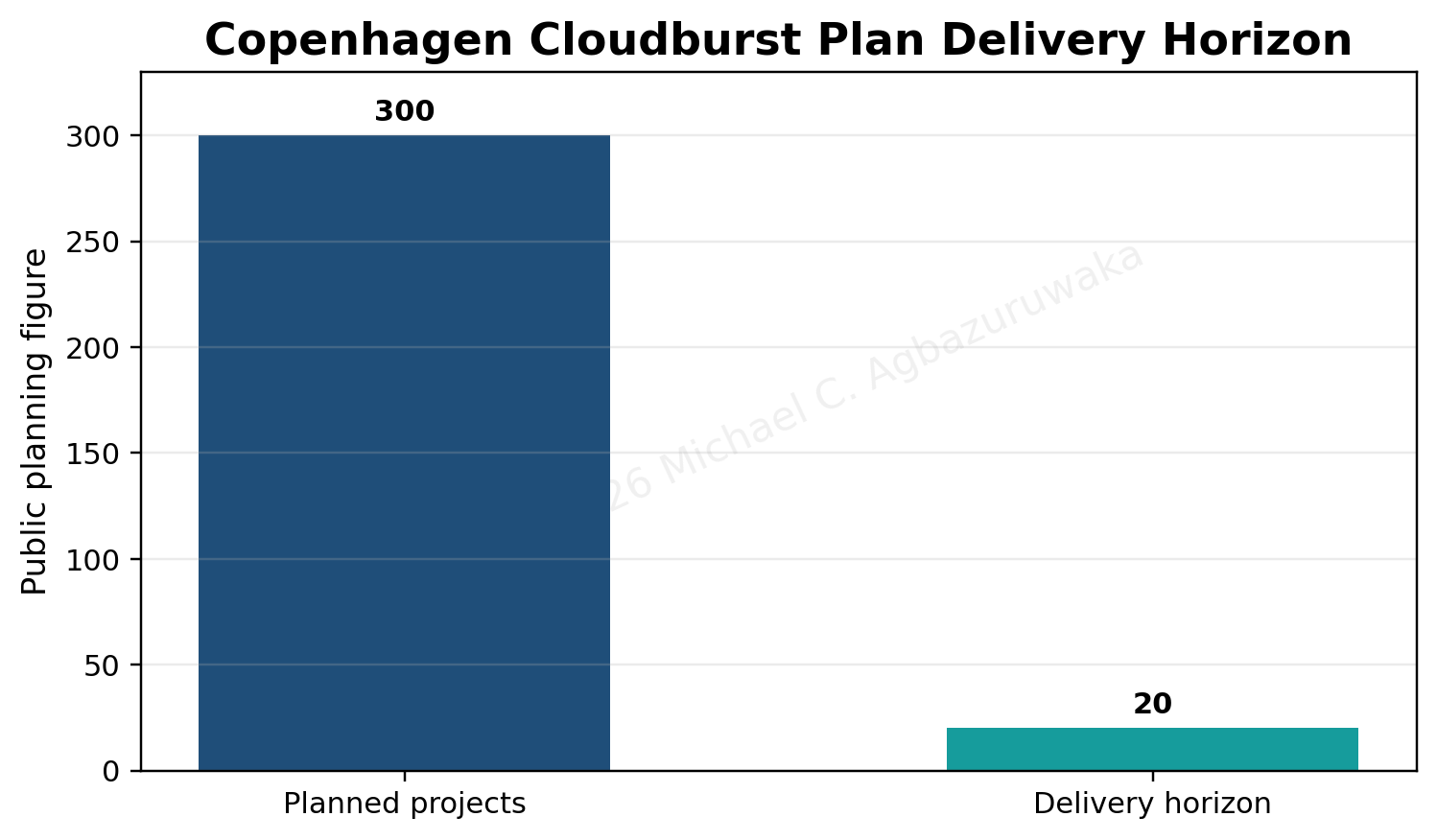
Figure 1. Copenhagen cloudburst plan delivery horizon based on public planning descriptions. Copyright © June 2026 Michael C. Agbazuruwaka.
Chapter 5: Rotterdam Case Analysis
5.1 Living with water as planning culture
Rotterdam’s adaptation case begins from a different condition. The city sits in a delta environment where water is not an occasional inconvenience but a permanent planning fact. River, sea, rainfall, groundwater, port infrastructure, and low-lying urban land create a layered risk setting. Rotterdam’s planning culture has therefore been shaped by protection, accommodation, economic continuity, and civic identity. It does not treat water as a problem that can be expelled once and for all. It treats water as a condition for continuous negotiation.
The Rotterdam Climate Change Adaptation Strategy, the Resilient Rotterdam Strategy 2022-2027, the Rotterdam Weatherwise framework, and port adaptation material all show a city that links climate risk with governance and public life. The city’s resilience language is broad, connecting climate, health, inequality, biodiversity, natural resources, pollution, economy, and digital risk. That breadth is important because climate pressure rarely respects departmental boundaries. Flooding can affect mobility, housing, port activity, emergency services, and public confidence. Heat can affect health, productivity, and social inequality. Adaptation cannot be a single-office responsibility.
The port adds a distinctive dimension. Rotterdam is not only a residential and civic city; it is also a major economic gateway. Port adaptation protects business continuity, transport flows, workers, energy systems, and regional supply chains. European Environment Agency case material on the port emphasizes prevention, adaptation-driven spatial planning, and crisis-management approaches. This layered view is useful for cities with critical infrastructure. A waterfront city asks not only how to protect homes and public space, but how to keep essential systems functioning under stress.
Rotterdam’s most useful lesson is cultural as much as technical. The city has built a public language around water adaptation. Water plazas, roofs, waterfronts, tidal parks, and risk communication create visible symbols of the adaptation agenda. That visibility matters because residents need to understand why public space is being redesigned and why investment is needed before disaster arrives. A city that hides adaptation entirely inside technical departments may struggle to build public trust.
C40’s account of Rotterdam’s adaptation strategy describes a layered approach shaped by flood defense, sea-level exposure, inner-dyke and outer-dyke conditions, and tailored spatial responses (C40 Cities, 2023). That layered language is important because it avoids a false choice between hard protection and adaptive urbanism. Rotterdam still needs serious flood defense. At the same time, the city uses public space, building adaptation, waterfront planning, and civic communication to manage water within the urban fabric.
The Port of Rotterdam adds scale and economic consequence. Climate-ADAPT describes the port adaptation strategy as a menu of measures developed to limit flood-related economic damage in a complex port environment (European Environment Agency, 2024). The Port of Rotterdam Authority also notes that port areas lie largely outside the dykes and require strategies for higher water levels (Port of Rotterdam Authority, 2025). For a planning paper, this matters because port resilience is not only about protecting land. It is about business continuity, transport links, workers, supply chains, energy systems, and national economic exposure.
5.2 Water plazas, tidal parks, and adaptive waterfronts
Rotterdam’s water plazas are among the clearest examples of multifunctional adaptation. Benthemplein is widely discussed because it combines everyday public use with temporary stormwater storage. Under ordinary conditions, the space serves social and recreational functions. During heavy rainfall, it can hold water and reduce pressure on drainage systems. This is circular urban planning in a direct form: the same urban land serves different functions at different times.
The significance of the water plaza is not only its form. It changes public understanding. Water storage that is buried underground is technically useful, but residents may not see its value. A water plaza makes adaptation visible. It shows that public space can be part of the infrastructure system. It also brings funding logics together because water-management budgets can support the creation of better civic space. That combined value is essential for cities with limited land and competing public needs.
Rotterdam’s tidal parks and adaptive waterfronts add another layer. Projects such as the Keilehaven tidal park show how former industrial edges can become spaces for ecological function, public access, and climate awareness. They do not remove water from the city’s identity. They create a more intelligent relation between water movement and urban life. This is especially important for waterfront redevelopment, where resilience can easily become a premium amenity if inclusion is not protected.
Rotterdam also requires caution. Adaptive waterfronts may raise property values and attract investment. Those outcomes can help a city, but they can also create displacement pressure or unequal access. A water-sensitive district cannot be judged by design images or tourism appeal. It is judged by who receives protection, who gains access, who pays, who is pushed out, and whether care remains funded after the opening.
The Rotterdam case shows why adaptation language needs discipline around real-estate development. Water-sensitive design can improve safety and dignity; it can also become a branding device for expensive districts. A serious planning system holds both truths at once. It welcomes good waterfront design while asking whether public access is secure, whether existing communities remain in place, whether small businesses can stay, and whether climate performance is measured after completion rather than assumed from appearance.
Research on Rotterdam’s water squares gives the case a useful empirical texture. Ilgen, Sengers, and Wardekker (2019) examine water squares as part of urban resilience learning, showing that such projects can travel as ideas while still requiring local adaptation. The lesson is not that every city needs the same plaza. It is that visible storage can change professional and public imagination. Residents can see that a square may be dry and social most of the time, then become part of the drainage system during heavy rain.
Rotterdam Weatherwise extends that imagination into a broader program. Its 2030 framework emphasizes upscaling and broadening climate-adaptive action across the city (Rotterdam Weatherwise, 2023). The importance of such a framework lies in repetition. A city does not become resilient through one celebrated project. It becomes resilient when similar principles appear in redevelopment, street renewal, public space, housing, waterfronts, schools, and maintenance standards. Rotterdam is useful because it shows adaptation moving from isolated demonstration toward city practice.
Chapter 6: Comparative Findings
6.1 Shared principles and different emphases
Copenhagen and Rotterdam share one practical principle: water becomes a visible planning matter. Both cities use public space as part of climate infrastructure. Both accept that conventional drainage and flood defense remain important but insufficient on their own. Both connect adaptation to urban quality rather than treating it as emergency engineering only. Both depend on long-term governance because projects require finance, delivery, maintenance, and explanation across many years.
Their emphases differ because their risks differ. Copenhagen’s case is shaped by cloudburst rainfall and the problem of intense surface water arriving faster than conventional systems can manage. Its planning response concentrates on routes, retention, parks, streets, and surface infrastructure that reduce flood damage while improving the city. Rotterdam’s case is shaped by delta exposure, sea-level pressure, rainfall, port continuity, and a long institutional relationship with water. Its response includes water plazas, tidal parks, waterfront adaptation, port strategies, and broad resilience governance.
The comparison shows that adaptation fits local risk. A city cannot import Copenhagen’s cloudburst streets or Rotterdam’s water plazas as objects. It examines its own slopes, rainfall, housing, social vulnerability, maintenance capacity, land values, drainage records, and governance structure. The transferable lesson is behavior rather than form: read the risk, use public space intelligently, coordinate agencies, fund maintenance, protect exposed residents, and measure performance.
Both cases also demonstrate that adaptation becomes credible when it leaves the strategy document. Public plans are necessary, but they are not enough. The real test is whether streets, parks, waterfronts, capital budgets, procurement rules, and maintenance routines change. Copenhagen and Rotterdam matter because their adaptation work has become physical and visible. That visibility gives researchers material to assess and gives residents evidence that planning is not only language.
6.2 Circular maturity and resilience interpretation
The circular planning maturity profile used in this study scores the two cities across water-sensitive design, multifunctional public space, flood governance, circular flows, and social resilience. Copenhagen scores clearly in water design and public-space adaptation because the cloudburst program makes streets, parks, and squares part of stormwater management. Rotterdam scores clearly in flood governance because of its delta tradition, port adaptation, and wider resilience framework. Both cities are high in circular flows and social resilience, though both still need continued attention to equity, affordability, and long-term participation.
The conceptual model gives both cities a resilience-capacity estimate of 67 using RCI_i = 25 + 50(CPM_i/10) + ε_i, with circular planning maturity at 8.4. The equal result does not mean the cities are identical. It means the model reads both as mature cases, but for different reasons. Copenhagen’s maturity is clearly visible in cloudburst surface design. Rotterdam’s maturity is clearly visible in water culture and layered governance. This difference is more useful than a winner-and-loser comparison.
The score needs careful reading. It is not official. It does not measure actual flood depth reduction, avoided damages, heat mortality, biodiversity gain, or displacement risk. Those outcomes require city-specific data and long-term monitoring. The score is a teaching and planning device. It helps a reader see how circular planning maturity may influence resilience while still leaving room for uncertainty.
The comparative finding is simple but important: circular planning raises the quality of adaptation when it converts water, public space, materials, maintenance, and social equity into one planning conversation. Cities that keep these issues in separate boxes will miss co-benefits and may increase inequality. Cities that connect them can turn climate spending into public value.
The comparison also clarifies the difference between resilience as image and resilience as capacity. Image is easy to produce. A city can photograph a water plaza, a green corridor, or a waterfront park and present it as evidence of progress. Capacity is harder. It requires a line of responsibility from climate analysis to project selection, design, construction, public communication, use, maintenance, and learning. Copenhagen and Rotterdam are most useful where that line is visible. Their weaker points, like any city’s, appear where public-space improvement may outrun affordability, or where long delivery timelines test civic patience.
Another comparative lesson concerns scale. Copenhagen’s case is particularly persuasive at the scale of the street network and surface-water route. Rotterdam’s case is particularly persuasive at the scale of delta culture, waterfront adaptation, and port exposure. Together they show that adaptation works across nested scales. A city needs the curb and the catchment, the plaza and the port, the park and the policy, the neighborhood meeting and the capital budget. Circular urban planning becomes valuable because it helps these scales speak to one another.
Table 2. Circular planning maturity scoring logic.
| Dimension | Copenhagen score | Rotterdam score | Reasoning |
| Water-sensitive design | 9 | 9 | Both cities treat water as a spatial planning condition, not only a drainage issue. |
| Multifunctional public space | 9 | 8 | Copenhagen’s cloudburst spaces are highly visible; Rotterdam’s water plazas and parks also perform well. |
| Flood governance | 8 | 9 | Rotterdam has a deeply established delta and port-resilience tradition. |
| Circular flows | 8 | 8 | Both cases connect water, space, ecology, materials, and public value. |
| Social resilience | 8 | 8 | Both require continued attention to inclusion, affordability, and participation. |
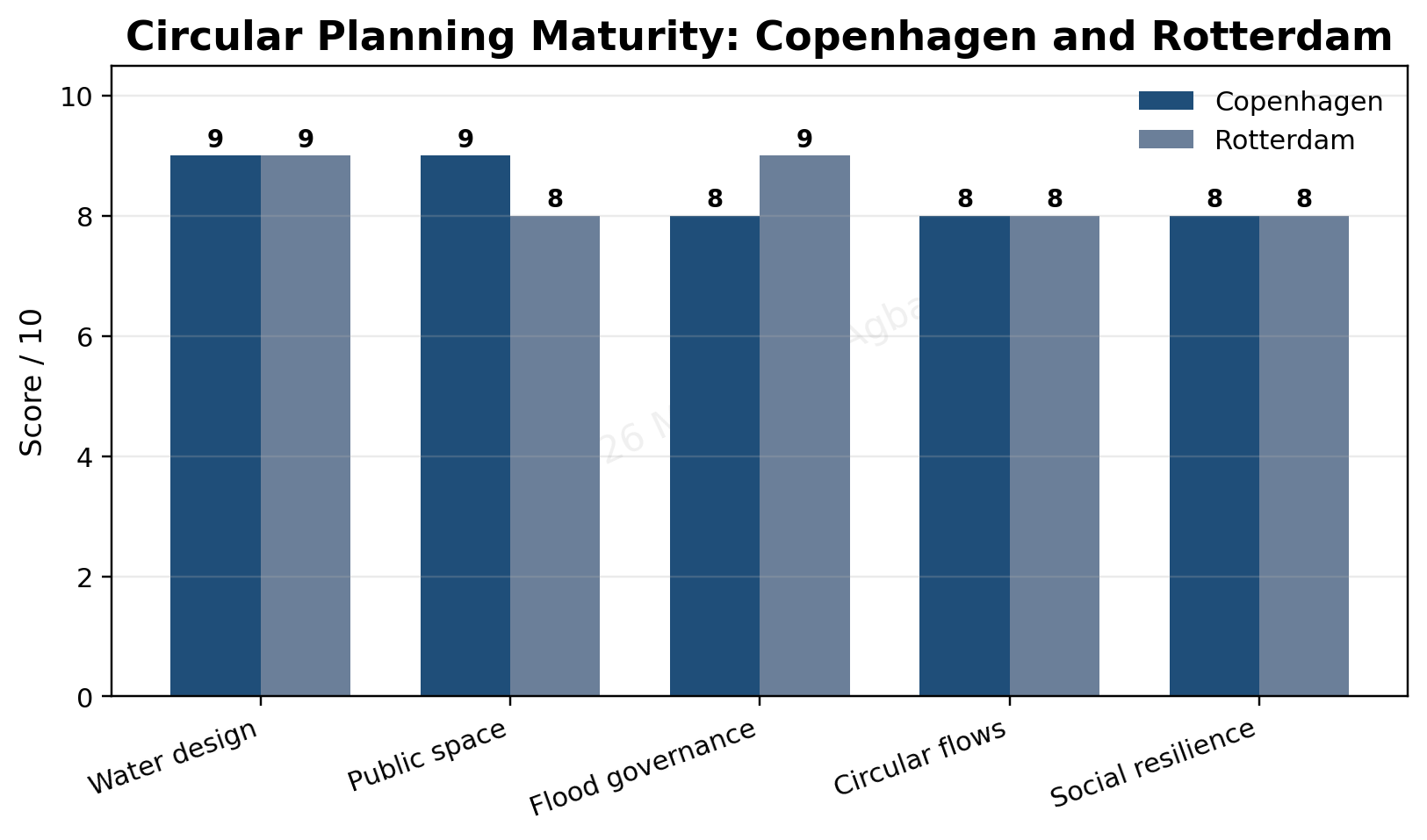
Figure 2. Circular planning maturity scorecard for Copenhagen and Rotterdam. Copyright © June 2026 Michael C. Agbazuruwaka.
Chapter 7: Climate Justice, Public Space, and Civic Value
7.1 Adaptation as a justice question
Climate adaptation is often introduced through physical exposure, but vulnerability is also social. A district may flood because of topography and drainage, yet the damage suffered by residents depends on housing quality, income, insurance, mobility, health, local services, and political voice. Heat risk follows the same pattern. Lack of tree cover, poor housing insulation, limited cooling spaces, and health vulnerability can make heat a serious public-health threat. A circular climate-adaptive city therefore treats equity as part of infrastructure performance.
Copenhagen and Rotterdam offer attractive public-space examples, but the justice test asks a harder question: who benefits? A park that stores water and cools the neighborhood can be a public good. It can also become part of a place-branding strategy that raises rents and displaces residents. A waterfront that protects against flooding can improve safety. It can also concentrate investment in already valuable districts. These tensions are not reasons to avoid adaptation. They are reasons to design anti-displacement safeguards, public access, community participation, and vulnerability-based investment from the beginning.
Public participation cannot be reduced to consultation after decisions have already been made. Residents know where water gathers, which routes fail, where heat is felt, which spaces are unsafe, and which projects might disrupt daily life. This knowledge is not a substitute for engineering, but it corrects technical blind spots. The best adaptation planning joins hydraulic modeling, climate data, maintenance knowledge, and local experience.
Climate justice also requires attention to maintenance. Wealthier districts may be better able to defend, report, and secure upkeep for improved public spaces. Vulnerable districts may receive projects that later deteriorate because maintenance budgets are weak. Equity therefore cannot end at project selection. It continues through funding, cleaning, planting, repair, monitoring, and public accountability.
7.2 Public-space value as resilience
Public space is one of the most powerful adaptation assets because it is shared. Streets, parks, squares, schoolyards, waterfronts, and green corridors shape how residents experience climate risk. They also shape whether residents see adaptation as a public benefit or a technical burden. A well-designed adaptation project can reduce flood risk, provide shade, support biodiversity, improve walking comfort, and create a place people value. That combination makes the city safer and more livable.
Copenhagen’s cloudburst spaces and Rotterdam’s water plazas show that the public field can be engineered without becoming hostile. The point matters because climate infrastructure that feels alien may meet resistance or neglect. Residents are more likely to defend places they use and understand. Civic attachment is not decorative. It can protect long-term performance by creating pressure for maintenance and care.
Schools, clinics, bus stops, markets, and public housing areas deserve particular attention. Climate risk affects the daily systems that people depend on. A flooded route to a clinic, an overheated schoolyard, or an inaccessible bus stop can turn a weather event into a social crisis. Adaptation planning therefore maps not only assets and hazards, but daily dependency. Which places continue functioning during stress? Which groups are most exposed if they fail? Which routes need protection first?
Schoolyards are especially important because they concentrate daily use, vulnerable users, and public land. A schoolyard that is redesigned for shade, safe drainage, play, and temporary storage can serve children during normal days and protect the surrounding area during heavy rainfall. The same logic applies to clinics and health centers. Heat, flooding, and access interruption can turn a facility into a weak point during climate stress. Planning for resilience therefore includes the small civic spaces that determine whether daily life can continue.
Climate justice also requires attention to time. Some benefits arrive immediately: shade, walking comfort, play space, cleaner public areas. Other benefits appear only during a severe event, when the drainage route, storage basin, or floodable plaza is tested. Communities asked to tolerate disruption need to understand both timeframes. Without clear communication, adaptation may look like construction inconvenience for benefits that are hard to see. Trust grows when residents can see how a project serves them before and during climate stress.
Affordability remains a serious concern around attractive adaptation projects. Waterfront upgrades, green corridors, and climate parks can raise land values. That may expand municipal revenue and attract investment, but it may also displace renters, small businesses, and lower-income households. A just adaptation strategy therefore requires coordination with housing policy, tenancy protection, public land rules, and anti-displacement measures. Resilience cannot become a premium product available only to those who can afford the improved district.
Public-space value also includes dignity. A climate park cannot look like a leftover basin. A floodable square cannot signal neglect. Residents cannot feel that their neighborhood received a cheaper or uglier version of adaptation. Beauty, usability, and care are part of justice because public infrastructure tells residents how the city values them.
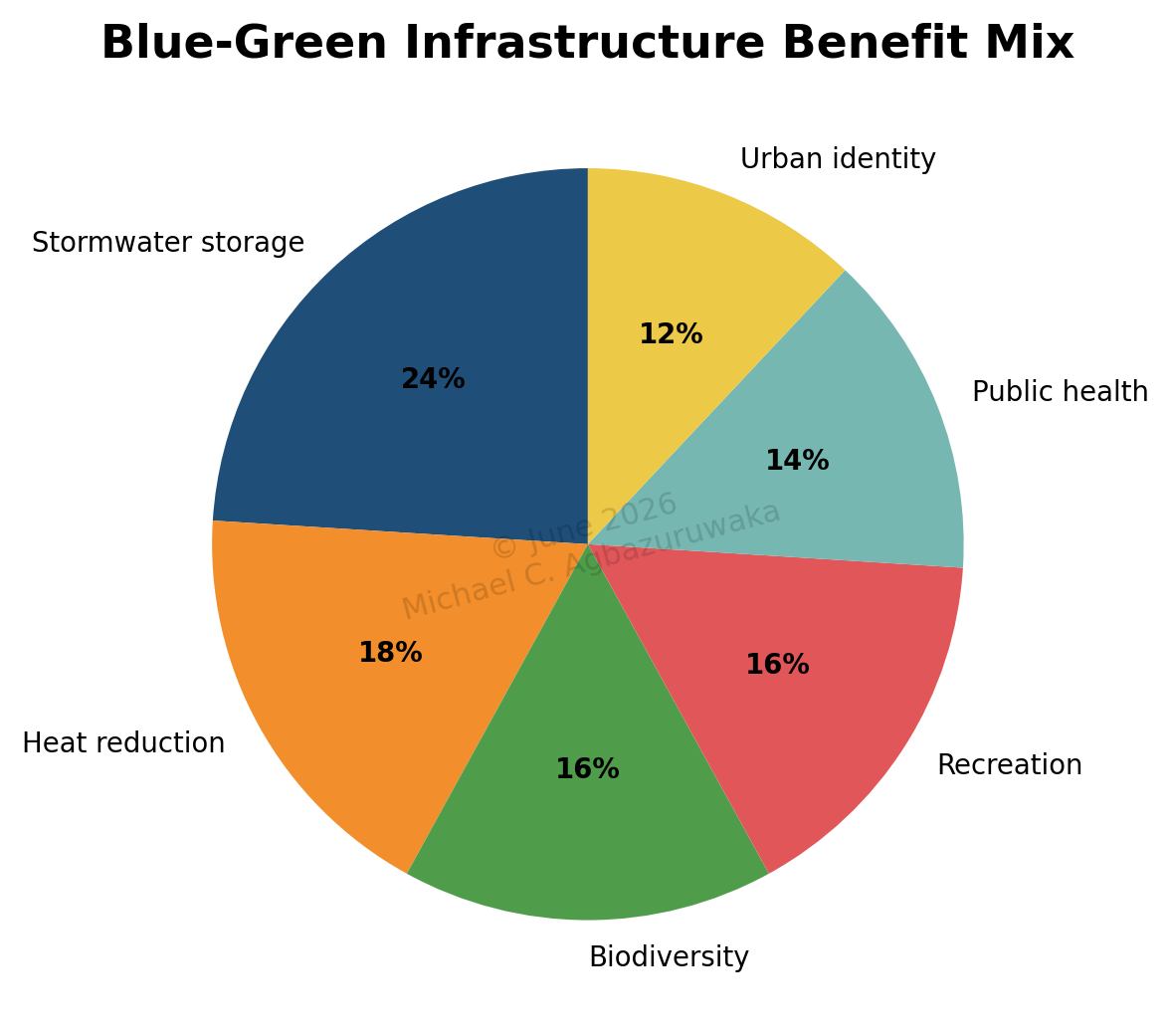
Figure 3. Blue-green infrastructure benefit mix. Copyright © June 2026 Michael C. Agbazuruwaka.
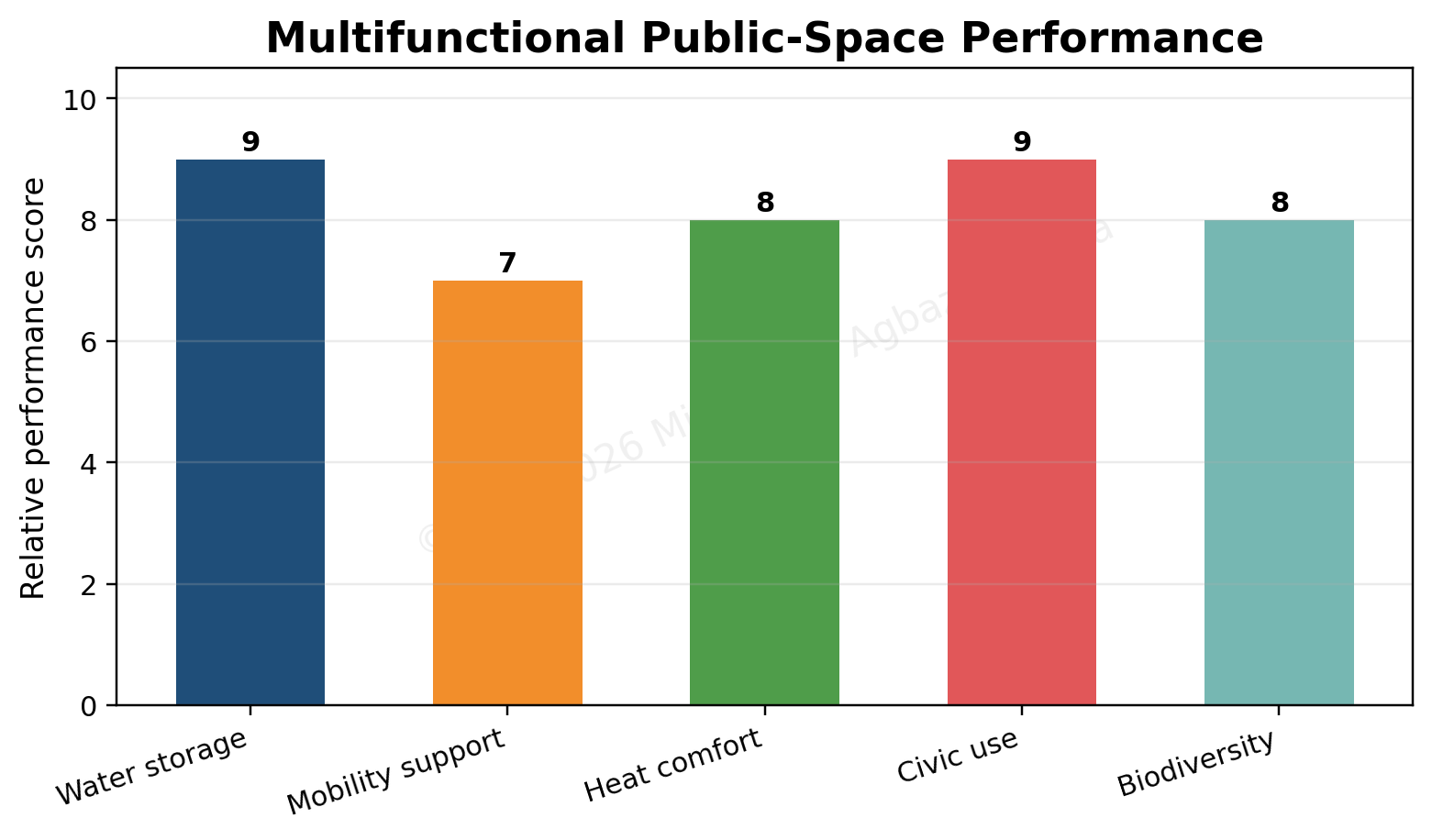
Figure 6. Multifunctional public-space performance scorecard. Copyright © June 2026 Michael C. Agbazuruwaka.
Chapter 8: Governance, Finance, and Maintenance
8.1 From policy language to delivery discipline
Many cities have climate plans. Fewer have delivery discipline. The difference lies in governance. An adaptation program requires clear ownership, risk maps, design standards, procurement rules, funding streams, maintenance budgets, monitoring indicators, and communication routines. It also requires coordination across departments that often work separately: water, roads, parks, housing, health, finance, emergency management, environment, and planning. Where these systems remain fragmented, adaptation becomes a collection of isolated projects.
Copenhagen’s cloudburst delivery horizon shows the importance of sequencing. A twenty-year program cannot depend on enthusiasm alone. It needs annual prioritization, capital planning, utility coordination, public explanation, and technical review. Rotterdam’s resilience and Weatherwise frameworks show a similar need for cross-sector governance. In both cities, adaptation is not simply designed; it is administered. That administrative capacity is less visible than the projects, but it is what allows the projects to continue.
Finance is the hard test of adaptation seriousness. Cities often support resilience in principle but hesitate when projects compete with immediate political demands. Circular planning helps by making co-benefits visible. A drainage upgrade may be expensive if counted only as flood protection. The same investment may appear more justified when it also improves public space, reduces heat, supports biodiversity, protects mobility, and avoids future damage. The broader the value account, the more durable the case for investment.
Procurement also matters. A city that wants multifunctional adaptation cannot procure every project through narrow technical specifications. Tender documents, design briefs, contractor requirements, material standards, and evaluation criteria have to reward water-sensitive design, durability, circular materials, maintenance feasibility, and social benefit. Otherwise, the ambition of the policy will be lost in the mechanics of delivery.
8.2 Maintenance as climate governance
Maintenance is one of the most underestimated parts of adaptation. It rarely attracts the same attention as design competitions or project launches, yet it determines whether the project continues to work. A clogged drain, compacted soil, dead tree, broken surface, unsafe plaza, or poorly cleaned basin can turn climate infrastructure into an embarrassment. Maintenance is not a secondary operational detail. It is part of the design’s truth.
Blue-green infrastructure is especially dependent on care. Vegetation needs soil volume, water, pruning, replacement, and protection from damage. Permeable surfaces need cleaning. Retention spaces need inspection. Water plazas need safety management and public trust. If maintenance budgets are not secured at the beginning, the project may perform well in photographs and poorly during storms. The city therefore treats life-cycle cost as part of approval, not an afterthought.
Data can improve maintenance, but data belongs with local observation. Sensors, flood maps, heat maps, asset registers, and dashboards can help cities decide where to invest and when to intervene. Yet residents, maintenance crews, school staff, health workers, and local businesses often notice problems before they become data points. A mature adaptation system listens to both. It does not mistake a digital map for the whole city.
The governance lesson from both cases is that adaptation becomes ordinary when it shapes street standards, park renewals, waterfront approvals, housing policy, schoolyard design, drainage maintenance, public-health planning, and emergency routes. When adaptation remains a special project, it misses too many chances to reduce risk. When it becomes a normal rule of planning, the city gradually changes its risk profile.
Ordinary does not mean weak. It means that adaptation is present in the decisions that normally shape a city: road resurfacing, park renewal, housing permits, utility replacement, schoolyard upgrades, public-health planning, and capital budgeting. When those routine decisions ignore climate risk, even a sophisticated resilience strategy remains fragile. When they absorb climate risk, the city changes gradually but seriously. That is the administrative meaning of circular urban planning: public money, land, materials, water, and civic benefit are managed as connected responsibilities.
Finance is best understood as governance, not only accounting. A budget reveals whether the city treats adaptation as a permanent duty or a temporary campaign. Capital funding without maintenance funding creates future failure. Grant-funded pilots without a route to ordinary budgets create isolated examples. Emergency spending after a flood may be unavoidable, but it is usually more expensive and less equitable than prevention. Sound adaptation finance therefore combines risk-based investment, co-benefit justification, asset management, and long-term maintenance responsibility.
Procurement can either support or weaken circular planning. Standard procurement may reward the lowest immediate cost and the narrowest technical specification. Climate-adaptive procurement asks for life-cycle performance, material reuse, low-carbon delivery, biodiversity value, maintainability, public-space quality, and social safeguards. A contractor asked only to build a drainage object may not deliver a civic place. A design team asked to produce only visual appeal may not deliver hydraulic performance. The procurement document is where the city’s values become enforceable instructions.
Maintenance data belongs with public reporting. Residents are more likely to protect and trust blue-green infrastructure when the city explains how it is performing. A short public report can state which projects were completed, which drains were cleared, where tree survival is weak, which districts remain exposed, and what will be repaired next. Such reporting is not only administrative. It is civic education. It shows that adaptation is a living system rather than a one-time announcement.
Table 3. Recommendations for climate-adaptive cities.
| Priority | Action | Expected value |
| Water-sensitive planning | Require stormwater and heat adaptation in streets, parks, waterfronts, and development approvals. | Normalizes adaptation across the city. |
| Maintenance finance | Fund vegetation care, drainage cleaning, safety checks, and performance monitoring from the start. | Protects long-term function. |
| Social inclusion | Use vulnerability data and community participation in project selection. | Reduces unequal protection. |
| Public-space value | Design projects that improve daily life while reducing climate risk. | Builds trust and political support. |
| Circular procurement | Use durable, reusable, low-carbon materials and life-cycle cost rules. | Links adaptation with circular economy practice. |
Chapter 9: Diagnostic Model and Applied Evidence
9.1 Applied evidence from the cases
The tables and figures in this publication are designed as planning tools. They do not replace the case analysis. They summarize it. Table 1 compares Copenhagen and Rotterdam across risk emphasis, spatial strategy, governance lesson, and social concern. The purpose is to show that the two cities share a climate-adaptive logic while operating from different risk conditions. Copenhagen’s primary emphasis is cloudburst rainfall and surface-water management. Rotterdam’s emphasis is delta exposure, flood protection, port resilience, and adaptive waterfronts. Both use public space as climate infrastructure.
Table 2 presents the circular planning maturity scoring logic. The scores are author-developed and need to be read as diagnostic values, not official measurements. They help translate qualitative judgment into a profile. Copenhagen receives high marks for water-sensitive design and multifunctional public space. Rotterdam receives high marks for flood governance. Both cities perform well, but neither is treated as complete. The useful insight is unevenness: a city can be advanced in design and still need deeper social safeguards, or advanced in governance and still need better neighborhood-level evaluation.
The figures work in the same way. Figure 1 uses the public planning description of Copenhagen’s cloudburst delivery horizon to show scale and time. Figure 2 compares circular maturity dimensions. Figure 3 summarizes the benefit mix of blue-green infrastructure. Figure 4 shows the conceptual resilience estimate. Figure 5 presents an adaptation intervention portfolio. Figure 6 scores multifunctional public-space performance. Figure 7 turns the argument into an adaptation cycle: read risk, slow water, share space, reduce heat, protect people, and maintain and learn.
These visual tools are important because planners work with both narrative and evidence. A good planning paper cannot only describe. It gives decision-makers a way to organize choices. The model, tables, and figures are therefore best understood as applied evidence aids. They are transparent enough to be challenged and simple enough to be used in teaching, policy discussion, or project review.
9.2 Using the model responsibly
The model’s greatest risk is misuse. A city could treat the conceptual resilience score as a ranking device, or a consultant could present it as proof of performance. That would be wrong. Resilience is tested with hydrological data, heat data, maintenance records, social vulnerability indicators, avoided-damage analysis, resident feedback, and post-event evaluation. The model in this study is a framing device, not a substitute for empirical evaluation.
Used responsibly, the model supports better questions. If a city claims high circular maturity, what evidence supports that claim? Are water-sensitive design requirements embedded in street standards? Are parks designed for stormwater and heat? Are vulnerable districts prioritized? Are maintenance budgets protected? Are materials reused? Are residents involved early enough to influence project design? Are project benefits monitored after completion? The model turns resilience language into a checklist of responsibilities.
The same approach can be used outside Europe. A city in Africa, Asia, Latin America, or North America may not have the same budget as Copenhagen or Rotterdam, but it can still ask whether streets can safely route water, whether schoolyards can store runoff, whether tree planting is linked to heat risk, whether drainage investments protect vulnerable districts, and whether maintenance is funded. Circular planning is not a luxury concept. At its best, it is a way to make limited resources perform more than one public function.
The applied evidence therefore points toward a professional planning ethic. Make assumptions visible. Separate official data from author-developed scoring. Connect physical protection with social value. Plan for maintenance before construction. Do not call a project resilient because it looks green. Judge it by how it performs, who it protects, how it is cared for, and whether the city learns from it.
That ethic matters in cities under fiscal pressure. Limited resources make multifunctional planning more necessary, not less. A drainage project that also improves shade, walking comfort, public safety, biodiversity, and neighborhood dignity has a more convincing public case than a narrow technical repair. The same principle applies to data. A risk map becomes more valuable when it is read beside resident testimony, maintenance records, insurance exposure, land values, and health vulnerability. Circular planning does its best work when it refuses to separate the technical city from the lived city.
The figures are therefore best read as planning communication tools. Figure 1 communicates the scale and time horizon of Copenhagen’s cloudburst work. Figure 2 summarizes the comparative maturity judgement. Figures 3 and 5 translate broad co-benefits and intervention portfolios into visible proportions. Figure 4 makes the conceptual model transparent by showing the equal resilience estimate produced by the selected maturity scores. Figure 6 focuses attention on public-space performance, while Figure 7 reduces the circular adaptation cycle to six professional moves: read risk, slow water, share space, reduce heat, protect people, and maintain and learn.
The charts are not presented as statistical outputs from a survey or official municipal dataset. That distinction is essential for research honesty. Their values come from the documentary review and author-developed diagnostic scoring. The notes below the figures state this clearly, and the text repeats the limitation so that the visual material cannot be misread as official measurement. In NYCAR publication terms, this is a strength. A figure clarifies evidence; it does not exaggerate it.
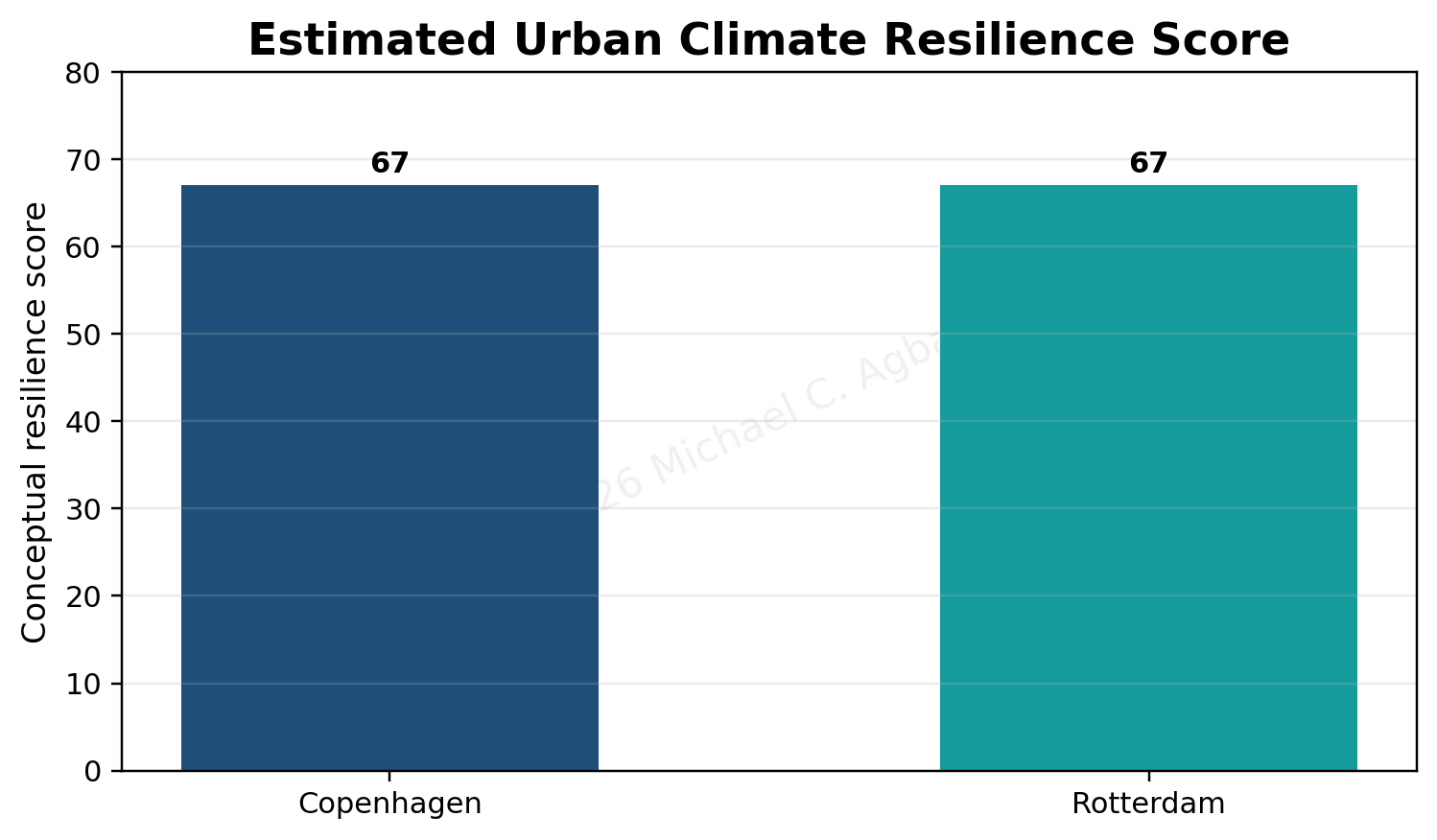
Figure 4. Estimated urban resilience capacity score derived from the conceptual model. Copyright © June 2026 Michael C. Agbazuruwaka.
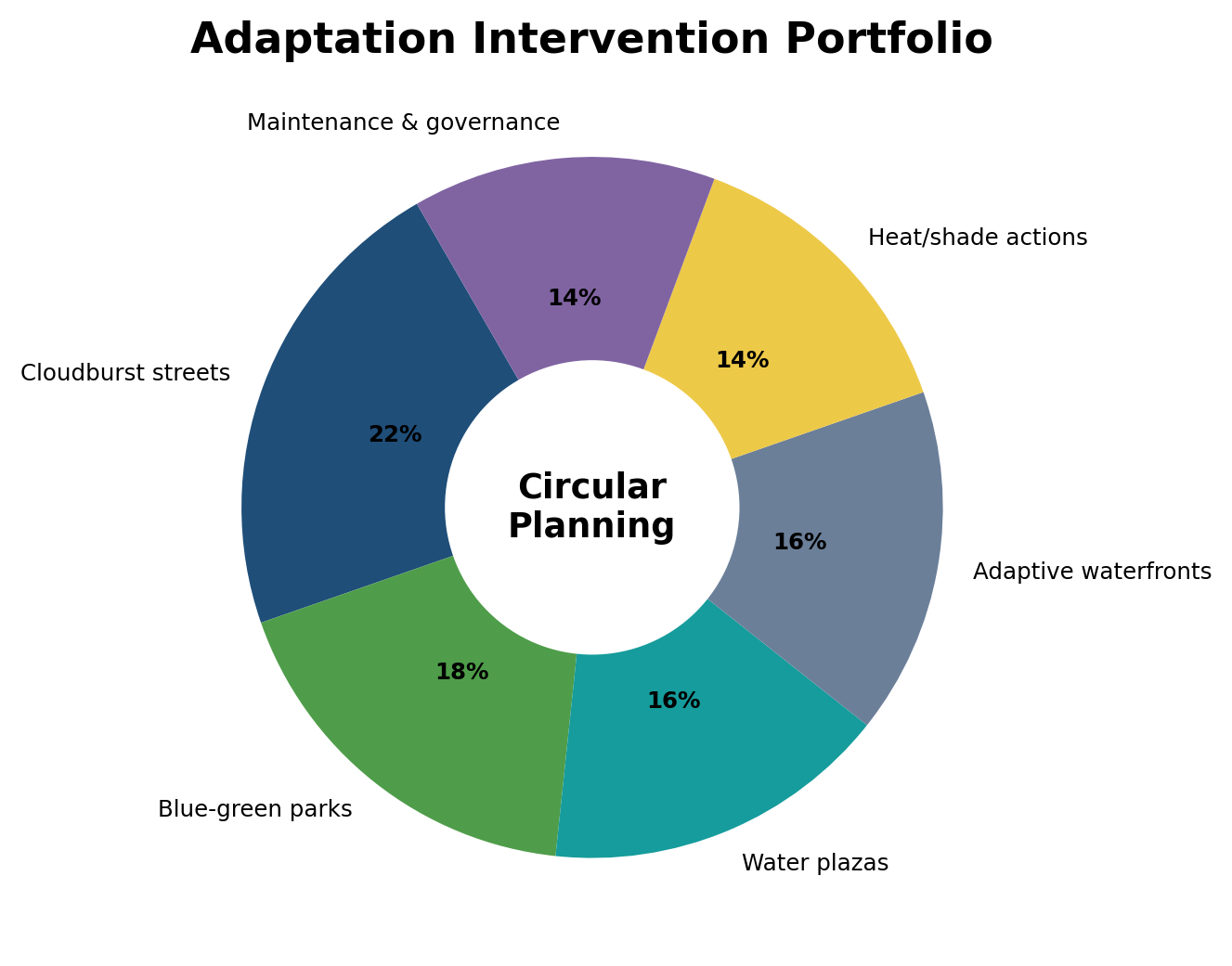
Figure 5. Adaptation intervention portfolio for circular urban planning. Copyright © June 2026 Michael C. Agbazuruwaka.
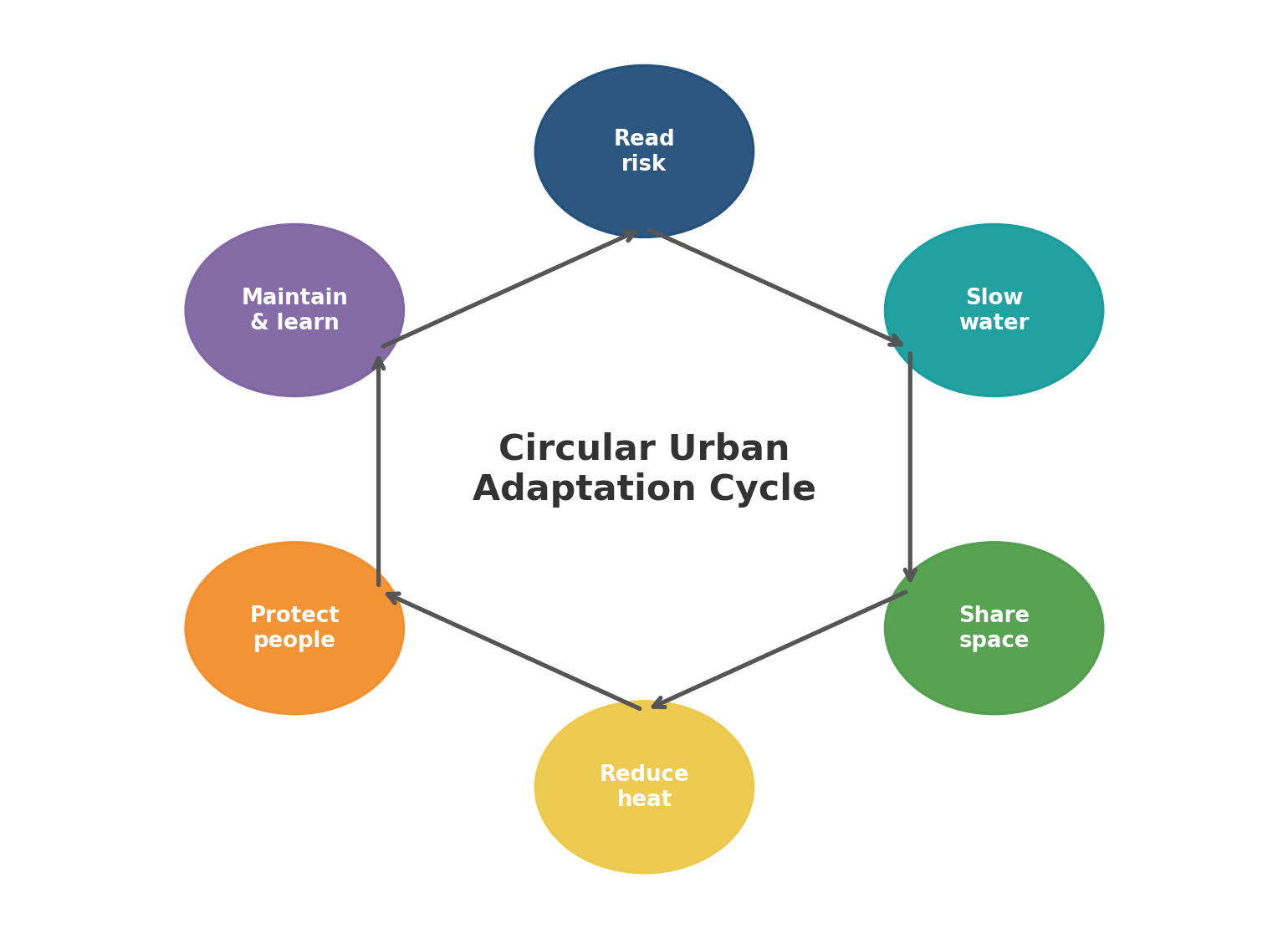
Figure 7. Circular urban adaptation cycle. Copyright © June 2026 Michael C. Agbazuruwaka.
Table 4. Implementation risks and professional safeguards.
| Risk | Planning consequence | Safeguard |
| Weak maintenance | Blue-green systems lose technical and social value. | Approve life-cycle budgets before construction. |
| Climate gentrification | Adaptive districts become exclusive amenities. | Pair public-space upgrades with affordability safeguards. |
| Fragmented governance | Projects remain isolated and inconsistent. | Create shared standards across water, roads, parks, health, and housing. |
| Overreliance on pilot projects | Innovation does not change the wider system. | Build project pipelines, design standards, and routine approvals. |
| Poor public communication | Residents see disruption without understanding benefit. | Use clear risk maps, neighborhood meetings, and post-project reporting. |
Chapter 10: Planning Recommendations and Final Position
10.1 Recommendations for climate-adaptive cities
Cities place water-sensitive design inside ordinary planning approvals when they treat every redevelopment as either a risk increase or a risk reduction. Streets, parks, waterfronts, public buildings, schoolyards, housing estates, and large developments then address stormwater, heat, vegetation, mobility, materials, and public-space value as part of routine approval rather than as an optional climate add-on.
Investment plans need to rank projects by risk reduction, social need, co-benefits, deliverability, and maintenance feasibility. The best project is not always the most dramatic. It may be a drainage corridor protecting a vulnerable district, a shaded route to a clinic, a schoolyard that stores water safely, or a green street that reduces repeated flooding. Cities need to use vulnerability data and local knowledge to decide where adaptation arrives first.
Maintenance finance belongs beside capital finance. A city cannot fund blue-green infrastructure responsibly unless it also funds vegetation care, cleaning, inspection, replacement, safety, and monitoring. The cost may appear higher at the beginning, but the alternative is false economy. Climate infrastructure that fails through neglect wastes public money and weakens trust.
Cities connect adaptation with circular procurement when materials are selected for durability, repairability, reuse, low carbon impact, and long service life. Construction waste is minimized. Project briefs require contractors and designers to show how water, heat, biodiversity, material use, and maintenance have been considered. Circularity belongs in tender documents, not only in policy statements.
Public participation begins before design decisions are fixed. Residents can help identify flood paths, heat-stress locations, unsafe spaces, daily routes, and local priorities. Participation functions as evidence, not ceremony. Technical knowledge and resident knowledge inform each other. The result is usually a better project and a more legitimate one.
Copenhagen keeps protecting the integrity of its cloudburst program by keeping long delivery timelines connected to neighborhood benefit, transparent prioritization, and maintenance evidence. The program’s strength lies in linking risk reduction with public-space improvement. That strength will weaken if delivery becomes uneven, if public understanding fades, or if maintenance does not keep pace with construction.
Rotterdam continues developing water-sensitive public spaces and adaptive waterfronts while guarding against climate gentrification. Its resilience tradition is high, but improved waterfronts and attractive adaptive districts can create affordability pressure. The city treats inclusion as part of resilience performance, not as a separate social policy applied later.
Cities with fewer resources can still act if they treat adaptation as a sequence rather than a single grand project. The first step is to identify repeated flood and heat stress points through local observation, complaints, maintenance records, and community reporting. The second step is to select practical interventions that serve more than one purpose: shade and drainage, storage and recreation, waterfront access and protection, schoolyard safety and public cooling. The third step is to protect maintenance funding before the project is announced. Without that discipline, modest projects can fail as quickly as expensive ones.
Professional education also has a role. Urban planners, architects, engineers, public-space designers, public-health officers, and municipal managers require training that teaches them to read climate risk together. Too much adaptation fails because each profession sees only its own part of the problem. The planner sees land use, the engineer sees drainage, the designer sees vegetation, the health officer sees heat exposure, and the finance officer sees cost.
Evaluation belongs inside every adaptation program. Cities track not only whether a project was completed, but whether it reduced flood exposure, improved shade, increased public use, protected vulnerable residents, and remained maintainable. Evaluation also records failure. If a permeable surface clogged, if a tree canopy failed, if a water plaza was avoided at night, or if a waterfront project increased displacement pressure, the lesson enters the next design cycle.
10.2 Final position
Copenhagen and Rotterdam show that climate adaptation can be a form of urban intelligence. They do not treat water only as a problem to be expelled. They treat it as a planning condition that shapes public space, ecological function, mobility, housing, economic continuity, and civic life. That is the deeper meaning of circular urban planning.
The climate-adaptive city will not be defined only by higher barriers, larger pipes, or more sophisticated emergency response, though all may remain necessary. It will be defined by streets that carry water safely, parks that cool and store, waterfronts that protect and welcome, schools and clinics that remain reachable, communities that participate, and planning systems that learn from evidence. Resilience is not only survival after an event. It is the redesign of ordinary life so that future events cause less harm.
The hardest lesson from the two cases is the discipline of connection. Water belongs with to public space. Design belongs with to maintenance. Climate investment belongs with to social equity. Circularity belongs with to procurement and material choices. Modeling belongs with to local observation. Policy belongs with to the street, the park, the waterfront, and the budget line. Without these links, adaptation remains fragmented.
Future research can follow projects over time. It can ask whether flood depth declined, whether heat exposure fell, whether maintenance remained funded, whether public spaces were used, whether vulnerable neighborhoods benefited, and whether property improvements produced displacement pressure. Admiration is not enough. Climate adaptation needs accountability.
The final position of this study is clear. Cities cannot wait for disaster before redesigning the public field. Every street renewal, park investment, waterfront plan, drainage upgrade, housing approval, and public-space project can become a chance to reduce climate risk. Copenhagen and Rotterdam are useful because they show how this work can be technical, civic, ecological, and practical at once. The city itself becomes the adaptation system when planning learns how to make ordinary space perform extraordinary work.
In professional terms, the study’s closing claim is that circular urban planning gives climate adaptation an operating grammar. It teaches cities to read risk before design, slow water before it becomes disaster, share scarce urban space across functions, reduce heat through land and vegetation, protect people rather than assets alone, and maintain what has been built. That grammar is simple enough for practice and demanding enough for serious planning education.
Copenhagen and Rotterdam do not provide perfect models, and they cannot be treated as finished cities. Their importance lies in the way each makes climate risk spatial, civic, and governable. They show that adaptation is not a separate future waiting outside the city. It is already present in the street section, the park design, the water edge, the maintenance budget, the procurement rule, and the public meeting. The cities that understand this will adapt earlier, fairer, and with greater public confidence.
10.3 Professional planning checklist
A practical checklist follows from the study. Before approving a climate-adaptation project, a city asks six questions. What exact risk is being reduced? Which residents are most exposed? Which public-space benefit will remain on ordinary days? What maintenance obligation is being created? Which circular procurement rule will reduce waste and emissions? What evidence will be collected after delivery? These questions are simple, but they prevent vague resilience language from replacing professional judgment.
The first question protects technical seriousness. A project cannot be called adaptive only because it includes trees, water, paving, or attractive public-space treatment. The project names the risk: cloudburst flow, surface flooding, heat stress, sea-level exposure, drainage overload, port disruption, or public-health vulnerability. Naming the risk allows the city to test whether the intervention is proportionate. It also helps residents understand why a familiar street, plaza, waterfront, or schoolyard is being changed.
The second question protects equity. Vulnerability data is combined with local knowledge because maps do not always capture how people experience risk. A district may look less exposed in a technical model but still contain older residents, basement housing, informal workspaces, weak transit access, or limited cooling options. Community reporting therefore sits beside engineering data. Each corrects the other.
The third and fourth questions protect public value over time. A floodable square that residents avoid is a weak civic investment. A rain garden that fails after two seasons because no one funded maintenance is not resilience. The project improves daily life through shade, safety, recreation, walking comfort, biodiversity, or public identity, and the city names who will care for it after construction. Maintenance is not a secondary issue. It is the point where climate ambition becomes durable public service.
The fifth question brings circularity into the construction process. Climate adaptation often requires materials, equipment, excavation, and new infrastructure. Those actions can either deepen linear consumption or support reuse, repairability, durability, and lower-carbon delivery. Circular urban planning therefore influences procurement, not only concept drawings. The city asks how materials will be sourced, whether components can be reused, how long the design is expected to last, and what happens at the end of the asset’s life.
The final question turns adaptation into learning. Every project produces evidence after delivery. Did water move as predicted? Did shade increase? Did residents use the space? Did maintenance costs match expectations? Did vulnerable households benefit? Did land values create exclusion pressure? The answers belong in the next project. Copenhagen and Rotterdam are valuable because they show direction, but the future of climate-adaptive planning depends on cities that can learn from their own streets with the same seriousness they bring to international examples.
A final professional test concerns institutional memory. Many cities lose adaptation knowledge when administrations change, consultants leave, or project teams dissolve. A climate-adaptive planning system preserves drawings, maintenance records, community feedback, cost data, risk assumptions, and performance reviews in a form future officials can use. Institutional memory is not paperwork for its own sake. It prevents the city from repeating mistakes, protects continuity across electoral cycles, and helps new projects build on tested practice rather than begin again with slogans.
This is why the study remains deliberately practical. It does not ask cities to admire Copenhagen or Rotterdam from a distance. It asks them to examine how those cities turn risk into design standards, budgets, and public-space decisions. The proper measure of the study is therefore not novelty alone, but usefulness: whether a planner, council member, infrastructure manager, or graduate researcher can use its framework to ask better questions before the next climate event exposes yesterday’s weak decisions.
References
C40 Cities. (2023). Rotterdam: Climate change adaptation strategy. C40 Good Practice Guides. https://www.c40.org/case-studies/c40-good-practice-guides-rotterdam-climate-change-adaptation-strategy/
City of Copenhagen. (2011). Copenhagen climate adaptation plan. City of Copenhagen. https://international.kk.dk/sites/default/files/2021-09/Copenhagen%20Climate%20Adaptation%20Plan%20-%202011.pdf
City of Copenhagen. (2012). The City of Copenhagen cloudburst management plan 2012. City of Copenhagen. https://international.kk.dk/sites/default/files/2021-09/Cloudburst%20Management%20plan%202010.pdf
Circular Cities Declaration. (2024). CCD report 2024. ICLEI Europe. https://circularcitiesdeclaration.eu/about/ccd-report
Ellen MacArthur Foundation. (2024). The circular economy in cities and regions: Planning for a regenerative urban future. https://www.ellenmacarthurfoundation.org/topics/cities/overview
European Environment Agency. (2024). Rotterdam port adaptation strategy for climate-resilient transport and business activities. Climate-ADAPT. https://climate-adapt.eea.europa.eu/en/metadata/case-studies/rotterdam-port-adaptation-strategy-for-climate-resilient-transport-and-business-activities
Ilgen, S., Sengers, F., & Wardekker, A. (2019). City-to-city learning for urban resilience: The case of water squares in Rotterdam and Mexico City. Water, 11(5), 983. https://doi.org/10.3390/w11050983
Intergovernmental Panel on Climate Change. (2022). Climate change 2022: Impacts, adaptation and vulnerability. Cambridge University Press. https://www.ipcc.ch/report/ar6/wg2/
INTERLACE Hub. (2023). Cloudburst management plan – Copenhagen. https://interlace-hub.com/cloudburst-management-plan-copenhagen
Pochodyła, E., Glińska-Lewczuk, K., & Jaszczak, A. (2021). Blue-green infrastructure as a new trend and an effective tool for water management in urban areas. Landscape Online, 92, 1–20. https://doi.org/10.3097/LO.202192
Port of Rotterdam Authority. (2025). Climate change adaptation. https://www.portofrotterdam.com/en/building-port/sustainable-port/climate-adaptation
Przestrzelska, K., Wartalska, K., Rosińska, W., Jurasz, J., & Kaźmierczak, B. (2024). Climate resilient cities: A review of blue-green solutions worldwide. Water Resources Management, 38(15), 5885–5910. https://doi.org/10.1007/s11269-024-03950-5
Resilient Cities Network. (2020). How resilient cities share strategies for adapting to a water-secure future. https://resilientcitiesnetwork.org/resilient-water-management/
Resilient Rotterdam. (2022). Resilient Rotterdam strategy 2022-2027. City of Rotterdam. https://s3.eu-central-1.amazonaws.com/storage.resilientrotterdam.nl/storage/2022/09/09093215/Resilient-Rotterdam-Strategy-2022-2027.pdf
Rotterdam Weatherwise. (2023). Weatherwise 2030 programme framework. City of Rotterdam. https://rotterdamsweerwoord.nl/content/uploads/2023/03/Programmakader-Rotterdams-Weerwoord-2030-EN.pdf
UN-Habitat. (2022). World cities report 2022: Envisaging the future of cities. United Nations Human Settlements Programme. https://unhabitat.org/world-cities-report-2022-envisaging-the-future-of-cities
Whittaker, S., & Jespersen, K. (2022). Stretching or conforming? Financing urban climate change adaptation in Copenhagen. Buildings and Cities, 3(1), 974-999. https://doi.org/10.5334/bc.238