

An Engineering Management Study of Delivery Risk, Regression-Based Schedule Control, and Case-Calibrated Project Assurance
Research Publication by Cherish Chiemela Okoroji
Institutional Affiliation: New York Center for Advanced Research (NYCAR)
Publication No.: NYCAR-TTR-2026-RP032
DOI: https://doi.org/10.5281/zenodo.20510030
Date: June 2026
Peer Review Statement
This research publication has been reviewed under the internal editorial framework of the New York Center for Advanced Research (NYCAR) and The Thinkers’ Review. The review assessed master’s-level engineering management coherence, offshore wind source integrity, megaproject governance reasoning, regression-based schedule-control suitability, energy-at-risk calculation, APA 7th alignment, visual evidence presentation, and professional relevance for project assurance in volatile energy markets. The work is approved for master’s-level NYCAR institutional publication.
Copyright © June 2026 Cherish Chiemela Okoroji. All rights reserved. NYCAR.
Contents
Abstract
Offshore wind turns energy policy into a physical test. A target can be announced in a ministerial speech, a lease can be awarded, a turbine can be specified, and a financial model can show attractive long-run capacity, yet none of those acts puts power on the grid. Delivery begins in the harsher place where blades, cables, foundations, converter stations, vessels, weather windows, ports, regulatory evidence, grid interfaces, and capital discipline have to meet at the same time. Dogger Bank, Vineyard Wind 1, and Ørsted’s United States offshore portfolio show that offshore wind is not just a renewable-energy category. It is a marine megaproject class with unusually tight connections between engineering control, public confidence, and financial exposure.
The publication studies those cases as evidence for engineering management. Dogger Bank is used to examine scale, phasing, high-voltage direct-current transmission, and learning transfer across a 3.6 GW project. Vineyard Wind 1 is used to examine how a turbine-blade failure can move from component quality into regulator action, construction stoppage, coastal concern, and public trust. Ørsted’s 2025 impairment disclosure is used to examine the point at which interest rates, seabed valuation, construction delay, and higher expected costs become part of the delivery risk picture. The cases are not treated as simple success or failure stories. They are read as signals of the conditions under which offshore wind governance either detects risk early or discovers it after the critical path is already damaged.
The study develops a regression-based schedule-control framework for project directors, owners’ engineers, lenders’ technical advisers, regulators, and public authorities. Schedule Variance Intensity is used as the dependent variable because delay in offshore wind means more than elapsed days; it reflects capacity exposure, phase dependency, workfront constraint, and critical-path pressure. Explanatory variables include supply-chain lead-time strain, turbine quality interruption, grid-readiness gap, regulatory stoppage exposure, vessel and port constraint, financing cost pressure, and governance response maturity. The model is presented as decision support, not as a claim that confidential project-control data have been analyzed.
The central finding is direct. Offshore wind delivery improves when the project can name the pressure moving the schedule, translate delay into deferred energy, and act before a technical weakness becomes a public failure. The energy-at-risk calculation gives that translation: capacity multiplied by capacity factor, delay days, and twenty-four hours. In volatile markets, offshore wind governance is not paperwork. It is the operating discipline through which engineered capacity becomes electricity delivered to people.
Keywords: offshore wind; megaproject governance; engineering management; schedule variance; energy-at-risk; project assurance; supply chain; grid readiness; regulatory risk.
Chapter 1: Introduction
Offshore wind has become one of the clearest places where energy strategy meets hard engineering reality. A government can announce a target, a developer can win an auction, and a turbine manufacturer can publish a rating, but none of that produces electricity until design interfaces, installation vessels, ports, cables, grid works, weather windows, manufacturing quality, finance, environmental conditions, and field execution converge. The distance between announcement and generation is where engineering management earns its importance.
The sector’s promise is undeniable. Offshore wind offers large-scale, low-carbon electricity close to coastal demand centers, and the size of modern projects can reshape national power mixes. Dogger Bank Wind Farm shows the scale now being attempted: 3.6 GW across three 1.2 GW phases in the North Sea, located about 130 kilometers from the Yorkshire coast and using high-voltage direct-current transmission for the United Kingdom’s initial wind-farm deployment of that technology. The project’s initial power in October 2023 marked a technical and symbolic milestone, but the milestone also illustrates how much management discipline is hidden behind a single phrase such as “initial power.” (Equinor, 2023; SSE Renewables, 2026).
Offshore wind is not a routine construction category with a green label attached. It is a marine megaproject class in which activity is planned around constrained vessels, specialized components, weather downtime, long-lead manufacturing, hazardous offshore work, complex logistics, and public expectations. Wind turbines have grown larger, foundations have become heavier, grid connections more demanding, and the economic exposure of delay more serious. Each technical advance changes the management problem. Larger turbines may reduce the number of foundations and cables, but they also raise manufacturing, transport, lifting, and quality-control consequences when one component fails.
The experience of Vineyard Wind 1 made this reality visible to the wider public. After the July 13, 2024 turbine blade failure, the U.S. Bureau of Safety and Environmental Enforcement ordered continuing restrictions that prohibited generation and further construction of certain turbine components until risk analysis and mitigation measures were submitted. The case was not just an equipment incident. It became a governance case involving safety oversight, public trust, coastal impacts, quality assurance, installation sequencing, and the timing of energy delivery. A single blade failure moved from a component issue to a project-control issue (BSEE, 2024a; BSEE, 2024b).
Ørsted’s 2024 financial reporting added another warning from a different angle. The company recognized large impairments connected mainly with its United States offshore projects, citing long-dated interest rates, lower seabed valuations, construction delays, and higher expected costs for Revolution Wind and Sunrise Wind. These disclosures show that offshore wind project risk is not confined to marine operations. The financial model is also part of the engineering management environment. Cost of capital, procurement timing, contract exposure, and construction delay all interact (Ørsted, 2025).
This study treats offshore wind megaproject governance as an engineering management problem, not as a general business challenge. The distinction matters. Engineering management requires the translation of technical uncertainty into decisions about schedule, cost, safety, reliability, quality, stakeholders, and organizational accountability. In offshore wind, the manager is expected to understand turbine technology, marine installation, electrical transmission, contracting, regulatory engagement, and capital discipline well enough to govern the project without pretending to be every specialist at once.
The central problem is not simply that offshore wind projects face risk. All large engineering projects do. The problem is that many risks in offshore wind interact in compressed and expensive ways. A quality defect can trigger a regulatory hold. A regulatory hold can disrupt vessel availability. Vessel disruption can delay follow-on installation. Delay can increase financing costs and defer energy revenue. Deferred energy can weaken public support. A weak project-control system sees each event separately. A disciplined governance system understands the chain.
The purpose of this study is to develop a master’s-level engineering management framework for governing offshore wind megaprojects in volatile energy markets. The study uses recent public evidence and develops a regression-based schedule-control model. The model does not claim access to confidential project databases. It explains how managers can structure project evidence so that risk drivers become measurable. The analysis is designed to support decision-making by project directors, engineering managers, owners’ engineers, lenders’ technical advisers, regulators, and public authorities involved in offshore wind delivery.
The research questions are direct. What engineering governance pressures are visible in recent offshore wind cases? Which project variables are most likely to explain schedule variance intensity? How can regression analysis help managers separate supplier-quality interruption from regulatory stoppage, grid-interface risk, vessel constraint, and financial pressure? How can energy-at-risk calculations make delivery delay visible in operational terms? What practical controls are needed to improve offshore wind megaproject assurance without slowing necessary delivery?
The study’s significance lies in the public stakes attached to delivery. Offshore wind is not only a developer’s investment. It is connected to electricity security, emissions policy, industrial strategy, port employment, regional development, and public confidence in the energy transition. When projects delay, the loss is not only a balance-sheet issue. It can affect decarbonization plans, grid adequacy, consumers, suppliers, and host communities. Engineering management therefore has to be treated as a public-capability discipline in this sector.
Chapter 2: Literature Review
Recent offshore wind literature has moved away from treating project risk as a simple list of technical hazards. The better literature shows that risk in wind power projects is systemic. Policy, economics, technology, construction, environment, and social conditions interact. Zhao, Su, Li, Suo, and Meng’s 2023 structural-equation and catastrophe-theory study is useful because it identifies policy, economic, technical, and construction factors as major risk groupings for wind power project design. The implication for engineering managers is practical: risk categories belong in relation to one another, not parked in separate registers where their combined effects disappear (Zhao et al., 2023).
Chou, Liao, and Yeh’s 2021 study of construction and operations risk in offshore wind projects also remains useful because it treats risk management as part of project execution rather than as an afterthought. Their use of risk impact and frequency thinking aligns with the everyday needs of engineering managers who requires prioritize controls. A risk register is not valuable because it is long. It is valuable when it allows the project team to distinguish between a high-frequency nuisance, a low-frequency catastrophic failure, and a medium-probability event that can move schedule and cost together (Chou et al., 2021).
Macroeconomic risk has become more important since the pandemic, inflation shock, and interest-rate increases. Yeter, Garbatov, Brennan, and Kolios’s 2023 work on macroeconomic impact in offshore wind risk management is especially relevant because it frames offshore wind finance through probabilistic and probabilistic thinking. The study’s emphasis on operational and macroeconomic data matches what the sector experienced in 2023-2025: higher capital costs, re-priced supply chains, procurement delays, and public renegotiation of projects that had once appeared commercially settled (Yeter, Garbatov, Brennan, & Kolios, 2023).
The NREL Offshore Wind Market Report: 2024 Edition provides an authoritative view of the U.S. market and its project pipeline. It notes that Vineyard Wind 1, Revolution Wind, and Coastal Virginia Offshore Wind were under construction during the report period and that the U.S. pipeline had reached a large potential generating capacity. Such pipeline figures matter because they show the gap between pipeline ambition and project-control capacity. A pipeline is not an energy system until projects pass through design, finance, fabrication, transport, installation, commissioning, and stable operation (McCoy et al., 2024).
Dogger Bank demonstrates the management implications of extreme scale. The project’s 3.6 GW design, three-phase delivery, and HVDC interface require more than standard construction sequencing. The project depends on high-voltage technology, offshore installation, large turbines, marine logistics, and long-term operations capability. Engineering management at this scale preserves learning across phases. A lesson identified in Dogger Bank A does not remain trapped in one phase if the same component, supplier, cable interface, installation method, or port procedure appears in Dogger Bank B or C (Equinor, 2023; SSE Renewables, 2026).
Vineyard Wind illustrates the cost of quality interruption in a politically visible project. A blade failure in a marine setting does not stay inside a factory nonconformance report. It affects safety authorities, coastal communities, fishing interests, tourism, press coverage, project finance, regulator confidence, and future approvals. For engineering managers, the incident reinforces the need for independent quality surveillance, manufacturing traceability, acceptance criteria, blade-handling controls, and a response system that can move quickly without hiding uncertainty (BSEE, 2024a; BSEE, 2024b).
Ørsted’s public disclosures show how economic and execution risks combine. Interest rates, seabed valuations, construction delays, and cost expectations can all affect project economics. The engineering manager cannot control interest rates, but the manager can control how quickly risks are detected, how credible the execution schedule is, how supplier issues are escalated, and how owners receive evidence before accounting impairment becomes the only visible warning (Ørsted, 2025).
Megaproject research outside offshore wind also informs the study. Large projects often suffer from optimism bias, strategic misrepresentation, weak front-end planning, and underdeveloped risk allowances. Offshore wind adds its own complications: marine installation, grid integration, new turbine platforms, and a supply base that requires expand while projects are already underway. Engineering governance therefore needs harder front-end realism than conventional energy-project optimism often allows.
The literature suggests that regression analysis is useful when management wants to move beyond narrative explanation. Offshore wind managers may know that supply chain, quality, regulatory engagement, vessels, grid readiness, and finance all matter. Regression design forces the team to define variables, assign measures, collect comparable project data, test relationships, and update assumptions. The method is not a substitute for professional judgment. It disciplines judgment by requiring evidence to be organized.
The gap this study addresses is the translation problem between risk literature and project-control practice. Much of the literature identifies risk categories. Project teams, however, need decision instruments. They need to know which risk categories are currently explaining delay, which variables have the clearest marginal effects, and what quantity of energy and revenue is being deferred. The regression framework developed here is intended to sit inside project assurance, not outside it as an academic exercise.
Chapter 3: Methodology and Regression Framework
The study uses an engineering-management case design supported by regression specification and case-calibrated projection. The qualitative component examines public evidence from Dogger Bank, Vineyard Wind 1, Ørsted’s offshore wind disclosures, NREL market reporting, and recent peer-reviewed studies on wind project risk. The quantitative component designs a regression model that can be used by project teams to explain schedule variance intensity. The design is practical: it describes what is measured, why it matters, and how results is expected to influence governance decisions.
The dependent variable is Schedule Variance Intensity, abbreviated SVI. It is defined as the number of delay days normalized by project capacity and phase exposure. In a simple implementation, SVI can be measured as delay days per gigawatt under construction. A more exact implementation can weight delay by critical-path exposure, offshore installation season, and commissioning dependency. The purpose is to avoid treating all days as equal. A delay during a narrow installation window carries a different project consequence from a delay in a less constrained office review period.
The central regression model is expressed as: SVI = β0 + β1SLS + β2TQI + β3GRG + β4RSE + β5VPC + β6FCP + β7GRM + ε. SLS represents supply-chain lead-time strain. TQI represents turbine quality interruption. GRG represents grid-readiness gap. RSE represents regulatory stoppage exposure. VPC represents vessel and port constraint. FCP represents financing cost pressure. GRM represents governance response maturity. The error term captures weather, local permitting complexities, contract details, and unobserved execution conditions.
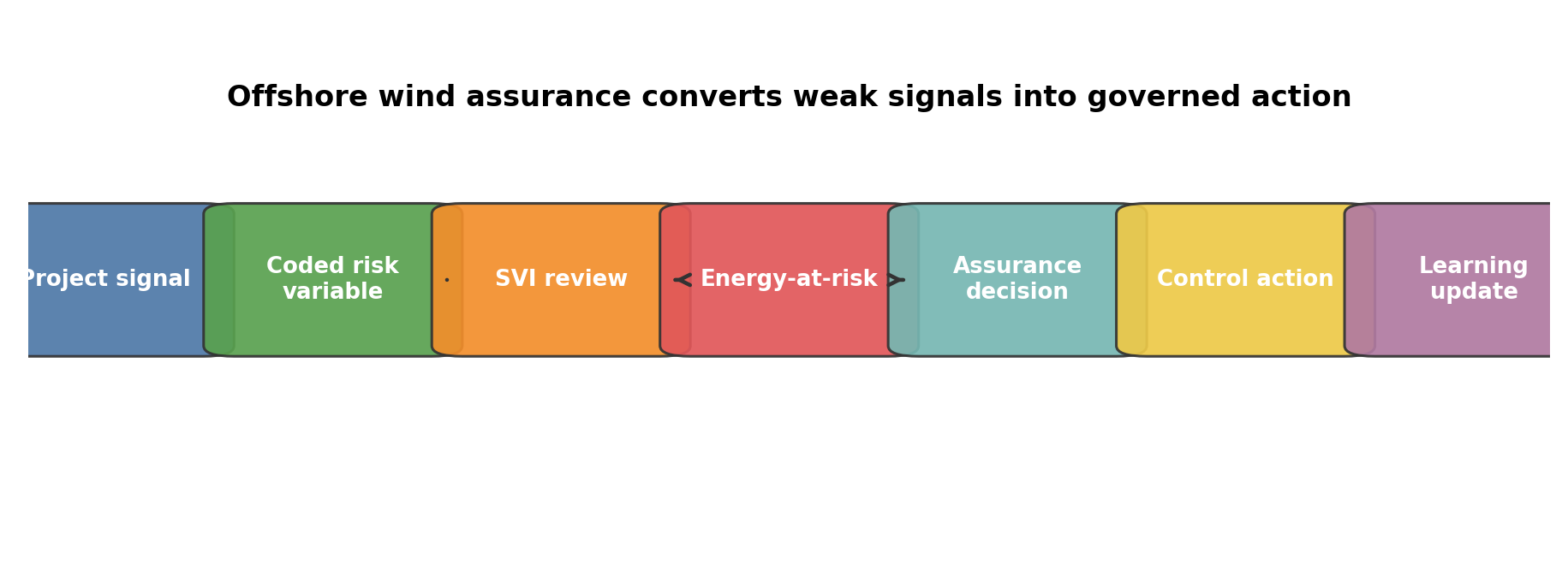
Figure 1. Offshore wind governance flow from early signal to control action. Author-developed visual for this publication. Copyright © June 2026 Cherish Chiemela Okoroji / NYCAR. All rights reserved.
The variables are deliberately engineering-facing. Supply-chain lead-time strain can be measured through variance between planned and actual delivery dates for blades, foundations, cables, substations, and major electrical packages. Turbine quality interruption can be measured through nonconformance severity, inspection holds, rework hours, blade or nacelle rejection events, and field quality stoppages. Grid-readiness gap can be measured through the difference between turbine-side commissioning readiness and onshore/offshore transmission readiness. Regulatory stoppage exposure can be measured in days under formal stop order, partial restriction, or unresolved authority review.
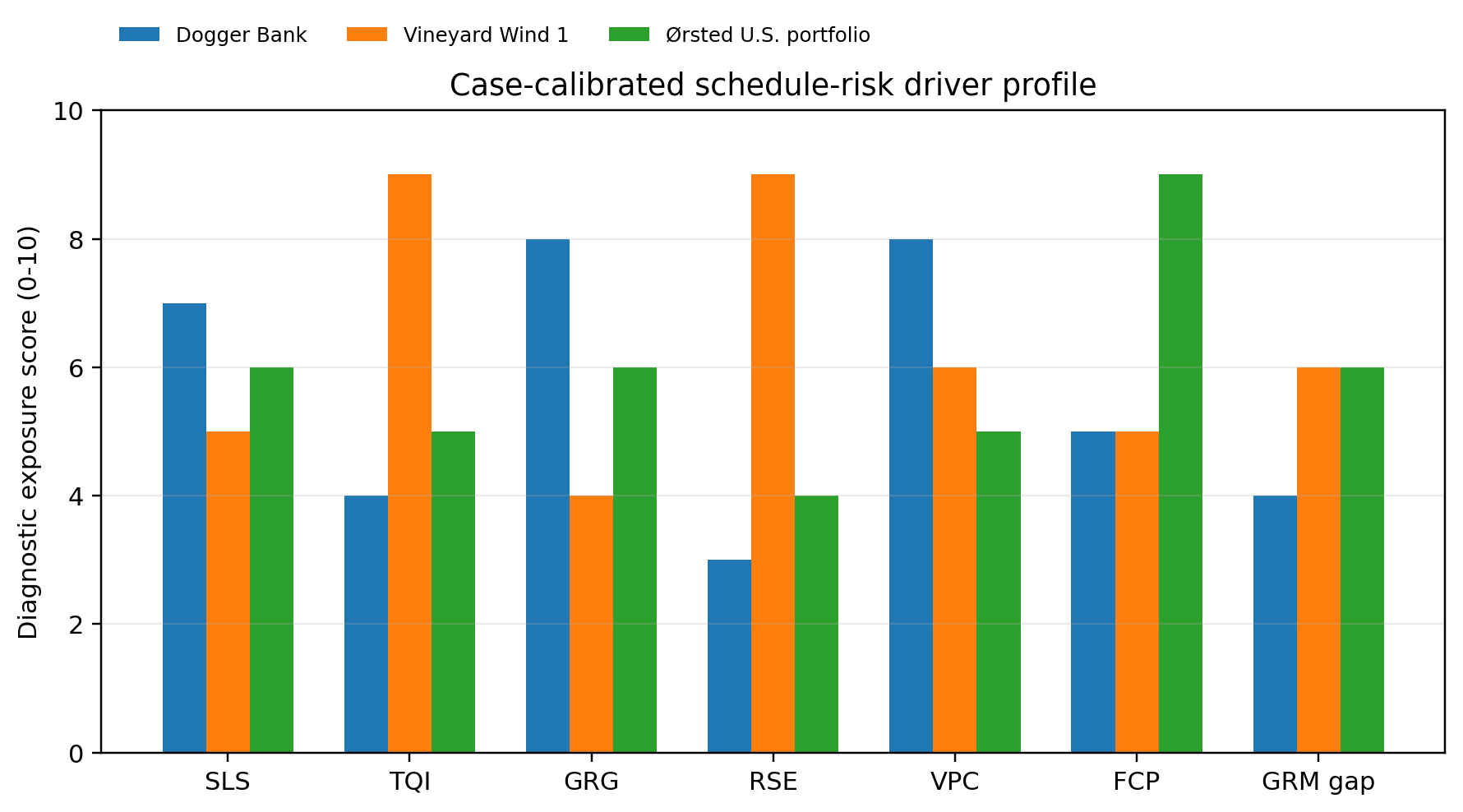
Figure 2. Case-calibrated schedule-risk driver profile for offshore wind assurance. Diagnostic author-developed scores, not official project ratings. Copyright © June 2026 Cherish Chiemela Okoroji / NYCAR. All rights reserved.
Vessel and port constraint is measured through installation-vessel availability, port readiness, berth conflicts, mobilization delay, and demobilization costs. Financing cost pressure can be proxied through the change in risk-free rates or project weighted average cost of capital between bid and financial close or between financial close and major procurement. Governance response maturity is a composite managerial variable measured through escalation timeliness, independent assurance coverage, decision-right clarity, risk review frequency, and the quality of evidence provided to the owner’s board or steering committee.
The model can be estimated with ordinary least squares when the project dataset is large enough and variables are continuous. For an owner managing a portfolio, panel regression may be more useful because it allows comparison across projects and time. The panel form is SVI_it = α_i + τ_t + β1SLS_it + β2TQI_it + β3GRG_it + β4RSE_it + β5VPC_it + β6FCP_it + β7GRM_it + ε_it. The project fixed effect α_i captures persistent differences between projects, and the time effect τ_t captures sector-wide shocks such as inflation or vessel-market tightening.
The study also uses an energy-at-risk calculation. Deferred Energy at Risk, abbreviated EAR, is calculated as EAR = Capacity_MW × Capacity Factor × Delay Days × 24. For offshore wind, capacity factor varies by site and operating assumptions; managers uses the project’s base-case model rather than a generic number. The formula is valuable because it turns a schedule problem into a physical energy-delivery problem. A 30-day delay on an 806 MW project is not simply one lost month; it represents a measurable quantity of clean electricity not delivered to the grid.
A related revenue-at-risk calculation can be expressed as RAR = EAR × Contract Price. If the contract price is confidential, the model can be used internally with the project’s agreed offtake price. For public analysis, the equation is enough to show why delay belongs as a strategic control issue. A project manager who cannot translate delay into energy and financial exposure may struggle to win adequate attention from executives until the damage is already visible.
The research does not present confidential coefficients or claim that public cases are sufficient to estimate a statistically valid industry model. That would be irresponsible. Instead, it provides a defensible model specification and shows how verified public cases support the choice of variables. A future owner-operator, lender, or public authority could estimate the coefficients using project-control data across a project portfolio. The value of the model lies in making the evidence structure clear.
Validity is protected by separating verified case facts from model use. Dogger Bank evidence supports the importance of scale, phasing, HVDC interface, and long-distance marine execution. Vineyard Wind supports the importance of turbine quality interruption and regulatory stoppage exposure. Ørsted’s disclosures support the importance of financing cost pressure and execution delays. NREL reporting supports market and pipeline context. Peer-reviewed studies support the categories of risk included in the model. The study avoids pretending that public information can reveal every internal project-control decision.
For implementation, the model needs a clear coding manual. Supply-chain lead-time strain is not coded only as a narrative comment such as “supplier delay.” It is measured against the baseline procurement schedule, the revised forecast, and the critical-path relationship of the delayed package. A late component that has float may matter less than an on-time component with unresolved quality conditions. The coding manual is expected to therefore separate date variance, criticality, and recoverability.
Turbine quality interruption also needs severity grades. Minor nonconformances that can be repaired before installation is not modeled in the same way as failures that stop offshore activity or require regulator engagement. A practical scale can classify quality events as observation, repairable nonconformance, package hold, installation hold, and fleet-wide review. Regression analysis becomes more reliable when such grades are consistent across projects and packages.
Grid-readiness gap deserves particular discipline because it often sits between organizations. Offshore generation assets may be ready while transmission works are still under review, or grid works may be ready while turbines lag. Neither side is best allowed to declare success alone. The variable is expected to measure readiness alignment between generation, offshore substation, export system, onshore grid, protection systems, metering, control rooms, and market registration. A project is only ready when the chain is ready.
Regulatory stoppage exposure includes formal and practical stoppages. A formal order is easy to count. Practical stoppage may occur when unresolved regulatory questions, environmental commitments, or safety-case deficiencies prevent work even without a headline suspension. The model is expected to classify stoppage by authority, cause, duration, scope, and affected workfront. That granularity helps the project see whether regulatory pressure is episodic or structurally connected to poor compliance preparation.
Vessel and port constraint is not a single market variable. It includes installation vessel availability, lifting capacity, crew availability, port berth readiness, quayside load limits, component storage capacity, customs clearance, towing logistics, and weather-window compatibility. Offshore wind projects can lose time not only because a vessel is unavailable, but because the required vessel, port, component, crew, and weather window do not align. The variable is expected to capture that combined availability.
Financing cost pressure is included because engineering managers need to understand capital context without turning into finance managers. Rising rates can make delay more costly, but the engineering response remains practical: improve schedule credibility, reduce avoidable uncertainty, preserve contingency, and provide accurate progress evidence. Investors and owners are more likely to support recovery plans when project managers can show which risks are active and how they are being controlled.
Governance response maturity can be measured through observable behaviors. How many days pass between risk detection and escalation? Are independent reviewers present at the right gates? Are package-level risks consolidated at project level? Does the steering group receive technical evidence or only traffic-light summaries? Are recovery actions assigned with dates and owners? These questions convert a seemingly soft management variable into a measurable project-control variable.
The model is expected to also include a rule for severe events. Regression outputs can support judgment, but they does not override non-negotiable safety or quality gates. A blade-failure pattern, unresolved high-voltage safety concern, evidence of systemic manufacturing defects, or serious environmental noncompliance is expected to trigger hard review regardless of predicted schedule effect. Engineering management loses integrity when statistical tools become excuses for tolerating unacceptable risk.
Table 1. Offshore wind case evidence and engineering management use
| Evidence | Verified detail | Engineering management use |
| Dogger Bank | 3.6 GW project in three 1.2 GW phases, about 130 km offshore, with HVDC transmission. | Scale, phasing, interface control, and learning transfer. |
| Vineyard Wind 1 | July 2024 blade failure led to BSEE restrictions on generation and further construction. | Supplier quality, incident response, regulatory stoppage exposure. |
| Ørsted U.S. portfolio | 2024 impairments reflected rates, seabed valuation, construction delay, and higher expected costs. | Finance-pressure tracking and execution realism. |
| NREL 2024 market report | The U.S. offshore wind pipeline contains large projects at different stages of maturity. | Separate pipeline ambition from deliverable capacity. |
Table 2. Regression variables for offshore wind schedule variance intensity
| Variable | Meaning | Engineering measurement |
| SVI | Schedule variance intensity | Delay days normalized by capacity and phase exposure. |
| SLS | Supply-chain lead-time strain | Variance between planned and actual delivery of major components. |
| TQI | Turbine quality interruption | Quality holds, rework, or component stoppage severity. |
| GRG | Grid-readiness gap | Misalignment between generation readiness and transmission readiness. |
| RSE | Regulatory stoppage exposure | Days under formal or practical authority restriction. |
| VPC | Vessel and port constraint | Installation vessel, berth, storage, and mobilization constraint. |
| FCP | Financing cost pressure | Change in capital cost or financing exposure affecting delivery pressure. |
| GRM | Governance response maturity | Escalation timeliness, decision quality, assurance coverage. |
Read also: Engineering Management Metrics That Drive Outcomes
Chapter 4: Case Analysis and Engineering Findings
The public cases make the managerial pattern clear. Offshore wind projects fail or succeed through the quality of their interfaces. Technical packages requires meet at exactly the point where contractual packages, marine operations, grid readiness, and regulatory expectations also meet. When one of those interfaces weakens, the project may still look healthy in percentage-complete reporting while the critical path is already deteriorating. Engineering managers therefore need evidence systems that focus on interface readiness, not only activity completion.
Dogger Bank is a useful starting point because it shows how a project can carry multiple layers of novelty at once. The project’s size is exceptional, its distance from shore is demanding, and the use of HVDC transmission on a UK wind farm adds a major grid-interface dimension. None of these features is inherently unmanageable. The point is that novelty stacks. A project with one new feature can isolate lessons. A project with several new features needs more durable learning loops and more independent assurance because cause and effect become harder to read when problems appear.
The three-phase structure of Dogger Bank offers a governance advantage if the learning system is firm. A phased megaproject can transfer lessons from early installation, commissioning, cable work, marine logistics, and control systems into later phases. That advantage is not automatic. It requires a formal mechanism to capture field learning, assign owners, modify standards, update inspection plans, and change supplier requirements. If lessons are only discussed informally, a later phase may repeat defects that the initial phase already exposed.
Vineyard Wind’s blade failure points to a different governance requirement: component quality belongs as a project-wide risk, not as a factory-side issue. A blade manufactured for offshore service carries high consequence because replacement, inspection, marine access, and public safety are all more difficult after installation. Factory acceptance therefore cannot be a box-checking exercise. Engineering managers need traceability down to critical manufacturing steps, independent inspection authority, non-destructive examination where justified, and an escalation rule that prevents commercial pressure from diluting quality review.
The BSEE order following the Vineyard Wind failure shows that regulatory stoppage exposure can dominate the schedule even when the underlying technical issue is located in one component category. Regulators do not simply ask whether a failed blade can be repaired. They ask whether personnel are safe, whether other installed assets are exposed, whether construction can continue, whether debris and environmental risk are managed, and whether the project’s mitigation plan is credible. An engineering manager requires anticipate this broader regulatory logic before an incident occurs.
Ørsted’s impairment disclosures show that project governance has to integrate financial and construction evidence. Construction delay is not only the result of technical difficulty; it can also be amplified by financing conditions and contract terms. Higher long-dated interest rates can reduce the value of future revenue. Delays can increase financing exposure. Higher expected costs can weaken internal approval confidence. Engineering managers do not set macroeconomic policy, but they provide the delivery evidence that determines whether executives and lenders trust the schedule.
A well-governed offshore wind project is expected to therefore treat the risk register as a live operating tool. The register distinguishes between risks that threaten cost, risks that threaten schedule, risks that threaten safety, risks that threaten technical performance, and risks that threaten public confidence. Some events threaten several categories at once. A turbine blade quality event can affect all five. Those high-coupling risks deserve more durable control than their raw probability may suggest.
Regression analysis helps because it makes the project confront patterns. If schedule variance rises mostly when supply-chain lead times move, the governance response is expected to focus on procurement buffers, supplier expediting, alternative manufacturing slots, and contract incentives. If turbine quality interruption explains most variance, the project needs deeper supplier assurance and manufacturing surveillance. If regulatory stoppage explains variance, then permitting compliance, authority engagement, and incident-response planning become schedule controls rather than legal formalities.
The model also prevents convenient explanations from becoming permanent. Offshore wind teams often blame weather because weather is visible and uncontrollable. Weather does matter. Yet if schedule variance persists across workable weather windows, managers requires look at deeper causes: late drawings, incomplete components, vessel queueing, port congestion, defective parts, grid bottlenecks, or slow decision rights. A regression framework does not allow the team to hide behind one explanation unless the data support it.
The energy-at-risk calculation sharpens the consequences. An 806 MW project delayed by 30 days with an assumed 45 percent capacity factor would defer about 261,144 MWh of electricity. That figure is calculated by multiplying 806 MW by 0.45, by 30 days, and by 24 hours. The number is not a claim about Vineyard Wind’s actual lost generation under any contract condition; it is the engineering translation of delay into energy terms. Project teams performs the same calculation with their approved internal assumptions.
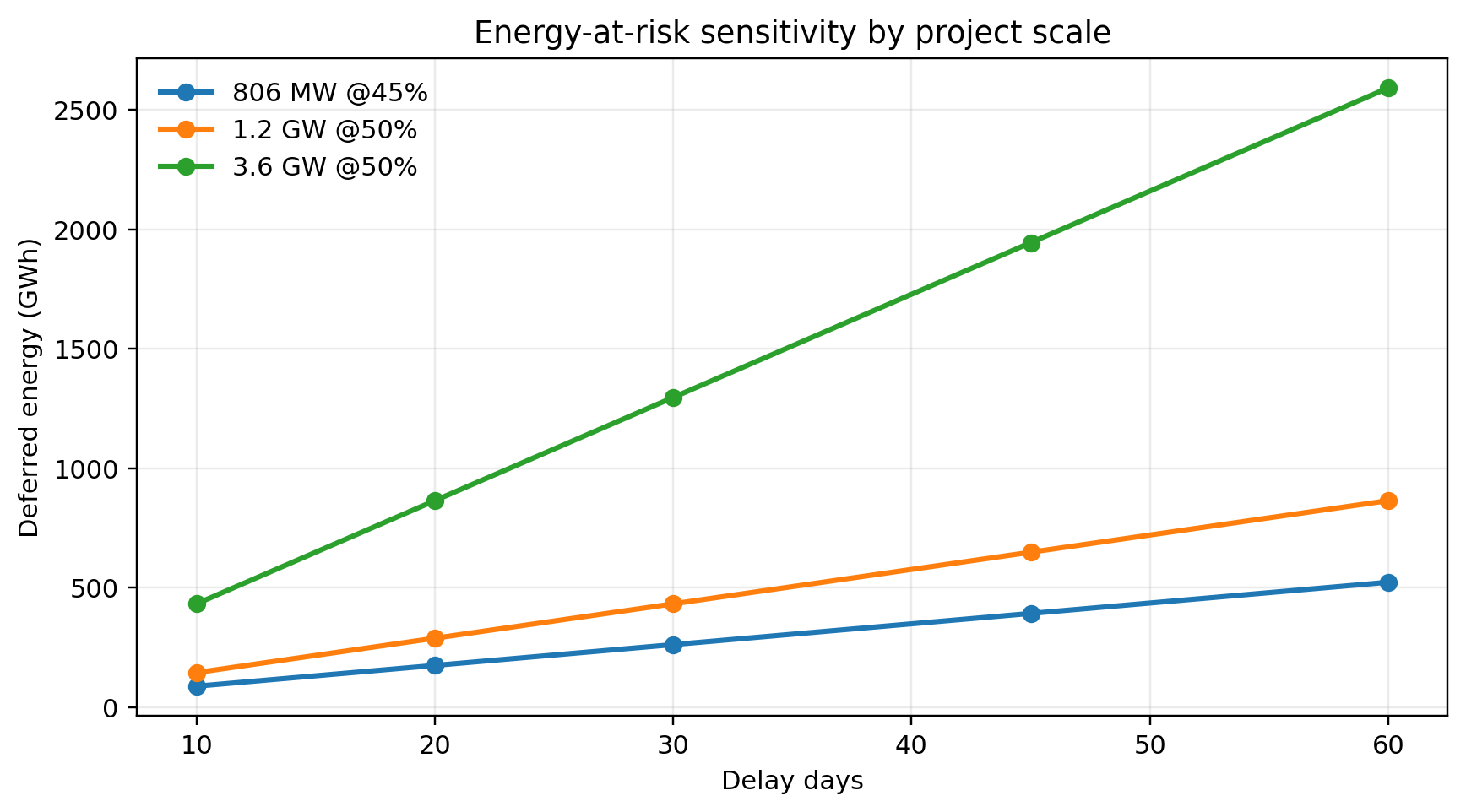
Figure 3. Energy-at-risk sensitivity by project scale and delay duration. Author-developed calculation using stated capacity-factor assumptions. Copyright © June 2026 Cherish Chiemela Okoroji / NYCAR. All rights reserved.
The same logic applies at Dogger Bank scale. A delay on a 1.2 GW phase carries a different energy consequence from a delay on a small pilot project. If a 1.2 GW phase were delayed by 30 days at a 50 percent capacity factor, deferred energy would be 432,000 MWh. A one-month delay becomes visible as a material amount of electricity. That kind of translation can change boardroom behavior. Schedule risk becomes easier to govern when its consequences are no longer hidden behind abstract dates.
The main managerial lesson from these cases is that governance requires arrive early. Once a blade has failed offshore, once a regulatory order has stopped construction, or once financial impairment is announced, the project is already in corrective mode. Firm engineering management invests more heavily in prevention and early detection: supplier qualification, independent audits, interface-readiness reviews, cable and converter-system assurance, installation simulation, spare strategy, port readiness, and formal decision pathways.
Contract strategy also deserves attention. Offshore wind projects rely on suppliers with scarce capacity and specialized knowledge. If contracts push too much risk onto suppliers that cannot realistically absorb it, the project may gain legal protection while losing delivery resilience. If the owner accepts too much risk without verification rights, the project may lose control of quality. Good contract management balances commercial incentives, technical transparency, and early-warning obligations.
The cases also show that public confidence is an engineering management variable. Offshore wind projects are visible from the moment they enter public debate. Coastal communities, labor groups, environmental organizations, regulators, fishing interests, and ratepayers all interpret incidents. A technically competent response can still fail if communication is evasive. Engineering managers is notcome public-relations substitutes, but they requires provide the factual clarity that credible communication requires.
The study’s regression framework is best used as part of a monthly project assurance cycle. Data is best collected from procurement, quality, construction, regulatory, finance, and grid-interface teams. The regression output is best reviewed with qualitative evidence. If the coefficient for vessel constraint rises, the project director asks whether installation campaigns are being over-optimized on paper. If quality interruption rises, the owner is expected to review supplier inspection authority. If governance response maturity is low, the issue may be leadership rather than technology.
A useful reading of Dogger Bank is that scale turns coordination into a technical issue. At small scale, managers can sometimes compensate for weak coordination through personal intervention. At 3.6 GW, with three phases and an HVDC interface, coordination requires embedded in the management system. The project requires know which decisions are repeatable, which are phase-specific, and which are learning opportunities. The size of the project means that even small percentage improvements in execution practice can produce large absolute benefits.
The same case also shows that a project’s operations base is not an afterthought. A long-term operations and maintenance base creates continuity between construction and operations. Engineering managers is expected to involve O&M personnel before final handover because maintainability issues are often created during design and installation. A project that is easy to build but hard to operate has transferred cost rather than created value. Offshore wind assets live in harsh environments; access is expensive, weather-limited, and safety sensitive.
The Vineyard Wind incident reinforces the need to treat quality evidence as a shared asset. Factory data, supplier inspection results, logistics records, installation records, and offshore condition evidence is best integrated. If records are fragmented, root-cause analysis slows. The project may know that a blade failed without quickly understanding whether the issue is isolated, batch-related, transport-related, installation-related, or linked to design assumptions. Time lost in uncertainty can be as damaging as time lost in repair.
Public incidents also reveal whether a project’s governance language is credible. Communities and regulators hear many assurances before construction begins. After an incident, they judge whether the developer’s behavior matches those assurances. Engineering managers contribute to credibility by maintaining clear evidence, plain explanations of what is known, honest separation of knowns from unknowns, and transparent recovery actions. Vague reassurance is not engineering leadership.
Ørsted’s case highlights another governance lesson: a project portfolio is not managed as if every asset has the same risk temperature. Some projects carry higher exposure because of location, contracts, supply-chain maturity, offtake arrangements, local regulation, or novel elements. Portfolio leaders is expected to assign assurance intensity according to risk temperature. A mature European fixed-bottom project and a constrained United States project may not need the same governance rhythm.
Portfolio-level regression can make this possible. If project data are captured consistently, leaders can compare whether delays across several projects are driven mainly by cable procurement, turbine quality, grid readiness, vessels, or financial pressure. Without portfolio analytics, every project tells its own story and lessons are slow to travel. Engineering organizations does not relearn the same supply-chain lesson across multiple projects while treating each delay as unique.
A mature offshore wind owner maintains a lessons-to-controls log. Ordinary lessons-learned reports often become ceremonial documents after milestones. A lessons-to-controls log asks what changed because of the lesson. Did a supplier audit checklist change? Did a contract requirement change? Did inspection coverage increase? Did the schedule model change? Did a regulatory interface plan improve? If nothing changed, the organization has not learned in a management sense.
The cases also show the importance of schedule humility. Offshore wind schedules are vulnerable to the false confidence of decimal precision. A plan may show a turbine installation date, cable pull date, commissioning date, and commercial operation date with impressive detail. The precision can hide fragility if the plan depends on multiple low-probability events all going right. Engineering managers asks not only what the planned date is, but how many assumptions requires hold for that date to remain credible.
Schedule contingency is best tied to risk profile, not negotiated down for commercial appearance. If a project has new turbine technology, constrained vessels, unresolved grid dependencies, complex permitting, and supplier ramp-up, a thin contingency is not ambitious; it is misleading. Good governance protects contingency until evidence justifies its release. The project sponsor may dislike the visible effect on headline schedule, but a realistic schedule is less damaging than a public miss.
One of the under-discussed risks in offshore wind is organizational fatigue. Large projects run for years. Teams face repeated deadlines, weather disruption, regulatory review, stakeholder pressure, and budget scrutiny. Fatigued organizations normalize warning signs because the alternative is another escalation. Engineering managers is expected to monitor decision quality, not only output. Slow responses, recurring unresolved actions, and repeated optimistic forecasts are signs that governance may be losing force.
A project-control model is expected to also distinguish between recoverable and nonrecoverable delay. Recoverable delay can be absorbed through resequencing, added shifts, alternative vessels, parallel work, or accelerated commissioning. Nonrecoverable delay moves the commercial operation date because the critical path has no practical recovery route. Regression outputs are more useful when SVI is broken into recoverable and nonrecoverable components. A supply delay that can be absorbed by float is not weighted like a converter-station delay that blocks energization.
Weather is treated with analytical care. Offshore wind projects cannot control wind, waves, fog, or storms, yet they can plan around historical patterns, seasonal access, and vessel capability. The weather variable is notcome a convenient explanation for all delay. Weather exposure is partly a planning choice because the schedule determines which work occurs in which season. Engineering managers distinguishes uncontrollable extreme events from poor alignment of work packages with predictable seasonal limitations.
Interface control documents is best living instruments. In complex offshore projects, many failures begin at boundaries: turbine-to-foundation, cable-to-substation, offshore-to-onshore transmission, supplier-to-installer, regulator-to-contractor, design-to-field, and construction-to-operations. Interface registers includes technical requirements, responsible parties, open decisions, inspection evidence, schedule dependency, and escalation route. A static interface register becomes obsolete quickly because field decisions change the real project faster than documents are updated.
The model can also support contingency allocation. Instead of holding a generic project contingency, leaders can assign contingency to risk drivers with observable triggers. If supply-chain strain rises above the agreed threshold, a procurement contingency is activated. If quality interruption rises, independent inspection funding is released. If vessel constraint becomes critical, alternative charter options are examined. Contingency becomes governed flexibility rather than a hidden reserve slowly consumed by pressure.
Claims management is not separated from engineering governance. Delays often become disputes over responsibility, notice, compensable events, and entitlement. A project with weak technical records will struggle to defend its position. Engineering managers is expected to ensure that quality holds, regulatory interactions, vessel delays, component conditions, weather events, and interface decisions are recorded with enough detail to support both learning and contractual clarity.
Human safety requires remain central. Offshore wind installation involves lifting heavy components, working at height, vessel transfer, energized systems, and difficult emergency response conditions. A schedule recovery plan that increases safety exposure is not genuine recovery. The regression model can explain schedule pressure, but safety governance requires set boundaries around acceptable response. Managers is expected to never allow deferred energy or revenue exposure to become a reason for unsafe work.
Another practical issue is the handover from construction to commissioning. Many projects treat commissioning as a final stage, but commissioning readiness is governed from the beginning. Documentation completeness, test procedures, spares, control-system access, operator training, grid-code compliance, cybersecurity, and fault-response routines all affect the ability to turn installed assets into operating assets. A turbine installed without a credible commissioning path is not a complete unit of value.
Chapter 5: Managerial Implications and Recommendations
The engineering management implications begin with front-end realism. Offshore wind projects cannot afford optimistic scheduling that treats long-lead components, port upgrades, regulatory review, and grid works as background tasks. The early project schedule is expected to identify the few interfaces most likely to move commercial operation date. Those interfaces is expected to receive independent assurance before procurement and construction commitments become difficult to revise.
A disciplined offshore wind governance system has a stable rhythm. It includes monthly critical-path review, supplier quality review, regulatory issues review, grid-interface review, safety assurance, and executive risk escalation. These meetings does not multiply bureaucracy. They is expected to shorten the distance between evidence and decision. When a supplier quality event appears, the project knows who can stop shipment, who can approve rework, who requires notify the regulator, and who updates the installation schedule.
Regression analysis is best embedded into the project-controls function. The schedule team already tracks earned value, milestones, float, and critical path. The regression layer adds explanatory discipline. It asks which variables are moving schedule variance rather than simply reporting that variance exists. A project may show a negative schedule trend for several months; the governance question is whether the trend is driven by procurement, weather, vessel availability, design change, grid delay, quality holds, or decision latency.
Data quality is essential. A regression model built on weak project data will produce false confidence. The project team is expected to define variables before major construction begins, use consistent coding rules, and record events in a way that survives staff turnover. For example, a quality interruption is not coded differently by every package manager. A regulatory stoppage is best dated and classified. Vessel constraint distinguishes between weather downtime, vessel unavailability, port conflict, and late mobilization.
Supplier assurance requirescome more intrusive where consequence is high. Offshore wind supply chains include components whose failure can stop the project: blades, nacelles, gearboxes, transformers, array cables, export cables, monopiles, jackets, substations, and converter equipment. The owner’s assurance plan is best proportionate to consequence. High-consequence components require supplier-process audits, hold points, manufacturing data review, nonconformance trending, and independent acceptance authority.
Quality governance is expected to avoid the illusion that a pass/fail certificate is enough. A certificate indicates compliance with a defined requirement at a defined point. It does not guarantee that upstream process variation, material handling, storage, transport, or installation damage are controlled. Offshore wind requires chain-of-custody thinking. A blade, cable, or transformer may pass factory inspection and still be damaged through transport, lifting, storage, or offshore handling. The quality system requires extend across the journey.
Regulatory readiness is treated as part of schedule readiness. The project team maintains a live map of required approvals, conditions, reporting obligations, environmental commitments, safety-case evidence, incident-response protocols, and authority interfaces. The map does not sit with legal counsel alone. Package managers, marine coordinators, HSE leaders, and commissioning teams knows which commitments affect their work. When regulatory relationships are only activated during problems, the project has already lost time.
Ports and vessels require separate governance because they are constrained resources. An installation plan that assumes perfect vessel availability and port flow is not a plan; it is a wish. Offshore wind projects performs stress tests against delayed components, vessel breakdown, port congestion, customs issues, and poor weather windows. The stress test is expected to show how many days of float are consumed and which contracts or contingency plans become active.
Grid-interface governance is often underestimated by teams focused on turbines and foundations. Offshore wind does not create system value until generated energy can move through export cables, substations, converter stations, transmission networks, and market systems. A project that installs turbines before grid readiness may create visible progress but limited delivery value. Engineering managers treats grid readiness as a co-equal workstream with turbine installation.
Governance response maturity is the softest variable in the regression, but it may be one of the most important. Mature governance means that bad news moves quickly, decisions are made at the right level, and technical disagreement is not suppressed. In a weak governance environment, risk information may be filtered until it becomes politically safe. By then, options are fewer and more expensive. Engineering leaders is expected to reward early escalation rather than punish it.
The study recommends an offshore wind Project Assurance Board with authority over risk acceptance, major quality deviations, critical-path changes, regulatory holds, and supplier recovery plans. The board includes engineering, construction, HSE, procurement, grid, finance, legal, and independent assurance representation. Its purpose is not to take daily control from the project team. Its purpose is to prevent high-consequence risks from being normalized inside work packages.
Owners maintains an energy-at-risk dashboard. The dashboard is expected to translate delay into deferred MWh and, where appropriate, revenue exposure. This is not a replacement for schedule reporting. It is a bridge between engineering delivery and business consequence. When managers can see the energy cost of delay, they are less likely to treat project-control warnings as technical pessimism.
Lenders and public authorities can also use the framework. Lenders’ technical advisers can ask project developers to report SVI variables monthly. Public authorities can require evidence of supply-chain readiness, quality controls, and regulatory response plans before treating pipeline capacity as credible future supply. The framework can improve public planning by distinguishing projects that have a signed agreement from projects that have a credible execution system.
The recommendations require investment, but the cost of weak governance is higher. Offshore wind is capital intensive, politically visible, and schedule sensitive. A project may save money by reducing assurance visits, shortening supplier audits, or avoiding independent quality review. Those savings disappear quickly if one defect stops offshore work. Engineering management is judged by prevented failure as much as by visible activity.
A practical assurance model includes hold points that cannot be waived at package level. Critical design reviews, factory acceptance tests, marine-readiness reviews, cable load-out approvals, substation energization, blade installation, and initial-power decisions is expected to have formal criteria. The project director may approve certain deviations, but high-consequence deviations is expected to require independent technical review. This protects both the project and the people under delivery pressure.
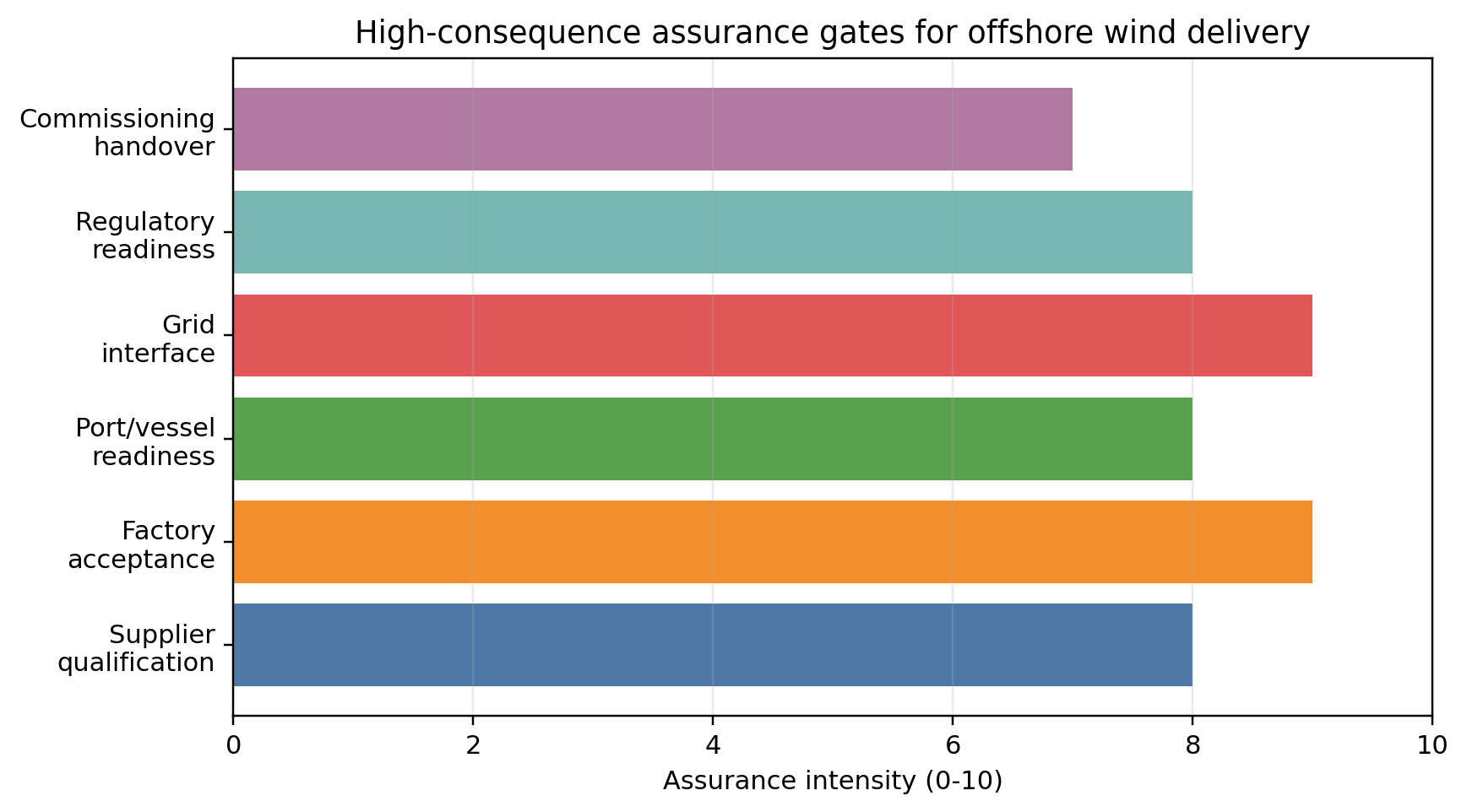
Figure 4. High-consequence assurance gates for offshore wind delivery. Author-developed engineering-management visualization. Copyright © June 2026 Cherish Chiemela Okoroji / NYCAR. All rights reserved.
Project teams is expected to also use leading indicators, not only lagging indicators. Lagging indicators include delay days, cost growth, nonconformance totals, and lost-time incidents. Leading indicators include supplier audit findings, late engineering deliverables, unresolved interface queries, component-test anomalies, vessel booking uncertainty, and recurring action slippage. Regression analysis is more useful when it includes leading indicators because management can still intervene.
The owner’s engineer role is best strengthened. In offshore wind, developers may depend heavily on EPC contractors, turbine suppliers, marine contractors, and grid parties. Those organizations have expertise, but they also have their own commercial pressures. An owner’s engineer or independent technical adviser provides challenge, verifies evidence, and helps the sponsor avoid becoming dependent on the most optimistic interpretation of the contractor’s report.
Digital project controls can help if they are built around decision-making. Many projects accumulate dashboards that show progress without changing decisions. A useful dashboard is expected to connect work package status to critical path, risk variables, forecast confidence, and decision needs. The project-control team does not simply publish data. It is expected to interpret data for action and record whether action was taken.
Offshore wind projects is expected to also maintain a community-and-regulator evidence pack for high-consequence incidents. This pack includes incident chronology, safety status, environmental status, affected assets, immediate controls, investigation path, external experts involved, and planned updates. The pack is not public spin. It is a disciplined way to prevent confusion, inconsistent statements, and avoidable loss of trust when events move quickly.
A further recommendation concerns supplier development. Offshore wind supply chains are expanding while being asked to deliver larger components under more pressure. Owners is expected to avoid treating suppliers only as transactional vendors. Where the supply base is strategically important, owners and governments may need to invest in qualification, workforce development, port upgrades, manufacturing capacity, and shared quality standards. Project governance cannot fully compensate for an underdeveloped industrial base.
Risk allocation is best reviewed for realism. Contracts that assign risk to the party least able to control it create disputes rather than resilience. A supplier cannot control regulatory delay. A developer cannot directly control factory process variation without access rights. A port cannot absorb indefinite component-storage pressure without capacity. Good contracts align responsibility with control and require early warning where control is shared.
The model developed here can also support public procurement. Auction systems that reward the lowest price without adequate adjustment for inflation, supply-chain pressure, and delivery credibility may create future failure. Public authorities is expected to examine not only bid price but also delivery model, supply-chain readiness, grid plan, technical maturity, and sponsor capability. Cheap projects that do not reach operation are expensive in public-policy terms.
Finally, offshore wind leaders is expected to communicate uncertainty more honestly. Certainty is often used to maintain stakeholder confidence, but false certainty is fragile. A more credible communication style explains what is controlled, what remains uncertain, and what actions are being taken. Mature engineering organizations do not pretend that megaprojects are risk-free. They show that risk is being governed.
The framework can be expanded with Bayesian updating after each major project event. A regression model estimates relationships across data, while Bayesian updating allows managers to revise confidence when new evidence appears. For example, a clean supplier audit may lower the expected risk of quality interruption, but an early nonconformance cluster is expected to raise it. The combination of regression and updating can make the assurance process more responsive without becoming erratic.
The project director is expected to insist on decision records for major risk acceptances. When a team chooses to proceed despite an unresolved risk, the reason is best documented: evidence reviewed, alternatives considered, people consulted, decision owner, and conditions for reopening the decision. This practice protects accountability. It also improves learning because later reviews can distinguish between a reasonable risk that matured badly and a weak decision that ignored evidence.
A final practical discipline is independent red-team review. Before major offshore campaigns, a small team not responsible for delivery is expected to challenge the schedule, logistics plan, quality evidence, emergency response, and interface readiness. The purpose is not to embarrass the project team. It is to surface assumptions that insiders may have normalized. Offshore wind projects are too expensive and too public to rely only on internal confidence.
Insurance is another underused source of project intelligence. Marine insurance, construction all-risk coverage, delay-in-start-up coverage, and warranty arrangements all require evidence about hazards and controls. Insurers often see patterns across projects that individual owners may not see. Engineering managers does not treat insurance review as a back-office requirement. It can provide a disciplined external challenge to lifting plans, vessel exposure, fire risk, cable protection, quality management, and emergency response.
Environmental commitments is expected to also be integrated into project control. Offshore wind projects operate in sensitive marine and coastal environments, and environmental noncompliance can stop work as surely as a failed component. Commitments about marine mammals, fisheries, noise, seabed disturbance, debris, and coastal impacts requires translated into work-package controls. When environmental obligations remain separate from construction planning, the project creates avoidable stoppage exposure.
A final issue is talent. Offshore wind delivery depends on people who understand marine operations, high-voltage systems, turbine technology, offshore safety, quality surveillance, project controls, and regulatory engagement. The supply of such people is not unlimited. Engineering managers includes workforce capability in project-readiness reviews. A plan that assumes experienced people will appear exactly when needed is no more credible than a plan that assumes every vessel will be available on demand.
The sector is expected to also distinguish between speed and pace. Speed is a short burst of movement. Pace is sustainable progress under constraints. Offshore wind projects need pace because they last through long procurement cycles, construction seasons, commissioning phases, and early operations. Governance is expected to keep the organization moving steadily without ignoring evidence that the plan has become unsafe, unrealistic, or poorly controlled.
Chapter 6: Closing Findings and Future Research
Offshore wind megaprojects sit at the point where engineering ambition, public policy, finance, and field execution either reinforce one another or collide. Dogger Bank shows the scale now being attempted in fixed-bottom offshore wind. Vineyard Wind 1 shows how a single component failure can move quickly from factory quality to regulator action, coastal concern, project sequencing, and public confidence. Ørsted’s U.S. disclosures show that construction delay and capital-market pressure can change the strategic value of projects that looked commercially sound on paper. These examples do not produce one simple lesson. They show a sector in which technical decisions, commercial assumptions, regulatory relationships, and public trust are tightly linked.
The main contribution of this study is the translation of that complexity into a project-control framework that an engineering manager can actually use. Schedule Variance Intensity gives delay a more useful meaning than a raw count of days. Supply-chain strain, turbine quality interruption, grid-readiness gap, regulatory stoppage exposure, vessel and port constraint, financing cost pressure, and governance response maturity are treated as measurable drivers rather than loose explanations. That distinction matters. A project cannot improve by saying it is under pressure. It improves when it can identify which pressure is active, where it sits in the critical path, and what decision is needed next.
Regression analysis is valuable here because it disciplines judgment without replacing it. Offshore wind teams will always need experienced marine planners, electrical engineers, project controllers, procurement leaders, HSE professionals, and regulatory specialists. A model does not know the sea state, the politics of a port, or the judgment of a blade inspector. What it can do is force the organization to collect comparable evidence and test whether its preferred explanation is true. If quality interruption is driving delay, the answer is not another general schedule meeting. It is deeper supplier assurance. If grid readiness is the driver, turbine installation progress alone is not success. If governance response maturity is weak, the problem may be leadership rather than technology.
The energy-at-risk calculation strengthens the board-level relevance of schedule governance. Delay is not only a missed date. It is electricity not delivered, revenue not earned, emissions reductions deferred, and public promises postponed. A 30-day delay on a large offshore wind phase can represent hundreds of thousands of megawatt-hours. Translating delay in that way helps executives, lenders, regulators, and project teams see why project controls are not administrative housekeeping. They are part of energy security and investment protection.
The cases also warn against the comfort of smooth reporting. Megaprojects often look orderly until the wrong interface fails. A turbine can be manufactured while the port is not ready. A vessel can be booked while the component is under quality hold. A grid workstream can move on paper while commissioning evidence remains incomplete. A regulator can be formally engaged while the project has not prepared the practical evidence needed after an incident. Offshore wind assurance requires therefore focus on interfaces, not only work-package completion. The question is not whether every team is busy. The question is whether the system is converging toward energization.
A mature owner is expected to build assurance around the few risks that can move the whole project. That means independent review at critical quality gates, live tracking of regulatory obligations, stress testing of vessel and port assumptions, serious treatment of transmission readiness, and decision records for high-consequence risk acceptance. It also means protecting contingency from commercial optimism. Thin contingency may make a bid or public schedule look attractive, but it does not make marine construction easier. Honest schedule planning is not pessimism. It is a professional duty.
The human side of governance is not underestimated. Project teams under pressure can normalize warning signs, filter bad news, and continue reporting recovery scenarios long after evidence has weakened. Firm governance creates a culture in which technical concern moves upward quickly and recovery claims requires supported by facts. That culture is not soft. It is one of the most effective controls available in a sector where weather, vessels, suppliers, and regulators leave little room for late correction.
Future research is expected to estimate the model with multi-project monthly data from developers, lenders, or public authorities. A useful dataset would connect procurement slippage, quality holds, grid-interface readiness, regulatory stoppage, vessel constraint, financing pressure, governance actions, and schedule variance across regions and project phases. Such research could test whether governance response maturity moderates technical risk. It may be that projects with similar supply-chain pressure perform differently because one escalates early, protects contingency, and acts on evidence while another waits until the problem is visible outside the project.
The practical standard for offshore wind is simple, even if delivery is not. Capacity promised on paper requirescome energy delivered to people. That conversion requires engineering managers who can read technical evidence, understand commercial exposure, respect regulatory authority, and speak honestly about uncertainty. Offshore wind does not need louder promises. It needs disciplined governance capable of carrying large engineered systems through volatile markets and difficult physical environments.
Chapter 7: Public Assurance, Market Volatility, and Delivery Credibility
7.1 Why public assurance belongs inside engineering management
Offshore wind is often discussed through targets, auctions, lease areas, and installed megawatts. Those terms matter, but they can make delivery sound smoother than it is. A project reaches public value only when the chain from design to generation survives real conditions: manufacturing tolerance, cable availability, offshore access, grid readiness, environmental commitments, financial pressure, and the local patience of communities that live with disruption long before they receive the promised benefits. Public assurance belongs inside engineering management because the public consequence of delay is not abstract. It appears as deferred clean electricity, postponed emissions reduction, weakened industrial confidence, and a harder argument for the next project.
The public does not see every design review, factory inspection, vessel charter, or grid-interface meeting. It sees milestones and failures. Initial power, a blade incident, a regulatory hold, a cost impairment, or a revised commercial operation date becomes the visible story. A project team may know that the cause is complex, yet public interpretation is less forgiving. If the explanation sounds evasive, the technical problem becomes a trust problem. If the project can explain what happened, what is known, what remains under review, and what control has changed, the same incident can be handled with more credibility. That is not communications polish. It is evidence discipline.
Engineering managers therefore carry a public duty even when they are not public officials. Their reports shape board decisions, lender confidence, regulatory engagement, supplier behavior, and community explanation. A weak risk note buried in a dashboard can become a late crisis. A clear escalation supported by traceable evidence can protect the schedule, the budget, and public confidence at the same time. The distinction matters in offshore wind because many delivery risks are visible only to specialists until they become visible to everyone.
The cases examined in this study show different forms of public assurance pressure. Dogger Bank raises the question of whether scale and phasing can be governed with enough learning discipline. Vineyard Wind 1 raises the question of whether component quality and incident response can retain authority under coastal scrutiny. Ørsted’s U.S. disclosures raise the question of whether market pressure and construction delay can be faced early enough to preserve strategic confidence. None of those questions can be answered by optimism. They require records, thresholds, ownership, and a willingness to revise claims when the facts change.
7.2 From market volatility to project-control judgment
Volatile energy markets do not sit outside the project. They change the meaning of schedule. A delay in a low-rate environment may be painful; the same delay under higher financing costs, tight supply-chain pricing, and pressured procurement can reshape project economics. Offshore wind is especially exposed because the capital is committed early, the components are specialized, and the revenue promise often depends on long-term policy instruments or offtake agreements. The engineering manager does not control macroeconomic conditions, but project-control judgment determines how much avoidable uncertainty is added to those conditions.
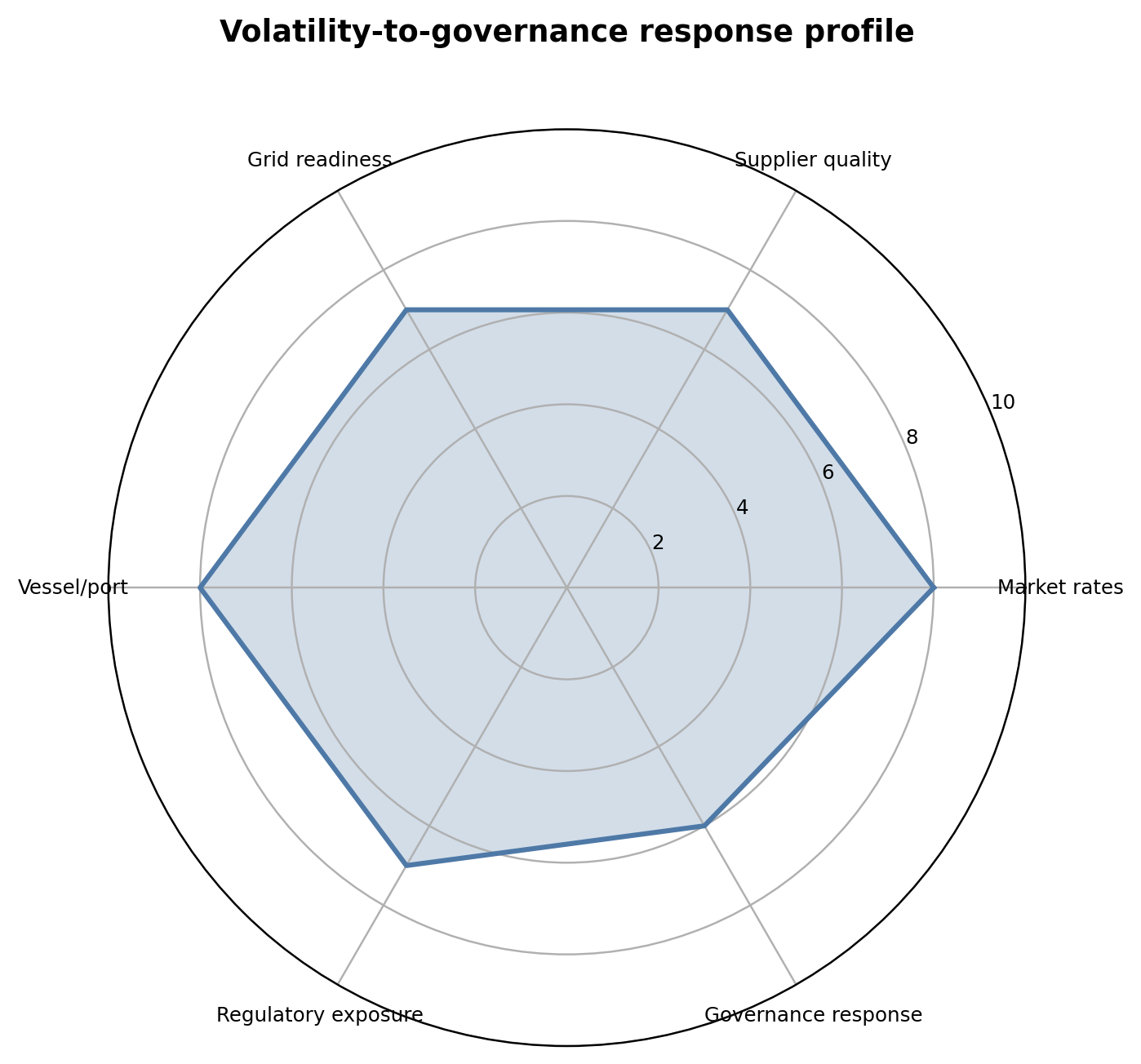
Figure 5. Volatility-to-governance response profile for offshore wind project assurance. Author-developed diagnostic visualization. Copyright © June 2026 Cherish Chiemela Okoroji / NYCAR. All rights reserved.
Financing cost pressure is included in the Schedule Variance Intensity model for that reason. It is not a finance department ornament. It captures the fact that the delivery organization operates in a capital environment. Rising rates, revalued seabed leases, supplier inflation, and construction delay can reinforce one another. A late converter station or unresolved foundation supply issue does not remain a technical event if it changes drawdown timing, contingency consumption, lender confidence, or impairment risk. By placing financing cost pressure beside turbine quality, grid readiness, and vessel constraint, the model forces a more honest reading of offshore wind delivery.
Market volatility also tests bid realism. Auction systems and public targets can reward low headline prices before the delivery system has proven that the assumptions are durable. A bid can look competitive because it compresses contingency, assumes smooth grid works, relies on supplier ramp-up, or discounts vessel-market pressure. Those assumptions may be rational at the time, but they require review once procurement begins. Mature governance does not treat the bid model as sacred. It asks which assumptions still hold and which have become risks with named owners.
A useful project-control system connects commercial exposure with physical constraints. If a blade package is late, the question is not only when the blades arrive. The manager has to ask which installation vessel is affected, whether port storage remains available, whether the weather window is still usable, whether financing assumptions depend on the original commissioning date, and whether public milestones require revision. This is the point at which engineering management differs from reporting. Reporting states the delay. Management reads the consequence chain.
7.3 Supplier quality as an assurance problem
Supplier quality in offshore wind has consequences beyond the factory gate. A blade, cable, transformer, foundation, or converter component carries a long chain of exposure from design specification to manufacture, inspection, transport, storage, lifting, installation, commissioning, and operation. The project may have a certificate, but a certificate is not the whole quality story. Offshore wind requires a memory of the component’s journey. Who made it, under which process controls, with which nonconformances, under which transport conditions, with which handling records, and with what evidence before installation?
Vineyard Wind 1 shows why that chain matters. A blade failure offshore cannot be reduced to an isolated technical note. It affects personnel safety, debris management, regulatory confidence, turbine inspection, construction sequencing, public concern, and the credibility of future assurances. The engineering-management issue is not only the failure itself. It is whether the project had enough independent quality surveillance, enough manufacturing traceability, enough escalation clarity, and enough readiness to explain the control response once the failure became public.
Supplier assurance becomes more demanding as turbine platforms grow. Larger components can improve energy capture and reduce the number of units, yet they raise the consequence of a defect. A quality issue in a small standardized component may be contained quickly. A quality issue in a large blade family, export cable section, or high-voltage package can interrupt offshore work, mobilize regulators, consume vessel time, and trigger a review of installed assets. The project’s assurance intensity has to reflect consequence, not only probability.
This is where the regression framework helps. Turbine Quality Interruption, or TQI, is not simply a label for defects. It is a measurable project driver: inspection holds, rework hours, rejected components, field stoppage, batch review, supplier corrective action, and regulator-visible quality concern. Once coded consistently, TQI can show whether delay is being driven by a supplier-quality pattern rather than by weather or generalized complexity. The data do not solve the defect. They stop the organization from misnaming it.
7.4 Grid readiness and the hidden boundary of completion
Offshore wind projects can create a misleading sense of progress when visible construction runs ahead of grid readiness. Turbines may stand, foundations may be installed, and offshore work may look impressive from a milestone chart, but the asset has no public energy value until generated power can pass through the export system, converter or substation equipment, onshore grid connection, protection systems, metering, controls, and market arrangements. Completion is not a photograph of installed steel. Completion is energized capability.
The Grid-Readiness Gap variable addresses that boundary. It measures the misalignment between generation-side readiness and transmission-side readiness. In a large project, misalignment can arise from converter-station delay, export cable defects, onshore works, grid-code requirements, control-system integration, commissioning documentation, or the timing of grid operator acceptance. Because those issues often sit across organizational boundaries, they can disappear into polite coordination language. The model makes the boundary explicit.
Dogger Bank is useful here because its scale and HVDC interface place grid delivery at the center of the management problem. A phased 3.6 GW project cannot be governed only as turbine installation. It requires a disciplined view of converter platforms, export routes, onshore interfaces, control logic, and phase learning. A lesson from one phase carries value only if it changes the assurance controls for the next phase. Without that loop, scale multiplies repetition rather than learning.
Grid readiness also has public meaning. When a project is delayed because the transmission chain is not ready, the community rarely separates turbine-side progress from grid-side limitation. Public authorities counting future capacity need a more rigorous distinction between pipeline, construction, installed assets, energized assets, and reliable operation. The framework developed in this paper supports that distinction. It keeps capacity claims tied to physical delivery rather than announcement language.
7.5 Regulatory exposure and the discipline of known obligations
Regulatory exposure is sometimes treated as an external interruption, but many regulatory delays begin as weak preparation. Offshore wind projects operate within safety, environmental, navigation, fisheries, coastal, labor, and grid obligations. These obligations are not administrative accessories. They define the permission to work. When they are translated poorly into work packages, incident response, environmental controls, or contractor requirements, the project creates stoppage exposure before any authority acts.
Regulatory Stoppage Exposure in the model includes formal orders and practical holds. A formal order is visible and easy to count. A practical hold can be more subtle: unresolved evidence, incomplete environmental documentation, unanswered authority questions, weak safety-case material, or a contractor method statement that cannot support the work. Both forms matter because both can move the critical path. The project team requires a register that distinguishes authority, condition, affected scope, exposure days, evidence owner, and recovery decision.
The Vineyard Wind case shows how quickly regulatory exposure can widen after a technical event. A blade failure led to federal restrictions on generation and additional turbine construction until risk analysis and mitigation measures were addressed. That sequence is not unusual in high-consequence engineering. A regulator is not only asking whether the component can be repaired. The authority asks whether personnel are safe, whether the risk could affect other assets, whether environmental effects are controlled, whether construction can continue without enlarging the hazard, and whether the project’s account of the facts is credible.
Good regulatory governance starts before incident response. It appears in clear commitments, contractor obligations, evidence packs, rehearsed notification routes, and managers who know when an issue crosses the threshold from internal nonconformance to authority engagement. It also appears in candor. An offshore wind project that communicates uncertainty honestly is more credible than one that offers confidence before the evidence is ready.
7.6 A practical delivery-credit test
The research points toward a delivery-credit test for offshore wind. A project earns credibility only when its public delivery claim can be traced to evidence across the few systems capable of stopping it: supplier quality, grid readiness, vessels and ports, regulatory obligations, financing exposure, and governance response. This test is deliberately stricter than milestone reporting. A milestone says an activity happened. Delivery credit asks whether the activity moved the project closer to safe, energized, public value.
The test begins with traceability. A board-level risk entry has to lead back to package evidence: the supplier record, the inspection result, the open interface query, the regulatory condition, the vessel plan, the commissioning dependency, and the named recovery owner. If that chain is missing, the dashboard is not ready to govern the project. It may still be useful for presentation, but it is not a management instrument.
Another part of the test is decision latency. Offshore wind projects lose time when teams know enough to act but wait until the problem is undeniable. The model’s Governance Response Maturity variable is useful because it examines the project’s own conduct. How long does escalation take after a serious nonconformance? How quickly is a regulatory question given an owner? How fast does the schedule team revise a false assumption? How often do recovery actions close on time? These questions expose whether governance is reducing delay or quietly producing it.
A further part of the test is readiness to pause. Projects under pressure often treat every warning as recoverable. A responsible delivery culture knows the conditions under which work stops. Severe quality uncertainty, unresolved high-voltage risk, unsafe lifting conditions, environmental noncompliance, and inadequate emergency readiness are not ordinary schedule variables. They are gates. A regression output can inform the discussion, but it cannot lower the safety threshold.
The final part of the test is learning transfer. Offshore wind organizations often collect lessons after a milestone. Fewer prove what changed because of those lessons. A useful lessons-to-controls system asks whether the supplier audit changed, whether inspection coverage increased, whether the installation sequence was revised, whether interface documents were corrected, whether contract notice practice improved, and whether a later phase now has a better control than an earlier phase. Without that conversion, learning remains ceremonial.
7.7 Contracting, insurance, and the discipline of recoverability
The contract is often treated as the commercial layer of the project, but in offshore wind it becomes part of technical recoverability. A contract that gives the owner no useful inspection rights can leave the project dependent on supplier reassurance at the exact moment when independent evidence is required. A contract that transfers unrealistic risk to a supplier can produce claims rather than recovery. A contract that rewards low visible cost while ignoring interface readiness can create a project that appears efficient until the workfront reaches the sea. Engineering managers do not draft every clause, yet their judgment is needed before commercial language hardens into delivery exposure.
Recoverability is the useful test. When a foundation package slips, can the installation sequence be changed without losing the season? When a blade batch enters review, can the project access manufacturing records, transport history, and nonconformance data quickly? When a cable fault appears, does the project have spares, repair partners, test records, and vessel access? When regulatory evidence is requested, can the team produce a coherent chronology within days rather than weeks? These questions turn contract management into project assurance. They ask whether the agreement gives the project enough evidence and authority to act while options still exist.
Insurance adds another source of discipline. Marine insurers, construction all-risk insurers, warranty providers, and delay-in-start-up underwriters examine risk through a different lens from the project team. Their questions often expose assumptions that insiders have accepted too easily: lifting method, cable protection, port storage, fire risk, vessel transfer, blade handling, emergency response, and weather exposure. A mature owner uses that scrutiny as intelligence, not as paperwork. Insurance review can become an external challenge to the project’s belief that the plan is ready.
Recoverability also belongs in the energy-at-risk calculation. A delay has a different meaning when the recovery route is clear. Thirty days lost to a documentation issue with a realistic catch-up path is not the same as thirty days lost to a high-voltage interface defect with no alternative commissioning route. For that reason, project teams can divide Schedule Variance Intensity into recoverable and nonrecoverable components. The split helps leaders decide whether to protect contingency, activate an alternative supplier, revise public milestones, or change the delivery sequence. It also prevents a familiar failure: reporting delay as if every day can be won back through effort alone.
7.8 Implementation pathway for owners and public authorities
The framework can enter practice through a staged assurance cycle. At the start of procurement, the owner defines the Schedule Variance Intensity variables and gives each one a measurement rule. Supply-chain lead-time strain is measured against baseline and recovery schedules. Turbine quality interruption is graded by severity and critical-path effect. Grid-readiness gap is measured across the full chain from generation assets to transmission acceptance. Regulatory stoppage exposure includes formal orders and practical holds. Vessel and port constraint captures combined availability, not vessel booking alone. Financing cost pressure records the capital context in which delay is being carried. Governance response maturity records how the organization behaves when the evidence worsens.
Once construction begins, the project reviews those variables on a fixed rhythm. The review is not another dashboard ceremony. Each active driver receives an owner, a next decision, and a date by which the decision loses value. If the active driver is supplier quality, the response may include added inspection, batch review, hold-point authority, or acceptance criteria revision. If the active driver is grid readiness, the response belongs at the interface between electrical engineering, transmission parties, commissioning, and commercial operation planning. If the active driver is governance latency, the project director has to repair the decision route itself.
Public authorities can use the same logic without claiming to manage the project for the developer. An authority assessing national capacity plans can ask whether reported pipeline capacity is backed by credible execution evidence. A project with a lease, an auction award, or a public milestone is not the same as a project with tested supply-chain readiness, grid-interface maturity, vessel and port alignment, environmental compliance, and regulator-ready incident protocols. This distinction matters for energy-security planning because promised megawatts can become politically convenient long before they become deliverable.
Lenders and technical advisers can also use the framework during due diligence. Instead of asking only for schedule status, they can ask which SVI variables are active, how the variables are measured, how much energy is at risk under current delay scenarios, and which recovery decisions have already been taken. That line of questioning brings engineering evidence into financial oversight without asking financiers to become turbine specialists. It makes the investment case less dependent on confident narrative and more dependent on governed evidence.
For research purposes, the framework also opens a path for future empirical work. A developer, lender, insurer, or public authority with access to multi-project monthly data could estimate the coefficients rather than treat them as conceptual. The most valuable future study would test whether governance response maturity moderates technical shocks. In practical terms, that means asking whether two projects with similar supplier delay perform differently because one escalates earlier, protects contingency, and converts lessons into controls while the other waits for the problem to become undeniable. That question sits at the heart of offshore wind project assurance.
7.9 Final position
Offshore wind delivery will not be secured by louder targets or more elegant project language. It will be secured by the discipline of reading weak signals early, naming the risk driver accurately, and acting before the consequence chain expands. The cases examined in this publication show the same lesson from different angles. Scale requires learning discipline. Quality failure requires traceable evidence. Market volatility requires honest schedule realism. Regulatory exposure requires preparation, not surprise. Public credibility requires candor before assurance becomes public damage control.
The Schedule Variance Intensity model and energy-at-risk calculation are useful because they move the discussion from impression to structure. They do not claim private data, and they do not pretend to predict the sea. Their purpose is more practical: to help project leaders ask what is moving the schedule, what energy consequence follows, which interface is exposed, and whether the project is acting at the speed required by the risk. That is enough to make the framework professionally valuable.
For engineering managers, the chapter’s closing standard is plain. Capacity promised on paper has no public value until it becomes reliable electricity. Between the promise and the power lies a chain of decisions. Offshore wind governance is the discipline that keeps that chain visible, tested, and honest.
References
Bureau of Safety and Environmental Enforcement. (2024a). BSEE statement on Vineyard Wind offshore incident. https://www.bsee.gov/newsroom/latest-news/statements-and-releases/press-releases/bsee-statement-on-vineyard-wind
Bureau of Safety and Environmental Enforcement. (2024b). BSEE issues new order to Vineyard Wind in continuing investigation. https://www.bsee.gov/newsroom/latest-news/statements-and-releases/press-releases/bsee-issues-new-order-to-vineyard-wind
Chou, J.-S., Liao, P.-C., & Yeh, C.-D. (2021). Risk analysis and management of construction and operations in offshore wind power project. Sustainability, 13(13), 7473. https://doi.org/10.3390/su13137473
Equinor. (2023). World’s largest offshore wind farm Dogger Bank produces power for the first time. https://www.equinor.com/news/202310-dogger-bank
McCoy, A., Musial, W., Hammond, R., Mulas Hernando, D., Duffy, P., Beiter, P., Pérez, P., Baranowski, R., Reber, G., & Spitsen, P. (2024). Offshore wind market report: 2024 edition (NREL/TP-5000-90525). National Renewable Energy Laboratory. https://docs.nrel.gov/docs/fy24osti/90525.pdf
Ørsted. (2025). Ørsted announces impairments relating to US interest rate increases, value of seabed leases, and execution of Sunrise Wind. https://orsted.com/en/company-announcement-list/2025/01/orsted-announces-impairments-relating-to-us-intere-142283101
RenewableUK. (2024). Offshore wind industrial growth plan. https://www.renewableuk.com/media/rqvlqzu0/offshore-wind-industrial-growth-plan.pdf
SSE Renewables. (2026). Dogger Bank Offshore Wind Farm. https://www.sserenewables.com/offshore-wind/projects/dogger-bank/
Yeter, B., Garbatov, Y., Brennan, F., & Kolios, A. (2023). Macroeconomic impact on the risk management of offshore wind farms. Ocean Engineering, 284, Article 115224. https://doi.org/10.1016/j.oceaneng.2023.115224
Zhao, S., Su, X., Li, J., Suo, G., & Meng, X. (2023). Research on wind power project risk management based on structural equation and catastrophe theory. Sustainability, 15(8), 6622. https://doi.org/10.3390/su15086622
Copyright © June 2026 Cherish Chiemela Okoroji. All rights reserved. NYCAR.