
Trust, Cultural Authority, and Growth Discipline in an AI-Mediated Market
Research Publication by Samuel Ugonna Benson
New York Center for Advanced Research (NYCAR)
Doctoral Research Publication
Peer-Reviewed Doctoral Research Publication
June 2026
Publication No.: NYCAR-TTR-2026-RP062
Date: May 2026
DOI: https://doi.org/10.5281/zenodo.20641316
Copyright © June 2026 Samuel Benson. All rights reserved.
NYCAR Peer Review and Publication Status
This research publication has passed NYCAR’s doctoral-level peer review and editorial assessment for the June 2026 Research Edition. The review examined the strength of the research problem, the originality of the applied argument, the currency of the United States marketing evidence, the case-selection logic, the source discipline, the usefulness of the diagnostic models, the APA 7th referencing, and the fit between the study’s claims and professional marketing practice.
The reviewer found that the publication moves beyond campaign description and treats strategic marketing as a governance discipline. Its strongest contribution is the framing of branding as earned market trust in an AI-mediated market, where visibility, automation, creator reach, retail media, and performance metrics can all become dangerous when they are separated from proof. The work shows mature command of current marketing pressure in the United States and connects public evidence to executive decision-making rather than relying on platform fashion or promotional language.
The case treatment is appropriate for doctoral-level applied research. Apple, Patagonia, Starbucks, The New York Times, Nike, Bud Light, and challenger-brand practice are not used as decorative examples. They are used to examine promise, proof, privacy, cultural authority, loyalty, customer experience, public risk, and institutional response under market pressure. The applied tools – including the Brand Trust Reliability Index, the Marketing Evidence-to-Action model, the AI Marketing Control Loop, and the Channel Discipline Review – give the publication practical value for senior marketing leaders, researchers, and public-facing organizations.
The publication is approved as a doctoral-level NYCAR research publication. Final Publication Number and DOI may be inserted by the issuing office when assigned. The reviewer recommends publication because the work is coherent, current, professionally useful, and written with the level of judgment expected of a doctoral research output in strategic marketing and branding.
Copyright © June 2026 Samuel Benson. All rights reserved. New York Center for Advanced Research (NYCAR).
Abstract
American marketing is no longer short of instruments. Impressions can be bought, copy can be generated at scale, creators can lend reach, retail media can reach the shopper close to purchase, and AI systems can now shape what customers see before they reach a company’s own site. The shortage is elsewhere. It lies in believable proof: the evidence that a brand’s public claims, product conduct, data practice, service experience, pricing, and leadership response can withstand ordinary customer scrutiny.
This doctoral research publication studies strategic marketing and branding in the United States as a problem of earned market trust. It draws on public evidence from IAB/PwC, Gartner, Pew Research Center, Edelman, the Federal Trade Commission, company reporting, and selected U.S. brand cases including Apple, Patagonia, Starbucks, The New York Times, Nike, Bud Light, and challenger-brand practice. The cases are not treated as heroic campaign stories. They are examined for what they reveal about promise, proof, cultural authority, privacy, customer experience, channel discipline, and institutional response under pressure.
The paper develops four applied tools: a Brand Trust Reliability Index, a Marketing Evidence-to-Action model, an AI Marketing Control Loop, and a Channel Discipline Review. These tools are intended for executives, CMOs, brand leaders, researchers, and public-facing institutions that need marketing to support growth without exhausting the conditions that make growth durable. The central claim is deliberately strict: attention is not demand, visibility is not trust, and a brand begins to deserve confidence only when it makes claims the organization can prove, then proves them repeatedly in the customer’s actual experience.
Keywords: strategic marketing, branding, United States, brand trust, AI marketing, customer experience, cultural authority, privacy, creator economy, marketing governance, NYCAR
Table of Contents
List of Tables
Table 1. Chapter structure and applied purpose 8
Table 2. U.S. case-study portfolio 17
Table 3. Strategic brand assets and management questions 21
Table 4. Channel portfolio decision rules 31
Table 5. Brand Trust Reliability Index 40
Table 6. AI marketing governance controls 41
Table 7. Implementation blueprint 44
List of Figures
Figure 1. U.S. digital advertising revenue, 2024-2025 13
Figure 2. Selected U.S. social platform use in 2025 21
Figure 3. Growth in selected platform use, 2021-2025 25
Figure 4. Marketing budget share as a percentage of company revenue 30
Figure 5. Global trust in major institutions, 2025 32
Figure 6. U.S. adults’ social media news frequency in 2025 35
Figure 7. Regular news use by social platform in 2025 36
Chapter 1: Introduction: Marketing After the Attention Chase
1.1 Strategic Problem
American marketing has outgrown the old comfort of being seen. Visibility still matters, but it no longer settles much. A brand can appear in a feed, rank in search, sponsor a creator, send a personalized email, or surface inside an AI-generated answer without earning any deeper confidence. The customer may notice the company and still doubt the claim, resent the targeting, mistrust the data practice, or leave the moment a cheaper or clearer alternative appears.
The problem facing marketing leaders is not tool scarcity. It is the widening distance between what firms can say quickly and what they can carry honestly. A campaign can lift short-term response while training customers to wait for discounts. A personalization system can appear sophisticated while feeling invasive. A creator partnership can look culturally current while borrowing intimacy the brand has not earned. Activity can rise while patience falls.
This study defines strategic branding as earned market trust. Logos, slogans, launch films, creator rosters, loyalty offers, retail-media buys, and AI content systems are instruments. The brand itself is the market’s working judgment about whether the organization is recognizable, useful, fair, competent, and worth returning to. That judgment is formed in ordinary encounters: the product used at home, the refund handled under pressure, the data request the customer did not expect, the price increase, the support transcript, the employee who carries the promise at the front line.
The United States is a demanding setting for this argument because customers do not meet brands in one place. They move between search, social platforms, retail platforms, private messaging, creator recommendations, Reddit threads, news coverage, app notifications, in-store experience, and now AI-mediated summaries. A person can admire a company’s values, dislike its pricing, tolerate its app, distrust its tracking, and still buy from it on a busy weekday. Brand meaning is assembled across these moments; management rarely controls all of them.
The familiar separation between brand and performance is therefore too crude. Performance without memory becomes extraction. Brand without accountable growth becomes expensive self-expression. The harder task is to create demand while preserving the conditions that allow demand to continue: relevance without intrusion, cultural participation without costume, automation without abandonment, loyalty without coercion, and scale without carelessness.
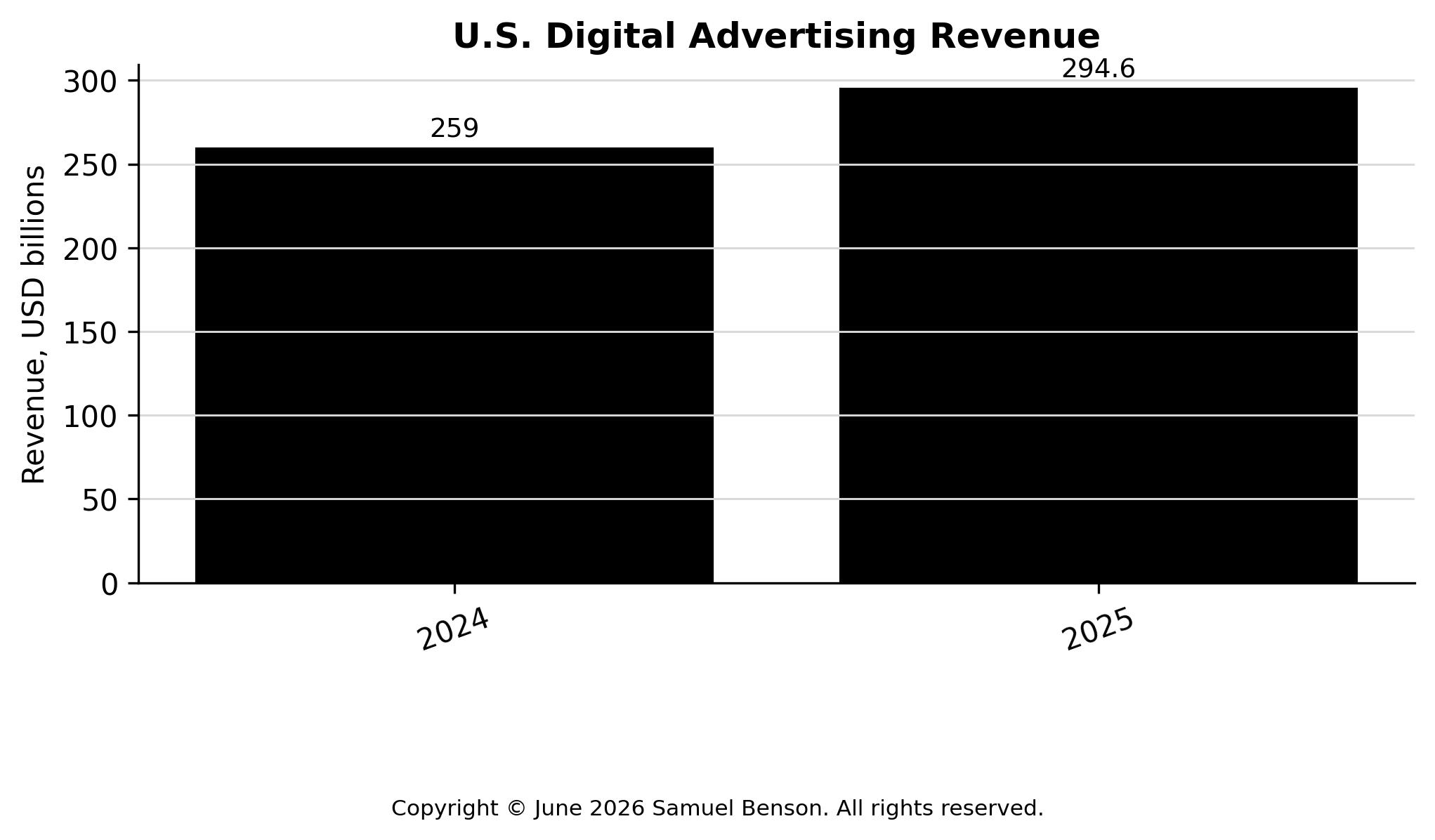
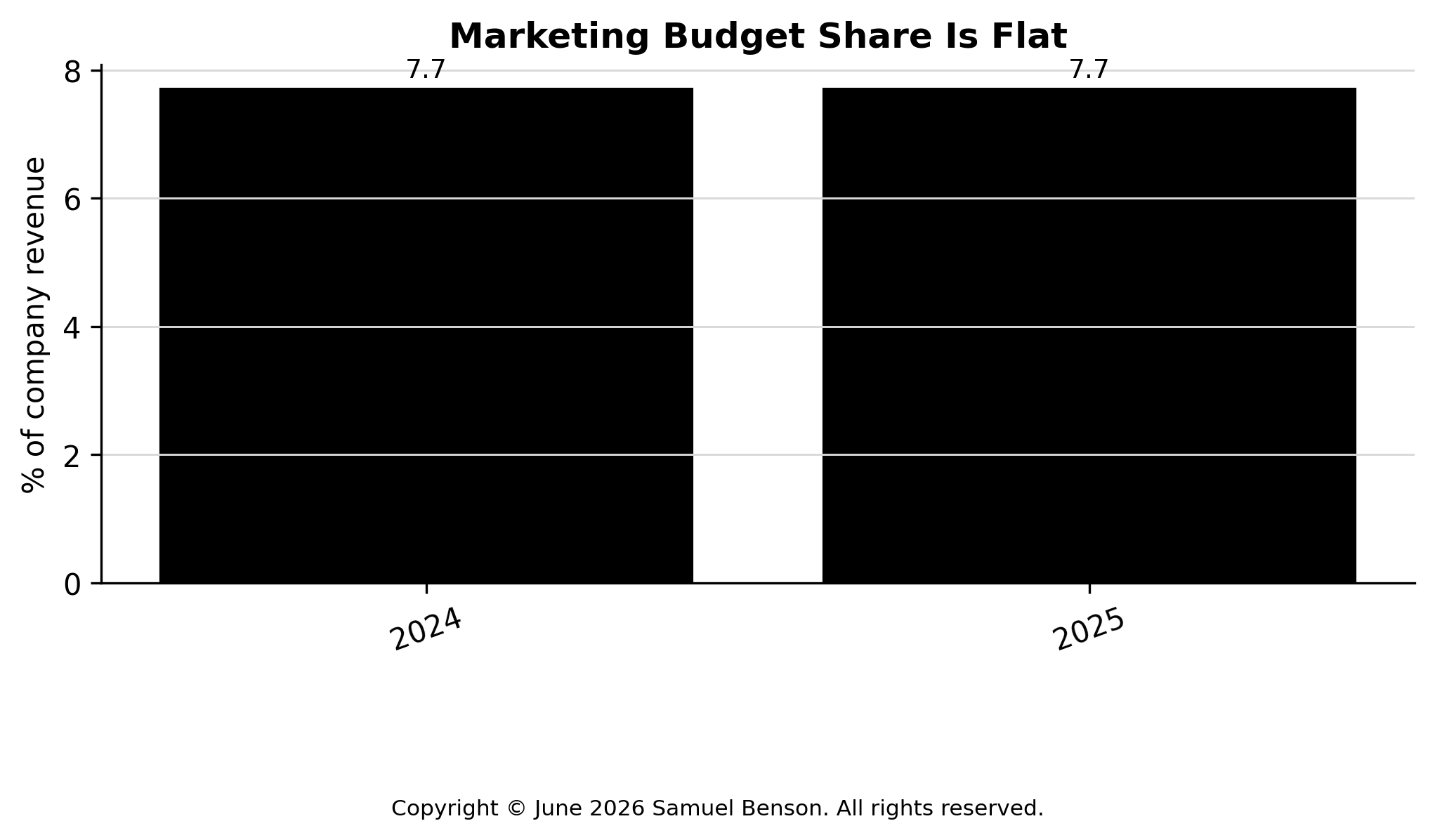
Budget pressure sharpens the issue. Gartner reported that 2025 marketing budgets remained flat at 7.7 percent of overall company revenue, while IAB/PwC reported that U.S. digital advertising revenue reached nearly $300 billion in 2025, a 13.9 percent year-over-year increase. The field is not shrinking; it is becoming more crowded, more measured, more automated, and less forgiving. More money moving through digital channels does not reduce strategic risk. It raises the cost of weak judgment.
1.2 U.S. Market Evidence
Trust sits beneath these pressures. Edelman’s 2025 Trust Barometer framed public life around grievance and institutional suspicion. Marketing cannot stand outside that mood. When people assume manipulation, disclosure matters more. When platforms reward outrage, cultural risk becomes easier to trigger. When AI fills the market with competent-looking content, proof becomes more valuable than polish.
The governing claim of this study is simple but not soft: strategic marketing is the management of demand under conditions of distrust. That does not mean timid communication. It means that creative work is tied to responsibility, claims are tested against operations, and campaign success is not declared until its effects on trust, customer experience, employee burden, and long-term meaning are understood.
The publication also rejects several flattering myths. It does not treat every new platform as a revolution. It does not reduce branding to aesthetics. It does not present AI as a cure for judgment. It does not assume that purpose language creates moral authority. It does not confuse customer data with customer understanding. These mistakes are common because they make marketing feel powerful without asking whether the organization deserves the power it is using.
The chapters that follow build an applied argument through current evidence and U.S. cases. Apple shows the discipline created by a privacy promise. Patagonia shows the difference between purpose speech and purpose structure. Starbucks shows how loyalty technology can both deepen and strain customer relationship. The New York Times shows the commercial value of repeated usefulness. Nike shows the work required to renew cultural authority. Bud Light shows the cost of entering contested meaning without enough readiness. Challenger brands show that distinctiveness can open attention, but proof has to keep it open.
The institutional problem is that marketing teams often speak about customers while reporting through internal score systems that reward volume, speed, and efficiency. That structure can teach teams to optimize what executives can see rather than what customers will remember. A serious marketing function needs the authority to slow a campaign when the proof is weak, reject a targeting tactic when permission is doubtful, and tell leadership when a brand problem is operational rather than communicative.
The attention chase survives because it is easy to report. Reach has a number. Impressions have a number. A campaign slide can make activity look like progress. Trust is harder to display. It appears in lower discount dependence, repeat purchase without begging, willingness to forgive an error, fewer angry contacts, better referral, and the quiet fact that customers come back. Strategic marketing has to defend those quieter signals because much of brand strength lives there.
Table 1. Chapter structure and applied purpose.
| Chapter | Focus | Practical use |
| 1 | Marketing after the attention chase | Frames marketing as proof rather than visibility. |
| 2 | Evidence base and concepts | Connects trust, AI, privacy, social media, and brand equity. |
| 3 | Method and U.S. case design | Explains source use, case selection, and applied diagnostics. |
| 4 | Demand and trust governance | Defines brand promise, evidence, channels, and measurement. |
| 5 | U.S. case studies | Tests the argument against practical brand cases. |
| 6 | AI, search, social, and creators | Places discovery and persuasion under trust control. |
| 7 | Brand risk and culture | Links compliance, privacy, crisis, and public accountability. |
| 8 | Applied models | Provides tools for executive and classroom use. |
| 9 | Implementation | Translates the research into operating routines. |
| 10 | Final position | States the publication’s institutional argument. |
1.3 Institutional Claim
Imitation intensifies the problem. When one brand succeeds through humor, social conviction, short video, founder storytelling, or AI-supported personalization, competitors often copy the visible form and miss the permission beneath it. The original may have earned a tone over years of customer intimacy; the imitator borrows the tone without the relationship. The market reads the move as costume.
Internal incentives deserve equal scrutiny. A campaign that lifts quarterly response can train customers to delay purchase. A lead program can satisfy a sales dashboard while filling the pipeline with weak prospects. A creator activation can look fashionable in a board presentation while feeling like paid intrusion to the audience. Strategy has to inspect what the organization rewards, because the brand eventually obeys those rewards.
Brand discipline is a form of institutional courage. It is easier to approve more content than to repair a broken service step. It is easier to buy a trend than to admit the organization lacks authority in the culture it wants to enter. It is easier to automate replies than to staff support properly. Marketing becomes valuable when it refuses the easier answer and forces the firm to face the condition that limits demand.
Brand time also differs from campaign time. Campaigns arrive in bursts; brands accumulate. Customers remember whether a promise was kept, whether the product worked, whether the company acted fairly when it had an advantage, whether a complaint received a human answer, and whether the next message respected what happened last time. Launch days matter, but ordinary days carry more evidence.
Platform systems complicate this by rewarding emotional intensity more reliably than institutional truth. Outrage, novelty, satire, and conflict move quickly. Repair, accuracy, and service quality often move slowly. The answer is not blandness. The answer is to choose intensity the brand can carry without pretending.
Popularity and authority are not the same asset. Popularity brings contact. Authority shapes how seriously people take what they find. A brand can be popular because it is amusing, cheap, controversial, convenient, or unavoidable. It becomes authoritative when customers believe it has earned a place in the decision.
A doctoral treatment of marketing has to make room for discomfort. Many brand failures begin in polite rooms where people know the promise is too broad, the evidence too thin, the timing too rushed, or the audience too poorly understood. The work keeps moving because stopping it would embarrass someone powerful. Strategic marketing needs a culture in which stopping weak work is protection, not obstruction.
Chapter 2: Evidence Base and Conceptual Foundations
2.1 Trust, Brand Equity, and Customer Experience
Strategic marketing has always been caught between commerce and meaning. The commercial side asks whether the organization can generate demand, protect margin, and convert attention into revenue. The meaning side asks whether the organization occupies a credible place in the customer’s mind and social life. Weak marketing treats these as separate assignments: one team buys media and another team guards the brand. Strong marketing understands that revenue and meaning work together. A sale made through pressure, deception, or disappointment can reduce future demand. A brand story with no path to purchase can become admiration without business value. The strategic task is to hold both realities without letting one excuse failure in the other.
Brand equity literature gives this publication a durable foundation. The most useful insight is that a brand is an asset because it reduces uncertainty. Customers use brands to make choices under imperfect information. A strong brand signals expected quality, social identity, service promise, moral stance, price logic, and future reliability. Yet the signal works only when experience keeps confirming it. Advertising may introduce a promise, but repeated customer encounters decide whether the promise becomes equity. This is why brand value can be damaged by slow service, confusing returns, poor app design, weak employee training, and careless data handling. The customer does not separate those failures from the brand. The customer experiences the organization as one system.
The evidence from current marketing practice shows a field under compression. Gartner’s 2025 CMO Spend Survey found marketing budgets flat at 7.7 percent of company revenue, which means marketing leaders have to absorb new technology costs and channel demands without assuming generous expansion. The CMO Survey has repeatedly shown the difficulty of proving marketing impact, especially when the pressure for short-term returns crowds out investment in brand memory, customer experience, and capability building. These findings matter because strategy always has a budget. When resources are tight, an organization reveals what it truly believes about marketing. It either protects the work that creates future demand or it reduces marketing to the most measurable short-term tactics.
The digital advertising market has not paused. IAB and PwC reported that U.S. digital advertising revenue reached $294.6 billion in 2025, with strong growth in social, video, commerce media, and automated buying. That scale explains why marketers are drawn to data-intensive performance systems. The temptation is clear: if behavior can be tracked, audiences can be segmented; if audiences can be segmented, offers can be tuned; if offers can be tuned, waste can be reduced. The weakness appears when measurement is mistaken for understanding. A platform can tell a company what a customer clicked. It cannot always tell whether the click increased respect, depleted patience, created regret, or made the brand feel intrusive.
Trust research cuts through this confusion. The Edelman Trust Barometer is useful because it reminds marketers that brand reception does not occur in a neutral public mood. Customers bring suspicion, economic anxiety, social conflict, and personal experience into every interaction. A brand that asks for data, loyalty, attention, or moral approval has to earn those things in a climate where institutions are often doubted. This is especially important for organizations using AI. When customers suspect that automated systems are designed mainly to reduce company costs, self-service can feel like abandonment. Forrester’s 2026 B2C predictions warned that a meaningful share of brands could erode trust through self-service AI, a warning that needs to be read as a management issue rather than a technology headline.
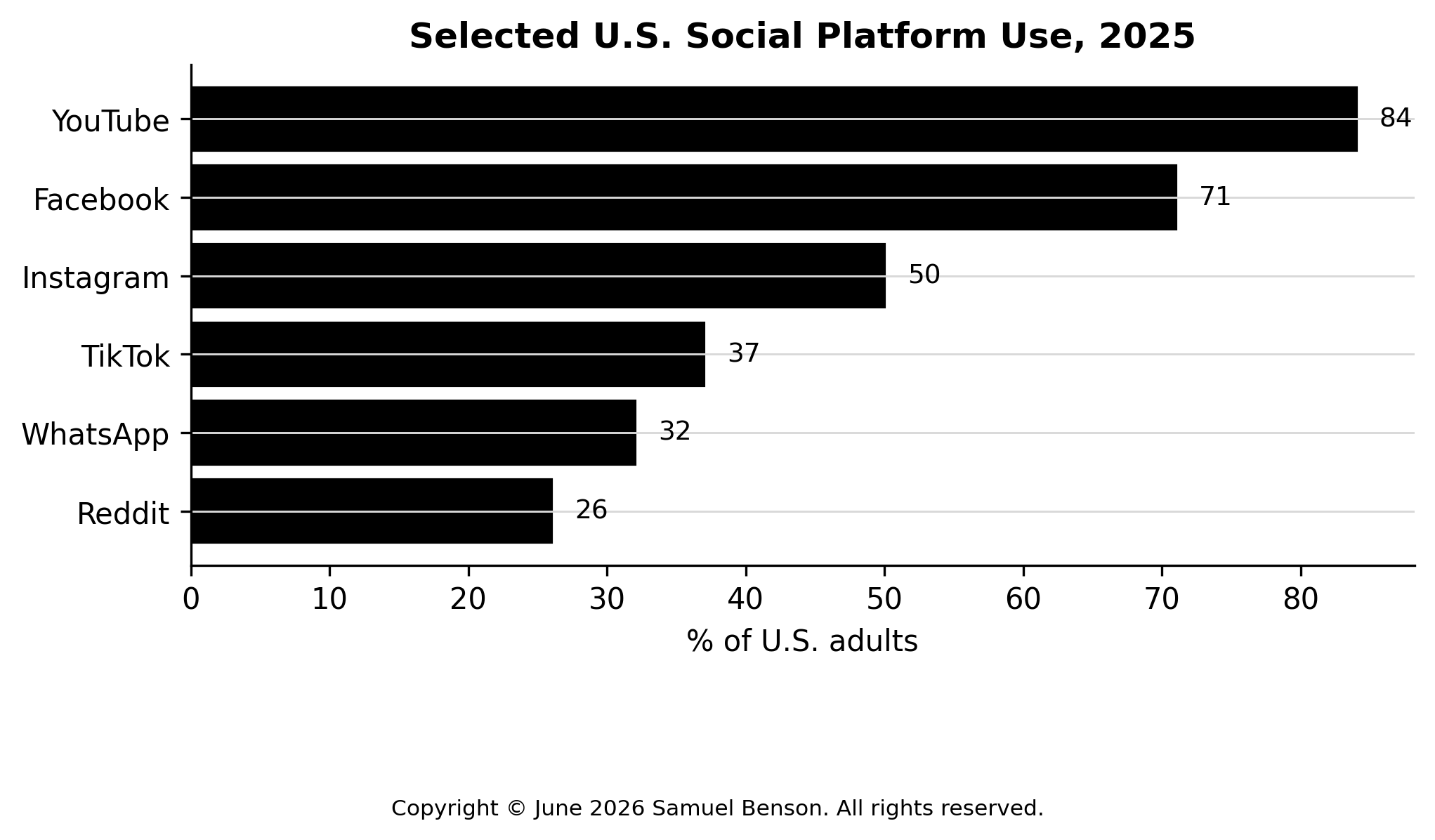
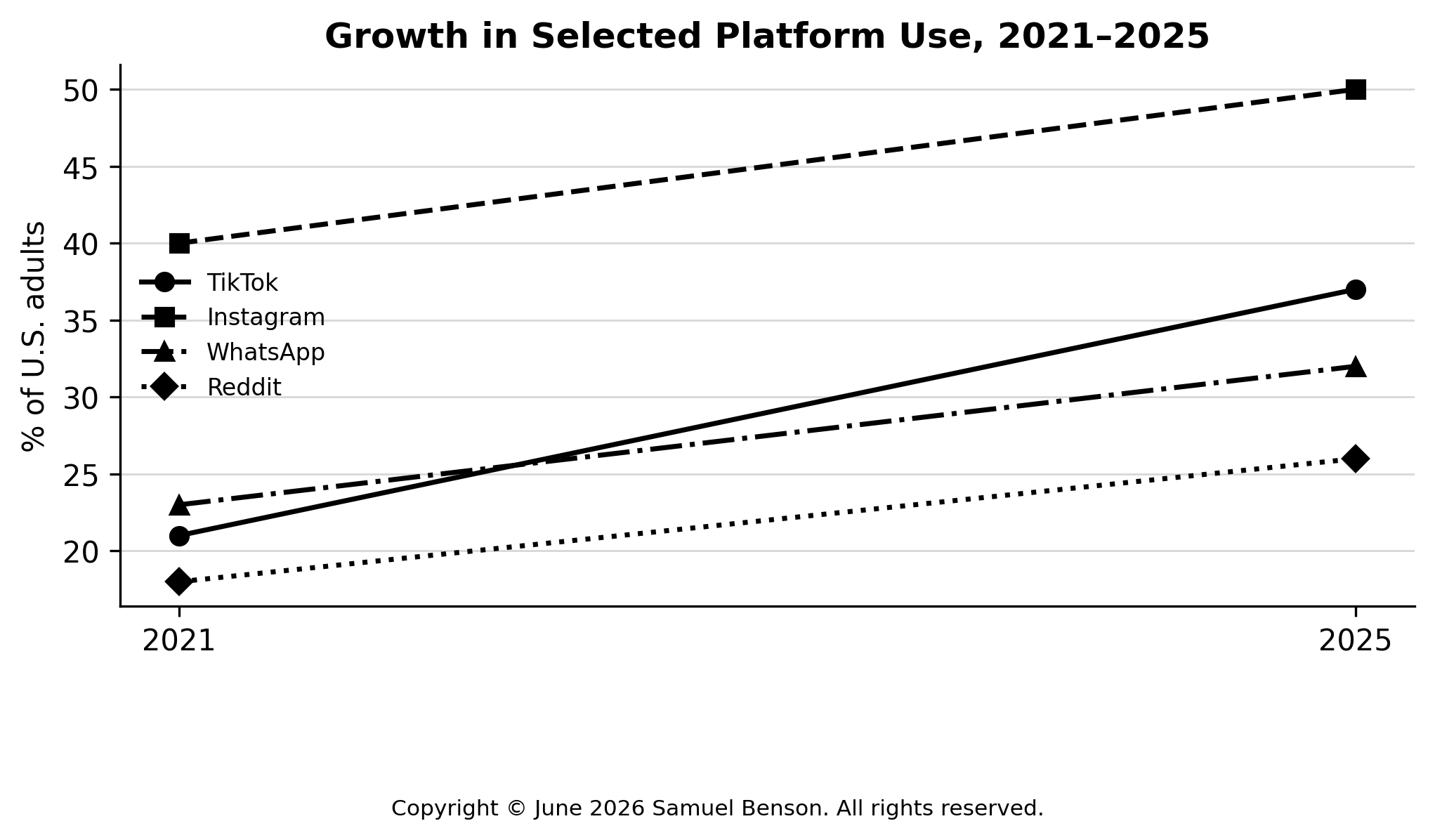
Consumer media behavior also complicates brand planning. Pew Research Center’s 2025 social-media reporting shows continued broad use of major platforms and growth in several platform communities. The practical meaning is fragmentation. There is no single American audience waiting in one media channel. YouTube may provide broad reach, Instagram may shape visual desire, TikTok may accelerate discovery, Reddit may influence evaluation, LinkedIn may support professional authority, and email may remain the quiet engine of retention. A strong brand does not chase every platform with the same message. It understands what kind of customer decision each space supports.
2.2 AI, Media Fragmentation, and Privacy
The creator economy has made this harder. Creators can give brands cultural closeness that conventional advertising often lacks. They can explain products, demonstrate use, tell stories, and build trust through repeated contact with a specific audience. Yet creator marketing carries special risk because the audience’s trust is borrowed, not owned. If disclosure is weak, the arrangement becomes deceptive. If creative control is too tight, the creator’s credibility falls. If a creator’s public conduct shifts, the brand inherits part of the damage. FTC endorsement guidance matters here because the legal issue reflects a deeper trust issue. Customers have to know when persuasion is being paid for.
AI introduces a more serious problem: the automation of persuasion. Industry commentary on agentic AI, marketing automation, and generative content points to real gains in workflow speed, personalization, and customer engagement. Those gains do not remove the need for judgment. AI lowers the cost of overproduction. It can generate plausible copy faster than an organization can verify the claim, personalize in ways that customers experience as surveillance, and produce brand language that sounds polished while knowing little about the institution behind it. Marketing leaders have to govern AI as a public-facing capability, not a private productivity shortcut.
Privacy sits at the center of that governance. Apple’s public privacy positioning offers a useful case because the company links privacy to product design and core values rather than treating it as a legal notice buried at the edge of the customer journey. That does not mean every company can copy Apple. Few have the same control over hardware, software, services, and brand power. The strategic lesson is narrower and more transferable: a privacy claim becomes credible when the company can show product choices, policies, and customer controls that match the promise. A privacy claim that is contradicted by aggressive tracking, obscure consent, or data-sharing surprises will fail.
Purpose branding also requires care. Patagonia has become an unavoidable case because its ownership transfer gave its environmental claim institutional weight. The organization did not simply run a campaign about climate concern; it changed the way ownership and profit distribution would support the mission. That decision does not make every Patagonia action immune from scrutiny. It does show that purpose is strongest when it changes legal, financial, and governance commitments. Most brands speak purpose more easily than they redesign the company around it. Customers increasingly notice the difference.
A final foundation is crisis learning. Brand crises are often discussed as communication failures. Sometimes they are. More often, communication exposes a deeper contradiction: between customer groups, between stated values and operational conduct, between speed and review, between cultural ambition and internal readiness. Bud Light’s 2023 controversy is a sharp example of how cultural signaling can become a brand crisis when audience expectation, internal decision-making, political conflict, and executive response collide. The case is not useful because it offers an easy ideological lesson. It is useful because it shows how a brand can lose control of meaning when it has not prepared for contested interpretation.
The literature on customer experience strengthens this point. Customer experience is not a mood board or a service aspiration; it is the sequence through which customers test whether a brand is worth believing. The sequence may include search, comparison, purchase, delivery, setup, use, support, renewal, cancellation, and recovery after error. Many companies measure pieces of this journey but fail to interpret the whole. A customer may rate one interaction well and still feel the brand is exhausting. A strategic marketing system reads friction patterns, not isolated satisfaction scores.
Figure 1. U.S. digital advertising revenue, 2024–2025.
Source: IAB/PwC Internet Advertising Revenue Report, Full Year 2025; IAB/PwC Full Year 2024 report. Copyright © June 2026 Samuel Benson. All rights reserved.
2.3 Purpose, Crisis, and Source Limits
Brand equity is also tied to price. A trusted brand can often hold price because customers believe the difference is real. A weak brand has to discount, shout, bundle, or chase novelty. This does not mean premium pricing is always good. It means that price is a referendum on perceived proof. When consumers stop believing that the brand offers meaningful difference, price becomes the main argument. The marketer then faces the dangerous task of buying demand with margin.
The same logic applies to loyalty. Membership does not equal loyalty. A customer may join a program for savings, convenience, or habit while feeling no attachment to the brand. A loyalty program becomes strategic when it increases mutual value: the customer receives relevant benefit and the company receives permission to serve better. It becomes extractive when the firm uses membership mainly to harvest data, complicate pricing, and push offers that train the customer to distrust regular value.
Academic work on market orientation remains relevant because it insists that firms listen to customers and competitors. Yet listening has become more difficult. The loudest customers are not always representative. The most measurable behavior is not always the deepest need. The most viral complaint may or may not indicate widespread experience. Strategic marketers have to combine listening channels: behavioral data, direct interviews, ethnographic observation, frontline insight, sales feedback, support data, and cultural reading. No single source is enough.
Regulatory evidence belongs in a marketing literature review because law often reveals where industry practice has become careless. FTC action on AI claims, reviews, endorsements, and deceptive design needs to be read as a signal about public harm. The best brands will not wait for enforcement to tell them that customers deserve truth. They will treat legal standards as the public floor and brand ethics as the operating ceiling.
Marketing theory also needs to keep the customer’s economic pressure in view. Inflation, debt, housing cost, healthcare cost, and employment uncertainty shape how people hear brand messages. A premium message may sound aspirational in one moment and insulting in another. A discount may attract customers while also teaching them to wait. A value claim therefore has to be precise. Value is not the same as cheapness. It is the customer’s judgment that the benefit, risk, effort, and price make sense.
The strongest literature for this paper is the work that refuses to separate brand meaning from organizational capability. Brand promise, market orientation, service quality, customer experience, and trust research all point toward the same conclusion: the market judges the company as a whole. A marketing department may own the campaign calendar, but it does not own all the evidence customers use. This is why strategic marketing belongs in executive governance.
Marketing research also has to become more attentive to exhaustion. Customers are exposed to prompts, offers, alerts, subscriptions, loyalty messages, creator endorsements, and automated recommendations across the day. The result is not unlimited openness to persuasion. It is fatigue. A brand that respects attention may become more distinctive precisely because it does not treat every contact point as a chance to push.
Chapter 3: Methodology and U.S. Case-Study Design
3.1 Research Design
This study uses an applied documentary and case-study method. It does not claim proprietary interviews, confidential brand data, or internal corporate files. The evidence base consists of public institutional reports, industry data, regulatory guidance, company statements, annual reporting, reputable journalism, and peer-reviewed or professional marketing analysis where available. This is appropriate for the purpose of the paper because the central concern is not to rank brands by secret performance metrics. The concern is to build a practical decision structure for marketing leaders who has to connect public claims, customer experience, and institutional conduct.
The case selection follows four criteria. Each case had to be U.S.-centered or deeply active in the U.S. market. Each had to show a distinct strategic problem rather than repeat the same lesson. Each had to involve more than advertising execution. Each had to give practical value to managers, students, and institutional leaders. Apple was selected for privacy as brand governance. Patagonia was selected for purpose backed by ownership structure. Starbucks was selected for loyalty, convenience, and experience strain at scale. The New York Times was selected for subscription brand trust and habit-building. Nike was selected for cultural authority and performance pressure. Bud Light was selected for brand meaning under political conflict. Challenger-brand practice was selected to examine category disruption and attention risk.
The method reads cases through management questions rather than campaign admiration. What promise did the brand make? What institutional evidence supported the promise? Which customer group interpreted the promise favorably or unfavorably? Which channels amplified the claim? What operational system had to carry the message after the campaign ended? What risk did the brand accept? What would a manager need to monitor before scaling a similar move? These questions keep the analysis grounded. They prevent the common habit of treating famous brands as inspirational stories detached from the conditions that made their choices possible.
The paper also develops diagnostic tools. The Brand Trust Reliability Index asks whether a brand can be believed across promise, experience, proof, privacy, response, and memory. The Marketing Evidence-to-Action model examines whether customer evidence leads to real decisions. The AI Marketing Control Loop sets conditions for safe use of AI in customer-facing marketing. The Cultural Relevance and Trust Matrix helps leaders distinguish between attention that carries authority and attention that creates fragility. These models are not presented as validated statistical instruments. They are proposed as management tools that make strategic judgment visible and open to review.
Quantification is used carefully. Marketing is full of numbers, but not every number deserves authority. A click-through rate can improve while customer respect declines. A sentiment score can rise briefly after a campaign while churn remains hidden. A loyalty membership count can grow while member profitability weakens or service expectations become harder to meet. The models in this publication therefore combine quantitative signals with qualitative review. They ask managers to place evidence beside judgment rather than allowing either to dominate the other.
3.2 Case Selection Logic
Source integrity is a central methodological concern. Industry reports often serve commercial audiences and may emphasize trends that support consulting, technology, media, or platform services. Company reports may frame performance in favorable terms. Regulatory guidance may define legal duties without resolving wider ethical questions. News coverage may highlight conflict more than routine execution. These limitations do not make the sources unusable. They require disciplined reading. A claim from a company is treated as evidence of the company’s public position, not proof that customers experience the brand as promised. A consulting forecast is treated as an indicator of strategic pressure, not as destiny.
The U.S. focus also requires attention to institutional pluralism. Branding in the United States is shaped by federal and state regulation, class and regional variation, racial and cultural history, digital platform power, polarized politics, shareholder pressure, labor markets, and high consumer expectations for convenience. A brand can be loved by one segment and distrusted by another. It can gain cultural energy on one platform and become a target on another. It can run the same campaign nationally and receive different local meanings. Strategic marketing therefore has to read the market as contested, not as a single audience waiting for persuasion.
The paper’s practical value lies in translation. A mid-sized university, hospital, nonprofit, civic institution, technology firm, retail brand, or public agency cannot simply copy Apple, Patagonia, or Starbucks. The budgets, control systems, talent pools, customer bases, and public expectations differ. What can be transferred are decision principles: make a promise that operations can carry; treat data practice as brand conduct; test cultural participation before scale; measure trust as well as reach; protect disclosure; keep human review inside AI-supported marketing; use customer complaints as intelligence; and repair the system rather than only changing the language.
The method also rejects a narrow view of creativity. Creativity is more than the production of striking campaigns. It is the ability to solve the market problem without injuring trust. Sometimes the creative act is restraint. Sometimes it is a better service script, a clearer return policy, a more honest pricing page, a better product photograph, a calmer executive response, or a loyalty offer that respects customers rather than trapping them. Strategic marketing has to make room for these quieter forms of creativity because they are often the ones that preserve brand value.
Finally, the publication is written for applied use. Each case is connected to management controls. Each model is followed by questions that can be used in review meetings. Each table is meant to help leaders identify evidence, responsibility, and risk. The goal is not to make marketing sound more academic. The goal is to make marketing harder to misuse. A discipline that can shape desire, identity, trust, and spending needs to be held to a serious institutional standard.
The case method also allows this publication to examine failure without turning failure into scandal. Marketing education often overuses heroic cases because they are easier to teach. The Apple launch, the Patagonia decision, the Nike campaign, the Starbucks loyalty machine, or the successful challenger brand can be made to look inevitable after the fact. A serious case method keeps contingency alive. It asks what could have gone wrong, what conditions were necessary, which risks were hidden, and where transfer to another organization would be irresponsible.
Table 2. U.S. case-study portfolio.
| Case | Strategic issue | Core lesson |
| Apple | Privacy as brand promise | Privacy gains force when product choices support public language. |
| Patagonia | Purpose and ownership | Purpose becomes credible when it changes firm rules. |
| Starbucks | Loyalty and experience strain | Digital relationship must not erase store meaning. |
| The New York Times | Subscription trust and habit | Repeated usefulness can turn brand trust into daily use. |
| Nike | Cultural authority and renewal | Heritage must be replenished through current product and meaning. |
| Bud Light | Contested cultural signaling | Audience mapping and response discipline are strategic controls. |
| Challenger brands | Category disruption | Distinctiveness opens attention; proof sustains demand. |
3.3 Evidence Handling
The research design also separates brand intention from brand reception. Leaders may intend to signal inclusion, sustainability, innovation, care, courage, or simplicity. The market may receive the signal differently because of history, audience identity, media framing, competitive attack, political context, or prior disappointment. Strategic marketing does not control reception, but it needs to anticipate plausible readings. A campaign review that asks only whether the internal team likes the work is not a market review.
Each case is read through three layers: the visible marketing act, the institutional support behind it, and the trust consequence. The visible act may be a campaign, product claim, loyalty system, ownership change, cultural partnership, or media strategy. The support layer asks what operations, policies, people, incentives, and data systems carry the act. The trust layer asks whether the act strengthens, weakens, or complicates the relationship with customers and the wider public.
The study also treats silence as data. If a brand says little about a material concern, that absence can shape trust. Silence around privacy, labor conditions, accessibility, product safety, or error correction may be interpreted as avoidance. At the same time, not every issue requires public speech. The strategic question is whether silence protects truth or hides weakness. Case analysis helps clarify this difference by connecting speech, action, and consequence.
The models are intentionally transparent because marketing teams already face too many black boxes. Attribution tools, platform algorithms, AI systems, and vendor dashboards can make decision-making feel technical while hiding assumptions. A useful diagnostic needs to be understandable enough for a CMO, CFO, general counsel, store leader, data scientist, and customer-service manager to debate together. If a model cannot be challenged by the people affected by it, it cannot guide major brand decisions.
The method also gives special weight to negative evidence. Customer complaints, cancellations, backlash, staff warnings, regulator action, and failed campaigns are often more instructive than polished success stories. They show where the brand promise meets reality. A research publication that only studies success would flatter marketing. This paper treats friction as evidence because the market often tells the truth through resistance.
Because the publication is applied, it also treats managers as moral actors. Marketing decisions are sometimes presented as neutral optimization choices, but they can affect privacy, self-image, household spending, public debate, and institutional trust. The case method keeps those effects visible. It asks what kind of market behavior the organization is encouraging and whether that behavior is defensible if described plainly.
Chapter 4: Strategic Marketing as Governance of Demand and Trust
4.1 Demand Governance
Strategic marketing becomes serious when it accepts that demand is not simply found in the market. Demand is formed through need, memory, social meaning, price, habit, availability, trust, and timing. A customer may want a product before seeing a campaign because the problem is urgent. Another may buy after years of exposure because the brand has become familiar. Another may refuse the brand after a public controversy, even if the product remains useful. The work of marketing is to manage these conditions with discipline. The work of branding is to make the organization recognizable and believable across time.
This is why the marketing function needs to be seen as a governance function. It governs the promise the organization makes to the market. It governs the evidence used to support that promise. It governs the boundaries of persuasion. It governs data use, channel conduct, sponsorship, cultural participation, customer feedback, and public response. In weak organizations, marketing is brought in near the end to make the work attractive. In stronger organizations, marketing is involved early enough to ask whether the proposed product, service, or policy can survive customer scrutiny. That timing matters. A promise made after the fact often becomes cosmetic. A promise built into the product and service system becomes strategic.
Demand governance begins with the promise. A brand promise needs to be short enough to remember and concrete enough to test. “We are customer-centered” means little until it is tied to wait time, refund behavior, product reliability, complaint handling, accessibility, and staff training. “We care about privacy” means little until it is tied to data minimization, permission, security, and meaningful customer control. “We support communities” means little until communities can see resources, participation, listening, and accountability. The test of a promise is not whether it sounds attractive. The test is whether the organization knows what would count as violating it.
The next element is audience discipline. Many brands talk about the audience as though it were a demographic cluster. Serious audience work is more complex. Customers have jobs to be done, fears, routines, identity concerns, social pressures, budget limits, and trust thresholds. A parent buying healthcare services is more than a consumer. A small-business owner choosing software is more than a lead. A student comparing universities is more than a prospect. Marketing fails when it strips people down to conversion targets and then acts surprised when they resist being treated that way.
Channel discipline follows. Every channel has a moral and practical character. Search captures intent. Social platforms shape visibility and social proof. Creator channels borrow personal trust. Retail media influences purchase close to the shelf. Email sustains relationship when used with restraint. Events create embodied memory. AI answer tools may soon shape what customers believe is true before they ever reach a company website. A marketing strategy that pushes the same content into every channel is not integrated. It is careless. Integration means that the organization understands what decision each channel supports and what risk it carries.
Measurement needs similar discipline. Marketing teams often inherit dashboards that reward activity because activity is easy to count. Impressions, views, clicks, leads, opens, and engagement can help diagnose performance, but they do not prove brand strength. A serious measurement system needs to include memory, trust, conversion quality, retention, complaint patterns, referral, share of search, customer lifetime value, and experience data. It also needs to include negative signals: unsubscribe, review decline, support burden, return rates, misleading attribution, audience fatigue, and staff reports that the campaign has increased operational strain.
A brand trust review needs to be part of executive governance. The review asks whether the brand promise remains accurate, whether customers experience it consistently, whether recent campaigns created unrealistic expectation, whether data practice matches public language, whether creator and affiliate relationships are properly disclosed, whether AI-generated content has human review, and whether complaints are being read as early warning. These questions are not bureaucratic. They are the difference between reputation as memory and reputation as fantasy.
4.2 Brand Promise and Internal Alignment
Brand strength also depends on internal alignment. Employees are often the first people asked to deliver a promise and the last people consulted before it is made. This is a costly error. A bank cannot advertise care while understaffing branches and call centers. A hospital cannot brand compassion while burning out nurses. A university cannot promise student success while advising systems are overwhelmed. A retailer cannot advertise hospitality while store teams are measured only by speed. The employee experience does not sit outside branding. It is one of the routes through which the brand becomes real.
The relationship between marketing and operations is therefore central. Operations often see marketing as overpromising. Marketing often sees operations as slow and unimaginative. Both criticisms may contain truth. Strategic leadership has to force the conversation into evidence. Which promises are customers responding to? Which promises are staff struggling to carry? Where are complaints concentrated? Which operational fixes would improve conversion more than another campaign? Which campaigns are creating demand the system cannot fulfill? A brand grows stronger when those questions are asked before the market punishes the gap.
The Brand Trust Reliability Index proposed in this publication turns that judgment into a disciplined audit. Its scored form is: BTRI = [(PC + EC + ES + PF + RI + MD) / 6] – CP. PC is promise clarity, EC is experience consistency, ES is evidence strength, PF is privacy fairness, RI is response integrity, MD is memory durability, and CP is contradiction pressure. Each positive component is scored from 0 to 5; contradiction pressure is scored from 0 to 5 and subtracted after the average is calculated. The index is not a universal law of brand trust. It is a management instrument that prevents a team from hiding a serious weakness behind strong campaign performance.
Strategic marketing also carries a social duty. Persuasion is not neutral. It shapes desire, norms, fear, aspiration, and public attention. A company that markets financial products, health services, education, food, technology, or political information can affect life chances and public trust. Even consumer brands outside high-stakes sectors participate in cultural meaning. This does not mean marketing becomes timid. It means marketing leaders need to understand the power they exercise. The most dangerous marketer is not the creative person. It is the marketer who believes creativity has no duty to truth.
The practical conclusion is demanding but simple. Marketing leaders need to stop asking only, “Will this work?” They ask, “What kind of demand will this create, what proof will be required, who will carry the promise, what trust could be lost, and what will we do if the public reads this differently from our intention?” Those questions do not weaken creativity. They protect it from becoming noise, manipulation, or institutional self-harm.
Demand governance also requires saying no. Many marketing problems begin when a brand says yes to every audience, every trend, every platform, every seasonal opportunity, and every internal request. The result is a brand with no center. Customers receive fragments rather than a coherent promise. Staff become busy maintaining activity rather than making strategic choices. Saying no is not a lack of ambition. It is the act that protects meaning from dilution.
The CMO’s role is changing because this governance work crosses departmental lines. A modern CMO has to understand media economics, analytics, AI, privacy, customer service, product truth, cultural risk, pricing signals, and organizational politics. The role cannot be reduced to creative taste. Creative taste remains important, but it has to sit beside evidence discipline and institutional influence. A CMO who cannot move operations will struggle to protect the brand promise. A CMO who cannot respect creativity will reduce the brand to process.
Table 3. Strategic brand assets and management questions.
| Asset | Management question | Evidence to request |
| Promise | What exactly are we asking customers to believe? | Public claims, product proof, service standards. |
| Memory | What does the market already associate with us? | Brand tracking, search behavior, repeat use, customer language. |
| Trust | Where could our conduct contradict our words? | Complaints, privacy review, crisis history, service failures. |
| Attention | Which attention helps demand rather than noise? | Channel role, audience fit, conversion quality. |
| Experience | Can the organization deliver the promise repeatedly? | Journey data, frontline evidence, quality measures. |
| Permission | What data and attention have customers truly granted? | Consent flow, preference controls, unsubscribe data. |
Figure 2. Selected U.S. social platform use in 2025.
Source: Pew Research Center, Americans’ Social Media Use 2025. Copyright © June 2026 Samuel Benson. All rights reserved.
4.3 Brand Trust Reliability Index
Finance has to be part of this conversation. Marketing teams often complain that finance does not understand brand value. Finance teams often complain that marketing cannot explain returns. Both sides have to improve. Marketing needs to show how trust affects retention, price, referral, and acquisition cost. Finance needs to recognize that some returns arrive through reduced future waste rather than immediate sales. A brand budget needs to be evaluated with both near-term and future-demand logic.
The product team is equally central. Product weakness cannot be solved with brand language for long. Marketing can position, educate, and dramatize value, but it cannot make a weak product excellent by describing it with confidence. Strong marketing sometimes begins by telling the organization that the product is not ready for the promise leadership wants to make. That conversation may be uncomfortable, but it protects money and reputation.
Customer service is the forgotten brand channel. A support agent who solves a problem fairly can preserve more trust than a campaign creates. A confusing chatbot can damage more trust than a campaign can repair. Support transcripts often contain the truth about brand gaps because customers speak there when the promise has failed. Marketing leaders reads those transcripts. They are not operational clutter. They are brand evidence.
Brand governance also needs to include the board in larger organizations. Boards often review financial risk, legal risk, and reputation after public trouble. They ask earlier whether the organization’s major claims are supported by evidence, whether AI use creates customer-facing risk, whether privacy practice matches values, and whether executive incentives encourage trust or only short-term growth. Brand stewardship is too important to be left only to campaign teams.
Brand governance is especially important for institutions that do not think of themselves as brands. Hospitals, universities, research centers, museums, libraries, public agencies, and nonprofits all depend on trust and public meaning. They may dislike the language of branding because it sounds commercial. Yet they still make promises, seek attention, recruit people, request funds, and ask communities to believe them. For such institutions, brand discipline protects mission from careless communication.
Governance also protects creativity from internal chaos. Creative teams do better work when they understand the promise, audience, proof, limits, and decision rights. Vague freedom often produces generic output because the team has no meaningful constraint. Clear strategy gives creative people something to push against. The best work usually comes from a tension between freedom and truth.
In practical governance, the strongest question may be the simplest: what would make this promise untrue? A company that cannot answer does not understand its own claim. Once leaders know what would violate the promise, they can design controls. They can train staff, review campaigns, monitor complaints, and stop overreach. A promise without a violation test is too soft to govern.
There is also a governance role for research. Research cannot be reduced to validating a preferred idea. It needs to be allowed to disappoint the brief. Customer interviews, concept tests, usability studies, and market analysis have value when leaders are willing to change direction. Research used only to decorate a decision already made is not research. It is internal theatre.
Chapter 5: U.S. Case Studies in Brand Promise and Institutional Proof
5.1 Apple, Patagonia, and Starbucks
Apple offers one of the clearest examples of privacy as brand position. The company’s public privacy language frames privacy as a core value and a human right. That phrasing is powerful because it elevates a technical issue into a moral and customer-experience claim. Yet the claim has force only because Apple can connect it to product choices, operating-system permissions, app tracking controls, security features, public policy statements, and a business model that differs from firms built primarily around advertising. Apple’s lesson is not that every brand becomes a privacy brand. The lesson is that a brand promise becomes stronger when it is supported by design, incentives, and repeated customer signals.
The risk in the Apple case is overextension. Once a company claims privacy as a core value, every data decision is read through that promise. Any exception, vulnerability, confusing setting, or partner practice can become a brand issue. This is not a weakness of the strategy. It is the price of credibility. A high-trust promise creates a higher standard. Marketing leaders need to understand that strong positioning narrows future freedom. A brand that claims care has to act with care. A brand that claims privacy has to accept the cost of restraint. A brand that claims simplicity has to fight internal complexity even when complexity is profitable.
Patagonia gives a different lesson: purpose becomes credible when governance changes. The company’s 2022 ownership transfer placed voting stock in the Patagonia Purpose Trust and nonvoting stock in the Holdfast Collective, with the public claim that profits not reinvested in the business would support environmental work. This moved the brand from ordinary purpose communication into institutional proof. Many brands speak about values during campaign cycles. Patagonia tied its claim to ownership and profit distribution. That does not eliminate debate about supply chains, pricing, accessibility, or the limits of consumption. It does show that purpose gains authority when the organization gives up something meaningful.
The Patagonia case matters because purpose marketing has been weakened by overuse. Consumers have seen too many campaigns where moral language rises faster than evidence. A brand may celebrate sustainability while pushing volume growth. It may support equality in advertising while tolerating inequity in leadership. It may speak of community while closing stores without local dialogue. Patagonia’s strength is not that it avoids all contradiction. No operating company does. Its strength is that the main claim is supported by a structural decision that customers and critics can inspect. Purpose becomes less fragile when it is spoken with restraint and built into the firm’s rules.
Starbucks shows the power and strain of relationship marketing at scale. Starbucks Rewards has tens of millions of active U.S. members, and the company has continued to refine the program as part of the customer relationship. The brand has long combined habit, convenience, personalization, store experience, and a sense of small personal ritual. The loyalty system is strategically valuable because it links data, payment, frequency, offers, and customer memory. It makes Starbucks less dependent on occasional advertising and more dependent on repeated use.
Yet loyalty at this scale carries a warning. A loyalty program can become a substitute for hospitality if the organization is not careful. Customers may enjoy rewards while also noticing long lines, mobile-order congestion, price increases, inconsistent store mood, or employee stress. The brand promise of a comfortable “third place” can weaken when the operational system feels like a pickup machine. Starbucks is useful precisely because it shows that loyalty technology cannot rescue experience indefinitely. If the app becomes the brand, the store loses some of its meaning. If the store becomes too strained, the app becomes a reminder of that strain.
The New York Times offers a case in subscription brand building. Its paid digital strategy depends on more than news. Bundles that include news, cooking, games, Wirecutter, audio, and sports create multiple reasons for repeated use. The brand’s economic logic is tied to habit and trust: customers return because the company offers a mix of authority, usefulness, routine, and identity. This is a different brand model from one built mainly on campaign bursts. It is a memory model. The product has to earn attention every day.
The risk for the Times is that brand trust is politically and culturally contested. News brands live under constant scrutiny from readers, critics, political actors, journalists, and subscribers. A bundling strategy can increase engagement while raising questions about whether the news brand becomes one part of a broader lifestyle subscription. That may be commercially sound, but it requires editorial clarity. The lesson for marketers is that diversification can strengthen revenue while complicating the meaning of the brand. A brand can become more useful and harder to define at the same time.
Figure 3. Growth in selected platform use, 2021–2025.
Source: Pew Research Center, Americans’ Social Media Use 2025. Copyright © June 2026 Samuel Benson. All rights reserved.
5.2 The New York Times, Nike, Bud Light, and Challenger Brands
Nike illustrates cultural authority under performance pressure. The company has often built brand power through athletic aspiration, athlete partnerships, design, and cultural fluency. Its strongest work has made customers feel that sport is a language of discipline, identity, and possibility. Yet cultural authority is difficult to maintain when the market shifts, competitors rise, wholesale and direct channels rebalance, product cycles slow, or consumers sense that storytelling is outrunning innovation. Nike shows why brand heritage cannot become a shield against execution risk. The market respects history, but it buys current relevance.
The Nike case is valuable because it undermines a lazy view of brand equity. A famous brand is not permanently safe. It can lose heat if product energy cools, if cultural signals feel recycled, or if distribution changes weaken discovery. Marketing leaders treats heritage as stored trust, not guaranteed trust. Stored trust can be spent. It can also be replenished through product excellence, credible athletes, retail experience, and customer communities. The brand that forgets to replenish begins to live off memory until the memory no longer sells.
Bud Light provides a crisis case in brand meaning. The 2023 controversy surrounding a social-media partnership became a national symbol far beyond the scale of the original promotion. The case is not useful as a simple instruction to avoid culture. Brands cannot avoid culture because audiences bring culture into their interpretations. The useful lesson is that cultural participation requires audience mapping, internal readiness, scenario review, executive discipline, and clear values. When controversy starts, evasive or inconsistent response can alienate several groups at once. A brand can appear cowardly to one audience and contemptuous to another.
The case also shows how a brand’s historical meaning can constrain future moves. Bud Light’s long-standing mass-market identity, humor, and broad social positioning created expectations among core customers. A sudden signal outside that expectation can be read as confusion, betrayal, or opportunism by some groups, while supporters of inclusion may see retreat as abandonment. Strategic marketing does not guarantee agreement, but it needs to reduce surprise inside the organization. Leaders need to know which audiences may object, which principles will guide response, and what the company is willing to defend before the public test arrives.
Challenger brands such as Liquid Death show how category convention can be attacked through tone, packaging, and cultural misfit. A canned water brand using the language of heavy metal, humor, and anti-plastic rebellion demonstrates that brand strategy can create interest in a category people assumed was dull. The deeper lesson is that distinctiveness still matters. Markets crowded with polished sameness create openings for brands that feel alive. Yet distinctiveness is not enough. The brand has to still deliver distribution, repeat purchase, price justification, and a credible reason to remain more than a joke. A challenger brand wins attention by breaking rules; it keeps value by proving that the rule-breaking serves a customer habit.
Across these cases, one conclusion holds. The strongest brands do not simply communicate differently. They organize themselves differently. Apple ties privacy to product control. Patagonia ties purpose to ownership. Starbucks ties loyalty to frequency and store behavior. The Times ties brand value to daily use and subscription depth. Nike ties meaning to sport, design, and cultural authority. Bud Light shows what happens when meaning becomes contested without enough response discipline. Challenger brands show the power and danger of distinctiveness. A strategic marketer needs to study the operating conditions, not the surface campaign.
Apple’s case also shows the advantage of consistency over time. A privacy position becomes stronger through repetition when repetition is backed by product behavior. Many brands abandon positions quickly when a new trend appears. Apple’s public language has been steady enough that customers and regulators know what standard the company has chosen for itself. Strategic marketers need to notice the value of staying with a hard promise long enough for the market to remember it.
Patagonia also teaches that brand purpose can limit customer base and still increase authority. A company that commits to environmental action may repel some consumers, attract others, and deepen loyalty among those who see the commitment as credible. Strategic branding does not require universal affection. It requires clarity about whose trust matters most and what the company is willing to risk to earn it. A brand that tries to be loved by everyone often becomes too vague to matter.
Starbucks reveals the tension between personalization and place. Its app can remember behavior, speed transactions, and support loyalty benefits. The store, however, remains a social and sensory environment. If digital convenience overwhelms the store’s human rhythm, the brand risks weakening one of its oldest sources of meaning. This is a lesson for all brands digitizing customer relationships: convenience cannot quietly erase the very experience customers valued.
5.3 Cross-Case Lessons
The New York Times case also demonstrates that trusted brands can extend when the extension respects the central relationship. Games, cooking, audio, product reviews, and sports can sit beside news because they increase daily habit and practical usefulness. The danger would be extension without editorial clarity. A brand extension makes the customer relationship richer, not blur the reason the brand was trusted in the beginning.
Nike’s difficulty is partly the burden of iconic status. A smaller brand can surprise because the market has fewer expectations. A famous brand has to renew itself while carrying decades of meaning. Every new campaign is judged against memory. Every product line is judged against the brand’s best work. This is why large brands need disciplined creative renewal, not nostalgia. The past can inspire, but it cannot do the current work.
Bud Light’s crisis also shows that mass brands face a special problem. They rely on broad acceptability, but the public sphere increasingly rewards sharper identity signals. A mass brand that enters a contested issue has to decide whether it is becoming more clearly defined or simply more exposed. Avoiding all meaning may make the brand empty. Entering meaning without conviction may make it vulnerable. The middle ground requires careful audience knowledge and executive steadiness.
Challenger brands need to be studied with equal skepticism. Their energy can make incumbents look slow, but their early attention may depend on novelty. Once novelty fades, the brand has to prove repeat value. The best challengers build supply, distribution, product quality, and community while the public is still laughing at the joke or admiring the difference. The weak ones confuse being noticed with being chosen.
Across the cases, the strongest strategic lesson is that brand authority is earned by cost. Apple bears the cost of privacy positioning. Patagonia bears the cost of purpose structure. Starbucks bears the cost of maintaining physical experience while scaling digital habit. The Times bears the cost of editorial trust. Nike bears the cost of constant renewal. Bud Light shows the cost of inadequate readiness. Marketing leaders asks what cost their brand is willing to bear. A promise with no cost is often just a phrase.
The cases also show that American brands now operate under audience surveillance. Customers, employees, journalists, creators, activists, investors, regulators, and competitors can all test claims publicly. This does not mean brands becomes defensive. It means the evidence file has to be ready. The public will ask whether the company can prove what it says. Strategic marketing prepares the proof before the question arrives.
These cases also warn against moral laziness. It is easy to praise Patagonia because its purpose seems admirable, or criticize Bud Light because the crisis was visible, or admire Apple because privacy is appealing. Strategic analysis needs to be colder and fairer. It asks how each brand tied claims to operating choices, how each prepared for risk, and what each case can teach without becoming a slogan. Admiration is not analysis.
The cases show that brands carry social memory. Apple inherits memories of design excellence and control. Patagonia inherits memories of environmental activism. Starbucks inherits memories of place and daily ritual. Nike inherits memories of sport and aspiration. Bud Light inherits memories of mass-market ease and humor. A new act is judged against that memory. Marketing leaders who ignore accumulated meaning are surprised by reactions that were predictable.
The cases also show that brand meaning is not always chosen by the brand. Customers complete the meaning through use, memory, and social conversation. Apple may intend privacy leadership, Patagonia may intend environmental commitment, Starbucks may intend daily ritual, and Nike may intend athletic possibility. Each meaning is still filtered through customer experience. The strategic marketer participates in meaning; the market finishes it.
Chapter 6: AI, Search, Social, Creators, and the New Visibility Problem
6.1 AI-Mediated Discovery
The visibility problem has changed. For years, marketers built around search rankings, paid social, email lists, retail placement, media buying, public relations, and influencer relationships. Those tools remain important, but AI-mediated discovery is altering the path by which customers encounter brands. A customer may ask an AI assistant for product recommendations, compare services through summarized reviews, receive synthesized advice drawn from multiple sources, or rely on a platform’s automated shopping support before visiting a brand’s own site. This does not end marketing. It changes where proof has to live.
Traditional search rewarded indexable content, authority signals, links, technical site health, and relevance to a query. AI answer systems reward some of the same things but may compress them into a response where the customer sees fewer sources and makes a judgment earlier. This means brands have to become easier to verify. Claims need to be consistent across owned sites, retail pages, help centers, reviews, expert coverage, knowledge bases, and trusted third-party references. A brand cannot depend on a beautiful website if the wider evidence field contradicts it. The marketing question shifts from “Can we be found?” to “Can we be trusted when we are summarized?”
This is a serious threat to content volume strategies. Many organizations have treated content as a production race. They publish articles, posts, guides, product pages, campaign pages, and keyword material with little editorial control. AI systems may expose the weakness of that approach because low-quality content can be ignored, flattened, or used in ways the brand does not control. The stronger response is not more content. It is better evidence: clear product information, transparent pricing, credible expertise, strong reviews, useful comparison material, accurate metadata, and customer-support content that answers real questions without promotional fog.
Social media remains central but more fragmented. Pew’s 2025 research confirms that U.S. adults still use major platforms at high levels while several platforms continue to grow among specific audiences. Marketers need to resist the urge to draw one simple lesson. YouTube, Instagram, TikTok, Facebook, Reddit, LinkedIn, Pinterest, and emerging platforms do different work. Some build awareness; some shape identity; some support search; some carry peer validation; some sustain professional authority; some influence purchase through creators. A brand that treats them as interchangeable pipes will waste money and weaken tone.
Creators add another layer. The creator is not simply a media slot. The creator is a relationship with an audience. That relationship may include trust, entertainment, skill, identity, taste, and community memory. When a brand enters it, the brand is borrowing social permission. The best creator work respects that permission. It gives the creator enough freedom to speak naturally, discloses the relationship clearly, and chooses partners whose audience has a real reason to care. Bad creator work turns people into ad surfaces and then wonders why engagement feels hollow.
The FTC’s endorsement guidance needs to be read beyond compliance. Disclosure is a trust practice. If the relationship is paid, materially supported, or otherwise connected to the brand, audiences deserve to know. Ambiguous tags, hidden disclosures, or artificial reviews may produce short-term gains, but they damage the public conditions that make creator marketing valuable. A market where people do not know what is paid becomes a market where all praise becomes suspect. The profession needs to defend disclosure because it protects the channel from decay.
Retail media has grown because it sits close to purchase. It offers targeting, measurement, and access to shopper behavior at a point where intent is high. For brands, this can be powerful. It can also narrow strategic thinking. If marketing spends too much energy at the conversion edge, the brand may underinvest in memory, meaning, and preference before the customer enters the store or retail platform. Retail media needs to be part of the channel portfolio, not the whole theory of demand. Customers often decide which brands are worthy before the sponsored product appears.
Figure 4. Marketing budget share as a percentage of company revenue.
Source: Gartner 2025 CMO Spend Survey. Copyright © June 2026 Samuel Benson. All rights reserved.
6.2 Social, Creators, and Retail Media
AI in marketing operations demands internal controls. Generative tools can produce copy, imagery, briefs, segmentation ideas, customer-service scripts, product descriptions, and creative variations. Agentic systems may help plan, test, and buy media. The advantage is speed. The risk is unsupervised scale. A wrong claim can travel quickly. A biased segment can distort targeting. A synthetic image can misrepresent the product. A chatbot can make commitments that the company cannot honor. A personalization engine can cross the line from helpful to invasive. Marketing leaders have to therefore create approval rules before AI becomes routine.
An AI Marketing Control Loop needs to include data source review, customer permission, purpose definition, model or tool assessment, human approval, legal and brand review for high-risk claims, live monitoring, customer feedback, and shutdown conditions. This may sound strict, but the alternative is worse. Once a public-facing AI system makes thousands of customer interactions, the brand inherits those interactions as conduct. A company cannot claim that the tool was separate from the brand. Customers experience the tool as the company.
The control loop needs to be risk-based. Low-risk internal brainstorming may need light review. Customer-facing claims about health, finance, employment, education, safety, or regulated products require stronger controls. Personalized offers based on sensitive inference require privacy review. AI-generated influencer avatars require disclosure and brand-safety review. Chatbots connected to service, refunds, or product recommendations require escalation paths to humans. The marketing function needs to work with legal, data science, product, and customer service rather than trying to govern these systems alone.
Email and owned channels deserve renewed respect in this environment. They may appear less glamorous than AI answer systems or social campaigns, but they give brands a direct relationship that is not entirely controlled by platforms. Yet direct access can be abused. Too many emails, irrelevant offers, confusing unsubscribe flows, or manipulative urgency teach customers to ignore or distrust the brand. Owned channels need to be treated as customer permission, not company property. A customer who shares an email address has not agreed to be exhausted.
The most mature marketing organizations will build a channel portfolio based on decision roles. Search captures expressed need. AI answer visibility supports early trust. Social content shapes culture and memory. Creator work borrows audience belief. Retail media closes demand near purchase. Email and loyalty maintain relationship. Events and stores create embodied experience. Public relations and earned media provide third-party validation. Community gives feedback and belonging. The discipline is knowing which role matters for which audience and which risk accompanies each channel.
A final warning is necessary. The future of marketing will be full of tools promising more automation, more personalization, and more measurement. Some will be useful. Some will be expensive distractions. The strategic marketer asks a harder question before adopting any tool: does this strengthen customer trust, improve proof, reduce friction, increase learning, or protect the brand promise? If the answer is unclear, the tool may be adding motion without value.
AI answer visibility will also change how brands think about authority. In classic search, a brand could compete for a query and still bring the customer into its own environment. In AI-mediated discovery, a recommendation may be made before the customer sees brand-owned material. This raises the value of third-party credibility. Reviews, expert analysis, accurate product data, community discussions, and consistent public information become part of the brand’s discoverability. The brand is no longer only what it says about itself. It is what trusted systems can verify from the wider record.
This makes marketers less tolerant of vague claims. Phrases such as “best,” “trusted,” “responsible,” “premium,” and “customer-first” are weak unless supported by evidence. AI summaries may flatten them, and customers may ignore them. Specific proof travels better: service times, ingredients, warranty terms, independent rankings, transparent fees, product compatibility, environmental data, security practices, and clearly stated limitations. Precision is becoming a marketing advantage.
Table 4. Channel portfolio decision rules.
| Channel | Best role | Primary risk |
| Search | Capture expressed need. | Weak evidence and outdated content. |
| Social | Shape memory and cultural contact. | Fatigue, backlash, shallow metrics. |
| Creators | Borrow audience trust. | Weak disclosure or partner mismatch. |
| Retail media | Influence close to purchase. | Overdependence on conversion edge. |
| Email and loyalty | Sustain relationship. | Permission abuse and discount training. |
| Events | Create embodied memory. | High cost without follow-up discipline. |
| AI answer visibility | Support early evaluation. | Inconsistent public evidence. |
Figure 5. Global trust in major institutions, 2025.
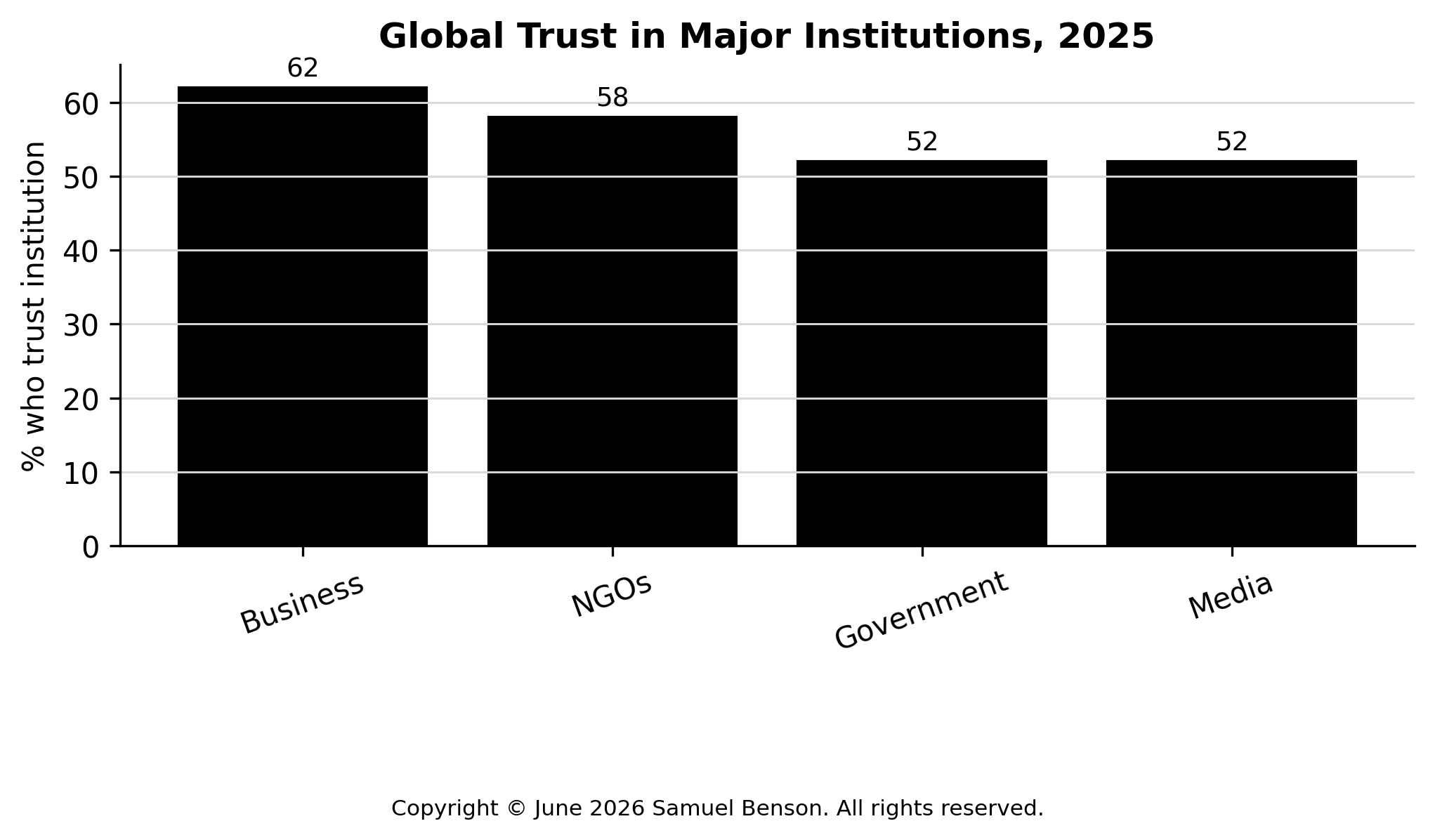
Source: Edelman Trust Barometer, 2025 global report. Copyright © June 2026 Samuel Benson. All rights reserved.
6.3 Channel Discipline
Social fragmentation also changes creative planning. One national campaign may need several expressions, but those expressions has to still come from the same brand center. Adapting to platform culture is not the same as letting each platform rewrite the brand. A TikTok tone, LinkedIn argument, YouTube demonstration, Reddit answer, and email offer can differ without contradicting one another. The discipline is voice continuity under channel variation.
The creator economy also requires better evaluation. Brands often select creators by follower count, engagement rate, or surface fit. Those metrics are incomplete. A creator may have a smaller audience with deep trust. Another may have large reach but shallow influence. A creator may be entertaining but unsafe for a regulated claim. A creator may be culturally close to the audience but poorly aligned with the product. Selection needs to include audience quality, disclosure history, comment sentiment, content durability, values fit, and the creator’s ability to explain the product honestly.
AI-generated creative raises another issue: sameness. When many brands use similar tools trained on similar patterns, outputs can converge. The words become smooth. The images become attractive but familiar. The campaign becomes competent and forgettable. Human taste becomes more valuable, not less, because human taste can reject the average. The marketer’s job is not to accept whatever the tool produces. It is to know when the tool has produced something lifeless.
Marketers also need to plan for customer fatigue. Every new channel arrives with the promise of engagement. Soon it becomes crowded. Customers learn to filter, skip, block, mute, unsubscribe, and distrust. The answer is not to become more intrusive. The answer is to become more useful, more restrained, and more worth receiving. Permission is renewed through value. It is lost through repetition without care.
The new visibility problem also changes public relations. Earned media, expert commentary, product reviews, podcasts, newsletters, and community discussions can become source material for customer judgment and AI summaries. Public relations can no longer be treated as separate from discoverability. It helps build the evidence record that machines and people may consult. Weak public proof leaves the brand dependent on paid claims.
Marketers also need to watch the rise of answer intermediaries in customer service. Customers may ask a device, browser, platform, or AI assistant how to solve a product problem before contacting the company. If the brand’s help content is unclear, outdated, or scattered, the customer may receive poor guidance from a third party. Accurate support content becomes a brand and safety asset. It is not low-status documentation.
The rise of AI discovery also increases the value of public consistency. A brand cannot say one thing in a press release, another in a product page, another in a sales deck, and another in support content. Inconsistency gives both customers and machines a reason to distrust the record. Consistency is no longer just a brand-style concern. It is discoverability infrastructure without using that term as an excuse for jargon.
AI will also place more pressure on brand language. Generic phrases that once filled websites may become invisible because they offer no usable evidence. The best response is not to game the tool but to become clearer. Customers and machines alike need specific claims, consistent facts, useful explanations, and visible proof. Clarity is becoming a market advantage.
Chapter 7: Brand Risk, Compliance, Privacy, and Cultural Accountability
7.1 Compliance and Privacy
Brand risk is often discussed too late. It enters the meeting after a campaign has produced backlash, after regulators have asked questions, after a creator partnership has gone wrong, after a chatbot has misled customers, or after employees complain that the public promise contradicts the workplace reality. By then the organization may treat risk as a communications cleanup. Strategic marketing requires risk review before the market test. The question is not how to avoid all risk. Brands that avoid all risk become dull, defensive, and easy to ignore. The question is which risks are worthy, which are reckless, and which the organization is prepared to explain.
Compliance is the minimum floor, not the full standard. FTC guidance on endorsements, reviews, testimonials, and deceptive AI claims provides clear warnings for marketers. Claims have to be truthful. Material connections have to be disclosed. Reviews cannot be manipulated. AI cannot be used as cover for deceptive conduct. These legal duties matter, but a brand can comply narrowly and still damage trust. For example, a disclosure may be technically present but visually buried. A privacy consent form may be legal but confusing. A promotion may be lawful but designed to exploit customer weakness. Strategic marketers need to be more ambitious than minimal compliance.
Privacy is now brand conduct. Customers may not read every privacy policy, but they react to surprises. They react when an app asks for data that does not seem necessary. They react when ads follow them too closely. They react when a company claims personalization but seems to know too much. They react when a service cannot explain how data are used. The marketing function treats these reactions as strategic evidence, not as legal inconvenience. Data used for marketing is not abstract. It is a claim about how the company sees the customer.
A privacy-centered marketing review asks several questions in plain language. What data do we collect? Why do we need it? What promise did the customer understand? Can the customer refuse without being punished unfairly? Who can access the data? How long do we keep it? Could the data reveal sensitive facts? Would the practice still feel fair if described clearly in a campaign? If the answer to the last question is no, the practice may be a brand risk even if counsel can defend it.
Culture requires similar seriousness. Brands often want cultural relevance because relevance creates attention, recruitment value, press interest, and emotional connection. Yet culture is not a costume. A brand entering a cultural issue, community, style, joke, movement, or identity has to ask whether it has earned the right to be there. Has it listened? Does it employ or work with people who understand the space? Is the participation useful or extractive? What will the brand do if the community challenges the work? Will the company defend the people it features if backlash comes? These are not side questions. They decide whether cultural participation is credible.
The Bud Light case shows the cost of poor readiness. Whatever one thinks of the politics, the brand appeared unprepared for the speed and intensity of interpretation. The public saw a partnership, a backlash, executive hesitation, and a brand caught between constituencies. The strategic issue is not that brands have to avoid all contested spaces. Many brands have taken contested positions and survived because the position matched the company’s identity, internal conviction, and customer strategy. The issue is that a brand needs to know what it is willing to defend before it enters a cultural conflict.
7.2 Cultural Accountability
Brand safety also applies to media placement. Automated buying can place ads beside harmful, misleading, or unsuitable content. Creator partnerships can expose brands to personal scandals. Affiliate programs can encourage aggressive or inaccurate claims by third parties. Search and retail advertising can create competitive or regulatory questions. Marketing leaders cannot treat these as technical details owned by agencies. The brand is accountable for where it appears and what it funds. Agency oversight is not a substitute for brand responsibility.
Crisis response needs to be built before crisis. A serious brand risk system includes signal detection, escalation authority, fact verification, stakeholder mapping, legal review, customer communication, employee guidance, and a repair plan. The weakest crisis responses often begin with vague empathy and end with no operational change. Customers can tell. A brand that says it is listening but changes nothing teaches the public that listening is theatre. A stronger response names what happened, owns what is true, protects affected people, corrects the system, and reports learning when appropriate.
The speed of social media tempts companies to respond before they understand. Silence can be costly, but premature certainty can be worse. The crisis team needs to distinguish between facts, allegations, interpretations, and values. It needs to know which stakeholders need direct contact and which can be reached publicly. It needs to prepare executives to speak with human clarity rather than legal fog. It protects employees who are suddenly exposed to customer anger. A brand crisis is often a workplace crisis as well.
Brand accountability also means refusing manipulative design. Dark patterns, hidden fees, forced continuity, hard cancellations, misleading scarcity, and confusing consent may improve conversion while injuring trust. Some managers defend such tactics by pointing to performance metrics. That is a failure of strategic judgment. A conversion achieved through customer confusion is not a healthy sale. It is a debt. The customer may pay once and distrust forever. The stronger brand makes value easier to understand, not harder to escape.
Reputation needs to be treated as operational memory. Customers remember how a company behaves when it has power over them: during a refund, a delay, a breach, a complaint, a cancellation, a service failure, a price increase, or a public controversy. Marketing cannot erase those memories. It can help the organization learn from them. The best marketing leaders bring inconvenient customer evidence to executive rooms and insist that the brand promise be corrected or the operation repaired. That is not negativity. It is stewardship.
The practical control is a Brand Risk and Trust Audit. It reviews claims, substantiation, data practice, creator disclosure, channel placement, cultural participation, crisis readiness, employee experience, customer complaints, and executive incentives. The audit cannot sit on a shelf. It needs to influence campaign approval, budget allocation, agency selection, and leadership review. A brand that spends heavily to persuade but lightly to protect trust is misallocating capital.
Cultural accountability needs to include internal people. Employees often know when a campaign is culturally thin or operationally false. They may warn that the organization is claiming values it does not practice. They may see how a public position will affect frontline conversations. They may belong to the community being addressed. If the organization does not create a safe way for those concerns to be heard, it will learn from the public what it refused to learn internally.
Figure 6. U.S. adults’ social media news frequency in 2025.
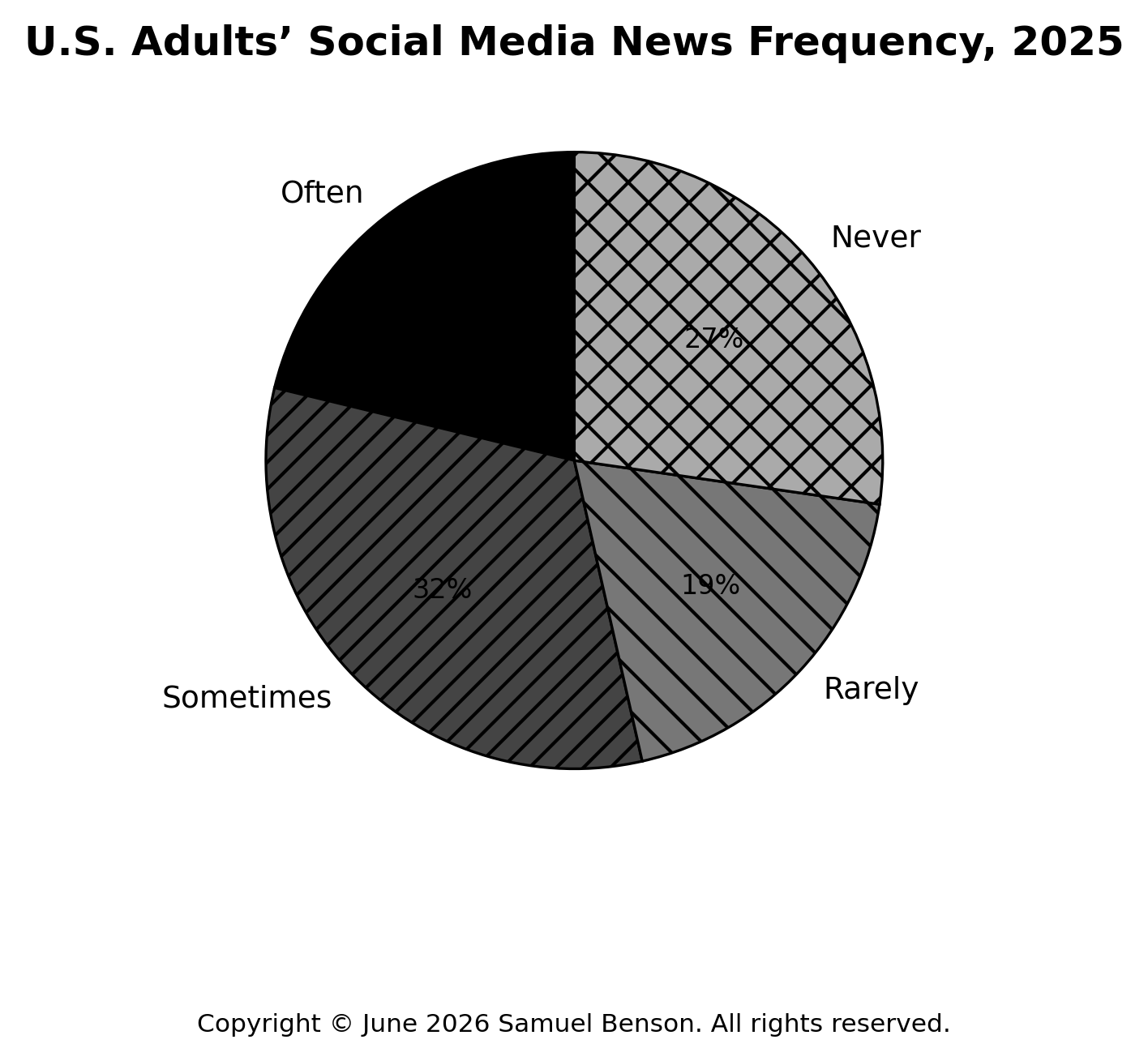
Source: Pew Research Center, Social Media and News Fact Sheet, 2025. Copyright © June 2026 Samuel Benson. All rights reserved.
Figure 7. Regular news use by social platform in 2025.
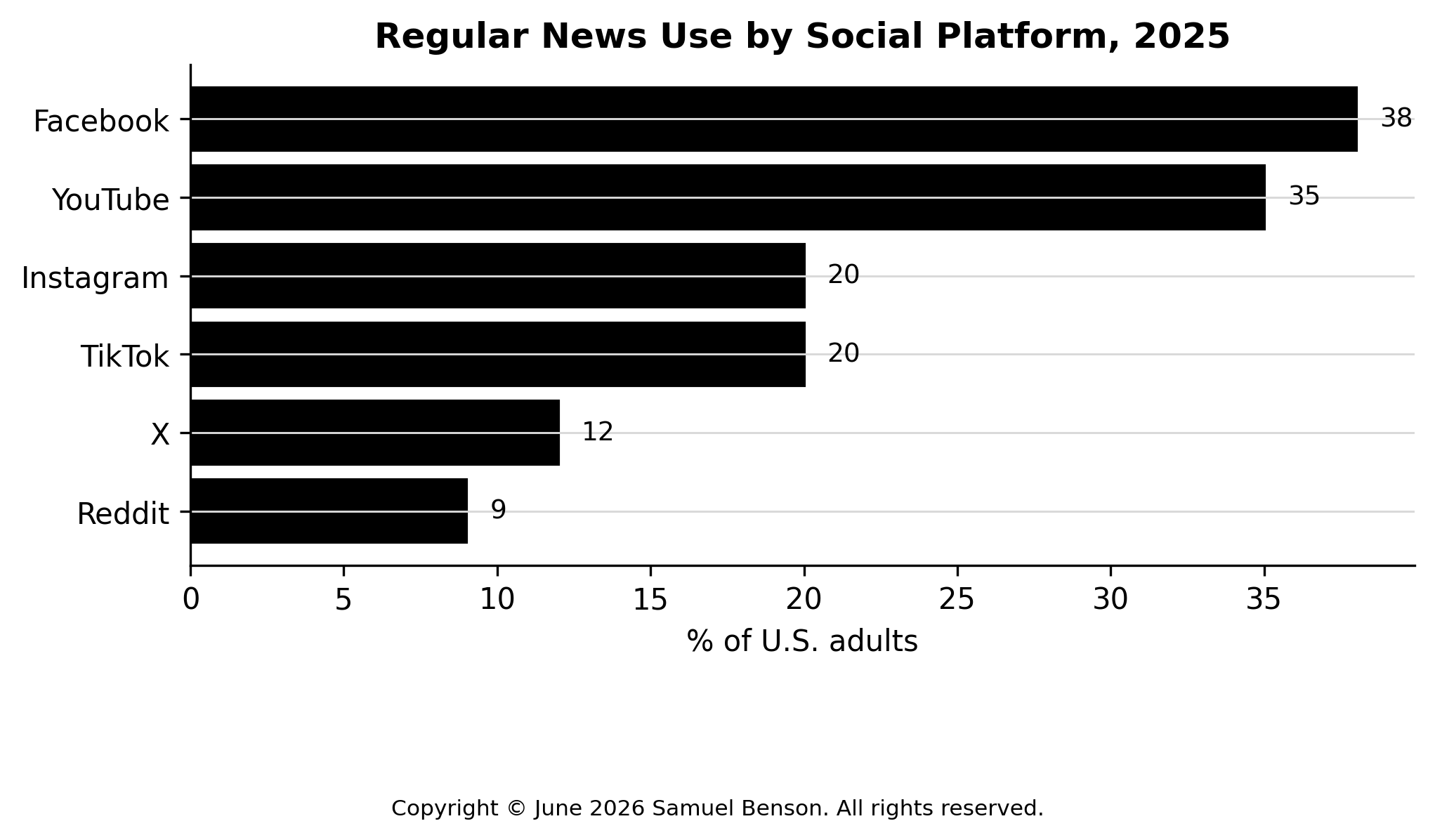
Source: Pew Research Center, Social Media and News Fact Sheet, 2025. Copyright © June 2026 Samuel Benson. All rights reserved.
7.3 Crisis and Repair
The same applies to accessibility. Brands often speak about inclusion while making websites, events, products, forms, or customer service difficult for people with disabilities. Accessibility is not a compliance afterthought. It is brand conduct. A company that excludes customers through poor design teaches the market that its welcome is conditional. Marketing teams need to include accessibility review in campaign, content, event, and digital design.
Pricing also needs to be viewed through brand risk. Hidden fees, aggressive subscriptions, confusing bundles, loyalty penalties, and unclear renewal terms may produce revenue while damaging fairness. Customers rarely separate pricing frustration from brand judgment. A company that makes cancellation hard is making a statement about how it views the customer. A brand that depends on friction to keep revenue is not strong; it is trapping demand that may leave when an easier path appears.
Environmental claims deserve special caution. Sustainability language is widely used and often poorly supported. A serious brand needs to define the claim, provide evidence, state limits, and avoid implying that buying more is automatically good for the planet. Patagonia’s case shows one route to credibility, but most companies will need smaller, more specific claims. A truthful limited claim is stronger than an expansive claim that cannot withstand scrutiny.
Brand risk review needs to be continuous because cultural meaning shifts. A term, symbol, partner, platform, or joke can change meaning quickly. That does not mean brands need to chase every micro-shift. It means someone has to be responsible for watching context. Cultural ignorance is no longer a defensible excuse for large organizations that spend millions to influence the public.
Crisis accountability also needs to include remedy. Many brand apologies fail because they express feeling without changing the customer’s situation. Remedy may involve refund, replacement, policy change, staff support, public correction, partnership termination, customer outreach, or clearer guidance. The right remedy depends on harm. A brand that apologizes but keeps the benefit of the harmful action is asking customers to absorb the cost of its mistake.
Cultural review has to avoid tokenism. Inviting one employee or one community representative to approve a campaign is not a serious process if that person has no authority or if the decision has already been made. Review needs to happen early enough to matter. It needs to include the ability to change the work. Otherwise, inclusion becomes a decorative step that protects leadership from discomfort without protecting the public from weak decisions.
Another risk is moral overclaim after a crisis. Organizations sometimes respond to failure by making sweeping values statements instead of concrete repairs. Customers are rarely helped by grandeur when they need remedy. Strategic crisis response needs to prefer specific action to inflated language. A small correction that reaches affected people is more credible than a public statement that tries to sound historic.
Chapter 8: Applied Models, Diagnostics, and Tables
8.1 Brand Trust Reliability Index
The models in this chapter are designed for management use. They are not formulas pretending to settle all judgment. Marketing resists perfect measurement because brand meaning is lived across memory, culture, price, service, habit, and social influence. Still, the absence of perfect measurement is not an excuse for vague leadership. Useful models can force better questions, reveal hidden assumptions, and prevent executives from celebrating activity that does not strengthen the brand.
The Brand Trust Reliability Index is the core diagnostic: BTRI = [(PC + EC + ES + PF + RI + MD) / 6] – CP. The six positive components are scored from 0 to 5 and averaged before contradiction pressure is subtracted. For review discipline, any component scored below 2 triggers a written explanation and an action owner before the total index is accepted. This safeguard prevents the index from treating a severe privacy, service, or proof failure as a minor numerical inconvenience.
Promise clarity asks whether the brand promise is specific enough to guide action. Many companies fail this test because their promises are interchangeable. They claim quality, innovation, value, care, or excellence without saying what those words require. A useful promise helps managers decide. It tells employees what to protect. It tells customers what to expect. It tells agencies what tone to use and what claims to avoid. Without clarity, the brand becomes a collection of impressions rather than a guide to behavior.
Experience consistency asks whether customers encounter the promise across the journey. Consistency does not require sameness. A digital interaction, call-center exchange, retail visit, shipping notice, and social post can differ in tone while still carrying the same promise. The issue is whether the customer feels the same company behind them. Inconsistency is especially damaging when the marketing is beautiful and the service is poor. The better the campaign, the worse the disappointment.
Evidence strength asks whether the brand can prove what it says. Proof can include product performance, independent reviews, certifications, customer outcomes, service data, expert recognition, transparent policies, or visible trade-offs. In an AI-mediated market, evidence also has to be machine-readable and publicly consistent. Brands need to expect their claims to be summarized, compared, challenged, and recombined. A claim that cannot survive comparison cannot be central to strategy.
Privacy fairness asks whether data practice would feel acceptable if explained plainly. This is deliberately broader than compliance. Customers evaluate fairness in context. A fitness app using workout data for progress insights may feel useful. The same data used for unrelated targeting may feel invasive. A retailer using purchase history for relevant offers may be acceptable. Sharing or inferring sensitive traits without clear permission may not. Marketing teams need customer empathy and legal advice; either one alone is insufficient.
Response integrity asks how the organization behaves when the promise fails. Every brand fails sometimes. Products break. Flights are delayed. Orders are missed. Campaigns offend. AI tools give wrong answers. The question is whether the brand responds in a way that confirms or destroys trust. Fast correction, honest language, fair remedy, and visible learning often matter more than defensive perfection. A brand that cannot apologize without sounding scripted is not ready for public accountability.
Table 5. Brand Trust Reliability Index.
| Component | Meaning | Failure signal |
| Promise clarity | The brand claim is specific enough to guide action. | The claim sounds like competitors’ language. |
| Experience consistency | Customers meet the promise across the journey. | Campaign quality exceeds service quality. |
| Evidence strength | Claims are supported by proof customers can inspect. | Proof is vague, old, or internal only. |
| Privacy fairness | Data use feels fair when explained plainly. | Customers are surprised by tracking or personalization. |
| Response integrity | The brand repairs failure truthfully. | Apology language replaces remedy. |
| Memory durability | Demand persists beyond promotion. | Sales depend heavily on discounting. |
| Contradiction pressure | Internal conduct clashes with public promise. | Employees or customers report the gap repeatedly. |
8.2 Evidence-to-Action and AI Control
Memory durability asks whether the brand is building recognition and preference that last beyond a promotion. Performance marketing can produce immediate action, but brands need memory to reduce future acquisition costs and protect margin. Memory is formed through repeated useful experience, distinctive identity, social proof, emotional association, and cultural meaning. It cannot be bought all at once. It can be weakened quickly through contradiction.
Contradiction pressure measures the gap between claim and conduct. It includes operational failures, employee reports, customer complaints, regulatory issues, pricing surprises, cultural inconsistency, and data practices that clash with public language. This negative term matters because contradictions are not just isolated errors. They teach the market how to interpret future claims. Once customers learn to discount the brand’s language, every new campaign becomes less efficient.
The Marketing Evidence-to-Action model addresses another weakness: many organizations collect data without changing decisions. The model follows a simple path: customer signal, interpretation, decision owner, resource movement, customer-facing change, and learning review. If any step is missing, evidence becomes theatre. A customer survey that produces a deck but no decision is not insight. A social-listening report that warns of distrust but cannot alter campaign timing is not strategy. Evidence becomes strategic when it changes what the organization does.
The AI Marketing Control Loop proposed earlier can be converted into a checklist. Before AI-generated or AI-assisted marketing reaches customers, the team needs to identify the data source, permission basis, purpose, claims, target audience, model/tool limits, human reviewer, legal risk, bias risk, brand-voice risk, escalation route, and monitoring plan. For low-risk uses, this can be brief. For high-risk customer claims, it needs to be formal. AI needs to increase the marketer’s capacity for disciplined work, not remove responsibility.
The Cultural Relevance and Trust Matrix helps organizations avoid a common trap. Some brands are culturally visible but not trusted. Others are trusted but culturally quiet. The strongest position combines relevance with proof. A culturally visible but low-trust brand may generate conversation and sales spikes while remaining fragile. A trusted but low-relevance brand may retain loyal customers while slowly aging out of public imagination. Strategy depends on knowing which quadrant the brand occupies and what movement is realistic.
The Channel Portfolio Decision Map places channels against reach and trust value. Search, social, creators, email, retail media, events, earned media, community, and AI answer visibility cannot be funded by habit. Each needs to be funded according to the customer decision it supports. A retention problem may not need more paid social. A trust problem may require earned proof and customer-service repair. A discovery problem may require creators and search. A credibility problem may require experts, reviews, and transparent evidence. Channel mix needs to follow the market problem.
These tools are best used in cross-functional review. Marketing alone may overrate message strength. Operations may underrate brand memory. Legal may overemphasize risk avoidance. Finance may overvalue near-term attribution. Customer service may see pain that dashboards hide. A good review brings these perspectives into conflict and then turns the conflict into decision. That is where strategic marketing becomes institutional rather than departmental.
Table 6. AI marketing governance controls.
| Control | Question | Owner |
| Data source review | What data trained or feeds the tool? | Data and marketing leads. |
| Purpose definition | What customer or business problem is being solved? | CMO or channel owner. |
| Human review | Who approves claims before public use? | Brand, legal, product. |
| Disclosure | Does the customer need to know AI is involved? | Legal and ethics review. |
| Monitoring | What signal triggers correction or shutdown? | Operations and customer service. |
| Learning | How will errors change the process? | Marketing governance team. |
8.3 Channel and Culture Diagnostics
The models need to be used with narrative evidence. A BTRI score without explanation can become another dashboard ritual. The review needs to include examples: customer quotes, complaint themes, operational data, campaign claims, privacy screens, creator disclosures, and screenshots from real journeys. Evidence makes the score harder to manipulate. It also helps teams see the customer’s experience rather than debating abstractions.
The function can also support scenario review. Before a major campaign, the team can ask what happens if experience consistency is weaker than assumed, if privacy fairness is challenged, if a creator partner becomes controversial, if an AI-generated response gives a wrong answer, or if the campaign attracts an audience the service system cannot handle. This does not predict every outcome. It exposes fragile assumptions before launch.
The Evidence-to-Action model needs to be reviewed after major campaigns and service changes. What did the organization learn? Who owned the decision? What changed in budget, product, service, or communication? What evidence was ignored? What did customers say after the change? A review that ends with “awareness increased” is incomplete. Awareness of what, among whom, at what cost, and with what effect on trust?
The Cultural Relevance and Trust Matrix can be used during annual planning. A brand may decide it needs more cultural relevance, but the right move depends on its trust base. A low-trust brand needs to repair proof before seeking louder cultural attention. A high-trust but low-relevance brand may need fresh partnerships, design renewal, or new audience rituals. A culturally visible but fragile brand may need restraint and operational repair. The matrix prevents the same recommendation from being applied to every brand.
The Channel Portfolio Map needs to include cost and learning value. A channel that produces immediate conversion but little learning may still be useful. A channel that creates deep customer insight but modest conversion may be worth protecting. A channel that creates both reach and distrust needs to be reduced. Channel review asks what each dollar teaches the organization, more than what it returns in attribution software.
These diagnostics also need to protect against executive pet projects. Senior leaders often prefer campaigns that reflect their own taste, media habits, or personal ambitions. A transparent model forces leadership to show how the idea supports promise, evidence, trust, audience need, and business value. It does not eliminate judgment, but it makes unsupported enthusiasm easier to challenge.
The models need to be revisited after use. If a brand scores well but customers respond poorly, the tool needs revision. If a risk was missed, the review needs to identify why. If the same contradiction appears across quarters, leadership needs to stop treating it as a communications issue. The value of a diagnostic is not in being right once; it is in improving organizational learning.
The models also need to help protect junior marketers. In weak cultures, younger staff may see risk but lack status to challenge a campaign. A formal diagnostic gives them a shared language and a documented process. It reduces dependence on personality and hierarchy. When judgment is placed into a review system, the organization becomes less vulnerable to the loudest person in the room.
Chapter 9: Implementation Blueprint for U.S. Organizations
9.1 Governance Sequence
Implementation begins with a brand promise audit. The organization needs to collect its public claims from websites, campaigns, sales decks, recruiting materials, customer-service scripts, investor language, executive speeches, and social profiles. The team asks whether these claims say the same thing and whether the organization can prove them. Contradictions are often visible before customers complain. A company may promise simplicity while its onboarding is confusing. A university may promise student support while advising wait times are long. A hospital may promise compassion while phone systems frustrate families. The audit needs to identify these gaps without trying to defend them.
The next step is customer-journey evidence. This needs to include quantitative and qualitative evidence: conversion data, retention, reviews, complaints, support transcripts, return reasons, social listening, sales objections, mystery shopping, accessibility testing, and frontline interviews. Marketing teams often overuse data from the top of the funnel because it arrives quickly. The more important evidence may sit after purchase, where disappointment, relief, loyalty, and advocacy are formed. A brand is often won or lost after the campaign has ended.
A third step is internal delivery review. The team asks who carries the promise and whether those people have the resources to deliver it. If the brand promises high-touch service, are staffing and training sufficient? If the brand promises responsible AI, who reviews outputs? If the brand promises local community, who has local authority? If the brand promises speed, which process delays are outside the customer’s view? This review prevents marketing from becoming an internal fantasy about what the organization wishes it could be.
Governance needs to then be clarified. Major campaigns, purpose claims, AI-supported customer interactions, high-risk creator partnerships, privacy-sensitive personalization, and cultural participation needs to have named decision owners. The decision owner has to have enough authority to pause, alter, or reject work. Responsibility without authority creates a familiar failure: everyone sees the risk, no one can stop the launch. The brand review process needs to be fast enough to support marketing speed and strong enough to prevent reckless scale.
Budgeting needs to change as well. A serious brand budget includes research, creative development, media, customer-experience repair, measurement, training, content maintenance, and trust safeguards. Many firms fund the visible campaign while underfunding the conditions that make the campaign credible. This is poor investment. A better return may come from repairing a service failure, improving product information, training frontline teams, clarifying pricing, or improving complaint response. Marketing investment needs to follow the constraint on trust, more than the opportunity for reach.
Measurement needs to be rebuilt around a small number of durable questions. Are more people aware of the brand? Do the right people understand the promise? Does the promise match experience? Are customers returning for reasons beyond discounting? Are complaints falling in areas tied to the promise? Are acquisition costs sustainable? Is trust improving among priority audiences? Are employees able to deliver what marketing says? Does AI-supported work increase quality or only speed? These questions can be translated into metrics, but the questions need to come first.
The organization also needs to create a content truth process. Content grows stale quickly. Product pages drift from current features. Old blog posts contain outdated claims. Automated emails keep promises that service teams cannot meet. Sales decks contain legacy language. AI tools may pull from outdated material. A content truth process assigns ownership for accuracy, review cycles, removal, and evidence. In a market where AI systems may summarize old content, stale claims become strategic risk.
9.2 Operating Controls
Creator and partner governance needs to be formal. The organization needs to define selection criteria, disclosure requirements, claim limits, approval rights, crisis terms, content ownership, audience fit, and compensation transparency. It also needs to decide what it will not ask creators to do. The strongest creator partnerships protect the creator’s credibility because that credibility is the reason for the partnership. Heavy-handed scripts and hidden payments damage both sides.
Privacy and personalization needs to be reviewed through customer expectation. The team needs to identify where personalization helps and where it may feel intrusive. It avoids sensitive inference unless there is a strong customer benefit and clear permission. It makes preference controls easy to find. It needs to test whether customers understand why they are receiving a message. Personalization needs to feel like service, not surveillance. The difference is often context, consent, and restraint.
Crisis readiness needs to be practiced. The organization runs scenario exercises involving data misuse, offensive creative, creator misconduct, product failure, employee backlash, pricing anger, AI error, and cultural controversy. The purpose is not to create fear. It is to define the decision path before emotion and speed take over. A practice session can reveal missing owners, weak facts, slow approvals, unclear values, or internal disagreement. Those weaknesses are cheaper to fix before the public is watching.
Staff capability matters. Marketing teams need training in AI governance, privacy, cultural review, performance measurement, brand strategy, customer research, and ethical persuasion. They also need writing judgment. AI can generate text; it cannot replace institutional knowledge, moral judgment, market taste, or the ability to hear what customers are actually saying. A team that loses writing and thinking skill will become dependent on tools it cannot properly evaluate.
Finally, implementation requires executive patience. Brand repair often takes longer than campaign launch. Trust may recover slowly. Customer experience fixes may require operations funding. A privacy correction may reduce short-term targeting power. A better creator strategy may involve fewer partnerships. A stronger content process may slow output. Executives who demand durable brand value has to accept these costs. There is no serious brand strategy without trade-offs.
A useful implementation rhythm is quarterly brand governance. The meeting needs to be short, evidence-based, and decision-oriented. It reviews the promise, customer evidence, experience gaps, AI and data practice, campaign pipeline, brand risk, and investment priorities. The meeting needs to end with owners and deadlines. If the meeting produces only discussion, the brand has gained vocabulary but not control.
Organizations also need to create a red-team process for high-risk campaigns. The red team needs to include people outside the campaign group who are allowed to challenge assumptions. They ask how the work could be misread, whether claims are supported, whether audience segments are properly understood, whether cultural participation is earned, whether operational teams can carry demand, and whether disclosure is clear. A red-team review is not an attack on creativity. It is protection from avoidable failure.
Table 7. Implementation blueprint.
| Action | Why it matters | Evidence of completion |
| Audit the promise | Clarifies what the brand must prove. | Claim inventory and contradiction list. |
| Map customer evidence | Shows where trust is gained or lost. | Journey evidence with decision owners. |
| Review AI and data practice | Prevents automated trust damage. | Control checklist and approval log. |
| Repair experience gaps | Aligns marketing with delivery. | Service changes tied to complaints. |
| Govern creators and partners | Protects borrowed trust. | Disclosure rules and partner criteria. |
| Run crisis scenarios | Reduces delay under pressure. | Decision path and stakeholder map. |
| Quarterly brand review | Turns brand into governance work. | Actions, owners, dates, and follow-up. |
9.3 Institutional Use
For smaller organizations, the same principles can be scaled down. A nonprofit, clinic, local college, startup, or cultural institution may not have a full brand governance team. It can still maintain a promise file, customer feedback log, content accuracy review, consent checklist, campaign approval note, and crisis contact tree. Strategic marketing is not reserved for large budgets. It begins with disciplined attention to promise and proof.
Universities and research centers need to pay special attention because their brands are built on trust, expertise, and public value. Overclaiming programs, exaggerating outcomes, using generic AI content, or publishing polished material without source integrity can damage academic credibility. Marketing for knowledge institutions has to be more exact than ordinary promotion. It has to persuade without cheapening truth.
Healthcare, nursing, and social-service organizations face an even higher standard. Their marketing reaches people under stress, uncertainty, or vulnerability. Claims about care, outcomes, compassion, access, or innovation needs to be reviewed with clinical and ethical seriousness. A hospital campaign that promises care while understaffing units creates a reputational and moral contradiction. In high-stakes sectors, marketing is never just marketing.
Implementation also needs to include sunset decisions. Brands often keep campaigns, pages, taglines, offers, and partnerships alive because no one has formally ended them. Old material accumulates and creates risk. A sunset process identifies what needs to be retired, updated, archived, or corrected. This is especially important when AI systems and search engines may continue to surface outdated claims.
An implementation plan needs to include agency, vendor, and platform accountability. Vendors may supply AI tools, media buying, creator access, data enrichment, analytics, and customer engagement systems. Their incentives may not fully match the brand’s trust obligations. Contracts need to require transparency, compliance, audit rights, data limits, and clear responsibility for errors. Outsourcing execution does not outsource judgment.
The same plan protects local variation. National brands often need consistent identity, but local teams see customer realities that headquarters misses. Local managers may know which claims feel tone-deaf, which service gaps are urgent, and which community partnerships are credible. A good system allows local intelligence to inform brand decisions without letting the brand fragment into unrelated local messages.
Implementation will fail if leaders treat brand governance as a compliance burden. The point is not to slow everything down. The point is to reduce avoidable waste, public error, and internal confusion. A campaign paused for one day to correct a weak claim may save months of reputation repair. Speed without direction is not agility. It is drift.
A final implementation control is post-launch humility. Once a campaign goes live, the team watches more than the metrics it hoped to improve but also the signals it feared. Did complaints rise? Did support tickets change? Did customers misunderstand the claim? Did employees struggle to answer questions? Did the wrong audience dominate reaction? Post-launch review needs to test the entire risk picture.
Chapter 10: Final Position: Branding as Earned Market Trust
10.1 Final Argument
Strategic marketing and branding in the United States are entering a harsher period. The market is full of content, metrics, claims, automated tools, creator partnerships, retail-media systems, and AI-generated summaries. Customers have more routes to discovery and more reasons to doubt what they find. They can compare alternatives quickly, organize criticism publicly, and test a company’s words against its conduct. These conditions make marketing more important, not less, but they also make weak marketing easier to expose.
The central mistake is to treat marketing as the management of appearance. Appearance can open a door; it cannot keep the customer there. A brand has to prove usefulness, reliability, fairness, privacy, cultural care, and the capacity to repair mistakes. That proof may come through product quality, service experience, transparent policy, employee conduct, independent validation, and repeated usefulness. Advertising is valuable when it brings proof to the right audience. It becomes dangerous when it tries to replace proof.
The U.S. cases show several routes to credibility. Apple’s privacy position gains force from product and policy choices. Patagonia’s purpose carries weight because it changed ownership and profit logic. Starbucks shows how loyalty can deepen customer relationship while placing pressure on store experience. The New York Times shows the commercial strength of daily usefulness and subscription trust. Nike shows that cultural authority has to be renewed, not inherited. Bud Light shows how quickly brand meaning can become contested when cultural participation outruns readiness. Challenger brands show that being noticed is only the first test.
The applied models convert these lessons into executive practice. The Brand Trust Reliability Index tests whether promise, experience, evidence, privacy, response, and memory are working together. The Marketing Evidence-to-Action model asks whether insight changes decisions. The AI Marketing Control Loop keeps automation tied to review, disclosure, and customer protection. The Channel Discipline Review separates useful attention from noise. Their value is not that they look technical. Their value is that they force management to name the evidence behind a claim.
A mature marketing organization can answer hard questions without retreating into slogans. What exactly are we asking the market to believe? What evidence supports it? Where does experience contradict the claim? Which data practice could damage trust? Which channel fits the customer’s decision at this moment? What human review controls AI-supported work? Which audiences may read this differently from our intention? What are we willing to defend if challenged?
Brand trust is operating capital. It can reduce acquisition waste, protect margin, support retention, strengthen hiring, increase forgiveness after error, and give the organization room to make hard changes. It is not soft value. It is stored belief created by previous conduct. Once spent carelessly, it is expensive to rebuild.
10.2 Research and Practice Implications
Marketing education and executive training need to change with this reality. Students and managers need more than campaign examples. They need case work that links promise to operations, privacy, AI, law, customer experience, and cultural conflict. They need to study failed moves without turning them into spectacle. They need to see that restraint can be strategic, not timid.
The future of strategic marketing will not belong to the brands that publish the most content or adopt each new tool first. It will belong to organizations that make themselves easier to believe. That requires fewer unsupported claims, better customer evidence, cleaner permissions, clearer pricing, stronger service recovery, and leadership that accepts uncomfortable facts before the public forces them into view.
For institutional research, this paper treats branding as a public proof system. A brand is the accumulation of what an organization has taught people to expect. That expectation can be strengthened through consistency and damaged through contradiction. The brand is not what the organization says on its best day. It is what customers expect after many ordinary days.
The final standard for marketing leadership is disciplined belief. The marketer has to believe in story, design, emotion, timing, and cultural signal. That belief, however, has to be restrained by evidence. Without belief, marketing becomes timid reporting. Without restraint, it becomes manipulation. The best leaders carry both: creative conviction and a willingness to be corrected by customers, staff, facts, and consequences.
Agency relationships change under this standard. Agencies cannot be selected only for output volume or awards potential. They need strategic honesty, customer understanding, craft, measurement discipline, and the courage to challenge a weak brief. A client that punishes honest challenge will receive attractive versions of bad thinking. A client that rewards it may receive fewer ideas, but better ones.
AI will intensify the test. Customers may accept AI when it saves time, improves relevance, increases access, or supports human service. They will resist it when it hides accountability, creates error, replaces necessary human help, or turns every interaction into a data extraction opportunity. The question will not be simply whether a brand uses AI. The question will be whether its use of AI makes the company more worthy of trust.
10.3 Institutional Standard
Strategic marketing, at its best, helps organizations align ambition with proof. It gives leaders a way to say what they mean, mean what they say, and learn when the market proves that the gap is larger than leadership believed. That work is commercial, but it is also ethical. A society flooded with persuasive systems needs institutions that know how to persuade responsibly.
The most valuable brands of the next decade may be those that reduce cognitive burden. Customers are tired of sorting claims, avoiding traps, checking whether content is real, and wondering what a company has done with their data. A brand that is clear, fair, useful, easy to understand, easy to leave, and serious when something fails offers relief. In a noisy market, relief is value.
The standard is strict: style has to serve judgment, and judgment has to serve public truth. A research publication on branding cannot sound like a sales deck. It has to face the uncomfortable conditions that make brand work difficult. Strategic marketing is not the art of making organizations look better than they are. It is the work of helping them become easier to believe.
The burden falls on leadership language. Executives need to stop asking marketing teams for magic and start asking for judgment, evidence, creativity, and honest warning. When leaders demand growth while ignoring the conditions of trust, they turn marketing into camouflage. When they accept the discipline of proof, marketing becomes a serious form of leadership.
Branding is not a decorative specialty. It organizes trust across strategy, operations, finance, product, service, law, data, and culture. Once leaders understand that reach, they stop asking brand teams to make the organization look coherent and start building an organization coherent enough to be believed.
The practical test is immediate. Look at the organization’s most important promise. Then look at the last customer complaint, the last service failure, the last data request, the last campaign approval, and the last leadership response to criticism. If these do not belong to the same truth, the brand is already paying for a gap marketing alone cannot close.
The work of strategic marketing is neither soft nor secondary. It is the disciplined management of the promises through which an organization asks people to spend money, give attention, share data, trust expertise, and return. A brand is not protected by saying better things. It is protected by making fewer claims than the organization can prove, then proving them repeatedly.
Appendix A: Brand Trust Reliability Review
Score promise clarity, experience consistency, evidence strength, privacy fairness, response integrity, memory durability, and contradiction pressure. Include marketing, operations, legal, customer service, and frontline representatives. Do not average away disagreement. A split score often reveals the exact place where the brand is weakest.
End the review with decisions. Low privacy fairness calls for consent repair. Weak experience consistency calls for service work before campaign scale. High contradiction pressure requires executive action. The point is not to produce a score for display; it is to stop calling a brand strong when the organization already knows where customers are being disappointed.
Appendix B: AI Marketing Control Checklist
Before customer-facing AI use, document the tool, data source, purpose, customer group, claim type, reviewer, risk level, disclosure need, monitoring plan, and human escalation route. High-risk use needs legal review and senior approval. Customer-service AI needs a human handoff. Generative content needs accuracy, tone, bias, and claim-support review before release.
Update the checklist as tools and law change. Vendor assurances do not remove brand responsibility. Customers do not experience the vendor as a separate actor. They experience the interaction as the company’s conduct.
Appendix C: Case-Study Teaching Notes
Apple: examine whether privacy can remain a strong brand promise as product, service, and partner systems expand. The case is strongest when students compare areas of direct control with areas where Apple relies on developers, regulators, or customer behavior. A rights-based promise creates authority and also gives critics a clear standard.
Patagonia: examine what separates costly purpose from ordinary purpose talk. The ownership transfer belongs in governance analysis, not campaign admiration. The useful question is which brands can make comparable structural commitments and which need narrower, more honest claims.
Starbucks: examine whether convenience and relationship can grow together without eroding store meaning. Loyalty data, mobile ordering, store experience, employee pressure, and customer ritual need to be read together. Digital convenience is valuable, but the brand loses something if the store becomes only a fulfillment node.
The New York Times: examine how a trust-based news brand can extend into adjacent products without diluting authority. Bundles may increase habit and revenue, but editorial trust remains the central asset.
Nike: examine how a brand renews cultural authority when its past work is legendary. Distinguish heritage from current relevance. Product innovation, athlete relationships, retail experience, community, and storytelling all matter; memory alone cannot do the present work.
Bud Light: do not reduce the case to which side of a cultural argument is right. Study how brand meaning, audience expectation, executive response, and public conflict interacted. The case teaches readiness more than ideology.
Challenger brands: test whether distinctiveness converts into repeat purchase. A funny, rebellious, or visually surprising brand still has to answer distribution, quality, price, and retention questions. Difference opens the door; proof keeps customers from walking back out.
Appendix D: Brand Governance Meeting Template
Begin a quarterly brand governance meeting with the promise. What are we asking the market to believe this quarter? Which campaigns, product changes, service updates, or public positions carry that promise? Which claims need evidence before launch? Which old claims need retirement? This opening anchors the meeting in meaning rather than activity.
Next, review customer evidence: retention, complaints, reviews, search questions, social signals, service transcripts, sales objections, and frontline warnings. The point is not to display every metric. The point is to identify the evidence that changes a decision.
Then review risk. Bring forward high-risk claims, AI use, creator partnerships, privacy changes, cultural participation, pricing changes, and major channel shifts. Decide whether to proceed, revise, test, pause, or reject. Record the reason; brand governance fails when caution is discussed but not documented.
Close by assigning work. Every issue needs an owner, date, and evidence requirement. If the customer-experience gap needs operational repair, operations leaves with responsibility. If a claim needs substantiation, legal and product teams are named. If content is outdated, a content owner updates it. The meeting matters only when it moves work.
References
Apple. (n.d.). Privacy. Retrieved June 10, 2026, from https://www.apple.com/privacy/
Apple. (2025, July 30). Apple privacy policy. https://www.apple.com/legal/privacy/en-ww/
Edelman. (2025). 2025 Edelman Trust Barometer: Global report. https://www.edelman.com/trust/2025/trust-barometer
Federal Register. (2023, July 26). Guides concerning the use of endorsements and testimonials in advertising. https://www.federalregister.gov/documents/2023/07/26/2023-14795/guides-concerning-the-use-of-endorsements-and-testimonials-in-advertising
Federal Trade Commission. (2024, September 25). FTC announces crackdown on deceptive AI claims and schemes. https://www.ftc.gov/news-events/news/press-releases/2024/09/ftc-announces-crackdown-deceptive-ai-claims-schemes
Forrester. (2025, October 28). Forrester’s 2026 B2C marketing, CX, and digital business predictions. https://www.forrester.com/press-newsroom/forrester-b2c-marketing-cx-digital-2026-predictions/
Gartner. (2025, May 12). Gartner 2025 CMO Spend Survey reveals marketing budgets have flatlined at 7.7% of overall company revenue. https://www.gartner.com/en/newsroom/press-releases/2025-05-12-gartner-2025-cmo-spend-survey-reveals-marketing-budgets-have-flatlined-at-seven-percent-of-overall-company-revenue
Interactive Advertising Bureau & PwC. (2026, April 16). Internet Advertising Revenue Report: Full Year 2025. https://www.iab.com/insights/internet-advertising-revenue-report-full-year-2025/
Moorman, C., & The CMO Survey. (2025). The CMO Survey: Highlights and insights report 2025. https://cmosurvey.org/cmosurvey_results/The_CMO_Survey-Highlights_and_Insights_Report-2025.pdf
NIKE, Inc. (2025, June 26). NIKE, Inc. reports fiscal 2025 fourth quarter and full year results. https://investors.nike.com/investors/news-events-and-reports/investor-news/investor-news-details/2025/NIKE-Inc–Reports-Fiscal-2025-Fourth-Quarter-and-Full-Year-Results/default.aspx
Patagonia. (2022, September 14). Yvon Chouinard donates Patagonia to fight climate crisis. https://www.patagonia.com/ownership/
Patagonia Works. (2022, September 14). Patagonia’s next chapter: Earth is now our only shareholder. https://www.patagoniaworks.com/press/2022/9/14/patagonias-next-chapter-earth-is-now-our-only-shareholder
Pew Research Center. (2025, September 25). Social media and news fact sheet. https://www.pewresearch.org/journalism/fact-sheet/social-media-and-news-fact-sheet/
Pew Research Center. (2025, November 20). Americans’ social media use 2025. https://www.pewresearch.org/internet/2025/11/20/americans-social-media-use-2025/
Starbucks Corporation. (2025, January 28). Starbucks reports Q1 fiscal year 2025 results. https://investor.starbucks.com/news/financial-releases/news-details/2025/Starbucks-Reports-Q1-Fiscal-Year-2025-Results/default.aspx
The New York Times Company. (2025). Annual report and investor materials. https://investors.nytco.com/