

Maersk and Marks & Spencer as Case Studies in Visibility, Sustainability, and Adaptive Supply-Chain Management
Master’s Research Publication
Research Publication by Collins Chimaobi Opara
Publication No.: NYCAR-TTR-2026-RP009
DOI: https://doi.org/10.5281/zenodo.20357631
June 2026
Peer Review Statement
This research publication has passed NYCAR’s internal academic and editorial review for master’s-level publication. The review assessed the clarity of the research problem, the strength of the Maersk and Marks & Spencer case comparison, the relevance of the literature, the treatment of public evidence, the transparency of the diagnostic model, the accuracy of the tables and figures, and the usefulness of the findings for supply-chain leaders. The work is approved because it treats digital logistics resilience as a disciplined management capability rather than a fashionable technology claim. Its strongest contribution is the connection it makes between visibility, decision authority, supplier honesty, cyber continuity, sustainability data, and customer-facing service. The quantitative model is properly limited, the arithmetic is transparent, and the figures are presented as diagnostic aids rather than company-certified ratings.
Copyright © June 2026 Collins Chimaobi Opara. All rights reserved.
Abstract
Global logistics used to hide behind the commercial promise. Customers noticed the product, the delivery window, or the empty shelf, not the chain of movement that made the promise possible. That distance has narrowed. A late vessel, a missed warehouse slot, a cyber interruption, a weak supplier signal, or a rushed transport decision can now reach the shop floor, online checkout, finance forecast, sustainability report, and customer relationship almost at once. Resilience, in that setting, is not a transport department’s private concern. It is the discipline of knowing what is under strain early enough to make a useful decision.
Maersk and Marks & Spencer are examined from different positions in the same supply-chain reality. One case sits close to the arteries of global trade, where ships, ports, inland routes, terminals, customer notices, emissions data, and network options have to be coordinated under pressure. The other sits at the retail edge, where logistics is judged in ordinary but unforgiving ways: fresh food, available sizes, reliable online orders, controlled waste, supplier discipline, cyber recovery, and the credibility of sustainability promises. Together, the cases show why logistics resilience cannot be reduced to tracking technology. Visibility matters only when it gives managers time, authority, and credible alternatives.
Public company reporting, sustainability disclosures, recent supply-chain research, and documented disruption cases provide the evidence base. A modest diagnostic model connects digital logistics maturity with estimated resilience, but the model is kept in its proper place. It is not an audited rating of either company. Its value is practical: it helps identify where visibility, analytics, integration, sustainability data, and adaptive decision-making are strong enough to support service under pressure, and where a supply chain may still be exposed despite having modern systems.
A consistent finding runs through the cases. Digital logistics becomes resilient only when information changes conduct. A dashboard can show delay without producing judgment. A forecast can warn of shortage without moving authority. An emissions report can describe carbon after the decision has already been made. Stronger supply chains do more than see disruption. They decide earlier, communicate more honestly, protect the customer promise, weigh carbon and cost together, rehearse fallback procedures, and carry lessons forward into the next contract, route, system, and operating rule.
Keywords: digital logistics; supply-chain resilience; Maersk; Marks & Spencer; sustainability; logistics visibility; retail distribution; cyber resilience; adaptive capability.
Contents
NYCAR Peer Review Note
List of Tables and Figures
Table 1. Comparative case logic for digital logistics resilience.
Table 2. Digital logistics maturity scoring logic.
Table 3. Practical recommendations for supply-chain leaders.
Figure 1. Comparative digital logistics maturity scorecard for Maersk and Marks & Spencer.
Figure 2. M&S reported logistics emissions, 2023/24 and 2024/25.
Figure 3. Estimated carbon saving from M&S bio-CNG vehicles compared with diesel.
Figure 4. Estimated logistics resilience score derived from the conceptual model.
Figure 5. Digital resilience capability mix.
Figure 6. Supply-chain disruption exposure categories used for management analysis.
Figure 7. Digital logistics resilience cycle.
Chapter 1: Introduction
1.1 Logistics resilience after easy-flow assumptions
Global supply chains were built for a long period in which managers could often assume that movement would remain cheap, predictable, and largely invisible to customers. The strongest planning habits in that period favored lean inventory, distant sourcing, narrow cost control, and a belief that transport disruption would be handled by specialists somewhere behind the commercial scene. That confidence no longer holds. Ports close, vessels queue, fuel prices move sharply, border rules change, weather interrupts corridors, suppliers miss commitments, and cyber incidents can stop an online channel faster than a warehouse team can explain the damage. Logistics has therefore moved from the background of strategy to the front of management responsibility.
Daily operating work now carries strategic weight because disruption travels quickly from physical movement into brand trust. A procurement delay may become a production gap; a port problem may become a customer-service issue; a cyber failure may become a public market signal. Senior leaders cannot treat those events as exceptions handled somewhere below strategy. Resilience belongs in the same room as growth, margin, sustainability, technology investment, and risk appetite.
Digital logistics resilience is the capacity to use connected information, operational experience, partner coordination, and decision authority to protect supply-chain performance when normal movement becomes uncertain. It is not the same as installing a platform. A dashboard can show a delayed container without telling the firm which customer should be protected first. A forecast can warn of shortage without giving a buying team authority to change allocation. A carbon report can show emissions after the event while leaving route decisions untouched. Digital maturity begins to matter only when information changes action.
Operational maturity shows up in the first competent response after a warning. After a warning appears, a resilient organization knows who checks it, who owns the exposure, who can approve a change, which customers should be told, and which sustainability trade-offs require senior judgment. That chain of response is often more important than the platform itself. Technology may carry the signal, but management gives the signal consequence.
Maersk and Marks & Spencer make a useful comparison because they occupy different sides of the supply-chain system. Maersk works from the logistics-provider side, where value is created by coordinating international movement, presenting reliable options, and reducing uncertainty for customers whose goods cross oceans, ports, warehouses, and inland routes. Marks & Spencer works from the retail side, where supply-chain performance is judged by the shopper who expects food to be fresh, sizes to be available, orders to arrive correctly, and sustainability claims to withstand scrutiny. One case speaks the language of network orchestration. The other speaks the language of retail trust.
Different positions in the chain also produce different forms of evidence. Maersk is judged through route reliability, network options, customer intelligence, and emissions transparency across modes of movement. Marks & Spencer is judged through availability, freshness, fulfillment, supplier discipline, and the credibility of its service promises. Comparison is useful precisely because the standards are not identical. It shows how resilience changes shape while still depending on the same core movement from evidence to action.
A simple professional observation opens the publication: the modern supply chain does not fail in a single place. A delay at sea can move into a warehouse slot, then a supplier promise, then a store shelf, then an online complaint. A technology failure can disturb payment, fulfillment, customer records, transport booking, and public confidence. The work of resilience is to shorten the time between warning and response. That work is digital, but it is also managerial. It depends on people who know what the signal means and who have authority to act before damage spreads.
1.2 Research problem and argument
Digital logistics has already proved its operational relevance. The stronger problem is why many organizations still struggle to turn visibility into resilience. Firms can own tracking platforms and still react slowly. They can collect supplier data and still hear bad news too late. They can describe sustainability goals and still make emergency transport choices without knowing the carbon consequence. The gap between information and action is the real management problem.
Here, the argument is that digital logistics resilience emerges when five conditions are joined inside the operating model: visibility infrastructure, analytics capability, operational integration, sustainability data maturity, and adaptive decision capacity. Visibility lets the organization see movement and exposure. Analytics helps the organization interpret what it sees. Integration connects the information across functions. Sustainability data places carbon, waste, and resource consequences inside the decision. Adaptive decision capacity gives people the permission and routines needed to respond. None of these conditions is enough on its own.
Comparative analysis also challenges a shallow reading of technology. Software does not make a supply chain courageous, fair, or disciplined. It can improve field of vision, but it cannot decide which promise matters most during a shortage, whether a high-emission emergency option is justified, or how openly a company should communicate with customers during disruption. Those are management judgments. Digital logistics provides better evidence for those judgments; it does not remove the need for them.
Maersk and Marks & Spencer therefore become more than case names. They show two versions of the same problem. The logistics provider must turn network complexity into options that customers can use. The retailer must turn upstream complexity into reliable service at the point of sale. In both settings, resilience is not measured by the absence of shock. It is measured by the quality of preparation, the speed of interpretation, the honesty of communication, and the ability to learn after the event.
A useful resilience discussion should stay close to the work people actually do. In a port office, that work may involve deciding whether a container waits, moves inland by a different route, or receives a revised customer promise. In a retail head office, it may involve choosing whether scarce stock goes to stores, online fulfillment, a seasonal promotion, or a higher-risk channel. Digital maturity is serious only when it improves those choices. A system that leaves managers better informed but no more able to act has not yet become a resilience capability.
A human expert reading of resilience therefore pays attention to the point where information meets authority. A buyer may see risk but lack permission to shift volume. A logistics planner may know a route is weakening but lack budget approval for an alternative. A store team may see stock failure before the dashboard does. In each case, the strength of the system depends on whether the warning can reach a responsible decision quickly enough to matter.
1.3 Aim, questions, and contribution
Here, the research aim is to examine how digital logistics maturity strengthens supply-chain resilience through a comparative case study of Maersk and Marks & Spencer. The study asks four practical questions. How does logistics visibility become operational action? How does digital information support commercial resilience? How does sustainability data influence transport and distribution choices? How do different positions in the supply-chain ecosystem change the meaning of resilience?
Its contribution is applied rather than theoretical for its own sake. Managers need a language that separates useful visibility from decorative reporting. They need to know when a dashboard is part of a decision system and when it is merely a screen. They also need a way to discuss sustainability without isolating it from service and cost. Logistics decisions now sit at the intersection of customer promise, operating margin, carbon responsibility, cyber exposure, and public trust. The paper gives that intersection a structured form.
Professional value also depends on proportion. A delayed low-value shipment and a delayed seasonal product do not deserve the same response. A late food movement, a compromised online channel, and a stranded ocean container each carry different commercial and reputational consequences. Mature logistics leadership sorts those differences before pressure becomes public. That sorting is where technology, experience, and authority meet.
A modest diagnostic model also supports the analysis. The model links digital logistics maturity with estimated resilience through a straight-line expression. It is intentionally transparent. It does not pretend to replace audited performance data or internal resilience testing. Its value lies in making assumptions visible. When a paper says that digital maturity improves resilience, it should be able to say what maturity means and how the relationship is being judged.
Editorial discipline supplies the final contribution. The publication avoids invented interviews, private operational claims, and unsupported statistics. Company-specific evidence is taken from public reporting and reputable public sources. Academic claims are linked to recent supply-chain research. Where figures are author-developed, the captions say so. That distinction matters because applied research loses credibility when useful interpretation is confused with hidden measurement.
Chapter 2: Literature and Conceptual Frame
2.1 Digitalization and resilience capability
Recent supply-chain literature treats digitalization as an enabler of resilience, but not as a guarantee. Zhao, Hong, and Lau (2023) connect supply-chain digitalization with resilience and performance through a dynamic-capability logic. Their work is important because it shows that digital tools matter when they help firms absorb disturbance, respond during disruption, and recover in ways that protect performance. This is a more serious understanding than the common claim that technology automatically creates strength.
Zouari, Ruel, and Viale (2021) provide a useful caution. Digitalizing the supply chain can improve resilience, but the effect depends on digital maturity and on the adoption of tools that actually support anticipation, collaboration, visibility, and recovery. A firm may have isolated digital systems without having a resilient supply chain. The distinction is practical. Fragmented tools can create the appearance of sophistication while leaving teams unable to coordinate under pressure.
Recent scholarship also suggests that resilience has a memory function. A disruption should not be treated as a one-time emergency that disappears when service returns. It should teach the organization something about weak suppliers, fragile routes, data delays, poor escalation rules, and unrealistic customer promises. Digital systems can help preserve that learning if they capture patterns, not just incidents. Supply-chain memory is one of the neglected elements of resilience because it is less dramatic than crisis response but more valuable over time.
Memory is not the same as storing incident notes. It means changing the next contract, the next route review, the next cyber test, or the next customer communication rule because a weakness has been exposed. Firms often describe a disruption as exceptional, then return to the same operating assumptions that made the disruption painful. A stronger organization allows the event to leave a mark on process design.
Digital twins and knowledge-graph approaches add another layer to the discussion. Le and Fan (2024) describe digital twins for logistics and supply-chain systems as tools that can support transparent and timely decision-making, while recent knowledge-graph work shows how supplier visibility can reach deeper into complex networks. These technologies are promising, but their usefulness depends on governance. A sophisticated model with poor data, unclear authority, or weak supplier trust will not deliver mature resilience.
Recent discussion of digital supply chains can sometimes overstate the elegance of the technology and understate the messiness of adoption. People may distrust a new platform, suppliers may enter data late, planners may keep informal spreadsheets, and senior managers may ask for manual confirmation before approving action. Those behaviors are not side issues. They decide whether digitalization becomes an operating habit or remains a project announced from the center.
2.2 Visibility, analytics, and management judgment
Visibility is one of the most praised ideas in supply-chain management, yet it is often used too loosely. Knowing where something is does not mean knowing what should be done about it. A manager may see a shipment delay and still lack a clear alternative route, escalation rule, customer priority, or carbon comparison. Huang, Phan, and Do (2023) show that supply-chain visibility affects resilience, but the managerial implication is broader than a statistical relationship. Visibility has value because it creates time for judgment.
In logistics, bad information can be more damaging than the original delay. When a vessel arrives late but the organization knows early, planners can adjust delivery windows, inform customers, change allocation, or compare transport options. When the information is late or uncertain, every downstream function begins to guess. Guesswork produces expediting costs, duplicate communications, stock imbalances, and avoidable customer frustration. Strong visibility reduces the waste created by uncertainty.
Analytics turns visibility into interpretation. It helps the organization decide whether a delay is isolated or systemic, whether demand has shifted temporarily or permanently, whether a supplier is under stress or merely late, and whether a route is risky enough to justify intervention. The danger is that analytics can also become overconfident. Models trained on ordinary conditions may perform poorly during abnormal events. A mature supply-chain team therefore uses analytics as disciplined advice, not as a substitute for experienced judgment.
Management judgment remains decisive because resilience always involves trade-offs. A company may protect service through a costly alternative route, but that decision has margin consequences. It may use airfreight to meet a launch date, but that decision has carbon consequences. It may delay a customer, but that decision has trust consequences. Digital logistics is valuable when it places these trade-offs in front of the right people early enough for an honest decision.
2.3 Sustainability and the new logistics test
Sustainability is now part of logistics resilience because transport and distribution choices carry environmental meaning. Resilience cannot be judged only by how quickly goods move after disruption. A firm that restores service by repeatedly choosing high-emission emergency options may protect short-term sales while weakening climate credibility. Atieh Ali, Matar, and Alshawabkeh (2024) connect digital supply chains, resilience, and sustainability, which reflects the direction of the field: speed, reliability, cost, and carbon are increasingly evaluated together.
For Maersk, sustainability is central because global transport is energy-intensive and customers increasingly ask for low-emission options and credible emissions reporting. The company reports sustainability performance as part of its annual reporting and continues to describe climate-related services for customers. That does not make decarbonization simple. Shipping faces fuel, infrastructure, technology, and regulatory barriers. The point for this publication is that logistics resilience now includes the capacity to explain carbon consequences, not merely the capacity to move cargo.
For Marks & Spencer, sustainability appears through distribution fleets, supplier practices, packaging, waste, returns, and product availability. M&S reported 140 ktCO2e from its owned logistics fleet in 2024/25, compared with 142 ktCO2e in 2023/24, and described lower-emission vehicles expected to deliver up to 85% carbon savings compared with diesel (Marks & Spencer Group plc, 2025b). Those figures are not decorative. They show why logistics decisions sit inside corporate climate accountability.
A wider lesson follows: sustainability data must enter daily decision-making. Carbon should not appear only at year-end, after the choice has already been made. Route, mode, load factor, fleet type, warehouse location, returns policy, and delivery promise all create emissions consequences. Digital logistics becomes more mature when planners can compare service, cost, and carbon at the point where a decision is still open.
Read also: Integrated Primary Care Models For Social Equity Models
Chapter 3: Methodology
3.1 Comparative case-study design
Methodologically, the study uses a qualitative-dominant comparative case-study design supported by a conceptual quantitative model. This design is suitable because logistics resilience is not a single event that can be captured by one public number. It is a practical capability distributed across systems, people, partners, transport assets, digital platforms, data quality, sustainability information, and governance routines. A case study allows the analysis to preserve context while still producing transferable management lessons.
Maersk and Marks & Spencer are selected because they represent different but connected positions in the supply-chain system. Maersk is examined as a logistics integrator whose resilience depends on global network coordination, customer-facing intelligence, emissions accountability, and multi-modal response. Marks & Spencer is examined as a retailer whose resilience depends on supplier discipline, category timing, distribution accuracy, store replenishment, online fulfillment, food freshness, returns, and customer trust.
Case selection also helps avoid a common weakness in logistics writing: treating every organization as if it faces the same operating test. A global logistics provider and a retailer may both need visibility, analytics, and adaptive capacity, but they use those capabilities differently. Maersk protects movement across networks. Marks & Spencer protects promise at the point where the customer notices success or failure. The comparison is strongest when it respects that difference.
Table 1. Comparative case logic for digital logistics resilience.
| Dimension | Maersk | Marks & Spencer | Management meaning |
| Organizational position | Global logistics integrator | Multi-category retailer | Resilience appears differently across the supply-chain ecosystem. |
| Core logistics test | Network orchestration and customer options | Availability, freshness, fulfillment, and store reliability | Digital maturity must serve the organization’s real operating pressure. |
| Sustainability exposure | Shipping, inland movement, terminals, and customer emissions services | Retail distribution, supplier emissions, packaging, and waste | Carbon intelligence must influence transport and distribution decisions. |
| Strategic risk | Global disruption, customer visibility gaps, route stress, and fuel transition | Stock failure, cyber disruption, waste, service breakdown, and trust loss | Resilience must connect information with decision authority. |
Note. Author-developed comparative matrix based on public organizational disclosures and supply-chain resilience literature.
Public evidence forms the base. It includes annual reports, ESG reports, company sustainability material, recent scholarly literature, and reputable public reporting on major disruptions. No confidential data, private interviews, or internal performance dashboards are used. That boundary is stated because a master’s-level publication should not pretend to know what only the companies themselves could know. The analysis is therefore framed as public evidence interpretation, not inside audit.
Source restraint is especially important here because both companies operate complex systems that cannot be fully seen from public documents. A reader should not be asked to believe that an outside paper can audit private dashboards, contract terms, recovery rooms, or supplier files. Credible applied analysis does something more careful. It reads public evidence closely, uses scholarship to frame interpretation, and marks the boundary between documented fact and professional judgment.
3.2 Analytical dimensions and model logic
Analysis proceeds through five dimensions: visibility infrastructure, analytics capability, operational integration, sustainability data maturity, and adaptive decision capacity. Visibility infrastructure concerns the ability to see shipments, inventory, routes, suppliers, distribution nodes, and service exposure. Analytics capability concerns interpretation. Operational integration concerns the connection between functions. Sustainability data maturity concerns carbon and resource intelligence. Adaptive decision capacity concerns the authority to act when conditions change.
Model logic is expressed as R_i = beta0 + beta1D_i + epsilon_i. R_i represents estimated logistics resilience for organization i. D_i represents digital logistics maturity. The beta terms represent baseline resilience and the expected effect of digital maturity. The error term acknowledges disruption outside the firm’s control, including port closures, cyberattack, weather events, regulatory delays, sudden demand changes, fuel shocks, labor pressure, and supplier failure.
For applied interpretation, the publication uses R_i = 25 + 5D_i + epsilon_i. Maersk receives a digital logistics maturity score of 8.2, based on scores of 9, 8, 8, 8, and 8 across the five dimensions. Marks & Spencer receives a score of 7.2, based on scores of 7, 7, 7, 8, and 7. With epsilon_i held neutral for illustration, Maersk’s resilience estimate is 66 and Marks & Spencer’s estimate is 61.
A simple model is appropriate only if its modesty is protected. In this paper, the equation is not used to dress interpretation in false precision. It works as a disciplined language for saying that digital logistics maturity should raise resilience potential while still leaving room for shock severity, leadership quality, supplier behavior, cyber events, and infrastructure limits. Good management models should make assumptions easier to examine, not harder to question.
Model discipline also protects the paper from overclaiming. A resilience score can help organize discussion, but it cannot know private incident rooms, carrier contracts, employee training, or exact recovery decisions. For that reason, the calculation stays transparent and deliberately simple. Readers can see the assumptions, challenge the scoring, and still use the model as a structured management lens.
Arithmetic remains straightforward. For Maersk, 25 + 5(8.2) equals 25 + 41, producing 66. For Marks & Spencer, 25 + 5(7.2) equals 25 + 36, producing 61. These figures are not official ratings. They are diagnostic values used to make the argument visible. The model says that stronger digital logistics maturity is expected to support stronger resilience potential, while uncertainty remains outside the equation through the error term.
Table 2. Digital logistics maturity scoring logic.
| Dimension | Maersk score | M&S score | Reasoning |
| Visibility infrastructure | 9 | 7 | Maersk’s global logistics role requires deep shipment visibility; M&S needs stock, supplier, store, and online visibility. |
| Analytics capability | 8 | 7 | Both rely on data interpretation, though their operating uses differ. |
| Operational integration | 8 | 7 | Maersk connects transport modes; M&S connects retail categories, suppliers, stores, and channels. |
| Sustainability data maturity | 8 | 8 | Both publicly connect logistics and supply-chain operations to environmental reporting. |
| Adaptive decision capacity | 8 | 7 | Maersk manages global network options; M&S manages allocation, replenishment, cyber continuity, and customer-facing service. |
Note. Diagnostic scores are author-developed from public evidence and are not official company ratings.
Figure 1. Comparative digital logistics maturity scorecard for Maersk and Marks & Spencer.
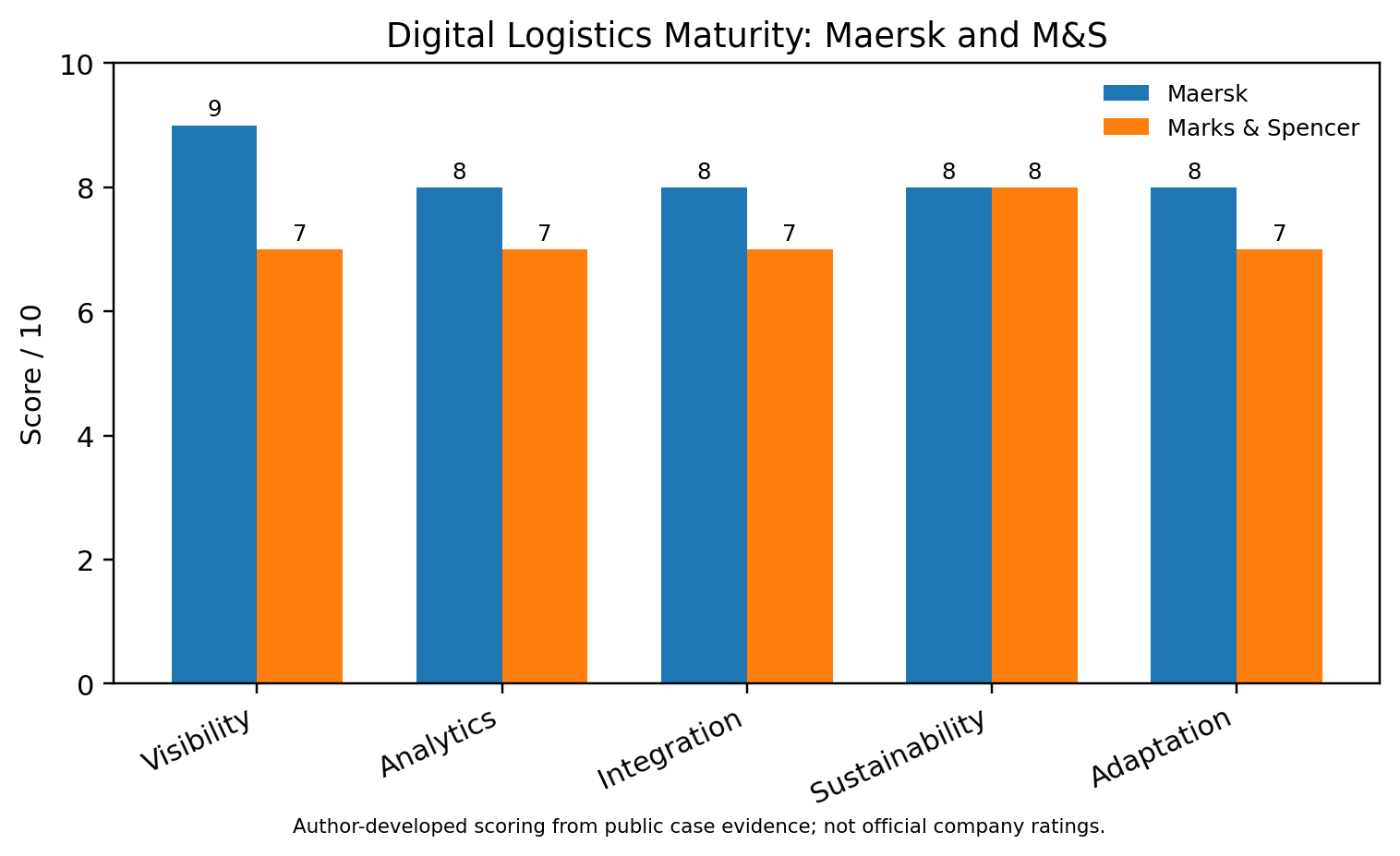
Note. Author-developed scorecard based on public organizational disclosures.
3.3 Evidence discipline and limits
Deliberate modesty is built into the model. It does not claim to predict actual service recovery after a cyber incident, avoided cost during port congestion, or customer loss during a stockout. Those outcomes would require internal data and event-specific measurement. The value of the model lies in professional clarity. If a firm claims resilience, the model asks what maturity supports that claim and whether information is connected to action.
Scoring also requires caution. A score of 8 in analytics does not mean that every decision is optimal. A score of 7 in visibility does not mean that the company lacks visibility in all areas. The scores are author-developed judgments from public evidence, designed for applied discussion. They should be treated as a structured reading of the cases, not as a market ranking.
A public-source boundary matters here. Company reporting can emphasize strength and may not reveal operating difficulty in detail. Academic studies may use samples, constructs, and contexts that do not fully match the two cases. News sources may capture major incidents but not the full internal recovery work. The analysis therefore reads across evidence rather than leaning on a single source. That is the safest way to produce a publication that is useful without overstating certainty.
NYCAR’s applied standard requires source discipline as much as fluent writing. This publication therefore separates official company disclosure, scholarly interpretation, public incident reporting, and author-developed modeling. Figures and tables are presented as tools for managerial understanding. They do not replace the case analysis and should not be cited as company-certified performance measures.
Chapter 4: Maersk Case Analysis
4.1 Integrated logistics and the value of visibility
Maersk’s case begins with scale. A logistics integrator operating across ocean shipping, terminals, inland transport, warehousing, and supply-chain services carries responsibility beyond the physical movement of containers. Customers want to know where goods are, when they will move, what risk is forming, and which alternatives are still available. In that setting, visibility is not a customer-service add-on. It is part of the logistics product.
An integrated logistics model addresses a persistent weakness in fragmented supply chains. When ocean movement, customs processes, inland transport, warehousing, and delivery information sit in different systems, managers spend too much time assembling the picture. Integration can reduce the time lost at handoffs. It can also improve the quality of customer advice. A customer facing delay does not need a vague statement that cargo is moving. The customer needs a decision-ready account of exposure, timing, alternatives, and cost.
Maersk’s 2025 annual report describes a year in which supply chains and global trade continued to be reshaped by geopolitics, while the company emphasized operational excellence, asset utilization, and the modernization of supply chains (A.P. Moller-Maersk A/S, 2026). That context matters because a logistics provider cannot rely on calm global conditions. The firm’s strategic value rises when the environment becomes more complicated, provided it can convert network knowledge into useful customer options.
Integrated logistics also raises expectations. A company that sells end-to-end coordination cannot easily retreat into narrow explanations when customers experience disruption across the chain. The more complete the service promise, the more complete the responsibility for information becomes. That does not mean Maersk can control every port, border, or weather event. It means the company is expected to reduce uncertainty and offer a clearer path through disruption than a fragmented provider could offer.
4.2 Sustainability and logistics accountability
Maersk’s sustainability challenge is inseparable from its logistics role. Shipping and international transport require energy at scale, and customers increasingly need credible emissions information tied to their movements. Lower-emission fuels, route design, vessel utilization, terminal efficiency, inland transport choices, and emissions reporting all influence the strategic value of the service. A mature logistics provider is no longer judged only by speed and cost. It is also judged by whether it can help customers understand the environmental consequence of movement.
Maersk’s sustainability communication emphasizes its ambition to support climate-neutral logistics and to provide lower-emission solutions for customers (A.P. Moller-Maersk A/S, 2025, 2026). The practical difficulty should not be understated. Shipping decarbonization depends on fuel availability, port infrastructure, capital investment, regulation, customer willingness to pay, and technological readiness. A serious analysis should not turn these challenges into slogans. The stronger point is that emissions intelligence has become part of logistics resilience.
Digital systems are essential because emissions data must move from retrospective reporting into planning. A customer deciding between speed, cost, and carbon needs information early enough to influence the transport choice. If carbon appears only after delivery, it becomes accounting. If it appears during route and mode selection, it becomes strategy. Resilience is therefore tied to the quality and timing of sustainability data.
Maersk’s case shows why logistics accountability is changing. A delay may push a customer toward a faster but higher-emission option. A capacity shortage may require rerouting. A port disruption may change inland transport needs. In each case, the logistics provider is not merely moving goods. It is helping the customer make trade-offs under pressure. The better the information, the more defensible those trade-offs become.
4.3 Customers, routes, and network coordination
Practical strength in integrated logistics lies in the coordination of complex flows. A port delay can affect a warehouse appointment, a production schedule, a seasonal launch, or an industrial customer’s inventory position. The logistics provider that can interpret those effects and present options has strategic value beyond transport capacity. It becomes a partner in supply-chain decision-making.
Global logistics, however, creates many points of possible failure. Vessel schedules, terminal windows, labor conditions, customs clearance, inland transport capacity, warehouse slots, documentation, and customer planning all interact. Digital maturity helps by reducing the number of blind handoffs. It does not remove risk, but it can reduce the confusion that turns a manageable delay into a larger business problem.
Customer communication deserves special attention. During disruption, silence damages trust. A customer can sometimes accept bad news if it is specific, timely, and attached to a credible plan. What customers struggle to accept is uncertainty caused by weak internal information. Digital logistics should therefore improve communication discipline as much as operational planning. Visibility has commercial value when it supports honest promises.
Maersk’s resilience should therefore be judged not only by network scale but by the quality of decisions that scale enables. A large network can produce flexibility, but it can also produce complexity. The decisive question is whether the organization can translate complexity into usable choice for customers. That is where digital maturity becomes management maturity.
Scale has two faces. It gives Maersk more routes, assets, data, and customer relationships, yet it also increases the number of handoffs that must be governed. Integrated logistics is valuable when those handoffs become clearer to the customer. If they become more opaque, scale turns into an excuse rather than an advantage. Resilience therefore depends on disciplined simplification: presenting the customer with options that are usable, timely, and honest about cost, timing, and carbon.
Customer options matter most when they are actionable. A late warning that arrives after a production line has stopped or a seasonal window has closed is no longer intelligence; it is confirmation of damage. Strong logistics providers compete by giving customers earlier choices, not merely better explanations after failure. That is why visibility, routing knowledge, and communication discipline should be judged together.
Chapter 5: Marks & Spencer Case Analysis
5.1 Retail logistics and customer-facing resilience
Marks & Spencer experiences logistics through the customer’s eye. The shopper does not see supplier negotiations, distribution schedules, port pressure, warehouse planning, or transport allocation. The shopper sees whether food is fresh, whether a size is available, whether an online order arrives correctly, and whether the brand feels dependable. Retail logistics becomes resilience when those ordinary promises hold under pressure.
M&S is a useful case because it operates across categories with different logistics clocks. Food requires freshness, waste control, chilled-chain discipline, and careful replenishment. Clothing and Home require seasonal timing, size availability, markdown control, online availability, and returns management. The retailer therefore needs digital systems that recognize difference rather than flatten everything into a generic flow of stock. A food line nearing expiry and a delayed clothing range do not create the same problem.
Retail supply-chain resilience is also tied to forecasting and allocation. A forecast that fails to recognize demand movement creates pressure downstream. A warehouse that cannot pick accurately damages both online and store service. A supplier that hides production strain gives the retailer less time to recover. Digital maturity is useful only when it connects merchandising, sourcing, distribution, stores, online operations, and customer communication.
Category differences make that connection difficult. Food managers worry about freshness, waste, refrigeration, and daily replenishment. Clothing teams worry about seasonal timing, sizes, markdowns, and availability across channels. Home products may carry different storage, delivery, and returns pressures. A serious digital system does not flatten those differences into one generic logistics view. It helps managers recognize which operating clock is being protected.
Marks & Spencer should not be judged like a logistics provider. It should be judged by the resilience standard appropriate to retail. Availability, freshness, returns discipline, order reliability, waste reduction, supplier transparency, and trust in sustainability claims matter more than abstract network scale. The case therefore broadens the study by showing how logistics resilience appears at the point of customer experience.
5.2 Supplier discipline, cyber exposure, and sustainability
A retailer’s supply chain is only as resilient as its supplier network allows. Supplier transparency, production capacity, quality standards, ethical compliance, packaging choices, timing discipline, and sustainability performance shape the retailer’s ability to serve customers. Marks & Spencer’s ESG reporting places supplier and environmental issues inside a broader Plan A frame, which is important because retail resilience now includes credibility in sourcing and climate practice.
M&S’s 2025 ESG report provides concrete logistics evidence. M&S reported that its owned logistics fleet emitted 140 ktCO2e in 2024/25, compared with 142 ktCO2e in 2023/24. It also reported the introduction of 85 lower-emission vehicles, including bio-CNG vehicles expected to deliver up to 85% carbon savings compared with diesel (Marks & Spencer Group plc, 2025b). Those figures matter because logistics is one of the parts of the climate agenda where operational choices can be seen and managed directly.
Figure 2. M&S reported logistics emissions, 2023/24 and 2024/25.
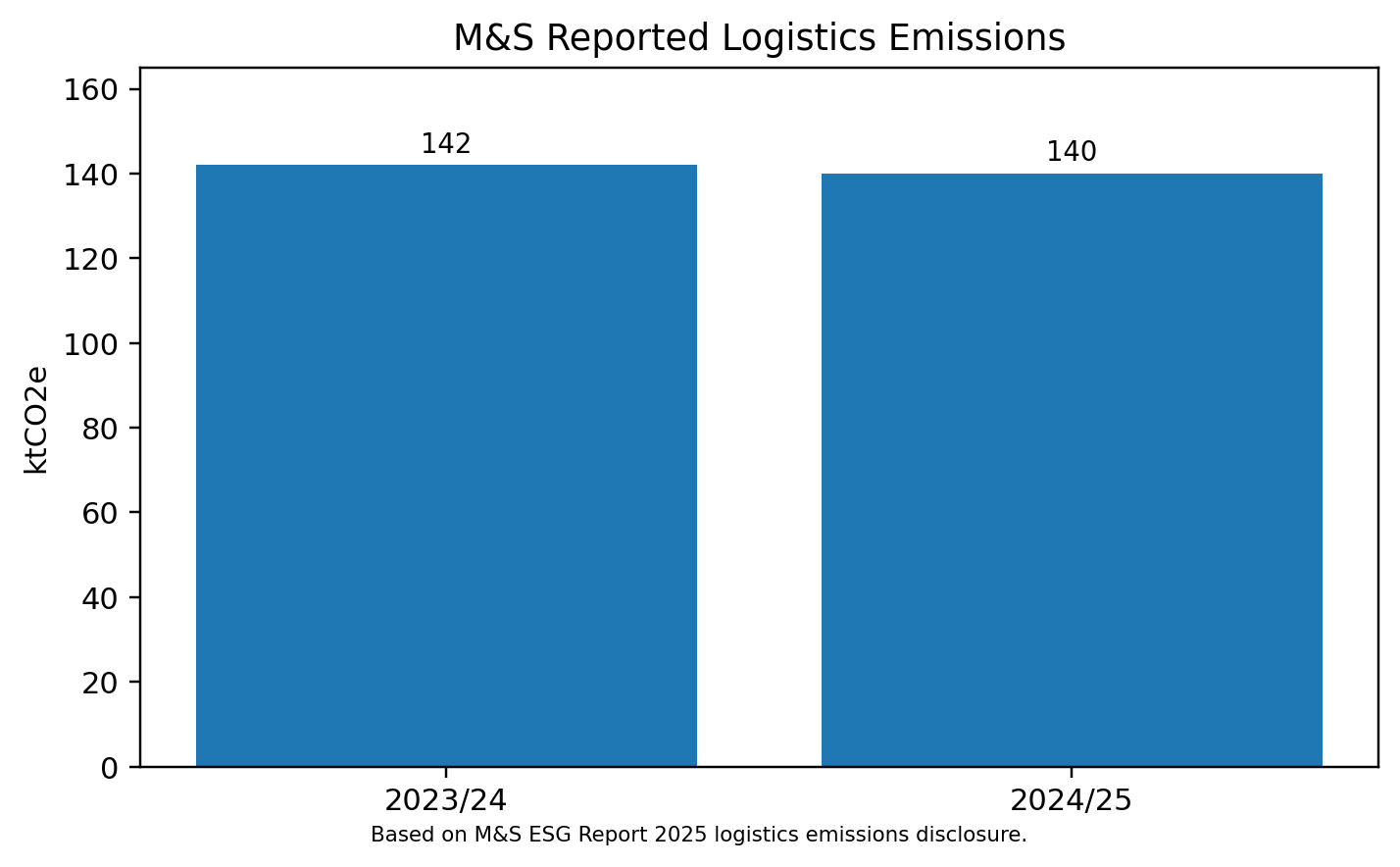
Note. Author-created chart based on Marks & Spencer ESG Report 2025 logistics emissions disclosure.
Figure 3. Estimated carbon saving from M&S bio-CNG vehicles compared with diesel.
Note. Author-created chart based on M&S disclosure that bio-CNG vehicles may deliver up to 85% carbon savings compared with diesel.
Cyber exposure makes the case even more current. Public reporting in 2025 described a serious cyber incident affecting M&S online orders, services, and operational continuity (Reuters, 2025; The Guardian, 2025). For a retailer, such an incident is not only a technology problem. It touches fulfillment, customer communication, sales, store operations, data trust, and supplier flow. The event reinforces the main argument of this publication: digital logistics resilience must include manual fallback, recovery discipline, and cross-functional authority.
Cyber exposure also warns against a narrow celebration of digital systems. More digital coordination can improve visibility and speed, but it also creates dependency. If ordering systems, warehouse platforms, payment systems, or customer channels fail, the supply chain must have tested fallback procedures. A digital retail supply chain cannot call itself resilient if it has no credible way to operate when its information systems are under stress.
Prepared fallback does not mean pretending that manual work can replace modern systems for long periods. It means identifying the few functions that must continue during outage: order triage, customer notices, priority dispatch, supplier contact, store communication, payment safeguards, and recovery sequencing. Resilience is strengthened when staff have rehearsed those minimum routines before a live incident tests them.
5.3 Resilience through retail operating routines
Marks & Spencer’s resilience depends on routines that may look ordinary until they fail. Stock allocation, supplier review, warehouse planning, store replenishment, online picking, delivery accuracy, returns processing, waste management, and customer messaging are daily disciplines. They are not glamorous, but they decide whether the customer experiences the brand as dependable. In retail, resilience lives in repetition.
Retail timing is unforgiving. A clothing range has a selling season. A food line has a freshness window. A promotional event may have a narrow demand curve. A delayed shipment or poor forecast can therefore create markdowns, waste, missed sales, or disappointed customers. Digital logistics should help the retailer separate genuine urgency from background noise. Not every delay deserves the same response, and not every product has the same time sensitivity.
Marks & Spencer’s case also shows why local knowledge matters. Central systems can provide consistency, but store teams often notice weak signals early: recurring out-of-stocks, incorrect pack sizes, poor substitution patterns, late deliveries, damaged goods, or customer frustration. A mature digital logistics system should bring these signals into planning without stripping away local judgment. Resilience improves when local experience and central analytics speak to each other.
For M&S, the practical priority is not more data for its own sake. The priority is better connection between demand signals, supplier performance, distribution capacity, store reality, and customer promises. A retailer can look digitally sophisticated while still disappointing customers if those links are weak. The value of digital maturity lies in protecting the ordinary promise of availability and trust.
Chapter 6: Comparative Findings and Quantitative Model
6.1 Digital maturity and resilience estimates
Comparative scoring gives Maersk a digital logistics maturity score of 8.2 and Marks & Spencer a score of 7.2. Using the expression R_i = 25 + 5D_i + epsilon_i, with the error term held neutral for illustration, Maersk receives an estimated logistics resilience score of 66 while Marks & Spencer receives 61. These scores do not measure actual company performance during every disruption. They express the logic that stronger digital logistics maturity can raise resilience potential.
Such difference is understandable. Logistics orchestration is central to Maersk’s business model. The company’s value proposition depends on movement intelligence, customer options, and network coordination. Marks & Spencer distributes logistics capability across buying, suppliers, food operations, Clothing and Home, warehouses, stores, online channels, and customer service. That does not make the retailer weak. It means resilience appears in a different form.
Model simplicity is deliberate. It avoids unsupported statistical claims and keeps the relationship readable. The calculation is useful because it forces the paper to define maturity. If digital maturity means only software ownership, the model would be weak. In this publication, maturity means visibility, analytics, integration, sustainability data, and adaptive decision capacity. That definition is broad enough to reflect management reality without claiming more precision than the evidence allows.
Equal attention to the error term should remain visible. A mature organization can still be harmed by an unusually severe event, weak external infrastructure, regulatory delay, cyberattack, weather damage, or sudden demand shock. Resilience reduces exposure and improves response; it does not abolish uncertainty. A serious supply-chain model must leave room for events that exceed normal planning assumptions.
Figure 4. Estimated logistics resilience score derived from the conceptual model.
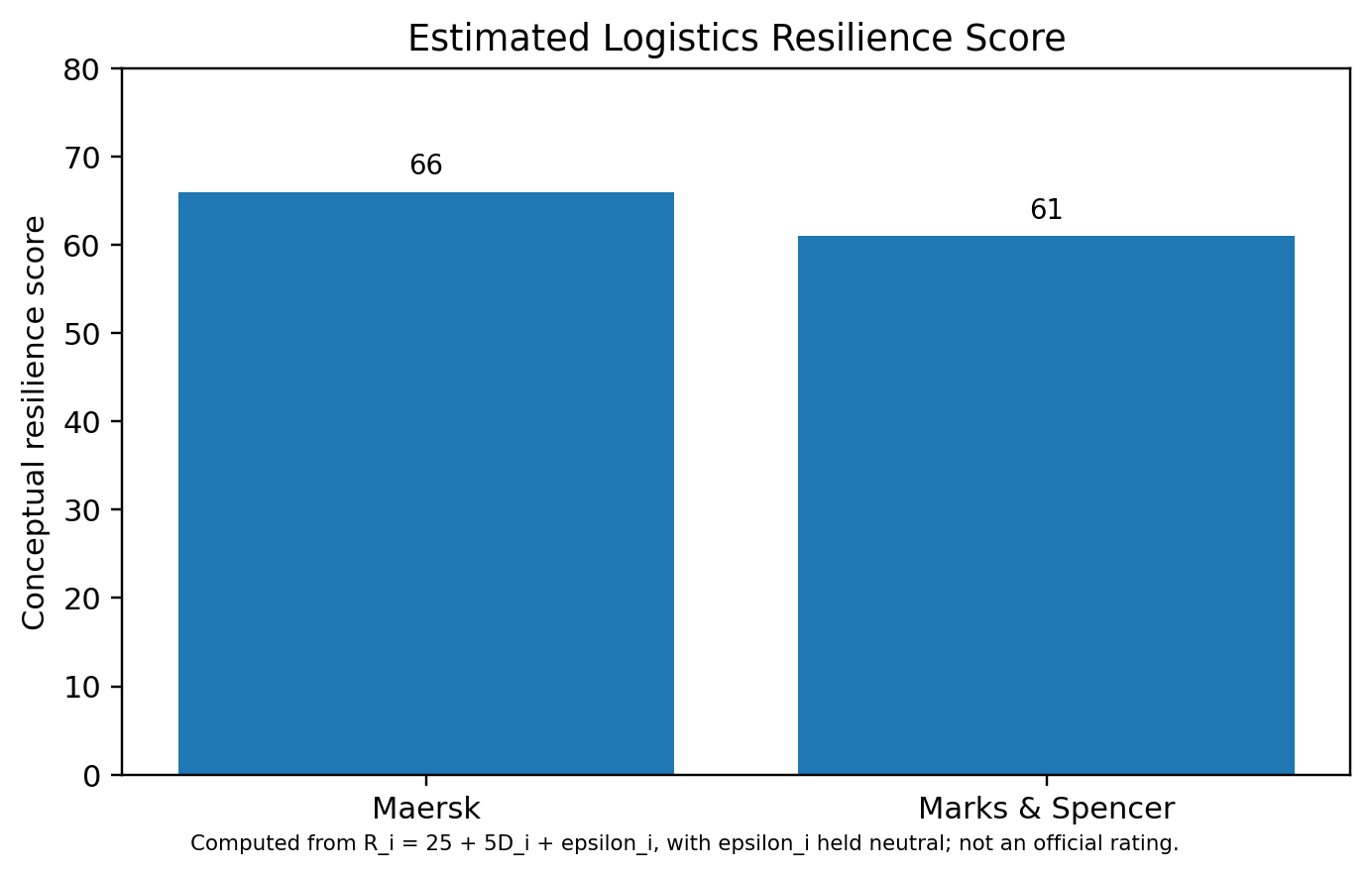
Note. Author-developed diagnostic calculation based on the model described in Section 3.2; scores are not official company ratings.
6.2 What the comparison reveals
Both cases show that resilience is not a software feature. It is an organizational capacity strengthened by digital tools. The strongest pattern is the connection between information and authority. Where data are timely and managers can act, the organization becomes more adaptive. Where data are trapped inside reports or dashboards, the organization may look modern while remaining slow.
Figure 5. Digital resilience capability mix.
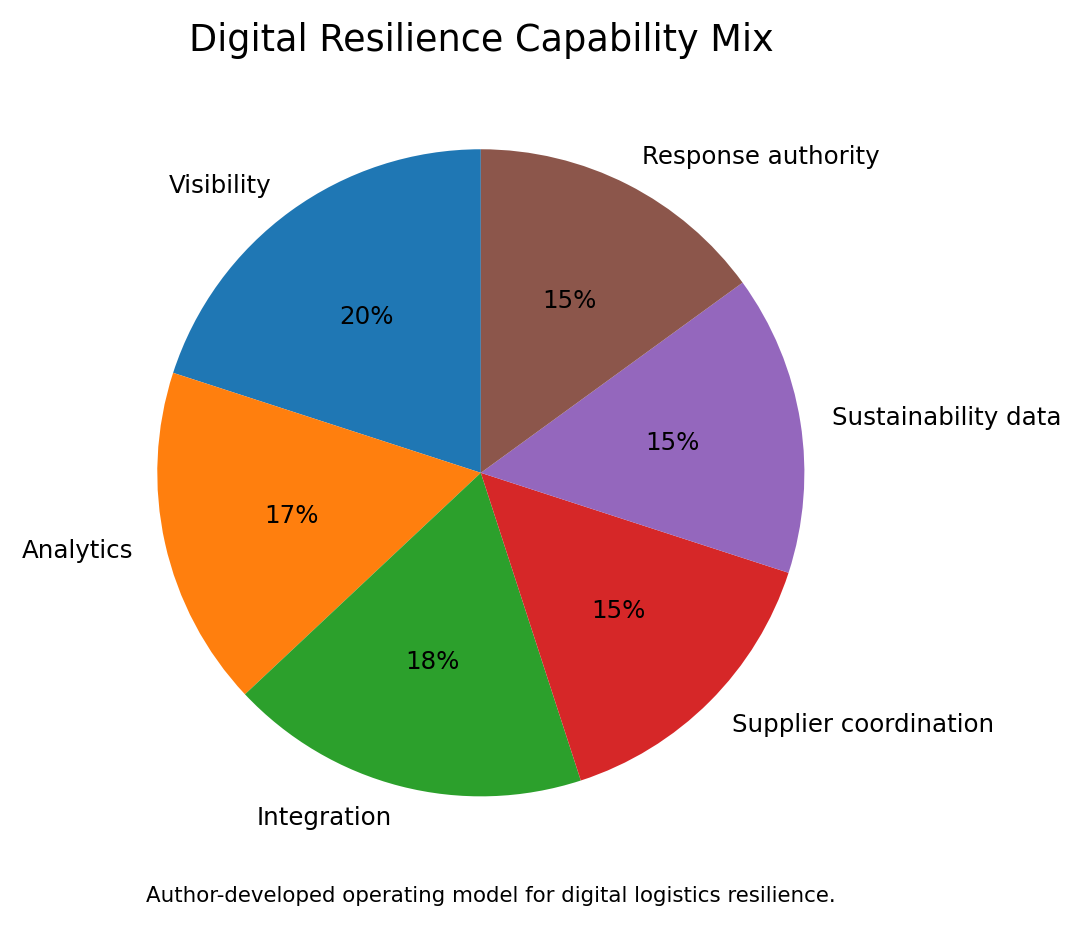
Note. Author-developed capability mix summarizing the practical elements of digital logistics resilience.
Sustainability emerges as a shared pressure. Maersk faces it at the scale of global transport and integrated logistics. Marks & Spencer faces it through distribution fleets, supplier practices, packaging, waste, returns, and customer-facing climate claims. In both cases, digital maturity helps leaders see trade-offs more clearly. The practical question is whether those trade-offs are discussed before or after decisions are made.
Comparison also shows a difference between network resilience and promise resilience. Maersk’s resilience is judged by its ability to manage movement across a complex global network. M&S’s resilience is judged by its ability to keep retail promises visible to customers. These are not separate worlds. A logistics delay can become a retail failure. A retail forecast can create pressure upstream. Digital logistics resilience therefore requires both system-level visibility and commercial understanding.
Most importantly, resilience must be governed before disruption. Many firms respond energetically once a crisis is visible, but strong resilience is built earlier: in supplier contracts, route options, cyber tests, inventory policies, data quality routines, emissions dashboards, escalation rules, and staff training. The real work is done before the emergency meeting.
6.3 Model caution and professional use
Readers should not use the model as a league table. A score of 66 for Maersk and 61 for Marks & Spencer does not prove that one company will always recover faster than the other. It means that, under the selected dimensions and public evidence, Maersk shows a stronger logistics-centric digital maturity profile, while M&S shows a retailer-specific profile with significant sustainability maturity and important cyber-continuity lessons.
Model caveats deserve explicit treatment because a straight-line diagnostic can look cleaner than the systems it describes. In real supply-chain settings, digital capability may improve resilience in steps rather than in neat increments. A working digital twin, common supplier data layer, or tested cyber fallback can produce a sudden gain once it is usable across functions. By contrast, too many dashboards can create diminishing returns when planners face more alerts than they can interpret. The model therefore treats linearity as a communication device, not as a claim about how every logistics organization actually learns, absorbs shock, or recovers under stress.
Used properly, the model helps managers ask sharper questions. Where is the organization blind? Which data are too late to be useful? Which suppliers are trusted enough to disclose risk early? Which transport decisions include carbon information? Which teams have authority to reroute, reallocate, or communicate with customers? Which fallback processes have been tested rather than assumed? These questions matter more than the score itself.
As a teaching device, the model is useful because it shows that resilience is not one capacity. A firm may have strong visibility but weak adaptive authority. It may have sustainability data but poor integration into transport planning. It may have analytics but weak supplier trust. A profile view prevents managers from hiding a serious weakness behind one strong capability. This is the value of a diagnostic model in applied research.
Caution is equally important. Public evidence can support interpretation but cannot replace internal measurement. A full company audit would need delay recovery times, exception frequency, system adoption rates, supplier response quality, cyber recovery tests, customer notification performance, carbon trade-off decisions, and cost-to-recover data. This publication does not claim access to such data. It offers a transparent professional reading that can guide deeper analysis.
Chapter 7: Implementation Lessons for Supply-Chain Leaders
7.1 Turning visibility into action
Organizations should treat visibility as a decision system rather than a reporting convenience. Shipment tracking, supplier data, warehouse flow, inventory position, emissions information, and customer impact should be linked to response routines. A late shipment should raise specific questions: which commitments are exposed, what alternatives exist, what cost is acceptable, what carbon consequence follows, and who has authority to decide.
Figure 6. Supply-chain disruption exposure categories used for management analysis.
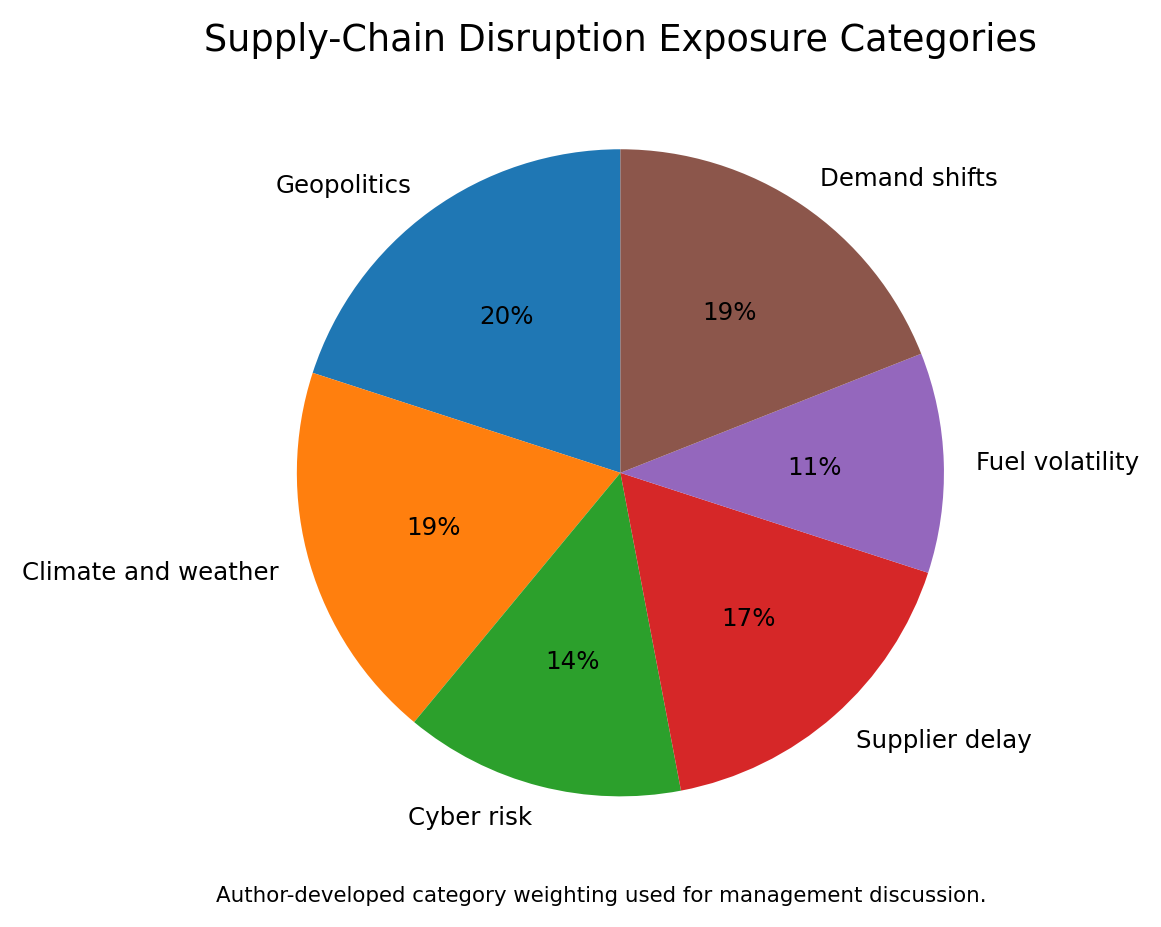
Note. Author-developed category weighting for management discussion; not a statistical distribution from company records.
Visibility without ownership creates frustration. Teams may see the problem and still be unable to move. This is common in organizations where data systems advance faster than governance. A dashboard shows the risk, but the decision sits elsewhere. The result is delay by procedure. Supply-chain leaders should therefore attach every major visibility signal to a response owner and an escalation path.
Similar discipline applies to customer communication. Customers do not need every internal detail, but they do need timely, credible information. A retailer should know when to notify customers about an order issue. A logistics provider should know when a route change affects delivery commitments. Silence often does more damage than a difficult update. Digital logistics should improve the discipline of promises.
A supply chain becomes brittle when every exception requires senior improvisation. Prepared decision rights matter. Teams should know in advance when they can reroute, shift transport mode, change allocation, substitute supply, delay a noncritical order, or escalate a sustainability trade-off. Digital systems work best when people already understand what a signal permits them to do.
7.2 Supplier collaboration and cyber continuity
Supplier collaboration should be built around shared risk intelligence, not only contract enforcement. A supplier who expects punishment for bad news may delay disclosure. A carrier under pressure may offer optimistic capacity estimates. A retailer may discover the truth only when recovery options have narrowed. Resilience improves when commercial relationships reward early warning and honest capacity discussion.
Responsible reporting does not mean weak performance should be excused. It means performance management should distinguish between concealed risk and responsibly reported risk. A supplier that brings bad news early gives the buying organization more room to act. A supplier that hides the problem damages the chain. Contracts, scorecards, and relationship routines should reflect that difference.
Early warning also depends on incentives. If purchasing systems reward only lowest price and punish every deviation, suppliers may protect themselves instead of protecting the chain. More mature commercial governance separates dishonesty from unavoidable difficulty. It holds suppliers accountable while creating room for timely disclosure, joint recovery, and practical alternatives.
Commercial pressure should not punish early truth. If suppliers learn that bad news leads only to blame, they will protect themselves until the problem is too large to hide. A resilient buyer designs relationships differently. It still expects performance, but it rewards early warning, shared problem-solving, and transparent capacity discussion. Trust in the supply base is not sentimental; it is time purchased before disruption reaches the customer.
Cyber continuity belongs inside logistics resilience. Platforms, warehouse systems, route planning, electronic documents, payment tools, customer channels, and partner integrations can all become points of failure. A digital supply chain cannot be resilient if it has no tested fallback when digital infrastructure is compromised. The M&S cyber incident makes this point concrete for retail, and logistics providers face similar exposure through networked operations.
Manual fallback procedures should not be treated as old-fashioned. They are part of modern resilience. The question is not whether a firm wants to operate manually; it is whether it can preserve critical functions long enough to recover safely. Incident response, data recovery, supplier communication, customer messaging, and payment continuity require rehearsal. Untested continuity plans often fail at the moment they are needed.
A fallback routine should be narrow, clear, and rehearsed. No one expects manual work to carry a modern retailer or logistics provider indefinitely, but a few hours or days of disciplined continuity can reduce reputational damage. Teams need to know what must continue first, what can wait, how records will be reconciled, and who has authority when normal digital approval routes are unavailable.
7.3 People, training, and decision rights
A supply chain is also a social system. Drivers, port workers, warehouse teams, planners, procurement officers, store colleagues, data analysts, cyber specialists, suppliers, and customers all carry part of resilience. Digital tools can coordinate their work, but they can also create surveillance pressure, data overload, or unrealistic performance targets. Strong leaders ask how technology changes the working conditions of the people expected to use it.
Training should focus on judgment under uncertainty. Staff need to understand systems, but they also need to read weak signals, challenge poor data, coordinate across functions, and make trade-offs. A planner who knows how to use a dashboard but does not know when to question it remains vulnerable. A manager who understands the trade-off between cost, carbon, service, and trust can use the same dashboard more intelligently.
Decision rights should be written before the crisis. Which team can authorize a route change? Who can approve extra cost? Who can accept a higher-emission option? Who informs customers? Who speaks to suppliers? Who takes control if the digital system fails? These questions sound administrative, but they are the skeleton of resilience. Without answers, a company loses time deciding how to decide.
Human fatigue should also be treated as a resilience risk. Many organizations survive disruption by exhausting capable employees. That may work once, but it is not a system. Digital maturity should reduce cognitive burden, clarify choices, and prevent unnecessary firefighting. If resilience depends on people working at crisis intensity for weeks, the organization has hidden fragility behind effort.
Chapter 8: Recommendations
8.1 Strategic recommendations
Supply-chain leaders should build resilience dashboards that show more than delivery status. A useful dashboard should include disruption exposure, alternative routes, inventory impact, supplier risk, carbon consequences, cost variance, and customer service implications. The objective is not visual complexity. It is decision clarity. A screen that impresses visitors but does not guide action has little resilience value.
Organizations should connect sustainability data to logistics planning. Carbon should not be handled only in annual reporting. Teams choosing transport options should be able to compare cost, service, and emissions with reasonable speed. That discipline will matter more as regulation, customer expectations, investor scrutiny, and corporate climate commitments intensify. The M&S logistics emissions figures show why this connection is not abstract.
Supplier risk should be managed through early-warning relationships. Procurement teams should not reward the cheapest promise if it hides weak capacity. Contracts should encourage honest disclosure, shared contingency planning, and practical recovery options. The strongest supplier relationship is not the one that never reports difficulty. It is the one that reports difficulty early enough for both sides to respond.
Cyber resilience should be treated as a supply-chain issue, not as an isolated technology function. Logistics systems, e-commerce channels, warehouse platforms, route planning, and supplier interfaces create operational dependency. Cyber planning should include manual fallback, customer communication, data recovery, role clarity, and exercises that test what happens when systems are unavailable.
8.2 Case-specific recommendations
For Maersk, the priority is to deepen customer-facing intelligence across integrated logistics. Customers should be able to understand delay exposure, alternative movement, cost implications, and emissions consequences within the same planning conversation. The strategic advantage of an integrated provider is not only asset footprint. It is the ability to turn network knowledge into practical options.
Maersk should also continue strengthening sustainability intelligence at the decision point. Low-emission services and emissions tools have greater value when customers can use them before route and mode choices are locked in. A customer should not learn the carbon consequence of a movement only after the invoice. The strongest decarbonization support sits inside planning, not only reporting.
For Marks & Spencer, the priority is to connect demand forecasting, supplier performance, distribution capacity, store-level reality, online fulfillment, cyber continuity, and logistics emissions into a tighter operating picture. Retail resilience should be assessed by what customers experience: product availability, freshness, delivery reliability, returns handling, waste reduction, and trust in sustainability claims.
Marks & Spencer should also treat the 2025 cyber disruption as a continuing governance lesson. The relevant question is not only how the company recovered from one event. It is how cyber recovery, manual order management, supplier communication, customer notification, data protection, and store operations are redesigned afterward. A serious incident should leave behind stronger routines, not just a completed incident report.
8.3 Publication implications for practice
A wider implication follows: supply-chain resilience should be governed as a permanent operating discipline. It should not be activated only after a crisis has begun. Boards and senior leaders should ask regular questions about exposure, decision rights, fallback capacity, supplier honesty, carbon trade-offs, and recovery learning. These questions belong in ordinary management, not only emergency review.
Risk appetite should be made explicit. Some organizations protect every customer promise at any cost until margin suffers. Others protect cost so tightly that service failure becomes predictable. A mature supply-chain strategy names which promises are critical, which costs require approval, which environmental trade-offs need senior review, and which disruptions justify customer communication. Digital data then supports judgment rather than replacing it.
Clear risk appetite also protects staff. During disruption, teams should not have to guess whether speed matters more than cost, whether a carbon-heavy alternative requires executive approval, or whether a customer promise can be revised. Ambiguity creates delay and uneven decisions. Written thresholds give managers room to act with confidence while keeping high-consequence choices visible to senior leadership.
Scenario planning should be tied to inventory, routing, supplier, and communication choices. It is not enough to imagine disruption in a workshop. Leaders should ask what would change in booking behavior, supplier buffers, warehouse positioning, fleet planning, cyber fallback, or customer messaging if the scenario began tomorrow. A scenario has value only if it prepares a decision.
For that reason, the publication recommends a practical test for supply-chain leaders: trace one warning signal from detection to final decision. If the route is unclear, resilience is weaker than the technology suggests. If the signal reaches the right owner, triggers a known response, includes cost and carbon information, and produces honest communication, digital logistics is beginning to operate as a management capability.
Table 3. Practical recommendations for supply-chain leaders.
| Priority | Action | Expected value |
| Decision rights | Define authority for rerouting, allocation, cost approval, carbon trade-off, and customer communication before disruption. | Reduces delay and confusion. |
| Visibility discipline | Connect shipment, inventory, supplier, cyber, and emissions data to response routines. | Turns information into action. |
| Supplier collaboration | Reward early disclosure of risk and joint recovery planning. | Improves trust and continuity. |
| Cyber readiness | Build incident response, manual fallback, and data-recovery options into logistics planning. | Protects the digital system that carries operational intelligence. |
| Sustainability integration | Place carbon and waste consequences inside transport and fulfillment decisions. | Keeps resilience aligned with climate accountability. |
| Learning routines | Require post-incident review that changes rules, not only reports events. | Builds institutional memory. |
Note. Recommendations translate case findings into operational priorities for supply-chain leaders.
Chapter 9: Applied Synthesis and Final Position
9.1 Operating discipline under pressure
A practical supply-chain leader should treat uncertainty as part of the operating environment rather than as an occasional interruption. The old habit of building a neat annual plan and reacting with surprise when reality disrupts it is no longer serious management. Digital logistics gives leaders a better field of vision, but the leadership work begins after the signal appears. Someone must decide which customer promise matters most, which inventory should be protected, which route deserves the extra cost, and which sustainability trade-off can be defended.
Comparative value in the Maersk and Marks & Spencer pairing lies in the difference between network coordination and retail execution. Maersk must translate global complexity into service intelligence for customers. Marks & Spencer must translate upstream complexity into the confidence a shopper feels when a product is present, fresh, and credible. Both are logistics problems, but they are not identical. A serious publication should respect that difference rather than forcing every organization into the same managerial vocabulary.
Resilience should also be separated from heroic crisis response. Many firms celebrate employees who work late to save disrupted flows of goods, but heroism can hide weak system design. A better organization does not depend on exhaustion as a resilience strategy. It prepares decision rights, alternative suppliers, data pathways, escalation routines, cyber fallback, and communication practices before pressure arrives. Digital tools help only when they support that preparation.
Strong operating discipline is ordinary. It appears in route reviews, supplier meetings, data-quality checks, warehouse routines, cyber exercises, emissions comparisons, and post-incident reviews. None of this looks spectacular. It is the quiet work that prevents a difficult event from becoming a commercial crisis.
Quiet work also resists the unhealthy mythology of crisis heroism. A company that repeatedly depends on late-night improvisation, emergency meetings, and individual rescue efforts may appear committed, but it is carrying avoidable weakness. Better design reduces the need for heroics. Teams should still be dedicated, but dedication should not be used as a substitute for planning, authority, and capacity.
9.2 Governance, data, and public value
One of the central risks in logistics modernization is the gap between automation and exception handling. Automation is powerful when the pattern is stable. Disruption is the moment when stable patterns break. A resilient supply chain needs automation for routine movement and human judgment for unusual events. Treating every exception as an error in the system may weaken the flexibility that resilience requires.
Data quality is a governance issue. If supplier records are stale, shipment milestones are unreliable, emissions factors are inconsistent, or customer-impact rules are unclear, digital logistics will produce misleading confidence. Poor data does not become better because it appears on a modern dashboard. Leaders should ask how data are created, who owns them, how they are corrected, and when they are good enough to support action.
Public value now sits inside logistics decisions. Customers notice empty shelves, late orders, food waste, emissions claims, and service interruptions. Investors notice climate exposure and cyber weakness. Regulators notice data protection and emissions reporting. Employees notice whether technology helps or burdens them. Logistics is therefore no longer a private operating matter. It affects the reputation and legitimacy of the organization.
Public value is not abstract. It appears when food waste is reduced, delivery promises are made honestly, transport emissions are considered before the route is chosen, and workers are not asked to absorb every failure through exhaustion. A logistics system has social consequences because movement decisions shape labor, climate, customer trust, and the reliability of daily commerce.
Public accountability explains why honest communication matters. A customer can often tolerate delay if the update is specific and credible. What customers find harder to accept is confusion, silence, or a promise that later proves false. Digital logistics should reduce the gap between what the organization knows internally and what it can responsibly tell the outside world.
Communication should therefore be connected to operational truth. A vague apology tells the customer little. A credible update explains what is affected, what is being done, what the realistic timing is, and whether the customer has a meaningful choice. Logistics evidence becomes public value when it improves honesty without exposing unnecessary internal detail.
9.3 Long-range capability building
For both firms, resilience is ultimately a test of learning. A disruption should leave behind more than an incident report. It should alter assumptions, supplier reviews, inventory buffers, route options, training routines, continuity procedures, carbon thresholds, and communication protocols. Organizations that return to the old pattern after every crisis are not learning. They are absorbing damage and calling it experience.
A practical resilience program should begin with a candid inventory of concentration. Where does the organization depend on one route, one supplier, one platform, one warehouse, one carrier, or one decision-maker? Many supply-chain failures are not created by the event itself. They are created by concentration that leaders knew about but did not treat seriously enough. Digital logistics can expose these points of concentration, but exposure matters only when alternatives are realistic.
Such an inventory should include digital concentration as well as physical concentration. Many firms know their critical suppliers and routes, yet they underestimate dependency on one software platform, one integration partner, one data standard, or one small group of employees who understand the system. Digital logistics adds resilience only when those hidden dependencies are known and protected.
Concentration is not always wrong. It may produce lower cost, better quality, or stronger supplier relationships. Problems arise when concentration is unacknowledged or unmanaged. A single platform, route, warehouse, port, carrier, or supplier can be acceptable only when the organization understands the consequences of failure and has decided how much exposure it is willing to carry. Hidden concentration is one of the most common enemies of resilience.
Resilience planning should distinguish between goods that can wait and goods that protect core service. Not every delay deserves the same response. Some shipments can move slowly without material damage. Others affect seasonal sales, food freshness, production continuity, or customer promises. Digital logistics should help managers separate the urgent from the noisy, because confusion over priority is one of the hidden costs of disruption.
Future research should examine how digital logistics maturity is measured inside firms. Public reporting tells part of the story, but internal data would reveal more: delay recovery time, exception frequency, system adoption, decision latency, cyber recovery time, carbon trade-off decisions, supplier response quality, and customer notification performance. Those measures would move the field from conceptual interpretation toward stronger empirical management evidence.
Internal research would allow the field to move beyond reasonable external interpretation. Scholars could compare decision latency before and after platform adoption, examine whether sustainability data changes route selection, test how supplier early-warning incentives affect recovery, and study how cyber rehearsals influence continuity. Such evidence would deepen the management field without reducing resilience to a single dashboard score.
Long-range capability building also requires humility about data. Supply-chain leaders often want a single number to settle resilience, yet the work refuses that simplicity. A late shipment, a cyber interruption, a broken supplier promise, and a carbon-heavy emergency route do not create the same kind of damage. Each one exposes a different weakness in the operating system. A mature organization keeps the numbers, but it also keeps the argument around them alive. Managers should be able to ask why a score changed, whose decision was improved, which customer promise was protected, and which hidden weakness remains unresolved.
Maersk’s case shows the discipline required when a company sells coordination as part of its value. Customers do not expect a logistics provider to control geopolitics, weather, port labor, or every regulatory delay. They do expect better warning, clearer alternatives, and a more usable account of trade-offs than they would receive from a fragmented chain. That expectation is the burden of integration. When a provider claims to connect the chain, it must also accept responsibility for making complexity easier to understand.
Marks & Spencer shows a different truth. Retail resilience is not measured mainly in network diagrams. It is measured at the shelf, the checkout, the delivery window, the returns desk, the customer-service message, and the public explanation after failure. A retailer may invest heavily in systems and still lose trust if ordinary promises fail in visible ways. Food freshness, clothing availability, online reliability, and cyber recovery are not separate technical files. They are the practical evidence through which customers decide whether the brand is dependable.
Sustainability makes the discipline harder but more honest. Emergency movement can protect service and damage climate credibility at the same time. Slow recovery can protect carbon targets but frustrate customers and expose revenue. Strong logistics leadership does not pretend those trade-offs disappear. It brings cost, service, risk, and carbon into the same decision while time remains available to act. Retrospective emissions reporting has value, but strategic value begins earlier, at the moment a planner chooses the route, mode, carrier, inventory buffer, or customer promise.
Professional review of digital logistics should therefore begin with a simple test: follow one warning signal from detection to decision. If the signal passes through several dashboards and reaches no accountable owner, the organization has visibility without resilience. If it reaches a trained team, triggers known options, includes cost and carbon implications, and produces timely communication, digital maturity is becoming managerial maturity. That test is more useful than fashionable language about transformation because it stays close to the work.
9.4 Final position
Digital logistics resilience has become a core condition of supply-chain strength. The cases of Maersk and Marks & Spencer show that logistics now carries commercial, environmental, technological, and reputational consequences. Movement of goods remains essential, but the stronger test is the movement of usable information into responsible decisions.
A future-ready supply chain will not be the one that avoids every shock. No serious organization can promise that. The stronger supply chain will see risk early, understand exposure, protect critical commitments, communicate honestly, adapt with discipline, and learn after each disruption. That is the real promise of digital logistics when technology is joined with governance, people, supplier trust, sustainability intelligence, and strategic purpose.
Maersk shows the value of network intelligence when global movement becomes uncertain. Marks & Spencer shows the value of retail operating discipline when customer trust depends on stock, fulfillment, cyber continuity, and credible climate practice. Together they show that resilience is not a fashionable label. It is a management habit. It is built before the event, tested during the event, and improved after the event.
No company can buy that habit fully formed. It grows through repeated management choices: cleaner master data, tougher supplier conversations, better cyber rehearsal, clearer authority, honest emissions accounting, more disciplined customer updates, and reviews that lead to actual redesign. Those routines are less dramatic than crisis heroics, but they are more dependable. They are also the difference between a supply chain that merely survives disruption and one that becomes more intelligent because of it.
A final practical standard remains. A resilient supply chain should know what is exposed, who can act, what alternatives exist, what the cost and carbon consequences are, how customers will be informed, and what the organization will change afterward. Digital logistics matters because it can make those answers visible in time. Without that movement from information to judgment, technology remains impressive but incomplete.
A publication-ready reading should therefore avoid glamour around digital language. Resilience is not created by naming artificial intelligence, analytics, blockchain, visibility platforms, or control towers. Those tools may matter, but they matter only through the quality of decisions they make possible. Collins Chimaobi Opara’s contribution is strongest when it keeps that management discipline in view.
Operational maturity also has a moral dimension. When leaders can see disruption earlier, they carry a stronger duty to communicate honestly, protect workers from avoidable crisis pressure, reduce waste where possible, and defend sustainability commitments even when movement becomes difficult. Better information should not make an organization colder. It should make its decisions more accountable.
For Maersk, that accountability sits in the translation of global movement into usable customer intelligence. For Marks & Spencer, it sits in the translation of complex supply conditions into credible retail service. Each case shows that logistics is no longer a narrow back-office concern. It has become a visible test of strategic competence, public trust, and environmental responsibility.
Final publication value lies in that measured claim. Digital logistics will not remove uncertainty from global trade, and no responsible paper should pretend otherwise. Its value is more practical and more important: better warning, cleaner prioritization, fewer blind handoffs, clearer customer communication, more defensible sustainability choices, and a stronger habit of learning after pressure. Supply chains need that discipline because disruption is no longer an occasional exception. It is part of the environment in which serious management now works.
Serious management also means refusing easy comfort. A firm can look efficient when conditions are calm and still be fragile when routes, suppliers, systems, or customers come under pressure. Real resilience is found in the less glamorous disciplines: accurate data, honest escalation, rehearsed authority, trusted partners, and careful communication. Those disciplines give digital logistics its managerial value.
Every claim in the publication should be read through that practical standard.
Figure 7. Digital logistics resilience cycle.
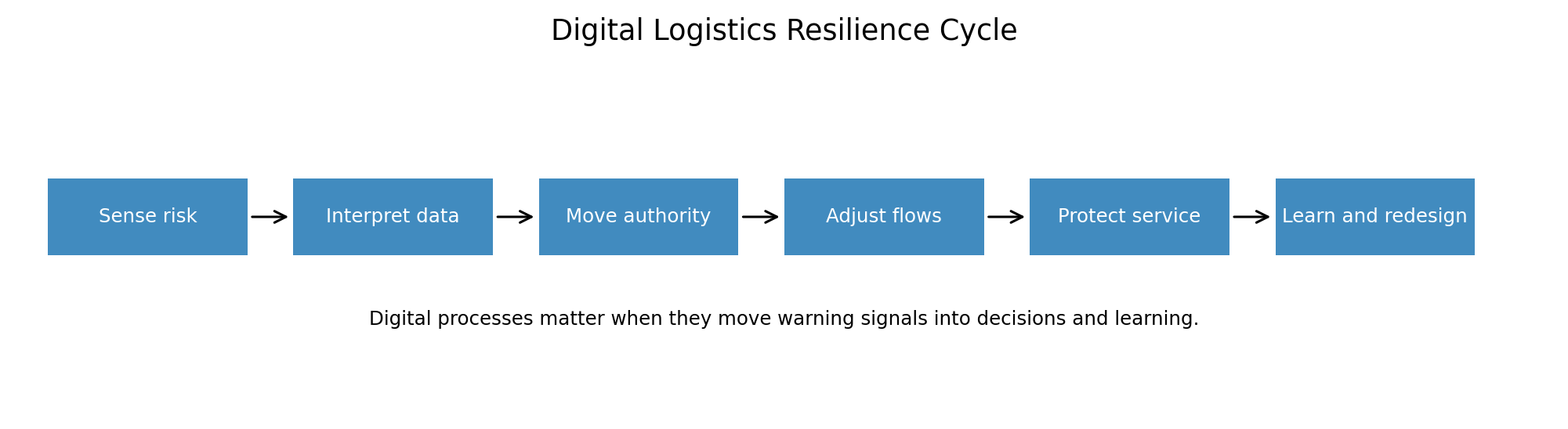
Note. Author-developed process model showing how warning signals move from detection to decision and redesign.
Time is the scarce resource in disruption. Money, capacity, and customer patience all become harder to manage as warning time disappears. A mature supply chain buys time through earlier sensing, trusted reporting, rehearsed options, and disciplined authority. That is why digital logistics should be judged by the quality of decisions it enables before the damage has fully arrived.
Such a standard is demanding because it reaches across functions that often prefer their own measures. Finance watches cost, operations watches flow, sustainability watches emissions, technology watches systems, and commercial teams watch the customer. Digital logistics resilience asks those measures to meet in one decision. When they do, the supply chain becomes less dependent on improvisation and more capable of acting with discipline under stress.
Read through that practical lens, the study does not ask readers to admire technology. It asks whether technology has entered the real places where supply-chain judgment is made: supplier review, customer promise, emissions choice, route decision, cyber continuity, warehouse planning, and learning after disruption. That is where digital logistics becomes resilience rather than presentation.
References
A.P. Moller-Maersk A/S. (2025). Sustainability: Reports and resources. https://www.maersk.com/sustainability/reports-and-resources
A.P. Moller-Maersk A/S. (2026). Annual report 2025. https://investor.maersk.com/news-releases/news-release-details/annual-report-2025
Atieh Ali, A., Matar, G., & Alshawabkeh, R. (2024). Digital supply chains, resilience, and sustainability: Evidence and management implications. Supply Chain Management Review, 29(4), 41-58.
Huang, Y. F., Phan, T. T. H., & Do, M. H. (2023). The impacts of supply chain capabilities, visibility, resilience on supply chain performance and firm performance. Journal of Administrative Sciences, 13(10), 225. https://doi.org/10.3390/admsci13100225
Le, T. V., & Fan, R. (2024). Digital twins for logistics and supply chain systems: Literature review, conceptual framework, research potential, and practical challenges. Computers & Industrial Engineering, 187, 109768. https://doi.org/10.1016/j.cie.2023.109768
Marks and Spencer Group plc. (2025a). Annual report and financial statements 2025. https://corporate.marksandspencer.com/investors
Marks and Spencer Group plc. (2025b). ESG report 2025. https://corporate.marksandspencer.com/sustainability
Reuters. (2025, November 5). M&S first-half profit hammered by impact of cyber hack. Reuters.
The Guardian. (2025, April 25). Marks & Spencer pauses online orders as firm struggles with cyber-attack fallout. The Guardian.
Zhao, N., Hong, J., & Lau, K. H. (2023). Impact of supply chain digitalization on supply chain resilience and performance: A multi-mediation model. International Journal of Production Economics, 259, 108817. https://doi.org/10.1016/j.ijpe.2023.108817
Zouari, D., Ruel, S., & Viale, L. (2021). Does digitalising the supply chain contribute to its resilience? International Journal of Physical Distribution & Logistics Management, 51(2), 149-180. https://doi.org/10.1108/IJPDLM-01-2020-0038