

Synodality, Safeguarding, Financial Accountability, and Trust in Mission-Centered Administration
Research Publication by Peter A. Otuonye
New York Center for Advanced Research (NYCAR)
Publication Date: June 2026
Publication Number: NYCAR-TTR-2026-RP040
DOI: https://doi.org/10.5281/zenodo.20546035
Peer Review Status:
This research publication has been reviewed under the internal editorial framework of the New York Center for Advanced Research (NYCAR) and The Thinkers’ Review. The review assessed doctoral-level coherence, ecclesial source integrity, safeguarding sensitivity, financial-stewardship reasoning, quantitative-model suitability, APA 7th alignment, and institutional relevance. The work is approved for doctoral-level NYCAR institutional publication.
Abstract
Catholic institutions do not lose trust only through public scandal. They lose it more quietly through vague authority, weak records, ceremonial consultation, poor financial explanation, safeguarding procedures that never reach daily supervision, and leadership habits that ask the faithful to trust what the institution has not made inspectable. This research publication examines Catholic governance as pastoral stewardship: the disciplined care of people, mission, money, authority, information, and institutional memory. The argument is not that Catholic schools, parishes, diocesan offices, hospitals, seminaries, or charities ought to imitate secular corporations. The demand is stricter. Catholic institutions have to govern in a manner worthy of their own claims about truth, service, human dignity, participation, and protection.
The analysis draws on recent Church and institutional sources, including the Final Document of the Synod on Synodality, Praedicate Evangelium, diocesan financial-management guidance from the United States Conference of Catholic Bishops, safeguarding reporting from the Pontifical Commission for the Protection of Minors, and contemporary implementation scholarship. These sources are read as practical governance evidence, not as decorative citations. Synodality is treated as a demand for accountable participation. Financial stewardship is treated as a visible duty to communities that give sacrificially. Safeguarding is treated as the hardest test of moral credibility because vulnerable persons cannot be protected by documents that are not practiced. Lay competence is treated as co-responsibility with defined roles, not as courtesy involvement.
The research develops a Pastoral Governance Stewardship Score, a governance response-lag model, a safeguarding exposure index, and a trust-repair credibility ratio. These instruments are not presented as canonical devices or substitutes for diocesan authority. They are decision aids for leaders who need to know whether governance claims have become reliable practice. The revised model uses hard gates: no Catholic institution can compensate for weak safeguarding, financial opacity, or missing decision records by scoring well on participation language or pastoral energy. Some failures close the file until corrected.
The central conclusion is practical and theological. Mission becomes credible when authority can be answered for, consultation leaves a trace, money can be explained, councils receive evidence, safeguarding reaches supervision, and records preserve truth when memory becomes contested. A Catholic institution that cannot show how it decides, protects, spends, listens, corrects, and learns asks people for a form of trust that responsible stewardship should never demand.
Keywords: Catholic governance, pastoral stewardship, synodality, safeguarding, financial transparency, lay competence, council functionality, institutional trust, Catholic administration, NYCAR.
Contents
Abstract
Chapter 1: Introduction
Chapter 2: Ecclesial and Governance Literature Review
Chapter 3: Methodology and Quantitative Framework
Chapter 4: Accountability, Finance, Safeguarding, and Records
Chapter 5: Synodality, Councils, and Lay Competence
Chapter 6: Public Case Anchors and Institutional Lessons
Chapter 7: Implementation Roadmap and Stress Testing
Chapter 8: Doctoral Discussion
Chapter 9: Conclusion and Recommendations
Chapter 10: Applied Governance Playbooks
Chapter 11: Governance Risk Scenarios
Chapter 12: Implementation Templates and Doctoral Closing Note
Chapter 13: Cross-Context Application and Research Agenda
Appendix A: Governance Review Instruments
Appendix B: Diagnostic Scoring Rubric
References
List of Tables and Figures
Table 1. Pastoral Governance Stewardship Score components.
Table 2. Hard-gate interpretation rules for Catholic governance review.
Table 3. Governance failure points and corrective controls.
Table 4. Annual implementation cycle for Catholic institutions.
Figure 1. Illustrative Pastoral Governance Stewardship Review.
Figure 2. Governance Risk Exposure by Control Area.
Figure 3. Illustrative Response Lag in Mission Delivery.
Figure 4. Trust Repair Readiness Across Institutional Practices.
Chapter 1: Introduction
Catholic governance becomes real at points that are easy to underestimate: the parish finance report that ordinary people can understand, the safeguarding file that shows who acted and when, the council minutes that do more than record attendance, the school policy that is followed when a popular employee is accused, the diocesan appointment whose reasons can be explained without embarrassment, and the complaint that is answered without institutional defensiveness. These moments do not sit outside the Church’s mission. They disclose whether the mission has acquired dependable form. A Catholic institution may preach dignity, participation, and service with complete sincerity, yet still injure trust if the systems beneath those words remain improvised, undocumented, or excessively dependent on the temperament of one leader.
This research publication treats governance as stewardship rather than as administrative decoration. Stewardship means responsible care for what has been entrusted. In Catholic institutions, what is entrusted is property or money. It includes minors and vulnerable adults, sacramental credibility, parishioner confidence, employee safety, family sacrifice, donor intention, institutional memory, clerical authority, lay competence, confidential records, and the public witness of the Church. The word governance can sound cold in pastoral settings, but weak governance is rarely gentle in its effects. It leaves people uncertain about who is responsible. It places good leaders at risk because their decisions lack records. It permits informal power to harden into habit. It allows serious warnings to disappear inside conversation rather than move into accountable response.
The paper is written at doctoral level because the subject requires more than a list of good practices. Catholic institutions need a framework able to hold theology, canon-sensitive authority, nonprofit accountability, safeguarding, finance, leadership formation, implementation discipline, and trust repair in one view. The goal is not to import business language into ecclesial life until parish work feels like corporate management. That would miss the point. The goal is to show that the Church’s own understanding of mission, service, participation, and truth requires visible institutional habits. Where those habits are absent, pastoral language carries more weight than it can bear.
1.1 Background to the Study
Catholic institutions often inherit trust before they demonstrate the administrative disciplines that should sustain it. Parents enroll children because a Catholic school promises formation and safety. Donors contribute because they believe offerings will serve mission. Staff accept roles because the institution claims moral purpose. Parishioners accept guidance because pastoral office still carries spiritual authority. Vulnerable persons seek help because the Church presents itself as a place of protection and care. That prior trust is precious, but it also creates danger. Institutions trusted in advance must be more accountable, not less, because the people who approach them often do so with lowered defenses.
Recent Church life has made the problem unavoidable. The Synod on Synodality renewed language around communion, participation, and mission, but participation cannot remain a listening exercise with no path into decisions. The Final Document of the Synod repeatedly presses the Church toward practices in which the baptized are not passive recipients of decisions but active participants in discernment and mission. Praedicate Evangelium, while written for the Roman Curia, speaks of ecclesial service, cooperation, competence, and mission in a way that applies beyond Rome. The text does not make governance secular. It places order and service inside evangelization.
Safeguarding has placed an even harsher demand on Catholic governance. An institution may survive inefficient budgeting or weak meeting discipline for years, though not without damage. It cannot treat safeguarding as another file. The abuse crisis has shown how vague authority, secrecy, poor records, clerical self-protection, and institutional concern for reputation can injure victims and disfigure the Church’s witness. The Pontifical Commission for the Protection of Minors has continued to press the need for safeguarding cultures marked by transparency, accountability, and survivor attention. Those words only matter when they shape supervision, reporting pathways, record keeping, training, appointment decisions, and consequences.
Financial stewardship presents another test. A Catholic budget is a moral document before it is a technical document. Collections, tuition, grants, bequests, fundraising campaigns, parish dues, diocesan assessments, and charitable donations carry intention. Money given for mission should not be managed through habits that would be unacceptable in a serious nonprofit or school system. The USCCB guide on diocesan financial management is useful because it translates stewardship into controls, reporting, budgeting, audit readiness, segregation of duties, and responsible oversight. Such controls do not betray trust. They make trust reasonable.
1.2 Problem Statement
The central problem is that many Catholic institutions possess strong mission language but weaker habits for making mission answerable. A parish may invite consultation but keep no record of what was heard or how it influenced action. A school board may exist without knowing whether it advises, approves, supervises, or merely receives information. A diocesan office may move personnel through informal channels that become impossible to reconstruct later. A finance council may meet but never receive reports detailed enough to permit responsible judgment. A safeguarding policy may be formally correct while practical supervision remains inconsistent.
These weaknesses are not always malicious. Some arise from overburdened clergy, undertrained lay administrators, small parish capacity, inherited custom, fear of conflict, or misplaced worry that structure will damage pastoral warmth. Yet the effect is still serious. Good intentions do not protect children. Goodwill does not create an audit trail. Personal sincerity does not replace financial controls. Listening without response does not build synodality. A Catholic institution that relies on trust while refusing the disciplines that make trust inspectable places its own mission at risk.
The research problem, therefore, is not whether Catholic institutions should govern. They already govern every time they assign roles, spend money, record or fail to record a meeting, respond to a complaint, appoint staff, handle allegations, or invite consultation. The problem is whether they govern as stewardship: visibly, proportionately, truthfully, competently, and in service of mission. This paper addresses that problem by developing a doctoral-level framework and diagnostic model that can be used by parishes, dioceses, Catholic schools, seminaries, hospitals, and charities without pretending that all institutions carry the same scale or complexity.
1.3 Aim and Objectives
This research publication examines Catholic governance as pastoral stewardship and designs a practical, source-grounded model for assessing accountability, synodal participation, safeguarding discipline, financial transparency, decision records, lay competence, council functionality, and trust repair. It does not claim confidential diocesan data, hidden interviews, or insider files. Its evidence base is public: ecclesial documents, official guidance, nonprofit accountability principles, and contemporary implementation scholarship.
The objectives are direct. First, the paper clarifies why governance belongs inside Catholic mission rather than outside it. Second, it reads recent Church documents as sources of administrative obligation. Third, it identifies recurring governance weaknesses that damage credibility. Fourth, it develops a Pastoral Governance Stewardship Score with hard gates for safeguarding, finance, and documentation. Fifth, it offers implementation methods that leaders can adapt to different institutional sizes. Sixth, it provides a trust-repair approach for communities where previous governance failures have already injured confidence.
1.4 Research Questions
The research publication is guided by five questions. How should Catholic governance be understood when pastoral authority, institutional responsibility, synodality, safeguarding, finance, and public trust meet in the same organization? What do recent ecclesial sources imply for accountability and participation? Which governance failures most often damage Catholic institutional credibility? How can a diagnostic model help leaders examine stewardship without reducing ministry to numbers? What practices allow trust to be repaired when weak governance has already harmed people or communities?
1.5 Significance of the Study
The significance of the study lies in the everyday character of the risk. Governance failure does not always announce itself dramatically. It appears in missing minutes, unclear roles, undocumented exceptions, vague complaints handling, weak financial reports, neglected supervision, informal procurement, and councils that discuss without consequence. These details decide whether an institution can respond credibly when serious questions arise. A Catholic institution that has kept records, trained people, clarified authority, reported money well, and practiced safeguarding has a very different moral position from one that must reconstruct reality after the fact.
For Catholic leaders, the paper offers a way of speaking about governance without embarrassment. For lay professionals, it affirms that their competence is part of co-responsibility and not a decorative courtesy. For clergy and religious leaders, it shows that accountable structure can protect pastoral authority from suspicion and overload. For researchers, it joins ecclesial sources and organizational implementation theory in a single applied framework. For communities, it insists that trust should not be demanded merely because the institution is Catholic; trust should be supported by visible stewardship.
Chapter 2: Ecclesial and Governance Literature Review
2.1 Governance as Pastoral Stewardship
The word stewardship is often narrowed to fundraising, but Catholic governance requires a much wider meaning. Stewardship is the disciplined care of whatever has been entrusted: mission, people, gifts, truth, property, records, money, safeguarding obligations, and authority. In the Catholic setting, governance has theological weight because the institution does not present itself as a neutral service provider. It claims to serve God and people through ecclesial mission. That claim raises the standard for administration. Poor practice is not redeemed by religious vocabulary. If anything, religious vocabulary makes poor practice more damaging because the failure is experienced as contradiction (United States Conference of Catholic Bishops, 2024; Standards for Excellence Institute, n.d.).
Nonprofit accountability resources help make this point practical. Ethical governance, transparent processes, board responsibility, financial oversight, and conflict management are common expectations for serious nonprofit life. Catholic institutions should not resist such expectations simply because their mission is spiritual. The Church’s mission gives stronger reasons for accountability. A parish or Catholic school that handles money, employment, facilities, minors, and public communications must be able to explain how decisions are made, how risk is controlled, and how complaints are heard (United States Conference of Catholic Bishops, 2024; Standards for Excellence Institute, n.d.).
The pastoral character of governance becomes clear when one follows the effect of weak administration. A parent may lose confidence in a Catholic school because a safeguarding concern was handled evasively. A donor may stop giving because financial reports are vague. A skilled lay professional may withdraw from council service because meetings are ceremonial. Staff may become cautious because decisions change without record. Parishioners may feel unheard because consultation never alters action. These are pastoral consequences. They affect belonging, participation, generosity, and faith in the institution’s integrity (United States Conference of Catholic Bishops, 2024; Standards for Excellence Institute, n.d.).
2.2 Synodality and Accountable Participation
The Final Document of the Synod on Synodality gives renewed force to participation, listening, discernment, and mission. For governance, the decisive issue is whether listening has institutional consequence. Many Catholic communities know how to hold a consultation. Fewer know how to create a traceable path from listening to decision, implementation, explanation, and review. Without that path, synodal language can become emotionally attractive but practically thin (General Secretariat of the Synod, 2024).
Accountable participation does not mean that every participant receives the decision he or she wants. It means that the process is serious enough to preserve what was heard, to distinguish local authority from external constraint, to weigh evidence, to discern responsibly, and to communicate the result. If a parish asks young adults, parents, staff, or ministry leaders to speak but never explains what changed, participation gradually loses credibility. People do not withdraw from synodal processes only because they are impatient. They withdraw because they have learned that the institution listens without memory (General Secretariat of the Synod, 2024).
Synodality also clarifies the role of lay competence. The baptized should not be treated as a passive audience. Finance professionals, educators, lawyers, clinicians, safeguarding specialists, communications experts, social workers, engineers, and administrators bring gifts that can help the Church govern more truthfully. Their participation, however, requires role clarity. A council member should know whether the role is advisory, consultative, supervisory, consent-based, or executive under local norms. Confusion in this area produces frustration and sometimes manipulation. People are invited into responsibility, then denied the information necessary to carry it (General Secretariat of the Synod, 2024).
2.3 Authority as Service after Praedicate Evangelium
Praedicate Evangelium describes the Roman Curia in language of service to the Pope, bishops, evangelization, and the local churches. Although the document concerns the Curia, its wider lesson is that ecclesial authority should be understood as service ordered toward mission. That insight has direct relevance for Catholic institutions outside Rome. Authority is not credible because it is private, inaccessible, or undocumented. It is credible when it can show how its decisions serve mission and protect people (Francis, 2022).
Service authority needs structure because service can be claimed too easily. A leader may sincerely intend to serve but still leave decisions undocumented, fail to consult relevant expertise, delay safeguarding action, or keep financial information too close. Structure does not replace virtue; it helps virtue endure pressure. It also protects leaders from the impossible expectation that personal goodness alone can carry institutional complexity. A pastor, principal, diocesan director, or agency head needs systems that make responsible action easier and irresponsible action harder (Francis, 2022).
The document’s attention to competence is especially important. In modern Catholic institutions, competence is not an optional supplement to piety. It is part of fidelity. A chancery, parish office, school, seminary, hospital, or charity that lacks the skills required for finance, safeguarding, records, employment, communications, and risk management cannot serve well merely by invoking mission. Competence must be formed, recruited, respected, and governed (Francis, 2022).
2.4 Financial Stewardship and Donor Trust
Financial governance often reveals the true priorities of an institution. A budget shows what leaders are willing to resource. Reports show whether they trust the community with meaningful information. Controls show whether they understand that honest people still need good systems. The USCCB diocesan financial-management guidance is helpful because it moves stewardship from intention into practice: budgeting, internal control, audit readiness, financial reporting, investment policy, segregation of duties, and responsible review (United States Conference of Catholic Bishops, 2024).
Catholic money carries a special moral density. Parish offerings may come from elderly members on limited income, immigrant families supporting both church and relatives abroad, school parents already paying fees with difficulty, or donors who believe that a capital campaign will serve a stated ministry. Such money should not disappear into opaque categories. A community does not need every technical detail, but it needs enough information to know whether leaders are serious, whether mission priorities receive resources, and whether controls protect the common good (United States Conference of Catholic Bishops, 2024).
Weak finance practice also harms leaders. Vague reports invite rumor. Informal procurement turns even legitimate decisions into objects of suspicion. When one person controls too much of the process, fraud becomes easier and false accusation becomes harder to refute. Financial transparency protects leaders who want to serve cleanly and leave a defensible record (United States Conference of Catholic Bishops, 2024).
2.5 Safeguarding as the Hardest Governance Test
Safeguarding is the most severe test because the institution deals with minors, vulnerable adults, spiritual authority, secrecy, shame, and harm that can last a lifetime. A Catholic institution that treats safeguarding as compliance rather than moral protection has already misunderstood the issue. Policies, background checks, training, reporting lines, supervision, survivor care, and review mechanisms are not bureaucratic burdens. They are the concrete form of the Church’s promise to protect (Pontifical Commission for the Protection of Minors, 2024; Holy See Press Office, 2024).
The Pontifical Commission for the Protection of Minors has emphasized transparency, accountability, and the inclusion of victims and survivors in the Church’s safeguarding response. That emphasis matters because institutions often prefer to speak about policy rather than experience. Survivors and affected families frequently expose gaps that documents hide: delayed response, defensive communication, poor record keeping, unclear jurisdiction, or leaders more concerned with reputation than protection. Governance must be judged partly by whether such voices can reach action (Pontifical Commission for the Protection of Minors, 2024; Holy See Press Office, 2024).
Safeguarding also tests institutional courage. A policy is easiest to apply when the accused person is marginal. The real test occurs when the person is popular, senior, generous, charismatic, or linked to powerful networks. Serious governance anticipates that pressure. It creates pathways that do not depend on personal bravery alone. Reporting duties, external notification where required, independent advice, supervision records, and clear consequences protect the vulnerable precisely when informal culture would prefer silence (Pontifical Commission for the Protection of Minors, 2024; Holy See Press Office, 2024).
2.6 Records, Institutional Memory, and Truth
Documentation is sometimes dismissed in pastoral settings as an administrative nuisance. That view is dangerous. Records preserve truth when memory becomes selective. They protect those who acted responsibly. They expose delay. They permit successors to understand previous decisions. They show whether complaints were heard, whether councils advised, whether money was approved, and whether safeguarding action was taken. A Catholic institution that does not document major decisions is making a theological as well as managerial mistake. It is failing to respect truth under conditions where truth may later be contested (General Secretariat of the Synod, 2024; Leadership Roundtable, 2025).
Institutional memory is fragile. Clergy are transferred. School leaders retire. Council members rotate. Volunteers move. Staff leave. A community may believe that everyone knows why a decision was made, but five years later the explanation has evaporated. Records are the institution’s memory discipline. They do not need to be excessive, but they must be adequate. Minutes, approval notes, safeguarding files, financial reports, risk assessments, and communication records can make the difference between responsible continuity and institutional amnesia (General Secretariat of the Synod, 2024; Leadership Roundtable, 2025).
Documentation also restrains power. A leader who knows that decisions must be recorded is more likely to seek evidence, consult relevant parties, and clarify the reason for action. A council that knows minutes will record unresolved issues is less likely to perform discussion without responsibility. A safeguarding coordinator who knows records will be reviewed is less likely to rely on informal reassurance. Records do not make institutions holy, but they make evasion harder (General Secretariat of the Synod, 2024; Leadership Roundtable, 2025).
2.7 Strategy Implementation and Catholic Institutions
Implementation scholarship helps Catholic institutions because many Catholic plans fail at the same points that organizational plans fail elsewhere: unclear ownership, weak coordination, insufficient competence, unfunded priorities, poor communication, and lack of review. Tawse and Tabesh describe implementation as requiring competence, commitment, and coordinated action. Catholic mission does not remove those requirements. It intensifies them because the consequences of weak delivery reach people who approached the institution with trust (Tawse & Tabesh, 2021; Tawse et al., 2024; Mwanza, 2025).
Middle managers matter in this process. In Catholic institutions, the equivalent roles may include pastors, associate pastors, principals, diocesan directors, safeguarding officers, finance managers, religious superiors, hospital executives, ministry coordinators, and council chairs. They translate direction into daily routine. If they are confused, unsupported, or excluded from planning, implementation weakens no matter how beautiful the vision sounds. Leadership that bypasses those people may produce announcements but not delivery (Tawse & Tabesh, 2021; Tawse et al., 2024; Mwanza, 2025).
Implementation theory also exposes a common Catholic temptation: the belief that a plan has moral force because its language is good. A pastoral plan, safeguarding program, mission statement, or school improvement strategy becomes real only when people, money, time, training, records, and review are assigned. Good language can inspire; it cannot execute. The challenge is not to remove spiritual language but to ask whether the institution has made that language operationally truthful (Tawse & Tabesh, 2021; Tawse et al., 2024; Mwanza, 2025).
2.8 Trust Repair and Institutional Credibility
Trust repair is slower than leaders usually hope. It does not occur because a statement was issued or a committee was formed. It occurs when injured communities see evidence that the institution has acknowledged truth, changed behavior, preserved memory, and created safeguards against repetition. Leadership Roundtable’s attention to trust, transparency, and renewal in Catholic life reflects a wider recognition that many communities now expect more than private reassurance (Leadership Roundtable, 2025).
Catholic institutions need a sober theory of apology. An apology without disclosure may sound evasive. Disclosure without correction may sound performative. Correction without follow-up may fade. Follow-up without participation may remain paternalistic. Trust repair requires sequence: hear, acknowledge, investigate, document, correct, communicate proportionately, and review. Each step must be scaled to the gravity of the failure. Not every matter can be public, but secrecy must not become the institution’s default posture (Leadership Roundtable, 2025).
Trust repair also requires humility about time. Communities remember patterns as well as events. A parish that ignored people for years will not regain confidence after one listening session. A school that handled a complaint poorly will not be believed simply because a new policy appears. A diocese that offered vague financial information will need repeated, intelligible reporting before people believe that the habit has changed. Governance repair is cumulative (Leadership Roundtable, 2025).
2.9 Literature Gap
The literature and official sources provide strong strands: synodality, service authority, financial administration, safeguarding, nonprofit accountability, strategy implementation, and trust renewal. The gap is integration. Catholic leaders often receive these materials separately. A parish studies synodality but ignores finance. A school discusses mission but neglects safeguarding supervision. A diocese trains councils but fails to improve records. A charity adopts good financial controls but does not understand participation. The community experiences all of those systems together (General Secretariat of the Synod, 2024; United States Conference of Catholic Bishops, 2024; Pontifical Commission for the Protection of Minors, 2024).
This study addresses that gap through an integrated diagnostic framework. The Pastoral Governance Stewardship Score claims neither canonical authority nor statistical finality. Its use is practical: it helps leaders ask whether major stewardship domains are functioning together. The model refuses to reward surface strength when a critical gate has failed. An institution with weak safeguarding, opaque finance, or missing records has not reached mature governance. Those deficiencies affect the institution’s moral permission to ask for trust (General Secretariat of the Synod, 2024; United States Conference of Catholic Bishops, 2024; Pontifical Commission for the Protection of Minors, 2024).
Chapter 3: Methodology and Quantitative Framework
3.1 Research Design
The study uses an integrative documentary and applied-model design. That design fits the subject because Catholic governance is shaped by public ecclesial documents, official financial and safeguarding materials, institutional guidance, and organizational implementation research. The paper does not claim interviews, confidential diocesan files, private complaints, or internal audits. It works only with public sources and practical reasoning. That restraint is deliberate. A governance framework intended for Catholic institutions should be useful without depending on inaccessible evidence.
Documentary analysis is appropriate here because key Church documents are not merely background theology. They contain operational implications. The Final Document of the Synod has consequences for consultation, participation, and feedback. Praedicate Evangelium has consequences for service, competence, and shared responsibility. USCCB financial guidance has consequences for controls and reporting. Pontifical safeguarding materials have consequences for supervision, transparency, and survivor attention. Implementation literature has consequences for moving from intention to visible action.
The methodology moves from source to practice. It identifies the governance claims implied by ecclesial and institutional sources, translates those claims into operational domains, develops diagnostic models that leaders can apply with local evidence, and proposes implementation steps suited to institutional scale. A rural parish, an urban school, a diocesan finance office, and a Catholic hospital require different procedures, but each can be examined through accountable authority, safeguarding, finance, records, lay competence, councils, and trust repair.
3.2 Source Selection and Evaluation
Sources were selected for authority, recency, relevance, and practical usefulness. Official Church sources were favored where the subject concerned synodality, curial reform, safeguarding, and Catholic financial administration. Peer-reviewed implementation scholarship was used where the subject concerned delivery, coordination, organizational capability, and performance. Nonprofit standards were included only where they clarified accountability without replacing ecclesial norms. Public case anchors were used carefully, not to accuse specific institutions, but to show how governance issues appear in real settings.
The study avoids decorative citation. A source is included only if it helps answer a governance question. Does it clarify authority? Does it define participation? Does it strengthen safeguarding? Does it make financial accountability visible? Does it help leaders understand why implementation fails? Does it help communities repair trust? This standard keeps the literature review from becoming a catalog and makes the framework easier to use.
3.3 Construct Definitions
Accountable authority means that office, responsibility, decision, evidence, and answerability can be connected. A decision may still involve discretion, pastoral judgment, confidentiality, or episcopal authority, but it should not float without record or reason. Accountable authority does not mean that every person gets access to every file. It means that the institution has a responsible chain of explanation and review.
Synodal participation means structured listening and discernment that can influence action. It is not identical with democratic voting, public debate, or emotional sharing. It includes who is heard, how evidence is preserved, how decisions are made, and how the institution responds. Safeguarding discipline means that protection is built into roles, supervision, reporting, training, record keeping, and culture. Financial transparency means that resources can be traced, reported, reviewed, and tied to mission. Decision documentation means that major decisions leave an institutional memory adequate for successor review.
Lay competence integration means that professional and pastoral gifts are used with role clarity. Council functionality means that councils and boards receive evidence, understand their mandate, influence practice, and review follow-up. Trust repair means that the institution can acknowledge weakness, correct practice, communicate proportionately, and preserve learning after failure. These constructs are not abstract virtues. They are observable through documents, meetings, reports, training records, budgets, minutes, communication, and lived community experience.
3.4 Pastoral Governance Stewardship Score
The Pastoral Governance Stewardship Score, or PGSS, is a diagnostic instrument for Catholic institutional self-review. Its purpose is not to rank parishes, shame leaders, or replace canonical structures. Its purpose is to identify whether stewardship domains are functioning together. The basic model is: PGSS = G × [0.15AA + 0.14SP + 0.14SD + 0.13FT + 0.12DD + 0.11LC + 0.11CF + 0.10TR] + C. AA represents accountable authority, SP synodal participation, SD safeguarding discipline, FT financial transparency, DD decision documentation, LC lay competence integration, CF council functionality, TR trust repair, C local context, and G the hard-gate factor.
Table 1. Pastoral Governance Stewardship Score components.
| Domain | Weight | Evidence standard |
| Accountable authority | 0.15 | Role, decision, evidence, and answerability can be connected. |
| Synodal participation | 0.14 | Listening is recorded, discerned, answered, and followed. |
| Safeguarding discipline | 0.14 | Protection is practiced through supervision, reporting, training, and records. |
| Financial transparency | 0.13 | Budgets, controls, reports, and mission priorities are visible. |
| Decision documentation | 0.12 | Major reasons, approvals, and follow-up actions are preserved. |
| Lay competence integration | 0.11 | Professional gifts are used with clear roles and boundaries. |
| Council functionality | 0.11 | Councils receive evidence and influence practice. |
| Trust repair | 0.10 | Failure is acknowledged, corrected, communicated, and reviewed. |
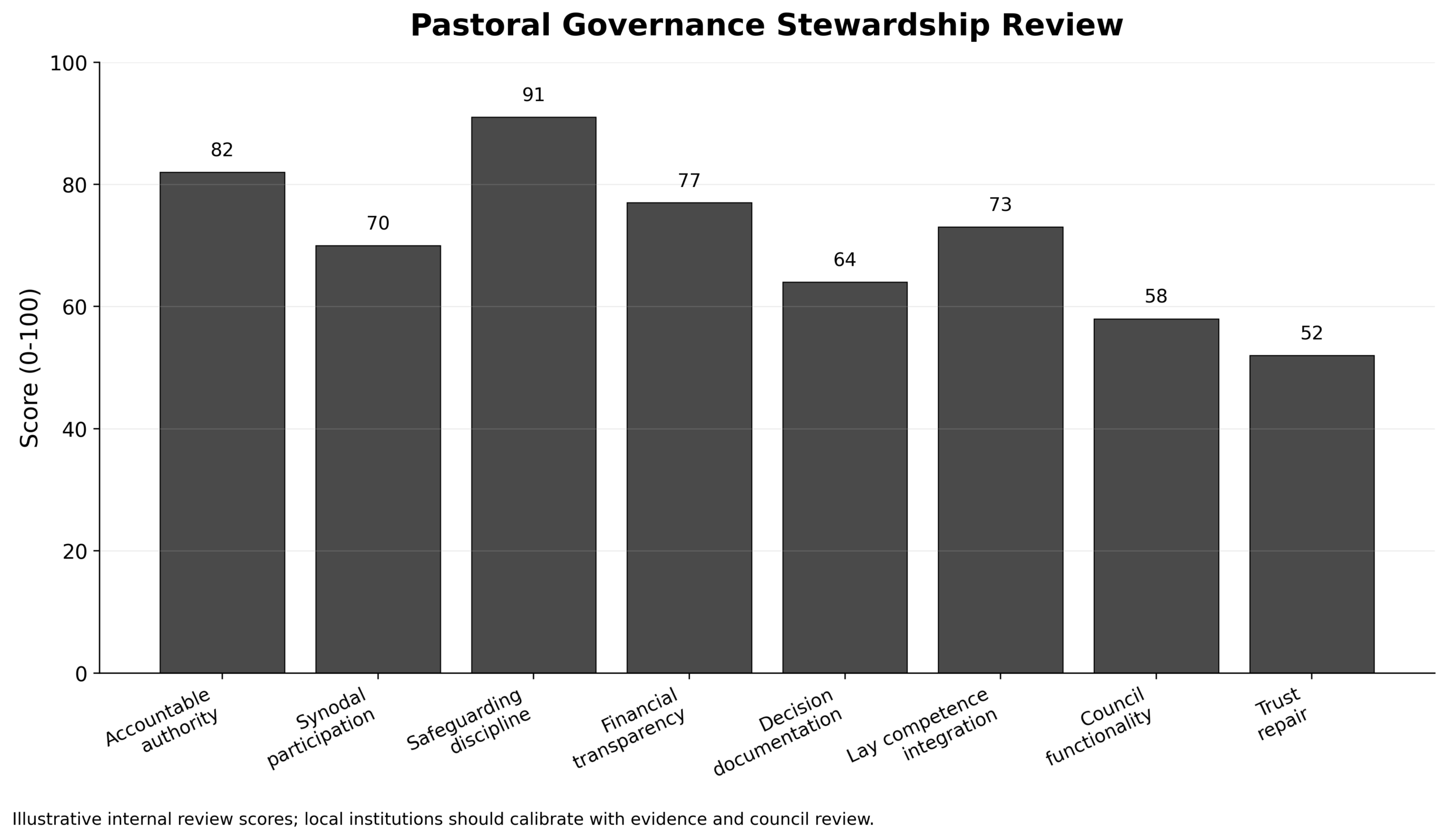
Figure 1. Illustrative Pastoral Governance Stewardship Review.
The hard-gate factor is essential. If safeguarding discipline, financial transparency, or decision documentation falls below a defined threshold, G reduces the total score sharply or collapses the score until correction begins. This prevents false reassurance. An institution cannot claim high governance maturity because parishioners enjoy meetings while safeguarding records are weak. A school cannot claim strong stewardship because its mission language is beautiful while financial reports are opaque. A diocese cannot claim effective participation if decision records are missing. Some domains are not compensatory. They are moral control points.
The local context term allows proportionality. A small rural parish does not need the same administrative machinery as a diocesan department or hospital network. Yet context cannot excuse negligence. Every Catholic institution requires basic safeguarding seriousness, financial traceability, role clarity, and truthful records. The model therefore permits scale adjustment but not moral avoidance.
3.5 Governance Response-Lag Model
Governance failure often appears as delay. A warning emerges, but the institution waits. A council raises concern, but review drifts. A safeguarding signal appears, but responsibility is unclear. A pastoral priority is announced, but no resources move. The Governance Response-Lag model measures the time between signal and visible action: GRL = t_visible_action − t_signal_received. A more detailed version separates the chain: GRL = SignalRecognitionTime + EscalationTime + DecisionTime + ResourceReleaseTime + ImplementationStartTime + FeedbackTime.
The model is not a demand for rushed action. Some issues require careful discernment, legal advice, confidentiality, or external notification. Its value lies in distinguishing purposeful delay from negligent drift. A long escalation period may show that staff do not know where to send concerns. A long decision period may indicate over-centralization. A long resource-release period may reveal financial misalignment. A long feedback period may show that consultation has no visible consequence.
3.6 Safeguarding Exposure Index
The Safeguarding Exposure Index is designed for internal seriousness, not public scoring. It is expressed as: SEI = RoleAccess × VulnerabilityLevel × SupervisionGap × ReportingUncertainty × RecordWeakness × TrainingDelay. The multiplicative design is intentional. Risk compounds. A role involving frequent access to minors or vulnerable adults becomes more dangerous when supervision is weak, reporting lines are unclear, records are poor, and training is delayed. One strong factor cannot safely compensate for several weak ones.
The model calls for conservative use. Where a Catholic institution is unsure how to score a safeguarding domain, uncertainty itself belongs in the risk file. A safeguarding program cannot rest on optimistic assumptions. Supervisory practice, renewal training, screening, ministry assignment, complaint pathways, and external reporting obligations require evidence. The institution needs to know whether policies are alive in practice, not merely present in a binder.
3.7 Trust-Repair Credibility Ratio
Trust repair is often claimed before it is earned. The Trust-Repair Credibility Ratio compares public commitments with verified corrective action: TRCR = VerifiedCorrectiveActions / PublicCommitments × ParticipationWeight × FollowUpEvidence. A high number of statements without implementation produces a low ratio. A modest statement followed by documented action may produce more credibility. ParticipationWeight captures whether affected people, relevant lay expertise, or appropriate councils were involved. FollowUpEvidence captures whether the correction remained visible over time.
This model is deliberately unfriendly to public relations. Catholic institutions sometimes over-speak after failure because silence seems unacceptable. Yet over-speaking can create another breach when promises are not delivered. The ratio forces leaders to ask before speaking: What can we actually correct? Who must be involved? What evidence will show change? When will the community be told what happened next? Such questions protect both truth and credibility.
3.8 Validity and Limitations
The models have practical face validity because each domain emerges from Church documents, financial guidance, safeguarding concerns, nonprofit accountability, or implementation literature. Their usefulness depends on honest evidence. Scores generated by the same leaders whose performance is being reviewed may be self-protective unless councils, lay experts, documents, and stakeholder feedback are included. The models should therefore be used as structured inquiry rather than institutional advertising.
Table 2. Hard-gate interpretation rules for Catholic governance review.
| Hard gate | Threshold concern | Required institutional response |
| Safeguarding | Weak supervision, unclear reporting, incomplete training, or missing records. | Immediate corrective plan and review by competent authority. |
| Finance | Opaque reporting, weak controls, no review body, or unmanaged conflicts. | Financial review, reporting repair, and council formation or training. |
| Records | Major decisions cannot be reconstructed. | Record system repair and decision-log discipline. |
| Trust repair | Commitments exceed verified action. | Communicate less, correct more, and provide follow-up evidence. |
Limitations must be stated plainly. PGSS is not a canonical judgment, civil audit, safeguarding investigation, psychometric instrument, or external accreditation. It does not replace diocesan norms, canonical counsel, civil reporting duties, professional safeguarding protocols, or episcopal authority. Its value is diagnostic. It gives leaders and councils a disciplined way to see where stewardship is strong, where it is fragile, and where urgent repair is required.
Chapter 4: Accountability, Finance, Safeguarding, and Records
4.1 Authority Becomes Pastoral When It Can Be Answered For
Catholic authority contains theological realities that ordinary management language cannot exhaust, but institutions still need to show how authority is exercised. A decision about a school appointment, parish expenditure, safeguarding restriction, property sale, council recommendation, or diocesan priority has consequences for people. If no one can explain who decided, what evidence was considered, what advice was received, and how follow-up will occur, authority appears arbitrary even when the leader’s intention was pastoral.
Answerability is not the same as publicity. Some matters must remain confidential. Personnel issues, safeguarding files, pastoral counseling, legal advice, and private family concerns require discretion. The question is not whether everyone receives every detail. The question is whether the institution has an accountable internal chain. Confidentiality should protect persons and justice, not institutional convenience. When secrecy is used as a blanket term, trust begins to erode.
Accountable authority also protects leaders from loneliness and suspicion. A pastor who documents finance-council advice is not weakening his role. A principal who records why a safety decision was taken is not becoming bureaucratic. A diocesan officer who preserves the rationale for resource allocation is not surrendering judgment. Such practices make authority more credible because they show that decisions were not merely personal preferences disguised as mission.
4.2 Financial Transparency as Visible Stewardship
A Catholic institution needs a coherent financial story. Where did resources come from? What restrictions or intentions attach to them? Which priorities received funding? What controls prevent error or misuse? What reports reach responsible councils? How are conflicts of interest handled? How is the community informed at the right level? These are pastoral questions because money is often one of the places where the faithful most directly entrust themselves to institutional leadership.
The USCCB financial guidance points to practices that should be normal: budgeting, reporting, internal control, audit readiness, segregation of duties, review by appropriate bodies, and clear policies. In some communities, leaders fear that financial detail will create conflict. In reality, vague reporting often creates more conflict. People can usually understand limits when leaders explain them plainly. What people resent is the feeling that financial knowledge is held above them while their contributions are requested.
Financial transparency must also connect to mission priorities. A parish that says youth formation is urgent but funds it only through occasional appeals has not aligned resources with speech. A Catholic school that names safeguarding and student support as priorities but underfunds training, counseling, or supervision creates a contradiction. A diocese that promotes evangelization while leaving communication and formation offices under-resourced may have a plan without delivery capacity. Budgets should be read as evidence.
4.3 Procurement and Conflict of Interest
Procurement rarely receives theological attention, yet it can quietly damage credibility. Catholic institutions buy construction services, books, technology, catering, insurance, vehicles, maintenance, consulting, uniforms, and professional support. If procurement relies on informal relationships, family ties, clerical preference, or undocumented exceptions, suspicion is almost inevitable. The institution may receive fair value, but without process it cannot prove fairness.
Conflict-of-interest rules protect the institution from both corruption and false accusation. A council member whose business may benefit from a contract should disclose the interest and step back from the relevant decision. A pastor whose relative provides services should not be the only approving authority. A school should document why a vendor was selected. These practices do not express distrust of individuals. They express respect for the community’s right to know that entrusted resources are handled cleanly.
4.4 Safeguarding Beyond Policy Language
Safeguarding cannot be reduced to annual training or a policy document. Policies are necessary, but a policy can be correct while culture remains weak. Supervisors may not observe ministry settings. Volunteers may not understand reporting obligations. Staff may hesitate because the person involved has influence. Parents may not know where to take concerns. Records may be scattered. This is why safeguarding governance must examine the full pathway from prevention to reporting, from reporting to response, and from response to review.
The hardest safeguarding failures often begin as ambiguity. A concern is described as a misunderstanding. A pattern is seen as personality. A report is delayed because leaders want more information. A boundary issue is handled informally because no one wants to damage a reputation. Serious governance interrupts that drift. It defines thresholds, requires documentation, clarifies external obligations, and refuses to let popularity or position control response.
Safeguarding review should be regular, not crisis-driven. Catholic institutions should examine who has contact with minors or vulnerable adults, whether supervision ratios are appropriate, whether training is current, whether reporting paths are visible, whether records are complete, whether transport and overnight activities are controlled, whether digital communication rules are followed, and whether survivors or affected families would know how to reach help. The review should be documented because undocumented safeguarding is fragile safeguarding.
4.5 The Moral Force of Records
Records are one of the ways Catholic institutions serve truth. A minute, report, approval note, safeguarding file, budget summary, risk register, or complaint log may seem ordinary, but such documents preserve reality when memory becomes contested. They allow successors to understand why decisions were made. They give councils evidence. They protect victims from having to retell concerns to leaders who claim not to know. They protect honest administrators from later suspicion.
The lack of records often becomes visible only after harm. A parent asks who received a complaint. A donor asks how a restricted gift was used. A priest asks why a previous restriction was imposed. A school board asks why a program was closed. A civil authority asks what the institution knew. If the answer depends on recollection rather than record, the institution has already weakened its moral position.
Record keeping should be proportionate. Not every pastoral conversation requires formal minutes. Not every minor purchase requires a lengthy file. Yet major decisions should leave a trace. Safeguarding, finance, personnel, property, litigation, risk, council recommendations, and strategic commitments should be documented. A Catholic institution that values truth should not be casual about the evidence by which truth is later known.
4.6 Information Access and Confidentiality
Governance requires a disciplined balance between access and confidentiality. Councils cannot function if they receive only vague summaries. Staff cannot implement decisions they do not understand. Parishioners cannot trust finances they never see. At the same time, Catholic institutions handle sensitive information about persons, families, victims, employees, minors, donors, and pastoral situations. The solution is not full disclosure or blanket secrecy. The solution is role-based information with clear reasons.
Role-based access asks who needs what information to carry responsibility. A finance council needs financial detail but not private counseling information. A safeguarding officer needs records relevant to protection but not unrelated parish gossip. A school board may need risk trends without identifying confidential student details. A diocesan leader may need summary information and escalation signals rather than every operational note. Governance maturity appears when access rules are intentional and documented.
4.7 Charted Diagnostic Reading
The illustrative review shown in Figure 1 demonstrates why a single statement of governance strength can mislead. Accountable authority may look strong while trust repair remains weak. Safeguarding may be better developed than council functionality. Records may lag behind participation. A Catholic institution that sees this pattern should avoid vague reassurance and ask where the next repair should begin. Governance improvement is strongest when it names the weakest control that could invalidate the institution’s public claim.
Figure 2. Governance Risk Exposure by Control Area.
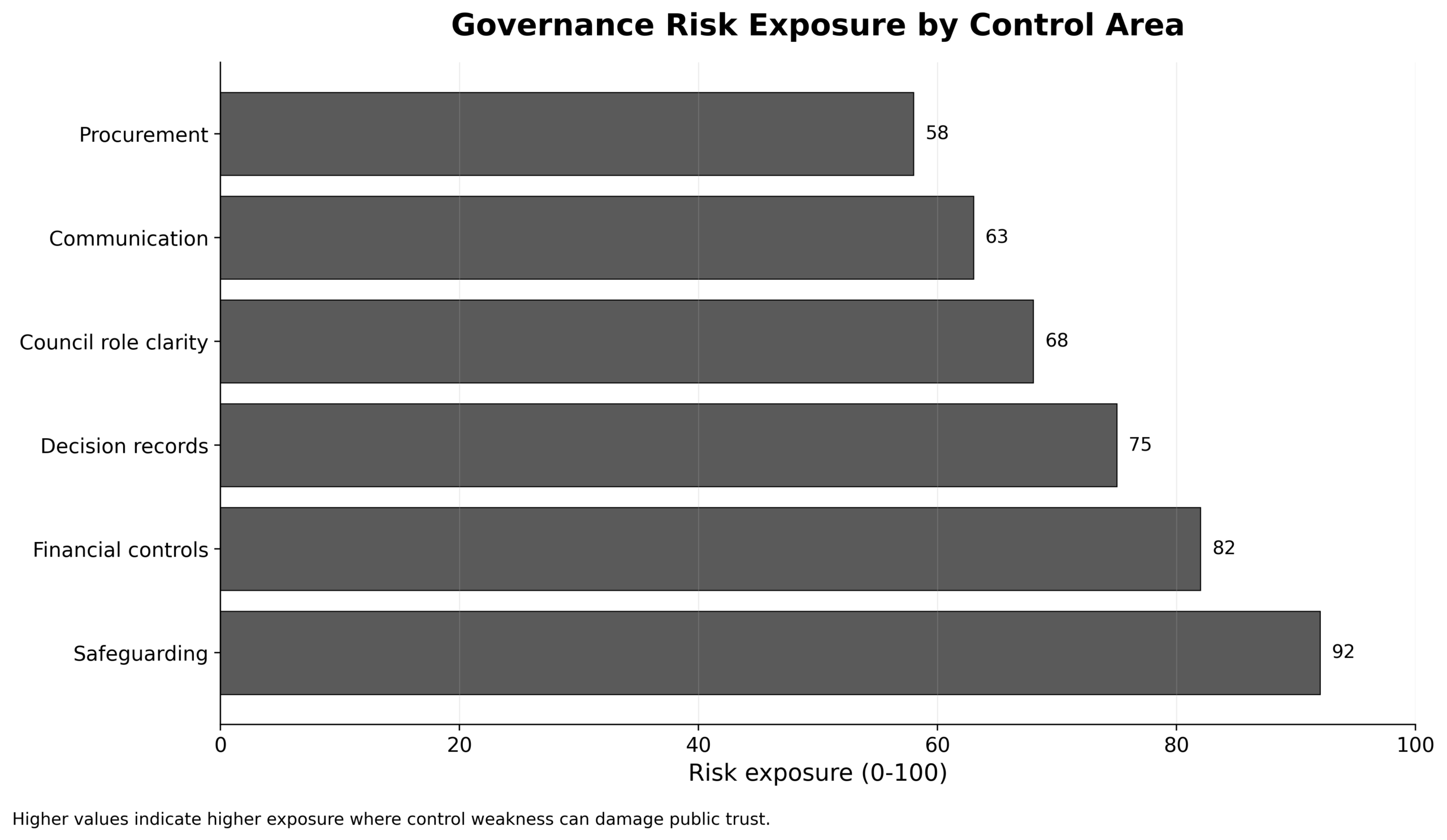
Table 3. Governance failure points and corrective controls.
| Failure point | Common symptom | Corrective control |
| Personalized authority | Decisions depend on one leader’s memory or preference. | Delegation notes, decision logs, council evidence. |
| Ceremonial consultation | People are heard but never answered. | Listening summary, discernment note, public follow-up. |
| Financial opacity | Reports are vague or delayed. | Budget variance reporting and finance council review. |
| Safeguarding drift | Concerns are handled informally. | Mandatory pathway, supervision evidence, external reporting where required. |
| Record weakness | Files are missing when conflict arises. | Retention policy, secure storage, handover checklist. |
Chapter 5: Synodality, Councils, and Lay Competence
5.1 Consultation Must Leave an Institutional Trace
Consultation becomes credible when people can see that listening was remembered. A parish listening session, school parent forum, diocesan survey, staff retreat, or council discussion cannot disappear into general language about appreciation. The institution needs to say what themes emerged, which matters lie within local authority, which require further discernment, which cannot be acted upon, and what follow-up will occur. Without that trace, participation becomes pastoral theater.
The trace does not need to be elaborate. A brief summary, a decision note, a response document, or a pastoral update may be enough. What matters is that the institution refuses to let participation become an emotional event with no governance consequence. People often accept limits when they are told the truth. They become cynical when they sense that their presence was used to legitimize a decision already made or to lower conflict without changing practice.
5.2 Councils Need Role Clarity
Catholic councils and boards often suffer from unclear identity. Members are asked to attend, but not told whether they advise, consent, review, supervise, implement, or represent. The result is frustration. Some members overreach because the mandate is vague. Others disengage because nothing they say matters. Leaders may prefer ambiguity because it preserves discretion, but ambiguity weakens trust and wastes competence.
A functioning council needs written terms of reference, a regular agenda, access to meaningful evidence, minutes that preserve decisions, follow-up assignments, and periodic self-review. It should know which matters are reserved to pastoral authority, which require consultation, which require consent under norms, and which can be delegated. Such clarity does not secularize Catholic life. It helps Catholic cooperation remain honest.
5.3 Lay Competence as Co-responsibility
Lay competence is not ornamental. Catholic institutions depend daily on lay expertise in finance, education, safeguarding, law, medicine, communications, technology, formation, administration, social care, and property management. A synodal Church cannot invite lay people into responsibility while ignoring the competence they bring. Nor should competence be treated as a threat to pastoral leadership. Properly governed, lay expertise helps authority serve more truthfully.
The challenge is role discipline. Lay professionals should not be asked to rubber-stamp decisions that were already made. They should not be allowed to exceed legitimate authority because they possess technical knowledge. They should not be burdened with responsibility while denied information. Co-responsibility requires mature boundaries: what is being advised, what is being decided, who has authority, what record will be kept, and how conflict will be handled.
5.4 Clergy Formation and Administrative Realism
Many Catholic governance problems are made worse because clergy are formed for pastoral and theological duties without enough preparation for institutional leadership. A pastor may suddenly carry responsibility for buildings, payroll, school relationships, staff conflict, safeguarding, communications, technology, finance, and legal exposure. Personal dedication cannot replace preparation. Governance formation should begin before crisis.
Seminary and ongoing clergy formation need to include financial literacy, safeguarding culture, council leadership, conflict management, staff supervision, record keeping, communications, and work with lay expertise. The point is not to turn priests into professional managers. Clergy need enough administrative literacy to know when to delegate, when to ask questions, when a report is too vague, and when a risk requires external help.
5.5 Lay Formation and Ecclesial Sensitivity
Lay professionals also need formation. A finance expert serving a parish should understand that a parish is not simply a nonprofit branch. A lawyer advising a diocese should understand pastoral consequences. A school administrator should understand Catholic identity. A communications officer should understand confidentiality, scandal, and truth. Technical competence without ecclesial sensitivity can become harsh, impatient, or politically clumsy.
The strongest Catholic institutions form lay and clerical leaders together. Shared formation allows each group to understand the other’s language. Clergy learn why controls, records, and professional standards matter. Lay leaders learn why discernment, pastoral care, and ecclesial authority matter. Such formation reduces suspicion and builds the trust needed for serious collaboration.
5.6 Meeting Discipline
Meetings reveal the seriousness of governance. A council meeting with no documents, no prior reading, no decision record, and no follow-up is not governance. It is group conversation. Catholic institutions often tolerate weak meetings because members are volunteers or leaders fear formality. That tolerance becomes costly. Poor meetings waste time, obscure responsibility, and train people to expect little from participation.
Good meeting discipline is simple: send the agenda early, identify decisions required, provide relevant evidence, record advice and decisions, assign follow-up, and review previous actions. Meetings should not become excessively procedural, but they must respect the responsibility of those present. A serious Catholic meeting should leave the institution more truthful than it was before the meeting began.
5.7 Measuring Participation Without Reducing Persons to Data
Participation can be measured carefully without reducing people to statistics. Attendance, diversity of participants, frequency of consultation, response rates, council follow-up, action completion, and participant feedback can show whether governance is alive. Such measures are not substitutes for pastoral discernment; they give discernment evidence. A leader who claims the community was heard needs evidence of who was invited, who came, what was heard, and what changed.
Survey instruments, listening summaries, and parish engagement data can help, but they must be interpreted humbly. The loudest voices may not represent the vulnerable. The absent may be absent because they have lost trust. Low response may indicate survey fatigue or fear. Data should therefore open questions rather than close them. Synodal governance requires both evidence and listening beyond the easiest participants.
Chapter 6: Public Case Anchors and Institutional Lessons
6.1 Vatican Reform as a Service Lens
Praedicate Evangelium is not a manual for parish governance, but it provides a service lens. The Roman Curia is described in relation to mission, cooperation, competence, and service to the Church. Catholic institutions at every level can draw from that logic. Offices exist to serve mission. Authority should clarify service, not obscure it. Competence matters because mission requires capable action. Structures should be judged by whether they help people receive pastoral care, formation, protection, and justice.
The lesson is not to copy Curial forms. The lesson is to ask whether institutional offices have become self-protective. A diocesan office, parish committee, school board, or agency department can slowly begin serving its own survival rather than the people entrusted to it. When that happens, procedures become defensive. Communication becomes guarded. Lay expertise becomes unwelcome. Reform begins when the institution asks again how each office serves mission in practice.
6.2 Synodality as a Governance Case
The Synod process offers a public case in participation. It has generated consultations, reports, assemblies, and a Final Document. Whether one emphasizes theology, pastoral practice, or institutional renewal, the governance lesson is clear: listening requires channels, records, synthesis, discernment, and publication. The process shows that participation is not merely a mood. It requires design, labor, translation, and accountability.
Local Catholic institutions can learn from both the promise and the challenge. A parish listening process cannot simply gather comments and stop. A school consultation cannot ask parents for concerns and then provide silence. A diocese cannot invite youth voices and then return to ordinary patterns without explanation. Participation raises expectation. If an institution is not ready to respond, it should not pretend that listening is complete.
6.3 USCCB Financial Guidance as Stewardship Practice
The USCCB financial-management guide demonstrates that stewardship can be translated into practice without embarrassment. It provides language around internal controls, reporting, budgeting, financial administration, and oversight. The document is valuable because it refuses the false separation between spirituality and financial discipline. In a Catholic institution, money is part of mission, and mission suffers when money cannot be explained.
The case also shows why annual updates and accessible guidance matter. Financial practice changes. Regulation changes. Risk changes. Dioceses, parishes, schools, and religious institutions need current standards and training. A finance council cannot carry serious responsibility if members are never formed, if reports are unreadable, or if leaders treat the council as a courtesy body. Financial governance is a skill, not an instinct.
6.4 Pontifical Safeguarding Reporting as Institutional Examination
The Pontifical Commission’s annual reporting work offers a case in institutional examination. Its significance lies in the willingness to identify progress, gaps, and recommendations. Safeguarding cultures mature when institutions can name what remains weak. The Church’s credibility grows less from claims of completion than from honest, evidence-based seriousness.
Local institutions need the same discipline. A parish, school, or diocese needs a clear account of what safeguarding review found, what was corrected, and what remains difficult within appropriate confidentiality. Silence is not proof of safety. No complaints may indicate safety, fear, ignorance, or inaccessible reporting. Annual review must ask whether people knew how to report and trusted the process enough to use it, not simply what was reported.
6.5 Catholic Leadership Roundtable and Institutional Trust
Leadership Roundtable’s work on trust, transparency, accountability, and co-responsibility provides a practical bridge between ecclesial renewal and governance. Its value lies in reminding Catholic institutions that trust is a measurable pastoral asset. It can be strengthened by transparency, trained leadership, responsible collaboration, and credible processes. It can be weakened by secrecy, personality-driven decisions, and failure to follow through.
The Roundtable case also shows why lay leadership matters. Many governance problems require people who can interpret budgets, policy, communications, human resources, risk, and data. The Church does not lack such people. It often lacks disciplined ways to invite them into roles that have clarity and consequence. A serious governance culture will not flatter lay expertise in speeches while leaving decisions untouched.
6.6 Comparative Nonprofit Accountability
Nonprofit accountability standards are not Catholic doctrine, yet they can help Catholic institutions examine whether basic controls are present. Ethical management, financial oversight, responsible boards, conflict-of-interest policies, personnel practices, and transparency are normal expectations in nonprofit life. Catholic institutions should not be behind those expectations while claiming higher moral purpose.
The comparative lesson must be used carefully. The Church is not a corporation, a political association, or a secular nonprofit. It has sacramental, pastoral, and canonical realities. Still, when it employs staff, receives money, runs schools, owns buildings, handles complaints, and serves vulnerable people, ordinary accountability expectations apply. Catholic identity should raise the standard rather than lower it.
6.7 Case Integration
The public case anchors point in the same direction. Vatican reform reminds leaders that authority should serve mission. Synodality reminds leaders that listening must become accountable participation. Financial guidance reminds leaders that stewardship requires controls. Safeguarding reports remind leaders that protection requires evidence and humility. Leadership Roundtable reminds leaders that trust must be rebuilt through credible practice. Nonprofit standards remind leaders that basic accountability cannot be treated as optional.
The cases do not produce a single formula. They produce a governance ethic. Catholic institutions need to show how they listen, decide, protect, spend, record, review, and repair. If one of those verbs is weak, the whole claim of stewardship becomes less credible. This is why the PGSS model includes several domains instead of one general score.
Chapter 7: Implementation Roadmap and Stress Testing
7.1 Opening Ninety Days: Establishing the Evidence Base
A serious governance review begins with evidence, not impressions. During the opening ninety days, an institution gathers its current policies, financial reports, council minutes, safeguarding training records, complaint pathways, role descriptions, procurement rules, decision records, and communication samples. This is not an exercise in blaming past leaders. It establishes what exists, what is missing, and which assumed practices were never written, recorded, or reviewed.
The review team needs pastoral leadership, lay expertise, safeguarding responsibility, finance competence, and at least one person skilled in documentation. It should remain small enough to work. Oversized committees often produce delay. A compact team can gather evidence and report to the appropriate council or authority. The opening report should be factual: what was found, what is missing, which risks are urgent, and which corrective actions begin.
7.2 Scoring the Pastoral Governance Stewardship Score
The PGSS should be scored with humility. Each domain should receive a rating only after the team identifies evidence. Accountable authority might be supported by role descriptions, decision logs, and delegation norms. Synodal participation might be supported by listening records and follow-up communication. Safeguarding discipline might be supported by training records, reporting pathways, supervision logs, and review minutes. Financial transparency might be supported by budgets, reports, audit trails, and council minutes.
A score without evidence should be treated as weak. Leaders may believe that authority is clear, but if staff cannot identify the decision chain, the score should fall. A parish may believe that consultation is strong, but if no record shows what was heard and what changed, the score should fall. A school may believe that safeguarding is alive, but if training records are incomplete or reporting is not visible, the score should fall. The model’s discipline lies in refusing self-congratulation.
7.3 Stress Testing the System
Governance should be stress-tested before crisis. A Catholic institution can conduct tabletop exercises around realistic scenarios: a safeguarding allegation involving a respected volunteer; a restricted donation disputed by a family; a data breach in a school; a conflict of interest in procurement; a public complaint about parish finances; a sudden resignation by a principal; or a council challenge to a major spending decision. The exercise asks who acts, what is recorded, who is informed, what law or policy applies, and how the community is protected.
Stress testing reveals hidden weakness. Leaders often discover that people know the policy title but not the reporting pathway. They may discover that a council is unclear about its role. They may discover that no one knows where older records are stored. They may discover that communication responsibility is vague. Such findings should not be treated as embarrassment. They are early warnings that can prevent greater damage.
7.4 Response-Lag Review
Response lag should be reviewed annually. The institution should choose several decisions or concerns and reconstruct the timeline: when the signal appeared, when it reached leadership, when a decision was made, when resources moved, when action began, and when feedback was given. This exercise often reveals that delay is not a single failure. It is a chain of small hesitations.
Figure 3. Illustrative Response Lag in Mission Delivery.
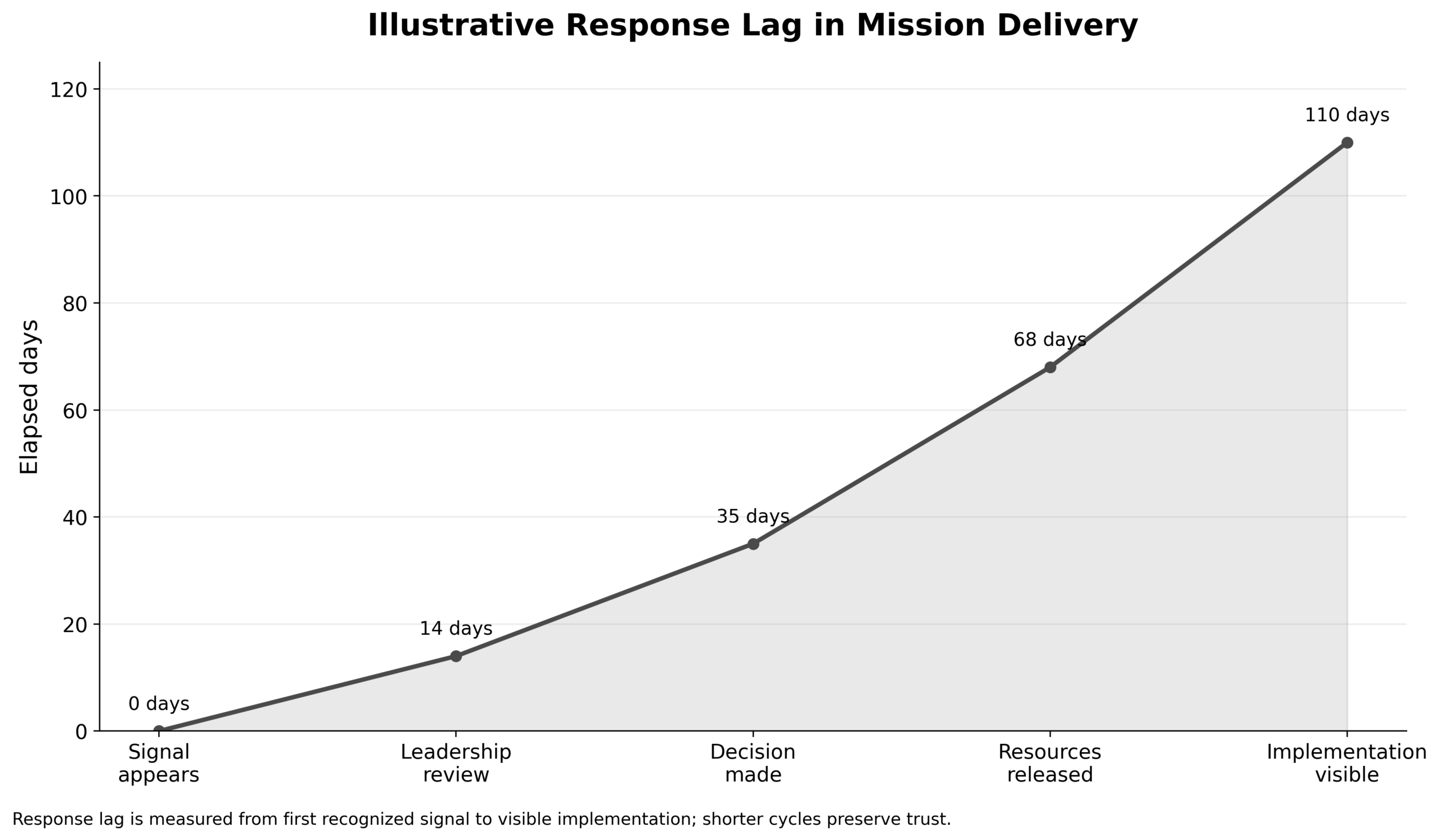
The response-lag model is especially useful after consultations. If a parish gathering raises repeated concerns about youth ministry, the institution should record when the concern was heard, when leaders reviewed options, when resources were assigned, when action began, and when the community was updated. Without that timeline, listening remains difficult to evaluate. Response lag turns pastoral seriousness into observable practice.
7.5 Trust Repair Protocol
When governance has already failed, the institution needs a trust-repair protocol. The sequence begins by acknowledging the category of failure without rushing into defensive explanation. Records are then preserved and reviewed, the right authority and expertise are involved, communication is directed proportionately to those affected, the process that allowed the failure is corrected, and the institution later reviews whether the correction held.
The protocol should avoid two extremes. One extreme is silence disguised as prudence. The other is dramatic communication that promises more than leaders can deliver. Responsible trust repair speaks carefully and acts more carefully. It treats affected people as moral agents, not as reputation risks. It keeps records. It returns to the community with evidence of change.
7.6 Annual Governance Cycle
A Catholic institution should adopt an annual governance cycle. Quarter one can review policies and roles. Quarter two can examine finance and safeguarding. Quarter three can review councils, participation, and decision records. Quarter four can review trust, communication, and implementation outcomes. The cycle should be manageable. If leaders attempt too much at once, governance improvement becomes another plan that fails at delivery.
Table 4. Annual implementation cycle for Catholic institutions.
| Period | Review focus | Expected output |
| Quarter 1 | Roles, policies, councils, and records. | Corrected role list and document inventory. |
| Quarter 2 | Finance, safeguarding, and risk controls. | Updated reports, training evidence, and action list. |
| Quarter 3 | Participation, response lag, and implementation. | Listening follow-up and delivery timeline. |
| Quarter 4 | Trust, communication, and next-year priorities. | Three commitments with owners and deadlines. |
Each annual cycle should end with three commitments. One may be safeguarding-related, one financial or documentation-related, and one participation-related. The commitments should have responsible owners, deadlines, and evidence of completion. A year later, the institution should ask whether those commitments changed practice. If they did not, leaders should name the reason.
7.7 Formation and Succession
Governance repair will not last unless formation and succession are addressed. New council members need orientation. New pastors and principals need administrative handover. Safeguarding officers need ongoing training. Finance council members need enough formation to ask useful questions. Diocesan offices need succession records. A system dependent on one competent person is not mature.
Succession matters because Catholic institutions often rely on memory held by individuals. When a long-serving secretary, treasurer, pastor, principal, or volunteer leaves, the institution may lose knowledge of files, routines, donor intentions, unresolved conflicts, and local history. Stewardship requires that knowledge be transferred responsibly. The handover process should be documented and reviewed.
Chapter 8: Doctoral Discussion
8.1 Against Two Weak Positions
Catholic governance is often trapped between two weak positions: administrative defensiveness, which treats calls for accountability as secular intrusion or lack of trust, and managerial imitation, which assumes that Catholic institutions can be repaired simply by copying corporate or nonprofit procedures. Both positions fail. Administrative defensiveness protects bad habits. Managerial imitation risks flattening the Church’s pastoral and theological identity.
A stronger position begins from stewardship. The Church governs because it has been entrusted with people, mission, truth, and resources. That starting point gives accountability theological depth. It also limits managerial methods. Procedures are not good because they are modern. They are good when they help the institution protect people, tell the truth, use resources responsibly, involve competent persons, and serve mission. A practice that does not serve those ends should be revised or rejected.
8.2 The Non-Compensatory Nature of Certain Failures
The revised model’s hard gates are a central contribution of this research publication. Many institutional reviews allow strong scores in one domain to offset severe weakness in another. That may be mathematically neat, but it is morally misleading. A Catholic institution with poor safeguarding cannot be treated as mature because its meetings are participatory. A parish with missing financial records cannot claim strong stewardship because parishioners feel welcome. A school with weak decision documentation cannot rely on strong mission language to cover accountability gaps.
Figure 4. Trust Repair Readiness Across Institutional Practices.
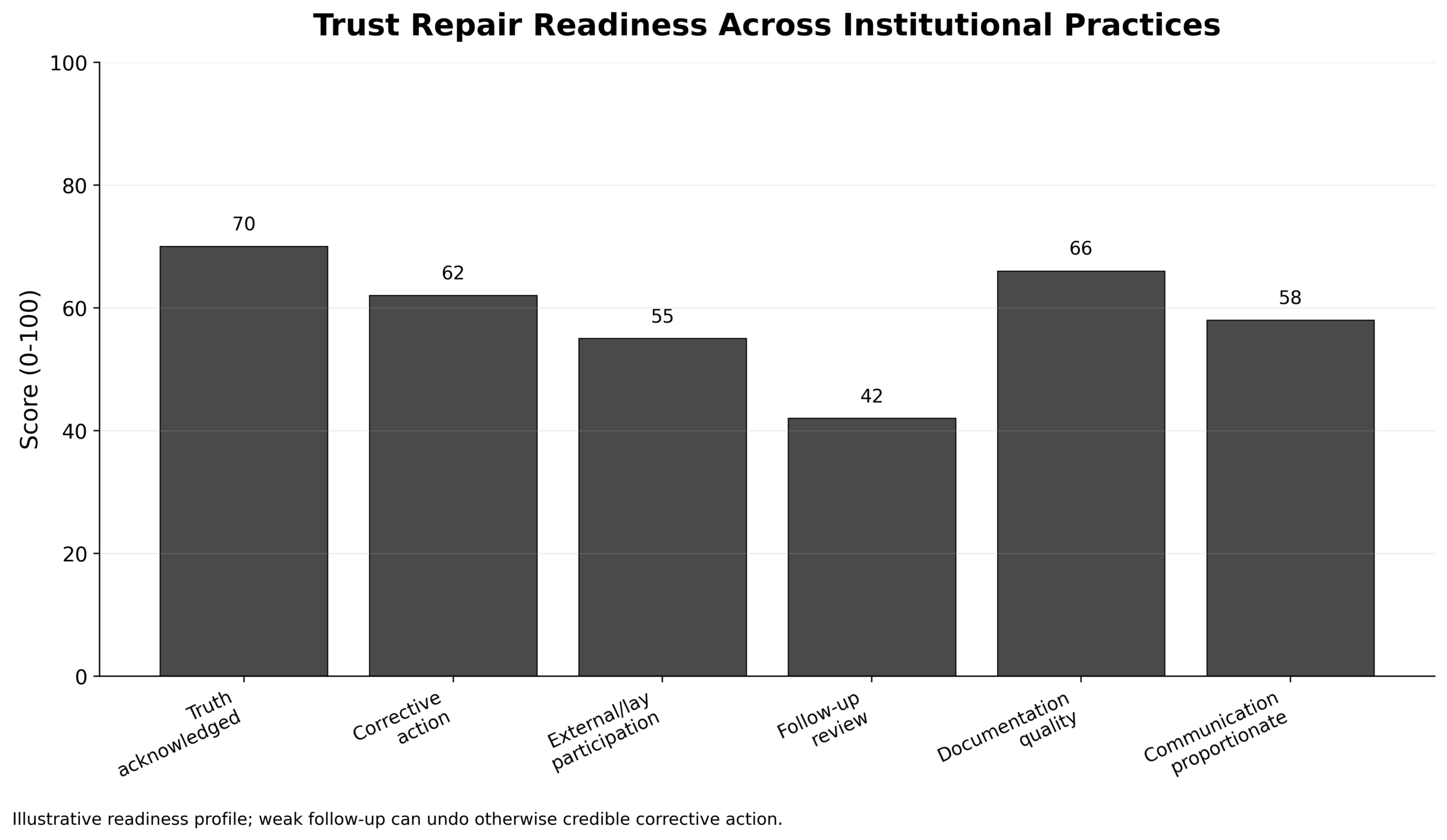
Some failures are non-compensatory because they affect the institution’s basic moral permission to operate with public trust. Safeguarding, finance, and records are in this category. Safeguarding protects persons. Finance protects entrusted resources. Records protect truth. When any of these is seriously weak, the institution should move into repair mode rather than reputation mode. The hard-gate factor forces that discipline.
8.3 Synodality and Evidence
Synodality requires more evidence than some leaders expect. If the baptized are to participate meaningfully, leaders need to know who is being heard, who is missing, what themes recur, which concerns are urgent, what decisions are possible, and what follow-up has occurred. Evidence does not replace prayer or discernment. It prevents the process from being controlled by memory, preference, or the most vocal participants.
This is especially important in diverse Catholic communities. Immigrants, young adults, school parents, older parishioners, staff, poor families, persons with disabilities, survivors, and disconnected Catholics may experience the institution differently. A single listening format may reach only the confident. Synodal governance should therefore use several channels and interpret silence carefully. The absence of complaint is not the same as trust.
8.4 The Leader’s Burden and the Leader’s Protection
Governance reform can sound like another burden placed on already stretched leaders. Many pastors, principals, diocesan officers, and ministry coordinators carry heavy workloads. They may fear that additional documentation, councils, or reports will reduce time for pastoral care. That fear deserves respect. Yet weak governance often increases burden over time. It creates crises, suspicion, duplicated work, confused expectations, and avoidable conflict.
Good governance should lighten the leader’s burden by clarifying responsibility, creating reliable routines, and sharing competence. A pastor who has a functioning finance council is not alone. A principal with a clear safeguarding protocol does not improvise under pressure. A diocesan director with documented decisions can brief a successor. Governance is protection when it is proportionate and useful. It becomes oppressive only when it grows without connection to mission.
8.5 Catholic Governance in Contexts of Scarcity
Few Catholic institutions have staff, technology, legal access, or financial resources equal to large dioceses or hospitals. Scarcity changes design. A small parish may need simpler tools, diocesan templates, shared safeguarding training, volunteer finance support, and basic record systems. A rural mission may need mobile support from diocesan offices. A Catholic school in financial stress may need governance that prioritizes the most material risks before less urgent improvements.
Scarcity cannot excuse dangerous weakness, but it should influence implementation. Leaders should not impose elaborate systems that cannot be sustained. The question is what minimum credible stewardship requires in each context. At minimum: clear roles, current safeguarding, understandable finance, minutes for major decisions, conflict-of-interest disclosure, and a way to respond to complaints. These practices are not luxuries. They are basic conditions for trust.
8.6 Institutional Trust as a Pastoral Asset
Trust should be treated as a pastoral asset. It is not sentiment alone. It determines whether people give, volunteer, report concerns, accept difficult decisions, enroll children, join councils, remain after disappointment, and believe that leadership speaks truthfully. Catholic institutions sometimes ask for trust as if it were owed. The better posture is to build trust through visible stewardship.
Trust is also unequal. Some groups carry historical reasons for suspicion. Survivors of abuse, marginalized communities, financially strained families, staff with prior negative experiences, and parishioners who have seen leaders evade questions may need more than ordinary assurance. A governance model that ignores those histories will overestimate trust. Responsible leaders ask who finds the institution trustworthy and who does not.
8.7 The Role of Mathematics in a Pastoral Paper
The mathematical models in this paper are deliberately modest. They do not claim to measure grace, holiness, pastoral charity, or ecclesial communion. They measure observable governance conditions. Their value lies in forcing questions that institutions often avoid. How long did we take to act? Which domain is weakest? Are we making more promises than verified corrections? Does safeguarding risk compound across role access, supervision, reporting, and records?
A Catholic institution should not become numerically obsessed. Yet it should also not hide from measurement. Numbers can be abused, but vagueness can also be abused. The models are best used as prompts for conversation grounded in evidence. They help leaders identify where action is needed and where optimism is unsupported.
8.8 Publication-Level Contribution
The doctoral contribution of this research publication lies in integration. It does more than repeat the widely accepted claim that Catholic institutions need accountability. It identifies the domains where accountability has to be visible, connects those domains to current ecclesial and implementation sources, and provides diagnostic models with hard gates. It also insists that governance is not secular interference but a form of pastoral stewardship.
This contribution is useful for NYCAR’s advanced research standard because it moves from critique to operational design. The paper does not end with a demand for transparency. It asks how transparency appears in finance, records, councils, safeguarding, response lag, trust repair, and formation. It does not romanticize synodality. It asks how listening becomes action. It does not praise lay competence abstractly. It asks how roles are clarified. That practical movement is what makes the work doctoral rather than simply reflective.
Chapter 9: Conclusion and Recommendations
9.1 Conclusion
Catholic governance is one of the places where mission becomes inspectable. The Church’s credibility does not rest only in doctrine, liturgy, charity, or personal holiness, though all of those matter deeply. It also rests in whether institutions can answer ordinary questions: Who is responsible? What was decided? How was money used? Were vulnerable persons protected? Did consultation matter? Are records available? What changed after failure? These questions are not hostile to the Church. They are part of responsible love for the Church.
This research publication has argued that governance belongs within pastoral stewardship. Accountable authority, synodal participation, safeguarding discipline, financial transparency, decision documentation, lay competence, council functionality, and trust repair have to be held together. Weakness in any one domain can damage the others. Weakness in safeguarding, finance, or records is especially severe because those domains protect persons, resources, and truth.
The Pastoral Governance Stewardship Score, Governance Response-Lag model, Safeguarding Exposure Index, and Trust-Repair Credibility Ratio offer practical tools for Catholic leaders. They do not replace prayer, discernment, canon law, diocesan norms, civil obligations, or pastoral judgment. They help leaders see whether the institution’s visible practices support its mission. Used well, the models create better questions, clearer responsibilities, and more honest reviews.
9.2 Recommendations
Catholic institutions should conduct an annual stewardship review that includes safeguarding, finance, records, council function, participation, lay competence, and trust repair. The review should use documents and evidence rather than impressions. It should end with no more than three priority commitments so that improvement remains realistic.
Parishes, schools, diocesan offices, and Catholic agencies should maintain clear role descriptions for councils, committees, and senior staff. Members should know whether they advise, consent, supervise, implement, or review. Ambiguous participation should be corrected because it weakens synodality and wastes competence.
Safeguarding should remain a standing governance agenda item. Leaders should review training, supervision, reporting pathways, record completeness, event protocols, transport, digital communication, and survivor-centered response. A year without reported concerns should not be assumed to prove safety. It should prompt leaders to ask whether reporting is known and trusted.
Financial reporting should be clear enough for responsible review. Catholic institutions should provide regular budgets, actual results, restricted-fund information where relevant, conflict-of-interest disclosure, procurement records for material decisions, and audit or review procedures appropriate to institutional size. Finance councils should receive formation so that they can serve competently.
Decision documentation needs to become normal practice. Major decisions on money, property, safeguarding, personnel, program closure, strategic priorities, council recommendations, and public communication require an adequate record. The institution must be able to reconstruct the decision without relying on personal memory alone.
Lay competence should be invited with clarity and respect. Catholic institutions should identify needed expertise, create defined roles, provide ecclesial orientation, and avoid using lay professionals merely to bless decisions already made. Co-responsibility requires truthful boundaries.
Trust repair should be planned before crisis. Every Catholic institution should know how it will receive complaints, preserve records, seek independent advice, communicate proportionately, correct failures, and report follow-up. Trust repair should never be improvised under scandal pressure.
Formation should be strengthened for clergy, religious leaders, lay administrators, council members, safeguarding officers, and school or agency heads. Formation should include financial stewardship, safeguarding culture, records, meeting discipline, conflict of interest, communication, and implementation. Shared formation across roles will reduce suspicion and improve cooperation.
9.3 Final Professional Judgment
Catholic institutions do not need louder claims that they are mission-centered. They need mission that survives inspection. The faithful need to see stewardship in budgets, council records, safeguarding practice, consultation, communication, supervision, and correction after failure. Where those signs are present, governance becomes part of evangelization because the institution’s ordinary behavior supports the message it proclaims. Where those signs are absent, even sincere leaders ask people to trust what the institution has not yet made trustworthy.
Chapter 10: Applied Governance Playbooks
10.1 Parish Governance Playbook
The parish is where many Catholics have their earliest experience of whether Church governance is trustworthy. It is also the setting where formal controls are most likely to be mistaken for unnecessary formality. A parish may be small, relational, volunteer-heavy, and financially limited. Those realities matter, but they do not remove the need for basic stewardship. The parish needs an active finance council, clear records of material spending, current safeguarding training, accessible complaint pathways, documented consultation around major pastoral priorities, and a simple process for communicating financial and pastoral updates to the community. The standard has to be modest enough to sustain and serious enough to protect trust.
A parish playbook should begin with role clarity. The pastor’s authority is real, but he should not be the only person who understands finances, building priorities, safeguarding routines, or administrative risks. The finance council should receive understandable reports and review material decisions. The pastoral council should have a defined consultative role and a pathway for turning parish concerns into agenda items. Ministry leaders should know reporting duties and escalation steps. Volunteers should be trained according to role risk. The office should maintain records that allow a successor to understand the parish without relying on folklore.
Parish communication should be honest without becoming excessive. Parishioners do not need every invoice, but they deserve periodic financial summaries, explanations of major projects, updates on pastoral priorities, and clear communication when serious changes occur. A culture of secrecy around ordinary finances or decisions creates suspicion long before any evidence of misconduct appears. The better practice is to normalize responsible explanation before a crisis. When people are used to receiving clear information, difficult news is less likely to be interpreted as concealment.
10.2 Diocesan Governance Playbook
The diocese carries a heavier burden because it must support, supervise, and sometimes correct local institutions. Diocesan governance should not consist only of central approval. It should include formation, templates, field support, risk monitoring, policy review, and timely intervention when local practice is weak. Parishes often fail not because leaders are indifferent but because they lack training or administrative capacity. A serious diocese helps local leaders govern well before weakness becomes public damage.
A diocesan playbook should include minimum standards for finance councils, safeguarding reporting, record retention, conflict-of-interest disclosure, parish visitation, school board operation, and pastoral planning. It should also include a response pathway for concerns that cross parish boundaries or involve clergy, staff, volunteers, or minors. Diocesan offices should not simply issue policies. They should ask whether policies are understood, practiced, documented, and reviewed. The test of a diocesan policy is not whether it exists on a website but whether a local leader can follow it under pressure.
Diocesan transparency requires disciplined communication. Some matters cannot be disclosed fully because of privacy, canonical process, civil law, or pastoral care. Even so, a diocese needs to explain its general processes, publish relevant financial information, support safeguarding accountability, and communicate the status of major initiatives. Silence cannot be the default. Responsible communication helps communities distinguish confidentiality from concealment, prudence from avoidance, and process from delay.
10.3 Catholic School Governance Playbook
Catholic schools sit at a difficult intersection of formation, education, safeguarding, employment, finance, parental trust, and public accountability. A school can have strong Catholic identity language and still be poorly governed if board roles are unclear, safeguarding supervision is weak, tuition decisions are opaque, complaint pathways are confusing, or staff are unsupported. Families judge the school by prayer, discipline, and academic results, but also by safety, fairness, communication, and whether leaders act consistently under pressure.
The school playbook should define the relationship between sponsor, proprietor, board, principal, chaplain, staff, parents, and diocesan authority. It should specify who decides finance, admissions, safeguarding, discipline, employment, curriculum, and mission matters. It should ensure that safeguarding is not treated as a form at hiring but as a continuing culture involving supervision, training, reporting, transport, digital communication, excursions, and complaint handling. It should require records of major decisions and communication with families.
Catholic schools also need mission-linked budgeting. If a school claims to serve poor families, students with disabilities, or pastoral formation, the budget should show resources for those commitments. If it claims safeguarding seriousness, training and supervision should be funded. If it claims academic excellence, teacher formation and student support should be visible. Governance becomes credible when the school’s spending pattern matches its mission claims. Parents may not use this language, but they see the contradiction when priorities are named but not resourced.
10.4 Catholic Health, Charity, and Social-Service Playbook
Catholic hospitals, charities, social-service agencies, and development organizations often face professional standards, government contracts, donor expectations, vulnerable clients, and Catholic identity requirements at the same time. Their governance must be more developed because their legal and operational exposure is greater. Yet the same stewardship principles apply: authority, safeguarding, finance, records, lay competence, council or board functionality, participation, and trust repair.
For these institutions, board practice becomes central. Board members need to understand Catholic mission, fiduciary duty, safeguarding obligations, risk management, service quality, finance, and public accountability. Management reports need to cover outcomes, incidents, complaints, financial risks, and mission tensions, not activities alone. Where public funding is involved, transparency and compliance become part of witness. The institution cannot claim Catholic identity while treating accountability to beneficiaries, staff, donors, or regulators as irritation.
Charitable agencies must be especially careful about the gap between compassion language and operational behavior. A charity can speak beautifully about the poor while managing staff poorly, failing to evaluate programs, or hiding service failures behind good intentions. Good governance asks whether beneficiaries are safer, whether resources reach intended purposes, whether complaints are heard, whether programs are evaluated, and whether staff can speak truth without retaliation. Charity without accountability can become paternalism.
10.5 Seminary and Formation House Playbook
Seminaries and formation houses occupy a sensitive position because they form future leaders while also requiring mature safeguarding, psychological support, academic oversight, spiritual accompaniment, and record discipline. Weak governance in formation can produce long-term damage because future leaders may carry poorly formed habits into parishes, dioceses, schools, and agencies. Formation houses should therefore model the governance culture they expect future leaders to practice.
The playbook should include clear authority lines among rector, formators, spiritual directors, faculty, safeguarding officers, psychologists, and sponsoring dioceses or religious institutes. Confidentiality boundaries must be respected, but they must also be understood. Formation records, evaluations, suitability concerns, safeguarding reports, and academic decisions require careful handling. Ambiguity in this setting can harm both candidates and communities.
Seminaries should teach governance explicitly. Candidates should learn financial basics, council leadership, parish administration, safeguarding culture, documentation, conflict management, and collaboration with lay professionals. This is not a distraction from priestly formation. It is preparation for responsible pastoral stewardship. A priest who does not understand institutional responsibility will eventually have to learn it under pressure, and pressure is a poor teacher.
Chapter 11: Governance Risk Scenarios
11.1 Scenario One: The Respected Volunteer
A respected parish volunteer who works with youth begins sending private digital messages to a minor. The messages are not explicitly abusive, but they are boundary-crossing. Several adults feel uncomfortable. One mentions it informally to a ministry leader, who hesitates because the volunteer is generous and widely liked. In a weak governance culture, this concern may be minimized as awkwardness. In a mature culture, the concern enters a defined safeguarding pathway immediately. The issue is documented, reviewed by the safeguarding lead, escalated according to policy, and handled before ambiguity becomes harm.
The PGSS model would treat this as a test of safeguarding discipline, accountable authority, records, and response lag. It would ask who received the signal, when it was escalated, what policy applied, what record was created, and what restrictions or guidance followed. The institution’s credibility depends less on whether people felt uncomfortable and more on whether the system acted when discomfort became a protection signal. Popularity should not slow response.
11.2 Scenario Two: The Capital Campaign
A parish launches a capital campaign to repair the roof and improve youth facilities. Two years later, parishioners see roof work but no youth facility improvement. Leaders say costs increased. The explanation may be true, but the governance question remains: were restricted intentions clear, were donors updated, did the finance council review changes, and was the community told before funds were redirected? A financial surprise can become a trust injury when communication is late.
A mature institution would have documented campaign purposes, gift restrictions, project budgets, variance reports, council review, and community updates. If a change became necessary, leaders would explain the reason, the financial evidence, and the revised plan. People can accept difficulty. They struggle more with unexplained drift. The scenario tests financial transparency, decision documentation, and trust repair.
11.3 Scenario Three: The Ceremonial Council
A Catholic school has a board that meets three times a year. Members receive broad updates but no detailed data on safeguarding, finances, complaints, staff turnover, or learning outcomes. The principal makes most decisions, and the board praises the school’s mission. When a crisis arises, board members realize they did not know enough to exercise meaningful oversight. Their good intentions cannot compensate for the missing evidence.
This scenario tests council functionality. A council or board should know its mandate, receive evidence, ask questions, and review follow-up. It should not become an audience for institutional reassurance. The corrective action would include terms of reference, a reporting calendar, role formation, executive sessions where appropriate, and minutes that show real review. A council that never sees risk cannot help govern risk.
11.4 Scenario Four: The Missing File
A diocese receives a complaint involving a matter that was allegedly raised years earlier. Staff search for records and find only scattered notes, emails, and memories. Several leaders have moved. No one can reconstruct what was known. The institution may or may not have failed substantively, but it has failed evidentially. That failure now weakens justice, communication, and trust.
The missing-file scenario is common across institutions. It demonstrates why records are not an administrative luxury. Record retention policies, secure file systems, handover procedures, and decision logs protect institutional memory. A Catholic institution that handles serious matters informally may later discover that truth cannot be retrieved. The failure is inefficient, but more importantly it is unjust to those seeking answers.
11.5 Scenario Five: The Listening Session That Went Nowhere
A diocese organizes listening sessions for youth and young adults. Participants speak honestly about distrust, liturgy, vocational anxiety, employment pressure, and lack of meaningful roles. A report is produced, then nothing visible happens. A year later, the same group is invited to another consultation. Participation declines sharply. Leaders describe young people as disengaged, but the deeper issue is that the institution trained them not to expect consequence.
The corrective practice is not to promise everything. It is to provide a response. Leaders can identify which themes will be acted upon, which require more study, which cannot be resolved locally, and when feedback will occur. The scenario tests synodal participation and response lag. Listening becomes credible when the institution remembers and answers.
11.6 Scenario Six: The Overloaded Pastor
A newly appointed pastor inherits a parish with building problems, unpaid bills, an inactive council, incomplete safeguarding records, and staff conflict. The diocese expects improvement but provides little practical support. The pastor delays action because every issue seems urgent. Parishioners become frustrated. In this scenario, failure should not be read only as personal weakness. It reveals a diocesan support gap.
A mature diocesan system would identify high-risk parishes, provide administrative mentoring, offer templates, assign finance support, review safeguarding immediately, and help rebuild councils. Governance maturity includes supporting leaders who are overwhelmed. Stewardship is shared. A system that places complex institutional burden on one person without support should not be surprised when drift follows.
Chapter 12: Implementation Templates and Doctoral Closing Note
12.1 Annual Evidence Checklist
Every Catholic institution should keep an annual evidence checklist. The checklist should include current safeguarding training records, finance reports, audit or review evidence, council minutes, role descriptions, conflict-of-interest disclosures, complaint pathway information, record retention status, major decision logs, communication updates, and prior-year commitments. The checklist should not become a bureaucratic monster. It should be short enough to complete and serious enough to reveal weakness.
The checklist belongs before the appropriate authority and council. A parish might review it with the pastor and finance or pastoral council. A school might review it with the principal and board. A diocese might use it during parish visitation or department review. A charity might use it with management and trustees. Repeated discipline is the point. Annual review creates memory and makes weakness harder to normalize.
12.2 Council Terms of Reference Template
A council terms-of-reference document states the council’s purpose, authority, membership, meeting frequency, evidence requirements, confidentiality rules, decision or advisory role, minute practice, conflict-of-interest expectations, and annual review process. The document needs to be short enough for members to understand and strong enough to prevent role confusion. New members need orientation before attending an initial meeting.
Terms of reference also protect leaders. When members know the boundaries, they are less likely to overreach or become frustrated. When leaders know the council’s role, they are less likely to use meetings as public relations. Healthy councils depend on mutual honesty. The institution should not invite serious people into a role whose real influence is hidden.
12.3 Safeguarding Review Template
A safeguarding review should include role-risk mapping, training status, screening status, supervision plans, reporting visibility, digital communication rules, transport and event protocols, complaint records, incident review, and evidence of corrective action. The review should ask whether the most vulnerable persons know how to raise concerns and whether adults know what to do when a concern appears. It should be repeated annually and after major program changes.
The review must avoid complacency. Low reporting may be positive, but it may also reflect fear or confusion. Leaders should therefore ask how reporting pathways are communicated, whether young people and vulnerable adults have accessible channels, and whether staff trust the institution to act. Safeguarding is strongest when early discomfort can be reported before harm escalates.
12.4 Financial Transparency Template
A financial transparency template should provide an annual budget summary, actual results, major restricted funds, campaign status, material project updates, debt or liability information where appropriate, and a statement of council review. It should be written in language that responsible parishioners or stakeholders can understand. Technical detail can remain in full reports, but public summary should not be so vague that it becomes meaningless.
The template should also connect money to mission. It should show how resources support worship, formation, education, safeguarding, outreach, maintenance, staff, and future planning. If a priority is named but not funded, leaders should explain why. Financial honesty includes explaining limits. Communities can often support difficult trade-offs when they see the evidence and believe the process.
12.5 Trust Repair Template
A trust repair template should begin with the category of issue: finance, safeguarding, communication, personnel, consultation, records, or service failure. It should identify the affected group, responsible authority, evidence review, independent advice if needed, communication plan, corrective action, timeline, and review date. It should also identify what cannot be disclosed and why. This prevents confidentiality from being used lazily and helps leaders communicate with discipline.
Trust repair must include follow-up. Many institutions apologize and disappear. The follow-up should tell people what changed, within proper limits. If a process was revised, say so. If training was completed, say so. If a council’s role changed, say so. If an investigation found no violation but revealed poor communication, say so. Credibility grows when the institution refuses both exaggeration and concealment.
12.6 Doctoral Closing Note
The deepest issue in Catholic governance is not technique. It is truthfulness under institutional conditions. Institutions are tempted to protect themselves. Religious institutions face the added temptation of confusing mission language with proof of integrity. This research publication has argued that stewardship requires a more serious posture. Catholic institutions need to withstand inspection because their ordinary practices already honor the people, resources, and mission entrusted to them.
Doctoral-level analysis requires resisting easy sentiment. The Church’s mission deserves more than warm language about service. It deserves records, trained people, councils with evidence, safeguarding that works before harm, budgets that tell the truth, consultation that has consequence, and leaders strong enough to be answerable. These disciplines are not hostile to Catholic identity. They are among the ways Catholic identity becomes credible in public life.
Chapter 13: Cross-Context Application and Research Agenda
13.1 Catholic Governance Across Unequal Contexts
Catholic governance cannot be written only for well-funded institutions in stable administrative environments. The Church lives across wealthy dioceses, rural missions, crowded urban parishes, immigrant communities, developing regions, conflict-affected areas, and school systems under serious financial strain. A governance framework that works only where staff are plentiful and technology is mature has limited pastoral value. The question is how to preserve core stewardship standards while allowing local forms to remain proportionate.
The answer begins by distinguishing essentials from instruments. Safeguarding seriousness is essential. The exact software used to track training is an instrument. Financial traceability is essential. The complexity of reporting formats may vary. Council role clarity is essential. Meeting frequency may vary. Decision records are essential. The length and format of those records may vary. Trust repair is essential. Public communication may differ according to law, culture, and pastoral situation. This distinction prevents two errors: imposing heavy systems on fragile communities and excusing dangerous weakness in the name of local context.
In lower-resource settings, governance may require shared diocesan services, regional finance support, mobile safeguarding teams, standard templates, parish leadership workshops, and simple paper-based records. In high-capacity institutions, governance may require more formal risk registers, professional audits, digital dashboards, board committees, and external review. Both settings can be faithful. Both can fail. The determining issue is not institutional size but whether stewardship is visible at the scale the institution actually carries.
13.2 The African Catholic Context
Many African Catholic institutions face the double reality of deep ecclesial vitality and severe administrative pressure. Parishes may grow quickly. Schools may serve families facing economic hardship. Dioceses may operate with limited staff. Faith communities may trust clergy strongly while formal oversight remains weak. Donor funds, school fees, development grants, parish offerings, and charitable activities may pass through institutions where administrative controls are still developing. In such contexts, governance as stewardship is not an imported luxury. It is a protection for mission.
The Nigerian context, for example, makes the issue practical. Catholic schools, seminaries, parishes, hospitals, and social services operate within a wider environment marked by economic instability, security concerns, regulatory complexity, youth unemployment, migration pressure, and high expectations of the Church as a trusted institution. When formal state systems are distrusted, Catholic institutions may receive even greater moral confidence from communities. That trust must be met with transparent finance, safeguarding discipline, records, and accountable leadership. Otherwise, the institution risks becoming another place where informal power decides outcomes.
Catholic governance in African contexts should also take extended-family culture, communal expectations, gift practices, and patronage risks seriously. A leader may face pressure to hire relatives, favor local networks, redirect resources, or avoid confronting influential donors. These pressures are not abstract. They shape finance, employment, school admissions, procurement, and complaint handling. Governance helps leaders resist unfair pressure without turning every decision into personal conflict. A clear policy can say what one leader may struggle to say alone.
13.3 Digital Records and Data Care
Digital records can strengthen Catholic governance, but only when they are secure, simple, and usable. A parish may not need a complex enterprise system, but it does need organized records for finance, safeguarding, council minutes, assets, personnel, and pastoral programs. A diocesan office may need a shared record system that allows continuity when personnel change. A Catholic school may need integrated records for safeguarding, fees, student support, staff training, and board decisions.
Digital care must include privacy. Catholic institutions hold sensitive information about children, families, donors, employees, victims, clergy, candidates for ministry, and vulnerable people. Poor data handling can harm persons even when the institution’s intention is good. Access should be role-based. Files should be backed up. Sensitive records should be protected. Retention rules should be known. Digital tools should not become a new source of disorder where files are scattered across personal devices, private email accounts, messaging apps, and undocumented cloud folders.
13.4 Research Agenda
Future research should test the PGSS model through mixed methods. A doctoral extension could conduct case studies across parishes, Catholic schools, diocesan offices, hospitals, and charities. It could compare self-assessed scores with document review, stakeholder interviews, safeguarding evidence, finance council minutes, and community trust surveys. Such research would show whether the model identifies weakness accurately and whether improvement in one domain correlates with stronger trust or better implementation.
Another research path concerns response lag. Catholic institutions often understand scandal after it becomes public, but they rarely measure how long signals sat inside the system before action. A study of response lag could examine financial concerns, safeguarding alerts, pastoral consultations, school complaints, and facility-risk reports. The goal would not be blame. It would be learning: where do signals slow down, and what kind of authority or record system shortens delay?
Another research path concerns council functionality. Many councils exist, but few are studied carefully. Researchers could examine agendas, minutes, member formation, access to evidence, decision influence, and follow-up. The study could distinguish councils that strengthen stewardship from councils that serve mainly symbolic purposes. Such research would be valuable because councils are often praised in theory while their actual operation remains hidden.
13.5 Formation Agenda for NYCAR and Catholic Partners
NYCAR and Catholic partner institutions could develop governance formation modules based on this research publication. The modules might cover stewardship theology, accountable authority, safeguarding culture, finance for pastoral leaders, records and institutional memory, synodal participation, council practice, trust repair, and implementation. Each module needs ecclesial sources joined to realistic scenarios. Leaders learn best when they see how principles behave under pressure.
The formation should avoid two styles. It should not become legalistic training that frightens leaders without helping them. It should not become inspirational formation that avoids hard controls. A mature program would teach leaders to read a budget, handle a concern, record a decision, chair a council, communicate limits, use lay expertise, and review a failed process. These skills belong inside responsible pastoral leadership.
13.6 Final Integration
The value of this research publication is not the proposal of another administrative system. Its value lies in the insistence that Catholic institutions must make stewardship visible. Every institution says that mission matters. Fewer can show whether mission governs money, records, safety, participation, appointments, communication, and correction. That gap is where trust is lost. The cure is not suspicion. The cure is disciplined transparency, proportionate structure, and leadership willing to let mission be examined in ordinary practice.
Catholic governance will remain difficult because the Church deals with sacred realities through human institutions. Human institutions are vulnerable to pride, fatigue, fear, incompetence, favoritism, and self-protection. That vulnerability does not discredit the mission. It explains why stewardship must be designed rather than presumed. The faithful deserve institutions that do not ask them to choose between reverence and accountability. A mature Catholic institution can kneel in prayer and stand under review without contradiction.
Appendix A: Governance Review Instruments
A.1 Minimum Governance File A Catholic institution preparing for a stewardship review should assemble a minimum governance file before discussion begins. The file should contain the current mission statement, organizational chart, role descriptions for major offices, finance council or board terms of reference, recent budgets, recent financial reports, safeguarding policy, safeguarding training records, complaint pathway, council minutes for the previous year, major decision notes, conflict-of-interest records, procurement rules, record retention policy, and public communication samples. If any item is missing, the absence should be recorded rather than hidden. Missing evidence is itself a finding.
The file should be reviewed for usability. A report that exists but cannot be understood by council members is only partially useful. A policy that exists but is not known by staff is weak. Minutes that record attendance but not decisions do not preserve accountability. A safeguarding folder that contains training certificates but no supervision evidence is incomplete. The review team should ask whether each document could help the next leader, an affected family, a donor, a council member, or a safeguarding officer understand what the institution actually did.
A.2 Interview Prompts for Internal Review A governance review may include short interviews with leaders, staff, council members, and selected stakeholders. Useful questions include: Who can approve a major expense? How would a safeguarding concern be reported today? What information does the council receive before decisions? How does the institution respond when consultation produces a difficult concern? Where are major records stored? How are conflicts of interest disclosed? When was the last time a decision changed because lay expertise was heard? What promise did the institution make last year, and what evidence shows whether it was fulfilled?
These questions need to be asked without accusation. The review exists to discover whether governance is alive in practice. Different answers from different people may indicate that policies are unclear or poorly communicated. Hesitation may reveal training gaps. Overconfidence may reveal dependence on memory rather than evidence. The findings should lead to formation and correction, not embarrassment.
A.3 Reporting Template The final report should be short, direct, and evidence-based. It should name the institution reviewed, the documents examined, the people consulted, the PGSS domain scores, any hard-gate failures, the top three risks, and the top three corrective actions. Each corrective action should have an owner, deadline, resource requirement, and review date. The report should also state what cannot yet be concluded because evidence is missing.
A.4 Ethical Use of the Model The PGSS model should not be used to publicly shame communities, punish leaders without context, or create rankings detached from reality. It should be used to protect mission. Leaders should interpret scores with humility, especially where institutions are poor, understaffed, or recovering from previous damage. Mercy and accountability belong together. A low score should invite help, formation, and repair. A high score should invite continued vigilance.
A.5 Doctoral Source Integrity Note All ecclesial claims in this research publication need to remain tied to their sources. Synodality belongs with the Synod’s Final Document rather than a vague slogan. Curial service belongs with Praedicate Evangelium rather than generalized management theory. Financial guidance belongs with the USCCB document. Safeguarding claims belong with Pontifical Commission and Holy See materials. Implementation claims belong with peer-reviewed management scholarship. Source discipline is part of stewardship because Catholic governance research must not claim more than its evidence permits.
A.6 Editorial Voice Note This research publication avoids decorative management language. Terms such as framework, control, record, council, safeguarding, finance, trust, and stewardship are used because they identify real institutional work. Language that sounds impressive but hides responsibility has been avoided. Catholic governance writing must not become artificial, inflated, or evasive. The prose should leave leaders with the sense that they are being asked to do specific work in specific places, not merely admire a polished theory of institutional life.
Appendix B: Diagnostic Scoring Rubric
B.1 Scoring Discipline Each PGSS domain should be scored with both evidence and narrative judgment. A score below forty indicates that the domain is largely informal or undocumented. A score between forty and sixty indicates partial practice with serious gaps. A score between sixty and eighty indicates functioning practice that still needs review. A score above eighty should require evidence of consistent use, review, and correction after weakness appears. No score above eighty should be allowed when the evidence is based only on leader assertion.
B.2 Hard-Gate Thresholds The institution should define hard-gate thresholds before scoring begins. A safeguarding score below sixty should trigger immediate corrective planning. A financial transparency score below sixty should trigger financial review, reporting improvement, and council formation where needed. A decision-documentation score below fifty should trigger record repair because the institution cannot govern responsibly when major decisions leave no trace. These thresholds may be adjusted by context, but the principle should remain: certain weaknesses require repair before public confidence can be claimed.
B.3 Evidence Weighting Not all evidence carries equal weight. A current safeguarding log is stronger than a statement that training occurred. Signed council minutes are stronger than memory of a discussion. A published financial summary is stronger than a promise that finances are sound. A documented action after consultation is stronger than a claim that people were heard. The review team should privilege records, observable practice, and follow-up over reassurance. Catholic governance should be generous in tone but strict with evidence.
B.4 Use in Leadership Formation The rubric can be used in workshops. Participants may score a fictional parish or school, compare scores, and explain their reasoning. Disagreement is valuable because it reveals what leaders consider evidence. A priest may see pastoral trust where a finance professional sees missing controls. A safeguarding officer may see unresolved risk where a council member sees friendliness. Training should help participants respect these differences and convert them into stronger institutional judgment.
B.5 Final Application Rule The final rule is simple: never let a score replace the question that produced it. If the number suggests strength but people still cannot explain how a decision was made, the number is wrong. If the number suggests weakness but evidence shows a serious repair process under way, the narrative should say so. Governance assessment is not an exercise in arithmetic prestige. It is a method for making stewardship more truthful, more visible, and more dependable.
References
Catholic Leadership Institute. (n.d.). The Disciple Maker Index. https://www.catholicleaders.org/disciple-maker-index
Francis. (2022). Praedicate Evangelium: Apostolic constitution on the Roman Curia and its service to the Church in the world. Vatican. https://www.vatican.va/content/francesco/en/apost_constitutions/documents/20220319-costituzione-ap-praedicate-evangelium.html
General Secretariat of the Synod. (2024). For a synodal Church: Communion, participation, mission: Final document of the XVI Ordinary General Assembly of the Synod of Bishops. Vatican. https://www.synod.va/content/dam/synod/news/2024-10-26_final-document/ENG—Documento-finale.pdf
Holy See Press Office. (2024). Press conference to present the annual report of the Pontifical Commission for the Protection of Minors. Vatican.
Leadership Roundtable. (2025). 2025 survey report: Trust, practice, and renewal in the Catholic Church after two decades. https://leadershiproundtable.org/2025-survey-report/
Mwanza, P. M. (2025). The role of strategy implementation practices on performance of public sector organisations. Africa’s Public Service Delivery and Performance Review, 13(1), Article 891. https://doi.org/10.4102/apsdpr.v13i1.891
Pontifical Commission for the Protection of Minors. (2024). Annual report on Church policies and procedures for safeguarding. Vatican City.
Standards for Excellence Institute. (n.d.). Standards for Excellence: Ethics and accountability in nonprofit governance, management, and operations. https://standardsforexcellence.org/
Tawse, A., Atwater, L., Vera, D., & Werner, S. (2024). Strategy implementation: The role of middle manager leadership and coordination. Journal of Strategy and Management, 17(1), 59–77. https://doi.org/10.1108/JSMA-01-2023-0007
Tawse, A., & Tabesh, P. (2021). Strategy implementation: A review and an introductory framework. European Management Journal, 39(1), 22–33. https://doi.org/10.1016/j.emj.2020.09.005
United States Conference of Catholic Bishops. (2024). Diocesan financial management: A guide to best practices. USCCB Committee on Budget and Finance. https://www.usccb.org/resources/diocesan-financial-management-guide-best-practices