

Management, Public Policy, and Institutional Trust in High-Risk Societies
Research Publication by Michael E. Emenike
Counterterrorism Management and Public Policy
NEW YORK CENTER FOR ADVANCED RESEARCH (NYCAR) Research Publication | June 2026
Publication No.: NYCAR-TTR-2026-RP067
DOI: https://doi.org/10.5281/zenodo.20745145
Copyright © June 2026 Michael E. Emenike. All rights reserved. New York Center for Advanced Research (NYCAR).
Peer Review and Publication Status
This research publication has passed NYCAR’s internal peer-review and editorial assessment for master’s-level research publication. The review examined the strength of the research problem, the quality of the public-policy argument, the handling of quantitative evidence, the relevance of the case analysis, the structure of the chapters, the discipline of APA 7th referencing, and the practical usefulness of the findings for counterterrorism management and public governance.
Peer review found the publication suitable for public release because it treats counterterrorism as a serious governance problem rather than a slogan for force. The work shows command of the subject, uses public evidence carefully, explains the limits of descriptive data, and maintains a professional voice appropriate for a sensitive security-policy field. Its quantitative model is suitable for master’s-level applied analysis because it supports management triage without pretending to replace lawful judgment, local knowledge, or institutional accountability.
NYCAR approves this work for inclusion in the June 2026 Research Edition as a publication-ready master’s-level research output. The publication meets the expected standard for conceptual clarity, evidence discipline, ethical restraint, quantitative suitability, professional relevance, and public-policy value.
Abstract
Counterterrorism policy becomes weak when it treats violence only as an event to be crushed. Armed groups are dangerous because they kill, frighten, recruit, move money, exploit borders, and challenge public authority. Yet the deeper management failure often sits around the violence: weak local government, poor justice reach, abusive enforcement, civilian fear, financial leakage, damaged trust, and services that disappear when communities need the state most. A serious counterterrorism response must therefore protect life while keeping law, intelligence, finance, development, justice, rehabilitation, communication, and regional cooperation inside the same operating system.
Michael E. Emenike studies counterterrorism as a management problem involving law, intelligence, public finance, criminal justice, border systems, community confidence, victim support, and institutional trust. The publication uses public evidence from the Global Terrorism Index 2026, United Nations counterterrorism instruments, FATF standards, UNODC rule-of-law material, World Bank conflict-policy work, and UNDP’s Journey to Extremism in Africa. The evidence is handled as public policy material, not as operational instruction. The analysis stays at the level of governance, risk, coordination, and accountability.
Globally, the picture is mixed. Terrorism deaths and incidents declined in 2025, yet the burden remained sharply concentrated in a small group of countries and corridors. Pakistan, Burkina Faso, Nigeria, Niger, and the Democratic Republic of the Congo carried a major share of global terrorism deaths. Nigeria is especially important for this publication because its 2025 pattern shows civilian exposure, territorial concentration, insurgent adaptation, cross-border pressure, and the continuing importance of public trust in the North-East and the wider Lake Chad Basin.
The publication introduces a Risk-Adjusted Counterterrorism Management Priority Score that combines fatalities, incidents, lethality, and territorial concentration. The model is not a tactical targeting tool. It is a management triage framework for deciding where oversight, prevention, victim support, lawful investigation, service restoration, financing controls, and interagency coordination deserve urgent attention. The central argument is clear: a state can win an encounter and lose the public. Counterterrorism becomes durable only when people become safer, institutions become more trusted, financing channels become harder to exploit, and justice can punish crime without punishing identity.
Keywords: counterterrorism management; public policy; terrorism risk; Nigeria; Sahel; institutional trust; terrorist financing; violent extremism; public safety; risk governance.
Contents
Chapter 1: Introduction – Counterterrorism as Public Management
1.1 The management problem behind the security language
That approach matters because the state is never judged only by the violence it prevents. It is also judged by the pattern of its decisions when fear is high. If checkpoints become opportunities for extortion, if detention becomes indefinite, if families are punished by association, or if victims receive speeches instead of service, the public reads counterterrorism as another form of insecurity. A management lens keeps attention on that everyday record of conduct, where legitimacy is either built quietly or lost permanently.
Strong counterterrorism systems therefore treat operations and administration as inseparable. Intelligence has to reach investigators in a form that can become evidence. Arrests have to reach courts without violating due process. Border information has to move across agencies without becoming a tool for harassment. Victim assistance has to be practical enough to reach the injured, the displaced, and the bereaved. None of this reduces the importance of force against armed groups. It gives force a lawful and institutional frame so that the state does not win one encounter while weakening the confidence needed for the next one.
Counterterrorism is usually discussed in the language of force, intelligence, borders, prosecution, and emergency powers. Those instruments matter. A government that cannot detect, disrupt, investigate, prosecute, or prevent organized violence has failed one of its oldest public duties. Yet the public-management question is larger than the immediate security response. Terrorism is not only an attack on life and property. It is also an attack on public authority, social confidence, territorial order, and the moral credibility of the state. A serious counterterrorism policy therefore has to ask how the state acts before, during, and after violence without turning its own response into another source of grievance.
Many counterterrorism debates weaken themselves when they is that they separate operations from governance. One office talks about military response. Another talks about policing. A development ministry speaks about livelihoods. A justice ministry speaks about prosecution. A finance unit speaks about suspicious transactions. A border agency speaks about movement control. A social-services department speaks about displaced families. Communities experience all of these together. When a market is attacked, when a school is threatened, when a farming village is displaced, or when a border corridor becomes unsafe, public policy does not arrive in neat departmental boxes. It arrives as the presence or absence of credible authority.
For that reason, counterterrorism management should be understood as the disciplined coordination of people, law, intelligence, finance, services, data, legitimacy, and regional cooperation to reduce organized political violence while protecting rights. That definition avoids two poor alternatives. It does not reduce security to welfare programs. It also does not pretend that armed response alone can repair the conditions that armed groups exploit. The master’s-level contribution of this paper is to hold those realities together without softening either one.
Recent evidence supports that approach. Recent public data shows a global decline in terrorism deaths and incidents in 2025, but the same evidence also shows intense concentration in a small number of countries and regions (Institute for Economics & Peace [IEP], 2026). A narrow reading would celebrate the global decline. A stronger public-policy reading asks why the burden remains so heavily clustered in Pakistan, Burkina Faso, Nigeria, Niger, the Democratic Republic of the Congo, and related conflict corridors. Concentration is a management signal. It tells policymakers that risk is territorial, institutional, and social, not merely numerical.
Nigeria is one of the clearest examples. Its terrorism challenge cannot be understood only through the number of attacks. The pattern involves civilian exposure, insurgent adaptation, weak local economies, regional spillover, border management, community fear, displaced populations, and a long struggle for legitimacy in the North-East and adjoining areas. A counterterrorism plan that counts incidents but misses concentration, civilian targeting, and trust erosion will always be late. It will see violence after communities have already absorbed the warning signs.
1.2 Research aim and questions
This research publication aims is to develop a management and public-policy framework for counterterrorism that is evidence-informed, legally defensible, operationally realistic, and attentive to public trust. The study asks how public data should be read when terrorism burden is concentrated, how fatalities, incidents, lethality, and territorial concentration can be combined without reducing communities to risk labels, and how Nigeria, the Sahel, and Pakistan can be compared without pretending that their histories are the same.
It also asks how states can strengthen security while reducing the legitimacy costs that arise from abusive, careless, or poorly coordinated responses. That question is central because counterterrorism policy is not judged only by what it interrupts. It is judged by whether citizens become safer, whether criminal cases become stronger, whether communities are less exposed to recruitment pressure, and whether the justice system can punish crime without punishing identity.
1.3 Why this topic belongs at master’s level
At this level, the issue is not whether violent extremism should be condemned. It is how a public institution should think when evidence is incomplete, resources are scarce, and every action carries political and human consequences. A master’s-level treatment must therefore move beyond general security language. It has to show how managers set priorities, read data with caution, supervise agencies, protect rights, and measure whether policy has made communities safer rather than merely more controlled.
A master’s-level paper should not only describe terrorism trends. It should show how a public manager can use evidence to make better decisions. The question is not simply whether terrorism exists, or whether it is morally wrong. Those points are settled. The harder question is how a government allocates scarce resources when threats differ in severity, when intelligence is incomplete, when public trust is fragile, and when rights violations can strengthen the propaganda of violent groups.
The analysis therefore avoids theatrical security language and stays with management: priority setting, interagency coordination, risk scoring, service restoration, financial oversight, lawful investigation, communication with communities, reintegration where it fits, and monitoring. These are the daily disciplines that decide whether a policy becomes real or stays a sentence in a national plan.
Operational details that could assist violent actors are deliberately avoided that could assist violent actors. It does not discuss tactical methods, attack planning, evasion, or weaponization. Its concern is protective public policy. The intended reader is a public manager, security-policy analyst, community-safety leader, development partner, or scholar who needs a rigorous but usable framework for reducing harm.
1.4 Contribution of the paper
Conceptually, the publication The paper defines counterterrorism management as a public-policy function, not a military label. That distinction matters because it moves the analysis from reaction to system design. A government may need force to stop armed groups, but it needs management to prevent repetition, coordinate agencies, protect evidence, support victims, reduce recruitment pressure, and maintain legality.
Analytically, the publication The paper introduces a Risk-Adjusted Counterterrorism Management Priority Score. The model is deliberately simple. It combines deaths, incidents, lethality, and territorial concentration because these four measures answer different management questions. Deaths show harm. Incidents show operational tempo. Lethality shows severity per incident. Concentration shows whether public authority is failing in particular geographic or institutional spaces.
In practical terms, the publication The paper converts the literature and public data into a policy framework that can be used in planning, monitoring, and review. The framework is not a universal cure. It is a disciplined way of asking the right questions before public money, coercive power, and community confidence are spent.
Chapter 2: Literature and Policy Context
2.1 Counterterrorism policy after the era of single-instrument thinking
Modern counterterrorism literature and policy record have moved away from the belief that one instrument can solve terrorism. Military response may disrupt armed capacity. Policing can investigate and arrest suspects. Courts can punish crime. Financial intelligence can make funding more difficult. Border systems can manage movement. Development programs can reduce grievance and exposure. Community engagement can improve early warning. None of these instruments is enough on its own. The policy challenge is to govern them together without allowing one instrument to damage the others.
United Nations Global Counter-Terrorism Strategy reflects that broader understanding by placing prevention, capacity building, human rights, rule of law, and international cooperation within the same global framework (United Nations General Assembly, 2023). Security Council Resolution 2396 extended attention to foreign terrorist fighters, border control, information sharing, biometric data, prosecution, rehabilitation, and reintegration, while requiring compliance with domestic and international law (United Nations Security Council, 2017). Resolution 2462 strengthened the international focus on terrorist financing and called on states to prevent and suppress the financing of terrorist acts (United Nations Security Council, 2019).
These instruments are important because they reject a careless divide between hard and soft policy. A state needs lawful coercive capacity, but it also needs accountability and prevention. The United Nations Office on Drugs and Crime has emphasized the international law context of counterterrorism, including the need to respect legality, due process, and human rights in criminal justice responses (UNODC, 2021). Public trust is not a sentimental add-on. It is part of the operating environment in which intelligence, reporting, cooperation, prosecution, and reintegration either work or fail.
2.2 Public evidence on concentration and risk
Concentration should also change the way success is discussed. A national reduction may be real, yet meaningless to a village, province, or border corridor where violence continues. The public manager’s responsibility is to prevent averages from concealing danger. When a small number of places carry a large share of deaths, the policy response must become geographically honest: more accurate local intelligence, stronger district administration, better victim services, and credible security presence where the risk is actually borne.
Global Terrorism Index 2026 provides a useful public evidence base because it shows both the decline and the continuing concentration of terrorism harm. It reported 5,582 terrorism deaths across 2,944 incidents in 2025, representing a decline from the previous year, while also showing that nearly seventy percent of global terrorism deaths occurred in five countries (IEP, 2026). The combined message is important. A lower global total does not mean that the management problem has become simple. It means that policy should become more precise.
Concentration is more than a statistical feature. It is a clue about governance. Where terrorism is concentrated, the state often faces a combination of geography, weak local authority, illicit financing, contested legitimacy, regional spillover, distrust between security forces and communities, and limited social services. In such settings, terrorism is not just a police file. It is a public-administration crisis that shows up in roads, courts, schools, humanitarian access, farming cycles, border markets, mobile money flows, and public fear.
Public data also warns against shallow success claims. A country may record fewer attacks but more deadly attacks. Another may show fewer deaths but rising hostage-taking. Another may show a national decline while one province remains trapped in violence. A public manager who reads only national totals may therefore reward the wrong policy. The management task is to read trend, concentration, target type, lethality, and institutional capacity together.
2.3 Recruitment, grievance, and the limits of coercion
Recruitment evidence has to be handled with care. Economic pressure, grievance, or abuse may help explain vulnerability, but they do not remove personal responsibility for violence. The public-policy value of the evidence lies elsewhere. It helps the state close the openings that violent groups use: unemployment without credible alternatives, humiliating encounters with authority, unresolved local conflict, revenge after abuse, and communities that see no lawful route for protection. Prevention is not indulgence. It is the removal of avoidable opportunities for recruitment.
UNDP’s Journey to Extremism in Africa is especially useful because it treats recruitment as a lived process rather than an abstract theory. The 2023 study reported that one-quarter of voluntary recruits cited job opportunities as their primary reason for joining, while religion was the third most common reason at seventeen percent. It also found that nearly half of voluntary recruits pointed to a specific trigger event, and among those who did, seventy-one percent cited human rights abuse, often by state security forces (United Nations Development Programme [UNDP], 2023).
Those findings do not excuse violent groups. They clarify the public-policy environment in which those groups recruit. A government that responds to terrorism with indiscriminate force, arbitrary detention, communal stigmatization, or abuse may weaken the very legitimacy it needs to defeat armed groups. In practical terms, abuse can damage intelligence flow, discourage witnesses, deepen fear, and give violent organizations material for recruitment narratives.
For public managers, the lesson is direct. Counterterrorism policy should reduce the supply of recruits as well as the capacity of armed groups. That means protecting communities from violence while also protecting them from state misconduct. It means that rights safeguards, complaint systems, disciplined detention procedures, compensation for wrongful harm, and public communication are not soft distractions. They are tools for preserving the credibility of the state.
2.4 Terrorist financing and institutional controls
Violent organizations need money, material support, movement, communication, and social cover. Terrorist financing policy is therefore a central part of counterterrorism management. FATF’s 2025 recommendations require countries to identify risks, develop coordinated policies, improve financial transparency, support operational responsibilities, and cooperate internationally (Financial Action Task Force [FATF], 2025). The same standards recognize that controls must be focused and risk-based, especially when nonprofit organizations and humanitarian actors are involved.
This balance matters. Poorly designed financial controls can damage civil society and humanitarian assistance without seriously disrupting violent groups. Overbroad derisking may push transactions underground, reduce community services, or punish lawful organizations working in high-risk areas. A stronger approach separates risk-based supervision from suspicion by association. It asks which channels are vulnerable, which controls are proportionate, and which legitimate activities must be protected.
A public manager should therefore treat terrorist financing as an interagency problem. It involves banks, mobile-money operators, customs, police, intelligence services, prosecutors, nonprofit regulators, humanitarian agencies, and regional partners. If those actors work in isolation, the system either misses abuse or overreacts to lawful activity. The counterterrorism-finance function should be precise enough to find risk and restrained enough not to damage public trust.
2.5 Public trust as a security asset
Trust is also a form of time. Communities that trust institutions report early, cooperate before a crisis hardens, and accept lawful intervention before rumor takes control. Communities that do not trust the state wait, hide, negotiate informally, or seek protection from actors who may later exploit them. In counterterrorism management, late information is often expensive information. A trusted system hears weak signals while they are still manageable.
Public trust is often discussed in moral language, but it is also a security asset. Communities provide information when they believe that information will not expose them to retaliation, collective punishment, or police abuse. Witnesses cooperate when they trust the justice process. Families report radicalization concerns when they believe the state will respond responsibly. Local leaders help with prevention when they are not treated as suspects by default. Trust is not automatic. It is earned through conduct.
Policy evidence therefore points to a practical conclusion. Counterterrorism management should be measured by more than arrests, raids, or funding seizures. It should also measure complaint resolution, lawful detention, case quality, community reporting, victim support, service restoration, financial-control precision, and reintegration outcomes. These measures do not weaken security. They show whether security is becoming sustainable.
Table 2. Literature and Policy Sources Used in the Study
| Evidence area | Key source | Policy use in this paper |
| Global trend evidence | IEP, 2026 | Shows deaths, incidents, concentration, and country burden; supports risk-based priority setting. |
| Recruitment pathways | UNDP, 2023 | Links recruitment to employment pressure, trigger events, and abuse; supports prevention and trust-based policy. |
| Foreign terrorist fighters and border systems | UN Security Council, 2017 | Connects border management, information sharing, prosecution, rehabilitation, and reintegration. |
| Terrorist financing | UN Security Council, 2019; FATF, 2025 | Frames financial suppression, risk assessment, transparency, and international cooperation. |
| Rule of law and criminal justice | UNODC, 2021 | Places counterterrorism inside legality, due process, and human rights obligations. |
| Global policy coordination | UN General Assembly, 2023 | Treats counterterrorism as a comprehensive strategy involving prevention, rights, and cooperation. |
Chapter 3: Methodology and Data Integrity
3.1 Research design
The research design also recognizes a safety boundary. A publication of this kind should not describe tactical procedures, operational vulnerabilities, or methods that could be reversed by violent actors. The useful contribution lies in governance: how to read public data, how to protect evidence quality, how to coordinate institutions, how to preserve legality, and how to evaluate whether the public receives more safety rather than another layer of fear.
The research uses an integrative, literature-based design supported by descriptive quantitative analysis. It makes no claim to interviews, surveys, field observation, classified intelligence review, or operational evaluation; the purpose runs in a different direction. It gathers recent public evidence, reads it through a public-management lens, and turns it into a policy framework for counterterrorism governance.
This design is suitable for a master’s-level publication because counterterrorism management is a field where ethical and evidentiary restraint matter. Fabricated field data would weaken the paper. Speculative operational detail would be irresponsible. A public-data approach allows the paper to make a careful argument: the available evidence is sufficient to show how policy priorities should be organized, but not sufficient to claim certainty about every local driver or operational outcome.
Evidence in the analysis combines three forms of evidence. The first is trend and burden evidence, mainly from the Global Terrorism Index 2026. The second is policy evidence from United Nations instruments, UNODC materials, and FATF recommendations. The third is recruitment and prevention evidence from UNDP’s Journey to Extremism in Africa. Together, these sources support a framework that is both security-aware and governance-aware.
3.2 Source selection criteria
Source discipline is part of security discipline. In a field where rumor, propaganda, and political accusation travel quickly, a publication cannot rely on dramatic claims simply because they sound plausible. The selected sources were chosen because they are public, traceable, and relevant to management decisions. That standard protects the argument from two weaknesses common in security writing: inflated certainty and evidence used only as decoration.
Sources were selected against five criteria. They had to be recent, preferably from 2017 onward. They had to come from recognized public institutions, international organizations, or reputable evidence producers. They had to speak directly to counterterrorism, terrorism trends, extremist recruitment, terrorist financing, criminal justice, public policy, or conflict governance. They had to be usable without classified information. And they had to support management judgment rather than serve as decorative citation.
Table 3. Source Selection Criteria
| Criterion | Application |
| Recency | Most sources are from 2017-2026, keeping the paper within the requested current-publication window. |
| Credibility | Priority was given to IEP, UNDP, United Nations bodies, FATF, UNODC, and World Bank policy material. |
| Policy relevance | Sources were chosen because they can inform management decisions, not because they are rhetorically convenient. |
| Transparency | The paper uses public evidence and states its limitations. |
| Safety | The paper avoids tactical or procedural details that could assist violent actors. |
3.3 Case selection
Three case clusters organize the study. The first is Nigeria and the Lake Chad Basin because Nigeria remains one of the most affected countries and because its violence pattern raises management questions about civilian protection, territorial concentration, insurgent adaptation, and regional cooperation. The second is the Sahel, including Burkina Faso, Niger, and Mali, because the area shows how state fragility, border space, local grievance, and armed-group expansion can overwhelm conventional security administration. The third is Pakistan because recent data shows high deaths, high incident volume, hostage-taking, and heavy burden in border provinces.
None of the cases is treated as identical. Nigeria is not Burkina Faso, Burkina Faso is not Pakistan, and Pakistan is not Niger. The paper uses them to examine common management questions: where is harm concentrated, who is targeted, how lethal are the incidents, how credible is state authority, and which policy instruments need to be joined rather than separated?
3.4 Data use and limitations
Data integrity is especially important in violent settings because numbers can acquire political force. A government may have an incentive to report improvement, an armed group may exaggerate harm to project power, and communities may underreport because they fear retaliation or distrust authorities. The publication therefore treats each number as a signal that needs context. A table can point to risk, but it cannot replace local verification, survivor testimony, court records, service data, and community feedback.
Figures in this publication are descriptive. They help readers see burden and concentration. They do not prove causality. For example, a high number of deaths can reflect armed-group capacity, state weakness, reporting quality, conflict intensity, geographic exposure, or a combination of these. A decline in deaths can reflect better security, temporary armed-group withdrawal, underreporting, displacement, negotiations, or changes in target selection. Public data therefore needs interpretation.
The publication also distinguishes between count data and management meaning. Deaths, incidents, and target shares are not policy by themselves. They become useful only when read against institutional capacity, community trust, justice reach, financing channels, border control, and prevention programs. This is why the paper introduces a simple scoring model. The model does not replace judgment. It disciplines judgment by forcing decision makers to compare several dimensions of risk at the same time.
The paper also avoids operational prescription. It does not identify tactical vulnerabilities, suggest attack-prevention details that could be reversed, or describe security procedures in a way that could aid violent actors. Its recommendations stay at the level of public policy, management oversight, institutional coordination, rights safeguards, and service design.
Chapter 4: Analytical Model for Counterterrorism Management Priority
4.1 Why a management model is needed
Public managers often face a practical problem that academic discussion can hide. Several districts, border corridors, or agencies may all claim urgent need at the same time. One area may have many incidents but fewer deaths. Another may have fewer incidents but unusually high lethality. A third may have most of the national burden concentrated in one province. A fourth may show a recruitment pattern tied to unemployment, abuse, or local grievances. Without a disciplined framework, priority setting becomes political, emotional, or reactive.
A useful model should not pretend to predict terrorism with certainty. It should do something more modest and more practical: help leaders organize attention. The model in this paper is designed for public-policy triage. It supports decisions about where to strengthen oversight, victim support, lawful investigation, prevention programs, financial controls, border coordination, service restoration, and community communication.
4.2 Risk-Adjusted Counterterrorism Management Priority Score
Its purpose is disciplined comparison. It asks managers to avoid the common mistake of treating the loudest political demand as the highest policy priority. A place with fewer incidents may deserve urgent attention if each incident is unusually lethal. Another place may need administrative repair if violence is clustered so tightly that public authority is visibly absent. RCMPS gives leaders a common language for such discussions while still leaving room for professional judgment.
At the center of the quantitative section is the Risk-Adjusted Counterterrorism Management Priority Score, abbreviated as RCMPS. It combines four dimensions: fatalities, incidents, lethality, and territorial concentration. The formula is:
RCMPS_i = 100 × [0.40(D_i / D_max) + 0.20(A_i / A_max) + 0.25(L_i / L_max) + 0.15C_i]
Where D_i is terrorism-related deaths in case i; A_i is the number of incidents in case i; L_i is lethality, calculated as deaths divided by incidents; C_i is the concentration ratio, meaning the share of deaths or incidents located in the worst-affected subnational area where such data is available; and D_max, A_max, and L_max are the highest values in the comparison set. The score runs from 0 to 100, with higher values indicating greater management priority.
Table 4. Variables in the RCMPS Model
| Symbol | Meaning | Management value |
| D_i | Deaths | Shows total human harm and political urgency. |
| A_i | Incidents | Shows operational frequency and pressure on policing, justice, and response systems. |
| L_i | Deaths divided by incidents | Shows severity per incident; detects low-frequency but high-impact violence. |
| C_i | Territorial concentration ratio | Shows whether harm is clustered in a province, state, border corridor, or district. |
| Weights | 0.40, 0.20, 0.25, 0.15 | Prioritize human harm while keeping operational tempo, lethality, and concentration visible. |
4.3 Why these weights are appropriate
These weights are not presented as universal law. They are a reasoned starting point for discussion by public managers who need a transparent way to compare burdens. A different country or agency may adjust the model after testing it against local data, but the principle should remain: human harm, operational tempo, severity, and concentration must be considered together. A model that sees only deaths can miss pressure on institutions; a model that sees only incidents can miss the depth of harm.
RCMPS gives the highest weight to deaths because the first duty of public safety policy is the protection of life. Incidents receive a lower but still important weight because frequency strains police, hospitals, courts, intelligence units, local government, transport systems, schools, and humanitarian services. Lethality receives a strong weight because a small number of incidents can still produce strategic harm if each incident is deadly. Territorial concentration receives a smaller weight because it is not harm by itself, but it is an important management signal. Where risk is highly concentrated, public authority is often failing in a specific space that deserves targeted governance attention.
Deliberate transparency is one of the formula’s strengths. It can be debated, adjusted, and improved. That is a strength. A public model that cannot be challenged becomes a black box. A simple model allows managers, researchers, and oversight bodies to ask whether the weights reflect current policy objectives. For example, a victim-centered agency might increase the weight on fatalities and survivor support. A border-management review might increase the concentration term. A prevention program might add recruitment pressure, school closure, youth unemployment, or displacement indicators.
RCMPS is not designed to rank communities as dangerous. It ranks management priority. That distinction is crucial. Communities affected by terrorism are not the enemy. They are often the victims. A high score should trigger more protection, better services, stronger lawful investigation, and more accountable institutions, not collective punishment.
4.4 Example application using Nigeria
Nigeria’s 2025 public figures illustrate how the model works. IEP reported 750 terrorism deaths and 171 incidents in Nigeria in 2025. That produces a simple lethality figure of approximately 4.39 deaths per incident. The same source reported that Borno State accounted for a dominant share of Nigeria’s terrorism burden in 2025, including seventy-two percent of terrorism deaths. In RCMPS terms, Nigeria would therefore register substantial fatalities, significant incident volume, high lethality, and high territorial concentration.
The management implication is not that Nigeria needs one more general security slogan. It needs concentrated public-policy capacity where the burden is highest: civilian protection, lawful intelligence gathering, community reporting channels, victim assistance, displaced-person support, cross-border cooperation, school and market protection planning, and credible justice. A model is useful only when it changes the question from “Where did attacks happen?” to “What public functions must now be strengthened there?”
4.5 Safeguards against misuse
Misuse is not a theoretical concern. In fragile environments, risk labels can travel quickly into identity suspicion, discrimination, or collective punishment. That is why any score should be held inside a rights-based review process. A high score should bring more protection, faster services, better case work, and stronger oversight. It should never become permission to treat a town, ethnic group, religious community, or displaced population as guilty by geography.
Any risk model can be misused. A counterterrorism score can become dangerous if it is treated as a label for entire communities. It can also become misleading if poor data quality, underreporting, or political pressure distort the inputs. The RCMPS should therefore be used with safeguards: independent review, transparent data sources, community impact assessment, human-rights checks, and periodic recalibration.
RCMPS should never be used to justify mass arrest, ethnic profiling, religious suspicion, or punishment by geography. Its purpose is to help public managers direct protection, services, lawful investigation, and oversight where the evidence indicates serious harm. In a responsible system, higher risk means higher duty of care.
Chapter 5: Global Burden and Policy Signal from Public Data
5.1 Global decline does not remove concentrated burden
A fall in global totals should be read as an opening for better management, not as proof that the problem is settling itself. When the overall trend improves, leaders have a chance to examine what worked, where violence shifted, and which institutions remain fragile. That review is usually more valuable than celebration, because terrorist organizations adapt to pressure and public systems can mistake a temporary reduction for durable control.
The global terrorism picture in 2025 contains a policy paradox. The headline numbers improved, but the burden remained severe in specific countries and corridors. According to the Global Terrorism Index 2026, deaths fell to 5,582 and incidents fell to 2,944 in 2025. That decline matters and should be acknowledged. It suggests that global terrorism harm can move downward. Yet the same data shows that risk remains concentrated, with Pakistan, Burkina Faso, Nigeria, Niger, and the Democratic Republic of the Congo carrying a disproportionate share of deaths (IEP, 2026).
For counterterrorism management, the decline should not produce complacency. A smaller global number can still hide intense local suffering. Public policy is implemented in provinces, districts, border towns, courts, schools, markets, banks, and communities. The question is not whether the global aggregate improved. The question is whether the people living inside high-burden areas experience a credible change in safety and governance.
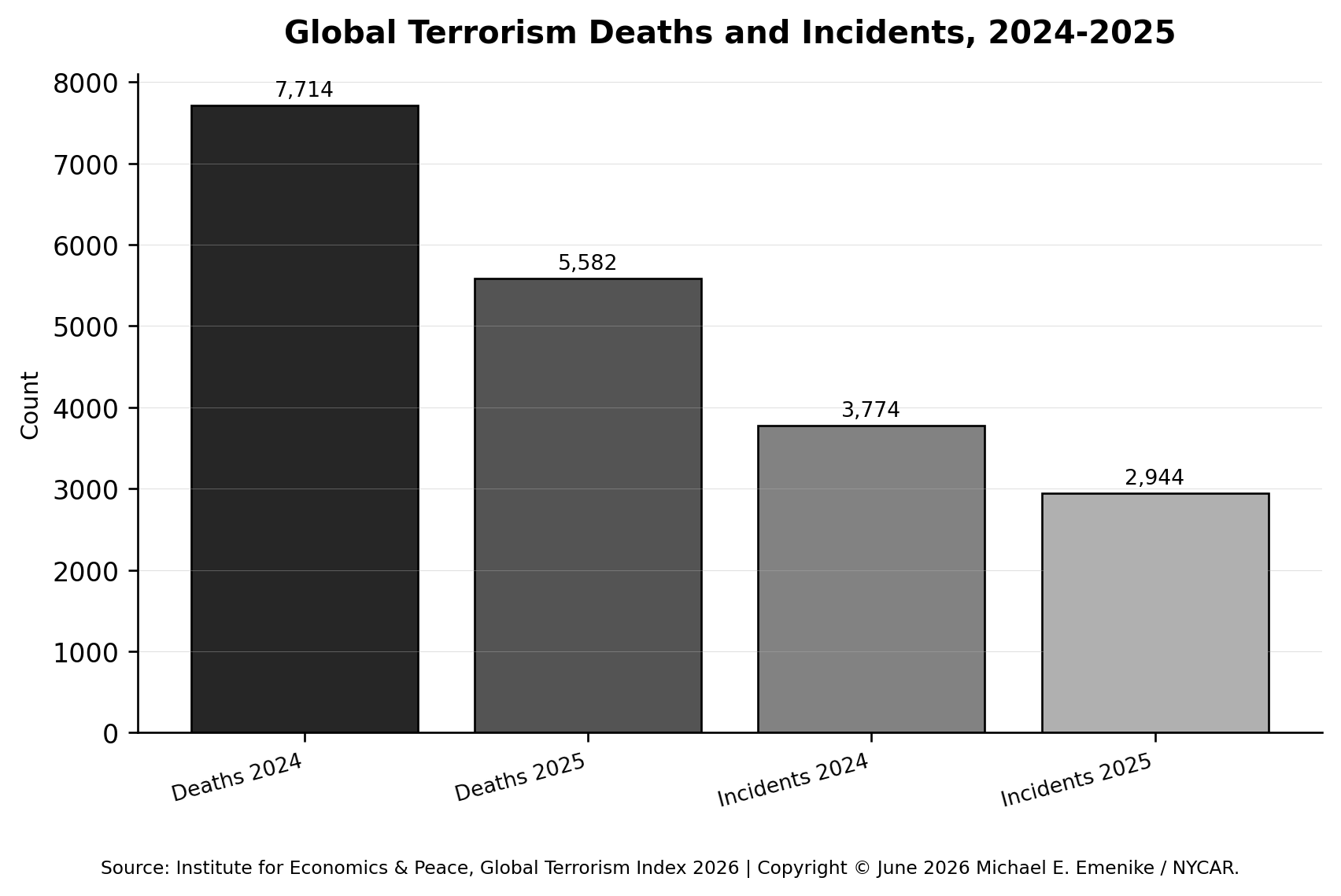
Figure 1. Global terrorism deaths and incidents, 2024-2025. Source: Constructed from Institute for Economics & Peace (2026). Copyright © June 2026 Michael E. Emenike / NYCAR.
5.2 Country burden and the need for differentiated policy
Differentiated policy also protects resources. A single national template wastes money because it funds the same activities in places that need different forms of support. A high-incident environment may need investigators, prosecutors, and forensic capacity. A high-civilian-fatality environment may need village protection, trauma services, safer routes to farms and markets, and stronger early warning. A high-concentration environment may need local government restoration before national announcements have any meaning on the ground.
Country comparisons are useful when they show difference rather than when they create false sameness. Pakistan’s 2025 burden involved high deaths, high incident volume, severe injury levels, and significant hostage-taking. Burkina Faso recorded fewer incidents than Pakistan but very high deaths. Nigeria recorded both a large death toll and a heavy civilian burden. Niger’s burden reflected serious violence with strong territorial concentration. The Democratic Republic of the Congo carried a large share of deaths linked to armed-group violence in the east. These differences call for different policy packages.
A country with many incidents may need stronger investigative, local-policing, judicial, and intelligence case-management capacity. A country with fewer but deadlier attacks may need improved early warning, civilian protection, emergency medical response, and protection of vulnerable settlements. A country with high civilian targeting needs public communication, victim support, and community trust mechanisms. A country with high territorial concentration needs local government restoration, service delivery, and accountable security presence in the affected areas.
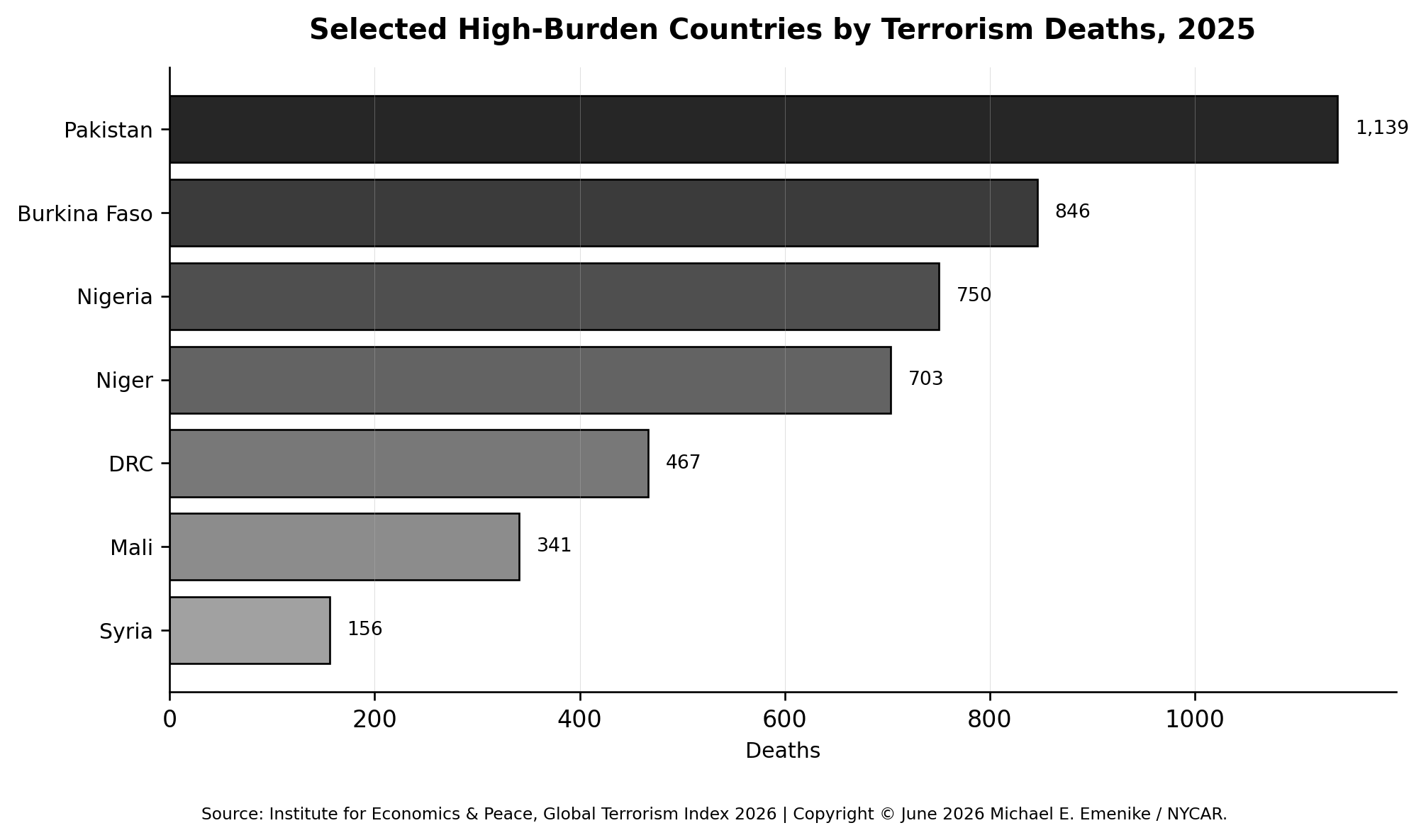
Figure 2. Selected high-burden countries by terrorism deaths in 2025. Source: Constructed from Institute for Economics & Peace (2026). Copyright © June 2026 Michael E. Emenike / NYCAR.
5.3 Increases matter even when global totals fall
A global decline can coexist with sharp country-level deterioration. That is why policy dashboards should show both total burden and year-on-year increases. Nigeria recorded the largest increase in terrorism deaths from 2024 to 2025 among the listed countries in the Global Terrorism Index 2026. The Democratic Republic of the Congo, Colombia, Benin, and Pakistan also recorded notable increases. This matters because deterioration often signals adaptation by armed groups, failure of local protection, new geographic spread, or pressure on public institutions.
Increases are especially important for early policy review. A country may not yet be the highest-burden country in absolute terms, but a sharp increase can show that existing controls are failing. Managers should therefore avoid waiting until a deterioration becomes a national crisis. A good system identifies acceleration early and asks what changed: leadership, funding, border movement, intergroup alliance, local grievance, prosecution capacity, or community cooperation.
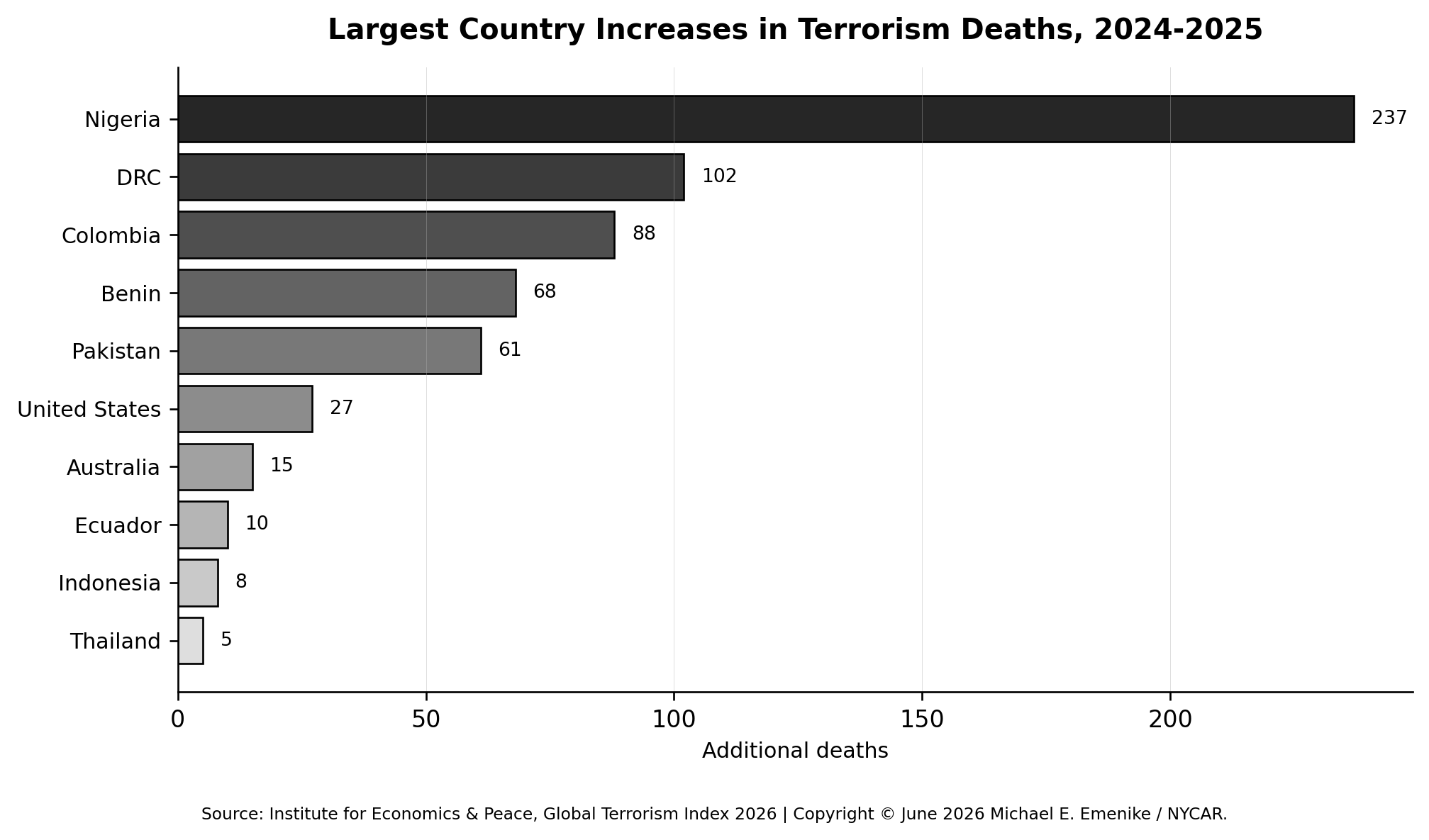
Figure 3. Largest country increases in terrorism deaths, 2024-2025. Source: Constructed from Institute for Economics & Peace (2026). Copyright © June 2026 Michael E. Emenike / NYCAR.
5.4 The concentration pattern
Concentration also has implications for international support. Donor programs often prefer national-level capacity building because it is administratively easier to fund and report. Yet high-burden areas may need more local and patient work: courts that can sit, schools that can reopen, police posts that are trusted, trauma services that reach survivors, and transport corridors that ordinary people can use. The concentration pattern therefore challenges both governments and partners to prove that their spending follows the geography of harm.
The strongest signal in the public data is concentration. Almost seventy percent of global terrorism deaths in 2025 occurred in five countries. That share is not an academic curiosity. It is a policy instruction. It tells international partners, regional organizations, humanitarian agencies, and national governments that counterterrorism capacity should be matched to burden, but also tailored to the political and social conditions of each place.
Concentration also warns against generalized counterterrorism spending. A national government can spend heavily and still miss the communities most exposed to risk. A donor can fund national training without improving the district where violence is clustered. A police reform can improve headquarters capacity while leaving the rural corridor unchanged. The concentration pattern requires counterterrorism management to become geographically literate.
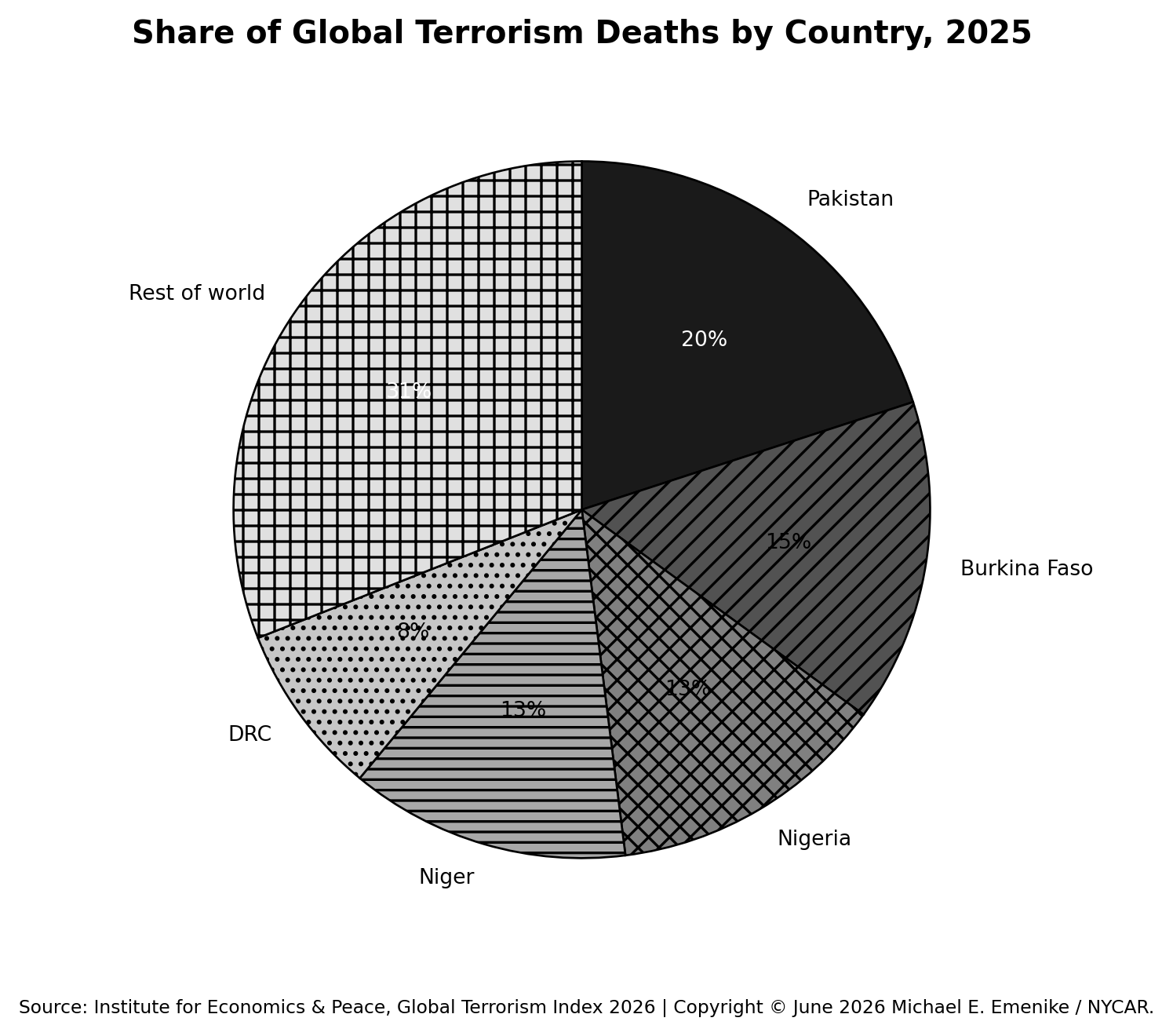
Figure 4. Share of global terrorism deaths by country, 2025. Source: Constructed from Institute for Economics & Peace (2026). Shares rounded to whole percentages. Copyright © June 2026 Michael E. Emenike / NYCAR.
5.5 What the global data cannot show
A second limitation is human experience. Datasets rarely show how a mother decides whether to send a child back to school, how a trader prices the risk of a road journey, or how a young man interprets humiliation at a checkpoint. These experiences do not fit neatly into global indices, yet they shape the environment in which violence either recedes or returns. Good policy keeps quantitative evidence in conversation with human knowledge, not above it.
Charts show burden, but they do not show everything a manager needs. They do not show the quality of local justice, the fear inside households, the reliability of witness protection, the political economy of armed groups, the trauma of survivors, the informal taxation of communities, or the reasons people do not trust state officials. A good public manager uses the charts as a starting point, not as a substitute for local knowledge.
Public data also cannot fully separate terrorism from wider conflict where armed groups, criminal networks, militias, insurgents, and state forces operate in overlapping spaces. Classification is difficult. Public data remains useful, but it must be handled with care. The stronger policy conclusion is therefore modest: public evidence can help prioritize attention, but legitimate action still requires context, legality, and local accountability.
Chapter 6: Nigeria and the Lake Chad Basin
6.1 Nigeria as a counterterrorism management case
Nigeria’s case also shows that security policy must be able to hold several truths at once. Armed groups must be disrupted, but communities must also be protected from the social and administrative collapse that violence produces. A village that has lost teachers, traders, health workers, local records, and trust in police cannot be stabilized by patrols alone. The management task is to rebuild the public functions that make security believable.
Nigeria is a central case because its terrorism problem is not only violent; it is administratively complex. The challenge involves Boko Haram factions, ISWAP, local insecurity, regional spillover, border movement, displacement, informal economies, weak service delivery in affected communities, political distrust, and a long history of security pressure in the North-East. A policy that treats the problem as a single armed-group question will miss the public-management burden carried by civilians, schools, health facilities, farmers, traders, local government, and displaced families.
IEP reported 750 terrorism deaths and 171 incidents in Nigeria in 2025, with attacks rising from the previous year. It also reported that ISWAP and Boko Haram were responsible for most terrorism-related deaths, while Borno State accounted for the overwhelming share of attacks and deaths (IEP, 2026). These figures point to a simple but demanding conclusion: Nigeria’s counterterrorism management should be concentrated where the burden is concentrated, but it should not be limited to armed response.
Nigeria’s case also shows why civilian protection belongs at the center of counterterrorism policy. When civilians carry most of the fatalities, the policy test changes. It is not enough to count militants killed or suspects arrested. Public institutions must ask whether markets reopen, children return to school, displaced people can move safely, farmers can access land, and communities can report threats without fear. These are not peripheral measures. They are evidence that public authority is returning.
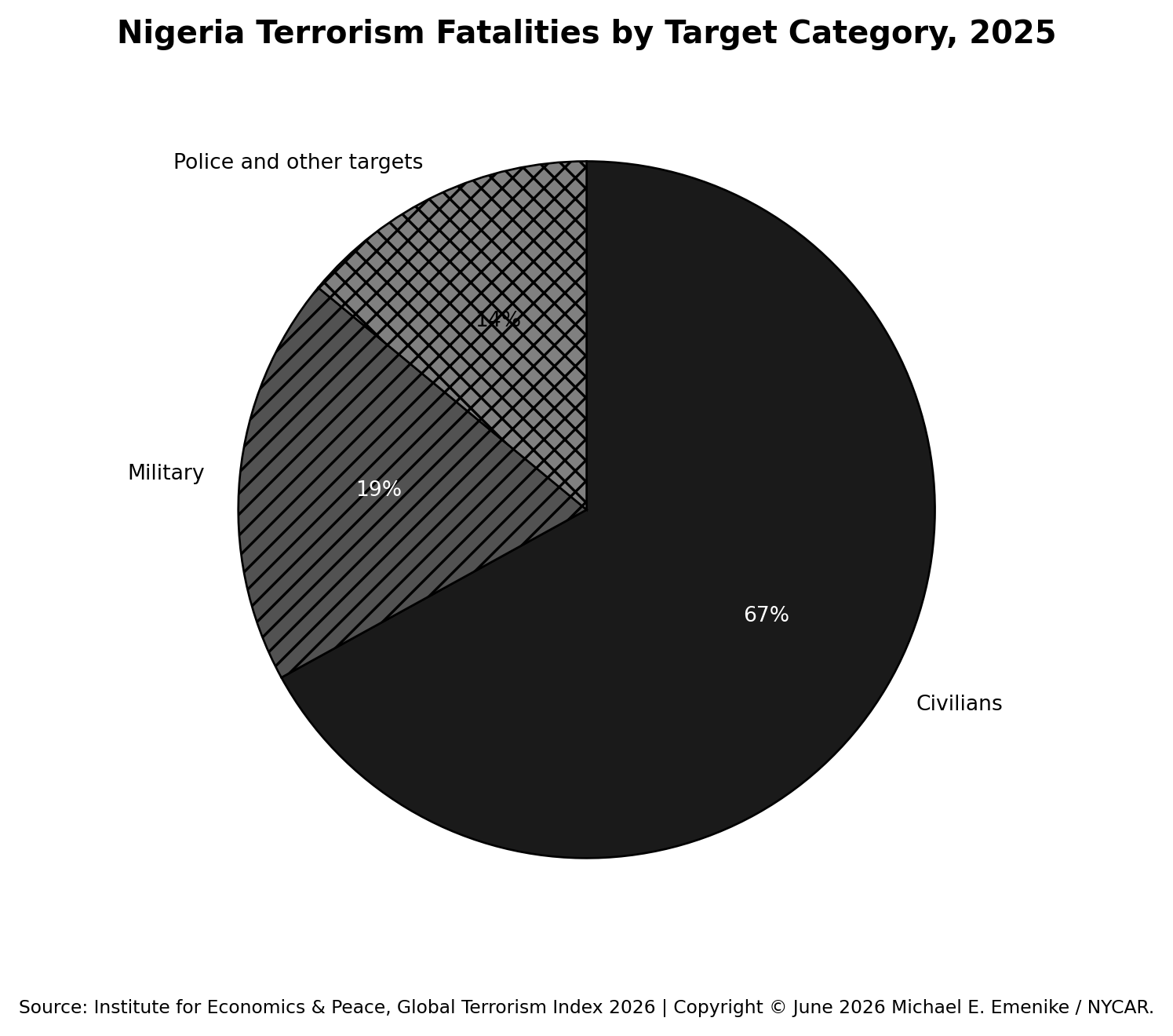
Figure 5. Nigeria terrorism fatalities by target category, 2025. Source: Constructed from Institute for Economics & Peace (2026). Copyright © June 2026 Michael E. Emenike / NYCAR.
6.2 Civilian exposure and public legitimacy
Nigeria’s civilian burden also creates a communication duty. People who live under threat need accurate information without propaganda, reassurance without exaggeration, and channels for reporting that do not expose them to retaliation. Public silence after attacks can look like abandonment; careless triumphalism can look like denial. The state must learn to speak in a way that recognizes grief, explains action, and protects ongoing investigations without turning victims into public relations material.
Nigeria’s target profile is a management warning. When civilians account for most deaths, counterterrorism must protect everyday life. That means improving the security of transport corridors, markets, worship places, farms, schools, health facilities, and displacement sites. It also means strengthening emergency response, victim assistance, trauma support, and community reporting systems. A policy that focuses only on armed encounters can leave civilian life dangerously exposed.
Civilian exposure also affects legitimacy. People judge the state not by national strategy documents but by what happens when they report a threat, seek protection, visit a police station, return to a village, or ask for support after an attack. If they meet indifference, abuse, extortion, or delay, trust collapses. Violent groups do not need to defeat the state everywhere. They need to make the state look absent, predatory, or unreliable in enough places.
This is why Nigeria’s counterterrorism management should be tied to public administration. Local government, schools, courts, health agencies, humanitarian partners, traditional authorities, religious leaders, youth organizations, and women’s networks should be part of the prevention and recovery system. The state should not outsource security to communities, but it should stop treating communities as passive recipients of orders.
6.3 Border management and Lake Chad cooperation
Lake Chad’s lesson is that border security cannot be separated from border livelihood. People cross for trade, family, farming, fishing, worship, and refuge. Armed groups exploit the same routes, but a policy that treats every movement as suspicious can damage the cooperation needed to identify real risk. Strong border management therefore needs intelligence, lawful identity systems, anti-corruption safeguards, humanitarian referral, and respect for legitimate movement. A hard border that is blind to livelihood may simply drive communities and criminals into the same informal paths.
Nigeria’s terrorism burden cannot be separated from regional geography. The Lake Chad Basin links Nigeria, Niger, Chad, and Cameroon through movement, trade, displacement, and armed-group mobility. Public policy therefore needs regional cooperation that is more practical than communiques. Border agencies, police, customs, immigration, intelligence services, prosecutors, and humanitarian actors need shared procedures that protect civilians while disrupting violent networks.
Security Council Resolution 2396 is relevant here because it places border control, information sharing, watchlists, biometrics, prosecution, rehabilitation, and reintegration within one international framework (United Nations Security Council, 2017). For Nigeria and its neighbors, the lesson is that border policy should not be reduced to a checkpoint. It should be a governed system: identity management, lawful information exchange, human-rights training, referral procedures for children and victims, anti-corruption controls, and clear channels for cross-border casework.
A poorly governed border can harm both security and livelihoods. Excessive harassment of traders and travelers can push movement into informal routes, weaken local economies, and reduce cooperation. Weak control can allow armed groups to move, tax, recruit, and resupply. The management goal is therefore balance: serious control, lawful conduct, accurate data, and respect for legitimate movement.
6.4 Recruitment pressure and prevention in Nigeria
UNDP’s recruitment findings have direct relevance for Nigeria. If job opportunities, trigger events, abuse, and local grievance play a role in recruitment, then prevention must be more than messaging. Young people in high-risk areas need credible alternatives, not slogans. Communities need protection from armed groups and protection from misconduct by security actors. Families need channels for early intervention that do not expose them to retaliation or humiliation.
Prevention should be designed around local evidence. A district where recruitment is linked to unemployment requires livelihood pathways and market access. A district where recruitment is linked to revenge after abuse requires accountability, complaint handling, and a credible justice response. A district where recruitment is linked to coercion requires protection, safe reporting, and support for escape or disengagement. One national prevention template cannot carry all of these differences.
Ownership is the management standard. Every prevention program should have a named public owner, a budget line, a target group, an implementation timeline, a complaint mechanism, and outcome measures. Without those details, prevention becomes a donor phrase rather than a public function.
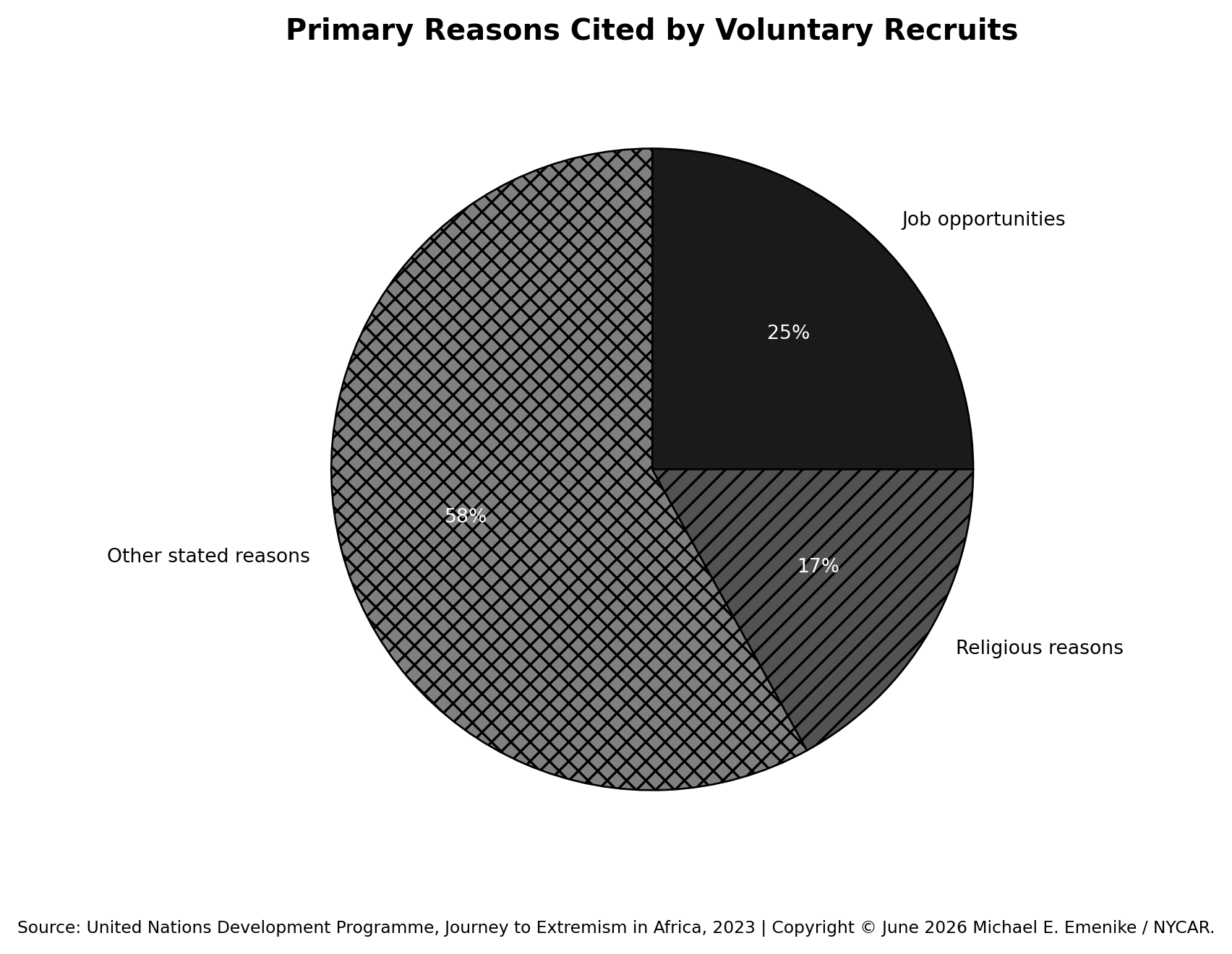
Figure 6. Primary reasons cited by voluntary recruits in UNDP’s Journey to Extremism in Africa. Source: Constructed from United Nations Development Programme (2023). Copyright © June 2026 Michael E. Emenike / NYCAR.
6.5 Nigeria policy priorities
A further priority is the link between security and ordinary administration. Identity documents, school reopening, clinic staffing, market access, road repair, and land-use security may appear outside the narrow vocabulary of counterterrorism, but they decide whether civilian life can resume. Armed groups exploit spaces where the state appears only as force and not as service. Nigeria’s long-term policy strength will depend on whether people in affected areas meet government as protection, justice, and practical presence, not only as a security operation.
Nigeria’s policy priorities should follow the evidence rather than the loudest demand. Civilian protection comes first, treated as a measurable counterterrorism outcome instead of a slogan. Borno and the worst-affected adjoining areas need concentrated management attention that brings security, courts, services, displaced-person support, and local governance together in the same place. Financial intelligence has to be tied to ground knowledge of informal taxation, extortion, ransom, and illicit flows, and tied with care, so that legitimate commerce and humanitarian work are not strangled in the process. And the complaint and accountability system for security operations needs strengthening, because misconduct left unanswered becomes a recruitment gift to the groups the state is trying to defeat.
Fifth, Nigeria should improve interagency case management. Intelligence that cannot become lawful evidence is often wasted. Arrest without prosecution can become grievance. Prosecution without witness protection can collapse. Military pressure without civil restoration can create repeated cycles of clearance and return. A public manager should therefore ask not only whether an operation occurred, but whether the whole chain of protection, evidence, justice, services, and trust moved forward.
Chapter 7: Sahel and Pakistan Case Lessons
7.1 Burkina Faso, Niger, and Mali: the Sahel management lesson
Sahel cases also expose the weakness of policies that treat territory as empty space. Borderlands are lived economies. They contain herders, farmers, traders, families, migrants, religious networks, and local authorities. When policy sees only a line on a map, it misses how armed groups enter daily life through taxation, mediation, intimidation, marriage ties, protection rackets, and control of movement. Counterterrorism management in the Sahel has to understand those social routes without romanticizing them or surrendering public authority to them.
Across the Sahel, what happens when armed violence, weak public authority, border space, local grievance, and regional insecurity reinforce one another. Burkina Faso, Niger, and Mali have different political histories and security trajectories, but their counterterrorism challenges share a management problem: the state must protect communities across vast territory while rebuilding legitimacy in places where citizens may experience the state as absent, late, or coercive.
In Burkina Faso, the public data shows very high deaths despite a sharp decline from the previous year. In Niger, the burden remains serious with concentration in affected border regions. In Mali, deaths and attacks declined, but the underlying public-policy problem remains connected to territorial control, governance reach, and local insecurity. These patterns demand more than incident response. They demand local administration that can protect movement, restore basic services, maintain lawful security presence, and resolve community disputes before armed groups turn them into recruitment channels.
Sahel evidence also shows the danger of overcentralized security planning. Headquarters may approve strategy, but insecurity is experienced at the level of villages, markets, grazing routes, schools, and roads. A plan that does not work at that level is not working. Counterterrorism management should therefore include district-level risk reviews, local civilian-protection plans, mobile justice support, corruption controls, and service-delivery tracking.
7.2 Pakistan: high incident volume and institutional pressure
High incident volume also places pressure on credibility. If cases move slowly, if suspects are held without lawful process, or if communities believe that enforcement is selective, the state’s capacity begins to look arbitrary. Pakistan’s challenge therefore underlines a wider lesson: a busy security environment needs stronger systems, not looser standards. The more intense the threat, the more important it becomes to protect evidence, maintain review, and communicate clearly with affected communities.
Pakistan’s 2025 terrorism burden illustrates a different management challenge. IEP reported that Pakistan ranked first in the Global Terrorism Index in 2025, with 1,139 deaths, 1,595 injuries, and 1,045 incidents. The Tehrik-i-Taliban Pakistan was responsible for a large share of violence, while the burden was concentrated heavily in provinces near the Afghanistan border (IEP, 2026). This combination of high deaths, high incident volume, injuries, hostage-taking, and border-adjacent concentration places enormous pressure on policing, intelligence, prosecution, military coordination, emergency response, and diplomacy.
Pakistan matters in this comparison because high incident volume can overwhelm institutional quality. When hundreds of cases compete for attention, evidence handling, witness protection, prosecutorial preparation, detention oversight, forensic capacity, and court scheduling become central to counterterrorism outcomes. Poor case management can weaken deterrence. It can also produce wrongful detention, public anger, and failed prosecutions. A state facing high incident volume needs systems, not only bravery.
Pakistan also shows the importance of regional context. Border dynamics, displacement, militant sanctuaries, ideological networks, and local political grievances cannot be handled by police action alone. Diplomacy, border administration, provincial governance, financial controls, and community engagement all matter. A management framework helps by forcing these elements into the same conversation.
7.3 Comparative policy lessons
Comparison also warns against ranking countries as if the policy answer were identical. Pakistan’s high incident volume is not the same management problem as the civilian burden in parts of Nigeria or the territorial fragility of the Sahel. The value of comparison is to make managers more precise. It should sharpen questions about capacity, legitimacy, target patterns, financing, displacement, and justice quality. It should not flatten different histories into a single security template.
Table 5. Comparative Policy Lessons from Selected Cases
| Case | Main management signal | Policy implication |
| Nigeria | High civilian burden and territorial concentration | Civilian protection, local trust, Borno-focused management, cross-border Lake Chad cooperation. |
| Burkina Faso | High deaths with fewer incidents than Pakistan | Protection of vulnerable communities, local government restoration, prevention of territorial isolation. |
| Niger | Serious border-region burden | Border governance, community protection, regional coordination, service continuity. |
| Mali | Declining totals but persistent insecurity | Sustain pressure while rebuilding local legitimacy and justice access. |
| Pakistan | High incidents, deaths, injuries, and hostage pressure | Case-management capacity, provincial coordination, border diplomacy, evidence quality, emergency response. |
The comparative lesson is not that every country should copy another. It is that counterterrorism management should be specific to burden. Where civilian fatalities dominate, civilian protection must be a performance measure. Where incident volume is high, case-management capacity becomes vital. Where territorial concentration is severe, local governance and service restoration are security functions. Where recruitment is linked to abuse, accountability is prevention. Where financing is hidden in informal channels, financial intelligence must be joined with local knowledge.
These lessons also warn against public-policy theater. A state can announce a task force, pass a law, train officers, acquire technology, or increase spending without changing the lived risk of affected communities. The policy question is always practical: what public function has improved, for whom, where, and with what evidence?
Chapter 8: Public Policy Management Framework
8.1 The eight-pillar management framework
This framework is intentionally broad because counterterrorism failure is often produced by the space between agencies. A finance unit may see suspicious movement but lack local intelligence. A police unit may arrest suspects but fail to preserve evidence. A development program may enter a community without understanding security risk. A reintegration program may return people without preparing victims or local leaders. The eight pillars force these functions into one management conversation.
A counterterrorism policy that is serious enough for high-risk societies should be organized around eight management pillars. These pillars are not separate departments. They are connected functions that should be reviewed together by cabinet-level leadership, national security institutions, justice officials, finance regulators, local government, and community-facing agencies.
Table 6. Eight-Pillar Counterterrorism Management Framework
| Pillar | Main function | Illustrative measures |
| 1. Protection of life | Civilian protection, emergency response, victim support, school and market safety planning. | Deaths, injuries, displacement, victim assistance coverage, time to response. |
| 2. Lawful intelligence and policing | Threat reporting, investigation, evidence preservation, witness protection, case quality. | Actionable reports, case files, prosecution readiness, complaint rates. |
| 3. Justice and detention governance | Due process, lawful detention, prosecution, rehabilitation screening, prison safeguards. | Case disposal, detention review, acquittal reasons, prison risk reviews. |
| 4. Financing and material support controls | Risk-based financial intelligence, sanctions implementation, customs controls, nonprofit safeguards. | Suspicious reports, successful investigations, false-positive review, protected humanitarian access. |
| 5. Prevention and disengagement | Livelihood pathways, grievance response, early intervention, family support, reintegration. | Program completion, recidivism monitoring, employment/education linkage, community acceptance. |
| 6. Service restoration | Schools, clinics, roads, identity services, local government, agricultural access. | Facility reopening, staffing, service use, travel safety, public feedback. |
| 7. Regional cooperation | Border management, information exchange, joint casework, humanitarian coordination. | Timely referrals, lawful data exchange, joint reviews, corruption reports. |
| 8. Public trust and accountability | Complaint systems, rights safeguards, transparent communication, independent review. | Complaint resolution, public confidence surveys, disciplinary outcomes, community reporting. |
8.2 Coordination and ownership
Ownership must also survive leadership changes. Many public systems depend on the energy of one minister, commander, donor, or reform officer. When that person leaves, the routine collapses. NYCAR-standard policy thinking requires institutional memory: written procedures, standing review meetings, shared indicators, responsible offices, and records that allow the next official to see what was done, what failed, and what remains unresolved.
A common weakness in many counterterrorism systems is not lack of agencies. It is lack of ownership across the chain. An intelligence service may know something. A police unit may need evidence. A prosecutor may need witnesses. A finance unit may detect a suspicious flow. A local government may know which families are displaced. A school authority may know which children have disappeared. If these pieces are not connected lawfully and responsibly, the state sees fragments while violent groups exploit the gaps.
The framework therefore requires a named owner for each pillar and a joint review process that brings the owners together. Joint review should not be a ceremonial meeting. It should examine current risk, recent incidents, civilian harm, case progress, financing signals, recruitment concerns, local service conditions, complaints, and community feedback. The purpose is to convert information into decisions: who must act, by when, with what authority, and how progress will be checked.
Ownership should also extend to local government. Counterterrorism is often national in command but local in effect. A national plan that does not define what a governor, mayor, district officer, school authority, health agency, police commander, or community liaison must do will not reach the people most affected. Public policy becomes real when it has local tasks, budgets, and accountability.
8.3 Communication as management
Communication should also make room for uncertainty. Public institutions lose credibility when they speak with false confidence before facts are known. They also lose credibility when they hide behind silence after harm. The professional standard is measured honesty: say what is known, what is being verified, what support is available, and when the public will receive the next update. In fearful environments, disciplined communication can reduce rumor without compromising investigation.
Counterterrorism communication is not simply publicity. It is a management function. Communities need to know how to report threats, where to seek help, what rights they have, what services are available, how victims can receive support, and how the state will protect lawful activity. Poor communication creates rumor, fear, and suspicion. Overconfident communication creates credibility problems when the next attack occurs. The best communication is sober, factual, timely, and respectful.
Communication also matters after harm. Victims should not learn about government concern only through speeches. They should experience it through identification of the dead, treatment of the injured, trauma care, compensation where appropriate, restoration of documents, support for displaced households, and public explanation of what is being done to reduce future risk. A state that communicates only victory and never grief sounds detached from the people it claims to protect.
In high-risk societies, public messaging must also avoid stigmatization. Religious, ethnic, regional, or occupational identity should not be treated as evidence of guilt. Collective suspicion can damage intelligence flow, increase social division, and create exactly the grievance that violent groups exploit. Communication should distinguish clearly between criminal organizations and the communities they harm.
8.4 Finance, civil society, and humanitarian access
Humanitarian access is not a side issue. In areas affected by terrorism, lawful charities, local associations, and relief agencies may be the only actors still able to provide food, medical support, education, trauma care, or documentation assistance. If controls are designed without understanding that reality, they may reduce the services that keep communities away from armed-group dependence. A precise system protects financial integrity while preserving the lawful assistance that makes resilience possible.
Finance policy also needs feedback from the field. A suspicious transaction report may be useful, but it does not explain whether a village economy is being taxed, whether ransom networks are moving through informal channels, or whether legitimate aid is being delayed by fear of compliance exposure. Regulators, banks, humanitarian agencies, prosecutors, and local officials should therefore review blocked transactions and confirmed abuse together. The aim is not softer control. It is better control, aimed at real risk rather than administrative anxiety.
Terrorist financing controls must be strong, but they must also be precise. FATF’s risk-based approach is useful because it recognizes that financial systems need to identify and mitigate risk without unnecessarily disrupting legitimate nonprofit and humanitarian activity (FATF, 2025). In conflict-affected areas, civil society and humanitarian actors often provide services that the state cannot immediately provide. If financial controls choke off lawful assistance, communities become more vulnerable and armed groups may gain influence.
A responsible policy should therefore build channels for lawful humanitarian access, clarify compliance expectations, train financial institutions on risk-based assessment, and establish escalation routes when legitimate transactions are blocked. Counterterrorism finance should disrupt violent organizations, not punish the communities that depend on relief, local charities, remittances, or development projects.
The management question is not whether financial controls should exist. They must. The question is whether they are intelligent enough to distinguish between risk and legitimate need. That requires data, supervision, appeal mechanisms, and regular review of unintended consequences.
Chapter 9: Implementation, Monitoring, and Ethical Safeguards
9.1 Building a counterterrorism management dashboard
A dashboard should also show movement over time rather than isolated numbers. One month of improvement may reflect temporary displacement, an armed-group pause, or poor reporting. Three quarters of consistent improvement across harm, justice quality, service restoration, and community reporting carry more meaning. The dashboard should help leaders ask better questions, not give them a false claim of certainty.
A management framework needs a dashboard, but the dashboard must avoid the false comfort of counting activity as success. Number of meetings, patrols, arrests, workshops, or media releases does not prove safer communities. A useful dashboard should combine harm measures, justice measures, prevention measures, service measures, finance measures, and trust measures. It should show whether the state is reducing harm while becoming more credible.
Dashboard review should occur at three levels. At the national level, leaders should examine country burden, regional cooperation, financing, legal reforms, and budget allocation. At the state or provincial level, officials should examine concentration, case progress, local service conditions, and displacement. At the community level, managers should examine reporting channels, victim support, school and market safety, complaint resolution, and public feedback.
Table 7. Suggested Counterterrorism Management Dashboard
| Dashboard domain | Measures | Review cycle |
| Harm reduction | Deaths, injuries, incidents, kidnappings, displacement, property loss | Monthly and quarterly |
| Justice quality | Evidence quality, lawful detention review, prosecutions, case disposal, witness protection | Monthly |
| Civilian protection | Response time, victim assistance, school/market reopening, protected movement corridors | Monthly |
| Prevention | At-risk youth referrals, livelihood placement, family support, disengagement outcomes | Quarterly |
| Financial controls | Suspicious reports, investigations, sanctions compliance, humanitarian false positives | Quarterly |
| Public trust | Complaints, resolution time, community reporting, survey evidence, civil society feedback | Quarterly |
| Regional cooperation | Cross-border referrals, shared casework, joint reviews, corruption complaints | Quarterly |
9.2 Ethical safeguards
Ethical safeguards should be designed before crisis, not improvised after scandal. Detention review, complaints, data correction, access logs, disciplinary procedures, and civilian harm recording all require systems that already exist when pressure arrives. A state that waits until abuse becomes public has already lost trust. Responsible counterterrorism management builds review into the ordinary process of exercising power.
Counterterrorism policy carries exceptional ethical risk because it gives the state strong powers at moments of public fear. Those powers may be necessary, but necessity does not remove the duty of restraint. Abuse can destroy cases, damage intelligence cooperation, violate rights, and strengthen extremist narratives. A serious management framework therefore builds ethical safeguards into the system rather than treating them as external criticism.
Legality is the first safeguard. Agencies should know the legal basis for detention, search, data collection, watchlisting, sanctions, asset freezes, and information sharing. The second safeguard is necessity and proportionality. A measure should be no broader than the risk requires. The third safeguard is review. Decisions that affect liberty, property, family life, humanitarian access, or reputation should be reviewable. The fourth safeguard is remedy. People wrongly harmed by counterterrorism action need a path to correction.
Data protection is another safeguard. Modern counterterrorism increasingly relies on identity systems, biometrics, watchlists, telecommunications information, financial intelligence, and cross-border data exchange. These tools can improve security, but they can also produce error, abuse, and stigma. Data systems should have clear access rules, audit trails, correction procedures, and independent oversight.
9.3 Monitoring unintended consequences
Strong monitoring systems are willing to hear bad news early. They make room for complaints, civil society reports, local government warnings, and victim feedback before the problem becomes international embarrassment or renewed violence. A counterterrorism system that cannot tolerate criticism is not strong. It is blind. Strength lies in correcting harmful practice quickly enough that public confidence is not permanently lost.
A policy can produce harm even when its goal is legitimate. Heavy-handed operations may displace civilians into unsafe areas. Broad financial restrictions may block humanitarian activity. Poorly managed reintegration may anger victims. Public messaging may stigmatize a community. Surveillance may chill lawful religious or political activity. A mature counterterrorism system monitors these unintended consequences and changes course when evidence demands it.
Monitoring should include civil society, community leaders, victim groups, women’s organizations, youth representatives, humanitarian partners, and local officials. This does not mean giving sensitive operational information to everyone. It means giving affected communities a serious channel to report harm, fear, corruption, abuse, or policy failure. People closest to risk often see problems before national dashboards show them.
A public manager should ask five questions after every major counterterrorism initiative. Did it reduce harm? Did it strengthen or weaken trust? Did it produce lawful evidence and fair process? Did it protect civilians and legitimate civil activity? Did it create new grievances that require correction? These questions keep policy honest.
9.4 Capacity building that matters
Capacity building should finally be tested in practice. If officers are trained on evidence handling, case files should improve. If prosecutors receive counterterrorism training, case quality and disposal should change. If border officials receive human-rights training, complaints and lawful referrals should be reviewed. If community liaison officers are trained, reporting channels should become safer and more trusted. Training has value only when it changes conduct.
Training is often the easiest reform to announce and the hardest to connect to outcomes. A workshop does not automatically improve counterterrorism management. Capacity building should be tied to specific performance gaps: evidence handling, financial investigation, border referral, victim support, forensic practice, witness protection, detention review, community reporting, data protection, or public communication.
Each capacity-building program should answer a practical question. What problem is being solved? Which staff need the skill? What procedure will change after training? Which supervisor will check compliance? What measure will show improvement? Without those questions, training becomes a record of attendance rather than a change in public performance.
Capacity building should also be multi-agency where the problem is multi-agency. Terrorist financing requires finance, police, prosecutors, customs, and regulators. Border management requires immigration, security agencies, humanitarian actors, child-protection officials, and neighboring states. Reintegration requires justice, social services, mental-health support, education, employment, victims’ representatives, and local communities. Training one agency alone can leave the chain weak.
Chapter 10: Findings, Recommendations, Limitations, and Conclusion
10.1 Main findings
The main finding is that counterterrorism management is strongest when it is treated as public governance rather than as a single security operation. The 2025 public data shows a global decline in deaths and incidents, but that improvement sits beside severe concentration in a small number of countries and territories. Public leaders should therefore resist both complacency and panic. The useful reading is more disciplined: terrorism burden is uneven, local, and shaped by institutional capacity.
Nigeria’s 2025 pattern confirms why civilian protection and territorial concentration must be treated as management priorities. The evidence also supports a prevention argument. UNDP’s recruitment findings show that employment pressure, trigger events, and human-rights abuse cannot be pushed to the edge of security planning. Terrorist-finance controls remain necessary, but they must be risk-based and proportionate so that lawful civil society and humanitarian activity are not damaged. Public trust emerges from the whole analysis as a security asset because it affects reporting, witness cooperation, prevention, reintegration, and the credibility of the state.
10.2 Recommendations
National counterterrorism councils and public safety agencies should adopt a transparent management-priority model such as RCMPS to compare burden across regions and decide where oversight, protection, justice, and services need urgent strengthening. The model should not be used mechanically. It should sit inside a review process that includes data quality checks, human-rights safeguards, local context, and clear ownership of follow-up actions.
Civilian protection should become a core performance measure. Deaths, injuries, displacement, school closure, market disruption, victim assistance, and the safe return of everyday movement should be tracked as counterterrorism outcomes, not as humanitarian afterthoughts. A policy that reduces the number of armed encounters but leaves civilians afraid to farm, trade, worship, travel, or send children to school has not restored public safety.
States should strengthen lawful case management across intelligence, policing, prosecution, detention review, witness protection, and court capacity. Weakness in any part of the chain can damage justice and trust. Governments should also protect public confidence while using state power by improving complaint systems, detention safeguards, disciplinary processes, and public communication. Abuse should be treated not only as a rights violation but as a strategic error that can become a recruitment driver.
Terrorist-finance controls should be risk-based and precise. Financial intelligence must focus on real risk, protect lawful nonprofit and humanitarian activity, and provide appeal routes when legitimate transactions are wrongly blocked. Prevention programs should also be localized. Employment pressure, family fear, abuse, coercion, and grievance require different tools. Generic messaging cannot replace credible local alternatives.
Regional cooperation should be improved through lawful information exchange, identity controls, child and victim referral procedures, anti-corruption safeguards, and cross-border prosecution support. Governments should also publish responsible non-sensitive dashboards on harm reduction, justice quality, civilian protection, prevention, finance controls, and complaint resolution. Public accountability does not require exposing operations. It requires showing citizens that power is being used with discipline.
10.3 Limitations of the study
This limitation does not weaken the publication. It defines its honesty. Counterterrorism research that pretends to know more than its evidence allows can become dangerous, especially where the subject involves coercive state power and vulnerable communities. The work keeps its claims within the reach of public data and management reasoning, and that restraint is part of the professional standard.
The publication relies on public evidence, and so it cannot claim the precision of classified intelligence, field interviews, or local ethnographic research. Public terrorism data carry their own reporting limitations, classification disputes, and information gaps. The model offered here is a management tool, not a predictive engine, and it should be tested, adapted, and improved with country-level data before any institution adopts it.
The publication also cannot settle every debate about counterterrorism theory, insurgency, political violence, or conflict resolution. Its focus is narrower and more practical: how should public managers organize counterterrorism priorities when the evidence shows concentrated harm, civilian exposure, recruitment pressure, financing risk, and trust deficits? Within that scope, the argument is clear and usable.
10.4 Conclusion
Michael E. Emenike’s central contribution is therefore not a claim that management can replace security action. It is the stronger claim that security action needs management if it is to endure. The publication asks leaders to judge counterterrorism by the condition of the public after policy has acted: whether civilians are safer, courts are stronger, agencies cooperate better, financial channels are cleaner, communities report earlier, and state power carries enough legitimacy to hold the ground it has recovered. It also gives the publication a clear professional standard for policy readers, not a rhetorical closing gesture.
The final lesson is that security must become administratively competent. A state may possess weapons, laws, and agencies and still fail if its institutions cannot coordinate, document, prosecute, repair, and learn. Counterterrorism beyond force is not a softer standard. It is a harder one, because it asks public power to be effective without becoming reckless, firm without becoming abusive, and protective without losing the trust of the people whose safety gives the policy its purpose. That is the standard this publication applies to every model, case, figure, and recommendation it presents, and it is the reason the study remains grounded in public management rather than performance language.
Counterterrorism beyond force is not counterterrorism without force. It is counterterrorism governed by judgment. A state has the right and duty to protect people from organized violence. But protection becomes durable only when public power is lawful, coordinated, trusted, and connected to the conditions that violent groups exploit. The strongest counterterrorism policy is therefore not the loudest one. It is the one that reduces harm while making public authority more credible.
Public data from 2025 gives both encouragement and warning. Global terrorism deaths and incidents declined, but the burden remains concentrated and severe in specific countries. Nigeria, the Sahel, and Pakistan show that public managers must read fatalities, incidents, lethality, territorial concentration, civilian exposure, recruitment drivers, and institutional trust together. Any policy that separates those variables will see only part of the problem.
Michael E. Emenike’s paper is therefore framed around a practical standard: counterterrorism management should be judged by whether it protects life, strengthens law, preserves trust, disrupts violent networks, supports victims, reduces recruitment pressure, and restores public services in places where fear has weakened the state. That is a demanding standard. It is also the only standard worthy of a public policy that claims to defend society.
References
Financial Action Task Force. (2025). International standards on combating money laundering and the financing of terrorism & proliferation: The FATF recommendations (updated October 2025). FATF. https://www.fatf-gafi.org
Institute for Economics & Peace. (2026). Global Terrorism Index 2026: Measuring the impact of terrorism. Institute for Economics & Peace. https://www.visionofhumanity.org/resources
United Nations Development Programme. (2023). Journey to extremism in Africa: Pathways to recruitment and disengagement. UNDP. https://www.undp.org/africa/publications/journey-extremism-africa-pathways-recruitment-and-disengagement
United Nations General Assembly. (2023). The United Nations Global Counter-Terrorism Strategy: Eighth review (A/RES/77/298). United Nations. https://undocs.org/A/RES/77/298
United Nations Office on Drugs and Crime. (2021). Module 1: Counter-terrorism in the international law context. United Nations. https://www.unodc.org
United Nations Security Council. (2017). Resolution 2396 (2017): Threats to international peace and security caused by terrorist acts. United Nations. https://undocs.org/S/RES/2396(2017)
United Nations Security Council. (2019). Resolution 2462 (2019): Threats to international peace and security caused by terrorist acts. United Nations. https://undocs.org/S/RES/2462(2019)
World Bank. (2020). World Bank Group strategy for fragility, conflict, and violence 2020-2025. World Bank. https://documents.worldbank.org