

Flexible Scholarship, Professional Evidence, and the Future of Executive Learning
Doctoral Research Publication
Research Publication by Dr. Nneka Anne Amadi
New York Center for Advanced Research (NYCAR)
June 2026
Publication No.: NYCAR-TTR-2026-RP064
Date: June 2026
DOI: https://doi.org/10.5281/zenodo.20706500
Peer Review Status
This doctoral research publication underwent independent peer review under the internal editorial peer review framework of the New York Center for Advanced Research (NYCAR) and The Thinkers’ Review. The review was conducted independently by designated Editorial Board members, without author involvement, and the manuscript was approved in accordance with NYCAR’s Research Ethics Policy and its standards for independent academic evaluation.
Copyright © June 2026 Dr. Nneka Anne Amadi and New York Center for Advanced Research (NYCAR). All rights reserved.
Abstract
This doctoral research examines unconventional higher education in the business school, treating the New York Center for Advanced Research (NYCAR) as an applied institutional case. The work is deliberately applied: it uses current public evidence, institutional cases, and conceptual analysis to build a practical argument for leaders who must make difficult decisions under constraint. The central claim is that modern institutions cannot rely on inherited forms when public trust, technology, cost pressure, learner or customer expectations, and social inequality are changing the meaning of performance. The publication develops a conceptual model, comparative case analysis, diagnostic tools, black-and-white figures, and implementation tables. It treats data as evidence, not decoration, and treats theory as a tool for disciplined judgement rather than academic display. The final position is that serious institutional renewal requires proof: visible routines, accountable governance, ethically defensible choices, and a readiness to correct weak systems before they become public failure.
Keywords: unconventional higher education, business-school reform, executive education, professional learning, institutional governance, quality assurance, micro-credentials, academic integrity, NYCAR
A note on evidence and method
The approach here is applied and interpretive rather than statistical. It draws on current public reporting from education and development bodies, on documented institutional practice, and on conceptual analysis, and it reads those sources beside the working mechanics of admission, supervision, assessment, and governance. The aim is not to measure a population of schools but to build a defensible argument that a leader can act on, and to be explicit about the limits of each kind of evidence so that demand is not mistaken for quality, nor ambition for proof.
A word is also owed on how the case material is used. The New York Center for Advanced Research appears throughout as an applied example rather than as a subject of independent audit, and the analysis treats its routines as illustrations of principles that other institutions could adopt or contest. Where public reports from bodies such as the OECD, UNESCO, AACSB, the World Bank, and the United Nations are cited, they are read as evidence about the sector’s direction and pressures, not as endorsements of any single provider. Throughout, the test applied to others is applied to the argument itself: claims are tied to something a reader could check, and the reasoning is meant to be followed, questioned, and improved rather than accepted on authority.
Contents
List of Tables and Figures
Table 1. Unconventional business-school model 25
Table 2. NYCAR case-study quality test 45
Table 3. Doctoral implementation plan 64
Figure 1. Business-school pressure profile 12
Figure 2. Unconventional business-school learning mix 18
Figure 3. Quality controls for non-traditional delivery 24
Figure 4. Learner value proposition 25
Figure 5. Business-school transformation stages 32
Figure 6. Assessment evidence strength 38
Figure 7. Academic governance attention 44
Figure 8. NYCAR case-readiness indicators 45
Chapter 1: Introduction: Why the Conventional Business School Is No Longer Enough
1.1 Naming the problem the policy language hides
The pressure on the conventional business school is rarely settled by renaming old arrangements. The real test is whether the institution changes the conditions under which learning is admitted, supervised, tested, and made useful. Adult professionals need learning that can recognize experience, test competence, and produce evidence of serious thinking without pretending that every learner has the same calendar, career stage, or institutional access. A doctoral-level discussion must stay close to that operating reality.
This matters because professional learners do not enter business education as blank academic subjects. They arrive with work histories, managerial habits, uneven writing confidence, partial technical knowledge, and urgent career pressures. NYCAR becomes useful here because its model begins with working adults and asks what academic rigor should look like when learners bring professional evidence into the room.
The test is therefore practical and academic at the same time. A claim about access must be supported by fair entry judgment. A claim about flexibility must be supported by supervision. A claim about research quality must be supported by sources, revision, and public accountability.
A weak model hides behind modern vocabulary. A serious model exposes itself to review..
This problem definition also requires a sharper reading of institutional behavior. In the conventional business-school model, weak schools tend to describe access as generosity while avoiding the harder question of what support, review, and academic pressure the learner will meet after admission. Stronger institutions do not confuse open doors with serious education. They ask whether the learner can receive timely guidance, produce evidence, revise weak work, and graduate with a body of scholarship that another reviewer can respect. The claim is not that every conventional practice should be discarded. The claim is that inherited practice should justify itself. Where a fixed classroom strengthens discipline, it should remain. Where it simply protects habit, the school has a duty to redesign the learning route without lowering the standard. The early chapters must establish that flexibility is valuable only when it is tied to supervision and proof.
1.2 Reading evidence about a changing learner
Evidence in this area should be handled with care. Public reports, institutional materials, employer signals, and education research can show pressure, but they cannot by themselves prove quality inside a school. The stronger academic move is to read those materials beside the lived mechanics of admission, supervision, assessment, and learner support.
For the pressure placed on the conventional business-school model, the useful evidence is the kind that changes judgment. It tells leaders where access is blocked, where professional learning is undervalued, where assessment is too narrow, and where digital delivery may expand reach without strengthening competence.
The analysis should not chase novelty. It should ask whether the learner can defend a position, use sources responsibly, recognize limits, connect theory to practice, and produce work that can stand outside the classroom.
Pace matters when a business school moves from announcement to practice. Early implementation should begin with visible routines: baseline review, named responsibility, simple dashboards, staff briefings, and repair of the failures already known to learners and faculty. The stronger sequence is to prove reliability in a limited number of settings, record the cost honestly, build staff confidence, and then expand with evidence rather than enthusiasm.
The evidence should be read with that caution in mind. Reports on digital learning, micro-credentials, executive education, labor-market change, and higher-education finance are useful because they show pressure on the sector, but they do not automatically validate any single institutional response. A serious reading asks what each source proves and what it cannot prove. Employer demand can show need, but not academic quality. Learner preference can show access pressure, but not competence. Publication output can show ambition, but only careful review can prove scholarly value. The value of the conventional business-school model lies in connecting these different signals without exaggerating them. That disciplined reading gives the paper a more credible voice than broad praise for innovation would allow. The micro-credential evidence is a useful example: industry reporting shows rapid uptake and perceived value, yet it measures demand rather than scholarly depth (Lumina Foundation, 2025). Broad development data make the same point at the level of whole economies, where access to learning and the spread of new technology are reshaping opportunity unevenly (United Nations Development Programme, 2025; United Nations, 2025).
1.3 The choices that separate reform from rhetoric
Management choices decide whether the pressure placed on the conventional business-school model becomes serious scholarship or promotional language. The decisive choices are often ordinary: who reviews entry evidence, who mentors the learner, who approves the research topic, who checks sources, who records feedback, and who has authority to stop weak work.
A school that serves experienced professionals needs firm routines without treating every learner as though their path is identical. Recognition of prior learning, workplace evidence, and flexible delivery require careful judgment, not loosened standards. The route may differ; the demand for intellectual quality should not.
The management burden also includes staff capacity. Mentors need time, training, and authority. Editorial review needs consistency. Learners need clear expectations. Employers and public readers need confidence that a published research paper represents supervised academic work rather than a private claim.
The outcome is decided by institutional habits. That is why the school must connect promise to records, supervision, review, and correction.
Management must then convert the argument into rules that staff can follow. In the conventional business-school model, decision-making should not depend on personal goodwill or informal memory. Admission panels need records. Supervisors need workload limits. Assessors need common standards. Learners need written expectations. Editorial reviewers need authority to return weak work rather than rescue it at the end. The stronger business school is not the one that promises the easiest path; it is the one that makes a flexible path academically demanding and professionally useful. Professional access, intellectual seriousness, and credible alternatives to fixed-campus routines matter because they decide whether the model will be trusted after the marketing language has faded.
1.4 Where flexibility turns into risk
Every unconventional model carries risk. The risk is not a reason to reject it; it is a reason to govern it properly.
The main safeguards are visible admission criteria, documented recognition of prior learning, signed supervision records, source verification, clear assessment rubrics, independent review, and a process for correcting or withdrawing weak publication material when necessary.
There is also a reputational risk. A business school built around flexibility can be misunderstood as less serious if it fails to explain its evidence discipline. That misunderstanding cannot be answered by slogans. It must be answered by transparent standards and better work.
A reform earns trust when it changes the daily routine before it expands its language. For NYCAR and similar business-school models, the practical beginning is disciplined: clarify who owns each decision, test the learner-support routine, watch completion patterns, and correct weak supervision before the promise is enlarged. Scale should come after proof, not before it.
The safeguards should be practical, not theatrical. A school can write impressive policy language and still fail if the record does not show how decisions were made. Risk control in the conventional business-school model should therefore include admission notes, proof of prior learning where relevant, supervisor feedback, version history, source checking, originality review, and a final academic sign-off. These controls protect the learner as much as the institution. They reduce confusion, prevent unfair judgment, and make it possible to defend a decision if the award is questioned. The aim is not bureaucracy for its own sake. The aim is a fair trail of evidence that shows the work earned its standing.
1.5 Proving the model through repetition
Implementation should begin with the routines that most directly affect quality. In the pressure placed on the conventional business-school model, the necessary disciplines are entry review, mentor assignment, milestone tracking, source control, writing feedback, and final review before public release.
Scale should follow demonstrated reliability. A school should expand only when it can show that ordinary teams, using ordinary resources, can maintain the same quality of guidance, record keeping, and assessment across cohorts.
Institutional learning must be built into the calendar. Each cohort should leave evidence about what worked, where learners struggled, which supervisors needed support, which assessment criteria were unclear, and which research outputs required deeper editorial care.
The school should resist the temptation to treat innovation as a launch event. Unconventional delivery becomes credible through repeated academic care: fair admission judgment, honest recognition of prior learning, clear assessment standards, responsive supervision, and records that can survive scrutiny. Growth without those routines would only reproduce the weakness that reform was meant to solve.
Implementation should be judged by repetition under ordinary conditions. A model is not proven by a successful launch, a strong public statement, or one excellent cohort. It is proven when the next cohort receives the same quality of guidance, when a different supervisor applies the same standard, when the review process catches weak evidence, and when the institution corrects defects without waiting for embarrassment. In the conventional business-school model, learning must travel from one cycle into the next. That means keeping clear records, discussing failures openly, revising instructions, and training staff before scale creates pressure. This is the quieter work of institutional maturity, and it is where unconventional education either becomes credible or exposes its weakness.
A short illustration makes the stakes concrete. Two schools may publish the same prospectus language about flexibility and access, yet one keeps a dated record of every admission judgement, supervision meeting, and revision request, while the other keeps almost nothing. When a graduate’s award is later questioned by an employer or a regulator, the first school can show how the standard was met and the second can only insist that it was. The difference is invisible in marketing and decisive in practice, and it is the reason this work treats records, not rhetoric, as the test of a serious model.
There is also a cost to getting this wrong that reaches beyond any single institution. When a flexible or non-traditional award is later found to rest on thin evidence, the damage spreads to every learner who earned the same credential honestly and to the wider confidence that such routes can be trusted at all. Protecting the standard is therefore not institutional self-interest; it is a duty owed to the graduates who will carry the qualification into their careers and to the public that relies on it.
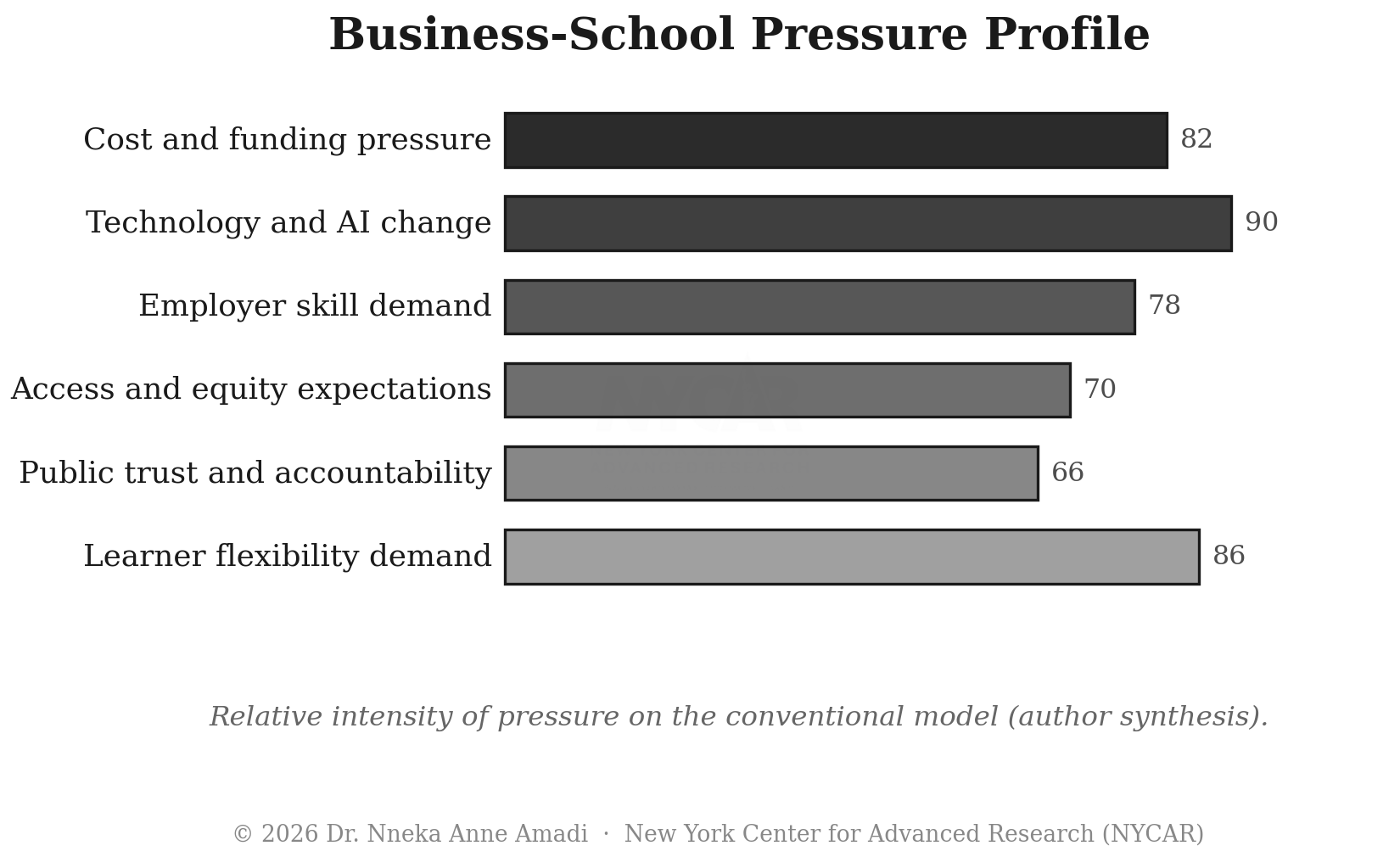
Each source of pressure shown here is real on its own, but the management problem is their accumulation. A school can absorb cost pressure or technological change in isolation; it is the simultaneous weight of funding limits, AI disruption, employer demand, equity expectations, and learner impatience that forces a rethink of form rather than a cosmetic adjustment.
Figure 1. Business-school pressure profile.
Chapter 2: The Global Pressure on Tertiary and Executive Education
2.1 What global pressure actually demands of schools
Global change does not reward schools that simply restate the problem in fashionable terms. The real test is whether the institution changes the conditions under which learning is admitted, supervised, tested, and made useful. Business schools now face learners who are older, mobile, employed, digitally connected, and unwilling to accept programs that separate theory from the problems they are already carrying at work. A doctoral-level discussion must stay close to that operating reality.
This matters because professional learners do not enter business education as blank academic subjects. They arrive with work histories, managerial habits, uneven writing confidence, partial technical knowledge, and urgent career pressures. international evidence on lifelong learning, micro-credentials, employer demand, and digital education makes the old campus-only model insufficient for many professionals.
The test is therefore practical and academic at the same time. A claim about access must be supported by fair entry judgment. A claim about flexibility must be supported by supervision. A claim about research quality must be supported by sources, revision, and public accountability.
A weak model hides behind modern vocabulary. A serious model exposes itself to review. Access can expand quickly while quality thins quietly unless the institution protects assessment, supervision, and learning evidence.
This problem definition also requires a sharper reading of institutional behavior. In global pressure on tertiary and executive education, weak schools tend to describe access as generosity while avoiding the harder question of what support, review, and academic pressure the learner will meet after admission. Stronger institutions do not confuse open doors with serious education. They ask whether the learner can receive timely guidance, produce evidence, revise weak work, and graduate with a body of scholarship that another reviewer can respect. The claim is that inherited practice should justify itself. Where a fixed classroom strengthens discipline, it should remain. Where it simply protects habit, the school has a duty to redesign the learning route without lowering the standard. International pressure should be read through the practical question of what adult learners can actually complete without weakening academic standards.
2.2 Interpreting international evidence without overclaiming
Evidence in this area should be handled with care. Public reports, institutional materials, employer signals, and education research can show pressure, but they cannot by themselves prove quality inside a school. The stronger academic move is to read those materials beside the lived mechanics of admission, supervision, assessment, and learner support.
For the global pressure on tertiary and executive education, the useful evidence is the kind that changes judgment. It tells leaders where access is blocked, where professional learning is undervalued, where assessment is too narrow, and where digital delivery may expand reach without strengthening competence.
The analysis should not chase novelty. It should ask whether the learner can defend a position, use sources responsibly, recognize limits, connect theory to practice, and produce work that can stand outside the classroom. international evidence on lifelong learning, micro-credentials, employer demand, and digital education makes the old campus-only model insufficient for many professionals.
Professional judgment enters where data are incomplete. The honest response is not to overstate certainty. It is to build review routines that keep records, compare learner progress, protect standards, and correct weak practice before it becomes institutional habit.
Reports on digital learning, micro-credentials, executive education, labor-market change, and higher-education finance are useful because they show pressure on the sector, but they do not automatically validate any single institutional response. A serious reading asks what each source proves and what it cannot prove. Employer demand can show need, but not academic quality. Learner preference can show access pressure, but not competence. Publication output can show ambition, but only careful review can prove scholarly value. The value of global pressure on tertiary and executive education lies in connecting these different signals without exaggerating them. That disciplined reading gives the paper a more credible voice than broad praise for innovation would allow.
2.3 Steering an institution through sector-wide change
Management choices decide whether the global pressure on tertiary and executive education becomes serious scholarship or promotional language. The decisive choices are often ordinary: who reviews entry evidence, who mentors the learner, who approves the research topic, who checks sources, who records feedback, and who has authority to stop weak work.
A school that serves experienced professionals needs firm routines without treating every learner as though their path is identical. Recognition of prior learning, workplace evidence, and flexible delivery require careful judgment, not loosened standards. The route may differ; the demand for intellectual quality should not.
The management burden also includes staff capacity. Mentors need time, training, and authority. Editorial review needs consistency. Learners need clear expectations. Employers and public readers need confidence that a published research paper represents supervised academic work rather than a private claim.
The outcome is decided by institutional habits. Access can expand quickly while quality thins quietly unless the institution protects assessment, supervision, and learning evidence That is why the school must connect promise to records, supervision, review, and correction.
Management must then convert the argument into rules that staff can follow. In global pressure on tertiary and executive education, decision-making should not depend on personal goodwill or informal memory. Admission panels need records. Supervisors need workload limits. Assessors need common standards. Learners need written expectations. Editorial reviewers need authority to return weak work rather than rescue it at the end. Lifelong learning, employer demand, demographic change, and the cost of formal study matter because they decide whether the model will be trusted after the marketing language has faded.
2.4 Trade-offs in a competitive global market
Every unconventional model carries risk. Access can expand quickly while quality thins quietly unless the institution protects assessment, supervision, and learning evidence.
The main safeguards are visible admission criteria, documented recognition of prior learning, signed supervision records, source verification, clear assessment rubrics, independent review, and a process for correcting or withdrawing weak publication material when necessary.
There is also a reputational risk. A business school built around flexibility can be misunderstood as less serious if it fails to explain its evidence discipline. That misunderstanding cannot be answered by slogans. It must be answered by transparent standards and better work.
The necessary pace is firm but not theatrical. Leaders should choose a manageable number of programmes, examine where learners struggle, strengthen the teaching and assessment chain, and document the result. A business school that proves reliability in ordinary academic work will have a stronger claim to expansion than one that announces a grand reform before its academic controls are steady.
The safeguards should be practical, not theatrical. A school can write impressive policy language and still fail if the record does not show how decisions were made. Risk control in global pressure on tertiary and executive education should therefore include admission notes, proof of prior learning where relevant, supervisor feedback, version history, source checking, originality review, and a final academic sign-off. These controls protect the learner as much as the institution. They reduce confusion, prevent unfair judgment, and make it possible to defend a decision if the award is questioned. The aim is a fair trail of evidence that shows the work earned its standing.
2.5 Sustaining reform at sector scale
Implementation should begin with the routines that most directly affect quality. In the global pressure on tertiary and executive education, the necessary disciplines are entry review, mentor assignment, milestone tracking, source control, writing feedback, and final review before public release.
Scale should follow demonstrated reliability. A school should expand only when it can show that ordinary teams, using ordinary resources, can maintain the same quality of guidance, record keeping, and assessment across cohorts.
Institutional learning must be built into the calendar. Each cohort should leave evidence about what worked, where learners struggled, which supervisors needed support, which assessment criteria were unclear, and which research outputs required deeper editorial care.
Implementation should be treated as evidence work. Each new routine should answer a practical question: did learners receive guidance on time, did assessors apply the standard consistently, did managers see the risk early enough, and did feedback alter the next cycle? Those questions protect academic seriousness better than any slogan about innovation.
Implementation should be judged by repetition under ordinary conditions. It is proven when the next cohort receives the same quality of guidance, when a different supervisor applies the same standard, when the review process catches weak evidence, and when the institution corrects defects without waiting for embarrassment. In global pressure on tertiary and executive education, learning must travel from one cycle into the next. That means keeping clear records, discussing failures openly, revising instructions, and training staff before scale creates pressure. This is the quieter work of institutional maturity, and it is where unconventional education either becomes credible or exposes its weakness.
It is worth being specific about what international pressure does and does not settle. Cross-national data can show that participation, cost, and technology are moving in the same direction across very different systems, which tells a leader that the pressure is structural rather than local. What such data cannot do is prescribe a single response, because a public university in one economy and a private executive provider in another face different constraints, learners, and accountabilities. The disciplined use of global evidence is to read it as a description of the operating environment, then design a response that fits the institution’s own mandate.
The equity dimension deserves direct attention rather than a footnote. Flexible, recognition-based routes are often the only realistic path for learners who were excluded from conventional study by cost, geography, or timing, which means that weak quality control falls hardest on the people the model was meant to serve. A reform that widens access while quietly lowering the value of the award has not advanced equity; it has relocated the disadvantage to the point of graduation, where it is harder to see and harder to undo.
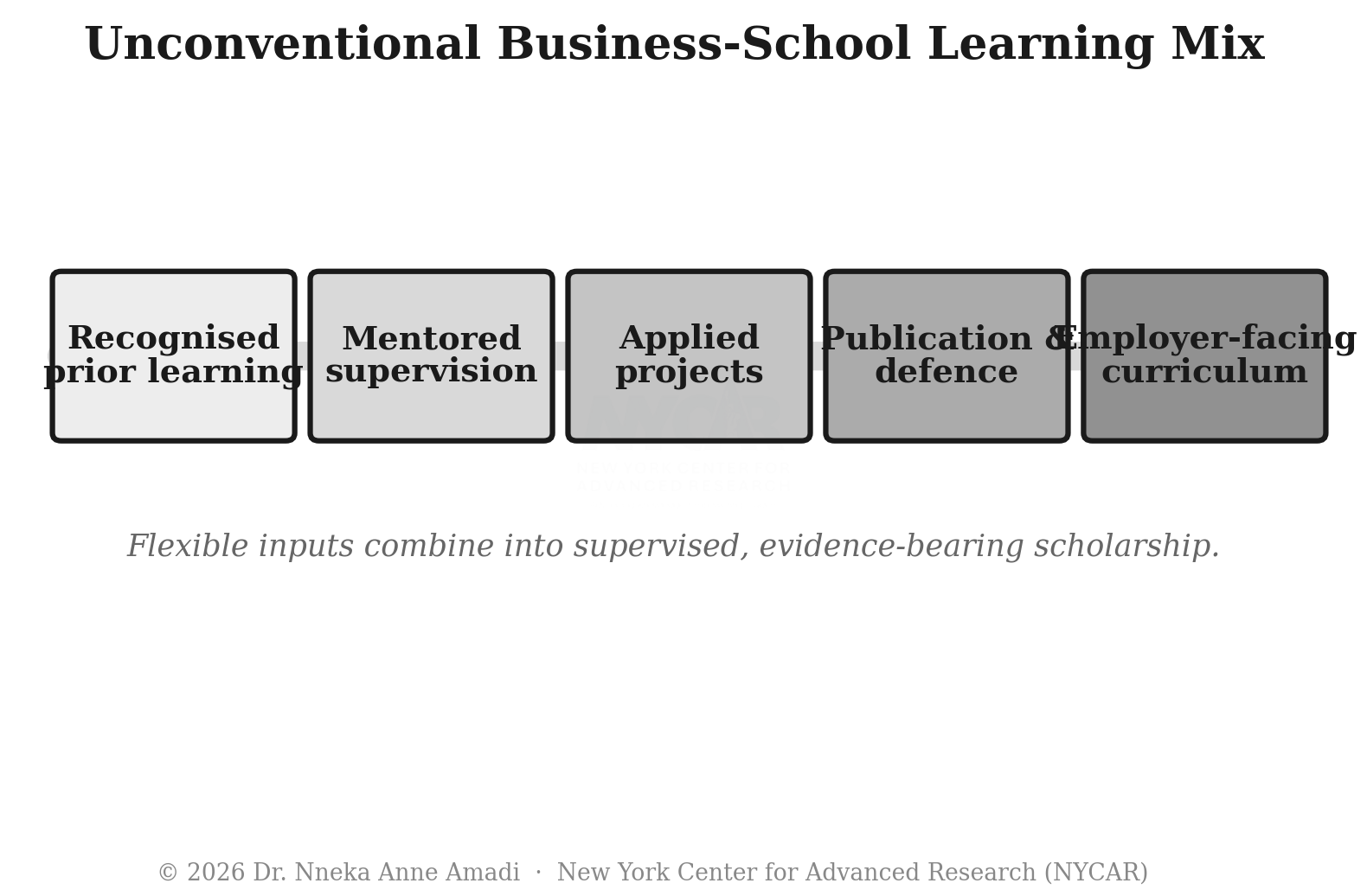
No single element in this mix carries the model. Recognised prior learning widens access, mentored supervision protects rigor, applied projects connect study to work, and publication with defence supplies proof. The credibility of the approach depends on holding these elements together rather than promoting any one of them as a shortcut.
Figure 2. Unconventional business-school learning mix.
Chapter 3: Unconventional Higher Education: Concepts, Risks, and Quality Tests
3.1 Defining “unconventional” so it can be tested
Calling a model “unconventional” settles nothing until the term can be tested against practice. The real test is whether the institution changes the conditions under which learning is admitted, supervised, tested, and made useful. Unconventional education is not a shortcut; it is a different route to serious academic formation, built around flexibility, professional evidence, mentored inquiry, and demonstrated competence. A doctoral-level discussion must stay close to that operating reality.
This matters because professional learners do not enter business education as blank academic subjects. They arrive with work histories, managerial habits, uneven writing confidence, partial technical knowledge, and urgent career pressures. the important question is whether the school can prove that learning has taken place and that the award rests on evaluated work rather than attendance, payment, or rhetoric.
The test is therefore practical and academic at the same time. A claim about access must be supported by fair entry judgment. A claim about flexibility must be supported by supervision. A claim about research quality must be supported by sources, revision, and public accountability.
A weak model hides behind modern vocabulary. A serious model exposes itself to review. A non-traditional route loses legitimacy the moment it becomes vague about standards, credits, supervision, or academic responsibility.
This problem definition also requires a sharper reading of institutional behavior. In unconventional higher education, weak schools tend to describe access as generosity while avoiding the harder question of what support, review, and academic pressure the learner will meet after admission. Stronger institutions do not confuse open doors with serious education. They ask whether the learner can receive timely guidance, produce evidence, revise weak work, and graduate with a body of scholarship that another reviewer can respect. The claim is that inherited practice should justify itself. Where a fixed classroom strengthens discipline, it should remain. Where it simply protects habit, the school has a duty to redesign the learning route without lowering the standard. The chapter has to separate legitimate innovation from casual credentialing.
3.2 Evidence that separates innovation from drift
Evidence in this area should be handled with care. Public reports, institutional materials, employer signals, and education research can show pressure, but they cannot by themselves prove quality inside a school. The stronger academic move is to read those materials beside the lived mechanics of admission, supervision, assessment, and learner support.
For the meaning and limits of unconventional higher education, the useful evidence is the kind that changes judgment. It tells leaders where access is blocked, where professional learning is undervalued, where assessment is too narrow, and where digital delivery may expand reach without strengthening competence.
The analysis should not chase novelty. It should ask whether the learner can defend a position, use sources responsibly, recognize limits, connect theory to practice, and produce work that can stand outside the classroom. the important question is whether the school can prove that learning has taken place and that the award rests on evaluated work rather than attendance, payment, or rhetoric.
Professional judgment enters where data are incomplete. It is to build review routines that keep records, compare learner progress, protect standards, and correct weak practice before it becomes institutional habit.
Reports on digital learning, micro-credentials, executive education, labor-market change, and higher-education finance are useful because they show pressure on the sector, but they do not automatically validate any single institutional response. A serious reading asks what each source proves and what it cannot prove. Employer demand can show need, but not academic quality. Learner preference can show access pressure, but not competence. Publication output can show ambition, but only careful review can prove scholarly value. The value of unconventional higher education lies in connecting these different signals without exaggerating them. That disciplined reading gives the paper a more credible voice than broad praise for innovation would allow.
3.3 Decisions that protect academic quality
Management choices decide whether the meaning and limits of unconventional higher education becomes serious scholarship or promotional language. The decisive choices are often ordinary: who reviews entry evidence, who mentors the learner, who approves the research topic, who checks sources, who records feedback, and who has authority to stop weak work.
A school that serves experienced professionals needs firm routines without treating every learner as though their path is identical. Recognition of prior learning, workplace evidence, and flexible delivery require careful judgment, not loosened standards. The route may differ; the demand for intellectual quality should not.
The management burden also includes staff capacity. Mentors need time, training, and authority. Editorial review needs consistency. Learners need clear expectations. Employers and public readers need confidence that a published research paper represents supervised academic work rather than a private claim.
The safest path is not delay; it is disciplined sequencing. NYCAR’s case has value only if unconventional higher education remains accountable to learning, assessment, supervision, and public trust. That means testing the model through the details of delivery rather than relying on the attractiveness of the idea.
Management must then convert the argument into rules that staff can follow. In unconventional higher education, decision-making should not depend on personal goodwill or informal memory. Admission panels need records. Supervisors need workload limits. Assessors need common standards. Learners need written expectations. Editorial reviewers need authority to return weak work rather than rescue it at the end. Non-traditional routes, recognition of prior learning, and academic quality tests matter because they decide whether the model will be trusted after the marketing language has faded.
3.4 The characteristic risks of non-traditional models
Every unconventional model carries risk. A non-traditional route loses legitimacy the moment it becomes vague about standards, credits, supervision, or academic responsibility.
The main safeguards are visible admission criteria, documented recognition of prior learning, signed supervision records, source verification, clear assessment rubrics, independent review, and a process for correcting or withdrawing weak publication material when necessary.
There is also a reputational risk. A business school built around flexibility can be misunderstood as less serious if it fails to explain its evidence discipline. That misunderstanding cannot be answered by slogans. It must be answered by transparent standards and better work.
The ethical issue is equally important. Adult learners deserve opportunity, but they also deserve honesty. The institution should not sell ease as education. It should offer a demanding route that respects professional experience while insisting on academic proof.
The safeguards should be practical, not theatrical. A school can write impressive policy language and still fail if the record does not show how decisions were made. Risk control in unconventional higher education should therefore include admission notes, proof of prior learning where relevant, supervisor feedback, version history, source checking, originality review, and a final academic sign-off. These controls protect the learner as much as the institution. They reduce confusion, prevent unfair judgment, and make it possible to defend a decision if the award is questioned. The aim is a fair trail of evidence that shows the work earned its standing.
3.5 Embedding quality tests in daily practice
Implementation should begin with the routines that most directly affect quality. In the meaning and limits of unconventional higher education, the necessary disciplines are entry review, mentor assignment, milestone tracking, source control, writing feedback, and final review before public release.
Scale should follow demonstrated reliability. A school should expand only when it can show that ordinary teams, using ordinary resources, can maintain the same quality of guidance, record keeping, and assessment across cohorts.
Institutional learning must be built into the calendar. Each cohort should leave evidence about what worked, where learners struggled, which supervisors needed support, which assessment criteria were unclear, and which research outputs required deeper editorial care.
The practical conclusion is restrained but firm: unconventional business education becomes credible when the institution can repeat good judgment under normal conditions. the important question is whether the school can prove that learning has taken place and that the award rests on evaluated work rather than attendance, payment, or rhetoric.
Implementation should be judged by repetition under ordinary conditions. It is proven when the next cohort receives the same quality of guidance, when a different supervisor applies the same standard, when the review process catches weak evidence, and when the institution corrects defects without waiting for embarrassment. In unconventional higher education, learning must travel from one cycle into the next. That means keeping clear records, discussing failures openly, revising instructions, and training staff before scale creates pressure. This is the quieter work of institutional maturity, and it is where unconventional education either becomes credible or exposes its weakness.
The quality test becomes clearer when it is applied to a borderline case. Consider a provider that grants generous recognition of prior learning, delivers entirely online, and assesses through a single capstone. None of these features is disqualifying, yet together they concentrate risk at the points where evidence is thinnest. A serious quality test does not ban such a design; it asks how each thin point is reinforced, whether recognition decisions are documented, whether online delivery preserves supervision, and whether the capstone is defended rather than merely submitted. The model is judged by how it manages its own weak points.
It is worth separating genuine innovation from credential inflation, because the two can look alike from outside. A new delivery format, a shorter cycle, or a stackable set of micro-credentials can each represent real pedagogical progress or merely a faster route to a thinner award. The distinguishing question is always evidentiary: does the learner finish able to do and defend more than before, or only holding more certificates? Concepts that cannot answer that question are fashion, and fashion is the most expensive thing a serious institution can buy.
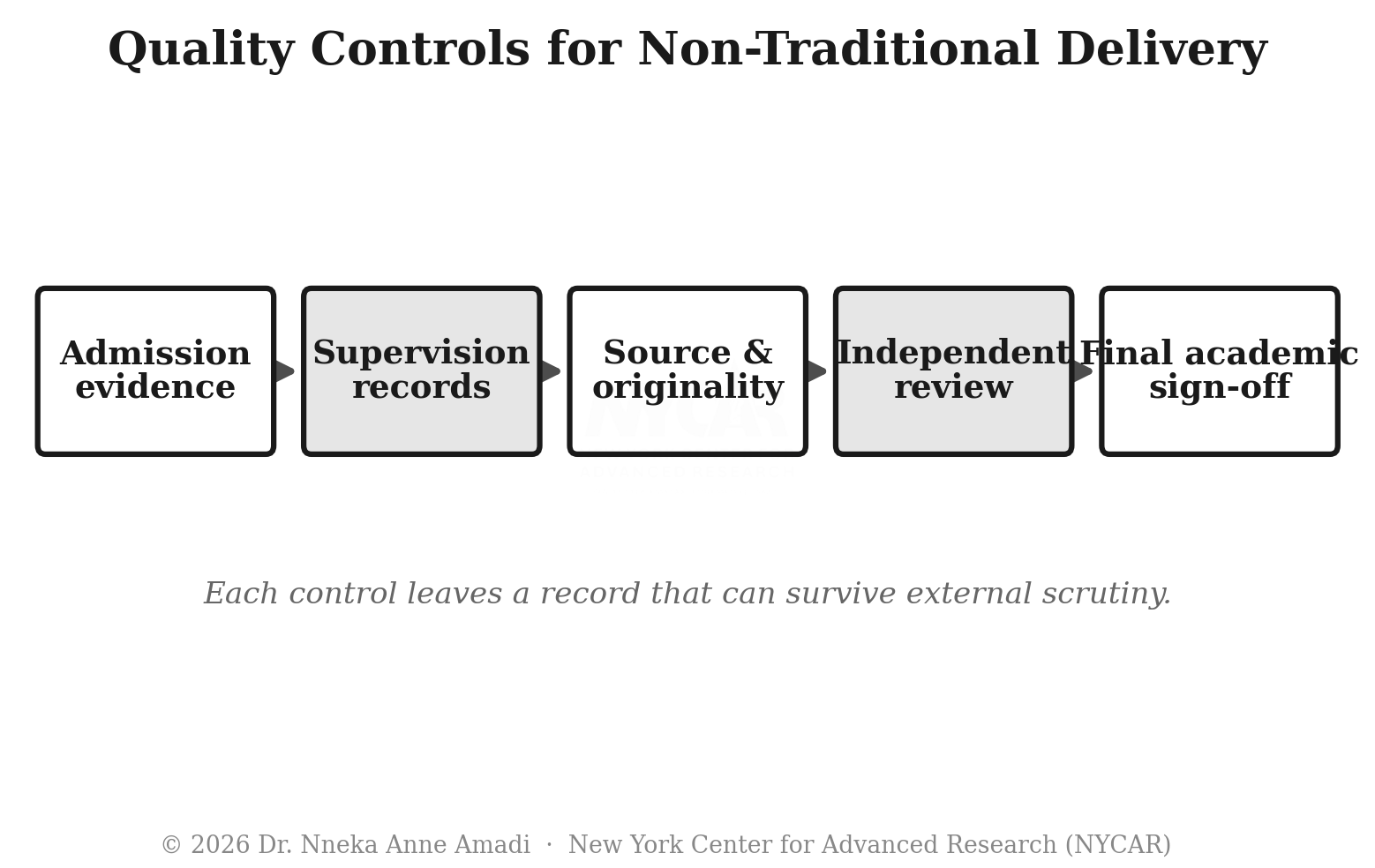
The controls are arranged as a sequence because each one leaves a record that the next can rely on. Admission evidence is of little use if supervision is undocumented, and supervision is fragile if the final sign-off cannot trace the work back through review. The point is not the number of controls but the unbroken trail they create.
Figure 3. Quality controls for non-traditional delivery.
Read from the bottom upward, the value to a professional learner is cumulative. Recognition of experience opens the door, a mentored route makes study feasible, evidence of competence replaces seat time, and defensible scholarship converts effort into standing that an employer or a peer can respect. A model that delivers only the lower layers has not yet earned the upper ones.
Figure 4. Learner value proposition.
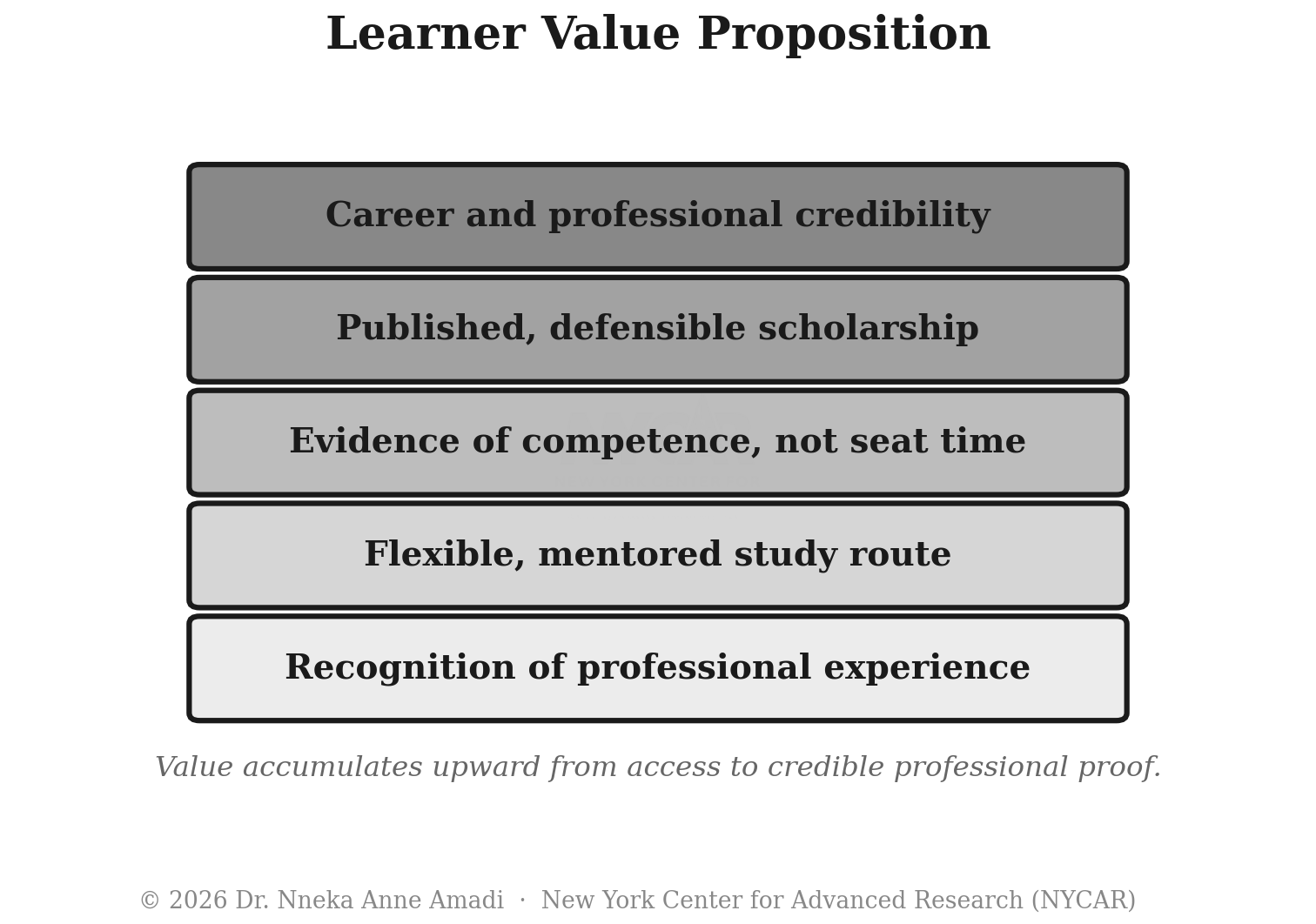
Table 1. Unconventional business-school model
| Element | Conventional weakness | Unconventional correction |
| Admission | Overreliance on prior institutional path | Recognise professional evidence and recognition of prior learning |
| Assessment | Exam-centred performance | Portfolio, capstone, publication, and defence |
| Curriculum | Slow response to market change | Modular revision and employer-facing topics |
| Delivery | Campus-bound timetable | Blended, mentored, asynchronous support |
| Quality | Reputation assumed by form | Quality shown through evidence and review |
Note. Black-and-white NYCAR publication format.
Chapter 4: NYCAR as an Applied Case of Research-Led Professional Learning
4.1 What the NYCAR case is meant to show
A case study earns its place only when it exposes how an institution actually behaves. The real test is whether the institution changes the conditions under which learning is admitted, supervised, tested, and made useful. The case is strongest when it is read as an institutional experiment in applied scholarship: flexible delivery, publication-centered research, professional reflection, and public-facing academic output. A doctoral-level discussion must stay close to that operating reality.
This matters because professional learners do not enter business education as blank academic subjects. They arrive with work histories, managerial habits, uneven writing confidence, partial technical knowledge, and urgent career pressures. NYCAR should be assessed by evidence of mentoring, source discipline, learner progression, publication quality, and the usefulness of research to professional practice.
The test is therefore practical and academic at the same time. A claim about access must be supported by fair entry judgment. A claim about flexibility must be supported by supervision. A claim about research quality must be supported by sources, revision, and public accountability.
A weak model hides behind modern vocabulary. A serious model exposes itself to review. The school must guard against confusing visibility with credibility; its value depends on the quality of the work it releases and the care behind each award.
This problem definition also requires a sharper reading of institutional behavior. In NYCAR as an applied case, weak schools tend to describe access as generosity while avoiding the harder question of what support, review, and academic pressure the learner will meet after admission. Stronger institutions do not confuse open doors with serious education. They ask whether the learner can receive timely guidance, produce evidence, revise weak work, and graduate with a body of scholarship that another reviewer can respect. The claim is that inherited practice should justify itself. Where a fixed classroom strengthens discipline, it should remain. Where it simply protects habit, the school has a duty to redesign the learning route without lowering the standard. The case is useful because it gives the argument a real institutional setting rather than a distant theory.
4.2 Reading NYCAR’s practice as evidence
Evidence in this area should be handled with care. Public reports, institutional materials, employer signals, and education research can show pressure, but they cannot by themselves prove quality inside a school. The stronger academic move is to read those materials beside the lived mechanics of admission, supervision, assessment, and learner support.
For NYCAR as an applied case of research-led professional learning, the useful evidence is the kind that changes judgment. It tells leaders where access is blocked, where professional learning is undervalued, where assessment is too narrow, and where digital delivery may expand reach without strengthening competence.
The analysis should not chase novelty. It should ask whether the learner can defend a position, use sources responsibly, recognize limits, connect theory to practice, and produce work that can stand outside the classroom. NYCAR should be assessed by evidence of mentoring, source discipline, learner progression, publication quality, and the usefulness of research to professional practice.
Professional judgment enters where data are incomplete. It is to build review routines that keep records, compare learner progress, protect standards, and correct weak practice before it becomes institutional habit.
Reports on digital learning, micro-credentials, executive education, labor-market change, and higher-education finance are useful because they show pressure on the sector, but they do not automatically validate any single institutional response. A serious reading asks what each source proves and what it cannot prove. Employer demand can show need, but not academic quality. Learner preference can show access pressure, but not competence. Publication output can show ambition, but only careful review can prove scholarly value. The value of NYCAR as an applied case lies in connecting these different signals without exaggerating them. That disciplined reading gives the paper a more credible voice than broad praise for innovation would allow.
4.3 Management behind research-led learning
Management choices decide whether NYCAR as an applied case of research-led professional learning becomes serious scholarship or promotional language. The decisive choices are often ordinary: who reviews entry evidence, who mentors the learner, who approves the research topic, who checks sources, who records feedback, and who has authority to stop weak work.
A school that serves experienced professionals needs firm routines without treating every learner as though their path is identical. Recognition of prior learning, workplace evidence, and flexible delivery require careful judgment, not loosened standards. The route may differ; the demand for intellectual quality should not.
The management burden also includes staff capacity. Mentors need time, training, and authority. Editorial review needs consistency. Learners need clear expectations. Employers and public readers need confidence that a published research paper represents supervised academic work rather than a private claim.
The outcome is decided by institutional habits. The school must guard against confusing visibility with credibility; its value depends on the quality of the work it releases and the care behind each award That is why the school must connect promise to records, supervision, review, and correction.
Management must then convert the argument into rules that staff can follow. In NYCAR as an applied case, decision-making should not depend on personal goodwill or informal memory. Admission panels need records. Supervisors need workload limits. Assessors need common standards. Learners need written expectations. Editorial reviewers need authority to return weak work rather than rescue it at the end. Research-led professional learning, publication practice, and supervised academic output matter because they decide whether the model will be trusted after the marketing language has faded.
4.4 Risks specific to an applied institutional case
Every unconventional model carries risk. The school must guard against confusing visibility with credibility; its value depends on the quality of the work it releases and the care behind each award.
The main safeguards are visible admission criteria, documented recognition of prior learning, signed supervision records, source verification, clear assessment rubrics, independent review, and a process for correcting or withdrawing weak publication material when necessary.
There is also a reputational risk. A business school built around flexibility can be misunderstood as less serious if it fails to explain its evidence discipline. That misunderstanding cannot be answered by slogans. It must be answered by transparent standards and better work.
A business school that wants to depart from convention must be stricter about evidence, not looser. The routine should show who was admitted, what prior learning was accepted, how learning was assessed, where support failed, and how managers corrected the fault. This kind of record gives reform its legitimacy.
The safeguards should be practical, not theatrical. A school can write impressive policy language and still fail if the record does not show how decisions were made. Risk control in NYCAR as an applied case should therefore include admission notes, proof of prior learning where relevant, supervisor feedback, version history, source checking, originality review, and a final academic sign-off. These controls protect the learner as much as the institution. They reduce confusion, prevent unfair judgment, and make it possible to defend a decision if the award is questioned. The aim is a fair trail of evidence that shows the work earned its standing.
4.5 Turning the NYCAR model into repeatable routine
Implementation should begin with the routines that most directly affect quality. In NYCAR as an applied case of research-led professional learning, the necessary disciplines are entry review, mentor assignment, milestone tracking, source control, writing feedback, and final review before public release.
Scale should follow demonstrated reliability. A school should expand only when it can show that ordinary teams, using ordinary resources, can maintain the same quality of guidance, record keeping, and assessment across cohorts.
Institutional learning must be built into the calendar. Each cohort should leave evidence about what worked, where learners struggled, which supervisors needed support, which assessment criteria were unclear, and which research outputs required deeper editorial care.
The practical conclusion is restrained but firm: unconventional business education becomes credible when the institution can repeat good judgment under normal conditions. NYCAR should be assessed by evidence of mentoring, source discipline, learner progression, publication quality, and the usefulness of research to professional practice.
Implementation should be judged by repetition under ordinary conditions. It is proven when the next cohort receives the same quality of guidance, when a different supervisor applies the same standard, when the review process catches weak evidence, and when the institution corrects defects without waiting for embarrassment. In NYCAR as an applied case, learning must travel from one cycle into the next. That means keeping clear records, discussing failures openly, revising instructions, and training staff before scale creates pressure. This is the quieter work of institutional maturity, and it is where unconventional education either becomes credible or exposes its weakness.
The value of the NYCAR case is not that it is flawless but that it is observable. An applied case is only useful to other institutions if its routines can be inspected and, where appropriate, copied or criticised. Treating NYCAR this way keeps the analysis honest, because claims about research-led professional learning are tied to specific practices in admission, supervision, and publication rather than to reputation. A case that cannot be examined in this way offers inspiration but little transferable evidence, and transferable evidence is what a doctoral analysis owes its readers.
Honesty about the case also means stating what would weaken it. The NYCAR argument would be undermined if its admission judgements could not be reconstructed, if supervision existed mainly on paper, or if published outputs were not genuinely reviewed. Naming these failure conditions is not a hedge; it is what separates an applied case from an advertisement. A reader should be able to test the case against those conditions, and an institution confident in its routines should welcome exactly that scrutiny.
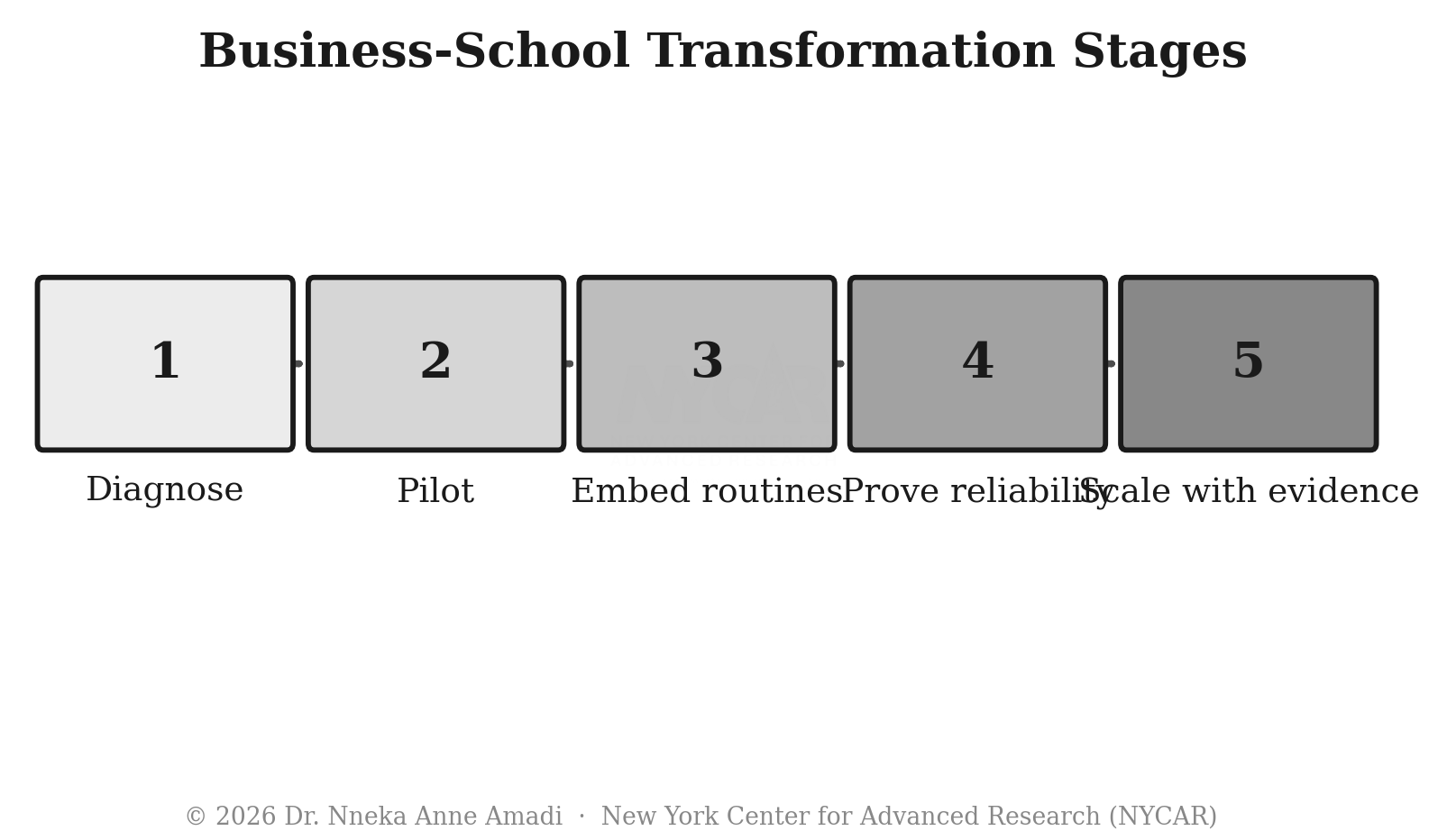
The stages are ordered deliberately. A school that scales before it has proven reliability simply multiplies its weaknesses, while one that diagnoses and pilots without embedding routines never moves past pilot energy. Movement from one stage to the next should be earned with evidence rather than announced on a schedule.
Figure 5. Business-school transformation stages.
Chapter 5: Business-School Relevance, Employers, and Lifelong Learning
5.1 The relevance gap employers actually feel
Relevance is not won by claiming it; employers and learners feel its absence quickly. The real test is whether the institution changes the conditions under which learning is admitted, supervised, tested, and made useful. Employers increasingly need graduates who can interpret evidence, write clearly, manage risk, lead teams, and solve problems across changing markets rather than repeat textbook language. A doctoral-level discussion must stay close to that operating reality.
This matters because professional learners do not enter business education as blank academic subjects. They arrive with work histories, managerial habits, uneven writing confidence, partial technical knowledge, and urgent career pressures. a serious business school earns value when its learning changes workplace judgment and gives organizations better decisions, not just certificates.
The test is therefore practical and academic at the same time. A claim about access must be supported by fair entry judgment. A claim about flexibility must be supported by supervision. A claim about research quality must be supported by sources, revision, and public accountability.
A weak model hides behind modern vocabulary. A serious model exposes itself to review. An employability claim becomes weak when the school cannot show how assessment connects to managerial competence, ethical judgment, and problem-solving under pressure.
This problem definition also requires a sharper reading of institutional behavior. In business-school relevance, weak schools tend to describe access as generosity while avoiding the harder question of what support, review, and academic pressure the learner will meet after admission. Stronger institutions do not confuse open doors with serious education. They ask whether the learner can receive timely guidance, produce evidence, revise weak work, and graduate with a body of scholarship that another reviewer can respect. The claim is that inherited practice should justify itself. Where a fixed classroom strengthens discipline, it should remain. Where it simply protects habit, the school has a duty to redesign the learning route without lowering the standard. The discussion should keep returning to what a business school enables a graduate to do with evidence and responsibility.
5.2 Evidence on skills, demand, and lifelong learning
Evidence in this area should be handled with care. Public reports, institutional materials, employer signals, and education research can show pressure, but they cannot by themselves prove quality inside a school. The stronger academic move is to read those materials beside the lived mechanics of admission, supervision, assessment, and learner support.
For business-school relevance, employers, and lifelong learning, the useful evidence is the kind that changes judgment. It tells leaders where access is blocked, where professional learning is undervalued, where assessment is too narrow, and where digital delivery may expand reach without strengthening competence.
The analysis should not chase novelty. It should ask whether the learner can defend a position, use sources responsibly, recognize limits, connect theory to practice, and produce work that can stand outside the classroom. a serious business school earns value when its learning changes workplace judgment and gives organizations better decisions, not just certificates.
Professional judgment enters where data are incomplete. It is to build review routines that keep records, compare learner progress, protect standards, and correct weak practice before it becomes institutional habit.
Reports on digital learning, micro-credentials, executive education, labor-market change, and higher-education finance are useful because they show pressure on the sector, but they do not automatically validate any single institutional response. A serious reading asks what each source proves and what it cannot prove. Employer demand can show need, but not academic quality. Learner preference can show access pressure, but not competence. Publication output can show ambition, but only careful review can prove scholarly value. The value of business-school relevance lies in connecting these different signals without exaggerating them. That disciplined reading gives the paper a more credible voice than broad praise for innovation would allow.
5.3 Aligning the school with professional need
Management choices decide whether business-school relevance, employers, and lifelong learning becomes serious scholarship or promotional language. The decisive choices are often ordinary: who reviews entry evidence, who mentors the learner, who approves the research topic, who checks sources, who records feedback, and who has authority to stop weak work.
A school that serves experienced professionals needs firm routines without treating every learner as though their path is identical. Recognition of prior learning, workplace evidence, and flexible delivery require careful judgment, not loosened standards. The route may differ; the demand for intellectual quality should not.
The management burden also includes staff capacity. Mentors need time, training, and authority. Editorial review needs consistency. Learners need clear expectations. Employers and public readers need confidence that a published research paper represents supervised academic work rather than a private claim.
The outcome is decided by institutional habits. An employability claim becomes weak when the school cannot show how assessment connects to managerial competence, ethical judgment, and problem-solving under pressure That is why the school must connect promise to records, supervision, review, and correction.
Management must then convert the argument into rules that staff can follow. In business-school relevance, decision-making should not depend on personal goodwill or informal memory. Admission panels need records. Supervisors need workload limits. Assessors need common standards. Learners need written expectations. Editorial reviewers need authority to return weak work rather than rescue it at the end. Employer value, workplace judgment, and lifelong professional learning matter because they decide whether the model will be trusted after the marketing language has faded.
5.4 The risk of chasing employer demand
Every unconventional model carries risk. An employability claim becomes weak when the school cannot show how assessment connects to managerial competence, ethical judgment, and problem-solving under pressure.
The main safeguards are visible admission criteria, documented recognition of prior learning, signed supervision records, source verification, clear assessment rubrics, independent review, and a process for correcting or withdrawing weak publication material when necessary.
There is also a reputational risk. A business school built around flexibility can be misunderstood as less serious if it fails to explain its evidence discipline. That misunderstanding cannot be answered by slogans. It must be answered by transparent standards and better work.
The ethical issue is equally important. Adult learners deserve opportunity, but they also deserve honesty. The institution should not sell ease as education. It should offer a demanding route that respects professional experience while insisting on academic proof.
The safeguards should be practical, not theatrical. A school can write impressive policy language and still fail if the record does not show how decisions were made. Risk control in business-school relevance should therefore include admission notes, proof of prior learning where relevant, supervisor feedback, version history, source checking, originality review, and a final academic sign-off. These controls protect the learner as much as the institution. They reduce confusion, prevent unfair judgment, and make it possible to defend a decision if the award is questioned. The aim is a fair trail of evidence that shows the work earned its standing.
5.5 Building durable employer and learner partnerships
Implementation should begin with the routines that most directly affect quality. In business-school relevance, employers, and lifelong learning, the necessary disciplines are entry review, mentor assignment, milestone tracking, source control, writing feedback, and final review before public release.
Scale should follow demonstrated reliability. A school should expand only when it can show that ordinary teams, using ordinary resources, can maintain the same quality of guidance, record keeping, and assessment across cohorts.
Institutional learning must be built into the calendar. Each cohort should leave evidence about what worked, where learners struggled, which supervisors needed support, which assessment criteria were unclear, and which research outputs required deeper editorial care.
Expansion should follow academic proof. Where learner support, faculty supervision, assessment review, and employer relevance are working, the model can grow. Where those routines are weak, expansion would only multiply a defect. Responsible reform knows the difference.
Implementation should be judged by repetition under ordinary conditions. It is proven when the next cohort receives the same quality of guidance, when a different supervisor applies the same standard, when the review process catches weak evidence, and when the institution corrects defects without waiting for embarrassment. In business-school relevance, learning must travel from one cycle into the next. That means keeping clear records, discussing failures openly, revising instructions, and training staff before scale creates pressure. This is the quieter work of institutional maturity, and it is where unconventional education either becomes credible or exposes its weakness.
Relevance also has a time dimension that schools often underestimate. A curriculum that matches today’s employer language can be obsolete by the time a cohort graduates, which is why responsiveness must be built into structure rather than achieved through one redesign. Modular revision, employer advisory input, and graduates who report back from practice turn relevance into a renewable property of the institution. Lifelong learning, understood this way, is less a product the school sells than a relationship it maintains, and the difference shows in whether alumni return.
Closeness to employers carries its own risk, which is the loss of academic independence. A school that simply trains to the current demands of a few large employers may produce graduates who are useful this year and stranded the next, and it surrenders the critical distance that lets scholarship question practice rather than only serve it. The stronger relationship treats employer signals as important evidence about relevance while reserving the right, and the duty, to teach what practitioners will need but are not yet asking for.
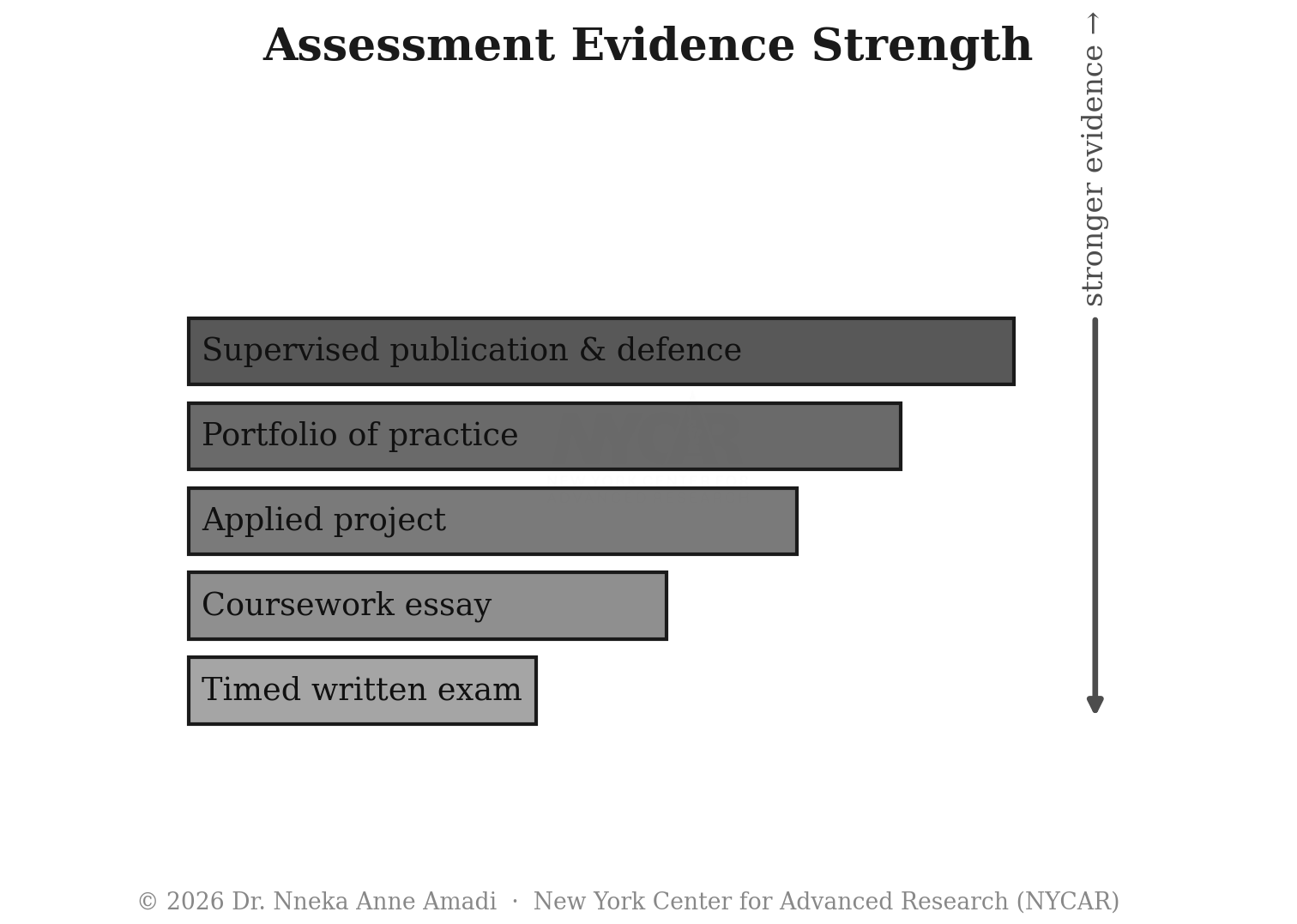
Forms of assessment differ in what they can prove. A timed examination can confirm recall under pressure; a supervised publication and defence can demonstrate sustained reasoning, source discipline, and the ability to answer challenge. An assessment system should match the strength of its evidence to the seriousness of the claim it certifies.
Figure 6. Assessment evidence strength.
Chapter 6: Assessment Beyond Exams: Evidence, Publication, and Practice
6.1 Why the exam alone no longer proves competence
The timed examination has carried more weight than it can honestly bear. The real test is whether the institution changes the conditions under which learning is admitted, supervised, tested, and made useful. Examinations still have a place, but professional higher education also needs portfolios, supervised projects, policy analysis, case interpretation, research writing, and reflective evidence that can be reviewed. A doctoral-level discussion must stay close to that operating reality.
This matters because professional learners do not enter business education as blank academic subjects. They arrive with work histories, managerial habits, uneven writing confidence, partial technical knowledge, and urgent career pressures. a publication-centered approach can be rigorous if it demands verifiable sources, defensible argument, supervision records, revision discipline, and a clear standard for originality.
The test is therefore practical and academic at the same time. A claim about access must be supported by fair entry judgment. A claim about flexibility must be supported by supervision. A claim about research quality must be supported by sources, revision, and public accountability.
A weak model hides behind modern vocabulary. A serious model exposes itself to review. Alternative assessment fails when it becomes sentimental about experience and does not test the quality of thought, evidence, writing, and application.
This problem definition also requires a sharper reading of institutional behavior. In assessment beyond examinations, weak schools tend to describe access as generosity while avoiding the harder question of what support, review, and academic pressure the learner will meet after admission. Stronger institutions do not confuse open doors with serious education. They ask whether the learner can receive timely guidance, produce evidence, revise weak work, and graduate with a body of scholarship that another reviewer can respect. The claim is that inherited practice should justify itself. Where a fixed classroom strengthens discipline, it should remain. Where it simply protects habit, the school has a duty to redesign the learning route without lowering the standard. Assessment must show the learner’s mind at work, not only memory under exam conditions.
6.2 Evidence on portfolios, publication, and defence
Evidence in this area should be handled with care. Public reports, institutional materials, employer signals, and education research can show pressure, but they cannot by themselves prove quality inside a school. The stronger academic move is to read those materials beside the lived mechanics of admission, supervision, assessment, and learner support.
For assessment beyond examinations, the useful evidence is the kind that changes judgment. It tells leaders where access is blocked, where professional learning is undervalued, where assessment is too narrow, and where digital delivery may expand reach without strengthening competence.
The analysis should not chase novelty. It should ask whether the learner can defend a position, use sources responsibly, recognize limits, connect theory to practice, and produce work that can stand outside the classroom. a publication-centered approach can be rigorous if it demands verifiable sources, defensible argument, supervision records, revision discipline, and a clear standard for originality.
Professional judgment enters where data are incomplete. It is to build review routines that keep records, compare learner progress, protect standards, and correct weak practice before it becomes institutional habit.
Reports on digital learning, micro-credentials, executive education, labor-market change, and higher-education finance are useful because they show pressure on the sector, but they do not automatically validate any single institutional response. A serious reading asks what each source proves and what it cannot prove. Employer demand can show need, but not academic quality. Learner preference can show access pressure, but not competence. Publication output can show ambition, but only careful review can prove scholarly value. The value of assessment beyond examinations lies in connecting these different signals without exaggerating them. That disciplined reading gives the paper a more credible voice than broad praise for innovation would allow.
6.3 Designing assessment that carries weight
Management choices decide whether assessment beyond examinations becomes serious scholarship or promotional language. The decisive choices are often ordinary: who reviews entry evidence, who mentors the learner, who approves the research topic, who checks sources, who records feedback, and who has authority to stop weak work.
A school that serves experienced professionals needs firm routines without treating every learner as though their path is identical. Recognition of prior learning, workplace evidence, and flexible delivery require careful judgment, not loosened standards. The route may differ; the demand for intellectual quality should not.
The management burden also includes staff capacity. Mentors need time, training, and authority. Editorial review needs consistency. Learners need clear expectations. Employers and public readers need confidence that a published research paper represents supervised academic work rather than a private claim.
The outcome is decided by institutional habits. Alternative assessment fails when it becomes sentimental about experience and does not test the quality of thought, evidence, writing, and application That is why the school must connect promise to records, supervision, review, and correction.
Management must then convert the argument into rules that staff can follow. In assessment beyond examinations, decision-making should not depend on personal goodwill or informal memory. Admission panels need records. Supervisors need workload limits. Assessors need common standards. Learners need written expectations. Editorial reviewers need authority to return weak work rather than rescue it at the end. Portfolio evidence, publication-quality research, case analysis, and practical judgment matter because they decide whether the model will be trusted after the marketing language has faded.
6.4 Integrity risks in evidence-based assessment
Every unconventional model carries risk. Alternative assessment fails when it becomes sentimental about experience and does not test the quality of thought, evidence, writing, and application.
The main safeguards are visible admission criteria, documented recognition of prior learning, signed supervision records, source verification, clear assessment rubrics, independent review, and a process for correcting or withdrawing weak publication material when necessary.
There is also a reputational risk. A business school built around flexibility can be misunderstood as less serious if it fails to explain its evidence discipline. That misunderstanding cannot be answered by slogans. It must be answered by transparent standards and better work.
The ethical issue is equally important. Adult learners deserve opportunity, but they also deserve honesty. The institution should not sell ease as education. It should offer a demanding route that respects professional experience while insisting on academic proof.
The safeguards should be practical, not theatrical. A school can write impressive policy language and still fail if the record does not show how decisions were made. Risk control in assessment beyond examinations should therefore include admission notes, proof of prior learning where relevant, supervisor feedback, version history, source checking, originality review, and a final academic sign-off. These controls protect the learner as much as the institution. They reduce confusion, prevent unfair judgment, and make it possible to defend a decision if the award is questioned. The aim is a fair trail of evidence that shows the work earned its standing.
6.5 Operating an assessment system that holds
Implementation should begin with the routines that most directly affect quality. In assessment beyond examinations, the necessary disciplines are entry review, mentor assignment, milestone tracking, source control, writing feedback, and final review before public release.
Scale should follow demonstrated reliability. A school should expand only when it can show that ordinary teams, using ordinary resources, can maintain the same quality of guidance, record keeping, and assessment across cohorts.
Institutional learning must be built into the calendar. Each cohort should leave evidence about what worked, where learners struggled, which supervisors needed support, which assessment criteria were unclear, and which research outputs required deeper editorial care.
The practical conclusion is restrained but firm: unconventional business education becomes credible when the institution can repeat good judgment under normal conditions. a publication-centered approach can be rigorous if it demands verifiable sources, defensible argument, supervision records, revision discipline, and a clear standard for originality.
Implementation should be judged by repetition under ordinary conditions. It is proven when the next cohort receives the same quality of guidance, when a different supervisor applies the same standard, when the review process catches weak evidence, and when the institution corrects defects without waiting for embarrassment. In assessment beyond examinations, learning must travel from one cycle into the next. That means keeping clear records, discussing failures openly, revising instructions, and training staff before scale creates pressure. This is the quieter work of institutional maturity, and it is where unconventional education either becomes credible or exposes its weakness.
Assessment design carries an ethical weight that is easy to miss. When a school certifies competence, it is making a promise to third parties who will never see the work: the employer who hires the graduate, the client who trusts the advice, the public that relies on the profession. An assessment that proves little exposes those third parties to risk while protecting the institution’s own throughput. Evidence-rich assessment is therefore not only more rigorous; it is more honest about the people who depend on the credential long after the cohort has moved on.
Rich assessment is not free, and pretending otherwise sets a reform up to fail. Portfolios, supervised publication, and oral defence demand more staff time, clearer rubrics, and more careful moderation than a single examination, and a school that adopts them without resourcing them will quietly retreat to easier methods under pressure. Designing assessment honestly therefore includes designing its workload, so that the evidence the institution promises to gather is evidence it can actually sustain across every cohort.
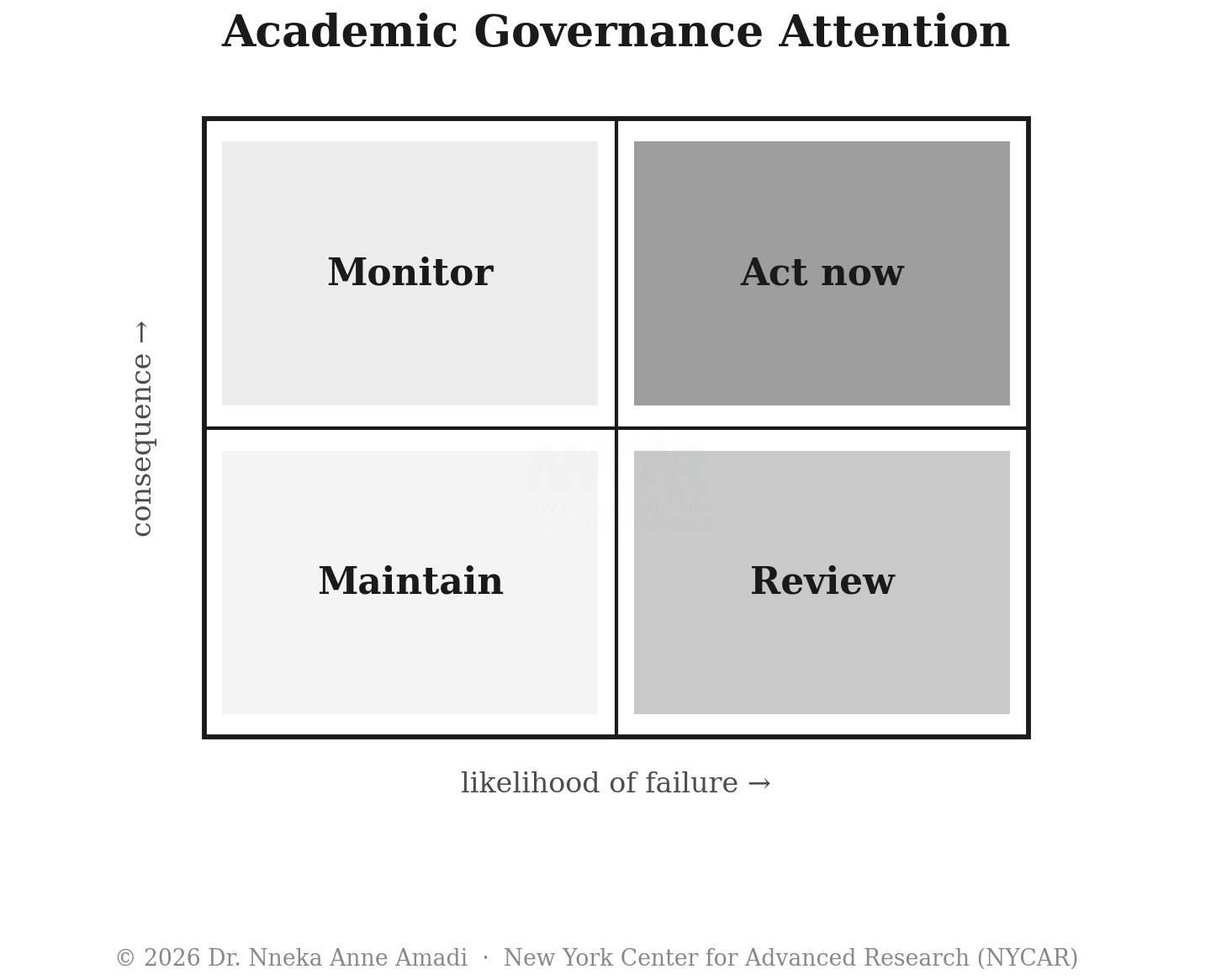
Governance attention is a scarce resource, and this simple map helps place it where consequence and likelihood are both high. Low-consequence routines can be maintained and monitored; the risks that combine a high likelihood of failure with serious academic consequence are the ones that justify immediate governance action rather than periodic review.
Figure 7. Academic governance attention.
Readiness is shown by routines that generate evidence, not by statements of intent. Each indicator here corresponds to something an external reviewer could inspect: admission notes, supervision records, assessment design, publication integrity, governance lines, and a working correction loop. The case is strong to the degree that these can be demonstrated rather than asserted.
Figure 8. NYCAR case-readiness indicators.
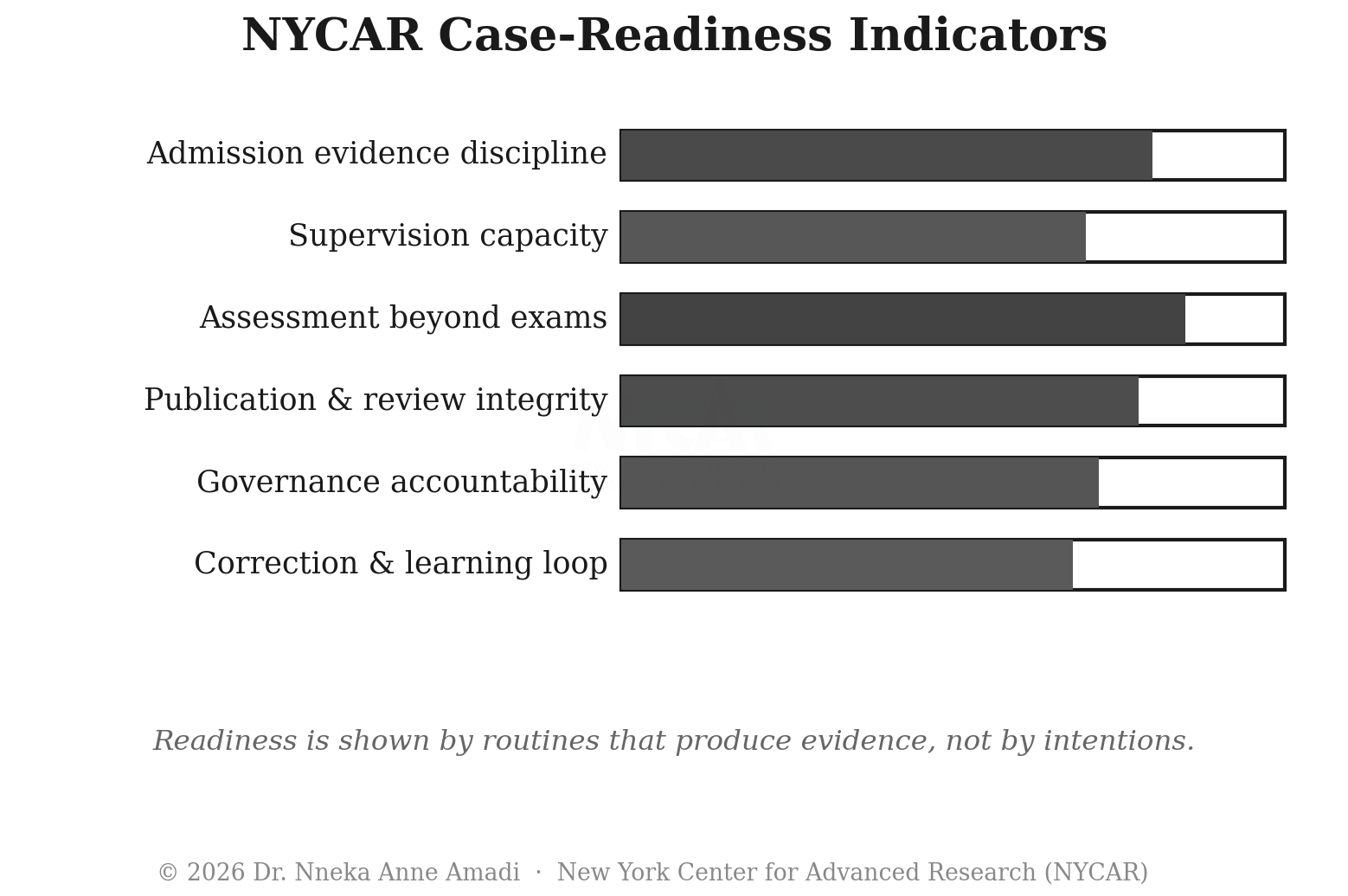
Table 2. NYCAR case-study quality test
| Quality domain | Question | Evidence |
| Access | Who is included without lowering standards? | Admissions and recognition of prior learning records |
| Rigour | How is mastery proven? | Research output and examiner notes |
| Mentorship | How are learners supported? | Supervision logs |
| Integrity | How is authorship protected? | Similarity, source and defence records |
| Impact | How does work enter practice? | Publication and professional application |
Note. Black-and-white NYCAR publication format.
Chapter 7: Digital Delivery, AI, Mentorship, and Academic Integrity
7.1 The integrity problem behind digital delivery
Digital delivery raises a question of trust long before it raises a question of technology. The real test is whether the institution changes the conditions under which learning is admitted, supervised, tested, and made useful. Digital learning can widen access, but the academic value comes from design of contact, supervision, feedback, and integrity checks rather than from the platform alone. A doctoral-level discussion must stay close to that operating reality.
This matters because professional learners do not enter business education as blank academic subjects. They arrive with work histories, managerial habits, uneven writing confidence, partial technical knowledge, and urgent career pressures. artificial intelligence should be treated as a controlled academic tool: useful for support, dangerous when it replaces reading, reasoning, authorship, or source judgment.
The test is therefore practical and academic at the same time. A claim about access must be supported by fair entry judgment. A claim about flexibility must be supported by supervision. A claim about research quality must be supported by sources, revision, and public accountability.
A weak model hides behind modern vocabulary. A serious model exposes itself to review. The greatest threat is not technology; it is the absence of responsible supervision when technology makes low-quality production easier.
This problem definition also requires a sharper reading of institutional behavior. In digital delivery and artificial intelligence, weak schools tend to describe access as generosity while avoiding the harder question of what support, review, and academic pressure the learner will meet after admission. Stronger institutions do not confuse open doors with serious education. They ask whether the learner can receive timely guidance, produce evidence, revise weak work, and graduate with a body of scholarship that another reviewer can respect. The claim is that inherited practice should justify itself. Where a fixed classroom strengthens discipline, it should remain. Where it simply protects habit, the school has a duty to redesign the learning route without lowering the standard. Technology should support academic work without taking over authorship or weakening supervision.
7.2 Evidence on AI, mentorship, and learning quality
Evidence in this area should be handled with care. Public reports, institutional materials, employer signals, and education research can show pressure, but they cannot by themselves prove quality inside a school. The stronger academic move is to read those materials beside the lived mechanics of admission, supervision, assessment, and learner support.
For digital delivery, artificial intelligence, mentorship, and academic integrity, the useful evidence is the kind that changes judgment. It tells leaders where access is blocked, where professional learning is undervalued, where assessment is too narrow, and where digital delivery may expand reach without strengthening competence.
The analysis should not chase novelty. It should ask whether the learner can defend a position, use sources responsibly, recognize limits, connect theory to practice, and produce work that can stand outside the classroom. artificial intelligence should be treated as a controlled academic tool: useful for support, dangerous when it replaces reading, reasoning, authorship, or source judgment.
Professional judgment enters where data are incomplete. It is to build review routines that keep records, compare learner progress, protect standards, and correct weak practice before it becomes institutional habit.
Reports on digital learning, micro-credentials, executive education, labor-market change, and higher-education finance are useful because they show pressure on the sector, but they do not automatically validate any single institutional response. A serious reading asks what each source proves and what it cannot prove. Employer demand can show need, but not academic quality. Learner preference can show access pressure, but not competence. Publication output can show ambition, but only careful review can prove scholarly value. The value of digital delivery and artificial intelligence lies in connecting these different signals without exaggerating them. That disciplined reading gives the paper a more credible voice than broad praise for innovation would allow.
7.3 Governing technology as an academic decision
Management choices decide whether digital delivery, artificial intelligence, mentorship, and academic integrity becomes serious scholarship or promotional language. The decisive choices are often ordinary: who reviews entry evidence, who mentors the learner, who approves the research topic, who checks sources, who records feedback, and who has authority to stop weak work.
A school that serves experienced professionals needs firm routines without treating every learner as though their path is identical. Recognition of prior learning, workplace evidence, and flexible delivery require careful judgment, not loosened standards. The route may differ; the demand for intellectual quality should not.
The management burden also includes staff capacity. Mentors need time, training, and authority. Editorial review needs consistency. Learners need clear expectations. Employers and public readers need confidence that a published research paper represents supervised academic work rather than a private claim.
The outcome is decided by institutional habits. The greatest threat is not technology; it is the absence of responsible supervision when technology makes low-quality production easier That is why the school must connect promise to records, supervision, review, and correction.
Management must then convert the argument into rules that staff can follow. In digital delivery and artificial intelligence, decision-making should not depend on personal goodwill or informal memory. Admission panels need records. Supervisors need workload limits. Assessors need common standards. Learners need written expectations. Editorial reviewers need authority to return weak work rather than rescue it at the end. Online access, mentorship, academic integrity, and responsible use of tools matter because they decide whether the model will be trusted after the marketing language has faded.
7.4 The risks AI introduces to academic trust
Every unconventional model carries risk. The greatest threat is not technology; it is the absence of responsible supervision when technology makes low-quality production easier.
The main safeguards are visible admission criteria, documented recognition of prior learning, signed supervision records, source verification, clear assessment rubrics, independent review, and a process for correcting or withdrawing weak publication material when necessary.
There is also a reputational risk. A business school built around flexibility can be misunderstood as less serious if it fails to explain its evidence discipline. That misunderstanding cannot be answered by slogans. It must be answered by transparent standards and better work.
The lesson for leaders is straightforward: make the operating routine visible before celebrating the reform. A short, honest review of learner progress, staff capacity, assessment quality, and employer response will do more for institutional credibility than a broad statement that cannot be tested.
The safeguards should be practical, not theatrical. A school can write impressive policy language and still fail if the record does not show how decisions were made. Risk control in digital delivery and artificial intelligence should therefore include admission notes, proof of prior learning where relevant, supervisor feedback, version history, source checking, originality review, and a final academic sign-off. These controls protect the learner as much as the institution. They reduce confusion, prevent unfair judgment, and make it possible to defend a decision if the award is questioned. The aim is a fair trail of evidence that shows the work earned its standing.
7.5 Sustaining integrity as delivery scales
Implementation should begin with the routines that most directly affect quality. In digital delivery, artificial intelligence, mentorship, and academic integrity, the necessary disciplines are entry review, mentor assignment, milestone tracking, source control, writing feedback, and final review before public release.
Scale should follow demonstrated reliability. A school should expand only when it can show that ordinary teams, using ordinary resources, can maintain the same quality of guidance, record keeping, and assessment across cohorts.
Institutional learning must be built into the calendar. Each cohort should leave evidence about what worked, where learners struggled, which supervisors needed support, which assessment criteria were unclear, and which research outputs required deeper editorial care.
The practical conclusion is restrained but firm: unconventional business education becomes credible when the institution can repeat good judgment under normal conditions. artificial intelligence should be treated as a controlled academic tool: useful for support, dangerous when it replaces reading, reasoning, authorship, or source judgment.
Implementation should be judged by repetition under ordinary conditions. It is proven when the next cohort receives the same quality of guidance, when a different supervisor applies the same standard, when the review process catches weak evidence, and when the institution corrects defects without waiting for embarrassment. In digital delivery and artificial intelligence, learning must travel from one cycle into the next. That means keeping clear records, discussing failures openly, revising instructions, and training staff before scale creates pressure. This is the quieter work of institutional maturity, and it is where unconventional education either becomes credible or exposes its weakness.
The integrity challenge of digital and AI-assisted delivery is best handled as a question of evidence rather than prohibition. It is increasingly hard to prove that a polished submission is the learner’s own unaided work, so the stronger response is to assess in ways that resist outsourcing: supervised drafting, oral defence, iterative feedback that shows a line of development, and tasks anchored in the learner’s own professional context. Technology is not the enemy of integrity here; an assessment design that ignores how learners now work is the real exposure.
Digital delivery also raises questions about data and the learner record that governance cannot ignore. The same systems that make supervision and originality visible also accumulate detailed information about how learners study, which must be held securely, used proportionately, and protected from drifting into surveillance. Academic integrity and learner privacy are usually discussed separately, yet they meet in the same record, and a school that protects one while neglecting the other has only solved half of the trust problem.
Chapter 8: Governance Model for Unconventional Business Schools
8.1 The governance question reform cannot avoid
Governance is the part of reform that institutions are most tempted to leave vague. The real test is whether the institution changes the conditions under which learning is admitted, supervised, tested, and made useful. Governance in this field must make standards visible: admissions, recognition of prior learning, supervision, assessment, complaints, records, faculty roles, and publication clearance all need accountable ownership. A doctoral-level discussion must stay close to that operating reality.
This matters because professional learners do not enter business education as blank academic subjects. They arrive with work histories, managerial habits, uneven writing confidence, partial technical knowledge, and urgent career pressures. a flexible institution needs more documentation, not less, because public confidence depends on showing how decisions were made.
The test is therefore practical and academic at the same time. A claim about access must be supported by fair entry judgment. A claim about flexibility must be supported by supervision. A claim about research quality must be supported by sources, revision, and public accountability.
The model should mature through learning rather than public performance. Each cohort should leave behind evidence about what worked, what failed, what support was missing, and which rules need revision. Without that institutional memory, unconventional higher education becomes improvisation with academic language attached.
This problem definition also requires a sharper reading of institutional behavior. In governance for unconventional business schools, weak schools tend to describe access as generosity while avoiding the harder question of what support, review, and academic pressure the learner will meet after admission. Stronger institutions do not confuse open doors with serious education. They ask whether the learner can receive timely guidance, produce evidence, revise weak work, and graduate with a body of scholarship that another reviewer can respect. The claim is that inherited practice should justify itself. Where a fixed classroom strengthens discipline, it should remain. Where it simply protects habit, the school has a duty to redesign the learning route without lowering the standard. Governance is where the flexible model proves that it has standards capable of public defense.
8.2 Evidence on what governance must control
Evidence in this area should be handled with care. Public reports, institutional materials, employer signals, and education research can show pressure, but they cannot by themselves prove quality inside a school. The stronger academic move is to read those materials beside the lived mechanics of admission, supervision, assessment, and learner support.
For governance for unconventional business schools, the useful evidence is the kind that changes judgment. It tells leaders where access is blocked, where professional learning is undervalued, where assessment is too narrow, and where digital delivery may expand reach without strengthening competence.
The analysis should not chase novelty. It should ask whether the learner can defend a position, use sources responsibly, recognize limits, connect theory to practice, and produce work that can stand outside the classroom. a flexible institution needs more documentation, not less, because public confidence depends on showing how decisions were made.
Professional judgment enters where data are incomplete. It is to build review routines that keep records, compare learner progress, protect standards, and correct weak practice before it becomes institutional habit.
Reports on digital learning, micro-credentials, executive education, labor-market change, and higher-education finance are useful because they show pressure on the sector, but they do not automatically validate any single institutional response. A serious reading asks what each source proves and what it cannot prove. Employer demand can show need, but not academic quality. Learner preference can show access pressure, but not competence. Publication output can show ambition, but only careful review can prove scholarly value. The value of governance for unconventional business schools lies in connecting these different signals without exaggerating them. That disciplined reading gives the paper a more credible voice than broad praise for innovation would allow.
8.3 Allocating authority and accountability
Management choices decide whether governance for unconventional business schools becomes serious scholarship or promotional language. The decisive choices are often ordinary: who reviews entry evidence, who mentors the learner, who approves the research topic, who checks sources, who records feedback, and who has authority to stop weak work.
A school that serves experienced professionals needs firm routines without treating every learner as though their path is identical. Recognition of prior learning, workplace evidence, and flexible delivery require careful judgment, not loosened standards. The route may differ; the demand for intellectual quality should not.
The management burden also includes staff capacity. Mentors need time, training, and authority. Editorial review needs consistency. Learners need clear expectations. Employers and public readers need confidence that a published research paper represents supervised academic work rather than a private claim.
The outcome is decided by institutional habits. Shared responsibility becomes a hiding place when nobody can explain who approved the learner route, who supervised the work, or who confirmed that the standard was met That is why the school must connect promise to records, supervision, review, and correction.
Management must then convert the argument into rules that staff can follow. In governance for unconventional business schools, decision-making should not depend on personal goodwill or informal memory. Admission panels need records. Supervisors need workload limits. Assessors need common standards. Learners need written expectations. Editorial reviewers need authority to return weak work rather than rescue it at the end. Admission control, supervision records, assessment authority, and institutional accountability matter because they decide whether the model will be trusted after the marketing language has faded.
8.4 Governance failures and their safeguards
Every unconventional model carries risk. Shared responsibility becomes a hiding place when nobody can explain who approved the learner route, who supervised the work, or who confirmed that the standard was met.
The main safeguards are visible admission criteria, documented recognition of prior learning, signed supervision records, source verification, clear assessment rubrics, independent review, and a process for correcting or withdrawing weak publication material when necessary.
There is also a reputational risk. A business school built around flexibility can be misunderstood as less serious if it fails to explain its evidence discipline. That misunderstanding cannot be answered by slogans. It must be answered by transparent standards and better work.
The ethical issue is equally important. Adult learners deserve opportunity, but they also deserve honesty. The institution should not sell ease as education. It should offer a demanding route that respects professional experience while insisting on academic proof.
The safeguards should be practical, not theatrical. A school can write impressive policy language and still fail if the record does not show how decisions were made. Risk control in governance for unconventional business schools should therefore include admission notes, proof of prior learning where relevant, supervisor feedback, version history, source checking, originality review, and a final academic sign-off. These controls protect the learner as much as the institution. They reduce confusion, prevent unfair judgment, and make it possible to defend a decision if the award is questioned. The aim is a fair trail of evidence that shows the work earned its standing.
8.5 Making governance a working routine
Implementation should begin with the routines that most directly affect quality. In governance for unconventional business schools, the necessary disciplines are entry review, mentor assignment, milestone tracking, source control, writing feedback, and final review before public release.
Scale should follow demonstrated reliability. A school should expand only when it can show that ordinary teams, using ordinary resources, can maintain the same quality of guidance, record keeping, and assessment across cohorts.
Institutional learning must be built into the calendar. Each cohort should leave evidence about what worked, where learners struggled, which supervisors needed support, which assessment criteria were unclear, and which research outputs required deeper editorial care.
A credible business school does not confuse speed with seriousness. It can move quickly where the risk is low and the evidence is clear, but it must slow down where academic quality, learner protection, or public trust is at stake. That discipline is what separates reform from marketing.
Implementation should be judged by repetition under ordinary conditions. It is proven when the next cohort receives the same quality of guidance, when a different supervisor applies the same standard, when the review process catches weak evidence, and when the institution corrects defects without waiting for embarrassment. In governance for unconventional business schools, learning must travel from one cycle into the next. That means keeping clear records, discussing failures openly, revising instructions, and training staff before scale creates pressure. This is the quieter work of institutional maturity, and it is where unconventional education either becomes credible or exposes its weakness.
Governance becomes real only when authority and consequence are attached to specific people. A model that names a quality committee but never specifies who can halt a weak award, who owns the correction of a published error, or who answers to an external body has described governance without enacting it. The test proposed throughout this work applies here too: a governance arrangement should be judged by what it can be shown to have done when something went wrong, not by the elegance of its organisational chart.
Internal governance is necessary but not sufficient, because an institution is rarely the best judge of its own failures. External accountability, whether through professional bodies, independent reviewers, or peer institutions, supplies the distance that internal committees lose under commercial and reputational pressure. A governance model worth the name therefore builds in a route by which an outside party can examine evidence and challenge conclusions, and it treats that exposure as a strength rather than a threat to be managed.
Chapter 9: Strategic Implementation and Quality Assurance Model
9.1 From strategy to quality-assured delivery
Strategy that never reaches the quality of daily delivery is only a document. The real test is whether the institution changes the conditions under which learning is admitted, supervised, tested, and made useful. Implementation should be built around tested routines: entry review, mentorship assignment, research milestones, evidence checks, editorial review, panel decision, and post-publication learning. A doctoral-level discussion must stay close to that operating reality.
This matters because professional learners do not enter business education as blank academic subjects. They arrive with work histories, managerial habits, uneven writing confidence, partial technical knowledge, and urgent career pressures. quality assurance is not a ceremonial audit at the end; it is the discipline that shapes each stage of the learner journey.
The test is therefore practical and academic at the same time. A claim about access must be supported by fair entry judgment. A claim about flexibility must be supported by supervision. A claim about research quality must be supported by sources, revision, and public accountability.
A weak model hides behind modern vocabulary. A serious model exposes itself to review. Growth becomes a liability when admissions, supervision, and review capacity do not grow with learner numbers.
This problem definition also requires a sharper reading of institutional behavior. In quality assurance and implementation, weak schools tend to describe access as generosity while avoiding the harder question of what support, review, and academic pressure the learner will meet after admission. Stronger institutions do not confuse open doors with serious education. They ask whether the learner can receive timely guidance, produce evidence, revise weak work, and graduate with a body of scholarship that another reviewer can respect. The claim is that inherited practice should justify itself. Where a fixed classroom strengthens discipline, it should remain. Where it simply protects habit, the school has a duty to redesign the learning route without lowering the standard. Implementation should proceed through reliability rather than ceremony.
9.2 Evidence for staged, measured implementation
Evidence in this area should be handled with care. Public reports, institutional materials, employer signals, and education research can show pressure, but they cannot by themselves prove quality inside a school. The stronger academic move is to read those materials beside the lived mechanics of admission, supervision, assessment, and learner support.
For strategic implementation and quality assurance, the useful evidence is the kind that changes judgment. It tells leaders where access is blocked, where professional learning is undervalued, where assessment is too narrow, and where digital delivery may expand reach without strengthening competence.
The analysis should not chase novelty. It should ask whether the learner can defend a position, use sources responsibly, recognize limits, connect theory to practice, and produce work that can stand outside the classroom.
Professional judgment enters where data are incomplete. It is to build review routines that keep records, compare learner progress, protect standards, and correct weak practice before it becomes institutional habit.
Reports on digital learning, micro-credentials, executive education, labor-market change, and higher-education finance are useful because they show pressure on the sector, but they do not automatically validate any single institutional response. A serious reading asks what each source proves and what it cannot prove. Employer demand can show need, but not academic quality. Learner preference can show access pressure, but not competence. Publication output can show ambition, but only careful review can prove scholarly value. The value of quality assurance and implementation lies in connecting these different signals without exaggerating them. That disciplined reading gives the paper a more credible voice than broad praise for innovation would allow.
9.3 Decisions that protect quality during change
Management choices decide whether strategic implementation and quality assurance becomes serious scholarship or promotional language. The decisive choices are often ordinary: who reviews entry evidence, who mentors the learner, who approves the research topic, who checks sources, who records feedback, and who has authority to stop weak work.
A school that serves experienced professionals needs firm routines without treating every learner as though their path is identical. Recognition of prior learning, workplace evidence, and flexible delivery require careful judgment, not loosened standards. The route may differ; the demand for intellectual quality should not.
The management burden also includes staff capacity. Mentors need time, training, and authority. Editorial review needs consistency. Learners need clear expectations. Employers and public readers need confidence that a published research paper represents supervised academic work rather than a private claim.
The outcome is decided by institutional habits. Growth becomes a liability when admissions, supervision, and review capacity do not grow with learner numbers That is why the school must connect promise to records, supervision, review, and correction.
Management must then convert the argument into rules that staff can follow. In quality assurance and implementation, decision-making should not depend on personal goodwill or informal memory. Admission panels need records. Supervisors need workload limits. Assessors need common standards. Learners need written expectations. Editorial reviewers need authority to return weak work rather than rescue it at the end. Tested routines, capacity limits, evidence review, and scalable academic practice matter because they decide whether the model will be trusted after the marketing language has faded.
9.4 Implementation risk and its controls
Every unconventional model carries risk. Growth becomes a liability when admissions, supervision, and review capacity do not grow with learner numbers.
The main safeguards are visible admission criteria, documented recognition of prior learning, signed supervision records, source verification, clear assessment rubrics, independent review, and a process for correcting or withdrawing weak publication material when necessary.
There is also a reputational risk. A business school built around flexibility can be misunderstood as less serious if it fails to explain its evidence discipline. That misunderstanding cannot be answered by slogans. It must be answered by transparent standards and better work.
The ethical issue is equally important. Adult learners deserve opportunity, but they also deserve honesty. The institution should not sell ease as education. It should offer a demanding route that respects professional experience while insisting on academic proof.
The safeguards should be practical, not theatrical. A school can write impressive policy language and still fail if the record does not show how decisions were made. Risk control in quality assurance and implementation should therefore include admission notes, proof of prior learning where relevant, supervisor feedback, version history, source checking, originality review, and a final academic sign-off. These controls protect the learner as much as the institution. They reduce confusion, prevent unfair judgment, and make it possible to defend a decision if the award is questioned. The aim is a fair trail of evidence that shows the work earned its standing.
9.5 Institutional learning across cycles
Implementation should begin with the routines that most directly affect quality. In strategic implementation and quality assurance, the necessary disciplines are entry review, mentor assignment, milestone tracking, source control, writing feedback, and final review before public release.
Scale should follow demonstrated reliability. A school should expand only when it can show that ordinary teams, using ordinary resources, can maintain the same quality of guidance, record keeping, and assessment across cohorts.
Institutional learning must be built into the calendar. Each cohort should leave evidence about what worked, where learners struggled, which supervisors needed support, which assessment criteria were unclear, and which research outputs required deeper editorial care.
The practical conclusion is restrained but firm: unconventional business education becomes credible when the institution can repeat good judgment under normal conditions.
Implementation should be judged by repetition under ordinary conditions. It is proven when the next cohort receives the same quality of guidance, when a different supervisor applies the same standard, when the review process catches weak evidence, and when the institution corrects defects without waiting for embarrassment. In quality assurance and implementation, learning must travel from one cycle into the next. That means keeping clear records, discussing failures openly, revising instructions, and training staff before scale creates pressure. This is the quieter work of institutional maturity, and it is where unconventional education either becomes credible or exposes its weakness.
Implementation discipline is where most reforms quietly fail. Strategy documents are approved with enthusiasm, but the daily work of maintaining records, training new supervisors, and reviewing evidence competes with every other operational pressure and usually loses unless it is protected. A quality-assurance model therefore needs more than indicators; it needs an owner with time, a cadence of review that survives staff turnover, and a leadership willing to slow growth when the evidence of reliability is not yet there.
Sequencing is the quiet discipline that separates durable reform from expensive failure. The temptation is always to scale a promising pilot quickly, before the routines that made the pilot work have been proven under ordinary staff and ordinary load. A measured sequence, proving reliability in a few settings, recording the true cost, and only then expanding, feels slow in a competitive market, but it is the difference between growing a sound model and multiplying a fragile one across more learners than the institution can actually support.
Table 3. Doctoral implementation plan
| Phase | Action | Control |
| Design | Define programmes and learning evidence | Academic board approval |
| Delivery | Run mentored modules and research clinics | Faculty review |
| Assessment | Use capstone/publication rubrics | External moderation |
| Publication | Prepare final works for dissemination | Peer review and copyediting |
| Improvement | Review outcomes and complaints | Annual quality report |
Note. Black-and-white NYCAR publication format.
Chapter 10: Final Position: Business Education as Public and Professional Proof
10.1 The case for education as public proof
In the end, an institution is judged less by what it promises than by what it can prove. The real test is whether the institution changes the conditions under which learning is admitted, supervised, tested, and made useful. The future of business education will favor institutions that can prove learning through performance, writing, judgment, and public accountability rather than through inherited prestige alone. A doctoral-level discussion must stay close to that operating reality.
This matters because professional learners do not enter business education as blank academic subjects. They arrive with work histories, managerial habits, uneven writing confidence, partial technical knowledge, and urgent career pressures. NYCAR and similar institutions should be judged by the seriousness of their evidence, the fairness of their process, and the professional usefulness of their research outputs.
The test is therefore practical and academic at the same time. A claim about access must be supported by fair entry judgment. A claim about flexibility must be supported by supervision. A claim about research quality must be supported by sources, revision, and public accountability.
A weak model hides behind modern vocabulary. A serious model exposes itself to review. The final danger is self-congratulation; a school should not call itself innovative unless its learners, supervisors, employers, and readers can see the proof.
This problem definition also requires a sharper reading of institutional behavior. In the final position on business education as proof, weak schools tend to describe access as generosity while avoiding the harder question of what support, review, and academic pressure the learner will meet after admission. Stronger institutions do not confuse open doors with serious education. They ask whether the learner can receive timely guidance, produce evidence, revise weak work, and graduate with a body of scholarship that another reviewer can respect. The claim is that inherited practice should justify itself. Where a fixed classroom strengthens discipline, it should remain. Where it simply protects habit, the school has a duty to redesign the learning route without lowering the standard. The closing argument should leave the reader with a standard for judging serious business education.
10.2 Evidence that renewal must be demonstrated
Evidence in this area should be handled with care. Public reports, institutional materials, employer signals, and education research can show pressure, but they cannot by themselves prove quality inside a school. The stronger academic move is to read those materials beside the lived mechanics of admission, supervision, assessment, and learner support.
For the final position on business education as proof, the useful evidence is the kind that changes judgment. It tells leaders where access is blocked, where professional learning is undervalued, where assessment is too narrow, and where digital delivery may expand reach without strengthening competence.
The analysis should not chase novelty. It should ask whether the learner can defend a position, use sources responsibly, recognize limits, connect theory to practice, and produce work that can stand outside the classroom. NYCAR and similar institutions should be judged by the seriousness of their evidence, the fairness of their process, and the professional usefulness of their research outputs.
Professional judgment enters where data are incomplete. It is to build review routines that keep records, compare learner progress, protect standards, and correct weak practice before it becomes institutional habit.
Reports on digital learning, micro-credentials, executive education, labor-market change, and higher-education finance are useful because they show pressure on the sector, but they do not automatically validate any single institutional response. A serious reading asks what each source proves and what it cannot prove. Employer demand can show need, but not academic quality. Learner preference can show access pressure, but not competence. Publication output can show ambition, but only careful review can prove scholarly value. The value of the final position on business education as proof lies in connecting these different signals without exaggerating them. That disciplined reading gives the paper a more credible voice than broad praise for innovation would allow.
10.3 The choices that make proof possible
Management choices decide whether the final position on business education as proof becomes serious scholarship or promotional language. The decisive choices are often ordinary: who reviews entry evidence, who mentors the learner, who approves the research topic, who checks sources, who records feedback, and who has authority to stop weak work.
A school that serves experienced professionals needs firm routines without treating every learner as though their path is identical. Recognition of prior learning, workplace evidence, and flexible delivery require careful judgment, not loosened standards. The route may differ; the demand for intellectual quality should not.
The management burden also includes staff capacity. Mentors need time, training, and authority. Editorial review needs consistency. Learners need clear expectations. Employers and public readers need confidence that a published research paper represents supervised academic work rather than a private claim.
The outcome is decided by institutional habits. The final danger is self-congratulation; a school should not call itself innovative unless its learners, supervisors, employers, and readers can see the proof That is why the school must connect promise to records, supervision, review, and correction.
Management must then convert the argument into rules that staff can follow. In the final position on business education as proof, decision-making should not depend on personal goodwill or informal memory. Admission panels need records. Supervisors need workload limits. Assessors need common standards. Learners need written expectations. Editorial reviewers need authority to return weak work rather than rescue it at the end. Public trust, professional usefulness, and academic evidence matter because they decide whether the model will be trusted after the marketing language has faded.
10.4 What still threatens credible reform
Every unconventional model carries risk. The final danger is self-congratulation; a school should not call itself innovative unless its learners, supervisors, employers, and readers can see the proof.
The main safeguards are visible admission criteria, documented recognition of prior learning, signed supervision records, source verification, clear assessment rubrics, independent review, and a process for correcting or withdrawing weak publication material when necessary.
There is also a reputational risk. A business school built around flexibility can be misunderstood as less serious if it fails to explain its evidence discipline. That misunderstanding cannot be answered by slogans. It must be answered by transparent standards and better work.
The practical test is whether a learner, assessor, employer, or reviewer can see how a decision was made. If the institution can explain admission, assessment, supervision, appeal, and improvement with clean evidence, the model begins to deserve confidence. Without that clarity, the reform remains exposed.
The safeguards should be practical, not theatrical. A school can write impressive policy language and still fail if the record does not show how decisions were made. Risk control in the final position on business education as proof should therefore include admission notes, proof of prior learning where relevant, supervisor feedback, version history, source checking, originality review, and a final academic sign-off. These controls protect the learner as much as the institution. They reduce confusion, prevent unfair judgment, and make it possible to defend a decision if the award is questioned. The aim is a fair trail of evidence that shows the work earned its standing.
10.5 Sustaining proof beyond a single cohort
Implementation should begin with the routines that most directly affect quality. In the final position on business education as proof, the necessary disciplines are entry review, mentor assignment, milestone tracking, source control, writing feedback, and final review before public release.
Scale should follow demonstrated reliability. A school should expand only when it can show that ordinary teams, using ordinary resources, can maintain the same quality of guidance, record keeping, and assessment across cohorts.
Institutional learning must be built into the calendar. Each cohort should leave evidence about what worked, where learners struggled, which supervisors needed support, which assessment criteria were unclear, and which research outputs required deeper editorial care.
The practical conclusion is restrained but firm: unconventional business education becomes credible when the institution can repeat good judgment under normal conditions. NYCAR and similar institutions should be judged by the seriousness of their evidence, the fairness of their process, and the professional usefulness of their research outputs.
Implementation should be judged by repetition under ordinary conditions. It is proven when the next cohort receives the same quality of guidance, when a different supervisor applies the same standard, when the review process catches weak evidence, and when the institution corrects defects without waiting for embarrassment. In the final position on business education as proof, learning must travel from one cycle into the next. That means keeping clear records, discussing failures openly, revising instructions, and training staff before scale creates pressure. This is the quieter work of institutional maturity, and it is where unconventional education either becomes credible or exposes its weakness.
The final position can be stated plainly. An institution that wants to be trusted in a sceptical, fast-changing environment cannot rely on inherited form or confident language; it has to make its quality visible, its decisions accountable, and its failures correctable in the open. That standard is demanding, and it is meant to be, because the people who depend on business education, the learners, the employers, and the wider public, carry the cost when the proof is missing. Renewal that can be demonstrated is the only kind that earns lasting confidence.
The standard set out here should finally be turned back on the publication itself. A doctoral argument that asks institutions to prove their quality through visible routines and honest correction must be willing to show its own sources, acknowledge its own limits, and invite challenge to its own claims. That reflexive test is the appropriate close to the argument, because a case for proof that exempts itself from proof would be the very evasion the work was written against.
10.6 Limitations and boundaries of the argument
Several limits should be stated so that the argument is not read as more than it is. The analysis is built from public reporting, documented practice, and conceptual reasoning rather than from a controlled study of many institutions, so its claims are about what a disciplined leader should attend to, not about measured effect sizes across a sector. The treatment of NYCAR is an applied, single-institution case, which makes it useful for illustrating routines but unsuitable for statistical generalisation. The international evidence used here describes pressures and directions of travel; it cannot certify the internal quality of any particular school. Recognising these boundaries is itself part of the method, because a publication that asks institutions to be honest about the limits of their evidence must hold itself to the same standard. The argument is therefore offered as a structured, defensible position that others can test, extend, or contest, not as a settled empirical finding.
10.7 A practical summary for institutional leaders
For a leader who has to act, the argument reduces to a small number of disciplines that can be started without waiting for perfect conditions. Decide who owns each academic judgement, and make sure that judgement leaves a record. Recognise professional experience honestly, but tie every recognition decision to documented evidence. Protect supervision as the point where flexibility either becomes rigorous or becomes empty. Choose assessment by the strength of proof it provides, not by the ease of administering it, and resource it accordingly. Treat technology as an academic decision with consequences for integrity and privacy, not as a procurement choice. Give governance real authority to halt weak work and to correct published error in the open. Above all, prove reliability in a few settings before scaling, and let evidence rather than ambition set the pace of growth. None of these steps is glamorous, and that is the point: institutional credibility is built from ordinary disciplines performed consistently, and it is lost when those disciplines are skipped under pressure.
None of these steps is glamorous, and that is the point: institutional credibility is built from ordinary disciplines performed consistently, and it is lost when those disciplines are skipped under pressure.
It is worth adding what this summary does not ask of leaders. It does not ask them to abandon what already works, to chase every new format, or to treat flexibility as a value in itself. A fixed seminar that produces strong, defensible work needs no apology, and a fashionable innovation that cannot show its evidence deserves no protection. The discipline proposed here is neutral about form and strict about proof, which means a leader can keep a great deal of inherited practice while still meeting the standard, provided that each retained practice can explain why it earns its place. Reform, on this reading, is less a break with the past than a steady insistence that every part of the institution justify itself by what it can demonstrate.
10.8 A closing note on proof
The recurring word in this work has been proof, and it is worth ending on what that word is meant to carry. Proof here does not mean bureaucracy, nor a defensive accumulation of paperwork for its own sake. It means that an institution can show, to a fair outside observer, how its decisions were made, why its standards were met, and what it did when they were not. A business school that can do this earns a kind of trust that marketing cannot manufacture and that reputation alone can no longer protect. In a period when learners, employers, and the public are right to be sceptical of confident claims, the schools that endure will be those willing to be examined. That willingness, more than any single model, table, or figure in these pages, is the real argument of the work.
If there is a single sentence a reader should carry away, it is that credibility in modern business education has shifted from what an institution claims to be toward what it can show it does. The conventional model drew authority from form, location, and reputation, and those sources have not vanished, but they no longer suffice in a world where learners are mobile, employers are sceptical, technology is disruptive, and the public is alert to hollow promises. An unconventional model does not escape this scrutiny by being new; it meets the same test from a different starting point, and it earns trust only by making its admission, supervision, assessment, and governance visible and correctable. The chapters here have tried to convert that broad claim into specific, ordinary disciplines, because principles that cannot be enacted on a Monday morning are of little use to the leaders who must carry them. The future of executive and professional learning will belong to institutions confident enough to be examined, humble enough to correct themselves, and disciplined enough to let evidence, rather than ambition, set the pace at which they grow.
References
AACSB. (2025). 2025 State of Business Education report. https://www.aacsb.edu/insights/reports/2025/2025-state-of-business-education-report
AACSB. (2025). Revamping executive education in the microcredential era. https://www.aacsb.edu/insights/articles/2025/08/revamping-exec-ed-in-the-microcredential-era
Lumina Foundation. (2025). Micro-credentials impact report 2025. https://www.luminafoundation.org/
OECD. (2025). Education at a glance 2025: OECD indicators. OECD Publishing. https://doi.org/10.1787/1c0d9c79-en
UNESCO. (2023). Global education monitoring report 2023: Technology in education. https://www.unesco.org/gem-report/
UNESCO. (2025). AI and technologies in education. https://www.unesco.org/en/digital-education
United Nations Development Programme. (2025). Human Development Report 2025: A matter of choice: People and possibilities in the age of AI. https://hdr.undp.org/content/human-development-report-2025
United Nations. (2025). The Sustainable Development Goals report 2025. https://unstats.un.org/sdgs/report/2025/
World Bank. (2025). Digital technologies in education. https://www.worldbank.org/ext/en/topic/education/digital-technologies-in-education