

Platform Power, Audience Ownership, AI Mediation, and Revenue Discipline in a Changing Media Market
Master’s Research Publication
Research Publication by Iniemem Ededem Edem
Institutional Affiliation: New York Center for Advanced Research (NYCAR)
Publication No.: NYCAR-TTR-2026-RP027
DOI: https://doi.org/10.5281/zenodo.20449694
Date: June 2026
Peer Review Status:
Approved for publication release. This master’s research publication meets the New York Center for Advanced Research standard for applied scholarship, source discipline, APA 7th accuracy, professional presentation, and public-facing relevance. The paper demonstrates strong command of digital publishing strategy, editorial trust, platform dependency, AI-mediated discovery, subscription resilience, and New York media case analysis. Its value lies in connecting credible public evidence with practical management judgment, showing how publishers can defend editorial authority while building direct audience relationships in a market shaped by search, social media, commerce, licensing, and artificial intelligence. The work is approved as a complete research publication suitable for institutional, academic, and professional readership without appendix material.
Abstract
Digital publishing in New York is no longer shaped only by editorial excellence, brand history, or metropolitan prestige. It is now shaped by platform power: search engines, social networks, app stores, newsletters, video feeds, commerce systems, and AI answer tools that influence whether audiences see, value, pay for, and return to editorial work. This master’s research publication studies that pressure through three New York-connected publishing cases: The New York Times Company, Condé Nast, and Dotdash Meredith. The argument is that editorial trust becomes a strategic asset only when publishers can convert it into direct audience relationships, durable subscriptions, product habit, licensing strength, revenue diversity, and reader confidence that survives platform change.
The study uses a mixed-methods case-study design. Qualitative analysis examines each firm’s publishing model, audience relationship, revenue logic, and exposure to platform disruption. Quantitative analysis develops a Direct Audience Capability model and an Editorial Trust Resilience Index. Public evidence is drawn from company filings, Reuters Institute digital news research, Pew Research Center platform-use data, IAC results, and recent scholarship on platform power, subscription behavior, AI news mediation, and digital journalism. The study uses colorful author-created charts to visualize social news use, major platform reach, subscriber mix, revenue pressure, and model weights.
Findings show that publishing resilience is not produced by traffic alone. The New York Times demonstrates the power of a paid digital audience and product bundle. Condé Nast demonstrates the difficulty of turning premium cultural authority into direct digital relationships without weakening editorial distinctiveness. Dotdash Meredith demonstrates the strength and risk of utility publishing, where search visibility and AI answer systems may intercept the value of service content. The paper concludes that sustainable digital publishing requires publishers to treat trust as operating discipline, direct audience capability as strategic protection, and AI licensing as a decision about long-term reader relationship rather than short-term revenue alone.
Keywords: digital publishing, editorial trust, platform power, New York media, subscriptions, audience ownership, AI summaries, licensing, media management
Contents
Chapter 1: Publishing After Platform Dependency
Chapter 2: Literature and Conceptual Foundations
Chapter 3: Methodology, Case Selection, and Data Discipline
Chapter 4: The New York Times: Direct Audience Power and Bundle Discipline
Chapter 5: Condé Nast: Premium Authority, Commerce Pressure, and Cultural Trust
Chapter 6: Dotdash Meredith / People Inc.: Utility Publishing and Search Exposure
Chapter 7: AI Mediation, Licensing, and Editorial Governance
Chapter 8: Quantitative Models and Strategic Charts
Chapter 9: Managerial Recommendations for New York Publishers
Chapter 10: Final Position and Research Contribution
Chapter 1: Publishing After Platform Dependency
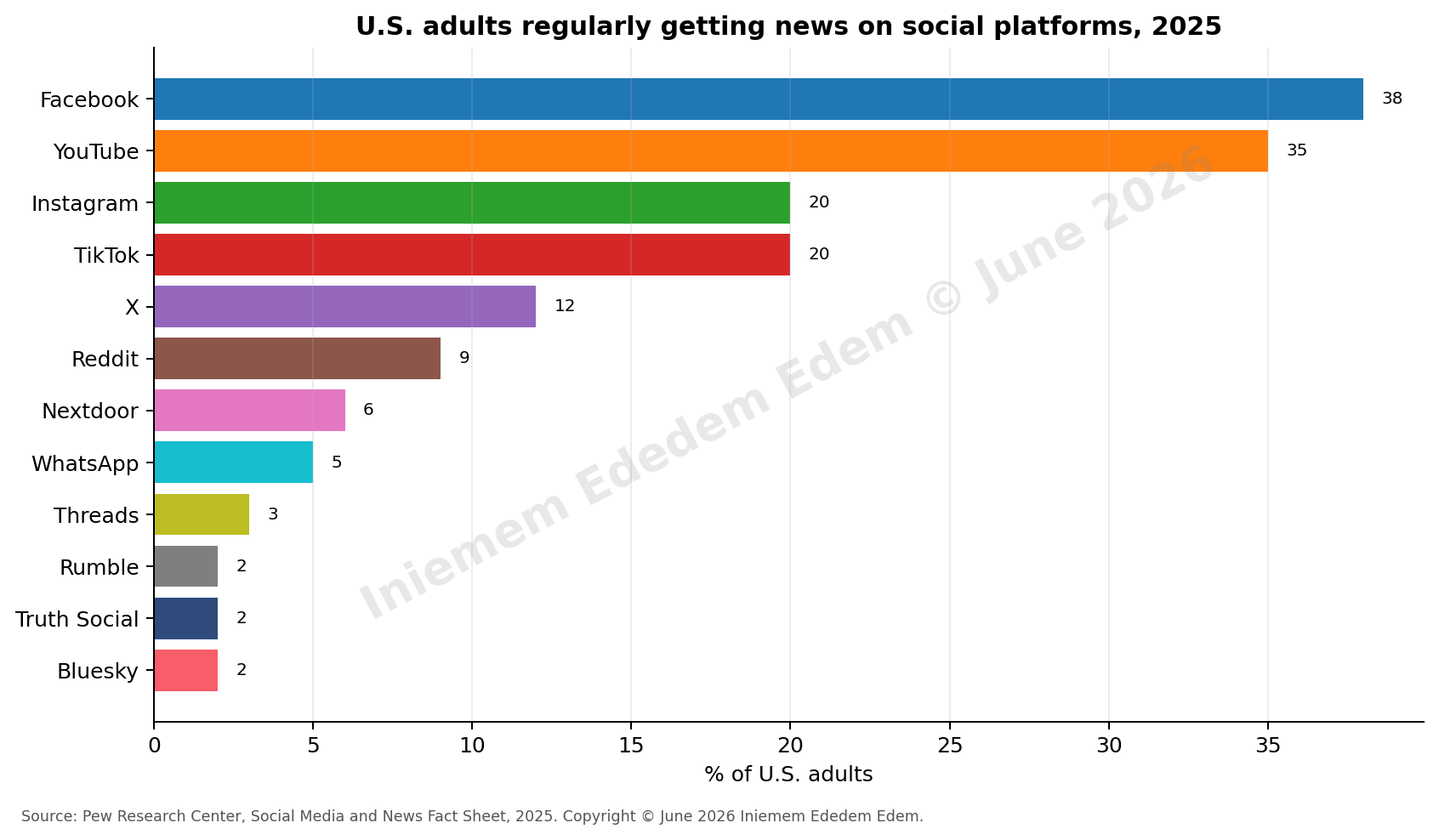
Figure 1. Ini Fig1 Social News.
1.1 The New York publishing problem
Digital publishing in New York now sits in a market where editorial reputation is not enough to protect a firm from platform power. Search engines, social platforms, app stores, newsletter inboxes, video feeds, payment systems, and AI answer tools all stand between publishers and readers. The result is not a simple loss of control; it is a daily negotiation over visibility, attribution, pricing, traffic, and trust.
The New York Times, Condé Nast, and Dotdash Meredith represent three different answers to that pressure. One has built a global subscription and product system around journalism and habit. One carries premium cultural authority across fashion, criticism, lifestyle, design, and technology brands. One operates scale publishing through practical service content, intent capture, advertising, commerce, and licensing. Their differences make the comparison useful because the same digital environment produces different strategic risks.
Editorial trust becomes valuable only when it can be converted into repeated audience behavior. A famous name may attract a visit, but durable publishing requires return, payment, registration, newsletter loyalty, app use, event attendance, product confidence, and willingness to accept corrections. The publisher that cannot hold a direct relationship with its reader is forced to borrow attention from platforms that may change rules without warning.
This study treats trust as an operating asset rather than a ceremonial reputation claim. Trust is built through accuracy, clarity, reader respect, visible correction, sound commercial boundaries, and product experience. The management question is not whether the publication has prestige. The question is whether the publication can carry prestige into a business model that still works when referral traffic weakens or AI summaries substitute for visits.
1.2 Audience ownership and trust
Audience ownership does not mean possession of people. It means a publisher has enough direct permission to reach readers without relying entirely on another company’s feed. Subscription accounts, registered users, newsletters, apps, events, saved preferences, paid communities, and editorial products all create a relationship that search and social platforms cannot fully intercept.
The phrase direct audience capability is used here to describe that relationship. It includes the publisher’s ability to attract readers, learn responsibly from their behavior, serve them through useful products, explain pricing, reduce churn, and maintain confidence in editorial standards. Without that capability, trust may exist culturally while remaining weak commercially.
The New York market matters because many of the firms studied here grew from metropolitan authority but now compete globally. A New York publisher may still trade on cultural capital, newsroom prestige, and brand memory, yet the reader may encounter the work through TikTok, Google, Apple News, YouTube, Reddit, AI search, or an inbox. The publication’s identity is therefore assembled across channels the publisher does not fully own.
The danger is quiet dilution. A brand can appear everywhere and still lose the habit of being visited directly. A publisher can gain traffic and lose pricing strength. A magazine can grow commerce revenue while readers begin to question whether recommendations are editorial or sponsored. Strategy must hold business growth and editorial trust together before the audience notices a contradiction.
1.3 Research focus and contribution
The study examines how New York digital publishers convert editorial trust into strategic resilience under platform power. It uses case evidence, public data, and a management model to show how direct audience relationships affect publishing durability. The argument is practical: trust must be managed through editorial practice, business design, product use, and platform exposure control.
The contribution lies in connecting three questions that are often treated separately. How is trust earned by editorial work? How is trust converted into subscriber, member, or registered-user behavior? How is that relationship protected when technology platforms mediate discovery and monetization? The answer cannot come from newsroom analysis alone or from revenue analysis alone. It requires a combined view of editorial, product, commercial, legal, and technology decisions.
The study does not claim access to internal corporate data. It draws on public filings, publisher statements, Reuters Institute evidence, Pew Research Center data, industry reporting, and recent scholarship. The quantitative model is used as a management instrument, not as a claim of audited firm performance. Where public data are unavailable, the paper separates observed evidence from author-developed diagnostic scoring.
The final purpose is to help publishing managers make better choices. Platform power is not going away. AI summaries will not reverse themselves because publishers dislike them. Advertising volatility will continue. Subscription fatigue will remain real. The firms that endure will be those that treat editorial trust as daily discipline and direct audience relationship as strategic protection.
Chapter 2: Literature and Conceptual Foundations
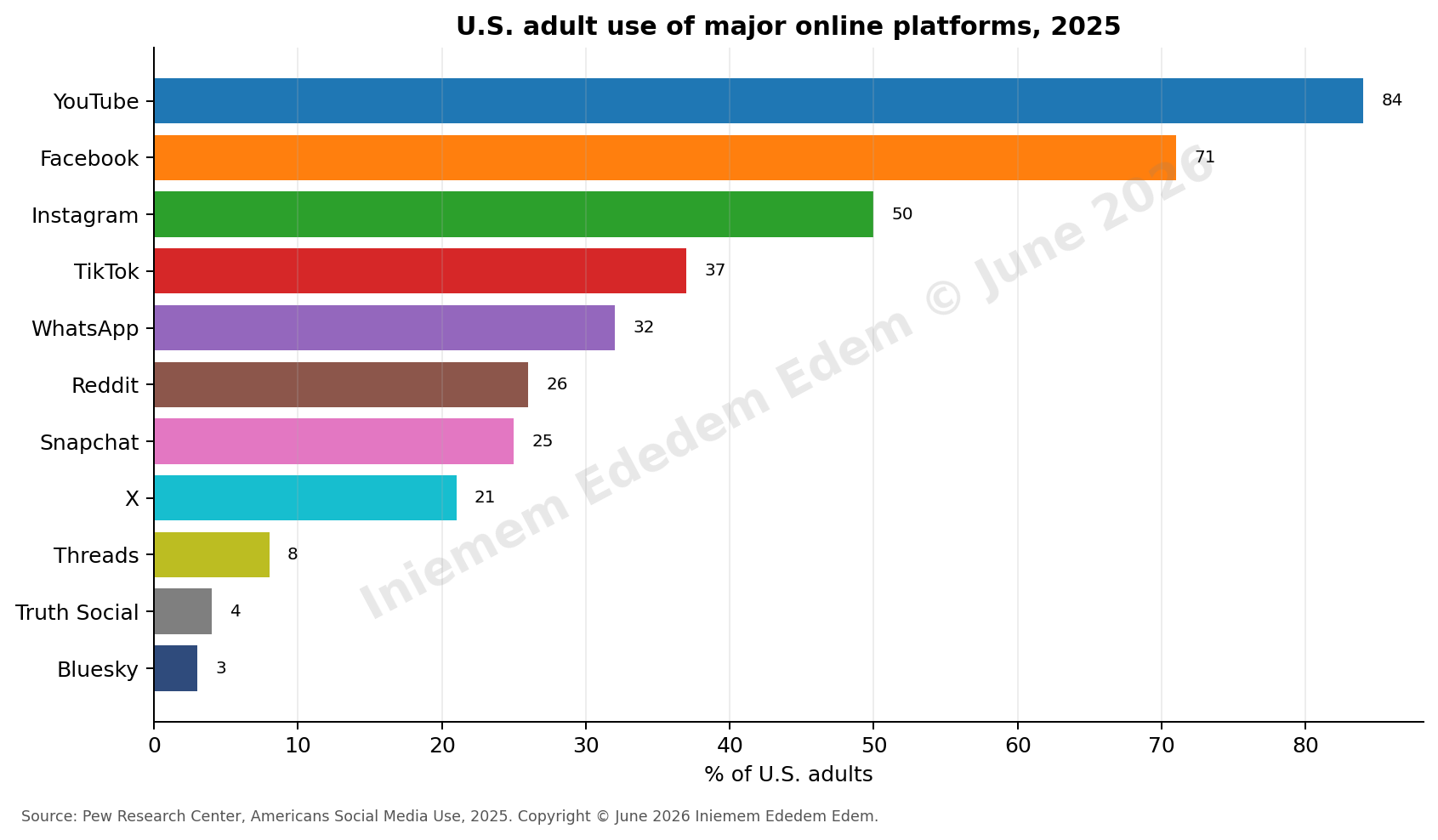
Figure 2. Ini Fig2 Platform Use.
2.1 Platform power and publisher dependence
Digital journalism scholarship has moved beyond the early language of disruption toward a sharper account of platform dependence. Publishers do not simply publish into an open internet. They publish into a market where discovery, ranking, advertising, payment, sharing, and summary are strongly influenced by companies whose business interests may differ from those of news and magazine publishers.
Young (2024) describes journalism’s business problem through people, power, and platforms, showing why publisher strategy must be studied through relations of dependency rather than through content production alone. Iosifidis (2025) makes a similar point in relation to the uneasy relationship between platforms and news publishers: a publisher may own the article but not the path through which many readers find it.
This literature is important because it prevents a false comfort. High-quality editorial work does not automatically produce economic stability. A magazine may win prestige and still lose traffic after a search change. A newspaper may maintain public trust and still face pressure if AI systems summarize reporting without sending readers back. A service publisher may serve millions while remaining exposed to changes in answer engines.
The platform problem is not only technological. It is a bargaining problem. Publishers need audiences, data, payment, distribution, and visibility. Platforms control or influence many of those channels. The strategic task is therefore not withdrawal from platforms but reduction of vulnerability through direct products, reader loyalty, licensing discipline, and commercial clarity.
2.2 Trust, subscriptions, and product habit
Trust literature in digital news shows that audience confidence is uneven, fragile, and tied to behavior. Reuters Institute evidence in 2025 reports continuing pressure on traditional news engagement, stagnating subscription growth in many markets, and concern that AI interfaces may reduce traffic to websites and apps (Newman et al., 2025). That evidence matters for publishers because trust cannot be assumed even when a brand is famous.
Subscription scholarship adds a retention problem. Belchior (2024) uses machine learning to examine online newspaper subscription churn, reminding managers that acquisition is not the same as loyalty. A person may subscribe because of a promotion, an election, a temporary need, or a paywall moment, yet leave when perceived value weakens. Sustainable publishing depends on habit and usefulness, not only reputation.
Bundling research is also relevant. Erbrich (2024) shows how digital news bundles can improve subscription sales and revenue compared with individual offers. Bundles can reduce churn when they give households more reasons to stay. They can also create identity risk when adjacent products become more visible than the editorial mission. The New York Times case is especially instructive because it tests both sides of that logic.
Audience trust should be read as both belief and practice. Readers show trust when they pay, return, recommend, forgive corrected error, and accept that a publisher’s commercial products do not corrupt its editorial judgment. The management task is to measure those behaviors without reducing trust to a dashboard score that ignores the moral obligation behind journalism.
2.3 AI, licensing, and value leakage
Generative AI changes the publishing problem because it can separate editorial value from publisher traffic. A reader may receive a summary of reporting without visiting the publication that produced the underlying work. Reuters Institute’s 2025 report notes publishers’ concern that AI summaries and chatbots could reduce traffic flows to websites and apps (Newman et al., 2025). For management, that is a revenue, attribution, and bargaining concern.
The AI issue is broader than newsroom productivity. AI may assist transcription, metadata, archive search, translation, accessibility, and personalization. It may also produce factual error, weaken attribution, blur accountability, and train readers to expect answers detached from the institutions that reported them. Editorial trust can be harvested by intermediaries if licensing and direct audience strategy remain weak.
Pew Research Center’s 2025 social media evidence reinforces the fragmentation problem. Many Americans encounter news through Facebook, YouTube, Instagram, TikTok, X, Reddit, and other social platforms, with platform audiences differing by age and identity. Publishers are therefore forced to meet audiences in many spaces while still trying to preserve direct relationships.
The literature points toward a strategic triangle: editorial trust, direct audience capability, and platform exposure control. A publisher with trust but no direct audience channel is vulnerable. A publisher with direct channels but weak trust is shallow. A publisher with revenue growth but high platform exposure may appear strong until the rules change. The model developed later in the paper is built around that triangle.
Table 1. New York Digital Publishing Case Matrix
| Publisher | Core strength | Primary exposure | Strategic management lesson |
| The New York Times | Subscriber scale and product habit | Bundle identity drift and AI licensing | Convert trust into recurring use without weakening journalism. |
| Condé Nast | Premium cultural authority | Commerce and platform trend pressure | Protect editorial taste while deepening direct audience ties. |
| Dotdash Meredith / People Inc. | Scale utility and service content | Search and AI answer substitution | Turn intent traffic into recognized brand relationship. |
Note. Table prepared for NYCAR publication use. Copyright © June 2026 Iniemem Ededem Edem.
Read also: An Econometric Renaissance for Africa’s Fiscal Integrity
Chapter 3: Methodology, Case Selection, and Data Discipline
3.1 Case-study design
The study uses a mixed-methods case-study design. Qualitative analysis examines The New York Times Company, Condé Nast, and Dotdash Meredith as different New York-connected publishing systems. Quantitative analysis uses public data and author-developed diagnostic measures to examine direct audience capability, platform exposure, and editorial trust resilience.
The case selection is purposeful. The New York Times represents a mature subscription and bundle model with public reporting on subscriber scale. Condé Nast represents premium brand authority across fashion, culture, criticism, technology, lifestyle, and design. Dotdash Meredith, now connected to People Inc. in later public reporting, represents scale service publishing, search visibility, advertising, performance marketing, and licensing.
The three cases differ in ownership, reporting transparency, product mix, and audience relationship. That difference is valuable. If all cases had the same business model, the study would only describe one strategy. The comparison shows how different publishers manage the same structural condition: dependence on platforms that can change discovery, pricing, attribution, and traffic.
The study is not a ranking of companies. It is a management analysis. The goal is to examine how trust becomes resilient, where platform exposure becomes dangerous, and what direct audience practices reduce vulnerability. Public figures are used carefully and diagnostic scores are labeled as author-developed where the underlying measure is interpretive.
3.2 Sources and boundaries
Sources include annual reports, SEC filings, Reuters Institute reports, Pew Research Center data, publisher materials, trade reporting, and recent peer-reviewed scholarship. The New York Times subscriber data come from company reporting and SEC materials. Dotdash Meredith revenue evidence comes through IAC reporting. Condé Nast analysis relies on public company materials and industry reporting because the firm is privately held.
The analysis separates public evidence from management interpretation. When subscriber totals are stated, they come from public reporting. When the paper scores case profiles, those scores are diagnostic judgments based on public evidence, not official firm metrics. This separation matters because publishing strategy often suffers from confident claims based on partial data.
The quantitative work uses simple formulas to make management relationships visible. The purpose is not to pretend that editorial trust can be reduced to arithmetic. It is to give managers a structured way to discuss direct relationship, habit, revenue mix, editorial-commercial clarity, AI control, and platform exposure.
Limitations remain. Private companies do not release comparable internal figures. Trust is not measured consistently across publishers. Platform exposure changes quickly. AI search and licensing remain unsettled. The study therefore treats the model as a practical aid for decision-making rather than as a final econometric test.
3.3 Analytical approach
Each case is examined through the same questions. How does the publisher earn trust? How does it convert trust into direct audience behavior? How exposed is it to external platforms? How does it diversify revenue without weakening editorial identity? How prepared is it for AI-mediated discovery? These questions allow comparison without forcing the companies into a single mold.
The model uses Editorial Trust Resilience as the central concept. Resilience is not the absence of risk. It is the publisher’s ability to maintain audience confidence, recurring revenue, product habit, and bargaining strength when platform rules change. A resilient publisher is not immune to disruption; it has enough relationship depth to withstand it.
The paper also considers commercial boundary risk. Publishing firms increasingly rely on affiliate revenue, events, licensing, newsletters, product reviews, branded content, and partnerships. These revenue streams can be necessary. They become dangerous when readers cannot tell whether editorial judgment has been shaped by commercial incentives.
The method therefore combines business analysis with editorial ethics. That combination is central to NYCAR master’s research in media management. Digital publishing cannot be studied only as revenue, nor only as journalism. It is a public-facing industry in which trust and business design now depend on each other.
Chapter 4: The New York Times: Direct Audience Power and Bundle Discipline
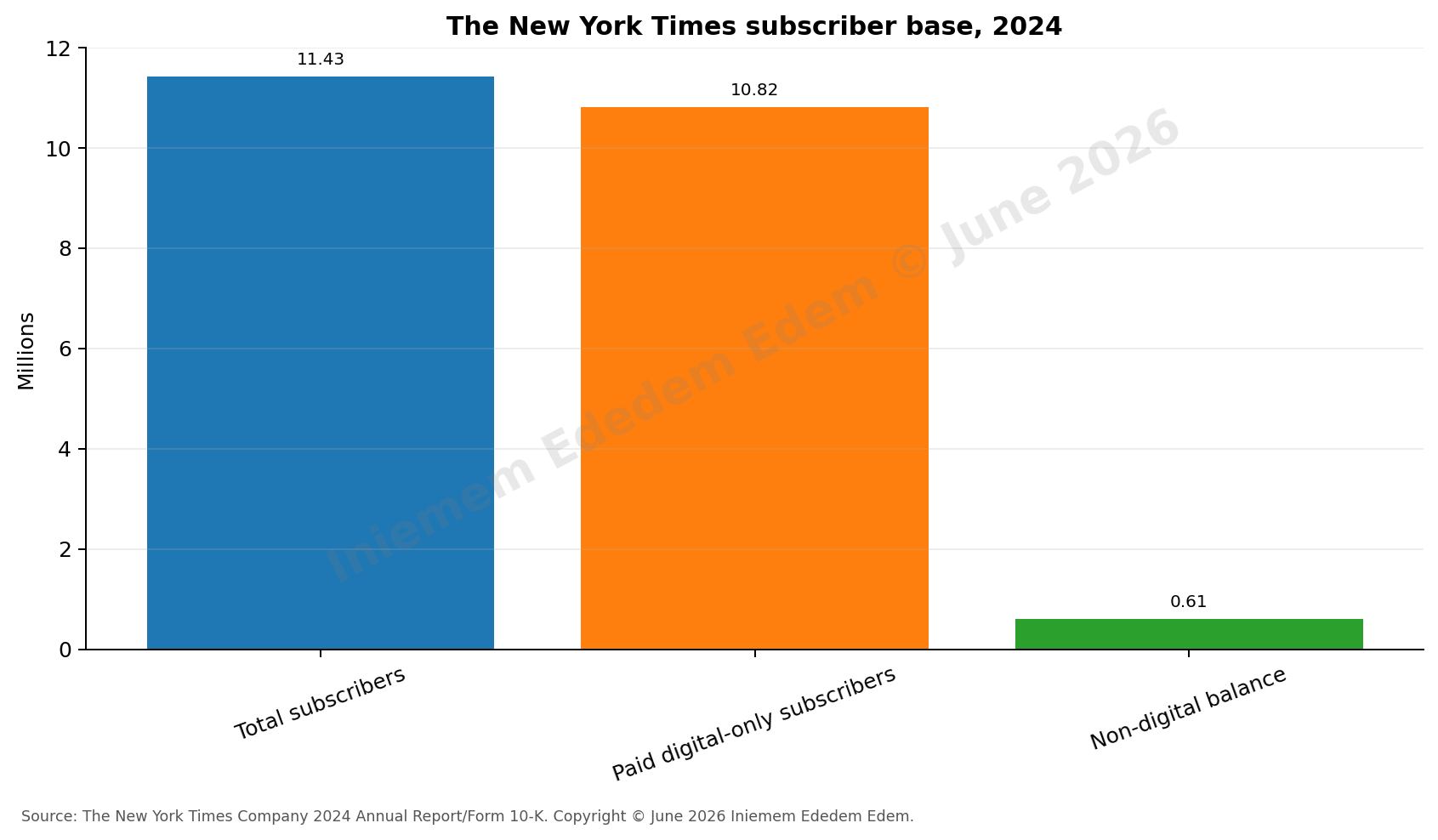
Figure 3. Ini Fig3 Nyt Subscribers.
4.1 The subscription base as strategic protection
The New York Times Company provides the strongest direct-audience example in the case set. Its 2024 reporting shows more than 11.4 million total subscribers and approximately 10.82 million paid digital-only subscribers. Those figures matter because they indicate that the company’s relationship with readers is overwhelmingly digital, account-based, and product-mediated rather than dependent on print habit alone.
A large subscriber base gives the company bargaining strength that many publishers lack. It does not remove platform dependence, but it changes the balance. Search, social platforms, app stores, newsletters, podcasts, and AI interfaces still affect discovery. Yet millions of subscribers already have a direct reason to return. That relationship gives the firm more room to withstand traffic shocks than a publisher built mainly on anonymous visits.
The direct-audience model also changes what trust means. Trust is no longer only a belief that the newsroom is credible. It becomes a pattern of recurring payment and use. Readers show trust when they renew, open the app, read deeply, save recipes, play games, follow sports coverage, and return for major public events. This makes editorial trust measurable through behavior, though not reducible to behavior alone.
The risk is that growth can create complacency. A large subscription base requires continued value, fair pricing, easy account management, and editorial confidence. If the publisher treats subscribers as locked-in revenue units rather than relationships, trust will weaken quietly before churn exposes it. Direct audience capability must be cared for, not simply counted.
4.2 The bundle as habit machine
The New York Times bundle is not just a revenue tactic. It is a habit system. News remains the center, but Games, Cooking, Wirecutter, The Athletic, audio, newsletters, and apps increase the number of daily and weekly reasons a household may stay connected. The bundle shifts the subscription from a single editorial purchase into a portfolio of use cases.
That structure creates strategic advantages. It reduces churn by making cancellation feel costly across more parts of household life. It broadens appeal beyond readers who follow hard news every day. It also gives the company more data about product use, which can support personalization, onboarding, pricing discipline, and product improvement.
The bundle also creates identity risk. If adjacent products become too dominant, the company may protect revenue while thinning the central meaning of the brand. A newsroom known for serious reporting must not allow entertainment, commerce, or lifestyle utility to make journalism feel like only one feature among many. The strongest bundle protects the core rather than replacing it.
The management test is balance. A product ecosystem should make editorial trust more usable without flattening it into convenience. Readers may love games and recipes, but the company’s unique strategic capital remains the credibility of its journalism. The bundle should extend that capital, not hide it.
4.3 Licensing, AI, and negotiation
The New York Times also illustrates the future bargaining problem. Its journalism is valuable to readers, advertisers, search systems, AI companies, educators, and public debate. The more valuable the archive and reporting become to AI systems, the more important licensing, attribution, and control become. A direct audience base strengthens that negotiation because the company is not only asking for traffic; it is defending a subscriber relationship.
AI summaries threaten a basic publishing exchange. Traditionally, search helped users find publisher pages. AI answers may satisfy users before they reach those pages. The shift places pressure on licensing agreements, legal strategy, and product design. The publication with stronger direct audience habits has more strategic room to resist unfavorable terms.
The lesson is not that every publisher can copy The New York Times. Most cannot. The transferable principle is narrower and more useful. Publishers need direct channels, repeated value, product clarity, and reader relationships that do not vanish when a platform changes display logic. Scale helps, but discipline matters even for smaller firms.
The case demonstrates that editorial trust is strongest when it becomes an operating system. Reporting, product, pricing, newsletters, onboarding, corrections, AI policy, and licensing all affect whether the reader sees the institution as worthy of recurring commitment. Trust is no longer only a newsroom matter.
Chapter 5: Condé Nast: Premium Authority, Commerce Pressure, and Cultural Trust
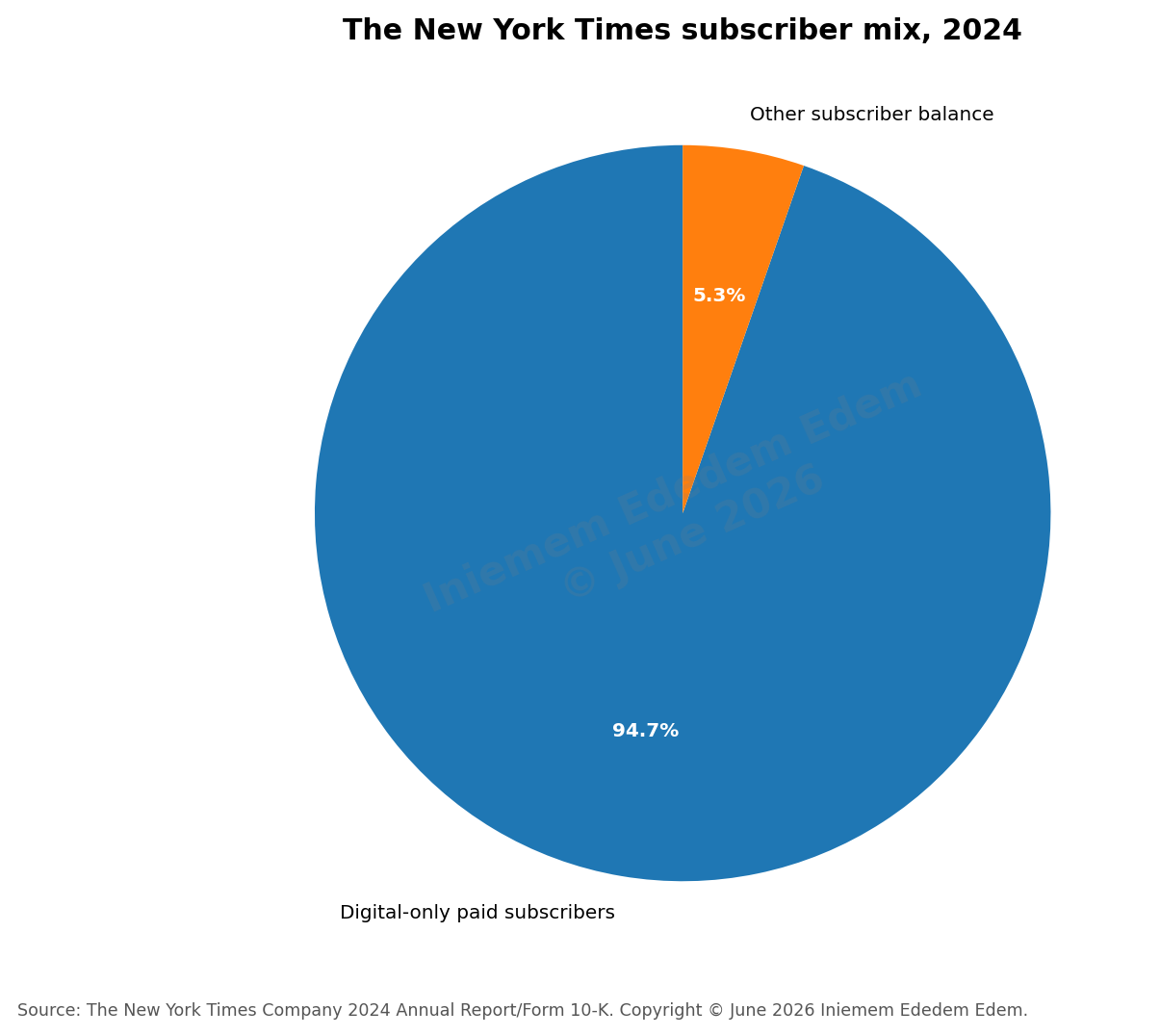
Figure 4. Ini Fig4 Nyt Share.
5.1 Premium brand power
Condé Nast occupies a different position from The New York Times. Its strongest assets are not only news products. They are premium editorial brands with cultural memory: Vogue, The New Yorker, Vanity Fair, GQ, Wired, Architectural Digest, and others. These titles carry authority in fashion, criticism, design, technology, culture, style, and taste. Their value often comes from symbolic judgment as much as information.
Premium trust is harder to measure than subscriber totals. A reader may not pay every month but may still take Vogue seriously during fashion week, trust The New Yorker for criticism, or consult Wired for technology context. Cultural authority can generate events, commerce, video, licensing, memberships, social distribution, and luxury partnerships. The challenge is to convert prestige into durable audience relationship without making the brands feel transactional.
The New York location of Condé Nast matters because it reinforces metropolitan identity and global cultural reach. The company’s brands operate internationally, yet their editorial aura remains tied to New York media power, fashion circuits, literary culture, and elite audience formation. That authority cannot be manufactured quickly by platforms.
At the same time, cultural authority is vulnerable to speed. Social platforms reward immediacy, image flow, celebrity conflict, and trend reaction. A premium publisher must participate in that system without surrendering its editorial character to it. The strongest brands speak quickly when needed but do not let platform tempo define taste.
5.2 Commerce and editorial boundary
Condé Nast’s commercial opportunity is also its risk. Fashion, design, lifestyle, product recommendation, events, luxury advertising, affiliate revenue, and branded content sit close to editorial work. Readers know that magazines in these categories operate near commerce. What they still demand is discernment. They want to believe that taste has not been purchased.
The boundary between editorial authority and commercial influence has to be visible. A product recommendation can support revenue and serve readers when the review is honest, the disclosure is clear, and the editorial standard remains intact. It becomes corrosive when the reader suspects that commerce has quietly replaced judgment.
The same applies to celebrity and influencer culture. Platform visibility may pull premium publishers toward personalities who create attention but weaken editorial independence. A magazine can become popular and less authoritative at the same time. Management must protect the difference between relevance and surrender.
Condé Nast’s strategic task is therefore not simply digital transformation. It is preservation under adaptation. Each brand needs direct audience products, newsletters, memberships, events, and commerce discipline that fit its identity. The New Yorker cannot be managed like Vogue; Wired cannot be managed like Vanity Fair. Shared infrastructure may help, but brand meaning must remain specific.
5.3 Trust as editorial taste
In premium publishing, trust often appears as taste. Readers return because they believe editors can identify what matters, interpret culture, distinguish quality from noise, and preserve a standard. That form of trust is less direct than trust in investigative reporting, but it is still real. It can command attention, price, and sponsorship when handled carefully.
Taste-based trust is fragile because audiences can sense imitation. If a publication chases every platform trend, every celebrity cycle, or every commerce opportunity, it may preserve activity while losing authority. Strong premium media must decide what not to cover, which sponsorships not to accept, and which visual or editorial signals would cheapen the brand.
A direct audience strategy for Condé Nast should therefore be brand-specific. Some titles may build events and memberships. Others may build subscriber communities, specialist newsletters, premium video, or curated commerce. The common rule is that direct relationship should deepen the brand’s authority rather than strip it down to generic engagement.
The case shows why digital publishing strategy cannot be reduced to subscriber counts. Premium authority can hold value across print, digital, social, events, and commerce, but it needs disciplined management. The question is whether cultural authority is being converted into sustainable relationship or spent for short-term monetization.
Table 2. Direct Audience Capability Variables
| Variable | Meaning | Management evidence |
| Subscription or membership depth | Paid relationship with reader | Subscriber totals, retention, renewal, bundle adoption. |
| Habit strength | Repeated reader behavior | App opens, newsletter engagement, product cross-use. |
| Owned-channel reach | Permission-based contact | Accounts, newsletters, apps, events, communities. |
| Commercial clarity | Reader confidence in boundaries | Disclosure, labeling, correction visibility, review rules. |
Note. Table prepared for NYCAR publication use. Copyright © June 2026 Iniemem Ededem Edem.
Chapter 6: Dotdash Meredith / People Inc.: Utility Publishing and Search Exposure
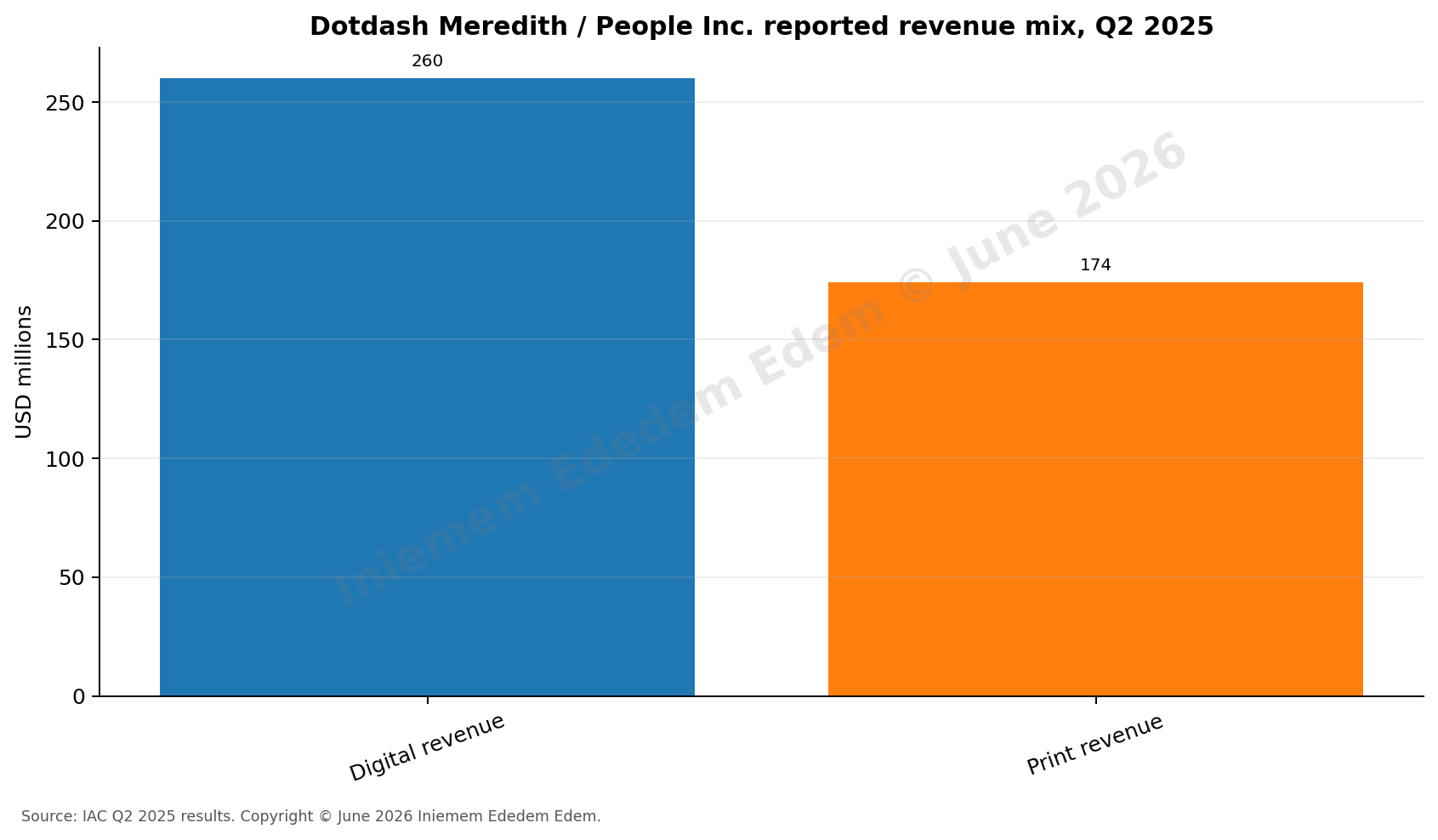
Figure 5. Ini Fig5 Iac Revenue.
6.1 Scale and service journalism
Dotdash Meredith offers a contrasting model built around scale, practical service, advertising, commerce, and intent. Its brands serve users who often arrive with a task: cook dinner, compare a product, understand a health question, improve a home, plan a trip, manage money, or follow entertainment. Trust in this environment is less ceremonial. It depends on usefulness, clarity, accuracy, and whether the answer helps.
IAC reporting shows the commercial strength of this model, with Dotdash Meredith reporting substantial digital revenue and later rebranding activity around People Inc. The Q2 2025 public results reported digital revenue of $260 million and print revenue of $174 million. Those figures show the digital weight of the business and the ongoing transition away from print dominance.
Service journalism creates a different trust contract from political reporting or luxury editorial. Readers may not think of themselves as loyal to a publisher before a search. They may search for a recipe, a symptom, a product, or a how-to question. The publisher earns trust in the moment by being accurate, clear, readable, and accountable.
The challenge is that this model often depends heavily on search visibility. Intent-driven content is valuable because users know what they need. But if search engines or AI answer tools provide the answer directly, the publisher may lose the visit, the ad impression, the affiliate click, and the chance to become known by name.
6.2 Search, AI, and attribution
Search dependence is not a moral failure. It is a business condition. Many useful publishers grew by matching high-quality content with user intent. The problem arises when the platform that organizes search also becomes an answer engine. The publisher’s work may inform the answer while the reader never develops a relationship with the source.
AI answer systems intensify this concern. A recipe, medical explanation, product comparison, or home repair instruction can be summarized in seconds. If attribution, traffic, and payment are weak, value moves away from the publisher. Licensing may become necessary, but licensing without audience recognition can still leave the brand invisible.
Dotdash Meredith’s strategic response should therefore combine scale with stronger direct relationship. Newsletters, saved recipes, account features, trusted product review standards, video explainers, expert credentials, and clear editorial policies can give users reasons to remember the brand behind the answer. Utility must become relationship, not only traffic.
The case also highlights quality risk. Service content can become thin when the incentive is to match search phrases rather than help readers. The stronger editorial approach is to treat service journalism as care. A reader asking about health, money, home safety, parenting, or product reliability deserves more than keyword coverage. Trust grows when the publisher acts like the answer matters.
6.3 Licensing and commercial credibility
Licensing is likely to become more important for scale publishers. Archives, product databases, expert-reviewed service content, recipes, and structured answers have value for AI companies and search platforms. The publisher must decide which licensing arrangements protect long-term brand value and which may train users to bypass the source.
Commercial credibility is equally important. Service publishers often use affiliate links and commerce partnerships. These can be legitimate when recommendations are tested, clearly labeled, and separated from undue influence. They damage trust when readers suspect that the publisher is pushing products because revenue incentives are hidden.
The management priority is documentation. Product review standards, health review standards, correction policies, affiliate disclosures, AI policies, and author credentials should be visible. Service publishing depends on ordinary trust. Readers may not know the board or editors, but they know when an answer feels careful and when it feels made for traffic.
Dotdash Meredith’s case shows that platform exposure does not eliminate opportunity. Scale, practical usefulness, and brand portfolios can generate strong revenue. The risk is that platform changes can interrupt the relationship before it becomes durable. The strategic goal is to turn answer-seeking users into known, returning, trusting audiences.
Chapter 7: AI Mediation, Licensing, and Editorial Governance
7.1 AI as intermediary
Generative AI has become a new intermediary in publishing. It does not only help newsrooms produce work. It changes how readers encounter information. AI summaries, chatbots, and search-integrated answers can present reporting or service content without preserving the full context, byline, correction history, advertising model, or subscription path of the publisher.
This creates a strategic problem for every case in the study. The New York Times must protect the value of reporting and archive material. Condé Nast must protect premium voice, images, reviews, and cultural authority. Dotdash Meredith must protect service answers and structured information that AI systems can easily summarize.
AI also creates internal risk. Publishers may use AI for transcription, search, tagging, image handling, personalization, or draft assistance. Those uses may save time, but they must be governed. The reader’s trust depends on knowing that human editorial responsibility remains in force where accuracy, judgment, taste, or accountability matters.
A publisher should not treat AI policy as a technical note. It belongs in editorial standards, legal review, licensing, product management, and audience communication. The question is not whether AI can reduce cost. The question is whether its use protects the relationship that makes the publisher valuable.
7.2 Licensing as strategic negotiation
Licensing has become a strategic negotiation over value. If AI companies use publisher content to answer user questions, train systems, or enrich search results, publishers must ask what they receive in return. Payment matters, but so do attribution, traffic, context, brand visibility, data sharing, and the right to control misuse.
The negotiation position differs by publisher. The New York Times brings global reporting authority and a large subscriber base. Condé Nast brings high-value brands, images, style archives, criticism, and lifestyle authority. Dotdash Meredith brings massive service content and user-intent libraries. Each must defend different assets.
A weak licensing deal can produce short-term revenue while reducing long-term audience habit. If readers become accustomed to receiving publisher content through an AI interface, the publisher may become invisible. The licensing strategy must therefore be linked to direct audience strategy. The goal is not only payment but preservation of relationship.
Management should evaluate AI deals through a reader-centered test. Will the deal make the source visible? Will it protect accuracy? Will it support subscriber or registered-user growth? Will it preserve editorial standards? Will it prevent the publisher’s work from being used against the publisher’s own products? If the answers are unclear, the deal may be strategically expensive even if it pays.
7.3 Editorial standards under automation
Automation must not be allowed to weaken correction culture. If an AI-assisted headline misstates an article, if an automated summary misses context, or if a recommendation system pushes sensitive content poorly, the publisher remains responsible. Audiences do not trust a tool; they trust the institution that chose to use it.
Editorial standards should therefore cover AI use in production, archive search, personalization, image handling, and licensing. The standard should be specific enough for editors, product teams, audience teams, and legal counsel to apply. Vague promises about responsible innovation will not protect a publisher when a public error occurs.
AI can help serious publishers if it is tied to verification, not substitution. It can speed transcription, surface archive material, improve accessibility, and support internal research. It becomes dangerous when it produces unverified claims, hides commercial motives, or presents synthetic material in a way that misleads readers.
The New York publishing cases show that editorial trust now depends on technology governance. The newsroom, product group, data team, legal counsel, and business office are all involved in preserving trust. A publisher that separates these functions too sharply will discover too late that the reader experienced them as one institution.
Chapter 8: Quantitative Models and Strategic Charts
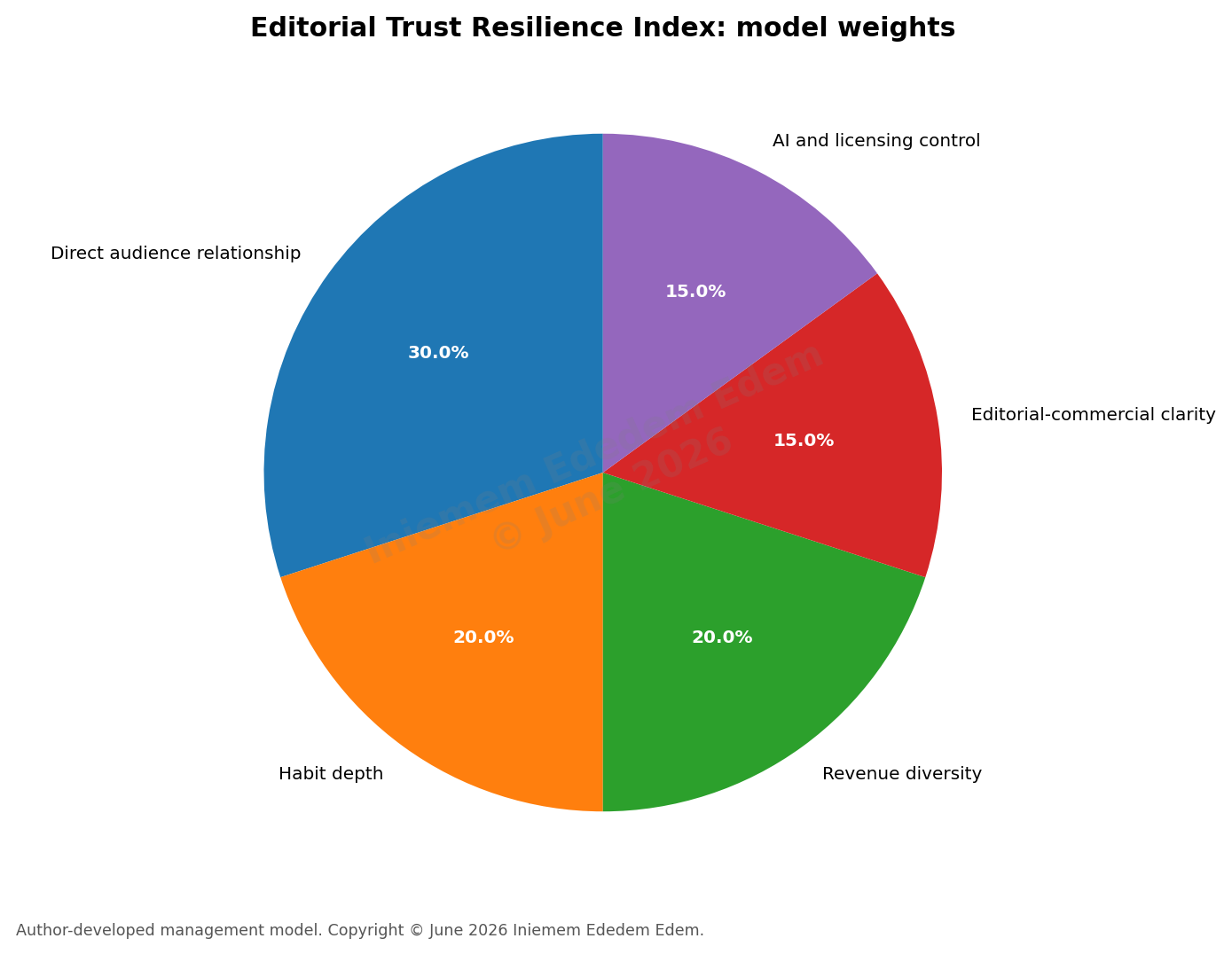
Figure 6. Ini Fig6 Etr Weights.
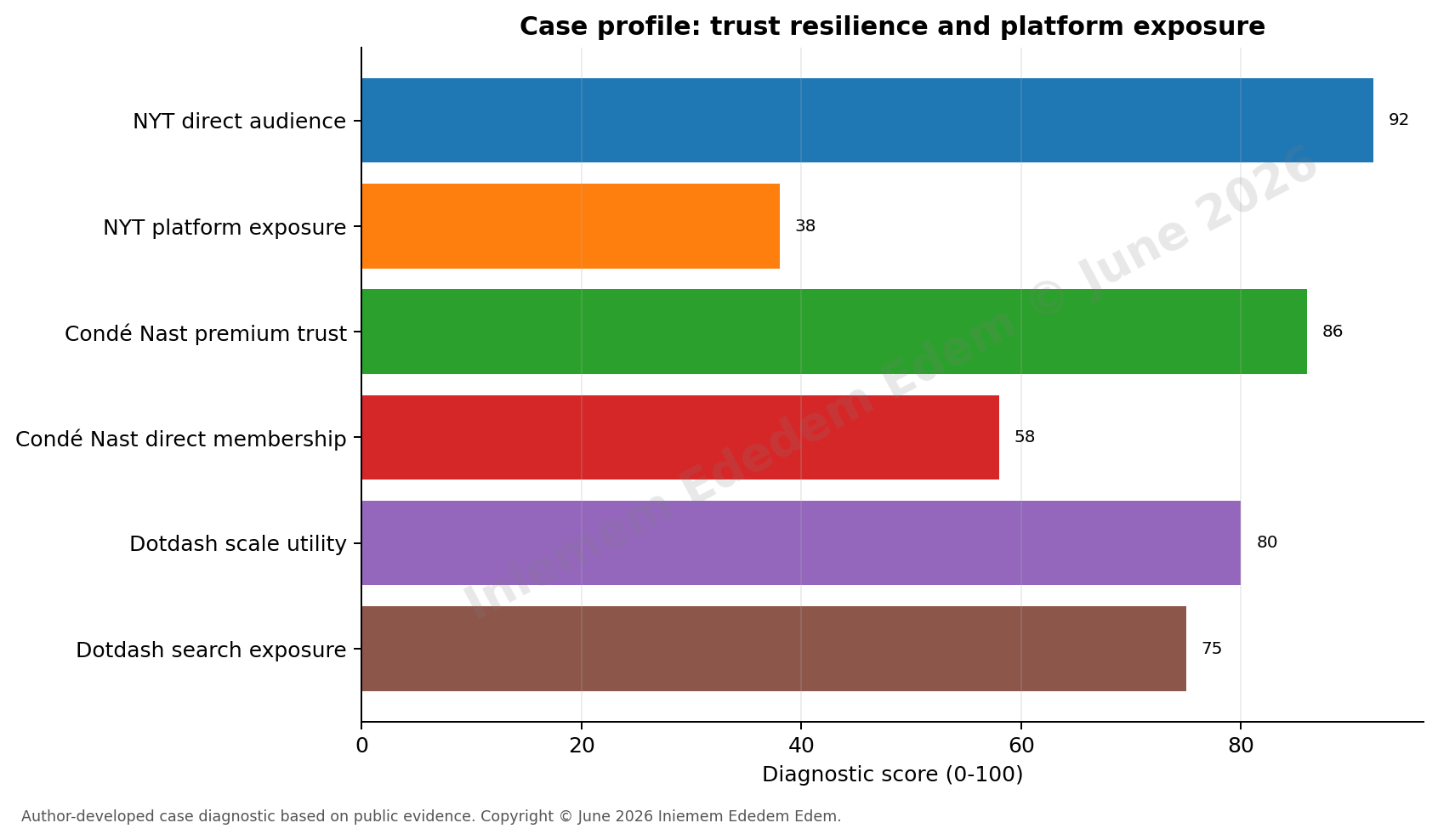
Figure 7. Ini Fig7 Case Profile.
8.1 Direct audience capability
Direct Audience Capability can be expressed as DAC = 0.25S + 0.20H + 0.15N + 0.15A + 0.15B + 0.10D. In this model, S represents paid subscription or membership depth, H habit strength, N newsletter and account reach, A app or owned-channel engagement, B brand loyalty, and D responsible data depth. The weights are author-developed and meant to guide discussion rather than replace management judgment.
The model is useful because it prevents a narrow reading of audience strength. A publisher may have many visitors and weak direct capability. Another may have smaller reach and stronger loyalty. The score asks whether the publisher has repeated, permission-based contact with readers and whether that contact can survive platform changes.
For The New York Times, paid subscription depth and product habit are strong. For Condé Nast, brand loyalty and cultural authority may be strong, but direct membership depth varies across titles. For Dotdash Meredith, reach and utility are strong, but platform exposure creates pressure. The model helps place these differences into a common conversation.
No score should be treated as permanent. Audience behavior changes, products mature, pricing shifts, and AI interfaces may alter referral patterns. The value of the model is that it encourages regular review and makes hidden dependency harder to ignore.
8.2 Editorial Trust Resilience Index
Editorial Trust Resilience can be expressed as ETR = 0.30D + 0.20H + 0.20R + 0.15C + 0.15G – P. D represents direct audience relationship, H habit depth, R revenue diversity, C editorial-commercial clarity, G AI and licensing control, and P platform exposure penalty. This equation captures the management claim at the center of the study: trust needs operational support.
The platform exposure penalty is important. A publisher may look strong if reach is high, but if that reach is mediated through search, social feeds, or AI summaries, the strategic position may be weaker than the traffic suggests. Exposure must be measured alongside revenue, not after revenue has already been disrupted.
The model also treats commercial clarity as a trust variable. Affiliate revenue, branded content, commerce links, and sponsorship may support the business. They also create reader concerns when disclosure is weak. A publisher can lose trust not because the content is inaccurate but because the audience no longer believes the judgment is independent.
These equations do not turn editorial work into accounting. They give managers a disciplined way to ask better questions. Where is the audience relationship strong? Where is the product habit shallow? Where does revenue invite suspicion? Where can AI extract value? Those questions belong in serious publishing management.
8.3 Interpretation of the seven figures
The social-news chart shows why publishers cannot rely on one platform. Facebook and YouTube remain powerful news channels for U.S. adults, while Instagram and TikTok have become meaningful for younger and visual audiences. The distribution of news attention makes channel management more demanding and makes direct audience relationships more valuable.
The platform-use chart broadens the point. YouTube and Facebook reach large adult audiences, but Instagram, TikTok, WhatsApp, Reddit, Snapchat, X, Threads, and newer platforms divide attention across communities. A publisher chasing every platform in the same voice will sound generic. A publisher using platforms intelligently will adapt format while preserving editorial identity.
The New York Times charts show the power of paid digital relationship. A digital-only paid subscriber base of approximately 10.82 million within a total subscriber base above 11.4 million indicates a mature digital subscription system. The pie chart makes the strategic point clearly: the company’s reader relationship has shifted decisively into digital products.
The Dotdash Meredith revenue chart, the trust-resilience weight chart, and the case-profile chart connect business evidence to management judgment. Public revenue data show commercial strength. The author-developed weights show how to read trust resilience. The case profile warns that no publisher is strong in every dimension. Strategy begins when leaders admit the shape of their own exposure.
Table 3. Strategic Risk and Recommended Response
| Risk | Likely effect | Recommended response |
| AI answer substitution | Traffic and attribution loss | Licensing discipline, direct channels, source visibility. |
| Search dependence | Volatile reach | Audience registration, newsletters, product habit. |
| Commerce overreach | Reader distrust | Plain disclosure and editorial-commercial separation. |
| Subscription fatigue | Churn and price resistance | Clear value, fair pricing, onboarding, bundle discipline. |
Note. Table prepared for NYCAR publication use. Copyright © June 2026 Iniemem Ededem Edem.
Chapter 9: Managerial Recommendations for New York Publishers
9.1 Build direct channels without abandoning platforms
Publishers should use platforms for reach while refusing to let platforms own the relationship. Search, social media, newsletters, apps, video channels, and AI interfaces should be managed as a portfolio. The goal is not to escape the digital ecosystem. The goal is to prevent any one intermediary from becoming so important that it can weaken the publisher’s future.
A direct audience plan should include account registration, newsletters, app habit, paid products, events, saved preferences, community features, and respectful data practice. Registration should not become a nuisance. It should create value for the reader through relevance, continuity, and better service.
Smaller publishers should not imitate The New York Times bundle mechanically. They may need narrower strategies: a professional newsletter, a local membership program, a single premium vertical, events, podcasts, or partnerships. The principle travels even when scale does not. Own enough of the relationship to remain alive when platforms change.
The strongest publishing managers will measure platform dependency before the crisis. They will know how much traffic, revenue, conversion, and habit comes from each channel. They will run scenarios for search loss, social decline, AI answer substitution, ad-market weakness, and subscription fatigue.
9.2 Protect editorial-commercial boundaries
Every revenue stream should be tested against trust. Subscriptions, affiliate links, branded content, licensing, events, advertising, and commerce all have a place. None should be allowed to blur the reader’s understanding of what is editorial judgment and what is paid influence.
Disclosures should be plain and placed where readers encounter the content. Hidden labels and clever euphemisms weaken confidence. A reader should not need to investigate whether a recommendation is editorial, sponsored, affiliate-linked, or licensed.
Editorial teams need authority to challenge commercial pressure. Product teams need to understand trust as a design value. Business teams need to know that revenue gained by weakening trust is not strategic. The publisher’s internal incentives should reward long-term relationship, not only short-term yield.
Correction culture should be visible. Trust is not created by pretending error never occurs. It is created when readers see that the publisher corrects carefully, explains responsibly, and learns from repeated mistakes. In a platform environment where error travels quickly, correction must travel too.
9.3 Govern AI as a public-facing editorial issue
AI policy should be written for editors, product leaders, lawyers, audience staff, and readers. It should state what AI may do, what humans must check, when disclosure is required, how errors are corrected, how training data are handled, and how licensing deals are reviewed.
Publishers should negotiate AI licensing from a position of long-term audience protection. Payment alone is not enough. Agreements should address attribution, source visibility, links, usage limits, accuracy responsibilities, data sharing, and whether the deal helps or harms subscriber growth.
AI should support editorial quality, not replace responsibility. A publisher may use AI to organize archives or improve accessibility, but final accountability remains human. The reader should never be forced to guess whether serious reporting, criticism, or health content has been handed to a machine without adequate oversight.
The future of New York publishing will be decided by firms that combine editorial seriousness with product discipline. Trust must become a daily operating practice, not a line in a mission statement. Audience relationship must be owned, not rented. Platform reach must be used, not worshiped.
Chapter 10: Final Position and Research Contribution
10.1 Trust as strategic capital
The study’s central position is that editorial trust has become strategic capital in digital publishing. It can support subscriptions, renewals, licensing, premium advertising, events, memberships, and product ecosystems. It can also disappear when commercial pressure, platform dependency, poor disclosure, or careless AI use weakens the reader’s confidence.
The New York cases show that no single model is sufficient. The New York Times demonstrates subscription strength and bundle habit. Condé Nast demonstrates premium cultural authority and brand-specific risk. Dotdash Meredith demonstrates scale utility and search exposure. Each case offers lessons; none offers a universal formula.
Direct audience capability is the practical bridge between trust and resilience. A publisher that has a meaningful relationship with readers can respond to platform changes with more strength. A publisher that depends on anonymous traffic may be successful for a period and exposed the moment discovery shifts.
The research also shows why editorial and business strategy can no longer be separated. A newsroom may produce excellent work, but the product may fail to create habit. A business team may grow revenue, but the revenue mix may damage trust. Serious publishing management must hold these concerns together.
10.2 Contribution to NYCAR media management studies
For NYCAR, the paper contributes an applied media-management model that links public trust, direct audience capability, platform exposure, and AI licensing. It is designed for publishers, editors, media executives, researchers, and graduate learners who need to understand digital publishing as both a business and a civic institution.
The study also offers a warning against shallow digital transformation. Moving content onto platforms is not transformation. Launching a newsletter is not transformation. Using AI is not transformation. The deeper question is whether the publisher can preserve editorial judgment, audience trust, and revenue durability under changing technological conditions.
The charts and equations are meant to aid judgment, not replace it. Publishing remains a human field because trust depends on editorial decisions, institutional conduct, and reader experience. Metrics can reveal risk, but they cannot decide what kind of publication deserves public confidence.
The final conclusion is direct. New York digital publishing will remain influential only if its firms convert prestige into relationships, relationships into repeated value, and repeated value into trust that survives platform change. The publisher that owns its voice but rents its audience is strategically unfinished.
10.3 Closing statement
The next decade will not be kind to publishers that confuse visibility with strength. A large audience can vanish when a platform changes ranking. A famous brand can weaken when commerce outpaces judgment. A subscription product can lose loyalty when pricing feels careless. An AI deal can pay money while training the public to bypass the publisher.
Yet the future is not only defensive. Publishers still possess assets platforms cannot easily create: reporting judgment, cultural authority, editorial memory, brand meaning, community trust, and the capacity to explain the world with responsibility. These assets become durable when they are tied to direct audience capability.
The cases studied here show three paths through the same pressure. The New York Times has built scale around habit. Condé Nast must protect premium meaning while deepening direct ties. Dotdash Meredith must defend utility against answer-engine substitution. Their lessons extend beyond New York because platform power now touches publishing everywhere.
A publisher’s strongest strategic question is no longer simply what will be published tomorrow. It is whether the institution is building the kind of relationship that readers will still choose when the platforms around them become faster, louder, and less accountable.
References
Belchior, L. M. (2024). Online newspaper subscriptions: Using machine learning to understand subscriber churn. Digital Journalism. https://doi.org/10.1080/16522354.2024.2343638
Erbrich, L. (2024). Bundling digital journalism: Exploring the potential of bundled offers for subscription sales. Media and Communication, 12, Article 7442. https://doi.org/10.17645/mac.7442
IAC Inc. (2025). IAC reports Q2 2025 results. U.S. Securities and Exchange Commission. https://www.sec.gov/Archives/edgar/data/1800227/000180022725000122/ex_991q22025iac-pressrelea.htm
Iosifidis, P. (2025). Digital platforms and news publishers: An uneasy relationship. Frontiers in Communication, 10, Article 1556826. https://doi.org/10.3389/fcomm.2025.1556826
Newman, N., Fletcher, R., Robertson, C. T., Arguedas, A. R., & Nielsen, R. K. (2025). Reuters Institute digital news report 2025. Reuters Institute for the Study of Journalism.
Pew Research Center. (2025). Social media and news fact sheet. Pew Research Center.
Pew Research Center. (2025). Americans’ social media use 2025. Pew Research Center.
The New York Times Company. (2025). 2024 annual report. The New York Times Company.
The New York Times Company. (2025). Form 10-K for the fiscal year ended December 31, 2024. U.S. Securities and Exchange Commission.
WAN-IFRA. (2024). Condé Nast’s six-point strategy for a sustainable future. World Association of News Publishers.
Young, M. L. (2024). People, power, platforms and the business of journalism. Digital Journalism, 12(1), 1–8. https://doi.org/10.1080/21670811.2023.2273523
Zhao, H., & Berman, R. (2025). The impact of large language models on online news consumption and production. arXiv. https://arxiv.org/abs/2512.24968