

NEW YORK CENTER FOR ADVANCED RESEARCH (NYCAR)
Strategy, Teaching Quality, Research Integrity, and Institutional Trust
Doctoral Research Publication by Stella Ifeyinwa Anumnu
Institutional Affiliation: New York Center for Advanced Research (NYCAR)
Date: June 2026
Publication No.: NYCAR-TTR-2026-RP063
DOI: https://doi.org/10.5281/zenodo.20357802
© June 2026 Stella Ifeyinwa Anumnu. All rights reserved. Charts, tables, and editorial presentation prepared for this publication. No part of this publication may be reproduced without proper attribution to the author and institution.
Abstract
Artificial intelligence has entered Nigerian higher education through the side door. It is already in students’ phones, lecturers’ drafts, postgraduate literature searches, coding exercises, translation work, slide preparation, plagiarism anxieties, and administrative shortcuts. Many universities are still discussing AI as if it were a future policy choice, but the real situation is less tidy: use has begun before most institutions have settled the academic rules, trained staff, protected student data, redesigned assessment, or decided where human judgment must remain final.
This study examines that problem from the standpoint of university responsibility. Nigerian higher education does not need AI enthusiasm for its own sake. It needs a disciplined way to decide where AI can improve teaching, research, access, feedback, administration, and national skills development without weakening the degree, exposing students, deepening inequality, or turning academic work into machine-assisted imitation. The paper reads Nigerian policy and institutional evidence alongside international guidance on AI risk, education, data protection, and quality assurance. National AI ambition, digital learning policy, CCMAS curriculum reform, JAMB’s data-supported admissions system, NOUN’s distance-learning experience, TETFund’s TERAS platform, 3MTT, the Nigeria Data Protection Act, UNESCO guidance, NIST risk-management work, ISO/IEC 42001, and connectivity evidence are treated as signals of direction, not proof that campus practice is already mature.
The paper proposes the AI Higher Education Readiness and Safeguards Score as a planning instrument for universities. Its purpose is not to rank institutions or produce false precision. It helps leaders examine eight areas that now decide whether AI use is responsible: governance authority, faculty preparation, data protection and infrastructure, assessment integrity, research capacity, equity and access, quality assurance evidence, and procurement control.
The argument is direct. Nigerian universities should adopt AI where it strengthens learning and research. They should resist it where it replaces authorship, hides weak teaching, exploits student data, rewards privilege, or places academic authority in the hands of vendors. The future question is not whether AI belongs in the university. It is whether Nigerian universities can make AI serve the university’s academic mission rather than the other way around.
Keywords: artificial intelligence; Nigerian higher education; AI governance; digital learning; academic integrity; data protection; research ethics; curriculum reform; faculty development; AI-HERS.
Contents
List of Tables
Table 1. Nigerian case-study evidence and strategic management lesson.
Table 2. AI governance responsibilities by institutional level.
Table 3. Faculty development program for AI-ready teaching.
Table 4. Assessment redesign options for the AI period.
Table 5. Research integrity and ethics safeguards for AI-assisted work.
Table 6. AI-HERS variables and scoring test.
Table 7. Twenty-four-month implementation sequence.
Table 8. AI tool register and approval evidence.
Table 9. Operational controls by university function.
Table 10. Future empirical evidence agenda for Nigerian AI governance.
List of Figures
Figure 1. AI governance priorities for Nigerian universities.
Figure 2. Nigerian case-study relevance matrix.
Figure 3. Readiness movement after governed AI adoption.
Figure 4. Balanced AI capacity profile.
Figure 5. AI use-case benefit and governance risk matrix.
Figure 6. Research-to-practice AI translation funnel.
Figure 7. Twenty-four-month AI strategy implementation roadmap.
Chapter 1: Introduction: AI as Academic Strategy, Not Institutional Fashion
1.1 The question Nigerian universities cannot postpone
The first mistake in discussing artificial intelligence in Nigerian higher education is to treat it as a future arrival. It has already entered the classroom. Students use it to turn dense readings into plain notes, to test code, to translate difficult passages, to draft study plans, and to rehearse answers before examinations. Lecturers use it, sometimes quietly, to prepare examples, simplify explanations, summarize articles, translate material, and reduce administrative burden. Research students test it for literature mapping and early coding. Registry, admission, library, and ICT units already handle large volumes of data that invite automation. The real question is not whether AI will come into the university. The question is whether the university will govern what has already entered.
That question is particularly serious in Nigeria because higher education carries expectations that are larger than the resources available to meet them. Families see the university as a route to livelihood and dignity. Employers want graduates who can reason, communicate, work with data, and learn quickly. Government expects universities to support national development, technological capacity, teacher preparation, professional formation, and social mobility. Academic staff are asked to maintain standards under pressure from growing enrolment, funding constraints, industrial disputes, weak infrastructure, uneven digital access, and heavy marking loads. AI arrives in that stressed system as both assistance and temptation.
A tool that helps a lecturer give faster feedback can improve learning. The same tool, poorly governed, can turn grading into unexamined automation. A chatbot that helps a student understand a concept can widen access. The same chatbot can become an undisclosed substitute for study. An AI search tool can help a postgraduate student discover relevant literature. The same tool can fabricate citations and mislead a weak supervisor. The strategic issue is therefore not technology itself. It is academic judgment under new conditions.
The correct starting point is not celebration or panic. It is responsibility. Nigerian universities need a framework that protects academic purpose while admitting that AI can support it. The institution that bans AI entirely may push use underground and widen inequality, because students with better access will continue to use tools privately. The institution that welcomes AI without rules may weaken intellectual formation, privacy, and trust. The better path is governed adoption: clear policy, trained lecturers, redesigned assessment, protected student data, ethical research use, procurement control, and public reporting.
1.2 Strategic higher education in the AI period
Strategic higher education is not a slogan for modernization. It concerns the long-term capacity of an institution to teach well, create knowledge, preserve standards, serve society, and prepare graduates for changing work. It asks what an institution can do repeatedly, ethically, and with evidence. AI becomes strategic only when it changes those capacities in a controlled manner. A university that purchases tools but leaves lecturers untrained has not become strategic. A university that issues policy but cannot monitor practice has not become strategic. A university that uses AI to attract attention while students cannot access basic connectivity has confused public relations with academic reform.
Nigeria’s policy direction gives universities a basis for action. The National Digital Learning Policy recognizes the place of AI, digital content, platforms, e-safety, and learning support in education (Federal Ministry of Education, 2023). Nigeria’s National Artificial Intelligence Strategy places education within a wider ambition to build local capability, competitiveness, and responsible innovation (Federal Ministry of Communications, Innovation and Digital Economy & National Information Technology Development Agency, 2025). The NUC’s CCMAS reform signals a curriculum system expected to reflect new knowledge and professional realities (National Universities Commission, 2023, 2024). JAMB’s CAPS shows that data-supported decision systems are already part of tertiary admission administration (Joint Admissions and Matriculation Board, n.d.). These instruments do not solve university practice, but they make inaction less defensible.
The strategic work sits between policy and the classroom. A vice chancellor may speak about AI readiness, but the decisive work occurs in departmental boards, libraries, ICT units, quality assurance offices, research committees, and examination rooms. Does the syllabus tell students what AI use is permitted? Does the assessment measure independent understanding? Does the ethics committee know how to review AI-assisted transcription or coding? Does the procurement office know whether a vendor can reuse student data? Does the library teach source verification in an AI period? These ordinary questions decide whether strategy has entered practice.
This paper treats AI as an institutional test. The university that responds well will not simply become more digital. It will become more explicit about its standards. It will say what counts as learning, how evidence is checked, where human authority remains, how students are protected, and how innovation will be evaluated. That is the heart of the argument.
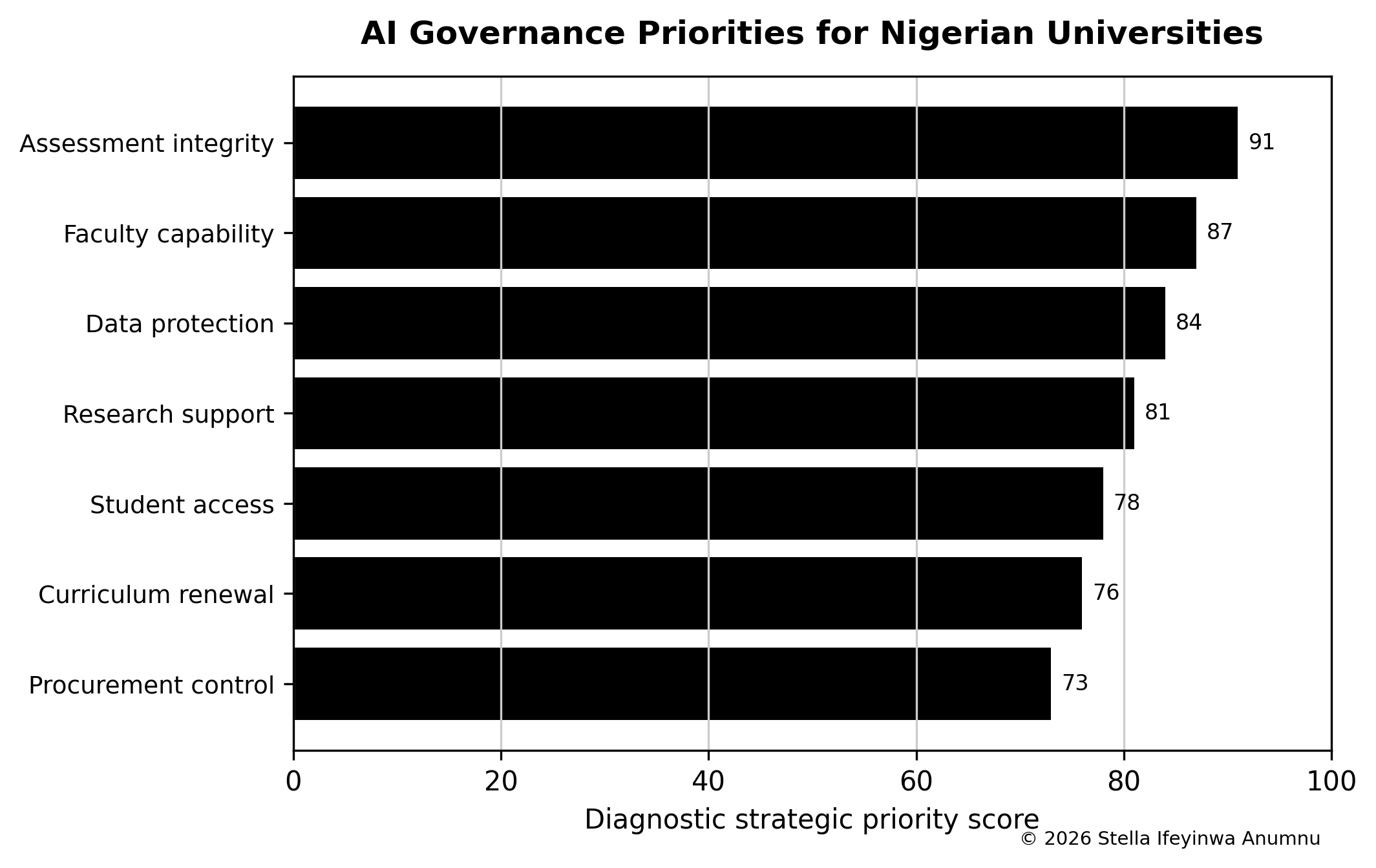
Figure 1. AI governance priorities for Nigerian universities.
Note. Diagnostic priority scores are author-created planning scores on a 0-100 scale. They synthesize the governance concerns raised by Nigerian policy sources, data-protection law, UNESCO guidance, NIST risk-management guidance, ISO/IEC 42001, and the institutional cases reviewed in this paper. They are not official national survey results.
1.3 Aim, questions, and contribution
The aim of this research publication is to develop a doctoral-level strategic governance framework for AI adoption in Nigerian higher education. The framework is designed for university leadership, faculty boards, quality assurance units, regulators, ICT teams, research committees, student affairs offices, and policy partners. It does not offer a technical manual for AI engineering. It offers a management and academic governance model that can help institutions make better decisions before informal practice hardens into unmanaged habit.
The study asks five questions. How should Nigerian universities define responsible AI use in teaching, assessment, research, and administration? What do current Nigerian case studies reveal about readiness, risk, and institutional opportunity? How can AI support academic quality without weakening integrity and independent judgment? What safeguards are needed for data protection, procurement, equity, and research ethics? How can readiness be assessed through a simple model that is useful to managers without pretending to replace professional judgment?
The contribution is practical as well as scholarly. The paper gives Nigerian higher education leaders a language for moving beyond tool excitement. It connects AI strategy to faculty workload, student access, curriculum reform, research credibility, data protection, and institutional trust. It also develops a stratified readiness model that can be debated, revised, and applied locally. The model is deliberately transparent because universities should be able to see how governance judgments are made. A black-box score for AI readiness would contradict the very values this paper defends.
1.4 Method, scope, and evidence discipline
The method of this publication is documentary, interpretive, and applied. It does not pretend that public documents can answer every question about university practice. They cannot. A policy text may state ambition, a platform may show institutional direction, and an international framework may clarify risk, but none of those sources can prove what happens in every classroom, laboratory, examination office, or postgraduate seminar. The value of documentary research lies in disciplined reading: identifying what the public record establishes, what it suggests, and where it stops.
For that reason, the paper uses Nigerian public cases as governance evidence rather than implementation proof. The National AI Strategy is evidence of national direction. The National Digital Learning Policy is evidence of official education-sector framing. CCMAS is evidence of curriculum reform space. JAMB CAPS is evidence that high-stakes tertiary decisions already depend on centralized data systems. NOUN is evidence of long-standing open and distance learning experience. TERAS is evidence of a tertiary services platform that may influence research administration and institutional coordination. 3MTT is evidence of a national digital skills agenda. Each source matters, but each must be read within its limits.
This evidence discipline also explains the treatment of figures in the paper. The charts are not borrowed from national datasets and should not be cited as official measurements. They are diagnostic planning visuals produced from the documentary analysis and the governance model developed here. Their purpose is to make institutional questions visible. A university that applies the model should replace the diagnostic scores with its own evidence: policy records, course redesign samples, student access data, ethics forms, tool registers, vendor contracts, complaints, and annual quality assurance reports.
The paper is therefore strongest when read as a practical governance study. It offers university leaders a way to think, not a claim that one formula can govern every institution. Nigerian higher education is too diverse for that. Federal, state, private, open, faith-based, specialized, and professional institutions face different constraints. The common requirement is not uniformity. The common requirement is responsibility.
1.5 What publication-ready governance requires
Publication-ready governance requires the paper to state its limits as clearly as it states its argument. The analysis can show why AI governance is urgent, how Nigerian public cases frame the issue, and what universities should build in response. It cannot claim that every university has implemented these safeguards. It cannot claim that one diagnostic score captures the full complexity of institutional life. It cannot replace legal advice, accreditation review, or institutional evidence. This restraint is not weakness. It is the difference between serious research and confident speculation.
The central question is practical: how can a university adopt AI without lowering the standard of the degree, exposing student data, widening inequality, weakening research integrity, or surrendering academic judgment to platforms? Every chapter returns to that question from a different angle. The answer is cumulative. It requires policy, but not policy alone; faculty development, but not workshops alone; assessment redesign, but not suspicion alone; data protection, but not legal language alone; and innovation, but not publicity alone.
Read also: Philosophy, Learning, and National Renewal: A Paradigm Shift for Nigerian Education
Chapter 2: Nigeria’s Higher Education Setting and the Readiness Gap
2.1 Expansion, pressure, and uneven capacity
Nigeria’s higher education system carries the weight of national aspiration. Demand for university places remains high, while public resources, staff strength, laboratories, libraries, accommodation, connectivity, and research funding remain uneven across institutions. The pressures are familiar to lecturers and students: large classes, delayed feedback, examination congestion, weak laboratory access, poor bandwidth, inconsistent electricity, administrative bottlenecks, and research supervision loads that stretch academic patience. AI does not remove these pressures. It enters them.
That entry matters because AI tools tend to magnify the condition into which they are introduced. Where a university has clear academic rules, trained staff, reliable data governance, and a serious culture of feedback, AI can strengthen existing capacity. Where a university has weak oversight, low trust, and poor access, AI can make the gap wider. Some students will use paid tools and private devices while others struggle with data bundles. Some lecturers will redesign assignments while others will continue with old questions that are easy to outsource to a machine. Some faculties will learn quickly; others will wait for national instruction.
Strategic planning must begin with that unevenness. Nigerian universities should not adopt AI as if all institutions start from the same place. A federal university with stronger ICT support, a private university with smaller classes, an open university with online systems, and a state university with severe funding constraints face different choices. A national framework can set principles, but local implementation has to begin with an honest inventory. What tools are already being used? Which students lack access? Which departments are most exposed to academic-integrity problems? Which data systems are already automated? What faculty development has occurred? Without these answers, AI policy becomes ceremonial.
The readiness gap is not an argument against AI. It is an argument against careless adoption. In a country with serious development needs, universities cannot afford to ignore a technology that may improve teaching support, research discovery, administrative planning, and workforce preparation. They also cannot afford to adopt it in a way that rewards privilege, weakens standards, and creates legal exposure.
2.2 Digital inequality as a core academic issue
Digital inequality is often discussed as infrastructure, but inside a university it becomes an academic matter. A student with a laptop, steady power, private study space, and reliable internet is not experiencing the same learning conditions as a student using a shared phone, unstable electricity, and expensive mobile data. When AI tools are added to learning, the difference becomes sharper. The better-equipped student can test explanations, receive instant feedback, improve drafts, translate materials, and practice questions. The poorly connected student may be left with policy language about innovation and no practical access to it.
DataReportal’s 2025 estimate that Nigeria had 107 million internet users at the start of 2025, representing 45.4 percent penetration, shows both scale and limitation (DataReportal, 2025). The country has a large online population, but access is not universal. Penetration figures also do not tell the whole story. A learner may be counted within internet reach and still lack stable bandwidth for sustained academic use. Connectivity may exist but be too expensive. A device may be available but not suitable for research writing, coding, statistical analysis, design work, or long reading. The university that treats connection as a yes-or-no question will misread student reality.
A publication-ready AI strategy in Nigerian higher education must therefore include access design. The minimum package should include campus learning hubs, device-support schemes, low-bandwidth materials, offline resources where possible, library-led digital literacy, assistive technologies, and clear alternatives when AI use is assigned. Faculty should be warned against requiring paid tools unless the institution provides access. Departments should not make AI use a hidden requirement through assignments that assume unrestricted digital access. Equity must be built into course design, not added after complaints.
This is not charity. It is quality assurance. If access differs sharply, assessment outcomes will no longer measure learning alone. They will measure private access to tools. A university that ignores this will lose the moral basis for its own grading system.
2.3 Curriculum reform and professional relevance
The NUC’s CCMAS reform is relevant because AI will not remain inside computer science departments (National Universities Commission, 2023, 2024). It affects education, medicine, law, management, engineering, communication, agriculture, public administration, environmental studies, and the arts. Every discipline will need to ask what its graduates should know about AI, data, evidence, ethics, and professional judgment. A lawyer who cannot understand AI-generated evidence will be less prepared for practice. A teacher who cannot guide learners through AI-supported study will be less effective. A journalist who cannot verify synthetic media will be exposed. A nurse manager who cannot read AI-supported risk data will be disadvantaged.
CCMAS provides an opening for universities to use the thirty percent institutional discretion in ways that reflect local mission and new knowledge. That space should not be filled casually. Institutions can design AI literacy modules, discipline-specific AI ethics, data reasoning, prompt critique, human-machine decision limits, digital research methods, and capstone projects linked to Nigerian problems. The aim is not to make every student a programmer. The aim is to prepare graduates who can use AI critically within their professional fields.
Professional bodies should be involved. AI competence in accounting differs from AI competence in medicine, journalism, engineering, education, or law. Universities that design AI curriculum without consultation may produce generic modules that satisfy a committee but fail in practice. The better approach is layered: a university-wide foundation in AI literacy and ethics, faculty-level modules for discipline-specific use, and program-level assessment that requires students to show judgment, not only tool familiarity.
Nigerian higher education has a chance to avoid a common error: teaching students how to use tools before teaching them how to question outputs. AI literacy without epistemic discipline is dangerous. Graduates must know how to ask where an answer came from, what source supports it, what bias may be present, what data was used, what uncertainty remains, and when human expertise must override machine suggestion.
2.4 Readiness audit before procurement
A Nigerian university that wants to use AI seriously should complete a readiness audit before procurement begins. The audit should be plain enough for deans, heads of department, librarians, ICT officers, and student representatives to understand. It should ask what digital systems already exist, what data they hold, what courses already permit informal AI use, what lecturers need for assessment redesign, which students lack reliable devices, and which offices have authority to approve tools. This is not a bureaucratic exercise. It is the moment when an institution discovers whether AI adoption will strengthen academic work or simply add another unmanaged layer to an already stretched system.
The audit should also separate infrastructure readiness from academic readiness. A campus may have a learning management system and still lack a culture of feedback. It may have computer laboratories and still lack meaningful student access after lectures. It may have an ICT directorate and still have no data-protection review of vendor platforms. Academic readiness means that lecturers know how to teach with AI without surrendering teaching, students know what they may disclose, ethics committees can review AI-assisted research, and examination boards can evaluate whether assessment still proves learning. Technology readiness without these academic controls is not readiness; it is exposure.
A strong readiness audit produces a small number of visible decisions. The university may decide that no high-stakes grading tool will be deployed in the first year. It may approve AI for formative feedback but not for final marks. It may require each faculty to identify three assessment types that need redesign. It may discover that student access hubs are more urgent than a campus-wide chatbot. These decisions are valuable because they reduce waste. In a resource-constrained environment, the best AI strategy may begin by declining the wrong tools.
2.5 Access as a condition of academic fairness
Access must be treated as part of academic fairness, not as a welfare issue outside the classroom. When one group of students can use paid AI tools, stable internet, private devices, and constant electricity while another group works from a shared phone, the assessment environment is no longer equal. The problem is not solved by telling students to be innovative. A university that assigns AI-supported work has a duty to provide realistic access, publish alternatives, or design tasks that do not punish students for poverty. In Nigerian higher education, this point is central because digital inequality can easily be mistaken for student weakness.
A practical equity policy should identify low-bandwidth options, campus access points, library support hours, disability accommodations, and acceptable no-AI alternatives. It should also warn lecturers against making paid tools a hidden requirement. If AI use is optional, the alternative should carry equal academic value. If AI use is required, the institution should provide access. The rule is simple but demanding: innovation cannot be used to transfer institutional cost to students who are least able to bear it.
Chapter 3: Governance, Law, Ethics, and Institutional Authority
3.1 Why AI governance belongs inside university management
AI governance in a university should not be left to the ICT unit alone. ICT staff are essential, but the deepest questions are academic, legal, ethical, and managerial. Who is allowed to use AI in grading? How should students disclose assistance? What data may be entered into external tools? Can an AI system support admissions or advising? What counts as misconduct? What role should libraries play in source verification? Which office reviews vendor contracts? Who reports failures to the senate or governing council? These questions cross the institution.
A credible governance structure should include academic leadership, legal counsel or compliance officers, data protection personnel, ICT staff, librarians, research ethics representatives, student affairs, quality assurance, disability support, and faculty representatives. The structure must have authority, not only advisory language. It should approve institutional policy, maintain a tool register, review high-risk deployments, set disclosure expectations, coordinate training, and report annually on implementation. In larger universities, each faculty can adapt the university policy to local discipline needs, but the core principles should remain common.
The governance rule should be plain: no AI system should make or materially influence a high-stakes academic decision without human accountability and documented review. Admissions, grades, disciplinary action, research conclusions, scholarship awards, academic probation, and student-support interventions carry consequences for real lives. AI may support decision-making, but it should not become an invisible authority. Students and staff should know when AI is used and how to challenge or correct errors.
This is where strategic management meets ethics. Good governance does not slow adoption for its own sake. It prevents confusion from becoming scandal. It gives innovation a safe route. It protects the institution’s reputation and, more importantly, the people whose data, learning, and futures are affected.
Table 2. AI governance responsibilities by institutional level.
| Level | Primary responsibility | Evidence of performance |
| Governing council | Approve risk appetite, demand annual AI governance reporting, protect institutional independence. | Annual report, approved policy, reviewed risk register. |
| Senate | Set academic policy for assessment, curriculum, research integrity, and student disclosure. | Approved academic rules and faculty implementation reports. |
| Faculty boards | Adapt policy to disciplines and supervise assessment redesign. | Revised syllabi, assessment samples, staff training records. |
| ICT directorate | Maintain tool inventory, security controls, integration standards, and approved-tool list. | Tool register, access logs, incident reports. |
| Library | Lead information literacy, source verification, citation integrity, and AI research support. | Training records, verification guides, research clinics. |
| Research ethics committee | Review AI-assisted research methods, sensitive data use, and disclosure. | Ethics addendum, approved protocols, compliance checks. |
| Student affairs | Monitor student access, disability support, advising risks, and complaint channels. | Access reports, advising records, complaints resolved. |
3.2 Data protection and student dignity
The Nigeria Data Protection Act of 2023 gives AI adoption in higher education a legal seriousness that many institutions still underestimate (Federal Republic of Nigeria, 2023). Universities process personal data at scale: admission records, grades, financial information, health disclosures, disciplinary files, biometric data, learning analytics, library use, accommodation records, and sometimes disability or counseling information. AI systems can make those data more useful, but they can also make exposure more damaging. A university that uploads sensitive student information into a poorly governed vendor tool may create risk that is larger than the immediate academic benefit.
Data protection should begin with purpose. What data is needed? Why is it needed? How long will it be kept? Who will access it? Will it leave Nigeria? Will the vendor use it to train models? Can students opt out? What happens if the system produces a wrong recommendation? These questions are not technical irritation. They are the minimum discipline of lawful and respectful administration. A university exists to form human beings, not to convert them into profiles without explanation.
Learning analytics deserves special caution. It can identify students who need support. It can also label students unfairly. A student who misses platform activity may be struggling with connectivity, work obligations, illness, caregiving, insecurity, or disability. If an AI system treats inactivity as laziness or risk without human context, it will harm the student it claims to help. Human advising must remain central. The system can flag concern; it should not close the file.
Student dignity should be the test. Data practices that a university would be ashamed to explain publicly should not be normalized privately. Consent notices should be clear. Data access should be limited. Vendor contracts should be reviewed. Sensitive data should not be placed in public tools. Breach response should be planned before a breach occurs.
3.3 Ethical use, transparency, and academic agency
UNESCO’s guidance on generative AI in education and research emphasizes human agency, privacy, equity, and appropriate regulation (UNESCO, 2023). Those principles are useful for Nigerian universities because they help move the debate away from tool fascination. AI can assist learning, but it cannot carry the moral responsibility of education. A lecturer remains responsible for what is taught. A supervisor remains responsible for research standards. A student remains responsible for submitted work. A university remains responsible for the systems it authorizes.
Transparency is therefore necessary. Syllabi should state how AI may be used. Research theses should include AI-use statements where tools assisted drafting, translation, transcription, coding, image generation, or data analysis. Administrative units should disclose when AI supports decisions that affect students. Faculty should not hide AI use from students while demanding disclosure from them. Institutional integrity requires a shared standard.
Academic agency also means that the university should teach students to use AI critically. Banning does not teach judgment. Unrestricted permission does not teach judgment either. Students should be required to compare AI outputs with primary sources, identify hallucinated citations, explain why they accepted or rejected a suggestion, and defend their own reasoning orally or in writing. The ability to challenge a machine answer may become one of the central literacies of higher education.
The ethical frame is not anti-technology. It is pro-education. A university that cannot explain how AI supports its educational purpose should not deploy it simply because other institutions are doing so.
3.4 Governance architecture for lawful academic AI
University AI governance needs a structure that is visible and answerable. The governing council should approve risk appetite and demand annual reporting. The senate should own academic rules. Faculties should adapt those rules to disciplines. ICT should maintain security and tool inventories. The data-protection officer or equivalent compliance function should review personal-data risks. Procurement should examine contract terms before academic units become dependent on a vendor. Research ethics committees should review AI-assisted methods where participants, sensitive records, or automated interpretation are involved. None of these offices can manage the issue alone.
The structure should also define escalation. A routine classroom tool may need departmental approval. A research tool processing anonymized text may need ethics notification. A tool handling student records, admissions analytics, grading support, disability data, or disciplinary evidence should require higher review. The risk level should determine the approval route. This type of architecture is consistent with risk-management thinking in NIST guidance and with the management-system discipline reflected in ISO/IEC 42001, although Nigerian universities must translate those frameworks into their own legal and academic setting (National Institute of Standards and Technology, 2023, 2024; International Organization for Standardization, 2023).
The most important governance habit is documentation. If a tool is approved, the reason should be recorded. If a tool is rejected, the risk should be recorded. If a pilot fails, the lesson should be recorded. Records protect the university from repeating old mistakes and from relying on memory when officers change. They also protect innovators, because a documented approval process gives staff a lawful route for experimentation rather than forcing them into private trial and error.
3.5 Procurement discipline and institutional independence
Procurement is now part of academic governance. A vendor that handles learning analytics, proctoring, writing support, admissions communication, or research data is not only selling software. It is touching the academic life of the institution. Contracts should therefore answer questions that matter to universities: whether student data will be used for model training, where records will be stored, how long data will be retained, whether the university can export its records, how errors can be corrected, what happens after termination, and whether the tool can function under local bandwidth constraints.
Institutional independence is also at stake. When a platform quietly shapes feedback, assessment, curriculum resources, and student support, the vendor begins to influence academic judgment. That influence may be useful when governed, but it is dangerous when hidden. The university should remain the authority over curriculum, standards, degrees, and student rights. Technology partners may support that authority; they should not replace it.
3.6 Data protection by design in academic systems
Data protection by design means that privacy is considered before a tool is adopted, not after a complaint. Universities should classify the data they hold, identify sensitive categories, limit access, document lawful purpose, and prevent staff from entering confidential information into public systems. Student records, disability accommodations, counseling notes, disciplinary files, health disclosures, biometric records, and unpublished research data require stronger protection than ordinary course announcements. This hierarchy should be understood by academic staff, not only by ICT officers.
The safest practice is to write simple internal rules that staff can actually follow. A lecturer should know that identifiable student submissions should not be uploaded to an external AI tool unless the institution has approved that use. A supervisor should know that interview transcripts require ethics and data review before automated coding. An administrator should know that advising analytics cannot be used to label students without human explanation. Data-protection training should therefore be practical, local, and repeated. Legal language alone will not change behavior.
Universities should also plan for correction and breach response. If an AI-supported system produces an inaccurate recommendation, the student or staff member should know how to challenge it. If a vendor exposes data, the institution should know who investigates, who communicates, and what records are preserved. A breach plan written after a breach is already too late. In academic settings, privacy failures are not only legal incidents. They are failures of institutional care.
Chapter 4: Teaching, Learning, and Assessment in an AI-Saturated Classroom
4.1 Teaching with AI without surrendering teaching
AI can assist teaching in practical ways. It can generate examples at different levels of difficulty, suggest formative questions, translate concepts into simpler language, create practice quizzes, support accessibility, summarize long readings, and help lecturers design activities for large classes. In Nigerian universities where class sizes and workload can be heavy, these uses deserve attention. They may help lecturers spend more time on explanation, discussion, supervision, and feedback rather than routine preparation. The problem begins when assistance becomes substitution.
Teaching is not content delivery alone. It is the formation of judgment, discipline, patience, and intellectual responsibility. A lecturer who copies AI-generated notes without checking them is not teaching well. A department that replaces office hours with chatbot responses has misunderstood student support. A faculty that treats AI-generated slides as curriculum renewal has confused output with learning. Good teaching in the AI period should become more deliberate, not less. Lecturers should ask what learners must struggle through themselves, what can be supported by tools, and how understanding will be tested.
Faculty development is the hinge. Many lecturers are not opposed to AI; they are underprepared and overloaded. They need practical workshops inside their disciplines, not generic demonstrations. An education lecturer needs to know how AI changes lesson planning and assessment. A law lecturer needs to handle source authority and legal reasoning. A medical lecturer needs to address patient safety and unreliable outputs. A management lecturer needs to teach data interpretation and ethical decision-making. A one-size training program will produce shallow compliance.
The library should be placed at the center of teaching support. Librarians understand source quality, search behavior, citation practice, and information literacy. In the AI period, libraries can teach students how to verify claims, trace evidence, identify fabricated sources, and use databases responsibly. This is an academic function, not a support afterthought.
4.2 Assessment redesign after generative AI
Assessment is the place where AI forces universities to be honest. Many traditional assignments can now be completed with extensive machine assistance. That does not mean essays, take-home tasks, problem sets, and projects are useless. It means their design must change. An assignment that asks for a generic explanation of a common topic may test access to a chatbot more than understanding. An assignment that requires local data, field observation, oral defense, draft history, source tables, reflective commentary, or application to a specific Nigerian problem is harder to outsource without learning.
Detection tools cannot carry the burden. They may produce false positives, especially against students who write in a second language or use translation support. They may also miss sophisticated AI-assisted work. A university that relies on detection alone will punish some students unfairly and give others false confidence. Assessment integrity should be built before submission. Students need clear rules. Lecturers need better prompts. Departments need oral defense, viva-style checks, in-class tasks, process evidence, and authentic projects where appropriate.
A practical assessment policy can divide tasks into categories. Some tasks may prohibit AI because the purpose is independent performance. Some may allow limited AI for brainstorming or language support with disclosure. Some may require AI use for critique, where students compare machine output with scholarly sources. Some may use AI as a professional simulation, especially in fields where graduates will encounter such tools at work. The important point is that the rule should match the learning outcome.
Nigerian universities should also protect students from confusion. The rules should not change quietly from lecturer to lecturer without explanation. Course guides should state permitted and prohibited uses. Departments should provide examples. Academic misconduct procedures should distinguish ignorance, poor disclosure, fabrication, and deliberate fraud. The aim is not to trap students. It is to teach responsible practice.
Table 4. Assessment redesign options for the AI period.
| Assessment problem | Better design response | Integrity safeguard |
| Generic essay easily generated by AI | Use local case application, source table, draft history, and oral explanation. | Student defends method and evidence. |
| Undisclosed AI editing | Permit language support with disclosure and evidence of student revision. | Clear distinction between editing and authorship. |
| Large classes and delayed feedback | Use AI-assisted formative feedback under lecturer review. | Final grading remains human-controlled. |
| Weak literature review | Require annotated bibliography from real databases and verification of citations. | Fabricated references trigger review. |
| Coding or quantitative tasks | Require explanation of steps, version history, and in-class problem variation. | Student proves process knowledge. |
| Postgraduate proposal drafting | Require research memo, supervisor discussion, and AI-use statement. | Supervisor checks reasoning, not polish alone. |
4.3 Student support, language, and inclusion
AI has real promise for student support. It can help learners practice writing, translate difficult material, generate study plans, explain mathematical steps, provide feedback on drafts, and support students who are shy about asking questions in crowded classrooms. For learners from weak secondary-school backgrounds, this may be valuable. For students with disabilities, language barriers, work obligations, or distance-learning constraints, AI may provide flexible assistance. That promise should not be dismissed because some students misuse the tools.
The problem is that support can become dependency. Students may begin to accept machine explanations without checking them. They may lose confidence in their own reading. They may submit polished work they cannot defend. They may learn prompt habits without acquiring disciplinary knowledge. The university should therefore teach students how to use AI as a tutor, not as a ghostwriter. The student should ask for explanation, examples, feedback, and challenge, but must still read, evaluate, revise, and own the final work.
Language support deserves careful handling. Many Nigerian students write in English while thinking through multiple languages and educational backgrounds. AI can improve expression, but it can also mask weak understanding. Lecturers should separate language correction from intellectual authorship. A student may be allowed to use AI to improve grammar if the student discloses use and can explain the argument. What should remain prohibited is the undisclosed generation of reasoning, evidence, or analysis that the student cannot defend.
Inclusion also means designing for low-resource use. If a course requires AI, the institution should provide access. If access cannot be provided, AI use should remain optional or alternative tasks should be available. Equity is not a decorative word. It is the condition under which academic standards remain fair.
4.4 Student authorship and the new discipline of proof
The AI period changes what it means for a student to prove authorship. Before generative systems became common, a polished essay could still be weak, but it usually signaled some level of reading, drafting, and revision. That assumption is no longer safe. A student may now submit work that is fluent, structured, and empty of genuine understanding. The answer is not to distrust every student. It is to ask for forms of proof that show thinking: source logs, draft trails, local examples, short oral explanations, annotated bibliographies, calculation steps, design notes, and reflective statements on tool use.
This discipline of proof should be taught early. First-year students should not discover AI rules only when accused of misconduct. They should learn how to use tools for explanation and practice, how to reject false information, how to cite real sources, how to disclose language assistance, and how to defend their own reasoning. The university should make academic integrity educational before it becomes disciplinary. That approach is fairer to students and stronger for standards.
Language support needs particular care. Many Nigerian students write in English while carrying different language histories and uneven secondary-school preparation. AI editing can help a student express a real idea more clearly. It can also replace the idea. The line between assistance and authorship should be explained through examples rather than slogans. A student may use a tool to correct grammar if the intellectual content remains theirs and disclosure is made where required. A student may not submit machine-generated argument, invented evidence, or analysis that cannot be defended. This is a higher standard than a simple ban, and it is more useful because it trains judgment.
4.5 Teaching large classes without reducing education to automation
Large classes make AI attractive because lecturers need faster ways to give feedback and manage learning. The attraction is legitimate. Formative quizzes, draft comments, reading prompts, and practice exercises can help students who would otherwise receive little individual attention. The safeguard is that automated support should not become the course itself. A lecturer still has to decide which concepts matter, which misconceptions are common, which local examples make sense, and which forms of feedback will move students forward.
Departments should therefore identify low-risk teaching uses first. A tool that helps generate practice questions may be easier to govern than a tool that recommends grades. A tool that helps students rehearse concepts may be safer than one that interprets disciplinary performance. Starting with lower-risk support allows staff to learn without placing degrees, records, or student futures under immature systems. This is the kind of modesty that serious reform often needs.
4.6 Moderation, feedback evidence, and examiner judgment
Assessment moderation becomes more important when AI assistance is uneven. Departments should compare samples across lecturers, check whether AI rules were stated clearly, and ask whether students were required to show process evidence. Moderation should include the assignment brief, marking rubric, source requirements, student disclosure statements, and any oral or in-class verification. This wider view is necessary because a polished submission no longer tells the examiner enough about how the work was produced.
Feedback evidence should also be reviewed. If AI-assisted formative feedback is used, the department should ask whether students received more useful comments, whether weak students improved, whether lecturers saved time, and whether final grading remained under human control. The evidence may show that a tool is useful for first drafts but weak for disciplinary critique. It may show that students need more instruction before automated comments help them. Such findings should shape policy. Good governance is not a one-time approval; it is a cycle of use, evidence, correction, and review.
Examiner judgment remains central. AI may support marking preparation, rubric design, or formative comments, but final academic judgment should belong to qualified staff. A degree is a public certification of learning. The public should be able to trust that human academics, not unseen systems, have judged whether the learner met the standard.
Chapter 5: Research Renewal, Postgraduate Supervision, and Knowledge Production
5.1 AI and the Nigerian research problem
Nigerian universities need stronger research capacity. Many scholars work with limited funding, restricted database access, heavy teaching loads, weak laboratory support, and uneven mentoring structures. Postgraduate students often struggle with topic clarity, literature review, methodology, data analysis, and publication writing. AI may help some of these problems, but it cannot repair the research culture by itself. Used well, it can reduce clerical burden and widen discovery. Used poorly, it can produce elegant nonsense.
The first responsible use is discovery support. AI tools can help researchers map concepts, identify related fields, draft search terms, summarize abstracts, translate material, and organize notes. These uses can be legitimate when researchers check outputs against actual sources. The danger is citation fabrication. A researcher who copies a plausible but nonexistent reference has not made a minor error; the researcher has broken the chain of evidence. Doctoral and master’s programs should teach AI-assisted literature review as a supervised skill, not leave it to informal experimentation.
AI can also support qualitative and quantitative analysis. It may help with transcription, coding suggestions, text classification, data cleaning, visualization, and statistical explanation. Each use needs method transparency. Researchers should disclose the tool, purpose, version where relevant, prompts or procedures when appropriate, validation steps, and human review. If AI assists coding interview data, the researcher must check the coding manually and explain reliability. If AI assists statistical interpretation, the researcher must verify the analysis. The machine cannot become a hidden method.
The Nigerian research opportunity is to use AI for problems that matter locally: agriculture, health systems, education quality, language technologies, public administration, climate adaptation, security studies, small business productivity, urban planning, and cultural preservation. Strategic higher education should not prepare universities to consume foreign tools only. It should position them to ask Nigerian research questions with better speed, evidence, and collaboration.
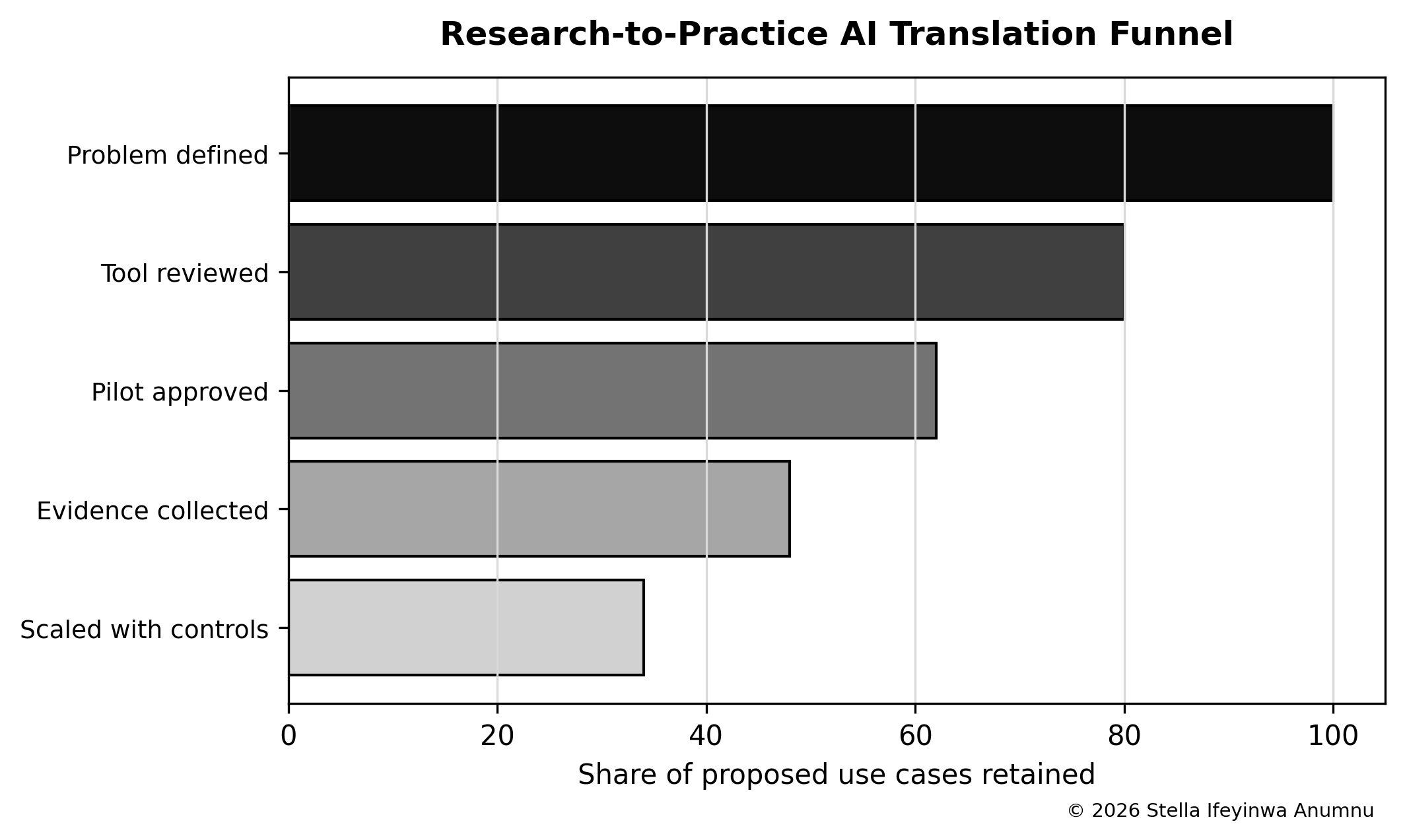
Figure 6. Research-to-practice AI translation funnel.
Note. The funnel illustrates a responsible sequence from problem definition to controlled scaling. The retained percentages are diagnostic planning values, not empirical measurements of Nigerian university projects.
5.2 Postgraduate supervision and research integrity
Postgraduate supervision may be one of the most affected areas. A student can now produce a proposal outline, literature summary, questionnaire draft, analysis plan, and polished chapter with AI assistance. Some of that assistance may be useful. Some may conceal weakness. Supervisors need new routines. They should ask students to bring reading logs, source tables, draft histories, methodological memos, and short oral explanations. A thesis should not be judged only by how polished the chapter looks. It should be judged by whether the candidate can defend the intellectual decisions behind it.
Universities should update research ethics forms. If a student uses AI for transcription, translation, coding, image generation, data synthesis, or literature mapping, the ethics committee should know. If sensitive data will be entered into any tool, the committee should examine privacy, consent, storage, vendor access, and anonymization. Researchers should be warned against placing interview transcripts, medical information, student records, or confidential institutional documents into public AI systems. Convenience cannot override participant protection.
Supervisors also need protection from overload. AI creates more work if handled properly, because supervisors must now check not only content but process. Institutions can help by creating standard disclosure templates, research-integrity workshops, AI-use statements for theses, and library support for source verification. Postgraduate schools should set university-wide expectations so that individual supervisors are not left to invent rules alone.
The integrity standard should remain simple: AI may assist, but the researcher remains responsible. The researcher must know the sources, understand the method, interpret the evidence, and defend the conclusion. A thesis that cannot survive oral questioning has not gained quality because it reads well.
Table 5. Research integrity and ethics safeguards for AI-assisted work.
| Research activity | Risk | Safeguard |
| Literature mapping | Invented or weak sources | Database verification and source table. |
| Transcription | Confidential data exposure | Approved secure tool and participant consent review. |
| Qualitative coding | Unvalidated categories | Human coding check and reliability explanation. |
| Statistical interpretation | Misleading explanation | Method review by supervisor or statistician. |
| Image or media generation | Misrepresentation | Label synthetic content and justify use. |
| Manuscript editing | Hidden authorship or false claims | AI-use disclosure and human responsibility statement. |
5.3 Publication, authorship, and institutional reputation
AI also affects publication pressure. Nigerian academics often work under requirements for promotion, accreditation, grant competition, and institutional ranking. AI can help with language editing, formatting, abstract drafting, and journal selection. These uses may support scholars who have strong research but need writing assistance. The risk is that AI can also flood the system with low-quality manuscripts, fabricated references, duplicated analysis, and paper-mill behavior. Universities need research offices that understand this risk.
Authorship must remain human and accountable. AI tools should not be listed as authors because they cannot take responsibility for accuracy, ethics, conflict of interest, or correction. Researchers should disclose substantial AI assistance according to journal requirements. Departments should train staff and students to recognize predatory journals, fake peer review, fabricated metrics, and AI-generated citations. The problem is not new, but AI makes it easier to scale bad practice.
Institutional reputation is at stake. One poorly checked AI-assisted publication may embarrass an author. A pattern of weak research can damage a faculty, a postgraduate school, and a university. Quality assurance units should therefore include research-integrity indicators in AI strategy. How many theses include AI-use disclosures? How many supervisors have been trained? How many research ethics committees can review AI-assisted methods? How many retractions or corrections involve fabricated sources? These are uncomfortable questions, but serious institutions ask them before outsiders do.
The purpose is not to frighten scholars away from useful tools. The purpose is to make the use of tools visible, disciplined, and tied to research quality.
5.4 Building a Nigerian evidence agenda
Nigeria should not build AI policy for universities only from imported evidence. Studies from North America, Europe, and Asia are useful, but they cannot fully explain Nigerian classrooms, power supply, mobile-data costs, multilingual learning, strike disruptions, postgraduate supervision pressures, or the specific ways students share tools informally. A serious research agenda should examine how Nigerian undergraduates, postgraduates, lecturers, librarians, administrators, and quality assurance officers actually use AI. It should ask which tools improve understanding, which tools encourage shortcutting, where access is unequal, and how disclosure rules are interpreted across disciplines.
The first empirical need is student-use evidence. A national survey would be useful, but it should be paired with interviews and course-level studies because students may underreport practices that feel risky. Researchers should distinguish between AI used for explanation, translation, editing, coding help, literature mapping, and ghostwriting. Those categories have different academic meanings. A paper that treats all AI use as cheating will misread reality. A paper that treats all AI use as innovation will do the same.
The second need is faculty readiness evidence. Nigerian lecturers need to be asked what they know, what they fear, what they have already tried, what assessment formats have failed, and what institutional support would matter. Faculty surveys should not be designed to shame staff for caution. Caution may reflect professional judgment. The question is how to move from private uncertainty to shared academic practice.
The third need is evaluation of pilots. If a university introduces AI-supported feedback, tutoring, advising, library search, or research administration, it should collect evidence before scaling. Did students learn more? Did weaker students benefit or fall behind? Did lecturers save time or spend more time correcting poor outputs? Did complaints increase? Did data-protection risks appear? Pilot evaluation should become normal, not exceptional. The strongest institutions will not be those that announce the most tools; they will be those that can show what worked, what failed, and what changed as a result.
Table 10. Future empirical evidence agenda for Nigerian AI governance.
| Research area | Why it matters | Suggested evidence |
| Student AI use | Shows real practice across disciplines and access groups | Survey, interviews, assignment analysis |
| Faculty readiness | Identifies training needs and assessment concerns | Faculty survey and course-redesign audit |
| Assessment redesign | Tests whether learning is better protected | Comparative task review and viva performance |
| Digital equity | Reveals who benefits or loses from AI-supported work | Device, bandwidth, disability, and cost audit |
| Research integrity | Tracks AI disclosure and source reliability | Thesis review, ethics forms, citation checks |
| Vendor governance | Tests whether procurement protects academic autonomy | Contract audit and incident review |
| Student support analytics | Evaluates whether risk flags help or harm students | Advising outcomes and complaint records |
5.5 Authorship, publication pressure, and postgraduate formation
Postgraduate formation is more than the completion of chapters. It is the slow development of a scholar who can identify a problem, read critically, choose a method, handle evidence, and defend a conclusion. AI can support parts of that work, but it can also create an illusion of maturity. A chapter may read smoothly while the candidate has not understood the debate. A literature review may appear broad while key sources were never read. A methodology section may sound technical while the design is weak. Supervisors should therefore move attention from polish to process.
The practical response is not complicated. Postgraduate schools can require source tables, reading memos, AI-use statements, draft histories, and periodic oral explanation. Supervisors can ask candidates to defend why a source belongs, why a method fits the question, and why an AI suggestion was accepted or rejected. Such routines are not punishment. They are research training. They remind candidates that a thesis is not a document produced for approval; it is evidence of intellectual authority.
Chapter 6: Nigerian Public Case Studies
6.1 National AI Strategy and the education mandate
Nigeria’s National Artificial Intelligence Strategy gives the higher education sector a national policy signal (Federal Ministry of Communications, Innovation and Digital Economy & National Information Technology Development Agency, 2025). The strategy positions AI as a tool for economic growth, productivity, inclusion, innovation, and local capability. For universities, that means AI cannot be treated as an optional departmental interest. It now belongs within national skills formation, research development, and institutional competitiveness. The case also warns universities not to remain consumers of imported systems while other countries build expertise, data infrastructure, and governance capacity.
The management lesson is straightforward. A university AI plan should align with national AI ambitions while preserving academic autonomy. Alignment does not mean repeating government language in a strategic plan. It means identifying what the institution can contribute: teacher preparation, AI ethics, local language research, data science, responsible innovation, public-sector training, startup incubation, or discipline-specific AI applications. A university that cannot name its contribution is not strategically positioned.
The National AI Strategy also raises a local-content question. Nigerian universities should not train students only to use global platforms. They should help develop datasets, evaluation methods, and applications relevant to Nigerian needs. Health, agriculture, traffic, financial inclusion, public records, education assessment, and language technologies require local knowledge. This is where doctoral education matters. Postgraduate research can turn national policy into tested knowledge if universities provide supervision, ethics, and partnership support.
6.2 National Digital Learning Policy, NOUN, and flexible learning
The National Digital Learning Policy places AI within a wider digital education agenda (Federal Ministry of Education, 2023). Its relevance lies in the fact that AI adoption cannot work if digital learning fundamentals remain weak. Content, platforms, safety, infrastructure, teacher capacity, and access devices are all part of the same readiness chain. A university cannot jump to sophisticated AI tutoring if students cannot consistently reach the learning platform. Nor can it claim digital maturity if lecturers are not supported to design online learning that is pedagogically sound.
The National Open University of Nigeria offers an important case because it has long carried the burden of flexible, distance, and technology-enabled learning (National Open University of Nigeria, n.d.). NOUN’s model shows that scale and access can be expanded through nontraditional delivery. It also reminds policymakers that access is not enough. Distance learners need feedback, advising, assessment integrity, platform reliability, library access, and student support. AI may improve these functions if it is used to assist human systems rather than replace them.
For conventional universities, the lesson from NOUN is not to copy its model mechanically. The lesson is to take flexible learning seriously. Many Nigerian students already live hybrid academic lives: they attend class, use WhatsApp groups, search YouTube explanations, consult AI tools, download PDFs, and learn from peers across campuses. Institutional strategy should bring this informal learning world under better academic guidance. AI can help, but only if universities design learning support that is reliable, inclusive, and examinable.
6.3 NUC CCMAS, JAMB CAPS, TETFund TERAS, and 3MTT
The NUC’s CCMAS reform provides a curriculum case (National Universities Commission, 2023, 2024). It creates a formal opening for program renewal and institution-specific innovation. AI strategy should use that opening to strengthen graduate capability across fields. This does not mean inserting a token AI course into every program. It means asking how each discipline should respond to AI: what tools graduates will encounter, what risks they must understand, what evidence standards they must protect, and what human judgment cannot be outsourced.
JAMB’s Central Admissions Processing System offers an administrative case (Joint Admissions and Matriculation Board, n.d.). CAPS was designed to automate and bring greater order to admissions processing. Its relevance to this study is not that CAPS is an AI system in the broad modern sense. Its relevance is that Nigerian tertiary education already relies on centralized data systems for high-stakes decisions. Any future AI-supported admission, advising, or placement tool must learn from that reality. Transparency, appeal, auditability, and fairness are not optional when data systems affect life chances.
TETFund’s TERAS platform offers a research and service case (Tertiary Education Trust Fund, n.d.). A centralized tertiary education, research, applications, and services hub can improve coordination, visibility, and access to institutional services. The AI opportunity here is not simply automation. It is better research administration, grant tracking, collaboration, repository discovery, and institutional memory. The risk is vendor dependence, weak data governance, and uneven institutional capacity to use the system meaningfully.
The 3 Million Technical Talent initiative, including DeepTech-oriented pathways, is a workforce case (3MTT, 2025). It signals that Nigeria wants a larger pool of technical talent. Universities should not compete with such initiatives as if skills programs and degrees are enemies. They should connect with them intelligently. Degree programs can provide theory, ethics, research depth, and professional formation; skills initiatives can provide pace, applied exposure, and industry connection. AI strategy in higher education should join these strengths where possible.
Table 1. Nigerian case-study evidence and strategic management lesson.
| Case | What it shows | Management lesson |
| National AI Strategy | National direction for responsible AI, local capability, skills, and innovation. | Universities should define their contribution to national AI capacity rather than wait for imported solutions. |
| National Digital Learning Policy | Digital learning, platforms, access, safety, and AI as connected education concerns. | AI adoption should be tied to digital learning fundamentals, not treated as a separate technology project. |
| NUC CCMAS | Curriculum reform and institution-specific innovation space within national standards. | AI literacy should enter disciplines through outcomes, assessment, and professional judgment. |
| JAMB CAPS | Centralized data-supported admissions processing in Nigerian tertiary education. | High-stakes data systems require transparency, auditability, fairness, and appeal. |
| NOUN | Scale, flexibility, distance learning, and learner support through technology-enabled delivery. | AI can support flexible learning only when feedback, advising, and access are protected. |
| TETFund TERAS | Centralized tertiary education, research, applications, and services platform. | Digital services should improve research administration and institutional memory while protecting data. |
| 3MTT | National technical talent development and applied digital skills agenda. | Universities should connect degree depth with applied skills and industry-facing AI competence. |
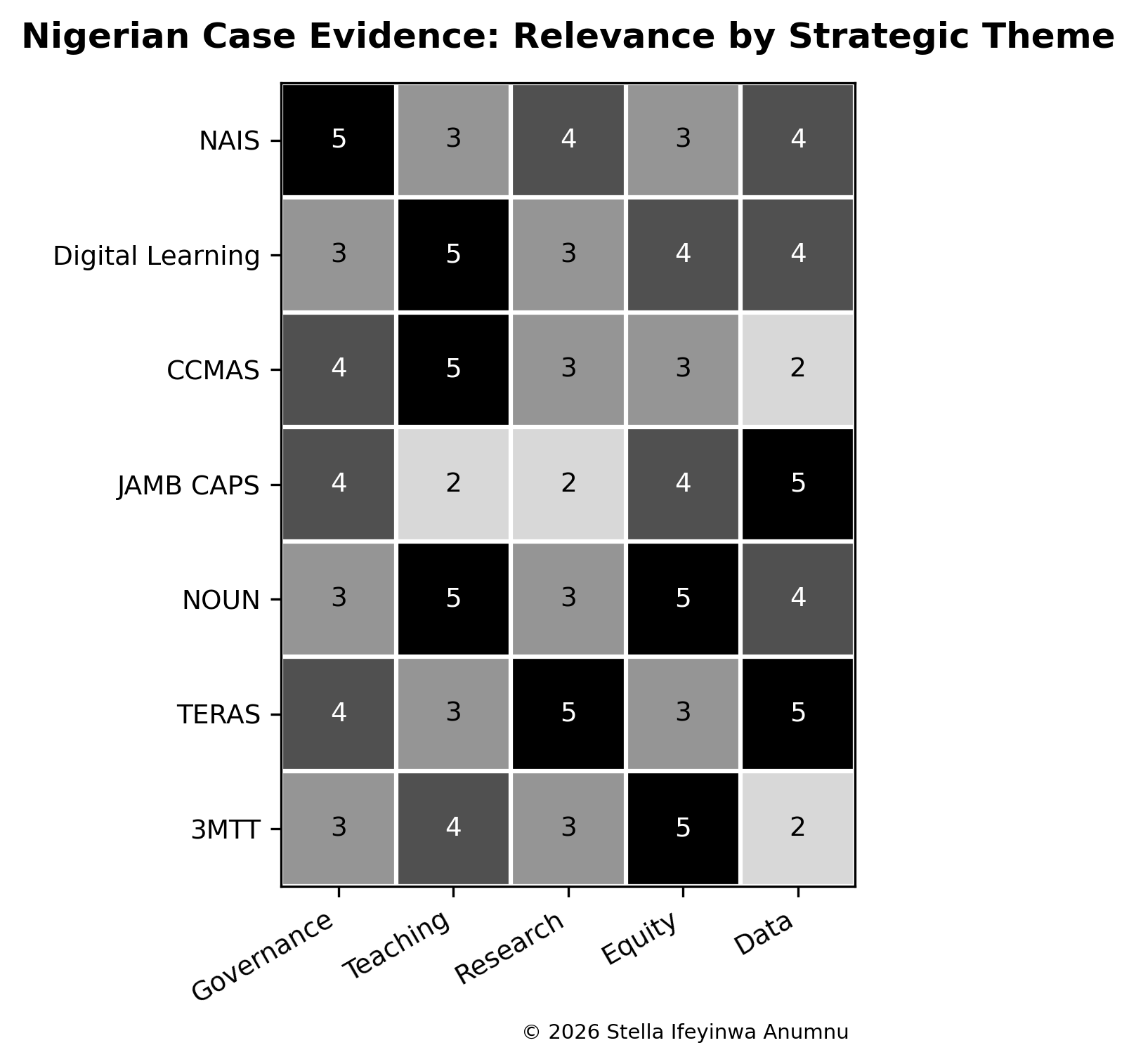
Figure 2. Nigerian case-study relevance matrix.
Note. Matrix values are diagnostic relevance scores on a 1-5 scale. They show how strongly each public Nigerian case informs the strategic themes of governance, teaching, research, equity, and data protection. The figure supports interpretation; it does not measure implementation performance across universities.
6.4 What the Nigerian public cases prove – and what they do not prove
The Nigerian cases used in this publication should be read with care. They prove that policy direction, digital learning ambition, curriculum reform, centralized admissions data, open and distance learning, tertiary-service platforms, and national skills programs are all active parts of the higher education environment. They do not prove that Nigerian universities have already solved AI governance. This distinction is essential. A national policy can set direction without producing classroom change. A platform can create a service channel without guaranteeing learning quality. A curriculum reform can open space for innovation while leaving departments to do the hard work of assessment redesign.
The National AI Strategy is therefore best read as a national capacity signal. It tells universities that AI will shape skills, research, enterprise, and governance. It does not tell a faculty how to grade an AI-assisted assignment. The National Digital Learning Policy is best read as an education-sector frame. It recognizes digital learning and e-safety as serious concerns, but it does not ensure that every campus has the infrastructure and staff development to implement them. CCMAS gives universities a curriculum opening, especially through institution-specific components, but it still requires academic boards to translate AI literacy into course outcomes and assessment.
JAMB CAPS matters because it shows that Nigerian tertiary education already depends on data systems for high-stakes decisions. Its lesson is not that every automated system is AI; its lesson is that transparency, appeal, and audit are necessary whenever data systems affect life chances. NOUN matters because it has long worked with open and distance learning. Its lesson is that flexibility requires advising, feedback, platform reliability, and quality assurance. TERAS matters because a centralized tertiary services platform can improve research and institutional coordination if data governance is strong. 3MTT matters because degree education and applied digital skills should speak to one another rather than compete for legitimacy.
Together, the cases justify a Nigerian governance framework. They also warn against exaggeration. The country has enough policy movement to make university inaction indefensible. It does not yet have enough implementation evidence to make confidence automatic. That is why this paper argues for governed adoption, diagnostic review, and annual reporting rather than symbolic AI branding.
6.5 Discipline-specific application of the case evidence
The public cases also speak differently to different fields. In education, the most urgent question is how future teachers will use AI for lesson planning, learner feedback, inclusive support, and source verification. In law, the challenge is evidence, authority, fabricated cases, data rights, and the responsibility of professional judgment. In medicine and health sciences, the issue is safety, confidentiality, clinical reasoning, and the danger of treating AI output as authority. In engineering, design logs, calculation checks, safety review, and responsible modeling become central. In media and communication, synthetic content, verification, attribution, and public trust must be taught directly.
Business, management, and public administration programs face another pressure. Graduates will work in organizations where AI supports planning, recruitment, customer service, fraud detection, performance dashboards, and risk analysis. Universities should teach them to question the data behind a recommendation, not merely to celebrate efficiency. The same principle applies across disciplines: AI competence is not tool familiarity alone. It is the capacity to combine domain knowledge, evidence, ethics, and human accountability.
Chapter 7: Institutional Management and Quality Assurance
7.1 From policy announcement to operating system
Many university reforms fail in the space between approval and routine. A policy is written, circulated, and praised; then departments continue as before. AI strategy cannot survive that pattern. It needs an operating system. The institution should know who owns AI governance, how tools are approved, how staff are trained, how students disclose use, how complaints are handled, how data is protected, and how evidence of improvement is collected. Without these details, AI remains a speech topic.
A strong operating system begins with an inventory. Which AI tools are already used by staff and students? Which vendors process institutional data? Which courses permit AI? Which departments have assessment-integrity problems? Which research projects use AI for data work? Which administrative units use automated decision support? The answers may be uncomfortable. That is useful. Hidden practice is more dangerous than imperfect practice that has been brought into the open.
Quality assurance should then convert the inventory into policy and monitoring. Course approval forms can ask whether AI literacy or AI restrictions apply. Examination boards can review assessment integrity. Research ethics committees can require AI-use disclosure. ICT units can maintain approved-tool lists. Procurement offices can review vendor terms. Libraries can report training. Student affairs can monitor access problems. Governing councils can request annual AI reports. Each unit does its part, but the institution sees the whole.
7.2 Faculty development as the center of reform
Faculty development is often treated as support, yet in AI adoption it is the center of reform. Lecturers decide what students read, how assignments are framed, what counts as evidence, how feedback is given, and how academic integrity is enforced. If they are unprepared, AI policy will remain abstract. If they are trained properly, the institution gains judgment across every course.
Training should be staged. Senior leaders need strategy and governance sessions. Deans and heads of department need discipline-specific policy design. Lecturers need practical assessment redesign, AI literacy, source verification, feedback methods, and disclosure rules. Librarians need enhanced roles in information literacy. Research supervisors need training in AI-assisted methodology and ethics. ICT staff need academic context. Students need orientation that does not sound like a threat.
Workload should be acknowledged. Redesigning assessment takes time. Learning new tools takes time. Reviewing AI-assisted research takes time. If universities demand change without workload adjustment, they will receive superficial compliance. A serious institution may need teaching grants, course-release arrangements, faculty AI fellows, departmental champions, and recognition in promotion criteria for genuine curriculum renewal. Reform that depends on unpaid academic labor will tire quickly.
Faculty development should also be evaluated. Attendance at a workshop is not enough. The institution should ask whether courses changed, whether assignments improved, whether students understood disclosure rules, whether grading became more meaningful, and whether lecturers felt better prepared. Evidence, not certificates, should guide the next round.
Table 3. Faculty development program for AI-ready teaching.
| Phase | Focus | Practical output |
| Orientation | Shared understanding of AI limits, opportunities, and institutional rules. | Departmental AI briefing and common syllabus language. |
| Assessment redesign | Authentic tasks, process evidence, oral defense, local case application. | Revised assignment bank and integrity rubric. |
| Research supervision | AI-use disclosure, source verification, methodology validation. | Postgraduate supervision checklist. |
| Discipline adaptation | Field-specific use in law, education, health, engineering, media, business, and sciences. | Faculty-level AI guidance notes. |
| Equity and access | Low-bandwidth teaching, device constraints, disability support, language assistance. | Inclusive learning-support plan. |
| Evaluation | Checking whether training changed courses and student outcomes. | Evidence report after each semester. |
7.3 Quality assurance, accreditation, and public trust
AI strategy should be placed within quality assurance because the public trusts degrees only when standards are credible. If students can complete assignments without learning, the degree loses value. If AI tools are used in grading without oversight, trust weakens. If research outputs are polished but unreliable, institutional reputation suffers. Quality assurance units must therefore treat AI as a core academic quality issue, not an ICT accessory.
Accreditation bodies will eventually ask harder questions. How does the program address AI in curriculum? How are assessments protected? How are staff trained? How is student data handled? How are research ethics updated? How does the institution verify learning in an AI period? Universities that prepare early will not be surprised. They will have policy documents, training records, assessment examples, disclosure statements, and evidence of review.
Public trust also requires honesty. Universities should not advertise AI adoption as proof of excellence. They should report what was piloted, what improved, what failed, what access barriers remain, and what safeguards were added. A modest report with evidence is more credible than a grand announcement without proof. Nigerian higher education needs that discipline because public confidence in institutions is earned through consistent practice, not vocabulary.
Figure 3. Readiness movement after governed AI adoption.
Note. The baseline and 24-month scores are planning estimates used to show the expected direction of improvement when policy, faculty development, assessment redesign, data review, and access support are implemented together. They should be replaced by institutional evidence during a real AI-HERS review.
7.4 The AI register as a management instrument
A practical university AI register should be updated every semester. It should list approved tools for teaching, research, administration, library support, student services, and quality assurance. It should also list prohibited uses, tools under review, the responsible office, the data category involved, the date of approval, the next review date, and the reason for approval. This register protects students and staff because it turns scattered practice into institutional knowledge.
The register should be short enough to use and serious enough to matter. A long spreadsheet that nobody reads will fail. A public-facing summary may tell staff and students which tools are approved and for what purpose. A confidential internal version may record security details, contract terms, risk notes, and incident history. The point is not paperwork. The point is that a university should know what technology is acting inside its academic system.
The register also helps with consistency. Without it, one department may allow a tool that another department prohibits. One lecturer may upload student work into a public system while another refuses. One research team may use AI transcription without ethics review while another is blocked. Some local variation is necessary because disciplines differ, but unmanaged contradiction weakens trust. A register gives the institution a shared base from which faculties can adapt responsibly.
Table 8. AI tool register and approval evidence.
| Register field | Purpose | Minimum evidence |
| Tool name and function | Identifies what the system is used for | Approved description and user group |
| Data category | Shows whether personal, sensitive, research, or administrative data is processed | Data-protection review note |
| Academic owner | Prevents ICT-only ownership of academic decisions | Named faculty, unit, or committee |
| Approval level | Matches review depth to risk | Department, faculty, senate, ethics, or council record |
| Permitted and prohibited uses | Gives staff and students clear boundaries | Published guidance or course note |
| Review date and incident history | Keeps adoption under continuing oversight | Semester review and incident log |
7.5 Student partnership, faculty autonomy, and institutional trust
Students should be involved in AI governance because they know the informal learning environment. They know which tools are common, which rules are ignored, which assignments invite shortcuts, and which access barriers are most damaging. A university that writes AI policy without student input may produce rules that look good in committee and fail in practice. Student representatives, postgraduate associations, distance learners, and disability-support groups should be heard before final rules are approved.
Faculty autonomy also needs protection. A central AI policy should provide principles, legal boundaries, disclosure standards, and risk controls. It should not flatten disciplinary judgment. A faculty of law, a faculty of education, a college of medicine, a school of engineering, and a business school will not use AI in the same way. The better method is a central policy with faculty guidance notes. Each faculty can state approved uses, prohibited uses, assessment examples, research risks, and professional expectations. This prevents both chaos and rigidity.
Trust grows when staff and students can see the reasons behind rules. If AI is prohibited in a task, the learning reason should be clear. If AI is permitted, the disclosure rule should be clear. If a tool is used for advising or feedback, the human oversight route should be clear. People accept rules more readily when the institution explains them honestly. In a period of technological uncertainty, clarity itself becomes a form of care.
7.6 Evidence that quality assurance should collect
Quality assurance should collect evidence that shows whether AI adoption has improved academic work. Evidence may include revised syllabi, assessment samples, student disclosure records, library workshop attendance, ethics-review forms, vendor reviews, data incidents, complaints, access-support use, and faculty-development outputs. These records should be interpreted carefully. Attendance at a workshop is not proof of capability. A policy document is not proof of practice. A pilot report is not proof of scale. Evidence must be read against academic outcomes.
Examination boards should review patterns after each semester. Which assignments produced suspicious uniformity? Which tasks produced stronger oral explanations? Which courses had unclear AI instructions? Which assessments required real sources? Which forms of feedback helped students revise? This review should not be used to shame lecturers. It should help departments learn which assessment designs still work. A university that cannot learn from its own assessment evidence will keep repeating the same failures with newer tools.
7.7 Finance, sustainability, and the cost of unfinished pilots
Sustainability should be tested before an AI pilot is celebrated. Many tools look affordable during a trial because external partners provide free credits, temporary licenses, or promotional support. The true cost appears later: subscription renewal, data charges, staff training, security review, accessibility support, integration, maintenance, and the time lecturers spend redesigning courses. A university that cannot fund the second year should be careful about calling the first year transformation.
Budget discipline does not mean refusing innovation. It means asking what the institution can sustain after the announcement has passed. A small, well-governed intervention may improve learning more than an expensive platform that staff cannot use. Finance offices should therefore sit with academic leaders before contracts are signed. The question is not only whether the tool can be bought. It is whether the institution can support, audit, improve, and, if necessary, exit the tool without harming students or losing records.
The cost of unfinished pilots is not only financial. When staff and students are asked to change practice and then a tool disappears, trust weakens. Future reforms become harder because people remember the abandoned promise. Nigerian universities need honest costing, staged adoption, and clear exit plans. Reform is stronger when it does not depend on excitement alone.
Chapter 8: Risks, Failures, and Safeguards
8.1 Academic integrity beyond detection
Academic-integrity debate often begins with fear of cheating, and the fear is not imaginary. AI can produce essays, code, summaries, problem solutions, references, and polished arguments within seconds. Students under pressure may use it dishonestly. Staff may struggle to prove misconduct. Old assignments may lose value. These are real problems. They should not, however, reduce AI policy to detection and punishment.
A better integrity approach has four parts. First, students need clear rules before work begins. Second, assessment should be redesigned so that process, local application, oral defense, and source judgment matter. Third, lecturers need practical ways to check learning without becoming investigators in every course. Fourth, misconduct procedures should remain fair, with space to distinguish careless disclosure from deliberate fraud. The aim is to protect learning, not to create a climate of suspicion.
Detection software should be used cautiously. False positives can damage students, especially those whose English style is unusual, heavily edited, translated, or formal. False negatives can give staff false assurance. A detector result should never be the sole basis for punishment. It may trigger review, but human academic judgment, evidence, and student explanation should remain central. The university’s integrity depends as much on fair process as on preventing cheating.
Integrity is also a staff issue. Lecturers should not use AI to generate feedback they do not read, references they do not verify, or course content they do not understand. Institutional rules must apply to both sides of the classroom.
8.2 Bias, exclusion, and language risk
AI systems may reflect the biases of their training data, design choices, and deployment setting. For Nigerian higher education, this includes risks around language, class, region, gender, disability, religion, and cultural context. A tool may perform better for standardized American English than for Nigerian English or for students moving between languages. It may misunderstand local examples, undervalue Nigerian sources, or produce advice that assumes infrastructure conditions that do not exist. These are not minor issues. They affect learning, assessment, and dignity.
Bias can also enter administrative analytics. A student from a low-income background may look less engaged because of unstable internet. A distance learner may appear inconsistent because of work obligations. A student with disability may require different interaction patterns. If an AI-supported advising system reads these signals without context, it may classify students unfairly. Human review and student explanation must be built into any system that flags risk.
Safeguards include local testing, diverse user feedback, accessibility review, clear appeal routes, and bias monitoring. Universities should not accept vendor claims without evidence. A tool that worked in one country or one university may fail under Nigerian constraints. Pilot studies should include students with varied devices, languages, disciplines, and access conditions. A system that benefits only the most privileged users cannot be called strategic for Nigerian higher education.
8.3 Vendor dependence and procurement discipline
AI adoption often enters through vendors: learning platforms, plagiarism tools, proctoring systems, chatbots, analytics dashboards, research software, and administrative automation. Procurement is therefore an academic governance issue. A cheap or fashionable tool may create long-term dependence, data exposure, hidden costs, or poor integration with existing systems. Universities should not sign technology agreements as if they are buying furniture.
Procurement review should ask direct questions. What data will the vendor process? Can the vendor use it for model training? Where is the data stored? What happens when the contract ends? Can the institution export its records? What support is provided? Does the tool work on low bandwidth? Is there independent evidence of educational value? Does the contract protect academic autonomy? What liability exists if the tool fails or exposes data? These questions should be asked before purchase, not after scandal.
Vendor dependence can also affect intellectual independence. If a university allows a platform to shape teaching, assessment, student support, and analytics without oversight, the vendor begins to influence academic life. Partnership can be valuable, but control must remain with the institution. The governing principle is simple: technology should serve the university’s academic mission; the mission should not be redesigned silently around vendor convenience.
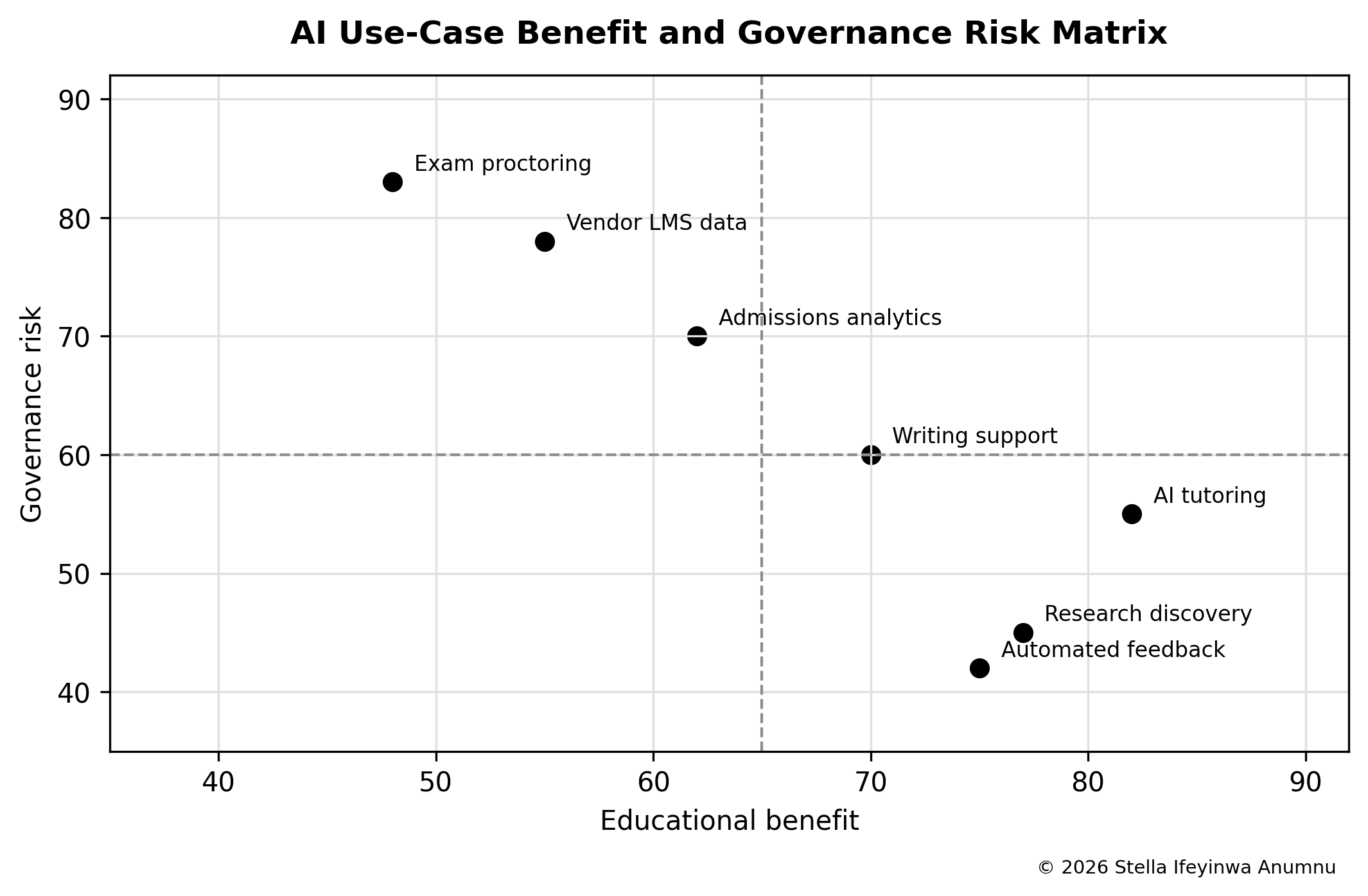
Figure 5. AI use-case benefit and governance risk matrix.
Note. Positions on the matrix are author-created risk-benefit judgments based on the kinds of AI use cases discussed in the paper. The figure is intended to discipline procurement and pilot decisions by making benefit and risk visible before adoption.
8.4 Discipline-based risk examples
The risks of AI are not identical across disciplines. In law, fabricated authorities can damage legal reasoning and professional ethics. In health sciences, inaccurate clinical advice can create safety risks. In engineering, unverified calculations can become design hazards. In journalism and media, synthetic images and fabricated quotations can injure public trust. In education, AI-generated lesson plans may appear polished while ignoring learner context. In business and management, efficiency claims may conceal bias in data or poor accountability for decisions. A serious AI policy should therefore include faculty-level examples, not only general rules.
In a faculty of education, students may be asked to use AI to draft a lesson plan, then critique it against curriculum goals, learner needs, cultural context, and assessment strategy. In a law faculty, students may be required to verify every cited authority through an approved legal database before submission. In health sciences, students may compare AI explanations with textbooks, clinical guidelines, and supervisor instruction, while being reminded that patient data must not enter public tools. In engineering, students may submit a design log showing assumptions, tool use, calculation verification, safety checks, and human decisions. The common thread is not prohibition. It is accountable use tied to professional standards.
These examples also help misconduct panels. A generic rule that says “responsible use” may be too vague when a case arises. A discipline-based guidance note gives staff and students a shared expectation before the work begins. It also makes punishment less arbitrary because the institution can show that the boundary was explained.
8.5 Crisis, continuity, and institutional memory
Nigerian universities have lived through disruptions that affect learning continuity: strikes, health emergencies, insecurity, weather events, funding delays, and infrastructure failure. AI-supported systems may help universities communicate faster, organize learning materials, answer routine platform questions, and preserve institutional records during disruption. They cannot solve the political and material causes of crisis. That distinction matters. Technology can support continuity; it should not be used to normalize broken conditions.
Institutional memory is another underrated risk. Universities lose knowledge when officers change and records are scattered. AI-supported search across policies, minutes, research outputs, quality reports, and administrative guidance may help new officers understand past decisions. The system will be useful only if records are accurate, lawful, and organized. A poor archive searched quickly remains a poor archive. Before universities rush into intelligent document search, they should improve records discipline, naming conventions, retention rules, and access controls.
Continuity planning should therefore connect AI to records management, not only to classroom delivery. If the university cannot tell which policy version is current, which contract is active, which ethics form was approved, or which student complaint remains unresolved, AI search may accelerate confusion. Responsible AI begins with responsible information management.
Chapter 9: AI-HERS Model and Diagnostic Tools
9.1 Purpose of the model
University leaders often ask for a score because scores simplify discussion. The danger is that a score can pretend to know more than it knows. The AI Higher Education Readiness and Safeguards Score, abbreviated AI-HERS, is designed to avoid that problem. It does not rank universities for publicity. It helps an institution organize a serious internal review. The model asks whether the main conditions for responsible AI adoption are present, partially present, or missing.
The model uses eight strata: governance, faculty readiness, data protection and infrastructure, assessment integrity, research capacity, equity and access, quality assurance evidence, and procurement or vendor control. These strata were chosen because they cover the main points at which AI can improve or damage higher education. A university may be strong in one stratum and weak in another. That unevenness is the point. A single general claim of readiness is rarely useful.
The model should be used with evidence. A governance score should be based on approved policy, responsible offices, meeting records, and reporting. Faculty readiness should be based on training, course redesign, and departmental support. Data protection should be based on inventories, vendor review, and compliance records. Assessment integrity should be based on actual assessment changes. Equity should be based on access data and student experience. The score should never be guessed in a closed office.
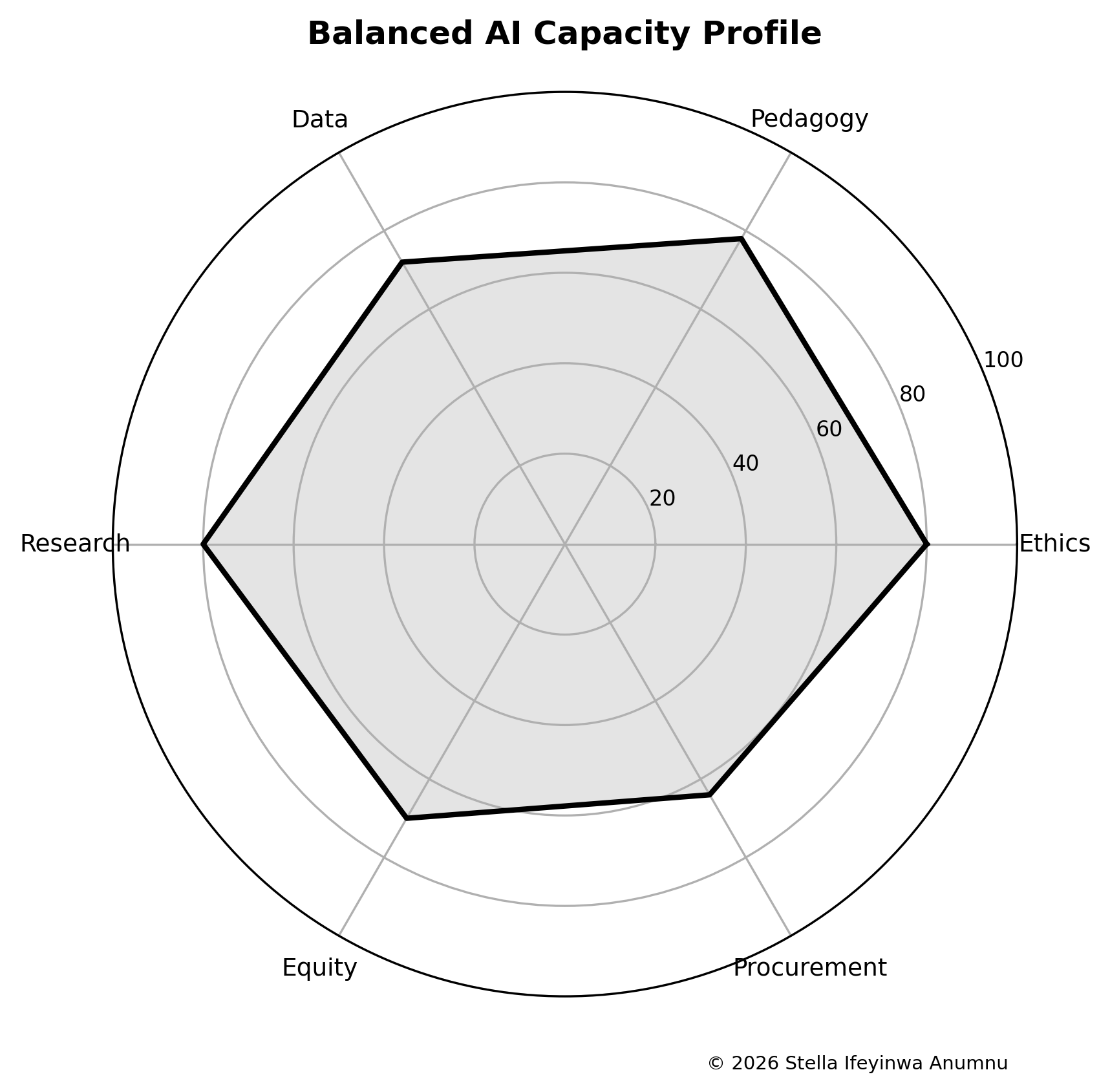
Figure 4. Balanced AI capacity profile.
Note. The radar profile is an institutional diagnostic illustration. It is designed for management discussion and should be completed with evidence from policy records, course redesign, ethics review, data inventory, student access reports, and vendor contracts.
9.2 The stratified formula
The proposed formula is: AI-HERS_i = 100 × [0.18G_i + 0.15F_i + 0.15D_i + 0.12A_i + 0.12R_i + 0.10E_i + 0.10Q_i + 0.08P_i]. In the formula, G_i represents governance authority; F_i represents faculty readiness; D_i represents data protection and infrastructure; A_i represents assessment integrity; R_i represents research capacity; E_i represents equity and access; Q_i represents quality assurance evidence; and P_i represents procurement and vendor control. Each variable is scored between 0 and 1 before weighting.
The weights are open to debate, which is a strength. Governance receives the highest weight because responsible adoption needs authority and policy. Faculty readiness and data protection receive strong weights because teaching and student data are central to the university’s mission. Assessment, research, equity, and quality assurance follow closely. Procurement receives a smaller but still meaningful weight because vendor control can undermine all other areas if ignored.
A score below 40 should be treated as early readiness. Such an institution should avoid high-stakes AI deployment and focus on policy, inventory, faculty training, and access. A score between 40 and 65 suggests controlled pilot readiness. The university can test AI in selected areas with safeguards. A score between 65 and 80 suggests institutional scaling readiness, provided evidence is reviewed. A score above 80 suggests mature governance, but not perfection. Even mature systems need audit, student feedback, and regular review.
The model should never be used to punish weaker institutions. Its purpose is to direct support. If a state university scores low because it lacks infrastructure and faculty training, the response should be targeted investment and technical support, not public embarrassment. Readiness assessment should become a planning tool for improvement.
Table 6. AI-HERS variables and scoring test.
| Variable | Meaning | Readiness evidence |
| G | Governance authority | Approved policy, named owner, reporting line, risk register. |
| F | Faculty readiness | Training participation, redesigned courses, departmental guidance. |
| D | Data protection and infrastructure | Data inventory, vendor review, security controls, access plan. |
| A | Assessment integrity | Disclosure rules, authentic tasks, oral defense, process evidence. |
| R | Research capacity | AI ethics addendum, supervisor training, source verification. |
| E | Equity and access | Device support, low-bandwidth options, disability support, student feedback. |
| Q | Quality assurance evidence | Review cycles, performance indicators, annual AI report. |
| P | Procurement and vendor control | Contract review, exit plan, data-use restrictions. |
9.3 Diagnostic review and public reporting
A useful diagnostic review should include documents, interviews, platform data, student feedback, faculty examples, vendor contracts, and assessment samples. It should include skeptical voices, not only enthusiasts. Students should be asked whether AI rules are clear, whether access is fair, and whether they know how to disclose use. Lecturers should be asked what support they need and which assessments are no longer reliable. ICT staff should be asked what tools are already in use without approval. Librarians should be asked where source-verification problems appear. Research ethics committees should be asked whether they can review AI-assisted work.
The institution should publish a short annual AI governance statement. It does not need to reveal sensitive details. It should state what policy exists, what training occurred, what pilots were approved, what risks were found, what student-access measures were taken, and what will change next year. Public reporting builds discipline. It also helps Nigerian universities learn from one another instead of repeating the same mistakes in isolation.
The strongest use of AI-HERS is longitudinal. A university should not only ask where it stands today. It should ask what improved over twelve months and why. Did faculty readiness rise because training became practical? Did assessment integrity improve because departments redesigned tasks? Did data governance improve because vendor contracts were reviewed? Did equity improve because the library opened access hubs? A score without explanation is thin. A score with evidence becomes management knowledge.
9.4 Interpreting diagnostic scores without overclaiming
The figures and the AI-HERS model in this paper are designed to make governance visible. They should not be read as official rankings of Nigerian universities, national survey results, or proof that implementation has occurred. Their strength lies in disciplined illustration. They show what leaders should examine: policy authority, faculty capability, data protection, assessment integrity, research support, student access, procurement control, and quality assurance evidence. A university using the model must replace diagnostic estimates with its own records.
This point is not a weakness. It is part of evidence integrity. A planning model should be transparent about its limits. If a university lacks data for one variable, the answer is not to guess confidently. The answer is to collect evidence. If student access is unknown, run an access audit. If faculty readiness is unknown, survey departments and review course changes. If vendor risk is unclear, review contracts. If research ethics practice is unclear, examine approved protocols. AI-HERS becomes useful when it forces these conversations into the open.
The model should also be adjusted by institutions with different missions. An open and distance learning institution may weight access, advising, platform reliability, and analytics governance more heavily. A research-intensive university may place more emphasis on ethics review, research data, publication integrity, and postgraduate supervision. A professional university may emphasize simulation, safety, accreditation, and field-specific judgment. The formula is therefore a starting discipline, not a permanent decree.
9.5 From diagnostic review to improvement plan
After scoring, the university should produce a short improvement plan. The plan should identify three to five priorities, assign responsible offices, state evidence to be collected, set review dates, and name decisions that will be paused until controls improve. If assessment integrity is weak, the next step may be an assignment-redesign institute. If data governance is weak, the next step may be a vendor review and staff guidance on sensitive data. If access is weak, the next step may be library-based support and low-bandwidth course materials. The model should lead to action, not decoration.
A public summary can strengthen accountability. It does not need to reveal sensitive internal weaknesses. It can state what was reviewed, what improvements were made, what risks remain, and what the institution will do next. Honest reporting may feel risky, but silence is riskier when AI affects students, staff, and research credibility. A university that can report unfinished work responsibly is more trustworthy than one that advertises perfection.
Chapter 10: Implementation Roadmap and Final Institutional Position
10.1 The first six months
The first six months should be disciplined and modest. The university should not begin with a grand AI center if it has not written course guidance, inventoried tools, or trained staff. The first step is an AI governance charter approved by senior academic authority. The charter should state principles: human academic responsibility, equity, lawful data practice, transparent use, assessment integrity, research ethics, and evidence-based adoption. It should also identify the office responsible for coordination.
The second step is an institutional inventory. Departments should report existing AI use in teaching, research, assessment, administration, and student support. ICT should list approved and unapproved tools. Procurement should identify vendor contracts that process student or staff data. Libraries should report current information-literacy support. Student affairs should identify access barriers. This inventory may reveal disorder. That is useful. Disorder seen early can be managed.
The third step is interim guidance for courses. Lecturers need syllabus language immediately. Students need to know what is allowed. A simple template can define prohibited use, limited permitted use, required disclosure, and AI-supported learning activities. Departments can adapt examples. Interim guidance should be reviewed after the first semester, because practice will reveal problems that policy writers did not imagine.
10.2 The first year and second year
By the end of the first year, the university should have a formal AI policy, a vendor review process, data-protection controls, faculty development plan, assessment-redesign pilots, student disclosure templates, and research ethics addendum. The policy should not be long for the sake of appearing serious. It should be usable. A lecturer should be able to apply it to a course. A student should understand it. An ethics committee should use it. An ICT officer should know which tools require review. A dean should know how to report implementation.
The first year should also produce examples. Abstract rules become clearer when staff can see sample assignments, disclosure statements, oral-defense formats, AI critique tasks, source-verification exercises, and research-methods templates. Universities should collect these examples in a shared repository. Departments can adapt them to local needs. This is cheaper and more useful than repeating generic training.
The second year should move from pilots to controlled scaling. Successful tools can be expanded, but only after evidence is reviewed. Faculty AI fellows can support departments. Libraries can run regular verification clinics. Research offices can integrate AI-use disclosure into postgraduate forms. Student affairs can use analytics cautiously to support at-risk learners, with human review. Procurement can renegotiate vendor terms based on lessons learned. The institution should issue its first annual AI governance statement before the end of the second year.
A mature implementation roadmap does not ask the university to do everything at once. It asks the university to build a sequence that protects standards while learning. The measure of success is not how many tools are purchased. The measure is whether teaching, assessment, research, administration, and student support become more credible, more inclusive, and more accountable.
Table 7. Twenty-four-month implementation sequence.
| Period | Main work | Publication-ready evidence |
| Months 1-3 | Create AI governance charter, interim course guidance, and tool inventory. | Approved charter and inventory report. |
| Months 4-6 | Begin faculty institutes, data-protection review, and assessment pilot selection. | Training records and pilot protocols. |
| Months 7-12 | Formal policy approval, ethics addendum, vendor review, student orientation. | Policy pack and compliance checklist. |
| Months 13-18 | Controlled scaling of successful pilots and department-level AI guidance. | Evaluation report and revised course examples. |
| Months 19-24 | Institution-wide AI-HERS review and public governance statement. | Annual AI governance statement and improvement plan. |
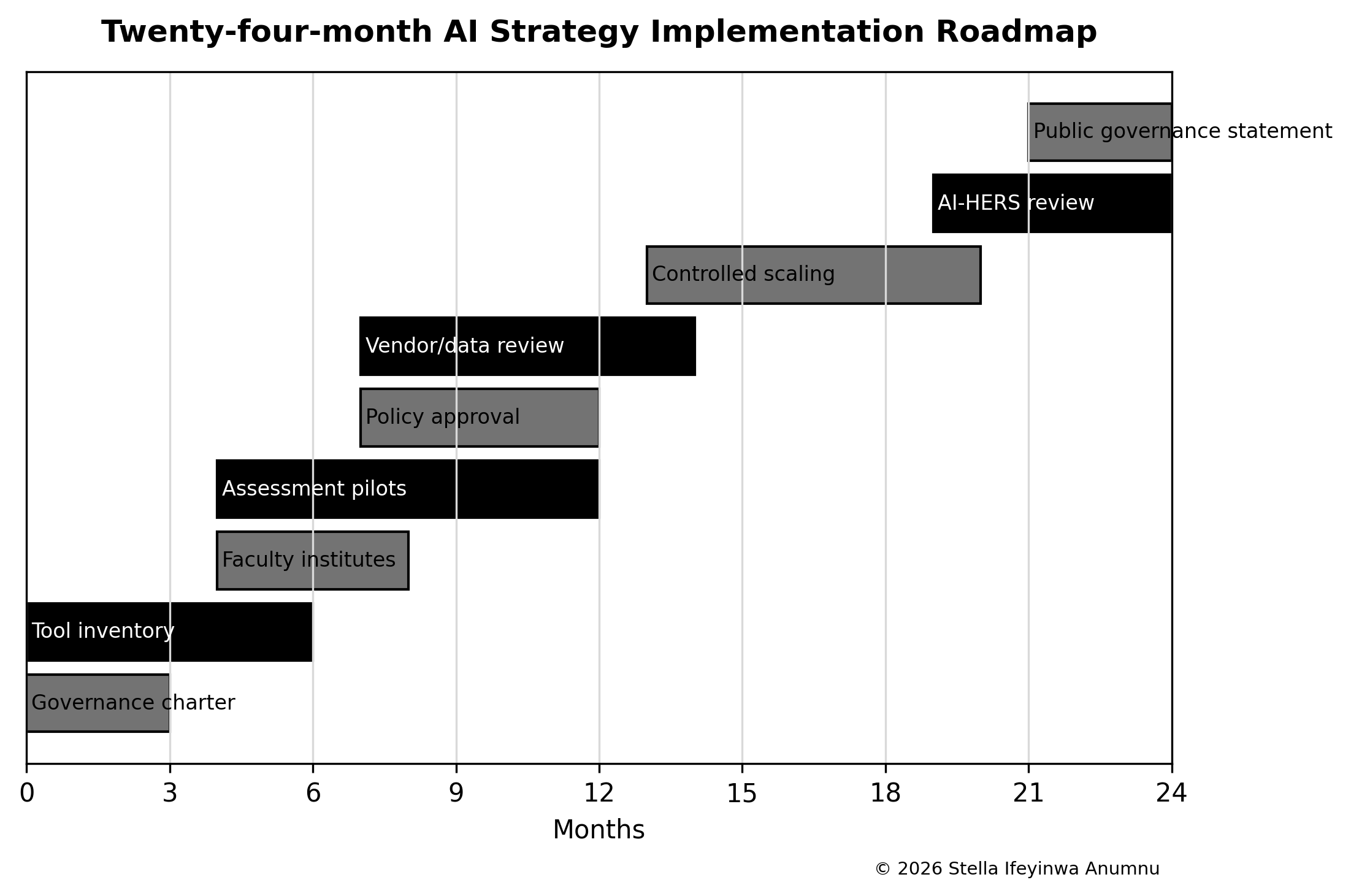
Figure 7. Twenty-four-month AI strategy implementation roadmap.
Note. The roadmap translates the paper’s implementation argument into a staged management sequence. Exact timing should be adapted to institutional resources, legal review, faculty workload, and student access conditions.
10.3 Final institutional position
Artificial intelligence will test Nigerian higher education because it exposes weaknesses that were already present. Weak assessment becomes easier to outsource. Weak supervision becomes easier to conceal. Weak data governance becomes more dangerous. Weak faculty development becomes more visible. Weak access becomes more unfair. AI is not the original cause of these problems, but it intensifies them. That is why the response has to be strategic, not decorative.
The opportunity is equally real. AI can support teaching in large classes, improve feedback, help students practice, assist researchers, strengthen administrative planning, support open and distance learning, and connect universities to national technology ambitions. Nigeria should not stand aside while other systems build capacity. But participation should not mean surrendering judgment to imported tools, vendor claims, or superficial innovation.
The institutional position is clear. AI belongs in Nigerian higher education as governed academic capacity. It should be taught, questioned, tested, documented, audited, and placed under human academic authority. It should support students without replacing study. It should assist lecturers without reducing teaching to generated content. It should strengthen research without weakening evidence. It should help managers see patterns without automating unfair decisions. A university that can hold those lines will not merely adopt AI. It will educate people capable of living responsibly with it.
10.4 Operational application across university functions
Admissions offices should treat AI as an aid to fairness, not as a way to hide judgment. Any tool that supports screening, placement, fraud detection, or applicant communication should be auditable. Applicants should know the official channel for questions and correction. Where automated systems help staff process large volumes, human officers must remain responsible for final decisions and appeals. JAMB CAPS already shows that Nigerian tertiary education accepts data-supported admission processes; the next challenge is to protect transparency as more automation becomes possible.
Registrar and examination offices need equally careful boundaries. AI can help classify inquiries, identify missing records, summarize policy questions, and support workflow. It should not alter grades, disciplinary records, graduation status, or academic standing without documented human review. Examination work carries consequences that may follow a graduate for life. Any system touching those records should have access controls, audit logs, backup procedures, and correction routes.
Libraries should become the visible home of AI information literacy. Their role should include source verification clinics, citation workshops, database searching, guidance on fabricated references, and support for postgraduate literature reviews. This is not an optional service. In the AI period, libraries defend the evidence culture of the university. They help students and staff distinguish a fluent summary from a source, a plausible citation from a real one, and a search shortcut from research.
Student affairs offices should use AI cautiously. Advising dashboards, chatbots, and risk flags may help staff identify students who need support, but they can also misread poverty, illness, disability, unstable connectivity, work obligations, or insecurity. A responsible system uses data to begin a human conversation. It does not turn a student into a risk label. Complaint channels and correction rights should be visible.
Research offices should integrate AI disclosure into postgraduate forms, ethics applications, and publication support. The purpose is not to stigmatize assistance. The purpose is to keep methods transparent. A thesis that uses AI for transcription, translation, coding suggestions, data visualization, or language editing should say so where relevant. Research offices can also train staff to identify predatory journals, paper-mill patterns, fabricated citations, and unreliable AI-assisted analysis.
Procurement and legal offices should build shared review templates. A contract for an AI platform should not be approved only because the price appears attractive. Data processing, model training, storage location, exit rights, service continuity, accessibility, liability, audit rights, and ownership of institutional records should be checked. If the university lacks internal capacity for this review, it should seek external legal or technical advice before signing. The cost of weak procurement is usually paid later by students, staff, and institutional reputation.
Table 9. Operational controls by university function.
| University function | AI opportunity | Required control |
| Admissions and registry | Faster inquiry handling, document checks, workflow support | Human decision review, appeal route, audit log |
| Teaching departments | Practice tasks, feedback support, local examples | Syllabus disclosure rules and assessment redesign |
| Examinations | Pattern review and process monitoring | No automated grade change without human authority |
| Library | Source verification, citation training, research support | Database-based verification and fabricated-reference guidance |
| Research ethics | Review of AI-assisted transcription, coding, and analysis | Consent, anonymization, secure tools, human validation |
| Student affairs | Advising signals and routine support | Human contact before adverse interpretation |
| Procurement | Selection of platforms and service partners | Data-use clauses, exit rights, accessibility, risk review |
10.5 Practical decision scenarios for Nigerian university leaders
A faculty of education may want students to use AI for lesson planning. The wise response is not a blanket ban. The faculty can require students to submit the AI draft, a critique of its weaknesses, the revised lesson plan, and a short explanation of learner needs. The student learns tool use, professional judgment, and accountability at the same time.
A research team may want to upload interview transcripts from vulnerable participants into a public AI tool for coding. The ethics committee should stop the process until consent, anonymization, storage, data transfer, vendor terms, and human validation are clear. If those protections cannot be guaranteed, the team should use a secure approved tool or manual coding. Research convenience cannot outrank participant protection.
A private university may market itself as an AI-powered institution. The claim is weak unless the institution can say what is powered by AI, who reviews outputs, what data is processed, which students have access, how assessment is protected, and how errors are corrected. Responsible communication should replace vague technological prestige with accountable detail.
A public university with limited funding may feel left behind because it cannot buy enterprise tools. It can still begin well. Syllabus language, student orientation, source-verification workshops, faculty peer groups, oral defense routines, disclosure templates, and a tool register are low-cost safeguards. Governance does not begin with money; it begins with clarity.
A lecturer may use AI to draft feedback on essays. This can reduce delay if the lecturer reviews the comments, corrects generic language, adds discipline-specific observations, and keeps final grading under human control. Feedback is a teaching act. It should not become an automated paragraph attached to a score.
A university may consider analytics for distance learners. The tool may identify students who are likely to fall behind, but poor connectivity or work obligations may be mistaken for weak commitment. Every automated flag should lead to human contact, not punishment. The student should have a way to explain and correct the record. Support systems lose legitimacy when students feel watched but not helped.
A department may want to ban AI entirely. Some tasks should indeed prohibit AI because they test independent competence. But a total ban across a program may be unenforceable and may prepare students poorly for professional work. A stronger policy divides tasks into no-AI tasks, disclosed-assistance tasks, AI-critique tasks, and professional-simulation tasks. Students learn boundaries rather than secrecy.
A university planning an AI innovation hub should not begin with equipment alone. It should define research themes, ethics support, student training, industry partnerships, data governance, intellectual property rules, and evaluation standards. A hub without academic direction is an expensive room. A hub with purpose can support research, entrepreneurship, and national development.
10.6 Annual review and final publication position
AI policy cannot be written once and left untouched. Tools change, laws change, student practice changes, and institutional capacity changes. The university should review policy annually, not to chase every novelty, but to keep standards honest. The review should ask what was adopted, what improved, what failed, what complaints were received, what access gaps remain, what data incidents occurred, and which tools should be stopped. Stopping a weak tool is as important as adopting a useful one.
Collaboration among Nigerian universities would strengthen this process. Institutions can share policy language, faculty-development materials, assessment examples, research findings, and procurement questions. NUC, TETFund, NITDA, NCAIR, professional bodies, and university networks can help convene such exchanges, but the value will depend on honesty. Success stories alone are not enough. Universities need to share mistakes, limits, and unfinished work so that the sector learns faster.
Academic freedom must remain protected. AI governance should not become a route for surveillance, censorship, or managerial interference with research. Lecturers and researchers must be free to study AI harms, critique policy, question vendors, examine bias, and publish uncomfortable findings. Responsible governance protects academic integrity; it should not narrow inquiry. A university that cannot tolerate critical research on AI is not ready to govern AI.
The final institutional position is therefore firm. Artificial intelligence belongs in Nigerian higher education, but only as governed academic capacity. It must serve teaching without replacing study, support research without weakening evidence, assist administration without hiding judgment, improve access without deepening inequality, and strengthen public trust without becoming public relations. The university remains responsible. That responsibility is the line that no tool should cross.
10.7 Sector responsibility beyond one institution
The burden of AI governance should not fall on single universities acting alone. Nigeria needs sector learning. Regulators can set expectations, but universities must generate evidence. TETFund can support infrastructure and research services, but institutions must show how those services improve academic work. NITDA and NCAIR can support national AI capacity, but faculties must translate capacity into curriculum and research. Professional bodies can define field-specific standards, but departments must teach and assess them. The system will move faster if these responsibilities are coordinated without erasing institutional autonomy.
Sector responsibility also means protecting weaker institutions. Some universities will begin with stronger infrastructure, better funding, smaller classes, and more experienced ICT units. Others will begin with limited bandwidth, overcrowded classes, and fragile administrative systems. A national AI agenda that benefits only the already strong will widen inequality inside higher education. Shared templates, open training materials, low-cost assessment models, library collaboration, and regional communities of practice can help reduce that gap.
The paper therefore ends with confidence, but not with complacency. Nigerian universities can use AI to strengthen teaching, research, administration, and public service. They can also damage trust if they adopt tools without safeguards. The difference will be made in ordinary institutional habits: clear rules, trained staff, protected data, fair access, honest assessment, documented procurement, and annual review. Those habits are not glamorous. They are the work of universities that take their public mission seriously.
10.8 The publication standard for immediate use
A publication-ready AI governance paper should leave no reader unsure about its operational standard. In this work, the standard is direct. No AI tool should enter teaching without a learning purpose. No AI-supported assessment should proceed without a rule on disclosure and evidence of student reasoning. No research use should hide the tool that shaped transcription, coding, analysis, translation, or writing. No procurement decision should ignore data storage, model training, exit rights, accessibility, and vendor dependence. No analytics system should turn student hardship into a silent institutional judgment.
The paper also sets a standard for language. Nigerian universities do not need exaggerated claims about revolution. They need careful work that can survive audit, complaint, accreditation review, and public scrutiny. A responsible institution will be able to show its policy, tool register, training records, assessment samples, ethics addendum, data review, access-support evidence, vendor checklist, and annual report. These records may look ordinary, but they are the infrastructure of trust.
The work is ready for institutional publication because it now carries both argument and restraint. It supports AI adoption, but it refuses technology glamour. It accepts innovation, but it keeps human academic responsibility at the center. It recognizes national ambition, but it does not confuse national ambition with campus implementation. It gives leaders a framework they can use now while leaving room for future empirical research. That balance is the mark of serious applied doctoral writing.
The immediate value for Nigerian higher education is practical. A vice chancellor can use the roadmap to sequence institutional work. A dean can use the faculty guidance to redesign assessment. A librarian can use the source-verification emphasis to strengthen research support. An ethics committee can use the disclosure standard to update forms. A procurement officer can use the vendor questions before a contract is signed. A student affairs team can use the access argument to prevent analytics from becoming unfair surveillance. A postgraduate school can use the supervision routines to protect thesis integrity. The paper therefore moves beyond commentary. It gives offices a shared language for responsible action.
References
3MTT. (2025). 3 Million Technical Talent programme. Federal Ministry of Communications, Innovation and Digital Economy. https://3mtt.nitda.gov.ng/
Ajonbadi, H. A., Idris, A., & Adebisi, Y. (2023). The anathema of digital divide in Nigerian higher education: Lessons from the pandemic. Sheffield Hallam University Research Archive.
DataReportal. (2025). Digital 2025: Nigeria. Kepios and DataReportal. https://datareportal.com/reports/digital-2025-nigeria
Federal Ministry of Communications, Innovation and Digital Economy, & National Information Technology Development Agency. (2025). National Artificial Intelligence Strategy. National Centre for Artificial Intelligence and Robotics.
Federal Ministry of Education. (2023). National Digital Learning Policy. Federal Republic of Nigeria. https://education.gov.ng/
Federal Republic of Nigeria. (2023). Nigeria Data Protection Act, 2023.
International Organization for Standardization. (2023). ISO/IEC 42001:2023: Information technology – Artificial intelligence – Management system. https://www.iso.org/standard/42001
Joint Admissions and Matriculation Board. (n.d.). Central Admissions Processing System (CAPS). https://www.jamb.gov.ng/caps
Maslej, N., Fattorini, L., Perrault, R., Gil, Y., Parli, V., Kariuki, N., Capstick, E., Reuel, A., Brynjolfsson, E., Etchemendy, J., Ligett, K., Lyons, T., Manyika, J., Niebles, J. C., Shoham, Y., Wald, R., & Walsh, T. (2025). The AI Index 2025 annual report. Stanford Institute for Human-Centered Artificial Intelligence. https://hai.stanford.edu/ai-index/2025-ai-index-report
McDonald, N., Johri, A., Ali, A., & Hingle, A. (2024). Generative artificial intelligence in higher education: Evidence from an analysis of institutional policies and guidelines. arXiv.
Miao, F., & Cukurova, M. (2024). AI competency framework for teachers. UNESCO.
Miao, F., Shiohira, K., & Lao, N. (2024). AI competency framework for students. UNESCO.
National Institute of Standards and Technology. (2023). Artificial Intelligence Risk Management Framework (AI RMF 1.0). U.S. Department of Commerce. https://www.nist.gov/itl/ai-risk-management-framework
National Institute of Standards and Technology. (2024). Artificial Intelligence Risk Management Framework: Generative Artificial Intelligence Profile. U.S. Department of Commerce.
National Open University of Nigeria. (n.d.). Welcome to the National Open University of Nigeria. https://nou.edu.ng/
National Universities Commission. (2023). Core Curriculum and Minimum Academic Standards downloads. NUC-CCMAS. https://nuc-ccmas.ng/downloads/
National Universities Commission. (2024). NUC to ensure full implementation of CCMAS. National Universities Commission. https://www.nuc.edu.ng/tag/ccmas/
Ogunleye, B., Zakariyyah, K. I., Ajao, O., Olayinka, O., & Sharma, H. (2024). Higher education assessment practice in the era of generative AI tools. arXiv.
Tertiary Education Trust Fund. (n.d.). TERAS: Tertiary Education, Research, Applications and Services. https://teras.ng/
UNESCO. (2023). Guidance for generative AI in education and research. UNESCO.
UNESCO. (2024). AI competency framework for teachers. UNESCO.
UNESCO. (2024). AI competency framework for students. UNESCO.
World Bank. (2025). Artificial intelligence revolution in higher education: What you need to know. World Bank Open Knowledge Repository.
Wu, C., Zhang, H., & Carroll, J. M. (2024). AI governance in higher education: Case studies of guidance at Big Ten universities. arXiv.