

An England and Wales Legal Protection Case Study
Research Publication by Rachel R. Shuma
New York Center for Advanced Research (NYCAR)
NYCAR Research Edition
Publication No.: NYCAR-TTR-2026-RP020
DOI: https://doi.org/10.5281/zenodo.20433846
June 2026
Peer Review and Publication Status
This research publication has been reviewed under the internal editorial framework of the New York Center for Advanced Research (NYCAR) and The Thinkers’ Review. The review assessed master’s-level coherence, legal-policy relevance, source integrity, APA 7th citation discipline, diagram clarity, practical usefulness, and publication readiness. The work is approved for NYCAR master’s-level research publication.
Copyright © June 2026 Rachel R. Shuma. All rights reserved.
Abstract
Cohabitation has become an ordinary feature of family life in England and Wales, yet legal protection still depends heavily on formal status. Marriage and civil partnership carry a settled legal structure for financial remedies, inheritance, pension consequences, housing security, and decision-making authority. Cohabitation does not. Such a gap might be defensible if the public clearly understood it, but the evidence shows that many households still believe in a common-law marriage that does not exist as a marriage-equivalent status. That misconception can delay wills, declarations of trust, cohabitation agreements, pension nominations, and other protective steps until separation or death has already removed the moment for calm planning. At master’s level, this research paper rebuilds the subject as a legal protection case study grounded in current public evidence, recent policy movement, and established legal authority. It uses parliamentary evidence, Office for National Statistics family data, Citizens Advice and Law Society guidance, the June 2026 Ministry of Justice consultation, recent legal scholarship, and core statutes and case law. Field interviews and unsupported statistics are not invented. Quantitative elements are limited to verified public data and clearly labeled legal-policy coding. In argument, the analysis preserves the distinct status of marriage while refusing to leave long-term cohabitants exposed to preventable misunderstanding, housing instability, inheritance shock, and unequal relationship-generated disadvantage. The recommended approach combines plain public legal education, low-cost planning tools, professional communication discipline, and a targeted statutory safety net for defined circumstances involving long-term interdependence, shared children, economic vulnerability, or bereavement.
Keywords: cohabitation, common-law marriage myth, relationship rights, family law, England and Wales, legal protection, intestacy, property law, housing vulnerability, public legal education, statutory reform.
Contents
Abstract
List of Figures
List of Tables
Chapter 1: Introduction
Chapter 2: Literature Review
Chapter 3: Methodology and Analytical Framework
Chapter 4: Case Analysis and Findings
Chapter 5: Discussion and Reform Design
Chapter 6: Implementation, Closing Analysis, and Recommendations
References
List of Figures
Figure 1. Cohabiting-couple families in the UK, 2015, 2024, and 2025.
Figure 2. Status-based protection gap: qualitative legal coding.
Figure 3. Common-law marriage myth: reported prevalence indicators.
Figure 4. Risk pathway from legal myth to household vulnerability.
Figure 5. Reform design principles for cohabitation protection.
Figure 6. Proposed 24-month implementation sequence.
List of Tables
Table 1. Core differences between formal status and cohabitation.
Table 2. Verified evidence map for the research argument.
Table 3. Household planning checklist for cohabiting partners.
Chapter 1: Introduction
1.1 Background to the Study
Family law in England and Wales remains organized around a visible legal boundary. Marriage and civil partnership are formal statuses. Once entered through recognizable legal acts, they bring an established framework for financial orders, inheritance treatment, property adjustment, pension sharing, and many practical assumptions about family responsibility. Cohabitation is different. Two adults may live together for ten or twenty years, raise children, buy property, reorganize employment, pool income, and appear to friends and institutions as a settled family. Those facts do not, by themselves, create a marriage-equivalent legal status. That distinction matters because family life often develops through habit, trust, and shared routines, while the law later asks for status, title, documents, wills, nominations, and evidence (House of Commons Women and Equalities Committee, 2022).
Social practice has moved faster than public understanding of the legal position. The Office for National Statistics reported that the United Kingdom had 3.5 million cohabiting-couple families in 2025, representing 17.6% of all families, up from 3.2 million in 2015 (Office for National Statistics [ONS], 2026). That same bulletin also recorded 13.0 million married-couple families, showing that marriage remains the dominant family form while cohabitation has become too common to be treated as marginal (ONS, 2026). A legal system can preserve status distinctions, but it should not ignore the number of people who live within a different social pattern and misunderstand the consequences of that choice.
At the center of the problem sits the common-law marriage myth. In ordinary speech, the phrase suggests that a couple becomes legally protected because the relationship has endured. In England and Wales, that assumption is false. No general rule converts time spent living together into spousal status. Citizens Advice and the Law Society continue to warn the public that living together without marriage or civil partnership does not carry the same rights around property, finances, and inheritance (Citizens Advice, n.d.; Law Society, n.d.-a). Although the warning is simple, the myth has survived because it sounds like fairness. Many people think the law must eventually recognize the reality of the household. In many crucial situations, it does not.
This paper treats cohabitation not as a moral argument about marriage but as a governance problem in family law. At stake is not whether marriage should be weakened, but whether the legal system can defend a situation in which millions of people live in relationships whose legal consequences are poorly understood. The Women and Equalities Committee reported that almost half of the England and Wales population wrongly believed cohabitants formed a common-law marriage, and the belief rose to 55% among households with children (House of Commons Women and Equalities Committee, 2022). A misunderstanding at that scale is no longer a private mistake. It is a public legal literacy failure.
Harm is not evenly distributed, which is why the subject matters beyond legal classification. Cohabitation may be low-risk where both partners retain independent assets, hold property jointly on clear terms, make wills, update nominations, and receive advice before major decisions. Risk becomes sharper where one partner has weaker title, lower income, care responsibilities, limited savings, or reduced bargaining power. Where the relationship ends or one partner dies, the person who relied most on the domestic unit may have the least formal protection. Recent government consultation recognizes that limited protection can affect women, children, economically vulnerable partners, and victim-survivors of domestic abuse, including economic abuse (Ministry of Justice, 2026a).
1.2 Problem Statement
At the root of the problem is the mismatch between lived commitment and legal recognition. Cohabiting partners may behave like a family long before they organize themselves like a legal unit. One partner may reduce paid work to care for children. Another may pay ordinary household costs while the other partner pays the mortgage. A home may be treated in conversation as shared even though title rests in one name. Legal doctrine does not always convert those arrangements into enforceable interests. When the relationship breaks down, the dispute may move away from the language of contribution and into the narrower language of title, trusts, intention, and proof (House of Commons Women and Equalities Committee, 2022; Law Society, n.d.-a).
Misinformation adds the second dimension. People who believe in common-law marriage may delay protective decisions precisely because they feel secure. They may postpone a will, ignore pension nominations, decline a cohabitation agreement, fail to record beneficial interests in a home, or assume that the surviving partner will automatically inherit. By the time the error is discovered, the household may already be in crisis. Death, separation, mortgage default, illness, domestic abuse, or conflict with extended family can make legal planning more expensive and emotionally harder. The myth therefore functions like false insurance: it appears to protect the couple until the moment a claim is needed.
Policy delay forms the third dimension. The Law Commission recommended a statutory scheme for cohabitants in defined circumstances as far back as 2007, while the Women and Equalities Committee renewed the case for public education and legal reform in 2022 (Law Commission, 2007; House of Commons Women and Equalities Committee, 2022). Government did not produce immediate reform at that time. By contrast, the June 2026 Ministry of Justice consultation has changed the policy context by inviting views on a new framework for eligible cohabitants on separation and on reforms to intestacy rights (Ministry of Justice, 2026a). That development makes the paper timely. It also requires careful analysis because consultation is not law, and households need accurate guidance while reform remains pending.
A further difficulty lies in the language used by institutions. Public bodies, commercial forms, schools, hospitals, insurers, and media commentary may use relationship labels in ways that feel socially inclusive but do not explain legal consequences. When language is loose, legal protection appears broader than it is. Solving the problem requires more than telling people to read legislation. Effective legal communication must meet people at the moments when risk is created: buying a property, having a child, becoming economically dependent, making pension choices, facing illness, or separating. Too often, the current system waits until the relationship has failed before speaking clearly.
For that reason, the central research problem is not simply that cohabitants have fewer rights than spouses. Adults may choose a relationship form with different legal consequences. The sharper problem is that the choice is often not fully informed, and the cost of the misunderstanding is carried most heavily by the partner with the least formal power. This paper asks how a master’s-level policy analysis should respond to that gap without making claims that exceed the evidence or pretending that cohabitation and marriage are identical.
1.3 Aim and Objectives
Accordingly, this paper examines how the law of England and Wales treats cohabiting relationships, why the common-law marriage myth remains so damaging, and what combination of legal education, private planning, and measured statutory reform would provide a credible response. It is written as an applied legal-policy study for a master’s-level research publication. It is not a practice manual, a campaign pamphlet, or a substitute for legal advice. Its purpose is to clarify the problem, assess current evidence, and develop a proportionate reform position.
To meet that aim, the paper explains the legal difference between cohabitation and formal status; examines the persistence and practical effect of the common-law marriage myth; analyzes the major risk areas of property, inheritance, pensions, care contribution, and housing security; uses recent demographic evidence to show why the issue is now socially significant; assesses the June 2026 Ministry of Justice consultation in light of older reform proposals; and presents a disciplined implementation agenda that does not fabricate data or exaggerate what existing law provides.
Source integrity receives special attention throughout the study. Recent sources are used where the question is current policy, public understanding, demographic scale, and professional guidance. Older materials are retained only where they remain legally or historically necessary, such as statutes, leading cases, and the 2007 Law Commission report. This distinction matters. A paper that pretends the law began in the last nine years would be legally weak. A paper that relies mainly on old commentary would be stale. The correct approach is to use current evidence for the present problem while acknowledging the legal foundations that still govern outcomes.
1.4 Research Questions
Five connected questions guide the paper. What is the present legal position of cohabiting partners in England and Wales, and where does it differ most sharply from marriage and civil partnership? Why does the common-law marriage myth remain powerful despite repeated public warnings? Which domains create the greatest practical risk for cohabitants: property, inheritance, children, housing, pension arrangements, care-based dependency, or access to advice? How does the growth of cohabiting-couple families increase the public importance of the problem? What reform design would protect against serious hardship without erasing the distinct status of marriage?
These questions are deliberately practical. They do not require the reader to accept a single political view of family life. A person who values marriage can still accept that cohabitants should not be misled about their legal position. A person who prefers informal relationships can still accept that private autonomy is weakened when choices are made under false assumptions. A person who supports reform can still recognize the need for clarity, thresholds, and limits. The value of the research lies in its refusal to reduce the issue to slogans.
1.5 Significance of the Study
Its significance is strongest at the point where law, household life, and public administration meet. Cohabitation is not only a private arrangement. It intersects with land registration, mortgage lending, inheritance administration, benefits, pensions, domestic abuse support, family court processes, advice services, and public legal education. When misunderstanding occurs at scale, the burden falls on individuals and on institutions that must later manage disputes, hardship, and avoidable litigation.
Within NYCAR’s applied research standard, the paper is also significant because it shows how a legal topic can be handled with academic seriousness while remaining useful to professionals and policy readers. The analysis does not invent interviews or claim original survey findings. It uses verified public evidence, official data, current guidance, and recent reform materials. The diagrams are retained and rebuilt as publication-ready visual aids, but they are labeled carefully so that source-based figures are separated from conceptual diagrams. That separation is part of academic honesty.
Finally, the subject is timely. The June 2026 Ministry of Justice consultation has placed cohabitation reform back into active public policy. Its proposals include a narrower framework than divorce for eligible cohabitants, an opt-out possibility, eligibility linked to long-term committed interdependence, shared children or at least three years’ cohabitation, and possible reform to intestacy rights (Ministry of Justice, 2026a). Those proposals are not yet enacted law. Their value for this paper is that they show the direction of policy attention and provide a current benchmark for evaluating reform design.
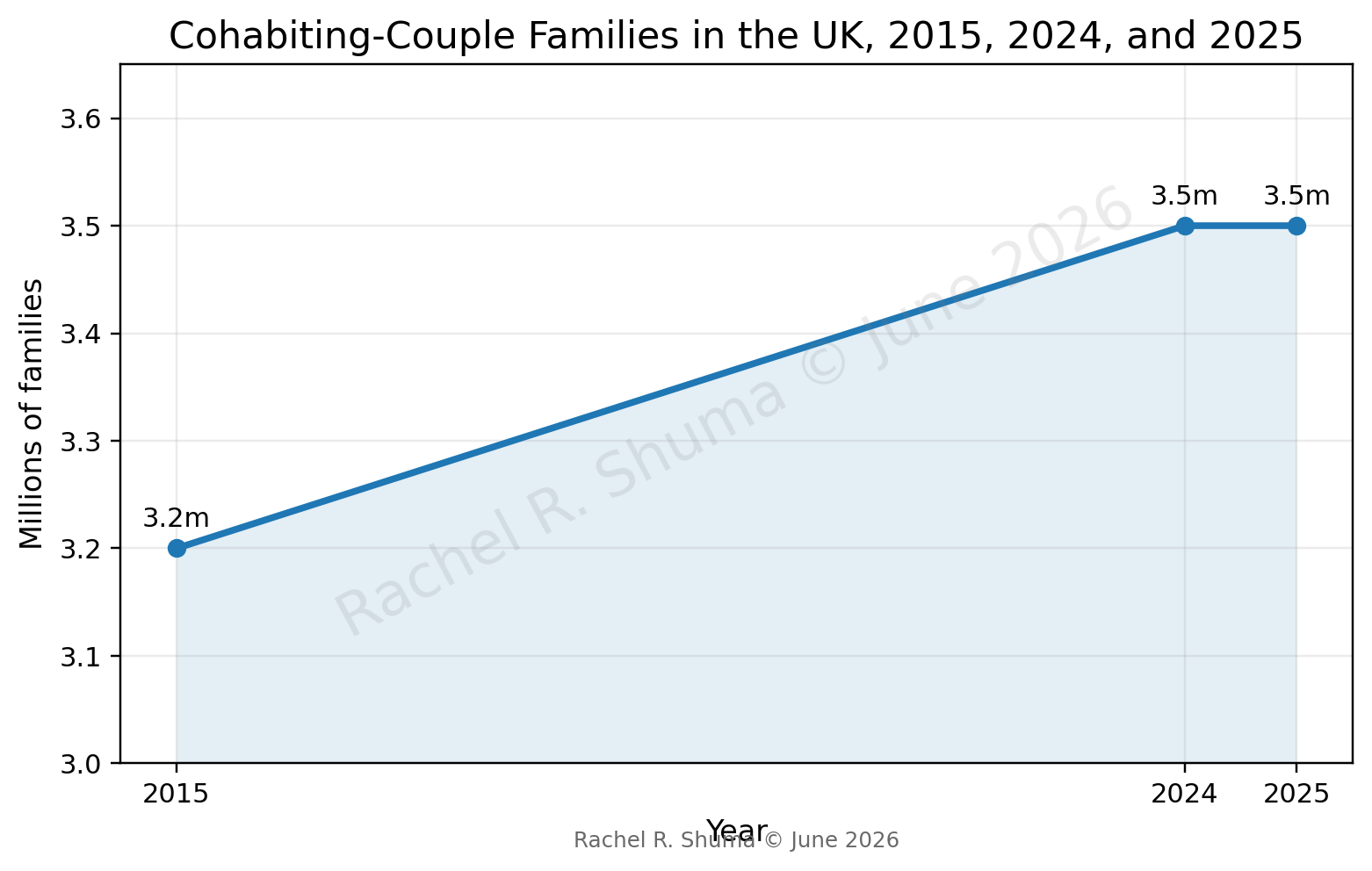
Figure 1. Cohabiting-couple families in the UK, 2015, 2024, and 2025.
Note. Values are drawn from ONS family bulletins for 2024 and 2025, with 2015 baseline reported in the ONS 2025 bulletin. The figure shows scale, not a projection.
Chapter 2: Literature Review
2.1 Formal Status and the Structure of Legal Protection
Across the literature on cohabitation in England and Wales, one legal fact remains settled: formal status is still the main route into broad family-law protection. When a marriage ends, the court may make financial orders under the Matrimonial Causes Act 1973, guided by a broad statutory discretion and the first consideration of the welfare of any minor child of the family. Civil partnership carries a parallel structure under the Civil Partnership Act 2004. By contrast, cohabitants generally do not enter a single statutory scheme on separation. They rely on property, trust, contract, child-related provisions, or specific statutory pockets rather than an overarching family-finance jurisdiction (House of Commons Women and Equalities Committee, 2022; Ministry of Justice, 2026a).
As a result, the legal map is both clear and confusing. It is clear because the law can say that marriage and civil partnership are different from cohabitation. It is confusing because cohabitants are not entirely invisible. In some legal contexts they may be recognized; in others they are treated very differently from spouses. A cohabitant may be relevant for domestic abuse protection, tenancy questions, benefits assessment, or a claim under the Inheritance (Provision for Family and Dependants) Act 1975. That partial recognition encourages the public to assume broader protection than the law gives. The gap between specific recognition and general status is one reason the common-law marriage myth survives.
Recent scholarship emphasizes that England and Wales remain comparatively cautious. Hayward, Sloan, Cullen, and Allum (2023) describe England and Wales as lagging behind Scotland and Australia in the protection given to cohabitants on separation and death. Rodway (2026) argues that the lack of comprehensive protection also invites a human rights framing, especially when relationship-generated vulnerability is ignored while spouses and civil partners enjoy bespoke protections. The shared point across this literature is that the issue has moved beyond technical land law. It now concerns family justice, public understanding, and the adequacy of legal recognition.
A status-based system is not inherently unfair. It can protect clarity, reduce uncertainty, and allow adults to choose whether they want the obligations of marriage or civil partnership. The weakness arises when the system depends on people understanding a legal distinction they do not actually understand. Autonomy is strongest when people know the consequences of the forms they choose. If a person avoids marriage because they understand that cohabitation carries fewer rights, the law may respect that choice. If a person avoids marriage because they wrongly believe cohabitation already carries equivalent rights, the autonomy argument becomes fragile.
2.2 The Common-Law Marriage Myth
At its core, the common-law marriage myth is not a small error in terminology. It is the belief that cohabiting partners acquire rights similar to spouses after living together for a period of time. The Women and Equalities Committee described the myth as widespread and consequential, citing evidence that 46% of people in England and Wales believed unmarried cohabitants formed a common-law marriage, with the figure rising to 55% in households with children (House of Commons Women and Equalities Committee, 2022). Those figures are striking because families with children are often the very households where financial dependency, care decisions, and housing stability carry the highest stakes.
Culturally, the myth endures because it has surface plausibility. In everyday life, long cohabitation often looks like marriage. The couple may share surnames socially, be treated as a unit by neighbors, attend school meetings together, hold joint accounts, raise children, and present as a household. Institutions sometimes reinforce the impression by using terms such as partner, spouse, next of kin, or household member without explaining which meanings are social and which are legal. Law then enters late, at the point when social meaning is no longer enough.
At the same time, the literature shows that legal knowledge is not the only factor. People in intimate relationships do not always behave like commercial actors. They may avoid difficult conversations because the relationship is going well. They may see a cohabitation agreement as unromantic, distrustful, or unnecessary. They may expect fairness to arise from love, parenthood, or shared sacrifice. The Women and Equalities Committee received evidence that optimism bias, uneven bargaining power, and financial dependence can prevent couples from arranging protection even when they know the law is risky (House of Commons Women and Equalities Committee, 2022). The problem is therefore social as well as legal.
Public legal education remains necessary, but the evidence cautions against treating education as a complete answer. Professor Anne Barlow’s work, cited in the parliamentary record, connects the myth to decisions about marriage, civil partnership, cohabitation agreements, and wills (House of Commons Women and Equalities Committee, 2022). A campaign can improve awareness, but awareness competes with emotion, routine, cost, language barriers, family pressure, religious-only marriage, and the tendency to postpone legal planning until crisis. The literature supports education as one part of reform, not as a substitute for reform.
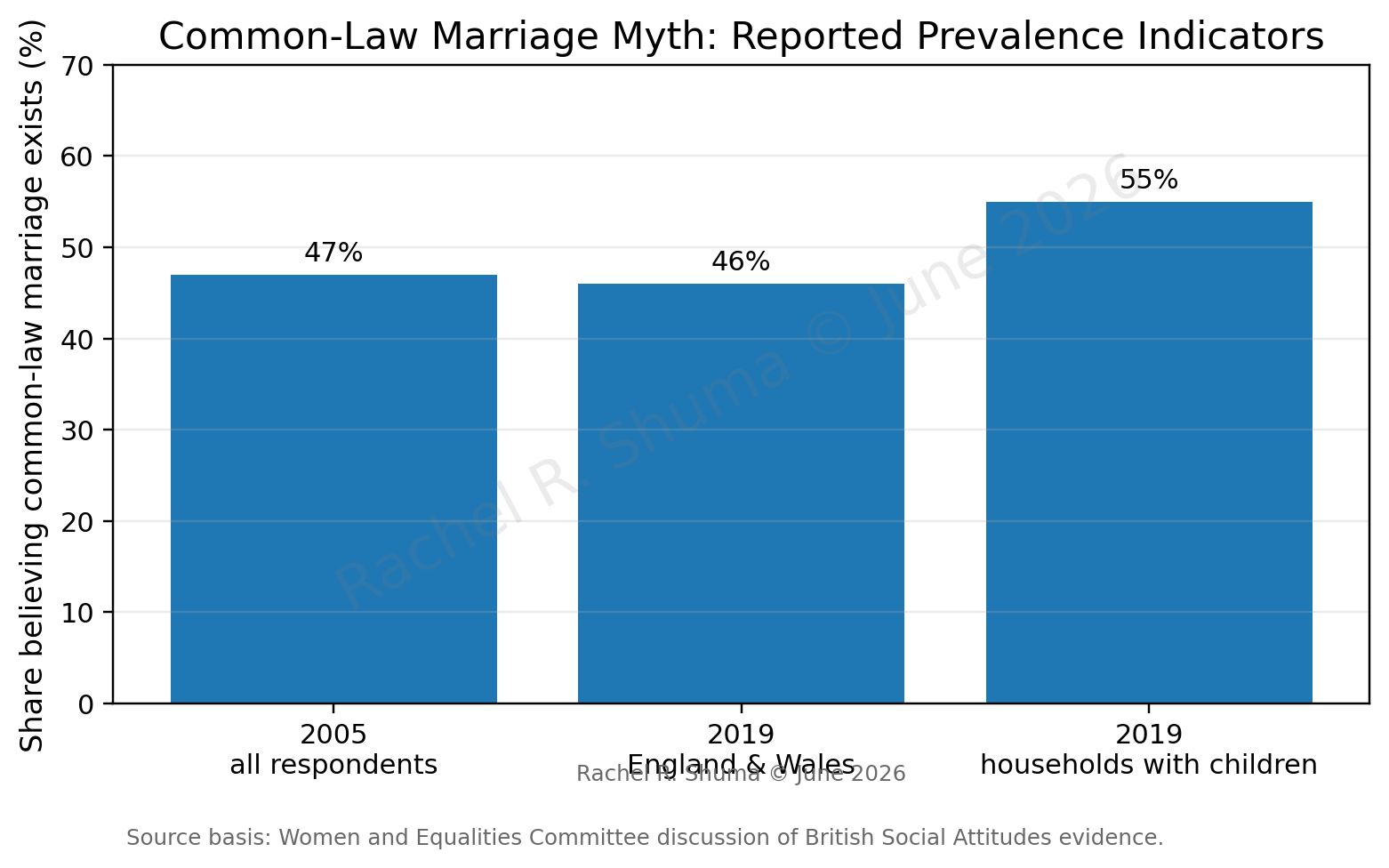
Figure 3. Common-law marriage myth: reported prevalence indicators.
Note. The 46%, 55%, and 47% indicators are drawn from the Women and Equalities Committee’s discussion of survey evidence. They are reproduced here as public-understanding indicators, not as new fieldwork.
2.3 Property, Trusts, and the Family Home
Among the clearest sites of cohabitation risk is the family home. Married spouses and civil partners may access family-law remedies that permit property adjustment within a broader assessment of needs, resources, children, and fairness. Cohabitants do not have that general route. Where the home is jointly owned, disputes may still arise over shares. Where the home is in one partner’s name, the non-owner may need to rely on trust principles, evidence of common intention, or contributions that the law recognizes. The Women and Equalities Committee noted that cohabitants must rely on contract, property, and trust law because there is no statutory scheme offering family-law remedies on relationship breakdown (House of Commons Women and Equalities Committee, 2022).
Leading cases such as Stack v Dowden and Jones v Kernott remain important because they show how beneficial ownership may be inferred or imputed in domestic property disputes. They also show the limits of litigation as a safety net. A court can examine evidence and, in some cases, reach an outcome that reflects the parties’ intentions. But the process is technical, costly, and uncertain. It is not a simple substitute for a clear family-law jurisdiction. Burns v Burns remains a warning from an older era: long cohabitation and domestic contribution did not produce the financial provision the claimant might have expected. The underlying lesson still matters, even though modern trust doctrine has developed since then.
Risk becomes sharper where contributions are indirect. A partner may pay food, utilities, childcare, or other costs, thereby enabling the legal owner to pay the mortgage. Another may provide unpaid care so the owner can work longer hours, travel, or build earnings. Such contributions may be central to the household economy, but they do not always translate neatly into property rights. The law’s evidential preferences can therefore privilege money paid to a deposit or mortgage over labor that sustained the family’s capacity to hold the home. That imbalance is a recurring concern in both scholarship and parliamentary evidence.
In practical guidance, the Law Society advises cohabitants to consider wills and cohabitation agreements and to record arrangements about finances and property (Law Society, n.d.-a; Law Society, n.d.-b). That advice is sound. The weakness is that advice often reaches people after the critical decisions have already been made. A declaration of trust is easiest to negotiate when a property is purchased. A will is easiest to make when relationships are calm. A cohabitation agreement is strongest when both partners have independent advice and enough bargaining power to speak honestly. Crisis is the worst time to discover that none of this was done.
2.4 Death, Intestacy, and Assumed Security
Death exposes another serious gap. A surviving spouse or civil partner has automatic rights under intestacy rules, subject to the structure of the estate and the presence of other relatives. A surviving cohabitant does not automatically inherit simply because the relationship was long, committed, or child-centered. The survivor may be able to bring a family provision claim under the Inheritance (Provision for Family and Dependants) Act 1975 if statutory conditions are met, including provisions for people who lived with the deceased as spouse or civil partner for the required period. But a claim is not the same as automatic inheritance. It may require litigation, delay, cost, and confrontation with the deceased partner’s relatives.
By June 2026, the Ministry of Justice consultation had recognized this weakness by seeking views on reforms to intestacy and family provision rules for cohabitants. The consultation notes that cohabitants currently have no automatic right to inherit when a partner dies without a will and invites views on extending intestacy rights to qualifying cohabitants, subject to defined criteria (Ministry of Justice, 2026a). That proposal is significant because it addresses the moment at which the common-law marriage myth can be most brutal. A person may grieve a partner and, almost at once, discover that the law sees the relationship differently from the way the household lived it.
Nor is the issue limited to inheritance of property. Death can affect administration of the estate, access to information, pension nominations, insurance proceeds, tenancy rights, funeral decisions, and the ability to remain in the home. Some of those issues can be addressed by documents. A will can direct assets. A nomination can guide pension trustees or benefit schemes. A declaration of trust can clarify shares. A lasting power of attorney can prepare for incapacity. Yet the need for these tools is precisely what many couples fail to understand when the common-law marriage myth has given them false confidence.
Taken together, the literature supports a layered response. Private planning is essential, but public law may still need to address severe hardship. Hayward et al. (2023) compare England and Wales with jurisdictions that provide more structured cohabitation protection, while Rodway (2026) situates the issue within a broader rights conversation. Neither point requires turning cohabitation into marriage. The argument is narrower: where death or separation reveals relationship-generated dependence, a modern legal system should not rely entirely on technical doctrines that ordinary couples rarely understand before crisis.
2.5 Care, Gender, Domestic Abuse, and Uneven Vulnerability
Cohabitation risk is often described in neutral terms, but outcomes are not neutral. They are shaped by income, property ownership, childcare, disability, migration status, age, and the distribution of unpaid work. The Women and Equalities Committee heard evidence that financially weaker partners, often women, can leave a relationship with little or nothing when property law does not value childcare and domestic contribution in the same way as direct financial contribution (House of Commons Women and Equalities Committee, 2022). That evidence does not mean every cohabiting relationship is exploitative. It means that the legal framework can magnify inequalities that the relationship itself has already produced.
Domestic abuse adds another layer. Economic abuse can prevent a partner from leaving, restrict access to money, conceal property information, or make negotiation unsafe. The Ministry of Justice’s 2026 consultation explicitly links cohabitation protection to vulnerable groups, women, children, and victim-survivors of domestic abuse, including economic abuse (Ministry of Justice, 2026a). This is not a decorative policy concern. If a partner cannot access a fair legal route without expensive trust litigation, an abusive or controlling partner may use legal complexity as a weapon. A system that appears neutral may then reinforce dependency.
Religious-only marriage also appears in the literature and parliamentary evidence. Some couples may believe they are married in a meaningful religious or community sense but not be married under the law of England and Wales. At breakdown, they may be treated as cohabitants rather than spouses. This can particularly affect women in communities where religious recognition carries strong social meaning but civil registration is absent. What matters legally is not a denial of religious commitment. The difficulty is that social or religious recognition does not automatically activate the civil financial protections attached to marriage or civil partnership.
These inequalities do not justify careless reform. A statutory scheme that is too broad or unclear could create uncertainty and discourage private ordering. But the presence of inequality does defeat the idea that cohabitation is always a fully informed, symmetrical choice. In many relationships one partner may control whether to marry, how property is held, whether documents are signed, and whether advice is affordable. Reform design must recognize that autonomy can be real in some cases, weak in others, and absent where coercion or dependence shapes the relationship.
2.6 Recent Policy Movement and the Literature Gap
Policy has shifted. The Law Commission’s 2007 report recommended a scheme for cohabitants who met defined criteria, but successive governments did not implement it. The Women and Equalities Committee’s 2022 report revived the urgency of the issue, including the need for public awareness and consideration of legal reform. By June 2026, the Ministry of Justice consultation had brought the issue into active policy discussion by proposing a narrower statutory framework for eligible cohabitants on separation and possible intestacy reform (Law Commission, 2007; House of Commons Women and Equalities Committee, 2022; Ministry of Justice, 2026a).
Accordingly, the literature gap is not a lack of debate. It is implementation. Scholars, advice bodies, practitioners, and committees have repeatedly identified the problem. Comparative models exist. Public misunderstanding is documented. Official statistics show cohabitation’s significance. What remains unresolved is the design of a system that is clear enough for the public, narrow enough to preserve marriage as a distinct status, flexible enough to address serious hardship, and cheap enough to avoid turning every dispute into a legal endurance test.
This paper contributes by rebuilding the manuscript around that implementation problem. It moves beyond saying that cohabitants have fewer rights. It asks what follows from that fact in a society where cohabitation is mainstream, where many people misunderstand the law, and where government is actively consulting on reform. The diagrams retained in this paper help translate the literature into decision tools: scale, status gap, myth prevalence, risk pathway, reform principles, and implementation sequence. Each figure is either source-based or clearly labeled as conceptual legal-policy coding.
Table 1. Core differences between formal status and cohabitation.
| Area | Marriage / civil partnership | Cohabitation under current law |
| Relationship status | Formal legal status with broad statutory consequences. | No marriage-equivalent status arises from living together. |
| Separation finance | Family court can consider statutory factors and make wide financial orders. | No overarching statutory financial remedy scheme; property, trust, contract, and child-focused routes dominate. |
| Inheritance without a will | Automatic rights may arise under intestacy rules. | No automatic inheritance as a cohabitant under current law. |
| Family home | Property adjustment may be available on divorce or dissolution. | Claims usually depend on title, trust principles, evidence, or specific statutory routes. |
| Planning need | Planning still useful but status supplies default protections. | Planning is critical: wills, declarations of trust, nominations, and agreements. |
Note. Compiled for publication from official guidance, statute, and parliamentary materials. Copyright © June 2026 Rachel R. Shuma. All rights reserved.
Chapter 3: Methodology and Analytical Framework
3.1 Research Design
This study uses a mixed legal-policy case-study design. Its qualitative dimension examines statutes, parliamentary materials, official consultation documents, professional guidance, and recent scholarship on cohabitation rights in England and Wales. Its quantitative dimension is narrow and cautious. It uses verified demographic and public-understanding indicators, together with clearly identified qualitative coding for legal-protection diagrams. No interviews, surveys, or court-file analysis are claimed. That restraint is important. Fabricated fieldwork would weaken the manuscript and violate the publication standard required for a serious master’s-level paper.
Case-study design is appropriate because cohabitation is not only a doctrinal topic. It is a social and institutional problem. A purely doctrinal study would explain why cohabitants lack general status protection, but it might understate the public misunderstanding and policy consequences. A purely sociological study would show how people live, but it might understate the technical role of property law, intestacy, and formal status. A case-study design allows the paper to examine the legal rule, the public belief, the policy record, and the household risk in one integrated analysis.
As applied research, the study is not theoretical in the narrow sense. It asks how a legal system should respond when its rules are formally knowable but widely misunderstood. It also asks how public institutions should communicate risk without frightening citizens or diluting the value of formal legal status. The study therefore places legal accuracy and practical usability together. A paper that is legally exact but unusable for policy readers would fail the applied purpose. A paper that is readable but legally loose would fail the academic purpose.
3.2 Source Selection and Verification
Evidence was selected according to authority, recency, and relevance. Official sources include the Office for National Statistics, the House of Commons Women and Equalities Committee, the Ministry of Justice, legislation.gov.uk, and the Law Commission. Professional guidance is drawn from Citizens Advice, the Law Society, and Resolution. Recent scholarship and legal commentary include the Financial Remedies Journal, Durham University commentary, Cambridge University Press scholarship, and comparative analysis of cohabitation protection. The use of these sources reflects the character of the topic: family law sits across legal doctrine, public policy, professional practice, and household behavior.
Most policy and empirical sources used in the paper are from 2022 to 2026. That satisfies the need for current support. Older sources are retained only where they remain foundational. The Matrimonial Causes Act 1973, Inheritance (Provision for Family and Dependants) Act 1975, Trusts of Land and Appointment of Trustees Act 1996, Civil Partnership Act 2004, Burns v Burns, Stack v Dowden, Jones v Kernott, and the 2007 Law Commission report are not current commentary; they are legal anchors. Removing them simply because they are older would make the legal analysis less accurate. Method therefore distinguishes current evidence from enduring legal authority.
Source-based evidence and interpretation are also kept separate. When the paper states that the UK had 3.5 million cohabiting-couple families in 2025, it relies on ONS data (ONS, 2026). When it states that the common-law marriage myth was believed by 46% of the England and Wales population and by 55% of households with children, it relies on the Women and Equalities Committee’s report of survey evidence (House of Commons Women and Equalities Committee, 2022). When the paper argues that legal education alone is insufficient, that is an interpretation based on the persistence of the myth, professional guidance, and reform evidence. The distinction helps preserve credibility.
3.3 Analytical Framework
Six dimensions structure the analytical framework: status, understanding, dependency, documentation, remedy, and reform. Status asks whether the relationship form carries a statutory structure comparable to marriage or civil partnership. Understanding asks what the public believes about the legal consequences of cohabitation. Dependency asks whether one partner’s economic position has been shaped by care, housing, children, health, migration, or domestic arrangements. Documentation asks whether the couple has wills, trust declarations, cohabitation agreements, pension nominations, or other protective instruments. Remedy asks what legal route exists when separation or death occurs. Reform asks whether the current response is proportionate to the scale and seriousness of the problem.
These dimensions are not abstract boxes. They correspond to practical questions asked by advisers and families. Who owns the house? Is there a will? Are there children? Did one partner leave work or reduce hours? Is there a pension nomination? Is there a written agreement? Was there abuse or coercive control? Can the surviving partner administer the estate? Does the non-owner have evidence of a beneficial interest? Has the public body or professional adviser used language that implied protection? Each question connects a household fact to a legal consequence.
Equally, the framework respects the boundary between cohabitation and marriage. It does not assume that every cohabiting partner should receive the same relief as a spouse. Instead, it asks when the absence of relief becomes difficult to justify because the relationship created dependence, the household included children, the myth distorted planning, or the legal route is too technical to function as realistic protection. The approach is therefore measured, not maximalist.
3.4 Quantitative and Visual Method
Visually, the method retains the diagrams expected in the manuscript but improves their academic discipline. Figure 1 uses ONS family data for 2015, 2024, and 2025 to show the scale of cohabiting-couple families (ONS, 2025, 2026). Figure 3 uses parliamentary evidence on common-law marriage myth prevalence (House of Commons Women and Equalities Committee, 2022). Figure 2 is not a survey and does not claim to measure actual outcomes. It is a qualitative coding of legal route availability across key domains. Figures 4, 5, and 6 are conceptual diagrams that translate the legal-policy argument into practical sequence and design logic.
This distinction is necessary because visual material can mislead when it assigns numbers to concepts that were not measured. The previous version of the manuscript contained useful diagram themes, but the revision must avoid any impression that illustrative charts are official statistics. For that reason, the current version keeps the diagrams while tightening captions and notes. Where a figure is based on public data, the caption says so. Where a figure is conceptual, the caption says so. Where legal coding is used, the note explains that the coding is analytical and not an empirical survey.
Quantitatively, the paper remains intentionally modest. It does not forecast litigation, estimate the number of future disputes, or assign monetary costs to cohabitation breakdown. It shows scale and misunderstanding because those are supported by the available evidence. It uses visual comparison to clarify legal differences, not to manufacture precision. This is the correct method for a legal-policy paper that must be useful without overclaiming.
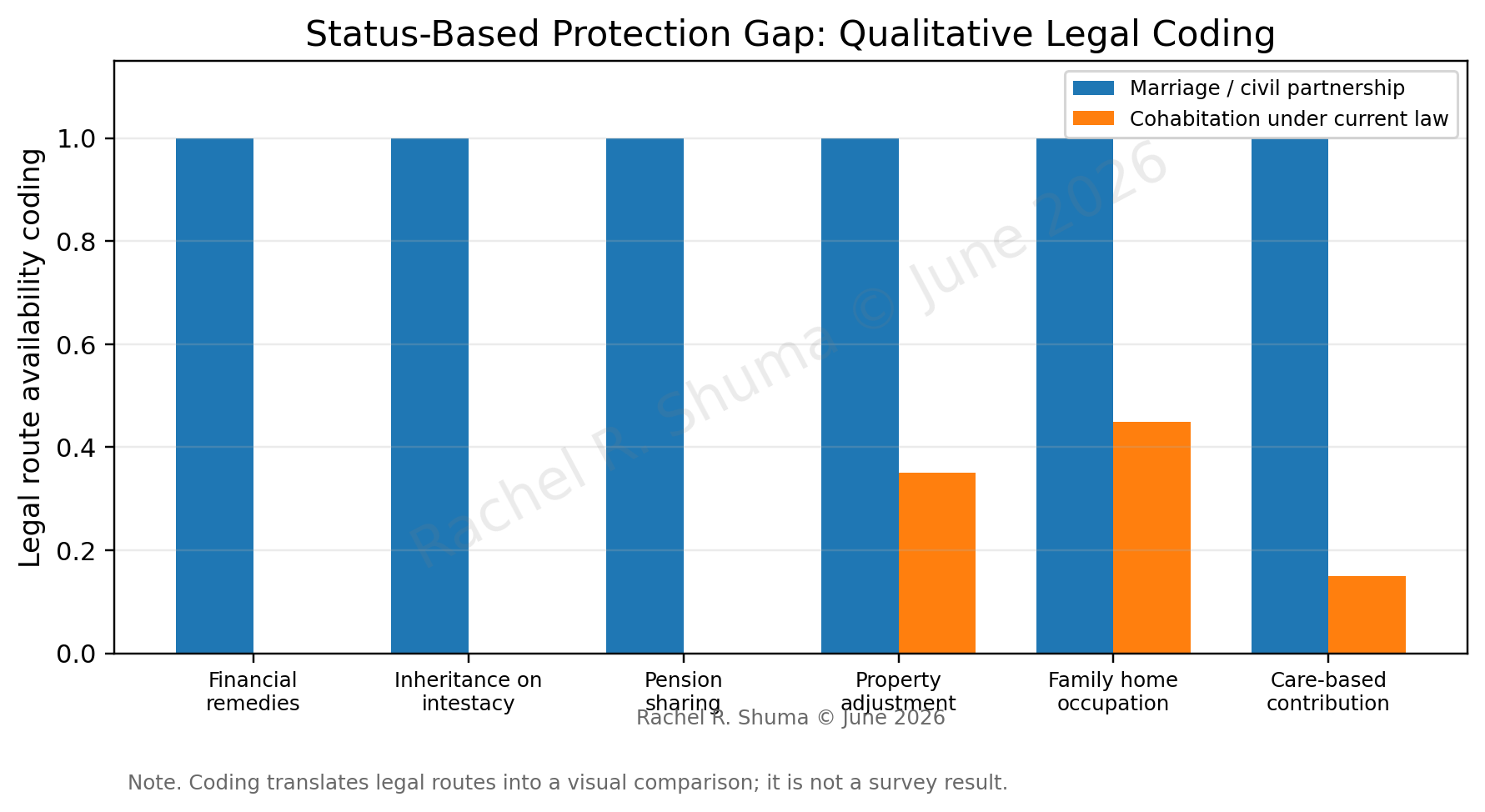
Figure 2. Status-based protection gap: qualitative legal coding.
Note. The figure codes broad legal route availability for communication purposes. It does not claim to measure case outcomes or public opinion.
3.5 Ethics and Limitations
Accuracy is the ethical foundation of the paper. Cohabitation law affects real households, and poor explanation can cause harm. Overstating rights may leave people falsely secure. Overstating reform may lead them to think the law has already changed when it has not. Understating risk may discourage protective planning. For that reason, the paper uses careful language. The June 2026 consultation is described as a consultation, not as enacted law. Cohabitation agreements are described as useful planning tools, not as automatic guarantees. Property claims are described as possible in some circumstances, not as simple substitutes for marriage.
Several limitations remain. This study does not analyze private court files, conduct interviews with separated cohabitants, or measure how many disputes are settled outside court. It does not provide jurisdiction-specific advice for Scotland, Northern Ireland, or other countries, although comparative material is used to inform reform design. It also does not assess every tax, immigration, welfare, or pension consequence of cohabitation. Those topics matter, but a master’s paper must keep a coherent scope. The chosen focus is England and Wales, legal protection, public misunderstanding, and reform design.
Properly acknowledged, the absence of fieldwork is not a weakness. Value here lies in disciplined synthesis of public evidence and legal materials. That synthesis is suitable for a master’s-level research publication because it demonstrates source evaluation, legal-policy reasoning, and practical application. The study also identifies future research opportunities: interviews with cohabitants at key planning moments, empirical analysis of TOLATA dispute costs, study of advice-sector demand, and evaluation of whether public education campaigns change behavior.
Table 2. Verified evidence map for the research argument.
| Evidence type | Main source examples | Role in the paper |
| Official statistics | ONS families and households bulletins, 2023–2026. | Supports demographic scale and the growth context. |
| Parliamentary evidence | Women and Equalities Committee report and government response. | Supports myth prevalence, hardship areas, and reform debate. |
| Professional guidance | Citizens Advice, Law Society, Resolution. | Shows current public-facing advice and planning tools. |
| Current policy | Ministry of Justice 2026 consultation and family test. | Provides live reform benchmark. |
| Legal authority | Statutes and leading cases. | Anchors doctrinal accuracy and explains current routes. |
| Recent scholarship | Rodway, Hayward, and comparative legal commentary. | Supports analysis of reform rationale and comparative lessons. |
Note. The table distinguishes current sources from enduring legal authorities. Copyright © June 2026 Rachel R. Shuma. All rights reserved.
Read also: Leading With Intention: Systems Thinking In Leadership
Chapter 4: Case Analysis and Findings
4.1 The England and Wales Case
England and Wales offer a compelling case because the rule is simple at the top but difficult in operation. Cohabitation does not create a marriage-equivalent legal status. That statement is clear. The difficulty is that cohabiting households still interact with legal systems that recognize them differently in different settings. A partner may be acknowledged in one administrative context and ignored in another. A household may be assessed jointly for some public purposes while one partner has no automatic claim to the other’s property on separation. This patchwork is part of what makes the public position hard to understand.
In parliamentary terms, the Women and Equalities Committee described the existing position as a reliance on a patchwork of property, trusts, contract, and other rules, with no statutory scheme comparable to the one available on divorce or dissolution (House of Commons Women and Equalities Committee, 2022). That description remains accurate while reform is still only in consultation. In practice, cohabitants often need to frame family breakdown as a property dispute. That shift can distort the human reality of the case. A person who spent years caring for children may be forced to prove a property intention rather than ask the court to assess family-generated disadvantage.
By 2026, the Ministry of Justice consultation had recognized the problem by proposing a new statutory framework for eligible cohabitants on separation, narrower than divorce and preserving marriage as a distinct institution (Ministry of Justice, 2026a). This creates a useful analytical moment. The case can now be examined not only through what the law lacks but through what government is considering. The question is whether the proposed direction addresses the main weaknesses identified by evidence: misinformation, property insecurity, economic dependence, child-related vulnerability, domestic abuse, and death without a will.
4.2 Finding One: The Myth Alters Legal Behavior
The common-law marriage myth changes behavior. It is not only an incorrect belief; it is a practical reason people delay protective action. If a person believes the law already protects a surviving partner, the person is less likely to make a will. If a couple believes long cohabitation creates equal property rights, they may not record beneficial interests when buying a home. If one partner believes fairness will be automatic at separation, that partner may accept a property or work arrangement that is legally dangerous. The myth turns a legal gap into a behavioral trap.
Parliamentary evidence makes this point strongly. The Committee reported the 46% and 55% prevalence indicators and connected the myth to the failure to make cohabitation agreements and wills (House of Commons Women and Equalities Committee, 2022). That connection is crucial. Public misunderstanding does not remain in the mind. It travels into decisions. It affects whether couples formalize title, obtain advice, discuss finances, use civil partnership, marry, or plan for death. A legal myth is therefore a risk factor in household governance.
In turn, the myth weakens the claim that cohabitation is always an informed rejection of marriage. Some cohabitants may indeed avoid marriage because they do not want its obligations. Others may avoid it because they assume the law already supplies a fallback position. These two situations should not be treated as the same. The law can respect the first while still addressing the second. The challenge is to design reform that does not punish people for choosing informality but does protect those whose choices were shaped by misinformation or unequal power.
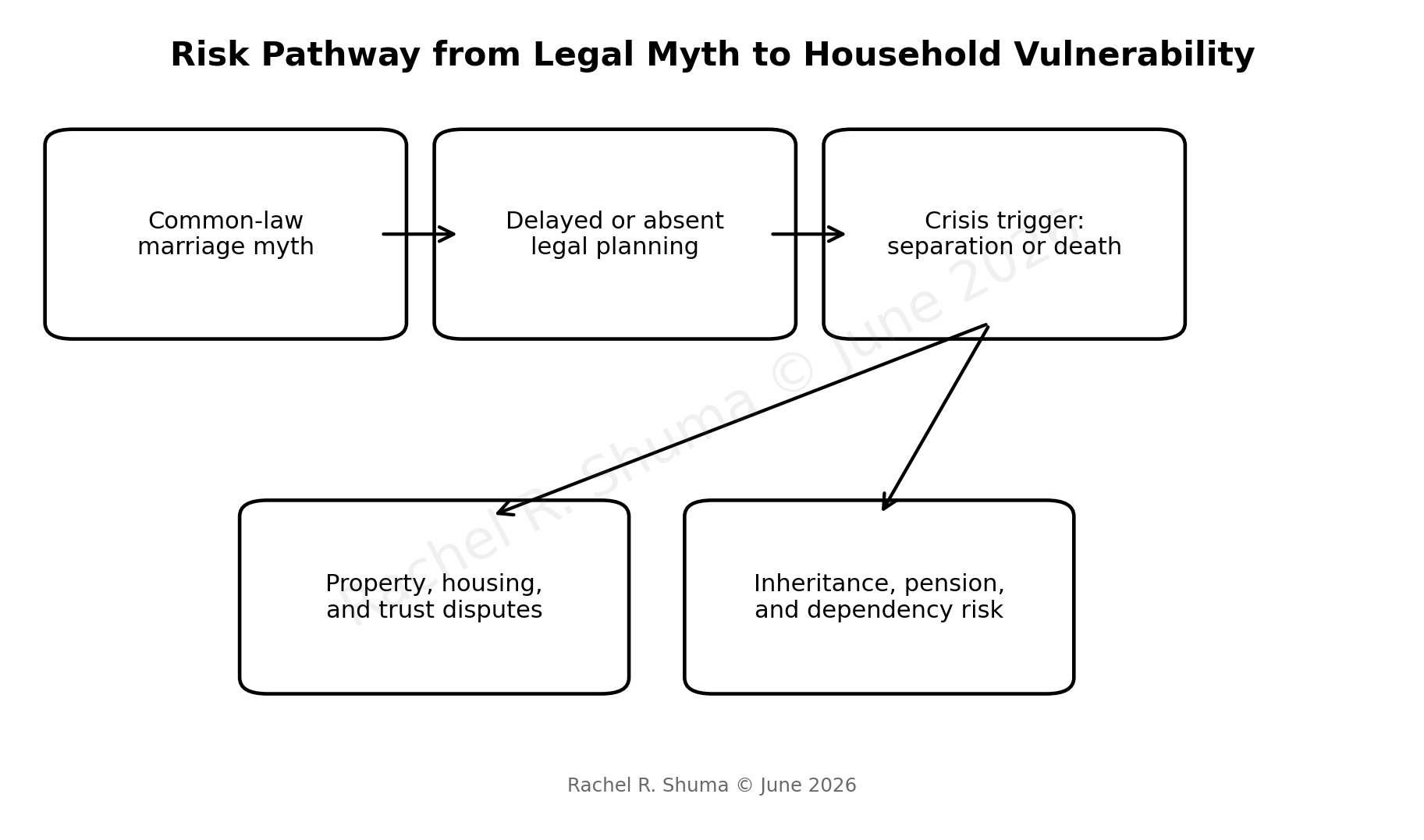
Figure 4. Risk pathway from legal myth to household vulnerability.
Note. This is a conceptual legal-policy diagram showing how misunderstanding can travel into household risk.
4.3 Finding Two: Property Law Cannot Carry the Whole Family Burden
Additionally, property and trust law are inadequate as the main response to long-term cohabitation breakdown. They are necessary legal tools, but they were not designed as a comprehensive family-finance scheme. A property claim may resolve who owns what share of a home. It does not easily address lost earning capacity, years of unpaid care, pension imbalance, or relationship-generated disadvantage. Nor does it provide the same range of remedies available to spouses under matrimonial finance law.
Stack v Dowden and Jones v Kernott show that courts can use domestic context to understand beneficial ownership, especially where property is jointly owned or where intentions can be inferred. But case law does not remove the need for evidence, litigation, and legal cost. It also does not create a general claim for maintenance or compensation. A cohabitant whose contribution took the form of caring labor may still struggle if the legal question is confined to property intention. The family story becomes filtered through doctrines that were not built to value every contribution.
This finding does not mean that courts act without sensitivity. Judges may recognize unfairness, but their powers are limited. The old language in Burns v Burns remains memorable because it located the larger problem with Parliament rather than with judicial sympathy. Now, the Ministry of Justice consultation appears to accept that a statutory answer may be necessary for eligible cohabitants in defined circumstances (Ministry of Justice, 2026a). Its significance is that it treats cohabitation breakdown as a family justice problem, not only as a land law dispute.
4.4 Finding Three: Death Without Planning Produces Severe Shock
Third, death creates severe exposure when one partner dies without a will. The surviving partner may have been the emotional and practical center of the deceased’s life. That fact does not automatically place the survivor in the same position as a spouse or civil partner. If the estate passes under intestacy rules to relatives, the survivor may need to bring a claim for provision. Even where a claim is available, the process can be expensive, delayed, and emotionally painful.
On that point, the Ministry of Justice consultation directly addresses the problem by seeking views on extending intestacy rights to qualifying cohabitants and aligning estate administration rights with any new inheritance entitlement (Ministry of Justice, 2026a). That proposal responds to one of the harshest results of the current law. It recognizes that bereavement is not the right moment to force a surviving partner into avoidable litigation over basic security. Still, the proposal requires careful thresholds because intestacy reform may affect children from previous relationships, parents, siblings, and other relatives. Reform must be protective without producing new unfairness.
Accordingly, the case analysis supports a dual message. Until the law changes, cohabitants need wills, nominations, and clear property arrangements. At the same time, public policy should not be satisfied with a system where basic security depends on whether a couple overcame the common-law marriage myth early enough to plan. Private responsibility and public reform are not enemies. They perform different tasks. Private planning protects individual couples. Public reform addresses predictable hardship where planning failed or was never realistically available.
4.5 Finding Four: Children Intensify the Policy Stakes
Children change the cohabitation question because relationship breakdown affects more than adult property expectations. Housing stability, schooling, care routines, and financial security can all be disrupted. Existing law can provide child-focused remedies in some circumstances, but the adult relationship gap still matters. A parent who reduced employment to care for children may face long-term economic consequences that are not fully addressed by child maintenance or child-focused provision. The welfare of children is therefore linked to the economic position of the caregiving parent.
On children’s welfare, the 2026 Ministry of Justice consultation places the issue among its guiding principles and proposes that children’s welfare should be the first consideration under a new cohabitation framework where resources are limited (Ministry of Justice, 2026a). That direction is sensible because it treats family structure as less important than the child’s need for stability. It also reduces the moral confusion of the debate. Protecting children in cohabiting families does not devalue marriage. It recognizes that children should not experience greater insecurity because their parents did not formalize their relationship.
For households with children, the myth prevalence figure is particularly concerning. If 55% of such households believed in common-law marriage, the group most likely to need stable planning may be among the most exposed to false confidence (House of Commons Women and Equalities Committee, 2022). This evidence supports targeted public communication through antenatal services, child benefit materials, schools, family hubs, housing transactions, and local authority platforms. Legal information should meet families where life decisions occur.
4.6 Finding Five: Reform Must Be Narrow Enough to Be Legitimate
The strongest reform case is targeted rather than symbolic. A reform that simply announces new rights without clear thresholds may create uncertainty and resistance. A reform that does nothing leaves the myth to continue. The middle path is a statutory safety net for defined relationships where interdependence, duration, shared children, economic vulnerability, or death without planning create serious hardship. The Ministry of Justice consultation reflects this by proposing that any cohabitation framework should be different from and narrower than divorce (Ministry of Justice, 2026a).
A narrow scheme can preserve autonomy if couples can opt out by informed agreement, subject to safeguards against coercion. It can preserve marriage by making clear that cohabitation protection is not full matrimonial finance. It can improve access to justice by reducing the need to stretch trust law into every dispute. It can also give professionals a clearer script. Instead of saying only that common-law marriage is a myth, advisers could explain the current law, the planning tools, and any qualifying statutory protections in plain language.
Policy design must avoid turning every informal relationship into a legal dispute. Eligibility should require more than casual co-residence. Factors such as shared household life, duration, financial interdependence, shared children, care responsibilities, and public presentation as a couple may be relevant. Remedies should focus on defined need and relationship-generated disadvantage, not automatic equal division. Maintenance, if available, should be exceptional, limited, and justified by circumstances such as health, childcare, or severe economic dependency. That approach is more credible than either full assimilation or continued neglect.
4.7 Findings Summary
Summarily, the findings show a recurring pattern. Cohabitation is legally different from marriage, but the difference is poorly understood. The common-law marriage myth delays planning and weakens informed choice. Property and trust law provide some routes but cannot value every form of domestic contribution. Death without a will exposes surviving partners to severe insecurity. Children and care responsibilities intensify the policy stakes. Reform is most defensible when it is targeted, clear, and distinct from marriage.
Evidence also shows why the paper needed a rebuild. A short paper without in-text citations cannot carry this subject at master’s level. Current official data, parliamentary evidence, professional guidance, statutory context, and recent scholarship are all necessary. So is a tone that avoids exaggeration. The credible argument is not that every cohabitant should be treated as a spouse. The credible argument is that a modern legal system should not let myth, complexity, and silence create avoidable harm for millions of households.
Chapter 5: Discussion and Reform Design
5.1 Autonomy and Informed Choice
Autonomy is the main objection to cohabitation reform. Adults may choose not to marry or enter a civil partnership. That choice may be personal, political, religious, financial, cultural, or emotional. The law should not assume that every informal relationship is a failed marriage waiting to be corrected. A serious reform argument must begin by accepting that autonomy matters. It also has to ask whether autonomy is meaningful when the legal consequences of a choice are misunderstood.
Autonomy requires information. If a couple rejects marriage after understanding that they will not have automatic financial remedies, pension sharing, or intestacy rights, the law can give weight to that decision. If the same couple rejects marriage because they believe the common-law marriage myth, their decision is not fully informed. The parliamentary evidence makes this distinction unavoidable. A belief held by almost half of the population cannot be dismissed as a fringe misunderstanding (House of Commons Women and Equalities Committee, 2022).
Informed choice also requires practical capacity. Some partners cannot secure marriage, civil partnership, or written agreements because the other partner refuses. Some cannot afford advice. Some are dealing with coercive control. Some are in religious-only marriages and do not realize the civil consequences. Some speak English as a second language or find legal forms intimidating. Reform should not treat all non-formalization as consent to vulnerability. That would turn autonomy into a fiction.
An opt-out model may offer a careful balance. If a statutory scheme applies to eligible relationships, adults who do not want those consequences could exclude them through a documented process, provided there is no coercion and both understand the effect. This respects freedom while avoiding the weakness of pure opt-in schemes, where the people most at risk may never know they need to opt in. The Women and Equalities Committee’s evidence shows why lack of knowledge makes opt-in protection inadequate for many households (House of Commons Women and Equalities Committee, 2022).
5.2 Public Legal Education
Public legal education is the least controversial reform and one of the most urgent. Its message must be plain: living together does not create a marriage-equivalent status in England and Wales. That same message must be repeated across the places where couples make life decisions. It should not appear only on specialist legal websites. It should appear in property purchase guidance, tenancy information, antenatal and family services, pension and nomination materials, bereavement guidance, advice-sector resources, and public-facing government pages.
An education campaign should avoid moralizing. People do not need to be scolded for cohabiting. They need accurate information. A useful message would say that cohabiting partners may have some rights in specific situations, but they do not have the same automatic protections as spouses or civil partners. It should explain wills, declarations of trust, cohabitation agreements, life insurance, pension nominations, and the importance of legal advice before major financial decisions. The Law Society’s public guidance already points in this direction by advising cohabitants to make wills and consider cohabitation agreements (Law Society, n.d.-a; Law Society, n.d.-b).
Timing matters. A person in the middle of grief, separation, or domestic abuse does not receive information in the same way as a person buying a home or planning a child. Legal education should therefore be designed around life events. State and professional bodies could create short, standardized notices for conveyancers, registrars, family hubs, mortgage lenders, will-writing services, pension administrators, and local authorities. The aim would not be to turn every adviser into a family lawyer. It would be to stop institutional silence from feeding the myth.
Language matters as well. The phrase common-law marriage should not be used loosely in forms, marketing, or institutional communication. Where it is mentioned, the phrase should be immediately corrected: there is no common-law marriage status equivalent to marriage in England and Wales. That correction should be written without legal jargon. A message that requires legal training to understand will not solve a public legal literacy problem.
5.3 Private Planning Tools
Private planning remains essential even if statutory reform occurs. A targeted cohabitation scheme would not remove the need for wills, trust declarations, nomination forms, and written agreements. It would only provide a safety net in defined circumstances. Couples who want certainty should still document their arrangements. The best private planning happens before conflict, when both partners can speak calmly, obtain advice, and record intentions clearly.
A will is central because intestacy does not currently protect cohabitants automatically. The 2026 consultation may change that for qualifying cohabitants, but consultation is not legislation (Ministry of Justice, 2026a). Until reform is enacted, a cohabiting partner who wants the other to inherit should use a valid will. Even after reform, a will may remain necessary to handle blended families, specific gifts, guardianship concerns, funeral wishes, and estate administration. Reform is not a substitute for estate planning.
Declarations of trust are equally important for homes. If a couple buys property together or one partner contributes to a home in the other’s name, the beneficial interests should be recorded. A declaration can prevent later disagreement about shares. It also protects the partner whose contribution might otherwise be hard to prove. The absence of written evidence is not only a legal inconvenience; it can become the difference between security and loss.
Cohabitation agreements can address finances, property, expenses, separation arrangements, and sometimes responsibilities during illness or death. The Ministry of Justice consultation notes that such agreements may set out property ownership, financial responsibilities, and what should happen if the relationship ends, although their enforceability depends on drafting and circumstances (Ministry of Justice, 2026a). That caveat should be part of public education. A poorly drafted agreement may give false confidence. A carefully drafted one can prevent serious dispute.
Private planning tools should be low-cost and accessible. Government, professional bodies, and advice organizations could publish model checklists rather than pretending every household can afford bespoke advice at the first sign of cohabitation. Such a model should not replace legal advice for complex cases, but it can alert couples to the issues. The goal is to make planning normal rather than alarming. Couples should not have to wait for relationship breakdown to learn that ordinary paperwork could have prevented hardship.
5.4 Targeted Statutory Reform
Targeted statutory reform is the strongest legal response because it accepts both sides of the issue. Cohabitation should not become marriage by accident. At the same time, the current gap leaves too much hardship to property litigation and private documents that many couples never make. A statutory scheme can be designed to apply only to qualifying relationships and to provide narrower relief than divorce. The Ministry of Justice consultation proposes this general direction by seeking views on a framework for eligible cohabitants that remains different from and narrower than divorce (Ministry of Justice, 2026a).
Eligibility must be clear. Duration, shared children, living together in a committed and interdependent relationship, financial dependence, and the nature of the household are obvious factors. The 2026 consultation suggests eligibility for adults in long-term, committed, interdependent relationships who have lived together for at least three years or live together and share a child (Ministry of Justice, 2026a). That threshold has the advantage of public intelligibility. People can understand a time period and the significance of shared children. A scheme should also consider safeguards for abuse, disability, and cases where strict duration rules would create obvious injustice.
Remedies should be limited to defined needs and relationship-generated disadvantage. A cohabitant should not receive a better outcome than a spouse in comparable circumstances. Nor should the scheme presume equal sharing of all assets. The starting point can remain that each person keeps what they legally own, with departure only where necessary to meet defined need, protect children, or address disadvantage generated by the relationship. That model answers the strongest autonomy objection while still giving courts a tool to prevent severe hardship.
Maintenance should be exceptional and time-bound. Long-term spousal-style maintenance would make the scheme more controversial and less distinct from marriage. But there may be cases involving disability, health, childcare, or severe dependency where a limited transitional order is justified. The point is not to reward informal relationships. It is to prevent a partner from leaving a long interdependent household in a state of serious vulnerability created by the relationship’s organization.
A clean-break principle should guide the scheme where possible. Many cohabitants will not want prolonged financial ties after separation. A targeted capital adjustment, occupation arrangement, or short transitional order may be more appropriate than continuing payments. This approach is consistent with the consultation’s emphasis on clean break and limited maintenance (Ministry of Justice, 2026a). It also gives reform a better chance of public acceptance because it makes clear that cohabitation protection is a safety net, not a full duplicate of marriage.
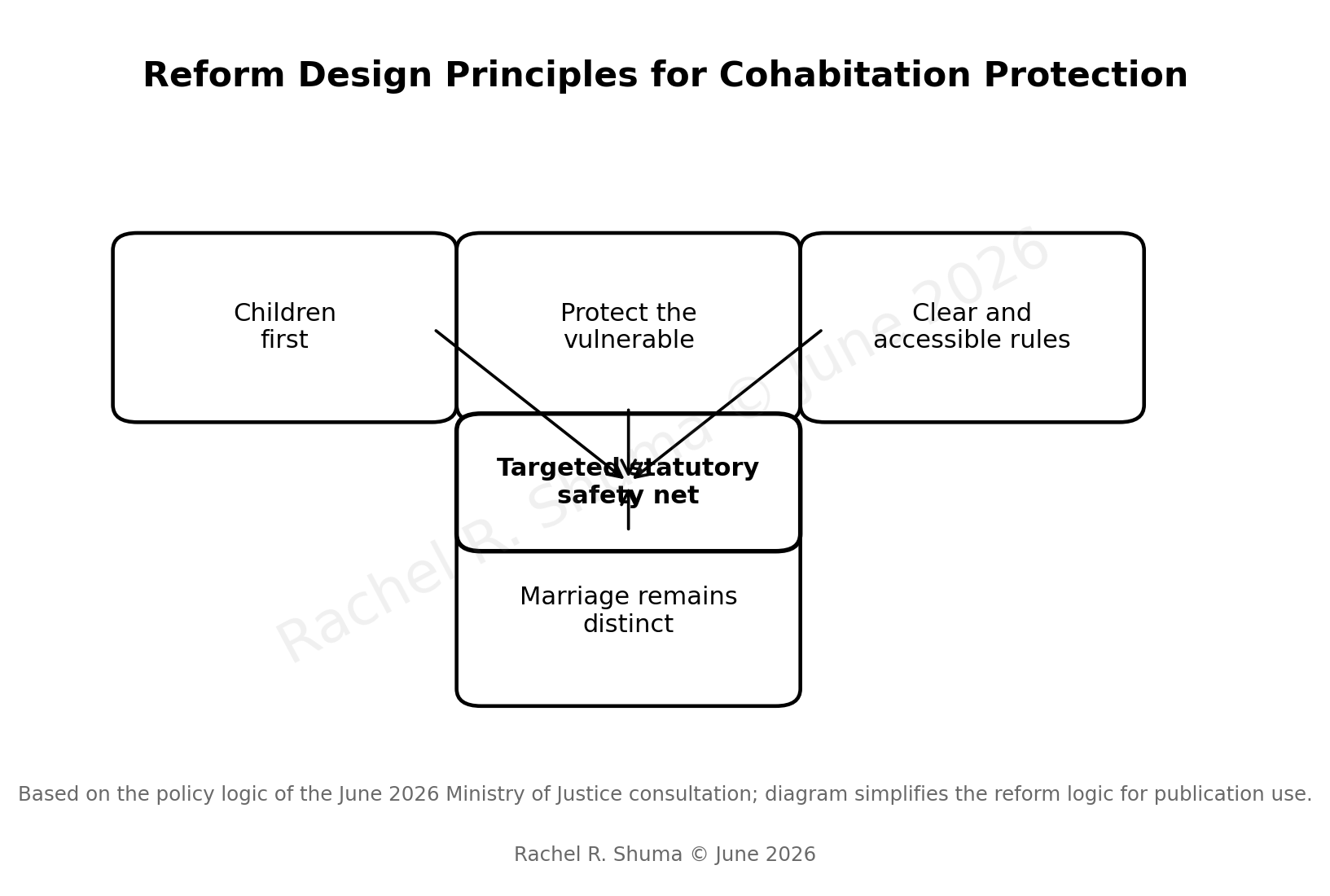
Figure 5. Reform design principles for cohabitation protection.
Note. The diagram simplifies the policy principles described in the June 2026 Ministry of Justice consultation and applies them to the paper’s targeted reform model.
5.5 Intestacy and Bereavement Reform
Reform on death may be even more compelling than reform on separation because bereavement leaves no opportunity for negotiation with the deceased partner. A surviving cohabitant may have shared life with the deceased for years, cared for them, raised children with them, or depended on them economically. Without a will, the survivor may still have no automatic inheritance. A family provision claim may exist, but it is not a simple or immediate right. The cost and emotional burden can be significant.
On this issue, the Ministry of Justice consultation proposes consideration of intestacy rights for qualifying cohabitants and related administration rights (Ministry of Justice, 2026a). This is a serious policy shift. It would bring the law closer to social reality in long-term relationships, while still requiring careful thresholds. The scheme must address blended families and children from previous relationships. It must also decide whether the qualifying test should mirror the separation test or require a stronger marriage-equivalence standard. Those design questions are not technical details; they determine who is protected and who may lose expected inheritance.
Reform is strongest where the couple shared children, lived together for a significant period, or where the surviving partner was financially dependent. It is weaker for short relationships, casual co-residence, or situations where the deceased clearly made contrary arrangements. A valid will should remain the primary expression of testamentary intention. Intestacy reform should address the absence of planning, not override clear planning without strong justification.
Public education must remain central even if intestacy law changes. Qualifying cohabitants might still fail to meet the threshold. A will remains more precise than a statutory fallback. Pension benefits may depend on scheme rules and nominations. Life insurance may have named beneficiaries. A surviving partner may need authority to administer the estate. These practical details show why reform should be joined to planning guidance rather than sold as a complete solution.
5.6 Professional Responsibility and Institutional Communication
Professionals have a direct role in reducing the myth. Conveyancers, family lawyers, will writers, pension administrators, housing officers, mortgage brokers, registrars, social workers, domestic abuse advocates, and advice workers all encounter cohabiting households at moments of legal significance. They do not all need to provide family-law advice. They do need to avoid language that implies rights that do not exist. They should know when to signpost clients to reliable information.
A simple professional protocol would help. When an unmarried couple buys a home, the conveyancing process should include a plain warning about beneficial interests, declarations of trust, wills, and separation consequences. When a child is born to unmarried parents, family-facing services should include information about parental responsibility, financial planning, and relationship status. When someone names a partner in a pension or insurance context, the form should explain what nomination does and does not do. When someone describes a partner as a common-law spouse, professionals should correct the term kindly and clearly.
Institutions should also update digital guidance. The problem is not that information is impossible to find. It is that people do not search for information they do not know they need. Public-facing websites should use plain headings, short examples, and decision checklists. A person should be able to answer basic questions: Do we own the home equally? What happens if one of us dies? Do we have wills? Are pension nominations up to date? Would the non-owner have to prove a trust? Do we have children? Is one partner economically dependent? These questions are more useful than abstract warnings.
Professional communication should also be sensitive to domestic abuse. Advising a victim-survivor to negotiate an agreement with an abusive partner may be unsafe. Signposting must include specialist support. Economic abuse can affect access to documents, bank accounts, property information, and legal advice. Any reform or education campaign that ignores abuse will fail the very group most likely to need protection.
5.7 Reform Risks and Safeguards
Every reform carries risks. A scheme that is too vague may increase litigation because couples will fight over whether they qualified and what remedies should follow. A scheme that is too rigid may exclude hard cases. A scheme that resembles marriage too closely may be criticized as undermining formal status. A scheme that is too narrow may become symbolic and fail to protect the vulnerable. Sound design must keep these risks in view rather than pretend they do not exist.
Clear definitions are the first safeguard. The scheme should define qualifying cohabitation in a way that ordinary people can understand and courts can apply. It should identify the significance of duration, shared children, living arrangements, financial interdependence, and mutual commitment. It should also state what does not count: ordinary house sharing, short casual relationships, temporary accommodation, and relationships lacking the required interdependence. Ordinary readers should not need a law degree to know whether a scheme may apply.
Independent advice and anti-coercion safeguards are essential for opt-out agreements. An opt-out signed under pressure should not defeat protection. This is especially important where there is economic abuse or unequal bargaining power. The law should respect adults who genuinely wish to exclude statutory consequences, but it should not allow a stronger partner to strip protection from a weaker one through pressure or deception.
Costs must also be controlled. If a new scheme sends every dispute into expensive litigation, it will fail the access-to-justice test. Mediation, early neutral evaluation, standardized disclosure, simple forms, and clear judicial guidance could reduce disputes. Legal aid and advice-sector capacity should be considered for vulnerable cases. Reform without access is often reform in name only.
Finally, reform should be reviewed after implementation. Data should be collected on claims, settlement patterns, duration, outcomes, costs, domestic abuse issues, children’s welfare, and user understanding. That review should not be used to delay reform indefinitely. It should be used to improve design after experience shows how the scheme works.
5.8 Discussion Summary
Overall, the discussion supports a layered model. Public legal education should correct the myth. Private planning should give couples practical control. Professional communication should prevent institutions from reinforcing false assumptions. Statutory reform should provide a narrow safety net for defined hardship. Intestacy reform should protect bereaved qualifying partners without ignoring children and other family members. Domestic abuse safeguards should be built into both advice and remedies.
This model is deliberately moderate. It does not treat cohabitation as morally inferior. It does not treat marriage as irrelevant. It does not claim that law can solve every intimate hardship. It asks the law to speak honestly, protect against predictable injustice, and give ordinary households tools they can understand before crisis. That is the proper standard for a master’s-level legal-policy paper on cohabitation and relationship rights.
Chapter 6: Implementation, Closing Analysis, and Recommendations
6.1 Implementation Priorities
Implementation should begin with communication because communication can be improved before legislation is complete. Government pages, advice-sector resources, local authority materials, family hubs, and professional bodies should use consistent language. One core message should be repeated without ambiguity: cohabitation is not marriage or civil partnership, and there is no automatic common-law marriage status in England and Wales. That message should then be followed by practical action points rather than left as a warning. People need to know what to do next.
A national cohabitation information pack would be useful if designed with restraint. It should include a one-page status explanation, a home ownership checklist, a will-making reminder, a pension and insurance nomination reminder, a cohabitation agreement guide, a domestic abuse safety note, and signposting to regulated legal advice. It should avoid dense legal language. The point is not to produce a textbook. It is to interrupt false confidence at the moment when decisions can still be made.
Professional training should follow. Conveyancers should understand the family-law significance of title choices. Will writers should ask about cohabiting partners and children. Pension administrators should explain the limits of nominations. Advice workers should know when to refer to family lawyers or domestic abuse specialists. Registrars and family-support workers should be able to explain the difference between marriage, civil partnership, and cohabitation without making moral judgments. Training should be short, practical, and repeated.
6.2 Legislative Design Steps
Legislative design should proceed through consultation, draft bill scrutiny, implementation planning, and public education. Consultation should not be treated as a formality. It should hear from cohabitants, family practitioners, domestic abuse organizations, children’s advocates, property lawyers, pension specialists, probate practitioners, faith communities, and civil society groups. Cohabitation affects many systems. A narrow legal drafting exercise would miss practical problems.
Draft legislation should state eligibility, remedies, opt-out rules, safeguards, court powers, limitation periods, and interaction with existing statutes. It should also clarify how claims relate to TOLATA, Schedule 1 to the Children Act 1989, the Inheritance (Provision for Family and Dependants) Act 1975, and any revised intestacy rules. Without clear interaction rules, reform may add a new layer of complexity rather than reduce it. The policy objective should be an accessible framework, one of the principles identified in the Ministry of Justice consultation (Ministry of Justice, 2026a).
Transitional rules should accompany the scheme. Couples who already live together should be informed before new rights or obligations apply. Opt-out procedures, if adopted, should be available but carefully safeguarded. Public education should begin before commencement so that reform is not misunderstood as automatic marriage. The language must remain clear: a statutory safety net for eligible cohabitants is not the same as marriage.
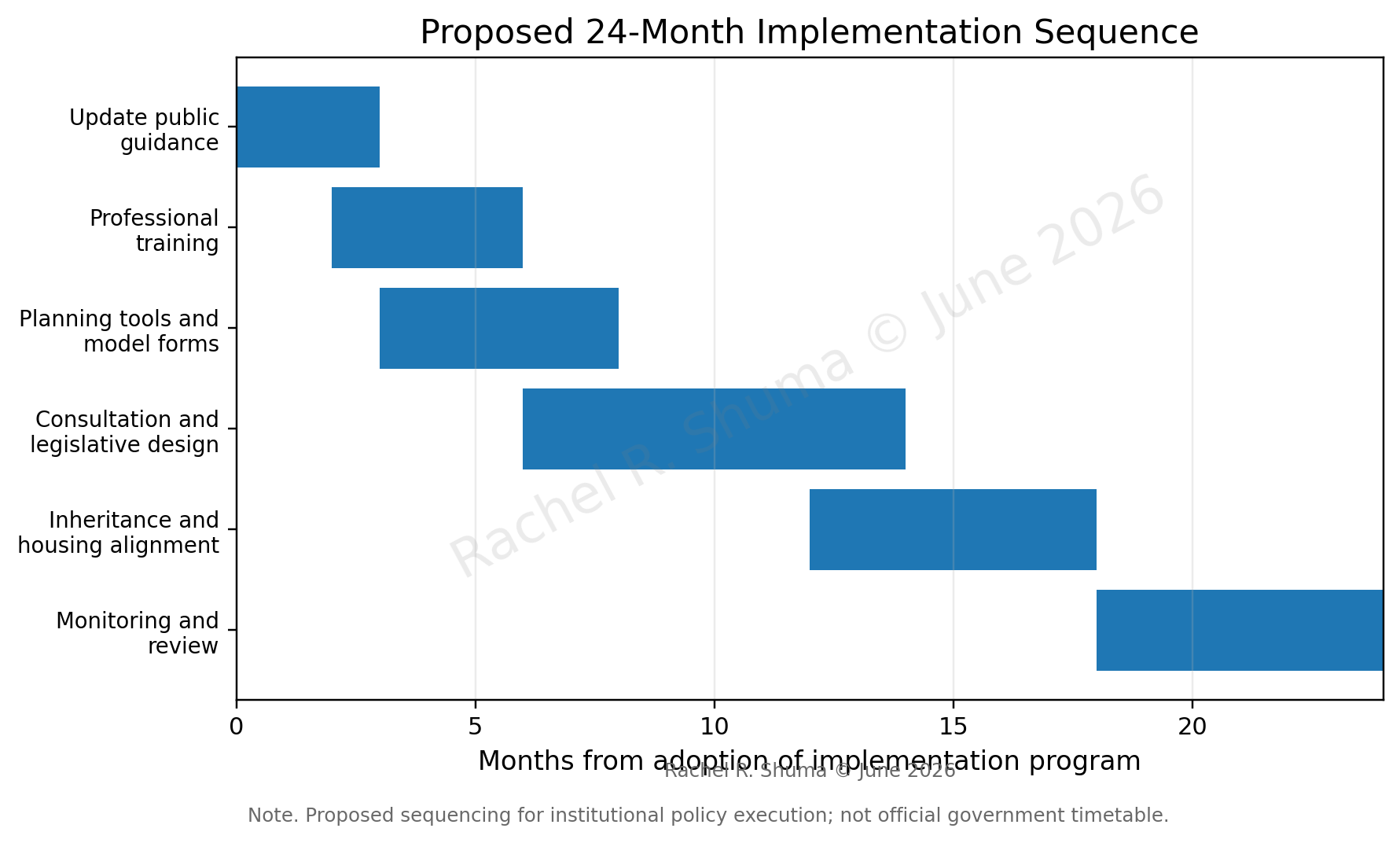
Figure 6. Proposed 24-month implementation sequence.
Note. This figure presents a proposed implementation order for public legal education and reform planning. It is not an official government timetable.
6.3 Household Planning Recommendations
Cohabiting couples should not wait for legal reform. They should review ownership, wills, nominations, insurance, debts, savings, parental responsibility, and emergency decision-making authority. If they own or intend to buy a home, they should record beneficial shares and understand the effect of joint tenancy or tenancy in common. If one partner contributes indirectly, the couple should discuss whether and how that contribution should be recognized. Silence is not a plan.
Couples with children should give special attention to housing stability and future care. A will should address guardianship issues and inheritance. Property arrangements should consider what happens if one parent dies or if the relationship ends. If one partner reduces paid work for childcare, both should understand the long-term financial consequences. The law may not repair those consequences later without documentation or statutory reform.
Couples should also treat cohabitation agreements as planning tools rather than signs of distrust. A serious relationship can survive honest financial conversation. The agreement should be drafted carefully, reviewed after major events, and supported by independent advice where possible. It should not be used to impose unfair terms on a weaker partner. Good planning protects both people because it reduces the chance that a later court or family dispute will have to reconstruct intentions from memory.
6.4 Recommendations for NYCAR and Public Legal Literacy
NYCAR can treat this paper as a model for applied legal literacy research. The topic is suitable for public seminars, professional short courses, and policy discussion because it affects ordinary households and requires interdisciplinary thinking. A training module could combine family law basics, demographic evidence, public communication, and case scenarios. Learners would not be trained to give legal advice unless qualified. They would be trained to recognize risk, communicate accurately, and refer responsibly.
A public legal literacy program should avoid legal panic. Its message should not be that cohabitants are doomed. Rather, it should explain that cohabitants need documents and clear arrangements because the law does not automatically treat them as spouses. A calm message is more effective than alarm. It respects people’s choices while making the consequences clear.
NYCAR’s publication version should retain the diagrams because they help readers see the issue quickly. A growth chart shows scale. A status-gap figure shows why marriage and cohabitation differ. A myth-prevalence figure shows why education matters. A risk pathway explains how misunderstanding becomes hardship. A reform-principles diagram presents the design balance. An implementation sequence turns the analysis into action. Each diagram should carry copyright in Rachel R. Shuma’s name and should be labeled accurately.
6.5 Closing Analysis
Cohabitation in England and Wales exposes a serious gap between household reality and legal protection. The law can say that marriage and civil partnership are formal statuses, and it is right to preserve the clarity of those statuses. But clarity inside the law is not the same as clarity in public life. When millions of people form intimate households outside marriage and a large share still believes in common-law marriage, the legal system has a communication problem as well as a protection problem.
A credible answer is not to pretend cohabitation is marriage. It is to make the difference honest, visible, and manageable. Couples should be told what the law does not do. They should be given practical tools before crisis. Professionals should stop using language that feeds the myth. Parliament should consider a narrow statutory scheme for eligible relationships where hardship is serious, children are affected, or dependence was created by the household itself. Death without a will should receive particular attention because bereavement is the harshest moment for legal surprise.
By placing reform in a live policy frame, the June 2026 Ministry of Justice consultation gives the debate a timely focus. It proposes clearer protection for eligible cohabitants while preserving marriage as distinct (Ministry of Justice, 2026a). That is the correct direction if handled carefully. Reform must be precise enough to avoid creating uncertainty and humane enough to avoid repeating old unfairness. The evidence does not support institutional silence. It supports honest law, practical planning, and targeted protection.
This paper therefore closes with a restrained conclusion. Cohabitation is a legitimate family form. Marriage and civil partnership remain legally distinct. The common-law marriage myth is dangerous because it gives households confidence without protection. A modern legal system should not rely on a false public belief to preserve formal categories. It should state the truth plainly, help people plan, and provide a measured remedy where the absence of status would otherwise produce serious and preventable hardship.
6.6 Final Recommendations
Government should run a plain-language national campaign explaining that common-law marriage does not exist as a marriage-equivalent status in England and Wales. The campaign should be connected to life events, including home purchase, childbirth, pension enrolment, bereavement planning, and separation support. Public bodies should audit their language so that they do not use common-law spouse or similar terms without correction.
Parliament should consider a targeted statutory scheme for eligible cohabitants, narrower than divorce and built around defined need, children’s welfare, serious economic vulnerability, and relationship-generated disadvantage. The scheme should include clear eligibility thresholds, opt-out safeguards, domestic abuse protections, and clean-break principles where possible. It should interact clearly with property, trust, child, and inheritance law.
Cohabiting couples should be encouraged to make wills, record property interests, update pension and insurance nominations, consider cohabitation agreements, and seek advice before major financial choices. These tools should be presented as normal household planning, not as pessimism. Advice-sector and professional bodies should produce affordable checklists and model guidance.
Future research should examine how cohabitants actually receive legal information, what prevents planning, how much TOLATA disputes cost, how domestic abuse affects cohabitation property claims, and whether public awareness campaigns change behavior. Reform should be reviewed after implementation with data on access, cost, outcomes, children’s welfare, and user understanding.
Table 3. Household planning checklist for cohabiting partners.
| Planning area | Question cohabitants should ask | Practical document or action |
| Home ownership | Who owns the legal title and who owns the beneficial share? | Declaration of trust; title review; written ownership record. |
| Death planning | What happens if one partner dies without warning? | Valid will; pension and insurance nominations; estate administration planning. |
| Children | How will housing, care, and financial stability be protected? | Parenting arrangements; child-focused financial planning; legal advice. |
| Separation | What happens if the relationship ends? | Cohabitation agreement; debt and savings records; dispute-resolution plan. |
| Dependency | Has one partner reduced work or earnings for the household? | Written recognition of contributions; pension planning; advice on risk. |
| Safety | Is there coercion, economic abuse, or fear? | Specialist domestic abuse support; safe legal advice; protection planning. |
Note. This checklist is educational and does not replace legal advice. Copyright © June 2026 Rachel R. Shuma. All rights reserved.
References
Burns v Burns [1984] Ch 317 (CA).
Citizens Advice. (n.d.). Living together and marriage: Legal differences. Citizens Advice. https://www.citizensadvice.org.uk/family/living-together-marriage-and-civil-partnership/living-together-and-marriage-legal-differences/
Civil Partnership Act 2004, c. 33. https://www.legislation.gov.uk/ukpga/2004/33/contents
Hayward, A. (2023, February 13). Cohabitation: It’s time to take legal reform seriously. Durham University. https://www.durham.ac.uk/research/current/thought-leadership/2023/02/cohabitation-its-time-to-take-legal-reform-seriously/
Hayward, A. (2023, November 23). Cohabitation and Labour’s commitment to changing the law: What reform might look like? Financial Remedies Journal. https://financialremediesjournal.com/cohabitation-and-labours-commitment-to-changing-the-law-what-reform-might-look-like/
Hayward, A., Sloan, W., Cullen, M., & Allum, M. (2023, July 3). Cohabitation rights in England and Wales, Scotland and Australia. Financial Remedies Journal. https://financialremediesjournal.com/cohabitation-rights-in-england-and-wales-scotland-and-australia/
House of Commons Women and Equalities Committee. (2022). The rights of cohabiting partners: Second report of session 2022–23 (HC 92). UK Parliament. https://publications.parliament.uk/pa/cm5803/cmselect/cmwomeq/92/report.html
House of Commons Women and Equalities Committee. (2022). The rights of cohabiting partners: Government response to the Committee’s second report of session 2022–23 (HC 633). UK Parliament. https://publications.parliament.uk/pa/cm5803/cmselect/cmwomeq/633/report.html
Inheritance (Provision for Family and Dependants) Act 1975, c. 63. https://www.legislation.gov.uk/ukpga/1975/63
Jones v Kernott [2011] UKSC 53.
Law Commission. (2007). Cohabitation: The financial consequences of relationship breakdown (Law Com No. 307). The Stationery Office. https://assets.publishing.service.gov.uk/media/5a7ca0e7ed915d12ab4bc10b/7182.pdf
Law Commission. (2024). Financial remedies on divorce and dissolution: A scoping report. https://lawcom.gov.uk/publication/financial-remedies-scoping-report-and-summary/
Law Society. (n.d.-a). Cohabitation: Your rights. The Law Society. https://www.lawsociety.org.uk/public/for-public-visitors/common-legal-issues/cohabitation-your-rights
Law Society. (n.d.-b). Moving in together: Getting a cohabitation agreement. The Law Society. https://www.lawsociety.org.uk/public/for-public-visitors/common-legal-issues/moving-in-together-getting-a-cohabitation-agreement
Matrimonial Causes Act 1973, c. 18. https://www.legislation.gov.uk/ukpga/1973/18
Ministry of Justice. (2026a, June 5). A fairer end to relationships: Consultation document. GOV.UK. https://www.gov.uk/government/consultations/a-fairer-end-to-relationships/a-fairer-end-to-relationships-consultation-document
Ministry of Justice. (2026b, June 5). The family test: A fairer end to relationships. GOV.UK. https://www.gov.uk/government/consultations/a-fairer-end-to-relationships/the-family-test-a-fairer-end-to-relationships
Office for National Statistics. (2024, January 25). Population estimates by marital status and living arrangements, England and Wales: 2022. https://www.ons.gov.uk/peoplepopulationandcommunity/populationandmigration/populationestimates/bulletins/populationestimatesbymaritalstatusandlivingarrangements/2022
Office for National Statistics. (2024, May 8). Families and households in the UK: 2023. https://www.ons.gov.uk/peoplepopulationandcommunity/birthsdeathsandmarriages/families/bulletins/familiesandhouseholds/2023
Office for National Statistics. (2025, July 23). Families and households in the UK: 2024. https://www.ons.gov.uk/peoplepopulationandcommunity/birthsdeathsandmarriages/families/bulletins/familiesandhouseholds/2024
Office for National Statistics. (2026, April 17). Families and households in the UK: 2025. https://www.ons.gov.uk/peoplepopulationandcommunity/birthsdeathsandmarriages/families/bulletins/familiesandhouseholds/2025
Resolution. (2024, February 19). Cohabitation reform: Marriage-lite or a new set of rights? https://resolution.org.uk/the-review/archive/the-review-issue-228/cohabitation-reform-marriage-lite-or-a-new-set-of-rights/
Rodway, H. (2026). A human rights framing of cohabitation reform. Legal Studies, First View, 1–19. https://doi.org/10.1017/lst.2026.10131
Stack v Dowden [2007] UKHL 17.
Trusts of Land and Appointment of Trustees Act 1996, c. 47. https://www.legislation.gov.uk/ukpga/1996/47