

Social Media Intelligence and Digital Influence in Modern Organizations
Governance, Measurement, and Strategic Credibility in Digital Communication
Research Publication by Charles Ifeanyi Okafor
Institutional Affiliation: New York Center for Advanced Research (NYCAR)
NYCAR Research Publication | June 2026
Publication No.: NYCAR-TTR-2026-RP038
DOI: https://doi.org/10.5281/zenodo.20543640
Copyright © June 2026 Charles I. Okafor. All rights reserved.
New York Center for Advanced Research (NYCAR)
Peer Review and Publication Status
This research publication has completed peer review for NYCAR’s June 2026 research edition and is approved for publication as a master’s-level academic and professional work. The review found a clear research problem, a disciplined argument, appropriate use of current sources, sound APA 7th referencing, and a practical model that speaks directly to communication leadership, digital strategy, institutional trust, and management decision-making.
The publication’s central contribution is its treatment of social media intelligence as an organizational judgment system, not a routine count of online activity. It distinguishes visibility from influence, reaction from evidence, and platform noise from usable institutional knowledge. Its value lies in showing how digital signals become meaningful only when they are read carefully, assigned to responsible decision-makers, and converted into better communication, service improvement, stakeholder engagement, and governance learning.
On that basis, the work meets NYCAR’s publication standard and is suitable for academic, institutional, and professional readership.
Table of Contents
Abstract
Digital influence is now earned in public conditions that many organizations still manage as if social media were a noticeboard. A brand may publish often and remain untrusted. A university may reach large audiences and still leave serious learners unsure about quality, accreditation, cost, and career value. A hospital, public agency, media organization, start-up, or professional institute may attract attention and still miss the warning signs inside complaints, reviews, hashtags, search behavior, employee posts, and stakeholder silence. The problem is not data scarcity. The harder problem is the weak movement from fast, noisy digital evidence to responsible judgment.
This research publication examines social media intelligence as a governed organizational capability. Digital influence is not treated as virality, visibility, or platform activity. It is treated as the capacity to help the right stakeholders understand, trust, remember, question, defend, or act on an organization’s message. That capacity depends on analytics, but it also depends on editorial judgment, cultural literacy, internal communication, institutional memory, ethical restraint, and the willingness to let public evidence change operations rather than merely improve the next post.
Using an applied, literature-based management design, the study is supported by current public digital-use evidence and recent peer-reviewed scholarship. DataReportal’s 2026 global statistics show that social media has become a supermajority communication environment, with 5.79 billion social media user identities at the start of April 2026, while also warning that these identities should not be read as unique human individuals. The scholarship used in this paper includes work on social media analytics in business-to-business markets, digital and social media marketing research, internal digital communication, performance measurement, SME digital marketing, start-up performance, and cyborg accounts used for strategic communication.
Four applied tools are developed: the Social Media Intelligence Conversion Index, a digital influence regression model, a response-speed and credibility adjustment, and an attention-risk penalty model. These tools are not decorative mathematics. They help managers ask whether online signals are meaningful, whether attention is reaching the right audience, whether speed is improving or damaging credibility, and whether content volume has crossed from useful presence into reputational fatigue. The central argument is direct: social media becomes intelligent only when an organization can listen without panic, measure without vanity, respond without carelessness, and learn without defensiveness.
The paper ultimately argues that social media intelligence should be governed as an executive capability. Organizations that use platforms only for publicity remain exposed to volatility, weak interpretation, and measurement comfort. Organizations that build disciplined intelligence systems can detect risk earlier, correct misinformation more responsibly, improve service design, strengthen relationships, and speak with authority in crowded public spaces. The contribution is a practical NYCAR-level framework for converting digital signals into trusted communication, organizational learning, and accountable influence.
Keywords
Social media intelligence; digital influence; strategic communication; social media analytics; stakeholder trust; digital marketing; performance measurement; organizational learning; ethical governance; reputation; NYCAR
Chapter 1: Introduction
1.1 Digital influence and the new public condition
Social media has moved from the edge of organizational communication to the center of public judgment. Customers now complain in visible spaces. Employees interpret workplace culture through posts, comments, private groups, and quiet networks. Regulators, journalists, activists, alumni, patients, investors, competitors, and communities watch organizations through fragments of language, images, video, reviews, short statements, influencer commentary, and algorithmic recommendation. A formal press release may still matter, but it no longer controls the first meaning attached to an event. Meaning travels before the meeting, before the approved statement, and often before senior leadership has understood the full pattern of concern.
At this scale, the communication environment is too large for casual treatment. DataReportal reported 5.79 billion social media user identities worldwide at the start of April 2026 and noted that these identities represented more than two-thirds of the global population, while carefully warning that user identities are not the same as unique persons because duplicate accounts and platform-reporting differences remain important limitations. The figure matters less as a trophy than as a management warning. Organizations now operate in public spaces where attention is abundant, interpretation is unstable, and credibility can be tested by people who were never invited into the formal communication plan.
Digital influence is therefore not a soft communication concern. It is a governance question. A university that fails to answer repeated questions about program quality may damage trust even while its posts look polished. A public agency that responds quickly with partial information may reduce fear or deepen confusion, depending on the quality of its evidence. A start-up may gain attention faster than it can build service discipline. A professional institute may become popular and still lose seriousness if its tone no longer fits its mission. These are not platform problems alone. They are management problems expressed through platforms.
Serious organizations now need a language that can separate visibility from influence. Visibility means that a message was seen, shared, recommended, discussed, or placed in front of an audience. Influence means that the right audience understood something more clearly, trusted a claim more reasonably, changed a decision, defended a standard, corrected a misunderstanding, or acted with confidence. The two can overlap, but they are not the same. A viral error is still an error. A quiet clarification may be strategically valuable. Social media intelligence begins when managers stop admiring attention and start asking what the attention means.
This publication uses social media intelligence to describe the governed process by which organizations collect digital signals, interpret them with context, test their relevance, move insight to the right decision owner, and turn learning into communication or operational action. Intelligence is not the dashboard. It is the disciplined movement from signal to judgment. It requires people who can read tone, culture, timing, platform habits, institutional history, audience memory, and the limits of automated classification. The strongest organizations treat analytics as evidence that needs interpretation, not as a machine that produces decisions.
1.2 Problem statement
Many organizations adopted social media faster than they developed the judgment needed to govern it. They can publish quickly but cannot always verify quickly. They can count engagement but cannot always explain whether the engagement helped trust. They can monitor sentiment but may not know whether the sentiment tool understands sarcasm, idiom, organized manipulation, local frustration, or culturally specific language. They can hire influencers without fully understanding how much credibility has been borrowed, exposed, or weakened. The result is an active digital presence that may look modern while remaining strategically thin.
Difficulty deepens when leaders ask for numbers before they ask for meaning. High reach may hide the wrong audience. A spike in negative comments may signal genuine harm, coordinated hostility, competitor interference, ordinary confusion, or poor platform moderation. A post can attract praise without producing useful action. A quiet correction may prevent crisis without ever looking impressive in a monthly report. Under these conditions, measurement becomes dangerous when it comforts management without improving judgment.
Broken internal movement is another weakness. Social listening may reveal that customers are repeatedly confused by pricing, learners are unsure about admission rules, patients are worried about access, employees are skeptical of leadership statements, or stakeholders cannot find evidence for a public claim. If those insights remain inside the communications office, intelligence has failed at the point where it should become management. The organization has heard the public without allowing that hearing to change the organization.
A precise research problem follows. Modern organizations need a practical and ethical framework for converting social media data into credible influence and organizational learning. They need to separate visibility from influence, speed from reliability, attention from trust, and analytics from judgment. Measurement tools must help them diagnose capability, evaluate performance, manage response risk, and restrain output when visibility begins to damage institutional seriousness.
1.3 Aim, objectives, and research questions
This research publication examines how social media intelligence strengthens digital influence and communication performance in modern organizations. The study treats influence as an outcome of trust, stakeholder relevance, narrative clarity, credible evidence, response discipline, platform fit, and internal learning. It rejects the shallow assumption that organizations become influential because they post frequently or because their content reaches large audiences.
Its objectives are to clarify social media intelligence as a governed capability; distinguish digital influence from platform visibility; examine how social media analytics supports organizational learning; explain the measurement failures created by vanity metrics; develop applied models for intelligence conversion, influence estimation, response credibility, and attention risk; and translate the framework into practical routines for leaders, communication teams, knowledge institutions, resource-constrained organizations, and public-facing bodies.
Five research questions guide the publication. How should social media intelligence be defined as an organizational capability? What conditions allow digital attention to become credible influence? How can managers use analytics without surrendering judgment to vanity metrics or automated misclassification? Which governance routines reduce the risk of misinformation, overreaction, weak escalation, and reputational fatigue? What practical model can organizations use to measure the conversion of digital signals into communication value, operational learning, and stakeholder trust?
1.4 Significance of the study
Digital conversation now touches nearly every public responsibility of the organization, which is why the study matters. It shapes brand reputation, customer service, recruitment, employee voice, stakeholder education, crisis communication, policy visibility, product learning, fundraising, enrollment, advocacy, and investor confidence. An organization that treats social media as a minor publicity channel may fail to see strategic risk until it becomes public damage. An organization that treats social media as intelligence can detect early warning signs and answer them with better judgment.
Two weak positions still dominate practice. One is digital neglect, where online discourse is dismissed because it appears informal, emotional, or unserious. The other is digital obsession, where every surge in attention is treated as proof of success. Neither is mature. A disciplined organization reads digital evidence without surrendering to it. Social media intelligence should make leaders calmer, more informed, more responsive, and more accountable. It should not make them chase noise.
Its contribution is practical as well as conceptual. The Social Media Intelligence Conversion Index gives leaders a diagnostic instrument. The regression model helps test whether intelligence capability is associated with influence outcomes. The response-speed adjustment prevents speed from being praised when credibility is weak. The attention-risk penalty challenges the assumption that more content is always better. These tools do not remove professional judgment. They make judgment more disciplined by tying it to clear questions, defined variables, and reviewable decisions.
Chapter 2: Literature Review
2.1 Social media intelligence as organizational learning
Social media intelligence begins with a simple distinction. Managing posts is not the same as understanding a digital environment. A scheduling team may produce consistent output, but intelligence begins when the organization can read what stakeholders are saying, identify which signals matter, place those signals in context, and move the resulting insight into decisions. Output belongs to communication activity. Intelligence belongs to strategy because it changes what the organization knows, how it responds, and what it improves.
Agnihotri, Afshar Bakeshloo, and Mani (2023) are especially useful because they extend social media analytics into business-to-business marketing, where influence depends less on spectacle and more on expertise, relationships, technical trust, and long decision cycles. Their work defines social media analytics through acquisition, analysis, dissemination, retention, and use of findings. That definition matters because it treats analytics as a learning process, not as a dashboard exercise. Data have to move; otherwise they remain stored observation.
A capability view also fits the wider digital-marketing literature. Dwivedi et al. (2021) show that digital and social media marketing research now includes artificial intelligence, mobile environments, customer engagement, electronic word of mouth, and ethical pressure. The breadth is important. Social media intelligence now crosses the boundaries between marketing, public relations, customer service, product design, human resources, risk management, leadership communication, and institutional governance. A serious system cannot leave evidence inside one department when the causes and consequences sit across the organization.
Capability requires tools, but tools are the least complete part of the system. A useful framework needs human interpretation, clear escalation routes, ownership of decisions, a review rhythm, and ethical limits. Without those elements, social media data may become a pile of observations that never becomes knowledge. The phrase intelligence should therefore be used carefully. It is earned when the organization can show how signals were collected, how relevance was tested, who interpreted the evidence, what action followed, and what was learned from the result.
2.2 Digital influence beyond visibility
Digital influence is often confused with visibility because visibility is easier to count. A message can be seen by many people without changing the relationship between the organization and its stakeholders. A controversial post may travel widely because it provoked ridicule. A public apology may receive large engagement because audiences distrust it. A short expert comment may reach a smaller audience and still influence the people whose decisions matter. Influence requires credibility, relevance, timing, trust, and meaningful movement in understanding or action.
Bruce et al. (2025) provide a useful entrepreneurial example. Their PLOS ONE study of 450 start-ups in Ghana found that social media usage, brand image, and innovation capabilities were positively linked with start-up performance, with brand image mediating the relationship between social media usage and performance. The lesson is not that social media automatically produces growth. The stronger reading is that social media becomes valuable when it strengthens a believable brand image and connects to an organization’s ability to innovate, serve, and convert attention into trust.
Sharabati, Al-Haddad, Al-Khasawneh, and Nababteh (2024) also show why digital marketing must be read through business capability. Their SME-focused study found that digital marketing strategies, including online advertising, social media marketing, search engine optimization, and customer engagement, can support performance, while digital transformation mediates that relationship. The implication is clear: platforms do not save weak operations. Digital communication has stronger value when the organization can support what its message promises.
Knowledge organizations face a special version of this distinction. A research center, university, hospital, professional body, or public agency may not be seeking an immediate purchase. It may be trying to teach, clarify, reassure, correct misinformation, build legitimacy, recruit a serious audience, or defend professional standards. In those contexts, influence must be evaluated through fit between message and mission. A post that attracts casual applause but weakens institutional seriousness may be a communication loss. A sober explanation that reduces confusion among a smaller stakeholder group may be a strategic win.
2.3 Analytics, data quality, and platform evidence
Analytics can support management only when its evidence is understood with restraint. Platforms provide reach, impressions, comments, shares, saves, referral traffic, watch time, follower growth, click-through rates, and demographic estimates. These measures can be useful. They can also mislead. A platform may report accounts rather than unique people. A single person may hold multiple profiles. A campaign may reach people outside the target stakeholder group. A sentiment tool may classify sarcasm as approval. A comment surge may reflect a coordinated campaign rather than authentic stakeholder consensus.
DataReportal’s treatment of global social media statistics offers a good example of responsible caution. Its 2026 figures present the scale of social media user identities, but the source explicitly warns that social media user figures may not represent unique individuals and may exceed internet-user or population figures because of duplicate accounts and reporting differences. That caution should travel into organizational practice. Mature managers do not merely ask what a platform reports. They ask what the measure represents, what it excludes, how it may be distorted, and what decision it can fairly support.
Agnihotri et al. (2023) help move analytics away from surface counting by linking social media analytics to organizational learning. In practice, this means that a recurring complaint, repeated technical objection, emerging stakeholder question, or quiet shift in audience language may have more value than a high-volume post. The useful signal is not always loud. Intelligence often comes from pattern, not spectacle. A manager who sees only the highest-engagement post may miss the slower evidence that exposes a product, service, policy, or credibility problem.
Noise is not an argument against analytics. It is an argument for better interpretation. Digital teams should compare automated classification with human reading, separate owned-channel engagement from earned discussion, distinguish support from curiosity, and test whether the audience reached matches the audience that matters. A single dashboard cannot carry those judgments. The strongest evidence comes when quantitative signals, qualitative reading, platform context, and operational knowledge are brought together in the same review process.
2.4 Performance measurement and vanity metrics
Measurement remains one of the most persistent weaknesses in digital strategy. Managers are surrounded by numbers, yet many of the available numbers are easy to collect and difficult to interpret. Impressions, reach, shares, likes, comments, completion rates, referral traffic, click-through rates, sentiment scores, follower growth, and watch time can all be useful. They can also mislead. A post may receive high engagement because people are angry. A campaign may gain followers who are irrelevant to the organization. A low-engagement message may still reassure a narrow but important professional audience.
Ascani and Ancillai (2025) address this difficulty directly through a systematic literature review of social media marketing performance measurement. Their work supports a move away from simply asking which metrics exist and toward a stronger question: how should organizations design and use measurement systems that support decisions? Measurement becomes useful when a metric explains something that matters, triggers a decision, guides improvement, or holds someone accountable. It becomes decorative when managers admire the dashboard but cannot say what should change.
Vanity metrics survive because they offer comfort. They allow leaders to feel that growth is happening even when trust is weak. They allow teams to prove activity when the more difficult outcome is influence. They produce monthly reports with attractive upward lines. Yet a serious organization must be willing to ask harder questions. Did the right stakeholders receive the message? Did the communication reduce confusion? Did the audience believe the claim? Did complaints reveal an operational failure? Did the digital evidence reach the department that could fix the cause?
Those questions are more demanding than engagement totals, and that is exactly why they matter. A university may need inquiry quality more than reach. A hospital may need patient reassurance and safe escalation more than likes. A public agency may need compliance, clarity, and rumor correction. A B2B firm may need decision-maker understanding rather than broad visibility. A news organization may need trust and source discipline rather than raw traffic. Measurement has to begin with the organizational purpose, not with the platform’s easiest numbers.
2.5 Internal communication and learning conversion
Analytics becomes strategic only when it changes what the organization understands or does. Social listening can identify recurring complaints, emerging demands, competitor narratives, misinformation patterns, service failures, product needs, and content themes that audiences find useful. These insights often remain trapped inside communication reports because the organization has not built a route from evidence to ownership. Intelligence then fails not because data were absent, but because the institution could not carry learning across internal boundaries.
Recent internal communication literature strengthens this argument. Tkalac Verčič, Verčič, Čož, and Špoljarić (2024) present digital internal communication as a serious field in its own right, with gaps that matter for organizations adjusting to digital transformation. Wuersch, Neher, Maley, and Peter (2024) go further by linking digital internal communication strategy with capability development, learning, and trust. For social media intelligence, the implication is direct: external listening has limited value if internal communication cannot move the evidence to people who can repair, clarify, redesign, or escalate.
Learning conversion requires a named pathway. A comment pattern about confusing fees should move to admissions, finance, and policy communication. A recurring patient concern about appointment access should move to scheduling, clinical operations, and service improvement. A repeated employee complaint about leadership messages should reach human resources and executive communication. A product explanation that generates technical confusion should move to sales enablement and product management. Without that pathway, the organization has not created intelligence. It has only collected symptoms.
Internal memory also matters. Digital teams often respond to issues as if each one is new. A stronger organization records patterns across campaigns, crises, stakeholder groups, and platforms. It knows which topics repeatedly create confusion, which audiences need evidence rather than slogans, and which responses reduce hostility. Social media intelligence becomes stronger when the organization can compare present signals with past experience. Memory protects the team from repeating the same explanation, the same mistake, and the same avoidable crisis.
2.6 Trust, automation, and digital credibility
Trust is the hinge between attention and influence. Organizations sometimes mistake informality for authenticity. A casual tone may suit one brand and damage another. Humor may build closeness in one setting and look irresponsible in another. Speed may reassure stakeholders during a crisis, but speed without verification can destroy confidence. Credibility depends on fit between platform, evidence, audience, institutional character, and timing. It also depends on whether public language matches the organization’s actual behavior.
Automation makes this harder. Ng, Robertson, and Carley (2024) examine cyborg accounts used for strategic communication on social media, defining them as accounts that move between bot-like and human-like classification across time windows. Their work matters for organizational intelligence because social environments now include automated amplification, hybrid posting, impersonation, manipulation, and tactical account behavior. A manager reading social conversation must therefore ask not only what people appear to be saying, but how the conversation may have been shaped.
Responsible organizations should not build influence through questionable amplification. Influence created by manipulation is fragile because it can collapse into reputational harm when methods become visible. Paid promotion, influencer partnership, automation, employee advocacy, community management, and audience targeting may all have legitimate uses, but each requires disclosure discipline, platform-policy awareness, and a clear ethical line. The question is not whether a tactic produces reach. The question is whether the organization would still defend the tactic if stakeholders understood how the reach was produced.
Authenticity is not merely a tone of voice. It is the alignment between what the organization says and what stakeholders can observe. A values campaign will not survive a workplace culture that contradicts it. A service apology will not persuade if the underlying failure continues. A public health message will lose force if it ignores the lived concerns of patients. Social media intelligence has to connect communication with operational reality. Digital credibility is not created by words alone; it is created when words can be reconciled with conduct.
2.7 SMEs, start-ups, and resource-constrained organizations
Social media offers special opportunity for small firms, start-ups, civic groups, educational providers, and professional institutions operating with limited traditional media budgets. A resource-constrained organization can reach niche audiences, demonstrate expertise, answer questions, and build community without buying expensive broadcast access. The same conditions create risk. Smaller organizations may lack analytics capability, crisis governance, legal review, brand discipline, accessibility standards, or trained staff who can manage the consequences of public attention.
Bruce et al. (2025) show how social media can support start-up performance when brand image and innovation capability are part of the relationship. That finding is useful because it moves the conversation away from posting enthusiasm. A young firm needs more than visibility. It needs a credible offer, responsive service, product learning, brand clarity, and the ability to convert audience interaction into customer confidence. Social media may open the door, but operational discipline determines whether the relationship can enter.
Sharabati et al. (2024) make a related point for SMEs, where digital marketing can improve market presence and financial outcomes but remains shaped by digital transformation, customer interaction, and organizational capability. In practice, a small business that posts effectively but cannot answer inquiries, fulfill orders, handle complaints, or maintain product quality may suffer from its own visibility. A good social media strategy should therefore ask whether the organization is ready for the attention it is trying to attract.
Emerging and multilingual contexts add another layer. Imported campaign templates may not fit local humor, religious expression, political memory, trust patterns, or consumer habits. Sentiment tools may misread idioms, respectful indirectness, irony, code-switching, or mixed-language speech. Social media intelligence therefore requires local interpretation. Data can show that a message moved. Human judgment must explain why it moved, whether the movement was useful, and what cultural meaning audiences attached to it.
2.8 Platform architecture and attention risk
Platforms are not neutral containers. Their algorithms, content formats, advertising systems, community habits, moderation rules, creator cultures, and recommendation engines shape what becomes visible. A message that builds authority on LinkedIn may look lifeless on TikTok. A short video that succeeds on Instagram may not create serious confidence for a professional institute. A crisis that begins on X may move into Facebook groups, WhatsApp communities, Reddit threads, or news websites. Organizations that treat platforms as interchangeable lose strategic precision.
Platform dependence also creates business risk. A firm may build audience on a channel whose organic reach later falls. Advertising costs may rise. Rules may change. Platform reputation may weaken. A content format may become fashionable and then tired. Social media intelligence should therefore include channel portfolio thinking. The goal is not to abandon platforms, but to avoid building influence on one rented space, one algorithm, or one content habit. Owned channels, email lists, websites, knowledge repositories, in-person relationships, and direct stakeholder communication still matter.
Attention risk becomes serious when organizations imitate platform fashion without protecting identity. A professional institution can be accessible without becoming trivial. A hospital can be human without becoming casual about safety. A university can be lively without sounding unserious. A public agency can be clear without becoming performative. The platform has a grammar, but the organization has a character. Mature digital influence requires enough adaptation to be heard and enough discipline to remain credible.
2.9 Literature gap
Recent scholarship provides strong building blocks: analytics, digital marketing capability, internal communication, performance measurement, SME performance, start-up brand image, automation, and strategic communication. The gap lies in the conversion process. Many organizations know how to collect social media data, and many know how to publish content. Fewer can explain how digital signals become knowledge, how knowledge becomes decision, how decision becomes credible communication or operational repair, and how the organization reviews whether the action worked.
This publication addresses that gap by building a practical conversion framework. It does not romanticize social media as democratic wisdom, and it does not dismiss it as noise. It treats digital conversation as imperfect evidence that can still be valuable when governed well. The contribution lies in joining analytics, credibility, audience relevance, response quality, platform risk, ethical restraint, and learning conversion into one managerial account. The framework gives leaders a way to ask sharper questions without losing the speed and responsiveness that make social media valuable.
Read also: Editorial Trust and Platform Power in New York Digital Publishing
Chapter 3: Methodology and Quantitative Framework
3.1 Research design
An integrative applied design guides this study. It draws from recent peer-reviewed literature, current public digital-use evidence, and strategic communication analysis to develop a practical framework for modern organizations. The study is not a private empirical survey and does not estimate coefficients from a proprietary organizational dataset. Its quantitative contribution is a set of model specifications that can be calibrated by organizations using their own social media, communication, customer, stakeholder, and performance data.
This design is suitable for a master’s-level management and digital communication publication because the research problem is both conceptual and practical. Organizations need a clearer understanding of social media intelligence, but they also need usable instruments. A purely descriptive discussion would leave managers with ideas but no decision method. A purely statistical exercise would risk building variables without enough conceptual discipline. The study therefore combines literature interpretation, construct definition, applied modeling, sector examples, and governance recommendations.
3.2 Evidence logic and source discipline
Sources were selected for recency, relevance, and contribution to the core research problem. Priority was given to peer-reviewed work from 2021 onward on social media analytics, digital marketing, digital internal communication, performance measurement, start-up performance, SME digital marketing, automation, and digital transformation. Public digital-use statistics are used for context, not as proof that any particular organization is influential. They help show why public digital conditions now require governance discipline.
Evidence is handled cautiously. Peer-reviewed research provides the conceptual foundation. Public global data provide scale and context. The models provide a disciplined method for local application. No single source is asked to carry more than it can support. A global user-identity figure cannot prove stakeholder trust. A scholarly study can support a construct but cannot remove the need for sector-specific calibration. A model can clarify relationships but cannot replace judgment.
No invented field evidence is used. It does not claim private interviews, confidential platform access, proprietary campaign results, or unpublished organizational data. Where examples are used, they illustrate management logic rather than asserting hidden empirical findings. That restraint is important. A publication on social media intelligence loses credibility if it makes unsupported claims about digital behavior while calling for better evidence discipline.
3.3 Construct definitions
Social media intelligence is the primary construct. It is defined as the organization’s ability to collect digital signals, interpret them accurately, connect them to stakeholder knowledge, and use them to improve communication and strategic decisions. Digital influence is defined as the capacity to shape stakeholder understanding, confidence, preference, advocacy, or action through credible online presence. Communication performance refers to outcomes such as trust, clarity, conversion, reputation protection, complaint resolution, stakeholder retention, knowledge transfer, and evidence of organizational learning.
Supporting variables include signal quality, audience relevance, content credibility, learning conversion, response speed, sentiment reliability, platform governance, ethical restraint, engagement depth, response quality, attention risk, and platform fit. Signal quality measures whether the data represent meaningful stakeholder concern rather than noise. Audience relevance measures whether the people reached are strategically important. Learning conversion measures whether insights move from reporting to action. Attention risk measures the possibility that output intensity creates fatigue, backlash, confusion, or reputational dilution.
Figure 1. Social Media Intelligence Conversion Logic
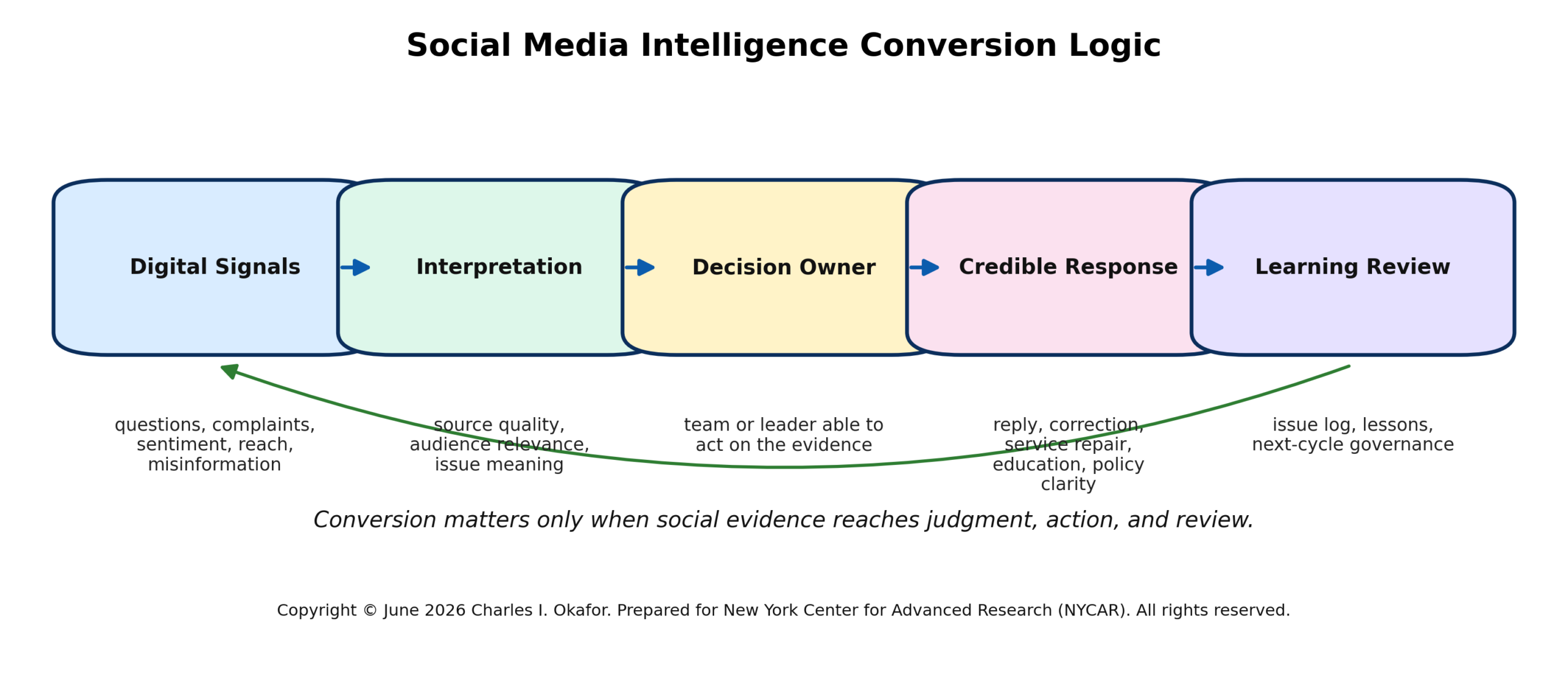
Note. Copyright © June 2026 Charles I. Okafor. Diagram prepared for NYCAR Research Publication. All rights reserved.
3.4 Social Media Intelligence Conversion Index
As designed here, the Social Media Intelligence Conversion Index is a diagnostic score. It does not treat maturity as the number of platforms used or the frequency of publication. It asks whether the organization can convert social media signals into useful knowledge and credible action. The index can be scored from 0 to 100 across eight dimensions. The weights proposed here are starting values for applied review, not universal constants.
SMICI = 0.18SQ + 0.16AR + 0.15CC + 0.14LC + 0.12RS + 0.10SR + 0.08PG + 0.07ER
Table 1. Social Media Intelligence Conversion Index
| Component | Weight | Management meaning |
| Signal quality | 0.18 | Strength and relevance of social media evidence rather than noise. |
| Audience relevance | 0.16 | Fit between reached audience and the strategic stakeholder group. |
| Content credibility | 0.15 | Evidence, tone, consistency, and institutional reliability. |
| Learning conversion | 0.14 | Movement from dashboard insight to organizational action. |
| Response speed | 0.12 | Timeliness of reply, correction, or stakeholder education. |
| Sentiment reliability | 0.10 | Confidence that sentiment scores reflect real meaning. |
| Platform governance | 0.08 | Rules for ownership, escalation, access, and risk. |
| Ethical restraint | 0.07 | Responsible use of data, automation, and targeting. |
Note. All measures can be scored on a 0–100 scale and recalibrated by sector, audience, and communication objective.
This index is most useful when the scoring conversation is honest. A team may have strong response speed and weak learning conversion. Another may have strong content credibility but poor audience relevance. A third may have useful data but poor platform governance. The score is therefore not a badge. It is a diagnostic instrument. Leaders should use it to decide where capability is fragile and what must be strengthened before the organization invests in more output.
3.5 Digital influence regression model
This regression model estimates whether social media intelligence predicts digital influence after accounting for content credibility, platform fit, engagement depth, response quality, attention risk, and learning conversion. It can be estimated across time periods, campaigns, business units, markets, or stakeholder groups, provided the organization has consistent data and a clearly defined outcome measure.
Influence_it = β0 + β1SMICI_it + β2Credibility_it + β3PlatformFit_it + β4EngagementDepth_it + β5ResponseQuality_it – β6AttentionRisk_it + β7LearningConversion_it + ε_it
Attention risk carries a negative sign deliberately. Visibility can damage influence when communication becomes excessive, unserious, poorly targeted, or inconsistent with institutional identity. The coefficient for learning conversion is expected to be positive because social media intelligence becomes stronger when insights change organizational behavior. The model should not be used mechanically. It should support review by showing which factors appear to move trusted influence and which factors are weakening it.
3.6 Response-speed and credibility adjustment
Speed is valuable only when the organization remains accurate enough to be believed. A crisis reply issued in minutes may reassure stakeholders if facts are clear and the tone is responsible. The same reply may become harmful if it contains errors or sounds dismissive. The response-speed and credibility adjustment therefore measures the balance between timeliness, verification, and relevance.
Figure 2. Digital Influence Measurement and Risk Control Model
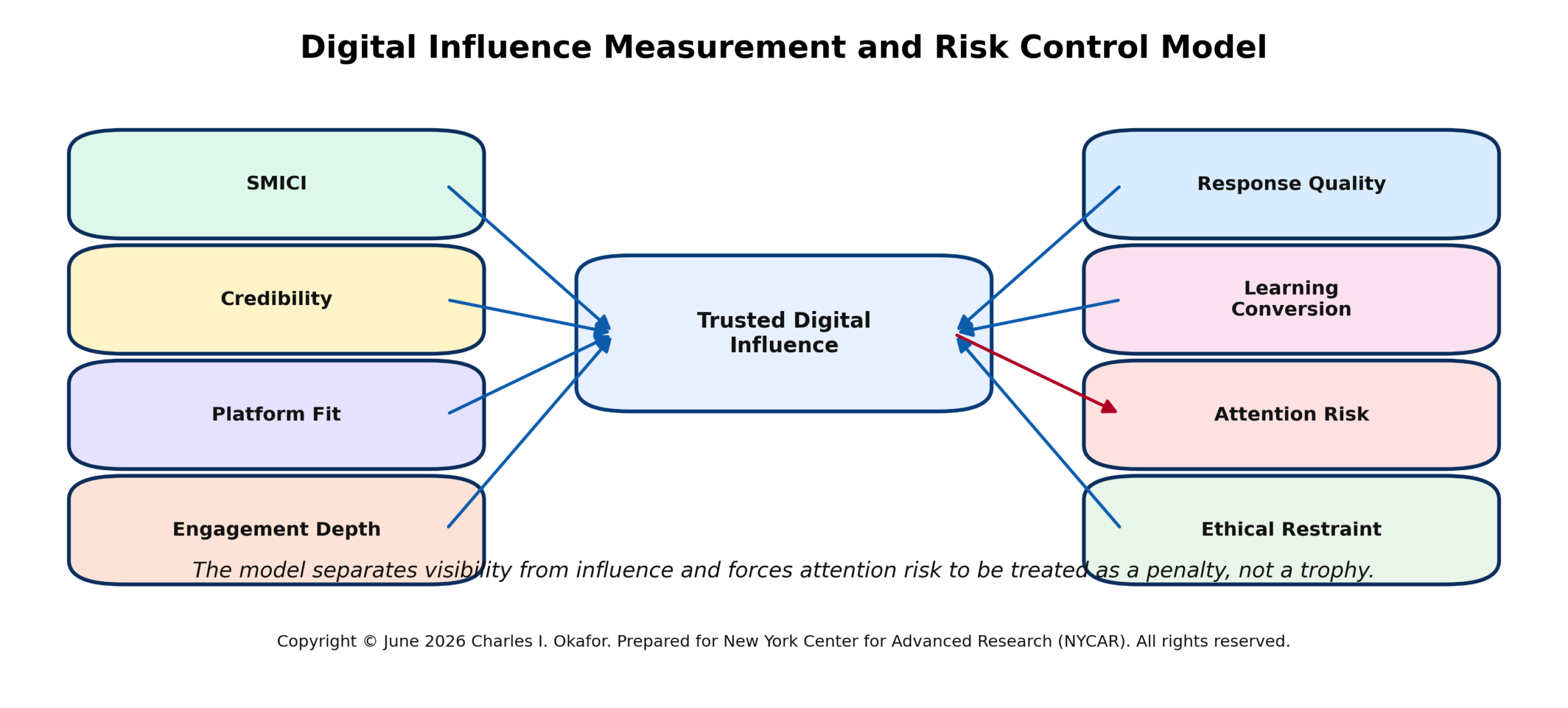
Note. Copyright © June 2026 Charles I. Okafor. Diagram prepared for NYCAR Research Publication. All rights reserved.
Adjusted Response Value = Response Speed Score × Credibility Score × Stakeholder Relevance Score ÷ (1 + Error Risk Score)
This adjustment discourages a common mistake: treating rapid response as automatic excellence. If error risk rises, the adjusted response value falls. The model pushes organizations to prepare before pressure arrives. Pre-approved evidence routes, escalation rules, issue libraries, and crisis language can make responsible speed possible. Speed without preparation is often just panic with better formatting.
3.7 Attention-risk penalty model
Attention-risk penalty estimates the cost of overcommunication, sensationalism, or platform chasing. It is especially useful for organizations that publish constantly but cannot show stronger trust, inquiry quality, conversion, service improvement, or stakeholder learning. The model helps leaders question whether output intensity still fits the organization’s purpose.
ARP = Σ[max(0, OutputIntensity_j – StrategicFit_j) × FatigueRisk_j × ReputationSensitivity_j]
Penalty rises only when output intensity exceeds strategic fit; the max(0, …) term prevents the model from creating a negative penalty when output remains below a reasonable strategic threshold. A youth-oriented consumer brand may tolerate higher frequency and humor than a professional institute, hospital, or regulatory agency. The point is not to discourage presence. The point is to make presence accountable to purpose. A visible organization that becomes tiring, erratic, or unserious may lose the very influence it was trying to build.
Table 2. Social Media Intelligence Models and Decision Use
| Model | Core question | Best use |
| SMICI | Can the organization convert social signals into knowledge? | Capability diagnosis and improvement planning. |
| Digital influence regression | Does intelligence improve trusted influence? | Performance evaluation across campaigns or stakeholder groups. |
| Response-speed adjustment | Is speed credible enough to create value? | Crisis, complaint, and service-response governance. |
| Attention-risk penalty | Is output intensity damaging strategic fit? | Content governance and reputation protection. |
Note. The models should be used together because social media influence depends on capability, credibility, timing, restraint, and learning.
3.8 Validity, calibration, and ethical use
Validity depends on aligning each measure with a real management question. Signal quality should not be scored by volume alone. Audience relevance should not be assumed because a platform reports demographic reach. Sentiment reliability should be tested against human reading, especially in multilingual settings. Learning conversion should be assessed by whether insight reached decision owners and changed practice. If variables are weakly defined, the model may produce confident numbers around poor judgment.
Calibration should be local. A public health agency, university, retailer, start-up, B2B manufacturer, and news organization will not define influence in the same way. Some need inquiry quality. Some need complaint resolution. Some need trust recovery. Some need enrollment, sales, donations, public understanding, or policy compliance. The framework provides structure, but managers must define outcomes that fit their mission and data reality.
Ethical use is not optional. The models should support better service, clearer communication, and responsible decision-making. They should not become instruments for manipulation or surveillance. Stakeholders should not be treated as abstract units of persuasion. When social media evidence involves vulnerable groups, health information, minors, political claims, or sensitive complaints, organizations should apply stronger review. The quality of intelligence depends not only on accuracy but on legitimacy.
Chapter 4: Applied Analysis and Sector Evidence
4.1 Listening is not learning
Listening is not learning. Many organizations listen in the narrow sense that they collect mentions, reviews, comments, and engagement summaries. Learning begins when the organization changes its understanding or behavior because of what it has heard. A dashboard may show rising complaints about delivery delays, but if operations never receives the pattern, intelligence has failed. A communication team may notice that audiences misunderstand a policy, but if leadership refuses to clarify the policy, the organization has collected evidence without learning from it.
A learning organization treats social media signals as early, imperfect public evidence. It does not panic each time a complaint appears, but it also does not dismiss recurring complaints as noise. Repetition matters. Language matters. Silence matters. The same question asked by different stakeholder groups may show that the organization has not explained itself properly. The same complaint repeated across platforms may show that a service promise is not being delivered. The same rumor appearing under different posts may show that uncertainty is spreading faster than the official explanation.
Learning also requires responsibility. Someone must own the interpretation, and someone must own the response. If every signal is everybody’s concern, no signal becomes anybody’s task. A practical system assigns responsibility by issue type: service problems to operations, policy confusion to executive communication and legal review, technical questions to product or academic teams, reputational threats to senior leadership, and safety or safeguarding issues to the appropriate risk function. The route must be clear before crisis arrives.
4.2 Knowledge institutions and professional credibility
Universities, training institutes, research centers, and professional bodies live by credibility. Their digital influence cannot be measured only by follower growth or public excitement. Serious learners, partners, regulators, employers, alumni, and faculty members ask for evidence. They want to know what is being taught, who is teaching, how quality is assessed, whether standards are real, what recognition exists, and what outcomes can be reasonably expected. A knowledge institution that posts energetic slogans while leaving these questions unanswered weakens its own seriousness.
Social media intelligence helps such institutions because stakeholder questions reveal where public understanding is weak. Repeated questions about admissions may show that the website is unclear. Skepticism about certificates may require clearer explanation of institutional status, assessment design, learning outcomes, and publication standards. Low engagement on a detailed academic post does not necessarily mean failure. It may have reached a smaller audience of serious readers whose trust matters more than casual applause.
For knowledge institutions, the strongest content is often evidence-rich rather than noisy. Course explainers, faculty notes, learner guidance, publication standards, research summaries, methodological corrections, and transparent frequently asked questions can build durable confidence. Platform style still matters; unclear or lifeless communication will not help. Yet the deeper requirement is intellectual seriousness. A university or research center should sound accessible without losing weight. Its social presence should make its standards more visible, not less believable.
4.3 Health, public agencies, and service trust
Health organizations and public agencies face another test. Their messages may affect safety, access, compliance, fear, stigma, and public trust. They cannot behave as if engagement is the main outcome. A low-visibility message that helps vulnerable people understand eligibility or access may be more valuable than a widely shared announcement that leaves practical questions unanswered. Social media intelligence in these settings must read complaints, misinformation, and confusion as service evidence, not only as reputational risk.
Patient comments may reveal missed appointments, unclear instructions, inaccessible phone systems, language barriers, or fear about cost. Public-agency comments may expose confusion about deadlines, eligibility, documentation, enforcement, or policy changes. In both settings, the communication team should not be left to carry the burden alone. The pattern may require operational repair, better forms, clearer call-center scripts, translated material, revised web pages, or new community outreach. A better post is sometimes necessary, but it is not always sufficient.
Credible health and public communication also requires restraint. Overconfident language can damage trust when circumstances change. Silence can damage trust when people need reassurance. The strongest response combines speed, evidence, humility, and practical guidance. It tells people what is known, what is not known, what they should do now, and where the next reliable update will appear. Social media intelligence should help public-facing institutions become clearer under pressure, not merely louder.
4.4 B2B firms and high-consideration markets
Business-to-business firms operate in markets where influence often travels through expertise, technical confidence, relationship trust, and long decision cycles. A large audience is not always valuable. A small audience of engineers, procurement officers, senior managers, compliance leaders, or specialist buyers may matter more. Agnihotri et al. (2023) are relevant here because they frame social media analytics as a learning resource in industrial markets. The most valuable signal may be a recurring objection, not a viral post.
For B2B organizations, social media intelligence should connect public signals with sales enablement and product knowledge. Technical questions can show where product explanation is weak. Competitor comparisons may show which claims require better evidence. Low engagement on a detailed technical piece may still help account teams if it supports the confidence of serious buyers. A webinar question, LinkedIn comment, or industry forum discussion can reveal the language decision-makers are using before a formal request for proposal appears.
A practical danger appears when content tries to behave like consumer entertainment while serving a high-consideration market. B2B communication can be clear, human, and visually strong without becoming shallow. It should respect the buyer’s intelligence. Social media intelligence helps by showing which content actually supports relationship movement, which topics produce qualified inquiry, and which messages only create empty impressions. Influence in such markets is often quiet. It is still measurable if the organization defines the right outcome.
4.5 Start-ups, SMEs, and emerging-market discipline
Start-ups and SMEs often use social media because it is affordable, fast, and close to customers. That advantage is real. It allows a small firm to test language, answer questions, present proof of work, build a community, and compete for attention without a large advertising budget. Yet the same openness can expose weaknesses quickly. A founder-led account can build trust, but it can also create reputational damage if promises outrun capacity, complaints are handled defensively, or the brand voice becomes erratic.
Research on start-ups and SMEs supports a disciplined view. Bruce et al. (2025) link social media usage with start-up performance through brand image, while Sharabati et al. (2024) connect digital marketing with SME performance through digital transformation and customer engagement. Both lines of evidence point beyond simple posting. Social media is useful when it strengthens a business system. It is risky when visibility rises faster than fulfillment, service, product quality, or managerial control.
Emerging-market organizations must also be careful with trust. Customers may rely heavily on social proof, peer recommendation, direct messages, informal networks, and visible complaint handling. A slow or dismissive response can damage confidence. At the same time, excessive posting may look desperate or unserious. The right balance depends on sector, audience, and operational readiness. A small firm should ask one hard question before every visibility push: can the organization honor the attention it is inviting?
4.6 Media organizations and editorial authority
Media organizations have a different burden because they work inside the same attention economy they report on. Social media can distribute journalism, identify sources, expose public concerns, and build audience relationships. It can also reward speed over verification, outrage over context, and personality over evidence. A newsroom that measures success only by traffic may gradually train itself to chase reaction rather than report with discipline. Social media intelligence should protect editorial authority instead of reducing journalism to platform performance.
For media institutions, digital influence rests on trust in judgment. Audience comments may help identify missing context or errors, but they should not replace editorial standards. Viral pressure may indicate public interest, but it should not decide what is true. Analytics can show where readers drop off, what topics generate sustained interest, and how explainers travel, but the newsroom must still defend evidence, source integrity, proportionality, and correction discipline. The dashboard can inform editors; it cannot become the editor.
A strong media intelligence system separates several signals: audience need, public emotion, misinformation pattern, source risk, political manipulation, and business performance. These signals are related but not identical. A public reaction may be intense because a report is important, because it is misunderstood, or because organized actors are trying to bend the story. Editorial authority depends on knowing the difference and showing the audience how the newsroom reached its judgment.
4.7 Crisis, misinformation, and response governance
Crisis communication tests social media intelligence more severely than routine posting. The organization must decide what is true, what is uncertain, who should speak, which audience needs information first, which claims require correction, and which channels are appropriate. Speed matters, but speed is not a virtue when it outruns verification. Delay matters, but delay is not always negligence when facts are being checked. A mature response system prepares the organization to move quickly without becoming careless.
Misinformation adds complexity because false claims often travel through emotion, identity, suspicion, and repetition. A correction that merely says a claim is false may not persuade if stakeholders do not trust the organization. Stronger correction provides evidence, acknowledges the concern behind the rumor where appropriate, explains what is known, and gives people a practical route to reliable information. Social media intelligence can help by identifying which misinformation is spreading, which communities are affected, and which explanation is likely to reach them.
Ng et al. (2024) show why crisis teams must consider manipulation and hybrid automation. Coordinated behavior can distort the apparent size or urgency of a reaction. A responsible organization should avoid two mistakes. It should not dismiss every hostile pattern as artificial, because real stakeholders may have legitimate concerns. It should not treat every high-volume pattern as representative, because tactical amplification is possible. The right response begins with evidence discipline, not assumption.
Correction protocols should be written before they are needed. The organization should know who can approve urgent statements, who verifies facts, who contacts legal or regulatory advisers, who monitors platform spread, and who decides when operational repair is more important than public reply. A crisis archive should preserve screenshots, timestamps, posts, responses, and decision notes. Public memory may be short, but institutional memory should not be.
4.8 Practical measurement interpretation
Measurement interpretation should begin with the purpose of the communication. A recruitment campaign should not be judged like a crisis correction. A patient-access update should not be judged like a product launch. A professional explainer should not be judged by the same standard as a consumer contest. The organization should define the target stakeholder group, intended movement, evidence of trust, acceptable risk, and follow-up action before it decides which metric matters.
A practical measurement review should ask four questions. First, did the message reach the people who mattered? Second, did the message improve understanding, confidence, inquiry quality, conversion, service resolution, or another defined outcome? Third, did the organization learn anything that requires internal action? Fourth, did the communication create any new risk through confusion, fatigue, backlash, or overclaiming? These questions convert metrics from reporting decoration into management evidence.
A balanced interpretation also recognizes invisible success. A clear correction may prevent rumor growth without producing high engagement. A stakeholder update may reduce inbound confusion. A technical explanation may support sales teams even if public reaction is modest. A service response may protect trust with one complainant and the silent audience watching the exchange. Social media intelligence should reward these forms of value. If the measurement system recognizes only visible applause, it will train the organization to neglect the quieter work of credibility.
Table 3. Evidence Interpretation Matrix
| Observed digital signal | Weak interpretation | Stronger intelligence response |
| High engagement on a complaint | The post is performing well. | Test whether the complaint exposes service failure, misinformation, or stakeholder distrust. |
| Low engagement on a technical explainer | The content failed. | Check whether it reached a small but strategically important professional audience. |
| Negative sentiment spike | The public is against us. | Review source mix, coordination indicators, issue history, and operational evidence. |
| Repeated direct-message questions | The audience is not reading. | Improve public information architecture, FAQs, web clarity, and follow-up routes. |
| Strong follower growth | Influence is rising. | Check audience relevance, inquiry quality, conversion, trust, and retention. |
Chapter 5: Discussion
5.1 What the evidence shows
Evidence supports one central finding: social media intelligence is strongest when it is treated as a decision system rather than a posting system. Agnihotri et al. (2023) connect analytics with organizational learning. Ascani and Ancillai (2025) show that performance measurement remains a difficult management problem, not a simple reporting task. Tkalac Verčič et al. (2024) and Wuersch et al. (2024) show why internal digital communication matters for organizational learning and trust. Bruce et al. (2025) and Sharabati et al. (2024) show that social media and digital marketing create stronger value when connected to capability, brand image, innovation, and transformation.
Taken together, the literature rejects a shallow digital strategy. The organization does not become influential because it has more platforms, posts more often, speaks faster, or produces attractive charts. Influence grows when digital evidence is interpreted responsibly and linked to credible action. The public sees not only what the organization says, but whether it answers questions, corrects errors, behaves consistently, and respects the intelligence of its stakeholders. Digital influence is therefore earned through repeated alignment between message, conduct, evidence, and response.
Public digital conditions make this harder because attention is unstable. User identity numbers show scale, but scale alone does not produce understanding. Platform architecture rewards certain formats, speeds, and emotional patterns. Automation and hybrid accounts complicate interpretation. Stakeholders move across channels. Metrics can create comfort while hiding the wrong audience or the wrong meaning. Management must therefore place interpretation at the center of social media intelligence. The system should make leaders wiser, not merely better supplied with numbers.
5.2 The governed intelligence model
A governed intelligence model has four movements: sensing, interpreting, deciding, and learning. Sensing collects signals from social platforms, search behavior, reviews, direct messages, public comments, influencer discourse, community forums, employee voice, and stakeholder silence. Interpreting tests the signal against audience relevance, platform context, cultural meaning, sentiment reliability, historical pattern, and possible manipulation. Deciding moves the issue to a decision owner who can communicate, repair, escalate, or hold. Learning records what happened and adjusts the organization’s practice.
This model is deliberately managerial. It refuses to leave intelligence inside analytics software. Tools can gather and classify evidence, but organizations decide what the evidence means and what responsibility follows. The practical weakness in many institutions is not lack of dashboards. It is lack of decision ownership. A dashboard can report rising complaints for months while the underlying service problem continues. A governed model insists that repeated signals must cross into management review.
Governance also clarifies restraint. Not every comment deserves a public reply. Not every rumor should be amplified through correction. Not every negative sentiment score means crisis. Not every viral moment deserves imitation. The organization needs a scale of response: monitor, clarify, engage privately, respond publicly, correct formally, escalate operationally, pause content, investigate, or notify regulators. Mature social media intelligence is calm enough to choose the right level.
5.3 The limits of automation
Automation can make social media intelligence faster, but it cannot make it complete. Sentiment analysis, topic clustering, bot detection, social listening, content scheduling, predictive alerts, and generative drafting can all support communication teams. Their value depends on limits. A sentiment model may miss sarcasm or cultural language. A bot detector may misclassify hybrid behavior. A content tool may produce fluent language that lacks institutional judgment. A predictive alert may overstate risk because it sees volume but not meaning.
Ng et al. (2024) are important because cyborg accounts reveal how difficult it can be to classify digital behavior cleanly. Accounts may behave partly like bots and partly like humans. Strategic communication may involve automation supported by human intervention. This creates a warning for organizations reading social environments and for organizations producing their own content. The fact that a tool provides classification does not mean the classification is final. Human review remains essential where stakes are high.
Generative systems create a further concern. They can help draft variations, summarize comments, create first-pass categories, and support accessibility. Used carelessly, they may flatten voice, invent confidence, miss legal risk, or produce language that sounds polished without being true. In social media intelligence, AI should be placed under editorial control. The human responsibility is not optional. Stakeholders judge the organization, not the tool.
5.4 Operational implications
Operationally, social media intelligence must be connected to work routines. A weekly dashboard is not enough. The organization needs issue logs, escalation thresholds, evidence owners, response libraries, review meetings, correction protocols, and learning records. Communication teams should not be forced to carry operational failures as reputational problems. If comments reveal a recurring service fault, operations must own the repair. If questions reveal policy confusion, leadership must own clarification.
Executives have a special role because they set the appetite for truth. If senior leaders reward only positive metrics, teams will hide difficult signals or reframe them as engagement. If leaders punish bad news, intelligence weakens. A mature executive asks what the digital evidence reveals about stakeholders and operations. This does not mean reacting to every complaint. It means refusing to use communication as insulation against reality.
Communication teams also need authority. They cannot be responsible for credibility while being denied access to facts. They need timely input from legal, operations, customer service, human resources, product teams, academic units, clinical teams, or policy owners depending on sector. Without access to truth, communicators are asked to dress uncertainty as confidence. That is not strategy. It is reputational exposure.
5.5 Ethical boundaries
Ethical boundaries are part of intelligence quality. An organization that manipulates attention cannot claim mature intelligence simply because the numbers improve. Audience targeting, influencer use, paid amplification, employee advocacy, automation, and data collection all require governance. Stakeholders should not be deceived about sponsorship, identity, evidence, or institutional role. Sensitive data should not be exploited because a platform makes it visible. Publicly available information is not automatically ethically available for every organizational purpose.
In health, education, children’s services, financial services, political communication, public administration, and vulnerable communities, the ethical test becomes stricter. Complaints may contain private information. Patient or learner stories may require consent. Public anger may reflect genuine harm. Automated targeting may reinforce exclusion. A serious organization should build ethics into its social media intelligence process rather than treating ethics as a legal review at the end.
Legitimacy also requires correction. Mistakes will happen. The question is whether the organization corrects them with seriousness. A correction should be easy to find, clear about what changed, and honest enough to protect trust. Quietly deleting a misleading post may solve a platform problem while creating an integrity problem. Public credibility grows when stakeholders can see that the organization is willing to repair its own record.
Chapter 6: NYCAR Implementation Framework
6.1 Governance architecture
A workable social media intelligence system begins with governance architecture. The organization should define what it monitors, why it monitors, who owns each issue, how evidence is classified, which risks require escalation, and how decisions are recorded. Governance should be proportionate. A small professional institute does not need the same structure as a multinational corporation, but both need clarity. Ambiguity is costly when a complaint becomes visible, misinformation spreads, or a public question requires evidence.
A sound architecture should include five layers. The first is strategic purpose: what influence means for the organization. The second is evidence capture: which channels, stakeholder groups, and signal types are monitored. The third is interpretation: how signals are read, validated, and compared with context. The fourth is decision ownership: who can respond, repair, pause, escalate, or correct. The fifth is learning: how the organization reviews what happened and updates practice. Missing any layer weakens the system.
A governance charter should be short enough to use and strong enough to matter. It should define platform access, account security, approval authority, tone boundaries, disclosure rules, data handling, crisis roles, and escalation thresholds. It should also specify what the organization will not do: no fabricated testimonials, no undisclosed paid influence, no manipulative automation, no private-data exposure, no unsupported claims, and no content output that contradicts institutional evidence.
6.2 Roles, routines, and decision ownership
Roles should be named before pressure arrives. A social listening lead may gather evidence. A communication lead may interpret public meaning and propose response. An operational owner may address service failures. A legal or compliance adviser may review sensitive claims. A senior executive may approve high-risk statements. A data or technology specialist may test classification reliability. A records owner may preserve evidence. The aim is not bureaucracy. The aim is to remove confusion when timing matters.
Routine matters as much as role. A daily scan can identify urgent issues. A weekly intelligence review can examine patterns. A monthly leadership report can connect signals with organizational priorities. A quarterly audit can test data quality, response performance, audience relevance, and learning conversion. Each rhythm has a different purpose. The daily scan protects responsiveness. The weekly review supports interpretation. The monthly report guides management. The quarterly audit strengthens the system.
Decision ownership should follow the nature of the signal. A content correction belongs to communication and editorial review. A recurring complaint about delivery belongs to operations. A safety concern belongs to risk management. A learner’s confusion about academic policy belongs to academic administration. A pricing question belongs to finance and customer support. Social media intelligence fails when every issue is treated as a communication issue merely because it appeared on a platform.
6.3 Dashboard design for judgment
A good dashboard should not overwhelm leaders with numbers. It should help them make better decisions. The first page should separate four categories: visibility, relevance, credibility, and action. Visibility shows reach and engagement. Relevance shows whether the right audience was reached. Credibility shows trust indicators, sentiment reliability, correction needs, and source quality. Action shows what the organization did because of the evidence. This structure keeps the dashboard from becoming a vanity exhibit.
A useful dashboard should include qualitative notes. A sentiment score without explanation is not enough. The report should identify recurring themes, representative stakeholder questions, misinformation patterns, source credibility, platform movement, and recommended action. Screenshots may be needed for high-risk issues. Trend lines should be read beside narrative interpretation. A number tells the team that something moved; it rarely explains the movement by itself.
Color coding can help, but it should not replace judgment. A green metric may hide weak relevance. A red metric may reflect a small but legitimate stakeholder issue rather than crisis. Amber may show uncertainty requiring human review. Dashboards should therefore include a confidence rating. The team should say whether evidence confidence is high, moderate, or low, and why. That practice encourages humility and prevents false precision.
Table 4. Judgment-Centered Dashboard Fields
| Dashboard field | What it should show | Decision value |
| Visibility | Reach, impressions, engagement, channel movement. | Shows whether the message entered public view. |
| Relevance | Target audience fit, stakeholder segment, qualified attention. | Shows whether the right people were reached. |
| Credibility | Trust indicators, sentiment confidence, source quality, correction need. | Shows whether attention is likely to support influence. |
| Action | Escalations, operational repairs, content changes, stakeholder follow-up. | Shows whether intelligence changed organizational behavior. |
6.4 Escalation, crisis, and correction protocols
Escalation should be based on risk, not emotion. A complaint from one person may require urgent action if it involves safety, discrimination, legal exposure, vulnerable groups, data breach, or credible media interest. A large volume of criticism may require monitoring rather than immediate statement if the facts are uncertain and the pattern appears coordinated. The escalation protocol should define thresholds, but it should also allow professional judgment.
A crisis protocol should answer practical questions. Who confirms facts? Who approves a holding statement? Which channels are used first? Who monitors misinformation? When should content be paused? What documentation is preserved? How are employees informed before public statements create internal confusion? How are corrections handled if the first statement changes? These questions should not be improvised under public pressure.
Correction discipline is central to credibility. A correction should not bury responsibility under vague wording. It should identify the issue, provide the accurate information, explain what has been changed where necessary, and give stakeholders a reliable route for follow-up. The organization should avoid defensive language that blames misunderstanding when the original communication was unclear. A dignified correction often protects trust more effectively than a perfect-looking silence.
6.5 Content discipline and stakeholder relevance
Content discipline begins with audience relevance. The organization should know who each message is for, why the message matters, and what action or understanding should follow. A content calendar that merely fills days is not a strategy. Every post should have a reason connected to stakeholder need, institutional purpose, service improvement, evidence, or relationship building. Silence can be better than output that weakens seriousness.
Tone should fit institutional character. A professional body can be warm without becoming casual. A public agency can be accessible without sounding unserious. A start-up can be lively without overclaiming. A university can use contemporary formats without reducing knowledge to slogans. The strongest content speaks in a human voice while respecting the weight of the subject. Social media intelligence helps by revealing when tone builds trust and when it creates fatigue.
Stakeholder relevance also means accessibility. Clear language, captions, image descriptions, readable design, translated summaries where appropriate, and practical links can determine whether a message actually serves the audience. A beautiful post that excludes people is not effective communication. Digital influence should not be measured only by reaction from those already comfortable with the platform or language. Serious organizations widen understanding rather than merely reward the already engaged.
6.6 Quality assurance for social media intelligence
A serious social media intelligence system needs quality assurance because the field is exposed to error at several points. Collection error occurs when the organization monitors the wrong platform, misses a private community where real discussion is happening, or overreads a channel used by a vocal minority. Classification error occurs when sentiment tools or human reviewers misread sarcasm, cultural language, coordinated activity, or ordinary frustration. Interpretation error occurs when managers treat a visible reaction as representative of the whole stakeholder group. Action error occurs when the organization responds publicly when operational repair would have mattered more.
Quality assurance should be built into routine practice. A sample of automated classifications should be checked by human reviewers. Sensitive issues should be read by people who understand the cultural and institutional setting. The team should track false alarms, missed signals, poor escalations, and weak corrections. Each problem should become a system lesson. Quality does not mean that every judgment will be perfect. It means errors are studied instead of repeated.
Documentation is part of quality. The organization should keep records of major issues, evidence used, decisions made, messages approved, corrections issued, and lessons learned. These records protect continuity when staff change. They also support accountability. A memoryless communication system is always vulnerable to the same preventable crisis. Good documentation turns experience into institutional knowledge.
Table 5. Ninety-Day Social Media Intelligence Playbook
| Period | Main task | Expected output |
| Days 1–30 | Audit platforms, stakeholders, metrics, account security, and recurring questions. | Baseline SMICI score and issue map. |
| Days 31–60 | Build governance rules, escalation routes, dashboard structure, and response standards. | Approved operating protocol and dashboard template. |
| Days 61–90 | Run intelligence reviews, test classification reliability, and conduct a crisis simulation. | Improvement report and next-cycle action plan. |
6.7 Ninety-day implementation playbook
During the first thirty days, the organization should focus on diagnosis. The organization should audit existing platforms, audience groups, account security, approval processes, recurring stakeholder questions, current metrics, and response history. The Social Media Intelligence Conversion Index can be scored honestly at this stage. The purpose is not to produce an impressive number. It is to expose weak points before the organization expands its digital activity.
Days thirty-one to sixty should focus on design. Governance rules, escalation pathways, dashboard structure, response templates, correction standards, and decision-owner responsibilities should be written and tested. The organization should also define a small set of influence outcomes that match its mission. A school may track inquiry clarity and learner trust. A hospital may track patient guidance and complaint resolution. A B2B firm may track qualified engagement and decision-maker education.
Days sixty-one to ninety should focus on practice. The organization should run weekly intelligence reviews, test classification reliability, conduct a crisis simulation, and evaluate whether insights reach decision owners. At the end of ninety days, leadership should review the system against four questions: what signals were missed, what signals were overread, what internal decisions improved, and what should change in the next cycle. The playbook is deliberately practical. Social media intelligence grows through disciplined routine, not grand language.
Chapter 7: Recommendations, Research Contribution, and Final Position
7.1 Recommendations for executive leadership
Executive leaders should treat social media intelligence as part of governance, not as a junior publicity function. They should ask for evidence that connects digital signals to stakeholder trust, service repair, policy clarity, recruitment quality, reputation protection, or organizational learning. Reports should show what the organization learned and what changed because of that learning. A leadership team that asks only for reach and engagement will train the organization to manage appearances.
Senior leadership should also protect truth-telling. Communication teams must be able to report weak signals, emerging distrust, unanswered questions, and recurring complaints without fear that bad news will be punished. The point of intelligence is not to flatter the organization. It is to help the organization see earlier and act better. Leaders who want only positive dashboards do not have an intelligence system. They have a decoration.
Investment decisions should follow capability gaps. If the SMICI review shows weak learning conversion, buying a more expensive listening tool may not solve the problem. If audience relevance is weak, more content may not help. If credibility is fragile, influencer spending may expose rather than strengthen the institution. Executive discipline means strengthening the weakest part of the conversion chain, not funding the most visible activity.
7.2 Recommendations for communication teams
Communication teams should build their work around stakeholder meaning. Every major message should state the audience, purpose, evidence, likely questions, risk level, and follow-up route. Teams should maintain issue libraries for recurring questions and approved evidence sources for common claims. They should also keep correction templates ready, not because mistakes are expected, but because responsible correction is part of professional communication.
Digital content should be varied without becoming erratic. Explainers, evidence notes, short videos, case examples, stakeholder answers, research summaries, service updates, leadership messages, and community responses can all have a place. The mix should serve the organization’s purpose. A team should not imitate a platform trend simply because it is popular. The question should remain: does this content strengthen trust with the right audience?
Communication teams should insist on internal access. They cannot answer stakeholder questions responsibly if they are kept away from operational facts. A post about service quality requires service evidence. A public statement about education quality requires academic evidence. A response about access requires operational reality. Professional communicators should resist being used to cover gaps that the organization has not repaired.
7.3 Recommendations for analytics and technology teams
Analytics and technology teams should design measurement systems that reveal decision value rather than reporting volume alone. They should separate raw attention from relevant attention, positive sentiment from trusted influence, and comment volume from stakeholder significance. Models should include confidence levels, data limitations, and human-review notes. Precision should not be performed where the evidence is uncertain.
Automated tools should be audited. Sentiment classifications should be sampled. Topic clusters should be reviewed for cultural meaning. Bot or cyborg indicators should be treated as risk signals rather than final proof. Generative summaries should be checked against source material before being used in management reports. Technology should widen the organization’s ability to see, but human judgment should decide what the seeing means.
Data ethics should sit inside the analytics function. Teams should define retention periods, access rules, sensitive-topic handling, consent concerns, and boundaries around profiling. Public comments may be visible, but visibility does not remove responsibility. An organization that wants trust should not use social media intelligence in ways that stakeholders would consider intrusive, manipulative, or unfair.
7.4 Recommendations for public-facing institutions
Public-facing institutions should design social media intelligence around service and trust. Universities, hospitals, agencies, professional bodies, and research centers should read stakeholder questions as evidence of what the public needs to understand. Their strongest digital work may not be the most entertaining. It may be the most useful, clear, accurate, and consistent. Institutional credibility grows through repeated proof of seriousness.
These institutions should also distinguish between public explanation and public performance. A public agency does not need to sound like a consumer brand. A hospital does not need to turn safety into entertainment. A research center does not need to chase every trend. Adaptation to platform language is useful, but identity must remain intact. The public should experience the institution as reachable and credible at the same time.
Transparency should be improved where stakeholders repeatedly ask the same questions. Admission rules, prices, eligibility, deadlines, service access, complaint routes, safety instructions, research methods, and accreditation status should be easy to find and easy to understand. Social media intelligence should not merely respond to confusion after it appears. It should help the institution remove avoidable confusion before it becomes public frustration.
7.5 Research limitations and future study
This publication has limits. It develops an applied framework and model specifications rather than estimating coefficients from a private organizational dataset. The proposed weights in the Social Media Intelligence Conversion Index are starting values and should be calibrated by sector. The models cannot solve poor data quality, weak leadership discipline, or unethical communication practice. They can clarify the questions managers should ask, but they cannot guarantee wise answers.
Future research can test the framework with organizational datasets across sectors. Universities, hospitals, SMEs, B2B firms, public agencies, and media organizations could each define influence outcomes and estimate how social media intelligence capability relates to trust, inquiry quality, complaint resolution, conversion, or reputation recovery. Comparative studies could examine whether learning conversion is the missing variable between social listening and performance. Further work is also needed on multilingual sentiment reliability and ethical uses of AI-supported social media intelligence.
Another useful direction is crisis memory. Organizations often learn after a digital crisis but fail to preserve the lesson. Longitudinal studies could examine how issue logs, correction archives, and escalation protocols affect future response quality. Research could also test whether executive incentives change metric selection. If leaders reward vanity metrics, teams may optimize for visibility; if leaders reward learning, teams may design better intelligence systems.
7.6 Final position
Social media has made organizations more visible, but visibility has not made them wiser. The central managerial task is no longer to appear online. Most organizations already appear online. The harder task is to read public signals with discipline, answer stakeholders with evidence, protect institutional character, and let digital evidence improve the organization behind the message. That is the difference between publicity and intelligence.
Influence is not the loudest post, the largest audience, or the fastest reply. It is the stakeholder’s reasonable confidence that the organization knows what it is saying, can support its claims, respects the audience, and acts consistently with its public language. That confidence cannot be manufactured by metrics. It is built through repeated alignment between evidence, conduct, and communication.
The final position is clear. Social media intelligence should sit inside organizational governance as a disciplined capability. It should help leaders listen without panic, measure without vanity, respond without carelessness, and learn without defensiveness. Used well, it turns digital conversation into early warning, stakeholder education, service improvement, and strategic credibility. Used poorly, it becomes another machine for noise. The organizations that will lead in public digital environments are not those that post the most. They are those that understand what the public is telling them and have the courage to act on it.
References
Agnihotri, R., Afshar Bakeshloo, K., & Mani, S. (2023). Social media analytics for business-to-business marketing. Industrial Marketing Management, 115, 110–126. https://doi.org/10.1016/j.indmarman.2023.09.012
Ascani, I., & Ancillai, C. (2025). Social media marketing and performance measurement: Does it take two to tango? Review of Managerial Science, 20, 775–823. https://doi.org/10.1007/s11846-025-00891-0
Bruce, E., Shurong, Z., Amoah, J., Egala, S. B., Sarfo, P. A., Baidoo, B. E., Darko, D. A., Ailing, L., & Yongxing, Y. (2025). Examining the impact of social media usage on start-ups performance: Mediating role of brand image. PLOS ONE, 20(5), Article e0320133. https://doi.org/10.1371/journal.pone.0320133
DataReportal. (2026). Global social media statistics. Retrieved June 10, 2026, from https://datareportal.com/social-media-users
Dwivedi, Y. K., Ismagilova, E., Hughes, D. L., Carlson, J., Filieri, R., Jacobson, J., Jain, V., Karjaluoto, H., Kefi, H., Krishen, A. S., Kumar, V., Rahman, M. M., Raman, R., Rauschnabel, P. A., Rowley, J., Salo, J., Tran, G. A., & Wang, Y. (2021). Setting the future of digital and social media marketing research: Perspectives and research propositions. International Journal of Information Management, 59, 102168. https://doi.org/10.1016/j.ijinfomgt.2020.102168
Ng, L. H. X., Robertson, D. C., & Carley, K. M. (2024). Cyborgs for strategic communication on social media. Big Data & Society, 11(1). https://doi.org/10.1177/20539517241231275
Sharabati, A. A. A., Al-Haddad, S., Al-Khasawneh, M., & Nababteh, N. (2024). The impact of digital marketing on the performance of SMEs: An analytical study in light of modern digital transformations. Sustainability, 16(19), 8667. https://doi.org/10.3390/su16198667
Tkalac Verčič, A., Verčič, D., Čož, S., & Špoljarić, A. (2024). A systematic review of digital internal communication. Public Relations Review, 50(1), Article 102400. https://doi.org/10.1016/j.pubrev.2023.102400
Wuersch, L., Neher, A., Maley, J. F., & Peter, M. K. (2024). Using a digital internal communication strategy for digital capability development. International Journal of Strategic Communication, 18(3), 167–188. https://doi.org/10.1080/1553118X.2024.2330405